Archive for the ‘Iranian military sites’ category

The U.S. response to Iran’s cheating is a worrying omen

July 8, 2015

The U.S. response to Iran’s cheating is a worrying omen, The Washington Post, The Editorial Board, July 6, 2015

(The Washington Post, usually supportive of the Obama administration, speaks moderately in this Editorial Board offering. However, it manages to point out a few of the major problems with an Obama-led P5+1 “deal.” Please see also, White House Instructs Allies To Lean On ‘Jewish Community’ to Force Iran Deal. — DM)

Mr. Albright, a physicist with a long record of providing non-partisan expert analysis of nuclear proliferation issues, said on the Foreign Policy Web site that he had been unfairly labeled as an adversary of the Iran deal and that campaign-style “war room” tactics are being used by the White House to fend off legitimate questions.

*******************

IF IT is reached in the coming days, a nuclear deal with Iran will be, at best, an unsatisfying and risky compromise. Iran’s emergence as a threshold nuclear power, with the ability to produce a weapon quickly, will not be prevented; it will be postponed, by 10 to 15 years. In exchange, Tehran will reap hundreds of billions of dollars in sanctions relief it can use to revive its economy and fund the wars it is waging around the Middle East.

Whether this flawed deal is sustainable will depend on a complex set of verification arrangements and provisions for restoring sanctions in the event of cheating. The schemes may or may not work; the history of the comparable nuclear accord with North Korea in the 1990s is not encouraging. The United States and its allies will have to be aggressive in countering the inevitable Iranian attempts to test the accord and willing to insist on consequences even if it means straining relations with friendly governments or imposing costs on Western companies.

That’s why a recent controversy over Iran’s compliance with the interim accord now governing its nuclear work is troubling. The deal allowed Iran to continue enriching uranium, but required that amounts over a specified ceiling be converted into an oxide powder that cannot easily be further enriched. According to the International Atomic Energy Agency, Iran met the requirement for the total size of its stockpile on June 30, but it did so by converting some of its enriched uranium into a different oxide form, apparently because of problems with a plant set up to carry out the powder conversion.

Rather than publicly report this departure from the accord, the Obama administration chose to quietly accept it. When a respected independent think tank, the Institute for Science and International Security, began pointing out the problem, the administration’s response was to rush to Iran’s defense — and heatedly attack the institute as well as a report in the New York Times.

This points to two dangers in the implementation of any longterm deal. One is “a U.S. willingness to legally reinterpret the deal when Iran cannot do what it said it would do, in order to justify that non-performance,” institute President David Albright and his colleague Andrea Stricker wrote. In other words, overlooking Iranian cheating is easier than confronting it.

This weakness is matched by a White House proclivity to respond to questions about Iran’s performance by attacking those who raise them. Mr. Albright, a physicist with a long record of providing non-partisan expert analysis of nuclear proliferation issues, said on the Foreign Policy Web site that he had been unfairly labeled as an adversary of the Iran deal and that campaign-style “war room” tactics are being used by the White House to fend off legitimate questions.

In the case of the oxide conversion, the discrepancy may be less important than the administration’s warped reaction. A final accord will require Iran to ship most of its uranium stockpile out of the country, or reverse its enrichment. But there surely will be other instances of Iranian non-compliance. If the deal is to serve U.S. interests, the Obama administration and its successors will have to respond to them more firmly and less defensively.

Here’s the most critical part of Iran’s nuclear program that nobody is talking about

July 7, 2015

Here’s the most critical part of Iran’s nuclear program that nobody is talking about, Business Insider, Michael Eisenstadt, The Washington Institute For Near East Policy, July 7, 2015

(Please see also, Iran’s Rafsanjani Reiterates ‘Israel Will Be Wiped Off The Map.’  — DM)

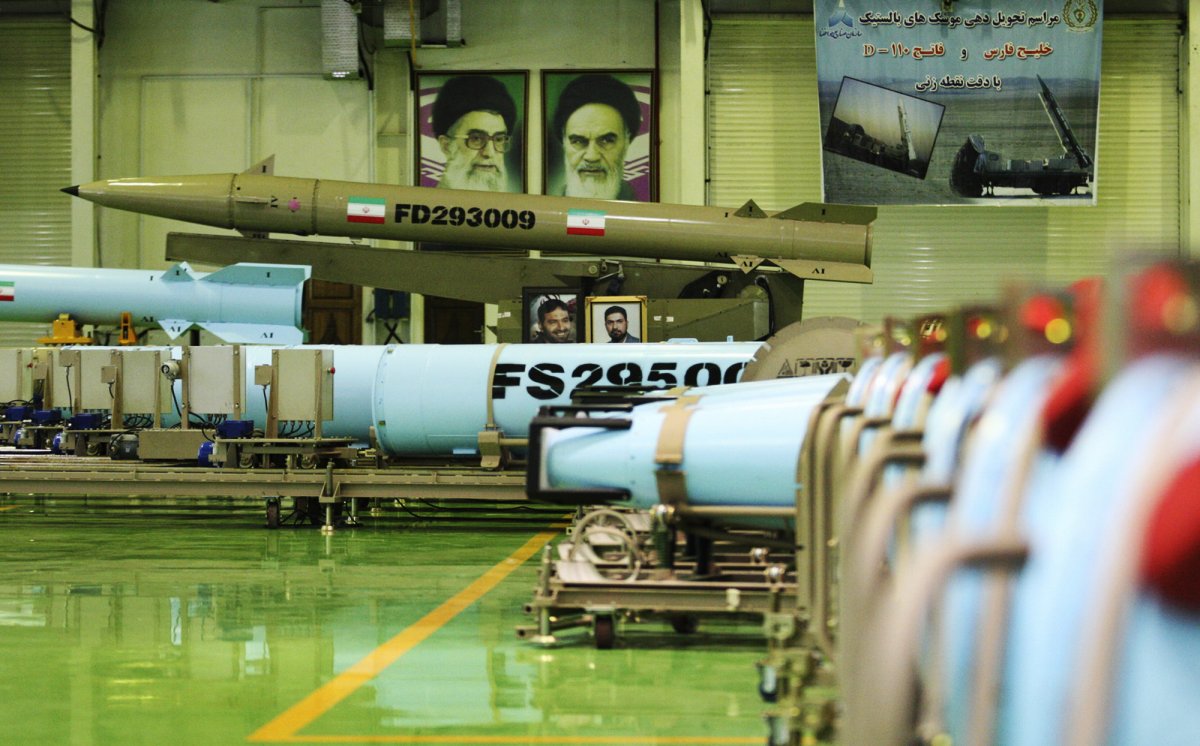
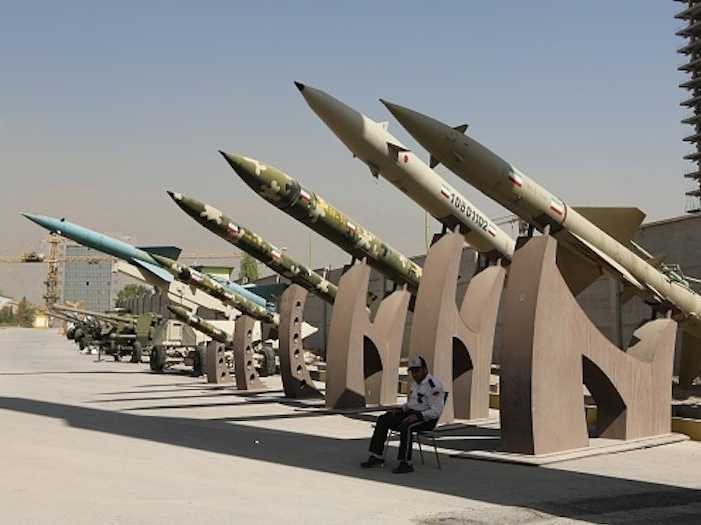
iran-missiles-exhibition-commemorationAtta Kenare/AFP/Getty Images. Missiles are displayed during ‘Sacred Defense Week,’ to commemorate the 1980-88 Iran-Iraq war. Photo taken on Sept. 28, 2014 at a park in northern Tehran.

Early in the P5+1 negotiations, US officials stated that “every issue,” including the missile program, would be on the table. In February 2014, however, Undersecretary of State for Political Affairs Wendy Sherman stated, “If we are successful in assuring ourselves and the world community that Iran cannot obtain a nuclear weapon,” then that “makes delivery systems … almost irrelevant.”

****************

According to the latest reports stemming from the P5+1 talks, Iran is now insisting that UN sanctions on its ballistic missile program be lifted as part of a long-term nuclear accord.

In addition to further complicating already fraught negotiations, this development highlights the importance Tehran attaches to its missile arsenal, as well as the need to answer unresolved questions about possible links between its missile and nuclear programs.

Iran is believed to have the largest strategic missile force in the Middle East, producing short- and medium-range ballistic missiles, a long-range cruise missile, and long-range rockets. Although all of its missiles are conventionally armed at present, its medium-range ballistic missiles could deliver a nuclear weapon if Iran were to build such a device.

Early in the P5+1 negotiations, US officials stated that “every issue,” including the missile program, would be on the table. In February 2014, however, Undersecretary of State for Political Affairs Wendy Sherman stated, “If we are successful in assuring ourselves and the world community that Iran cannot obtain a nuclear weapon,” then that “makes delivery systems … almost irrelevant.”

Yet many observers remain concerned that personnel and facilities tied to Iran’s missile program were, and may still be, engaged in work related to possible military dimensions (PMD) of the nuclear program. These concerns underscore the need to effectively address the missile issue as part of the UN Security Council resolution that will backstop the long-term nuclear accord now being negotiated, if it will not be dealt with in the accord itself.

screen shot 2015-06-11 at 8.47.42 am copyEstimated Range of Iranian Long-Range Missile Forces

Deterrence, warfighting, and propaganda

The Iran-Iraq War convinced Tehran that a strong missile force is critical to the country’s security, and it has given the highest priority to procuring and developing various types of missiles and rockets. Missiles played an important role throughout that war and a decisive role in its denouement.

During the February-April 1988 “War of the Cities,” Iraq was able to hit Tehran with extended-range missiles for the first time. Iranian morale was devastated: more than a quarter of Tehran’s population fled the city, contributing to the leadership’s decision to end the war.

Since then, missiles have been central to Iran’s “way of war,” which emphasizes the need to avoid or deter conventional conflict while advancing its anti-status quo agenda via proxy operations and propaganda activities.

Iran’s deterrence triad rests on its ability to (1) threaten navigation through the Strait of Hormuz, (2) undertake terrorist attacks on multiple continents, and (3) conduct long-range strikes, primarily by missiles (or with rockets owned by proxies such as Hezbollah).

rtr2vqx9REUTERS/Fars News/Hamed Jafarnejad. Iranian military personnel participate in the Velayat-90 war game in unknown location near the Strait of Hormuz in southern Iran December 30, 2011.

Yet the first two options carry limitations.

Closing the strait would be a last resort because nearly all of Iran’s oil exports go through it and Tehran’s ability to wage terror has atrophied in recent years (as demonstrated by a series of bungled attacks on Israeli targets in February 2012). Therefore, Iran’s missile force is the backbone of its strategic deterrent.

Missiles enable Iran to mass fires against civilian population centers and undermine enemy morale. If their accuracy increases in the future, they could further stress enemy defenses (as every incoming missile would have to be intercepted) and enable Iran to target military facilities and critical infrastructure.

Although terrorist attacks afford a degree of standoff and deniability, missiles permit a quicker, more flexible response in a rapidly moving crisis — for example, after an initial series of preplanned terrorist attacks, Tehran or its proxies might need weeks to organize follow-on operations. Missile salvos can also generate greater cumulative effects in a shorter period than terrorist attacks.

Indeed, missiles are ideally suited to Iran’s “resistance doctrine,” which states that achieving victory entails demoralizing one’s enemies by bleeding their civilian population and denying them success on the battlefield. In this context, rockets are as important as missiles, since they yield the same psychological effect on the targeted population.

The manner in which Hezbollah and Hamas used rockets in their recent wars with Israel provides a useful template for understanding the role of conventionally armed missiles in Iran’s warfighting doctrine.

flickr_-_israel_defense_forces_-_damage_caused_by_rockets_fired_from_gaza_(10)Israel Defense Forces via Wikimedia Commons. An apartment building in the town of Kiryat Malachi, damaged as a result of rockets fired from Hamas.

Missiles are also Iran’s most potent psychological weapon. They are a central fixture of just about every regime military parade, frequently dressed with banners calling for “death to America” and declaring that “Israel should be wiped off the map.”

They are used as symbols of Iran’s growing military power and reach. And as the delivery system of choice for nuclear weapons states, they are a key element of Iran’s nascent doctrine of nuclear ambiguity and its attempts at “nuclear intimidation without the bomb.”

Finally, while most nuclear weapons states created their missile forces years after joining the “nuclear club” (due to the significant R&D challenges involved), Iran will already have a sophisticated missile force and infrastructure in place if or when it opts to go that route.

This ensures that a nuclear breakout would produce a dramatic and rapid transformation in Iran’s military stature and capabilities.

Iran’s missle force

Iran has a large, capable missile force, with a likely inventory of more than 800 short- and medium-range ballistic missiles.

These include single-stage liquid-fuel missiles such as the Shahab-1 (300 km range), Shahab-2 (500 km), Qiam (500-750 km), Shahab-3 (1,000-1,300 km), and Qadr (1,500-2,000 km).

Nearly all of them can reach US military targets in the Persian Gulf, and the latter two can reach Israel. These missiles, which include several subvariants, are believed to be conventionally armed with unitary high-explosive or submunition (cluster) warheads.

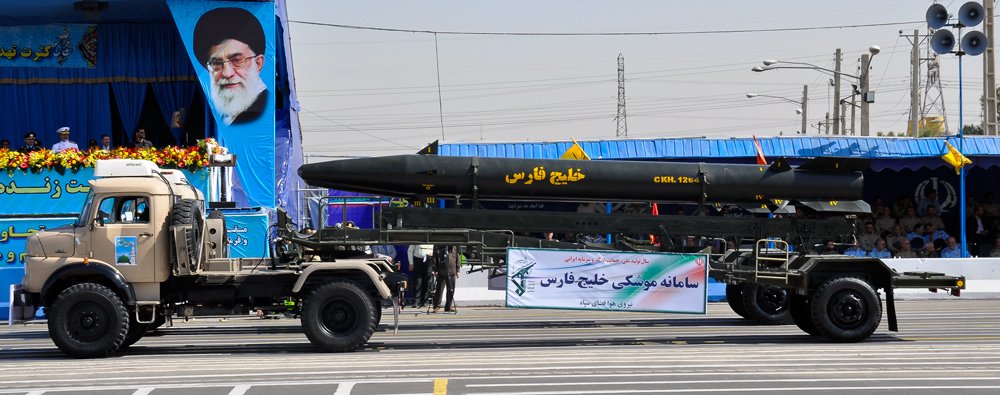
persian-gulf-missileKhalij Fars missile on a transporter.

Additionally, Iran has tested a two-stage solid-fuel missile, the Sejjil-2, whose range of over 2,000 km would allow it to target southeastern Europe — though it is apparently still not operational. In a June 28, 2011, press statement, Tehran claimed that it was capping the range of its missiles at 2,000 km (sufficient to reach Israel but not Western Europe), implicitly eschewing the development of intercontinental ballistic missiles in a presumed bid to deflect US and European concerns.

Yet its Safir launch vehicle, which has put four satellites into orbit since 2009, could provide the experience and knowhow needed to build an ICBM. (According to a May 2010 report by the International Institute for Strategic Studies, the Safir struggled to put a very small satellite into low-earth orbit and has probably reached the outer limits of its performance envelope, so it could not serve as an ICBM itself.) In 2010, Iran displayed a mockup of a larger two-stage satellite launch vehicle, the Simorgh, which it has not yet flown.

Tehran has also claimed an antiship ballistic missile capability that it probably intends for potential use against U.S. aircraft carriers: the Khalij-e Fars and its derivatives, the Hormuz-1/2, each with a claimed range of 300 km. Yet it is not clear that these systems are sufficiently accurate or effective to pose a credible threat to U.S. surface elements in the Gulf.

In addition, Iran recently unveiled the Soumar land-attack cruise missile, which is reportedly a reverse-engineered version of the Russian Raduga Kh-55. It has a claimed range of 2,500-3,000 km, though it may not be operational yet.

The Kh-55 was the Soviet air force’s primary nuclear delivery system.

Iran also fields a very large number of rockets, including the Noor 122 mm (with a range of 20 km), the Fajr-3 and -5 (45 and 75 km), and the Zelzal-1, -2, and -3 (with claimed ranges of 125 to 400 km). During the Iran-Iraq War, rockets played a major role in bombarding Iraqi cities along the border, and they are central to the “way of war” of Iranian proxies and allies such as Hezbollah and Hamas.

Tehran has built this massive inventory so that it can saturate and thereby overwhelm enemy missile defenses in any conflict. It would likely use such tactics whether its missile force remains conventional or becomes nuclear-armed, since conventional missiles could serve as decoys that enable nuclear missiles to penetrate defenses. Numbers would also enable Iran to achieve cumulative strategic effects on enemy morale and staying power by conventional means.

missilesiranAP Photo/Iranian Defense Ministry. To outwork missile defense systems, Iran would use a high volume of missiles.

Finally, many of Iran’s missiles are mounted on mobile launchers, and a growing number are based in silo fields located mainly in the northwest and toward the frontier with Iraq.

This mix of launch options is likely intended to impede preemptive enemy targeting of its missile force. The resources invested in this effort are unprecedented for a conventionally armed force, which indicates that at least some of these missiles would likely be nuclear armed if Iran eventually goes that route.

Nuclear connections

In the annex of a November 8, 2011, report regarding the nuclear program’s possible military dimensions, the International Atomic Energy Agency said it possessed credible information and documents connecting Iran’s missile and nuclear programs. These indicated that, prior to the end of 2003, Iran had:

  • conducted engineering studies on integrating a spherical payload (possibly a nuclear implosion device) into a Shahab-3 reentry vehicle (RV);
  • tested a multipoint initiation system to set off a hemisphere-shaped high-explosive charge whose dimensions were consistent with the Shahab-3’s payload chamber; and
  • worked on a prototype firing system that would enable detonation upon impact or in an airburst 600 meters above a target (a suitable height for a nuclear device).

Moreover, in 2004, Iran began deploying triconic (or “stepped”) RVs — a design almost exclusively associated with nuclear missiles — on its Shahab variants.

Some experts (including Uzi Rubin and Michael Elleman) believe that Iran may have deployed the triconic RV to enhance the stability and thus the accuracy of its conventional warheads, and perhaps to achieve higher terminal velocities that could reduce reaction time for missile defenses.

But if Iran were able to build a miniaturized nuclear device, its experience in designing, testing, and operating missiles with triconic RVs could expedite deployment of this weapon. Indeed, David Albright claimed in his 2010 book Peddling Peril that members of the A. Q. Khan nuclear smuggling network possessed plans for smaller, more advanced nuclear weapon designs that might have found their way to Iran, though most experts doubt the regime’s ability to build such a compact device at this time.

russianukeDesmond Boylan/Reuter

Could Iran have smuggled in a nuclear bomb?

These reports underscore why Washington and its partners must insist that Tehran respond to the IAEA’s questions about past engineering studies, design work, tests, and other elements of the PMD file prior to the lifting of sanctions.

They also highlight the need for a UN Security Council resolution (as called for in the Lausanne parameters) that would impose limitations on Iran’s missile R&D work and threaten real consequences for those who assist Iran’s missile program.

Failure to do so would signal tacit acceptance of activities that could enable Iran to deploy its first nuclear weapon atop a medium-range missile — an achievement that took most nuclear weapons states, including the United States and Soviet Union, about a decade to accomplish.

This development would in turn magnify the destabilizing impact of an Iranian breakout, while incentivizing other regional states to either take preventive action or move toward nuclear capabilities of their own before Iran crosses that threshold.
Contentions — Cementing the Bad Deal

July 6, 2015

Contentions — Cementing the Bad Deal, Commentary Magazine, July 6, 2015

The following is a dispatch from The Israel Project’s Omri Ceren regarding the state of nuclear negotiations with Iran:

Happy Monday from Vienna. The EU’s foreign affairs chief Federica Mogherini arrived yesterday and told reporters: “As you know I have decided to reconvene the ministers. They will be arriving tonight and tomorrow. It is the third time in exactly one week. That’s the end, the last part of this long marathon.” Secretary of State John Kerry and Iranian Foreign Minister Javad Zarif already held an impromptu meeting this morning. The overarching consensus – which is almost certainly correct – is that whatever gets announced will be announced no later than tomorrow afternoon. It might very well happen tonight.

As to what that announcement might be, there are a few options. In order of increasing probability:

0% chance: Kerry might make good on the comments that he made yesterday to reporters, and walks away from a bad deal.

Very low probability: the parties might come to a full-blown agreement ready to be implemented immediately. This scenario was never likely by June 30, and became functionally impossible after Supreme Leader Ayatollah Ali Khamenei set out a range of new red lines a few weeks ago. Also, the Iranians gave a background briefing earlier today in Vienna where they provided their interpretation of an emerging final deal. Among other things they have some interesting views on what military-related restrictions will be lifted, which are in tension with how the Americans have been describing the deal. Those differences will have to be overcome, and they won’t be in the next few days.

Low-probability: the gaps might still be too significant to even colorfully announce a deal, and the parties would extend the interim agreement all the way through the summer. The option would be more attractive to the Obama administration than taking another 2 or 3 weeks. If the administration sends Congress a deal after July 9 then the Corker clock – how long a deal sits in front of Congress – goes from 30 days to 60 days. But if they get all the way through the summer, it goes back down to 30 days. The administration has obvious reasons to prefer that.

Most likely: there will be a non-agreement agreement. The parties will announce they’ve resolved all outstanding issues but they still have to fill in some details. Then the P5+1 and Iran would move in parallel to implement various commitments, and the Iranians would in particular have to work with the IAEA on its unresolved concerns regarding Iran’s weapons program (PMDs). In the winter the IAEA would provide a face-saving way for the parties to declare Iran is cooperating – IAEA head Amano said earlier this week that the agency could wrap up by the end of the year if Iran cooperates – and then a deal would officially begin. The option is attractive to the administration because it puts off granting Iran all of its anticipated sanctions relief until the IAEA makes some noises about the Iranians cooperating. The alternative would be poison on the Hill. This way the administration can tell Congress that of course PMDs will be resolved before any sanctions relief is granted; and after Congress votes, if the Iranians jam up the IAEA but demand relief anyway, lawmakers will have no leverage to stop the administration from caving.

The focus will then shift to Congress, where the debate on approving or disapproving of the deal will take place over the next month. Some of the questions will get technical and tangled – the breakout time debate is going to be mind-numbing – but lawmakers will also use a very simple metric: Is the deal the same one the President promised he’d bring home twenty months ago? Back then the administration was very clear about what constituted a good deal and emphatic that U.S. negotiators had sufficient leverage to secure those terms. The U.S. subsequently collapsed on almost all of those conditions, and lawmakers will want to know how the deal can still count as a good one.

In line with those questions, here is a roundup from the Foreign Policy Initiative on where the administration started and how dramatically it has moved backwards. From the overview of the analysis:

Over the past three years, the Obama administration has delineated the criteria that any final nuclear agreement between the P5+1 and Iran must meet. In speeches, congressional testimony, press conferences, and media interviews, administration officials have also articulated their expectations from Tehran with repeated declarations: “No deal is better than a bad deal.” This FPI Analysis… compiles many of the administration’s own statements on nuclear negotiations with Iran over the past three years, and compares them with current U.S. positions. It also examines U.S. statements on a range of other issues related to U.S. policy toward Tehran, and assesses whether subsequent events have validated them.

The web version has embedded links for each of the statements, so if you need them just click through on the url at the top. You might just want to do that anyway, because the web version is more readable.

Deadlines, red lines

July 3, 2015

Deadlines, red lines, Israel Hayom, Ruthie Blum, July 3, 2015

(Please see also, Iran’s Nuclear Negotiators Emboldened by Islamic Ideology: Cleric at (Iranian) Tashim News Agency. — DM)

The regime in Tehran has made its position clear. So has the White House. It will take a miracle — or a military strike — to prevent Iran from building nuclear bombs.

**********************

The deadline for a nuclear deal between the P5+1 powers and Iran was extended on Tuesday, when too many bones of contention remained unresolved on June 30. The new date set by the parties to finalize the “framework for an agreement” reached in Lausanne three months ago is July 7.

This means that there are four days to go before the current talks in Vienna bear fruit in the form of an official document. If such a piece of paper is signed, two leaders will feel particularly vindicated: U.S. President Barack Obama and Iranian President Hassan Rouhani — the former for playing out his fantasy of peace through diplomacy and the latter for delivering the goods to his boss, Ayatollah Ali Khamenei.

The rest of the world, however, will be in mortal peril. And Israel will be forced to act fast.

The only sliver of a silver lining in this otherwise black cloud is that Islamists sometimes play their cards wrong. Buoyed by the weakness of the West in the face of their fanaticism, they often take their visions of grandeur to heights that even American and European appeasers cannot accept. So by next week, it is possible that the Iranian negotiators will overstep their counterparts’ bounds, and everyone will return to the country from whence they came with nothing but another date and venue to show for their efforts.

But because the stakes are nuclear weapons in the hands of a mullah-led regime bent on global hegemony — and working toward it through proxy terrorist organizations — one cannot count on the above scenario.

A number of recent statements are cause for concern.

On Thursday, Iranian Foreign Minister Mohammad Javad Zarif told reporters: “The negotiations are moving forward and we should be hopeful. Today is a good day.”

This was an abbreviated version of what his deputy, Abbas Araqchi, said the day before in a TV interview: “A positive atmosphere is ruling the negotiations, and the spirit for going forward exists in all delegations, but this doesn’t mean that all delegations, including us, are ready to reach an agreement at any price.”

Araqchi also defined a “good deal” as one that would honor Khamenei’s “red lines.”

These were spelled out in a June 23 speech by Khamenei (and included in a June 30 Middle East Media Research Institute report): “In contrast to what the Americans are insisting on, we do not accept long-term restrictions for 10 to 12 years.

“Research, development and construction will continue. … They say, ‘Don’t do anything for 12 years,’ but these are particularly violent words, and a gross mistake.

“The economic, financial and banking sanctions — whether related to the Security Council or the American Congress and administration — must be lifted immediately with the signing of the agreement. The remainder of the sanctions will also be lifted within a reasonable time frame. The Americans are presenting a complex, convoluted, bizarre, and stupefying formula for [removing the] sanctions, and it is unclear what will emerge from it, but we are clearly stating our demands.

“The lifting of the sanctions must not depend on Iran carrying out its obligations. Don’t say, ‘You carry out your obligations and then the IAEA will approve the lifting of the sanctions.’ We vehemently reject this. The lifting of the sanctions must take place simultaneously with Iran’s meeting of its obligations. We oppose the delay of the implementation of the opposite side’s obligations until the [release of] the IAEA report [verifying that Iran has met its obligations], because the IAEA has proven repeatedly that it is neither independent nor fair, and therefore we are pessimistic regarding it.

“They say, ‘The IAEA should receive guarantees.’ What an unreasonable statement. They will be secure only if they inspect every inch of Iran. We vehemently reject special inspections [that are not customary for any country except Iran], questioning of Iranian personnel, and inspection of military facilities.

“Everyone in Iran — including myself, the government, the Majlis [parliament], the judiciary, the security apparatuses, and the military, and all institutions — want a good nuclear agreement … that is in accordance with Iran’s interests.

“Although we wish the sanctions lifted, we see them as [having brought us] a particular kind of opportunity, because they made us pay more attention to domestic forces and domestic potential.”

A few days later, on June 29, Obama’s deputy national security adviser, Ben Rhodes, gave an interview to The Atlantic’s Jeffrey Goldberg at the Aspen Ideas Festival.

When asked whether Obama believes a deal will exact change in Iran’s behavior, Rhodes replied: “We believe that an agreement is necessary … even if Iran doesn’t change. … That said, we believe that a world in which there is a deal with Iran is much more likely to produce an evolution in Iranian behavior than a world in which there is no deal. In fact … if the notion is that Iran has been engaged in these destabilizing activities under the last several years when they’ve been under the pressure of sanctions, clearly sanctions are not acting as some deterrent against them doing destabilizing activities in the region. … [T]he point is … in a world of a deal, there is a greater possibility that you will see Iran evolve in a direction in which they are more engaged with the international community and less dependent upon the types of activities that they’ve been engaged in.”

The regime in Tehran has made its position clear. So has the White House. It will take a miracle — or a military strike — to prevent Iran from building nuclear bombs.

Rouhani Threatens Nuclear Breakout

July 2, 2015

Rouhani Threatens Nuclear Breakout, Commentary Magazine, July 2, 2015

Obama, Kerry, and negotiator Wendy Sherman have effectively become Iran’s lawyers. In doing so, they have applied the logic of “it depends on what the meaning of ‘is’ is” to U.S. national security. All one has to do, however, is look at the thinly veiled threats and logical somersaults of Iran’s top leaders . . . to understand just what a capability Tehran is after.

***********************

Where brinkmanship is in the blood of Iranian negotiators, careerism and obsession about legacy appears to be in the blood of their American counterparts. By playing good cop, bad cop with Ayatollah Ali Khamenei, by quibbling over every understanding previously reached, and by increasingly threatening to walk away, the Iranians appear to be wringing the Americans dry. Obama and Kerry have voided their own red lines, and prepare to normalize an Iranian path to a bomb whenever the Iranian government makes a decision to pursue that option.

Iranian President Hassan Rouhani is part and parcel of Iran’s brinkmanship. According to the Islamic Republic News Agency in Persian, he declared: “…If they do not fulfill their commitments, the government will be ready to immediately reverse the path in a more severe way than they can ever dream of.”

If Iran’s program has always been peaceful—as repeated Iranian officials have maintained—then reverting to Iran’s previous behavior would mean what exactly?  Threats from Rouhani, the supposed moderate, should get the attention of Congress.

Increasingly, Iran is tripping upon its own internal inconsistencies. First, there was Supreme Leader Ali Khamenei’s (as yet unseen) sacrosanct nuclear fatwa that forbids nuclear weaponry and yet the Iranian leadership refuses to come clean on past nuclear work for fear it would show nuclear weaponry work. There has also been Iran’s insistence that it seeks a completely indigenous program, yet it doesn’t possess enough natural uranium to fuel an expanded civilian energy program. Now, Rouhani has more or less threatened to build a nuclear bomb, the same threat made previously by Ali Akbar Hashemi Rafsanjani and a number of clerical associates of Khamenei himself. On May 29, 2005, for example, Hojjat ol-Islam Gholam Reza Hasani, the Supreme Leader’s representative in the Iranian province of West Azerbaijan, declared possession of nuclear weapons to be one of Iran’s top goals. “An atom bomb …must be produced as well,” he said.

Obama, Kerry, and negotiator Wendy Sherman have effectively become Iran’s lawyers. In doing so, they have applied the logic of “it depends on what the meaning of ‘is’ is” to U.S. national security. All one has to do, however, is look at the thinly veiled threats and logical somersaults of Iran’s top leaders, however, to understand just what a capability Tehran is after.

On eve of Iran deal, US retreats on inspections of nuclear past, speeds up sanctions relief

June 29, 2015

On eve of Iran deal, US retreats on inspections of nuclear past, speeds up sanctions relief, DEBKAfile, June 29, 2015

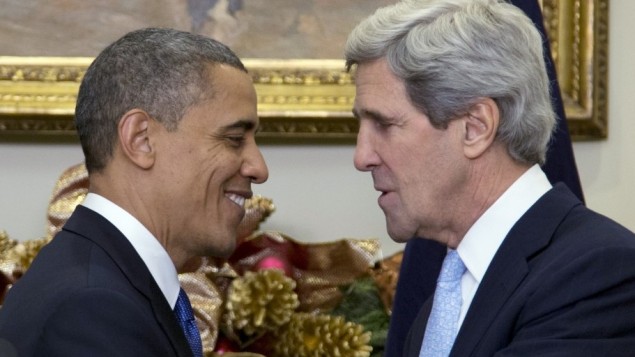
Obama KerryObama and Kerry upbeat over concessions to Iran

Nothing is therefore left of the original US pledges to link sanctions relief to Iran’s compliance with its commitments or President Obama’s solemn vow to “snap back” sanctions any time for any Iranian violations. The IAEA is virtually left without teeth.

******************

Prime Minister Binyamin Netanyahu said Sunday, June 28: “We are seeing a clear retreat from the red lines that the world powers set recently and publicly.” Addressing the weekly cabinet meeting in Jerusalem and later the Knesset, he added: “There is no reason to rush to sign this bad agreement which is getting worse every day.” 

Netanyahu was referring to three major concessions approved by President Barack Obama and Secretary of State John Kerry in the final stage of negotiations for a comprehensive nuclear accord with Iran.

They are outlined here by DEBKAfile:

1. After barring International Atomic Energy Agency (IAEA) inspections of suspect sites for years, Tehran will now be allowed to submit a paper with answers to queries about its past clandestine activities at those military sites, such as suspected tests of nuclear bomb detonators and explosives. That document would effectively draw a line on Iran’s suspect past

DEBKAfile: Iran has submitted countless documents to the IAEA, none of which gave specific replies to specific questions. The UN Security Council accordingly passed a number of resolutions requiring Tehran to come clean on the military aspects of its nuclear program. Tehran ignored them. Now Obama and Kerry are letting Tehran off the hook on its past secrets.

2.  Obama and Kerry have withdrawn the “any time, anywhere” stipulation for snap inspections of suspect nuclear facilities, as mandated by the Additional Protocol signed by Iran. They now agree that international monitors must first submit a request to an “Iranian Committee” (not even a joint US-Iranian committee) for advance permission to inspect nuclear facilities.

This would leave Tehran free to approve, deny, or delay permission for inspections.

3.  Washington has backed down on its insistence on predicating sanctions relief on Iran’s compliance with its obligations under the final accord. After Tehran countered with a demand for the sanctions to be lifted immediately upon the signing of the accord, the Obama administration agreed to remove them in three stages:

a)  Straight after the deal is signed.

b)  After ratification of the accord by the US Congress and Iranian Majlis.

This process is expected to take place by the end of 2015, and so Iran will win two multibillion windfalls this year without being required to meet any obligations beyond its signature

Obama counts on the support of 34 US senators. In any case, Congress is not empowered to reject or delay the deal

c)  All remaining sanctions will be lifted when implementation of the accord begins.

Nothing is therefore left of the original US pledges to link sanctions relief to Iran’s compliance with its commitments or President Obama’s solemn vow to “snap back” sanctions any time for any Iranian violations. The IAEA is virtually left without teeth.

Iran’s supreme leader is laughing, for good reason

June 25, 2015

Iran’s supreme leader is laughing, for good reason, Israel Hayom, Boaz Bismuth, June 25, 2015

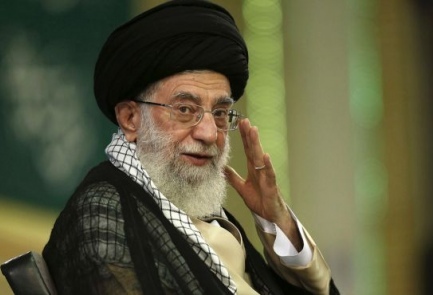
143522169662385559a_bIranian Ayatollah Ali Khamenei | Photo credit: AP

In Tehran on Tuesday, Khamenei spoke about his country’s “red lines.” Red lines? Can someone maybe explain what those are to the Obama administration?

********************

Iranian Ayatollah Ali Khamenei feels confident enough, only a few days before June 30 (the deadline for a final-status nuclear deal with world powers), to thumb his nose at the international community, including the American government, and declare Iran’s three noes: no to freezing its nuclear program, no to international oversight at its nuclear facilities, no to a phased lifting of sanctions (as proposed by the French). In other words, Khamenei is telling the world: Dear superpowers — bite me.

Meanwhile, almost simultaneously, we have received an Associated Press report from Vienna that the U.S. and its partners conducting the negotiations with Iran are prepared — for the sake of reaching a deal — to even provide the Iranians with advanced nuclear reactors and equipment. This isn’t a joke.

It’s possible, perhaps, to imagine Khamenei rejecting this generous offer outright because the Americans aren’t also including ballistic missiles in the package. If you’re going to be generous, then you might as well go all the way.

Truth be told, this entire business to this point seems quite like a joke. The problem is that it’s coming at our expense. And it’s also not that funny.

French Foreign Minister Laurent Fabius met on Wednesday with his Saudi counterpart and promised him a “tough deal.” The Saudis are no less worried than we are about a bad deal. But who is promising us a “tough deal?” The French, who ultimately always fall in line with the Americans, whose help they need for more burning issues closer to home (Ukraine)? Who? The Russians? The Chinese? The Americans? The Germans? The British? The truth is, it would be best to trust the Iranians to torpedo the deal on their own, but Khamenei’s and even Iranian President Hassan Rouhani’s promulgations from two weeks ago aren’t enough to scare anyone off.

In November 2013, as a reminder, we were just several days before the interim agreement. I remember how the Iranian and Western delegations leaked information about the many difficulties in the negotiations, but that in the end, in the middle of the night, the deal was born (how shocking). Eventually, we saw virtually the same scenario unfold in Lausanne this past March — the numerous problems were made public, the deadline was extended by a few days, and finally on April 2 we received the framework deal.

We can assume that in the coming days we will get to see “the best show in town,” at the end of which, in contrast to the previous rounds, we can expect a final status deal with an Iran that is not only slated to become a nuclear power but a stabilizing force in our crumbling Middle East.

In Tehran on Tuesday, Khamenei spoke about his country’s “red lines.” Red lines? Can someone maybe explain what those are to the Obama administration?

The West’s Misconceptions Over the Final Nuclear Deal

June 25, 2015

The West’s Misconceptions Over the Final Nuclear Deal, Front Page Magazine, June 25, 2015

ayatollah_2146641b-450x282

[W]hat is the Obama administration’s strategy? Apparently, the Obama administration does not have one. This is due to the fact that the administration believes that the Islamic Republic will not cheat, interfere in other nations’ affairs, or do any harm in case sanctions are lifted. In other words, the Islamic Republic is going to be another Switzerland.

****************

In a recent interview that President Obama gave to Israeli outlet Channel 2’s Ilana Dayan, he indirectly defended the Islamic Republic and suggested that the ruling clerics are not going to cheat on the terms of the final nuclear deal. But how can President Obama be so sure about Iran’s compliance if a deal is reached and when economic sanctions are lifted? Is he making such an argument based on Iran’s past history of nuclear defiance? Or based on its current military intervention in several nations and support for Shiite militia groups, proxies, and Islamic Jihad?

It is crucial to point out that the nuclear activities of the Islamic Republic came to the international spotlight due to Iran’s clandestine and underground nuclear sites. Iran had since repeatedly violated the IAEA’s terms by building additional underground nuclear sites and inching towards nuclear capabilities in order to obtain nuclear weapons.

President Obama also argued that sanctions will snap back in case Iran cheats. Nevertheless, the truth is that there is no such thing as automatic snapping back of sanctions.  In addition, by the time that the international community realizes that Iran has cheated, Iran would have reduced the nuclear break-out capacity to zero, boosted its Revolutionary Guards’ economy, and gained billions of dollars. Secondly, Russia and China will scuttle any process that would snap back the economic sanctions.

There exists a crucial underlying misconception in the West headed by the Obama administration regarding the final nuclear deal with the Islamic Republic, which is approaching its June 30th deadline.

From President Obama and the Western powers’s perspective,  the nuclear deal with the Islamic Republic is going to be transformational and revolutionary. This follows that the West, and particularly the White House, contends that the final nuclear deal or the nuclear resolution is going to transform the character of Iran’s political system in the long term; hence it will fundamentally alter Iran’s regional, domestic policies, shift its support for Shiite militia groups and proxies across the Middle East, moderate Iran’s foreign policy, and probably change the government in the long term.

On the other hand, from the Iranian leaders’s perspective, the nuclear deal is transitory, fleeting, momentary and transactional. In other words, Iranian authorities will follow the rules of the nuclear agreement for the limited time assigned in the deal. They will boost their economy, regain billions of dollars, and reinitiate their nuclear program soon after.

As long as Iran’s Supreme Leader, Ayatollah Ali Khamenei, is alive, the Islamic Republic is going to prioritize its Islamist revolutionary ideologies. The 75-years-old man, who has ruled over 25 years and continuously spread anti-American and anti-Semitic propaganda, is not going to change his position and become a Western-loving person open to forces of globalization and integration. His has created a powerful social base based on his anti-American and anti-Semitic propagandas.

Since Iranian leaders view the final nuclear deal on a short-term basis, from the perspective of Iranian leaders, particularly Ayatollah Ali Khamenei and influential officials of Iran’s Revolutionary Guard Corps (IRGC), reaching a final nuclear deal is a no-brainer, economically speaking. In addition, the leaders of the Islamic Republic are cognizant of the fact that they will not give up their nuclear program based on the current terms of the nuclear agreement.

Most recently, Royal Dutch Shell PLC, which owes the Islamic Republic an outstanding debt of more than $2 billion, has been talking about repaying Iranian leaders the debt after the nuclear deal is signed. and consequently the related sanctions are lifted. Several other foreign companies were unable to pay Iran due to the financial and banking sanctions imposed by the United Nations Security Council and previous US administrations. Nevertheless, President Obama is opening the way for the flow of billions of dollars into the revolutionary Islamist ideology of the Islamic Republic.

It is crucial to point out that the flow of billions of dollars into the Islamic Republic will not trickle down to the Iranian ordinary people or even be distributed equally among the governmental institutions such as Iran’s foreign ministry. An overwhelming majority of the cash will likely be controlled by the IRGC, Quds forces (an elite revolutionary branch of IRGC fighting in foreign countries) and office of the Supreme Leader. The IRGC and office of the Supreme Leader do enjoy a monopoly over major economic sectors of the Islamic Republic.

The issue of immediate access to billions of dollars is particularly appealing and crucial for the Iranian leaders due to the notion that Tehran looks at the final nuclear deal through the prism of short-term, immediate economic and geopolitical boosts.

As a result, the final nuclear deal is viewed as purely short-term business for the IRGC and the Supreme Leader.

Finally, it is rational for every government to have strategies to rein in Iran’s full economic return. But, what is the Obama administration’s strategy? Apparently, the Obama administration does not have one. This is due to the fact that the administration believes that the Islamic Republic will not cheat, interfere in other nations’ affairs, or do any harm in case sanctions are lifted. In other words, the Islamic Republic is going to be another Switzerland.

Can these forces stop a rotten Iran deal?

June 25, 2015

Can these forces stop a rotten Iran deal? The Washington Post, Jennifer Rubin, June 25, 2015

(Ms. Rubin is one of the Washington Post’s token conservatives, and anything she says is routinely disparaged by many WaPo readers. Others? Not so much. — DM)

Between the press leaks revealing serial concessions, the public incoherence of Secretary of State John Kerry and Ayatollah Ali Khamenei’s public declarations, the forces opposing an imminent Iran deal have plenty of material to work with. And if there is any doubt as to Israel’s position, opposition leader Isaac Herzog — whom President Obama dearly hoped would replace Prime Minister Benjamin Netanyahu, made clear what Israel-watchers already knew:

“There is no difference between me and [Prime Minister Benjamin] Netanyahu in reading the threat of Iran,” Herzog said in an interview with The Telegraph. “There is no daylight between us on this issue at all. I do not oppose the diplomatic process.

However, the proof of the pudding is in the eating.

We want to know ‘what is the deal?’ What’s the best deal possible that can be reached and would it change the region in a better direction? And here we are worried.”

In the article, Telegraph chief foreign correspondent David Blair appeared to express frustration that Herzog did not come across as opposing Netanyahu on Iran.

“If the US administration hoped that Mr. Herzog might dilute Israel’s visceral suspicion of an imminent nuclear deal with Iran, however, then he seems likely to disappoint,” Blair wrote.

There is no divide in the country at large, with 80 percent of Israelis declaring they have no confidence in President Obama’s handling of Iran.

Most GOP presidential hopefuls have decried the president’s giveaways. On Wednesday, former Texas governor Rick Perry, for example, put out a statement, which read in part: “In reckless pursuit of any agreement, President Obama has conceded point after point after point. Iran has used deadlines and extensions as a tactic for eliciting still more concessions from the U.S. We are well past the time where further concessions are tolerable if we still intend to prevent Iran from getting a nuclear weapons capability rather than manage its breakout time. This agreement is shaping up to spark a nuclear arms race in the Middle East and increase the odds of a devastating and catastrophic military conflict in the future. President Obama should abandon these dangerous negotiations and resume international sanctions until Iran understands and accepts that they cannot have a nuclear weapon.”

Meanwhile, the most influential Democrat on Iran, Sen. Robert Menendez (N.J.), has been taking to the Senate floor on a regular basis to denounce the reported concessions. On Wednesday, former Bill Clinton secretary of defense William Cohen denounced the deal as likely to start a nuclear arms race: “Once you say they are allowed to enrich, the game is pretty much up in terms of how do you sustain an inspection regime in a country that has carried on secret programs for 17 years and is still determined to maintain as much of that secrecy as possible.” He echoed multiple critics who saw it was all downhill once Obama did an about-face on the Syrian red line: “It was mishandled and everybody in the region saw how it was handled. And I think it shook their confidence in the administration. … The Saudis, the UAE and the Israelis were all concerned about that. They are looking at what we say, what we do, and what we fail to do, and they make their judgments. In the Middle East now, they are making different calculations.” (While Sen. Lindsey Graham strongly supported military action, none of the other three senators running for president did.)

More bipartisan opposition comes from ex-lawmakers. The American Security Initiative, headed by former senators Joe Lieberman (I-Conn.), Evan Bayh (D-Ind.), Norm Coleman (R-Minn.) and Saxby Chambliss (R-Ga.), announced a $1.4 million ad buy to inform the public about the contents of the imminent deal. Its targets include Democratic Sens. Richard Blumenthal of Connecticut, Michael Bennet of Colorado and Chuck Schumer of New York and independent Angus King of Maine. While Schumer likes to fancy himself as a great friend of Israel, when the chips are down, he has often given the administration cover, as he did in supporting the nomination of former senator Chuck Hagel (R-Neb.) for defense secretary.

In addition, an all-star group of Iran and military experts including former Obama advisers Dennis Ross, Robert Einhorn and Gary Samore warn against a deal that does not include anytime/anywhere inspections, revelation of possible military dimensions of Iran’s program before sanctions relief begins, “strict limits on advanced centrifuge R&D, testing, and deployment in the first ten years, and [measures to] preclude the rapid technical upgrade and expansion of Iran’s enrichment capacity after the initial ten-year period,” gradual lifting of sanctions and no relief from non-nuclear sanctions and a timely mechanism to reimpose sanctions if Iran cheats. In other words, they’ll support a deal utterly unlike the one we are likely to get.

Other voices now are speaking out on the administration’s willingness to lift sanctions while Iran continues its support for terrorism. Manhattan’s long-time Democratic district attorney Robert Morgenthau  (who tracked Iranian finances and relations with dictators in our hemisphere) writes that “the fundamental question to be asked is whether the deal the U.S. is negotiating with Iran will curtail its role as a state sponsor of terrorism. The answer appears to be a resounding no. . . . These sanctions, particularly over the past decade, have given the U.S. powerful leverage. It appears that this leverage is being frittered away as U.S. negotiators bend over backward to strike a deal. But meaningful deals are negotiated from strength; not from desperation. Any deal that fails to address or curtail Iran’s role as a state sponsor of terrorism—and that actually undercuts our ability to confront that threat—is a deal that we must not make.”

There is little doubt that the most prominent pro-Israel organization, the American Israel Public Affairs Committee (AIPAC) will go all-out to defeat the deal if it contains the sorts of concessions reported in the media. As we have noted, it already has begun warning lawmakers and the public of the dangers in a deal that does not stop Iran from getting nuclear weapons.

The White House, aided by every left-wing group it can round up (including persistent Israel antagonist J Street) will try to make this a choice between war and its crummy deal. It will strong-arm every Democrat who will listen. It will gloss over concessions, trying to pass off critics as unfamiliar with the fine print of the deal. Working against the president, however — in addition to the ludicrous concessions — are two factors. He, according to every recent public poll out there, is distrusted on foreign policy. And he is increasingly ineffective in bullying his own party, as we saw on the Corker-Menendez bill giving Congress an up-or-down vote. (If not for GOP leadership in both houses, he’d never have gotten trade-promotion authority.) Still, opponents of the deal do not underestimate the task of getting enough votes in the Congress to override the president’s veto of a resolution of disapproval.

The most interesting figure in all this may be Hillary Clinton. Unlike trade authority, it is inconceivable that she could refuse to take a clear position on an Iran nuclear deal. If she breaks with the president (highly unlikely), the left will attack her mercilessly. If she stands by him she risks — as he does — a bipartisan repudiation and an irate electorate. It is fitting that the biggest loser in this may be Clinton, who initiated engagement with Iran and continually opposed congressional efforts to tighten sanctions. Obama’s name may be on the deal, as the president said, but if there is a deal, it will be a direct result of four years of her Iran policy that set the pattern for her successor.

The Iran scam worsens — Part III, Human rights and support for terrorism

June 22, 2015

The Iran scam worsens — Part  III, Human rights and support for terrorism, Dan Miller’s Blog, June 22, 2015

(The views expressed in this post are mine and do not necessarily reflect those of Warsclerotic or its other editors. — DM)

It is likely that the P5+1 nuke “deal” with Iran will be approved soon. Military and other nuke sites which Iran has not “disclosed” will not be inspected. Nor will Iran’s nuke ties with North Korea — which P5+1 member China seems to be helping, Iran’s massive support for terrorism and abysmal human rights record be considered because they are also deemed unnecessary for “deal” approval. Sanctions against Iran are moribund and will not be revived regardless of whether there is a “deal.” However, a bronze bust of Obama may soon be displayed prominently in Supreme Leader Khamenei’s office and one of Khamenei may soon be displayed proudly in Dear Leader Obama’s office.

Iran fenced in

Iranian support for terrorism

According to the U.S. State Department, The Islamic Republic of Iran continued its sponsorship of terrorism during 2014. The linked article observes,

Iran has increased its efforts to finance and carry out terrorist activities across the world and remains a top nuclear proliferation threat, according to a new State Department assessment. [Emphasis added.]

Iran is funding and arming leading terrorist groups in the Middle East and elsewhere, according to the State Department’s 2014 Country Reports on Terrorism, which thoroughly documents how Tehran continues to act as a leading sponsor terror groups that pose a direct threat to the United States.

The report comes as Western powers work to finalize a nuclear deal with Iran ahead of a self-imposed June 30 deadline, though it is unclear whether the new findings will come up in negotiations.

It seems clear that the new findings will not be considered.

Among many other terrorist organizations, Iran supports the Taliban.

Afghan and Western officials say Tehran has quietly increased its supply of weapons, ammunition and funding to the Taliban, and is now recruiting and training their fighters, posing a new threat to Afghanistan’s fragile security.

Iran’s strategy in backing the Taliban is twofold, these officials say: countering U.S. influence in the region and providing a counterweight to Islamic State’s move into the Taliban’s territory in Afghanistan. [Emphasis added.]

According to James Clapper, the U.S. Director of National Intelligence, the intelligence community considers Iran to be the “foremost state sponsor of terrorism.”

The assessment came after criticism from the Senate that the information was omitted in a global threat assessment submitted to Congress [in February of this year.] Initially, Iran and Hezbollah were not included as terror threats in the intelligence community’s report to the Senate in February. [Emphasis added.]

Might the Obama administration have been trying to ignore Iran’s continuing support for terrorist activities because of its fixation on getting a “deal” with Iran in the ongoing P5+1 “negotiations?” Probably, but that was then. Now, it is apparently not a problem to report on Iran’s terrorist activities because they are deemed unworthy of consideration by the P5+1 negotiators. It’s terrible, but so what?

Iran is the world’s biggest sponsor of terrorism. Its tentacles have a hold on Syria, Lebanon, Iraq, Afghanistan, Yemen and the Gaza Strip. Its terrorist operations know no border and its proxies partake in mass killings and war crimes. But as it has been demonstrated time and time again, the West appears unperturbed by all that. It views Iran as a potentially constructive state actor, which, as long as it gets its way, could serve to stabilize the region. [Emphasis added.]

Iran could, of course, “stabilize” the region with its own military and its terror proxies in much the same way that Hitler tried to “stabilize” Europe — by gaining military control and forcing his ideology on subjugated residents. At first, there was some resistance but that was shown to be useless as Britain under Chamberlain gave Hitler Czechoslovakia. Eventually, Britain and later her ally, the United States, became sufficiently upset to intervene militarily.

As noted in an article at Asia Times on Line, the “free world” is unwilling to confront Iranian hegemony:

For differing reasons, the powers of the world have elected to legitimize Iran’s dominant position, hoping to delay but not deter its eventual acquisition of nuclear weapons. Except for Israel and the Sunni Arab states, the world has no desire to confront Iran. Short of an American military strike, which is unthinkable for this administration, there may be little that Washington can do to influence the course of events. Its influence has fallen catastrophically in consequence of a chain of policy.

. . . .

President Obama is not British prime minister Neville Chamberlain selling out to Hitler at Munich in 1938: rather, he is Lord Halifax, that is, Halifax if he had been prime minister in 1938. Unlike the unfortunate Chamberlain, who hoped to buy time for Britain to build warplanes, Halifax liked Hitler, as Obama and his camarilla admire Iran. [Emphasis added.]

The bountiful windfall soon to be given to Iran if the P5+1 “deal” is approved, via a “signing bonus” and other Sanctions relief, will help Iran’s terror sponsorship.

[S]hould the “treaty” with Iran be consummated, this sponsor of global terrorism will receive at least $100 billion in sanctions relief. Not only will this money be used for Assad, but it will bankroll Hezbollah and Hamas with a new generation of rockets and weapons.

For Tehran, money buys weapons, and weapons buy power and influence. President Obama is counting on an accommodative Iran that receives foreign assistance. But is there any reason to embrace this hypothesis? And even if someone does, at what point can the International Atomic Energy Agency (IAEA), or any other relevant body, determine the turnabout in Iran’s nuclear program? How do we know when a genuine peace has arrived? [Emphasis added.]

Iranian leaders have made it clear that dreams of a Persian kingdom dance like sugar plums in their imagination. For that to happen, the money pump cannot run dry. There is a need to support their Houthi surrogates in Yemen; resupply Hamas rockets that were destroyed in the last war with Israel; continue to add to the Hezbollah war machine that is poised to attack Israel; and keep Assad afloat, the mechanism by which control of Lebanon is retained. [Emphasis added.]

Iran’s abysmal human rights record is getting worse

Executions in Iran

According to Iranian Human Rights,

[T]he Iranian regime has executed a prisoner every two hours this month.

“So far in 2015, more than 560 have been executed, and we are just in the first half of the year… What we are witnessing today is not so much different from what ISIS is doing. The difference is that the Iranian authorities do it in a more controlled manner, and represent a country which is a full member of the international community with good diplomatic relations with the West.” — Mahmood Amiry-Moghaddam, spokesman for Iran Human Rights. [Emphasis added.]

Now the West, with the possibility of a nuclear deal, stands to increase Iran’s diplomatic standing.

According to officials of the Islamic Republic of Iran,

Iran has “the best human rights record” in the Muslim world;[11] that it is not obliged to follow “the West’s interpretation” of human rights;[12] and that the Islamic Republic is a victim of “biased propaganda of enemies” which is “part of a greater plan against the world of Islam“.[13] According to Iranian officials, those who human rights activists say are peaceful political activists being denied due process rights are actually guilty of offenses against the national security of the country,[14] and those protesters claiming Ahmadinejad stole the 2009 election are actually part of a foreign-backed plot to topple Iran’s leaders.[15] [Emphasis added.]

Conclusions

Iran’s abysmal and already worsening records of human rights violations and support for terrorism will likely get even worse as it gets (or gets to keep) the bomb, along with a reward of massive further sanctions relief. None of that is deemed worthy of consideration by the P5+1 “negotiators,” lest Iran decline to sign a deal or lest its feelings be hurt — as they would be were IAEA inspections of “undisclosed” sites be demanded or if any Iranian demands were not met.

Iran and North Korea share not only nuclear weaponization technology; they also share a common contempt for human rights. Yet the North Korea – Iran nuclear nexus (denied by Iran) appears to be of no concern to the P5+1 “negotiators.”

Obama long ago “opened his heart” to the Muslim world.

“To the Muslim world, we seek a new way forward based on mutual interest and mutual respect,” Obama declared in his first inaugural address. The underlying assumption was that America’s previous relations with Muslims were characterized by dissention and contempt. More significant, though, was the president’s use of the term “Muslim world,” a rough translation of the Arabic ummah. A concept developed by classical Islam, ummah refers to a community of believers that transcends borders, cultures, and nationalities. Obama not only believed that such a community existed but that he could address and accommodate it.

The novelty of this approach was surpassed only by Obama’s claim that he, personally, represented the bridge between this Muslim world and the West.

ALL of My policies are the best ever

ALL of My policies are the best ever

Obama does deserve some credit: His foreign policies are the most foreign in U.S. history to the security of the United States and of what’s left of the free world. Much the same is true of His domestic policies.