Archive for the ‘Iranian capture of U.S. Navy boats’ category

Iran Continues Needling U.S. Over Navy Boat Seizure

April 8, 2016

Iran Continues Needling U.S. Over Navy Boat Seizure, Front Page Magazine, Ari Lieberman, April 8, 2016
ws_1

Pentagon remains mute.

On January 12, at approximately 9:23 a.m., a pair American navy riverine command boats or RCBs, set sail south from Kuwait to Bahrain, headquarters of the U.S. 5th Fleet. At 2:10 p.m., the navy received a report that the RCBs had been intercepted by the Iranians. At 2:45 p.m., the military reported that all communication with the RCB flotilla was severed. At 6:15 p.m., the U.S. Navy cruiser USS Anzio received a communication from the Iranians that the sailors were being detained. Coincidentally, their detention coincided with Obama’s scheduled State of the Union Address, which predictably, made absolutely no mention of the event.

The Pentagon claimed that the RCBs strayed into Iranian territorial waters as a result of a “navigation error” and thereafter, one of the RCBs experienced engine trouble. They were then greeted by a pair of Iranian speed boats. Photos and video of the incident released by the Iranians show that the Iranian boats were armed with nothing more than forward mounted Russian 14.5mm DShK machine guns of Korean War vintage.

At gunpoint, the Iranians transferred the boats and their crew to Farsi Island where they maintain a military base. The boats and crew members were released some 16 hours later during which time, the Iranians thoroughly inspected the RCBs. Two satellite phone sim cards were stolen by the Iranians and the Pentagon has not divulged what, if any, information they contained. The groveling John Kerry thanked his Iranian counterpart profusely for releasing the illegally detained sailors.

Aside from these bare facts, the Pentagon has not released any new information concerning the embarrassing incident, a humiliation unparalleled in modern U. S. naval history. As I previously noted, several troubling questions still remain unanswered.

First, how did an experienced naval crew, equipped with sophisticated navigational equipment and traveling a well-charted, straight forward path, encounter a “navigational error” that led them into the territorial waters of an extremely hostile entity? In the absence of additional information, the Pentagon’s explanation makes absolutely no sense.

There has been speculation that the Iranians employed a device that spoofed or tricked the RCB’s on-board GPS devices with fake signals, leading the sailors into believing that they were on a correct course when they had in fact, substantially deviated. If the Iranians had in fact employed such a device, it would not have been the first time. In 2011, they reportedly misdirected a U.S. drone operating in Afghanistan by hacking into its GPS. The drone and all of its technology fell into Iranian hands relatively intact. The Pentagon has not issued any comment on this theory and notably, has not issued any denial of this troublesome scenario.

Second, and even more troubling, is how did 10 American sailors surrender their heavily armed and armored RCBs to a vastly inferior Iranian force without firing a single shot? Why weren’t readily available military assets immediately deployed and dispatched after the military was notified of the hostile encounter? Who gave the commander the order to surrender and was the decision to surrender influenced by political considerations, notably Obama’s State of the Union Address?

While the Pentagon continues to remain mute on these and other crucial issues surrounding the seizure of the RCBs, the Iranians have been extremely talkative, missing no opportunity to humiliate the “Great Satan.”  The list of outrages includes the following:

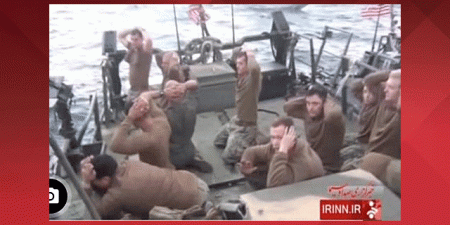
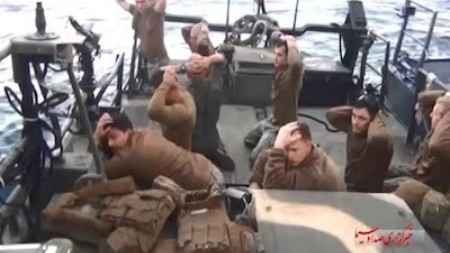
  • The sailors were forced to kneel at gunpoint with their hands interlocked behind their heads. The display was videotaped.
  • The commander was forced to apologize and acknowledge his “navigational error” and the graciousness of his Iranian captors on Iranian TV.
  • The Iranians reenacted the surrender spectacle during one of their annual “Death to America” demonstrations.
  • The sailors were subjected to rather intense interrogation.
  • Iranian TV aired footage purporting to show an American sailor crying.
  • A female sailor endured further humiliation and was forced into Sharia compliance by being made to wear a head covering.
  • Iran’s supreme leader, Ayatollah Ali Khamenei, publicly issued the Iranians responsible for capturing the RCB sailors with “medals of conquest.”
  • Approximately two weeks after the sailors were freed; Iran released footage of one its drones shadowing the U.S. aircraft carrier Harry S. Truman. The drone incident occurred on the very day the sailors were captured. A U.S. Navy spokesman called the flyover “abnormal and unprofessional.”
  • As noted, two satellite phone sim cards, likely containing classified information, were stolen by the Iranians.
  • In mid-March, naval commander Gen. Ali Razmjou of the Iranian Revolutionary Guards announced that Iran had retrieved thousands of pages of information from laptops, GPS devices and maps used by U.S. Navy sailors.

It is likely that we have not heard the last from the Iranians on this humiliating saga. In fact, Razmjou said that the IRG will publish a book about the incident. The Iranian bombast stands in marked contrast to the Pentagon’s demurred, almost docile stance. The reasons for the Pentagon’s silence are not hard to fathom. Something happened in the Arabian Gulf on January 12 that if revealed, would likely cause considerable embarrassment to the Obama administration.

In mid-February, Sen. John McCain threatened to subpoena the sailors if the Pentagon was not more forthcoming about the details surrounding the incident. He correctly noted that it did not take that long to debrief the sailors, accused the administration of “dragging [its] feet” and gave the administration a deadline of March 1 to present more information. That deadline has come and gone but the public still remains in the dark thanks to the Obama administration’s attempts to obfuscate.

In the meantime, Iran continues to test ballistic missiles in defiance of UNSC resolution 2231 and flush with $150 billion, continues to operate as a malignant regional influence by providing sophisticated weapons to Hezbollah, the Houthi rebels and other assorted terrorist organizations. More ominously, Iran and its proxy Hezbollah have constructed a ballistic missile base in Syria near the Israeli border, greatly magnifying an already explosive situation.

Obama will ignore these and other Iranian transgressions because he recognizes that the JCPOA, his crowning foreign policy achievement, is on thin ice. For the very same reason, he will continue to order the Pentagon to obfuscate and remain silent on the circumstances surrounding the seizure of U.S. personnel in the Arabian Gulf because it will likely embarrass the administration and add to further congressional calls to toughen sanctions against the Islamic Republic.

Iran Mocks Capture Of U.S. Sailors In Tehran Revolution Day Parade – Outnumbered

February 12, 2016

Iran Mocks Capture Of U.S. Sailors In Tehran Revolution Day Parade – Outnumbered, Fox News via You Tube, February 11, 2016

https://www.youtube.com/watch?v=DHTV01837CI

“Extensive Information” Obtained from US Sailors Captured by IRGC

February 1, 2016

“Extensive Information” Obtained from US Sailors Captured by IRGC, Tasnim News Agency, February 1, 2016

Iranian admiral

TEHRAN (Tasnim) – Commander of the Islamic Revolution Guards Corps Navy Rear Admiral Ali Fadavi said the forces extracted a lot of information from the confiscated cell phones and laptops of the US sailors recently captured by Iran after intrusion into the country’s territorial waters.

“We have extracted extensive information from their (American sailors’) laptops and cell phones,” Admiral Fadavi said in a parliamentary session in Tehran on Monday.

The IRGC commander went on to say that the information can be made public if a decision is made to that effect.

Admiral Fadavi also noted that the IRGC has filmed the capture of the US sailors for several hours, the release of which would bring humiliation to the United States.

If US officials say they are angry with and frustrated by the footage released, they would be 100 times more embarrassed if the IRGC releases other films of the capture, the Iranian commander said.

Iran does not seek to humiliate any nation, he said, but stressed that if they want to humiliate Iran, the IRGC would publish the footage and make them even more embarrassed and humiliated.

US Defense Secretary Ashton Carter had earlier said he was “very, very angry” when he saw footage of 10 US Navy sailors detained by Iranian authorities broadcast by Iranian television news.

The Islamic Revolution Guards Corps (IRGC) Navy on January 12 captured the US Navy sailors inside Iran’s territorial waters in the Persian Gulf, but released them the next day following an apology and after technical and operational investigations indicated that the intrusion into Iranian territorial waters was “unintentional”.

Yesterday, Leader of the Islamic Revolution Ayatollah Seyed Ali Khamenei awarded the ‘Medal of Fath (Conquest)’ to Admiral Fadavi and four other IRGC commanders who made the “courageous and timely” move in the recent capture of American boats and sailors near Iran’s Farsi Island.

Cartoon of the Day

January 17, 2016

H/t Vermont Loon Watch


knees

Arab Commentators On American Sailors Incident: This Is Iran’s Message On The Eve Of JCPOA ‘Implementation Day’

January 14, 2016

Arab Commentators On American Sailors Incident: This Is Iran’s Message On The Eve Of JCPOA ‘Implementation Day’ MEMRI, January 14, 2016

On January 12, 2016, Iranian authorities arrested 10 American sailors from two small U.S. naval craft that had strayed into Iranian territorial waters. Iran’s Islamic Revolutionary Guard Corps (IRGC) arrested and handcuffed the crew and held them at a military base, releasing them a short time later. Iranian authorities released photos of the sailors kneeling with their hands on their heads.

Following the incident, articles were published in the Arab press both by supporters of Iran and by its opponents, claiming that, with its actions, Iran had sent a message to the U.S. Tareq Al-Homayed, former editor of the London-based Saudi daily Al-Sharq Al-Awsat, stated that the IRGC had shamed U.S. President Obama and shown him to be weak on the eve of the JCPOA’s “Implementation Day.” The Lebanese daily Al-Akhbar, which is affiliated with Hizbullah and supports the resistance axis, argued that the IRGC was sending a message to the U.S. that Iran will be willing to clash with it if it has to, and at the same time telling other countries – that is, the Gulf states – not to mess with Iran. It should be noted that Al-Akhbar’s January 14, 2016 front page showed the photo of the American sailors kneeling with hands on their heads, under a headline reading “Tehran to Washington: I Control The Gulf.”

26432January 14 Cover of Al-Akhbar: “Tehran to Washington: I Control the Gulf”

Article In Lebanese Daily Close To Hizbullah: Iran Sent U.S. And Others A Message That It Is Ready For A Clash

The Lebanese daily Al-Akhbar, which is close to Hizbullah and the Iranian axis, published an article by columnist Hassan Haidar, who claimed that Iran wanted to use this incident to send a message to the U.S. that it would not hesitate to clash with it if necessary. He added that this was also a message to other countries, hinting at the Gulf states, specifically Saudi Arabia, that the rules of the game have changed and that they must acknowledge their own weakness.

He wrote: “This incident was a quiet yet an important battle, since it took place off the Saudi coast, targeted an American force, and triggered American [responses expressing] hope [that Iran would not hurt the sailors], which were akin to apologizing to Iran. Washington did not threaten war or raise its voice…

“The Revolutionary Guards, which are in charge of defending the Gulf, are known to ‘see but not be seen’ – a term coined by the head of their navy, General Ali Fadavi. This means that they watch [the goings on] in the Gulf without being noticed by anyone, and in an emergency, they suddenly appear.

“The Revolutionary Guards possibly wanted to send a message to all, that if Iran feels that its interests and security are at stake, it will be willing to enter any conflict, even with the U.S…. [Furthermore,] dealing with Washington in this way ensures that smaller [countries] understand that Tehran will never hesitate to respond to any violation of its sovereignty, and that the rules of the game have changed, and therefore certain [elements] should recognize the limits of their power.”[1]

Leading Saudi Writer: Iran Kidnapped Not Only The Sailors But Obama Himself As Well

Tareq Al-Homayed, former editor of the London-based Saudi daily Al-Sharq Al-Awsat, wrote on January 14, 2016 that the arrest of the American sailors just hours before President Obama’s final State of the Union address had cast a shadow over the address, and had in effect kidnapped the president himself. He noted that the kidnapping had proven that Iran has no intention of moderating its positions, and had exposed Obama, who wanted to present the nuclear agreement with it as a great achievement, in all his weakness. Al-Homayed wrote: “When Iran’s Revolutionary Guards seized two American naval craft in the Gulf on Tuesday evening [January 13, 2016], with ten American sailors on board, it was not the sailors who were the important point, but the fact that the Revolutionary Guards effectively kidnapped U.S. President Barak Obama [himself only] a few hours before he was to deliver his final State of the Union address, towards the end of his second term in office. The crisis of the American sailors [detained by] Iran ended [just] a few hours after their arrest, but it was Obama’s speech that was hijacked, since the Iranians deprived Obama of the opportunity to appear as the strong man who had forced Iran to capitulate on the nuclear dossier. The sailors’ arrest deprived Obama of the chance to boast of the legitimacy of the nuclear agreement and to tell America, which is divided on the Iranian issue, as is the entire world, that Iran has changed and will once again become an active member of the international community, [a country] that renounces violence and respects international treaties and agreements. Some may say that the Iranians’ conduct was foolish, and this is true – but so was placing faith in the Iranian regime!

“Hence, the arrest of the Iranian sailors [right] before Obama’s address exposed the weakness of the American president and sparked doubts even in those who defend his foreign policy, especially [his policy] towards Iran’s [behavior] in our region. Embarrassment was apparent even among the White House staff, as manifest in leaks and excuses conveyed by Obama’s staff to the U.S. media during the sailors’ detention. The biggest embarrassment was over Obama’s handling of the incident… and [the question of] whether or not he would refer to it in his pre-prepared speech. So what we witnessed was not so much the abduction of the sailors but the abduction of the American president himself. His ransom was the missed opportunity to present himself as a strong president enjoying the legitimacy of achieving the nuclear agreement with Iran.

“With the premeditated intent to abuse the American president and to present his weakness to all, the Revolutionary Guards arrested the American sailors, and in fact kidnapped Obama himself, [just] days before the expected implementation of the nuclear agreement they will not submit and that Obama is too weak to boast of victory over them. Likewise, the Revolutionary Guards seek to tell anyone, in Iran and outside it, that their hand is still uppermost in Tehran, despite everything that has happened to Iran recently, after the wild attack on the Saudi Embassy in Iran and Tehran’s apology to the [UN] Security Council for this. Additionally, the IRGC’s action [i.e. detaining the sailors] is a response that embarrasses the propaganda of the Iranian president [Rohani] and his men – particularly the wily foreign minister [Zarif] and others – who claim that they want peace and openness, as they market lies and corrupt accusations against Saudi Arabia.

“Obama’s predicament is not manifested only in his kidnapping, but [also] in that he wants to take a neutral stand vis-à-vis the recent Iranian hostility against Saudi Arabia and the entire region. But he himself became a victim of Iran when [Iran] kidnapped him [just] before his final State of the Union address, and wrecked his opportunity to present himself as an accomplished hero when [his accomplishments] are in fact not yet completed.”[2]


Endnotes:

[1] Al-Akhbar (Lebanon), January 14, 2016.

[2] Al-Sharq Al-Awsat (London), January 14, 2016.

Humor| Navy Downgraded To ‘Regional Force For Good’

January 14, 2016

Navy Downgraded To ‘Regional Force For Good’ Duffel Blog, January 13, 2016

sailors-iran-1000x600

PERSIAN GULF — Following the recent capture and release of two US Navy riverine war vessels by Iran on Tuesday, the Navy has officially rebranded itself as a “Regional Force for Good,” sources report. The Navy backed off from its previous “Global Force For Good” branding earlier this year, replacing it with a series of giant red blobs meant to emphasize “presence.”

“Let’s be honest,” Adm. John Richardson, Chief of Naval Operations said. “The F-35 has sucked our budget dry like one of those Twilight vampires giving a horny teenager an undeath-hickey.”

“We can’t afford to be in more than a couple places at a time, and once we get there, we usually have to fire the skipper and come right home.”

Though the new brand had been under consideration for some time, he contentious “catch and release” of 10 Navy sailors in Iranian waters prompted a rapid decision on it. The Navy has not announced how these sailors let their boats drift into Iranian territory, although some are blaming the Naval Academy’s Celestial Navigation training.

The sailors were released without harm, but Navy officials are scrambling to manage the negative optics of the situation.

“We thought about playing it off as a stunt raising awareness for the ‘Hands Up Don’t Shoot’ initiative,” a Navy public affairs official admitted, “but ultimately we decided to just pull a Blackwater and re-brand instead.”

“We’ve really been a regional force since Clinton anyway,” Richardson added. “‘Global’ set the bar too high, and between scary Chinese island-building and sequestration, we’re just not living up to our advertisements. Regional is definitely more in our comfort zone.”

Secretary of the Navy Ray Mabus revealed another spin during a press conference, remarking that “this historic event with Iran proves that women can be prisoners of war just as well as men can. I look to the Marine Corps to emulate this shining example.”


Iran Captures and Releases US Sailors: the Back Story

January 14, 2016

Iran Captures and Releases US Sailors: the Back Story, Clarion Project, Meira Svirsky, January 14, 2016

Iran-Captures-US-Sailors-HPIranian footage of the capture of the 10 American sailors.

Although the government and news media seem to be adopting Shakespeare’s famous maxim, “All’s well that end’s well,” the back story behind the seizure and eventual release of 10 American sailors by Iran is not so simple.

Vice-President Joe Biden insisted “the Iranians picked up both boats — as we have picked up Iranian boats that needed to be rescued .. [they] realized they were there in distress and said they would release them, and released them — like ordinary nations would do.”

Yet Iran can hardly be called an “ordinary nation.” The Islamic Republic leveraged the incident to humiliate the U.S., forcing the sailors to apologize and acknowledge their “fantastic” treatment by Iran. Not just a typical “rescue.”

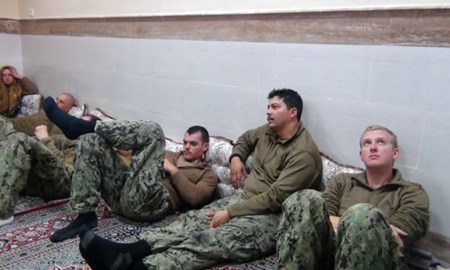
Iranian brinkmanship, an art unto itself, was played to perfection. Footage aired on Iranian Press TV in English (see below) showed uncomfortable U.S. sailors sitting on Persian carpets laden with food, the lone female sitting in a corner sequestered behind her male compatriots with a hijab covering her hair.

Films of their “surrender” — on their knees with their hands behind their heads –featured prominently in the Iranian press coverage as did all the weapons contained on the ship.

Still Biden insisted it was all in a normal day’s work. “When you have a problem with the boat, (do) you apologize the boat had a problem? No,” Biden said. “And there was no looking for any apology. This was just standard nautical practice.”

Others were more blunt. “This incident in the Persian Gulf, which probably will not be the American forces’ last mistake in the region, should be a lesson to troublemakers in the U.S. Congress,” said Major General Hassan Firouzabadi, head of Iran’s armed forces.

One wonders what the lesson might have been if Iran had already been granted the billions of dollars in sanctions relief instead of being just days away receiving it.

Watch Iranian TV coverage of the capture and apology (voices begin after three minutes):