It’s a two-step charade. First, since the UN has no definition of terrorism, state sponsors of terrorism happily denounce “terrorism” at the very same time as they promote it. Second, the terrorist funders and weapons suppliers redirect the world’s attention to the supposed “root causes” of terrorism.
On Oct. 7, at the legal committee meeting at UN headquarters, Hezbollah-controlled Lebanon listed “root causes that may lead to radicalism such as . . . poverty, social exclusion and marginalization” along with “Islamophobia.”
Iranian President Hassan Rouhani played the same card in an address to the General Assembly in September when he whined about “Iranophobia.
******************
While we are looking for terrorists sneaking across borders, lurking in mosques and holed up in caves, pro-terrorist ideology is spreading across America and around the globe — disseminated in plain sight from the United Nations, in the heart of New York City.
Over the past week, the UN’s top legal committee — a General Assembly body where all 193 states are represented — met to discuss terrorism. The webcasts are broadcast globally in multiple languages. The documents are translated and disseminated on a mammoth website free of charge.
It’s a two-step charade. First, since the UN has no definition of terrorism, state sponsors of terrorism happily denounce “terrorism” at the very same time as they promote it. Second, the terrorist funders and weapons suppliers redirect the world’s attention to the supposed “root causes” of terrorism.
Conveniently, the catalog of root causes of terrorism dreamed up in these circles never includes religiously driven bigotry doled out by anti-Semites and misogynist, homophobic sociopaths — whose need to torture, rape and kill requires no deep explanation.
A quick moral inversion, and the terrorist becomes the victim.
The UN was full of such dangerous canards last week.
On Oct. 7, at the legal committee meeting at UN headquarters, Hezbollah-controlled Lebanon listed “root causes that may lead to radicalism such as . . . poverty, social exclusion and marginalization” along with “Islamophobia.”
Iranian President Hassan Rouhani played the same card in an address to the General Assembly in September when he whined about “Iranophobia.”
Iran is the leading state sponsor of terrorism. And to the organization’s great shame, Iran is also the president of the so-called “Non-Aligned Movement” — a group of nations routinely aligned against the West. As such, Iran speaks for 120 UN member states — a majority of the 193 UN countries.
Here’s the Iranian speech to the UN legal beagles that was webcast Oct. 7: “Terrorism should not be equated with the legitimate struggle of peoples under colonial or alien domination and foreign occupation for self-determination and national liberation.”
Here’s state sponsor of terrorism North Korea on the same day: “Domination and interference, poverty and social inequality, and racial or religious discrimination constitute the root cause of terrorism. International efforts to put an end to terrorism should be preceded by removing the root cause of terrorism.”
All 56 member states of the Organization of Islamic Cooperation have signed on to the Islamic Convention on Combating International Terrorism, which gives a green light to killing Israelis, Americans and anybody else deemed fair game. The treaty says: “Peoples’ struggle, including armed struggle against foreign occupation, aggression, colonialism and hegemony, aimed at liberation and self-determination . . . shall not be considered a terrorist crime.”
Speaking on behalf of the Organization of Islamic Cooperation on Oct. 7, Egypt reiterated this pro-terror exemption clause. Over the course of Oct. 7 and 8, the UN trumpeted support for the Iranian and Organization of Islamic Cooperation call to arms from half of all the speakers.
Compounding the efficacy of this outrage, unfortunately, is the Obama administration. With great fanfare, on Sept. 24,, President Obama chaired a Security Council meeting that unanimously adopted a resolution on foreign terrorist fighters.
But the only reason everybody could agree that “terrorism constitutes one of the most serious threats to international peace and security” was because terrorism was left undefined.
Moreover, the Security Council didn’t just denounce terrorism. It demanded we “address the conditions conducive to the spread of terrorism.” Next it insisted we “counter the violent, extremist narrative that can incite terrorist acts.” And then it ordered us to “address the conditions conducive to the spread of violent extremism.”
In other words, Obama sold us an infinite regression. Because at the UN, the buck never stops with radical Islamists or the governments that support them.
(The UN’s “responsibility to protect” doctrine now applies principally to groups favored by the multicultural international community, such as the “Palestinians” from wicked Israel, disfavored by the international community. Those needing protection from Islamic terror must look elsewhere. But where? The U.S. of Obama?– DM)
Illustration on the illusion of “Responsibility to Protect” by Linas Garsys
[I]’s ludicrous to propose that the U.N. Security Council — whose permanent members include neo-Soviet Russia and anti-democratic China — should be vested with the authority to pass judgment on the legitimacy of such missions.
While the Islamic State is currently attracting the most attention, it is the Islamic Republic of Iran — which has been using proxies to kill Americans on and off for the past 35 years — that could soon have nuclear weapons as well as missiles to deliver them to targets anywhere in the world. Hezbollah and other terrorist groups offer an alternative means of delivery. Iran’s radical Shia rulers are more sophisticated than the Sunni jihadis displaying disembodied heads on pikes. However, their goals differ little from those of their rivals.
[T]he notion of an international community that can prevent or halt mass atrocities is a chimera.
***************
Remember R2P? Not to be confused with R2-D2 (a robotic character in the “Star Wars” movies), “Responsibility to Protect” was an international “norm” proposed by United Nations Secretary-General Kofi Annan following the genocide in Rwanda in 1994 and the mass murders in the Bosnian town of Srebrenica a year later. The idea was for the “international community” to assume an obligation to intervene, militarily if necessary, to prevent or halt mass atrocities.
Why has R2P not been invoked to stop the slaughters being carried out in Syria and Iraq? Why isn’t it mentioned in regard to the Syrian-Kurdish city of Kobani, which, as I write this, may soon be overrun by barbarians fighting for what they call the Islamic State?
Here’s the story: In 2009, Mr. Annan’s successor, U.N. Secretary-General Ban Ki-moon, issued a report on “implementing” R2P. The foreign-policy establishment cheered. For example, Louise Arbour, a former U.N. high commissioner for human tights, called R2P “the most important and imaginative doctrine to emerge on the international scene for decades.” Anne-Marie Slaughter, an academic who served under Hillary Clinton at the State Department, went further, hailing R2P as “the most important shift in our conception of sovereignty since the Treaty of Westphalia in 1648.”
In 2011, President Obama cited R2P as his primary justification for using military force to prevent Libyan dictator Moammar Gadhafi from attacking the opposition stronghold of Benghazi.
If that was the apogee of R2P, the nadir was not far off. The intervention in Libya has led to chaos and bloodshed with no end in sight. Meanwhile, in Syria, four years ago this spring, Bashar Assad brutally cracked down on peaceful protesters.
Mr. Obama made Mr. Assad’s removal American policy but overruled the recommendation of his national security advisers to assist Syrian nationalist opposition groups. Civil war erupted. Self-proclaimed jihadis from around the world flocked to Syria to fight on behalf of the Sunnis. The opposition was soon dominated by the al Nusra Front, an al Qaeda affiliate, and the Islamic State (also known as ISIS or ISIL), whose leader, Abu Bakr al-Baghdadi, broke with al Qaeda and, audaciously, declared himself caliph, or supreme leader.
As for Mr. Assad, he is supported by the Islamic Republic of Iran, deploying both its elite Quds Force (designated in 2007 by the U.S. government as a terrorist organization) and Hezbollah, a Lebanon-based militia loyal to Iran’s supreme leader, Ayatollah Ali Khamenei. Russia also backs Mr. Assad, even supplying on-the-ground military intelligence specialists.
With no U.N.-approved R2P effort to rescue the innocent civilians of the region from these brutal forces, the death toll in Syria and Iraq has topped 200,000, and the number of refugees is in the millions.
Failed experiments, like crises, should not go to waste. Among the lessons to be learned from the R2P debacle: First, the notion of an international community that can prevent or halt mass atrocities is a chimera. If such work is going to get done, the United States has to do it, perhaps supported by a coalition of the willing and, with few exceptions, not particularly able. Second, it’s ludicrous to propose that the U.N. Security Council — whose permanent members include neo-Soviet Russia and anti-democratic China — should be vested with the authority to pass judgment on the legitimacy of such missions. Third, American power should be used primarily in pursuit of American interests. Sometimes that will include humanitarian interventions, but that’s a decision for Americans to make.
This, too, should be clear: While the Islamic State is currently attracting the most attention, it is the Islamic Republic of Iran — which has been using proxies to kill Americans on and off for the past 35 years — that could soon have nuclear weapons as well as missiles to deliver them to targets anywhere in the world. Hezbollah and other terrorist groups offer an alternative means of delivery. Iran’s radical Shia rulers are more sophisticated than the Sunni jihadis displaying disembodied heads on pikes. However, their goals differ little from those of their rivals.
In response to this dire and deteriorating situation, Mr. Obama should be instructing his advisers to present him with a range of strategic options. I’d recommend conceptualizing the global conflict not as disconnected “overseas contingency operations,” and not as akin to World War II, but more like the Cold War. That is to say, the United States should plan for a long, low-intensity struggle. In particular, we should support those willing to fight the jihadis who threaten them.
Economic weapons can be powerful if used correctly, which has not been the case in the past. For example, though sanctions brought Iran’s rulers to the negotiating table, premature relief from sanctions pressure has encouraged Iranian intransigence as the talks proceeded.
Also long overdue is a serious war of ideas — it’s insufficient to leave that to Bill Maher and Ben Affleck on HBO. Bottom line: We are not really engaged in a conflict against “violent extremism” or even “terrorism.” What we’re confronting are ideologies derived from fundamentalist readings of Islamic scripture. Proponents of those ideologies stress the supremacy of one religion — much as communists stressed the supremacy of one class, and Nazis of one race. There is no reason to suppose that saying this clearly, rather than obfuscating, will radicalize Muslims not already favorably inclined toward killing infidels.
Our aim should be, to borrow a phrase from Mr. Obama, to “degrade and eventually defeat” jihadism. Nothing is more imperative than preventing Iran’s rulers from taking the next, short steps toward a nuclear-weapons capability that they clearly intend to use to threaten not just their neighbors, but also Americans for decades to come. For an American president, this is where the R2P needs to begin.
The Islamic Jihad Movement in Palestine (Arabic: حركة الجهاد الإسلامي في فلسطين,Harakat al-Jihād al-Islāmi fi Filastīn) known in the West as simply Palestinian Islamic Jihad (PIJ), is a PalestinianIslamist organization formed in 1981 whose objective is the destruction of the State of Israel and the establishment of a sovereign, Islamic Palestinian state.[2] PIJ has been labelled a terrorist organisation by the United States,[3] the European Union,[4] the United Kingdom,[5]Japan,[6]Canada,[7]Australia,[8]New Zealand[9][10] and Israel. Iranis a major financial supporter of the PIJ.[11][12][13][14] Following the Israeli and Egyptian squeeze on Hamas in early 2014, PIJ has seen its power steadily increase with the backing of funds from Iran.[15] Its financial backing is believed to also come from Syria.
Secretary-General of the Islamic Jihad Movement Ramazan Abdullah arrived in Iran on Tuesday to confer with senior officials of the country on the latest security developments in region.
Abdullah, who arrived in Tehran last night, is to hold separate meetings with Secretary of Iran’s Supreme National Security Council (SNSC) Ali Shamkhani, and Member of Iran’s Expediency Council Saeed Jalili later today.
He will also hold meetings with some other Iranian officials during his stay in the country.
Late in August 2012, Supreme Leader of the Islamic Revolution Ayatollah Seyed Ali Khamenei asked participants in the 16th Non-Aligned Movement (NAM) summit in Tehran to pay special attention to the Palestinian issue, and called on the American backers of the Israeli regime to accept Iran’s proposal for holding a referendum in Palestine.
The Leader reminded the Zionists’ bloody occupation of Palestine over 6 decades ago, and blamed the Zionist regime for waging various wars, massacre and state-sponsored terrorism in the last decades.
He blamed the western world for supporting and defending the Zionist regime of Israel against the oppressed Palestinian nation.
The leader further renewed Iran’s solution to the Palestinian issue, calling for a “comprehensive referendum to be attended by all the indigenous residents of Palestine, including those refugees who have been away from their motherland for decades to determine the country’s fate”.
The Iranian supreme leader cautioned the US against the continue support and defense for the Zionist regime of Israel, reminding that decade-long support for the Israeli regime has incurred many costs and losses on the American people.
The leader called on the White House leaders to revise their Middle-East policy and “show courage and opt for the referendum solution” presented by Iran to put an end to the astronomical spending that has been inflicted on the American nation for its support for the Zionist regime of Israel.
To conclude his remarks, he urged for collective management of global issues, asking the NAM member states “not to be afraid of the bullying powers and remain loyal to their own causes”.
He reminded failure of communism and capitalism, and said the world is pregnant to new events, saying the Islamic Awakening and the US and Israeli failures in North Africa and the Middle-East are indicative of the very same fact.
(Some of this is directly pertinent to Israel and the Middle-East, some is pertinent only as U.S. politics affect both. It’s intended to be humorous, in a macabre way. — DM)
The Obama Nation’s multicultural society has become so politically correct and otherwise obtuse that words and phrases are used in any odd ways that may be desired — just as Humpty Dumpty did.
“When I use a word,” Humpty Dumpty said, in rather a scornful tone, “it means just what I choose it to mean—neither more nor less.”
“The question is,” said Alice, “whether you can make words mean so many different things.”
“The question is,” said Humpty Dumpty, “which is to be master—that’s all.”
Here are a few examples and explanations.
Religion of peace. Amish? Quakers? Of course not: it’s Islam. Although the Islamic State, according to Obama, is not “Islamic,” the Islamic Republic of Iran, Turkey, Qatar, Saudi Arabia, et al — which are “Islamic” — are among the world’s foremost sponsors of Islamic terrorism. However, that is irrelevant because Muslims would be offended.
Here’s Andrew Klavan on how to survive an Islamic Quaker massacre:
Islamic extremists are extreme because they follow the Koran and demand Shari Law. So do “moderate Muslims.”
Bitter clingers are Christians in fly-over country who support the Second Amendment, while revering and trying to live according to their Bibles. Islamists who cling to their scimitars, guns and suicide vests, while revering and trying to live by their Korans and Sharia law, are not bitter clingers.
That’s racist! Unless you happen to be Black and therefore not conservative, see Great Uniter, below.
The science is settled and the debate is over. Ipse dixit.
Honest discussion. According to Attorney General Holder, Federal Dick, we need to have an honest discussion about race. “Honest” means agreeing with and favoring his people above all others. Or something.
Gender identity. Don’t like your gender? Try another; it’s probably on the house.
The war on women has long been fought byRepublican scoundrels, not by Democrats like Billie BJ Clinton or various Islamic states such as Saudi Arabia, Iran and Turkey. The (non Islamic) Islamic State and other (non Islamic) freaks may be fighting a war on women and girls, whom they capture as sex slaves, use and sell. However, few engaged in fierce combat against the war on women seem to notice or care, so the vile war on women must still be exclusively a Republican thing.
Feminism rejects the vast powers that men have over women by, among many other things, demanding free contraception and abortion on request. Although opposed by some bitter clingers, both are needed to empower women and girls to have sex as often and with as many men as they may desire, with no illnesses (such as pregnancy) or other adverse consequences. Is lesbianism the cure? Should it replace heterosexual nymphomania?
Truth. “Beauty is truth, Truth is beauty. This is all ye know on Earth and all ye need to know.” Truth is beautiful only if it “sounds good” and can become a helpful sound bite to be memorized and used effortlessly.
Party of billionaires. This refers to Republicans. It does not mean Democrats who pay big bucks (up to $32,000 or more in some cases) to hear Obama tell them how filthy rich Republicans are ruining the country and how wonderful He is.
As Gwyneth Paltrow, an impoverished working mother who only “makes $16 million per movie,” said at a recent Obama fundraiser thrown at her humble shanty in California, Obama is
a president who would be studied for generations, and a role model for everyone of this generation.
“It would be wonderful if we were able to give this man all of the power that he needs to pass the things that he needs to pass,” she told the crowd.
Having been reminded of His greatness, attendees contribute more big bucks. It’s a good thing Obama is not a narcissist.
Great uniter refers to Obama, who has done more to unite Blacks against Whites than any other American President. (Conservative Blacks, such as Allen West, Ben Carson and others are White, not Black.) Great progress, Big Guy! Oh. He’s also a like, way cool military strategist.
Oh well. Try not to laugh cry; it may cause even more global warming, cooling, climate change and other demons not yet exploited discovered. As Jon Carson at BarackObama.com advised my spam filter just today,
We’re going to win on climate change. We don’t really have another option.
The question is how long will it take for the other side to take this fight seriously — to push the climate change deniers out of the way, and to defeat the powerful interest groups protecting the status quo.
We’re not waiting.
Climate change is already affecting Americans’ lives now — droughts, wildfires, and super storms have devastated every corner of the country.
“Fat cats” such as Tom Steyer, who is using his billions to impact multiple races in key states in ways that no ordinary voter can? Of course not. He’s the right kind of fat cat, meaning he is on the left. Plus, he controls NextGen and pays Lehane a lot of money to come up with its strategies. The libertarian-minded Koch brothers are the wrong kind of fat cats, so the billionaire-funded NextGen, led by consummate Beltway insider Chris Lehane, is pushing Democrat candidates to attack them. [Emphasis added.]
According to a linked article at Politico, the NextGen strategy of demonizing Republican “billionaires” seems to be working. So is the NextGen strategy:
According to the Lehane [NextGen] memo:
“In virtually every state NextGen is electorally engaged, there is an issue where the Republican candidate”s anti-climate, anti-basic science beliefs has manifested itself in policies with harmful consequences for all voters in state, including Republican voters. Our Republican Haircut Strategy – a precision focus on a specific harm in target Republican markets – we will seek to degrade Republican performance.” [Emphasis added.]
There’s a lot of loaded language in that — “anti-climate, anti-basic science beliefs” could describe anyone who ignores the fact that the climate scare-mongers keep being proved wrong, and that the data shows that the earth has not warmed in the past 15 to 18 years. Climate hysterics systematically rule out the role that the Sun plays in climate stability and change. Which is a very large thing to omit. And we cannot control it with any carbon trade scheme, tax, regulatory regime or any other means. [Emphasis added.]
Having nothing substantive to say, the Dems apparently attract voters by misleading and scaring them. The farce continues apace.
Obama likely to extend Iran nuclear talks and flex on demands says senior Israeli source, even as Egypt wages diplomatic war on Israel.
**************
According to a senior diplomatic source in Jerusalem, the chances of a deal being reached on Iran’s nuclear program between it and world powers before the November 24 deadline are slim – but US President Barack Obama is liable to flex on several points, including the deadline.
“When there’s a will on the part of both leaders everything is possible, but Israel needs to stand guard so that a bad deal won’t be made,” the source told Walla!, warning against a deal that will leave the Islamic regime with thousands of centrifuges and breakout capability to quickly create a nuclear bomb.
The source further warned that the current American-led coalition against Islamic State (ISIS) terrorists in Iraq and Syria may impact the deal with Iran, as Obama’s administration has already backtracked about possible military cooperation with Iran.
There is a real danger that the US will hold secret talks with Iran and make agreements against Israeli interests, warns the source.
Indeed, Obama was revealed last November to have been holding secret talks with Iran for over half a year which led to a temporary agreement, and likewise reportedly had been easing sanctions on Iran for five months ahead of the deal.
“Iranian boastfulness has taken over their minds and they aren’t hurrying to reach an agreement that will contradict their red lines and add to their sanctions. That’s their real concern,” the source said of Iran.
On the other side, he added “the Americans want to reach a deal, and the true danger is that they will flex their position for the Iranians.”
“A nuclear Iran will undermine all of the balance in the region,” warned the source against a bad deal. “The Arabs won’t agree – not Saudi Arabia and not Egypt. The Egyptians already said officially that they will arms themselves with nuclear weapons (in the case of a deal). These are the dangers that senior officials are repressing.”
Egypt has also been increasingly hostile towards Israel according to the source, who says the Nile state backed by other Arab countries is pushing an initiative to have Israel recognized as a nuclear capable state – a process that is part of the diplomatic war on Israel.
“It doesn’t even interest anyone in Israel and that is serious,” warned the source. “Their goal is to weaken Israel.”
Cairo has been holding host to the truce talks between Israel and the Hamas terror organization, and just on Sunday hosted an international donor conference that saw world states pledge $5.4 billion for Gaza.
(The Korean mess was similar, particularly after China entered the conflict in mid – late 1950. Political attempts to end the conflict (1951 – 1953) by putting things back where they had been before the Russian sponsored June 25, 1950 invasion of South Korea resemble current negotiations with Iran over its nukes.
In Korea and Vietnam, we were not fighting for our homes and mothers; they were not at risk. In Korea, after China joined the conflict against us, we were fighting to maintain our status quo as a world power against alien cultures (mainly China) and to bring as many of our “boots on the ground” back home alive as possible. After initial successes and attempts to win, we no longer sought victory. Victory was not politically useful and had ceased to be an objective.
Have we learned much since then? It does not appear that we, or our “leaders,” have. Here we go again, this time with (as Obama has often pledged) no boots on the ground against the “not Islamic” Islamic State although it may in time threaten our homes and mothers, and with little interest in keeping Iran from getting (or keeping) nukes. — DM)
The “grand strategy” of Obama in the Middle East is an indecent flux of poll numbers and sound bites. It is to react to crises that affect American public opinion until the media and the voters are lulled into thinking that he has done something. The purpose of American national security policy is to make Barry look good.
The price for such selfishness is that innocent blood is spilt for ignoble vanities. Today it is Kurdish blood, but because ISIS is the sort of existential threat to Western values that in time will demand either its defeat or our surrender, inevitably it will be the blood of our best and bravest that will wash away the venality of Obama and his Vietnam.
***************
Vietnam has long been recognized as a failure caused by political meddling in military operations, coupled with lying by Democrat presidents anxious to protect their image and popularity. Although many Americans – count me in that group – believed that the cause of freedom demanded that communist aggression in Southeast Asia be stopped, implementing this policy demanded presidential leadership. The man in the White House had to tell us why spending treasure and blood to win a war was in our nation’s interest, and he had to explain, at least in broad terms, how we were going to win.
Vietnam was a winnable war. The idea that American military power could not stop a communist attack from the north and a guerrilla war from within South Vietnam was absurd. As Goldwater accurately explained during his 1964 presidential campaign, our command of the air meant that if we let military leaders decide the targeting in North Vietnam, we could “bomb them back to the Stone Age.” (This phrase was twisted by leftists to imply that he wanted to use nuclear weapons.)
Our four Iowa-class battleships – each with nine sixteen-inch guns, which could hit targets in 90% of North Vietnam with perfect precision – if all four were brought out of mothballs, had a combined rate of fire of one sixteen-inch shell every two seconds. Every factory, every bridge, every railway, every anti-aircraft battery, every North Vietnamese Army post, every power generation plant – everything of any military, political, or economic value – could have been utterly destroyed in a few months.
Our minelayers, our bombers, and our submarines had the capacity to completely blockade Haiphong Harbor, where nearly all the munitions, weapons, and supplies the North Vietnamese came through, with an airtight quarantine. The Ho Chi Minh Trail, if hit at irregular intervals by different types of attacks, could have been stopped cold. The very preventable Holocaust that Cambodia and Vietnam endured happened because of gutless American presidents and in spite of the courage and honor of our fighting men.
Whatever the faults of George H. Bush, he fully grasped the reasons we failed in Vietnam, and he scrupulously avoided those in Desert Storm, a war against a much more powerful Iraq (we tend to forget that the battle-tested Iraqi army had outfought, in a decade-long war, an Iranian army three times as big.) We had a specific goal, and we used every weapon we had to achieve that goal. Leftists at the time predicted that this would be “another Vietnam,” but they were utterly and pathetically wrong.
Obama, now, is demonstrating that it is possible to repeat all the mistakes of Vietnam. He is following what fifty years ago was called “escalation,” or the incremental response with American military power to communist aggression with the vague intention of raising the costs high enough so that the rational actors who were leading enemy forces would decide that peace was in their best interest. ISIS leaders, like communists and like similar radical Islamists, are madmen obsessed with the destruction of those they cannot conquer. These are the folks who successfully recruit suicide bombers.
Obama also fails to tell us what victory will look like. Will we establish and support a free Kurdistan? Is our goal to both defeat ISIS and the Assad regime and create a functioning democracy in Syria? Are we trying to prevent a general conflagration in West Asia? Obama doesn’t say, and, scary as this sounds, his dull-witted advisers – truly embarrassingly dumb folks – don’t know any more than he does what we are trying to do.
The “grand strategy” of Obama in the Middle East is an indecent flux of poll numbers and sound bites. It is to react to crises that affect American public opinion until the media and the voters are lulled into thinking that he has done something. The purpose of American national security policy is to make Barry look good.
The price for such selfishness is that innocent blood is spilt for ignoble vanities. Today it is Kurdish blood, but because ISIS is the sort of existential threat to Western values that in time will demand either its defeat or our surrender, inevitably it will be the blood of our best and bravest that will wash away the venality of Obama and his Vietnam.
Parallels between the current negotiations with Iran over nukes and those with North Korea and China over the end of the U.S. – U.N. “police action” in Korea should be considered in evaluating the former. That is the purpose of this article.
Among the conclusions to be drawn is that Obama’s America and the rest of the “international community” are heading down a foolishly misguided path in nuke negotiations with Iran. The path is likely to lead to results more inconclusive and substantially worse than did negotiations to end the Korean Conflict.
Korea negotiations
Negotiations looking to the end of the Korean conflict began on July 10, 1951 at Kaesong, a town occupied by North Korea. On November 25th, negotiations moved to neutral territory in Panmunjom, where they continued until July 19, 1953, just over two years after they had begun.
During the Korea negotiations — which South Korea opposed and at which North Korea and China, but not South Korea were represented — fighting continued with many casualties on all sides. The push for “peace” and political strategies to achieve it — mainly on the part of the United Nations, America and her allies — overwhelmed military considerations. Those factors pushed the casualty rate higher than it would likely have been during more normal combat operations had there been no “peace process.” (Note: much of the information provided here on the Kaesong – Panmunjom peace process and the continuing combat which accompanied it is from T. R. Fehrenbach’s excellent book titled This Kind of War, first published in 1963. During the conflict, Mr. Fehrenbach served in Korea as a U.S. Army officer.)
The resulting agreement put the geographical situation back where it had been when North Korean troops – supplied, trained and led by Stalin’s Russia — invaded the South on June 25, 1950.
Still a horridly repressive country, North Korea still remains aggressive against South Korea and now has nuclear weaponry. In contrast Japan — which we nuked to end the war in the Pacific with fewer casualties than would otherwise likely have occurred had the war continued — has become one of few reasonably free, democratic and prosperous nations in Asia. Another is South Korea, far past the days of the Japanese occupation followed by the increasingly dictatorial reign of U.S. supported Syngman Rhee.
is the key trading partner of Iran.[4]Iran’s nuclear program depends mainly upon German products and services. For example, the thousands of centrifuges used to enrich the uranium are controlled by Siemens “Simatic WinCC Step7” software.[5][6] Around 50 German firms have their own branch offices in Iran and more than 12,000 firms have their own trade representatives in Iran. Several well-known German companies are involved in major Iranian infrastructure projects, especially in the petrochemical sector, like Linde, BASF, Lurgi, Krupp, Siemens, ZF Friedrichshafen, Mercedes, Volkswagen and MAN (2008). (Emphasis added.]
Iran’s relationships with Russia and China are similar. Negotiations have continued at various venues since February of 2013 with little if any progress and have been extended through November 24, 2014. They seem likely to be extended further. By November 24th, they will have lasted one year and nine months. An extension could well prolong them beyond the two years consumed by negotiations over the Korean conflict.
Iran has benefited substantially from the amelioration of sanctions which pressed it into negotiations and which seem highly unlikely to be restored in any effective manner no matter what happens during the negotiations. Iran has very likely continued its efforts to obtain (or keep) and militarize nukes. P5 + 1 negotiators, with “guidance” from Obama, have yielded to many if not most Iranian demands pointing to that result.
Iran continues to refuse the U.N. “watchdog,” the International Atomic Energy Agency (IAEI), access to sites such as Parchin, where it is thought that Iran continues its nuclear weapons research but which the IAEI has not been permitted to inspect since 2005. According to the IAEI, it has
collected about 1,000 pages of information that point to attempts to develop such weapons.
Several meetings have resulted in little progress since Iran and the IAEA agreed late last year on a new effort to try and clear up the allegations.
The agency said Thursday that Iran presented no new proposals at the latest talks with IAEA experts. An IAEA statement gave no date for a new meeting.
The explosions at Parchin may have been workplace violence a workplace accident, sabotage or, perhaps more likely, an effort by Iran to hide its nuke developments because pressure to allow inspection by IAEI has increased significantly.
The timing of the blast is notable. On Monday night, a delegation from the IAEA landed in Tehran for a new round of talks scheduled for that Tuesday. The UN’s demand to inspect Parchin was set to be one of the top agenda items at the talks. [Emphasis added.]
Given the timing, it is certainly possible that the Iranians carried out the explosion themselves as a means of preventing the IAEA from demanding access.
The explosions at Parchin strongly suggest that Iran continues its nuclear weapons development while Obama and many others continue to live in a world of fantasy, hoping that Iran does not have, may not get and in any event will not use nukes. Obama has not declared the Islamic Republic of Iran “non-Islamic,” so evidently He fantasizes that it (unlike the “non-Islamic” Islamic State) is benign and trustworthy.
Here is an Iranian video simulation of a nuclear attack on Israel:
According to the summary posted at You Tube,
A short animated film being aired across Iran, shows the nuclear destruction of Israel and opens with the word ‘Holocaust’ appearing on the screen, underneath which a Star of David is shown, Israel’s Channel 2 reported on Tuesday.
Israel may well be the first to suffer an Iranian nuclear attack if when Iran decides to use its nukes. Why would Iran — which continues to proclaim to the West its innocence of any past, present or future desire for nuclear weapons — try to convince its denizens otherwise? Just as South Korea had the most to lose, opposed and was not represented at the Korean peace process negotiations, Israel is not represented in the P5+1 peace process. She can do little more than sit on the sidelines and urge an international community that rejects her contentions to deny Iran nukes.
As was the case during the Panmunjom peace process, the human rights abuses by Iran appear to be deemed irrelevant. Despite Iranian President Rouhani’s pre-election promises to improve Iranian human rights, its human rights record remains little if any better than that of North Korea. Indeed, far from improving, the situation under “moderate” Iranian President Rouhani has worsened.
The Iranian regime executed more people per capita than any other country, executing as many as 687 people in 2013—an increase of 165 over the prior year. In March 2014, Reuters quoted Dr. Ahmed Shaheed, the U.N. special rapporteur for human rights in Iran, as saying: “I am still at a loss to understand how a reformist president should be in office and see such a sharp rise in executions. The government hasn’t given an explanation, which I would like to hear.”
The United Nations cited an increase in the rate of executions in Iran under Rouhani’s presidency in the second half of 2013. As the Office of the United Nations High Commissioner for Human Rights (OHCHR) noted in an April 2014 report: “An escalation in executions, including of political prisoners and individuals belonging to ethnic minority groups such as Baloch, Ahwazi Arabs and Kurds, was notable in the second half of 2013. At least 500 persons are known to have been executed in 2013, including 57 in public. According to some sources, the figure may be as high as 625.”
Under Rouhani, Iranian authorities have executed more than two people per day in 2014. As Iran Human Rights reported in June 2014: “at least 320 prisoners have been executed in 2014 in Iran. Iranian official sources have announced at least 147 executions in the period between 1. January and 1. June 2014. In addition, more than 180 executions have been reported by human rights groups and not announced by the official sources. Based on these numbers, the Iranian authorities have executed in average, more than 2 people every day in the first five months of 2014. This is despite the fact that there has been a 3 week’s halt in the executions around the Iranian New Year in March.” [All emphasis is in the original.]
It also appears to be deemed inconsequential that Iran is among the world’s foremost state sponsors of Islamic terrorism, perhaps because Obama and His minions refuse to recognize the nature of Islamic terrorism. Indeed, the State Department recently
issued a tweet endorsing a manual that promotes sharia and admonishes investigators not to use terms like “jihad,” which it describes as “a noble concept” in Islam.
. . . .
Upon reading the book, Toronto Star columnist Anthony Furey observes that it frowns on “liberal values,” forbidding such things as the intermingling of the sexes in civil society and the marriage of a Muslim woman to a non-Muslim, while promoting the treatment of adultery and premarital sex as crimes for which “punishments are harsh.” [Emphasis added.]
Even if Iran does not itself use nukes against its enemies (e.g., Israel) how likely is it that it will provide nukes to its Islamic terrorist clients? It has been supplying them with conventional weapons for years.
Iranian negotiators, like the negotiators for North Korea and China, are skillful, well led and devious. They know what they want and will not accept less. “Our” negotiators? Not so much. Indefinite continuation of the Iran Scam negotiations helps rather than hurts Iran. Please see The Iran Scam continues for a summary of the problems as of January of this year. The situation has not got better and instead continues to worsen.
Summany
The Korean “police action” was a deadly mess and its results were inconclusive. Ditto the 1951 – 1953 peace process and the attenuation of military strategy and tactics for the political purpose of achieving “success” at Panmunjom. In view of Obama’s likely willingness to continue negotiations with Iran for however long it may take to get a deal – any deal that He can claim will bring peace in His time – the results are likely to be far worse than merely inconclusive.
Iran even without nukes — assuming that it does not already have them — has been and continues to be a major problem. With nukes, it will become an even greater threat to world security, including that of the United States.
While North Korea has nukes, it has not yet used them. Since North Korea (unlike the Islamic Republic of Iran) is “not Islamic,” perhaps it may eventually do so. However, North Korea has more than enough problems for now. It continues to deteriorate economically and it is not now even known for sure whether Kim Jong-un remains in power, if he ever was. As I noted here in January of 2013,
I disagree that Young Kim leads the direction in which North Korea travels and contended even prior to the death of Kim Jong-il, his father, that a regency would be needed to “guide” his steps. Kim Jong-un is only twenty-eight or so. He is simply too young, too unworldly, too untrained, and by himself too weak, to govern a nation — particularly one such as North Korea, where age is revered and poverty worse than we can imagine based on our own experiences is endemic. For those reasons, and because continuation of the Kim Dynasty was and remains necessary to prevent unfortunate events — among them the death or worse of those in Kim Jong-il’s inner circle — a regency was and remains necessary. There have been changes in the Kim Jong-un regency as central leaders have gained power and those at the periphery have lost it or been ousted. But there is still a regency and Kim Jong-un still seems to dance in step with the music it plays and directs.
Iran — with which North Korea has collaborated in nuke development — is very different. Supreme Leader Khamenei is its most powerful leader; “moderate” President Rouhani has comparatively little power. With the amelioration of sanctions, and despite Iran’s abysmal record of human rights abuses and continuing sponsorship of terrorism, Iran has grown economically as it continues to pursue nuclear weapons; its government seems more than merely stable because it has and uses forceful means to keep it so.
Conclusions
P5 +1 negotiations with the Persian rug merchants of Iran should terminate on November 24th and Iran should be told, clearly and emphatically, that any further attempt to augment its nuclear arsenal will be met with such force as may be needed to eliminate it. That of course assumes something quite unlikely, that such attempts will come to our attention. It also assumes with little basis that the “international community” will care enough to do anything substantial.
However, any Iranian attempt to use its nuclear weapons is more likely to be obvious, and the U.S., what’s left of Israel and others should respond forcefully. It can probably be done effectively even without boots on the ground.
It would be criminally insane to leave the matter up to the “international community” and the U.N. The U.N. in June of 1950, immediately following the North Korean invasion of South Korea, took several of its rare useful steps to respond to aggression. Then, however, Russia was boycotting the U.N. in its efforts to have Communist China admitted as a member. At the request of the U.N. as then very temporarily configured, members of what was then an international community of sorts sent troops and supplies to fight along with the American and South Korean troops. Had Russia been present in the Security Council, the U.N. could not and would not have taken those steps. The Russian boycott stopped soon after the initial U.N. actions and, by 1951, the U.N. and the “international community” were clamoring for an end of military conflict regardless of the outcome and its consequences. America now has far fewer friends there and the U.N. is now far worse than in June of 1950.
Hopefully, Obama will be out of office by the time that Iran uses its nuclear weapons and there may be someone in the Oval Office with sufficient courage, testicular fortitude, belief in freedom and democracy to collaborate with Israel in eliminating those weapons. That remains to be seen, but the prospects do not seem very encouraging.
Iranian political and military leaders tend to censor terrorist threats inside Iran, to bolster their reign over the country. But the ISIS threat is so bold inside Iran that even the highest officials have publicly acknowledged it.
While the threat of Sunni extremism influenced by ISIS success is increasing, the Iranian military’s front lines have appeared to be unreliable in the eastern part of the country.
**********************
Suicide bombs. Captured soldiers. Guerrilla attacks. Iran claims it’s under assault by Sunni militants like ISIS. Now Tehran is making mass arrests to try to stop the onslaught.
On May 13, 2014, a pickup truck approached a caravan of white vans moving on a road near Baqubah, east of Baghdad, in Iraq. Within few meters of the caravan, the pickup exploded, leaving five Iranian engineers and several of their Iraqi guards dead, according to local news reports. The attack came less than 24 hours after a threat by ISIS spokesperson, Abu Mohammad al Adnani.
But al Qaeda long has been known to have deep, complex relations with Iran. And so ISIS, which grew out of a branch of al Qaeda in Iraq, “held back its soldiers and repressed its rage over the years to preserve the unity” of al Qaeda’s ranks.
“So let history record that Iran owes an invaluable debt to al Qaeda,” he added.
But in May, Adnani announced a change of plans: ISIS would not respect al Qaeda requests any more. And while Adnani did not overtly threaten Iran, the May 13th attack turned out to be one in a string of purported terror attacks against Iran and Iranians. These attacks have been pinned by local media and Iranian officials to ISIS and other Sunni extremist groups.
The American intelligence community has heard the claims. But they’re not sure whether the violence can be blamed on the Islamic State—or some other Sunni militants. “While no one is ruling out the possibility of an ISIL presence in Iran,” a U.S. intelligence official told The Daily Beast, using the government’s preferred acronym for ISIS, “at this time we are not able to validate reports of any activity there.”
ISIS’s rampage through Iraq has produced collateral damage that’s been largely unnoticed in the West. Iran, on the other hand, has been paying close attention. When ISIS took over the city of Jalawlah near the Iranian border, several Iranian media outlets reported a heavy attack on a border guard post near the city of Qasr-e-Shirin—on Iranian soil. The initial toll was reported four guardsmen killed in the incident. Qasr-e-Shirin’s representative in the Iranian parliament, a hardliner conservative named Fathollah Husseini, denied any casualties. But less than two days later, Iranian media outlets reported on funerals held for privates killed in the incident. Later reports suggested at least 11 Iranian border guards were killed in the incident.
Iranian political and military leaders tend to censor terrorist threats inside Iran, to bolster their reign over the country. But the ISIS threat is so bold inside Iran that even the highest officials have publicly acknowledged it. MohamdReza Rahmani Fazli, the Iranian interior minister and the highest ranking government official in charge of coordinating police and security efforts inside Iran, issued a warning on September 7 saying “Daesh”—a pejorative term for ISIS—“is posed to attack Iran imminently.”
Perhaps. But don’t expect a full-out ISIS invasion. After the extremist group took the Iraqi city of Tikrit in early July 2014, the majority of ISIS’s efforts have been concentrated on consolidating its power and eliminating pockets of resistance inside its territory. Evidently, ISIS’s current strategy is to launch guerrilla attacks and not a full invasion of Iran’s border regions. Given the history of arrangements of Iranians with sunni extremist militia that directly threatened Iran (as noted by Abu Mohamad Al Adnani), such attacks could push Iran to dial back its support for the Iraqi army and force Iran to accept ISIS’s presence in Sunni-populated regions of Iraq.
On the August 28, Jihadi twitter accounts associated with ISIS reported clashes of Islamic State sympathizers with Iranian Revolutionary Guard Corps units near the city of Urmia in West Azarbaijan providence. Iranian news outlets claimed that the attack was carried by ISIS, but no casualties were reported. The results of another strike, not far away, were quite different. On October 2, independent sources reported another ISIS attack near Khoi city, close to Urmia. The attack was an assassination which targeted an IRGC Sargent. Thousands attended the funeral of Sargent Mostafa Mohammad-Nezhad in Urmia on October 3.
In response, Iran has carried out mass arrests at home—and backed a series of offensives against ISIS abroad. On October, Iranian Minester of Intelligence Mahmoud Alavi was summoned by Iranian parliament to report on the latest developments around Sunni extremist groups in Iran. “As a result of tens of intelligence operations, more than 130 individuals believed to be key members of Takfiri [infidel] groups were arrested in past few months,” Alavi reported, using a pejorative term commonly attached to ISIS and other Sunni extremist outfits.
These arrests, Alavi claimed, were the result of a five-month long intelligence efforts which foiled at least four suicidal attack in Tehran—including a suicide bombing which targeted a massive demonstration in Tehran in late July.
Iran’s support for the Iraqi army—and Shi’a militias inside Iraq—is also putting a great deal of pressure on ISIS. On August 31, U.S. warplanes delivered at least four air strikes in support of Shi’a militia operations in the Iraqi village of Amirli. Later reports revealed that the operation in fact was led by notorious commander of the IRGC’s Qods Force, Maj. Gen.Qassem Suleimani.
Early on October 6, Iraqi army and Shi’a militia units operating in Anbar Providence identified a meeting of a half-dozen or more senior ISIS field commanders. According to Iraqi Army Lt. Gen. Rashid Falih, the location of the meeting place were passed to allied forces and three air strikes were carried “immediately” to the given coordinates. However, the results of that particular strike were not clear, The methodology suggests that Iraqi officers are probably mediating between allied officers and their Iranian and Iranian-led counterparts.
ISIS and its sympathizers have begun to open up a wide front against Iran, according to local media accounts. The group not only has demonstrated its presence in Iran’s Shi’ite west and north, closer to Iraq and Turkey. ISIS is also beginning to make its presence felt in long-troubled and mostly Sunni-populated eastern Iran. In early September 2014 residence of Mashhad city in northeastern iran reported graffiti hailing ISIS. The tags were signed by an unknown group calling itself the “Khorasan Division.” At the same time, the Tasnim news agency, run by the IRGC, reported that ISIS is sending propaganda via text message inside Iran. One of the texts: a claim that the Iranian government had poisoned Dates in southern Iran to kill Iran’s Arab minority.
While the threat of Sunni extremism influenced by ISIS success is increasing, the Iranian military’s front lines have appeared to be unreliable in the eastern part of the country. An attack in early September by a Sunni jihadist group called Jaysh Al Adl overran a border post called Eskan in a matter of minutes. JAA attack was executed “ISIS-Style.” 26 armed pick-up trucks, known as “technicals,” carrying 150 fighters were reportedly involved in the attack.
According Jaysh Al Adl, the attack started midnight when JAA fighters opened suppressive fire on the post and destroyed a BMP-2 armored vehicle inside. Then a suicide bomber drove a car to the post’s gate to cause a breach. To his astonishment, the driver found the gate open; guards already had abounded the border post. The driver parked the car near another BMP armored vehicle, ran away and then detonated 600 kilograms of explosive via a remote detonator. Backup forces rushed to the scene, but the JAA was ready. On the roads leading to the post, JAA fighters ambushed a quick response team, killing at least one IRGC officer.
JAA claims it have killed 30 IRGC officers in the raid, but there is no evidence supporting that claim. Nonetheless, the severity of the incident is appalling—especially given Iran’s recent history of trying to stop such strikes. In past 10 months, southeastern Iran has seen several brutal attacks from JAA. One attack in November 2013 killed 17 Iranian border guards; another in March 2014 captured five soldiers alive [6]. In May, the IRGC declared that it was taking over responsibility of border police and is reinforcing border posts. It was one of these reinforced posts that was ran over almost with no resistance.
But perhaps the most terrifying attack wasn’t on Iranian soil. It involved Iranian citizens. On May 20, a pickup truck drove to an Iraqi army checkpoint in the city of Tal Afar. While waiting on line, the driver detonated the truck. 13 guards and civilians died, according to local press reports. The driver was an Iranian man in his mid-30s.
Abou Ebrahim Al Irani was in Iran, less than three months before the attack. ISIS had summoned him from the Talesh area in the Guilan province north of Tehran, to perform the unholy duty. Less than a week later, the head of Iranian Ministry of Intelligence’s branch in Guilan claimed that Iranian security forces have captured a Takfiri cell leader there. However, the security official, which Iranian state media didn’t name, didn’t say who was captured—whether Iran had really eliminated the cell which sent Abu Ebrahim to Iraq.
But if an Iranian extremist cell could so easily spare a suicidal jihadi to go to Iraq to perform an attack, the real question is: How many others are out there?
(Obama continues to tell us that Islam helped to make America what she is today and is not his our enemy. Since we seem to have some, who might they be? Surely not the soon-to-be Islamic Nuclear Republic of Iran. — DM)
It is the height of folly to believe we can degrade and ultimately destroy anti-American jihadist organizations while continuing to turn a blind eye to Iran’s essential support for those organizations, while accommodating the mullahs on nuclear weapons, and while idling as Tehran’s agents seize control of key strategic territory (see Mr. Gerstman’s excerpt from Michael Segall’s analysis of Iran’s goals in Yemen and beyond). Again, we cannot defeat our enemies without recognizing who they are.
******************
Iran, the enemy of the United States that the Obama administration nonetheless regards as a potential ally and stabilizing influence in the Middle East, has seized substantial control of Yemen.
Under the apt headline, “While you were watching ISIS, Iran took Yemen,” Legal Insurrection’ David Gerstman sifts through reports from the Washington Post and Reuters, relating that the Houthi, Shiite jihadists backed by Tehran’s mullahs, have wrested “control of almost all state buildings, from the airport and the cental bank to the Defense Ministry.” They have likewise festooned Sanaa with signs proclaiming their mullah-echoing slogan, “Death to America, death to Israel, a curse on the Jews and victory to Islam.”
As Mr. Gertzman observes, the same chant is routinely heard from Iran’s forward jihadist militia, Hezbollah. Hezbollah means the “Party of Allah” and the Houthisimilarly call themselves “Ansal Allah,” the “Supporters of Allah.” And, taking another page out of the Hezbo playbook, the Houthi are blocking the appointment of a new prime minister – just as Hezbollah has done in Lebanon in the terror group’s role as, to quote the Post report, “top down brokers dominating the government and running a virtual state-within-a-state.
As in Syria, the Shiites are opposed by the combination of the “moderate” Muslim Brotherhood – i.e., the Islah party, whose power-sharing arrangement with the rump of the ousted Sunni government the Houthi reject – and the local al Qaeda franchise (al Qaeda in the Arabian Peninsula), which continues to attack Houthitargets.
Not to beat a dead horse, but we are in a global conflict in which the Islamic State is only one component of the enemy – and not the most significant one. I argued it this way a few weeks back:
The main challenge in the Middle East is not the Islamic State; it is the fact that the Islamic State and its al-Qaeda forebears have been fueled by Iran, which supports both Sunni and Shiite terrorism as long as it is directed at the United States. There cannot be a coherent strategy against Islamic supremacismunless the state sponsors of terrorism are accounted for, but Obama insists on seeing Iran as a potential ally rather than an incorrigible enemy.
It is the height of folly to believe we can degrade and ultimately destroy anti-American jihadist organizations while continuing to turn a blind eye to Iran’s essential support for those organizations, while accommodating the mullahs on nuclear weapons, and while idling as Tehran’s agents seize control of key strategic territory (see Mr. Gerstman’s excerpt from Michael Segall’s analysis of Iran’s goals in Yemen and beyond). Again, we cannot defeat our enemies without recognizing who they are.
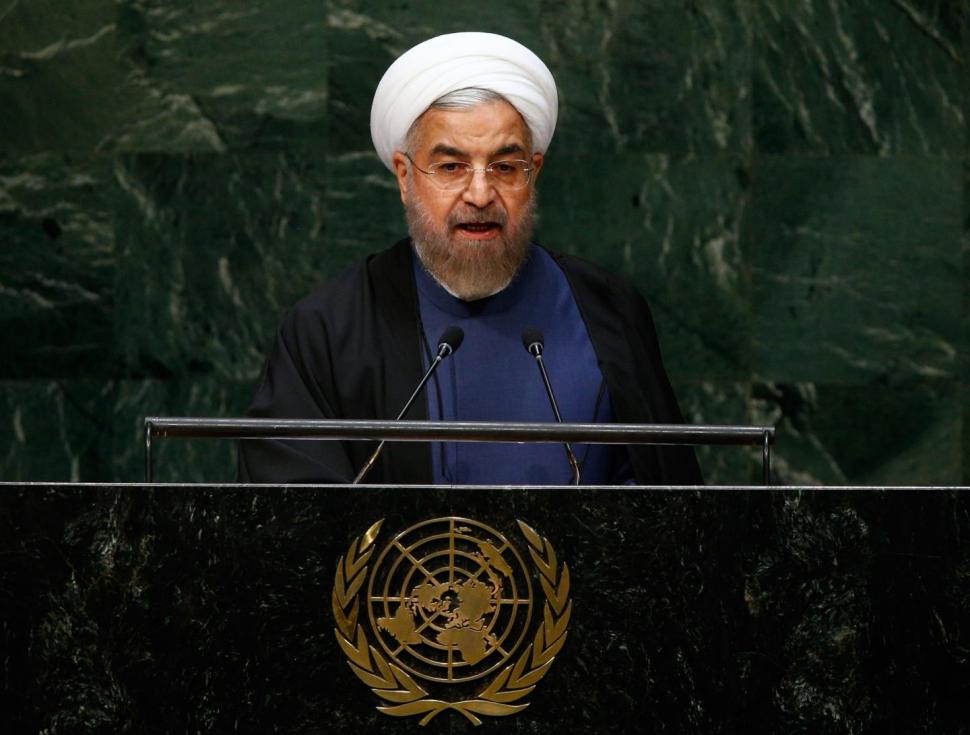 Hassan Rouhani of Iran.








 anneinpt
 artaxes
 danmillerinpanama
 davidking1530
 Peter Hofman
 Joseph Wouk
 Peter
Peter Louisiana Steve
 WarSclerotic
Recent Comments