Archive for the ‘Iran – Syria war’ category

Israel’s biggest fears are materializing

September 27, 2015

Israel’s biggest fears are materializing, Israel Hayom, Boaz Bismuth, September 27, 2015

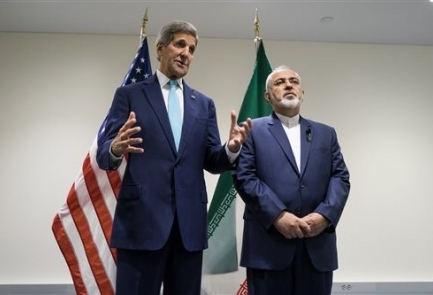
144334028328300476a_bThe Munich moment is upon us. U.S. Secretary of State John Kerry with Iranian Foreign Minister Mohammad Zarif at U.N. headquarters on Saturday | Photo credit: AP

Washington is reaching out to Russia, which is openly helping Syrian President Bashar Assad, who is working in conjunction with Iran, which in turn supports Hezbollah. Now Europe is prepared to talk to Assad, but what about us, for heaven’s sake?

Two years ago to the day, in September 2013, U.S. Secretary of State John Kerry compared Bashar Assad to Adolf Hitler, after the Syrian dictator once again used chemical weapons against his own people. “This is our Munich moment,” Kerry said at the time.

As far as the Americans were concerned, Assad had crossed a line. In those days (more like in those hours, actually), Washington briefly believed that a failure to respond to Assad’s actions would send a dangerous message to Iran regarding its nuclear ambitions.

“Will [Iran] remember that the Assad regime was stopped from those weapons’ current or future use, or will they remember that the world stood aside and created impunity?” Kerry asked at the time. History and retrospect have turned what may have been Kerry’s greatest speech into remarks entirely detached from reality.

The United States did not attack, Assad is still in power, and an ominous nuclear deal has been signed with Iran. It is no wonder that there is a new kind of atmosphere in the region, under American auspices. There are no more good guys and bad guys; everyone is a partner. And thanks to this new reality, Assad now has a renewed license to rule, after having received a license to kill.

Washington is reaching out to Russia, which is openly helping Assad in Syria, who is working in conjunction with Iran, which in turn supports Hezbollah. Europe (Angela Merkel), in the meantime, startled by its refugee crisis, is already prepared to talk with Assad; the same Assad who was compared to Hitler only two years ago. But what about us, for heaven’s sake?

Regretfully, Israel’s biggest fears are now materializing. Instead of being the architects and shaping a new reality in the Middle East, Washington is falling into line with the existing reality. Russia, Syria and Iran are enjoying the consequent vacuum. When the cat is away, the mice will play. Now, all of a sudden, even Hezbollah chief Hassan Nasrallah is letting himself go on television, beaming with joy. Aside from the 75 tanks Damascus is giving him, he now sees his two patrons (Damascus and Tehran) become partners with the West, without having to change one bit.

There is no diplomatic vacuum

The latest developments in Syria are not encouraging: Assad’s first target, with Russia’s help, is expected to be the Nusra Front rebel group, which not only threatens Assad but is also a bitter enemy of the Islamic State group. In other words, somewhat paradoxically, Islamic State could initially benefit from the Russian intervention in Syria.

And one final word about Iran’s rapprochement with the international community: We have been told repeatedly that this was only about the nuclear deal, but in reality we can see cooperation between the U.S. and Iran in Iraq and in the war against Islamic State. We can also see American-Iranian dialogue regarding Syria’s future, and on Saturday night we learned of a gigantic deal worth upwards of $21 billion between Iran and Russia. This time I am forced to agree with Secretary Kerry: This really does look like a Munich moment.

Clearing my spindle, Syria edition

September 26, 2015

Clearing my spindle, Syria edition, Power LineScott Johnson, September 26, 2015

The withdrawal of the United States from Iraq and points elsewhere around the Middle East has created a vacuum that has been filled by forces hostile to the United States. Syria is representative. ISIS has moved into Syria from Iraq. Iran and Hezbollah have both moved into Syria to defend the Assad regime from ISIS.

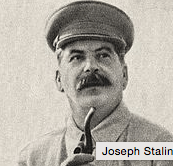
Stalin

The Obama administration has taken a sort of Stalinist tack. Obama has concentrated on building socialism in one country (i.e,, the United States) rather than protecting the national interests of the United States abroad in a difficult foreign theater, especially insofar as doing so might complicate Obama’s dreams of an entente with Iran.

Last week brought a new round of Syria related stories. At the Weekly Standard, Lee Smith noted “Obama’s Syria doctrine.” Obama disclaims responsibility even for his own pathetically failed approach:

In the wake of last week’s embarrassing revelation that only four or five U.S.-trained rebels are currently engaged in fighting the Islamic State, the White House was scrambling to deflect blame. It wasn’t Obama’s fault, said White House press secretary Josh Earnest. The president never wanted to back the rebels in the first place. His hand was forced by administration figures and Republican lawmakers who wanted to aid the rebels. It’s time, said Earnest for “our critics to fess up in this regard as well. They were wrong.”

Enter Russia. Barbara Starr & Ross Levitt report for CNN: Russian fighter jets enter Syria with transponders off”

Lucas Tomlinson & Jennifer Griffin report for FOX News “Russians, Syrians and Iranians setting up military cooperation cell in Baghdad”. Tomlinson and Griffin note:

Russian, Syrian and Iranian military commanders have set up a coordination cell in Baghdad in recent days to try to begin working with Iranian-backed Shia militias fighting the Islamic State, Fox News has learned.

Western intelligence sources say the coordination cell includes low-level Russian generals. U.S. officials say it is not clear whether the Iraqi government is involved at the moment.

Describing the arrival of Russian military personnel in Baghdad, one senior U.S. official said, “They are popping up everywhere.”

The Wall Street Journal published two important stories last week. Dion Nissenbaum & Carol Lee report: “Russians expand military presence in Syria, satellite photos show.” Jay Solomon & Sam Dagher report: “Russia, Iran seen coordinating seen coordinating of Assad regime in Syria.”

And Prime Minister Netanyahu flew to Moscow with two members of the IDF General Staff to meet with Putin about Russia’s moves in Syria. “In Moscow,” the Times of Israel reported, “presence of generals sends a message of military urgency.” President Obama, however, is taking the long view. A couple of weeks ago Obama declared Russia’s Syrian adventure to be “doomed to failure.” Obama’s judgment represents a striking case of projection.

Like it or not, Putin’s is the ‘only game in town’

September 26, 2015

Like it or not, Putin’s is the ‘only game in town’ Gulf News, Mustapha Karkouti, September 26, 2015

(Nature abhors a vacuum and Obama created one in the Middle East. Please see also, A Chinese aircraft carrier docks at Tartus to support Russian-Iranian military buildup. — DM)

With a nearly total absence of any significant US-led coalition presence in Syria, apart from slow-effective air strikes, Moscow seems to be the only dominant player in that region. As the Kremlin clearly stated, Putin’s intention is to prevent a repetition of Libya’s 2011 scenario and avoid the total collapse of Bashar Al Assad’s authority, similar to what happened following Muammar Gaddafi’s overthrow after the badly-planned intervention by Nato. Putin is simply, but clearly, saying to the West: Where you failed in Libya, I’ll do better in Syria.

[W]hatever Putin’s plans are in the long run, his mission in the country is largely seen by the majority of Syrians as a sinister effort to save Al Assad and help him consolidate his authority in Syria.

**********************

It is very rare that a Russian head of state holds top strategic talks with an Israeli prime minister in the Russian capital. This happened just recently when Vladimir Putin met Benjamin Netanyahu to discuss Syria’s latest developments. The two chiefs are not known to have had close and friendly personal relations, but they displayed those sitting side by side in the Kremlin last week. The arrival in Moscow last Monday of Netanyahu accompanied by his chief of staff and head of military intelligence, is by all means unprecedented.

The visit is significant as it is a part of tripartite diplomatic activities that involve discussions with the US as well. The American Defence Secretary Ashton Carter has recently had a long and “useful” discussion with his Russian counterpart over Syria. With the current congestion of military activities in the sky above the region by the Israelis and Americans and the rapidly increasing presence of Russian forces and hardware, there is obviously a need to liaise to avoid any unpredicted conflict, i.e. shooting down one another’s planes by mistake. But both the US and Israel’s main concern goes far beyond the technicalities. They aim mostly at finding out what exactly the Kremlin’s long term purpose in Syria is and how far Moscow is capable of effectively controlling the direction of the tragic game currently being played in this sad country.

Sitting next to Netanyahu, Putin reassuringly explained what he was trying to achieve by stating that Moscow’s main goal was “to protect the Syrian state”, or more accurately, what’s left of it. The Russian president seemed fully aware of Netanyahu’s main concern of the Iran-supported potential attacks by Hezbollah and the Syrian army across the occupied Golan Heights, when he told his visitor that neither Damascus nor the Iranian-financed Lebanese militia was “in any state to open a second front”. In others words, Putin reassured Netanyahu that Moscow was fully engaged with Tehran and Damascus on that front.

Saving Al Assad

With a nearly total absence of any significant US-led coalition presence in Syria, apart from slow-effective air strikes, Moscow seems to be the only dominant player in that region. As the Kremlin clearly stated, Putin’s intention is to prevent a repetition of Libya’s 2011 scenario and avoid the total collapse of Bashar Al Assad’s authority, similar to what happened following Muammar Gaddafi’s overthrow after the badly-planned intervention by Nato. Putin is simply, but clearly, saying to the West: Where you failed in Libya, I’ll do better in Syria.

The timing of Moscow’s build-up along the Syrian coastal area couldn’t be more perfect, particularly with western policy on the country in a state of limbo. Surely, moving dozens of combat aircraft and hundreds of troops to the aid of the encircled Syrian president must have been given the green light a while ago. This is precisely how Putin sees the situation. Under the nose of the Americans and the world community, Russian personnel and Special Forces have re-emerged in large numbers at an old air base of theirs near Al Assad’s stronghold of Latakia. Russia has always had, through the former Soviet Union, significant military presence in Syria during the long years of the Cold War and beyond.

However, whatever Putin’s plans are in the long run, his mission in the country is largely seen by the majority of Syrians as a sinister effort to save Al Assad and help him consolidate his authority in Syria.

After all, Al Assad is the man largely accused of killing thousands of Syrians during the almost five-year war in the country. It has become absolutely clear that all players in the region, including US, Israel, Turkey and Iran are adjusting to the new reality as a result of the speed and scale of Russian’s deployment. It is commonly known now that Israel was made aware of Moscow’s deployment before it began, while Iran had been informed of the move as early as the first week of August. In fact, shipments from Black Sea ports to the Syrian port of Tartous began to pass through the Bosphorus as from August 20.

The Russians had moved by last Tuesday into the coastal stretch between Latakia and Tartous 28 combat jets (12 Su24 bombers, 12 Su25 ground attack aircraft and 4 Su-30 multi-role fighters), two types of drones and 20 multi-purpose helicopters. Almost the equivalent of Al Assad’s entire air power. Pentagon officials have confirmed these deployments and said Russian drones are now fully operating where offensive air attacks could be expected very soon.

Turkey on its part, is willing to dip its hands in ‘Syria’s Cake’ as a highly Turkish informed source told me few days ago, and send troops into the country, provided it gets the green light to set up its ‘no-fly zone’ along Syria’s northern borders. In fact, discussion between Ankara and several European capitals, including Berlin, over the issue has been going on for sometimes as many European leaders consider the no-fly zone option is urgently needed method to help controlling the flow of refugees into European Union countries.

However, with Iran well entrenched behind Al Assad at an annual cost of $6-$10 billion (Dh22-36.7 billion), it is also a decisive regional power of huge influence in shaping events in shrinking Syria and beyond. Additionally, there is newcomer into the killing fields of Syria as China has just officially revealed that it is sending personnel and advisers to assess the situation. And with almost total US absence in the Levant, Russia would militarily and politically remain the most significant power to shore up Al Assad’s regime as long as it is possible.


A Chinese aircraft carrier docks at Tartus to support Russian-Iranian military buildup

September 26, 2015

A Chinese aircraft carrier docks at Tartus to support Russian-Iranian military buildup, DEBKAfile, September 26, 2015

liaoning_Tartus_25.9.15

This turn of events has a highly detrimental effect on Israel’s strategic and military position. It also strengthens Iran’s supreme leader Ayatollah Ali Khamenei in his determination to turn the nuclear deal concluded in July into a tool for isolating the US politically, militarily and economically in the Middle East, rather than a milestone on the road to a breakthrough in ties with Iran, as the Obama administration had hoped. 

***********************

As US President Barack Obama welcomed Chinese President Xi Jinping to the White House on Friday, Sept. 25, and spoke of the friendship between the two countries, the Chinese aircraft carrier Liaoning-CV-16 docked at the Syrian port of Tartus, accompanied by a guided missile cruiser. This is revealed exclusively byDEBKAfile.

Beijing is not finding it hard to dance at two weddings, wooing the US for better relations, while at the same time backing Russia in its military intervention in Syria. Coupled with the warm smiles and handshakes exchanged at the lavish reception on the White House lawn, Beijing was clearly bent on showing muscle – not just in the South China Sea, but by allying itself with the Russian-Iranian political and military buildup in support of Syrian President Bashar Assad and his regime.

DEBKAfile’s military sources report that the Chinese aircraft carrier passed through the Suez Canal on Sept. 22, one day after the summit in Moscow between Russian President Vladimir Putin and Israeli Prime Minister Binyamin Netanyahu.

When they talked, Putin made no mention of the Chinese warship entering the eastern Mediterranean or its destination. Its arrival has upended the entire strategic situation surrounding the Syrian conflict, adding a new global dimension to Moscow and Tehran’s military support for Assad.

This was grasped at length by US Secretary of State John Kerry. On Sept. 25, he sent Under Secretary of State Wendy Sherman, who also led the US negotiating team for the nuclear talks with Iran, to announce that the Obama administration is ready for dialogue with Iran about the situation in Syria, and this topic would be raised when Kerry’s met Iranian Foreign Minister Muhammad Jawad Zarif in New York on Sept. 26.

But if the top US diplomat hoped to bypass the Russian initiative in Syria by going straight to Tehran, he was too late. Iran is already moving forward fast to augment its military presence in the war-torn country, buttressed by the ground, air and sea support of two world powers, Russia and China.

This turn of events has a highly detrimental effect on Israel’s strategic and military position. It also strengthens Iran’s supreme leader Ayatollah Ali Khamenei in his determination to turn the nuclear deal concluded in July into a tool for isolating the US politically, militarily and economically in the Middle East, rather than a milestone on the road to a breakthrough in ties with Iran, as the Obama administration had hoped.

Our military sources find evidence that the Chinese forces are digging in for a prolonged stay in Syria. The carrier put into Tartus minus its aircraft contingent. The warplanes and helicopters should be in place on its decks by mid-November – flying in directly from China via Iran or transported by giant Russian transports from China through Iranian and Iraqi airspace.

This explains the urgency of establishing a RussianSyria-Iranian “military coordination cell” in Baghdad in the last couple of days. This mechanism, plus the Russian officers sighted in Baghdad, indicates that the Russian military presence is not limited to Syria but is beginning to spill over into Iraq as well.

The coordination cell – or war room – was presented as necessary to begin working with Iranian-backed Shiite militias fighting the Islamic State in both places. But more immediately, it is urgently needed to control the heavy traffic of Russian, Iranian and Chinese military flights transiting Iraqi air space.

Our sources report that the Chinese will be sending out to Syria a squadron of J-15 Flying Shark fighters, some for takeoff positions on the carrier’s decks, the rest to be stationed at the Russian airbase near Latakia. The Chinese will also deploy Z-18F anti-submarine helicopters and Z-18J airborne early warning helicopters. In addition, Beijing will consign at least 1,000 marines to fight alongside their counterparts from Russia and Iran against terrorist groups, including ISIS.

DEBKAfile’s counterterrorism sources point out that just as Russian marines will be instructed to single out rebel militias with recruits from Chechnya and the Caucasus, the Chinese marines will seek out and destroy Uighur fighters from the northern predominantly Muslim Chinese province of Xinjiang.

In the same way that Putin has no wish to see the Chechen fighters back in Russia, so too Chinese President Xi wants to prevent the Uighurs from returning home from the Syrian battlefields.

Russian marines join Hizballah in first Syrian battle – a danger signal for US, Israel

September 24, 2015

Russian marines join Hizballah in first Syrian battle – a danger signal for US, Israel, DEBKAfile, September 24, 2015

KweirisAir480

[T]he most ominous aspect for the US and Israel of the Russian attack on the Syrian airbase is that Russian marines were combined with Syrian and Hizballah special forces.

*********************

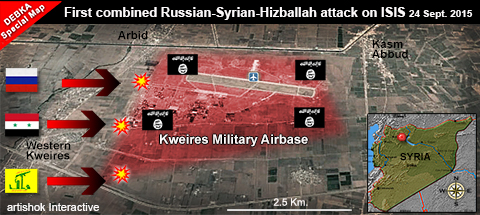
Before dawn on Thursday, Sept. 24, Russian marines went into battle for the first time since their deployment to Syria, DEBKAfile’s military and intelligence sources reveal. Russian Marine Brigade 810 fought with Syrian army and Hizballah special forces in an attack on ISIS forces at the Kweiris airbase, east of Aleppo.

This operation runs contrary to the assurances of President Vladimir Putin to Prime Minister Binyamin Netanyahu on Sept. 21 – just three days ago – that Russian forces in Syria were only there to defend Russian interests and would not engaged in combat with the Syrian army, Hizballah or Iranian troops.

The ISIS force defending the air base is dominated by Chechen fighters under the command of Abu Omar al-Shishani, who is considered one of the terrorist organization’s leading commanders in the last two years. The 27-year-old al-Shishani hails from the Chechen enclave of Pankisi in Georgia, like many others who joined ISIS from 2012.

However, targeting Chechen fighters was not the only reason for the order given by Russian command in Syria to attack the air base.  In DEBKA Weekly 678 of September 11, we predicted that the first Russian mission in Syria would be to break the Syrian rebel siege on Aleppo, Syria’s second-largest city.

As their first step, the Russians would have to prevent the cutoff of highway 5, running from Aleppo to Damascus, and keep it open for Syrian army reinforcements and military equipment to the city.

The offensive to regain Kweiris airbase that fell to ISIS in mid-June is the first step in the implementation of Russia’s operational plan for the Aleppo area.

Meanwhile, little substance was to be found in the reports appearing, mainly in the United States, suggesting that Putin, disappointed by the Obama administration’s unwillingness to send the US Air Force to collaborate with Russia in the fight against ISIS, would try to talk Obama round if and when they meet on the sidelines of the UN General Assembly on September 28.

According to DEBKAfile’s sources, these reports were spread to cover up the serious crisis in the US war against ISIS.

While Russia poured troops and advanced hardware into Syria, establishing bases and launching offensive action, the US anti-Islamic State effort suffered a heavy blow with the decision of Obama’s ISIS war czar, Gen. John Allen, to step down in early November.

Sources close to the general were quoted as referring to his frustration “with the White House micromanagement of the war and its failure to provide adequate resources.”’

The fact that the Russian forces launched their attack on ISIS shortly after the announcement of Allen’s upcoming resignation shows that Putin is not waiting for US cooperation in the war on the Islamist terrorists.    That said, DEBKAfile’s military sources point out that the most ominous aspect for the US and Israel of the Russian attack on the Syrian airbase is that Russian marines were combined with Syrian and Hizballah special forces.

For the first time in 41 years, since the 1974 war of attrition against the IDF on the Golan, Russian troops are fighting alongside Syrian forces. It is also the first time that a world power like Russia is willing to go into battle with an acknowledged terrorist group, such as Hizballah.

Our sources point out that the joint attack was completely counter to the tone and the content of the comments exchanged by Putin and Netanyahu at their summit.

A full report on Russian military activity and strategic objectives in Syria, and a rundown of the content of the Putin-Netanyahu talks in Moscow appear in the coming issue of DEBKA Weekly out Friday, September 25.

Russian troops already engaged in battle against ISIS around Homs

September 17, 2015

Russian troops already engaged in battle against ISIS around Homs, DEBKAfile, September 17, 21015

Russia_Putin267

Contrary to the impression conveyed by Moscow that Russian troops in Syria are not engaged in combat and that none of the sophisticated arms deliveries were destined to the Syrian army, new developments belie both these claims. 

DEBKAfile’s military and intelligence sources report that on Wednesday, September 16, Russian R-166-0.5 (ultra) high-frequency signals (HF/VHF) vehicles were spotted on Highway 4, which links Homs and Aleppo. These vehicles, called “mobile war rooms” by the IDF and Western armies, were accompanied by BTR-82 troop carriers transporting Russian marines. The R-166-0.5 enables communication with forces located on battlefields as far as 1,000 kilometers away using high frequency and ultra-high frequency signals.

The communication systems are resistant to electromagnetic jamming so Russian forces operating deep inside Syria can report to their commanders at the main Russian base in Latakia or receive orders, intelligence data and even video from drones or planes.

Another feature is a cylinder on the side of the vehicle containing a folded antenna that can be raised to a height of 15 meters.

The R-166-0.5 is an integral part of Russia’s battlefield operations, so it would not be deployed unless long-distance troop movements were underway. The appearance of those vehicles in the Syrian theater provides a clear signal of Moscow’s intentions.

Our sources point out that during the past few days, fighters from the Islamic State in Iraq and the Levant (ISIS) succeeded in cutting off part of the highway between Homs and Aleppo for several hours. It marked a very dangerous development for the Syrian army and regime, because a permanent cutoff of Highway 4 would tighten the siege on Aleppo and possibly pave the way for the conquest of the second-largest city in Syria.

The movements by the armored vehicles show that the Russian troops are preparing to head into battle in order to prevent such a scenario.

Moscow has denied supplying new, sophisticated weapons to the Syrian army. However, a Syrian military source revealed Thursday, Sept. 17, that the Syrian military has recently started using new types of air and ground weapons supplied by Russia, underlining growing Russian support to Damascus that is alarming the United States and Israel. “New weapons – and new types of weapons – are being delivered,” said the source which described them as “highly accurate and effective.”  The army had started using them in recent weeks having been trained in their use in Syria in recent months. “We can say they are all types of weapons – be it air or ground,” he said.

DEBKAfile’s military sources reveal that the Russian shipments for the Syrian army include MI-28 MIL assault helicopters (NATO-coded Havoc), an all-weather aircraft, which can also serve as an anti-tank weapon against the mostly US-made tanks fielded by ISIS and Al Qaeda’s Nusra Front Syrian arm.

Our military and intelligence sources point out that Moscow has given itself room to maneuver in terms of its declared goals, telling Washington and Jerusalem during the past few days that its troops will defend their own interests if there is a need to do so. Thus, Russia aims to use its forces in any way that it deems fit.

DEBKAfile’s sources in Washington report an ongoing debate within the Obama administration regarding whether to accept the proposal that was raised during the telephone conversations this week between Russian Foreign Minister Sergei Lavrov and US Secretary of State John Kerry.

Moscow proposed military-to-military talks on ways to prevent a confrontation between its troops in Syria and those of the US-led coalition, saying that the talks would provide a complete and clear understanding of Moscow’s intentions.

Unlike Kerry, who is in favor of taking the Russians up on their proposal, some circles in the administration feel that such talks would ultimately give Russia the green light for its military involvement and that Moscow is in the process of grabbing control of running all military operations in Syria, including those by other countries and groups.

Last week, Gen. Qassem Soleimani, commander of Iran’s al-Quds brigades, visited Moscow for the second time since April.  DEBKAfile’s sources in Moscow point out that this time, unlike his previous visit, Soleimani met with Russia’s National Security Adviser Nikolai Patrushev and a number of generals directly connected to the buildup in Syria, but not with President Vladimir Putin.

The developments in Syria will also take center stage when Israeli Prime Minister Benyamin Netanyahu meets with Putin in Moscow on September 21.

Is Europe Losing Control Over Its Destiny?

September 13, 2015

Is Europe Losing Control Over Its Destiny? Gatestone InstituteSoeren Kern, September 13, 2015

  • The move by unelected bureaucrats in Brussels to force European countries to throw open their borders — and to require them to provide migrants with free clothing, food, housing and healthcare for an indefinite period of time — not only represents an audacious usurpation of national sovereignty, it is also certain to encourage millions of additional migrants from the Muslim world to begin making their way to Europe.
  • “We are not facing a refugee crisis, we are facing a migration crisis… Let us not forget that those arriving have been raised in another religion, and represent a radically different culture. Most of them are not Christians, but Muslims. This is an important question, because Europe and European identity is rooted in Christianity. Is it not worrying in itself that European Christianity is now barely able to keep Europe Christian? If we lose sight of this, the idea of Europe could become a minority interest in its own continent.” — Prime Minister Viktor Orbán of Hungary.
  • “[T]he continent is experiencing a mass movement of people not seen since the aftermath of the Second World War. Unlike the end of the war, however, none of the masses currently on the move is European… The control over one’s own borders is one of the most important characteristics — and responsibilities — of a modern state. Countries lose control over their destinies and even cease to exist when they lose control over who gets in.” — Arthur Chrenkoff, New York Observer.
  • Statistics show that of the 625,920 people who applied for asylum in the European Union in 2014, only 29.5% were from Syria, Afghanistan and Iraq.
  • “If you do not like it, just go away.” — Czech Republic President Milos Zeman, commenting that no one had invited migrants to his country, but once they arrive, they should respect the rules of his country or leave.
  • “The lesson for the United States is that reducing our global influence does not increase international peace and security. Quite the opposite. Obama’s retreat from the Middle East, whether in the aftermath of Libya, his disinterest in the Islamic State’s continuing rise, or his surrender to Iran’s nuclear-weapons program, are all part of the larger pattern.” — Ambassador John R. Bolton, Fox News Opinion.
  • “Since Slovakia is a Christian country, we cannot tolerate an influx of 300,000-400,000 Muslim immigrants who would like to start building mosques all over our land and trying to change the nature, culture and values of the state…. If we do not start telling the truth about migration, we will never move from this spot.” — Prime Minister Robert Fico, Slovakia.

The European Commission, the powerful administrative arm of the European Union, has unveiled a controversial plan that would compel EU member countries to accept 160,000 migrants and refugees from the Middle East and North Africa.

The move by unelected bureaucrats in Brussels to force European countries to throw open their borders — and to require them to provide migrants with free clothing, food, housing and healthcare for an indefinite period of time — not only represents an audacious usurpation of national sovereignty, it is also certain to encourage millions of additional migrants from the Muslim world to begin making their way to Europe.

The migration proposal, announced on September 9, would “share” 120,000 migrants currently holed up in Greece, Hungary and Italy with other countries in the European Union. This number is in addition to previous demands by the European Commission that 40,000 Syrian and Eritrean migrants be relocated from Greece and Italy.

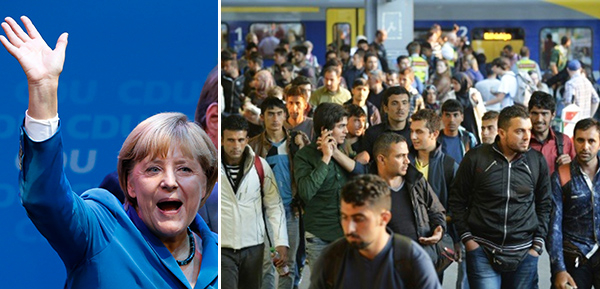
German Chancellor Angela Merkel, whose open-door immigration policy is partly responsible for fueling the rush of migrants to Europe, has already warned that the European Commission’s plan is “merely a first step” and that Europe may have to accept even bigger numbers. German Vice Chancellor Sigmar Gabriel said that Germany could take 500,000 migrants annually for “several more years.”

1243Welcome to Germany! At left, German Chancellor Angela Merkel. At right, some of the hundreds of migrants who arrived in Munich on September 12, 2015.

It remains unclear just how many of the migrants arriving in Europe are refugees fleeing warzones, and how many are economic migrants seeking a better life in the West. Statistics show that of the 625,920 people who applied for asylum in the European Union in 2014, only 29.5% were from Syria, Afghanistan and Iraq.

German officials have admitted that 40% of the migrants arriving in the country in 2015 are from the Balkans, including Albania, Kosovo and Serbia, which implies that at least half of those arriving in Germany this year are economic migrants fleeing poverty not war.

Critical observers are describing the migration chaos engulfing Europe in apocalyptic terms: an “unstoppable demographic revolution,” a “total Armageddon scenario,” and an “exodus of biblical proportions.”

What follows is a selection of quotes and commentary from a variety of political leaders and opinion-shapers in Europe and elsewhere about the consequences of untrammeled immigration from the Muslim world.

In Britain, Nigel Farage, the leader of the Eurosceptic UK Independence Party (UKIP), spoke to the BBC Radio 4’s Today program. He said:

“The problem we’ve got is we’ve opened the door to an exodus of biblical proportions meaning millions and millions of refugees. We’ve lost sight of what it is to be a refugee. How many millions does Europe want to take? That is the question.

“Genuine refugees have tended to be groups of people, ethnic groups or religious groups who were directly under persecution and were fleeing in fear of their lives. The problem we’ve got now if you look at the definition of the EU’s common asylum policy, it includes anyone fleeing from a war-torn country, and it even includes people fleeing extreme poverty.”

British MEP Janice Atkinson, said:

“Nobody voted for illegal immigration. Plenty of people voted to put us here to oppose it. The hundreds of thousands of illegal immigrants overwhelming our borders and our capacities to cope are exactly that — illegal.

“Let’s be clear about another thing: despite what the human rights industry and the massed ranks of taxpayer-funded charities and lobby-groups repeat, this is not a refugee crisis but a massive crisis of illegal immigration which must be resisted for what it is.”

English author and journalist Peter Hitchens, in an essay titled, “We won’t save refugees by destroying our own country,” wrote:

“Actually we can’t do what we like with this country. We inherited it from our parents and grandparents and we have a duty to hand it on to our children and grandchildren, preferably improved and certainly undamaged. It is one of the heaviest responsibilities we will ever have. We cannot just give it away to complete strangers on an impulse because it makes us feel good about ourselves….

“Thanks to a thousand years of uninvaded peace, we have developed astonishing levels of trust, safety and freedom…. I am amazed at how relaxed we are about giving this away.

“Our advantages depend very much on our shared past, our inherited traditions, habits and memories. Newcomers can learn them, but only if they come in small enough numbers. Mass immigration means we adapt to them, when they should be adapting to us….

“So now, on the basis of an emotional spasm, dressed up as civilization and generosity, are we going to say that we abandon this legacy and decline our obligation to pass it on, like the enfeebled, wastrel heirs of an ancient inheritance letting the great house and the estate go to ruin?

“I can see neither sense nor justice in allowing these things to become a pretext for an unstoppable demographic revolution in which Europe (including, alas, our islands) merges its culture and its economy with North Africa and the Middle East. If we let this happen, Europe would lose almost all the things that make others want to live there.”

British MEP Daniel Hannon warned that Germany’s open-door immigration policy was drawing ever more migrants to Europe. He wrote:

“The belief that Germany is relaxing its policy is bound to lead to a level of migration that surpasses anything seen so far. Refugees and economic migrants will be thrown together in a rush. Some will be trampled, and some boats will be overturned. But many more will reach Italy and Greece. Eventually, the front-line EU states will stop trying to enforce the rules, and will simply wave new arrivals across their territory, tempting even more into attempting the crossing.”

The London-based Financial Times lamented the lack of a unified European response to the migration crisis:

“This has been a miserable summer for European ideals. From a bloc founded in the pursuit of peace have emerged frightful images of refugees suffocating on motorway lay-bys, squalid makeshift camps, lifeless toddlers washed ashore, burning asylum centers, serial numbers penned on forearms, the sight of black-clad police pepper spraying families fleeing war. Inundated with asylum seekers, yet lacking the central functions to cope, Europe is divided over what to do. Higher walls? Welcome mats? Is this a national problem or should the burden be shared?

British political scientist Anthony Glees accused the German government of rank hypocrisy for demanding that Greece comply with the strict letter of EU law to obtain a financial bailout, but that same German government unilaterally dispensed with EU law to open Europe’s borders wide open to hundreds of thousands of migrants from the Muslim world. He said:

“Europe’s tectonic plates will move if Germany behaves as a hippie state, guided only by feelings. Prime Minister David Cameron said, quite rightly, in my opinion, that the United Kingdom must act not only with the heart, but also with the head. And the question in the UK is that if Frau Merkel now pursues this policy, a very different policy which it pursued vis-à-vis Greece, where will this end? The UK already intervenes militarily in the fight against the so-called Islamic State. Germany, however, has kept its distance from these things. But then at the same time to say to desperate people in Syria and Iraq, please come to the Federal Republic of Germany, many Britons view this as nonsensical. This will have no end!

“I think it may be that Germany still has historical feelings that are completely absent in Britain. It may be that in 2015, there are still memories of what happened with refugees before the Second World War (1938/1939). But in Britain, where we are currently not only fighting terrorism, not only coping with the problem of economic migrants, but also coping with the humanitarian problem, the German approach seems sloppy and not properly thought through, especially when it comes to Europe when the Germans do not abide by the rules. One may think whatever they might about the Hungarian government, but the rules are there, and if Germany does not comply with the rules, the entire Union is in danger of falling apart.

In Brussels, the self-proclaimed capital of Europe, the president of the European Commission, Jean-Claude Juncker, insisted that immigration from Muslim countries would be a solution to Europe’s demographic decline. He said:

“Let us not forget, we are an ageing continent in demographic decline. We will be needing talent. Over time, migration must change from a problem to be tackled to a well-managed resource. To this end, the Commission will come forward with a well-designed legal migration package in early 2016.”

During the so-called State of the European Union address on September 9, Juncker said that there was no difference between Christian, Jewish and Muslim migrants. He said:

“Europe has made the mistake in the past of distinguishing between Jews, Christians and Muslims. There is no religion, no belief and no philosophy when it comes to refugees.”

Although unemployment is rampant within the European Union, especially among young Europeans, Juncker said:

“I am strongly in favor of allowing asylum seekers to work and earn their own money whilst their applications are being processed. Labor, work, being in a job is a matter of dignity…so we should do everything to change our national legislation in order to allow refugees, migrants, to work since day one of their arrival in Europe.”

In the Czech Republic, President Milos Zeman said that no one had invited migrants to his country, but once they arrive, they should respect the rules of his country or leave. He said:

“If you do not like it, just go away. Someone may consider it appealing to the worst instincts, but this is the same stance that Hungarians share when they are building a fence against Serbia, and Americans who have built a fence on its border with Mexico.”

In Denmark, Andreas Kamm, the secretary general of the Danish Refugee Council (Dansk Flygtningehjælp), warned that the current refugee crisis could lead to total collapse of European society. In an interview with the newspaper Jyllands-Posten, Kamm said he believes that Europe is facing “a total Armageddon scenario.” He added:

“We are experiencing a historical imbalance between the very high numbers of refugees and migrants and the global capacity to provide them with protection and assistance. We are running the risk that conflicts between the migrants and local populations will go awry and escalate. The answer cannot be that Europe imports surplus populations. We cannot be required to destroy our own society.”

Danish Finance Minister Claus Hjort Frederiksen said: “I’m most indignant over the Arab countries who are rolling in money and who only take very few refugees. Countries like Saudi Arabia. It’s completely scandalous.”

In Germany, Interior Minister Thomas de Maizière, in an interview with Die Zeit, said:

“The migration crisis presents a formidable challenge. It is bigger than any of us have previously thought — socially, politically, economically, culturally…. Now we will get hundreds of thousands of Muslims with an Arab background. According to what I am told by my French colleague, this is a significant difference as far as integration is concerned…. I am being told that between 15% and 20% of the adult migrants are illiterate.

“We must get used to the idea that our country is changing. School, police, housing, courts, health care, everywhere! We also need an amendment to the constitution. And all this has to happen very quickly, within weeks! This will require a huge change in our established way of thinking.”

In an interview with Politico, Josef Joffe, a normally astute Jewish-German intellectual who is the publisher of the newspaper Die Zeit, seemed completely oblivious to the long-term consequences of importing hundreds of thousands of Muslims to Germany, when he said:

“It is a true miracle. Our poster-boy refugee is now the Syrian doctor who combines educational achievement with moral obligation, given the unspeakable cruelty against civilians in the Syrian war. Germany, like the countries of English settlement, is turning into an Einwanderungsland, a country of immigration, accepting different colors, faiths and origins. So Germany is evolving into a kind of America, where you need not be born as American, but can become one. It is a mental and emotional revolution.”

In Hungary, Prime Minister Viktor Orbán warned of the “explosive consequences” of culture clash between Europe and migrants from the Muslim world. In a September 3 essay published by the Frankfurter Allgemeine Zeitung, Orbán wrote:

“To understand what we must do, we need to grasp the true nature of the situation we are facing. Europe is not in the grip of a ‘refugee problem’ or a ‘refugee situation,’ but the European continent is threatened by an ever mounting wave of modern-era migration. Movement of people is taking place on an immense scale, and from a European perspective the number of potential future immigrants seems limitless.

“With each passing day we see that hundreds of thousands have been turning up and clamoring at our borders, and there are millions more intending to set out for Europe, driven by economic motives….

“We must acknowledge that the European Union’s misguided immigration policy is responsible for this situation. Irresponsibility is the mark of every European politician who holds out the promise of a better life to immigrants and encourages them to leave everything behind and risk their lives in setting out for Europe. If Europe does not return to the path of common sense, it will find itself laid low in a battle for its fate….

“Let us not forget that those arriving have been raised in another religion, and represent a radically different culture. Most of them are not Christians, but Muslims. This is an important question, because Europe and European identity is rooted in Christianity. Is it not worrying in itself that European Christianity is now barely able to keep Europe Christian? If we lose sight of this, the idea of Europe could become a minority interest in its own continent.”

Referring to Hungary’s occupation by the Ottoman Empire from 1541 to 1699, Orbán said:

“I think we have a right to decide that we do not want a large number of Muslim people in our country. We do not like the consequences of having a large number of Muslim communities that we see in other countries and I do not see any reason for anyone else to force us to create ways of living together in Hungary that we do not want to see. That is a historical experience for us.”

According to Zoltán Kovács, a spokesman for Hungary’s center-right government, the EU’s response to the crisis has been a complete failure. He said:

“The EU does not differentiate between those who are in real need of help. Genuine refugees are pushed together with economic migrants. We are not facing a refugee crisis, we are facing a migration crisis. People are coming here from a hundred countries around the world. It is completely unacceptable that illegal means of movement are now institutionalized.”

In Slovakia, Prime Minister Robert Fico said that 95% of so-called refugees were actually economic migrants:

“We won’t assist in this folly with arms opened wide with the notion that we’ll accept them all regardless of whether they’re economic migrants or not. If we do not start telling the truth about migration, we will never move from this spot.”

Fico also warned of the consequences of untrammeled Muslim immigration. He said:

“Since Slovakia is a Christian country, we cannot tolerate an influx of 300,000-400,000 Muslim immigrants who would like to start building mosques all over our land and trying to change the nature, culture and values ​​of the state.”

In the United States, Ambassador John Bolton warned that Europe’s migration crisis is America’s problem too. He wrote:

“While Americans may believe that Europe, long disdainful of our own intense debate over border-security problems, is getting what it deserves, we should nonetheless focus on both the potential threats and lessons applicable to us.

“One critical cause of Europe’s illegal-immigration spike is the growing chaos across the greater Middle East. This spreading anarchy derives, in substantial part, from Barack Obama’s deliberate policy of ‘leading from behind’ by reducing U.S. attention to and involvement in the region. When America’s presence diminishes anywhere in the world, whatever minimal order and stability existed there can rapidly evaporate….

“For years, the central cause of population movements into Europe was economic: North Africans crossed the narrow Strait of Gibraltar or headed to France or Italy. Turks and Arabs entered through Greece and Eastern Europe. Once into the European Union, thanks to the Schengen Agreement, travel barriers are now almost nonexistent, and, as in the United States, illegal aliens can essentially travel freely….

“Spreading terrorism, armed conflict and collapsing political authority in the Middle East are now powerful causal factors equaling or exceeding continuing economic disparities. Europe fears being overwhelmed by the sheer numbers of people on the move, thereby losing control over decisions on who to admit and who to turn away. These concerns are legitimate, but there are deeper risks as well. Mirroring worries in Washington, there is a serious and rising Islamicist terrorist threat hidden within the tides of people seeking refuge.

“The lesson for the United States is that reducing our global influence does not increase international peace and security. Quite the opposite. Obama’s retreat from the Middle East, whether in the aftermath of Libya, his disinterest in the Islamic State’s continuing rise, or his surrender to Iran’s nuclear-weapons program, are all part of the larger pattern. Europe’s illegal immigration problem is our problem as well.”

Writing for the New York Observer, Arthur Chrenkoff wrote:

“As an unseasonably hot European summer gives way to autumn, the continent is experiencing a mass movement of people not seen since the aftermath of the Second World War. Unlike the end of the war, however, none of the masses currently on the move is European. As hundreds of thousands of people continue to arrive on Europe’s doorsteps and throng her roads and railway lines, many conservative commentators see a more apt, and more ominous, historical parallel in the Völkerwanderung or ‘wanderings of the peoples’ that foreshadowed the fall of the Roman Empire some sixteen centuries ago. Europeans have long historical memories….

“As we reflect on the vivid media images of boats and trains overflowing with desperate humanity, it is important to keep in mind two points: 1) The majority of the 350,000-400,000 immigrants who have arrived in Europe so far this year (these are the known numbers; no one knows how many enter undetected) are not Syrians. In fact, less than a third are, with the rest originating in a miscellany of African, Middle Eastern and South Asian countries. 2) The majority seem to be single, healthy-looking young men, which traditionally suggests economic motives for migration, rather than the fear of death or persecution.

“What is happening in Europe at the moment is not so much, or at least not predominantly, a refugee crisis but a crisis of European immigration policies.

Chrenkoff summed it up this way:

“The control over one’s own borders is one of the most important characteristics — and responsibilities — of a modern state. Countries lose control over their destinies and even cease to exist when they lose control over who gets in.”
 

Putin’s offer to shield & develop Israel’s gas fields predated Russia’s military buildup in Syria

September 13, 2015

Putin’s offer to shield & develop Israel’s gas fields predated Russia’s military buildup in Syria, DEBKAfile, September 13, 2015

(Nice little gas field you have there. It would be a shame if something happened to it. — DM)


Leviathan480

More than a fortnight ago, Russian President Vladimir put a proposition to Israel for Moscow to undertake responsibility for guarding Israel’s Mediterranean gas fields, along with the offer of a Russian investment of $7-10 billion for developing Leviathan, the largest well, and building a pipeline to Turkey for exporting the gas to Europe, DEBKAfile reports. The offer was made to Prime Minister Binyamin Netanyahu in confidential phone conversations and through quiet envoys.

At the time, Putin did not share with Netanyahu his plans for an imminent buildup of marines, air force units, warships and missiles in Syria, although the plan had been worked out in detail with Tehran in late July. The Russian ruler put it this way: Leviathan abuts on the fringes of Lebanon’s economic water zone and is therefore vulnerable to potential sabotage by Iran, Syria or Hizballah, whether by commando or rocket attack.

A multibillion Russian investment in the field would make it a Russian project which neither Syria nor Hizballah would dare attack, even though it belongs to Israel.

But now the situation has assumed a different face. Russian forces are streaming to Latakia, and Moscow has declared the area from Tartous, Syria up to Cyprus closed to shipping and air traffic from Sept. 15 to Oct. 7 in view of a “military exercise including test firings of guided missiles” from Russian warships.

When he offered a shield for Israeli gas fields in late August, The Russian ruler knew that implementation would rest with Russian military forces on the spot, rather than Iranian and Syrian reluctance to harm Russian interests.

Then, on Aug. 30, Netanyahu discussed the new Russian proposition with Italian Prime Minister Matteo Renzi when they met in Florence, in the context of the former Italian Prime Minister Silvio Berlusconi’s involvement in Middle Eastern and European energy business and his close ties with Putin.

Berlusconi and Netanyahu are also good friends.

The Israeli prime minister never explicitly confirmed to Putin that he would consider the Russian transaction.

He hesitated because he sensed that a deal with Moscow for gas projects would be unacceptable to Washington and Noble Energy of Texas, which holds a 39.66 percent share in the consortium controlling Leviathan, as well as stakes in the smaller Tanin and Tamar gas wells.

Meanwhile, two Israeli ministers, Moshe Kahlon, finance, and Arye Deri, economy, consistently obstructed the final government go-ahead for gas production, tactics which also held Netanyahu back from his reply to Putin.

But when the fresh influx of Russian troops and hardware to Syria became known (first revealed by DEBKAfile on Sept.1), Netanyahu began to appreciate that, not only had Israel’s military and strategic situation with regard to Syria and the eastern Mediterranean been stood on its head, so too had foreign investment prospects for development projects in Israeli gas.

Israel’s strategic landscape had in fact changed radically in four respects:

1.  Its government can no longer accept as a working hypothesis (which never, incidentally, held up) the short term expectancy of the Assad regime. The injection of Russian military might, combined with the Iranian Revolutionary Guards forces, have given Assad a substantial lease of life.

The Israel Defense Forces must therefore revamp its posture on the Syrian front, and reassess its sponsorship of the select rebel groups which are holding the line in southern Syria against hostile Iranian or Hizballah cross-border attacks on northern Israel.

The changing attitude was suggested in views heard in the last couple of days from top Israeli security officials, who now say that leaving Assad in office might be the better option, after all.

2.  The new Russian ground, air and sea buildup taking shape in Syria provides a shield not just for the Assad regime but also Hizballah. This too calls for changes in Israel’s military posture.

3.  The Russian military presence in Syria seriously inhibits Israel’s flexibility for launching military action against Iranian or Hizballah targets when needed.

4. Three aspects of the new situation stand out prominently:

a)  The Russian air force and navy are the strongest foreign military force in the eastern Mediterranean. The US deplloys [sic] nothing comparable.

b)  Israel’s military strength is substantial but no one is looking for a military clash with the Russians, although this did occur four decades ago, when Israel was fighting for its life against Russian-backed Arab invasions.

c)  In view of the prevalence of the Russian military presence in the eastern Mediterranean, it is hard to see any foreign investor coming forward to sink billions of dollars in Israeli gas.

d)  Although Russia called Saturday, Sept. 12, for “military-to-military cooperation with the United States” to avert “unintended incidents” amid its naval “exercises” off the coast of Syria, the tone of the call was cynical. It is more than likely that Moscow may revert to the original Putin offer of a Russian defense shield for Israeli gas fields. But with such strong Russian cards in place in Syria, he may well stiffen his terms for this deal.

Russian submarine with 20 ICBMs and 200 nuclear warheads is sailing to Syria

September 7, 2015

Russian submarine with 20 ICBMs and 200 nuclear warheads is sailing to Syria, DEBKAfile, September 7, 2015

Dmitriy_Donskoy_BDmitri Donskoy TK-208 submarine heads for Syria

The world’s largest submarine, the Dmitri Donskoy (TK-208), Nato-coded Typhoon, has set sail for the Mediterranean and is destined for the Syrian coast, DEBKAfilereports exclusively from its military and intelligence sources. Aboard the sub are 20 Bulava (NATO-code SS-N-30) intercontinental ballistic missiles with an estimated up to 200 nuclear warheads. Each missile, with a reported range of 10,000km, carries 6-10 MIRV nuclear warheads.

The Russian sub set sail from its North Sea base on Sept. 4, escorted by two anti-sub warfare ships. Their arrival at destination in 10 days time will top up the new Russian military deployment in Syria.

President Vladimir Putin’s introduction of a nuclear force opposite Syrian shores builds up what first looked like an operation to fortify Assad’s regime in Damascus into a military expedition capable of an air and sea confrontation with US forces in the Middle East.

US Secretary of State John Kerry suggested as much Saturday, Sept. 5, when he expressed concern over reports of Russia’s “increasing military build-up in Syria” in a phone call to Russian Foreign Minister Sergey Lavrov. The State Department reported: “The Secretary made clear that if such reports were accurate, these actions could further escalate the conflict, lead to greater loss of innocent life, increase refugee flows and risk confrontation with the anti-ISIL coalition operation in Syria.”

Kerry was referring to potential Russian interference with US-led coalition air strikes against the Islamic State in Syria.

DEBKAfile’s sources in Washington and Moscow report that the dispatch of a nuclear sub to Syrian waters is taken as a strong message that the Kremlin will not let the US impede its military intervention in the Syrian conflict and will go to extreme lengths to keep the way open for the flow of Russian troops to the war-torn country.

This situation has gone a long way beyond Obama administration intentions when US-Russian talks were initially held for US forces posted in Turkey and Iraq, together with the Russian troops arriving in Syria, to launch a combined effort against the Islamic State. Those talks came to naught.

In its coming issue out Friday, Sept. 11, DEBKA Weekly 678 will reveal for the first time how Putin intends to array the Russian forces he is consigning to Syria, their operational planning, their military coordination with Iran and, above all, how the new Russian intervention in Syria may impact US Middle East policy and Israel.


Four parties caused Syria’s genocidal calamity. Should Israel get involved?

September 6, 2015

Four parties caused Syria’s genocidal calamity. Should Israel get involved? DEBKAfile, September 6, 2015

migrants_along_railways_5.9.15Refugees flooding into Europe

Chapter by chapter, a long list of the guilty parties must bear responsibility for the Syrian catastrophe hacking the ruined country into bleeding parts.

1.  The first culprit is undoubtedly its insensate president Bashar Assad and his close family, who have had no qualms about spilling the blood of some 300,000 men, women, children and old people – some estimate as many as half a million – and making some 11 people homeless, to keep himself in power. No one has ever counted the number of people maimed and crippled by the war, but they are conservatively estimated at one million.

These figures add up to genocide or serial mass murder, which has been allowed to go into its fifth year.

2.  Iran warrants second billing for this mass crime.

Tehran has laid out the stupendous sum of some $40 billion to keep the mass marderer Assad in power with total disregard for his methods of survival. The motives behind the ayatollahs’ military and political boost are well recorded. Worth mentioning here is that Tehran not only pressed its Lebanese proxy, the Shiite Hizballah group, into service alongside Assad’s army, but sent its its own generals to orchestrate the war, led by the Al Qods Brigades chief Qassem Soleimeni.

We can reveal here that 22 Iranian generals have died fighting for the Assad cause.

3. The third place belongs to the United States and President Barack Obama. His refusal to put American boots on the ground may have been the correct decision for the US, but it had four direct consequences:

a)  The slaughter of the Syrian people continued unchecked. Even after President Obama declared that chemical warfare was a red line, he backed down at the last minute against intervening and ordered the US fleet to draw back from the Syrian coast.

To this day, Assad continues to use chemical weapons to poison his enemies.

b)  Obama and his Secretary of State John Kerry let Iran use its military backing for Assad as a high card in the negotiations for a nuclear accord. Instead of making it a condition for a deal against the lifting of sanctions, Washington allowed Tehran to come away from the table with US non-intervention in Syria as one of its concessions for buying Iran’s assent to the Vienna deal.

Tehran, in a word, won Washington’s tacit approval for propping up the atrocious Syrian ruler.

c)  The rest of the world, including the United Nations and the European Union, followed the Obama administration’s lead and stood aside as at least 11 million Syrians became homeless refugees.

The lifeless body of a three-year old Syrian child washed up from the sea has figured in the Western media as a symbol of the tragic fate of Syria’s refugees. However, his tragedy came after the hair-raising atrocities endured by millions of those refugees for nearly five years.

Many families were forced to sell their daughters as sex slaves to buy food, their young sons to pedophile predators. The slave markets were centered on the Persian Gulf. Young Alan Kurdi died aged three. Many thousands of Syrian refugee children still live in appalling circumstances. No humanitarian organization has started an outcry or a campaign to rescue them.

d)  US refusal to intervene in the most savage humanitarian tragedy the world has seen for many decades opened the door to the belligerent branch of al Qaeda, the Islamic State of Iraq and the Levant, to march into the vacuum. The videotaped records of beheadings, the massacre of the Iraqi Yazdi people, the enslavement of its women and the burning alive of “apostates,” followed in quick succession.

The strongest nation in the world fought back with an ineffective trickle of air strikes on ISIS targets, allowing the group to go forward to conquer terrain and gain in strength.

4.  Russia bears a heavy weight of guilt – and Israel would do well to watch its cynical conduct and draw the right conclusions. Like the ayatollahs, President Vladimir Putin led the second world power to total commitment for keeping Bashar Assad in power. Among other motivations, Putin pursued this policy to settle a score with Obama for the overthrow of Libya’s Muammar Qaddafi.

With one world power on the sidelines and a second jumping in with two feet, the Syrian imbroglio was bound to have devastating historical repercussions.

Throughout the Syrian conflict, Israel refrained from interfering, with only one exception: It supported Syrian rebel groups holding a strip of southern Syria, as a buffer against Iranian, Hizballah and Syrian army encroachment on its northern borders.

More than a thousand injured Syrians were treated and their lives saved in Israeli hospitals after receiving first aid at a field hospital on the Israeli-Syria border.

The esteemed Israeli historian Prof. Shlomo Avinery said Sunday, Sept 6, that Prime Minister Binyamin Netanyahu did the right thing in steadfastly keeping Israel out of the Syrian conflict. He very much doubted that Syrian refugees would seek asylum in a country they regard as the Zionist enemy.

Israel’s opposition leader Isaac Herzog nonetheless urged the government to take in a limited number of Syrian asylum seekers from among those flooding into Europe, and not to forget that “we are Jews.”

 One wonders why he never had a word to say about US dereliction when Assad committed his atrocities across Israel’s border.

Herzog’s favorite advice to Netanyahu is to go to Washington right now, beard President Obama in the Oval Office and hammer out an agreed policy on Iran.

Netanyahu referred to the Syrian refugee crisis at the weekly cabinet meeting Sunday: “While Israel is not indifferent to the human tragedy of refugees from Syria and Africa, it is a small country that cannot throw its doors open to them,” he said.

“We have conscientiously treated thousands of wounded from the fighting in Syria, and we have helped them rebuild their lives,” the prime minister recalled. “But Israel is a very small country, with neither demographic nor geographic depth, and therefore we must control our borders.”

Regarding a visit to Washington, the prime minister has a problem: Just as President Obama has not invited any Syrian refugees to come to America, he has not issued Netanyahu with an invitation to come to DC, whether to discuss the Iranian or the Syrian questions.