Archive for the ‘Iran – secret deal’ category

The inspection joke

December 16, 2015

The inspection joke, Israel Hayom, Dan Margalit, December 16, 2015

Amano knew very well what was expected of him as early as 2014, and he acted accordingly. Obama and other Western leaders wanted an agreement at any cost, and as a result they gave without taking. Rather than letting Amano visit the site on his terms, Iran handed over soil samples collected by Iran itself, with no supervision, making a mockery of the inspection process.

*************************

U.S. President Barack Obama addressed the American nation from the Oval Office following the San Bernardino terrorist attack earlier this month. In his address, he beat around the bush, doing all he could to avoid describing the attack as the work of Islamic terrorists. He opted instead for euphemism and bland language. This turned him into the butt of a viral joke online about how he would have responded to the Pearl Harbor attack almost exactly 74 years ago. “A few bad men arrived on planes and shot people on ships,” Obama would have told the nation, making no mention of “Japanese” “war” or “attack on America.” This approach neatly dovetails with what happened on Tuesday, when the International Atomic Energy Agency adopted a resolution ending its probe into Iran’s efforts to manufacture nuclear bombs.

The Iran nuclear deal stipulates that the IAEA director general “will provide by 15 December 2015 the final assessment on the resolution of all past and present outstanding issues” regarding “possible military dimensions” of Iran’s nuclear program. Although current IAEA chief Yukiya Amano is highly regarded, it was clear early in the negotiations that the Iran deal was skewed in favor of Tehran.

Almost two years ago, Defense Minister Moshe Ya’alon attended a panel in Munich. On stage were Iran’s Foreign Minister Mohammad Javad Zarif and Amano, among others. When Zarif was asked why his government would not let Amano visit Parchin [where some of the clandestine research was carried out], Zarif lied, telling the audience that such a visit was prohibited. When Ya’alon asked Amano why he didn’t interject and expose Zarif’s lie, Amano said the timing, and the venue, weren’t right. From that moment onward, it was clear that Amano would probably shirk his duty as chief inspector when it came to the Iranian nuclear deal, culminating with the Tuesday’s decision at the IAEA Board of Governors meeting (Iran, for its part, was not convinced that the IAEA would be on its side, and staged a conflict in the upper echelons of the regime, but it calmed down once it became clear that the IAEA would pass a very nonthreatening resolution.)

Amano knew very well what was expected of him as early as 2014, and he acted accordingly. Obama and other Western leaders wanted an agreement at any cost, and as a result they gave without taking. Rather than letting Amano visit the site on his terms, Iran handed over soil samples collected by Iran itself, with no supervision, making a mockery of the inspection process.

Why has Amano let Iran off the hook? Why has he forgone, at the very least, an effort to get to the bottom of Iran’s deception over the years? Why does Amano think that it is not worth exposing the truth, even if the West wants to look the other way and ignore Iran’s bomb making efforts? Only he knows.

Even the proponents of the deal should view Amano’s approach as a mistake. During the 2014 conference in Germany, Ya’alon warned that the West was fooling itself if it thinks the deal would work. Tuesday’s decision has two ramifications: First, Iran will consider it a concession and assume that this will define the West’s conduct down the road, and second, it will embolden the ayatollahs in Iran. From now on their approach to the West will be “anything goes, because we are always successful.” One day, a leader may rise in the West and try to end Iran’s lucky streak, but it may be too late.

History has proven that mistakes are bound to be repeated.

Nuke watchdog approves Iran for sanctions relief

December 15, 2015

Nuke watchdog approves Iran for sanctions relief, Washington ExaminerDavid Brown, December 15, 2015

(The watchdog’s teeth were extracted and its glasses taken away by the “side deals.” — DM)

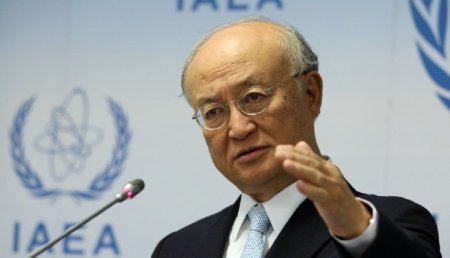
730x420-79ad08c54362ad0f598ff795dd9dc307Director General of the IAEA Yukiya Amano said, “the agency has no credible indications of activities in Iran relevant to the development of a nuclear explosive device after 2009.” (AP Photo/Ronald Zak, File)

The board of the nuclear watchdog group agreed to close the file on Iran’s past nuclear work on Tuesday, clearing the way for Tehran to receive billions in relief from international sanctions, according to news reports.

The board’s decision, according to diplomats quoted by Agence France-Presse, followed the recommendation of International Atomic Energy Agency Director General Yukiya Amano, who earlier on Tuesday said “the agency has no credible indications of activities in Iran relevant to the development of a nuclear explosive device after 2009.”

“Nor has the agency found any credible indications of the diversion of nuclear material in connection with the possible military dimensions to Iran’s nuclear program,” he said.

“Significant progress has been made on the Iran nuclear issue, but now is not the time to relax. This issue has a long and complex history, and the legacy of mistrust between Iran and the international community must be overcome,” he said. “Much work lies ahead of us. All parties must fully implement their commitments under the JCPOA. Considerable effort was required in order to reach this agreement. A similar and sustained effort will be required to implement it.”

Nuclear Agency Says Iran Worked on Weapons Design Until 2009

December 2, 2015

Nuclear Agency Says Iran Worked on Weapons Design Until 2009, New York Times

(Please see also, Iran threatens to walk away from nuke deal. — DM)

[W]hile the International Atomic Energy Agency detailed a long list of experiments Iran had conducted that were “relevant to a nuclear explosive device,” it found no evidence that the effort succeeded in developing a complete blueprint for a bomb.

In part that was because Iran refused to answer several essential questions, and appeared to have destroyed potential evidence in others.

**********************

VIENNA — Iran was actively designing a nuclear weapon until 2009, longer than the United States and Western intelligence agencies have publicly acknowledged, according to a final report by the United Nations nuclear inspection agency.

The report, based on partial answers Iran provided after reaching its nuclear accord with the West in July, concluded that Tehran conducted “computer modeling of a nuclear explosive device” before 2004. It then resumed the efforts during President Bush’s second term and continued them into President Obama’s first year in office.

But while the International Atomic Energy Agency detailed a long list of experiments Iran had conducted that were “relevant to a nuclear explosive device,” it found no evidence that the effort succeeded in developing a complete blueprint for a bomb.

In part that was because Iran refused to answer several essential questions, and appeared to have destroyed potential evidence in others.

The report, issued here Wednesday evening to the 167 countries that make up the board of the agency, is intended to complete a decade-long attempt to determine what kind of progress Iran made toward the technological art of designing a warhead that could fit atop a nuclear missile.

The completion of the report is one of the steps that Iran had to take — along with dismantling centrifuges and shipping nuclear fuel out of the country — before sanctions will be lifted under the nuclear deal.

Mr. Obama and his secretary of state, John Kerry, concluded this year that it was more important to secure a deal that will, if carried out fully, prevent Iran from gaining the material to build a bomb for at least 15 years than making it admit to past activities. So, the report’s publication allows the deal to go through, no matter how definitive or inconclusive the final result.

But Iran’s refusal to cooperate on central points could set a dangerous precedent as the United Nations agency attempts to convince other countries with nuclear technology that they must fully answer queries to determine if they have a secret weapons program.

The agency’s bottom line assessment was that Iran had a “coordinated effort” to design and conduct tests on nuclear weapon components before 2003 — echoing a United States national intelligence estimate published in 2007 — and that it had conducted “some activities” thereafter.

“These activities did not advance beyond feasibility and scientific studies” and the acquisition of technical capabilities, the agency concluded. The efforts ended “after 2009,” or just as Mr. Obama was taking office and accelerating the sanctions and cyber sabotage program against Iran’s nuclear facilities that ultimately brought Iranian officials to the negotiating table.

Tehran gave no answer to one quarter of the dozen specific questions or documents it was asked about, leaving open the question of how much progress it had made.

The report, titled “Final Assessment of Past and Present Outstanding Issues Regarding Iran’s Nuclear Program,” will not satisfy either critics of the nuclear deal or those seeking exoneration for Iran. Instead, it draws a picture of a nation that was actively exploring the technologies, testing and components that would be needed to produce a weapon someday, without coming to a conclusion about how successful that effort was.

The agency’s director, Yukia Amano, said last week that the document would not be “black and white,” and that assessment proved correct.

Nothing in the report suggests that Iran will prevent the I.A.E.A. from monitoring its production of nuclear fuel for the next decade and a half, the crucial element of the July agreement. But Iran’s refusal to answer some of the questions also does not portend well for its transparency about its activities.

At Iran’s Parchin complex, where the agency thought there may have been nuclear experimental work in 2000, the agency said “extensive activities undertaken by Iran” to alter the site “seriously undermined the Agency’s ability” to come to conclusions about past activities.

Diplomats familiar with the compilation of the report said that they met “experts” in Iran, but would not say if they met the leader of the effort, Mohsen Fakhrizadeh. (Other diplomats said Mr. Fakhrizadeh was definitely not among those the inspectors met.) One diplomat said Iran had said it feared the scientists could be assassinated if they were identified. The agency appeared to have visited two laboratories.

Time and again, the agency seemed close to rejecting Iranian arguments that its experimentation was for civilian purposes. The inspectors found that Iran’s nuclear program was “suitable for the coordination of a range of activities relevant to the development of a nuclear explosive device” and that its experiments have “characteristics relevant to a nuclear explosive device.”

In one or two areas, notably a document provided by Western intelligence agencies indicating that Iran was looking at how to make uranium metal, a step needed for a weapon, it found “no indication of Iran having conducted activities” related to the document.

Recently, as the report’s publication approached, Iran’s position of complete denial that it had sought a bomb seemed to soften. In October, a former Iranian president, Ali Akbar Hashemi Rafsanjani, told journalists in Tehran that the nation had considered making nuclear arms during its war with Iraq in the 1980s but backed away.

“We sought to have that possibility for the day that the enemy might use a nuclear weapon,” he was quoted as saying. “That was the thinking. But it never became real.” He said nothing about what happened up to 2004 or the more sporadic efforts beyond.

The issues the I.A.E.A. addressed in Wednesday’s report date back a decade. Starting around mid-2004, thousands of pages of detailed evidence of Iran’s suspected research on how to design a weapon were collected by intelligence agencies in the United States, Israel and Europe, and eventually turned over to the agency’s inspectors here in Vienna.

Some of the evidence came from a laptop computer smuggled out of Iran by a person American and German officials identified as an Iranian technician, who had access to some of the most sensitive results from two secret Iranian nuclear projects. Both appeared related to different technologies needed to design a nuclear warhead, including the vital process of building a detonation system to fit inside the nose cone of Iran’s Shahab-3 missile, Persian for shooting star.

Iran claimed that the documents were fabrications, part of a Western conspiracy to set the groundwork for bombing the country’s nuclear facilities or overthrowing the government. The technician apparently never made it out of the country; he remained in Iran after sending the laptop out with his wife and family.

“We never figured out if he was imprisoned or executed,” a former intelligence officer involved in the operation said in an interview in 2008.

The year before that interview, however, the American intelligence community had warned the Bush administration of a surprising finding: While Iran once had a full-scale weapons development effort underway, it had suspended the project sometime in late 2003, shortly after the American invasion of Iraq.

“Prior to 2003 they had a full-scale Manhattan Project,” said Gary Samore, Mr. Obama’s top nuclear proliferation expert in the first term. After that, he said, the effort was sporadic, even as Iran pressed ahead to build the facilities to produce uranium fuel — the program that was rolled back and frozen by the agreement reached in July.

Even after the 2007 report, though, I.A.E.A. inspectors pressed Iran to address the questions raised in the documents. In 2008, the agency’s chief inspector gathered officials from around the world into a large auditorium here and displayed the evidence to them. This included, memos signed by Mr. Fakhrizadeh, the elusive academic who ran the program for the Islamic Revolutionary Guards Corps, and Iranian videos appearing to show how to detonate a weapon in an “air burst,” much as the bomb exploded high over Hiroshima, Japan, in 1945.

In 2011, frustrated that Iran had failed to honor several agreements to answer questions and turn over documents, the atomic agency published a list of a dozen issues — “possible military dimensions,” in bureaucratic jargon — that it had to clear up before it could close Iran’s file.

But as the deal got closer last spring, Mr. Obama and Mr. Kerry had to make a crucial decision: whether it was worth jeopardizing the deal by insisting that Iran must admit to its past activities. From all indications since then, the president seemed to have decided it was more important to get commitments about limiting future activities than forcing Iranian officials to admit to a past the country insists never happened.

Mr. Kerry, pressed on the question of Iranian disclosure of past activities by Judy Woodruff on the “PBS NewsHour,” said: “They have to do it. It will be done. If there’s going to be a deal, it will be done.” But weeks later, he said United States intelligence agencies already had “perfect knowledge” of Iran’s activities, suggesting that a public confession was not necessary.

The result was a carefully designed diplomatic compromise. Iran had to meet deadlines to turn over documents, but the agreement did not specify how complete the disclosures had to be, whether important scientists had to be interviewed or whether inspectors had to be allowed into the sensitive research sites, including some universities, where the work happened.
The Iran Nuclear Deal: What the Next President Should Do

October 2, 2015

The Iran Nuclear Deal: What the Next President Should Do, Heritage Foundation, October 2, 2015

(But please see, The Elephant In The Room. — DM)

The failure of Congress to halt the implementation of the Obama Administration’s nuclear agreement with Tehran means that the U.S. is stuck with a bad deal on Iran’s nuclear program at least for now. Iran’s radical Islamist regime will now benefit from the suspension of international sanctions without dismantling its nuclear infrastructure, which will remain basically intact. Iran’s path to a nuclear weapon is unlikely to be blocked by the Administration’s flawed deal, any more than North Korea was blocked by the Clinton Administration’s 1994 Agreed Framework.

The next President should not passively accept Obama’s risky deal with Tehran as a fait accompli. Instead, he or she should immediately cite any violations of the agreement by Iran, its continued support for terrorism, or other hostile policies as reason to abrogate the agreement. The Bush Administration, faced with bad deals negotiated by the Clinton Administration, eventually withdrew from both the Agreed Framework and the Kyoto Protocol.

Rather than endorsing a dangerous agreement that bolsters Iran’s economy, facilitates its military buildup, and paves the way for an eventual Iranian nuclear breakout, the next Administration must accelerate efforts to deter, contain, and roll back the influence of Iran’s theocratic dictatorship, which continues to call for “death to America.”

How the Next President Should Deal with Iran

Upon entering office, the next Administration should immediately review Iran’s compliance with the existing deal, as well as its behavior in sponsoring terrorism, subverting nearby governments, and attacking U.S. allies. Any evidence that Iran is cheating on the agreement (which is likely given Iran’s past behavior) or continuing hostile acts against the U.S. and its allies should be used to justify nullification of the agreement.

Regrettably, Tehran already will have pocketed up to $100 billion in sanctions relief by the time the next Administration comes to office because of the frontloading of sanctions relief in the early months of the misconceived deal. Continuing to fork over billions of dollars that Tehran can use to finance further terrorism, subversion, and military and nuclear expansion will only worsen the situation.

In place of the flawed nuclear agreement, which would boost Iran’s long-term military and nuclear threat potential, strengthen Iran’s regional influence, strain ties with U.S. allies, and diminish U.S. influence in the region, the new Administration should:

1. Expand sanctions on Iran. The new Administration should immediately reinstate all U.S. sanctions on Iran suspended under the Vienna Agreement and work with Congress to expand sanctions, focusing on Iran’s nuclear program; support of terrorism; ballistic missile program; interventions in Syria, Iraq, and Yemen; human rights violations; and holding of four American hostages (Washington Post reporter Jason Rezaian, Christian pastor Saeed Abedini, former U.S. Marine Amir Hekmati, and former FBI agent Robert Levinson, who has been covertly held hostage by Iran since 2007).

The new Administration should designate Iran’s Islamic Revolutionary Guard Corps (IRGC) as a foreign terrorist organization and apply sanctions to any non-Iranian companies that do business with the IRGC’s extensive economic empire. This measure would help reduce the IRGC’s ability to exploit sanctions relief for its own hostile purposes.

Washington should also cite Iranian violations of the accord as reason for reimposing U.N. sanctions on Iran, thus enhancing international pressure on Tehran and discouraging foreign investment and trade that could boost Iran’s military and nuclear programs. It is critical that U.S. allies and Iran’s trading partners understand that investing or trading with Iran will subject them to U.S. sanctions even if some countries refuse to enforce U.N. sanctions.

2. Strengthen U.S. military forces to provide greater deterrence against an Iranian nuclear breakout.Ultimately, no piece of paper will block an Iranian nuclear breakout. The chief deterrent to Iran’s attaining a nuclear capability is the prospect of a U.S. preventive military attack. It is no coincidence that Iran halted many aspects of its nuclear weapons program in 2003 after the U.S. invasion of and overthrow of hostile regimes in Afghanistan and Iraq. Libyan dictator Muammar Qadhafi, motivated by a similar apprehension about the Bush Administration, also chose to give up his chemical and nuclear weapons programs.

To strengthen this deterrence, it is necessary to rebuild U.S. military strength, which has been sapped in recent years by devastating budget cuts. The Obama Administration’s failure to provide for the national defense will shortly result in the absence of U.S. aircraft carriers from the Persian Gulf region for the first time since 2007. Such signs of declining U.S. military capabilities will exacerbate the risks posed by the nuclear deal.

3. Strengthen U.S. alliances, especially with Israel. The nuclear agreement has had a corrosive effect on bilateral relationships with important U.S. allies in the Middle East, particularly those countries that are most threatened by Iran, such as Israel and Saudi Arabia. Rather than sacrificing the interests of allies in a rush to embrace Iran as the Obama Administration has done, the next Administration should give priority to safeguarding the vital security interests of the U.S. and its allies by maintaining a favorable balance of power in the region to deter and contain Iran. Washington should help rebuild security ties by boosting arms sales to Israel, Saudi Arabia, and other members of the Gulf Cooperation Council (GCC) that are threatened by Tehran, taking care that arms sales to Arab states do not threaten Israel’s qualitative military edge in the event of a flare-up in Arab–Israeli fighting.

To enhance deterrence against an Iranian nuclear breakout, Washington also should transfer to Israel capabilities that could be used to destroy hardened targets such as the Fordow uranium enrichment facility, which is built hundreds of feet beneath a mountain. The only non-nuclear weapon capable of destroying such a target is the Massive Ordnance Penetrator (MOP), a precision-guided, 30,000-pound “bunker buster” bomb. Giving Israel these weapons and the aircraft to deliver them would make Tehran think twice about risking a nuclear breakout.

The U.S. and its European allies also should strengthen military, intelligence, and security cooperation with Israel and the members of the GCC, an alliance of Bahrain, Kuwait, Oman, Qatar, Saudi Arabia, and the United Arab Emirates, founded in 1981 to provide collective security for Arab states threatened by Iran. Such a coalition could help both to contain the expansion of Iranian power and to facilitate military action (if necessary) against Iran.

4. Put a high priority on missile defense. Iran’s ballistic missile force, the largest in the Middle East, poses a growing threat to its neighbors. Washington should help Israel to strengthen its missile defenses and help the GCC countries to build an integrated and layered missile defense architecture to blunt the Iranian missile threat. The U.S. Navy should be prepared to deploy warships equipped with Aegis ballistic missile defense systems to appropriate locations to help defend Israel and the GCC allies against potential Iranian missile attacks as circumstances demand. This will require coordinating missile defense activities among the various U.S. and allied missile defense systems through a joint communications system. The U.S. should also field missile defense interceptors in space for intercepting Iranian missiles in the boost phase, which would add a valuable additional layer to missile defenses.

5. Deter nuclear proliferation. For more than five decades, Washington has opposed the spread of sensitive nuclear technologies such as uranium enrichment, even for its allies. By unwisely making an exception for Iran, the Obama Administration in effect conceded the acceptability of an illicit uranium enrichment program in a rogue state. In fact, the Administration granted Iran’s Islamist dictatorship better terms on uranium enrichment than the Ford and Carter Administrations offered to the Shah of Iran, a U.S. ally back in the 1970s.

The Obama Administration’s shortsighted deal with Iran is likely to spur a cascade of nuclear proliferation among threatened states such as Saudi Arabia, Turkey, Egypt, and the United Arab Emirates. Such a multipolar nuclear Middle East, on hair-trigger alert because of the lack of a survivable second-strike capability, would introduce a new level of instability into an already volatile region. To prevent such an outcome, the next Administration must reassure these countries that it will take military action to prevent Iran from gaining a nuclear capability as well as to deter Iranian military threats to their interests.

6. Expand domestic oil and gas production and lift the ban on U.S. oil exports to put downward pressure on world prices. In addition to sanctions, Iran’s economy has been hurt by falling world oil prices. Its oil export earnings, which constitute more than 80 percent of the regime’s revenue, have been significantly reduced. By removing unnecessary restrictions on oil exploration and drilling in potentially rich offshore and Alaskan oil regions, Washington could help to maximize downward pressure on long-term global oil prices. Lifting the ban on U.S. oil exports, an obsolete legacy of the 1973–1974 energy crisis spawned by the Arab oil embargo, would amplify the benefits of increased oil and gas production. Permitting U.S. oil exports not only would benefit the U.S. economy and balance of trade, but also would marginally lower world oil prices and Iranian oil export revenues, thereby reducing the regime’s ability to finance terrorism, subversion, and military expansion.

7. Negotiate a better deal with Iran. The Obama Administration played a strong hand weakly in its negotiations with Iran. It made it clear that it wanted a nuclear agreement more than Tehran appeared to want one. That gave the Iranians bargaining leverage that they used shrewdly. The Administration made a bad situation worse by downplaying the military option and front-loading sanctions relief early in the interim agreement, which reduced Iran’s incentives to make concessions.

The next Administration should seek an agreement that would permanently bar Iran from acquiring nuclear weapons. At a minimum, this would require:

  • Banning Iran from uranium enrichment activities;
  • Dismantling substantial portions of Iran’s nuclear infrastructure, particularly the Fordow and Natanz uranium enrichment facilities and Arak heavy water reactor;
  • Performing robust inspections on an “anytime anywhere” basis and real-time monitoring of Iranian nuclear facilities;
  • Linking sanctions relief to Iranian compliance;
  • Ensuring that Iran comes clean on its past weaponization efforts; and
  • Determining a clear and rapid process for reimposing all sanctions if Iran is caught cheating.

The Bottom Line

The nuclear deal already has weakened relationships between the U.S. and important allies, undermined the perceived reliability of the U.S. as an ally, and helped Iran to reinvigorate its economy and expand its regional influence. After oil sanctions are lifted, Iran will gain enhanced resources to finance escalating threats to the U.S. and its allies. The next Administration must help put Iran’s nuclear genie back in the bottle by taking a much tougher and more realistic approach to deterring and preventing an Iranian nuclear breakout.

Satire but not funny|Kim Jong-un has replaced John Boehner as Speaker of the House

September 11, 2015

Kim Jong-un has replaced John Boehner as Speaker of the House, Dan Miller’s Blog, September 11, 2015

(The views expressed in this article are mine and do not necessarily reflect those of Warsclerotic or its other editors. — DM)

We have met the enemy and it is us: we have become too tired to be effective and hence are becoming indifferent. The charade on Capitol Hill continues, and not only about the nuke “deal” with Iran. Will the carnival end before it’s too late, or will Obama continue to win?

The House speaker is elected by all House members, not just those of the majority party. He need not be a member of the House. Boehner having resigned because a serious medical condition often reduces him to tears, one group of Democrats nominated Debbie Wasserman-Schultz to replace him. However, due to her support for Hillary Clinton, she fell out of favor with the White House so another group of Democrats nominated Kim Jong-un at Obama’s request. To avoid the appearance of confrontation, Republicans offered no candidates. Kim won by seventeen votes, becoming the first non-US citizen to hold the office thus far this month.

tearsofboehnerDebby


Reporting for duty!

REPORTING FOR DUTY!

The current upset was precipitated by Republican members’ disagreements with Boehner and other party leaders about how best to deal with the catastrophic Iran nuke “deal” without unnecessarily offending the President. Kim Jong-un is expected to substitute his own brand of leadership for Boehner’s leadership through ambivalence.

A majority also deemed Kim the best qualified to negotiate with Dear Leader Obama on behalf of the House because, as the undisputed leader of a rogue nuclear nation himself, he should be able to pull not only Obama’s strings but also those of the Supreme Leader of the Islamic Rogue Republic of Iran.

White House Press Secretary Josh Earnest declined comment on the situation beyond refusing to comment on whether Obama met privately with Kim to congratulate him. However, Obama is generally thought to have confirmed that He fully supports Kim’s way of governing his own Democratic Peoples’ Republic and — subject to the few pesky restraints still imposed by an antiquated Constitution that He has not yet found ways to sneak around — He does His best to emulate him. In that connection, Obama asked Kim for recommendations on antiaircraft guns to deal humanely with Jews and other traitors who oppose Him (Please see also, New York Times Launches Congress ‘Jew Tracker’ – Washington Free Beacon.)

Desiring to gain Obama’s total good will, Kim promised to have derogatory cartoons of Donald Trump and Hillary Clinton painted on all future North Korean nukes and missiles just before they explode. In return, Obama promised to issue executive orders granting North Korea the permanent right to declassify any and all U.S. documents it sees fit pertaining to the security of the United States and to obtain copies, gratis, from the Government Printing Office.

House Speaker Kim Jong-un will next meet with Supreme Leader Khamenei in Tehran to make two common sense proposals, with which Khamenei is certain to agree:

First, Kim will propose that a group of highly regarded North Korean nuclear experts — under his personal guidance and supervision — conduct all nuke inspections in Iran and draw all conclusions concerning any past or present Iranian nuclear program based on them exclusively. Those conclusions will be drawn on behalf of, and in lieu of any conclusions drawn by, the International Atomic Energy Agency (IAEA). The head of the IAEA, Yukiya Amano, immediately endorsed this plan as “splendid and totally consistent with any and all IAEA – Iran “secret deals.”

Second, Kim will propose that Khamenei promise not to nuke anyone until all sanctions have been permanently eliminated, unless he really wants to.

Obama is thought to have agreed with every aspect of the Kim plan and to have directed Secretary Kerry to tell Khamenei that if he agrees all sanctions will be eliminated permanently, via executive decree, and hence even more expeditiously than previously expected. Due to a successful Senate filibuster yesterday, Obama can issue the executive decree very soon; Today — Friday, September 11th — is being considered seriously due to the obvious symbolism of the date.

H/t Freedom is just another word

arming

The inevitable success of Kim’s mission will result in a win-win situation for nearly everyone, particularly the financially strapped IAEA, and the true Peace of Obama will prevail throughout all parts of the world that He considers worth saving. Remember — it’s all for the Children!

veto (1)Mushroom cloud


Addendum

하원 의장 김정은 의 문 사랑하는 북미 친구 , 그것은 오바마 대통령 아래에서 당신의 인생 이 곧 Amerika 민주주의 인민 공화국 이 될 것입니다 무엇 에 미래의 삶을 위해 잘 준비 것을 진심으로 희망 합니다. 배리 와 나는 제출 된 것을 기쁘게 사람들을 위해 가능한 한 오랫동안 지배 구조 의 우리의 양식 에 서서히 적응 을 하기 때문에 전환이 원활 하게 하기 위해 함께 열심히하고 고통 일했다 .

Translation:

Statement of House Speaker Kim Jong-un

My dear North American friends, it is my sincere hope that your life under President Obama has prepared you well for your future life in what will soon become the Democratic People’s Republic of Amerika. Barry [a.k.a. Barack] and I have worked long and hard together to acclimate you gradually to our transformed and transformational form of governance and hence to make the transition as smooth and painless as possible for those pleased to submit. Now, we will accelerate the progress.

Conclusions

It does not have to be that way. Here, in closing, are a few words from Daniel Greenfield.

We don’t have to give in to despair. If we do, we are lost. Lost the way that the left is lost. Lost the way that the Muslim world is lost.

We are not savages and feral children. We are the inheritors of a great civilization. It is still ours to lose. It is ours to keep if we understand its truths. [Emphasis added.]

We are not alone. A sense of isolation has been imposed on us as part of a culture war. The task of reconstructing our civilization and ending that isolation begins with our communication. We are the successors of revolutions of ideas. We need to do more than keep them alive. We must refresh them and renew them. And, most importantly, we must practice them.

We are not this culture. We are not our media. We are not our politicians. We are better than that.

We must win, but we must also remember what it is we hope to win. If we forget that, we lose. If we forget that, we will embrace dead end policies that cannot restore hope or bring victory.

What we have now is not a movement because we have not defined what it is we hope to win. We have built reactive movements to stave off despair. We must do better than that. We must not settle for striving to restore some idealized lost world. Instead we must dream big. We must think of the nation we want and of the civilization we want to live in and what it will take to build it.

Our enemies have set out big goals. We must set out bigger ones. We must become more than conservatives. If we remain conservatives, then all we will have is the America we live in now. And even if our children and grandchildren become conservatives, that is the culture and nation they will fight to conserve. We must become revolutionaries.

We must think in terms of the world we want. Not the world we have lost.

This is the America we live in now. But it doesn’t have to be.

It can be up to us, not to those who hate America and all for which she once stood.

What is to be done? (2)

September 8, 2015

What is to be done? (2), Power LineScott Johnson, September 8, 2015

The first resolution the House should consider when it returns [today] should be one stating that Congress has not been provided the material it needs, that the Iran deal has not been properly submitted to Congress, and therefore that the president has no authority to waive or suspend sanctions on Iran.

********************

Yesterday I noted that the Obama administration has failed to comply with the condition precedent to Congress’s review of the deal with Iran (and the president’s authority to waive sanctions). I asked what is to be done.

I asked, Bill Kristol answered. Bill wears many hats, one of which is Chairman of the Emergency Committee for Israel. In this capacity he released the following statement addressing the question yesterday:

The Obama Administration has not complied with the legal requirement that it provide Congress “any additional materials” related to the Iran deal, including “side agreements, implementing materials, documents, and guidance, technical or other understandings, and any related agreements, whether entered into or implemented prior to the agreement or to be entered into or implemented in the future.” The Administration has not given Congress a key side agreement between Iran and the International Atomic Energy Agency, one which describes how key questions about the possible military dimensions of Iran’s nuclear program will be resolved, as well as how the verification regime will work.

Congress should not accept this evasion of the law by the Obama Administration. Congress should insist on the text of this and any other side agreements. Lacking this, Congress can and should take the position that the Iran deal has not been properly submitted to Congress to review, and therefore that the president has no authority to waive or suspend sanctions.

We understand the temptation of leadership to get to a vote on a resolution of disapproval and then to move on to other votes. But the Iran deal isn’t just another legislative issue where some corner-cutting by the Administration is to be accepted with a brief expression of discontent followed by a weary sigh of resignation.

The Iran deal is the most important foreign policy issue this Congress will have before it. Congress should rise to the occasion and insist on its prerogative — and the American people’s prerogative — to see the whole deal. The first resolution the House should consider when it returns [today] should be one stating that Congress has not been provided the material it needs, that the Iran deal has not been properly submitted to Congress, and therefore that the president has no authority to waive or suspend sanctions on Iran.

I think this is the correct direction and congressional leadership should follow it.

Rep. Gohmert Introducing Resolution to Declare Iran Deal a Treaty

September 7, 2015

Rep. Gohmert Introducing Resolution to Declare Iran Deal a Treaty, Town HallCortney O’Brien, September 7, 2015

cda995d7-4ffe-417b-8d94-702f8bfdaa92

On March 11, 2015, Secretary of State John Kerry said the Obama administration was “not negotiating a legally binding plan” with Iran and therefore their nuclear agreement did not have to be submitted to Congress for approval. Rep. Louie Gohmert (R-TX) is ready to challenge that notion by putting forward a resolution that would define the Joint Comprehensive Plan of Action as a treaty.

The Corker-Cardin bill, a.k.a. the Iran Nuclear Agreement Review Act of 2015, was introduced as an accountability tool for the Iranian deal, requiring a ‘yes’ or ‘no’ vote from Congress. Yet, as more details about the Joint Comprehensive Plan Of Action (JCPOA) have surfaced, Corker and Cardin’s effort has become basically null, Rep. Gohmert is convinced. The Obama administration, he asserts, left Congress in the dark about the specifics of JCPOA. For instance, the Corker-Cardin bill was only meant to rein in nuclear sanctions, but JCPOA allows for a lifting of sanctions on ballistic missiles and international arms embargoes. Congress also had no clue about the side deals allowing Iran to inspect itself at nuclear sites.

In his resolution, Gohmert also exposes Secretary of State Kerry’s hypocrisy regarding his refusing to label the Iran deal a treaty.

Whereas, on June 4, 2015, less than two months before Secretary Kerry testified that it has become “physically impossible” for the Senate to ratify treaties, he stated that the State Department is “preparing the instruments of ratification of [several] important treaties” and that he “want[s] to personally thank the U.S. Congress . . . for their efforts on” the implementing legislation for the nuclear security treaties;

Gohmert is not the only legislator to demand the Iran agreement be defined as a treaty. Sen. Tom Cotton (R-AR), the only senator not to vote for the Corker-Cardin act, demanded the clarification be made back in May:

“A nuclear-arms agreement with any adversary—especially the terror-sponsoring, Islamist Iranian regime—should be submitted as a treaty and obtain a two-thirds majority vote in the Senate as required by the Constitution,” he said.

Such a consequential handshake should be accompanied by some oversight from our elected representatives. It’s what Americans want.

Should the resolution pass, Gohmert says the Senate should deliberate on the ratification of the Iran Deal within 30 days hence.

US Congress – rip up Iran deal – pass resolution!

September 7, 2015

US Congress – rip up Iran deal – pass resolution! United West via You Tube, September 7, 2015

(Please see also, What is to be done? — DM)

What is to be done?

September 7, 2015

What is to be done? Power LineScott Johnson, September 7, 2015

(In this context, the refusal of Obama — a rogue president — to comply with U.S. law jeopardizes our national security. He will probably continue to get away with it until he leaves office. — DM)

President Obama has failed to comply with the conditions of the Iran Nuclear Agreement Review Act (the Corker-Cardin bill) that he himself signed into law. By its express terms the law required Obama to transmit to Congress “the agreement. . . . including all related materials and annexes.” He was obligated to do this “not later than five days after reaching the agreement.”

Obama has not done so. The administration has failed or refused to submit the IAEA side deal with Iran regarding the possible military dimensions of Iran’s research at the Parchin military facility to Congress.

Indeed, the administration claim not even to have seen the IAEA side deal. Rather, administration officials claim only to have been briefed by the IAEA on the terms of the side deal. They claim it is cloaked in secrecy that prevents its disclosure. The side deal is nevertheless an integral part of the JCPOA and its disclosure expressly required by the act.

Whether or not the side deal is “confidential” matters not one iota under the terms of the Corker-Cardin bill. It should be noted, however, that the administration appears to have constructed an elaborate pretense regarding the side deal. Fred Fleitz has advanced a highly plausible case that administration officials themselves drafted one or more side deals including this one for the IAEA including the Parchin side deal. He calls the arrangement “a national security fraud.”

Obama’s noncompliance with the act is more than problematic. It precludes (or should) the president’s authority to waive sanctions. It prevents (or should) the JCPOA itself from coming to a vote in Congress. Yet little notice has been taken of any of the serious issues that Obama has created in the service of his Iranian fantasies. As always, Obama acts by the executive equivalent of main force and trusts others to fall into line.

Rep. Mike Pompeo and attorney David Rivkin take note in a brief Washington Post column. They write:

Congress must now confront the grave issues of constitutional law prompted by the president’s failure to comply with his obligations under the act. This is not the first time this administration has disregarded clear statutory requirements, encroaching in the process upon Congress’s legislative and budgetary prerogatives. The fact that this has happened again in the context of a national security agreement vital to the United States and its allies makes the situation all the more serious.

For Congress to vote on the merits of the agreement without the opportunity to review all of its aspects would both effectively sanction the president’s unconstitutional conduct and be a major policy mistake. Instead, both houses should vote to register their view that the president has not complied with his obligations under the act by not providing Congress with a copy of an agreement between the IAEA and Iran, and that, as a result, the president remains unable to lift statutory sanctions against Iran. Then, if the president ignores this legal limit on his authority, Congress can and should take its case to court.

At the least, the congressional leaders should refuse to call up the JCPOA for a vote of approval and “register their view” as Pompeo and Rivkin suggest. Congress should force the issue in other ways within the scope of their powers. I don’t know about the proposed judicial remedy; it seems like weak tea. I don’t have the answer, but Congress should not proceed as though the conditions precedent to a vote of approval and the waiver of sanctions have occurred as required under the Corker-Cardin bill; they have not.

Iran’s supreme leader: No nuclear deal unless sanctions fully lifted

September 4, 2015

Iran’s supreme leader: No nuclear deal unless sanctions fully lifted, Israel Hayom, Erez Linn, Shlomo Cesana, Yoni Hersch, Associated Press and Israel Hayom Staff, September 4, 2015

144135927674638061a_bSupreme Leader Ayatollah Ali Khamenei speaks in a meeting with members of Iran’s Experts Assembly in Tehran | Photo credit: AP

If Khamenei decides to make good on his word and demand the lifting of sanctions entirely, it will not be possible to implement the snapback mechanism and reimpose sanctions should Iran violate its obligations under the deal.

******************

Iran’s supreme leader said Thursday that “there will be no deal” if world powers insist on suspending rather than lifting sanctions as part of a landmark nuclear agreement and said it is up to Iran’s parliament, and not him, to approve or reject it.

His remarks, read aloud by a state TV anchorman, mark the first official comment on the deal since U.S. President Barack Obama secured enough support to prevent the Republican-led Congress from blocking it.

Ayatollah Ali Khamenei has yet to express a clear opinion on the deal, clinched in July, which would curb Iran’s nuclear activities in exchange for relief from crippling sanctions.

Khamenei said some U.S. officials have spoken of the “suspension” of sanctions, which he said was unacceptable. “If the sanctions are going to be suspended, then we will also fulfil our obligations on the ground at the level of suspension and not in a fundamental way,” he said.

In response, White House press secretary Josh Earnest reiterated the Obama administration’s stance that it would focus on Tehran’s actions and not its words.

Washington has been “crystal clear about the fact that Iran will have to take a variety of serious steps to significantly roll back their nuclear program before any sanction relief is offered,” he said.

However, the snapback plan (reimposing economic sanctions on Iran if it violates the deal), which Iran agreed to as part of the deal, could lose its validation as it is based on the suspension of the sanctions rather than a full removal.

If Khamenei decides to make good on his word and demand the lifting of sanctions entirely, it will not be possible to implement the snapback mechanism and reimpose sanctions should Iran violate its obligations under the deal.

Iran’s supreme leader has traditionally had the final say on all important matters in the country, but on Thursday Khamenei said that Iran’s parliament, the Majlis, known to oppose the agreement, should decide on the deal.

“It is the representatives of the people who should decide. I have no advice regarding the method of review, approval or rejection,” he said.

Either way, according to a Revolutionary Guard senior official, the deal does not detract one bit from the Iranian regime’s rancor toward Israel. “The Islamic revolution will continue to enhance its abilities until it will destroy Israel and liberate Palestine,” he said.

Meanwhile on Thursday, Prime Minister Benjamin Netanyahu told Foreign Ministry officials that most Americans agreed with Israel over dangers posed by Iran. In remarks at a Rosh Hashanah reception at the Foreign Ministry, Netanyahu made no direct mention of President Barack Obama’s victory on Wednesday in securing enough Senate votes to protect the agreement in Congress.

Speaking of a need to preserve Israel’s traditionally close ties with Washington despite what he called “differences of opinion,” Netanyahu told diplomatic staffers: “I must say, however, that the overwhelming majority of the American public sees eye to eye with us on the danger emanating from Iran.”

Israel’s message to ordinary Americans, Netanyahu said, would continue to be that “Iran is the enemy of the United States — it declares that openly — and Israel is a U.S. ally.”

Netanyahu explained that the “ratio of people who oppose the deal to people who support the deal in the U.S. is two to one.”

Ensuring the U.S. public understands that point will have “important ramifications for our security down the line,” Netanyahu said, according to an official statement.

Foreign Ministry Director General Dore Gold, meanwhile, revealed that Iran was transferring advanced weapons from arms depots in Syria to Hezbollah.

Speaking to Israel Hayom, Gold explained that the Iranians want to provide the Shiite terrorist organization with cruise missiles, Yakhont missiles and S2 land-based strategic missile.

Hezbollah’s activity, backed by Iran, has reached Kuwait and is evident in the Golan Heights, as seen in their attempts to launch another battle front with Israel.”

Gold also touched on Iran’s Parchin nuclear facility, saying that the Iranians had paved the floor of the facility with asphalt. He explained that the purpose of the move was to prevent International Atomic Energy Agency inspectors from testing the soil for dangerous substances.

Meanwhile, tensions are running high surrounding the approaching vote in the U.S. Congress. The Wall Street Journal published on Thursday a caustic article, warning the Democratic Party that if the nuclear deal fails, it will be their fault. “Politically, Obama’s victory in Congress makes Democrats hostage to Iran’s behavior. This means that if a nuclear arms race breaks out in the Middle East, democrats are accountable,” the article said.