(It’s comforting that Kerry is “aware” of anything the secret facility. But what’s being done to investigate it without, of course, offending Iran? — DM)
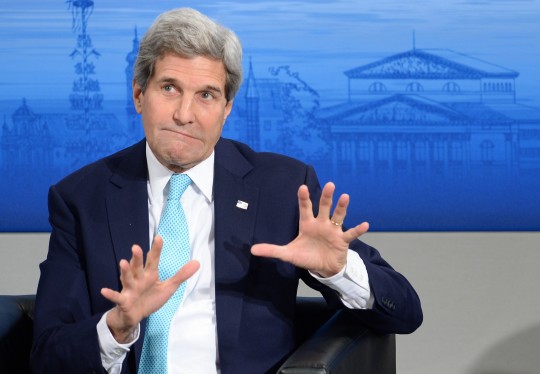
Secretary of State John Kerry admitted before Congress on Wednesday that the United States is aware of a secret Iranian facility that an Iranian opposition group identified this week as part of an undisclosed parallel nuclear program.
The group, the National Council of the Resistance of Iran (NCRI), has a history of disclosing the existence of Iranian nuclear facilities that the United States has been later forced to confirm were indeed part of a clandestine nuclear program.
Kerry, under questioning before the House Foreign Affairs Committee, acknowledged that the United States has evidence of the facility, but declined to elaborate to lawmakers about its nature.
“Did the [Iranian] regime tell us about existence of this new nuclear facility,” Rep. Dana Rohrabacher (R., Calif.) asked Kerry at the hearing.
“What you’re saying is it’s a nuclear facility,” Kerry responded. “That is yet to be determined, but we know about the facility, yes.”
“So had they disclosed that facility to us?” Rohrabacher asked.
“It has not been revealed yet as a nuclear facility,” Kerry insisted. “It is a facility that we are aware of, which is on a list of facilities we have. I’m not going to go into greater detail, but these things are going to have to be resolved [in negotiations] as we go forward.”
Questions about the site come in the wake of a report released Tuesday by an Iranian dissident group claiming to provide evidence of “an active and secret parallel nuclear program” in the suburbs of Tehran.
The facility is said to be an “underground top-secret site currently used by the Iranian regime for research and development with advanced centrifuges for uranium enrichment,” according to a copy of the findings by NCRI, also known as the MEK.
Years-long concerns about several secret Iranian nuclear facilities have plagued advocates of an emerging Iran deal and provided ammunition to critics who maintain that the agreement would leave Iran with sufficient infrastructure to continue producing a nuclear weapon.
The existence of such sites has been known for some time to U.S. intelligence agencies and runs counter to the Obama administration’s narrative that Iran can be trusted to comply with a nuclear deal.
“There has never been a time in the past 15 years or so when Iran didn’t have a hidden facility in construction,” a senior Obama administration officialadmitted to the New York Times in 2013.
Concerns among lawmakers and others have been amplified in recent days following the revelation by the Associated Press that the United States is considering permitting Iran to keep its nuclear infrastructure in tact.
The deal is shaping up to be a two-phased agreement, meaning Tehran would be subject to restrictions on its work for around a decade before they are lifted, the AP reported.
In an article published today, Washington Post columnist David Ignatius, a notorious Obama administration apologist, provided his latest endorsement of the president’s deeply flawed nuclear diplomacy with Iran. Ignatius also discussed some worrisome U.S. concessions to Iran that have not been previously disclosed.
During testimony to the Senate Foreign Relations Committee yesterday, Secretary of State John Kerry denied that the United States has proposed a final nuclear deal with Iran last only ten years. Although the ten-year limit has been leaked to many journalists, Ignatius confirmed that Obama officials want a deal with a “double-digit” duration of 10 to 15 years.
Ignatius also confirmed that a final deal will likely allow Iran to operate about 6,000 uranium centrifuges. He noted the Obama administration’s justification for allowing this: strict monitoring and intrusive inspections of Iranian nuclear facilities that will limit the “break-out time” – the time for Iran to make enough nuclear fuel for one weapon – to a year or more. (Click HERE to read the Center for Security Policy’s analysis of this issue.)
Ignatius failed to mention that the Iranian government has never fully cooperated with IAEA inspectors, refuses to answer the IAEA’s questions about weapons-treated nuclear activity, and did not allow IAEA inspectors to inspect all of its nuclear facilities during the nuclear talks. Ignatius also was strangely silent on yesterday’s revelations by the NCRI, an Iranian dissident group, that Iran has been operating a secret facility where it has been developing advanced uranium centrifuges and may be enriching uranium.
Ignatius’ column revealed some shocking new Obama administration concessions to Iran. According to Ignatius, although Iran will not be permitted to install more advanced centrifuges in a final agreement, it will be permitted to conduct “limited” research on advanced designs. Existing operational “non-permitted” centrifuges would be “dismantled,” either by pulverizing them or simply unplugging them.
So according to Ignatius, the Obama administration has proposed allowing Iran to continue to enrich uranium with thousands of centrifuges, ‘non-permitted’ centrifuges may only be turned off, and Iran will be permitted to continue to develop new centrifuge designs. Ignatius does not explain the purpose of Iran’s uranium enrichment. It can’t be to make nuclear fuel for Iran’s Bushehr power reactor since that would take about 200,000 centrifuges (Iran currently has about 19,000). As Israeli Prime Minister Benjamin Netanyahu has explained, there is only one purpose for Iran’s uranium enrichment program: to make nuclear bombs.
Ignatius also revealed the latest Obama administration concession to address Iran’s Arak heavy-water reactor which will be a source of about two weapons-worth of plutonium per year when completed in about a year to 18 months. Iran constructed this reactor in defiance of UN Security Council resolutions. U.S. and European government previously demanded this reactor be dismantled. The U.S. and its European allies reportedly backed away from this position over the last year by offering to let Iran operate the Arak reactor if steps were taken to ensure that it produced little plutonium either by a redesign (an irreversible approach) or fueling the reactor with enriched uranium.
According to Ignatius, “negotiators seem to have agreed on a compromise that will halt construction well before Arak becomes ‘hot’ with potential bomb fuel.” This appears to mean that construction of the Arak reactor will proceed without any alterations to its design or fueling and Iran will be trusted to halt construction just before the reactor is operational.
Ignatius fails to answer two crucial questions about the Arak reactor. Why does Iran need a plutonium-producing heavy-water reactor? Why has the United States proposed to let Iran to continue construction of this reactor?
As we learn more about the outline of a possible nuclear agreement with Iran, it is becoming more obvious that the Obama administration has made dangerous concessions that will not prevent or slow Iran’s pursuit of nuclear weapons out of its desperation to get a nuclear agreement with Tehran. Ignatius’ column also suggests the Obama administration is kicking several difficult issues down the road for a future president to deal with such as Iran’s uranium centrifuges and its plutonium-producing Arak reactor.
Charles Krauthammer said on Fox News last night that the Iranian nuclear negotiations are “simply catastrophic.” I agree. Congress needs to respond to President Obama’s nuclear sell-out to Iran by demanding an end to the nuclear talks and passing new sanctions requiring Tehran to comply with all UN Security Council resolutions on its nuclear program.
In the White House, Obama has tried to shape an Islamist future for the Middle East, favoring Islamist governments in Turkey and Islamist movements such as the Muslim Brotherhood. He saw his role as paving the way for the next generation of regional regimes that would be explicitly Islamist.Obama’s foreign policy in the region has been an elaborate exercise in trying to draw up new maps for a caliphate. The inclusion of terrorist groups in this program isn’t a mistake. It’s not naiveté or blindness. It’s the whole point of the exercise which was to transform terrorist groups into governments.
Obama’s foreign policy in the region has been an elaborate exercise in trying to draw up new maps for a caliphate. The inclusion of terrorist groups in this program isn’t a mistake. It’s not naiveté or blindness. It’s the whole point of the exercise which was to transform terrorist groups into governments.
******************
Obama says that we are not fighting a war on Islam. What he leaves out is that under his administration the United States is fighting in a civil war that is taking place within Islam.
It’s not a conflict between the proverbial moderate Muslim and the raging fanatic. That was an outdated Bush era notion. Instead Obama has brought us into a fight between Muslim governments and Muslim terrorists, not on the side of the governments we were allied with, but on the side of the terrorists.
It’s why Egypt is shopping for French planes and Russian nukes. Yemen’s government was run out of town by Obama’s new Iranian friends in a proxy war with Saudi Arabia. And the Saudis are dumping oil.
Iran and Qatar are the regional powers Obama is closest to. What these two countries have in common, is that despite their mutual hostility, they are both international state sponsors of Islamic terrorism.
Obama’s diplomats will be negotiating with the Taliban in Qatar. Among the Taliban delegation will be the terrorist leaders that Obama freed from Gitmo. And Iran gets anything it wants, from Yemen to the bomb, by using the threat of walking away in a huff from the hoax nuclear negotiations as leverage.
In Syria and Iraq, Obama is fighting ISIS alongside Islamic terrorists linked to Al Qaeda and Iran. In Libya, he overthrew a government in support of Islamic terrorists. His administration has spoken out against Egyptian air strikes against the Islamic State Jihadists in Libya who had beheaded Coptic Christians.
At the prayer breakfast where he denounced Christianity for the Crusades was the foreign minister of the Muslim Brotherhood government of Sudan that has massacred Christians. Unlike Libya, where Obama used a false claim of genocide to justify an illegal war, Sudan actually has committed genocide. And yet Obama ruled out using force against Sudan’s genocide even while he was running for office.
The United States now has a strange two-tier relationship with the Middle East. On paper we retain a number of traditional alliances with old allies such as Egypt, Israel and Saudi Arabia, complete with arms sales, foreign aid and florid speeches. But when it comes to policy, our new friends are the terrorists.
American foreign policy is no longer guided by national interests. Our allies have no input in it. It is shaped around the whims of Qatar and Iran; it’s guided by the Muslim Brotherhood and defined by the interests of state sponsors of terror. Our foreign policy is a policy of aiding Islamic terrorists.
It’s only a question of which terrorists.
Obama’s familiar argument is that ISIS and Al Qaeda fighters shouldn’t be called Islamic terrorists. Not even the politically correct sop of “Radical Islam” is acceptable. The terrorists are perverting Islam, he claims. The claim was banal even before September 11, but it bears an entirely new significance from an administration that has put Muslim Brotherhood operatives into key positions.
The administration is asserting the power to decide who is a Muslim. It’s a theological position that means it is taking sides in a Muslim civil war between Islamists.
This position is passed off as a strategy for undermining the terrorists. Refusing to call the Islamic State by its name, using the more derogatory “Daesh,” denying that the Islamic terrorists are acting in the name of Islam, is supposed to inhibit recruitment. This claim is made despite the flood of Muslims leaving the West to join ISIS. If any group should be vulnerable to our propaganda, it should be them.
But that’s not what this is really about.
According recognition to a state is a powerful diplomatic tool for shaping world politics. We refuse to recognize ISIS, as we initially refused to recognize the USSR. Obama resumed diplomatic ties with Cuba. His people negotiate and appease the Taliban even though it was in its own time just as brutal as ISIS.
Obama is not willing to recognize ISIS as Islamic, but he does recognize the Muslim Brotherhood as Islamic. Both are violent and murderous Islamists. But only one of them is “legitimate” in his eyes.
Those choices are not about terrorist recruitment, but about building a particular map of the region. Obama refuses to concede that ISIS is Islamic, not because he worries that it will bring them more followers, this is a tertiary long shot at best, but because he is supporting some of their rivals.
The White House Summit on Countering Violent Extremism has brought a covert strategy out into the spotlight. Despite its name, it’s not countering violence or extremism.
The new director of the Center for Strategic Counterterrorism Communications, the axis of Obama’s CVE strategy, is Rashad Hussain who appeared at Muslim Brotherhood front group events and defended the head of Islamic Jihad. In attendance was Salam Al-Marayati of the Muslim Public Affairs Council, yet another Muslim Brotherhood linked group, who had urged Muslims not to cooperate with the FBI and defended Hamas and Hezbollah.
In Syria, the United States is coordinating with Assad and backing the Syrian rebels, who have their own extensive ties to the Muslim Brotherhood and even Al Qaeda. This could be viewed as an “enemy of my enemy” alliance, but this administration backed the Brotherhood before it viewed ISIS as a threat. Top Democrats, including Nancy Pelosi and John Kerry, had focused on outreach to Assad under Bush.
They’re not allying with Assad and the Brotherhood to beat ISIS. They’re fighting ISIS to protect the Brotherhood and their deal with Iran.
In the White House, Obama has tried to shape an Islamist future for the Middle East, favoring Islamist governments in Turkey and Islamist movements such as the Muslim Brotherhood. He saw his role as paving the way for the next generation of regional regimes that would be explicitly Islamist.
The Arab Spring was a deceptive code name for a clean sweep that would push out the old leaders like Mubarak and replace them with the Muslim Brotherhood and other likeminded Islamists. Islamic terrorism, at least against the United States, would end because their mission had been accomplished.
Stabilizing unrest by putting the destabilizers in charge wasn’t a new idea. Carter helped make it happen in Iran. And the more violent an Islamic terrorist group is, the more important it is to find a way to stop the violence by putting them in charge. The only two criteria that matter are violence and dialogue.
So why isn’t Obama talking to ISIS? Because ISIS won’t talk back. It’s impossible to support a terrorist group that won’t engage in dialogue. If ISIS were to indicate any willingness to negotiate, diplomats would be sitting around a table with headchoppers in less time than it takes a Jordanian pilot to burn.
And that still might happen.
Obama isn’t trying to finish off ISIS. He’s keeping them on the ropes the way that he did the Taliban. Over 2,000 Americans died on the off chance that the Taliban would agree to the negotiations in Qatar. Compared to that price in blood, the Bergdahl deal was small potatoes. And if Obama is negotiating with the Taliban after all that, is there any doubt that he would negotiate to integrate ISIS into Iraq and Syria?
Obama’s foreign policy in the region has been an elaborate exercise in trying to draw up new maps for a caliphate. The inclusion of terrorist groups in this program isn’t a mistake. It’s not naiveté or blindness. It’s the whole point of the exercise which was to transform terrorist groups into governments.
Stabilizing the region by turning terrorists into governments may sound like pouring oil on a fire, but to progressives who believe in root causes, rather than winning wars, violence is a symptom of discontent. The problem isn’t the suicide bomber. It’s our power structure. Tear that down, as Obama tried to do in Cairo, and the terrorists no longer have anything to fight against because we aren’t in their way.
Bush tried to build up civil society to choke off terrorism. Obama builds civil society around terrorists.
Obama does not believe that the terrorists are the problem. He believes that we are the problem. His foreign policy is not about fighting Islamic terrorists. It is about destroying our power to stop them.
America is ready to legitimize a seismic shift in the global balance of power through a grand civilizational bargain with the ayatollahs of Iran.
It is ardor for Islam and sympathy for Islamic ambitions of global leadership, not just distaste for American overreach, that apparently fuels Obama’s secretive dash toward a deal with Iran.
******************
Why does U.S. President Barack Obama so desperately want a deal with Iran? Why is he so fixated on a grand bargain with the Islamic republic, the world’s biggest killer of Americans? What explains the president’s passion to embrace the radical mullahs of Tehran, despite the fact that all America’s traditional allies in the region are calling for him to check Iran’s advances? Why the deferential approach that seeks Iran’s partnership, instead of its isolation?
The question becomes even sharper when you consider the fact that Iran is patently not seeking integration in the Middle East or reconciliation with the West, but rather obviously domination of the region and apocalyptic victory over the West.
After all, you don’t have to be an expert to discern the expansionist and threatening Iranian strategy. Tehran is seeking to create a land corridor under its domination from the Persian Gulf through Iraq and Syria to the Mediterranean. The only missing link in this land bridge of Shiite supremacy is Anbar province in western Iraq, now under Islamic State control. Now you understand why Iranian troops are leading the fight against ISIS in this zone.
What is harder to understand are American airstrikes against ISIS in Anbar, which seem to be tailored to match the movements of Iranian ground advances. The clear U.S.-Iranian military coordination in this theater of operations gives lie to Washington’s denials that it has already entered into a tacit alliance with Iran.
While the defeat of ISIS is a rational American policy goal, acquiescence to Iranian ascendancy in ISIS’s stead is not. Nor is American acceptance of the Iranian takeover of Yemen, through its Zaydi/Houthi Shiite allies — which gives Iran choke-off control of the vital Bab el-Mandeb waterway at the opening the Red Sea. Obama’s Washington hasn’t even whimpered in protest or concern about this.
We also have no indication that in its current negotiations with Tehran the administration has tackled Iranian adventurism in Syria and Lebanon, and along Israel’s northern and southern borders. Just the opposite: The administration says that the talks with Iran have been narrowly focused on centrifuges and uranium stockpile limits. Iran’s regional subversion (plus its long-range missile capabilities and its human rights record, etc.) has not been on the agenda.
I don’t believe for a second that Obama truly thinks he can bring about substantial moderation of Iranian diplomatic and military behavior; that by giving Supreme Leader Ayatollah Ali Khamenei the comprehensive sanctions relief and renewed international legitimacy that Iran seeks, the Islamic republic will stop being the expansionist and aggressive Islamic republic it is.
That’s just not believable. Iran has consistently cast its quest for regional power as a movement of “Islamic resistance” against the U.S. and its sidekick, Israel. There is no basis for the assumption that moving to a less polarized relationship with Iran will accelerate a transition toward a more democratic, less theocratic, and less expansionist regime within Iran. On the contrary: A nuclear deal that lifts sanctions without addressing Iran’s regional ambitions would have the effect of greatly strengthening Iran’s hand.
And indeed, an Iranian Islamic empire is emerging in vast swaths of territory, from Shiraz to Sanaa and from Tabriz to Tripoli, right under Obama’s nose.
So again, what could possibly explain Obama’s relentless pursuit of strategic partnership with Iran — a partnership that is so perceptibly detrimental and dangerous to the West and to Israel and other long-standing American allies in the region?
A spate of recent articles by American analysts (Anthony Cordesman, Bill Kristol, Colin Dueck, Eli Lake, Elliott Abrams, Eric Edelman, Jonathan Tobin, Josef Joffe, Michael Doran, Michael Ledeen, Raymond Ibrahim, Victor Davis Hanson, Walter Russell Mead) have sought to plumb the depths of Obama’s fervor for rapprochement with Iran.
They mostly conclude that the roots of Obama’s approach rest in the fairly widespread, basically liberal, and quintessentially leftist convictions that America has for decades been sinful and diplomatically domineering, and must atone for its arrogance through retrenchment and accommodation. Obama shares the progressive aversion to the use of American power. Hence his chronic need to apologize for it.
Thus, U.S. Cold War culpability — in Iraq, Iran, Afghanistan, Africa, South America and Cuba — is a burden on America that must be addressed by shrinking America’s global footprint, and allowing indigenous, revolutionary movements to legitimately emerge and stabilize.
As such, the rules of nuclear non-proliferation are an unfair Western construct and need not apply to Iran. China is an authentic power with vast continental rights. And Israel is an abnormality, a Western outpost of capitalism and privilege where it has never really belonged, an irritant that should be treated like any other country as much as politically possible — no more.
In short, Obama believes that he will be leaving the world a better place by cutting America down to size.
To me, this is an insufficient explanation of Obama’s symptoms. Nor does it help to call Obama messianic and self-absorbed — as in George Will’s delicious quip this week that “If narcissism were oil, this president would be Saudi Arabia.”
None of this explains the depth of commitment to a deal with Iran that Obama has evinced since his first day in office (and perhaps, even before taking office, as Michael Doran has sought to show in Mosaic magazine). Nor does it explain the administration’s commitment to keeping everybody in the dark about the extent of its apparent pact with Iran.
It seems to me that Obama’s fervor for Iran lies somewhere much more fundamental: In a deep-seated ideological belief that Islam has a rightful leadership place in the world.
Consider the fact that Obama’s inaugural address abroad was “A New Beginning,” delivered in Cairo in 2009 — a contrite appeal to the Muslim world for forgiveness and for partnership. Go back and listen to Obama wax eloquent about “hearing the call of the azaan” as a young man in Indonesia, and about the historical achievements of Islamic civilization in algebra and architecture. This is Obama speaking from the recesses of his soul.
Consider Obama’s refusal to acknowledge the Manichean and irreconcilable nature of the challenge posed to the West by radical Islam; his refusal to even mutter the words “Islamic extremism” or “jihadism”; and his absolute unwillingness to connect terrorism to Islam or even admit that Islamic terrorists deliberately target Jews (like those Jews in Paris’ Hyper Cacher grocery).
The terms radical Islam and Islamic terrorist aren’t in Obama’s lexicon because deep down Obama doesn’t believe that Western (or Judeo-Christian) civilization is any better than Islamic civilization.
No better, perhaps, than even the Islamic State group. Speaking to the National Prayer breakfast in Washington on February 5, Obama said: “Before we get on our high horse and think this [ISIS beheadings, sex slavery, crucifixion, roasting of humans, etc.] is unique to some other place, remember that during the Crusades and the Inquisition, people committed terrible deeds in the name of Christ.”
This is tantamount to saying that the West is rooted in immorality, and that it is time for other, no less moral, and possibly more moral, powers to emerge — specifically, Islamic powers. It is equivalent to saying that the denouement of America and rise of an Islamic superpower will elevate world politics to a better sphere.
It is like saying — actually this is exactly what Obama is saying! — that America is ready to legitimize a seismic shift in the global balance of power through a grand civilizational bargain with the ayatollahs of Iran.
It is ardor for Islam and sympathy for Islamic ambitions of global leadership, not just distaste for American overreach, that apparently fuels Obama’s secretive dash toward a deal with Iran.
(This is from left-“leaning” Huffington Post. William Buckley, the CIA agent mentioned in the article, was not National Review’s William F. Buckley, Jr. The comments following the article are interesting.– DM)
President Obama seems determined to move forward on a nuclear agreement with the regime that tortured and murdered William Buckley. He should reflect on how this dedicated CIA agent must have felt, abandoned by his government and alone with his Iranian torturers, enduring a hellish nightmare in the basement of the Iranian foreign ministry. Is the nation William Buckley died for now about to be abandoned, for the sake of a presidential legacy?
***************
There are growing indications that the Obama administration will sign a nuclear agreement with Iran that will allow Tehran to become a nuclear-threshold state. It seems the only issue being contested at present is the extent of the cosmetic and temporary concessions the Iranians will grant so that Iran does not fully emerge as a nuclear weapons state until after the expiration of the Obama presidency. The disarming body language and genuine warmth that characterizes the public interaction between U.S. Secretary of State John Kerry and Iran’s Minster of Foreign Affairs Mohammad Javad Zarif seems to point in that direction, belying the fact that these two nations have not had diplomatic relations for 35 years because the government of one of those states ordered its armed thugs to attack and seize the embassy of the other nation, in the most flagrant violation of international law, holding its diplomats hostage for 444 days.
Of course, Barack Obama has promised on more than one occasion that he would never permit Iran to become a nuclear armed state. Then again, this is the same President Obama who warned Syria’s president not to use poison gas on his own people, or there would be consequences for crossing that red line. And let us not forget the President’s assurances that the war in Iraq was over and it was safe to withdraw all U.S. forces, or that the emerging Islamic State was nothing more than a “jayvee team” or that Yemen was a great success story for America’s anti-terrorism strategy — the same Yemen where Washington was recently forced to close its embassy after a coup in that country staged by anti-American rebels loyal to Iran.
The consequences involved in permitting Iran to become a nuclear weapons state are, obviously, far more consequential. Barack Obama is not the first president confronting a rogue regime about to acquire nuclear weapons capability. In the early 1990s, evidence mounted that North Korea was embarking on a nuclear weapons program. As with President Obama, then President Clinton pledged to the American people that the North Korean regime would never be permitted to obtain nuclear weapons. Then former President Jimmy Carter came to the rescue. He flew to North Korea, met with the reigning dictator and laid the groundwork for what became the 1994 Agreed Framework treaty, which supposedly froze North Korea’s attempt to develop atomic weapons through plutonium production in exchange for U.S. economic aid. However, the treaty collapsed after Clinton left office when U.S. intelligence learned that North Korea had cheated on the agreement by secretly developing a uranium enrichment program as an alternative path towards developing nuclear bombs. In 2006, North Korea conducted its first test detonation of a nuclear bomb.
It appears that the Obama administration is following in the path originally set by President Clinton. In addition to tolerating a vast nuclear enrichment facility, much of it underground, that can only have been established for the eventual mass production of nuclear bombs to mate with Tehran’s increasingly powerful and longer-range ballistic missiles, the current administration has been passive in the face of Iran’s growing hegemony in the Middle East, as witnessed by Tehran’s virtual occupation of Lebanon through its proxy militia, its massive intervention in the Syrian civil war on the side of Basher Assad, and increasing military involvement and control in Iraq and the recent pro-Iranian coup in Yemen. This passivity is inexplicable, considering the potential and dire strategic and economic consequences for the United States.
What about the character of the regime that President Obama and his national security team seem about to trust with the most destructive weapons on earth? Amid the long list of Iranian terrorist attacks against the U.S. and its interests aboard unleashed by Tehran since 1979, there is one which, more than any other, defines the essence of the regime of the Ayatollahs and its contempt for the United States.
In 1984, the CIA station chief in Beirut, William Buckley, was kidnapped by the Iranian controlled Hezbollah militia. The fate of William Buckley was disclosed byWashington Post columnist Jack Anderson in an article published the following year. According to Anderson, who based his account on confidential sources within the U.S. intelligence community, Buckley was smuggled into Iran, and subjected to numerous bouts of brutal interrogation under barbaric torture in the basement of the Iranian foreign ministry, the same building being presided over today by John Kerry’s Iranian counterpart, Zarif. The barbarous torture eventually induced a heart attack, leading to the death of Buckley. As Jack Anderson stated in his article, Iran was responsible for the horrific murder under torture of an American patriot.
President Obama seems determined to move forward on a nuclear agreement with the regime that tortured and murdered William Buckley. He should reflect on how this dedicated CIA agent must have felt, abandoned by his government and alone with his Iranian torturers, enduring a hellish nightmare in the basement of the Iranian foreign ministry. Is the nation William Buckley died for now about to be abandoned, for the sake of a presidential legacy?
(The views expressed in this article are mine and do not necessarily reflect those of Warsclerotic or its other editors. — DM)
“Extremist” Muslims believe that the Koran and the Hadithmust be taken literally and that Sharia law, rather than “man made” law, must control everyone. Secular Muslims seem to disagree or not to be very interested. “Extremist” Roman Catholics believe that birth control, abortion and pre-marital sex are sinful and oppose governmental support for them. Secular Roman Catholics seem to disagree or not to be very interested.
“Extremist” Muslims are “literalist,” because they believe that the Koran is the word of Allah as faithfully transcribed by Mohamed, his messenger, and that there is no room for interpretation. The many conflicting verses in the Koran present a problem.
Rather than explain away inconsistencies in passages regulating the Muslim community, many jurists acknowledge the differences but accept that latter verses trump earlier verses. Most scholars divide the Qur’an into verses revealed by Muhammad in Mecca when his community of followers was weak and more inclined to compromise, and those revealed in Medina, where Muhammad’s strength grew. [Emphasis added, footnotes omitted.]
Classical scholars argued that anyone who studied the Qur’an without having mastered the doctrine of abrogation would be “deficient.” Those who do not accept abrogation fall outside the mainstream and, perhaps, even the religion itself. [Emphasis added.]
Islamist literalism coupled with abrogation now has temporal, and often fatal, consequences for non-Muslims as well as for “apostate” Muslims because, as Mohammad grew stronger, his words became stronger and more violent toward apostates and other non-believers.
According to an article titled “What is Islam?” Revisited by Father James V. Schall, S.J., posted at Catholic World Report on January 8th,
Islam considers itself the only true religion. It has a “narrative” of itself that all branches of Islam hold, although they differ somewhat on how it is to be achieved. [Emphasis added.]
. . . .
In the Quran, there is no mention of the Trinity or Incarnation, except explicitly to deny them. It is blasphemy to believe in them, as well as to question anything connected with the Quran. Allah intends the whole world to observe the Sharia, the Muslim legal code, observing its letter. As soon as it can, this law is imposed in every Muslim land or smaller community, even in democratic states. No distinction between Islam and the state exists. Everyone is born a Muslim. If he is not a Muslim, it is because his parents or teachers corrupted him. It is impossible to convert from Islam to another religion, without grave, often lethal, consequences. [Emphasis added.]
It is not against the Quran to use violence to spread or enforce Islamic law. Those Islam conquers, even from its beginnings till now, it either kills, forces conversion, or imposes second class citizenship. The Islamic State, now so much to the forefront, seems to have the correct understanding of what the Quran intends and advocates. [Emphasis added.]
. . . .
Dialogue is looked upon as a sign of weakness unless it can be used to further Muslim goals. In the case of the killings that Coren lists, if they are looked upon as legitimate means, there is no need either to talk about them or to cease their presumed effectiveness in spreading Islam. One cannot really appeal to the Quran to cease these killings, as there is ample reason within it to justify them as worthy means. Had it not been possible to justify these means in the Quran, the whole history of Islam would be different. Indeed, it probably never would have expanded at all. [Emphasis added.]
Similarly, “extremist” Christians can be characterized as “literalist” because they believe, for example, that Jesus was literally conceived immaculately and literally ascended bodily into Heaven. These views now have no deadly temporal consequences for Christians or anyone else.
As for the crusades and the inquisition, which Obama used to try to divert our attention from Islam,
Islam is the only religion the textual core of which actively and unequivocally defames other religions.
Soon after Muslim gunmen killed 12 people at Charlie Hebdo offices, which published satirical caricatures of Muslim prophet Muhammad, the Organization of Islamic Cooperation (OIC)—the “collective voice of the Muslim world” and second largest inter-governmental organization after the United Nations—is again renewing calls for the United Nations to criminalize “blasphemy” against Islam, or what it more ecumenically calls, the “defamation of religions.”
To ban “defamation” of Islam — in reality to ban accurate factual analyses of its core tenets — is to engage in jihad via lawfare with the help of non-Islamic nations, including Obama’s America, while violent Islamic jihad against all religions except “true” versions of Islam continues apace.
Yet the OIC seems to miss one grand irony: if international laws would ban cartoons, books, and films on the basis that they defame Islam, they would also, by logical extension, have to ban the entire religion of Islam itself—the only religion whose core texts actively and unequivocally defame other religions, including by name. [Emphasis added.]
For example,
Consider Christianity alone: Koran 5:73 declares that “Infidels are they who say God is one of three,” a reference to the Christian Trinity; Koran 5:72 says “Infidels are they who say God is the Christ, [Jesus] son of Mary”; and Koran 9:30 complains that “the Christians say the Christ is the son of God … may God’s curse be upon them!”
. . . .
[T]he Christian Cross, venerated among millions, is depicted—is defamed—in Islam: according to canonical hadiths, when he returns, Jesus (“Prophet Isa”) will destroy all crosses; and Muhammad, who never allowed the cross in his presence, once ordered someone wearing a cross to “throw away this piece of idol from yourself.” Unsurprisingly, the cross is banned and often destroyed whenever visible in many Muslim countries.
Reforming Islam
Egyptian President al-Sisi — who appears to be a fairly secular Muslim — told Muslim clerics in Cairo on New Years Day (on or about the date when Mohamed’s birthday is celebrated) that Islam needs to be reformed, substantially. He “accused Islamic thinking of being the scourge of humanity—in words that no Western leader would dare utter.” Following his address,
Sisi went to the St. Mark Coptic Cathedral during Christmas Eve Mass to offer Egypt’s Christian minority his congratulations and well wishing. Here again he made history as the first Egyptian president to enter a church during Christmas mass—a thing vehemently criticized by the nation’s Islamists, including the Salafi party (Islamic law bans well wishing to non-Muslims on their religious celebrations, which is why earlier presidents—Nasser, Sadat, Mubarak, and of course Morsi—never attended Christmas mass). [Emphasis added.]
met with a delegation aligned with the Egyptian Muslim Brotherhood . . . . It is understood that the group, which included a leading Brotherhood-aligned judge and a Muslim Brotherhood parliamentarian, discussed their ongoing efforts against the current Egyptian government of President Abdel Fattah el-Sisi. [Emphasis added.]
El-Sisi came to power after he deposed the Muslim Brotherhood’s Islamist government in a popularly backed coup. After only one year of Muslim Brotherhood rule, 15 million people came out onto the streets demanding an end to their rule.
The Muslim Brotherhood’s stated goal is the recreation of an Islamic caliphate, although they follow a policy of the gradual implementation of sharia law. [Emphasis added.]
The Muslim Brotherhood, and “extremist” Islam in general, are Obama’s friends and advisers. They are also now the largest and most destructive enemies of western civilization; Obama assists them at every opportunity.
Meanwhile, a Muslim Brotherhood affiliate, Hamas, is busily training thousands of youth to attack Israel, the only free and democratic nation, as well as the only outpost of western civilization, in the Middle East.
On February 10th, a Jordanian columnist wrote, consistently with President al-Sisi’s remarks, that
“The escapism that mainstream Islam has nothing to do with those atrocities does not hold water anymore because Wahabism and Islam have become indistinguishable. To understand the crisis of Muslims today, one has to remember that Wahabism exists in several textbooks containing the alleged sayings of the Prophet Mohammad, or books of ‘Hadith,’ revered by so many. What we must confront is the undeniable fact that it is from many stories found in these books that the unprecedented cruelty of groups such as the so-called Islamic State and Jabhat Al-Nusra emanates. [Emphasis added.]
. . . .
“There is obviously a propensity towards eliminating ‘the other’ imbedded deep within Wahabist ideology. It is not only foolish to deny this fact, it is also dangerous, for we would be covering the cancerous tumour with a bandage. What we cannot deny is that many of the Wahabist textbooks are the same operating manuals that Islamist butchers use to justify their savagery. For example, very few people know that while [the Jordanian pilot] Muath was being set on fire in that macabre video, the voiceover was a recitation of an Ibn Taymiyah fatwa deeming the incineration of unbelievers a legitimate act of jihad. Ibn Taymiyah is not some obscure scholar on the fringe of Sunni Islam. In the Sunni world, he is universally venerated with the title ‘Sheikh of Islam,’ elevating him to an almost infallible clerical status. [Emphasis added.]
“If we really want to defend Islam as a religion of mercy, if we really want to be believed when we proclaim the innocence of this religion, we need to do more than just repeat this meaningless mantra about us having nothing to do with [ISIS]. We have to muster the courage to identify the specific texts that actually defame Islam, denounce them and permanently cleanse Islamic tradition of them.” [Emphasis added.]
Until “extremist” Islam reforms itself, as al-Sisi (and a few other Muslims) contend that it must, Islam in all of its manifestations will remain an existential threat to what’s left of western civilization. If Islam manages to reform itself Obama — who considers Islam to be just peachy now — will, once again, be shown to have been on the wrong side of history.
Nuclear Iran
Unfortunately, Obama’s place on the wrong side of history may become apparent long before Islam is reformed, when Iran gets (or is permitted to keep) and uses “the bomb.” Iran, and perhaps Obama, have availed themselves of the Islamic doctrine of taqiyya, which
allows Muslims to have a declared agenda, and a secret agenda (Jihad, slaughter, and mayhem) during time of weakness, this is called Taqiyya.” To put it in simpler words, it is the “art” of deception, or more correctly, of deceiving non-Muslim infidels. [Emphasis added.]
[H]e is one of the two world leaders in the West telling the truth, warning of what is to come (Geert Wilders of the Netherlands is the other). This burden of responsibility for his people (how many of us wish our leaders had even a bit of that?) has earned him only the venom of the Obama Administration, who see him as trying to spoil their strategy of leading by procrastination. [Emphasis added.]
It is also becoming increasingly clear that the Obama Administration’s policy consists of running after Iran, in order to concede everything it wants, just to be able wave a piece of paper not worth the ink on it, claiming there is “a deal.” Iran, for its part, would probably prefer not to sign anything, and most likely will not. Meanwhile, both sides continue strenuously to claim the opposite. [Emphasis added.]
Iran seems likely to get and use, or to keep and use, nuclear weapons by virtue of the essentially bilateral Iran – US nuclear negotiations. Please see also The Iran scam continues, which I wrote in January of last year. The situation has worsened since then, with substantial concessions to, and few if any of significance by, Iran.
The U.S. concessions have, in part, been in exchange for Iran’s “help” in defeating the Islamic State and hence becoming the major power in the Middle East.
Iran would be the hegemon of the Middle East. Some states would accept Tehran’s authority, striking deals and kowtowing in order to survive. Europeans would accommodate Iran, based on its control of the flow of Gulf oil. Israel and Saudi Arabia, nations that Iran’s rulers have threatened to wipe from the map, would be left to fend for themselves. [Emphasis added.]
. . . .
Doran cites evidence that in the first year of Obama’s first term, there were more White House meetings on Iran than any other national security concern. Detente with Iran was seen as “an urgent priority,” but the president “consistently wrapped his approach to that priority in exceptional layers of secrecy” because he was convinced that neither Congress nor the American public would support him. [Emphasis added.]
A year ago, Doran further reports, Benjamin Rhodes, a member of the president’s inner circle, told a group of Democratic activists (unaware that he was being recorded) that a deal with Iran would prove to be “probably the biggest thing President Obama will do in his second term on foreign policy.” He made clear that there would be no treaty requiring the Senate’s advice and consent. [Emphasis added.]
The president believes that “the less we know about his Iran plans, the better,” Doran concludes. “Yet those plans, as Rhodes stressed, are not a minor or incidental component of his foreign policy. To the contrary, they are central to his administration’s strategic thinking about the role of the United States in the world, and especially in the Middle East.” [Emphasis added.]
Obama’s plans may well blow up in His face and, of greater importance, ours. Iran, particularly with the help of Russia and North Korea, will be able to do it. Here is a
short animated film being aired across Iran, [which] shows the nuclear destruction of Israel and opens with the word ‘Holocaust’ appearing on the screen, underneath which a Star of David is shown, Israel’s Channel 2 reported on Tuesday.
Don’t worry; be happy
Here’s the Revolting Truth from Andrew Klavan, which debunks everything bad ever said about Obama. Sort of.
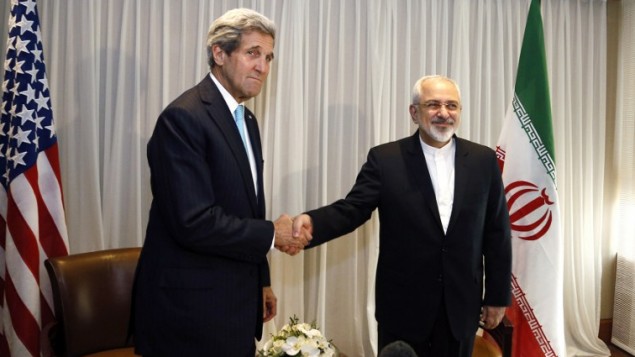
Iranian Foreign Minister Mohammad Javad Zarif (right) shakes hands with US Secretary of State John Kerry (left) in Geneva, January 14, 2015. (photo credit: AFP/Rick Wilking/Pool)
Corker and the Democrat he replaced as committee chairman, Senator Robert Menendez, left the latest briefing expressing concern about the administration basing negotiations on the need to maintain Iran’s potential nuclear weapons “breakout” time to at least one year.
“One of my major concerns all along that is becoming more crystal clear to me, is that we are, instead of preventing proliferation, we are managing proliferation,” Menendez said.
*****************
WASHINGTON — Five of the six world powers negotiating with Iran over its nuclear program have stepped back, leaving Washington to hammer out a deal with Tehran, a key US lawmaker said Tuesday.
“It’s evident that these negotiations are really not P5+1 negotiations any more,” Senate Foreign Relations Committee Chairman Bob Corker said as he emerged from a closed-door briefing by Obama administration officials on the status of nuclear talks with Iran.
“It’s really more of a bilateral negotiation between the United States and Iran.”
The five permanent UN Security Council members — Britain, China, France, Russia and the United States — plus Germany have undertaken years-long talks with Iran in a bid to halt the Islamic republic’s nuclear drive.
Several rounds of sanctions have been imposed on Iran, cutting deeply into the country’s economy.
Under an interim agreement reached in November 2013, Iran has diluted its stock of fissile materials from 20 percent enriched uranium to five percent in exchange for limited sanctions relief.
Senator Bob Corker, R-TN (photo credit:: CC BY-SA, byUS Congress, Wikimedia Commons)
But two deadlines for a permanent agreement have already been missed, requiring the talks to be extended.
President Barack Obama met with German Chancellor Angela Merkel at the White House on Monday, and Obama said he saw no reason to further extend the current deadlines.
The present issue, Obama said, was “does Iran have the political will and the desire to get a deal done?”
With a March 31 deadline for a political agreement approaching, and a final deal confirming technical details required by June 30, Corker said the key players are now essentially Washington and Tehran.
“I was in Munich this weekend (for an international security conference) and was very aware that this was becoming more of a one-on-one negotiation,” the Senate Republican told reporters.
Corker and the Democrat he replaced as committee chairman, Senator Robert Menendez, left the latest briefing expressing concern about the administration basing negotiations on the need to maintain Iran’s potential nuclear weapons “breakout” time to at least one year.
“One of my major concerns all along that is becoming more crystal clear to me, is that we are, instead of preventing proliferation, we are managing proliferation,” Menendez said.
Having Iran just one year away from building a bomb would be “a different world and a far more challenging world,” he added.
Absolutely not. Unless maybe the talks that are going nowhere, except to an Iranian nuclear bomb, seem really promising.
MUNICH — Secretary of State John F. Kerry said in an interview broadcast Sunday that it would be “impossible” to extend nuclear negotiations with Iran if an agreement on fundamental principles is not reached in the coming weeks.
Munich, how appropriate. Also that extension might still be possible if that agreement is reached.
Using more categorical language than he has employed previously, Kerry definitively precluded a third extension to talks with Iran about reducing its ability to make a nuclear bomb or easing sanctions.
That’s right. No third extension of talks… unless an agreement on principles is reached. Then we can extend it until Iran goes nuclear.
Khamenei seems to oppose a procedure already agreed to by the two sides, which is to conclude an understanding of general principles by March 24 and to finalize details of a deal by the end of June. “If an agreement is reached,” he said, “it must be concluded in one go and must encompass both general principles and details.”
So much for that. The negotiations can’t agree on the principles.
In November, when no deal could be struck by a self-imposed deadline, a temporary agreement, which had been in place for a year and had been extended once before, was pushed to late June. Kerry said at the time that the major points of agreement would have to be reached by late March.
So Kerry is desperately and clumsily trying to pressure the Iranians to agree to Obama’s sellout. Unfortunately for him, the Iranians know that he can rolled like an empty barrel, so they’re pushing even harder.
It’s a game of chicken in which Iran isn’t worried while Obama needs some kind of signature on a piece of paper to shut up senators from both parties.
“But if we’re not able to make the fundamental decisions that have to be made over the course of the next weeks, literally, I think it would be impossible to extend,” Kerry said. “I don’t think we would want to extend at that point. Either you make the decisions to prove your program is a peaceful one, or if you’re unable to do that, it may tell a story that none of us want to hear.”
Smart power. Notice how many ways Kerry backtracks a simple statement. When he says, “a story that none of us want to hear”, he’s talking about his administration’s denial. Iran has no problem talking about destroying Israel.
This anti-Egypt agenda, which seems to be shared by Turkey, is fueled by the desire to realize the dream of installing a Sunni Islamic empire, all while undermining moderate Arab regimes and giving a nod to Iran, as a way of covering all bases — just in case.
******************
Qatar and Egypt are at odds, and the attempts by the late King Abdullah of Saudi Arabia to facilitate a reconciliation between them have failed.
Qatar’s relentless efforts to overthrow Egyptian President Abdel-Fattah el-Sissi’s regime and reinstate the Muslim Brotherhood to power are evident from the programs airing on the Doha-controlled Al-Jazeera television network, and from the publication of doctored wiretaps featuring the Egyptian president and his advisers, who allegedly “stole” Egypt away from the Muslim Brotherhood and the “holy” Mohammed Morsi.
This anti-Egypt agenda, which seems to be shared by Turkey, is fueled by the desire to realize the dream of installing a Sunni Islamic empire, all while undermining moderate Arab regimes and giving a nod to Iran, as a way of covering all bases — just in case.
Egypt’s decision to outlaw the Muslim Brotherhood has resulted in increased incitement by Qatar as well as in an escalation in terrorist attacks in Egypt and Sinai. Egyptian intelligence has linked the latest series of attacks to Ansar Beit al-Maqdis, an offshoot of the Islamic State group, as well as to Hamas’ Izzedine al-Qassam Brigades. Hamas and the Izzedine al-Qassam Brigades are very much Qatar’s “babies,” and their involvement in these terrorist attacks has prompted Egypt to outlaw both.
In response, Al-Jazeera has begun portraying Izzedine al-Qassam Brigades’ operatives, who have denounced Sissi as a traitor to Islam and Arabs everywhere, as heroes fighting for the liberation of “Palestine.” The Qatari television station has also been obsessively covering the riots and unrest instigated by the Muslim Brotherhood to undermine the regime, intimidate foreign investors, and reverse the image of stability Sissi’s government is trying to convey to the world.
The airing of secret wiretaps, on which Sissi is heard mocking the wealthy Persian Gulf states, at this time seeks to pit Cairo against the Gulf states, ahead of the World Economic Forum on the Middle East, which is scheduled to convene in Sharm el-Sheikh, in Egypt, in late February, and where Egypt will lobby for aid.
Sissi’s assertion about the current situation in the Middle East is correct: Sunni Arab states are being offered as sacrifice to Iran, which is pursuing its nuclear endeavors uninterrupted. These states understand that Egypt’s stability is a prerequisite for their own national security, and therefore aiding Cairo is a favor that could only work to their advantage.
At the end of the day, in a reality where Iran poses an existential threat to other Arab countries, pointing to the emir of Qatar as a leader drowning in gold while millions of Egyptians go hungry — as heard on the wiretaps — may prove to be a double-edged sword, which may end up striking Qatar itself.









 anneinpt
 artaxes
 danmillerinpanama
 davidking1530
 Peter Hofman
 Joseph Wouk
 Peter
Peter Louisiana Steve
 WarSclerotic
Recent Comments