Archive for the ‘Iran scam’ category

Iran Promises to ‘Set Fire’ to U.S. Interests

September 3, 2015

Iran Promises to ‘Set Fire’ to U.S. Interests, Washington Free Beacon, September 3, 2015

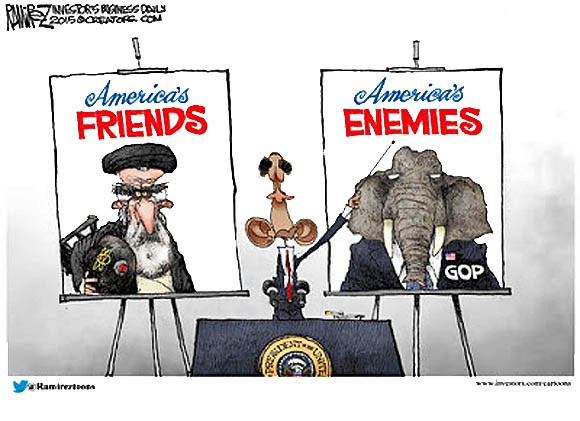
(Despite a the “deal” that favors Iran on every point, Obama’s Iranian friends keep saying “death to America.” He does not seem to mind. Who are his real friends and enemies?

Obama's enemies

— DM)

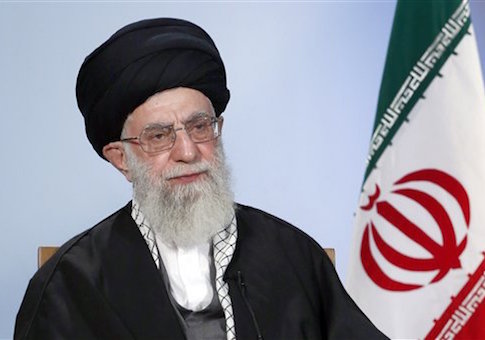
(AP Photo/Office of the Supreme Leader)
A senior Iranian military official has vowed to “set fire” to all U.S. interests in the region and maintained that the Islamic Republic welcomes war with America, according to regional reports demonstrating that Tehran is still committed to fighting the United States in the wake of a recently inked nuclear accord.

“In threatening remarks,” a top Iranian commander of the Revolutionary Guard Corps (IRGC) stated that Iran is prepared to “annihilate” U.S. and Israeli war forces should they “take the slightest military move against Iran,” according to Iran’s state-controlled Fars News Agency.

“We monitor their acts day and night and will take every opportunity to set fire to all their economic and political interests if they do a wrong deed,” Brigadier General Hossein Salami, the IRGC’s lieutenant commander, was quoted as saying in Tehran on Thursday.

In a direct threat to both the United States and Israel, Salami promised to “cut off enemies’ hands and fingers will then send its dust to the air,” according to the report.

These Iranian military officials were responding to multiple claims by U.S. officials that a military option against Tehran still remains on the table, despite the recently inked accord, which aims to constrain the Islamic Republic’s contested nuclear program.

In May, Salami said that Iran desires a war with the United States.

“We have prepared ourselves for the most dangerous scenarios and this is no big deal and is simple to digest for U.S.; we welcome war with the U.S. as we do believe that it will be the scene for our success to display the real potentials of our power,” he said at the time.

The comments came on the say day that the Iranian military unveiled a new missile defense system to track enemy threats.

“The system can detect and trace targets, take decisions for the operation of the missile systems, decide about the type of weapon systems needed, assess and foresee hostile targets, and field commanders can easily take a final decision with the data provided by the command and control system,” according to Fars.

Meanwhile, Iranian Supreme Leader Ali Khamenei on Thursday said that Iran is not open to negotiate with the United States on any other issue outside of the nuclear portfolio.

Khamenei “reiterated the complete ban on any negotiation between the Iranian officials and the Americans on other issues, and said there won’t be any other talks with the White House, except for the nuclear issue,” according to Fars.

“The U.S. positions are fully against the stances of the Islamic Republic,” Khamenei was quoted as saying in a wide-ranging speech.

Khamenei also called on the country’s leaders to attack U.S. critics of the deal.

“In the nuclear talks with are negotiating with the 5+1, but the U.S. administration is, in fact, the main party; but the U.S. officials speak very badly and a decision needs to be taken about the manner they speak,” Khamenei told the country’s powerful Assembly of Experts.

“Don’t say that the Americans are uttering these words to convince their internal rivals; of course, I believe that the internal disputes in the U.S. are real and they have differences and the reason for such a difference is clear to us, but what is officially said needs a response and if no response is given to them, the other side’s remarks will be entrenched,” Khamenei said.

Should Israel and its Arab neighbors form an alliance against Iran?

September 3, 2015

Should Israel and its Arab neighbors form an alliance against Iran? The Hill, Eli Verschleiser, September 3, 2015

Could a nuclear deal with Iran accomplish more than decades of diplomacy in the Middle East and, rather ironically, create new alliances between Israel and Arab neighbors?

That’s a key question as we gear up for the battle on Capitol Hill over President Barack Obama’s controversial pact with Tehran to limit uranium enrichment in return for lifting of sanctions. Critics say the agreement paves the way for a double reward of Tehran— a huge influx of cash and an eventual, unfettered path toward nuclear arms.

Neither the Saudis, the Kuwaitis, nor the United Arab Emirates or for that matter any of the other Persian Gulf states are too excited about the prospect of a nuclear-armed Iran. The role of Iran in the conflicts in Iraq and Syria, and the rise of Islamic State terror and the Muslim Brotherhood, have become a much bigger problem for Arab leaders than the tired conflict with Israel. Those countries have a Sunni majority, while Persian Iran is led by rival Shia Muslims.

Iran, of course, is also a major oil rival for the Gulf States and became more powerful following the fall of Saddam Hussein’s Iraq.

The Saudis have been publicly moderate on the deal but said to be privately angry over it. Epitomizing the old Middle East adage that the enemy of my enemy is my friend, the Saudis were reported to have offered Israel the ability to use their airspace to strike at Iran. This is a crucial step in keeping a military option on the table as it would save time and fuel if such a strike were necessary. “The Saudi authorities are completely coordinated with Israel on all matters related to Iran,” a European official was quoted as saying in an Israeli TV report.

Clearly momentum for alignment with Israel in some form is building.

“To all those who think the Persian state, and the regime of the Rule of the Imprudent… the dictatorial fascist Persian regime which controls it, is a friendly country, whereas Israel is an enemy country, I say that a prudent enemy is better than an imprudent one.”

Those words were written by Abdallah Al-Hadlaq in the official newspaper of Kuwait, Al-Watan.

It is not the first time the author has expressed support for ties with Israel. As far back as 2009 he called on his government and other Gulf states to put aside their differences with Jerusalem and forge an alliance against Iran.

But the fact that his column was published in a government daily in a country without full press freedom speaks volumes.

“The state of Israel and its various governments have waged more than five wars with the Arabs, yet never in the course of these wars did Israel think to use its nuclear weapons against its Arab enemies,” Al-Hadlaq wrote. “Conversely, if the Persian state, with its stupid, rash and fascist regime that hides behind a religious guise, ever develops nuclear weapons, it will not hesitate to use nuclear bombs against the Arab Gulf states in the first conflict that arises.”

Were the Saudis to show leadership in rallying other Sunni-led states against Iran it could have a significant impact on a new order in the Middle East.

Furthermore the new coalition could collectively work wonders to get rid of ISIS, as Jordan’s King Abdullah recently declared in a CNN interview that the war against ISIS ‘is our war’. The Iranian nuclear threat and the ISIS threat can top the agenda in this new coalition.

“Iran does have enough politico-military and economic potential to counter-balance Saudi led “Sunni” states in the Middle East and beyond,” wrote Salman Rafi Sheikh in an essay for the magazine Eastern Outlook last March. “It is precisely for this very reason that Saudi Arabia’s anxiety about an agreement has fueled a flurry of intense diplomacy in recent days to bolster unity among “Sunni” states in the Middle East in the face of “shared threats”, especially those emanating from Iran.”

Rafi Sheikh, a research-analyst of International Relations and Pakistan’s foreign and domestic affairs, noted that “this deal is most likely to send political jolts across the entire Middle Eastern political landscape, with Saudi Arabia and Israel standing as the most sensitive areas to bear its shocks; and as such, are most likely to clutch their hands into an alliance against Iran, and by default, against the US ambitions as well.”

There is great potential for Saudi Arabia’s King Salman to rally Gulf states as well as Turkey, Egypt and Jordan to stand up to an Iran that will only become more emboldened with the huge influx of post-sanctions billions and new political bona fides that will make Tehran bolder.

Increased security cooperation as Iran bides its time for an eventual bomb –after the agreement period, or in the worst-case scenario, in violation of the agreement — may eventually lead to more nuclear proliferation in the region.

Will that mean a nuclear pact between Israel and its former enemies? That will be a fascinating development that could never have been imagined even a decade ago.

And it will truly be a sad irony if, after nearly 70 years of a solid relationship between the United States and Israel, the Jewish state had to turn to despotic regimes with little or no human rights to solidify its security position, feeling far less than confident that Washington has its back than it has in the past.

However this may simply be the beginning of an Arabic Israeli accord where both groups can begin to understand and accept each other.

NATO Allies Making It Easier for Iran to Attack Israel?

September 3, 2015

NATO Allies Making It Easier for Iran to Attack Israel? The Gatestone InstituteBurak Bekdil, September 3, 2015

  • Iran did not go mad and threaten to hit all NATO installations in Turkey because it wanted 3.5 million Turkish citizens to die from the chemical warhead of a Syrian missile. It went mad and threatened because it viewed the defensive NATO assets in Turkey as a threat to its offensive missile capabilities.
  • Iran’s reaction to the NATO assets in Turkey revealed its intentions to attack. It could be a coincidence that the U.S. and Germany (most likely to be followed by Spain) have decided to withdraw their Patriot missile batteries and troops from Turkey shortly after agreeing to a nuclear deal with Iran. But if it is a coincidence, it is a very suspicious one. Why were Assad’s missiles a threat to Turkey two and a half years ago, but are not today?
  • Apparently, NATO allies believe, although the idea defies logic, that the nuclear deal with Iran will discourage the mullahs in Tehran from attacking Israel.

In early 2013, NATO supposedly came to its ally’s help: As Turkey was under threat from Syrian missiles — potentially with biological/chemical warheads — the alliance would build a mini anti-missile defense architecture on Turkish soil. Six U.S.-made Patriot missile batteries would be deployed in three Turkish cities and protect a vast area where about 3.5 million Turks lived.

The Patriot batteries that would protect Turkey from Syrian missiles belonged to the United States, Germany and the Netherlands. In early 2015, the Dutch mission ended and was replaced by Spanish Patriots. Recently, the German government said that it would withdraw its Patriot batteries and 250 troops at the beginning of 2016. Almost simultaneously, the U.S. government informed Turkey that its Patriot mission, expiring in October, would not be renewed. Washington cited “critical modernization upgrades” for the withdrawal.

Since the air defense system was stationed on Turkish soil, it unnerved Iran more than it did Syria. There is a story behind this. First, Patriot missiles cannot protect large swaths of land, but only designated friendly sites or installations in their vicinity. That the six batteries would protect Turkey’s entire south and 3.5 million people living there was a tall tale. They would instead protect a U.S.-owned, NATO-assigned radar deployed earlier in Kurecik, a Turkish town; and they would protect it not from Syrian missiles with chemical warheads, but from Iranian ballistic missiles.

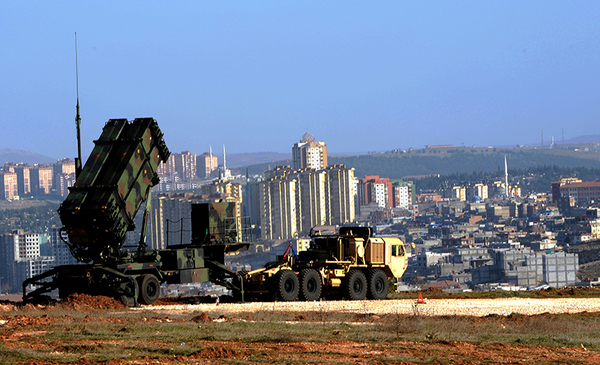
1234 (1)U.S. Patriot missiles, deployed outside Gaziantep, Turkey in 2013. (Image source: U.S. Army Europe/Daniel Phelps)

Kurecik seemed to matter a lot to Iran. In November 2011, Iran threatened that it would target NATO’s missile defense shield in Turkey (“and then hit the next targets,” read Israel) if it were threatened. Shortly before the arrival of Patriots in Turkey, Iran’s army chief of staff warned NATO that stationing Patriot anti-missile batteries in Turkey was “setting the stage for world war.”

What was stationed in Kurecik was an early-warning missile detection and tracking radar system. Its mission is to provide U.S. naval assets in the Mediterranean with early warning and tracking information in case of an Iranian missile launch that might target an ally or a friendly country, including Israel. So, a six-battery Patriot shield to protect the NATO radar in Kurecik against possible Iranian aggression was necessary. And that explains why the Iranians went mad about Kurecik and openly threatened to hit it.

NATO and Turkish officials have always denied any link between the Patriot missiles and the NATO radar in Turkey. They have often pointed out that the Patriot batteries were stationed in the provinces of Adana, Kahramanmaras and Gaziantep, while Kurecik was in nearby Malatya province. But the Patriot is a road-mobile system: It can be dismantled easily and re-deployed in another area in a matter of hours (the road distance between Kurecik and Kahramanmaras is a mere 200 kilometers, or 124 miles).

Clearly, Iran did not go mad and threaten to hit all NATO installations in Turkey because it wanted 3.5 million Turkish citizens to die from the chemical warhead of a Syrian missile. It went mad and threatened because it viewed the defensive NATO assets in Turkey as a threat to its offensive missile capabilities, which the Patriots could potentially neutralize.

Why, otherwise, would a country feel “threatened” and threaten others with starting a “world war” just because a bunch of defensive systems are deployed in a neighboring country? Iran did so because it views the NATO radar in Turkey as an asset that could counter any missile attack on Israel; and the Patriots as hostile elements because they would protect that radar. In a way, Iran’s reaction to the NATO assets in Turkey revealed its intentions to attack.

It could be a total coincidence that the U.S. and Germany (most likely to be followed by Spain) have decided to pull their Patriot batteries and troops from Turkey shortly after agreeing to a nuclear deal with Iran. But if it is a coincidence, it is a very suspicious one. In theory, the Patriot systems were deployed in Turkey in order to protect the NATO ally from missile threats from Syrian President Bashar al-Assad’s regime. Right? Right.

Assad’s regime is still alive in Damascus and it has the same missile arsenal it had in 2013. Moreover, Turkey’s cold war with Assad’s Syria is worse than it was in 2013, with Ankara systematically supporting every opposition group and openly declaring that it is pushing for Assad’s downfall. Why were Assad’s missiles a threat to Turkey two and a half years ago, but are not today?

The Patriot missiles are leaving Turkey. They no longer will “protect Turkish soil.”

Apparently, NATO allies believe, although the idea defies logic, that the nuclear deal with Iran will discourage the mullahs in Tehran from attacking Israel.

It looks as if the potential target of NATO heavyweights’ decision is more a gesture to Iran than to Turkey.

Obama secures rubber stamp for Iran deal catastrophe

September 3, 2015

Obama secures rubber stamp for Iran deal catastrophe, Front Page MagazineJoseph Klein, September 3, 2015

(Please see also, Use Our Senatorial Nuclear Option to Stop Iran’s Radioactive Nuclear Option. Make Senators vote yes or no on the “deal.”— DM)

obama-wc2

Democratic Senator Barbara Mikulski of Maryland has pushed President Obama’s nuclear appeasement deal with Iran over the top. With her decision to vote in favor of the deal, Obama now has the support of the 34 senators he needs to uphold his expected veto of a congressional resolution of disapproval. If enough craven Democrats back a planned filibuster to prevent a vote on the floor of the Senate, Obama will not even have to use his veto pen.

The nightmare of a financially secure nuclear armed Iran, legitimized by the Obama administration and its international partners, is about to envelop us.

Ironically, Obama warned in a speech he delivered on September 1st in Alaska that a potentially bleak future could lie ahead, in which “there’s not going to be a nation on this Earth that’s not impacted negatively.”

“People will suffer,” Obama said. “Economies will suffer. Entire nations will find themselves under severe, severe problems…more conflict.”

President Obama is right to be concerned about the future, but his stated reason for his concern is entirely misplaced. Obama was talking about climate change, which he considers to be a man-made disaster. In truth, Obama himself has created a far more imminent disaster with his nuclear deal.

In his climate change speech, Obama spoke about our “grandkids” who “deserve to live lives free from fear, and want, and peril.” He added that we need to prove “we care about them and their long-term futures, not just short-term political expediency.”

Obama, and the partisan loyalists who support him no matter what, are the ones letting down our grandkids. They are the ones who have sacrificed our grandkids’ long-term futures at the altar of short-term political expediency. The only long-term future that Obama is interested in is his own legacy.

By President Obama’s own admission, no later than 15 years from now – when my granddaughter will be just 18 years old – Iran will be in a position to develop enough enriched materials to produce nuclear bombs with virtually no “break-out” time. The deal’s major nuclear restrictions, such as they are, will have gone away, even assuming that Iran had not cheated in the meantime.

The deal’s inspection mechanism is a farce, including most notably, Iran’s self-inspection of its military site where it is suspected that nuclear weaponization research and development work was carried out. The military facility at Parchin is off-limits to onsite inspection by the International Atomic Energy Agency (IAEA). Yet the Obama administration continues to lie to the American people about how comprehensive the IAEA inspections will be. Secretary of State John Kerry tweeted this falsehood on September 2nd:  “With this #IranDeal, the IAEA can go wherever the evidence leads. No facility…will be off limits.”

The Iranian leaders also will get their hands soon on hundreds of billions of dollars. No doubt they will use some of their treasure trove from sanctions relief to fund their terrorist proxies all over the world. Obama admitted in his speech defending his deal last month at American University that monies from sanctions relief “will flow to activities we object to.” He acknowledged that “Iran supports terrorist organizations like Hezbollah. It supports proxy groups that threaten our interests and the interests of our allies – including proxy groups who killed our troops in Iraq. They try to destabilize our Gulf partners.”

Yet Obama tells the American people not to worry about such real-life risks. Instead, he diverts attention to his Chicken Little climate change hype that the sky will fall if we do not take urgent action now.

Much of the rest of the Iranians’ windfall from sanctions relief will go towards developing and acquiring, from North Korea, Russia and other sources, advanced military technology and long-range missiles.

Iran’s leaders have made it abundantly clear that they do not consider themselves bound by either the 5-year UN Security Council arms embargo or the 8-year missile embargo.  For example, Iran’s President Hassan Rouhani declared: “We will buy, sell and develop any weapons we need and we will not ask for permission or abide by any [U.N.] resolution for that.”

Iranian Defense Minister Hossein Dehghan said last month that “We are considering the design, research, and production of [missiles] that are highly destructive, highly accurate, radar evasive, and tactical.”

Brigadier General Amirali Hajizadeh, commander of the aerospace division of the Islamic Revolutionary Guard Corps (IRGC), said: “Some wrongly think Iran has suspended its ballistic missile programs in the last two years and has made a deal on its missile program.” To emphasize his point, the commander announced that Iran “will have a new ballistic missile test in the near future that will be a thorn in the eyes of our enemies.”

The head of Iran’s Islamic Revolutionary Guard Corps, Maj. Gen. Mohammad Ali Jafari, announced plans to expand the reach of Iran’s missiles.

The Iranian thugs are not limiting themselves to purely defensive weapons. “They (the US and the Zionists) should know that the Islamic Revolution will continue enhancing its preparedness until it overthrows Israel and liberates Palestine,” said Brigadier General Mohsen Kazzemeini, the IRGC’s top commander in the Tehran Province (as quoted by Iran’s Fars News Agency). “We will continue defending not just our own country, but also all the oppressed people of the world, especially those countries that are standing on the forefront of confrontation with the Zionists,” he added.

The Obama administration, which conceded as part of the nuclear deal to agree to unconditional term limits on the arms and missile embargoes, barely raised an eyebrow at Iran’s refusal to be bound by even these limited embargoes. In fact, Kerry went so far as to say that “they are not in material breach of the nuclear agreement for violating the arms piece of it.”

A sobering report was just released by the Iran Strategy Council, led by retired generals Chuck Wald (Commandant of Marine Corps) and James Conway (Deputy Commander of European Command). It warns of the deal’s likely dangers to America’s own national security and of the “cascading instability” it will produce in the Middle East region and beyond:

“The final agreement on Iran’s nuclear program, the Joint Comprehensive Plan of Action (JCPOA), has potentially grave strategic implications that directly threaten to undermine the national security of the United States and our closest regional allies. By allowing Iran to become a nuclear threshold state and enabling it to become more powerful and expand its influence and destabilizing activities – across the Middle East and possibly directly threatening the U.S. homeland – the JCPOA will place the United States in far worse position to prevent a nuclear Iran.”

The report’s authors predict that the “nightmare scenarios of WMD and terrorism on the soil of the United States and its allies will become more probable.”

Nevertheless, the Obama administration is spiking the ball, exulting over its evident victory in keeping enough Democratic senators on board to protect Obama’s deal.

The White House tweeted: “If your house is on fire, would you refuse to put it out because there could be another fire in 15 years?”

The question should be: “If your house is flammable, would you hand your enemy a match?”

Kerry, who turned on his own fellow soldiers during the Vietnam War, tweeted: “I have had the privilege of serving our country in times of peace and in times of war—and peace is better.”

When Neville Chamberlain returned from Germany with his infamous Munich Pact in hand, he declared: “I believe it is peace for our time…Go home and get a nice quiet sleep.”

The long nightmare of World War II ensued shortly thereafter. Thanks to Barack Obama and John Kerry, we are entering the nightmare leading inevitably to an emboldened, well-funded Iran equipped with nuclear arms and the missiles to deliver them.

Kerry Promises Israel, Saudis Money In Wake of Iran Nuclear Deal

September 2, 2015

Kerry Promises Israel, Saudis Money In Wake of Iran Nuclear Deal, Washington Free Beacon, , September 2, 2015

U.S. Secretary of State John Kerry takes a drink during a news conference after the closed-door nuclear talks with Iran, in Vienna, Austria, Monday, Nov. 24, 2014. Facing still significant differences between the U.S. and Iran, negotiators gave up on last-minute efforts to get a nuclear deal by the Monday deadline and extended their talks for another seven months. The move gives both sides breathing space to work out an agreement but may be badly received by domestic sceptics, since it extends more than a decade of diplomatic efforts to curb Iran's nuclear prowess. (AP Photo/Ronald Zak)  (AP Photo/Ronald Zak)

“No amount of conventional weapons can neutralize the threat posed by the mullahs acquiring nuclear weapons,” the [congressional] source said. “This type of appeasement is a slap in the face to our closets allies and a wink-wink to the dictators in Tehran.”

****************

Secretary of State John Kerry on Wednesday moved to reassure Congress that Israel and America’s Gulf State allies would be fully taken care of in the wake of the Iran nuclear deal, which Kerry acknowledged would not stop Iran’s support for terrorism, according to a letter sent by the secretary of state to lawmakers.

Just moments after the White House secured enough votes to override a congressional veto of the Iran deal, a letter from Kerry appeared in the inboxes of congressional offices across Capitol Hill.

Kerry admits that, despite the deal, Iran will continue to back terrorist groups across the globe and promises to boost military support and funding to Israel and Gulf states such as Saudi Arabia, according to a copy of the letter obtained by the Washington Free Beacon.

The letter comes in response to concerns among lawmakers, Israel, and other Gulf region allies that the nuclear accord will boost the Islamic Republic’s support for terrorism, while leaving traditional U.S. allies on the defense.

“Important questions have been raised concerning the need to increase security assistance to our allies and partners in the region and to enhance our efforts to counter Iran’s destabilizing activities in the region,” Kerry writes. “We share the concern expressed by many in Congress regarding Iran’s continued support for terrorist and proxy groups throughout the region, its propping up of the Assad regime in Syria, its efforts to undermine the stability of its regional neighbors, and the threat it poses to Israel.”

The Obama administration, Kerry claims, is under “no illusion that this behavior will change following implementation of the JCPOA,” or Joint Comprehensive Plan of Action.

“The president has made clear that he views Israel’s security as sacrosanct, and he has ensured that the United States has backed up this message with concrete actions that have increased US military, intelligence, and security cooperation with Israel to their highest levels ever,” the letter states.

Kerry then goes on to outline the ways in which the Obama administration will enhance security cooperation with Israel and Gulf State allies.

Israel, for instance, will be the first country in the region to get a U.S.-made next-generation F-35 fighter aircraft in 2016.

An additional $3 billion in U.S. aid also will go to secure Israel’s missile defense programs, such as the Iron Dome system. The administration also stands ready “to enhance” funding to next-generation missile defense systems, such as Arrow-3 and David’s Sling.

The administration, Kerry writes, recently “offered Israel a $1.89 billion munitions resupply package that will replenish Israel’s inventories and will ensure its long-term continued access to sophisticated, state of the art precision guided munitions.”

The administration will additionally work to secure a new 10-year “Memorandum of Understanding” with the Jewish state that “would cement for the next decade our unprecedented levels of military assistance,” Kerry writes.

Kerry also proposes to collaborate with Israel on “tunnel detection and mapping technologies to provide Israel new capabilities to detect and destroy [terrorist] tunnels before the could be used to threaten Israeli civilians.”

President Barack Obama has further proposed to Prime Minister Benjamin Netanyahu that the two governments “begin the process aimed a further strengthening our efforts to confront conventional and asymmetric threats.”

Gulf States, such as Saudi Arabia and the United Arab Emirates (UAE), also will benefit from increased arms shipments and new security deals, according to Kerry.

The administration is “working to expedite the delivery of capabilities needed to deter and combat regional threats, including terrorism and Iran’s destabilizing activities in the region,” Kerry writes.

In July, for example, the administration notified Congress of new arms sales to Saudi Arabia and the UAE “that will provide long-term strategic defense capabilities and support for their ongoing operations,” the letter states.

Another goal is to strengthen ballistic missile defense capabilities in the region. This goal, Kerry says, “is a strategic imperative and an essential component to deterring Iranian aggression against any GCC member state.”

One senior Congressional aide who received the letter said that it is a clear attempt by the administration to placate regional fears about the deal.

“Let’s not be fooled about what the letter represents. This desperate move to placate Israel and our Gulf partners is a tacit acknowledgment that Iran will expand its international terror regime thanks to the nuclear agreement,” the source said. “If this is such a good deal, why does the administration feel compelled to immediately offer arms packages as compensation to our regional allies?”

“No amount of conventional weapons can neutralize the threat posed by the mullahs acquiring nuclear weapons,” the source said. “This type of appeasement is a slap in the face to our closets allies and a wink-wink to the dictators in Tehran.”

Israel Navy’s defense of Mediterranean gas fields hinges heavily on upgraded Barak and intelligence

September 2, 2015

Israel Navy’s defense of Mediterranean gas fields hinges heavily on upgraded Barak and intelligence, DEBKAfile, September 2, 2015

noble_energyIsraeli elite unit practices defense of gas field

The Israeli Navy Wednesday, Sept. 2, staged a defensive exercise, which centered on the elite Shayetet 13 unit silently and smoothly driving off the terrorists who had “captured the Yam Tethys Mediterranean gas field, off the coast of the southern Israeli port of Ashkelon. This demonstration and the weapons used exposed but a small part of the IDF’s scope and capabilities. The key, say our military experts, is intelligence – strategic and tactical – for early warning of enemy plans of attack and its actions in real time – whether by sabotage or long-range missile or drone.

Navy commander Brig. Ram Rotberg, leading a tour of military correspondents, outlined the potential threats addressed by the latest defense doctrines. They include the Russian Yakhont anti-ship missile which is in hands of Hizballah and the Syrian army, with a range of 300 km, a speed of 2 mach and the ability to cruise as low as ten meters, way under most radar systems, with a payload of 300 kg of explosives.

Another is the Iranian Ababil drone, believed to have been upgraded with navigation capabilities and the ability to carry tens of kilos of explosives. Iran is also ceaselessly developing new missiles and rockets, some of which are no doubt being supplied to the Lebanese Hizballah and the Palestinian Hamas.

The counter-measures and weapons unveiled in the Navy drill Wednesday were as follows:

1. The Barak 8 multi-purpose seaborne missile defense system (sea-to-sea, sea-to-air, sea-to-coast and sea-to-missile) has been upgraded to offer the gas rig the same sort of protection as Iron Dome provides on land. It is designed to intercept surface to sea missiles, ballistic missiles with GPS guidance systems and primitive rockets. It is 4.5 meters long, weighs 275 kg, has a speed of two mach, and effective range of around 100 km and carries a 75 kg payload of explosives.

Last year, a Barak 8 was reported to have intercepted a Russian Yakhont during a war game.

2.  A system of sensors installed on and below the sea’s surface to detect terrorists attempting to climb onto the gas rigs, and an active-passive obstacle field around the installation.

3. UAV’s and spy balloons will be on 24/7 patrol over the gas rigs.

4. Additional missile systems are available or in the works for supplementing the current defenses. They include Rafael’s Spyder surface-to-air missiles and David’s Sling.

Mikulski pushes Obama’s Iran nuke deal over the top in Senate

September 2, 2015

Mikulski pushes Obama’s Iran nuke deal over the top in Senate, The Hill, Jordain Carney, September 2, 2015

(“Mikulski added that in the wake of the Iran deal, the United States must ‘reaffirm our commitment to the safety and security of Israel.'”  Commitments from Obama are, at best, ephemeral.  Israel can rely only in herself. — DM)

mikulskibarbara03022015getty_1

Mikulski was one of 11 remaining undecided Democrats. Opponents needed all 11 to buck Obama and vote against the deal if they were going to be able to block it in the Senate.

*********************

Sen. Barbara Mikulski said on Wednesday that she will support President Obama’s nuclear deal with Iran, all but ensuring the agreement will survive an attack in the Senate.

“No deal is perfect, especially one negotiated with the Iranian regime,” the Maryland Democrat, who is retiring after her current term, said in a statement. “I have concluded that this Joint Comprehensive Plan of Action is the best option available to block Iran from having a nuclear bomb. For these reasons, I will vote in favor of this deal.”

Mikulski’s decision hands President Obama a needed foreign policy win after a months-long lobbying effort by administration officials to shore up support for the agreement.

Democrats have rallied around the deal since leaving town in August, giving Obama the 34 senators he needs to back the agreement and uphold a veto of a potential resolution of disapproval.

Mikulski was one of 11 remaining undecided Democrats. Opponents needed all 11 to buck Obama and vote against the deal if they were going to be able to block it in the Senate.

She said that while reviewing the deal she focused on a handful of questions, including whether it blocks Iran from getting a nuclear bomb, what sanctions would be lifted and if a better alternative could be reached if Congress rejects the deal.

Republicans have argued that the Obama administration could force Iran back to the negotiating table, but Mikulski said on Wednesday that the two alternatives to the deal were either more sanctions against Iran or military action.

“Maintaining or stepping up sanctions will only work if the sanction coalition holds together. It’s unclear if the European Union, Russia, China, India and others would continue sanctions if Congress rejects this deal. At best, sanctions would be porous, or limited to unilateral sanctions by the U.S.,” she said, adding that the “military option is always on the table for the United States.”

Mikulski, as well as undecided Sen. Ben Cardin (D-Md.), have been under intense pressure from opponents of the deal and pro-Israel advocates to reject the Iran nuclear agreement.

She tried to preempt some of their criticism on Wednesday, touting her support for Israel and noting that she considered how the deal would affect the country.

“I have been an unabashed and unwavering supporter of Israel. I have persistently supported the sanctions that brought Iran to the table,” she said. “With the horrors of the Holocaust in mind, I have been deeply committed to the need for a Jewish homeland, the State of Israel, and its inherent ability to defend itself.”

Mikulski added that in the wake of the Iran deal, the United States must “reaffirm our commitment to the safety and security of Israel.”

Why won’t Obama stop lying about Iran’s military budget?

September 2, 2015

Why won’t Obama stop lying about Iran’s military budget? Front Page Magazine, Daniel Greenfield, September 2, 2015

ofp

Obama claimed that ISIS was only a “jayvee” team even as it was capturing Iraqi cities. Now he wants us to believe that Iran is just another “jayvee” team even as it’s taking over Iraq, Syria and Yemen.

Like the rest of his Iran deal talking points, the one about Iran’s tiny military budget is false, and not only is it false, but his claim about how small Iran’s military budget keeps changing.

A few weeks ago, in a speech at American University, he was  claiming that “The defense budget of the United States is more than $600 billion. To repeat, Iran’s is about $15 billion.”

“Iran’s defense budget is $30 billion. Our defense budget is closer to $600 billion. Iran understands that they cannot fight us,” Obama had told the New York Times in April.

Just now, he told the Forward, “As I pointed out repeatedly, Iran’s annual defense budget is about $15 billion.”

What is Iran’s military budget? Read Obama’s lips. It’s either $15 billion or $30 billion.

Either Iran’s military budget changes every time Obama gives a speech or he’s playing with numbers to make it seem small. If $30 billion still seems big, how about $15 billion? And if $15 billion is still too big, get ready for the $7.5 billion Iranian defense budget. How can you be worried about that?

Obama is borrowing a trick from the Manchurian Candidate. No one is talking about how big Iran’s military budget is, but debating how small it is. And how small is it?

Iran’s military is at over 500,000 in strength. The Basji militia claims to be able to mobilize millions more. It has a nuclear weapons program and some of the most advanced indigenously developed weapons programs in the region. Iran is currently involved in wars in Syria and Iraq. Its proxy armies have carved up Lebanon and Yemen, and are slavering over Bahrain.

Not bad for $15 billion or $30 billion or whatever Obama is claiming it is this week.

Of course Iran’s budget isn’t $15 or $30 billion. It spent $11 billion on the Bushehr reactor alone. Its nuclear program cost upward of $100 billion. Obama’s deal requires him to claim that the program is peaceful, but who really believes that a country sitting on a mountain of gas and oil blew that much money just to lower the cost of electricity a little bit?

How much money is Iran really spending to expand its territory and influence?  Iran is allegedly spending billions a month to back Assad’s military campaign. The total may come to as much as $35 billion a year.

That’s more than more than twice as much as Obama’s current estimate of its military budget.

The Hezbollah terror group has received billions from Iran over several years. Islamic Jihad in Israel gets between $100 and $150 million a year.  Iran cut off aid to Hamas due to the Sunni-Shiite shift. Since then relations are slowly being restored, but it’s unclear how much money this will mean for the terror group. In 2007, Iran had pledged $250 million in aid. It’s unknown how much money Iran is spending on its Houthi terrorists in Yemen or how much money it’s spending on Shiite militias in Iraq and Syria.

In 2007, a senior Hezbollah terrorist captured by the US claimed that Iran was providing $3 million a month to Shiite terror groups to attack Americans in Iraq. Considering that the Shiite militias now dominate Baghdad and other parts of Iraq and number in the tens of thousands, it’s a safe bet that the bill for maintaining Tehran’s terrorist army in Iraq has gone up a whole lot since then.

It’s unknown how much Iran is spending on its Shiite militias in Syria, but the NDF reportedly has 100,000 men and is being trained and financed by Iran.

And this is just the visible ground forces.

Iran also has an international terrorist network which it has used to carry out terror attacks everywhere from Argentina to Thailand to Saudi Arabia to Paris. No country since the USSR has anything like it in its scope and organizations like that cost money. We can’t even begin to guess how much Iran spends on it.

But there are hints. The investigation into Iran’s bombing of the Jewish Community Center in Argentina was stymied by bribery attempts and climaxed in the assassination of Alberto Nisman, the Special Prosecutor who had accused President Kirchner of a cover-up in return for business deals with Iran.

That sort of arrangement doesn’t come cheap. Iran is willing to spend a lot of money to maintain a global terror network and then to clean up after it.

So what is Iran’s real military budget?

It has the biggest ballistic missile arsenal and the only known nuclear weapons program in the region. It has the largest number of active military personnel in the region and its militias control large sections of four other countries. It has indigenously developed fighter jets and a global terrorist network. It has drone bases, submarines and is the “the holder of the largest chemical weapons stockpile” in the area.

This doesn’t come cheap and you can’t have all that on the military budget of Colombia. If you believe Obama, then Iran has a smaller military budget than Israel and Saudi Arabia even though the military spending in both countries is largely focused on countering threats from Iran. If you believe Obama, Iran is no match for any of its neighbors, and yet it’s conquering or terrorizing them one by one.

But with Obama, the devil is usually in the details. He emphasizes the “defense budget”, but despite its official claims, Iran doesn’t play defense. It goes on the offensive. Its constitution states that its military is an “ideological army” built to fulfill “the ideological mission of jihad in Allah’s way; that is, extending the sovereignty of Allah’s law throughout the world.”

Or as the Ayatollah Khomeini said, “Islam makes it incumbent on all adult males… to prepare themselves for the conquest of [other] countries so that the writ of Islam is obeyed in every country in the world.”

Iran doesn’t have a defense budget. Like Nazi Germany or the USSR, its entire system is militarized. A portion of its money goes to the business of government. A portion of that exists officially as a defense budget, most of which is swallowed up by Iran’s Revolutionary Guard (IRGC). The IRGC is a terrorist group with its own army and air force that is involved in wars across the region.

None of these numbers really mean anything because Iran’s accounting would make the mafia blanch. Iran is an oligarchy built on a complex network of organizations. State-owned enterprises, generals, Islamic foundations and terrorist bosses move money around using everything from oil to heroin.

The official budget means even less than it does in Russia. It’s just a number you read in the newspaper.

The IRGC controls construction companies, nuclear plants, airports, banks and ports. Imagine if GE, HSBC and Berkshire Hathaway were all one entity and had their own army. That’s the IRGC. Its annual revenue is estimated to be higher than Obama’s estimate for Iran’s entire defense budget.

Iran doesn’t have a defense budget. Its economy is its military budget. The IRGC controls at least a third of the country’s GDP and the vast majority of its exports. It claims a majority of the official defense budget, but unofficially it controls a majority of Iran’s economy.

It’s also responsible for exporting terrorism worldwide.

Obama’s claims about Iran’s tiny defense budget, which shrinks every time he gives a speech, are a lie. He claims that the “Gulf States, combined, spend about eight times” as much as Iran does. In fact, Iran spends at least as much if not more because most of its military budget is as black as night.

Ever since he struck a deal with Iran’s terror regime, he’s been knowingly passing on misinformation from that regime. And Obama can’t even seem to keep the phony budget numbers he’s using straight.

Obama has told many lies about his Iran deal. But this is more than just another lie. Minimizing Iran’s military spending to make it look as harmless as possible endangers American national security. There are already reports that Obama worked to tamper with ISIS intelligence materials to make the terror group look weak. It was his insistence that ISIS was only a jayvee team that let it take over cities.

Now he wants to convince Americans that Iran is just another jayvee team we shouldn’t take seriously. Pay no attention to the nukes or the worldwide terror rings. Its fake military budget is so small.

Obama deserves to be called out for every lie he has told about his disastrous Iran deal. But it’s important to our national security to call him out for his big lie about Iran’s little military budget.

Khamenei: U.S.Is The Enemy’; ‘We Must Combat The Plans Of The Arrogance With Jihad For The Sake Of Allah

September 1, 2015

Khamenei: U.S.Is The Enemy’; ‘We Must Combat The Plans Of The Arrogance With Jihad , MEMRI, September 1, 2015

(Does Iran’s Supreme Leader refer to Obama’s America or to the United States? There’s a difference. — DM)

On August 17, 2015, just over a month after the announcement of the JCPOA in Vienna, Iranian Supreme Leader Ali Khamenei said in a speech at a conference held by the Iranian Shi’ite Ahl Al-Bayt organization that the U.S. is the embodiment of the enemy of the Islamic peoples and of Iran. It must be fought with military, cultural, economic, and political jihad, he said, adding that Islamic Iran is not interested in reconciling with it. He further claimed that the U.S. is attempting to divide the Islamic world into Shi’ite and Sunni camps that will wage a religious war against each other, and in this way gain it will be able to gain control over the peoples of the region.[1]

Iran, he stressed, stands behind the resistance axis, opposes the division of Syria and Iraq, and will continue to support anyone who fights Israel.

Following are excerpts from a report on the speech that was posted on Khamenei’s website (Leader.ir):

“[Khamenei said:] ‘We must combat the plans of the arrogance [i.e. the West, led by the U.S.] with jihad for the sake of Allah.’ The Leader pointed to ‘America’s efforts to exploit the results of the nuclear talks and exert economic, political, and cultural influence in Iran’ and to the plots of the power-hungry order aimed at sowing conflict and gaining influence in the region. The Leader called for ‘adopting the correct plans in order to wisely and consistently fight this plot, in an offense against it and a defense against it.’

“[Khamenei said:] ‘Jihad for the sake of God does not only mean military conflict, but also means cultural, economic, and political struggle. The clearest essence of jihad for the sake of God today is to identify the plots of the arrogance in the Islamic region, especially the sensitive and strategic West Asian region. The planning for the struggle against them should include both defense and offense.

“[He continued:] ‘The plots of the arrogance in the region have continued for a century, but [its] pressure and plotting increased after Iran’s Islamic Revolution [1979], in order to prevent [this Revolution] from spreading to other countries. For 35 years, the regime in Iran has been subjected to threats, sanctions, security pressure, and various political plots. The Iranian nation has grown accustomed to this pressure. After the Islamic awakening movement blossomed in recent years in North Africa [i.e. the Arab Spring], the enemy greatly stepped up its plots in the West Asian region because of its panic.

“‘The enemies thought that they could suppress the Islamic awakening movement, but it cannot be suppressed. It continues, and sooner or later it will prove itself as reality.

“‘The power-hungry order led by the United States of America is the perfectly clear embodiment of “the concept of the enemy.” America has no human morality. It carries out evil crimes under the guise of flowery statements and smiles. The enemy’s plot is two pronged: creating conflict and [exerting] influence. [The enemy sows conflict] among governments, and, worse, among the nations. At this stage, they are using the Shi’a and the Sunna to create conflict among the nations. Britain is an expert in sowing conflict; the Americans are its apprentices.

“‘Establishing violent despicable criminal takfiri circles, which the Americans have acknowledged establishing, is the main means of sowing conflict, ostensibly religious conflict, among [the Muslim] nations. Sadly, some innocent and ignorant Muslims have been fooled by this plot, and have been tricked by the enemy and fallen into its trap. Syria is an obvious example of this. When Tunisia and Egypt, with Islamic slogans, ousted their infidel governments, the Americans and Zionists decided to use this formula to eliminate the countries of the resistance, turning their attention to Syria. After the events in Syria began, some ignorant Muslims were tricked by the enemy and dragged Syria to its current situation. What is happening today in Iraq, Syria, Yemen, and other countries, which some people insist on calling “a religious war,” is in no way a war of religion [i.e. Sunni vs. Shi’ite], but a political war. The most important duty today is to remove these conflicts.

“‘I have explicitly stated that Iran reaches out in friendship to all the Islamic governments in the region, and that we have no problem with Muslim governments. Iran has friendly relations with most of its neighbors. Some still have conflicts with us; they are stubborn, and carry out nefarious acts, but Iran aspires to good relations with its neighbors and with the Islamic governments, especially with the governments in the region. The basis for Iran’s conduct comprises the principles laid out by Imam Khomeini, which he used to bring about victory for the Islamic Revolution, and he led it to a phase of stability.

“‘One of the principles of the [Islamic] regime [in Iran] is to be “forceful against the disbelievers, merciful amongst themselves [Koran 48:29].” On the basis of Imam Khomeini’s lesson, we do not wish to reconcile with the arrogance, but we aspire to friendship with our Muslim brothers. When we support [any of] the oppressed, we ignore the religious element; we provide the same aid to our Shi’ite brothers in Lebanon and to our Sunni brothers in Gaza. We see the Palestinian issue as the chief issue of the Islamic world.

“‘There must be no exacerbation of the conflict in the Islamic world. I oppose any conduct, even by Shi’ite circles, that creates conflict. I condemn the insults against the sanctities of the Sunna.

“‘The U.S. has aspired for decades to infiltrate the region and regain its lost reputation. The Americans wish to infiltrate Iran with the [JCPOA] agreement, whose fate in Iran and in the U.S. is still unknown. But we have decisively blocked this path, and we will do anything to keep them from infiltrating Iran economically, politically, and culturally.

“‘Iran’s regional policy is the opposite of America’s. While [America] seeks to divide the countries of the region and to create statelets that obey it, this will not happen. Some were amazed by statements I made in the past about America’s attempt to divide Iraq, but today the Americans themselves honestly acknowledge this. The Americans’ clear goal is to divide Iraq, and, if they can, Syria as well. But the territorial integrity of the countries of the region – Iraq and Syria – is very important to Iran.

“‘Iran supports the resistance in the region, including the Palestinian resistance, and we will support anyone who struggles against Israel and strikes at the Zionist regime. Iran’s chief policy is a struggle against America’s policy of division and its sowing of conflict. We do not recognize the Shi’a that is based in London and works in the service of the arrogance.

“‘In contrast to unfounded claims, Iran is not interfering in Bahrain and Yemen, but will continue to support the oppressed. The massacre of oppressed Yemenis and the destruction of that country must be strictly condemned. Promoting some [Saudi] political goals via foolish methods results in ongoing crimes against the Yemeni people.

“‘There are also painful events in Pakistan and Afghanistan. Muslims must be wise and vigilant, and thus they will solve these problems.

“‘The Islamic Radio and Television Union [organization in Iran] is an important center in the struggle against the dangerous empire of the sophisticated American-Zionist media mafia. We must strengthen and grow this movement…

“‘The future of the region belongs to the Muslim nations. Islam’s might is clear and will be maintained because of the presence of the fighting men and women.'”[2]

_________________

Endnotes:

[1] It should be noted that in the main Friday sermon in Tehran on August 28, 2015, prayer leader Ayatollah Kazem Seddiqi advised the officials in the government of Iranian President Hassan Rohani not to be misled by the West and the U.S. following the JCPOA, because they are “cannibals, liver-eaters, and anti-religion.” Fars, Iran, August 29, 2015.

[2] Leader.ir, August 18, 2015.

Meet the Iran Lobby

September 1, 2015

Meet the Iran Lobby, Tablet MagazineLee Smith, September 1, 2015

In part, Parsi and NIAC’s relative anonymity is the work of a White House that would rather pretend that there is no Iran Lobby, in accordance with the standard Beltway wisdom that a “lobby” is any group of people who advocate things that you are opposed to (lobbies that advocate things you are for are known as “supporters”). But the White House surely knows better, in part because so many friends and graduates of the Iran Lobby now staff key Iran-related government posts. The White House’s Iran desk officer, Sahar Nowrouzzadeh, for example, is a former NIAC employee. NIAC’s advisory board includes two former U.S. diplomats, Thomas Pickering, a former ambassador to Israel, and John Limbert, who was held hostage by the revolutionary regime in 1979. 

Most important, of course, Parsi found common cause with a White House that believed the same things he did: The United States and Iran should be closer, and all that was preventing rapprochement was Israel and AIPAC. “NIAC didn’t really need to write their talking points anymore,” said Dai. “Because they were coming from the White House.

***********************

Trita Parsi, the Iranian-born émigré who moved to the United States in 2001 from Sweden, where his parents found refuge before the Islamic Revolution, should be the toast of Washington these days. As I argued in Tablet magazine several years ago, Parsi is an immigrant who in classic American fashion wanted to capitalize on the opportunity to reconcile his new home and his birthplace. And now he’s done it: The founder and president of the National Iranian American Council (NIAC), the tip of the spear of the Iran Lobby, has won a defining battle over the direction of American foreign policy. The Joint Comprehensive Plan of Action not only lifts sanctions on Iran, a goal Parsi has fought for since 1997, but also paves the way for a broader reconciliation between Washington and Tehran across the Middle East.

In Washington, to have the policies you advocate implemented with the full backing of the president counts as a huge victory. Winning big like this means power as well as access to more money, which flows naturally to power and augments it—enhancing reputations and offering the ability to reward friends and punish enemies. And yet, Parsi (who declined comment for this story) has got to be frustrated that very few in the halls of American power—either in government or in the media—are celebrating the Iran lobby for its big win. It seems the only thing people can talk about is the big loser in this fight over Middle East policy—the pro-Israel lobby, led by AIPAC. It’s as if Parsi and NIAC had nothing to do with the Obama Administration’s decision to move closer to Iran while further distancing itself from Israel.

“It’s a huge win for NIAC,” said one Iranian-American analyst who requested anonymity. “Every other part of Iranian-American advocacy—from the Mujahedin-e Khalq, to the washed-up old monarchists—is useless, and then in comes Trita and he’s slick, presentable, and knows how to build an impressive network.” So, why is the rise of the Iran Lobby both Washington’s biggest and also its least-heralded success story of the past six years?

In part, Parsi and NIAC’s relative anonymity is the work of a White House that would rather pretend that there is no Iran Lobby, in accordance with the standard Beltway wisdom that a “lobby” is any group of people who advocate things that you are opposed to (lobbies that advocate things you are for are known as “supporters”). But the White House surely knows better, in part because so many friends and graduates of the Iran Lobby now staff key Iran-related government posts. The White House’s Iran desk officer, Sahar Nowrouzzadeh, for example, is a former NIAC employee. NIAC’s advisory board includes two former U.S. diplomats, Thomas Pickering, a former ambassador to Israel, and John Limbert, who was held hostage by the revolutionary regime in 1979. Past speakers at NIAC leadership conferences include Joe Biden’s National Security Adviser Colin Kahl, and the White House’s Middle East Director Rob Malley. Other past speakers from the political realm include: Robert Hunter, former U.S. ambassador to NATO; PJ Crowley, State Deptartment spokesperson under Hillary Clinton; Hans Blix, former director general of the IAEA. Other reputable names include figures like Aaron David Miller from the Wilson Center, Robert Pape from the University of Chicago, and Suzanne Maloney from the Brookings Institution.

Indeed, the impressive roster of speakers at NIAC events is evidence of Parsi’s assiduous cultivation of friendly contacts, both here and in Iran. The biggest NIAC booster in academia is the author of The Israel Lobby himself, Harvard University’s Steven Walt. The in-house portion of Parsi’s network also includes public intellectuals, like Iranian-American authors Hooman Majd and Reza Aslan, as well as figures from Iranian business concerns, like Atieh Bahar, who are reportedly close to the Iranian regime, especially former President Akbar Hashemi Rafsanjani.

According to a deeply informed video series posted earlier this month by Iranian-American activist Hassan Dai, Parsi has partnered with Atieh Bahar since the very beginning of his career as an Iran lobbyist in order to promote a pro-trade agenda, which of course will inevitably help the regime. (In 2008, Parsi sued Dai, claiming he had “defamed them in a series of articles and blog posts claiming that they had secretly lobbied on behalf of the Iranian regime in the United States.” The U.S. District Court for the District of Columbia found in 2012 the work of NIAC, which wasn’t registered under the Foreign Agents Registration Act, “not inconsistent with the idea that he was first and foremost an advocate for the regime.”) “Parsi believed that what stood between U.S.-Iran trade and dialogue,” said Dai, “was AIPAC.”

NIAC not only modeled itself after AIPAC, Dai said, it waged a crusade against it. “Back in 2004 Parsi gave a talk to European ambassadors saying that Israel and AIPAC stood between better relations between the United States and Iran. That turned into his dissertation at Johns Hopkins and later his [2007] bookTreacherous Alliance: The Secret Dealings of Israel, Iran, and the US.”

As it happens, Parsi was able to tap into a pool of support for his ideas. According to NIAC’s financial statement, the majority of the organization’s money comes from community support, while a portion comes from foundations, like the Ploughshares Fund, which has spent lots of money to influence U.S. policy toward Iran—“millions of dollars,” according to Michael Rubin writing for Commentary, “to pro-administration groups to support whatever Iran deal came out of Vienna.”

Most important, of course, Parsi found common cause with a White House that believed the same things he did: The United States and Iran should be closer, and all that was preventing rapprochement was Israel and AIPAC. “NIAC didn’t really need to write their talking points anymore,” said Dai. “Because they were coming from the White House.”

To push through the Iran deal, the White House, including the president himself, waged a brutal campaign against the prime minister of Israel and the pro-Israel community, even, some have argued, accusing JCPOA opponent Sen. Chuck Schumer of dual loyalty. Parsi, some of whose anti-Israel sentiments have previously been documented, followed suit. Most recently, he suggested that the Associated Press had printed an Israeli forgery of an IAEA agreement with Iran that allowed the Islamic Republic to self-inspect its Parchin military base. When AP reporters and others on Twitter challenged Parsi’s absurd allegation slandering a trusted Western news source, the Iran lobby chief backed down—but not before he’d put his obsession with Israel and Jewish power on full display.

NIAC, whose direct expenditure of a little over a million dollars is a tiny fraction of AIPAC’s Iran deal campaign budget, won because it was aligned with the White House. And instead of boasting and posturing about his power and top-level access, as AIPAC is wont to do, Parsi understood his role. Like J Street, NIAC was cast to play second banana to the President’s star turn and stay close to the White House and make the case to journalists and other intellectuals who weren’t already sold on the idea of rapprochement with Iran—and on the idea that Israel is a big problem for the United States.

The paradox is that Parsi deserves lots of credit for his victory, but he can’t cash his checks too publicly—because the American public doesn’t like Iran. Which in turn points up a major difference between the pro-Israel lobby and the pro-Iran lobby—both of which, I want to add, contrary to critics on both the left and the right, make entirely legitimate use of the American democratic system to advocate for their respective points of view.

Where NIAC differs from AIPAC is in its relation to American public opinion. AIPAC has never been about selling access to the Israeli economy: In fact, AIPAC piggy-backed on the huge well-spring of affection that the American public has for Israel in order to establish itself as a power in Washington. If Americans want to invest in an IT firm in Herzliya, or a gift shop in Tzfat, donating money to AIPAC is unlikely to be of much help: They’re free to take their chances and fight through the red tape. Nor is it clear that pursuing exciting economic opportunities in Israel has ever been a particular motivating force for pro-Israel activism. The pro-Israel lobby never sold anything except the opportunity for Americans—Jews, evangelical Christians, and mainstream Democrats and Republicans alike—to feel even better about supporting something they already felt good about, for personal, ethnic, ideological, religious, sentimental, and other such reasons.

The pro-Iran lobby on the other hand has no real base of popular support in America: Many Iranians in America are in fact deeply opposed to the regime in Tehran, and see NIAC as a regime tool. What NIAC has to offer instead, like the Saudi lobby before it, is access, which is a big reason why Parsi has been fighting sanctions for nearly two decades. For an Iran Lobby to have any heft, it needs to be able to deliver the goods to its supporters. With sanctions, the Iran Lobby has been largely crippled, because it has very little to offer: It was able to accumulate the power it has now only because the Administration clearly signaled its desire to do business with Iran, thereby offering NIAC supporters at least some mathematical expectation of a future payout. Now, if the JCPOA gets through Congress, that payout is likely to be tremendous, as the Iran Lobby will be able to help broker access to anything and everything in Iran—from industry, to schools, to opportunities for journalists and academics, etc.—which will in turn make NIAC and the Iran Lobby that much more powerful.

One of the chief ironies of the ongoing debate over the Iran deal is that both defenders and detractors of a supposedly all-powerful “Israel Lobby” have been wasting their breath over an entity that has notably failed to affect U.S. policy on a single issue of major concern over the entire course of Obama’s 6-year Presidency—a record of unmitigated failure that would clearly condemn it to the black hole of Beltway irrelevance if not for the bizarre imaginative hold, and political utility, of the myth of a powerful conspiracy of Jews who secretly rule the planet. Or perhaps it’s not an irony at all. Some of the loudest detractors of the “Israel Lobby” are in fact paid staffers and partisans of the Iran Lobby—an entity that, unlike the Israel Lobby, has succeeded in radically altering U.S. foreign policy, with the help of the President and his advisors. Seen from a certain angle, the Iran Lobby has pulled off the neat trick of using the specter of the Israel Lobby to shift U.S. policy away from Israel and toward Iran—while actually succeeding at the same dark arts that it blames the Jews for employing. The Iran lobby used a combination of lobbying, donations, propaganda, and back-door personal connections to top policy-makers to radically alter American foreign policy, and align the United States with an oppressive authoritarian regime that is destabilizing the Middle East.