Archive for the ‘Iran scam’ category

The cipher in the White House

October 11, 2015

The cipher in the White House, Washington TimesWesley Pruden, October 8, 2015

3f7c81114649b52c830f6a706700a75e_c0-0-4712-2746_s561x327

Mr. Obama, humiliated by Vladimir Putin’s seizure of the initiative in the Middle East, seems not to understand what has happened to him. No one fears him or respects him. He has become a harmless cipher in an empty suit in the affairs of serious men. The nation pays the price.

************************

ANALYSIS/OPINION:

Perhaps it’s not fair to blame Barack Obama for the mess he’s making. The Middle East is where chaos was invented, after all, and perhaps not even the collection of incompetents and boobs the president has installed in the White House could make things this bad. Maybe it’s someone else’s fault. He blames the Jews.

When Mr. Obama promised the United Nations General Assembly earlier this month “a different type of leadership,” he prescribed “a leadership strong enough to recognize that nations share common interests and people share a common humanity.” That’s all very nice, and Mr. Obama should buy the world a Coke (or at least a Perrier in a glass bottle). He may have a profitable post-White House career waiting for him writing treacle for greeting cards.

Well-meaning he may be (or not), but he doesn’t have a clue about how such leadership would deal with people who do not share the common humanity. Some people have no humanity, but are the bastard progeny of an alien species of an evil planet in a cosmos, far, far away from our own.

Israel, which has seen pain and death in every guise, was stunned this week by a round of stabbings and shootings, including the murder of an American and his Israeli wife, seated in their car on the road near Nablus, by Palestinian gunmen who required their four children — aged 9, 7, 4 and 4 months — watch while their mother and father bled out their lives. The brutes fled, leaving the terrified children to deal with the terror and the gruesome aftermath of unspeakable cruelty.

The Palestinians celebrated the slaying with what Palestinian newspapers described as “joy” over the “heroics” of the gunmen. They put up photographs of their grim work on Twitter and Facebook. In Washington, the government of the “leader from behind” said it was “monitoring” the violence with a “growing sense of alarm.” The leader from behind hoped the perpetrators would be “swiftly brought to justice.”

Senior officials at the White House viewed with alarm, and pointed with pride at the moral equivalence served at the State Department. “We are deeply concerned about recent violence and escalating tensions in the West Bank and Jerusalem, and we condemn in the strongest terms violence against Israeli and Palestinian civilians.”

And then, with its reserves of decency spent, comes the “but” that everyone knew was on the way. “We call upon all parties to take affirmative steps to restore calm, and refrain from actions and rhetoric that would further escalate tensions.” Memo to Israel: “This means you.” Those parents with their four children should have known their presence on the road was a provocation. Why else assess the not-so-subtle blame for both killer and prey? The super-sleuths in Foggy Bottom are still trying to figure out whether the slaying of the couple on the road, with their four children watching, was an “act of terror.” Why not ask the 9-year-old?

President Obama and his friends dismiss as canard the logical conclusion of a reasonable man that this president just doesn’t like Jews very much, and scorns Israelis in particular.

Israeli President Benjamin Netanyahu demonstrated with devastating effect his dilemma in getting a fair hearing for Israel at the U.N. When he observed that only 70 years after the Holocaust, Iran, guaranteed by Mr. Obama’s deal to get a nuclear bomb, threatens anew to annihilate the Jewish state. There was no response from the General Assembly audience — not a cheer, not even a rumble of applause, nothing but the silence of frightened churls. Mr. Netanyahu did not disturb the silence while 44 seconds ticked off the clock. The only movement in the hall was the squirming in the ranks of the West by the occasional delegate with still a remnant of shame.

The same audience had wildly cheered President Obama the day before as he took a victory lap for his deal with the mullahs, and for making sure a docile Congress took nothing away. The delegates now sat again in stony silence when Mr. Netanyahu observed that Iran continues to spread fear and terror, opposing every interest of America and the democracies, and works without rest toward establishing dominion over the region. Worst of all, there was no silence more profound and more frightening than in the ranks of the American delegates.

Mr. Obama, humiliated by Vladimir Putin’s seizure of the initiative in the Middle East, seems not to understand what has happened to him. No one fears him or respects him. He has become a harmless cipher in an empty suit in the affairs of serious men. The nation pays the price.

Fast-roping toward war in the Middle East

October 10, 2015

Fast-roping toward war in the Middle East, Washington Times, Ken Allard, October 8, 2015

(Oh well,


Not on our side

— DM)


Home to the Arab world’s largest population and the region’s geopolitical crossroads, Egypt had been a key American strategic ally ever since Anwar Sadat. But Mr. Obama backed the Islamist dictatorship of Mohammed Morsi, even after 30 million Egyptians took to the streets in July, 2013 to force his overthrow. When Mr. Obama cut off military ties with the new Egyptian regime of President Abdel Fattah al-Sisi, the Russians swiftly stepped in to reverse a generation of American statecraft. Unlike the amateurs in the West Wing, Russian strategists and diplomats have no difficulty connecting dots or reading maps.

Neither do our few remaining allies in the Middle East, who can be forgiven for drawing their own conclusions, given the Egyptian reversal, those Syrian red-lines, the recent Iranian arms control deal and the steady expansion of Iranian influence throughout the region.

*****************************

The Russians are rapidly reinforcing their bridgehead in Syria, adding ground troops to their air, marine and naval forces. It is a classic air, land and sea intervention by a military establishment that understands how combined arms build synergies and broaden capabilities. As Jed Babbin pointed out in these pages on Wednesday, the broad-shouldered Russian intervention is the direct counterpoint to the “inaction, indecision and dithering” that have long characterized President Barack Obama’s foreign policy.

Russian President Vladimir Putin has called Mr. Obama’s bluff. He has also deployed a Russian expeditionary force bristling with robust anti-aircraft and ground-attack weapons, even firing cruise missiles from warships in the Caspian Sea. Such a deployment is precisely what Mr. Putin believes necessary to insure that Russian jets and helicopters dominate the skies over Syria. Fox News reports that Russian jets have already shadowed U.S. Predator drones on three occasions, a quiet but unsubtle message that the unmanned aircraft are flying only because of Russian forbearance.

Depending solely on Mr. Putin’s strategic objectives, that prevailing restraint can vanish in an instant. Union and Confederate commanders, for example, routinely practiced counter-reconnaissance throughout the Shenandoah Valley campaign of 1864. When planning a surprise attack or defending a vulnerable position, their first objective was to prevent enemy cavalry from having an unobstructed view of one’s own dispositions. What cavalry did back then, air forces and satellites do today.

Updating an ancient principle for the digital age, Norman Schwarzkopf destroyed Saddam Hussein’s radars, reconnaissance systems and intelligence assets before American airpower launched the opening salvos of Operation Desert Storm. Today’s Russian generals grew up practicing the basic principles of Soviet electronic warfare: Intercept the enemy’s communications, jam him or destroy him. Above all: Use the electromagnetic spectrum and state-of-the-art Russian air defenses to offset hi-tech American airpower. In Syria, that campaign has already begun.

Pandering to an American public that is militarily and strategically illiterate, some presidential candidates have reflexively called for “no-fly zones” to be set up in Syria. Predictably, Donald Trump has even expressed enthusiasm for Mr. Putin’s alleged intent to combat ISIS. But seriously, folks, why would Vladimir Putin go to the considerable trouble of staging the largest foreign deployment of Russian forces since the Cold War only to cater to western conceits about no-fly zones? Even if he did, who would set up and enforce them? Having made a power play to control Syria (and therefore a major chunk of the Middle East) why on earth would Mr. Putin content himself solely with attacking ISIS? (If you are having trouble following this logic, then you probably are a member of the White House staff “perplexed” by Russian objectives.

As a highly trained KGB apparatchik, Syria is not Mr. Putin’s first rodeo. While it has become obligatory in Washington policy salons to deplore Crimea and eastern Ukraine, Egypt’s recent history offers a better clue to Russia’s long-range goals.

Home to the Arab world’s largest population and the region’s geopolitical crossroads, Egypt had been a key American strategic ally ever since Anwar Sadat. But Mr. Obama backed the Islamist dictatorship of Mohammed Morsi, even after 30 million Egyptians took to the streets in July, 2013 to force his overthrow. When Mr. Obama cut off military ties with the new Egyptian regime of President Abdel Fattah al-Sisi, the Russians swiftly stepped in to reverse a generation of American statecraft. Unlike the amateurs in the West Wing, Russian strategists and diplomats have no difficulty connecting dots or reading maps.

Neither do our few remaining allies in the Middle East, who can be forgiven for drawing their own conclusions, given the Egyptian reversal, those Syrian red-lines, the recent Iranian arms control deal and the steady expansion of Iranian influence throughout the region. Because it is a tough and unforgiving neighborhood, where would you place your bets if you lived there? Do you ally yourself with the rising regional power or the one seemingly intent only on defeat and retreat? As a friend points out, “Obama only attacks oilmen, Wall Street, the police, pro-lifers, the NRA, Christians, conservative Republicans, and traditional U.S. allies. Remember when they were the good guys?”

In this confusing world, it is important to remember that things can get worse, particularly given the fog of war with lots of heavily armed aircraft moving at high speeds over surprisingly small operating areas. War is justly famed for confounding the best intentions, for proving that the only assumption which holds true is the one you were certain could never happen.

How ironic that the place where three of the world’s great religions were born might yet spark a global confrontation where no holds are barred.

What could a “harsh” Iranian reaction to Riyadh constitute?

October 10, 2015

What could a “harsh” Iranian reaction to Riyadh constitute? Al-MonitorAli Omidi, October 9, 2015

[A]s history has shown, a country’s desire to start a military campaign is not always logical. Iran might decide that no matter what, it must launch a military campaign against Riyadh in order to punish Saudi Arabia.

**********************

TEHRAN, Iran — Hundreds of Iranian pilgrims were killed in the Sept. 24 stampede in Mina, near Mecca. The incident was followed by Saudi negligence in reporting the situation on time, and failure to collaborate with Iranian authorities. This prompted Iran’s Supreme Leader Ayatollah Ali Khamenei to call on Saudi Arabia to apologize to the “Muslim world” and Iran. Ayatollah Khamenei also accused Riyadh of not fulfilling its obligations in returning the bodies of the Iranian pilgrims, and behaving “maliciously.” He further warned, “The slightest disrespect to tens of thousands of Iranian pilgrims in Mecca and Medina as well as the Saudi government’s refusal to fulfill its duties with regard to the transfer of the pure corpses [of those killed during the hajj] will elicit a harsh and tough reaction from Iran.”

Meanwhile, upon the Oct. 3 return of the bodies of 104 Iranian pilgrims, President Hassan Rouhani issued an additional warning. He said, “So far, our language has been one of brotherhood. When necessary, we have used the language of diplomacy; however, if needed, the language of authority will be used as well.”

Indeed, on the very same day, Maj. Gen. Mohammad Ali Jafari, the commander of the Islamic Revolutionary Guard Corps (IRGC), said, “The IRGC has prepared all its possible potentials in order to fulfill the will of the great leader of the Islamic Revolution and make the Saudi dynasty answer for the crimes it committed in Mina and restore the rights of the victims. We are ready and are awaiting orders.” Jafari added, “The Muslim World is tired of the Saudis’ betrayals and ignorance, which reminds us of Abu Lahab, including the massacre of the people of Yemen, displacement of the poor people of Syria, repression of the people of Bahrain, ethnic massacres in Iraq, creation of ethnic tension and support of terrorism. The Saudis shall melt in the anger of the Muslims.”

Lastly, former IRGC Cmdr. Mohsen Rezaei, who is also adviser to Ayatollah Khamenei, warned Riyadh, “Don’t play with fire, because the fire will burn you … don’t follow the example of Saddam [Hussein], who in the middle of the Iraq-Iran War had no way out.”

In response, Saudi Arabia has accused Iran of playing politics with the stampede. “I think the Iranians should think of more productive activities than to play politics with a tragedy that has befallen those people who were performing their most sacred religious duty,” Saudi Foreign Minister Adel al-Jubeir told the UN General Assembly. Mindful of the increasingly hostile rhetoric, the question arises of what the “harsh and tough reaction” that Iran has warned of could potentially constitute.

In general, harsh reaction translates into military action. Iran has just finished its negotiations with the six world powers over its nuclear program, and thus considers itself to be in a stronger position. Separately, Iran also assesses that Saudi Arabia is in a desperate situation in Yemen. Therefore, in the case of a possible military confrontation with Saudi Arabia, there are several scenarios that Tehran could consider:

    • A ground campaign. For this kind of campaign to be possible, Iran would need to cross both Iraq and Kuwait. Neither of these countries will allow Iran to enter their territory in order to attack Saudi Arabia. Therefore, this option is not on the table. In addition, such a military campaign requires a large and well-equipped army as well as logistical, financial and economic abilities enjoyed by a superpower. Iran is only considered a mid-level power in the region. There is also the historical example of the US reaction to Iraq’s 1991 invasion of Kuwait for Iran to consider.


    • A naval campaign. This would mean that Iran has to travel a distance of 200 miles to reach the eastern coast of Saudi Arabia. Such a campaign is impossible considering the Iranian armed forces’ lack of strategic depth vis-a-vis Saudi Arabia, as the latter has the advantage of controlling the sea from land.


    • Supporting allies in proxy wars. This would mean that Iran will, more determinedly than ever, support Syrian President Bashar al-Assad in his fight against opposition forces. Tehran would also support Hezbollah against pro-Saudi elements of the Lebanese government, as well as in Israel, and the Houthis in Yemen. Of course, while supporting Hezbollah and Assad is possible and easy, it is more difficult to give military support to the Houthis since Yemen is under naval blockade. Moreover, UN Resolution 2216 forbids provision of military support to the Houthis. Iran can, however, achieve this goal via smugglers and private contractors.


    • Restricting Saudi access to the Strait of Hormuz. Considering Iran’s familiarity with the Strait of Hormuz and the military advantages that it enjoys in this regard, this option is possible. The problem, however, is that this scenario can lead to a battle of tankers, as it did toward the end of the 1980-88 Iran-Iraq War. Indeed, Saudi ships could be prompted to raise a third party flag. In addition, this scenario will give an excuse to world powers to increase their military presence in the Persian Gulf, which runs counter to Iran’s objectives.


    • Destroying the bridge that connects Saudi Arabia to Bahrain. The King Fahd Causeway, which is 25 kilometer (15.5 miles) long, was used for the first time in December 1986. If the bridge is destroyed by high-explosives missiles from the air, the Saudi military support for Bahrain is likely to decrease, which will in turn weaken the Bahraini regime. If such an attack is carried out, and Iran at the same time manages to provide opposition groups in Bahrain with logistic and military support, the Bahraini regime is likely to collapse. However, considering that the United States maintains a military presence in Bahrain, it is not possible for Iran to conduct a direct military campaign against Bahrain.


    • Supporting the Shiite population of Qatif, in Saudi Arabia’s Eastern Province, with the condition that in case of receiving military and logistic support, the Shiites of Saudi Arabia will rebel with the aim of toppling the Saudi government. Considering that Saudi Arabia has built a very long wall on its border with Iraq, and also considering the distance between the Shiite-inhabited region of Saudi Arabia and Iran, this is hardly a probable option. In addition, there are doubts about whether Saudi Shiites will in fact rebel against their government if provided with such support.


  • Firing missiles at Saudi Arabia. As Iran is equipped with multiple types of missiles, it can hit a variety of targets inside Saudi Arabia. Since Saudi Arabia does not have the necessary infrastructure for an effective air defense, such as an Iron Dome, an Iranian missile attack will be effective. The problem, however, is that in such a scenario, Saudi Arabia and its allies will destroy Iran’s oil infrastructure in retaliation.

Considering the options above, and existing limitations, any “harsh” response on the part of Iran will likely be limited to options three through six above. Of course, in case of any kind of confrontation between Iran and Saudi Arabia, all the Arab states of the Persian Gulf — minus Oman — and more than likely the United States and Israel, will offer their complete support to Saudi Arabia. Nevertheless, as history has shown, a country’s desire to start a military campaign is not always logical. Iran might decide that no matter what, it must launch a military campaign against Riyadh in order to punish Saudi Arabia. It is therefore more beneficial, for both Iran and Saudi Arabia, to solve their problems via diplomatic means. However, the current exchange of harsh words between Saudi and Iranian officials shows that the situation will either get critical, or the current cold war will continue.


A word from their Supreme Leader

October 10, 2015

A word from their Supreme Leader, Power LineScott Johnson, October 10, 2015

We have yet to see the fatuous fatwa allegedly promulgated by Iranian Supreme Leader Ali Khameni denouncing the development of nuclear weapons. Yet it has repeatedly been cited by President Obama and others in support of the deadly arrangement into which we have entered with Iran regarding its nuclear program. See, e.g., MEMRI’s reports here and here. The foreboding John Fogerty/Creedence Clearwater Revival song could be put to good use: “I want to know, have you ever seen the fatwa?”

Obama seems to have premised the agreement on hopes for an opening to Iran. Perhaps he doesn’t understand the nature of the Iranian regime. He has an unending train of excuses to mitigate the meaning of their terrorist ventures and ceaseless hostility to the United States. To the extent that Obama can distinguish America’s friends from America’s enemies, he weakens our friends and props up our enemies.

This week Reuters highlighted words actually spoken by their Supreme Leader that tend to belie Obama’s train of thought. In the translation provided in the video Reuters posts with the story, Khamenei states that “negotiation with the U.S. is forbidden[.]” It sounds something like a fatwa of the nonmythical variety. Reuters reports:

Iran’s Supreme Leader Ayatollah Ali Khamenei on Wednesday banned any further negotiations between Iran and the United States, putting the brakes on moderates [sic] hoping to end Iran’s isolation after reaching a nuclear deal with world powers in July.

Khamenei, the highest authority in the Islamic Republic, already said last month there would be no more talks with the United States after the nuclear deal, but has not previously declared an outright ban.

His statements directly contradict those of moderate Iranian President Hassan Rouhani, who says his government is ready to hold talks with the United States on how to resolve the conflict in Syria, where the two countries back opposing sides.

“Negotiations with the United States open gates to their economic, cultural, political and security influence. Even during the nuclear negotiations they tried to harm our national interests.,” Khamenei was quoted as saying on his website.

Khamenei asserts that in the negotiations leading to the arrangement “the Americans took advantage of a few chances.” I’m thinking those “chances” are of the same nature as the fatuous fatwa, i.e., mythical.

Khamenei’s remarks came in an address Revolutionary Guards Navy commanders. Obama hasn’t been asked about them yet. When asked, he will undoubtedly dismiss them as offered for domestic political consumption, as he has done with the Supreme Leader’s “Death to America” routine. Taking Obama’s interpretation at face value, we have Obama presenting a pure case of projection if there ever was one.

What’s Obama’s Next Move on Israel?

October 9, 2015

What’s Obama’s Next Move on Israel? Commentary Magazine, October 9, 2015

(On the other hand, Obama may concentrate on global smarming and bypassing Congress on gun control. — DM)

new-obama

The reasoning behind America’s supine reaction to Russian intervention in Syria is no mystery. It is a clear reflection of President Obama’s longstanding desire to withdraw from the Middle East, as well as his commitment to détente with Iran. Since the Iranians are hoping the Russian forces can do what Hezbollah and Iranian volunteers failed to accomplish in the last few years — destroy Bashar Assad’s opposition — it is hardly surprising that the U.S. would decide to shrug at this nightmarish reversal of fortune for American interests. But that doesn’t mean the president likes being upstaged by Russian President Vladimir Putin. The question for the White House now is how to seize back the initiative on the world stage in a manner better suited to President Obama’s sensibilities. The recent surge of Palestinian terror attacks on Israelis may provide the answer. Though the administration has its hands full with foreign crises right now, it may be that Obama’s answer to Russian adventurism will be a return to the dead in the water peace process between Israel and the Palestinians. Instead of stronger efforts to make good on his promise to destroy ISIS, he may prefer another go at hammering Israeli Prime Minister Netanyahu.

As late as only a couple of weeks ago, the conflict between Israel and the Palestinians didn’t seem to be on the White House’s front burner. To judge by his recent speech at the United Nations General Assembly, President Obama was done with the Israel-Palestinian peace process. For the first time since he became president, Obama didn’t mention the topic once in his annual UN address. With Russia waging war in Syria, the U.S. is unable to do much about ISIS and the region in chaos. The notion that the carnage and suffering that had spread across the Middle East has anything to with Israel or the Palestinians is ludicrous. So it was little surprise that the president preferred to use his address to boast of the dubious virtues of his nuclear deal with Iran than to spout his standard lines about Israel needing to take risks for the sake of a peace process that wasn’t going anywhere.

Indeed, the scheduled meeting with Prime Minister Netanyahu next month was seen as an opportunity to repair the alliance that was damaged by the debate over Iran rather than another chance for Obama to renew his longstanding feud with the Israeli leader. Though Palestinian Authority leader Mahmoud Abbas’s farcical declaration at the UN that the Oslo Accords no longer bound him fell flat, the outbreak of a wave of Palestinian terror directed at Israelis has put that issue back in the news. The administration’s studious neutrality about the recent violence in spite of the incitement from the Palestinian Authority that has stoked the bloodshed has helped to further isolate Israel. The intractable nature of the conflict and the Palestinians’ obvious lack of interest in peace would deter a wiser man than Obama. But the need to do something to assert American influence, or at least get some attention, could prompt the president to use what may be the start of a third intifada to unleash Secretary of State John Kerry and begin a new round of pointless negotiations.

Why would the administration expend what is left of its diminishing political capital for another round of Netanyahu-bashing that would almost certainly do nothing to advance the cause of peace?

The first thing to remember about this president is never to underestimate either the strength of his obsessions or his willingness to hold onto grudges.

President Obama is a man who has learned nothing in his seven years in office. He arrived at the White House determined to foster engagement with Iran and create more daylight between the U.S. and Israel, and convinced that Netanyahu’s Likud was not to his taste. Nothing that has happened in the intervening years has altered his opinion about any of this.

Part of it is rooted in a genuine belief that the only way to solve the Israel-Palestinian conflict is to put sufficient pressure on the Israelis to make concessions. That fits in nicely with his equally sincere conviction that the United States must concentrate its efforts on reaching out to the Muslim and Arab worlds rather than reinforcing the alliance with Israel, which he and advisors like Susan Rice see as an impediment to U.S. interests.

The failure of every previous attempt to foster peace has not influenced the president’s opinion. No matter how many times the Palestinian leadership says no to Israeli offers of peace or incites their people to religious-based violence — as Abbas is currently doing — Obama still thinks that the key to success will be more Israel-bashing.

However, just as important as his faith in pressure on Israel is his animus for Netanyahu. The president’s defining characteristic in office is his arrogant belief in his own superior intellect and Netanyahu’s stubborn refusal to bow to Obama’s demands irritates him in a way that can only be described as disproportionate. As State Department veteran and former Obama staffer Dennis Ross describes in his new book that was excerpted yesterday in Politico, Obama and Susan Rice were so offended by possible Israeli opposition to the Iran deal that they kept Netanyahu in the dark about the talks with Tehran and then spread canards about his dissent being rooted in racism.

It would make political sense for Obama and the Democratic Party for the president to forget about his feud with Netanyahu,  but that isn’t likely to happen. That’s especially true since the prime minister used his own UN speech to reiterate his criticisms of the Iran deal, something that was likely to drive Obama straight up the White House walls even though that’s a fight he’s already won.

Lastly, a new peace process push would let Obama preen on the international stage in a way that he likes. The president disdains and even mocks Putin’s muscular approach to international affairs, even though Russia’s advances come at America’s expense. But he really thinks that moves like appeasing Iran or putting Israel in its place enhance his prestige. That this is dangerous nonsense that only undermines American credibility seems never to occur to him.

The ultimate outcome of any new push for peace with the Palestinians is a foreordained conclusion. Neither Abbas nor his Hamas rivals are willing to recognize the legitimacy of a Jewish state, no matter where its borders might be drawn. Moreover, the violence that Abbas has incited in order to compete with Hamas may not be so easily kept in check. American neutrality about Abbas’ double game in which he stokes hatred with one hand and seeks to restrain it with the other may serve to only make the situation even more dangerous. Instead of allowing the president to claim that the U.S. is a force for peace, more pressure on Israel will just add to the toll of suffering in Iraq and Syria, that Obama’s misguided policies have created.


Russia Missile Attacks Embarrass Obama, Warn Israel

October 9, 2015

Russia Missile Attacks Embarrass Obama, Warn Israel, American ThinkerJonathan Keiler, October 9, 2015

Beyond heaping yet another humiliation on Obama and signaling American admirals to keep their distance, the missile attack probably also sent a very pointed message to Israel. Israel currently deploys four advanced German-made and Israeli equipped Dolphin submarines, with two more on the way.

******************************

Russia’s October 7 cruise missile bombardment of anti-Assad Syrian rebels from ships stationed nearly 1000 miles away was probably the most expensively ineffectual display of military firepower since Bill Clinton launched a similar strike against al Qaeda in 1998. Clinton’s feckless and spendthrift action was supposedly in retaliation for the embassy bombings in Tanzania and Kenya and succeeded by most accounts in wiping out a few empty tents with several tons of explosives and several million dollars’ worth of advanced ordnance.

It is unlikely that Vladimir Putin’s strike did much damage to Syrian rebels either. But unlike Clinton (and the current Democrat in the White House) Putin doesn’t use force to shirk greater national responsibilities, he uses it to pursue clear strategic objectives. In this case, the Russian decision to launch brand-new Kalibr-NK missiles from the Caspian Sea fleet was clearly intended as yet another poke in the eye to President Obama, and a demonstration of Russian firepower, from diminutive but still dangerous Russian warships.

The 26 missiles were launched by three patrol boats and a frigate (a warship smaller than a destroyer.)  Russian spokesmen claimed all landed within nine feet of their targets, a degree of accuracy probably not needed against dispersed irregular infantry, but necessary to hit opposing warships, like those flying American flags. The Syrian rebels served as live practice targets for the Russian missile crews, who got to shoot off the new and previously unproven (in combat) missile.

Beyond heaping yet another humiliation on Obama and signaling American admirals to keep their distance, the missile attack probably also sent a very pointed message to Israel. Israel currently deploys four advanced German-made and Israeli equipped Dolphin submarines, with two more on the way. Most analysts presume that these advanced boats are intended to penetrate the Persian Gulf in the event of war with Iran, and from their launch cruise missiles in support of Israeli air action.

However, several years ago, in this article I proposed that the Israeli purpose was probably otherwise. Israeli is widely presumed to have equipped the subs with Israeli Popeye turbo cruise missiles with a range similar to that of the Russian Kalibr-NK. With such a weapon, Israeli subs need not make the long and dangerous journey to the Persian Gulf, but could launch from off the coast of Syria, the missiles following a flight plan very similar to those the Russian weapons took (but in reverse) where they could strike targets across northern Iran.

If I could conceive of such a plan, so could Russian intelligence services, which have probably backed this idea with hard, but secret intelligence. The Russian attack is a clear signal to Israel, demonstrating that cruise missiles which can go from the eastern Mediterranean to Iran can go the other way too. It is unlikely that it was a message lost on the Israelis, and more evidence that Russia’s movement in to the Syrian arena is proving disastrous for America and her allies.


Obama Admin’s Iran Point Man Promotes Anti-Israel Conspiracy Theories

October 8, 2015

Obama Admin’s Iran Point Man Promotes Anti-Israel Conspiracy Theories, Washington Free Beacon, October 8, 2015

(Surprising? Nope. — DM)

eyrestate__2_Alan Eyre / Twitter

A State Department official closely involved in the Obama administration’s Iran push has been promoting publications from anti-Semitic conspiracy sites and other radical websites that demonize American Jewish groups and Israel, according to sources and documents obtained by the Washington Free Beacon.

Alan Eyre, the State Department’s Persian-language spokesman and a member of the negotiating delegation that struck a nuclear deal with Iran earlier this year, has in recent months disseminated articles that linked American-Jewish skeptics of the deal to shadowy financial networks, sought to soften the image of Iranian terrorists with American blood on their hands, and linked deal criticism to a vast “neoconservative worldview.”

Eyre described the one article, penned by the anti-Israel conspiracy theorist Stephen Walt, as having an “interesting thesis.”

Insiders who spoke to the Free Beacon about Eyre’s private postings pointed to a pattern of partisanship and called it a sign that key officials at the State Department are biased against the state of Israel. Such criticism has dogged the team Obama since the early days of the administration.

Eyre regularly briefed U.S. officials at the negotiating table and was responsible for proofreading draft texts of the recent Iranian nuclear agreement.

While Eyre has a public Facebook page officially sponsored by the State Department, screenshots taken from his private personal account obtained by the Free Beacon include content that insiders described as concerning.

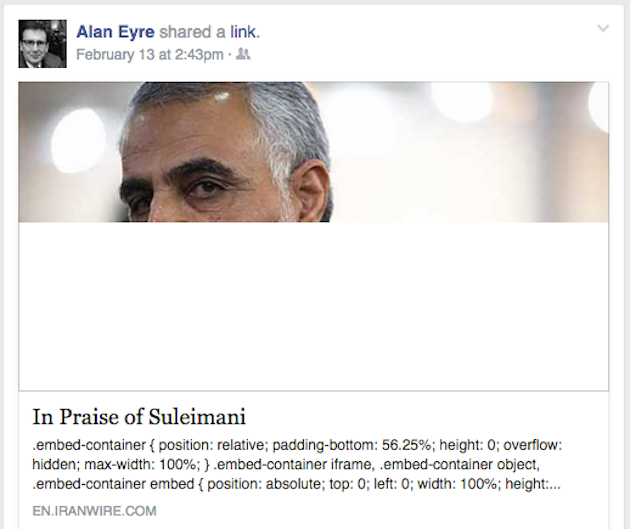
In one Feb. 13 posting, when Iran talks were at a critical stage, Eyre disseminated a link to an article praising Iranian Quds Force Chief Ghassem Suleimani, who is directly responsible for the deaths of Americans abroad.

Image-1

Suleimani, who is listed as a terrorist by the U.S. State Department, will have international sanctions against him waived under the parameters of the nuclear accord.

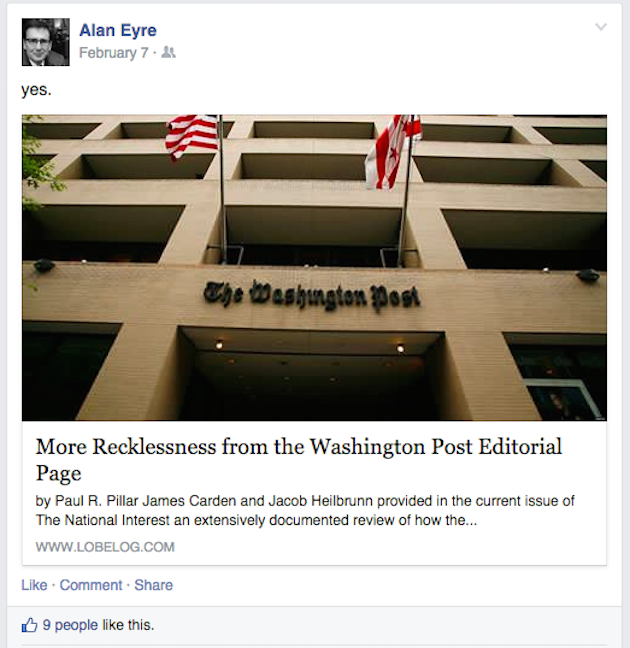
In another posting from Feb. 5, Eyre links to the website LobeBlog, which is viewed by critics as anti-Israel and regularly attacks neoconservative pundits.”

The article Eyre links to, “Who Are the Billionaires Attacking Obama’s Iran Diplomacy,” attacks opponents of the Iranian deal and insinuates that wealthy Jewish donors are behind this push.

The article puts particular emphasis on the Israel Project (TIP), a non-profit advocacy organization run by Josh Block, a longtime Democrat, and claimed that wealthy Jewish individuals were behind a stealth campaign to kill the deal. TIP is portrayed as playing a crucial role in discrediting the deal and convincing lawmakers to take a stance against it.

The article was penned by a former ThinkProgress blogger, Eli Clifton, who was forced out of the Center for American Progress-backed blog following a scandal in which several writers accused Iran deal critics of being “Israel firsters.”

Image-2

In another posting, Eyre links to an article by Stephen Walt, co-author of the book The Israel Lobby, which has been branded by the Anti-Defamation League (ADL) as an “anti-Jewish screed.”

Walt lashes out in the piece at neoconservative critics of the Iran deal, writing that “no one should listen to their advice today.”

Eyre linked to the piece with the comment, “interesting thesis.” He then quoted Walt at length, according to a screenshot:

The real problem is that the neoconservative worldview — one that still informs the thinking of many of the groups and individuals who are most vocal in opposing the Iran deal — is fundamentally flawed. Getting Iraq wrong wasn’t just an unfortunate miscalculation, it happened because their theories of world politics were dubious and their understanding of how the world works was goofy.

Image-3

Eyre also appeared to express disappointment online in March, when Sen. Tom Cotton and 46 other Republican lawmakers penned an open letter to Iran opposing the nuclear talks.

Eyre links to a March 9 Washington Post article by Paul Pillar, an Israel critic who backs boycotts of the Jewish state, titled ‘The misguided, condescending letter from Republican senators to Iran.’ He then opined in the post, “Seriously. Can someone write them a letter telling them that the most fundamental duty of Congress is to pass a budget?”

Image-4

At least one of Eyre’s Facebook friends has quibbled with his postings.

When Eyre linked to a Talking Points Memo article claiming that “49 percent of Republicans don’t believe in evolution,” one critic commented: “This post is total crap. Some 300 people were polled, and the polling criteria were, of course, not specified. This outfit has a deserved reputation as a left-leaning, professionally anti-Republican Flak Tank.”

Eyre dismissed that criticism, responding, “If you are going to fact check every incendiary posting I put up, it is going to detract from the sum total of my facebook-derived frivolity.”

In addition to his postings, Eyre has appeared as a keynote speaker at the National Iranian American Council’s Washington, D.C., conference.

The council, which has been accused as serving as a pro-Tehran lobbying shop, has helped the Obama administration disseminate pro-Iran talking points and champion the deal in the public sphere. Its top officials also have insinuatedthat Jewish lawmakers who oppose the deal have more loyalty to Israel than America.

One senior official at a Washington, D.C., pro-Israel organization expressed disappointment but not surprise at Eyre’s posting.

“The easiest way to explain the State Department’s behavior toward the Middle East is to assume that they don’t like the Israelis very much and they have this romantic fascination with Iran,” the source said. “That’s what you’re seeing here.”

“Of course they can’t admit that out loud, because the American people believe exactly the opposite, so they do it through passive-aggressive Facebook posts and occasional slips of the tongue about how moderate and sophisticated the Iranians are,” the source added.

A State Department spokesman declined to comment on Eyre’s personal postings when contacted by the Free Beacon.

“Alan Eyre is the Department’s Persian Language Spokesperson,” the official said. “In that capacity, he maintains his official page on Facebook here,” the spokesman continued, providing a link to the page.

The Facebook page in question, however, is separate from Eyre’s public-facing personal page referenced by the State Department, which said it had no knowledge of the second page.

“We’re not aware of any such content that you refer to posted on that account,” the official said.

The official did not respond to follow-up requests asking for comment from Eyre on the postings.

Russia’s endgame in Syria: Follow the Money

October 7, 2015

Russia’s endgame in Syria: Follow the Money, Center for Security Policy, John Cordero, October 6, 2015

(Is Putin engaging in a holy war against the Islamic State, an oily war or both? — DM)

3300795117

The one strategic motivation for Russia that has been widely ignored is the economic one.  Qatar, the richest country in the world per capita and also owner of the world’s largest natural gas field, proposed in 2009 to jointly construct a gas pipeline running through Saudi Arabia, Jordan, Syria, Turkey, and into Europe.  Assad, not wanting to provoke Moscow, refused to sign on.  Instead, he floated an alternative: an Iran-Iraq-Syria and possibly Lebanon pipeline, to then follow under the Mediterranean to Europe. The Qatar-Turkey pipeline would run through majority Sunni countries with the exception of Syria’s Alawite regime. Assad’s counter proposal follows the Shia crescent.

Russia, not wanting to lose its primary market in Europe, is adamantly opposed to a prospective Qatari project.  A military presence in Syria will guarantee that even if Assad is removed from power, the pipeline will not be built.  It will look on favorably to the Iranian proposal, provided Gazprom and other state-owned companies get their share of the pie.

****************************

As Vladimir Putin orders airstrikes against rebels of all stripes fighting Bashar al-Assad’s regime, there are important strategic economic goals behind Russia’s actions in Syria.  The short term goal is easy to discern: prevent Assad’s collapse as no alternative suitable to Russian interests exists, preserve Russia’s only naval base in the Middle East at Tartus, and promote Russia both at home and abroad as a world power that counterbalances American hegemony.

Much of the media has focused on Putin as a personal driver of Russian behavior.  While forays into Georgia and Ukraine have accomplished the tactical goals of preventing increased European Union presence in Russia’s sphere of influence, these have come at a high cost both politically and economically in the form of isolation and sanctions. Putin seems to have concluded that intervening in Syria in the name of fighting terrorism can only help repair Russia’s battered image.

It is important to at least try to understand Putin’s motivation without delving too much into psychoanalysis.  He is on record as lamenting the collapse of the Soviet Union as “the greatest geopolitical catastrophe of the 20th century.”  In power since 2000, the former KGB officer is an ardent Russian nationalist, a promoter of a personality cult concerned with his country’s standing and perception in the world.  With his career spent in the service of the state, he is not one to take a background role in world affairs. Putin has effectively used Russia’s alliance with Iran as an effective tool to undermine the US, both regionally in the Gulf and globally with the nuclear deal.

The current buildup at Tartus and Latakia is nothing new: since Hafez al-Assad’s rise to power in 1970, the Former Soviet Union and then Russia was and is a stalwart ally, long attempting to position Syria as a counterbalance to American and Israeli military superiority in the Middle East.

Russia’s actions are also a message to the world: unlike the US, which abandoned long-time ally Hosni Mubarak during his time of need in Egypt, Russia is prepared to intervene, militarily if necessary, to preserve a friendly regime in danger.  Therefore, it pays for autocrats to court Moscow, especially if they possess valuable resources or are in prime strategic locations.

While Vladimir Putin ostensibly espouses the acceptable goal of a global alliance against IS, the strategic context is that he has entered into a sectarian alliance with Shia Iran, Iraq, Syria, and the proxy army Hezbollah (The P4+1) against the American-backed Sunni alliance of Turkey, Saudi Arabia, Qatar, Jordan, and the UAE, all of whom insist that Assad has no future in Syria.

Through its airstrikes, Russia continues to advance the prior Syrian strategy of focusing efforts against pro-Western rebels, with the recognition that, while dangerous, the Islamic State is the one party in the conflict the West will never support.

The Islamic State will take advantage of both the respite, and the propaganda value of being the recognized number one enemy of the infidel coalition, which it uses to rally supporters simply by pointing out that its enemies are gathering to destroy the renewed Caliphate.

The one strategic motivation for Russia that has been widely ignored is the economic one.  Qatar, the richest country in the world per capita and also owner of the world’s largest natural gas field, proposed in 2009 to jointly construct a gas pipeline running through Saudi Arabia, Jordan, Syria, Turkey, and into Europe.  Assad, not wanting to provoke Moscow, refused to sign on.  Instead, he floated an alternative: an Iran-Iraq-Syria and possibly Lebanon pipeline, to then follow under the Mediterranean to Europe. The Qatar-Turkey pipeline would run through majority Sunni countries with the exception of Syria’s Alawite regime. Assad’s counter proposal follows the Shia crescent.

Russia, not wanting to lose its primary market in Europe, is adamantly opposed to a prospective Qatari project.  A military presence in Syria will guarantee that even if Assad is removed from power, the pipeline will not be built.  It will look on favorably to the Iranian proposal, provided Gazprom and other state-owned companies get their share of the pie.

Pipeline politics in the region have a long and varied history of Russian involvement.  The Baku-Tbilisi-Ceyhan oil pipeline was built only after Moscow’s demand for an alternative pipeline for Azeri oil to Russia was met.  During the 2008 Russia-Georgia war, US intelligence officials determined that an explosion on the pipeline near the Turkish-Georgian border was carried out via Russian government cyber warfare.  Days after the explosion, Russian fighter jets bombed positions in Georgia close to the pipeline. Although the BTC pipeline was built precisely to avoid Russian interference, the Kremlin has never let that stop them.

Turkey and Azerbaijan have also begun construction on a joint natural gas pipeline, theTANAP. This project’s stated goal is to reduce the EU’s dependence on Russian natural gas, a prospect that cannot please Moscow.   Both the BTC and TANAP bypass Armenia, a Russian ally and wary of its neighbors in the Caucasus.

As the endpoint for the Qatari project, Turkey is adamant in calling for Assad to step down or be removed, which dovetails with the proposed Sunni pipeline.  By clearing the way through Syria, Qatar and Saudi Arabia can receive a handsome return on their investment in backing jihadis fighting Assad.  On the other hand, Iran will not sit idly by and leave potential billions of dollars in the hands of its ideological and regional enemies.

Russian intervention in Syria is just beginning. There is every possibility that it will expand as more targets are found, perhaps those that are in the way of the proposed Iranian pipeline, directly threatening Damascus and by extension, the Russian monopoly of gas exports to Europe.  For the time being, Putin has the world’s attention.

Prominent Iranian Analyst Amir Taheri: Obama Is Capitulating And Chasing Illusions In Deal With Iran

October 6, 2015

Prominent Iranian Analyst Amir Taheri: Unlike Kennedy, Nixon And Reagan, Who Drove A Hard Bargain In Negotiations With Enemies, Obama Is Capitulating And Chasing Illusions In Deal With Iran, Middle East Media Research Institute, October 5, 2015

In an opinion piece published August 25, 2015 in the London-based Saudi daily Al-Sharq Al-Awsat, Amir Taheri, a prominent Iranian analyst, author and columnist, compared Obama’s policy towards Iran to the policies of Kennedy, Nixon and Reagan in their dealings with the U.S.’s main rivals in their day – the USSR and China. Taheri wrote that, in making the deal with Iran, Obama wishes to portray himself as an heir to the tradition established by these presidents of defusing conflict through diplomacy and negotiations. He noted, however, that these leaders negotiated from a position of strength, and pursued a detente with America’s enemies only after the latter had fulfilled important American demands and changed key elements of their policies. For example, Kennedy negotiated with the USSR only after forcing it to remove the nuclear sites from Cuba; Nixon’s normalization with China came only after the latter had turned its back on the Cultural Revolution and abandoned its project of exporting communism, and Reagan engaged with the Soviets only after taking military measures to counter the threat they posed to Europe. Moreover, says Taheri, the U.S. warmed its relations with China and the USSR only after they abandoned their absolute enmity towards it and began regarding it as a rival and competitor rather than a mortal enemy that must be destroyed.

Conversely, says Taheri, Obama demanded nothing of the Iranians before commencing negotiations, not even the release of U.S. hostages. Moreover, he pursued rapprochement with Iran despite the absence of any positive change in this country’s hardline policies and ideologies. On the contrary, America’s overtures only encouraged Iran’s worst tendencies, as reflected in a sharp rise in human rights violations within Iran and in its continued support for terror groups and for Assad’s regime in Syria. The detente with America did not even cause Iran to abandon its calls of death to America, Taheri notes. He concludes “Kennedy, Nixon and Reagan responded positively to positive changes on the part of the adversary,” whereas “Obama is responding positively to his own illusions.”

The following are excerpts from his article:

24977Amir Taheri (Image: Twitter.com/amirtaheri4)

JFK Forced Russia To Remove Its Missiles From Cuba; Obama Obtained Nothing Tangible And Verifiable

“Promoting the ‘deal’ he claims he has made with Iran, President Barack Obama is trying to cast himself as heir to a tradition of ‘peace through negotiations’ followed by US presidents for decades. In that context he has named Presidents John F. Kennedy, Richard Nixon and Ronald Reagan as shining examples, with the subtext that he hopes to join their rank in history.

“Obama quotes JFK as saying one should not negotiate out of fear but should not be afraid of negotiating either. To start with, those who oppose the supposed ‘deal’ with Iran never opposed negotiations; they oppose the result it has produced… In one form or another, Iran and the major powers have been engaged in negotiations on the topic since 2003. What prompted Obama to press the accelerator was his desire to score a diplomatic victory before he leaves office. It did not matter if the ‘deal’ he concocted was more of a dog’s dinner than a serious document. He wanted something, anything , and to achieve that he was prepared to settle for one big diplomatic fudge.

“Is Obama the new JFK? Hardly. Kennedy did negotiate with the USSR but only after he had blockaded Cuba and forced Nikita Khrushchev to blink and disband the nuclear sites he had set up on the Caribbean island. In contrast, Obama obtained nothing tangible and verifiable. Iran’s Atomic Energy chief Ali-Akbar Salehi put it nicely when he said that the only thing that Iran gave Obama was a promise ‘not to do things we were not doing anyway, or did not wish to do or could not even do at present.’

“JFK also had the courage to fly to West Berlin to face the Soviet tanks and warn Moscow against attempts at overrunning the enclave of freedom that Germany’s former capital had become. With his ‘Ich bin ein Berliner‘ (I am a citizen of Berlin), he sided with the people of the besieged city in a long and ultimately victorious struggle against Soviet rule. In contrast Obama does not even dare call on the mullahs to release the Americans they hold hostage. Instead, he has engaged in an epistolary courting of the Supreme Guide and instructed his administration in Washington to do and say nothing that might ruffle the mullahs’ feathers.

Nixon Extracted Far-Reaching Concessions From China; Obama Has Only Encouraged The Worst Tendencies Of The Khomeinist Regime

“No, Obama is no JFK.  But is he heir to Nixon? Though he hates Nixon ideologically, Obama has tried to compare his Iran ‘deal’ with Nixon’s rapprochement with China. Again, the comparison is misplaced. Normalization with Beijing came after the Chinese leaders had sorted out their internal power struggle and decided to work their way out of the ideological impasse created by their moment of madness known as The Great Proletarian Cultural Revolution. The big bad wolf of the tale, Lin Biao, was eliminated in an arranged air crash and the Gang of Four defanged before the new leadership set-up in Beijing could approach Washington with talk of normalization.

“At the time the Chinese elite, having suffered defeat in border clashes with the USSR, saw itself surrounded by enemies, especially after China’s only ally Pakistan had been cut into two halves in an Indo-Soviet scheme that led to the creation of Bangladesh. Hated by all its neighbors, China needed the US to break out of isolation. Even then, the Americans drove a hard bargain. They set a list of 22 measures that Beijing had to take to prove its goodwill, chief among them was abandoning the project of ‘exporting revolution’.

“Those of us who, as reporters, kept an eye on China and visited the People’s Republic in those days were astonished at the dramatic changes the Communist leaders introduced in domestic and foreign policies to please the Americans. In just two years, China ceased to act as a ’cause’ and started behaving like a nation-state. It was only then that Nixon went to Beijing to highlight a long process of normalization. In the case of Iran, Obama has obtained none of those things. In fact, his ‘deal’ has encouraged the worst tendencies of the Khomeinist regime as symbolized by dramatic rise in executions, the number of prisoners of conscience and support for terror groups not to mention helping Bashar Al-Assad in Syria.

Reagan Had No Qualms About Calling The USSR ‘The Evil Empire’;  Obama Is Scared Of Offending The Mullahs

“No, Obama is no Nixon. But is he a new Reagan as he pretends? Hardly. Reagan was prepared to engage the Soviets at the highest level only after he had convinced them that they could not blackmail Europe with their SS20s while seeking to expand their empire through so-called revolutionary movements they sponsored across the globe. The SS20s were countered with Pershing missiles and ‘revolutionary’ armies with Washington-sponsored ‘freedom fighters.’

“Unlike Obama who is scared of offending the mullahs, Reagan had no qualms about calling the USSR ‘The Evil Empire’ and castigating its leaders on issues of freedom and human rights. The famous phrase ‘Mr. Gorbachev, tear down that wall!’ indicated that though he was ready to negotiate, Reagan was not prepared to jettison allies to clinch a deal.

“Obama has made no mention of Jimmy Carter, the US president he most resembles. However, even Carter was not as bad as Obama if only because he was prepared to boycott the Moscow Olympics to show his displeasure at the invasion of Afghanistan. Carter also tried to do something to liberate US hostages in Tehran by organizing an invasion of the Islamic Republic with seven helicopters. The result was tragicomic; but he did the best his meagre talents allowed. (NB: No one is suggesting Obama should invade Iran if only because if he did the results would be even more tragicomic than Carter’s adventure.)

“On a more serious note, it is important to remember that dealing with the Khomeinist regime in Tehran is quite different from dealing with the USSR and China was in the context of detente and normalization. Neither the USSR nor the People’s Republic regarded the United States as ‘enemy’ in any religious context as the Khomeinist regime does. Moscow branded the US, its ‘Imperialist’ rival, as an ‘adversary’ (protivnik) who must be fought and, if possible, defeated, but not as a ‘foe’ (vrag) who must be destroyed. In China, too, the US was attacked as ‘arch-Imperialist’ or ‘The Paper Tiger’ but not as a mortal foe. The slogan was ‘Yankee! Go Home!'”

China And USSR Moderated Their Virulent Hate For U.S,; In Iran The Slogan Is Still ‘Death To America’

“In the Khomeinist regime, however, the US is routinely designated as ‘foe’ (doshman) in a religious context and the slogan is ‘Death to America!’ Supreme Guide Ali Khamenei has no qualms about calling for the ‘destruction’ of America, as final step towards a new global system under the banner of his twisted version of Islam. Tehran is the only place where international ‘End of America’ conferences are held by the government every year. The USSR and China first cured themselves of their version of the anti-American disease before seeking detente and normalization. That did not mean they fell in love with the US. What it meant was that they learned to see the US as adversary, rival, or competitor not as a mortal foe engaged in a combat-to-death contest. The Islamic Republic has not yet cured itself of that disease and Obama’s weakness may make it even more difficult for that cure to be applied.

“Détente with the USSR and normalization with China came after they modified important aspects of their behavior for the better. Kennedy, Nixon and Reagan responded positively to positive changes on the part of the adversary. In the case of the USSR positive change started with the 20th congress of the Communist Party of the Soviet Union in which Khrushchev denounced Joseph Stalin’s crimes, purged the party of its nastiest elements, notably Lavrentiy Beria, and rehabilitated millions of Stalin’s victims.

“In foreign policy, Khrushchev, his swashbuckling style notwithstanding, accepted the new architecture of stability in Cold War Europe based on NATO and the Warsaw Pact. Kennedy, Johnson and, later, Nixon and President Gerald Ford had to respond positively. In the late1980s, the USSR offered other positive evolutions through Glasnost and Perestroika and final withdrawal from Afghanistan under Mikhail Gorbachev. Again, Reagan and President George Bush (the father) had to respond positively.

“In the case of China we have already noted the end of the Cultural Revolution. But China also agreed to help the US find a way to end the Vietnam War. Beijing stopped its almost daily provocations against Taiwan and agreed that the issue of the island-nation issue be kicked into the long grass. Within a decade, under Deng Xiaoping, China went even further by adopting capitalism as its economic system.

“There is one other difference between the cases of the USSR and China in the 1960s to 1990s and that of the Khomeinist regime in Tehran today. The USSR had been an ally of the United States during the Second World War and its partner in setting up the United Nations in 1945. Although rivals and adversaries, the two nations also knew when to work together when their mutual interests warranted it. The same was true of the Chinese Communist Party which had been an ally of the US and its Chinese client the Kuomintang during the war against Japanese occupation when Edgar Snow was able to describe Mao Zedong as ‘America’s staunchest ally against the Japanese Empire.’ In the 1970s, Washington and Beijing did not find it strange to cooperate in containing the USSR, their common rival-cum-adversary as they had done when countering Japan.

“In the case of the Islamic Republic there is no sign of any positive change and certainly no history of even tactical alliance with the US.

“Unless he knows something that we do not, Obama is responding positively to his own illusions.”

Salman Rushdie invite to Frankfurt Book Fair against freedom of expression: official

October 6, 2015

Salman Rushdie invite to Frankfurt Book Fair against freedom of expression: official, Tehran Times (Iran), October 6, 2015

(To what extent do western “democracies” share variants of this view? To what extent are anti-immigrant and other “Islamophobic” comments becoming unlawful or prohibited de facto? — DM)

TEHRAN — Deputy Culture Minister for Cultural Affairs Seyyed Abbas Salehi has said that Frankfurt Book Fair’s plan to invite Salman Rushdie violates freedom of expression.

Earlier last week, the organizers of the book fair, which is the world’s largest event in the publishing industry, said, “On the significance of freedom of expression for authors and the book industry”, Rushdie will give the keynote address at the opening press conference of the fair on October 13.

Rushdie is the author of “The Satanic Verses”, a blasphemous novel about Islam, which was published in 1988.

The book sparked Muslims’ outrage, which culminated in a fatwa by Imam Khomeini, the founder of Islamic Republic, calling for Rushdie’s death.

“If we want freedom to turn into a sustainable issue and not an overture to violence, we should provide the necessary prerequisites,” Salehi told the Persian service of MNA on Monday.

“A basic prerequisite is respect for the sanctities of every religion,” he noted.

He warned the organizers of the Frankfurt Book Fair about the Rushdie invite and said, “The plan to invite Salman Rushdie would provoke feelings whose results would not be clear.”

Salehi said that Iran has sent a letter to Frankfurt Book Fair Director Juergen Boos, asking him to cancel their plans for Rushdie’s speech. However, there has been no response from him so far.

He said that Iran has also called upon other Muslim countries to protest against the Frankfurt Book Fair’s plans for Rushdie’s speech.

The Frankfurt Book Fair is slated to take place from October 14 to 18.

In addition, dozens of independent Iranian publishers are scheduled to showcase their latest offerings at the fair, which is the world’s largest event in the publishing industry.