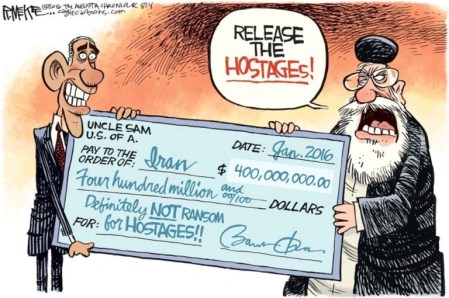
Archive for the ‘Iran – ransom payments’ category

Obama Admin Seeks Pathway for Future ‘Ransom Payments’ to Iran

September 22, 2016

Obama Admin Seeks Pathway for Future ‘Ransom Payments’ to Iran, Washington Free Beacon, September 21, 2016
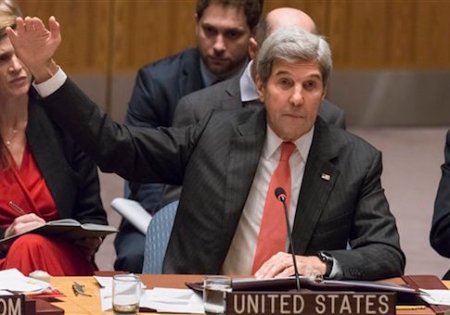
US Secretary of State John Kerry addresses the United Nations Security Council during an open, high-level debate regarding the ongoing Syrian crisis, at UN Headquarters in New York, NY, USA on September 21, 2016. The meeting, presided over by New Zealand's Prime Minister John Key, comes amid growing hostility between the United States and Russia over allegations of military operations conducted in the region. (Photo by Albin Lohr-Jones) *** Please Use Credit from Credit Field ***

US Secretary of State John Kerry addresses the United Nations Security Council during an open, high-level debate regarding the ongoing Syrian crisis, at UN Headquarters in New York, NY, USA on September 21, 2016. (Credit Field)

The Obama administration is pushing a pathway to ensure it can continue sending Iran cash payments amid mounting accusations it laundered some $1.7 billion to the Islamic Republic as part of a “ransom payment” to free U.S. hostages earlier this year, according to statements by the White House and sources familiar with the matter.

The White House late Wednesday promised to veto new legislation—first disclosed by theWashington Free Beacon—that would bar the administration from making “future ransom payments to Iran,” prompting outrage from key members of Congress who have been investigating how U.S. officials delivered nearly $2 billion in cash to Iranian officials.

The administration’s veto threat comes as top lawmakers on a range of investigatory committees launch efforts to uncover details about the cash exchange still being hidden by the Obama administration.

Congressional sources who spoke to the Free Beacon raised questions as to why the Obama administration would threaten to veto the bill, given its insistence that the cash payments to Iran were not part of a ransom.

“President Obama’s veto threat on our ransom legislation puts the lives of U.S. citizens around the world at risk,” Rep. Mike Pompeo (R., Kan.), a member of the House Intelligence Committee who helped spearhead the ransom legislation, told the Free Beacon.

“Instead of admitting wrongdoing, this administration is sticking to talking points. But selective noun use cannot explain away criminality, nor does it excuse eight months of lying to the American people,” Pompeo said. “It is unprecedented and reckless for the U.S. to be doling out billions to the Islamic Republic of Iran—under wraps and in cash—which is why our bill is necessary.”

Sen. Marco Rubio (R., Fla.), a lead sponsor of the legislation to ban future payments to Iran, told theFree Beacon that he would continue to push the legislation, despite threats by the administration.

“This effort by the President to defend his ransom payments to Iran at all costs amounts to doubling down on ‎a policy that has made Americans less safe,” Rubio told the Free Beacon. “Democrats may be swayed by this threat, but I will continue to fight to prevent the U.S. government from sending taxpayer dollars to the world’s foremost state sponsor of terrorism.”

Sen. Mark Kirk (R., Ill.) told the Free Beacon Wednesday evening that the Obama administration is betraying U.S. victims of Iranian terrorism, who are owed billions under federal court rulings.

“Under U.S. court judgments, Iran owes $55.6 billion to American victims of Iranian terrorism,” Kirk told the Free Beacon. “The Administration should stop finding ways to send more cash to Iran, and start working to bring a measure of justice to American families whose loved ones were killed or injured due to Iran-backed terrorists.”

One source familiar with the matter said Iran prefers cash because it can more easily be used to fund terrorism.

“There is no credible reason for the administration to oppose this bill. We already know, contrary to what the president initially said, that the administration can in fact wire money to Iran,” the source said. “So why do we need the option to pay in cash? Simple. This money can fund terrorism, and there’s nothing we can do to know of stop it.”

The Obama administration maintains the legislation is “ill-advised” and would “undermine U.S. obligations” to Iran.

The bill is “an ill-advised attempt to respond to a problem—so-called ‘ransom’ payments to Iran—that does not exist, in a way that would undermine U.S. obligations and ultimately benefit Iran at the expense of the United States,” the White House said in a statement.

The administration said it plans to award Iran further payments, which would not be possible under the ransom legislation.

“This bill, while styled as prohibiting future purported ‘ransom payments,’ instead bars virtually any payment from the U.S. government to Iran, including those permitted or even required by law,” the administration said.

The $1.7 billion cash payment was given to Iran as part of an effort to resolve decades-old legal disputes, many of which are still outstanding. The administration said further payments could be made to Iran in order to settle these disputes.

“Specifically, this bill would effectively prevent the United States from paying out awards rendered by the Tribunal and, thus, risk putting the United States in violation of our obligations under the Algiers Accords—an agreement concluded by President Carter, endorsed by President Reagan and honored by every President since that time,” according to the White House.

Questions remain about why the administration chose to pay Iran in cash installments routed through the New York Federal Reserve and several European banks.

Lawmakers such as Pompeo and Sen. Ted Cruz (R., Texas) have described the administration’s process as tantamount to a money laundering scheme.

UPDATE 8:40 P.M.: This piece was updated to include comments from Sens. Marco Rubio (R., Fla.) and Mark Kirk (R., Ill.).
Obama Admin: Iran Was Only Paid $1.7 Billion in Cash After Hostages Released

September 8, 2016

Obama Admin: Iran Was Only Paid $1.7 Billion in Cash After Hostages Released, Washington Free Beacon, Adam Kredo, September 8, 2016

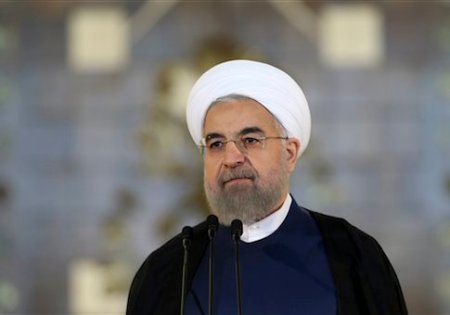
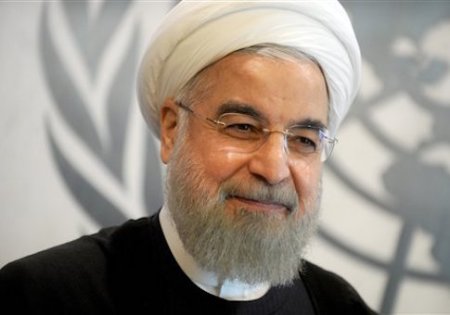
Assan Rouhani, The President of Iran during the United Nations General Assembly at the United Nations General Assembly Hall on September 25, 2015 in New York City. Photo by Dennis Van Tine/Sipa USA

Hassan Rouhani. Photo by Dennis Van Tine/Sipa USA

Senior Obama administration officials, under the threat of a subpoena, were forced to appear on Capitol Hill on Thursday to explain why lawmakers and the American public were kept in the dark about a $1.7 billion cash payment to Iran that has been widely viewed as a ransom to free imprisoned U.S. hostages.

Four senior administration officials declined to provide in-depth explanations of how U.S. funds were transferred to Iran, but said that at least $1.3 billion was withdrawn from a U.S. taxpayer fund and sent to Iran only after it released the hostages.

The payments to Iran were made in hard currency after the United States delivered the funds to European banks. The money was converted into hard currency and bank notes before being transferred to an official from the Central Bank of Iran for transport to Tehran, according to the officials.

Administration officials confirmed that the $1.7 billion payment only went through once the United States was able to secure the release of several U.S. hostages being held in Iran—though the officials would not say this amounted to a ransom.

The Obama administration also could not guarantee lawmakers that the money would not be spent by Iran to fund terror operations.

These disclosures appear to confirm key details about the payment that the administration had either denied or declined to elaborate on for months.

Details are only becoming public now following several news reports and leaks from Congress about the source of the payment, which has been shrouded in mystery since January, when it was first announced.

“This committee requested records … more than a month ago and to date the self-proclaimed most transparent administration in our history has failed to provide any, not one document to this committee,” said Rep. Sean Duffy (R., Wis.), a member of the House Financial Services Committee, during the hearing.

“The witnesses today only agreed under threat of subpoena” to appear before Congress, Duffy said.

The testimony by these administration officials is likely to fuel claims that the payment amounted to a ransom, following the admission that the administration only went through with the cash delivery after it was able to confirm that the U.S. hostages had left Iran.

“You can’t tell me that you guaranteed our prisoners would have been released had your money not been sent,” Duffy said to Christopher Backemeyer, a deputy assistant secretary for Iranian affairs at the State Department.

Backemeyer also could not provide a guarantee that the money would not be spent by Iran on terrorist operations.

“I can’t speak to every dollar that’s going to go in or out of Iran,” he said.

“There is a risk you have taken in providing $1.7 billion to the leading state sponsor of terrorism in the world,” Duffy said.

European officials handed off the first payment of $400 million in cash to Iran on Jan. 17, only after Iran agreed to release the U.S. hostages following an evening of negotiations that included Secretary of State John Kerry, officials said.

After converting the U.S. funds to European bank notes and cash, the money was given to an “official from the Central Bank of Iran for transfer to Tehran,” according to Paul Ahern, assistant general counsel for enforcement and intelligence at the Treasury Department. “The funds were under U.S. government control until their disbursement.”

The remaining $1.3 billion was withdrawn from a U.S. taxpayer fund operated by the Treasury Department and sent to Europe. Once there, the money was converted into foreign currency and transferred to a representative of Iran’s central bank on Jan. 22 and Feb. 5.

Information about the payment and the circumstances surrounding it remains a mystery.

The administration officials  made the decision to pay Iran in cash, even though other options existed.

“Iran had to have it in cash,” Ahren said. “Iran was very aware of the difficulties it would face in accessing and using the funds if they were in any other form than cash, even after the lifting of sanctions.”

A cash delivery “was the most reliable way that they received the funds in a timely manner and it was the manner preferred by the relative foreign banks,” Ahren said.

“For them,” Backemeyer added, “the critical need was they [Iran] got immediate access.”

The administration officials would not provide in-depth details, citing diplomatic sensitivities.

“My guess is, if any private citizen had done what this administration did, they’d be indicted on money laundering and the administration calls in diplomacy,” said Rep. Jeb Hensarling (R., Texas), who questioned why the deal was hidden from the public

“Why did the administration go to such great lengths to hide it from the American people?” Hensarling asked. “Why did I have to threaten subpoenas to get the administration to show up in the first place?”

The State Department’s Backemeyer explained that some details could only be divulged in a classified setting.

“There will be limitations to what I and my colleagues can say in an open setting,” he explained. “There are a number of litigations and diplomatic sensitivities that could jeopardize U.S. interests if we were to go into too much detail.”

When asked why the United states agreed to pay $1.3 billion in interest to Iran from a taxpayer fund, a State Department official bristled.

“The details of why we settled for this amount are litigation sensitive,” said Lisa Grosh, a legal adviser in the State Department’s office of international claims and investment disputes. “Iran’s lawyers would try to use my words or maybe even your words against us to help their position at the [claims] tribunal. I believe this settlement was the best thing for the United States.”

Secrets of the Iran Ransom

August 28, 2016

Secrets of the Iran Ransom, Power Line, Scott Johnson August 28, 2016

At the New York Sun last week, Claudia Rosett tentatively reported the mechanics of the Obama administration’s payment of the $1.3 billion tranche of the ransom to Iran. She discovered what Andy McCarthy calls “a bizarre string” of 13 identical money transfers of $99,999,999.99 each — all of them one cent less than $100 million — paid out of an obscure Treasury Department stash known as the “Judgment Fund.”

In the aggregate, Andy notes, the transfers amount to 13 cents shy of the $1.3 billion the State Department claims Iran was owed in “interest” from the $400 million that our government had been holding since the shah deposited it in a failed arms deal just prior to the Khomeini revolution. The administration added a fourteenth payment of $10 million — not necessarily for good measure. We don’t know why and the administration isn’t saying.

The administration’s payments to Iran bear the earmarks of a structured transaction intended to avoid detection by the authorities. Structuring deposits or withdrawals in this fashion to avoid bank reporting is a federal crime (the one that ensnared Dennis Hastert). Federally regulated financial institutions are required to look for such structured transactions and to report them. That’s undoubtedly how Dennis Hastert was caught.

What is going on in the matter of the payments to our enemies in Iran? Andy notes:

The administration refuses to divulge any further information about the $1.7 billion the president acknowledges paying the world’s leading state sponsor of terrorism. Grilled on Wednesday about how Obama managed to pay the final $1.3 billion installment — particularly given the president’s claim that it is not possible to send Tehran a check or wire-transfer — State Department spokesman Mark Toner decreed that the administration would continue “withholding this information” in order “to protect confidentiality.”

Whose confidentiality? The mullahs’? That of the intermediaries the president used? Whose privacy takes precedence over our right to know how Obama funneled our money to our enemies?

Good question. I can’t believe that Andy is the only man asking it, as he does in “Why is Obama stonewalling on details of the $1.7 billion in Iransom payoff.”

State Dept Warns: Iran Seeking to Capture U.S. Citizens

August 23, 2016

State Dept Warns: Iran Seeking to Capture U.S. Citizens, Washington Free Beacon, August 22, 2016

Iran's President Hassan Rouhani addresses the nation in a televised speech after a nuclear agreement was announced in Vienna, in Tehran, Iran, Tuesday, July 14, 2015. Rouhani said "a new chapter" has begun in his nation's relations with the world. He maintained that Iran had never sought to build a bomb, an assertion the U.S. and its partners have long disputed. (AP Photo/Ebrahim Noroozi)

Iran’s President Hassan Rouhani (AP Photo/Ebrahim Noroozi)

The State Department issued a warning on Monday urging U.S. citizens to avoid traveling to Iran, which has made the detention of Americans a priority.

The latest travel advisory, which emphasizes Iran’s desire to capture U.S. citizens, comes on the heels of a growing scandal over the Obama administration’s decision to pay Iran $400 million in cash on the same day that it freed several U.S. hostages.

The payment has been cast by lawmakers and others as a ransom payment and prompted concern among U.S. officials that Iran is making arresting Americans a priority.

The travel warning is meant to “highlight the risk of arrest and detention of U.S. citizens, particularly dual national Iranian-Americans,” according to a State Department announcement on Monday. “Foreigners, in particular dual nationals of Iran and Western countries including the United States, continue to be detained or prevented from leaving Iran.”

“U.S. citizens traveling to Iran should very carefully weigh the risks of travel and consider postponing their travel,” the warning adds. “U.S. citizens residing in Iran should closely follow media reports, monitor local conditions, and evaluate the risks of remaining in the country.”

Iran continues to imprison Americans, particularly those holding dual Iranian citizenship, according to the State Department.

“Iranian authorities have detained and harassed U.S. citizens, particularly those of Iranian origin,” the travel warning states. “Former Muslims who have converted to other religions, religious activists, and persons who encourage Muslims to convert are subject to arrest and prosecution.”

The Obama administration expressed particular concern about commercial airlines doing business with Iran. This warning comes as American companies such as Boeing continue to pursue million-dollar business deals with the Islamic Republic.

“The U.S. government is concerned about the risks to civil aircraft operating into, out of, within, or over Iran due to hazards from military activity associated with the conflicts in Iraq and Syria,” the warning states. “The FAA has advised U.S. civil aviation to exercise caution when flying into, out of, within, or over the airspace over Iran.”

The warning emphasizes that “the U.S. government’s ability to assist U.S. citizens in Iran in the event of an emergency is extremely limited.”

What does America owe Iran?

August 11, 2016

What does America owe Iran? Israel Hayom, Clifford D. May, August 11, 2016

An unmarked cargo plane filled with $400 million in cash lands in Tehran, and four American hostages held by Iran’s rulers are set free. These revelations have sparked two controversies.

First: Did the Obama administration pay a ransom to Iran, the world’s leading state sponsor of terrorism? White House spokesmen insist it did not and there was no quid pro quo, while Iranian officials say that was precisely what happened. Who is more credible? More importantly, whom do you think prospective hostage-takers around the world believe?

Second: Did this payment violate American law? Justice Department officials opposed the payment. Former federal terrorism prosecutor Andrew C. McCarthy argued that the transaction involved the commission of several “felony law violations.” Former Attorney General Michael Mukasey opines that while the transaction was not “right,” it was not illegal.

The roots of this affair run deep. In early 1979, the shah of Iran, as part of an arrangement to purchase jet fighters, deposited $400 million into a Pentagon account. Soon afterward, he was overthrown in the Islamic Revolution. As White House spokesman Josh Earnest said: “Once the revolution took place, obviously that equipment was not transferred, but we also didn’t return Iran’s money.”

Return the money to whom? At what point does the property of a government that has been toppled become the rightful possession of those who have done the toppling? International law is murky on this matter, as it is on many matters.

One thing we can say with reasonable certainty: Had envoys representing Ayatollah Ruhollah Khomeini reached out to President Jimmy Carter, he would have done whatever was in his power to establish amicable relations.

But that did not happen. We know what did: On Nov. 4, 1979, followers of the supreme leader seized the U.S. Embassy in Tehran and took 52 diplomats hostage. The diplomats were held and, in many cases, tortured for 444 days. That such conduct violates international law — indeed, that it constitutes an act of war — is not a matter for legal debate. The hostages were released on Jan. 20, 1981, the day President Ronald Reagan was inaugurated.

Iran’s rulers have never apologized, much less compensated their victims. The Weekly Standard’s Lee Smith reports that President Bill Clinton considered using the $400 million to pay victims of Iranian terrorism who had won judgments against Iran in U.S. courts. In the end, however, he left it to American taxpayers to pick up the check. President George W. Bush could have reimbursed the Treasury using frozen Iranian funds. He did not.

There matters lay until, in January of this year, President Barack Obama boasted that thanks to “strong American diplomacy,” the United States and Iran “are now settling a long-standing Iranian government claim against the United States government and Iran will be returned its own funds, including appropriate interest, but much less than the amount that Iran sought.”

Note that the president neglected to mention claims against Iran. And shouldn’t there be some controversy over the notion of “appropriate interest” — which is how the $400 million “owed” to Iran rose to the $1.7 billion that is being paid?

Since the money was not loaned to the U.S. by Iran’s current regime, why should the assumption be that the U.S. invested it for the benefit of Iran’s current regime? As part of this hostage deal, the U.S. also freed seven Iranians charged or convicted of crimes and dropped extradition requests for 14 others. How much is that worth? Why does that not count as “interest”?

Surely, justice would have been better served had the shah’s funds been distributed to Iran’s many victims: the diplomats who were illegally imprisoned, to be sure, but also the families of those murdered on Iran’s orders, such as those in Beirut in 1983, at Khobar towers in 1996, and more recently in Iraq by Shiite militias armed and instructed by Tehran.

In addition, thousands of innocent Iranians were put to death by the leaders of the Islamic Revolution. Tens of thousands were forced to flee the country, and their businesses, homes, lands, and bank accounts were stolen by the regime. Why have these victims been forgotten?

Here is part of the reason: Carter, during his final days in office, negotiated the Algiers Accord, agreeing that in exchange for the release of the hostages, Iran’s new rulers would be granted immunity from criminal or civil penalties.

Congress did not approve the Algiers Accord, which was not a treaty but only an executive agreement. President Reagan could have revoked it, pointing out that his predecessor had negotiated it with a knife at his throat — or, more precisely, with knives at the throats of the hostages. But he did not.

Instead, in 1981, pursuant to the Algiers Accord, the Iran-U.S. Claims Tribunal was set up in The Hague. This international arbitration mechanism has further entrenched the perverse notion of moral equivalence between the United States and the Islamic republic.

It has led to President Obama and Secretary of State John Kerry attempting to satisfy Iran’s “claims” against the U.S. against the backdrop of the Iran deal, another executive agreement. Obama considers that deal vital to his legacy. By contrast, Iran’s Supreme Leader Ayatollah Ali Khamenei has made it plain that he is more than willing to walk away from the deal — and will should the river of American concessions not continue to flow.

So last week’s hostages-for-cash story turns out to be only one chapter in a long and sad saga. It should give rise to additional controversies, starting with this: Why are Iran’s negotiators so consistently more skillful than America’s?

Congress ‘Disgusted’ With White House Lies on Iran ‘Ransom’ Payment

August 10, 2016

Congress ‘Disgusted’ With White House Lies on Iran ‘Ransom’ Payment, Washington Free Beacon, August 10, 2016

UNITED STATES - JUNE 28: Rep. Mike Pompeo, R-Kan., speaks during a news conference in the Capitol Visitor Center, June 28, 2016, to announce the Select Committee on Benghazi report on the 2012 attacks in Libya that killed four Americans. (Photo By Tom Williams/CQ Roll Call) (CQ Roll Call via AP Images)

UNITED STATES – JUNE 28: Rep. Mike Pompeo, R-Kan. (Photo By Tom Williams/CQ Roll Call) (CQ Roll Call via AP Images)

Members of Congress expressed “disgust” with the White House this week and are demanding Obama administration officials come clean about the circumstances surrounding a $400 million cash payment to Iran that is widely perceived as a ransom for the recent release of U.S. hostages, according to conversations with multiple lawmakers and senior congressional sources.

Growing tensions between the White House and Congress came to a head following comments by White House spokesman Josh Earnest in which he compared Republican critics in Congress to Iranian regime hardliners.

Earnest’s comments came in response to multiple unanswered questions about the circumstances surrounding the delivery of $400 million in cash to Iran ahead of the release of several U.S. hostages earlier this year.

When faced with questions about this cash exchange, White House officials such as Earnest have lashed out at Republican lawmakers for their continued efforts to unearth details about the so-called ransom payment.

“It sounds to me like they are once again in a position where they’re making the same argument as hardliners in Iran in an effort to undermine the Iran nuclear agreement,” Earnest said responding to questions from reporters about administration efforts to suppress key details about the cash payment.

“The president made clear a year ago that right-wingers in the United States were making common cause with right-wingers in the Iranian government,” Earnest added. “And, again, if they’re doing it again to try to justify their opposition to an agreement that has benefited the American people, they can do that, but I think that’s going to be pretty hard for them to explain.”

Asked about Earnest’s comments comparing Republicans to Iranian hardliners, a White House official said the spokesman’s comments speak for themselves and are in line with past remarks from the administration.

Earnest’s comment elicited a sharp response from leading GOP lawmakers, who said to the Washington Free Beaconthat Congress is “disgusted” with White House efforts to suppress vital information from the American public and malign Congress for performing its oversight duties.

“Josh Earnest should provide answers, not insults,” Rep. Mike Pompeo (R., Kan.), a member of the House Intelligence Committee, said to the Free Beacon. “The American people have grown disgusted with this type of politics.”

Pompeo has led several unsuccessful inquiries into the administration’s multiple cash payments to Iran, which have totaled more than $1.7 billion. In each case, the administration declined to provide Pompeo with the information he requested about the payment.

“The Obama administration needs to stop with the excuses and personal attacks and start providing truth on why the U.S. is delivering millions of dollars in pallets of cash to the Iranians and why the regime still has U.S. citizens hostage,” Pompeo said. “For Earnest to once again compare critics of the nuclear deal to the Ayatollah [Iran’s Supreme Leader Ali Khamenei] is part of a tired and unconvincing press-manipulation playbook that his colleagues have already admitted to using.”

Other Republican critics of the nuclear deal and subsequent cash payments to Iran said to the Free Beacon that the White House is trampling on Americans’ right to know how their taxpayer dollars are being spent, particularly when it comes to Iran, which remains the world’s foremost sponsor of terrorism.

“I can understand the rhetorical challenge of defending ransom payments to a state sponsor of terrorism, but still–these latest comments are just plain offensive,” Rep. Peter Roskam (R., Ill.), a leading critic of the nuclear deal with Iran, said to the Free Beacon. “I’m deeply concerned about unmarked cargo planes secretly ferrying cash to Iran.”

Those concerns, Roskam added, “don’t put me in the same camp as radical clerics in the Islamic Republic–they put me in the same camp as the administration’s own Justice Department. These are the actions of an increasingly brazen, rogue regime–and I’m not talking about the one in Tehran.”

Since news first broke of the $400 million cash payment–which was delivered by the United States to Iran in an unmarked plane carrying pallets of hard currency–multiple lawmakers have initiated inquiries into the administration’s behavior, which some say is illegal under current sanctions against Iran.

While the White House, including President Obama, has insisted the exchange was not part of a ransom payment, Iranian officials have claimed otherwise. Iranian state-controlled television also has broadcast footage of what they claim is the cash delivered by the administration in exchange for the release of U.S. hostages.

“The Obama administration sent Iran $400 million in stone cold cash, and then the Iranians gloated about how they forced the U.S. to provide money which they immediately transferred to the Iranian military,” said one longtime congressional adviser who was not authorized to speak on record. “But the White House spokesperson says that Americans concerned about sending money to terrorists are just like Iranian hardliners. It’d be funny if it wasn’t so disgusting.”

A senior congressional aide who is familiar with congressional efforts to ascertain further details about the cash payment said to the Free Beacon that the administration has no good defense for its behavior, which is why top officials are resorting to blanket attacks on GOP lawmakers.

“The administration is once again resorting to its signature defense mechanism: demagogue the issue and accuse the other side of lying,” the source said. “The notion that only hardliners in both countries oppose the nuclear deal is demonstrably false and brazenly patronizing.”

“A strong bipartisan coalition in Congress voted to kill this dangerous agreement,” the official continued. “And this type of spin and demonizing rhetoric is exactly why a majority of Americans oppose the nuclear deal.”

RIGHT ANGLE: The $400M Iran Deal

August 10, 2016

RIGHT ANGLE: The $400M Iran Deal via YouTube, August 10, 2016

The blurb beneath the video states,

Iran takes hostages. Phone calls are made. Hostages are released. And $400M IN CASH finds its way into the hands of the world’s leading sponsor of state terrorism. So who are you going to believe: Barack Obama, or your own lying eyes?

State Department Doesn’t Say Whether Hostages Left Iran Before Money Arrived

August 8, 2016

State Department Doesn’t Say Whether Hostages Left Iran Before Money Arrived, Washington Free Beacon via YouTube, August 8, 2016

(Please see also, State Dept Rep FINALLY being honest and laughs hysterically about US gov transparency and democracy. — DM)

The Mendacity Behind Obama’s Mockery of the Cash-for-Iran Story

August 6, 2016

The Mendacity Behind Obama’s Mockery of the Cash-for-Iran Story, PJ Media,  Claudia Rosett, AUGUST 5, 2016

(Iran did not allow the aircraft sent to bring the hostages home to depart until the cash had arrived. The funds apparently are going to the Iranian military. — DM)

obama ransom

“It is not at all clear to me why it is that cash, as opposed to a check or wire transfer, has made this into a news story.”

   — President Barack Obama, Pentagon Press Conference, August 4, 2016

Thus did President Obama scold those who are now asking why his administration secretly airlifted $400 million worth of cash to Iran this past January, just as Iran was releasing four American prisoners. By Obama’s account, there’s nothing to see here. Not only did Obama deny, despite the striking coincidence of timing, that the payment was a ransom. He also mocked anyone who might see the story of the cash itself as troubling news, or newsworthy at all. Obama dismissed such reactions as “the manufacturing of outrage in a story that we disclosed in January.”

Welcome, once again, to the vertigo of the Obama “narrative,” in which the priority of his “most transparent” administration is not to deal honestly with the American public, but to spin a web of half truths, enmeshed in complexities, to cover up highly questionable uses of power — and then, if caught red-handed, use the bully pulpit to deride and dismiss the critics.

In this case, the thrust of Obama’s remarks was to write off the story of the cash shipment to Iran as a bit of out-dated trivia, the sort of thing no serious person would care about. At his Pentagon press conference on Thursday, he went on to speculate that maybe the tale is generating interest simply because it is colorful to picture pallets of cash: “Maybe because it feels like some spy novel or some crime novel.”

Yes, it does. But there are reasons that spy and crime novels — plus a fair number of felony cases in U.S. courts — are prone to feature such episodes as stacks of cash delivered secretly to the bad guys. Such behavior reeks of shady activity. Cash is highly fungible, and harder to trace than checks or wire transfers. (A word to the wise: If you ever find yourself making a multi-million dollar payment to someone, and he asks for it in stacks of cash, you might want to walk away).

For a government, such as Iran’s regime — world’s leading state sponsor of terrorism — cash lends itself less to financing national infrastructure (the use to which the administration suggestsit has likely been put) than to funding terrorists and pursuing illicit weapons. Whatever Iran’s regime might be doing in the way of sewer and road repair, its demonstrated priorities include its continued testing of ballistic missiles, in violation of UN sanctions. The prime use of ballistic missiles is to carry nuclear warheads — which suggests that Iran’s likely intent is, at a moment of its choosing, to scrap Obama’s vaunted Iran nuclear deal (on which Iran is already cheating). As far as that entails buying weapons and technology from, say, nuclear-testing North Korea, or procuring illicit inputs on world markets, hard cash is a big help.

Obama’s justification for sending the $400 million installment in cash is that the U.S., due to its strict sanctions on Iran, has no banking relationship with the country — thus the air-freighted pallets of banknotes. Except that doesn’t add up. Writing in The Wall Street Journal, former U.S. Attorney General Michael Mukasey asks; “How come the U.S. did not simply transfer the $400 million we are told actually belonged to Iran to a foreign entity, to be converted into foreign funds for conventional banking transmission to Tehran?”

It’s also disturbing that Obama’s administration still seems unable or unwilling to officially disgorge such basic information — relevant to the accusation of ransom — as precisely what time, on what date, the $400 million worth of cash arrived in Tehran. Nor has Obama’s administration disclosed how or when it conveyed to Iran a further $1.3 billion payout, which was part of the same deal. Was it sent by check? By wire? Or were there yet more pallets of money delivered door-to-door to Tehran?

One might almost suppose Obama knows quite well that cash shipments to Tehran are actually a very big story. A story that quite reasonably raises glaring questions about his dealings with Iran, and the integrity of the narrative he offers the public.

What’s now clear is that Obama misled the public months ago, with an artfully crafted tale — omitting any mention of all that colorful cash. On Jan. 17, the same Saturday that Iran freed the American prisoners, Obama delivered a long statement, celebrating the formal implementation a day earlier of the Iran nuclear deal. In the same statement, Obama announced as if it were a separate issue — “a second major development” — that “several Americans unjustly detained by Iran are finally coming home.” Framing this strictly as a prisoner swap, Obama added that “in a reciprocal gesture” seven Iranians charged or convicted of crimes in the U.S. were being released (he neglected to add that the U.S. was also dropping extradition requests for another 14 Iranians).

Then, as if turning to yet another, independent issue, Obama mentioned the payment to Iran, but without naming any actual amount, or time frame, or how the funds would be conveyed. He said, “the third piece of work that we got done this weekend involved the United States and Iran resolving a financial dispute that dated back more than three decades.” Obama advertised this settlement as a terrific deal for America, while omitting entirely such eye-catching specifics as the information that he had directly approved a $1.7 billion payout to Iran, starting with a $400 million airborne stash of cash that we now know was touching down in Tehran within hours — give or take — of his public remarks.

Instead, Obama announced the payment in generic terms, further smoothing over the implications by using the passive voice: “Iran will be returned its own funds, including appropriate interest, but much less than the amount sought.”

To the extent Obama used his high-profile podium to name any particular sum, he mentioned not the payout, but his rough estimate, purely hypothetical, that this deal might ultimately save America money. He said (the italics, highlighting the speculative nature of his statement, are mine): “For the United States, this settlement could save us billions of dollars that could have been pursued by Iran.” Obama then used that bait-and-switch bit of guesswork about “billions” in savings to justify the timing: “So there was no benefit to the United States in dragging this out.”

Actually, it’s far from clear that there would have been no benefit to dragging out any settlement. Four previous American presidents had already dragged it out, quite rightly postponing the day that terror-sponsoring Iran might get its hands on a payout. But not Obama.

Obama deflected to Secretary of State John Kerry the job of handling the public “messaging” about the actual sum the U.S. had agreed to pay Iran, which totalled $1.7 billion. On that same day of Obama’s statement, and Iran’s prisoner release, Jan. 17, Kerry put out a press statement saying the U.S. and Iran had settled a dispute over roughly $400 million paid by Iran long ago, under the Shah, for a U.S. arms deal that fell through after Iran’s 1979 Islamic revolution. Kerry described the agreement as if it were relatively routine, saying it was: “the latest in a series of important settlements reached over the past 35 years at the Hague Tribunal.” Citing “litigation risk” as the reason the Obama administration had chosen to settle this dispute that dated back well over three decades, Kerry said Iran would receive the $400 million plus “a roughly $1.3 billion compromise on the interest.”

Like Obama, Kerry made no mention of how or when or where any payment might take place. Instead, the Obama administration stonewalled relevant questions from Congress and the press, for months.

Finally, this week, The Wall Street Journal’s Jay Solomon and Carole E. Lee  broke the news of the secret Obama-approved cash airlift in mid-January to Iran. Their story included such details as the U.S. government swapping $400 million U.S. dollars into euros, Swiss francs and other currency via the Dutch and Swiss central banks, loading the cash on pallets and flying the loot to Tehran’s Mehrabad Airport aboard an unmarked cargo plane. The Journal cited a report from an Iranian news site close to Iran’s Islamic Revolutionary Guard Corps, the Tasnim agency, which said the cash arrived on the same day the American prisoners left, Jan. 17.

Forced to admit that the cash shipment took place, the Obama administration now appears to be having great difficulties locating information on what time the cargo plane landed in Tehran — before or after the American prisoners took off? Asked about this at a press briefing on Thursday, State Department spokesman Mark Toner replied: “I don’t believe we’ve gotten clarity on that.

There’s also no clarity to date on how the Obama administration handled the payout to Iran of the additional $1.3 billion in interest. On Thursday The Wall Street Journal reported that “Administration officials said the remaining $1.3 billion was later paid out of a fund used to pay judgments and settlements of claims against the U.S.”  But the Journal story included no information on how or when the U.S. made that additional payment, most likely because the administration won’t say. Also this Thursday, the New York Times reported: “White House officials have declined to say whether the rest of the $1.7 billion payment (including $1.3 billion in interest) was also made in cash.”

Where does that leave us?

1. For all Obama’s denials and derision of his critics, the $400 million payment in January sure looks like a ransom, a cash-for-captives deal that can only encourage Iran to imprison more Americans — which it has already done.

2. If indeed there was a quid pro quo, and if the Iranians have any evidence of that, then Obama’s denial that he paid any ransom opens the door to Iranian blackmail of the administration over this payola.

3. The U.S. airlift of cash to Tehran quite likely sends a signal to the world that those strict U.S. sanctions need not deter others from airlifting into Iran crates, or pallets, of cash, which can then be used for Iran’s terrorist and military ventures. The U.S. government itself has set the example.

4. If there was nothing wrong with Obama’s $1.7 billion settlement with Iran, and his administration’s handling of the payments, then why won’t his office provide full information about the logistics, for both the $400 million and the additional $1.3 billion, and answer in good faith the questions of Congress and the press?

5. Finally, there’s the ugly matter of Obama belittling anyone who might question or criticize his cash payola for Iran. That shows an utter disregard for his own promises of transparency, and gross disrespect for the American public. It’s terrible policy for an American president to secretly ship $400 million — or is it by now $1.7 billion? — worth of cash to the terror-sponsoring ballistic-missile-testing Islamic Republic of Iran. It’s even worse when the president, caught out by the press, chooses to defend himself by denigrating the reporters, and his fellow citizens generally, as sensation-seeking fools. The best retort by now, no matter what the presidential mockery, is don’t stop following the money.

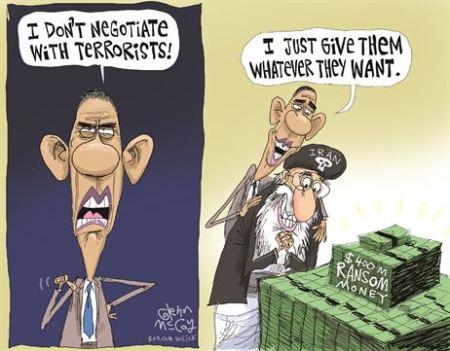
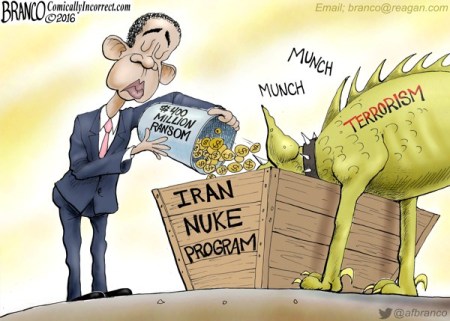
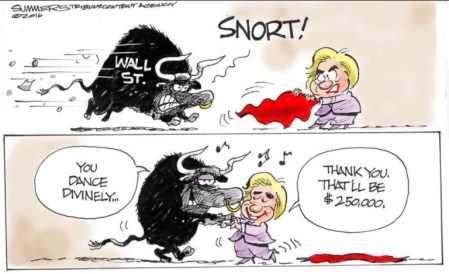
Cartoons of the Day

August 6, 2016

H/t Town Hall

gimmee OK


H/t The Conservative Treehouse

Iran-Cash-600-CI


H/t Power Line

Hillary-Wall-Street-copy


Islam-Doubletalk-copy


Home-Early-copy


Iran-Ransom-copy


Undocumented-Felon-copy