Archive for the ‘Ideology’ category

Spain in the Eye of the Storm of Jihad

June 6, 2015

Spain in the Eye of the Storm of Jihad, The Gatestone InstituteSoeren Kern, June 6, 2015

(Right of return? — DM)

  • The Islamists are especially interested in converts who have not yet taken on Muslim names and whose official IDs still have their Christian names, so they can purchase weapons without drawing the attention of police.
  • At least 50,000 Muslim converts are currently living in Spain. Police say that converts are especially susceptible to radicalization because they are facing increasing pressure from Islamists who are calling on them to carry out attacks to “demonstrate their commitment” to their new faith.
  • Spain has also become a key entry point for human trafficking mafias being used by jihadist veterans seeking to return to Europe after fighting in the Middle East.
  • “Turkey is the Seven-Eleven of false passports.” — Spanish agent working on a human trafficking case.

Spanish security forces have arrested a total of 568 jihadists over the past ten years in 124 separate operations against Islamic terrorism, Spanish Interior Minister Jorge Fernández Díaz revealed at an African security conference in Niger on May 14.

Fernández Díaz said that “constant police and judicial actions” have helped Spanish authorities prevent another large-scale terrorist attack similar to the March 2004 Madrid train bombings, in which nearly 200 people were killed and more than 2,000 were injured.

At the same time, Fernández Díaz has warned that it is “very probable” that Islamic terrorists will strike Spain at some point in the future; he has estimated the probability of an attack to be 70%.

At a two-day terrorism conference held in Madrid on April 23 and 24, Fernández Díaz said that at least 115 Spanish jihadists — including at least 15 women — are now known to have joined the Islamic State. He added that 14 jihadists had returned to Spain; nine of those are in prison and five remain free.

In January, Fernández Díaz said the number of Spanish jihadists abroad was 70, which implies a jump of more than 40 new jihadists in the first four months of 2015 alone. In August 2014, the first time that Fernández Díaz provided an official estimate, he said there were 51 Spanish jihadists fighting abroad.

Meanwhile, “dozens” of jihadists and other Islamic radicals are entering Spain from neighboring France, where they are said to be “asphyxiating” due to a government crackdown following theCharlie Hebdo attacks in Paris in January. (On April 29, French President François Hollande announced that a force of 7,000 troops would be deployed to patrol French streets on a permanent basis.)

According to an anonymous Spanish intelligence operative interviewed by El Confidencial, a media outlet based in Madrid, French jihadists are moving to Spain because they feel they have “greater room for movement” on the Iberian Peninsula. They include individuals “suspected” of being Islamic radicals, but for whom there is insufficient proof for either government to arrest them.

The report says that most of the jihadists from France are moving to Catalonia and Spain’s Mediterranean coast, where they are attempting to “blend in” with Muslim communities there. Also known as the Spanish Levant, the region roughly corresponds with what was once known as Xarq al-Ándalus, territories that were occupied by Muslim invaders for nearly five centuries.

Al-Andalus is the Arabic name given to those parts of Spain, Portugal and France occupied by Muslim conquerors (also known as the Moors) from 711 to 1492. Many Muslims believe that territories Muslims lost during the Christian Reconquista of Spain still belong to the realm of Islam. They claim that Islamic law gives them the right to return there and re-establish Muslim rule.

In July 2014, jihadists with the Islamic State produced a video in which they vowed to liberate al-Andalus from non-Muslims and make it part of their new Islamic Caliphate. The video showed a jihadist speaking in Spanish with a heavy North African accent, warning:

“I say to the entire world as a warning: We are living under the Islamic flag, the Islamic caliphate. We will die for it until we liberate those occupied lands, from Jakarta to Andalusia. And I declare: Spain is the land of our forefathers and we are going to take it back with the power of Allah.”
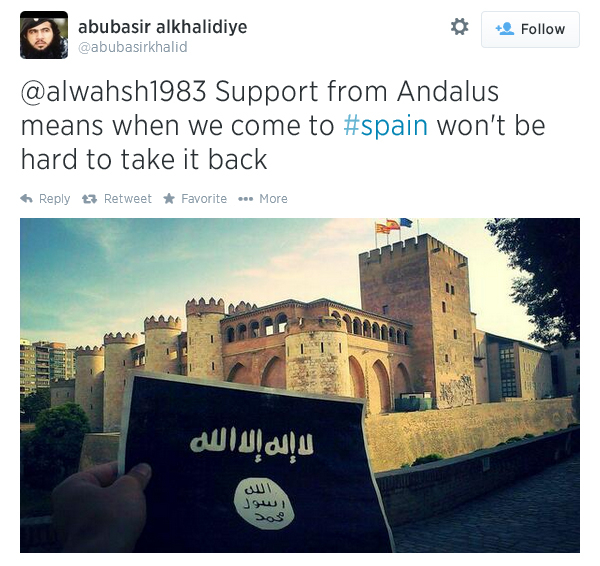
639A tweeted photo of an Islamic State supporter holding the Islamic State’s black flag of jihad in front of Aljafería Palace in Zaragoza, Spain

Counter-terrorism authorities are now warning that the Islamic State is actively looking for Spanish converts to Islam who possess gun licenses and who can legally purchase rifles and shotguns. The Islamists are especially interested in converts who have not yet taken on Muslim names and whose official IDs still have their Christian names, so that they can purchase weapons without drawing the attention of police.

At least 50,000 Muslim converts are currently living in Spain. Police say that converts are especially susceptible to radicalization because they are facing increasing pressure from Islamists who are calling on them to carry out attacks to “demonstrate their commitment” to their new faith. “Converts are the perfect breeding ground for Islamism,” according to a Spanish intelligence operative.

These concerns have been confirmed in a new report published by the Spanish Institute of Strategic Studies, an organ of the Ministry of Defense, which warned that so-called lone wolves pose the biggest threat to Spain and other European countries.

“They are activists who secretly swear allegiance to [Islamic State leader] Abu Bakr al-Baghdadi and act independently without making contact with anyone, so locating them becomes a living hell,” the report said. It added:

“Terrorists no longer need to communicate directly with the leadership of the organization to which they belong, or use the telephone or emails to know exactly what to do, when and under what circumstances. There is no longer any need for prior contact to establish the type of signals to be used, the conditions and dimensions of an attack or any restrictions.

“These tactics end the dream of the intelligence services to control everything through the systematic interception of communications and the use of satellite imagery. If there is no communication, it is not possible to intercept anything.”

Spain has also become a key entry point for human trafficking mafias being used by jihadist veterans seeking to return to Europe after fighting in the Middle East. A report prepared by Spanish border police identifies three main routes of entry — Africa, South America and Europe — and warns that human trafficking is “more lucrative than cocaine trafficking.”

According to the report:

“The proliferation of organizations trafficking in human beings and taking advantage of counterfeit documentation is resulting in the introduction of thousands of people into European countries. The problem is compounded when one considers that European jihadist veterans who have fought in Syria and Iraq on behalf of the Islamic State are using the same networks to facilitate their return. Many have arrest warrants in different countries (Spain, France, UK, etc.) and Islamic State members may cross our borders to carry out terror attacks in Europe.”

In November 2014, police in Madrid arrested 18 individuals — eight Lebanese, four Spaniards, three Syrians, one Ecuadorian, one Moroccan and one Ukrainian — accused of running smuggling operation to bring people from Syria into Spain. Police estimate that the cell, which had branches in Lebanon and Turkey, generated earnings of between €50,000 ($55,000) and €100,000 ($110,000) each month. According to one of the agents working on the case, “Turkey is the Seven-Eleven of false passports.”

Meanwhile, at least 60 jihadists in Catalonia are said to be waiting for a signal from the Islamic State to attack, according to the Madrid-based El País newspaper. The warning was given during a closed-door meeting of anti-terrorism police held in late April in Viladecans, a town near Barcelona.

The unofficial meeting was convened after a counter-terrorism operation in Catalonia was compromised, when some jihadists were allegedly tipped-off that they were about to be arrested. Although the exact circumstances of the imbroglio remain unclear, it appears to have been the result of poor inter-agency coordination between counter-terrorism police in Madrid and Catalan police known as the Mossos d’Esquadra. The two groups were apparently investigating the same Islamist cell without consulting each other.

The meeting in Viladecans, attended by 130 agents from different police forces — Mossos, Civil Guards, national and local police — from across the country, got together to discuss their mutual concerns about “the lack of training of law enforcement to combat jihadist terrorism.”

Much of the daylong meeting was used to share information about how to detect “radicalization processes” and how to distinguish ordinary Muslims from Salafists and jihadists. A counter-terrorism specialist said that one of the key problems faced by police is that “jihadists have infiltrated society, they drink alcohol, eat pork and dress like a Westerner and are undetectable.”

One of the organizers of the event, Alex Pérez of a local branch of the International Police Association, said:

“We go out on the street every day but we do not have the tools needed to combat threats against the public. Some of us are digging into our own pockets to train ourselves, protect ourselves and provide an adequate service to society.”

Another police officer summed it up this way: “We are screwed and will be much worse off in the future because there are radicals increasingly inclined to attack.”

D-Day invasion and Those were the days

June 6, 2015

(Please see also, Forfeiting America’s Military Leverage. Are “we” still willing to sacrifice our lives and those of others, including “collateral damage,” to defeat even our relatively weak enemies?– DM)

The Islamic State Is Here to Stay

June 5, 2015

The Islamic State Is Here to Stay, VICE NewsAhmed S. Hashim, June 6, 2015

(Please see also, The Kurd-Shia War Behind the War on ISIS. — DM)

The victories against IS in early 2015 have proven ephemeral — or have been nullified by IS gains elsewhere. On Sunday, CIA director John Brennan said on Face the Nation, “I don’t see this being resolved anytime soon.” Assad’s vaunted offensives of February 2015 have fallen short as the regime faced stiff resistance from a wide variety of opposition fighters, including elements from IS. The failure was alarming in part because the campaign was designed and aided by both Hezbollah and the Iranians, two seemingly ascendant Shia powers.

************************

Just a few months ago, analysts and policy-makers were certain that the defeat of Islamic State (IS) forces was simply a matter of time.

Coalition airstrikes would degrade the group’s capabilities and eventually allow Iraqi forces and Kurdish Peshmerga — though discredited by their poor military showing in mid-2014 — to push back the extremists. And indeed, IS fighters were ejected from Tikrit in March 2015 by the Iraqi army and thousands of motivated fighters from Shia militias. In Kobani in northern Syria, IS fighters were defeated by Syrian Kurdish fighters. Elsewhere in the country, the regime of Bashar al-Assad was going on the offensive with help from Hezbollah and advisers from the Iranian Revolutionary Guard.

The Islamic State, however, rose like a phoenix from the ashes of every setback. And today, the situation is not so rosy.

The victories against IS in early 2015 have proven ephemeral — or have been nullified by IS gains elsewhere. On Sunday, CIA director John Brennan said on Face the Nation, “I don’t see this being resolved anytime soon.” Assad’s vaunted offensives of February 2015 have fallen short as the regime faced stiff resistance from a wide variety of opposition fighters, including elements from IS. The failure was alarming in part because the campaign was designed and aided by both Hezbollah and the Iranians, two seemingly ascendant Shia powers.

The situation in Iraq is just as complicated, something that the Obama administration appears either oblivious to or reluctant to acknowledge. Much of the US strategy continues to hinge on what is increasingly a mirage: a unified, albeit federal, Iraq under the control of Baghdad. Meanwhile, the resilience of IS is greatly enhanced by the ability of its military forces to innovate and adapt faster on the ground than its lackluster opponents.

In light of the constant aerial strikes by the US and its allies, IS has dispersed and made its forces more mobile, no longer presenting dense concentrations of fighting men as it did when it seized Mosul in mid-2014. Instead, when IS seized Ramadi in May 2015, it made use of inclement weather and sent several small units from different directions simultaneously into the city aided by suicide bombers. Moreover, the fact that the group faced ill-equipped and poorly motivated Sunni fighters in and around Ramadi did not do anything for Baghdad’s standing with the country’s already alienated Sunni community, which had pleaded for arms while caught between the unfathomable brutality of IS and revengeful Shia militias.

Many Sunnis are now angling for their own “super-region,” one that would have considerable independence from Baghdad. The problem? In order to have it, the Sunnis would need to first defeat IS. Currently, they’re unable to do so because they lack the resources; despite all the talk from Baghdad and Washington about arming Sunni tribes, Baghdad is not actually keen to do so.

And besides, the Sunnis seem relatively ambivalent about defeating IS. They took an unequivocal stance between late 2006 and 2009, when they joined with the Americans and the Iraqi government to deal the Islamist militants what was then seen as a decisive blow. Now, however, despite Sunnis’ resentment and fear of IS, the Islamists’ existence is seen as a kind of insurance policy against Shia revanchism should Baghdad succeed in retaking the three Sunni provinces of Anbar, Salahuddin, and Ninevah.

(Please see video at the link. — DM

The “victory” of the Iraqi government in Tikrit was more propaganda than reality; a few hundred IS fighters managed to inflict considerable damage on the Shia militias that had been mobilized to fight alongside the Iraqi army, then withdrew because they were outnumbered and wished to avoid being surrounded. The IS forces in Tikrit simply felt that they had done enough damage; there was no need to waste further assets in an untenable situation.

Militarily, the Iraqi Shia militias are better motivated and more dedicated than the regular army. Anecdotal information out of Baghdad suggests that Iraqi Shias are wondering whether the government should invest more effort building these forces into an effective and more organized parallel army. Even that parallel army, however, might be reluctant to commit to any significant long-term offensive to reclaim provinces full of “ungrateful” Sunnis.

But the Shia are willing to die to defend what they have, and there is increased sentiment among the Shia in central Iraq and Baghdad, along with the southern part of the country, that they would be better off without the Sunnis. There also exists the belief that the Kurds have more or less opted out of the Iraqi state despite the fact that they maintain a presence within the government in Baghdad. The Shia would seemingly not be sorry to see them exit the government in a deal that would settle as best as possible divisions of resources and territory. However, whether the Kurds would take the plunge and opt for de jure rather than de facto independence is a question that is subject to regional realities — How would Ankara and Tehran react? — rather than merely a matter of a deal between Baghdad and Erbil.

The Islamic State will continue to be a profound geopolitical problem for the region and the international community, and a long battle lies ahead. Syria and Iraq are more or less shattered states; it is unlikely that they will be put back together in their previous shapes. If Assad survives 2015, it will be as head of a rump state of Alawites and other minorities protected by Hezbollah, Iran, and Alawite militias. Shia Iraq will survive, and will possibly dissociate itself from the nettlesome Sunni regions. The Kurds will go their own way step by step. The international community is currently at a loss for how to stem the flow of foreign fighters to the IS battlefields — and even more serious is the growing sympathy and admiration for the group in various parts of the world among disgruntled and alienated youth.

If the US is serious about defeating IS, it needs to take on a larger share of the fight on the ground. This means more troops embedded with regular Iraqi forces in order to bring about better command, control, and coordination. It also means advisors who can continue to train these forces so that they improve over time. If this is not done, the regular Iraqi military will continue to be nothing more than an auxiliary to the more motivated — and pro-Iranian — Shia militias. Currently, militia commanders are giving orders to the regular military; that cannot be good for morale.

This month, the Islamic State celebrates the first anniversary of its self-declared caliphate. The group has little reason to fear it will be the last.

Goodbye to the First Amendment

June 5, 2015

Goodbye to the First Amendment, Pat Condell via You Tube, January 5, 2015

(What’s left of it, anyway. — DM)


How Islam in America Became a Privileged Religion

June 3, 2015

How Islam in America Became a Privileged Religion, Front Page Magazine, Daniel Greenfield, June 3, 2015

(Much the same nonsense infects foreign policy and propels the notion that the Islamic State is not Islamic. — DM)

islam

What is Islam? The obvious dictionary definition answer is that it’s a religion, but legally speaking it actually enjoys all of the advantages of race, religion and culture with none of the disadvantages.

Islam is a religion when mandating that employers accommodate the hijab, but when it comes time to bring it into the schools, places that are legally hostile to religion, American students are taught about Islam, visit mosques and even wear burkas and recite Islamic prayers to learn about another culture. Criticism of Islam is denounced as racist even though the one thing that Islam clearly isn’t is a race.

Islamist organizations have figured out how lock in every advantage of race, religion and culture, while expeditiously shifting from one to the other to avoid any of the disadvantages.

The biggest form of Muslim privilege has been to racialize Islam. The racialization of Islam has locked in all the advantages of racial status for a group that has no common race, only a common ideology.

Islam is the only religion that cannot be criticized. No other religion has a term in wide use that treats criticism of it as bigotry. Islamophobia is a unique term because it equates dislike of a religion with racism. Its usage makes it impossible to criticize that religion without being accused of bigotry.

By equating religion with race, Islam is treated not as a particular set of beliefs expressed in behaviors both good and bad, but as an innate trait that like race cannot be criticized without attacking the existence of an entire people. The idea that Islamic violence stems from its beliefs is denounced as racist.

Muslims are treated as a racial collective rather than a group that shares a set of views about the world.

That has made it impossible for the left to deal with ex-Muslims like Ayaan Hirsi Ali or non-Muslims from Muslim families like Salman Rushdie. If Islam is more like skin color than an ideology, then ex-Muslims, like ex-Blacks, cannot and should not exist. Under such conditions, atheism is not a debate, but a hate crime. Challenging Islam does not question a creed; it attacks the existence of an entire people.

Muslim atheists, unlike all other atheists, are treated as race traitors both by Muslims and leftists. The left has accepted the Brotherhood’s premise that the only authentic Middle Easterner is a Muslim (not a Christian or a Jew) and that the only authentic Muslim is a Salafist (even if they don’t know the word).

The racialization of Islam has turned blasphemy prosecutions into an act of tolerance while making a cartoon of a religious figure racist even when it is drawn by ex-Muslims like Bosch Fawstin. The New York Times will run photos of Chris Ofili’s “The Holy Virgin Mary” covered in dung and pornography, but refuses to run Mohammed cartoons because it deems one anti-religious and the other racist.

The equating of Islam with Arabs and Pakistanis has made it nearly impossible for the media to discuss violence against Christians in those parts of the world. The racialization of Islam has made Arab Christians, like Bangladeshi atheists, a contradiction in terms. The ethnic cleansing of the Yazidi could only be covered by giving them a clearly defined separate identity. Middle Eastern Christians are increasingly moving to avoid being categorized as Arabs because it is the only way to break through this wall of ignorance.

While racialization is the biggest Muslim privilege, race provides no protection for many Islamic religious practices. Muslims then seek religious discrimination laws to protect these practices even if it’s often a matter of debate whether their lawsuits protect their religious practices or impose them on others.

Islam is a theocracy. When it leaves the territories conquered by Islam, it seeks to replicate that theocracy through violence and by adapting the legal codes of the host society to suit its purposes.

Islamic blasphemy laws are duplicated using hate crime laws. Employers are obligated to make religious concessions to Muslim employees because of laws protecting religious practices, but many of these practices, such as refusing to carry out jobs involving pork, liquor or Seeing Eye dogs, are really ways of theocratically forcing behaviors that Islam forbids out of public life much as Saudi Arabia or Iran do.

Accusations of bigotry are used to outlaw ideas that Islam finds blasphemous and religious protection laws are used to banish behaviors that it disapproves of. By switching from race to religion and back again, Islamists construct a virtual theocracy by exploiting laws designed to protect different types of groups.

Religions in America traded theocracy for religious freedom. They gave up being able to impose their practices on others in exchange for being able to freely practice their own religions. Islam rejects religious freedom. It exploits it to remove the freedom of belief and practice of others. When it cannot do so through religious protection laws, it does so through claims of bigotry.

Religions were not meant to be immunized from blasphemy because that is theocracy. Instead religions are protected from restrictions, rather than from criticism. Islam insists on being protected from both. It makes no concessions to the freedom of others while demanding maximum religious accommodation.

While race and religion are used to create negative spaces in which Islam cannot be challenged, the creed is promoted positively as a culture. Presenting Islam as a culture allows it easier entry into schools and cultural institutions. Islamic missionary activity uses the Western longing for oriental exotica that its political activists loudly decry to inject it into secular spaces that would ordinarily be hostile to organized religion.

Leftists prefer to see Islam as a culture rather than a religion. Their worldview is not open to Islam’s clumsy photocopy of the deity that they have already rejected in their own watered down versions of Christianity and Judaism. But they are constantly seeking an aimless and undefined spirituality in non-Western cultures that they imagine are free of the materialism and hypocrisy of Western culture.

Viewing Islam as a culture allows the left to project its own ideology on a blank slate. That is why liberals remain passionately convinced that Islam is a religion of social justice. Their Islam is a mirror that reflects back their own views and ideas at them. They pretend to respect Islam as a culture without bothering to do any more than learn a few words and names so that they can seem like world travelers.

By morphing into a culture, Islam sheds its content and becomes a style, a form of dress, a drape of cloth, a style of beard, a curvature of script and a whiff of spices. It avoids uncomfortable questions about what the Koran actually says and instead sells the religion as a meaningful lifestyle. This approach has always had a great deal of appeal for African-Americans who were cut off from their own heritage through Islamic slavery, but it also enjoys success with white upper class college students.

The parents of those students often learn too late that Islam is not just another interchangeable monotheistic religion, that its mosques are not places where earnest grad students lecture elderly congregants about social justice and that its laws are not reducible to the importance of being nice to others.

Like a magician using misdirection, these transformations from religion to race, from race to culture and from culture to religion, distract Americans from asking what Islam really believes. By combining race, religion and culture, it replicates the building blocks of its theocracy within our legal and social spaces.

Separately each of these has its advantages and disadvantages. By combining them, Islam gains the advantages of all three, and by moving from one to the other, it escapes all of the disadvantages. The task of its critics is to deracialize Islam, to reduce it to an ideology and to ask what it really believes.

Islam is a privileged religion. And there’s a word for that. Theocracy.

Egypt Says NY Times Promoting Muslim Brotherhood Agitprop

June 3, 2015

Egypt Says NY Times Promoting Muslim Brotherhood Agitprop, The Clarion ProjectRyan Mauro, June 3, 2015

(Obama has spread and relied upon much the same meme as the NY Times and Washington Post. — DM)

New-York-Times-Building-IP_1The New York Times building in New York City

If the New York Times values objective reporting, then it must mention the Brotherhood’s calls to violence in its coverage as well as the many other instances of violence that the group has been involved in.

*********************

The Egyptian ambassador to the U.S. has written a public letter toThe New York Times protesting “its unquestioning adoption of Moslem Brotherhood’s propaganda” and false characterization of the Islamist group as non-violent.

Ambassador Mohamed Tawfik’s letter was written around the same time that the Egyptian embassy released three videos of calls to violence made on Muslim Brotherhood television networks based in Turkey.

The networks’ coverage promoted explicit calls for killing Egyptian police officers and attacking foreign companies and embassies. A threat was also made to carry out regional attacks against the interests of countries who support the Egyptian government.

Egypt is infuriated at the Times as well as the Washington Post for repeatedly asserting that the Brotherhood is non-violent. In response to the Times suggestion that the Egyptian government’s prosecution of the Brotherhood is pushing it towards terrorism, the Egyptian ambassador writes:

This statement demonstrates, at best, a complete misunderstanding of the roots of radicalism. At worst, it amounts to a justification for violent extremism. Today, terrorists in Egypt are part of a network of extremists who are bound by a singular distorted ideology, and by a shared goal of taking our region back hundreds of years. They are inspired by the radical teachings of the former Moslem Brotherhood leader Sayyid Kutb [Qutb]. Terrorists in Egypt share the same evil goals as terrorists in Iraq, Syria and Libya.

Indeed, Ambassador Tawfik is correct that the New York Times separates Islamists from terrorists and extremists. The Times editorial condemns “relentless and sweeping crackdown on Islamists, under the baseless contention that they are inherently dangerous.”

The New York Times described sentencing to death of former President Morsi and 100 other Brotherhood members as “deplorable.” It describes the Brotherhood as having renounced violence in the 1970s.

However, Morsi and the defendants were sentenced for his involvement in prison breaks in 2011 that freed 20,000 inmates, including Morsi himself. The Egyptian government says the attacks were well-orchestrated and involved participation by the Muslim Brotherhood, Hamas and Hezbollah.

Tawfik chastises the Times for failing to mention that the prison break was a violent operation that resulted in the deaths of prison guards and inmates and freed members of Hamas and Hezbollah.

The Egyptian ambassador also excoriated the Washington Post in February for “toeing the Muslim Brotherhood line” and advised it to be more balance in order to “save whatever is left of your credibility in the Arab world.”

Egyptian President El-Sisi came into power after the popularly-supported military intervention in July 2013 overthrew the Muslim Brotherhood government. The move had the support of a broad spectrum of Egyptian society with public endorsements from secular-democratic activists, the Grand Sheikh of Al-Azhar University and the leader of the Coptic Orthodox Church.

The overthrow came after Morsi (whose election itself was marred bycharges of voter fraud) seized far-sweeping powers for himself, essentially negating any semblance of a democratic government.

El-Sisi is often characterized as an anti-democratic strongman; a depiction that his government is now challenging.

He argues that these strongman tactics are necessary because a democratic transition cannot be completed without stability, economic development and a confrontation with Islamism (also known as Political Islam). He asks the West to understand that there is a “civilizational gap between us and you” and it will take time to modernize.

A study commissioned by the Egyptian government criticized its heavy-handedness but concluded that banning Islamist parties is required for the country’s stability and democratic development. It recommended a program to separate politics and religion.

The Egyptian government sees the Islamic State (ISIS) as a natural outgrowth of the Muslim Brotherhood. Its website warns that the Muslim Brotherhood has a network of fronts in America that are disguised as civil society organizations.

El-Sisi called for a reformation in Islamic interpretation in January 2014 and made a dramatic call on the Islamic religious establishment to address problematic teachings this January that received widespread media coverage. He has explicitly said that Egypt should be “a civil state, not an Islamic one” and defined the ideology of the enemy as Political Islam in an interview on FOX News Channel.

El-Sisi is also confronting Islamist terrorism internationally, in addition to its fight against Islamic State in the Sinai Peninsula. His government is an enemy of Hamas and is as minimally anti-Israel as can be expected of an Arab leader.

Egypt has conducted airstrikes on ISIS in Libya and is materially supporting the Libyan government in its civil war against Islamist forces. Egypt and Libya are complaining about a lack of American backing. A new Egyptian-backed offensive is said to be in the works.

El-Sisi is assembling an Arab rapid-reaction force of 40-50,000 troops that can quickly be deployed to fight Islamic State and other terrorists. Egypt is also taking part in the Arab military intervention against the Iranian-backed Houthi rebels in Yemen.

El-Sisi also made a historic visit to a Coptic Christian church during mass on Christmas Eve. He challenged the Egyptian honor culture when he apologized to a woman who was raped in Tahrir Square.

Major American media outlets have fallen for the falsehood that the Muslim Brotherhood is non-violent. It is true that the Egyptian government is often criticized for its human rights record, but coverage of those accusations should not automatically exempt the Brotherhood and other Islamists from blame.

If the New York Times values objective reporting, then it must mention the Brotherhood’s calls to violence in its coverage as well as the many other instances of violence that the group has been involved in.

Iran Implicated in Foiled Hezbollah Attacks on Europe

June 2, 2015

Iran Implicated in Foiled Hezbollah Attacks on Europe, The Clarion ProjectRYAN MAURO, June 2, 2015

Iran-Basij-IP_3Iranian Basij volunteer militia members (Photo: © Reuters)

If this is the behavior of the Iranian regime when it has every incentive to temporarily play nice, then what will it do when it breaks free of sanctions and uses trade deals to disarm the U.S. of its economic leverage?

********************

The arrest of a Hezbollah terrorist in Cyprus is believed to have foiled attacks in Europe, probably against Israeli or Jewish targets. The plots show that Iran is as committed to international terrorism as ever and is not the least bit dissuaded by the prospect of a lucrative nuclear deal.

The terrorist came to Cyprus last month and had nearly two tons of ammonium nitrate—a substance commonly used for making bombs—in his basement. That’s about the amount that was used to carry out the Oklahoma City bombing in 1995 that took down a federal building and killed 168 people.

It is suspected that he was planning on attacking Israelis, and there is evidence linking the operative to Hezbollah leader Hassan Nasrallah. It is also believed that the operative belonged to a network planning on using Cyprus as a “port of export” for additional terrorist plots in Europe.

The National Council of Resistance in Iran, an opposition group, says that a Cyprus newspaper reported that he was trained in Iran by the Revolutionary Guards Corps.

In 2012, a Hezbollah terrorist was arrested and later found guilty of planning attacks on Israeli tourists in Cyprus. His possession of a Swedish passport enabled him to conduct surveillance on targets in Europe. It was discovered that he was tracking flights from Israel to Cyprus, researching bus routes used by Israeli tourists and assessing a hospital parking lot. He also traveled to France and the Netherlands for Hezbollah.

The foiled plot helps make an important point about the nature of the Iranian regime. If there was any time for the regime to resist its impulses to engage in international terrorism, it is now.

An Iranian-sponsored plot could unravel the nuclear deal that could strengthen its “Islamic Revolution,” bolster the regime and allow it to dramatically increase its sponsorship of terrorism. And yet, even under these conditions, the Iranian regime can’t help but orchestrate terror plots in Europe with the objective of killing hundreds of innocents.

If this is the behavior of the Iranian regime when it has every incentive to temporarily play nice, then what will it do when it breaks free of sanctions and uses trade deals to disarm the U.S. of its economic leverage?

Harf ”perplexed” by NYT story on Iran’s increased nuclear stockpile

June 2, 2015

Harf ”perplexed” by NYT story on Iran’s increased nuclear stockpile, Washington Free Beacon via You Tube, June 2, 2015

(Please see also, Contrary to Obama’s claims, Iran increased its nuclear fuel stockpiles — DM)


The “Speech-Denialists”

June 2, 2015

The “Speech-Denialists,” The Gatestone InstituteDaniel Mael, June 2, 2015

  • In denying the average college student the opportunity to hear, think, question and learn, these minority organizations violated the basic principles of a liberal arts education and what higher learning should presumably be about: challenging assumptions and talking openly about issues that might cause discomfort.
  • Both micro-sensitivity and political correctness require at best, obfuscating information, and at worst, silencing it.

On college campuses, teachers, students and sometimes even administrators seem to have become ever more eager to block any idea with which they disagree.

Often it appears as if their first impulse is to demonize the individual or organization presenting the offending idea, rather than to address the substance of the argument and open a discussion in the “free marketplace of ideas.”

On the campus of Lake Superior State University, wall postings “deemed offensive, sexist, vulgar, discriminatory or suggestive will not be approved.” The campus code of conduct states that if students fail to comply, they may be disciplined — a rule that was named “Speech Code of the Month” for May by the Foundation for Individual Rights in Education (FIRE).

1092Lake Superior State University’s campus code of conduct states that wall postings “deemed offensive, sexist, vulgar, discriminatory or suggestive will not be approved.” (Image source: Bobak Ha’Eri/Wikimedia Commons)

Increasingly, individuals and groups, perhaps unknowingly betraying the spirit of classic liberalism, seek to shame or ridicule dissenting opinion into silence. Both in politics and on college campuses, it seems as if aggressive shaming has replaced the art of persuasion as the favored means of argumentation. Substantive, non-politically correct discussion is now at a premium.

In her recently published book The Silencing, life-long liberal and Fox News contributor Kirsten Powers documents the escalating efforts of people claiming to be liberal to silence dissent on issues they regard as contentious. The tactic follows what Powers calls the “authoritarian impulse to silence.”

On issues ranging from campus “speech codes” to feminism, these self-described liberals are unwilling to entertain the notion that a well-intentioned individual from the other side of the aisle might have a different remedy for the problems of the day.

When feminist scholar Christina Hoff Sommers of the American Enterprise Institute gave a lecture on the campus of Oberlin University on the topic of campus sexual assault and due process, protesters labeled her a “rape denialist” and claimed that they felt “unsafe.” Perhaps we should begin calling such protesters “due-process denialists.”

When the subject is religion, these “liberals” maintain a disingenuous double standard. “While the illiberal left seems to hold a special animosity to Christianity,” Powers notes, in a remark that could also apply to Israel, “it is strangely protective of Islam, despite the fact that orthodox Muslims oppose same-sex marriage.” Not only are Muslim attitudes toward gay marriage overlooked or roadsided completely, but if anyone dares to discuss the issue of minorities in the Muslim-majority world, they are labeled “racist,” “Islamophobic,” or other slurs at arm’s reach.

Meanwhile, critics are unrelenting in their animosity toward observant Christians’ views of homosexuality. “If you think about it, we are at the water’s edge of the argument that mainstream Christian teaching is hate speech,” Senator Marco Rubio recently told CBN News. “Because today we’ve reached the point in our society where if you do not support same-sex marriage you are labeled a homophobe and a hater.”

Last year, at Brandeis University, when I sought to bring a human rights display highlighting the oppression of LGBTQ individuals in Yemen, Saudi Arabia and Iran, the initiative was blocked in a flood of administrative bureaucracy. The member of the administration with whom I met was clearly not thrilled by the idea.

Meetings with a gay rights group and the Muslim Students Association (MSA), however, were just as telling. Hoping to solicit partnerships in the initiative, I explained to leaders and members of both organizations that the project was not about Islam, but about how, on a routine basis, certain governments murder people who identify as LGBTQ. Members of the gay rights organization expressed concern about “Islamophobia,” while members of the Muslim Students Association expressed concern about “homophobia.” The initiative was rejected. Both groups evidently prioritized the emotional and intellectual comfort of the campus community over drawing attention to the plight of innocent LGBTQ individuals in the Muslim world.

In denying the average college student the opportunity to hear, think, question and learn, these minority organizations violated the basic principles of a liberal arts education and what higher learning should presumably be about: challenging assumptions and talking openly about issues that might cause discomfort. It is still puzzling why the LGBTQ club and the MSA are not at the forefront of defending other members of their respective groups, regardless of where they may live.

Both micro-sensitivity and political correctness require at best, obfuscating information, and at worst, silencing it. It is incumbent upon those who recognize the dangers of the ever-expanding “speech-denialists” in the “political correctness” movement to put up a fight — figuratively, of course.

Obama Assures Iran It Has Nothing to Fear

June 2, 2015

Obama Assures Iran It Has Nothing to Fear, Commentary Magazine, June 1, 2015

(Obama seems to have been talking about Iranian efforts to militarize nukes, not peaceful uses such as medical or generation of electricity. If, as claimed, Iran has no intention of getting, keeping or using nukes why try to halt it? Why bother even to negotiate?– DM)

“A military solution will not fix it. Even if the United States participates, it would temporarily slow down an Iranian nuclear program but it will not eliminate it.”

****************

At this point, there is virtually no one in Israel or the United States who thinks it is remotely possible that the Obama administration would ever, under virtually any circumstances, use force against Iran. Though President Obama and his foreign policy team have always claimed that “all options,” including force, are always on the table in the event that Iran refuses to back down and seeks to produce a nuclear weapon, that is a threat that few took seriously. But President Obama has never been quite as explicit about this before as he was in an interview with Israel’s Channel 2 in which he reportedly said there is no military option to stop Iran. If Obama wanted to telegraph Iran that it could be as tough as it likes in the talks over the final text of the nuclear deal being negotiated this month this statement certainly did the job. Though they had little worry about Obama’s toughness or resolve, the ayatollahs will be pleased to note that the president no longer even bothers to pretend he is prepared to do whatever is necessary to stop Iran’s nuclear ambition.

According to the Times of Israel, Obama said:

“A military solution will not fix it. Even if the United States participates, it would temporarily slow down an Iranian nuclear program but it will not eliminate it.”

Though he continued to use rhetoric that left force as an option, the implicit threat of American action if a nuclear weapon were a possibility has lacked credibility since the president began his second term. Once he embarked upon secret back-channel talks in which, one by one, he abandoned his previous pledges about forcing Iran to shut down its program in concessions and virtually every other U.S. position on the issue, force was never a real possibility. The signing of a weak interim deal in November, 2013, and then the framework agreed upon this spring signaled the end of any idea that the U.S. was prepared to act. That is especially so because the current deal leaves Tehran in possession of its nuclear infrastructure and with no guarantees about inspections or the re-imposition of sanctions in the event the agreement collapsed. The current deal, even with so many crucial details left unspecified makes Iran a U.S. partner and, in effect, the centerpiece of a new U.S. Middle East policy that essentially sidelines traditional allies like Saudi Arabia and Israel that are directly threatened by Iran.

Moreover, it must be conceded that the use of force against Iran would be problematic even for the United States and its vast military resources. As for Israel, despite a lot of bold talk by some in the Jewish state, there has always been skepticism that its outstanding air force had the ability to sustain an air campaign for the length of time that would be required to make a difference. Nevertheless, the notion that force would not be effective in forestalling an Iranian bomb is mistaken. Serious damage could put off the threat for a long time and, if sanctions were kept in place or made stricter as they should have been to strengthen the West’s bargaining position, the possibility of an Iranian nuke could have been put off for the foreseeable future.

Yet, while talk about using force has been largely obsolete once the interim deal was signed in 2013, for the president to send such a clear signal that he will not under any circumstances walk away from the current talks, no matter what Iran does, is significant.

After all, some of the most important elements of the deal have yet to be nailed down. Iran’s Supreme Leader, Grand Ayatollah Ali Khamenei has publicly stated that he will never allow the sort of inspections that would make a deal verifiable. He has also demanded that sanctions be lifted permanently on the day the agreement is signed, and that there should be no provision for them to be snapped back. Nor are the Iranians conceding that their stockpile of nuclear fuel be taken out of their hands.

So if Obama is to get the “verifiable tough agreement” he told Channel 2 he seeks, the U.S. must somehow convince the Iranians to back down on all these points. That’s going to be difficult since the past two years of negotiations with Obama have taught them to wait for him to give up since he always does so sooner or later. The president’s statement makes it clear that, no matter how obdurate the Iranians remain, he will never walk away from the talks. And since this deal is the lynchpin of his foreign policy legacy, they know very well that all they have to do is to be patient.

Iran already knows that the deal in its current form allows them two clear paths to a bomb. One is by cheating on its easily evaded terms. The other is by waiting patiently for it to expire, the sunset provision being another astonishing concession by Obama.

If a tough deal were even a possibility, this would have been the moment for the president to sound tough. But throughout this process, the only toughness the president has shown has been toward Israel as he sought to disparage and dismiss its justifiable worries about his course of action. Merely saying now, as he does in the Channel 2 interview, that he understands Israel’s fears is mere lip service, especially since it comes along with a virtual guarantee to Iran that it needn’t worry about a U.S. strike under any circumstance.

With only weeks to go until the June 30 deadline for an Iran deal, there is no question that Obama’s statement makes an unsatisfactory final text even more certain than it was before. That’s good news for Tehran and very bad news for an Israeli people who have no reason to trust the president’s promises or believe in his good intentions.


