Archive for the ‘Hezbollah’ category

Iranian Official: ‘If America Wants To Try Its Luck Against Us, [It Should Know That] We Are Completely Capable Of Mobilizing 9 Million Fighters… In Under 10 Days’; ‘We Have Warehouses Full [Of Missiles]… That Can Hit Tel Aviv’

October 3, 2016

Iranian Official: ‘If America Wants To Try Its Luck Against Us, [It Should Know That] We Are Completely Capable Of Mobilizing 9 Million Fighters… In Under 10 Days’; ‘We Have Warehouses Full [Of Missiles]… That Can Hit Tel Aviv’ MEMRI, October 2, 2016

In a September 25, 2016 speech to a Tehran political circle, Mohsen Rafighdoost, who was minister of the Iran’s Islamic Revolutionary Guard Corps (IRGC) during the 1980-88 Iran-Iraq War and who heads the Noor Foundation,[1] said that the secret of the victory of Iran’s Islamic Revolution was Iranians’ total obedience to the leader. He said that today the IRGC ground forces are “five times better” than the U.S. Army, and that the Iranian regime is capable of deploying nine million troops against it in less than 10 days.

Rafighdoost added that Iran’s missiles in Tehran and the northwest of the country can reach Tel Aviv, and expressed his yearning for Israel to launch a missile at Iran so that Iran could “flatten Tel Aviv.” He also said that Islamic Revolution founder Ayatollah Khomeini established Hizbullah in Lebanon to promote the Islamization of other countries,[2] and that today, in the era of Supreme Leader Ali Khamenei, the organization has become “a supreme force in the region.”

30165Mohsen Rafighdoost. Source: Wilayah.info, January 27, 2014.

Following are his September 25 statements:

“The IRGC’s Ground Forces Are Perhaps Five Times Better Than The American Army”

“The factor that led to our victory in the [Iran-Iraq] War is [the same] factor that led to our victory in the [Islamic] Revolution. The Imam [Khomeini], in France, would order a parade [to be held in Iran], and the people would hold a parade, even in remote villages.

“During the eight years of the imposed war, not only was not one inch of Iranian land surrendered to the enemy, but we also acquired deterrent capability. I believe that as long as the Islamic Revolution stands against the Western and Eastern camps, we will be under military sanctions. We must never think that the world will provide us with military aid. Thanks to the war and its martyrs, Iran currently has deterrent capability. After a while, the Imam [Khomeini] replaced the call of ‘war, war to victory’ with ‘war, war until the fitna is removed.’ At the time, we understood this call as meaning that ‘we must be so strong that the enemy will not even think of a military strike against Iran.’

“Today, Iran has deterrent capability. In recent years, the enemies have spoken of the option [of a military strike against Iran] as being on the table, but that was a lie. [Our] air force and navy are good, but it is [our] ground forces that finish the war. The IRGC’s ground forces are perhaps five times better than the American army.

“Despite all the enemy media and cultural propaganda against us, if America wants to try its luck against us, [it should know that] we are completely capable of mobilizing nine million fighters [against it]… on the [battle]front in under 10 days.”

“If Only A Single [Israeli] Shell Would Strike Anywhere In This Country – So That We Can Flatten Tel Aviv”

“We have warehouses full [of missiles] in Tehran, Zanjan [in northwest Iran] and Oshnavieh [in Western Azerbaijan Province in northwest Iran] that can strike Tel Aviv. If only a single [Israeli] shell would strike anywhere in this country, so that we can flatten Tel Aviv.”

In Khamenei’s Era, Hizbullah “Has Become A Supreme Force In The Region”

“In accordance with his secondary plan, the Imam [Khomeini] created Hizbullah in Lebanon. This plan was [aimed at] Islamizing other countries. Today, in the era of the Leader [Khamenei, Hizbullah] has become a supreme force in the region.

“Despite all the criminal [plots], Iranian security forces grow stronger every day. Some of the statements being put out there are made out of lack of awareness, and anyone who makes them is ignorant.[3]

“The secret to victory lies in wise and complete obedience to the leader [Khamenei]. During the time of the Imam [Khomeini], we obeyed him, and today we obey the leader [Khamenei].”[4]


Endnotes:


[1] Since 1999, Mohsen Rafighdoost has been director of the Noor Foundation, which reportedly owns significant real estate and has revenues of over $200 million from importing pharmaceuticals, sugar and construction materials.

[2] During the 1980s, Rafighdhoost was involved in the creation of Hizbullah in Lebanon and likely had knowledge of its terror activities in Beirut.

[3] A reference to Hashemi Rafsanjani’s August 20, 2016 call for investing in Iran’s economy instead of in its the military, as Japan and Germany did post-World War II. MEMRI is soon publishing a report on Rafsanjani’s statements and reactions to them.

[4] Khabaronline.ir, September 25, 2016.

Column One: The New Middle East

September 29, 2016

Column One: The New Middle East, Jerusalem PostCaroline B. Glick, September 29, 2016

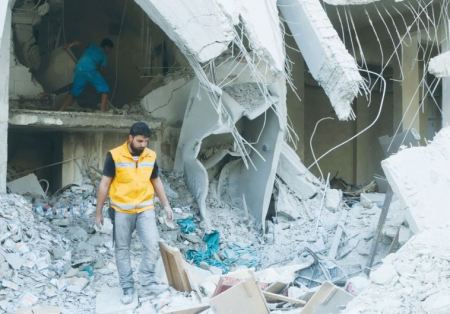
aleppo-messA RED CRESCENT aid worker inspects scattered medical supplies after an air strike on a medical depot in Aleppo on Saturday.. (photo credit:REUTERS)

So Obama let Syria burn. He let Iran and Hezbollah transform the country into their colony. And he let Putin transform the Mediterranean into a Russian lake.

A new Syria is emerging. And with it, a new Middle East and world are presenting themselves. Our new world is not a peaceful or stable one. It is a harsh place.

The new Syria is being born in the rubble of Aleppo.

The eastern side of the city, which has been under the control of US-supported rebel groups since 2012, is being bombed into the Stone Age by Russian and Syrian aircraft.

All avenues of escape have been blocked. A UN aid convoy was bombed in violation of a fantasy cease-fire.

Medical facilities and personnel are being targeted by Russia and Syrian missiles and barrel bombs to make survival impossible.

It is hard to assess how long the siege of eastern Aleppo by Russia, its Iranian and Hezbollah partners and its Syrian regime puppet will last. But what is an all but foregone conclusion now is that eastern Aleppo will fall. And with its fall, the Russian-Iranian-Hezbollah-Assad axis will consolidate its control over all of western Syria.

For four years, the Iranians, Hezbollah and Bashar Assad played a cat and mouse game with the rebel militias.

Fighting a guerrilla war with the help of the Sunni population, the anti-regime militias were able to fight from and hide from within the civilian population. Consequently, they were all but impossible to defeat.

When Russian President Vladimir Putin agreed to join the fight, he and his generals soon recognized that this manner of fighting ensured perpetual war. So they changed tactics. The new strategy involves speeding up the depopulation and ethnic cleansing of rebel-held areas. The massive refugee flows from Syria over the past year are a testament to the success of the barbaric war plan. The idea is to defeat the rebel forces by to destroying the sheltering civilian populations.

Since the Syrian war began some five years ago, half of the pre-war population of 23 million has been displaced.

Sunnis, who before the war comprised 75% of the population, are being targeted for death and exile. More than 4 million predominantly Sunni Syrians are living in Turkey, Lebanon and Jordan. More than a million have entered Europe. Millions more have been internally displaced. Assad has made clear that they will never be coming home.

At the same time, the regime and its Iranian and Hezbollah masters have been importing Shi’ites from Iran, Iraq and beyond. The process actually began before the war started. In the lead-up to the war some half million Shi’ites reportedly relocated to Syria from surrounding countries.

This means that at least as far as western Syria is concerned, once Aleppo is destroyed, and the 250,000 civilians trapped in the eastern part of what was once Syria’s commercial capital are forced from their homes and property, the Russians, Iranians, Hezbollah and their Syrian fig leaf Assad will enjoy relative peace in their areas of control.

By adopting a strategy of total war, Putin has ensured that far from becoming the quagmire that President Barack Obama warned him Syria would become, the war in Syria has instead become a means to transform Russia into the dominant superpower in the Mediterranean, at the US’s expense.

In exchange for saving Assad’s neck and enabling Iran and Hezbollah to control Syria, Russia has received the capacity to successfully challenge US power. Last month Putin brought an agreement with Assad before the Duma for ratification. The agreement permits – indeed invites – Russia to set up a permanent air base in Khmeimim, outside the civilian airport in Latakia.

Russian politicians, media and security experts have boasted that the base will be able to check the power of the US Navy’s Sixth Fleet and challenge NATO’s southern flank in the Mediterranean basin for the first time. The Russians have also decided to turn their naval station at Tartus into something approaching a fullscale naval base.

With Russia’s recent rapprochement with Turkish President Recip Erdogan, NATO’s future ability to check Russian power through the Incirlik air base is in question.

Even Israel’s ability to permit the US access to its air bases is no longer assured. Russia has deployed air assets to Syria that have canceled Israel’s regional air superiority.

Under these circumstances, in a hypothetical Russian-US confrontation, Israel may be unwilling to risk Russian retaliation for a decision to permit the US to use its air bases against Russia.

America’s loss of control over the eastern Mediterranean is a self-induced disaster.

For four years, as Putin stood on the sidelines and hedged his bets, Obama did nothing. As Iran and Hezbollah devoted massive financial and military assets to maintaining their puppet Assad in power, the Obama administration squandered chance after chance to bring down the regime and stem Iran’s regional imperial advance.

For his refusal to take action when such action could have easily been taken, Obama shares the responsibility for what Syria has become. This state of affairs is all the more infuriating because the hard truth is that it wouldn’t have been hard for the US to defeat the Iranian- Hezbollah axis. The fact that even without US help the anti-regime forces managed to hold on for four years shows how weak the challenge posed by Iran and Hezbollah actually was.

Russia only went into Syria when Putin was absolutely convinced that Obama would do nothing to stop him from dislodging America as the premier global power in the region.

As Michael Ledeen recalled earlier this week, Obama chose to stand on the sidelines in Syria because he wanted to make friends with Iran. Obama began his secret courtship of the mullahs even before he officially took office eight years ago.

After the war broke out in Syria, midway through his first term and in the following years, the Russians and the Iranians told the obsessed American president that if he took action against Assad, as strategic rationality dictated, he would get no nuclear deal, and no rapprochement with Tehran.

So Obama let Syria burn. He let Iran and Hezbollah transform the country into their colony. And he let Putin transform the Mediterranean into a Russian lake. Obama enabled the ethnic cleansing of Syria’s Sunni majority, and in turn facilitated the refugee crisis that is changing the face not only of the Middle East but of Europe as well.

And as it turns out, the deal with Iran that Obama willingly sacrificed US control of the Mediterranean to achieve has not ushered in a new era of regional moderation and stability through appeasement as Obama foresaw. It has weakened US credibility with its spurned Sunni allies. It has undermined the strategic position of Israel, the US’s only stable and reliable regional ally. It has financially and strategically fueled Iran’s hegemonic rise throughout the region. And it has facilitated Iran’s development of a nuclear arsenal.

Far from causing the Iranian to become more moderate, the nuclear deal has radicalized the regime still further.

On Wednesday Ray Takeyh wrote in The Washington Post that Supreme Leader Ali Khamenei is now grooming Ibrahim Raisi, a fanatic who makes Khamenei look moderate, to succeed him in power.

On Monday night, for the first time, Israel Air Force jets flying over Syria were shot at by Syrian anti-aircraft ordnance.

Air force sources told the media that the aircraft were never in danger and the munitions were only shot off after the aircraft had returned to Israel and were in the process off landing.

The fact that no one was hurt is of course reassuring.

But the fact that Russia targeted the planes makes clear that Putin has decided to send Israel a very clear and menacing message.

He is now the protector of the Iranian-Hezbollah colony on our northern border. If Israel decides to preemptively attack targets belong to that colony, Russia will not stand by and watch. And with the US no longer well-positioned to challenge Russian power in the region, Israel will have to deal with Russia on its own.

To face this challenge, Israel needs to look beyond its traditional reliance on air power.

There are two parts of the challenge. The first part is Iran.

As far as Israel is concerned, the problem with the Russian- Iranian takeover of Syria is not Putin.

Putin is not inherently hostile to Israel, as his Soviet predecessors were. He is an opportunist. Obama gave him the opportunity to partner with Iran in asserting Russian dominance in the Middle East and he took it. Israel is threatened by the alliance because it is threatened by Iran, not by Putin. To neutralize the alliance’s threat to its own security, Israel then needs to degrade Iran’s power, and it needs to emphasize its own.

To accomplish these goals, Israel needs to operate in two completely separate arenas. To weaken Iran, Israel should take its cue from Iran’s Revolutionary Guard Corps, and from its own past successful military ties to the Kurds of Iraq in the 1960s and 1970s.

Israel needs to deploy military trainers beyond its borders to work with other anti-Iranian forces. The goal of that cooperation must be to destabilize the regime, with the goal of overthrowing it. This may take time. But it must be done. The only way to neutralize the threat emanating from the new Syria is to change the nature of the Iranian regime that controls it.

As for Russia, Israel needs to demonstrate that it is a power that Putin can respect in its own right, and not a downgraded Washington’s sock puppet.

To this end, Israel should embark on a rapid expansion of its civilian presence along its eastern border with Syria and with Jordan. As Russia’s air base in Syria undermines Israel’s air superiority and reliance on air power, Israel needs to show that it will not be dislodged or allow its own territory to be threatened in any way. By doubling the Israeli population on the Golan Heights within five years, and vastly expanding its population in the Jordan Valley, Israel will accomplish two goals at once. It will demonstrate its independence from the US without harming US strategic interests. And it will reinforce its eastern border against expanded strategic threats from both the Golan Heights and the new Jordan with its bursting population of Syrian and Iraqi refugees.

It is ironic that the new Middle East is coming into focus as Shimon Peres, the failed visionary of a fantasy- based new Middle East, is being laid to rest. But to survive in the real new Middle East, Israel must bury Peres’s belief that peace is built by appeasing enemies along with him. The world in which we live has a place for dreamers.

But dreams, unhinged from reality, lead to Aleppo, not to peace.

FBI: 7,700 Terrorist Encounters in USA Last Year

September 26, 2016

FBI: 7,700 Terrorist Encounters in USA Last Year, Counter Jihad, September 26, 2016

us-mexico-border

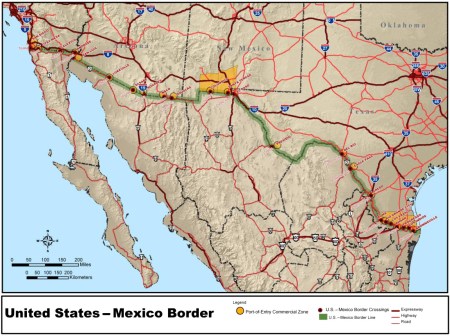
Breitbart news has received a collection of leaked documents from the Federal Bureau of Investigation that show a massive number of terrorist encounters, especially in border states.  The documents are not classified, though they are marked sensitive.  7,712 terrorist encounters occurred from July 20, 2015 and the same date a year later — last year, in short.

Some of the documents pertain to the entire U.S., while others focus specifically on the state of Arizona.  The states with the highest encounters are all border states. Texas, California, and Arizona–all states with a shared border with Mexico–rank high in encounters…. Most significantly, the map shows that many of the encounters occurred near the border outside of ports-of-entry, indicating that persons were attempting to sneak into the U.S.

Page Six shows a pie chart indicating that the majority of encounters in Arizona were with Islamic known or suspected terrorists, both Sunni and Shi’a.

That last is surprising, as one would expect drug cartels to make up the majority of such encounters.  The leak comes at a time when the FBI’s crime reporting shows an increase in violent crime across the country.

The Shiite terrorist organization Hezbollah has developed connections with the Latin American drug cartels because of its prominent role in heroin.  Iran’s Revolutionary Guards Corps (IRGC) controls the opium trade from the poppy fields in Afghanistan to the Levant, and they provide a great deal of opium to Hezbollah.  Hezbollah has a refining capacity in Lebanon that allows them to provide a substantial part of the world’s heroin.  They trade heroin to the Latin American drug cartels for other illegal money-making opportunities, forged documents, and access to the Americas.  Hezbollah’s operations produce between ten and twenty million dollars in revenue for its American operations, which are based out of a large Lebanese immigrant community in what is called the “Tri-border region,” an area between Paraguay, Brazil, and Argentina.

In addition to its money-making ventures, Hezbollah provides the cartels with military training.  As one of the world’s foremost guerrilla organizations, Hezbollah finds that its military trainers are sought after commodities.  They are able to parley those connections in order to perform operations in Mexico.  Their ability to infiltrate the United States, in order to conduct terrorist violence in service to Iran, is highlighted by these leaked FBI documents.

The role of Sunni groups is less fully understood, but it was a concern for the intelligence section of the United States military’s Southern Commandaccording to another set of leaks earlier this year.

Sunni extremists are infiltrating the United States with the help of alien smugglers in South America and are crossing U.S. borders with ease, according to a U.S. South Command intelligence report.  The Command’s J-2 intelligence directorate reported recently in internal channels that “special interest aliens” are working with a known alien smuggling network in Latin America to reach the United States….  Army Col. Lisa A. Garcia, a Southcom spokeswoman, did not address the intelligence report directly but said Sunni terrorist infiltration is a security concern.

“Networks that specialize in smuggling individuals from regions of terrorist concern, mainly from the Afghanistan-Pakistan region, the Middle East, and East Africa, are indeed a concern for Southcom and other interagency security partners who support our country’s national security,” Garcia told theWashington Free Beacon….  “In 2015, we saw a total of 331,000 migrants enter the southwestern border between the U.S. and Mexico, of that we estimate more than 30,000 of those were from countries of terrorist concern,” she said….

[T]he Southcom intelligence report revealed that the threat of Islamist terror infiltration is no longer theoretical. “This makes the case for Trump’s wall,” said one American security official of the Southcom report. “These guys are doing whatever they want to get in the country.”

Here at CounterJihad, we reported on Southern Command’s commander, Admiral Kurt Tidd, and his testimony before Congress on the threat.  Tidd reported that a number of terrorists were transiting the region who had gone to Syria and fought for the Islamic State (ISIS) and other radical groups.  Their ability to return to Latin America was smooth, given that they actually had legal travel documents.

Whether they can then pass into the United States is an open question.  The leaked FBI documents only talk about actual law enforcement encounters with people on terrorist lists.  How many are infiltrating without encountering law enforcement?

Hizballah units regroup on Israel’s Golan border

September 7, 2016

Hizballah units regroup on Israel’s Golan border, DEBKAfile, September 7, 2016

qunetrafront

DEBKAfile’s military sources note that the Iranian media attached photos of Israel’s security force opposite Quneitra to their reporting on the new move, thereby framing the target of the Syrian-Iranian-Backed Hizballah build-

***********************

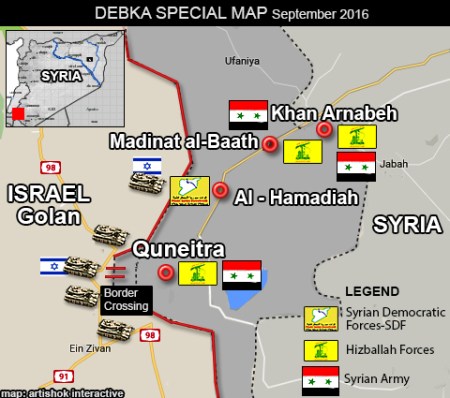
A large Hizballah force, backed by the Syrian army and pro-Iranian Shiite militias, is building up outside Quneitra, just 2km from Israel’s Golan border. The Lebanese Shiite fighters, under the command of Iranian Revolutionary Guards (IRGC) officers, are streaming into southern Syria, armed with tanks and artillery.

Monday night, Sept. 5, Iranian state-controlled media shed light on this movement, reporting that the combined force had “completed preparations necessary for an extensive operation in southern Syria,” adding, “Hizballah aims to put an end to the presence of armed men in the area close to the border.”

The nature of the “armed men” was not specified, but the goal of the new operation was clear: after evicting the assorted anti-Assad groups, including the Islamic State, holding territory “close to the border,” Hizballah and its backers planned to regroup on the Syrian-Israeli boundary.

This would position Iran and its Hizballah surrogate ready to realize their six-year old design, which is to open a second warfront against Israel.

Western and Mid East sources have toldl DEBKAfile that the triple army is in high spirits after last week’s successful operation in Aleppo. By snatching back parts of the city they lost in mid-August, the Syrian army and its allies managed to cut off the rebels’ supply lines from Turkey.

It was then that some Hizballah units were detached from the Aleppo arena and redirected to the Quneitra front in southern Syria to face the Israeli border.

israeliborder480

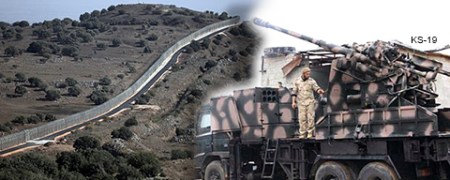
Those sources report that the incoming troops were sighted this week when they arrived at Madinat al-Baath and Khan Amabeh, the main Syrian army bases on the Syrian Golan. They came with tanks and heavy artillery. Seen for the first time in the Quentra sector were heavy, self-propelled KS-19 artillery batteries, which are Russian anti-air guns adapted to ground warfare. They have a range of 21km and a firing capacity of 15 shells per minute.

The newly-arrived Hizballah force appears to have set the capture of Syrian rebel-held al-Hamdiniyah 2km from the Israeli border, as its first objective.

DEBKAfile’s military sources note that the Iranian media attached photos of Israel’s security force opposite Quneitra to their reporting on the new move, thereby framing the target of the Syrian-Iranian-Backed Hizballah build-up.

This fast-approaching development poses two tough questions:

1. Will Israel lie down for the avowedly hostile Hizballah and Iran to occupy territory along its eastern border?Israel officials have repeatedly emphasized that these forces would not be allowed to take up positions on the Golan border, a message Russia most certainly passed on to Damascus.

If Hizballah and its allies go through with their planned offensive, Israel will have to consider serious military action to prevent them from reaching the border fence, i.e., an operation on a scale quite different from the small-shot IDF reprisals for rockets or shells straying across into the Golan from fighting on the other side.

2. Will the advancing Iranian-led force have Syrian air cover? If it does, the Israeli Air Force will also be involved in aerial combat over the Golan.

Putin-Erdogan deal deadlocks Aleppo, Manjib frays

August 13, 2016

Putin-Erdogan deal deadlocks Aleppo, Manjib frays. DEBKAfile, August 13, 2016

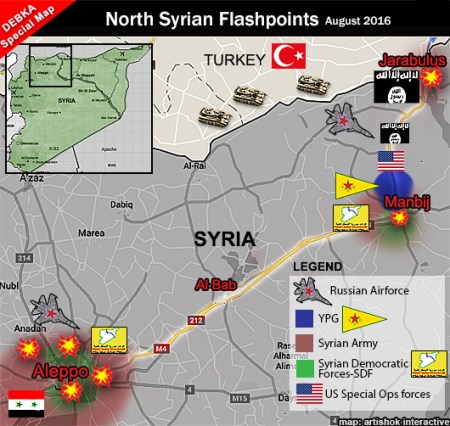
n syria flashpoints

This hopeless standoff is the result of Moscow’s refusal to provide the Syrian army and its allies with enough air support to pull ahead, in the wake of President Vladimir Putin talks with Turkish President Reccep Tayyip Erdogan in St. Petersburg Tuesday, Aug. 9.

*********************

All day Friday and Saturday, Aug.11-12, fighters of Hizballah’s elite Radwan Force – 3,000 in all – streamed to the pivotal Aleppo battlefield from all parts of Lebanon and Syria. DEBKAfile’s military and intelligence sources disclose that they were following the orders of their leader Hassan Nasrallah, who was warned by Tehran that the pro-Assad army fighting for Syria’s second city was flagging in the face of rebel assaults.

The Radwan Force was called in as the only military capable of saving the day for Assad and his allies. This step had been carefully avoided by Nasrallah was required in view of the heavy losses his organization had already suffered for backing the Syrian army – some 1,500 dead in three years – and intense fallout at home.

He has now been forced to sacrifice his last remaining military asset to fight in one of the bloodiest battles ever fought in recent times in the Middle East, even though it promises a swelling procession of Hizballah coffins returning to Lebanon.

According to our military sources, the battle to wrest Aleppo from rebel control, now in its second month, has claimed some 2,000 war dead and 4,000 injured on both sides – not counting the masses of civilians.

Some units have lost more than a quarter of their combatants and dropped out.

Nasrallah knows exactly what is happening in this critical arena. He also understands that a unit which loses 30 percent of its combatants is deemed in military terms unfit to continue fighting and that the battle for Aleppo will be drawn out and bloody. Yet he is willing to commit his entire deck of military resources to keep Bashar Assad’s fighting in Aleppo.

There is no hope of an early resolution in Aleppo, because stalemate between the combatants is exceptionally complicated and thankless. Whenever one side captures terrain, it quickly discovers it was drawn into a trap and under siege.

This hopeless standoff is the result of Moscow’s refusal to provide the Syrian army and its allies with enough air support to pull ahead, in the wake of President Vladimir Putin talks with Turkish President Reccep Tayyip Erdogan in St. Petersburg Tuesday, Aug. 9.

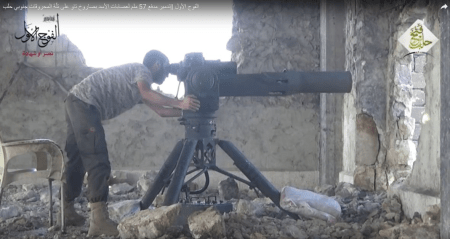
Aleppo_Rebels_ATGM-firings

Erdogan explained that if Assad’s army, along with Hizballah and Iran, defeated the Turkish-backed rebel forces holding Aleppo, he would suffer a serious knock to his prestige and setback for Syrian policy. This was more than he could sustain in the troubled atmosphere in Turkey in the wake of the failed coup against him.

He therefore asked the Russian president to abandon his Bashar Assad, Iran and Hizballah to their fate in Aleppo.

Erdogan was backed up in his request to Putin by a large Turkish military and intelligence delegation which arrived in St. Petersburg the next day to work with their Russian counterparts on setting up a joint military control center in Turkey.

DEBKAfile’s sources disclose the first two tasks assigned the new war room:

1. Russian aerial bombardments over Aleppo would not go beyond keeping the rebels from defeating Syrian and allied forces in Aleppo, but would refrain from supporting offensive action by the latter for routing the former.

2. Turkish air and ground forces would remain in a state of preparedness to ensure that rebel Syrian Democratic Forces (SDF) and the Kurdish YPG militia never moved out of the town of Manjib, from most parts of which they ousted ISIS, to the town of Jarabulus on the Turkish border.I

ISIS had used Manjib as its primary way station for supplies from Turkey 30km to the north. (See attached map). But to drive the jihadists completely out of the Syrian-Turkish border region, the combined rebel forcesmust advance on Jarabulus and expel ISIS from there too.

However, Turkish officers in the joint command center with Russia made it clear that any Kurdish forces allowed to reach that border would come under Turkish army attack.

The Russian president complied with Erdogan’s wishes on the Manjib-Jarabulus front as well as Alepp

Officials In Lebanese, Gazan Terror Organizations Confirm: Iran Funds Our Activity

August 11, 2016

Officials In Lebanese, Gazan Terror Organizations Confirm: Iran Funds Our Activity, MEMRI, August 11, 2016

Arab media have recently published statements by officials in the Lebanese Hizbullah and the Gazan Hamas and Islamic Jihad organizations, and by their supporters, confirming what has long been known – namely that these Lebanese and Gazan terror organizations receive substantial financial and military assistance from Iran. These statements join many reports, especially in the anti-Iranian media, regarding Iran’s funding of various terrorist organizations across the Arab world. According to these reports, the assistance comes mainly from the office of Iranian Supreme Leader Ali Khamenei and from the Islamic Revolutionary Guards Corps (IRGC).

The following are some examples of these statements and reports from the last two months:

Hizbullah Secretary-General Nasrallah: Hizbullah’s Entire Budget Is Provided By Iran

In a speech he delivered on June 24, 2016, marking 40 days after the killing of Mustafa Badr Al-Din, who was considered to be Hizbullah’s chief operations officer, and following the imposition of U.S. sanctions on Hizbullah that threaten its financial infrastructure and income, Hizbullah Secretary-General Hassan Nasrallah clarified: “Hizbullah’s budget – its salaries and expenditures, [the money that pays for] its food and drink, weapons and missiles – [all come from] Iran. Is that clear?… As long as Iran has money we have money. Do you require greater transparency than that[?] The funds earmarked for us do not reach us through the banks. We receive them the same way we receive our missiles, with which we threaten Israel.”[1]

Hamas Official Abu Marzouq: Iran’s Assistance To Hamas Is “Not Comparable” To Any Other Assistance

The deputy head of Hamas’s political bureau, Moussa Abu Marzouq, tweeted on June 15, 2016: “The aid extended by Iran to the Palestinian resistance, in provisions, training and funds, is not comparable [to any other aid], and most other countries cannot match it.”[2]

29502Abu Marzouq’s tweet

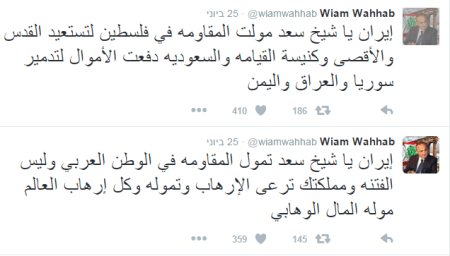
Former Lebanese Minister Wiam Wahhab: Iran Has Funded Resistance In Palestine

On June 25, 2016, in response to a remark by former Lebanese prime minister Sa’d Al-Hariri that Iran funds fitna(internecine strife) in the Arab world,[3] former Lebanese minister Wiam Wahhab, a known supporter of Hizbullah and the resistance axis, tweeted: “O Sheikh Sa’d [Al-Hariri], Iran has funded resistance in Palestine to restore Jerusalem, Al-Aqsa and the Church of the Sepulcher [to Palestinian hands, whereas] Saudi Arabia paid to destroy Syria, Iraq and Yemen.” In another tweet he wrote: ” O Sheikh Sa’d, Iran funded resistance in the Arab homeland rather than fitna, [whereas] your kingdom [Saudi Arabia, who supports Al-Hariri and his faction in Lebanon,] sponsors and funds terrorism. The funds of all the terrorist [organizations] in the world are Wahhabi [i.e., Saudi] funds.”[4]

29503Wiam Wahhab’s tweets

Saudi Daily Al-Sharq Al-Awsat: Hizbullah’s Weapons Come Directly From IRGC; Iran Has Renewed Regular Aid To Islamic Jihad Organization

The anti-Iranian press, such as the London-based Saudi daily Al-Sharq Al-Awsat, also reported on Iran’s funding of terrorist organizations in Lebanon and Gaza. On June 29, 2016, Al-Sharq Al-Awsat confirmed Nasrallah’s statements regarding the Iranian funding. The report stated that Hizbullah’s funds came from the office of Iranian Supreme Leader Ali Khamenei while its weapons are provided by the IRGC. It quoted the director of the Umam Research and Documentation center in Lebanon, Luqman Salim, a Shi’ite known for his opposition to Hizbullah, as saying that between 70% and 80% of Hizbullah’s funds come from Iran. According to Salim, Iran also invests about $400 million of the IRGC’s budget in the Islamic Radio and Television Union, a group of stations which includes the Iranian Al-Alam but also Hizbullah’s Al-Manar and Al-Mayadin and the Hamas-affiliated Al-Quds (all of which broadcast from Lebanon) and Hamas’s Al-Aqsa station, which broadcasts from Gaza.

The daily also cited a “knowledgeable source” as saying that until 2005 Iran transferred to Hizbullah between $200 million and $250 million annually, but since then the allocation has increased: After the 2006 Lebanon War it rose to $850 million, and since Hizbullah entered the Syria war its budget has become unlimited, because it has become part of Tehran’s war effort there.[5]

On May 25, 2016, the daily reported, citing sources close to the Islamic Jihad organization in Gaza, that Iran had renewed its regular financial aid to the organization after the two sides agreed to renew their mutual relations.[6] According to these sources, an Islamic Jihad delegation headed by the organization’s secretary-general Ramadan Shalah visited Iran in April 2016, and during this visit Tehran renewed its sponsorship of the organization after the latter accepted its terms. In meetings held by the delegation during this visit, including with IRGC commander Mohammad Ali Jafari and Qods Force commander Qassem Soleimani, Iran clarified its vision of Islamic Jihad’s course in the coming years. The sources claimed further that Soleimani decided, in coordination with the organization’s military and political bureaus, to grant $70 million a year out of the IRGC budget to Islamic Jihad’s military wing, Saraya Al-Quds, and to reorganize this body and appoint Khaled Mansour, who is close to Tehran, as its commander.[7]

Endnotes:

[1] Alahednews.com.lb, June 24, 2016.

[2] Twitter.com/mosa_abumarzook, June 15, 2016.

[3] Al-Mustaqbal (Lebanon), June 26, 2016; Al-Hariri’s remark was a response to Nasrallah’s  statement one day earlier that Hizbullah’s entire budget comes from Iran.

[4] Twitter.com/wiamwahhab, June 25, 2016.

[5] Al-Sharq Al-Awsat (Lebanon), June 29, 2016.

[6] Reports in the Arab media in the passing year indicated that Iran had suspended its assistance to Islamic Jihad following disagreements between them on the crisis in Yemen. According to these reports, the Islamic Jihad refused Iran’s demand to declare its opposition to the Arab Coalition’s activities in Yemen. See for example Aljazeera.net, May 26, 2016, Janoubia.com, April 3, 2016.

[7] Al-Sharq Al-Awsat (London), May 25, 2016.

Aleppo battle seesaws: pro-Assad siege in place

August 8, 2016

Aleppo battle seesaws: pro-Assad siege in place, DEBKAfile, August 8, 2016

(Please see also, Jihadists and other rebels claim to have broken through siege of Aleppo. — DM)

Aleppo_A_6.8._2016

The battle for Aleppo was locked in a draw Monday, Aug. 8 – contrary to the claims of Syrian rebel forces to have broken through the weeks-long government siege on the city and seized key positions from Assad’s army and its allies, Hizballah and pro-Iranian Shiite militias.

DEBKAfile’s military sources report that the rebels had not yet secured control of the roads linking western and eastern Aleppo. Neither was there any sign of the heavy Russian air strikes claimed by the rebels Sunday afternoon to have been launched in an effort to halt their advance.

According to our sources, intensive air strikes are indeed being conducted in the Aleppo theater – but only by the Syrian air force. There is no Russian presence in the skies over city. Their air force is active in the last few days in only one arena, Idlib in northern Syria. Its absence accounts for the Syrian rebel militias’ partial gains in the battle for Aleppo, and the Pro-Assad forces’ difficulties in holding them back.

Had the Russians provided solid air support for the Syrian army and its allies, our military analysts assert that the rebels would have been pushed back.

It is being withheld, according to our intelligence sources, because Moscow wishes to keep the door ajar for dialogue to continue with the Obama administration. The Russians are interested in particular in setting up with the Americans a joint military and intelligence coordination mechanism in Syria for fighting Islamist forces.

the division of tasks is conceived in Moscow, the Americans would provide intelligence for the Russian air force to undertake the bombardment of targets to be marked by US intelligence.

An agreement in principle on this deal would necessitate direct communication lines to operate between their two active war rooms for Syria: the US-Jordanian and Russian-Jordanian joint command centers operating in Amman.

Kremlin fears that Russian aerial intervention in the Aleppo fighting would put paid to the talks with Washington on this broad collaboration.

So long as those talks are underway,, neither the Russians nor the Americans are likely to step in to determine the military situation in the battle for Aleppo – which was once Syria’s commercial center. The fighting will  continue to seesaw inconclusively between the warning sides.

Israeli-Saudi Ties Warming; Hizballah and Iran Livid

August 8, 2016

Israeli-Saudi Ties Warming; Hizballah and Iran Livid, PJ MediaP. David Hornik, August 7, 2016

netImage Courtesy of Shutterstock

As Khamenei tweeted on Monday: “Revelation of Saudi government’s relations with Zionist regime was stab in the back of Islamic Ummah.”

************************

The Israeli society that I encountered embraces a culture of peace, has accomplishments it wants to (protect), wants coexistence, and wants peace.

Those words weren’t spoken by an enthused congressman after a trip to Israel. They were spoken to BBC Arabic by Abd al-Mujid al-Hakim, director of the Middle East Center for Strategic and Legal Policy in Jedda, Saudi Arabia, and a member of a Saudi delegation that recently visited Israel.

The delegation, which included academics and businessmen, was led by Dr. Anwar Eshki, a retired Saudi general and former top adviser to the Saudi government. About a year earlier Eshki had shaken hands and shared a stage in Washington with Israeli Foreign Ministry director-general Dore Gold—seen as a major breakthrough at the time. But a public visit to Israel of this kind, which could only have been carried out with the approval of the highest level of the Saudi government, is a historical first and still has a taste of the surreal to it.

During the visit Eshki met again with Gold; with Maj.-Gen. Yoav Mordechai, responsible for Israeli administration of the territories; with Palestinian officials in Ramallah; and with opposition Members of Knesset.

One of those opposition MKs, Issawi Frej of the far-left, mostly Jewish Meretz Party, said:

The Saudis want to open up to Israel. It’s a strategic move for them. They want to continue what former Egyptian president Anwar Sadat started (with the 1979 Israeli-Egyptian peace treaty). They want to get closer with Israel, and we could feel it clearly.

What’s going on?

Israeli commentator Yossi Melman, while noting that the visit marks a new plateau in the increasingly overt Israeli-Saudi ties, points out:

[O]n a covert level, according to foreign reports, the ties being cultivated are even more fascinating. Intelligence Online reported that Israel is selling intelligence equipment, as well as control and command centers, to the Saudi security forces. Previously, it had been reported in the foreign media that the heads of the Mossad, the organization responsible for Israel’s covert ties, met with their Saudi counterparts. Media outlets affiliated with Hezbollah even reported that officers from the two countries’ armies had met.

What’s going on, in other words, is that Israel and Saudi Arabia have common enemies in the region, and with American power withdrawing, Israel’s power constantly growing, ISIS threatening, and the Obama administration having paved a path to nuclear weapons for Iran, the Saudis—like Egypt, Jordan, and other Sunni states—are casting their troubled gaze toward Jerusalem.

Or as Melman puts it:

Israel and the Saudis share a fear for Iran’s nuclear program and Tehran’s efforts to increase its influence in the region. They also both have an interest in weakening the standing of Hezbollah, “the forward headquarters” of Iran on Lebanon’s Mediterranean coast. Prime Minister Benjamin Netanyahu speaks often of Israel’s ties with the “Sunni Bloc,” and hints that the Saudis are included in this group.

It appears that he need hint no more.

Last week’s Saudi visit to Jerusalem—a dramatic, even stunning confirmation of Israel’s cooperation with that bloc—did not go unnoticed, of course, by the rival Shiite bloc. And they’re not happy about it.

Hizballah chief Hassan Nasrallah accused the Saudis of “normalizing for free, without receiving anything in return…. It seems the future of Palestine and the fate of its children have become a trivial matter for some Arab states recently.”

The Saudi visit, he said, “couldn’t have taken place without the agreement of the Saudi government. We know how things work there. In Saudi Arabia a person will be lashed for so much as tweeting.”

But if Nasrallah is not pleased with this development, his boss—Iranian supreme leader Ayatollah Khamenei—is even less thrilled.

As Khamenei tweeted on Monday: “Revelation of Saudi government’s relations with Zionist regime was stab in the back of Islamic Ummah.”

None of this means that the Sunni Arab part of the Ummah is ready to warmly embrace Israel. While in Israel last week, Dr. Eshki—like Egyptian and Jordanian officials before him—said that real “normalization” would have to await a resolution of the Palestinian issue. It’s code for: “We’re not really ready to accept a Jewish state in our midst.”

Still, considering that Israel and Sunni Arab states used to fight wars every few years, a reality of nonbelligerency and pragmatic ties is a major improvement for Israel. Whoever is the next U.S. president might want to cooperate with the Israeli-Sunni alliance against Iran instead of giving the mullahs a “sunset clause” leading to nuclear night.

Has the IDF hit the Basij forces commander General Naghdi?

July 30, 2016

Has the IDF hit the Basij forces commander General Naghdi? DEBKAfile, July 30, 2016

EinZivan2 (1)

Gen. Naghdi’s visit to Quneitra undoubtedly presaged some decisions in Tehran with regard to direct Hizballah-Syrian-Iranian action against Israel.

The Iranian, Syrian and Hizballah agencies accuse Israel of the attack because the say it was executed by two Nimrod anti-tank long-range missiles, manufactured by the Israeli Aerospace Industry, for use by the IDF against armored vehicles, ships, bunkers and troop concentrations.

*****************

Iranian, Syrian and Hizballah sources are intimating that the “Syrian officer” injured on July 26 in Quneitra by Israel’s double Nimrod’ missile shot was none other than Revolutionary Guards Gen. Muhammad Resa Naghdi, head of the paramilitary Organization for the Mobilization of the Oppressed, also known as the Basij, which falls under the Islamic Revolutionary Guard Corps (IRGC). The victim was earlier described officially as a Syrian officer.

If he was indeed hurt or killed by an Israeli rocket, Naghdi would become the highest-ranking IRGC general ever hit by the IDF.

On July 27, the semi-official Fars news agency reported that a top Iranian general recently visited the Israeli-Syrian border to tour Quneitra and the Golan demarcation lines between Syria and Israel – the first time the Tehran government had publicized a visit by a senior regime official to the area.

It may be presumed, DEBKAfile’s intelligence sources say, that someone at the IDF lookout posts spotted and reported on Gen. Naghdi’s arrival with an entourage in Quneitra on July 26 and saw him inspecting through binoculars the IDF defense positions. He was then quickly identified.

Any decision to go after a high-ranking Iranian would not have been left to local IDF commanders or even OC Northern Command Maj. Gen. Aviv Kohavi, but passed straight to Prime Minister Binyamin Netanyahu, Defense Minister Avigdor Lieberman and Chief of Staff Lt. Gen. Gady Eisenkot – especially in this case.

General Naghdi is not just another Iranian general. He heads the more than a million-strong Basij militia, which is a pillar of the ayatollahs regime in Tehran, and the backbone of the Iranian internal security forces which maintain the regime’s total control in every corner of the Islamic Republic.

Gen. Naghdi’s visit to Quneitra undoubtedly presaged some decisions in Tehran with regard to direct Hizballah-Syrian-Iranian action against Israel.

The IDF is holding its silence on reports of his injury, declining as usual to comment on reports by foreign publications.

The Iranian, Syrian and Hizballah agencies accuse Israel of the attack because the say it was executed by two Nimrod anti-tank long-range missiles, manufactured by the Israeli Aerospace Industry, for use by the IDF against armored vehicles, ships, bunkers and troop concentrations..

The missile has a semi-active laser guidance system, and is able to operate day and night. Its flight path can be below the clouds, while its operators far behind use a laser to guide it to target.

The launcher platform, with four missiles, can be installed on a Jeep, weapon-bearing vehicle, Abir, or armored vehicles. In addition, it is possible to send it from CH-53 ‘Yasur’ helicopter.

Israel has acted in the past against the establishment of an Iranian and/or Hizballah military presence on its Golan doorstep. On Jan. 19, 2015, an IDF air strike killed the Iranian Brig. Gen, Mohammad Ali Allahdadi and six Hizballah officers while they were on a tour of inspection near Quneitra.

Thursday, July 28, DEBKAfile ran an exclusive report on rising Israel-Russia tensions centering on southern Syria and the Golan.

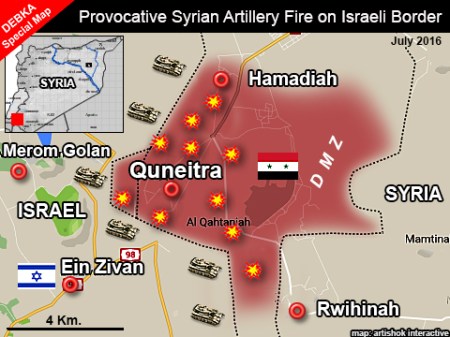
For four days since July 25, the Syrian army has been continuously firing artillery batteries – moved close to Israel’s defense lines on the Golan border – in a manner that comes dangerously close to provoking an Israeli response. This carefully orchestrated Syrian campaign goes on around the clock.

It is the first time in the six years of the Syrian war that Bashar Assad has ventured to come near to provoking Israel. But now he appears to be emboldened by his Russian ally.

The IDF is holding its fire for the moment. But Israeli military and government leaders know that the time is near for the IDF to be forced to hit back, especially since it is becoming evident that the Syrian army’s steps ae backed by Russia.

DEBKAfile’s military sources provide details of the Syrian steps:

  • The Syrian army’s 90th and 121nd battalions have been firing their artillery batteries non-stop across a 10km band along the Golan border from Hamadia, north of Quneitra, up to a point facing the Israeli village of Eyn Zivan. (See attacked map).
    This means that the Syrian army has seized the center of buffer zone between Israel and Syria and made it a firing zone.
  • This artillery fire fans out across a radius that comes a few meters short of the Israeli border and the IDF troops stationed there. It then recedes to a distance of 500 to 600 meters and sweeps across the outposts and bases of the Syrian rebel forces believed to be in touch with Israel or in receipt of Israeli medical aid.
  • The new Syrian attack appears to hold a message for Jerusalem: For six years, you supported the rebels against the Assad regime in southern Syria. That’s now over. If you continue, you will come face to face with Syrian fire.
  • Damascus is also cautioning those rebels:  For years, you fought us with Israel at your backs. But no longer. Watch us bring you under direct artillery fire, while the IDF sits on its hands.
  • On July 26, Russian media published an article revealing that Russia had delivered to the Syrian Air Force, advanced SU-24M2 front-line bombers, which is designed for attack on frontlines of battle. Israeli officials were unpleasantly taken aback by the news. Up until now, the Russians and Syrians refrained from deploying air strength in South Syria near the Israeli border. Now the Syrian air force has the means to do so.
  • DEBKAfile military sources report that the SU-24M2, following recent upgrades and modifications in Russian factories, is now capable of dropping smart bombs – ballistic bombs with a guidance system on their tails that enable them to hit targets with precision.This guidance system does not rely on US GPS satellites but rather the equivalent Russian GLONASS system which is linked to a network of 21 Russian satellites and partially encrypted for military usages.
    In addition, the SU-24M2 is equipped with a system that projects the information the pilot needs (flight details and battle details) on the plane’s windshield (head-up display) and on the pilot’s visor.
  • The Russians delivered to the Syrians two of these sophisticated airplanes this week, out of 10 that they will supply soon.

The IDF has concluded that it is only a matter of time before these planes appear in Southern Syria and so generate a new and highly combustible situation on Israel’s northern and northeastern borders.

The Russians are colluding with Damascus to inform Israel that it will no longer be allowed by either to continue backing the rebel forces in southern Syria or sustain the buffer zone which they man.

Israel may pay dear if Prime Minister Binyamin Netanyahu, Defense Minister Avigdor Lieberman, and Chief of Staff Lt. Gen. Gadi Eisenkot decide to continue to abstain from hitting back at the Syrian fire which is aimed every few hours at the vicinity of IDF posts or the impending arrival of Russian bombers. The price in store would be the weakening of the IDF’s hold on the Golan border.

Not Just the Saudis: Iran’s Huge Role in 9/11 Also Covered Up

July 19, 2016

Not Just the Saudis: Iran’s Huge Role in 9/11 Also Covered Up, PJ MediaRobert Spencer, July 19, 2016

Iran and Saudi

“Satan in Flames” was the Iranian’s elaborate plot to hijack three passenger jets, each packed full of people, and crash them into American landmarks: the World Trade Center, which jihadis took to be the center of American commerce; the Pentagon, the center of America’s military apparatus; and the White House.

*************************

The 28-page section of the 9/11 report detailing Saudi involvement in the terror attack has finally been released (although with substantial portions still redacted). We now know why one president who held hands with the Saudi King and another president who bowed to him worked so hard all these years to keep these pages secret. The 28 pages confirm that the 9/11 jihad murderers received significant help from people at the highest levels of the Saudi government.

However, Saudi involvement in 9/11 was not the only subject of a cover-up: Iran’s little-noted role in 9/11 has been covered up as well.

As I detail in my new book The Complete Infidel’s Guide to Iran, on December 22, 2011, U.S. District Judge George B. Daniels ruled in Havlish, et al. v. bin Laden, et al., that Iran and Hizballah were liable for damages to be paid to relatives of the victims of the September 11, 2001 jihad attacks in New York and Washington.

Judge Daniels found that both the Islamic Republic and its Lebanese proxy had actively aided al-Qaeda in planning and executing those attacks. He found that Iran and Hizballah had cooperated and collaborated with al-Qaeda before 9/11, and continued to do so after the attacks.

Before 9/11, Iran and Hizballah were implicated in efforts to train al-Qaeda members to blow up large buildings. This training resulted in the bombing of the Khobar Towers in Saudi Arabia in 1996, the bombing of the U.S. embassies in Kenya and Tanzania in 1998, and the attack on the USS Cole in 2000.

Shortly after the Cole attack, the 9/11 jihad plot began to come together — and Iran was involved.

Former MOIS operative Abolghasem Mesbahi, a defector from Iran, testified that during the summer of 2001 he received messages from Iranian government officials regarding a plan for unconventional warfare against the United States. The plot was entitled Shaitan dar Atash (“Satan in Flames”).

“Satan in Flames” was the Iranian’s elaborate plot to hijack three passenger jets, each packed full of people, and crash them into American landmarks: the World Trade Center, which jihadis took to be the center of American commerce; the Pentagon, the center of America’s military apparatus; and the White House.

A classified National Security Agency analysis referred to in the 9/11 Commission report reveals that eight to 10 of the 9/11 hijackers traveled to Iran repeatedly in late 2000 and early 2001.

The 9/11 Commission called for a U.S. government investigation into Iran’s role in 9/11 — but none was ever undertaken.

So Kenneth R. Timmerman of the Foundation for Democracy in Iran was, in his words, “engaged by the Havlish attorneys in 2004 to carry out the investigation the 9/11 Commission report called on the U.S. government to handle.”

Timmerman noted that during the 9/11 hijackers’ trips to Iran, they were “accompanied by ‘senior Hezbollah operatives’ who were in fact agents of the Iranian regime.” Iranian border agents did not stamp their passports so that their having been inside the Islamic Republic would not arouse suspicion when they entered the United States. The CIA, embarrassed by its failure to recognize the import of these trips, tried to suppress this revelation.

However, Timmerman contends that even the available evidence is explosive enough. In his words, he reveals that the Islamic Republic of Iran:

  • Helped design the 9/11 plot
  • Provided intelligence support to identify and train the operatives who carried it out
  • Allowed the future hijackers to evade U.S. and Pakistani surveillance on key trips to Afghanistan — where they received the final order of mission from Osama bin Laden — by escorting them through Iranian borders without passport stamps
  • Evacuated hundreds of top al-Qaeda operatives from Afghanistan to Iran after 9/11 just as U.S. forces launched their offensive
  • Provided safe haven and continued financial support to al-Qaeda cadres for years after 9/11
  • Allowed al-Qaeda to use Iran as an operational base for additional terror attacks, in particular the May 2003 bombings in Riyadh, Saudi Arabia

The Ayatollah Khamenei knew about the plot. During the summer of 2001, he instructed Iranian agents to be careful to conceal their tracks. He told them to communicate only with al-Qaeda’s second-in-command — Ayman al-Zawahiri — and Imad Mughniyah of Hizballah.

Mughniyah was Iran’s key player in the 9/11 “Satan in Flames” plot. During the Havlish trial, former CIA agents Clare M. Lopez and Bruce D. Tefft submitted an affidavit stating:

Imad Mughniyah, the most notable and notorious world terrorist of his time, an agent of Iran and a senior operative of Hizballah, facilitated the international travel of certain 9/11 hijackers to and from Iran, Lebanon, Saudi Arabia, and Afghanistan, and perhaps various other locations for the purpose of executing the events of September 11, 2001.This support enabled two vital aspects of the September 11, 2001 plot to succeed: (1) the continued training of the hijackers in Afghanistan and Iran after securing their United States visas in Saudi Arabia, and (2) entry into the United States.

The Obama-era CIA went to great pains to try to ensure that information about Iran’s role in 9/11 did not come out in the Havlish case.

In August 2010, a CIA official pressured a Havlish witness to withdraw his testimony in exchange for a new identity, new passport, and new job.

In December of that year, another CIA operative approached a different Havlish witness, showed him documents stolen from the case, and took him to a U.S. embassy where he was subjected to five hours of interrogation. He was finally offered cash if he recanted his testimony. Says Timmerman:

After I reported those attempts at witness tampering to a Congressional oversight committee, they ceased.

Judge Daniels determined that Iran, Hizballah, the Islamic Revolutionary Guard Corps, the Iranian Ministry of Intelligence and Security, and other Iranian government departments — as well as the Ayatollah Khamenei himself and former Iranian president Ali Akbar Hashemi Rafsanjani — were all directly implicated in Iranian efforts to aid al-Qaeda in its 9/11 plot.

Daniels awarded the plaintiffs in the Havlish case $394,277,884 for economic damages, $94,000,000 for pain and suffering, $874,000,000 for mental anguish and grief, $4,686,235,921 in punitive damages, and $968,000,000 in pre-judgment interest for a total of $7,016,513,805.

The Havlish plaintiffs will not receive a check for that amount from the Islamic Republic of Iran neatly signed by the Ayatollah Khamenei. Still, the judgment provided a small bit of solace for the loss of life and years of trauma these families suffered as a result of the Islamic Republic’s war against the United States.

Most importantly, the judgment stands as an acknowledgment of Iran’s role in the 9/11 attacks.

Clearly, Iran is and has been at war with the United States, Over a period of many years, Iran has conducted that war on numerous unconventional fronts while threatening conventional attacks if its agenda is thwarted in any way.

For the Islamic Republic this war is very real, a principal focus of its energy and expenditures. But it appears that only one side is fighting.

This was underscored in March 2016, when it came to light that Iranian hackers who were accused of being tied to the Islamic Republic had attempted to hack into the operating system of the Bowman Avenue Dam north of New York City, as well as into financial conglomerates Bank of America, JP Morgan Chase, Citibank, and HSBC – and the New York Stock Exchange.

Said Attorney General Loretta Lynch:

These attacks were relentless, they were systematic, and they were widespread.

Such attacks, if they had been successful, could have caused catastrophic damage to New York City and the American economy. Yet true to form, the Obama administration only indicted the accused (none of whom it had in custody). He took no measures against the Iranian government.

After 9/11, the U.S. declared war on terror and entered Afghanistan and Iraq. But if Bush had really been serious about attacking jihad terror at its root, he would have invaded Saudi Arabia and Iran instead. Under Obama, the denial and willful ignorance have only gotten exponentially worse.