Archive for the ‘Gulf states’ category

The day after the deal

August 9, 2015

The day after the deal, Israel Hayom, Prof. Eyal Zisser, August 9, 2015

(Please see also, Russia and US woo Saudis to help save Assad – albeit putting Israel and Jordan in danger from S. Syria.– DM)

[Soleimani] wanted Russia and Iran to agree on the division of the Middle East in a way that would serve their clients in the region (among them, Assad) and check their joint enemies (the Islamic State). After figuring that out, they probably moved on to the next topic: how to marginalize America in the region. As a means to both ends, Russia will continue to serve as Assad’s protector (despite his many crimes), all the while providing Iran with international backing. But above all it will send arms to Iran, to the Syrian regime, and if needed, to Hezbollah.

***********************

Over the weekend it transpired that Maj. Gen. Ghasem Soleimani, the commander of Iran’s Quds Force, had visited Moscow two weeks ago and met with President Vladimir Putin. The Quds Force, in case you forgot, is in charge of the Iranian Revolutionary Guards’ clandestine operations (including terrorism). The Quds Force is responsible for providing aid to Hezbollah and Hamas as well as to Syrian President Bashar Assad and the Houthi rebels in Yemen. In light of his direct involvement in terrorism, the international community imposed sanctions on Soleimani, including travel restrictions.

Only last week, at a hearing on Capitol Hill, U.S. Secretary of State John Kerry vowed that the U.S. will make sure the sanctions on Soleimani would stay in effect and that the Obama administration would counter Iran’s efforts to destabilize the Middle East. But no one takes Kerry seriously anymore. While Kerry continues to engage Iran’s unimportant Foreign Minister Mohammad Javad Zarif, the real wheeling and dealing is actually in Moscow.

Soleimani did not go to Moscow because he had tickets to the Bolshoi. Rather, he arrived because he wanted to discuss “the day after the nuclear deal” with Putin. Namely, he wanted Russia and Iran to agree on the division of the Middle East in a way that would serve their clients in the region (among them, Assad) and check their joint enemies (the Islamic State). After figuring that out, they probably moved on to the next topic: how to marginalize America in the region. As a means to both ends, Russia will continue to serve as Assad’s protector (despite his many crimes), all the while providing Iran with international backing. But above all it will send arms to Iran, to the Syrian regime, and if needed, to Hezbollah.

The Russians, unlike the Iranians, don’t consider Israel to be an enemy state. But as a famous Russian official once said: “When you chop wood, chips fly.” Israel has become the latest chip — the collateral damage. Soleimani’s visit is just the tip of iceberg. It shed light on the not-so-secret deals that are being negotiated in the wake of the “Vienna nuclear agreement.” Europe, as usual, is focused on profit and its corporate executives are already traveling in droves to Tehran to ink deals. There are also political deals Iran wants to secure, which are as important for Tehran. Their price, however, will be measured in blood rather than in euros or dollars.

No one in the Middle East, it seems, is keen on parsing each and every provision in the nuclear deal. Nor is there an attempt to see whether, in the grand scheme of things, it is will have been a worthwhile endeavor some 10 or 15 years from now, when its key elements expire. In this region, what counts is the way this agreement is perceived here and now — and what really matters to people is the way it is portrayed in the media. Under that criteria, Iran is the victor and America is the vanquished, because it caved to Iran. The deal, according to how the media has portrayed it, is a crushing political blow to Israel and the moderate Arab states, led by Saudi Arabia.

This knockout victory will likely produce a new Iranian-American partnership. At the very least, the two nations will mend fences. This will alienate many of Washington’s clients, who will have to look elsewhere for a more reliable ally. Egypt and the Saudis have already realized this and turned to Russia for aid and arms, figuring it would be more trustworthy than the “staff of this broken reed” (Isaiah 36:6).

Saudi Arabia is reportedly sending feelers to see if there is a deal to be had with Russia and Iran. Under the terms of the proposed deal, Saudi Arabia would withhold aid to the Syrian rebels if Iran ends its rogue presence in the state. Such a deal would secure Assad a victory over the insurgents, or a least ensure his regime survives.

The ongoing developments have caused panic, but not over the rising clout of Iran and Russia. The White House, it seems, is fretting over the possibility that Congress may vote against the Iran deal and further tarnish Obama’s image.

Into the fray: Iran- Reaping the storm that Barack sowed…

July 18, 2015

Into the fray: Iran- Reaping the storm that Barack sowed…, Jerusalem PostMARTIN SHERMAN,July 16, 2015

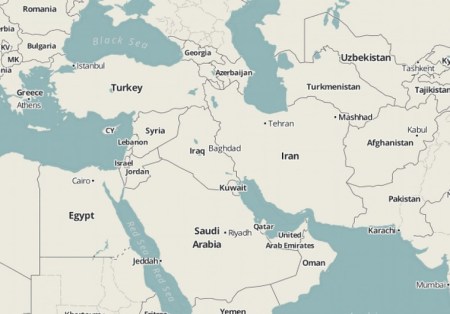
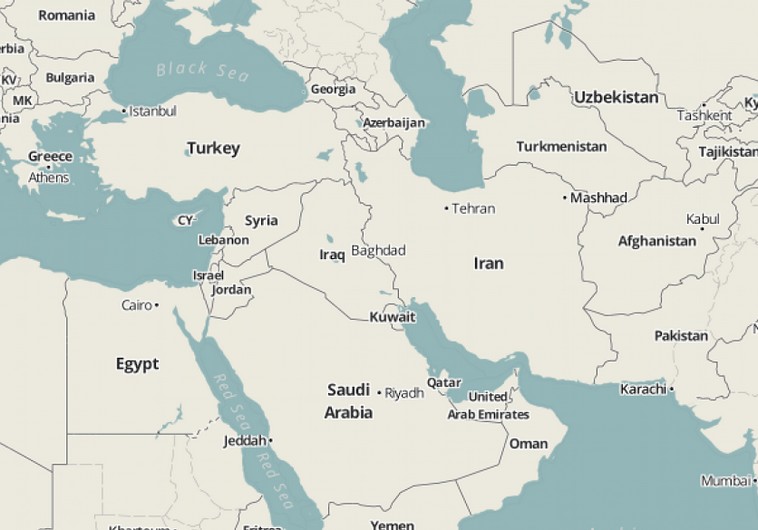
ShowImage (3)Map of Middle East. (photo credit:Courtesy)

It is through this Islamo-philic prism that the Obama administration’s attitude to, and execution of, its foreign policy must be evaluated – including its otherwise incomprehensible capitulation this week on Iran’s nuclear program.

********************

Obama is the first US president who genuinely conceives of Islam as not inherently opposed to American values or interests.

You’re absolutely right that John McCain has not talked about my Muslim faith – Barack Hussein Obama to ABC’s George Stephanopoulos, September 7, 2008

I also know that Islam has always been a part of America’s story Barack Hussein Obama, Cairo, June 4, 2009

Islam has always been part of AmericaBarack Hussein Obama, the White House, August 11, 2010

Islam has been woven into the fabric of our country since its founding Barack Hussein Obama, the White House, February 18, 2015

Barack Hussein Obama is the first US president who is explicitly and overtly unmoored, both cognitively and emotionally, from the moorings of America’s founding Judeo-Christian cultural heritage, and who genuinely conceives of Islam as not inherently opposed to American values or American interests.

A question of cultural affinity?

It is through this Islamo-philic prism that the Obama administration’s attitude to, and execution of, its foreign policy must be evaluated – including its otherwise incomprehensible capitulation this week on Iran’s nuclear program.

Almost two years ago, I wrote a column titled, “Will the West withstand the Obama presidency?” (11/28/2013). In it I warned: “For anyone who understands that the US Constitution is not a Shari’a-compliant document…

it should be alarmingly apparent that the Obama incumbency is a dramatic and disturbing point of inflection in the history of America and its Western allies… whose political practices and societal norms are rooted in Judeo-Christian foundations in a cultural rather than in any religious sense.”

There is little alternative explanation to account for the metamorphosis that has taken place in how the US has approached resolving the impasse with Tehran, as starkly laid out by two former secretaries of state, Henry Kissinger and George Shultz.

In a Wall Street Journal opinion piece, “The Iran Deal and Its Consequences” (April 7), they note that the negotiation has been turned “on its head.” As they point out: “For 20 years, three presidents of both major parties proclaimed that an Iranian nuclear weapon was contrary to American and global interests – and that they were prepared to use force to prevent it. Yet negotiations that began 12 years ago as an international effort to prevent an Iranian capability to develop a nuclear arsenal are ending with an agreement that concedes this very capability.”

Risible inspection mechanism

Even before the specifics of the risible inspection mechanism, which one Israeli minister aptly described as “worse than worthless,” Kissinger and Shultz laid out the difficulties that would render any extended inspection endeavor ineffective: “In a large country with multiple facilities and ample experience in nuclear concealment, violations will be inherently difficult to detect.”

With considerable prescience, they warn: “Devising theoretical models of inspection is one thing. Enforcing compliance, week after week, despite competing international crises and domestic distractions, is another. Any report of a violation is likely to prompt debate over its significance – or even calls for new talks with Tehran to explore the issue.

Envisaging the problems likely to arise in enforcing any agreement, they caution: “Compounding the difficulty is the unlikelihood that breakout will be a clear-cut event.

More likely it will occur… via the gradual accumulation of ambiguous evasions. When inevitable disagreements arise over the scope and intrusiveness of inspections, on what criteria are we prepared to insist and up to what point? If evidence is imperfect, who bears the burden of proof? What process will be followed to resolve the matter swiftly?”

Reminiscent of taqiya?

But even without the daunting generic difficulties described by Kissinger and Shultz, the inspection mechanism provided for in the nascent deal make a mockery of Obama’s contention (July 14): “… this deal is not built on trust; it is built on verification,” and, “Because of this deal, inspectors will also be able to access any suspicious location… [They] will have access where necessary, when necessary.”

One can hardly imagine a more grossly misleading representation of the deal – so much so that it is difficult not to find it strongly reminiscent of the Muslim tactic of taqiya (the religiously sanctioned deception of non-Muslims).

Indeed, immediately following the announcement of the agreement, Ben Rhodes, Obama’s deputy national security adviser, made a stunning admission to CNN’s Erin Burnett. Starkly contradicting the president’s contention of “access where necessary, when necessary,” Rhodes conceded, “We never sought in this negotiation the capacity for so-called anytime, anywhere,” which is diametrically opposed to the impression he conveyed in April this year when queried on this issue.

You couldn’t make this stuff up

For as it turns out, it provides the Iranians with ample warning of impending inspections on any suspected violation, and ample ability to forestall the definition of any given suspicious event as a possible violation.

Thus in the case of a suspected infringement in any undisclosed (to the international community) site, the Iranians will have at least 24 days’ notice. Moreover, inspectors will not be able to conduct surprise visits but will be required to “provide Iran the basis for such concerns and request clarification.” No kidding!!! But wait, there’s more.

If Iran’s explanations do not adequately assuage international concerns, inspectors “may request access to such locations” to make sure no illicit activity has occurred. But first they need to “provide Iran the reasons for access in writing and will make available relevant information.” You can’t make this stuff up.

But here’s the kicker: Should the Iranians and the inspectors prove unable to “reach satisfactory arrangements,” Tehran will resolve any concerns “through necessary means agreed between Iran and the IAEA.” If there is still no agreement two weeks after the initial inquiry is filed, the crisis will be resolved by vote in the so-called Joint Commission – consisting of the six world powers, a representative of EU and – wait for it – Iran.

Like warning drug dealers of a bust

Astonishingly, nearly all the decisions of the Joint Commission, tasked with overseeing/ administering the implementation of the deal, are to be made by consensus – which in effect gives Iran veto power over them. In the case of inspection access, it is sufficient for two of its eight members (say China and Russia) to abstain for Iran to block any decision it dislikes.

It is thus difficult to dispute Benjamin Netanyahu’s characterization of the deal during his address in the Knesset when he likened it to giving drug dealers notice of an impending raid: “It’s like giving a criminal organization that deals drugs a 24-day warning before inspecting its drug lab.”

But worse – the deal requires the international inspectors to expose the sources of intelligence that lead to the detection of the possible infringement – thereby virtually ensuring the termination of their effectiveness.

As Netanyahu remarked: “The agreement also requires the world powers to… show Iran the very intelligence for which they want to conduct the inspections in the first place.”

It is possible that all this could be nothing more than mind-boggling incompetence and blatant lack of foresight? Or are these glaring loopholes the reflection of intent.

Devil not in details

After all, the more you think about the unenforceable, unverifiable agreement just concocted in Vienna, the more implausible it seems. As Alan Dershowitz points out in a Jerusalem Post opinion piece this week, “The devil is not so much in the details as in the broad outlines of this deal.”

Rather than the detailed minutiae of the deal, it is its deeply flawed overall structure that makes it so difficult to comprehend – unless the motives for its conclusion are reexamined.

For unless one is imbued with the child-like naiveté to believe that the tyrannical clergy who head the totalitarian theocracy in Tehran, on seeing their defiant intransigence vindicated and having vast additional resources placed at their disposal, will suddenly change their worldview, the picture of emerging realities is decidedly bleak and bewildering.

The spectacle unfolding before us is almost incomprehensible by any rational criterion.

Virtually the entire developed world, led by the only superpower on the planet, has for all intents and purposes conceded a legitimized path to weaponized nuclear status for a fanatical fundamentalist regime, ideologically bent on the destruction of America and its allies, and a major proliferator of terrorism, committed to attaining regional hegemony at the expense of relatively pro-Western governments.

Despite dwarfing Iran in terms of military might, economic wealth, physical size and population, Tehran’s interlocutors have provided it with vast resources to enormously enhance its nefarious pursuits across the region and beyond.

The New Middle East: Conflicts on steroids

The ominous consequences are not difficult to foresee.

As Ariel Ben Solomon, the Post’s Middle East correspondent, wrote in a recent report, “Iran deal to see Middle East conflicts go on steroids,” “A stronger Iran will translate into a more robust Hezbollah in Lebanon, Houthi movement in Yemen, and Shi’ite forces in Iraq and Syria, and increasing sectarian strife fueled by Shi’ite minorities or Iranian agents throughout the Arab world.” (July 16) There is precious little reason for believing any other outcome is plausible.

In a July 15 interview, New Jersey Democrat Sen. Bob Menendez lamented another aspect of the deal, relating to easing restrictions on conventional weapons to Iran: “When you lift the arms embargo to a country that is the major sponsor of… terrorism in the world and is already destabilizing the region in Yemen, Lebanon, Syria [and] Iraq, to give them – after they are going to get $100 billion-150b. in economic relief – the opportunity to buy conventional weapons and improve their missile technology doesn’t seem to me to be in the national interest of the United States.”

The intriguing question is, of course, does this seem to President Obama to be in the national interest of the United States? And if so, why so? If so, how so?

‘No alternative’: A mindless mendacious mantra

The almost Pavlovian response of the apologists for the Iran deal is that its critics have not offered a feasible alternative. This is a claim – for want of a better word – so feeble that it barely merits a response.

As Sen. Menendez points out: “We never tested the proposition that dismantling elements of Iran’s illicit nuclear infrastructure was possible. It is pretty hard for me to believe that the world powers, sitting on one side of the table, the five permanent members of the Security Council plus Germany and the European Union looking at the Iranians… suffering under staggering sanctions… and falling oil prices couldn’t get a deal that eliminated some of that infrastructure.”

Rebutting John Kerry’s claim that such a goal was achievable only in “a world of fantasy,” Menendez retorted, “I don’t know that that is a ‘world of fantasy.’ Isn’t it possible with all the world on one side of the table, and Iran reeling with economic challenges, that you couldn’t have done better as relates to eliminating that nuclear infrastructure.”

Of course if the underlying assumption is that alternatives are only feasible if Iran deigns to accept them, then the apologists may be right. However, if the rationale were not to accommodate the ayatollahs, but to coerce them, the alternative is clear: Enhanced sanctions backed by the credible threat of military action aimed at destroying Iran’s nuclear facilities and their attendant infrastructure.

Arab arms race or Arab client states

But despite the overwhelming preponderance of power in their favor, the US and its Western allies seem to have forsworn the use of force, or even the credible specter thereof. As Kissinger and Shultz remark: “The threat of war now constrains the West more than Iran.”

This will clearly have a devastating impact on both friend and foe in the region.

It will destroy the confidence of US allies who will therefore be compelled to either acquire their own appropriate arsenals, as they can no longer rely on America for their security, or to become compliant client states of a hegemonic Iran.

For Iran it sends an equivocal message that it can violate the terms of the deal with impunity – for if what it encountered at Vienna is all the West can throw at it, what does it have to fear? There can be little doubt that what happened in Vienna this week has shredded America’s standing in the Middle East.

Some might even suspect that that was the purpose of the exercise.
Column One: Obama’s age of nuclear chaos

July 16, 2015

Column One: Obama’s age of nuclear chaos, Jerusalem Post, Caroline Glick, July 16, 2015

ShowImage (2)Iranian Foreign Minister Mohammad Javad Zarif gestures as he talks with journalist from a balcony of the Palais Coburg hotel where the Iran nuclear talks meetings are being held in Vienna, Austria. (photo credit:REUTERS)

Not only will the US and its allies remove the sanctions imposed on Iran over the past decade and so start the flow of some $150 billion to the ayatollahs’ treasury. They will help Iran develop advanced centrifuges.

They even committed themselves to protecting Iran’s nuclear facilities from attack and sabotage.

Israel still may have the ability to attack Iran’s nuclear sites. If it does, then it should attack them as quickly and effectively as possible.

*********************

On Tuesday, we moved into a new nuclear age.

In the old nuclear age, the US-led West had a system for preventing the proliferation of nuclear weapons. It had three components: sanctions, deterrence and military force. In recent years we have witnessed the successful deployment of all three.

In the aftermath of the 1991 Gulf War, the UN Security Council imposed a harsh sanctions regime on Iraq. One of its purposes was to prevent Iraq from developing nuclear weapons. After the US-led invasion of Iraq in 2003, we learned that the sanctions had been successful. Saddam largely abandoned his nuclear program due to sanctions pressure.

The US-led invasion of Iraq terrified several rogue regimes in the region. In the two to three years immediately following the invasion, America’s deterrent strength soared to unprecedented heights.

As for military force, the nuclear installation that Syrian dictator Bashar Assad built in Deir a-Zour with Iranian money and North Korean technicians wasn’t destroyed through sanctions or deterrence. According to foreign media reports, in September 2007, Israel concluded that these paths to preventing nuclear proliferation to Syria would be unsuccessful.

So then-prime minister Ehud Olmert ordered the IDF to destroy it. The outbreak of the Syrian civil war three years later has prevented Assad and his Iranian bosses from reinstating the program, to date.

The old nuclear nonproliferation regime was highly flawed.

Pakistan and North Korea exploited the post-Cold War weaknesses of its sanctions and deterrence components to develop and proliferate nuclear weapons and technologies.

Due to American weakness, neither paid a serious price for its actions.

Yet, for all its flaws and leaks, the damage caused to the nonproliferation system by American weakness toward Pakistan and North Korea is small potatoes in comparison to the destruction that Tuesday’s deal with Iran has wrought.

That deal doesn’t merely show that the US is unwilling to exact a price from states that illicitly develop nuclear weapons. The US and its allies just concluded a deal that requires them to facilitate Iran’s nuclear efforts.

Not only will the US and its allies remove the sanctions imposed on Iran over the past decade and so start the flow of some $150 billion to the ayatollahs’ treasury. They will help Iran develop advanced centrifuges.

They even committed themselves to protecting Iran’s nuclear facilities from attack and sabotage.

Under the deal, in five years, Iran will have unlimited access to the international conventional arms market. In eight years, Iran will be able to purchase and develop whatever missile systems it desires.

And in 10 years, most of the limitations on its nuclear program will be removed.

Because the deal permits Iran to develop advanced centrifuges, when the agreement ends in 10 years, Iran will be positioned to develop nuclear weapons immediately.

In other words, if Iran abides by the agreement, or isn’t punished for cheating on it, in 10 years, the greatest state sponsor of terrorism in the world will be rich, in possession of a modernized military, a ballistic missile arsenal capable of carrying nuclear warheads to any spot on earth, and the nuclear warheads themselves.

Facing this new nuclear reality, the states of the region, including Jordan, Egypt, Saudi Arabia, Turkey and perhaps the emirates, will likely begin to develop nuclear arsenals. ISIS will likely use the remnants of the Iraqi and Syrian programs to build its own nuclear program.

Right now, chances are small that Congress will torpedo Barack Obama’s deal. Obama and his backers plan to spend huge sums to block Republican efforts to convince 13 Democratic senators and 43 Democratic congressmen to vote against the deal and so achieve the requisite two-thirds majority to cancel American participation in the deal.

Despite the slim chances, opponents of the deal, including Israel, must do everything they can to convince the Democrats to vote against it in September. If Congress votes down the deal, the nuclear chaos Obama unleashed on Tuesday can be more easily reduced by his successor in the White House.

If Congress rejects the deal, then US sanctions against Iran will remain in force. Although most of the money that will flow to Iran as a result of the deal is now frozen due to multilateral sanctions, and so will be transferred to Iran regardless of congressional action, retaining US sanctions will make it easier politically and bureaucratically for Obama’s replacement to take the necessary steps to dismantle the deal.

Just as the money will flow to Iran regardless of Congress’s vote, so Iran’s path to the bomb is paved regardless of what Congress does.

Under one scenario, if Congress rejects the deal, Iran will walk away from it and intensify its nuclear activities in order to become a nuclear threshold state as quickly as possible. Since the deal has destroyed any potential international coalition against Iran’s illegal program, no one will bat a lash.

Obama will be deeply bitter if Congress rejects his “historic achievement.” He can be expected to do as little as possible to enforce the US sanctions regime against his Iranian comrades. Certainly he will take no military action against Iran’s nuclear program.

As a consequence, regardless of congressional action, Iran knows that it has a free hand to develop nuclear weapons at least until the next president is inaugurated on January 20, 2017.

The other possible outcome of a congressional rejection of the deal is that Iran will stay in the deal and the US will be the odd man out.

In a bid to tie the hands of her boss’s successor and render Congress powerless to curb his actions, the day before the deal was concluded, Obama’s UN Ambassador Samantha Power circulated a binding draft resolution to Security Council members that would prohibit member nations from taking action to harm the agreement.

If the resolution passes – and it is impossible to imagine it failing to pass – then Iran can stay in the deal, develop the bomb with international support and the US will be found in breach of a binding UN Security Council resolution.

Given that under all scenarios, Tuesday’s deal ensures that Iran will become a threshold nuclear power, it must be assumed that Iran’s neighbors will now seek their own nuclear options.

Moreover, in light of Obama’s end-run around the Congress, it is clear that regardless of congressional action, the deal has already ruined the 70-year old nonproliferation system that prevented nuclear chaos and war.

After all, now that the US has capitulated to Iran, its avowed foe and the greatest state sponsor of terrorism, who will take future American calls for sanctions against nuclear proliferators seriously? Who will be deterred by American threats that “all options are on the table” when the US has agreed to protect Iran’s nuclear installations and develop advanced centrifuges for the same ayatollahs who daily chant, “Death to America”? For Israel, the destruction of the West’s nonproliferation regime means that from here on out, we will be living in a region buzzing with nuclear activity. Until Tuesday, Israel relied on the West to deter most of its neighbors from developing nuclear weapons. And when the West failed, Israel dealt with the situation by sending in the air force. Now, on the one hand Israel has no West to rely on for sanctions or deterrence, and on the other hand, it has limited or no military options of its own against many of the actors that will now seek to develop nuclear arsenals.

Consider Israel’s situation. How could Israel take action against an Egyptian or Jordanian nuclear reactor, for instance? Both neighboring states are working with Israel to defeat jihadist forces threatening them all. And that cooperation extends to other common threats. Given these close and constructive ties, it’s hard to see how Israel could contemplate attacking them.

But on the other hand, the regimes in Amman and Cairo are under unprecedented threat.

In theory they can be toppled at any moment by jihadist forces, from the Muslim Brotherhood to ISIS. It’s already happened once in Egypt.

The same considerations apply to Saudi Arabia.

As for Turkey, its NATO membership means that if Israel were to attack Turkish nuclear sites, it would run the risk of placing itself at war not only with Turkey, but with NATO.

Given Israel’s limited military options, we will soon find ourselves living under constant nuclear threat. Under these new circumstances, Israel must invest every possible effort in developing and deploying active nuclear defenses.

One key aspect to this is missile defense systems, which Israel is already developing.

But nuclear bombs can be launched in any number of ways.

Old fashioned bombs dropped from airplanes are one option.

Artillery is another. Even suicide trucks are good for the job.

Israel needs to develop the means to defend itself against all of these delivery mechanisms. At the same time, we will need to operate in hostile countries such as Lebanon, Syria and elsewhere to destroy deliveries of nuclear materiel whether transferred by air, sea or land.

Here is the place to mention that Israel still may have the ability to attack Iran’s nuclear sites. If it does, then it should attack them as quickly and effectively as possible.

No, a successful Israeli attack cannot turn back the clock. Israel cannot replace the US as a regional superpower, dictating policy to our neighbors. But a successful attack on Iran’s nuclear program along with the adoption of a vigilantly upheld strategy of active nuclear defense can form the basis of a successful Israeli nuclear defense system.

And no, Israel shouldn’t be overly concerned with how Obama will respond to such actions.

Just as Obama’s nuclear capitulation to Iran has destroyed his influence among our Arab neighbors, so his ability to force Israel to sit on the sidelines as he gives Iran a nuclear arsenal is severely constrained.

How will he punish Israel for defying him? By signing a nuclear deal with Iran that destroys 70 years of US nonproliferation strategy, allows the Iranian regime to grow rich on sanctions relief, become a regional hegemon while expanding its support for terrorism and develop nuclear weapons? Years from now, perhaps historians will point out the irony that Obama, who loudly proclaims his goal of making the world free of nuclear weapons, has ushered in an era of mass nuclear proliferation and chaos.

Israel can ill afford the luxury of pondering irony.

One day the nuclear Furies Obama has unleashed may find their way to New York City.

But their path to America runs through Israel. We need to ready ourselves to destroy them before they cross our border.

The Iran Deal: Making War More Likely?

July 16, 2015

The Iran Deal: Making War More Likely? American ThinkerStephen Bryen and Shoshana Bryen, July 16, 2015

The deal is done. Iran has sort-of promised it won’t build nuclear weapons, but even the promise has serious caveats: Iran can continue to build weapons platforms to deliver the non-existent weapons; it can cooperate with friendly countries to acquire enhancements to weapons delivery technology; and it can prevent entry to requested facilities by international inspectors for 24 days per request; it need not account for prior military activity. And Iran will be vastly richer.

Based on the world’s experience with the efficacy of multinational inspection regimes and with Iran specifically, it would be wise to assume that the Islamic Republic will move (continue?) covertly to build nuclear warheads, perhaps just leaving out the nuclear fuel. Iran will likely begin testing rockets so that they will be able to release a future nuclear weapon securely at the right moment to get the right blast effect.

The rocket is as important as the nuclear weapon it carries.

Nuclear weapons don’t go off if they plow into the ground, because as they disintegrate they can’t achieve the necessary chain reaction; they must explode above ground at a fixed altitude

Allowing Iran to openly acquire ballistic missile technology can shorten the time from weapons acquisition to weapons use, increasing the relative nervousness of the neighbors — not a recipe for stability. Israel will have to try to interdict and disrupt Iranian ballistic missile testing on an active and overt basis. Because Israeli is not a signatory to the Iran deal, it can expect to be censured by its allies and everyone else. But Israel will have no choice.

If a nuclear weapon were to be fired at Israel, in the few minutes from launch to impact Israel could, in theory, launch its own nuclear weapons from diverse platforms including land-based intermediate range ballistic missiles (IRBMs), from F-4’s and F-15’s, and from the newer Israeli submarines. Iran would face annihilation. It potentially could mean the same for Israel, although Israel’s anti-missile system may be sufficient to block the Iranian strike. A lot will depend on how good the Iranian technology is, how well tested it is, and what Israel’s countermeasures are.

The above scenario suggests this might be the time for Israel to place whatever nuclear cards it holds on the table. Israel has long been a presumed nuclear power, including by the CIA since the 1970s, and Secretary Robert Gates said so explicitly in his confirmation hearings. But Israel’s official posture remains “nuclear ambiguity” and a vague statement that Israel would not be the first to use nuclear weapons in the region, hinting that the program was designed as a deterrent. But given that Iran is likely on its way to being a nuclear power as well, and has threatened Israel specifically and directly with annihilation, Israel’s deterrence may well be enhanced by a less ambiguous posture.

While the first of the deal’s unintended consequences is that it forces Israel to officially become a nuclear power, there are others.

The deal increases the chances of direct conventional warfare between Israel and an emboldened and wealthier Iran. It may come as a consequence of Israel’s “interdict and defeat” effort in Syria; too many Iranian missiles in the hands of Hizb’allah; the deployment of Iranian troops in Syria threatening Israel; a firefight in the Golan or southern Lebanon; or conflict on the high seas. The list is a long one.

And Israel is not the only country that views Iran with alarm. Egypt and Saudi Arabia will urgently step up their search for nuclear capability. Egypt has gone down this road before and the Saudis have been leaning on Pakistan for a bomb.  Neither Egypt nor Saudi Arabia is inherently stable, and instability runs different scenarios. Saudi Arabia has IRBM delivery systems and F-15s that can be used to deliver a nuclear weapon. Egypt does not presently have the rockets, but it has a good nuclear science base that it gained in cooperation with different international partners. How viable its nuclear science pool is today is unclear; but in the 1980s Egypt was working with Iraq on the creation of plutonium fuel for weapons (at the Osirak reactor, among other locales) and was partnered with Argentina and perhaps others in building a version of the American Pershing II mobile nuclear missile. It is not unreasonable to think these programs or variants of them will in some way be revived.

The U.S. administration may think the Sunni Arab states have nowhere to turn for technology, but that would be wrong. Russia, for example, and China are more than capable under the right circumstances of cynically supporting both sides in the region — greatly enhancing the chances of war.

In the short term, the Saudis and Egyptians will need to rely on under-the-table relationships with Israel to resist pressure from Iran, which will grow apace thanks to the Washington-led deal; whether this can be concretized and turned into a workable and useful collective security pact is an important consideration. At a minimum, given the substantial barriers to overt cooperation, Egypt, Saudi Arabia, and the Gulf States will be heavily exposed and at risk for some time.

The security consequences do not only accrue to the regional countries, but to the United States and our European allies as well.

The U.S.-led deal leaves the Islamic Republic on the road to nuclear weapons capability, now or in five years or in ten — we don’t actually know because the administration gave up its demand for information on Iran’s previous military activities. The cost of this, which we already are seeing, is further diminution of American power and influence in the Middle East as neither our Arab allies nor Israel believe we can protect them. This fuels Russian as well as Iranian ambitions. Europe, which needs oil from the Middle East, can consequently be expected to back away from NATO, encouraging Russian nibbling on the margins of Europe — Estonia is already panicked. The Atlantic Alliance system andPax Americana that emerged from the ashes of WWII will collapse.

In the face of that possibility, the U.S. — whether in this administration or the next — will find that it cannot stand aside. In some manner, however halting, the United States will have to agree to do what Israel by circumstance is being forced to do, namely move militarily to truncate Iran’s nuclear program.

That being the case, it would be wise for the U.S. to pick up the leadership gauntlet earlier rather than later, and to do so in the company of as many friends and allies as it can muster.

US blocks attempts by Arab allies to fly heavy weapons directly to Kurds to fight Islamic State

July 2, 2015

US blocks attempts by Arab allies to fly heavy weapons directly to Kurds to fight Islamic State, The Telegraph (UK), Defence Editor, July 1, 2015

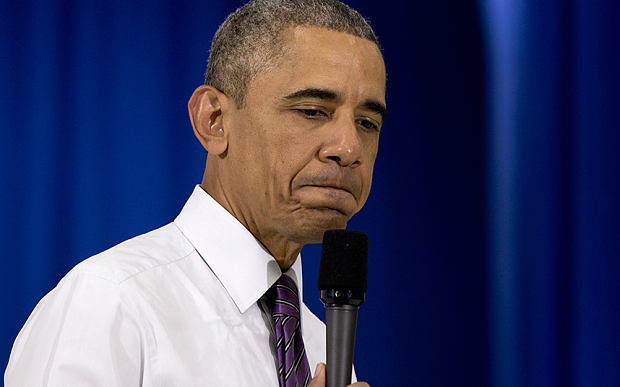
Barack-Obama-_3361379bPresident Barack Obama pauses speaks at Taylor Stratton Elementary School in Nashville Photo: AP

The United States has blocked attempts by its Middle East allies to fly heavy weapons directly to the Kurds fighting Islamic State jihadists in Iraq, The Telegraph has learnt.

Some of America’s closest allies say President Barack Obama and other Western leaders, including David Cameron, are failing to show strategic leadership over the world’s gravest security crisis for decades.

They now say they are willing to “go it alone” in supplying heavy weapons to the Kurds, even if means defying the Iraqi authorities and their American backers, who demand all weapons be channelled through Baghdad.

High level officials from Gulf and other states have told this newspaper that all attempts to persuade Mr Obama of the need to arm the Kurds directly as part of more vigorous plans to take on Islamic State of Iraq and the Levant (Isil) have failed. The Senate voted down one attempt by supporters of the Kurdish cause last month.

The officials say they are looking at new ways to take the fight to Isil without seeking US approval.

“If the Americans and the West are not prepared to do anything serious about defeating Isil, then we will have to find new ways of dealing with the threat,” said a senior Arab government official. “With Isil making ground all the time we simply cannot afford to wait for Washington to wake up to the enormity of the threat we face.”

Kurdish-weapons_3361377bKurdish Peshmerga fighters train on a weapon during a training session with British military advisers

The Peshmerga have been successfully fighting Isil, driving them back from the gates of Erbil and, with the support of Kurds from neighbouring Syria, re-establishing control over parts of Iraq’s north-west.

But they are doing so with a makeshift armoury. Millions of pounds-worth of weapons have been bought by a number of European countries to arm the Kurds, but American commanders, who are overseeing all military operations against Isil, are blocking the arms transfers.

One of the core complaints of the Kurds is that the Iraqi army has abandoned so many weapons in the face of Isil attack, the Peshmerga are fighting modern American weaponry with out-of-date Soviet equipment.

At least one Arab state is understood to be considering arming the Peshmerga directly, despite US opposition.

The US has also infuriated its allies, particularly Saudi Arabia, Jordan and the Gulf states, by what they perceive to be a lack of clear purpose and vacillation in how they conduct the bombing campaign. Other members of the coalition say they have identified clear Isil targets but then been blocked by US veto from firing at them.

“There is simply no strategic approach,” one senior Gulf official said. “There is a lack of coordination in selecting targets, and there is no overall plan for defeating Isil.”

Western leaders increasingly accept that the “war on Isil” has not gone well, from the moment last year Mr Obama called the group a “JV [junior varsity] team” of jihadists compared with al-Qaeda. At that point, Isil had seized Fallujah, which US forces took in a bloody battle in 2004. It went on to take much of western Iraq and large areas of Syria, and in May took Ramadi, the capital of Anbar province.

Britain is moving closer to expanding its role in the war. The Government on Wednesday gave its strongest indication yet that MPs will be given a new vote on whether to bomb Isil in Syria.

Michael Fallon, the Defence Secretary, said it was “illogical” that British planes were able to hit extremists in Iraq but not across the border.

Any decision to bomb in Syria would have to be approved by MPs. In 2013, the Prime Minister lost a vote for British military action in Syria. However, Mr Fallon said: “It is a new Parliament and I think new Members of Parliament will want to think very carefully about how we best deal with Isil, and the illogicality of Isil not respecting the borderlines.”

Mr Fallon suggested that a bombing campaign could be mounted in revenge for the terror attacks in Tunisia if a link could be proved between the killer and Isil in Libya. Britain would only take military action in Libya “where we think there is an imminent threat, a very direct to British lives or, for example, to British hostages”, he said.

Senior Whitehall sources did not distance themselves from Mr Fallon’s comments but insisted there was no immediate prospect of military action.

The Telegraph understands that Mr Cameron is concerned that Labour might force the Government into another defeat over Syria.

On achievements and ideas

May 29, 2015

On achievements and ideas, Israel Hayom, Maj. Gen. (ret.) Yaakov Amidror, May 29, 2015

Lately it looks as though the Islamic State group has managed to rack up highly significant geographic achievements. These coups will lead to the group controlling the enormous expanse of territory west of Baghdad to the Syrian border beyond Palmyra by establishing rule in the north and east of the crumbling Syrian state.

The occupation of Ramadi, one end of an arch that bridges between the Iraqi capital and Palmyra in the heart of northern Syria, serves as a base for future gambits of even greater importance. We shouldn’t wonder if the group needs a little time to “digest” the new areas it has conquered, to take care of any local population that might resist, if any such remains, and to settle its rule on the rest of the residents and prepare for retaliatory attacks by the Syrian and Iraqi armies and their auxiliary militia forces.

It appears that in Iraq and Syria — but more importantly, in the U.S. — it is understood that the counterattack stage could turn out to be critical. If the group overcomes these strikes, it is hard to imagine what might stop it in the future, barring full-scale involvement by the U.S. military that would include heavy ground forces.

After the counter-strikes, the moment the organization feels secure in its new area, and we cannot know how long that will take, it will face the standard dilemma presented by such situations: What next? By nature, a group like this cannot refrain from action for long. It needs constant movement; it is thirsty for new gains and fears the “stagnation” that could affect it after a period of calm. The group is still in its dynamic stage, continuing to rise. It has four options for action, and no one knows which one its leaders will choose. It is possible that they themselves have not made up their minds and are still not ready to decide, at least until the results of any possible counterattack become clear.

Islamic State’s next “natural” effort could be toward Baghdad, to strengthen its rule of everything west of the Iraqi capital. The goal would be to strike a fatal blow to the Shiite government’s operational ability in the Sunni regions the group has taken thus far, and maybe even to bring down the present Iraqi regime.

Such a move would doubtless put pressure on the ruling Shiites and their Iranian allies, because when an organization like this approaches areas with a dense Shiite population, as well as the cities most holy to Shiites, the latter envision a mass slaughter. So there is no question that a move like that, if successful, would force the Iranians to make some tough decisions, mainly about whether to opt for direct military intervention.

The group has another option in Iraq: to the north, beyond Kurdistan. If it managed to take control of the areas where the Kurds are currently extracting oil, it would enjoy maximal success, running nearly an entire country and putting heavy pressure on Turkey. That looks tempting, because the West hasn’t taken care to adequately arm the Kurds, the only ones so far who have fought the group successfully.

It is also possible that after its great success in Iraq, the group will prefer to entrench its rule over northern Syria — in other words, seize control of Aleppo and Homs. That would be an ambitious plan given the size of the geographic area, but it appears any resistance there would be weaker than it would be in a metropolis like Baghdad or from the fierce Kurds. If Islamic State took Aleppo and Homs, it would improve its chances of eventually taking action against the Kurds, particularly their Syrian wing.

In Syria, the main ones opposing the group would be President Bashar Assad’s exhausted army. In that area, other Sunni groups from what is known as the army of insurgents might join Islamic State, granting it legitimacy in the eyes of the locals. A move like that could lead to a dramatic change in Assad’s position and force Hezbollah to spread its forces even thinner. A loss of Hezbollah’s strategic homefront and the presence of its Sunni haters breathing down the neck of the Alawite minority, on the coast of Latakia, means a threat to a region that is vital to Hezbollah and to the Iranians’ position in Syria, and eventually in Lebanon. The Iranians and Hezbollah would do almost anything to protect these, because any threat to them is an existential one. If the Islamic State group acquires control of Alawite or Shiite areas, it will exterminate everyone there. This is a life or death struggle. That’s clear to everyone.

The ambitious option

And there is a fourth option, which for now seems less appealing and therefore less likely, although not impossible. It’s possible that to avoid clashing with Shiite strength around Baghdad or with Alawite and Hezbollah desperation en route to Damascus, the group will turn its attention to Amman.

All the residents of Jordan are Sunni, and some of them could begin to identify with a serious, successful Sunni group that purports to act on behalf of Sunnis, who are in distress because of the Shiite dynamic in the Middle East. The group could asses that it would be easier for it to operate against Jordan, and if it does so successfully it would have more convenient access to Saudi Arabia — the crown jewel of the Muslim world.

Saudi Arabia is the target that anyone who talks about an “Islamic caliphate” dreams of, because it is home to Mecca and Medina, the two holiest cities for any Muslim. In acting against Jordan, the group could combine a military maneuver with an attempt to influence the kingdom from inside by exploiting the social and economic problems in Jordan that have worsened because of the mass influx of refugees from Syria.

Today, the chances of the organization succeeding in Jordan appear very slim. The Jordanian army, unlike the armies of Iraq and Syria, is both serious and professional and among many Jordanians, the king is popular as well as legitimate. Jordan is no easy prey, and it would certainly have the help of everyone for whom the kingdom’s stability is important.

In any case, it is obvious that the American intervention thus far has not brought the U.S. any closer to the goal defined by President Barack Obama of “destroying the organization.” The opposite — it has grown stronger and expanded its area of control since the U.S. declared war on it. The last chance the U.S. has to continue its current policy, avoiding the deployment of massive American ground forces, is conditional upon its ability to give the Iraqi army the assistance it needs in the attack it is promising to execute, and possibly on helping the Syrian army indirectly.

The Americans will take a look at themselves after these battles, when it becomes clearer whether the group’s recent successes are the regular ups and downs seen in conflicts like these, or whether they have altered its standing, and Islamic State will now take advantage of the momentum to move on more ambitious targets.

Relying on the U.S. for security is a mistake

May 21, 2015

Relying on the U.S. for security is a mistake, Al Arabiya News, Khalaf Ahmad Al Habtoor, May 21, 2015

(Al Arabiya is based in the United Arab Emirates and is majority-owned by Saudi broadcaster Middle East Broadcasting Center.– DM)

Obama says Iran’s newfound wealth will be used to improve lives rather than end up in the treasure chests of Hezbollah, the Shiite Yemeni Houthis, or other troublemakers under the Iranian wing. Sorry, but to me that smacks of naivety at best, snake oil at worst.

According to a Daily Telegraph investigation, Iran’s Supreme Leader controls “a financial empire” estimated to be worth $95 billion, more than even the grandiose Shah had managed to accumulate. That alone should tell Mr Obama that Iran has no intention of prioritising the needs of its people over its regional mischief makers.

****************

At a passing glance, President Barack Obama’s meetings with the leaders of the Arab Gulf States have borne fruit in terms of furthering mutual respect and as a building block to closer cooperation. But when one digs beneath the flimflam and the verbal pledges – with the exception of a joint missile defense system and a promise that deliveries of U.S. weapons would be fast-tracked – the recent Camp David Summit delivered few tangible benefits.

Indeed, more than a few commentators have described the meeting as a U.S.-hosted arms bazaar, one that will fill the coffers of American weapons manufacturers with billions of dollars. Plus the P5+1 – Iranian nuclear deal is set to enrich and empower Tehran once economic sanctions are lifted.

Obama says Iran’s newfound wealth will be used to improve lives rather than end up in the treasure chests of Hezbollah, the Shiite Yemeni Houthis, or other troublemakers under the Iranian wing. Sorry, but to me that smacks of naivety at best, snake oil at worst.

According to a Daily Telegraph investigation, Iran’s Supreme Leader controls “a financial empire” estimated to be worth $95 billion, more than even the grandiose Shah had managed to accumulate. That alone should tell Mr Obama that Iran has no intention of prioritising the needs of its people over its regional mischief makers.

Eradicating terrorism

The question is whether the leaders of the GCC countries should rightly feel secure from Iranian aggression now that the U.S. President has promised to come to their defense, militarily if deemed necessary. Naturally, that assessment would be made by the White House, not by the threatened states.

Without a signed and sealed security pact and in light of Obama’s track record of hesitancy in ending regional conflicts or eradicating terrorism, I don’t think so. Are we seriously to believe that the U.S. would declare war on Iran were we to be menaced?

Obama’s rhetoric speaks otherwise when he told the New York Times that internal threats to Gulf States are “bigger than Iran” and, at Camp David, he warned his guests not to “marginalise” Tehran. And even if Obama’s undertaking was rock solid, his term expires in just over 18 months. What happens then?

In any case, while there is nothing wrong with cementing better relations with the U.S., we must not on any account rely on its protection or that of any other world power. Yemen proves that we are able and willing to protect ourselves and our allies and when the proposed Joint Arab Force comes into play, our capabilities will be strengthened. We have no need of guardians or bosses in foreign capitals. We have strong, well equipped armies and air forces. We are not helpless, underage youths pleading to be defended, as characterised by sectors of the media.

Merely a public relations exercise

I would urge GCC heads of state to put Camp David under a microscope to ascertain whether it was a genuine attempt on Obama’s behalf to induce closer ties or merely a public relations exercise to bring Gulf States on board a bad deal rewarding Iran for its hostility, regional interference and its backing of terrorists.

In my opinion, trusting the Obama administration to rein in Iran would be a huge mistake. U.S. engagement with Iran was exactly the legacy Obama was after even before he moved into the Oval Office. And to that end he surrounded himself with pro-Iranian officials, such as Vice President Joe Biden, Secretary of State John Kerry and Deputy Secretary-of-State Bill Burns, who have all been championing détente with Iran for many years.

Obama’s personal adviser and family friend, Valerie Jarrett grew up in Iran, speaks Farsi, and was a main player along with Bill Burns in U.S.-Iranian secret talks to pave the way for official negotiations. The President’s National Security Council Director for Iran, Sahar Nowrouzzadeh is a former employee of the National-Iranian American Council, a pro-Iranian lobbying organisation.

The President’s own behaviour with regards to America’s long-time sworn enemy was suspect since the beginning. He has been sending the Iranians video Nawrus (New Year) messages and letters to Iran’s Supreme Leader. This year, Obama actually celebrated the Persian New Year at home with his wife and daughters.

Just as strange was Obama’s silence concerning Iran’s crackdown on street protests following elections. And if he condemns Tehran for its human rights abuses and lack of civil liberties, he must be whispering. Because all we hear from him is condemnation of predominately Sunni Arab states on those issues.

“The greatest supporter and plotter of terrorism”

Stranger still, while Obama comes across as the ayatollahs’ new best friend, just days ago, the Ayatollah Khamenei attacked the U.S. as “the greatest supporter and plotter of terrorism” and accuses Washington of pursuing its own interests making the region insecure, while branding America as the enemy of both Shiite and Sunni Muslims. Far from committing to stay out of Arab affairs, Khamenei stressed that his country would continue supporting “the oppressed people of Yemen, Bahrain and Palestine in every way possible.”

Are we really going to place our trust in America’s Commander-in-Chief when he claims backing the Free Syrian Army against the Syrian regime partnered with Iran and Hezbollah, even as his Air Force provides air cover to Iran’s Quds Force and pro-Iranian Shiite militias in Iraq’s Anbar province? This rabble with blood-stained hands – officially known as Popular Mobilisation Forces (Al-Shaabi) – has been deployed by Prime Minister Haider Al-Abadi and is directed by the commander of Iran’s Quds Force Qassem Soleimani. What is worse is that Iran is poised to send in ground troops as soon as it receives the go ahead from the government.

And what does Mr Obama say about the shocking news revealed by the Times and other papers to the effect that the government in Baghdad is turning away tens of thousands of desperate Sunni refugees fleeing the city of Ramadi, recaptured by ISIS? Nothing much as far as I can tell! Iraq families with nowhere to go are being treated worse than foreign foes, barred entrance into their own capital city unless they happen to have a local “guarantor.” This is a plan to reduce the Sunni population by sending them into the fray to die; there is no other explanation.

In reality, Saudi Arabia’s towns bordering northern Yemen are under direct threat from Houthis, while Iran, close to being literally under the Iranian boot, constitutes a grave threat to Gulf States. Does the Obama administration plan to wait until the horse has bolted before acting? The Iranian plot to dominate the region is taking shape before our eyes. We are being surrounded. Yet the U.S. president asks us to play nice with the plotters.

Qualitative military edge

The bottom line is we did not get what we asked for. Obama’s commitment to intervene in Syria to stop the regime’s killing spree was off the table along with a joint defense pact on the lines of those the U.S. has with Israel, Japan and South Korea. Moreover, he has turned down the Saudi request to purchase state-of-the-art F-35 Joint Strike Fighters to maintain Israel’s qualitative military edge over its neighbors.

And we certainly did not get what we need. Most importantly, any final agreement with Iran should be negotiated with the participation of Gulf states and co-signed by our leaders. Such agreement should not be limited to nuclear issues, but should be conditional upon Tehran’s commitment to quit meddling in the affairs of Arab countries, notably Syria, Lebanon, Iraq, Yemen and Bahrain whether directly (in the case of Iraq and Syria) or via its armed proxies (Lebanon and Yemen).

We should not trust any other countries but our own. We must not await instructions from the White House on how to pursue our own interests, as it is well-known that U.S. friendship is not proffered without strings. We must proceed with our mission to free Yemen of Houthi rabble, continue with our efforts to destroy ISIS and lend every support to that sector of the Syrian opposition fighting for a democratic, inclusive state – as opposed to terrorist groups that seek to drag Syria back to the Middle Ages.

Lastly, we should insist upon the stringent terms outlined above. And if those terms are not put in writing, the GCC should work to weaken the Iranian regime once and for all, beginning with material support for the oppressed Ahwazi Arab citizens of Iranian-occupied Arabistan – a region Iran now calls Khuzestan, which supplies the country with most of its oil and gas.

I fear that Camp David was a well-timed bluff and its weapons bounty no more than candies to sweeten the pill. I trust and believe that our leaders understand the score and will maintain independent strategies to counteract threats to our very existence. We cannot gamble with tomorrow on the words of one man, even if that man is the U.S. president.

Our region has been burned many times before. If the past is a good predictor of the future, we should recognise that ultimately we must become the masters of our own destiny, which is far too precious to be handed to the safekeeping of fair-weather friends.

Arab military chiefs approve Egyptian-led intervention in Libya

May 19, 2015

Arab military chiefs approve Egyptian-led intervention in Libya, DEBKAfile, May 19, 2015

(Obama will be displeased. — DM)

Arab military chiefs held an unpublicized meeting in Cairo Monday to confirm coordinated plans for Egyptian-led regional intervention into the eastern Libya region of Cyrenaica to drive out the armed extremists, who have kept the country locked in chaos since Muammar Qaddafi’s ouster, and install a stable government in the region;s capital of Benghazi. The meeting was attended by the chiefs of staff of Egypt, Jordan, Saudi Arabia, UAE, Kuwait, Bahrain, Sudan and the Libyan Tobruk government. Talks are ongoing with France and Libya to take part in the operation. Both have a direct interest in putting a stop to the ungoverned flow of African refugee migrants to Europe through Libya, which is being used by Islamic State terrorists to infiltrate Europe. France will be asked for logistic support and special forces for the Libyan operation and Italy to provide naval support. Egyptian President Abdel-Fatteh El-Sisi is seeking  early military action cut down the fast-expanding ISIS threat to his country, the region and southern Europe.

Ramadi’s fall opens ISIS road to Baghdad. Jordan warns US air strikes won’t stop the terrorists’ advance

May 18, 2015

Ramadi’s fall opens ISIS road to Baghdad. Jordan warns US air strikes won’t stop the terrorists’ advance, DEBKAfile, May 18, 2015


Jordan’s King Abdullah has warned the Obama administration in an urgent message that US air strikes alone won’t stop the Islamic State’s advances in Iraq and Syria and, what is more, they leave his kingdom next door exposed to the Islamist peril. ISIS would at present have no difficulty in invading southern Jordan, where the army is thin on the ground, and seizing local towns and villages whose inhabitants are already sympathetic to the extremist group. The bulk of the Jordanian army is concentrated in the north on the Syrian border. Even a limited Islamist incursion in the south would also pose a threat to northern Saudi Arabia, the king pointed out.

Abdullah offered the view that the US Delta Special Forces operation in eastern Syria Saturday was designed less to be an effective assault on ISIS’s core strength and more as a pallliative to minimize the Islamist peril facing Saudi Arabia, Jordan and the Gulf emirates.

DEBKAfile’s Washington sources report that US officials refused to heed Abdullah’s warning and tried to play it down, in the same way as Secretary John Kerry tried Monday, May 18, to de-emphasize to the ISIS conquest of Ramadi, the capital of Iraq’s largest province.

At a news conference in Seoul, Kerry dismissed the Islamists’ feat as a “target of opportunity” and expressed confidence that, in the coming days, the loss “can be reversed.”

The Secretary of State’s words were unlikely to scare the Islamists, who had caused more than 500 deaths in the battle for the town and witnessed panicky Iraqi soldiers fleeing Ramadi in Humvees and tanks.

Baghdad, only 110 km southeast of Ramadi, has more reason to be frightened, in the absence of any sizeable Iraqi military strength in the area for standing in the enemy’s path to the capital.

The Baghdad government tried announcing that substantial military reinforcements had been ordered to set out and halt the Islamists’ advance. This was just whistling in the dark. In the last two days, the remnants of the Iraqi army have gone to pieces – just like in the early days of the ISIS offensive, when the troops fled Mosul and Falujah. They are running away from any possible engagement with the Islamist enemy.

The Baghdad-sourced reports that Shiite paramilitaries were preparing to deploy to Iraq’s western province of Anbar after Islamic State militants overran Ramadi were likewise no more than an attempt to boost morale. Sending armed Shiites into the Ramadi area of Anbar would make no sense, because its overwhelmingly Sunni population would line up behind fellow-Sunni Islamist State conquerors rather than help the Shiite militias to fight them.

Iran’s Defense Minister Hossein Dehghan, who arrived precipitately in Baghdad Monday, shortly after Ramadi’s fall, faces this difficulty. Our military sources expect him to focus on a desperate effort to deploy Shiite militias as an obstacle in ISIS’s path to Baghdad, now that the road is clear of defenders all the way from Ramadi.

In Amman, King Abdullah Sunday made a clean sweep of senior security officials, firing the Minister of Interior, the head of internal security (Muhabarat) and a number of high police officers. They were accused officially of using excessive violence to disperse demonstrations in the southern town of Maan.

The real reason for their dismissal, DEBKAfile’s counter-terror sources disclose, is the decline of these officials’ authority in the Maan district,  in the face of the rising influence of extremist groups identified with Al Qaeda and ISIS, in particular.

President Strangelove or, how I learned to stop worrying and love the bomb

May 14, 2015

President Strangelove or, how I learned to stop worrying and love the bomb, Jerusalem Post, David Turner, May 14,2015

Concerned about Soviet intentions in the region the Truman administration entered into the U. S.-Saudi Mutual Defense Assistance Agreement (MDA) in 1951. The Agreement provided the foundation for what would emerge as an American commitment to provide a defense umbrella for the region to protect American interests in the Middle East. American assurances to states in the region seemed intact until the GW Bush Administration invasion of Iraq. Trapped in a war it completely misjudged and soon realized it could not win the administration sought an accommodation with Iran to control Shi’ite militias battling the Americans.

The Bush policy of “accommodation” with Iran became the Obama policy of “appeasement” towards the Islamic Republic. Thus began a six-year-long quest to intended to encourage that country’s recalcitrant and hegemony ambitious leaders to abandon its nuclear weapons program. With the imminent 30 June deadline for signing an Agreement quickly approaching the president invited the Gulf Cooperation Council (GCC) states headed by Saudi Arabia to Camp David promising a mutual defense agreement assuring the Arab states of American protection in the event Iran proved a threat to the region. In addition to “assurances, the Saudis insisted on a signed and “formal alliance structure with the United States guaranteeingU.S. support against potential Iranian aggression.”

In advance of the conference the White House announced that President Obama would meet with the Saudi king the day beforeCamp David. But at the last minute, [d]ispleased with Washington’s dealings with Iran, with an emerging deal over its nuclear program and with US security proposals to Gulf Arab nations,” King Salman announced he would not meet with President Obama and would not attend the Camp Davidconference. In the end only two of six Gulf nations decided to attend with heads of state.

The king’s last-minute cancellation, his turn-down of a meeting with the leader of the Free World was described as “a calculated snub for the president’s policies on Iran and the Middle East.” It was revealed that Kerry, in his meeting with the Saudis the week earlier, told the king that Obama was not prepared to finalize according to the king’s timetable any agreement that might result at Camp David.

And then there was the fact that a mutual defense agreement with the Saudis, the 1951 MDA, already existed already assuring the Saudis protection under America’s nuclear umbrella. Mistrust of American intentions and assurances by America’s “allies” built up over the previous twelve years was palpable.

Bush and the Region

“Even before the inauguration [and, of course, the pretext of 9/11], Cheney asked outgoing Secretary of Defense William Cohen to provide Bush with a briefing focused on Iraq… [Bush appointee] Defense Secretary Rumsfeld saw, “September 11, 2001, as a potential “opportunity.””

Symptomatic of hubris resulting from power minus coherent policy President Bush ignored both Arab and Israeli warnings of Foreseen Consequences certain to follow should the administration follow through with its threat to invade Iraq.

“With his latest remarks, [Saudi, later king] Prince Abdullah joined the chorus of Arab complaints about the Bush administration’s talk of taking military action to oust Saddam Hussein and put an end to his programs to develop weapons of mass destruction. At virtually every stop in the Arab world, Mr. Cheney has been told that an American military strike would destabilize the region.”

And, according to Lawrence Wilkerson, a member of the State Department’s Policy Planning Staff, “[t]he Israelis were telling usIraq is not the enemy – Iran is the enemy.” Wilkerson said that the Israeli reaction to invading Iraq in early 2002 was, “If you are going to destabilize the balance of power, do it against the main enemy.”

Bush and the Bomb

Cut off the head of the snake,” the Saudi ambassador toWashington, Adel al-Jubeir, quotes the king as saying during a meeting with General David Petraeus in April 2008.

In a speech to the Knesset in 2008 to observe Israel’s 60thanniversary Bush told the Knesset, “America stands with you in firmly opposing Iran’s nuclear weapons ambitions. Permitting the world’s leading sponsor of terror to possess the world’s deadliest weapon would be an unforgivable betrayal of future generations.” Nowhere in his speech did Bush hint at his long held view that America was not prepared to enter another Middle East war, that there never was a military option with which to threaten Iran’s nuclear weapons program. No accident then that Bush chose war-averse Robert Gates as his defense secretary; and that Gates in turn chose war-averse Admiral “Mike” Mullen as head the Joint Chiefs of Staff. The dovish defense pair would for years be the president’s PR mouthpiece warning against even the threat of force to halt Iran’s nuclear program. The Gates/Mullen oft-repeated warning of “unforeseen consequences” became, over the years a common, almost mantra-like warning against any action against Iran.

No surprise then that the openly dovish, newly-elected President Obama invited Gates to remain on as his defense department head, “a show of bipartisan continuity in a time of war that will be the first time a Pentagon chief has been carried over from a president of a different party.”

Obama and the Region

By way of destabilizing the region Obama has not yet equaled the fallout of Bush’s invasion of Iraq. If Bush gifted Iraq to Iran, set the stage for the “Arab Spring,” Obama did not come in second for lack of trying. The new president followed Bush by targeting his own tyrant, Muamar Qadafi and transformingLibya, as did Bush in Iraq, a political wreck bordering on a failed state.  Libya today is ruled al-Queda, Islamic State and other terror organizations with two governments powerless to assert control. Bordering Egypt Libya today supplies both the Sinai Salafist insurgency and the terror enclave of Gaza with weapons. And as Bush ignored Israeli and Arab warnings regarding the impact of invading Iraq, Obama chose to those same Arab-Israeli warnings regarding his intention to depose America’s principal Arab ally, Hosni Mubarak of Egypt. In a single mindless move the U.S. followed up its Iraq disaster with Egypt. And followed the collapse of Egypt’s secular regime, insult to injury Obama endorsed as “democratic government” the same Muslim Brotherhood with a decades-long terror campaign against the government; the group behind the assassination of Anwar Sadat for having sought peace with Israel: the Muslim Brotherhood whose child, al-Quaeda, had flown airliners into New York’s World Trade Center! The list of Bush and Obama Administration policy failures seems to know no limits: Iraq redo, Bahrain,Yemen and the bloodbath of Syria. Lacking capacity to learn from ideology-based failures, it continually repeats its “unintended consequences.”

Obama and the Bomb

If Bush set the pattern for accommodation then the tactic at least had some “justification” as Iran’s IRGC was funding, arming and even leading the Shi’ite insurgency against Iraq’s American invaders. Not provoking Iran might have the result of limiting American casualties. But for Obama, recipient in advance of the Nobel Peace Prize for promising regarding “world peace”; for Obama to provide Iran, a state sponsor of Islamist terrorism a world forum to show up American weakness and enhance Iranian prestige; for Obama whose commitment on entering office was to promote nuclear non-proliferation: for Obama to provide Iran all the time necessary to achieve threshold nuclear armament status and, failing to contain Iran the consequence would be a nuclear arms race in the lands of the Arab Spring… Saudi Arabia,Turkey and Egypt are already moving to parity with Iran whileJordan and several Gulf states are at varying stages of planning.   

Obama, who promised nuclear non-proliferation, has turned out to be godfather to a nuclear arms race in the least stable, most militant region of the world!