Archive for the ‘Freedom’ category

How to lose friends and empower radicals: the peace prize president’s more dangerous world

January 29, 2015

How to lose friends and empower radicals: the peace prize president’s more dangerous world, Breitbart,  Dr. Sebastian Gorka, January 29, 2015

(Please see the video at the link. — DM)

obama-binoculars-AP-640x480AP Photo/Susan Walsh

Since 2008, the world has become a significantly more dangerous place. In every region, new threats have emerged or old ones have reasserted them. The scorecard is clear: the bad guys are winning and America’s interests are being undermined daily.

As a nation, America has yet to recover from the experience of September 11th, 2001. Public opinion on our national response to the attacks against the World Trade Center, the Pentagon, and Flight 93 is today divided. On one side we have the “Bush lied, People Died!” crowd who portray President George W. Bush’s response in terms of a conspiracy, despite the fact that we now know Saddam Hussein indeed possessed thousands of WMD warheads (and had used them in the past).

On the other, we have conservatives who are themselves split between the unsophisticated isolationists/non-interventionists who believe that an American withdrawal from the world will make us safe, and the quietly resurgent neoconservatives who see in the rise of ISIS/The Islamic State a justification for more foreign engagements.

For a moment, let us put Operations Enduring Freedom (Afghanistan), and Operations Iraqi Freedom (OIF), to one side. Instead, let us take an unemotional snap-shot of the global geostrategic situation to see whether the administration whose head was awarded a Nobel Peace Prize during his first year in office has indeed make the world a safer and more peaceful place.

Europe: During most of the last century, American security was tied directly to the continent of Europe. Whether is was the generational genocide of World War One, the racial genocide of WWII, or the class-based totalitarianism of the Cold War, Europe was the source of strategic, and at times existential, threats to America.

During the first Obama Administration, Secretary of State Hilary Clinton declared a “Pivot to Asia” which would deemphasize Europe’s importance and see Washington focus more on our Pacific partners than on old Atlantic Allies.

Since that announcement, an emboldened Vladimir Putin has seen fit to break an almost 70-year-old international taboo by using force to redraw national borders with his annexation of Crimea. This includes, incredibly, the shooting down of a civilian jet-liner by forces armed by Moscow.

At the same time, we have seen the European Union become evermore centralizing and undemocratic as untenable economic and fiscal policies are propped up by a Brussels bureaucracy in the name of “broader and deeper union.” This has naturally led to two types of responses: the unprecedented success of a paleo-conservative backlash,f best typified by the insurgent victories of UKIP in Great Britain, as well the reverse: Utopian socialist populists such as the victorious Syriza party of Greece.

Then there are Europe’s ties to the Global Jihadist Movement. The recent slaughter in Paris, the beheading of a British serviceman on the streets of the UK, and Spanish and Belgian terror-related arrests all attest to the failure of the current international campaign against Islamist terrorism.

The flawed immigration policies of many EU nations have also facilitated the establishment of literally hundreds of ethnic and religious enclaves across the continent where integration is seen as a bad thing and where radical talent spotters for groups such as Al Qaeda and ISIS/IS identify, indoctrinate and recruit murderers such as the Charlie Hebdo killers, as well as thousands of fighters for The Islamic State.

This has led to a grass-roots response from Europeans afraid of the future survival of their countries embodied in the ever-broadening PEGIDA movement that Breitbart London has covered in great detail. The failure of multiculturalist immigration policies has not only encouraged the enclave phenomenon, but is also clearly linked to the disturbing rise of anti-Semitism on the continent which has led to unprecedented numbers of European jews deciding to leave the nations of their birth for good.

If we include Turkey in our European snapshot, the situation is even worse, as we have seen the one viable example of a secular Muslim state slip even deeper into the corruption-ridden maelstrom of Islamic fundamentalism under the Erdogan government which is either incapable or unwilling to prevent Turkey becoming a pre-deployment site for jihadist fighters traveling into Syria and Iraq. All this from a formal NATO ally of the US.

Asia: The much-vaunted Pivot to Asia has clearly not worked. China has, over the last several years, openly challenged the post-Cold War peace in the region with a commitment to its own military build-up coupled with a concerted campaign of intimidation against its smaller and weaker neighbors.

While challenging and intimidating our regional partners, China has continued to grow economically at such a rate that the nation which was once universally ridiculed as the maker of plastic toys for McDonalds Happy Meals has now surpassed the US economy in terms of gross output.  At the same time, China is waging a covert war against America in the cyber domain, stealing not only state secrets for use in developing its new weapons systems, but also billions of dollars worth of intellectual property and commercial secrets from American businesses. See the remarkable report from Mandiant on scale of the threat.

North Korea has also used the internet to assault American interests as the Sony hacking attack attests, while Washington has proven totally ineffective in undermining the world’s last truly fully-fledged Stalinist regime, or its regionally destabilizing nuclear weapons capabilities.

Africa: A giant continent, with threats as bad as they were in 2008, or in several cases much worse. The Global Jihadist Movement continues to consolidate its control in Nigeria through the horrific attacks of Boko Haram, the group made famous for the kidnapping of the girls from Chibok, an attack which is just one part of a vast campaign targeting Christians and anyone who does not want to live under a theocratically run system based upon sharia and 7th century interpretation of the Koran.

In addition to the insurgent-like threat of Boko Haram, we have also witnessed horrific hit and run terrorist tactics used by other African jihadists, as in the Westgate Mall attack in Nairobi by Al Shabaab. At the same time, China proceeds to build its vast network of economic interests in the continent in ways that far outstrip American geostrategic investment in Africa.

Australasia: Of course, the Pivot to Asia should have pleased our Antipodean allies. But the concrete consequences of the declarations and speeches by Secretary Clinton and the White House have amounted to little more than the deployment of a handful of US Marines from Camp Pendleton to Australia. Instead of the security situation improving, Australia faced its own Jihadist attack just before Christmas last year as a self-styled imam took hostages and brought the violent jihad so familiar to New York, London, Madrid, and Paris, to the streets of Sydney.

The Americas: Canada likewise became a direct victim of the Global Jihadist Movement after a spate of attacks against its armed forces and even its parliament which was only stopped when a brave sergeant-at-arms applied deadly force in the face of a rampaging jihadi.

Those who like illicit quality cigars may be celebrating the White House’s “normalization” of relations with Communist Cuba, but if statements by the Castro regime are to be credited as expressing Havana’s true intentions, then the deal was good for the dictatorship and bad for America. And despite the US government’s historic decision, conditions inside Cuba have remained the same, or in many case deteriorated, with last year seeing record-breaking numbers of political arrests on the island nation. And Cuba’s anti-democratic influence is a problem for the region, not just its wretched population, with Raul Castro’s secret police providing aid and expertise in the oppression of dissidentsto the government of Venezuela.

The Middle East and North Africa: Leaving the worst for last we have, of course, the Middle East, and North Africa. The highs hopes for the Arab Spring turned very rapidly into a “Christian Winter” and a victory for the fundamentalist and anti-Democratic forces of the Muslim Brotherhood. One after another, one-man authoritarian regimes fell to Islamist MB governments, or collapsed into deadly civil wars which are still being fought in places like Syria and Libya. Throughout the region, proto-democrats and vulnerable minorities, especially ancient Christian communities, have been targeted for death or persecution, or have been forced to flee.

The one ray of hope, the people’s revolt in Egypt against the Brotherhood government of Mohammad Morsi, which led to his being ousted by a secular military, was rejected by the US administration as a coup, despite the fact that General, now President, Sisi, has been fighting his own war against Jihadi fundamentalists since he was the Chief of the Egyptian Armed Forces.

And now Yemen, which was lauded just a few months ago by President Obama as the poster-child of his successful counterterrorism strategy, has collapsed under insurgent attacks and the resignation of the government in Sanaa.

Then there is Iran, which, much like Cuba, has squeezed concession after concession out of the administration without either stopping its acquisition of nuclear weapons capability, or curtailing its support of Shiite terrorist fighters in either Iraq or Syria.

I said I would leave Afghanistan and Iraq of our the equation, but nevertheless, it is important to recognize that this is a new jihadist threat that is even more dangerous than Al Qaeda. ISIS, the Islamic State, is today a full-fledged insurgency, one that in four dimensions is much more of a threat that [Sic] Al Qaeda ever was.

The Islamic State is more than a terrorist group, it now functions as a quasi-state and controls territory equivalent to the size of the UK. It is the richest non-state threat group in human history. It has an incredibly sophisticated understanding of information warfare and how to use social media as a propaganda platform, and lastly – and relatedly – it has recruited ten of thousands of young Muslim men from around the world, including Europe and the US, to fight for the new Caliphate of Abu Bakr al Baghdadi. Bin Laden dreamt of being this powerful. The Islamic State has turned his dream into a horrific reality.

There is not one area of the world of import to America in which we have either not lost friends, or failed to help our allies to defend themselves against the common enemies that threaten us all. Whatever your politics, or whomever you favor for the next Commander-in-Chief of the United States, one thing is certain: without resolute American leadership the world can become, and now is, a much more dangerous place.
The Imaginary Islamic Radical

January 28, 2015

The Imaginary Islamic Radical, Front Page Magazine, Daniel Greenfield, January 28,2015

(Ask Secretary Kerry.

Please see also Muslim Brotherhood-Aligned Leaders Hosted at State Department. — DM)

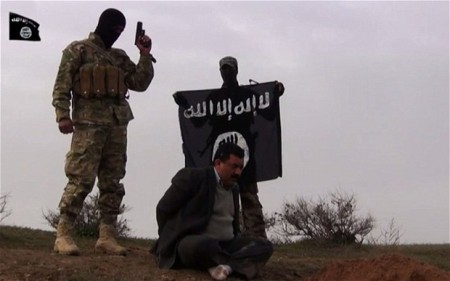
iraqstill-450x281

Our problem is not the Islamic radical, but the inherent radicalism of Islam. Islam is a radical religion. It radicalizes those who follow it. Every atrocity we associate with Islamic radicals is already in Islam. The Koran is not the solution to Islamic radicalism, it is the cause.

******************

The debate over Islamic terrorism has shifted so far from reality that it has now become an argument between the administration, which insists that there is nothing Islamic about ISIS, and critics who contend that a minority of Islamic extremists are the ones causing all the problems.

But what makes an Islamic radical, extremist? Where is the line between ordinary Muslim practice and its extremist dark side?

It can’t be beheading people in public.

Saudi Arabia just did that and was praised for its progressiveness by the UN Secretary General, had flags flown at half-staff in the honor of its deceased tyrant in the UK and that same tyrant was honored by Obama, in preference to such minor events as the Paris Unity March and the Auschwitz commemoration.

It can’t be terrorism either. Not when the US funds the PLO and three successive administrations invested massive amounts of political capital into turning the terrorist group into a state. While the US and the EU fund the Palestinian Authority’s homicidal kleptocracy; its media urges stabbing Jews.

Clearly that’s not Islamic extremism either. At least it’s not too extreme for Obama.

If blowing up civilians in Allah’s name isn’t extreme, what do our radicals have to do to get really radical?

Sex slavery? The Saudis only abolished it in 1962; officially. Unofficially it continues. Every few years a Saudi bigwig gets busted for it abroad. The third in line for the Saudi throne was the son of a “slave girl”.

Ethnic cleansing? Genocide? The “moderate” Islamists we backed in Syria, Libya and Egypt have been busy doing it with the weapons and support that we gave them. So that can’t be extreme either.

If terrorism, ethnic cleansing, sex slavery and beheading are just the behavior of moderate Muslims, what does a Jihadist have to do to be officially extreme? What is it that makes ISIS extreme?

Our government’s definition of moderate often hinges on a willingness to negotiate regardless of the results. The moderate Taliban were the ones willing to talk us. They just weren’t willing to make a deal. Iran’s new government is moderate because it engages in aimless negotiations while pushing its nuclear program forward and issuing violent threats, instead of just pushing and threatening without the negotiations. Nothing has come of the negotiations, but the very willingness to negotiate is moderate.

The Saudis would talk to us all day long while they continued sponsoring terrorists and setting up terror mosques in the West. That made them moderates. Qatar keeps talking to us while arming terrorists and propping up the Muslim Brotherhood. So they too are moderate. The Muslim Brotherhood talked to us even while its thugs burned churches, tortured protesters and worked with terrorist groups in the Sinai.

A radical terrorist will kill you. A moderate terrorist will talk to you and then kill someone else. And you’ll ignore it because the conversation is a sign that they’re willing to pretend to be reasonable.

From a Muslim perspective, ISIS is radical because it declared a Caliphate and is casual about declaring other Muslims infidels. That’s a serious issue for Muslims and when we distinguish between radicals and moderates based not on their treatment of people, but their treatment of Muslims, we define radicalism from the perspective of Islamic supremacism, rather than our own American values.

The position that the Muslim Brotherhood is moderate and Al Qaeda is extreme because the Brotherhood kills Christians and Jews while Al Qaeda kills Muslims is Islamic Supremacism. The idea of the moderate Muslim places the lives of Muslims over those of every other human being on earth.

Our Countering Violent Extremism program emphasizes the centrality of Islamic legal authority as the best means of fighting Islamic terrorists. Our ideological warfare slams terrorists for not accepting the proper Islamic chain of command. Our solution to Islamic terrorism is a call for Sharia submission.

That’s not an American position. It’s an Islamic position and it puts us in the strange position of arguing Islamic legalism with Islamic terrorists. Our politicians, generals and cops insist that the Islamic terrorists we’re dealing with know nothing about Islam because that is what their Saudi liaisons told them to say.

It’s as if we were fighting Marxist terrorist groups by reproving them for not accepting the authority of the USSR or the Fourth International. It’s not only stupid of us to nitpick another ideology’s fine points, especially when our leaders don’t know what they’re talking about, but our path to victory involves uniting our enemies behind one central theocracy. That’s even worse than arming and training them, which we’re also doing (but only for the moderate genocidal terrorists, not the extremists).

Secretary of State Kerry insists that ISIS are nihilists and anarchists. Nihilism is the exact opposite of the highly structured Islamic system of the Caliphate. It might be a more accurate description of Kerry. But the Saudis and the Muslim Brotherhood successfully sold the Western security establishment on the idea that the only way to defeat Islamic terrorism was by denying any Islamic links to its actions.

This was like an arsonist convincing the fire department that the best way to fight fires was to pretend that they happened randomly on their own through spontaneous combustion.

Victory through denial demands that we pretend that Islamic terrorism has nothing to do with Islam. It’s a wholly irrational position, but the alternative of a tiny minority of extremists is nearly as irrational.

If ISIS is extreme and Islam is moderate, what did ISIS do that Mohammed did not?

The answers usually have a whole lot to do with the internal structures of Islam and very little to do with such pragmatic things as not raping women or not killing non-Muslims.

Early on we decided to take sides between Islamic tyrants and Islamic terrorists, deeming the former moderate and the latter extremists. But the tyrants were backing their own terrorists. And when it came to human rights and their view of us, there wasn’t all that much of a difference between the two.

It made sense for us to put down Islamic terrorists because they often represented a more direct threat, but allowing the Islamic tyrants to convince us that they and the terrorists followed two different brands of Islam and that the only solution to Islamic terrorism lay in their theocracy was foolish of us.

We can’t win the War on Terror through their theocracy. That way lies a real Caliphate.

Our problem is not the Islamic radical, but the inherent radicalism of Islam. Islam is a radical religion. It radicalizes those who follow it. Every atrocity we associate with Islamic radicals is already in Islam. The Koran is not the solution to Islamic radicalism, it is the cause.

Our enemy is not radicalism, but a hostile civilization bearing grudges and ambitions.

We aren’t fighting nihilists or radicals. We are at war with the inheritors of an old empire seeking to reestablish its supremacy not only in the hinterlands of the east, but in the megalopolises of the west.

What Bobby Jindal Gets about Islam — and Most People Still Don’t

January 24, 2015

What Bobby Jindal Gets about Islam — and Most People Still Don’t, National Review on lineAndrew C. McCarthy, January 24, 2015

(This is the best post I have read thus far on “no go zones” and their significance to civilized societies. — DM)

With Western Europe still reeling from the jihadist mass-murders in Paris at Charlie Hebdo magazine and the Hyper Kacher Jewish market, Governor Jindal outlined a bold, Reaganesque vision of American foreign policy guided by three imperatives — freedom, security, and truth. It is on the last one, truth, that our capacity to ensure freedom and security hinges. “You cannot remedy a problem,” Jindal explained, “if you will not name it and define it.”

The world’s most influential Islamic supremacists have told us in no uncertain terms that they see Muslim immigration in the West as part of a conquest strategy.

******************

pic_giant_012415_SM_Muslims-France

Footballs are deflating, the president is detached from reality, the Saudi king is deceased, and the sharia state next door, Yemen, is descending into bloody chaos. With mere anarchy loosed upon the world, it would be easy to miss the fact that, in England this week, Bobby Jindal gave as important and compelling a speech as has been delivered in years about America — our leadership role on the world stage, our preservation as a beacon of liberty.

In the birthplace of the Magna Carta, it has nonetheless become legally risky to speak with candor (even when quoting Churchill). Yet Louisiana’s Republican governor became that rarest of modern Anglo or American statesmen. Bobby Jindal told the truth about Islam, specifically about its large radical subset that attacks the West by violent jihad from without and sharia-supremacist subversion from within.

With Western Europe still reeling from the jihadist mass-murders in Paris at Charlie Hebdo magazine and the Hyper Kacher Jewish market, Governor Jindal outlined a bold, Reaganesque vision of American foreign policy guided by three imperatives — freedom, security, and truth. It is on the last one, truth, that our capacity to ensure freedom and security hinges. “You cannot remedy a problem,” Jindal explained, “if you will not name it and define it.”

And so he did: Our immediate security problem today “is ISIS and all forms of radical Islam.” That is, the challenge is not limited to violent jihadists who commit barbaric atrocities. Jindal elaborated: “In the West, non-assimilationist Muslims establish enclaves and carry out as much of sharia law as they can without regard for the laws of the democratic countries which provided them a new home.”

The campaign to implement and spread sharia is antithetical to Western liberty. Freedom, Jindal said, means “the ability to conduct commerce both inside and outside your borders; it means the right to speak freely, to publish any cartoons you want. It means the right to worship freely. It means the right to self-determination.” By contrast, “radical Islamists do not believe in freedom or common decency, nor are they willing to accommodate them in any way and anywhere.” Moreover, the version of sharia law to which they adhere

is not just different than our law, it’s not just a cultural difference, it is oppression and it is wrong. It subjugates women and treats them as property, and it is antithetical to valuing all of human life equally. It is the very definition of oppression. We must stop pretending otherwise.

It cannot credibly be denied that this is so, as I have documented — using not only notorious examples of how sharia is applied in countries like Saudi Arabia (where it is the law of the land), but also Reliance of the Traveller, a classic sharia manual certified as accurate by prominent Islamic scholars, including at both al-AzharUniversity (the seat of Sunni jurisprudence since the tenth century) and at the International Institute of Islamic Thought (an influential Muslim Brotherhood think tank).

Still, Governor Jindal has been pilloried since his courageous speech by tendentious critics across the spectrum, from the usual Islamist grievance chorus to Fox News commentators and British prime minister David Cameron.

Why? Because he dared notice what ought to be an inarguable fact: The non-assimilationist Muslim campaign has resulted in the rise throughout Western Europe of what Jindal described as “unofficial” “so-called” “no-go zones.”

Jindal was clearly right about this. His timing, however, was wrong: He had the misfortune to dilate on “no-go zones” at the same time that Steven Emerson, the usually astute terrorism analyst, made a no-go gaffe. Steve erroneously claimed that the entire British city of Birmingham is “totally Muslim” and has become a “no-go zone” where “non-Muslims simply don’t go in.”

Emerson has since apologized profusely. The damage, however, was done. Fox News is evidently so embarrassed at having been the forum for his faux pas (and at having been threatened with legal action by the city of Paris, which was the main target of Steve’s commentary), that the network is over-correcting. This helps stoke the Islamist meme that no-go zones are a hysterical figment of the “Islamophobic” imagination.

That is absurd, but follows naturally from two things: a common misunderstanding about sharia, and a misrepresentation that describing the incontestable fact that sharia is being applied de facto in Europe is the same as falsely claiming that sharia is now the de jure writ of Europe.

Dreamy Islamophiles like Mr. Cameron and many of his like-minded progressives in bipartisan Beltway circles have a sputtering snit anytime a commentator associates Islam with anything other than “peace.” Consequently, the doctrine of Islam (which actually means submission) remains taboo and poorly understood in the West. One major misconception is that Islamists (i.e., Islamic supremacists or Muslims who want sharia implemented) demand that all non-Muslims convert to Islam. A no-go zone is thus incorrectly assumed by many to be a place that Muslims forbid non-Muslims to enter.

In reality, sharia explicitly invites the presence of non-Muslims provided that they submit to the authority of Islamic rule. Indeed historically, as I related in The Grand Jihad, my book about the Muslim Brotherhood and its Islamist ideology, because sharia calls on these submissive non-Muslims (dhimmis) to pay a poll tax (jizya), their continued presence was of economic importance in lands conquered by Islamic rulers.

It is therefore easy for Islamists and their apologists to knock down their strawman depiction of no-go zones as places where non-Muslims are not allowed. That is not what no-go zones are — neither as they exist in fact nor as they are contemplated by sharia. The point of imposing sharia — the reason it is the necessary precondition for building an Islamic society — is to make Islam the dominant social system, not the exclusive faith. The idea is that once sharia’s systematic discrimination against non-Muslims is in place, non-Muslims will see the good sense of becoming Muslims. Over time, every one will convert “without coercion.” The game is to set up an extortionate incentive for conversion while maintaining the smiley-face assurance that no one is being forced to convert at the point of a sword.

So radical Muslims will be welcoming to any ordinary non-Muslims who are willing to defer to their mores. What they are hostile to are officials of the host state: police, firefighters, building inspectors, emergency medical personnel, and anything associated with the armed forces. That is because the presence of those forces symbolizes the authority — the non-submission — of the state.

Notice, however, that no sensible person is saying that state authorities are prohibited from entering no-go zones as a matter of law. The point is that they are severely discouraged from entering as a matter of fact — and the degree of discouragement varies directly with the density of the Muslim population and its radical component. Ditto for non-Muslim lay people: It is not that they are not permitted to enter these enclaves; it is that they avoid entering because doing so is dangerous if they are flaunting Western modes of dress and conduct.

There is a reason that Governor Jindal qualified his invocation of the term no-go zones, modifying it with “so-called” and noting that the term is used “unofficially.” His speech was about reality, particularly where it stressed the need for truthfulness in forming policy. If our premise is reality, it is not no-go zones that are imaginary; it is the suggestion that no-go zones do not exist simply because non-Muslim entry is not literally prohibited by law. As the Gatestone Institute’s Soeren Kern painstakingly demonstrates, “Muslim no-go zones are a well-known fact of life in many parts of Europe.” It has been amply acknowledged not only in press reports and academic analyses but by governments that must deal with them.

Have a look, for example, at the French government’s official listing of 750 Zones Urbaines Sensibiles­ — “sensitive urban zones.” France’s “ZUS” designation is significant. As the estimable scholar Daniel Pipes recounted in a column at NRO this week, when he coined the term “no-go zone” in 2006 it was intended as “a non-euphemistic equivalent” of ZUS. If that is how the term “no-go zone” is understood — as an enclave deferential to Islamic sensibilities rather than exclusionary of non-Muslims — the contention that no-go zones do not exist is plainly frivolous. This is so even if, as Pipes maintains, the term “no-go zone” itself was an overstatement. The term “semi-autonomous sectors,” he says, would more accurately convey the historical anomaly the West has created: “a majority population [that] accepts the customs and even the criminality or a poorer and weaker community,” and in a manner that involves far more than control over physical territory.

Nevertheless, the problem with all this semantic nattering is its intimation that we can only infer the existence of no-go zones, and of the Islamist subversion they signal, by drawing inferences from what we see happening on the ground.

Nonsense. The world’s most influential Islamic supremacists have told us in no uncertain terms that they see Muslim immigration in the West as part of a conquest strategy.

As I recounted in The Grand Jihad, the strategy is often referred to as “voluntary apartheid.” One of its leading advocates is Sheikh Yusuf al-Qaradawi, the Muslim Brotherhood icon who is probably the world’s most revered sharia jurist. SheikhQaradawi, who vows that Islam will conquer America and Europe, and who has been crystal clear on the incompatibility of sharia and Western democracy, elaborates:

Were we to convince Western leaders and decision-makers of our right to live according to our faith — ideologically, legislatively, and ethically — without imposing our views or inflicting harm upon them, we would have traversed an immense barrier in our quest for an Islamic state.

Translation: To establish Islamic domination in the West, we do not need to resort to terrorism or to force non-Muslims to convert; we need merely a recognized right to resist assimilation, to regard sharia as superseding Western law and custom when the two conflict, as they do in fundamental ways.

This is precisely why the Organization of Islamic Cooperation — the bloc of 56 Muslim countries (plus the Palestinian Authority) — warned in a 2010 report on “Islamophobia” that “Muslims should not be marginalized or attempted to be assimilated, but should be accommodated.” (Here, at p. 30.) It is why Recep Tayyip Erdogan, the Islamist president of Turkey who has systematically dismantled that country’s secular, pro-Western system, pronounces that pressuring Muslims to assimilate “is a crime against humanity.”

At Oxford, Bobby Jindal bluntly asserted that the ideology of our enemy, radical Islam,

holds the view that it is wrong to expect assimilation, that assimilation is colonialist, assimilation is backward, and assimilation is in fact evidence of cultural bigotry and insensitivity. They think it is wrong to expect that people who chose to immigrate to your country should be expected to endorse and abide by your laws. They think it is unenlightened, discriminatory, and even racist to expect immigrants to endorse and assimilate into the culture in their new country. This is complete rubbish.

That is the truth. The United States will not get national-security policy right, nor reestablish our credentials as leader of the free world, until we accept that truth. Accept it and resolve, as Governor Jindal has resolved, to tell it boldly.

“Unity”? About What Exactly?

January 22, 2015

Unity”? About What Exactly? The Gatestone Institute, Jeremy Havardi, January 22, 2015

Meanwhile, Saudi Arabia tried to fool the world by joining France’s “Unity March” for free speech just two days after a young Saudi blogger, Raif Badawi, received the first installment of 50 lashes — out of the 1000 he is to get — “very severely,” the lashing order says. Badawi still has 950 lashes to complete.

Mahmoud Abbas, whose genocidal, jihadi partner, Hamas, was just declared not a terrorist group by the European Union, joined the forefront of the “Unity March” at the same time as a Palestinian human rights groups published a report accusing the Palestinian Authority of “waging war” against university students in the West Bank.

What “Islamophobia” motivated the killing of Jewish customers in a kosher supermarket? What had those victims done to deserve that?

We may like to imagine that this is not Islam, and that the faith promotes peace and nothing else. But the murderers say it is Islam, and they act accordingly.

Much of the media has offered up a context for these killings that is false.

The real story is that despite a few sporadic incidents, there has been no backlash against the Muslim community.

The recent rally for free speech and against the terrorism in Paris initially appeared to have generated a surge of defiance and resolve, not just in France but around the world. People were actually talking about a turning point in the battle against terrorism and radical Islam.

If only it were true.

The reality is that much of the political class and media remain in denial about the events in Paris.

Ban Ki Moon explained that the tragic events had nothing to do with religion. Signing a condolence book for the victims of the attacks, he said: “This is not a country, a war against religion or between religions… This is a purely unacceptable terrorist attack – criminality.”

France’s President François Hollande said that the Charlie Hebdo fanatics had “nothing to do with Islam,” and he was joined in this view by commentators on France24, as well as the German Interior Minister, Thomas de Maizière.

The Guardian’s Jonathan Freedland condemned the actions of a “handful of wicked fanatics against the rest of us.” The implication was that they merely acted in the name of Islam — purely coincidentally, as it were.

In the Daily Mail, Piers Morgan wrote that the perpetrators were “not ‘real’ Muslims” and that this was “not a religious war.” Why he thought he could act as the arbiter on that question is still unclear.

As for President Obama, he has effectively outlawed the term “Islamic terror.”

The United States, in what was widely seen as a snub, was only represented at the rally by the U.S. Ambassador to France, Jane Hartley. Since the President had declared in 2012 that “[t]he future must not belong to those who slander the prophet of Islam” — the implication was that they were not acting purely coincidentally.

There is in those comments a mixture of political correctness, wishful thinking and staggering ignorance. It is understandable and commendable not to lump a majority of law-abiding, patriotic and peaceful Muslims together with their violent counterparts. But calling for “unity” in a march leaves one asking: Unity about what exactly?

To pretend that there is a complete disconnect between Islam and terror is to ignore reality. Jihadis are gaining ideological succour from the tenets of their faith, drawing upon teachings promulgated by imams, including the late Anwar al Awlaki. We may like to imagine that this is not Islam, and that the faith promotes peace and nothing else. But the murderers say it is Islam, and they act accordingly.

To confront this problem properly, the ideological underpinnings of jihad need to be tackled comprehensively at source.

It is not enough to unite against terrorism, as every community must. We need to know what we are uniting for — free speech. And we need to know what we are uniting against — namely the militant war of extremist Islamism.

It is equally inaccurate to describe these jihadis as “lone wolves.” They will have spent time gaining combat experience abroad, perhaps in Yemen, Syria or Iraq, and will have received ideological indoctrination and funding from a network of other jihadis. They are recruits in a theocratic, totalitarian death-cult spread across the planet. It comes in different forms: Boko Haram, which slaughtered 2,000 people in Nigeria the weekend before last; the Taliban, which murdered schoolchildren in Pakistan; Hamas with its genocidal doctrine and many years of bombings, and the Islamic State, which seems busy ethnically cleansing nearly everyone in Syria and Iraq.

The murders in Paris, therefore, were merely the latest salvo in a global confrontation between jihadist Islam and its declared enemies, this time in the West.

Much of the media has offered up a context for these killings that is false. Within hours of the massacre at Charlie Hebdo, the Telegraph led with a feature on the growing problem of “Islamophobia” in France. The Guardian, too, weighed in; one story headlined: “Muslims fear backlash after Charlie Hebdo deaths as Islamic sites attacked”. The Spectator spoke of the killings as an “attack on Islam;” and Robert Fisk in the UK Independent referred to the legacy of the Algerian war as a motive for the attackers. Other news outlets voiced fears of a “backlash” against Muslims in France and elsewhere.

But the real story is that while there have been some sporadic incidents against mosques and Muslim owned businesses in France following the Charlie Hebdo attacks, there has been no backlash against the Muslim community. Muslims across France even joined in the unity rally, an act that would have been impossible were there a climate of widespread public hostility.

The majority of hate crimes in France, as in a number of other countries, affects the Jewish community. It was a Jewish supermarket that was attacked. This does not mean that there will not be attacks — all of them naturally deplorable — against Muslim innocents, only that fears of a major widespread assault seem highly exaggerated. The same fears of widespread attacks against the Muslim community also proved unfounded after the 7/7 London bomb attacks.

Lumping terrorism and “Islamophobia” together ignores the real motivation of the latest killers in France. One of them, Amedy Coulibaly, pledged allegiance to the Islamic State in a video address prior to the supermarket attack. This hardly suggests a rant against perceived intolerance or racism. Invoking racism here also suggests, in a shifting of blame, that we in the West are somehow at fault for the violent behaviour of these Islamist terrorists. What “Islamophobia” motivated the killing of Jewish customers in a kosher supermarket? What had those victims done to deserve that?

Another reason this is no turning point is that the press continues to engage in self-righteous self-censorship. Not one broadcaster — including the BBC, Fox, NBC and CNN — showed any of the Charlie Hebdo images that had been deemed provocative. Those outlets were joined by the Associated Press, which deliberately cropped a photograph of the magazine’s now-dead editor to avoid showing an image of the Prophet Muhammad. In a cringe replicated across almost all of Europe, not one major British newspaper published any of Charlie Hebdo’s satirical images of Islam, and only The Guardian showed the full front cover of the edition that the survivors published after the attack.

Big mistake. These newspapers and broadcasters are denying the public a dispassionate view of what the killers themselves say is causing them to kill. Worse again, by drawing a line against possibly offending Muslims — many of whom seem to have no problem offending Jews and Christians, among others, if not killing them — the media have acted as if there is already in place an unofficial blasphemy law: the terrorists’ key demand.

A violent mob, disastrously undermining Western values, is effectively dictating the boundaries of free speech.

It is all very well to praise Charlie Hebdo as an icon of free speech, but after the riots that followed the publishing of Muhammad cartoons in Denmark’s Jyllands Posten in 2006, Charlie Hebdo was virtually alone in reprinting them, and it was condemned widely for doing so.[1]

Time magazine, in 2011, likened Charlie Hebdo’s reprinting the cartoons as “the right to scream ‘fire’ in an increasingly over-heated theater.” In other words, the “Islamophobic” cartoonists were to blame for their own misfortune. There is a notion permeating Europe, that if you speak out, not only can you can be put on trial — as is the Dutch MP, Geert Wilders[2] — but that it will also, in an Orwellian twist, be your own fault; if you had just kept quiet, nothing unpleasant would be happening to you. Try telling that to the four Jews lying murdered on the floor of the French supermarket. What did they ever say?

Meanwhile, Saudi Arabia tried to fool the world by joining France’s “Unity March” for free speech just two days after a young Saudi blogger, Raif Badawi, received the first installment of 50 lashes — out of the 1000 he is to get — “very severely,” the lashing order says. He was taken after Friday prayers to a public square outside a mosque in Jeddah. His declared “crime” is “insulting Islam,” for writing thoughts such as, “My commitment is to reject any repression in the name of religion… a goal we will reach in a peaceful and law-abiding way.” Badawi still has 950 lashes to complete. If he lives. There is no medical help.

Palestinian Authority President Mahmoud Abbas — whose genocidal, jihadi partner, Hamas, was, in a burst of surrealism, declared not a terrorist group by the European Union — joined the forefront of the Unity March in Paris at the same time as a report was published by a Palestinian human rights group, accusing the Palestinian Authority of “waging war” against university students in the West Bank.

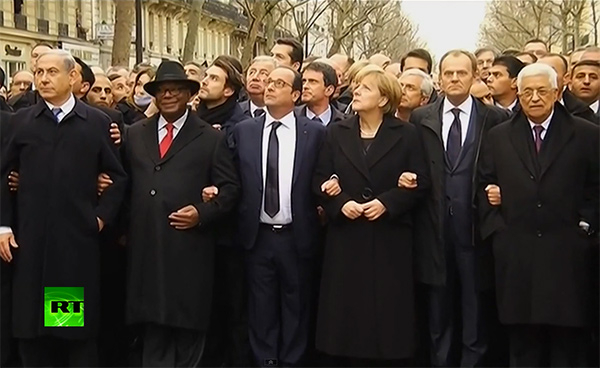
883World leaders link arms at the Paris anti-terror rally on January 11, 2014. Palestinian Authority President Mahmoud Abbas stands at the far right of the front row. (Image source: RT video screenshot)

Turkey, “named the world’s biggest jailor of journalists in 2012 and 2013” according to theWashington Post, was also there. Turkey “ended 2014 by detaining a number of journalists … including Ekrem Dumanli, editor in chief of Zaman, a leading newspaper” with links to an opposition movement.

Meanwhile, between January 8 and January 14, as over three million copies of Charlie Hebdowere selling out and four million more being printed, there was already talk in France of hardening its laws against free speech. So this may not be a turning point either for free speech or against radical Islam. So it may be a while before we can truly say, “Nous sommes Charlie.”

Jeremy Havardi is a historian and journalist based in London. His books include The Greatest Briton, analytical essays on Churchill.


[1] Ezra Levant, who reprinted the cartoons in Canada, was then compelled to appear before the Alberta Human Rights Commission to defend their publication, because of a complaint lodged by Syed Soharwardy of the Islamic Supreme Council of Canada and the Edmonton Council of Muslim Communities.

[2] As also was Lars Hedegaard (for speaking in his own drawing room), Suzanne Winters, Elisabeth Sabaditsch-Wolff, or at the very east need round-the-clock-bodyguards, such asFrench journalist Eric Zemmour, for saying that France might be facing a virtual civil war.

Sisi’s Brave New Egypt?

January 21, 2015

Sisi’s Brave New Egypt? Front Page Magazine, January 21, 2015

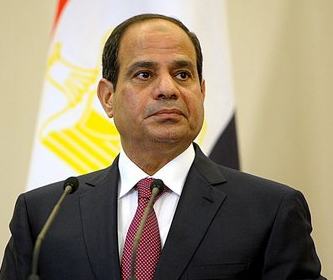
El-Sisi

Originally published by PJ Media.

Egyptian President Abdel Fattah al-Sisi continues to be the antithesis of longstanding mainstream media portrayals of him.

First there was his historic speech where he, leader of the largest Arab nation, and a Muslim, accused Islamic thinking of being the scourge of humanity—in words that no Western leader would dare utter. This remarkable speech—which some say should earn him the Nobel Peace Prize—might have fallen by the wayside had it not been posted on my website and further disseminated by PJ Media’s Roger L. Simon, Michael Ledeen, Roger Kimball, and many others, including Bruce Thornton and Robert Spencer.

Instead, MSM headlines on the day of and days after Sisi’s speech included “Egypt President Sisi urged to free al-Jazeera reporter” (BBC, Jan 1), “Egyptian gays living in fear under Sisi regime” (USA Today, Jan. 2), and “George Clooney’s wife Amal risks arrest in Egypt” (Fox News, Jan. 3).

Of course, the MSM finally did report on Sisi’s speech—everyone else seemed to know about it—but, again, to portray Sisi in a negative light. Thus, after briefly quoting the Egyptian president’s call for a “religious revolution,” the New York Times immediately adds:

Others, though, insist that the sources of the violence are alienation and resentment, not theology. They argue that the authoritarian rulers of Arab states — who have tried for decades to control Muslim teaching and the application of Islamic law — have set off a violent backlash expressed in religious ideas and language.

In other words, jihadi terror is a product of Sisi, whom the NYT habitually portrays as an oppressive autocrat—especially for his attempts to try to de-radicalize Muslim sermons and teachings (as discussed in this article).

Next, Sisi went to the St. Mark Coptic Cathedral during Christmas Eve Mass to offer Egypt’s Christian minority his congratulations and well wishing. Here again he made history as the first Egyptian president to enter a church during Christmas mass—a thing vehemently criticized by the nation’s Islamists, including the Salafi party (Islamic law bans well wishing to non-Muslims on their religious celebrations, which is why earlier presidents—Nasser, Sadat, Mubarak, and of course Morsi—never attended Christmas mass).

Accordingly, the greetings Sisi received from the hundreds of Christians present were jubilant. His address was often interrupted by applause, clapping, and cheers of “We love you!” and “hand in hand”—phrases he reciprocated. Part of his speech follows:

Egypt has brought a humanistic and civilizing message to the world for millennia and we’re here today to confirm that we are capable of doing so again. Yes, a humanistic and civilizing message should once more emanate from Egypt. This is why we mustn’t call ourselves anything other than “Egyptians.” This is what we must be—Egyptians, just Egyptians, Egyptians indeed! I just want to tell you that Allah willing, Allah willing, we shall build our nation together, accommodate each other, make room for each other, and we shall like each other—love each other, love each other in earnest, so that people may see… So let me tell you once again, Happy New Year, Happy New Year to you all, Happy New Year to all Egyptians!

Sisi stood side-by-side with Coptic Christian Pope Tawadros II—perhaps in remembrance of the fact that, when General Sisi first overthrew President Morsi and the Muslim Brotherhood, Pope Tawadros stood side-by-side with him—and paid a heavy price: the Brotherhood and its sympathizers unleashed a Kristallnacht of “reprisals” that saw 82 Christian churches in Egypt attacked, many destroyed.

It is also significant to recall where Sisi came to offer his well-wishing to the Christians: the St. Mark Cathedral—Coptic Christianity’s most sacred church which, under Muhammad Morsi was, for the first time in its history, savagely attacked, by both Islamists and the nation’s security (see pictures here).

Once again, all of this has either been ignored or underplayed by most mainstream media.

There is, of course, a reason the MSM, which apparently follows the Obama administration’s lead, has been unkind to Sisi. One will recall that, although Sisi led the largest revolution in world history—a revolution that saw tens of millions take to the streets and ubiquitous signs and banners calling on U.S. President Obama and U.S. ambassador to Egypt Anne Patterson to stop supporting terrorism (i.e., the Brotherhood)—U.S. leadership, followed by media, spoke only of a “military coup” against a “democratically elected president,” without pointing out that this president was pushing a draconian, Islamist agenda on millions who rejected it.

So what is the significance of all this—of Sisi? First, on the surface, all of this is positive. That Sisi would criticize the Muslim world and Islamic texts and thinking—in ways his Western counterparts could never—and then continue his “controversial” behavior by entering the Coptic Christian cathedral during Christmas mass to offer his greetings to Christians—a big no-no for Muslim leaders—is unprecedented. Nor can all this be merely for show. In the last attack on a Coptic church, it was two Muslim police officers guarding the church who died—not the Christian worshipers inside—a rarity.

That Sisi remains popular in Egypt also suggests that a large percentage of Egyptians approve of his behavior. Recently, for instance, after the Paris attacks, Amru Adib, host of Cairo Today, made some extremely critical comments concerning fellow Muslims/Egyptians, including by asking them “Are you, as Muslims, content with the fact that today we are all seen as terrorists by the world?… We [Egyptians] used to bring civilization to the world, today what? — We are barbarians!  Barbarians I tell you!” (More of Adib’s assertions here.)

That said, the others are still there—the Muslim Brotherhood, the Salafis, those whom we call “Islamists,” and their many sympathizers and allies.

Worst of all, they have that “corpus of [Islamic] texts and ideas” that has been “sacralized over the centuries” (to use Sisi’s own words) to support them—texts and ideas that denounce Sisi as an “apostate” deserving of death, and thus promising a continued struggle for the soul of Egypt.

Op-Ed: The West Cannot Win this War

January 19, 2015

Op-Ed: The West Cannot Win this War, Israel National News, Giulio Meotti, January 19, 2015

(Can’t win, or refuses to win? — DM)

Take another look at the video filmed under the Charlie Hebdo’s building, the black car of the terrorists who had no fear of death and are advancing by shooting, while the white car of the policemen is forced to retreat.

We are capitulating.

The West cannot win this war. Take the last French mass rally with dozens of heads of states from around the world: it was a silent march, a mute show where nobody took the podium. As if these people didn’t know what to say. As if these Western leaders didn’t really believe in what they were doing in Paris.

A few days ago, Martin Wolf in the British daily Financial Times gave voice to the deep estrangement of Europe’s élite. He suggested using massive doses of multicultural recognition of equality between different cultures in order to combat Islamism. Mr. Wolf is implicitly saying that we must surrender, that we cannot win, that we have to contain terror and finally find a way to coexist with it.

The French horror doesn’t lie in the killings per se. A few hours later, in Nigeria, Boko Haram destroyed many villages and burned hundreds of people to death. Europe’s horror lies in the fact that the terrorists came from the heart of the continent. The Chouaci’s brothers, the British bombers and Theo Van Gogh’s killer didn’t came from Raqqa, in Syria, or Al Qaeda in Yemen. No, they were born and raised in European democracies.

Europe gave everything to these terrorists: schools, education, entartainment, sexual pleasures, salaries and freedom. The French terrorists rejected the French values of liberté, egalité and fraternité; the British suicide bombers rejected British multiculturalism, while Dutch terrorist Mohammed Bouyeri, who slaughtered the film maker in Amsterdam, rejected the Dutch mute values of moral indifference.

A few days ago, I was talking with Flemming Rose, the Danish journalist who first published the cartoons in 2006 and now lives protected by the police. He told me the shocking truth nobody wants to hear:

“I am pretty pessimistic about the future of free speech, though I am delighted that so many people came out to support Charlie Hebdo”, Rose told me. “I knew several of the cartoonists who were killed, and I was a witness in a criminal case against CH in 2007. My fear is that this support will not translate into real decisions and changed behavior when we get back to our day-to-day life. We have seen that before. Madrid 2004, Theo van Gogh 2004, London 2005, Kurt Westergaard 2008 and 2010 (one planned attack and another real attack in which he was nearly killed). Every time lots of support and solidarity with the victims, but very little has changed in reality, quite to the contrary, apart from CH no European newspapers have dared to publish Mohammed cartoons since 2008”.

Charlie Hebdo’s journalists were brave people, defiant, but if they are the Western heroes, we have already lost. “Charb” and the other cartoonists didn’t believe in anything.

A few years ago, at my newspaper in Italy. I suggested we publish a letter that Mohammed Bouyeri released from his Dutch prison. Bouyeri says he does not feel remorse for what he did. The tone of the letter is marked by a kind of puerile candor. Bouyeri never mentions Van Gogh, but he makes it clear that he has fulfilled a religious duty by killing him.

The West cannot win this war. The price it would have to pay is the loss of European values: reducing the civil rights of many people, deporting them, declaring a war of values, sending boots on the ground in the Middle East, imposing Western civilization on them. Europe will never do that. Europe itself doesn’t believe in these values anymore. This is also one of the reason why Europe hates Israeli Jews who daily confront evil and fight it, so deeply.

The terrorists of Charlie Hebdo talk a religious language and use terms like honor, faith, prophet and loyalty, while the West replies to them with words such as freedom, democracy, rights, respect and tolerance. They speak theology, we reply with logic. They use bullets, we march in the streets.

It is a sad joke. The truth is that people in the West are relieved that they don’t have to fight, that we are surrendering, that life goes on as usual. Hurray, we are capitulating!

Meet the honor brigade, an organized campaign to silence debate on Islam

January 17, 2015

Meet the honor brigade, an organized campaign to silence debate on Islam, Washington Post, Asra Q. Nomani, January 16, 2015

(It’s encouraging to read that a few actually moderate Muslims are slowly bringing modest changes to a few who practice the Religion of the Perpetually Offended and Violent. However, much more and a long time will be needed before significant numbers of “moderate” and “non-extremist” Muslims begin to accept freedoms for themselves and for others and to reject Sharia law in its present and historic form.  Until then?– DM)

[W]e need a new interpretation of Islamic law in order to change the culture. This would require rejecting the eight schools of religious thought that dominate the Sunni and Shiite Muslim world. I propose naming a new one after ijtihad, the concept of critical thinking, and elevating self-examination over toxic shame-based discourse, laws and rules.

********************

“You have shamed the community,” a fellow Muslim in Morgantown, W.Va., said to me as we sat in a Panera Bread in 2004. “Stop writing.”

Then 38, I had just written an essay for The Washington Post’s Outlook section arguing that women should be allowed to pray in the main halls of mosques, rather than in segregated spaces, as most mosques in America are arranged. An American Muslim born in India, I grew up in a tolerant but conservative family. In my hometown mosque, I had disobeyed the rules and prayed in the men’s area, about 20 feet behind the men gathered for Ramadan prayers.

Later, an all-male tribunal tried to ban me. An elder suggested having men surround me at the mosque so that I would be “scared off.” Now the man across the table was telling me to shut up.

“I won’t stop writing,” I said.

It was the first time a fellow Muslim had pressed me to refrain from criticizing the way our faith was practiced. But in the past decade, such attempts at censorship have become more common. This is largely because of the rising power and influence of the “ghairat brigade,” an honor corps that tries to silence debate on extremist ideology in order to protect the image of Islam. It meets even sound critiques with hideous, disproportionate responses.

The campaign began, at least in its modern form, 10 years ago in Mecca, Saudi Arabia, when the Organization of Islamic Cooperation — a mini-United Nations comprising the world’s 56 countries with large Muslim populations, plus the Palestinian Authority — tasked then-Secretary General Ekmeleddin Ihsanoglu with combating Islamophobia and projecting the “true values of Islam.” During the past decade, a loose honor brigade has sprung up, in part funded and supported by the OIC through annual conferences, reports and communiques. It’s made up of politicians, diplomats, writers, academics, bloggers and activists.

In 2007, as part of this playbook, the OIC launched the Islamophobia Observatory, a watchdog group based in Jiddah, Saudi Arabia, with the goal of documenting slights against the faith. Its first report, released the following year, complained that the artists and publishers of controversial Danish cartoons depicting the prophet Muhammad were defiling “sacred symbols of Islam . . . in an insulting, offensive and contemptuous manner.” The honor brigade began calling out academics, writers and others, including former New York police commissioner Ray Kelly and administrators at a Catholic school in Britain that turned away a mother who wouldn’t remove her face veil.

“The OIC invented the anti-‘Islamophobia’ movement,” says Zuhdi Jasser, president of the American Islamic Forum for Democracy and a frequent target of the honor brigade. “These countries . . . think they own the Muslim community and all interpretations of Islam.”

Alongside the honor brigade’s official channel, a community of self-styled blasphemy police — from anonymous blogs such as LoonWatch.com and Ikhras.com to a large and disparate cast of social-media activists — arose and began trying to control the debate on Islam. This wider corps throws the label of “Islamophobe” on pundits, journalists and others who dare to talk about extremist ideology in the religion. Their targets are as large as Israeli Prime Minister Benjamin Netanyahu and as small as me.

The official and unofficial channels work in tandem, harassing, threatening and battling introspective Muslims and non-Muslims everywhere. They bank on an important truth: Islam, as practiced from Malaysia to Morocco, is a shame-based, patriarchal culture that values honor and face-saving from the family to the public square. Which is why the bullying often works to silence critics of Islamic extremism.

“Honor brigades are wound collectors. They are couch jihadis,” Joe Navarro, a former supervisory special agent in the FBI’s behavioral analysis unit, tells me. “They sit around and collect the wounds and injustices inflicted against them to justify what they are doing. Tragedy unites for the moment, but hatred unites for longer.”

In an e-mail exchange, the OIC’s ambassador to the United Nations denied that the organization tries to silence discussion of problems in Muslim communities.

The attacks are everywhere. Soon after the Islamophobia Observatory took shape, Sheik Sabah Ahmed al-Sabah, the emir of Kuwait, grumbled about “defamatory caricatures of our Master and Prophet Muhammad” and films that smear Islam, according to the OIC’s first Islamophobia report.

The OIC helped give birth to a culture of victimization. In speeches, blogs, articles and interviews widely broadcast in the Muslim press, its honor brigade has targeted pundits, political leaders and writers — from TV host Bill Maher to atheist author Richard Dawkins — for insulting Islam. Writer Glenn Greenwald has supported the campaign to brand writers and thinkers, such as neuroscientist and atheist Sam Harris, as having “anti-Muslim animus” just for criticizing Islam.

“These fellow travelers have made it increasingly unpleasant — and even dangerous — to discuss the link between Muslim violence and specific religious ideas, like jihad, martyrdom and blasphemy,” Harris tells me.

Noticing the beginnings of this trend in December 2007, a U.S. diplomat in Istanbul dispatched a cable to the National Security Council, the CIA, the Defense Intelligence Agency and various State Department offices. The cable said the OIC’s chief called supporters of the Danish cartoons of Muhammad “extremists of freedom of expression” and equated them with al-Qaeda.

Most of the criticism takes place online, with anonymous bloggers targeting supposed Islamophobes. Not long after the cable, a network of bloggers launched LoonWatch, which goes after Christians, Jews, Hindus, atheists and other Muslims. The bloggers have labeled Somali author Ayaan Hirsi Ali, a born Muslim but now an atheist opponent of Islamic extremism, an “anti-Muslim crusader.” Robert Spencer, a critic of extremist Islam, has been called a “vicious hate preacher” and an “Internet sociopath.” The insults may look similar to Internet trolling and vitriolic comments you can find on any blog or news site. But they’re more coordinated, frightening and persistent.

One prominent target of the honor brigade’s attacks was Charlie Hebdo, the French newspaper where several staffers were recently killed by Islamic extremists. According to some accounts, as the killers massacred cartoonists, they shouted: “We have avenged the prophet Muhammad.” The OIC denounced the killings, but in a 2012 report, it also condemned the magazine’s “Islamophobic satires.” Its then-secretary general, Ihsanoglu, said the magazine’s “history of attacking Muslim sentiments” was “an outrageous act of incitement and hatred and abuse of freedom of expression.”

Charlie Hebdo is not the only evidence that, to self-appointed defenders of the faith, a call to kill the message can very easily become a plan to kill the messenger. In January 2011, a security officer for the governor of Pakistan’s Punjab province, Salman Taseer, assassinated him after Taseer defended a Christian woman accused of blasphemy. In court, supporters laid flowers on the shoulders of the assassin in approval.

Murderers like him would be much harder to radicalize in a climate that welcomed debate about Islam rather than seeking revenge on its critics. But in so many Muslim communities now, saving face trumps critical thinking and truth-telling. This is why reform from within Islam is so difficult. In my experience, if you try to hold the community accountable, you’re more likely to be bullied and intimidated than taken seriously.

When Rupert Murdoch recently tweeted, “Maybe most Moslems peaceful, but until they recognize and destroy their growing jihadist cancer they must be held responsible,” he was criticized for indelicately saying all Muslims were responsible for the acts of a few. But I do believe we bear collective responsibility for the problems in our communities.

After my threatening meeting at Panera, I kept advocating for women’s rights in the mosque and in the bedroom. Among other things, I argued that Muslim women have the right to orgasm, an intimacy too often denied in societies with a tradition of female genital mutilation.

Then came the death threats. In the fall of 2004, my parents and my son picked me up after I spoke at a conference. “Somebody wants to kill you,” my father said from behind the wheel of our gold Dodge Caravan, his voice trembling. The death threat was posted on Muslim WakeUp!, a now-defunct progressive Web site. The offender told the FBI that he would stop harassing me, and he did. More prosaic taunts in the past decade have called me a “Zionist media whore,” a “House Muslim” and many other unprintable insults.

Two years ago, Zainab Al-Suwaij, executive director of the American Islamic Congress, was so battered by online attacks aimed at silencing her that she experienced a physical response to the stress and anxiety, and ended up in an emergency room. When I met her in her office near the White House, she pulled up her sleeves to show me the marks left by IV injections that the hospital staff had administered to get her necessary fluids.

“The attacks just killed me,” Al-Suwaij said, wearily.

Bullying this intense really works. Observant members of the flock are culturally conditioned to avoid shaming Islam, so publicly citing them for that sin often has the desired effect. Non-Muslims, meanwhile, are wary of being labeled “Islamophobic” bigots. So attacks against both groups succeed in quashing civil discourse. They cause governments, writers and experts to walk on eggshells, avoiding important discussion.

For my part, I have continued to write, calling on American Muslims to root out extremism in our communities and arguing that certain passages of the Koran are too antiquated for our times. As I see it, the injunction to “stand out firmly for justice even against . . . your kin” is our divine “See something, say something” mandate. But too often, this passage is misused as a justification for attacking our own.

While we still have a long way to go, I have seen progress since I started calling for women’s rights in mosques and challenging the extremism I saw in American Muslim communities. Our mosque in Morgantown, a mostly male congregation, elected its first female president a few years ago, and she was largely accepted as a leader. But most women still shuffle through the back door and pray in a separate balcony.

Four years ago, the Muslim Public Affairs Council, an advocacy group, announced programs to discuss “taboo topics” such as homosexuality, interfaith marriage and extremism. Recently, young Muslim leaders in Northern Virginia started an initiative to create mosques that promote assimilation, interfaith harmony and women’s rights. Later this month, a new group, the Women’s Mosque of America, will hold a female-led prayer service in Los Angeles, a rare event in Muslim communities.

Next month, the Obama administration will hold a conference on challenging violent extremism, and President Obama last year called on Muslim communities to “explicitly, forcefully and consistently reject the ideology of al-Qaeda and ISIL.” But his administration isn’t framing extremism as a problem directly tied to Islam. Last month, by contrast, Egyptian President Abdel Fatah al-Sissi acknowledged that there was an ideology problem in Islam and said, “We need to revolutionize our religion.”

When I heard Sissi’s words, I thought: Finally.

Beyond these statements, though, we need a new interpretation of Islamic law in order to change the culture. This would require rejecting the eight schools of religious thought that dominate the Sunni and Shiite Muslim world. I propose naming a new one after ijtihad, the concept of critical thinking, and elevating self-examination over toxic shame-based discourse, laws and rules. Such a project could take the power out of the hands of the status quo clerics, politicians and experts and replace it with a progressive interpretation of faith motivated not by defending honor but acting honorably.

Don’t ignore the writing on the wall

January 16, 2015

Don’t ignore the writing on the wall, Israel Hayom, Yoram Ettinger, January 16, 2015

(It’s much easier and much less stressful to look forward to hope and change. Briefly. –DM)

Since the 1993 Oslo Accord, Western democracies have refrained from reading the writing on the Palestinian (Mahmoud Abbas and Hamas) wall: hate education in grades K-12; unprecedented terrorism; systematic noncompliance with agreements; naming squares, streets and tournaments after terrorists; monthly allowances for families of terrorists; responding to Israeli withdrawals with intensified terror.

Hitler’s master plan was outlined in 1925-26 in the two volumes of the supremacist, anti-Jewish “Mein Kampf” (“My Struggle”), which is currently a best-seller in the Muslim world, particularly in Iran and the Palestinian Authority.

***************

In 539 B.C.E., Babylonian King Belshazzar ignored the writing on the wall — as interpreted by the Prophet Daniel — and was, therefore, annihilated by the Persians (Daniel 5).

In 2015, Western civilizations must read the writing on the wall, desist from ambiguity, denial and political correctness and embrace clarity, realism and political incorrectness, in order to survive and overcome the clear and present lethal threat of Islamic takeover, which is gathering momentum via demographic, political and terroristic means.

History proves that Western ambiguity and the refusal to identify enemies — due to ignorance, gullibility, oversimplification, appeasement, delusion and wishful thinking — have taken root, yielding major strategic setbacks and painful economic and human losses. When it comes to reading the writing on the wall, Western eyesight has been far from 20:20, dominated by modern day Belshazzars, ignoring modern day Daniels.

For example, during the 1930s, the writing was on the wall in glaring letters: Germany abrogated the Treaty of Versailles, which called for German disarmament, reparations and territorial concessions; German military spending skyrocketed, military conscription was reintroduced and the Rhineland was remilitarized; Germany withdrew from the League of Nations and annexed Austria. Still, on September 30, 1938, British Prime Minister Neville Chamberlain signed the Munich Pact, declaring “peace for our time.” He refused to recognize Hitler’s strategic, global, supremacist goal, assuming that Hitler’s appetite could be satisfied with a tactical, limited gain in Czechoslovakia’s Sudetenland, signing a “peace accord” that triggered the “war of all wars.”

Hitler’s master plan was outlined in 1925-26 in the two volumes of the supremacist, anti-Jewish “Mein Kampf” (“My Struggle”), which is currently a best-seller in the Muslim world, particularly in Iran and the Palestinian Authority.

During 1977-79, U.S. President Jimmy Carter did not read the writing on the wall, supporting the Ayatollah Ruhollah Khomeini’s battle against the Shah of Iran, who was, in fact, the U.S.’s policeman in the Persian Gulf. Overwhelmed by denial and wishful thinking, and heavily influenced by the U.S. foreign policy establishment, Carter ignored the litany of sermons delivered by Khomeini, which exposed the Iranian cleric as an enemy of Western civilization and civil liberties. He despised the U.S. and aligned himself with the enemies of the U.S., while protected by a Palestinian PLO praetorian guard. Thus, the U.S. betrayal of the Shah eliminated a most effective and loyal strategic partner of the U.S., gave rise to the most lethal, conventional and nonconventional threat to vital U.S. interests in the Persian Gulf, the Middle East and beyond and generated a robust tailwind to Islamic terrorism.

In 1990, on the eve of Saddam Hussein’s invasion of Kuwait, the U.S. stated that an Iraq-Kuwait military clash would be an intra-Arab, rather than a U.S., concern. The Bush/Baker administration assumed that “the enemy of my enemy [Iran] is my friend [Iraq],” supplying Saddam with dual-use sensitive systems, providing him with $5 billion loan guarantees and concluding a U.S.-Iraq intelligence sharing agreement. The 1990 policy of denial triggered a conventional conflict, a $1.25 trillion cost to the U.S. taxpayer, 4,500 U.S. military fatalities, a surge of anti-U.S. Islamic terrorism and a dramatic destabilization of the Persian Gulf.

Since the 1993 Oslo Accord, Western democracies have refrained from reading the writing on the Palestinian (Mahmoud Abbas and Hamas) wall: hate education in grades K-12; unprecedented terrorism; systematic noncompliance with agreements; naming squares, streets and tournaments after terrorists; monthly allowances for families of terrorists; responding to Israeli withdrawals with intensified terror.

In 2011, Western democracies denied the eruption of an Arab tsunami, welcoming the violence on the Arab Street as an Arab Spring that would transition the Arabs toward democracy. The Obama administration embraced the Muslim Brotherhood (while giving a cold shoulder to Gen. Abdel-Fattah el-Sissi), refusing to recognize its well-documented intra-Arab terrorism, the offshoot of its motto: “Allah is our objective; the Quran is the constitution; the prophet is our leader; jihad is our way; death for the sake of Allah is our wish.”

The 2015 failure to carefully read the Iranian writing on the wall could produce a nuclear conflict that would cost the U.S. taxpayer trillions of dollars, incur an unprecedented level of fatalities, spark a tidal wave of Islamic terrorism throughout the globe, including in the U.S., decimate the pro-U.S. Arab regimes in the Persian Gulf and Jordan, create an unprecedented disruption of the supply of Persian Gulf oil, further radicalization of the anti-U.S. regime in Venezuela with ripple effects in Latin America, including Mexico, and additional tectonic eruptions of insanity throughout the globe.

At stake is not only freedom of expression and the safety of European Jewry, but the survival of Western democracies.

Solidarity demonstrations and eloquent speeches will not spare Western democracies the wrath of Islamic terrorism and domination, unless accompanied by clarity, realism and the willingness to take military, legislative and political action to thwart the writing on the walls of the mosques: submission of humanity to the Prophet Muhammad; submission of the Christian, Hindu, Buddhist, Sikh and Jewish kuffar (“infidel”) to Muslims and to Shariah laws; jihad — holy war on behalf of Islam — is the duty of Muslims; waqf — Muslim land — is ordained by Allah; Dar al-Islam (the residence of Islam) must take over Dar al-Harb (the residence of war); and Islam-sanctioned taqiyya (dissimulation, deception and concealment of inconvenient data) aimed at shielding Islam and “believers” from “disbelievers.”

Isolated incidents or global war?

January 16, 2015

Isolated incidents or global war? Israel Hayom, Dore Gold, January 16, 2015

[V]irtually all these radical Islamic leaders see themselves as in no less than a civilizational battle with the West. There have been those who do not want to depict this struggle in this way, including those in the West who, out of political correctness, refuse to discuss the threat of radical Islam.

***************

In response to the first attack in Paris on the offices of the French satirical magazine Charlie Hebdo, a member of a jihadi forum, affiliated with ISIS, wrote a very striking explanation as to why France in particular was targeted. As is usual in the jihadi world, which seeks to return to the early days of Islam centuries ago, history played an important role in his thinking: “France was one part of the Islamic land and it will be Islamic again.

What was he talking about? For years, global jihadi organizations have issued calls to retake al-Andalus, the Arabic name for Spain and those parts of the Iberian peninsula when they were held by the Muslims from 711 until 1492. This last summer ISIS members produced a video calling for the liberation of al-Andalus. But, it is often forgotten that shortly after the conquest of Spain, an Arab army crossed the Pyrenees and occupied territories that today are part of France. Having captured Bordeaux, it was met and defeated in 732 by a Frankish army led by Charles Martel at the Battle of Tours — some 200 miles from Paris. Even after this historical battle, Arab armies did not halt their efforts to seize French territory. They in fact reached Lyons and threatened to occupy all of Provence. In fact, parts of France remained under Islamic rule until 759, when Narbonne, the main base of the invading Arab armies, fell.

Whether or not the attack in France was motivated by such historical memories, the passion to recover lost territories that were once under Islamic rule is a theme running through most of the organizations associated with the global jihadist network. It was no less than Hassan al-Banna, the founder of the Muslim Brotherhood, who first articulated this theme: “Andalusia, Sicily, the Balkans, South Italy and Roman Sea Islands were all Islamic lands that had to be restored to the homeland of Islam; the Mediterranean and Red Sea should equally be part of the Islamic Empire as they were before.” Al-Banna’s writings, which are to this day still revered by most of the radical Islamic movements, are available on the internet today in Arabic and even in English.

In recent times, this ideological orientation of the Muslim Brotherhood has been best represented by Sheikh Yusuf Qaradawi, who is based in Qatar. Regarded by many as the highest spiritual authority in the Muslim Brotherhood, Qaradawi appeared on Qatari television in 2007 and declared: “I expect that Islam will conquer Europe without resorting to the sword or fighting. It will do so by means of da’wa (proselytizing) and ideology.” The only geographic points he mentioned in relationship to this expansion of the Islamic realm were as follows: “The conquest of Rome — the conquest of Italy, and Europe — means that Islam will return to Europe once again.”

Qaradawi, who appeared weekly on Al Jazeera, gave his patronage to a Muslim Brotherhood facility in a French chateau where Islamists used to train European Imams. Thousand of young Muslims were bussed into this retreat center. In short, Qaradawi’s ideas had multiple platforms through which they could spread.

There were other organizations that took Qardawi’s declarations a step further. Hamas, which is after all the Palestinian branch of the Muslim Brotherhood, has also made similar statements. Sheikh Younus al-Astal, who has had a leading role within the supreme religious body of Hamas (the Association of the Religious Scholars of Palestine) gave the following sermon in 2008 that was broadcast on Hamas television: “Very soon, Allah willing, Rome will be conquered, just like Constantinople was, as was prophesied by our Prophet Muhammad.” He then spoke about how the “Islamic conquests … will spread through Europe in its entirety” and beyond.

Dabiq, a journal published by ISIS, also deals with the conquest of Rome. The journal recently put on its cover a picture of Saint Peter’s Square in Rome; the editors manipulated the photograph and put the flag of ISIS on the obelisk in the center. The journal also quotes the founder of al-Qaida in Iraq, Abu Musab al-Zarqawi, as saying: “We fight here while our goal is Rome.” Before he led the insurgency in Iraq against the U.S. and its allies, Zarqawi actually set up a terrorist network for operations on European soil.

Recep Tayyip Erdogan’s Turkey, under the ruling AKP Party, has also taken up the cause of recovering lost Islamic lands. In 2004, a U.S. State Department official sent a cable to Washington warning that at an event held at the AKP’s main think tank, he heard the idea voiced that Turkey’s role is to spread Islam in Europe, and “avenge the defeat at the siege of Vienna in 1683.” The cable linked a high level Turkish official with this view. It was made public by WikiLeaks.

What all these statements teach us is that virtually all these radical Islamic leaders see themselves as in no less than a civilizational battle with the West. There have been those who do not want to depict this struggle in this way, including those in the West who, out of political correctness, refuse to discuss the threat of radical Islam. They also cling to the mistaken idea that the Muslim Brotherhood can become an ally against al-Qaida and its affiliates.

Last week, on January 9, the American journal National Review published emails, leaked from an Al Jazeera producer, about the attacks in France. He sought to play down the significance of the terror in Paris, rejecting the notion that this was a “civilizational attack on European values.” He insisted that no one knows the motivation behind the attacks, suggesting perhaps that it was a reaction to France’s military actions against ISIS, or its operations in Libya and Mali.

In other words, the Al Jazeera producer did not want his network to admit that the attack in Paris was motivated by an aggressive Islamist ideology, but rather preferred to blame Western policies, which if it became widely accepted would cripple its leaders and deny them the self-confidence to take any effective action. That is what has largely happened until now. It is no wonder that Al Jazeera, whose headquarters is located in Qatar, has been correctly described as the satellite channel of the Muslim Brotherhood.

In contrast, Ghassan Charbel, the editor-in-chief of Al Hayat, the leading newspaper in the Arab world, on Monday refused to play down the Paris attacks as a unique, one-time event: “No one can disregard the scale of the problem and the extent of the threat any more.” Defying the political correctness of many of the world’s capitals, he bravely told the truth about what was happening: “What is clear is that the Paris attack is just the opening shot of a global war that the Islamist extremists will be waging in the West and the rest of the world.” He had no qualms about saying that the problem was the threat of radical Islam. Until the West internalizes his warning of what it is facing, unfortunately a new wave of attacks in the West will only be a matter of time.

Allies Know They Haven’t “Got a Friend” in Obama’s America

January 16, 2015

Allies Know They Haven’t “Got a Friend” in Obama’s America, Commentary Magazine, January 16, 2015

[T]he French and the rest of Europe know very well that the last thing they can count on in a crisis is the willingness of the Obama administration to “be there” for their oldest ally or anyone else for that matter.

In a week when French officials were rightly calling on the world to join them in the fight against Islamist terror, Washington was dithering and couldn’t even force itself to say the word “Islamist.”

***************

One of the basic rules of satire is that it is virtually impossible to satirize something that is already inherently ridiculous. That axiom is brought to mind as America belatedly sought to reaffirm its friendship with France in the wake of the administration’s decision to snub the Paris unity rally that commemorated the terror attack on the Charlie Hebdo office and a kosher market. Neither the president nor the vice president or even Secretary of State John Kerry bothered to come to a gathering attended by over 40 world leaders. But to make up for this, Kerry brought folk rock singer James Taylor to Paris to serenade French officials with a version of Carol King’s classic ballad, “You’ve Got a Friend.” This is something so absurd that it isn’t clear even the cleverest minds at Saturday Night Live or even Charlie Hebdo could adequately convey the sophomoric nature of a lame attempt to make up for a gaffe. While the real problem is the administration’s lack of comfort in standing up for the rights of cartoonists to offend Islamists as evidenced by the decision to stay away from the rally, it also tells us something significant about the inadequate man who is serving as the nation’s chief diplomat.

That Kerry would think schlepping an aging rock icon from his youth to Paris to tell the French that “all you’ve got to do is just ca-aall” if they need us is the sort of thing that makes one longs for the diplomacy of an earlier era when envoys wore uniforms, swords, and feathered hats and stuck to rigid formality.

That’s not just because such a gesture is jejune as well as puerile, though it is both of those things as well as a clear reflection of Kerry’s lack of seriousness as a public official. It’s that the French and the rest of Europe know very well that the last thing they can count on in a crisis is the willingness of the Obama administration to “be there” for their oldest ally or anyone else for that matter.

This is an administration that has spent six years offending and snubbing allies all the while seeking in vain to appease old foes and rivals such as Russia and Iran. Though U.S. and French policies often intersect, Paris and the rest of Europe have come to understand that Obama is as uninterested in their point of view or their needs as he is of those of congressional Republicans. In a week when French officials were rightly calling on the world to join them in the fight against Islamist terror, Washington was dithering and couldn’t even force itself to say the word “Islamist.”

As is well known, French opinion about the United States is decidedly mixed with resentment of American wealth and culture often overwhelming the basic commonality of interests shared by two great democracies. A James Taylor concert won’t make things much worse but neither will it improve the situation. What it will do is to remind Europe and those enemies once again that this is an administration that neither understands symbolism or how to reaffirm an alliance.

It is no small irony that an administration that came into office determined to work with the international community, and our allies rather than to be Bush-like unilateral cowboys, is now reduced to this sort of nonsense. What the French or any ally wants is not a touchy-feely Oldies song but a sense that the U.S. believes it is still part of the war against international terror. To the contrary, Obama’s instincts are such that allies have come to expect his contempt or disinterest in their problems.

Kerry’s cringe-inducing turn hosting his friend Taylor isn’t the dumbest thing he has done at the State Department by a long shot. Having faith in Mahmoud Abbas as a champion of peace and signing a weak nuclear deal with Iran are hard to top. But is an iconic moment that will symbolize Obama and Kerry’s ham-handed approach to allies. A song, even a folk rock classic that allows Kerry to reminisce about his youth spent falsely testifying against his fellow Vietnam vets, can’t substitute for a strong stand against Islamists or even the ability to say the word. Prior to this, it was possible to argue that U.S. foreign policy had become a joke. But after Taylor had finished warbling, even the president and his inner White House circle must be wondering what sort of a fool they’ve unleashed on the world.