Archive for the ‘“Fake news”’ category

All the News the Editors See Fit to Print

December 18, 2016

All the News the Editors See Fit to Print, American Thinker, Clarice Feldman, December 18, 2016

Decades ago while in high school I read John Dos Passos’s USA. It was published in the 1930s before television or cable news. But it presaged well the strange mixture of important and ridiculous news we receive today. News today is largely fashioned into narratives by mostly young, unworldly reporters and biased news editors, repeated on TV by well-coiffed, fashionably garbed and cosmetically buffed up news readers, jazzed up by often highly biased photo editors and presented on a plate to passive consumers.

When I read USA, my hometown had — like most larger cities — two major newspapers, one liberal, the other conservative, and like most homes we got both and read both so we had a fairer picture of what was happening in the world. The reporters were often grizzled veterans of the world who drank hard, smoked a lot, and believed no one or nothing without evidence.

With the advent of television and the monopolization of print markets it seems to me we lost the ability to forensically analyze the news; we have become passive consumers and got what we deserved — propaganda, largely megaphoning the increasingly leftward tilt of the Democratic Party and various “nonprofit” organizations who promote scare stories about food, health, and the weather and challenge wars  only when a Republican is in office. To be sure, there are some fine people (operating largely online) who take the time to read the accounts with a critical eye. Among the best are James Taranto of the Wall Street Journal, bloggers Don Surber, Glenn Reynolds, Sheryl Attkisson, and Tom Maguire. If you read them daily you may reacquire this lost, but important art.

This week the clash between fake and real news became even more obvious.

Sharyl Attkisson who has sued the Department of Justice and the U.S. Postal Service for matters relating to intrusions on her computer and who is known for her outstanding reportage, took aim this week at the Obama-Clinton suggestion that Clinton lost because of fake news reports. Obama called “fake news” a “dust cloud of nonsense” and Clinton dubbed it “an epidemic”.

My online friend Matt Holtzmann has some questions about this:

So the president lectured the media and the masses on fake news during his press conference today. Does that include the Journo-List? Does it include enlisting the National Endowment for the Arts to engage in a propaganda campaign for Obamacare? Does it include the video that Hillary Clinton broadcast on Pakistani network television blaming an obscure video? Does it include “if you like your doctor, you can keep your doctor’? Does it include his visits to the fake news shows? [ed: Like the Daily Show and Colbert]

Attkisson herself also weighed in on the issue:

Wednesday on Newsmax TV’s “The Steve Malzberg Show,” while discussing the 2016 presidential election’s fake new controversy, “Full Measure” host Sharyl Attkisson said fake news is a “propaganda campaign” to censor truth started by politicians like President Barack Obama and Clinton ally the founder of Media Matters Democratic operative David Brock.

Attkisson said, “Before about September 13, if you searched the news you won’t find many or any mentions of fake news. But as soon as there was, in my view, a propaganda campaign to put this on the plate of the American public, the news media and politicians including President Obama went hog wild with the term and it started making headlines every day. It wasn’t a new invention.”

“And yes, fake news exists but the idea that there is this huge campaign behind it to controversialize certain reports and censor, in my view, certain views is a propaganda campaign,” she continued. “And I think when David Brock, Hillary Clinton’s ally from Media Matters, announced that he would be the arbitrator, or help be the arbitrator, of so called fake news, that sort of sealed the deal that the whole thing is a propaganda effort and a political effort, not really an honest effort to seek out facts, but more to determine for other people what truth they should hear.”

Right on cue, Facebook announced it was empaneling a group of outsiders, including Politifact, Snopes, ABC, AP, the Washington Post and Poynter’s IPCN to announce to readers which sites are fake and to jiggle with the news feed to spare the readers from seeing them often.

Obviously, this is intended to shield Facebook from liability for news posted on the site, but it appears ill considered. The far left manipulator George Soros, for example, funds Poynter. AP regularly shades its stories, as my editor friend in upstate New York, Steven Waters, keeps noting, and the Washington Post just admitted this week it had posted a fake list of fake news sites.

As for the news organization fact checkers, James Taranto has regularly exposed them as – well — fakes, the way he nailed Politifact years ago:

PolitiFact’s 2013 “Lie of the Year” was the central ObamaCare fraud: “If you like your plan, you can keep your plan.” As this column noted at the time, the site had previously certified the promise as “true” (2008), then equivocated and labeled it “half true” in both 2009 and 2012.

Everyone’s entitled to his own opinion, but “fact checkers” think they’re entitled to call their own opinions facts. As the president perpetrated a fraud on American consumers, journalists have often helped him along. They would never dream of doing the same for an unscrupulous CEO of, say, a beer company.

This week, he covered more of the “fact checkers” and reminded us of Politifact’s song and dance on ObamaCare:

To be sure, in 2008 and 2009 the claim was not yet a lie, merely a promise; and in 2012 it was not a demonstrable lie, or at least not as clearly demonstrable as it was when policyholders had in fact started losing their plans. But it is difficult to understand how a categorical promise could be “half” true at any stage. (Maybe ObamaCare should be renamed Schrödinger’s Care.) And a promise is not a factual claim at all, so its truth or falsity is purely a matter of opinion.

Others have noted that PolitiFact has often given different ratings to what were substantively the same statements from different sources, usually with Democrats getting the benefit of the doubt when compared with Republicans.

On FNC, Tucker Carlson has been exposing real fake news and newsmakers.

Take the concession he got from Matt Cooper, Newsweek’s editor, that the commemorative issue of Hillary’s electoral victory, accidentally shipped out before the returns came in, was ridiculous and had never been seen by Newsweek’s editors, and Carlson’s mind-boggling interview with the wacky Newsweek reporter who claimed out of thin air that Trump had once been institutionalized for mental illness.

Iowahawk could not contain himself at the news AP was going to be on the prowl for fake news and tweeted:

“In related news, Anthony Weiner announces he will be working with Ashley Madison to stop online adultery.”

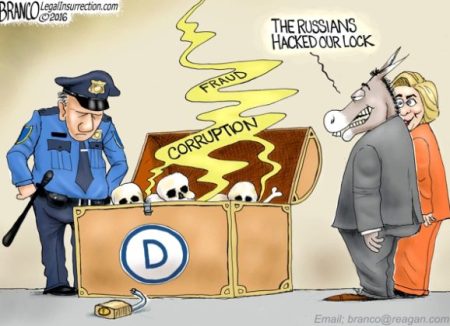
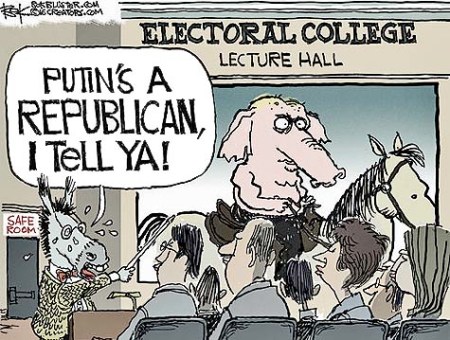
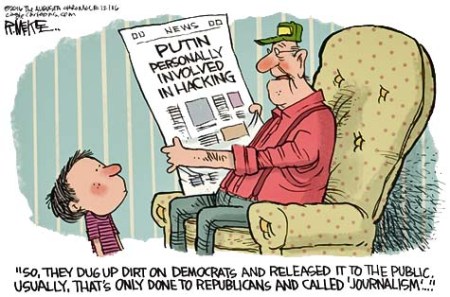
The award for fake news purveyors of the year has to go to the Washington Post and New York Times for peddling the sore loser Democratic fable that the Russians hacked the Clinton and DNC emails, passed them off to Julian Assange who published them in Wikileaks to help Trump. Why the Russians would want to hurt “Reset” Clinton — who was certain to follow Obama’s ineffectual  –policies toward Russia and who, among other things, as Secretary of State in a clear pay-to-play move let them buy up 20% of the U.S. uranium supplies — is an obvious, unspoken flaw in that argument. But there is much more to discount this story.

In the first place, her email server was insecure; in March of 2015 Don Surber showed how anyone could hack into her system.

The RNC was not so clueless and stopped attempted hacks. So the suggestion that Russia hacked both sides but only slipped to Assange the Democrat’s is poppycock.

In the second place, the Washington Post and NYT accounts claim that all the intelligence agencies and the head of the FBI concur that the Russians did it.  These largely unverified and mostly anonymously sourced pieces conflict with earlier stories that the agencies are in disagreement.

Comey and Clapper have not responded to these latest accusations, whose only named source is the CIA’s  Director John Brennan, but prior to these accounts Comey had a conversation with president-elect Trump in which he discounted the theory that Russia had provided the information to Wikileaks:

In telephone conversations with Donald Trump, FBI Director James Comey assured the president-elect there was no credible evidence that Russia influenced the outcome of the recent U.S. presidential election by hacking the Democratic National Committee and the e-mails of John Podesta, the chairman of Hillary Clinton’s presidential campaign.

What’s more, Comey told Trump that James Clapper, the director of National Intelligence, agreed with this FBI assessment.

The only member of the U.S. intelligence community who was ready to assert that the Russians sanctioned the hacking was John Brennan, the director of the CIA, according to sources who were briefed on Comey’s conversations with Trump.

“And Brennan takes his marching orders from President Obama,” the sources quoted Comey as saying.

In Comey’s view, the leaks to the New York Times and the Washington Post alleging that the Russians tried — and perhaps even succeeded — in tilting the election to Trump were a Democratic Party effort to delegitimize Trump’s victory.

During their phone conversations, Comey informed Trump that the FBI had been alert for the past year to the danger that the Russians would try to cause mischief during the U.S. presidential election.

However, whether the Russians did so remains an open question, Comey said, adding that it was just as likely that the hacking was done by people who had no direct connection to the Russian government.

This account is in accord with those from members of Congress who had interviewed Comey and reported that he disagreed with Brennan, and with the New York Times‘ own account in October:

Law enforcement officials say that none of the investigations so far have found any conclusive or direct link between Mr. Trump and the Russian government. And even the hacking into Democratic emails, F.B.I. and intelligence officials now believe, was aimed at disrupting the presidential election rather than electing Mr. Trump.

Hillary Clinton’s supporters, angry over what they regard as a lack of scrutiny of Mr. Trump by law enforcement officials, pushed for these investigations.

The most damaging of the leaks involved the DNC’s work to knock Bernie Sanders out of the running. Isn’t it more likely that someone inside the organization was angry and provided the damaging emails?

And then there’s Assange, who repeatedly, forcefully denied that his source was Russia.

Today, news organization, as the Nation notes, “do overtly what the CIA has paid it to do covertly: regurgitate the claims of the spy agency and attack the credibility of those who question it.”

When the Democrats lose a presidential election, they work harder at delegitimizing the winner than they do respecting the democratic process. When Gore lost, it was “selected not elected” and Bush “lied us into war” — all fake. This time — as a result of the fecklessness of Clinton-Obama and Kerry – president-elect Trump faces a far more dangerous world than they found. The Chinese just stole an underwater drone of ours in off of the Philippines, Russia is continuing to threaten Europe, the EU is crumbling, and the Democrats’ childish nonsense, fed by the big-time fake newsmakers, is an even greater threat to us all.
 

NY Times CEO Advises How to Avoid ‘Fake News:’ Subscribe to Our Paper

December 17, 2016

NY Times CEO Advises How to Avoid ‘Fake News:’ Subscribe to Our Paper, Truth Revolt, Trey Sanchez, December 16, 2016

The New York Times Company president and CEO of one of the leading purveyors of leftwing-biased news has some peculiar advice on how to avoid “fake news:” “Subscribe to The New York Times.”

That’s what Mark Thompson told the Detroit Economic Club in his recent speech about getting consumers back to “real journalism.”

“If you want real journalism, you as a consumer will have to pay for it,” Thompson said. “So subscribe. Subscribe to your local paper, or The New York Times, or the Wall Street Journal, or The Washington Post, or, if you’re feeling particularly flush, to all of the above.”

“At The Times,” he added, “we’re making real progress, with audiences and subscriber numbers larger than at any time in our history, as well as big gains year over year in digital revenue. We still post healthy profits.”

That’s an interesting take seeing how readership is lower than ever with a reported $14 million net loss for the first quarter of 2016. Not to mention the paper getting “five times the normal level” of complaints of bias; a bias the NYT has apologized for with promises to act like journalists from now on.

In his speech, Thompson meandered through several fixes to “fake news” such as through “human or algorithmic means,” especially on social media platforms. But even with “a mighty algorithm” or “legions of human scrutineers” it would raise suspicions of “repressive regimes” and would be too “worrisome… in our free societies.” He cites the protections of the First Amendment:

“And who said that the public should only be allowed to read the facts anyway? The First Amendment essentially says they should be allowed to write, distribute and read anything they damn well please. If some of them turn out to prefer churning out and eagerly consuming lies and fantasies, so be it.”

But Thompson’s eagerness to fix the news is hindering his ability to see he is leading the charge in distributing highly partisan content. The NYT just hired on Glenn Thrush. If his name doesn’t ring a bell, his actions sure will. Thrush is the Politico writer exposed by WikiLeaks for sending his articles to Hillary Clinton’s camp for preapproval before publishing. Thrush is also a self-proclaimed “hack.”

Yet, Thompson remains confident that his paper is the portal to truth:

“Real journalism is vital to our democracy, and it has to be paid for. If not, it will largely disappear … If you as a citizen are worried about fake news, put your money where your mouth is and pay for the real thing.”

What Adam Carolla said about the NYT bears repeating here: “New York Times, you don’t get to dictate outcomes… We got the Internet. New York Times, no one gives a sh*t about you. You ain’t Hearst, William Randolph Hearst. You can’t affect things anymore.”

Cartoons and Videos of the Day

December 17, 2016


Via Media Research Center


Via LATMA-TV


H/t Vermont Loon Watch

donkey


flacks-kg


travel-trunk


H/t Freedom is Just Another Word

alleged


H/t Power Line

trump-salve


alien-dems


notmyfault


obama-putin


nbc-fake


161212-pajama-boy


pollster-end


H/t Tom Fernandez’s Blog

notbuying


Fake News

December 17, 2016

Fake News, Bill Whittle.com Via YouTube, December 16, 2016

Facebook to Label ‘Fake News’ with Help of Partisan ‘Fact Checkers’

December 16, 2016

Facebook to Label ‘Fake News’ with Help of Partisan ‘Fact Checkers’, BreitbartBen Kew, December 15, 2016

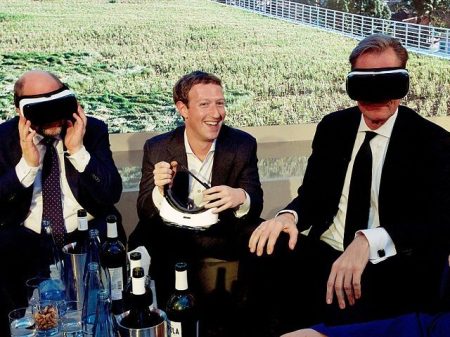
BERLIN, GERMANY - FEBRUARY 25: Martin Schulz, Mark Zuckerberg and Mathias Doepfner attend the presentation of the first Axel Springer Award on February 25, 2016 in Berlin, Germany. (Photo by Frank Zauritz - Pool /Getty Images)

BERLIN, GERMANY – FEBRUARY 25: Martin Schulz, Mark Zuckerberg and Mathias Doepfner attend the presentation of the first Axel Springer Award on February 25, 2016 in Berlin, Germany. (Photo by Frank Zauritz – Pool /Getty Images)

Facebook has announced it will introduce warning labels on stories they deem to be “fake news,” with the help of partisan “fact checking” organisations such as Snopes and PolitiFact.

Stories deemed to be false will now be “flagged” by Facebook, with an accompanying red label claiming the story is “disputed by 3rd Party Fact-Checkers.”

Users will then have the option to “learn why this is disputed” to receive an explanation as to why Facebook believes the story is false.

“We’ll use the reports from our community, along with other signals, to send stories to these organizations,” Facebook VP Adam Mosseri wrote in the Facebook news blog. “If the fact checking organizations identify a story as fake, it will get flagged as disputed and there will be a link to the corresponding article explaining why.”

Mossieri insists that the company will not prohibit users from posting anything deemed “fake,” but “you will see a warning that the story has been disputed as you share.”

Furthermore, Facebook will prohibit paid promotion of stories that have been marked as disputed.

In the announcement, Facebook confirmed that it will be working alongside organizations that are signatories of “Poynter’s International Fact Checking Code of Principles.”

Business Insider reports that these organisations will include the likes of Snopes, ABC, Politifact, and FactCheck.org, all of which have records of left-wing partisanship — particularly throughout the 2016 election.

For example, PolitiFact infamously said it was “mostly false” when Donald Trump claimed in a presidential debate that Hillary Clinton wanted “open borders.” PolitiFact made this ruling despite Clinton being on the record at a paid speech saying “My dream is a hemispheric common market, with open trade and open borders.”

Trump also said that Russia has 1,800 nuclear warheads and has expanded its arsenal while the U.S. has not. PolitiFact admitted that Trump’s claim was factual, but it rated the statement as “half true” for supposedly “missing the big picture.”

In both of these cases, PolitiFact went beyond mere fact-checking and moved the goal posts in ways that benefited Clinton’s candidacy. This type of ideological “fact checking” went beyond parody during October’s presidential debates, with NBC taking Trump’s statement that Clinton “acid washed” her emails (a reference to the data deletion tool “BleachBit”) 100% literally and declaring the statement “false.”

FACT CHECK: Trump says Clinton “acid washed” her email server. She did not.
More fact checks: http://nbcnews.to/2c6w8lx 

 Meanwhile at ABC, George Stephanpoulos — a former campaign operative and top White House staffer to Bill Clinton — led the network’s election coverage, never disclosing this fact in his on-air appearances. Stephanopoulos’s wife said the pair would “leave the country” should Donald Trump be elected to the presidency.

Washington Post Issues Correction To “Fake News” Story

December 10, 2016

Washington Post Issues Correction To “Fake News” Story, Jonathan Turley’s Blog, Jonathan Turley, December 9, 2016

wapo1

The Washington Post has been under fire for its publication of an article entitling “Russian propaganda effort helped spread ‘fake news’ during election, experts say.” The article by Craig Timberg relied on a controversial website called PropOrNot, which published what is little more than a black list of website that the authors deemed purveyors of fake news including some of the largest sites on the Internet like Drudge Report. However, the previously unknown group was itself criticized for listing “allies” that proved false. Yesterday, Hillary Clinton ramped up the call for action against “fake news” which she described as an epidemic. Now the Washington Post has published a rather cryptic correction to the fake news story. The controversy is the subject of my latest column in USA Today.

The organization listed a variety of news sites as illegitimate. It included some of the most popular political sites from the left and right Truthout, Zero Hedge, Antiwar.com, and the Ron Paul Institute. It even includes one of the most read sites on the Internet, the Drudge Report. Notably, it also included WikiLeaks, which has been credited with exposing political corruption and unlawful surveillance programs.

The Washington Post is the largest newspaper to buy the clearly biased list as the work of objective “experts” — ignoring that the site relies on anonymity of those contributors. When the Post ran the story, some were eager to push the story as a reason why they lost the election. The former White House adviser Dan Pfeiffer tweeted, “Why isn’t this the biggest story in the world right now?” The reason is that it was facially absurd.

The Post has now added the following “correction”:

Editor’s Note: The Washington Post on Nov. 24 published a story on the work of four sets of researchers who have examined what they say are Russian propaganda efforts to undermine American democracy and interests. One of them was PropOrNot, a group that insists on public anonymity, which issued a report identifying more than 200 websites that, in its view, wittingly or unwittingly published or echoed Russian propaganda. A number of those sites have objected to being included on PropOrNot’s list, and some of the sites, as well as others not on the list, have publicly challenged the group’s methodology and conclusions. The Post, which did not name any of the sites, does not itself vouch for the validity of PropOrNot’s findings regarding any individual media outlet, nor did the article purport to do so. Since publication of The Post’s story, PropOrNot has removed some sites from its list.

One of the spins offered by the Clinton camp was that the election loss was not (1) the establishment engineering the primary win for Clinton; (2) the selection of the ultimate establishment figure when all polls showed people wanted an outsider; (3) the record low polls of Clinton for popularity and honesty; or (4) the continual missteps of Clinton or her staff in just being honest in dealing with various scandals. Instead it was the “fake news” problem. When this has been raised during speech appearances in the last few weeks, I have repeatedly asked people to point to the fake news that influenced the election. They often cite the FBI investigation but that is not fake news. It was real news. They also cite Wikileaks. However, while Clinton and DNA head Donna Brazile suggested that emails were tampered with, they produced no proof of any such false emails on Wikileaks.

When the New Yorker pressed the anonymous spokesman (a curious position) for ProporNot, he struggled to explain why conservative sites like Drudge were put on the list.

Yet, when pressed on the technical patterns that led PropOrNot to label the Drudge Report a Russian propaganda outlet, he could point only to a general perception of bias in its content. “They act as a repeater to a significant extent, in that they refer audiences to sort of Russian stuff,” he said. “There’s no a-priori reason, stepping back, that a conservative news site would rely on so many Russian news sources. What is up with that?”

Now there is hard journalistic work. The Post insists that it had other sources, but what would prompt the reliance on this anonymous band of obvious amateurs?

I have been highly critical of sites like The National Report, a group of truly juvenile idiots who get a thrill by just placing false news stories. Those sites are the Internet version of graffiti and should be addressed by servers. I have also encouraged lawsuits for defamation and false light when available. However, there are thankfully few adults who actually get a kick out of tricking people into posting false stories. They are the same type of people who love to watch fire departments rush to false alarms. It gives some weird sense of worth to degrade others by tricking them.

The current controversy is different. Many people in Washington are irate over Wikileaks — not because the email were untrue but because they proved what many had long suspected . . . that Washington is a highly corrupt place full of truly despicable people. For people who make their living on controlling media and information, it was akin to the barbarians breaching the walls of Rome. So the answer is to call for government regulation to combat what will be declared “fake” news or propaganda. It is only the latest effort to convince people to surrender their rights and actually embrace censorship.

Michelle Malkin DESTROYS The World’s Foremost FAKE NEWS Provider Hillary Clinton 12/10/16

December 10, 2016

Michelle Malkin DESTROYS The World’s Foremost FAKE NEWS Provider Hillary Clinton 12/10/16, Fox News via YouTube, December 10, 2016

Cartoons and Video of the Day

December 10, 2016

H/t Conservative Tree House

obama-yapping-blah-blah-blah-speech-sad-hill-news2


Via LATMA-TV


H/t Vermont Loon Watch

democrat-plan


H/t Vermont Loon Watch

fraudsters


H/t Power Line

pc-agabn


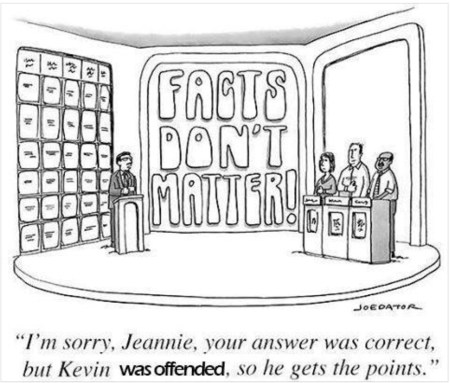
facst-dont-matter


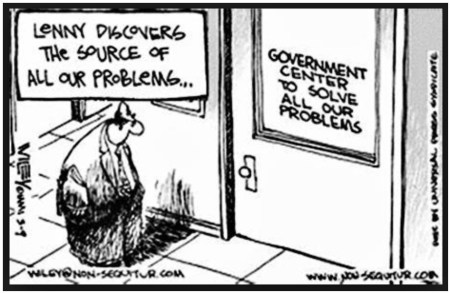
govt-center


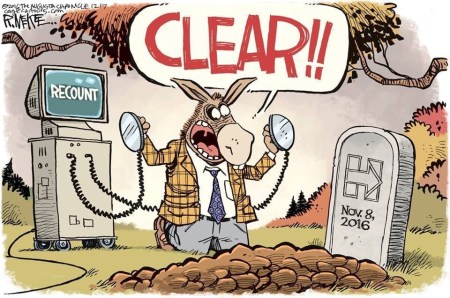
clear


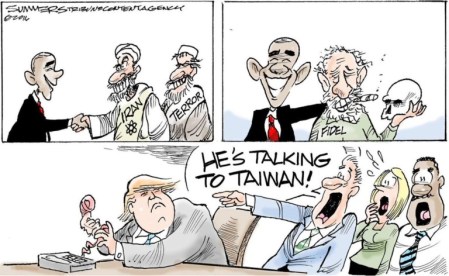
taiwan-hypocrisy


Requiem for a Narrative

December 9, 2016

Requiem for a Narrative, Washington Free Beacon, , December 9, 2016

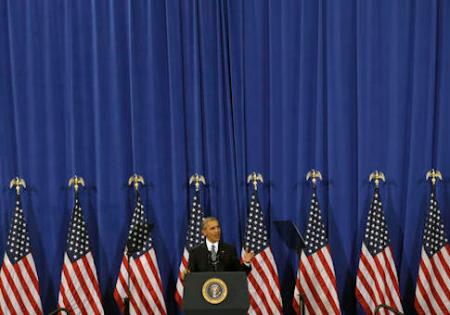
President Barack Obama gestures during a U.S. counterterrorism strategy speech at MacDill Air Force Base Tuesday, Dec. 6, 2016, in Tampa, Fla. (AP Photo/Chris O'Meara)

President Barack Obama gestures during a U.S. counterterrorism strategy speech at MacDill Air Force Base Tuesday, Dec. 6, 2016, in Tampa, Fla. (AP Photo/Chris O’Meara)

At a dinner in Washington earlier this week—one packed with well-meaning folks who really, really wanted this year’s election to have gone the other way—I heard a speaker cite Elizabeth Bishop’s One Art by way of consoling the audience. “The art of losing isn’t hard to master,” the poem famously begins. The speaker hastened to remind the room that, later in the poem, we are informed numerous times that losing “is no disaster.” With that in mind, those who didn’t like the election’s result should buck up and dive back into the fight, and so forth.

It didn’t seem like the time or place for me to point out that the poem’s declarations that losing isn’t a disaster are clearly ironic. It also didn’t seem the time to note that among the most important reasons why so many people supported Trump was that they were conscious of a series of painful disasters, the existence of which the Obama administration, abetted by a friendly press, refused to acknowledge. The nature of our politics today—and perhaps immemorially—is that every ambitious mayor or governor of a state feels the need to create a narrative of success: build a stadium or bridge that he can slap his name on, massage the crime statistics to show civic healing, and call it good.

If the reality matches the narrative, so much the better—but you won’t find too many politicians admitting that things haven’t improved, or that they have actually grown worse. Obama and his aides certainly weren’t big on admitting shortcomings, and after the electoral wipeout they have just suffered, it looks like their most lasting impact will be to have discredited the word “narrative” among a large portion of Americans. That’s something, I guess.

For years, Americans were told that after the financial panic in 2008, the president’s policies had put us on a steady course to a strong economy. But in much of the country, people looked around them and thought, That just doesn’t seem right. Especially in those parts of the country hit the hardest by the transition from the Industrial Era to the Information Age, people asked a number of questions. If the economy is doing so great, why are my adult children not moving out? If the unemployment rate is declining, why are so many prime-age males not working? And doesn’t it matter that the quality of jobs for non-college graduates is so obviously worse than it was a generation ago? Why, instead of working, are so many people dependent on public benefits and falling prey to addiction?

All of these questions had answers—but looking to the Obama White House for clarity about the uncomfortable tradeoffs their policies involved was a fool’s errand. Take, as an example, the crusade against coal, pushed by activists and coastal liberals for whom shutting down these companies was a clear and uncomplicated good deed on behalf of Mother Earth, of which the only real victims would be the greedy energy executives. The miners could retrain, or get “green jobs,” or something.

Well, a lot of the coal companies did shut down, or all but shut down. Many of the owners cut their losses and moved on—capital may be inconvenienced, but it generally does not suffer. The workers just lost their jobs. The economy in places like southeastern Ohio wasn’t exactly ready to absorb them, and as for retraining—well, you give that a try when you’re 45 years old. The availability of welfare and disability payments is a bitter replacement for the dignity of an honest, decently paid job. The only good news in some of these regions for much of the last eight years was the fracking revolution, a phenomenon that generally occurred in spite of the president’s best efforts.

We were also told, again and again, that things were going well abroad. The tide of war was receding. Afghans and Iraqis were taking the lead. Osama bin Laden was dead, and al Qaeda was on the run. And people again thought, That just doesn’t seem right. As recently as this Tuesday, President Obama was still at it, telling troops assembled at MacDill Air Force Base (side note: polls suggest that a plurality in that room must have voted for Donald Trump) that, a few bumps in the road notwithstanding, things were going pretty well out there.

Characteristic of the head scratchers in Obama’s speech was this howler: “No foreign terrorist organization has successfully planned and executed an attack on our homeland.” Elsewhere in the speech the president cited the “homegrown and largely isolated individuals” who killed Americans in Orlando, San Bernardino, Boston, and Fort Hood, and who were “radicalized online.” Never mind the fact that the Fort Hood terrorist exchanged a dozen or so emails with Anwar al-Awlaki, the American cleric who worked so hard to encourage American Muslims to murder their fellow citizens, or that al Qaeda and ISIS were actively calling for such attacks, and providing instructions for how to carry them out in their online magazines.

People listen to this sort of hairsplitting, and they think, that just doesn’t seem right. One hears the president, during the same speech, praise the campaign against the Islamic State as “sustainable,” and one can’t help but wonder, since when did we want a military effort against a trumped up gang of women-beating thugs like this to be “sustainable”? Swift, yes; crushing, sure; but “sustainable?” How about “victorious”? How about “over”?

“Fake news” is becoming a catch-all explanation for Democrats to explain Hillary Clinton’s loss. Voters didn’t trust Hillary, and didn’t appreciate the great deal they were getting from Obama, because of right-wing lies. The problem with this explanation is that it was hardly necessary for Russian troll farms to sow distrust about the Obama administration, when the administration (not to mention the Clinton campaign!) was itself such a relentless and strategic purveyor of half-truths and convenient omissions. For eight years, the word from the top just didn’t seem right—and the lack of trust such habitual semi-honesty engendered is why the left is very much the author of its own disaster.

Kerry: People can’t tell ‘what’s real and what isn’t’

December 3, 2016

Kerry: People can’t tell ‘what’s real and what isn’t’, Washington ExaminerJoel Gehrke, December 2, 1016

(Alas, soon John Kerry will not have an official podium from which to tell us, the stupid little people, what’s true and what’s false. — DM)

kerryandlittlepeopleKerry lamented Friday that technology has allowed the quick spread of false information. (AP Photo/Andrew Harnik)

“There are divisions and places where they divide, but there’s a fundamental oneness, sameness, body of basis,” he said. “And I would respectfully submit to all of you that every single major philosophy, every single major religion, all have a basis in some pretty fundamental things like the Golden Rule: Do unto others as you would have them do unto you. Love other people. You can run the list of the verses or — I think we all refer to them as verses, actually — that are of a common foundation.”

**********************

Secretary of State John Kerry lamented Friday that technology has allowed the quick spread of false information to the point that people are struggling to “know what’s real and what isn’t.”

“This is one of our chief challenges today, is to manage information and to do it in a way that average folks at home can know what’s real and what isn’t, what’s true, what’s false, and try to build consensus around a common set of understandings,” Kerry said during the Mediterranean Dialogues Conference in Rome. “Technology has brought the world closer, yes; but it’s also enabled bigots and demagogues to spread messages of divisiveness and hate with the click of a button, with the push of a finger.”

That focus on misinformation was apparent whether he was talking about the risk of jihadist recruiters propagandizing young Muslims or pushing back against the trade skepticism now regnant in the United States. “Now, none of us should have any illusion about the challenges that we face. They are real, and frankly, they require our collective courage,” Kerry continued. “And, I might add, they require all of those things based on truth.”

He offered counterarguments to such ideas throughout his talk, beginning with the problem of terrorist propaganda. Kerry argued, contrary to jihadists, that all the great religions of the Mediterranean world share a common set of ethics.

“There are divisions and places where they divide, but there’s a fundamental oneness, sameness, body of basis,” he said. “And I would respectfully submit to all of you that every single major philosophy, every single major religion, all have a basis in some pretty fundamental things like the Golden Rule: Do unto others as you would have them do unto you. Love other people. You can run the list of the verses or — I think we all refer to them as verses, actually — that are of a common foundation.”

More broadly, Kerry faulted media outlets for contributing to an unnecessary degree of fear among their audiences and lamented the skepticism of trade agreements and climate change science that undermined some of the Obama administration’s top second-term priorities. “Despite what some pundits write in the daily headlines that cause people a lot of fear, the world today is not falling apart,” Kerry said. “On the contrary, I think it is in many respects coming together. But it’s coming together with this clash of modernity and culture and religion and the fear of the dislocation that comes with it.”

Environmental policy and trade policy were two areas where Kerry suggested misinformation had taken hold in the west. “There are some truths, folks. Hard sometimes for people to discern, but it is true that the Earth is warming even as we have climate deniers in the world today,” he said.

He seemed particularly annoyed at “politicians running today damning the concept of trade,” following an election year that saw both Hillary Clinton and President-elect Trump campaign against the Trans-Pacific Partnership agreement that he helped negotiate.

“Ladies and gentlemen, 85 percent of the job loss in the United States of America comes from technology, not trade,” Kerry said. “But if you think we’ve seen dislocation to date, just wait ’til artificial intelligence comes down the road. We have challenges that we need to get ahead of, and we have an extraordinary breach, if you will, between those who want to sort of take the simplistic road of pretending they have answers for these things but shooting at the wrong target versus those who are willing to think about facts and deal with science and build on experience and talk reality to the people of whatever country it is that they’re talking in.”