Archive for the ‘European Union Parliament’ category

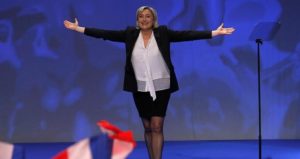
EU seeks to help prosecute Marine Le Pen for… Tweeting

March 3, 2017

EU seeks to help prosecute Marine Le Pen for… Tweeting, Hot Air, Jazz Shaw, March 3, 2017

The horrible, dangerous activity which Le Pen engaged in was the tweeting of an “image of violence” last year. The picture in question was one of James Foley, the journalist who was beheaded by ISIS. 

The law in question is one which forbids the publication of violent images but this is where the true irony comes in. Le Pen was considered in violation of a rule which was designed to stop people from distributing such images as a way to recruit terrorists. She was doing precisely the opposite, drawing attention to the barbaric nature of the enemy, but now may run afoul of the law.

***********************************

Clearly French presidential candidate Marine Le Pen is making all the right enemies in high places. The established political class in France clearly despises her but the European Union is now getting in on the act, no doubt because of her less than favorable opinions of the continental organization. In one of the stranger stories to come out of the French election cycle, the EU has moved to suspend Le Pen’s standard immunity from prosecution over images which she posted on her Twitter account. If that sounds to you like something out of a George Orwell novel, fasten your seat belts because it gets even more strange. (Washington Post)

On Thursday, the European Parliament voted to lift Marine Le Pen’s immunity from prosecution for tweeting violent images, a crime that in France can carry up to three years in prison.

As Le Pen, the leader of France’s far-right National Front party, rises in the polls ahead of France’s presidential election next month, authorities will now be able to pursue a case against her. Speaking on French television Thursday morning, she was quick to condemn her European colleagues for what she called “a political inquiry.”

Apparently in France the phrase “political inquiry” is the European equivalent to what we in the United States would call “an obvious witch hunt.”

This question of immunity is the first one to sort out because the entire concept will no doubt sound like something from an alien planet to most Americans. The European Union Parliament provides immunity to its members in matters of free speech so that they will be free to express their opinions in public debate. That sentence alone is a chilling reminder of precisely how different things are across the pond if you grew up taking American rights to freedom of speech for granted. Yes, in Europe you can frequently be prosecuted for thought crimes.

The horrible, dangerous activity which Le Pen engaged in was the tweeting of an “image of violence” last year. The picture in question was one of James Foley, the journalist who was beheaded by ISIS. Such images are no doubt disturbing to some people, in this case the Foley family in particular. After a complaint was raised by relatives, Le Pen apologized and deleted the tweet but the damage had already been done.

Keep in mind that one of Marine Le Pen’s main selling points in the election is her outrage over attacks by violent Islamic extremists and her insistence that the nation do more to protect its citizens. The law in question is one which forbids the publication of violent images but this is where the true irony comes in. Le Pen was considered in violation of a rule which was designed to stop people from distributing such images as a way to recruit terrorists. She was doing precisely the opposite, drawing attention to the barbaric nature of the enemy, but now may run afoul of the law.

It’s simply impossible to deny that this is a political hit job. By lifting Le Pen’s immunity, the European Union is paving the way for France to prosecute her over a tweet. This prosecution is taking place (assuming it happens) just as the final stages of the presidential election are kicking into high gear. You don’t need the world’s best detective to figure that one out. Of course, it would be nice to pretend that this is somehow a unique situation, but it’s obviously not. You’ll recall that Dutch candidate Geert Wilders was actually taken to trial and convicted for chanting a slogan at a political rally. Wilders did not wind up serving any time for his “crime” and the trial lead to a surge in sympathetic support for him in the polls. But it still underscores the fact that freedom of speech in Europe is largely a joke.

The thing to watch for now and over the next few weeks is whether or not Marine Le Pen receives the same sort of boost in her popularity which Wilders experienced previously. Are the French truly such a nation of sheep that they want to stand by idly and watch a presidential candidate be dragged into court over a tweet expressing a political position? If not, and if they are truly disgusted by this effort to stifle Le Pen’s opinions, there may be another upset brewing in the European electoral races.
marinelepen-300x159

European Union Parliament moves to censor “offensive speech”

February 27, 2017

European Union Parliament moves to censor “offensive speech”, Hot Air, Jazz Shaw, February 27, 2017

This is a story which would never take place in the United States, at least not yet and not with the official permission of the government. The European Union has obviously become increasingly alarmed over trends in popular sentiment rippling through their member countries. This started with Brexit, but has more recently cropped up with the candidacies of Marie Le Pen and Geert Wilders. Clearly such rabble rousing is not to be tolerated in the largely socialist paradise so something had to be done. The solution? The EU has passed new rules which will allow them to cut the broadcast of any “hate speech or offensive material” and then purge such speech from the official record. (Associated Press)

With the specter of populism looming over a critical election year in Europe, the European Parliament has taken an unusual step to crack down on racism and hate speech in its own house.

In an unprecedented move, lawmakers have granted special powers to the president to pull the plug on live broadcasts of parliamentary debate in cases of racist speech or acts and the ability to purge any offending video or audio material from the system.

Trouble is, the rules on what is considered offensive are none too clear. Some are concerned about manipulation. Others are crying censorship.

To be clear here, they are obviously not talking about concerns over any of the members giving speeches endorsing slavery, a new Holocaust or racial purging. They are talking about so-called “nationalist” platforms supporting some of these upstart candidates who threaten the permanence of the European Union Parliament itself. With more “exits” being threatened in places like France, the Netherlands, Hungary and Poland, supporters of the EU clearly feel they are in danger.

Anyone who is acting surprised clearly hasn’t been paying attention to the news. This is representative of most of Europe in a nutshell. Despite the fact that we tend to think of most of our allied nations on the continent as being “westernized” in nature, their citizens (and indeed their lawmakers as well) do not have the same freedoms in terms of speech, religion and other things which Americans take for granted. It is still standard practice in many European countries for laws to remain on the books which allow for the prosecution of people who are overheard saying unpopular things, even if that option is not frequently exercised. Let’s not forget that Geert Wilders was recently convicted of a crime for chanting the word “fewer” at a political rally when asking how many Moroccan immigrants the crowd wanted to see.

This censorship at the European Union Parliament may be going even one step further. The Associated Press article brings up the fact that they are already looking at some sort of delay button for the live broadcast of parliamentary speeches. We have such things in the United States to prevent the seven dirty words from being heard on network programming (and yes, we’re looking at you, Joe Scarborough) but such a thing is not employed to prevent the airing of political diatribes, even when they include unpopular speech.

The only conclusion I can draw at the moment is that candidates like Le Pen and Wilders really have the wizened heads at the European Union in a panic. The lesson we can take from this is found in observing the response. Actual freedom requires a robust rebuttal and persuasive argument against real hate speech. But in the EU they can simply make your speech disappear, and the powers that be get to determine what qualifies as acceptable.

Why Isn’t the EU Doing More Against Religious Persecution?

July 6, 2016

Why Isn’t the EU Doing More Against Religious Persecution? Clarion Project, Gideon Bratt, July 6, 2016

(The EU Parliament has a small voice and substantially no power over what the EU Bureaucracy does. — DM)

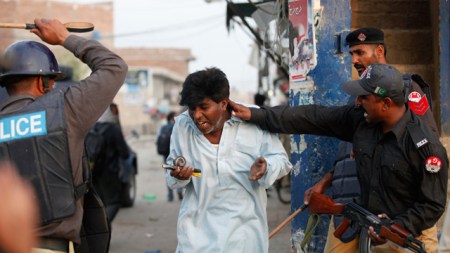
PakistaniChristianBeaten-IP_7A Christian in Pakistan is beaten by the police (Photo: © Reuters)

Christians and other religious minorities are being subjected to horrific human rights abuses globally, according to a recently released report on freedom of religion from a European Union (EU) group.

The EU Parliament Intergroup on Freedom of Religion or Belief and Religious Tolerance released their annual report last week, in which they highlighted restrictions to freedom of religion and religious persecution in 53 countries. Many of these countries have government-sanctioned persecution, while others have groups such as the Islamic State (ISIS/ISIL) operating within them and oppressing religious minorities.

“Our beliefs are at the core of our human dignity – tragically, however, today not everyone enjoys the freedom to hold and manifest their beliefs. We have witnessed the near extinction of Christians in Iraq and Syria,” said Peter van Dalen, a member of the European Parliament and one of the co-chairs of the group.

The report outlined some of the restrictions facing Christians, Yazidis, Sunni and Shiite Muslims and others in countries across the world, many in the Middle East and Africa. In Nigeria, for example, non-Muslims have been forcefully brought for judgement in sharia(Islamic) courts and punished by caning, amputation or death by stoning for “offencss” including blasphemy.

The report, which can be found in full online, notes that, in some ways, the situation has improved in Egypt recently under President Abdel Fattah el-Sisi’s rule. Nevertheless, minorities – especially Coptic Orthodox Christians — still face sectarian abuse and discrimination. Christian girls are still being abducted by Muslims “and the government’s inability to respond over several years has made the situation worse.”

In Saudi Arabia (a Sunni country, where Shiite Muslims are amongst the persecuted), apostasy, blasphemy and peaceful dissent are punishable by death. The report calls Saudi government restrictions “the most severe violations of the freedom of religion or belief in the world.”

Bahais in Iran are “deemed apostates by the government and denied civil rights.” Amongst other restrictions, they “are banned from higher education, denied the right to establish … religious institutions, [and] excluded from the social pension system.” Around 90 Iranian Christians have been detained or imprisoned “because of their religious beliefs and activities” and there has been a “significant increase” in the number of physical assaults of Christians in prison.

In some areas of Syria, ISIS has carried out “brutal ethnic and religious cleansing” of Christians, Yazidis and other minorities. In Aleppo, for example, just 60,000 of the city’s original Christian population of 400,000 remain. The European Parliament has called ISIS’ massacres in Syria a “genocide” but, like the UN, has fallen short on taking action.

The report describes how “the 2,000-year-old Christian community in Iraq is facing extinction” and has decreased from 1.2 million in the 1990s to just 260,000 in 2015. Iraqi Christians are forced to convert to Islam, pay the jizya tax (essentially protection money) or face execution. Similarly, Yazidis in Iraq are subject to “forced conversion and marriage, sexual assault, slavery, torture and murder,” with many victims being women and children.

The hope is that this report “will effectively help us to address religious persecution throughout the world and ensure that the European Union uses its political and financial power to safeguard the fundamental rights of religious minorities in all countries,” according to Sophia Kuby, director of EU Advocacy for ADF International. She said that we “cannot accept that people today are being killed, tortured, or oppressed, simply because of their religious convictions or beliefs.”

The report is a sad reminder of the scale and breadth of religious persecution taking place in today’s world as well as also an important call (for the EU, at least) to take real action and put an end to these atrocities.

“The EU, in its external actions, continuously compromises its human rights agenda in favor of a more economic and geopolitical agenda”, according to Dennis de Jong, a member of the European Parliament and the second co-chair the EU group that released the report.

Until the foreign policy apparatus of the EU, along with UN bodies (especially the Security Council), prioritize this issue and take action, the annual release of reports such as this will continue to be a sad and constant reality.


