Archive for the ‘Erdogan’ category

Brexit – Backlash from mass migration and ISIS

June 25, 2016

Brexit – Backlash from mass migration and ISIS. DEBKAfile, June 24,2016

BREXIT_23.6.16

In a historic referendum, millions of British citizens voted Thursday, June 23, to leave the European Union after 43 years by a margin of 52 to 48 percent. Many were undoubtedly moved into approving this pivotal step by three seismic world events:

1. The mass migration flowing into Europe from the Middle East and Africa under the EU aegis. Forebodings in the UK were fueled by figures released a week before the referendum showing an influx of 330,000 migrants to Britain in 2015.

2. The war on the Islamic State which poses a peril which most Western governments avoid addressing by name as World War III in the making.

3. The inability of those governments, beyond empty words, to grapple with the war on ISIS or cope with the  mass of migrants expected to beat on the gates of Western societies for many more hard years.

Many Americans and Europeans are dissatisfied and resentful of President Barack Obama’s approach to the war on ISIS, which is to dismiss the enemy as a minor band of fanatics and thus, rather than a war against Islam. Neither do they accept German Chancellor Angela Merkel’s magnanimous invitation to take refugees in – 1.5 million in two years – as her country’s moral responsibility.

This popular disgruntlement has thrown up such antiestablishment figures as Donald Trump in the US and Boris Johnson in Britain and contributes to the rise of far right-wing movements and extremist violence on both continents.

Those two leaders, though different in most other ways, owe much of their popularity to the pervasive fear in their countries that surging immigration will forever alter the fabric of their societies.

Such social upheaval is the result of a trap deliberately set for the West by two Muslim leaders: ISIS “caliph” Abu Bakr al-Baghdadi, and Turkish President Tayyip Reccep Erdogan.

Al-Baghdadi conceived the idea of flooding the western world with waves of immigrants from Africa and the Middle East as a way to achieve three targets:

a) To change the composition of the population of Western countries by expanding the Muslim increment.

b) To plant networks of ISIS terrorists in the West.

c) To boost ISIS Middle Eastern arms, people and drugs smuggling networks as the organization’s main source of income. Migrants are willing to pay an average of between 5,000 and 10,000 dollars to reach the West even though they know that many never make it alive.

Al Baghdadi made up for the revenue shortfall caused by the US bombing of ISIS-held oil fields and money reserves by pushing over a new wave of immigrants.

President Erdogan’s motives are quite different.

He allowed the waves of immigrants to pass through Turkey on their way to the US and Europe – just as for years, he allowed Western jihadists joining ISIS to reach Siria via Turkey – because he was consumed with the desire to punish the US, namely, the Obama administration, for refusing to back up his hegemonic aspirations in the Middle East; Europe was punished for denying Turkey EU membership year after year.

The victory of Boris Johnson’s “leave” campaign – in the face of Obama’s personal championship of Prime Minister David Cameron’s bid to keep his country in, supported by the Democratic presumptive nominee Hilary Clinton – was a loud and clear signal for politicians running in future elections in the West, including the US presidential vote in November.

Republican candidate Donald Trump’s call to stop Muslim immigration into the US until proper screening measures are in place may sound like an unformed idea, but no other US politician has dared put it on the table, or directly challenge the hollow words and self-righteous hypocrisy of Obama and Clinton on the issues of terror, wars in the Middle East and mass immigration. This alone gives Trump a popular edge in widening circles in the USA over his rival.

Trump is not likely to lose votes either by his pledge to rebuild NATO for leading the West in the war against Islamic terror.

During the five months up until the US presidential election, the West can expect more large-scale ISIS terror coupled with dramatic events in the wars raging in at least seven countries  – Iraq, Syria, Lebanon, Jordan, Egypt, Libya and Afghanistan. Refugees in vast numbers will continue to batter down the doors of countries that are increasingly unable and unwilling to accept them.

Wars in general and religious wars in particular, have throughout history thrown up massive shifts of population displaced by violence, plague, falling regimes, famine and economic hardship.

The year 2016 will go down as the year in which Middle East crises spilled over into the west, bringing social change and far-reaching political turmoil in their wake.

And this is only the beginning.

Erdogan Revs Hate Between Muslims and Turkey’s Minorities

June 1, 2016

Erdogan Revs Hate Between Muslims and Turkey’s Minorities, Clarion Project, William Reed, June 1, 2016

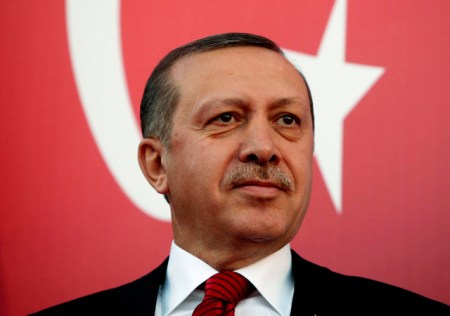
ErdoganPortrait-IP_2Turkish President Recep Tayyip Erdoğan (Photo: © Reuters)

On May 28, Turkish President Recep Tayyip Erdogan visited the predominantly Kurdish city of Diyarbakır and delivered a public speech in which he targeted Kurds requesting official recognition and the right to self-rule, calling them “atheists” and “Zoroastrians.”

In an attempt to appeal to Islamist sentiment, Erdogan claimed that Kurdish militants had burnt down schools and mosques, stating, “They are atheists, they are Zoroastrians. They are useless. They have not and are not acting with our values.”

This was not the first time Erdogan targeted non-Muslims in his public speeches.

In February, 2014, in the city of Balikesir, Erdogan, then prime minister, referred to the students of the Middle East University in Ankara, as “atheists” and “terrorists.” The students had protested the construction of the “1071 Manzikert Boulevard,” to which the police responded with gas bombs and pressurized water.

“On Monday, we opened the boulevard built by our metropolitan municipality of Ankara,” said Erdogan. “Despite whom? Despite those leftists! Despite those atheists! They are atheists! They are terrorists!”

The Battle of Manzikert was fought in 1071 in Anatolia between the Byzantine Empire and the Seljuq Turks, which marked the beginning of the Islamic invasion of Anatolia. The defeat of the Byzantine army and the capture of the Emperor Romanos IV Diogenes paved the way for the gradual Turkification and Islamization of Anatolia and Armenia.

Erdogan bashed the university students in his own unique way: “What is the name of the boulevard? Manzikert 1071. One of them was wearing Byzantine clothes. Alp Arslan [the Sultan of the Seljuq Empire] fought against Byzantium. So he [the student] put himself in the position of Byzantium. Shame on you!”

Apparently, Erdogan knows the easy and certain way of getting votes from much of Turkish public: Target any non-Muslim community – Jews, Christians, atheists, Alevis, Zoroastrians, you name it – and get the votes of millions of people, those who might not even know anything about the said religions or people but whose overall hatred for the “infidel” would be enough to make them enjoy the hate-filled slurs.

In May 2015, in the predominantly Kurdish city of Batman, Erdogan once again publicly targeted the secular, pro-Kurdish Peoples’ Democratic Party (HDP) – for “having nothing to do with Islam.”

“They say they will abolish Diyanet [Turkey’s Presidency of Religious Affairs]. They have nothing to do with religion. The Diyanet that they say they will abolish has published the Kurdish translation of the Koran.

“They [the HDP party] go to extremes by saying that Jerusalem belongs to Jews. They have nothing whatsoever with Islam. Jerusalem is the most important Kaaba [sacred site] of Muslims; it is where we found life.

“We have documents that in the mountains, they [the PKK] give education of the Zoroastrian religion.”

Despite the hateful stigma of Erdogan regarding Zoroastrianism, it is an ancient faith of peace, ethics and wisdom. Basic tenets of Zoroastrians include:

“The basic moral principles that guide the life of a Zoroastrian are three: Humata, ‘Good Thoughts’, Hukhata, ‘Good Words’, and Havarashta, ‘Good Deeds’.

“These three principles are included in many Zoroastrian prayers, and children commit themselves to abide by them at their initiation ceremony, marking their responsible entry into the faith as practicing Zoroastrians. They are the moral code by which a Zoroastrian lives.”

Sadly, this ancient, peaceful religion has become one of the greatest victims of Islamic jihad.

Before Iran (formerly called Persia) was invaded by Muslim armies in the 7th century, Zoroastrianism was the major religion there. Founded by the Prophet Zoroaster, Zoroastrianism was the state religion of several Persian empires.

Muslims should actually feel guilt and shame in the face of the enormous damage and destruction they have brought to the Zoroastrian people, but the Islamist ideology seems to erase even the most humane emotions of its followers.

Another social disease commonplace in Turkey is “atheophobia” ‎– fear or hatred of atheism or atheists.

The 2015 Freedom of Thought Report by the International Humanist and Ethical Union (IHEU) puts Turkey in the category of countries which expose their citizens who identify as atheists or non-religious to “severe discrimination.”

“Freedom of expression is theoretically protected by the current constitution, but is increasingly not respected in practice,” said the report. “Identifying [as an] ‘atheist’ prompts insults, threats, discrimination.”

In 2015, for instance, members of the Turkish Atheism Association (Ateizm Derneği), spoke up about receiving death threats and hate mail, and how “atheist”  is used as an insult or equated with “Satanism” or “terrorism.”

“The term ‘atheist’ is used as a harsh insult – one of the harshest in the country,” said Morgan Romano, vice-president of the Turkish Atheism Association, at the group’s first public conference in Germany.

“Furthermore, atheists are commonly and publicly discriminated against and are subjects of public and private hate speech in Yeni Turkiye [the New Turkey] all the time.”

In March, 2015, the Atheism Association had its website blocked in Turkey in a decision the association protested was “arbitrary.”

Given the Islamic roots of hatred for infidels, it seems that the Atheism Association is engaged in an extremely grueling business in Turkey: trying to promote understanding, tolerance and liberty in a sociologically Islamic society.

“Any person who openly disrespects the religious belief of a group is punished with imprisonment from six months to one year if such act causes potential risk for public peace,” says article 216 of the Turkish penal code.

But this “blasphemy law” seems to be in action only to punish non-Muslims or former Muslims or anyone who speaks critically about Islam. Bringing to account those who insult or even threaten non-Muslims is not very much included within the scope of this law.

The current constitution of Turkey lists secularism as one of the fundamental characteristics of the republic. The written law, which is not even put into practice effectively, is something; but promoting secularism as well as religious freedom and tolerance – through various means including public education and media – is another. And Turkey seems to fail terribly in the latter.

Can US, Turkey keep up appearances in Syria?

May 30, 2016

Can US, Turkey keep up appearances in Syria? Al-Monitor, May 29, 2016

A terrorist group linked to the Islamic State (IS) claimed responsibility for suicide bombings in Tartus and Jableh in Syria on May 23 that killed more than 150 civilians and wounded more than 200 others. Maxim Suchkov points out that the attack in Tartus occurred deep inside government-controlled territory. Russia maintains a naval base in Tartus and an air base and reconnaissance center in Khmeimim in the Latakia region. The suicide attacks, Suchkov suggests, could be a catalyst for a Russian “first strike” strategy against terrorist and aligned Salafi groups.

Moscow had already signaled the prospect of escalation against Jabhat al-Nusra and allied groups prior to the May 23 attacks. The Russian Ministry of Defense has announced a pause in its air campaign to allow armed groups allied with Jabhat-al Nusra to distance themselves from the al-Qaeda affiliate. On May 26, Jabhat al-Nusra, Ahrar al-Sham and allied groups seized the town of Dirkhabiyah near Damascus. Ahrar al-Sham has coordinated more closely with Jabhat al-Nusra in response to increased US and Russian targeting of the al-Qaeda affiliate over the past few months.

This column last week suggested that the United States take up a Russian offer to coordinate attacks on Jabhat al-Nusra, which is not a party to the cessation of hostilities. For the record, we have no tolerance or empathy for groups or individuals who stand with al-Qaeda. We hope that this is at least part of the message the United States is conveying to its regional partners who have backed these groups.

With the Geneva talks suspended for several weeks, the prospect of a Russian campaign to deliver heavy and potentially fatal blows to Jabhat al-Nusra and its allies, especially in and around Aleppo and Idlib, could signal yet another turning point in the Syria conflict.

Turkey’s failed proxy war

The United States and Turkey are struggling to keep up appearances in Syria, despite even further signs of division and discord.

Gen. Joseph Votel, US CENTCOM commander, met last week with Syrian Kurdish forces during a “secret” visit to northern Syria as part of a regional diplomatic tour that also included a stop in Ankara. Votel told Washington Post columnist David Ignatius that he is seeking to “balance” Turkey’s role as a “fabulous” partner in the battle against IS with that of the People’s Protection Units (YPG), the backbone of the Syrian Defense Forces (SDF), which is a “very good partner on the ground.”

In contrast to the YPG, Turkey’s proxy forces, including a worrying mix of Salafists who are willing to run operations with Jabhat al-Nusra, have been a flop. Last week, IS seized at least seven villages in the northern Aleppo region.

Fehim Tastekin reports that SDF-led military operations to liberate Jarablus, which is an essential gateway along with al-Rai to the outside world via Turkey, were postponed “because of Turkey’s red line against the Kurds.” The offensive against Raqqa has also been slowed, writes Tastekin, because “the SDF’s operational capacity still leaves much to be desired. It is not an option for the Kurdish YPG-YPJ to control Raqqa, because they will encounter local resistance. They also worry that scattering their forces in Arab regions could weaken the defensive lines of Rojava (Syrian Kurdistan). Therefore, Arab forces would have to get in shape to control the situation in the post-IS period.” Laura Rozen reports from Washington that the United States is seeking to boost the numbers of Arab Sunni forces among the SDF in anticipation of an advance on Raqqa.

Meanwhile, the Pentagon found itself in a public relations fiasco after Turkey complained that US special forces in Syria were wearing badges with the logo of the YPG, which Turkey considers the Syrian partner of the Kurdistan Workers Party (PKK) and therefore also a terrorist organization. This might be compared with what in the sports world is known as an unforced error, and made Votel’s already daunting diplomacy that much more complicated.

Air Force Col. Sean McCarthy also told Ignatius that US air operations against IS out of Incirlik Air Base were mostly “autonomous” of Turkish missions, saying that “we don’t discuss with them where we’re going.”

Adding it all up, the US-Turkish “partnership” against IS may be more fable than fabulous. The open secret is that Turkey is preoccupied first with thwarting advances by Syria’s Kurds, and second with shutting down the remaining lifelines for IS in northern Syria. These priorities are of a piece. No doubt Turkey is taking up the fight against IS, but first things first. Tastekin, who previously broke the back story on Turkey’s disastrous proxy efforts to retake al-Rai from IS in April, now concludes that “there is no room for optimism that Ankara will erase its red lines vis-a-vis the Kurds. Instead, Turkey is now trying to put together an even more formidable force with Jabhat al-Nusra, which it is trying to steer away from al-Qaeda.”

The catch might just be that many of the Syrian armed groups backed by Washington’s regional partners are proxies for a sectarian agenda that is mostly about toppling Syrian President Bashar al-Assad, however unlikely that now appears, and, by extension, keeping the heat on Iran. The when and where of taking the fight to IS or Jabhat al-Nusra is more or less negotiable, depending on trade-offs and pressure. We do not feel we are out on a limb in suggesting that efforts by Ankara or others to wean Jabhat al-Nusra from al-Qaeda will come to no good. This column has repeatedly documented the fluidity of foreign-backed Salafi groups such as Ahrar al-Sham and Jaish al-Islam shifting in and out of tactical alliances with Jabhat al-Nusra, all the while preaching an ideology almost indistinguishable from al-Qaeda and IS.

The losers, of course, are the people of Syria, including those who suffer under IS’ tyranny that much longer because of Turkey’s concerns about the Kurds, and as Washington’s policymakers and pundits begin another maddening deep dive into how to rejigger ethnic and sectarian fault lines. Syrians fleeing IS terror in Aleppo, meanwhile, told Mohammed al-Khatieb that living under IS is “like hell … unbearable.” While we acknowledge the complexities and challenges of the raw ethnic and sectarian politics of Syria, as well as the potential for vendettas and mass killings, there is, in our score, an urgency and priority to focus on the destruction of IS and al-Qaeda above all else.

Sur’s aftermath

Diyarbakir’s historic district of Sur has witnessed some of the most brutal fighting between Turkish military and PKK forces over the past year. Mahmut Bozarslan reports from Diyarbakir that “historical landmarks in Sur, which was last year added to UNESCO’s World Heritage List, also suffered their share of destruction. The walls of the Armenian Catholic church are partially destroyed, while the nearby Haci Hamit Mosque is missing its minaret, with a dome riddled with bullets. Another Armenian church, Surp Giragos, had its windows shattered and interior damaged.”

“Still, those ancient monuments were lucky compared with more ordinary structures in the area,” writes Bozarslan. “A building with an intact door was almost impossible to find. The warring parties had used some buildings as fighting bases, others as places to rest. Stairways were littered with empty tins; one was also stained with blood. At the bloodied spot, a piece of paper reading “body #1” was left behind, suggesting that the security forces had been there for a crime scene report. A couple seemed relieved that they had escaped with relatively little damage, but grumbled that their apartment had been broken into, with the bedroom and closets rummaged. They claimed it was the security forces who had entered, while their neighbor showed Al-Monitor binoculars that had been left behind.”

EU-Turkey Migrant Deal Unravels

May 18, 2016

EU-Turkey Migrant Deal Unravels, Gatestone InstituteSoeren Kern, May 18, 2016

♦ “It can be expected that, as soon as Turkish citizens will obtain visa-free entry to the EU, foreign nationals will start trying to obtain Turkish passports … or use the identities of Turkish citizens, or to obtain by fraud the Turkish citizenship. This possibility may attract not only irregular migrants, but also criminals or terrorists.” — Leaked European Commission report, quoted in theTelegraph, May 17, 2016.

♦ According to the Telegraph, the EU report adds that as a result of the deal, the Turkish mafia, which traffics vast volumes of drugs, sex slaves, illegal firearms and refugees into Europe, may undergo “direct territorial expansion towards the EU.”

♦ “If they make the wrong decision, we will send the refugees.” — Burhan Kuzu, senior adviser to Turkish President Recep Tayyip Erdogan.

♦ Erdogan is now demanding that the EU immediately hand over three billion euros ($3.4 billion) so that Turkish authorities can spend it as they see fit. The EU insists that the funds be transferred through international aid agencies in accordance with strict rules on how the aid can be spent. This prompted Erdogan to accuse the EU of “mocking the dignity” of the Turkish nation.

The EU-Turkey migrant deal, designed to halt the flow of migrants from Turkey to Greece, is falling apart just two months after it was reached. European officials are now looking for a back-up plan.

The March 18 deal was negotiated in great haste by European leaders desperate to gain control over a migration crisis in which more than one million migrants from Africa, Asia and the Middle East poured into Europe in 2015.

European officials, who appear to have promised Turkey more than they can deliver, are increasingly divided over a crucial part of their end of the bargain: granting visa-free travel to Europe for Turkey’s 78 million citizens by the end of June.

At the same time, Turkey is digging in its heels, refusing to implement a key part of its end of the deal: bringing its anti-terrorism laws into line with EU standards so that they cannot be used to detain journalists and academics critical of the government.

A central turning point in the EU-Turkey deal was the May 5 resignation of Turkish Prime Minister Ahmet Davutoglu, who lost a long-running power struggle with Turkish President Recep Tayyip Erdogan. Davutoglu was a key architect of the EU-Turkey deal and was also considered its guarantor.

On May 6, just one day after Davutoglu’s resignation, Erdogan warned European leaders that Turkey would not be narrowing its definition of terrorism: “When Turkey is under attack from terrorist organizations and the powers that support them directly, or indirectly, the EU is telling us to change the law on terrorism,” Erdogan said in Istanbul. “They say ‘I am going to abolish visas and this is the condition.’ I am sorry, we are going our way and you go yours.”

Erdogan insists that Turkey’s anti-terrorism laws are needed to fight Kurdish militants at home and Islamic State jihadists in neighboring Syria and Iraq. Human rights groups counter that Erdogan is becoming increasingly authoritarian and is using the legislation indiscriminately to silence dissent of him and his government.

European officials say that, according to the original deal, visa liberalization for Turkish citizens is conditioned on Turkey amending its anti-terror laws. Erdogan warns that if there is no visa-free travel by the end of June, he will reopen the migration floodgates on July 1. Such a move would allow potentially millions more migrants to pour into Greece.

European officials are now discussing a Plan B. On May 8, the German newspaper Bild reported on a confidential plan to house all migrants arriving from Turkey on Greek islands in the Aegean Sea. Public transportation to and from those islands to the Greek mainland would be cut off in order to prevent migrants from moving into other parts of the European Union.

Migrants would remain on the islands permanently while their asylum applications are being processed. Those whose asylum requests are denied would be deported back to their countries of origin or third countries deemed as “safe.”

The plan, which Bild reports is being discussed at the highest echelons of European power, would effectively turn parts of Greece into massive refugee camps for many years to come. It remains unclear whether Greek leaders will have any say in the matter. It is also unclear how Plan B would reduce the number of migrants flowing into Europe.

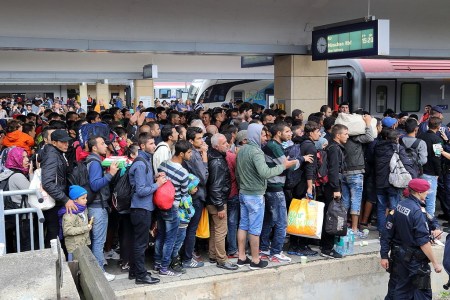
1607Thousands of newly arrived migrants, the vast majority of whom are men, crowd the platforms at Vienna West Railway Station on August 15, 2015 — a common scene in the summer and fall of 2015. (Image source: Bwag/Wikimedia Commons)

Speaking to the BBC News program, “World on the Move,” on May 16, Sir Richard Dearlove, the former head of the British intelligence service MI6, warned that the number of migrants coming to Europe during the next five years could run into millions. This, he said, would reshape the continent’s geopolitical landscape: “If Europe cannot act together to persuade a significant majority of its citizens that it can gain control of its migratory crisis then the EU will find itself at the mercy of a populist uprising, which is already stirring.”

Dearlove also warned against allowing millions of Turks visa-free access to the EU, describing the EU plan as “perverse, like storing gasoline next to the fire we’re trying to extinguish.”

On May 17, the Telegraph published the details of a leaked report from the European Commission, the powerful administrative arm of the European Union. The report warns that opening Europe’s borders to 78 million Turks would increase the risk of terrorist attacks in the European Union. The report states:

“It can be expected that, as soon as Turkish citizens will obtain visa-free entry to the EU, foreign nationals will start trying to obtain Turkish passports in order to pretend to be Turkish citizens and enter the EU visa free, or use the identities of Turkish citizens, or to obtain by fraud the Turkish citizenship. This possibility may attract not only irregular migrants, but also criminals or terrorists.”

According to the Telegraph, the report adds that as a result of the deal, the Turkish mafia, which traffics vast volumes of drugs, sex slaves, illegal firearms and refugees into Europe, may undergo “direct territorial expansion towards the EU.” The report warns: “Suspect individuals being allowed to travel to the Schengen territory without the need to go through a visa request procedure would have a greater ability to enter the EU without being noticed.”

While the EU privately admits that the visa waiver would increase the risk to European security, in public the EU has recommended that the deal be approved.

On May 4, the European Commission announced that Turkey has met most of the 72 “benchmarks of the roadmap” needed to qualify for the visa waiver. The remaining five conditions concern the fight against corruption, judicial cooperation with EU member states, deeper ties with the European law-enforcement agency Europol, data protection and anti-terrorism legislation.

European Commission Vice President Frans Timmermans said:

“Turkey has made impressive progress, particularly in recent weeks, on meeting the benchmarks of its visa liberalization roadmap…. This is why we are putting a proposal on the table which opens the way for the European Parliament and the Member States to decide to lift visa requirements, once the benchmarks have been met.”

In order for the visa waiver to take effect, it must be approved by the national parliaments of the EU member states, as well as the European Parliament.

Ahead of a May 18 debate at the European Parliament in Strasbourg over Turkey’s progress in fulfilling requirements for visa liberalization, Burhan Kuzu, a senior adviser to Erdogan, warned the European Parliament that it had an “important choice” to make.

In a Twitter message, Kuzu wrote: “If they make the wrong decision, we will send the refugees.” In a subsequent telephone interview with Bloomberg, he added: “If Turkey’s doors are opened, Europe would be miserable.”

Meanwhile, Erdogan has placed yet another obstacle in the way of EU-Turkey deal. He is now demanding that the EU immediately hand over three billion euros ($3.4 billion) promised under the deal so that Turkish authorities can spend it as they see fit.

The EU insists that the funds be transferred through the United Nations and other international aid agencies in accordance with strict rules on how the aid can be spent. That stance has prompted Erdogan to accuse the EU of “mocking the dignity” of the Turkish nation.

On May 10, Erdogan expressed anger at the glacial pace of the EU bureaucracy:

“This country [Turkey] is looking after three million refugees. What did they [the EU] say? We’ll give you €3 billion. Well, have they given us any of that money until now? No. They’re still stroking the ball around midfield. If you’re going to give it, just give it.

“These [EU] administrators come here, tour our [refugee] camps, then ask at the same time for more projects. Are you kidding us? What projects? We have 25 camps running. You’ve seen them. There is no such thing as a project. We’ve implemented them.”

In an interview with the Financial Times, Fuat Oktay, head of Turkey’s Disaster and Emergency Management Authority (AFAD), the agency responsible for coordinating the country’s refugee response, accused European officials of being fixated on “bureaucracies, rules and procedures” and urged the European Commission to find a way around them.

The European Commission insists that it was made clear from the outset that most of the money must go to aid organizations: “Funding under the Facility for Refugees in Turkey supports refugees in the country. It is funding for refugees and not funding for Turkey.”

The migration crisis appears to be having political repercussions for German Chancellor Angela Merkel, a leading proponent of the EU-Turkey deal. According to a new poll published by the German newsmagazine Cicero on May 10, two-thirds (64%) of Germans oppose a fourth term for Merkel, whose term ends in the fall of 2017.

In an interview with Welt am Sonntag, Horst Seehofer, the leader of the Christian Social Union (CSU), the Bavarian sister-party to Merkel’s Christian Democrats (CDU), blamed Merkel for enabling Erdogan’s blackmail: “I am not against talks with Turkey. But I think it is dangerous to be dependent upon Ankara.”

Sahra Wagenknecht of the Left Party accused Merkel of negotiating the EU-Turkey deal without involving her European partners: “The chancellor is responsible for Europe having become vulnerable to blackmail by the authoritarian Turkish regime.”

Cem Özdemir, leader of the Greens Party and the son of Turkish immigrants said: “The EU-Turkey deal has made Europe subject to Turkish blackmail. The chancellor bears significant responsibility for this state of affairs.”

Obama’s Animus toward Israel May Lead to War

May 15, 2016

Obama’s Animus toward Israel May Lead to War, American ThinkerVictor Sharpe and Robert Vincent, May 15, 2016

Will the looming conclusion of the Obama presidency lead him to engineer an all-out war by Iran’s terror surrogates, Hamas and Hezbollah, against the embattled Jewish state?  Will that war conveniently occur in December 2016, as Obama serves out the final days of his presidency?

Is it conceivable that the pro-Muslim president of the United States will use such a conflict to predictably and mendaciously blame Israel as a means to permanently fracture the U.S.-Israeli alliance in a manner that would be difficult for any successor to repair?  As extreme as this may sound, it is entirely possible in view of Obama’s past acts of blatant hatred toward America’s one and only true democracy and ally in the Middle East.

As should be obvious by now, Obama believes that Islam has suffered from British and European Christian colonization and oppression.  After being thoroughly prepared to be receptive to this message by his stridently anti-Western mother and maternal grandparents, such was the indoctrination Obama received from Khaled al-Mansour – a Muslim high-level adviser to Saudi Prince Al-Waleed bin Talal and anti-Jewish hate-monger – during his formative years.

It was al-Mansour who helped Obama gain admittance to the Harvard Law School.  Edward Said, an outspoken anti-Israel professor of Obama’s at Columbia University, and Rashid Khalidi, a former press agent for Yasser Arafat’s PLO, served as Obama’s mentor in the former case and friend in the latter.

These figures, whose entire professional adult lives had been essentially dedicated to eliminating Israel, focused on influencing Obama to support the Arabs who call themselves Palestinians – along with their thugocracy known as the Palestinian Authority.  These overwhelmingly Muslim terrorists amount to little more than cannon fodder in the ongoing Islamist quest to effectively perpetrate yet another Holocaust.

Thus, while Obama weakens America and disparages Western values and the tenets of Judeo-Christian civilization, he always chooses to suppress the reality of Islamic triumphalism and its appalling and inhumane history of slavery, hatred of non-Muslims, brutal Muslim conquests, and slaughter dating back to its 7th-century origins in Arabia.

This is why no one should be surprised that he would bow to a Saudi king and venerate the Islamic call of the muezzin.

Given his background, it is no wonder that Obama fell for the monumental lie that the Jewish state is also a modern colonizer, just as the European powers were.  After all, Obama’s other confidants included, as the principled and worthy Victor David Hanson recently pointed out, “the obscene Reverend Wright and reprobates like Bill Ayers and Father Michael Pfleger.”

But unlike the European colonizers who had no ancestral roots in the Middle Eastern territories they occupied, Israel is the biblical and post-biblical homeland of the Jewish people, and as the native people of its ancestral homeland, the Jews predate the Muslim invasion of Israel by millennia, as is clearly evident in the Bible, which could not have been written when and where it was otherwise.

Even though sovereignty was lost to them after the Roman destruction of the Jewish state, Jews have always lived in their native land in whatever numbers they could sustain under a succession of alien occupiers.

Despite these clearly established historical facts, modern reborn Israel and her democratically elected leader, Prime Minister Netanyahu, have been treated with unprecedented contempt by Obama and his sycophants.

This was evident early on with Obama’s support of and friendship to the Islamist Erdoğan in Turkey, who has reduced once secular Turkey to a growing totalitarian Islamic state that has openly supported terrorism against Israel, as demonstrated by the Gaza flotilla incident of 2010.

Erdoğan’s perfidy – which has included all but open support for ISIS – has in no way dampened Obama’s preferential treatment of this dictator, in contrast to his appalling treatment of Israel’s Prime Minister Netanyahu.

Routinely, the State Department promotes the hypocrisy of the Obama administration by ignoring the aggression and terror of the Palestinian Authority, led by the Holocaust-denying Mahmoud Abbas and the Hamas and Islamic Jihad thugs who rule over the Gaza Strip.

In deplorable contrast, the State Department routinely attacks Israel for building homes in Jerusalem for young couples, or chiding Israel to exercise “restraint” when Israel is forced to defend itself from relentless Palestinian brutality and murder of Israeli civilians.  Was France or Belgium similarly asked to exercise “restraint” in the face of recent Muslim terrorist attacks in those countries?

This spitefulness was exhibited when the U.S., at the behest of a high-level individual in the Obama administration (wonder who!), denied visas to Israelis during Israel’s defensive Gaza war in 2014 against Hamas aggression.

Even as the barrage of thousands of rockets aimed at Israeli villages and towns from Gaza continued, this outrage was compounded when President Obama banned the much needed resupply of armaments to Israel at the height of the Hamas terror blitz and temporarily banned U.S. airlines from flying to Israel on the flimsiest of pretexts (23 international carriers – including British Airways – continued flights to Israel in spite of this ban).

Obama has also treated America’s other traditional allies with insolent disdain and cozied up to the worst enemy of freedom and liberty – namely, the Islamo-Nazi regime of Iran.

Iran’s ongoing implicit threats of nuclear warfare – against the U.S. as well as Israel – including its aggressive development of potentially nuclear-armed ICBMs, which can eventually reach the U.S., does not faze this incumbent in the White House.

The fact that this supposed nuclear “agreement” with Iran was reached, even as his very own State Department admits that Iran has yet to actually sign the agreement and even as Iranian mobs continue to chant “Death to America” to the approving nods of the Iranian mullahs, also fits into Barack Hussein Obama’s distorted world view – a deliberate policy of lies, deception, and dissimilitude.

This was admitted to by one of his closest advisers, Ben Rhodes, who recently disclosed that the Obama administration had deliberately deceived Congress and the American public about the Iran deal – as if this was something to be proud of.

Perhaps one of the most blatant examples of Obama’s anti-Western, anti-American, and anti-Israeli ideology was his support for the Muslim Brotherhood in Egypt and his reluctance to sell arms to President El-Sisi, who overthrew the Brotherhood’s Mohammed Morsi and his vicious anti-Christian regime after it had been in power for only two years and had wrought havoc on that country.

Obama’s support for Morsi should have come as no surprise, given the endless flow of Muslim Brotherhood activists visiting Obama’s White House and the filling of senior positions within the administration, as documented by former CIA analyst Clare Lopez.

Even today, El-Sisi fights al-Qaeda terrorism in the Sinai and the Hamas terrorists in Gaza without any apparent support or approval from Obama.

These examples of the president’s bias, his pro-Islamic sympathies, and his agenda point to a seminal hatred of not only America itself, but most pointedly of the Jewish state – this hatred may override all other practical considerations in the remaining few months of his term in office.

His parting shot at Israel may well be to force her expulsion from the United Nations and turn the Jewish state into another Taiwan.

As suggested at the beginning of this article, he might well encourage both Iranian terror proxies, Hamas in Gaza and Hezb’allah in Lebanon, to attack Israel with a massive missile bombardment sometime this coming December.

Hamas, for its own part, has thousands of lethal rockets and mortars and is feverishly building tunnels into Israeli territory in the hope of sending its terrorist hordes into Israeli villages and towns and slaughtering as many civilians as possible.  Hezb’allah, on the other hand, is estimated to have more than 150 thousand missiles and rockets aimed at all of Israel, hidden in Lebanese schools, hospitals, and apartments.

Even as the deliberate use of civilians as human shields is explicitly spelled out by the Geneva Conventions as a crime against humanity, and though Israel would have no choice but to inflict substantial civilian casualties in her own defense, this circumstance would naturally be used as a pretext by the U.N. to punish Israel in an unprecedented manner.

They would do so knowing that for the first time, an American president would likely stand by and approve whatever the U.N. anti-Israel “lynch mob” might concoct in order to further isolate and delegitimize the Jewish state.  This might include severe economic sanctions or embargoes or might even involve expulsion of Israel from the U.N. entirely.

It should be emphasized here that once the American national election is over, there will be nothing to stop Obama from doing this.  Obama’s entire foreign policy has revolved around undermining Israel.  Such an action on his part in the closing weeks of his administration can be seen as not only possible, but likely, given the pattern of his behavior toward Israel for the whole of his presidency.

This latter punishment would suit Israel’s enemies very well, even though it would change nothing on the ground.  An Israel reduced to a Taiwan-like status – i.e., a de facto sovereign state not officially recognized as such by the U.N. – would obviate the need for Gulf Arabs (who are covertly making common cause with Israel against Iran) to establish any formal diplomatic relations with her.

The “Zionist entity,” as their official propaganda impudently puts it, would remain just that.  This might even, in rhetorical terms, satisfy the requirement of Iran’s mullahs to “wipe Israel from the map.”  What is more, once Israel is expelled from the U.N., it would be very difficult for any future U.S. president, no matter how pro-Israel, to successfully support Israel’s re-admittance into the U.N.

As is the case with Taiwan, the U.S. may maintain a commitment to supplying Israel with arms and supporting her efforts at self-defense, but in practical terms, that may be the extent of the relationship, even in the best-case scenario surrounding Israel’s expulsion from the U.N. under Obama during his final days in office.

While such a turn of events may sound far-fetched to even some of those most critical of Obama, it is entirely possible in view of Obama’s past acts of blatant hatred toward America’s one and only true ally and democracy in the Middle East.


Europe’s Migration Crisis: No End in Sight

May 2, 2016

Europe’s Migration Crisis: No End in Sight, Gatestone Institute, Judith Bergman, May 2, 2016

♦ According to France’s Defense Minister, Jean-Yves Le Drian, 800,000 migrants are currently in Libyan territory waiting to cross the Mediterranean.

♦ The multitude of very costly social problems that Muslim migration into Europe has caused thus far, do not exist in this whitewashed European Union report, where the “research” indicates that migrants are always a boon. Similarly, any mention of the very real security costs necessitated by the Islamization occurring in Europe, and the need for monitoring of potential jihadists, simply goes unmentioned.

♦ Several European states have a less optimistic picture of the prospect of another three million migrants arriving on Europe’s borders than either the Pope or the European Commission do.

Pope Francis, on his recent visit to the Greek island of Lesbos, said that Europe must respond to the migrant crisis with solutions that are “worthy of humanity.” He also decried “that dense pall of indifference that clouds hearts and minds.” The Pope then proceeded to demonstrate what he believes is a response “worthy of humanity” by bringing 12 Syrian Muslims with him on his plane to Italy. “It’s a drop of water in the sea. But after this drop, the sea will never be the same,” the Pope mused.

The Pope’s speech did not contain a single reference to the harsh consequences of Muslim migration into the European continent for Europeans. Instead, the speech was laced with reflections such as “…barriers create divisions instead of promoting the true progress of peoples, and divisions sooner or later lead to confrontations” and “…our willingness to continue to cooperate so that the challenges we face today will not lead to conflict, but rather to the growth of the civilization of love.”

The Pope went back to his practically migrant-free Vatican City — those 12 Syrian Muslims will be hosted by Italy, not the Vatican, although the Holy See will be supporting them — leaving it to ordinary Europeans to cope with the consequences of “the growth of the civilization of love.”

There is nothing quite as free in this world as not practicing what you preach, and what the Pope is preaching is the acceptance of more migration into Europe, and more migration — much more — is indeed what is in the cards for Europe.

At the UN’s Geneva conference on Syrian refugees on March 30, Italy’s Minister of Foreign Affairs, Paolo Gentiloni, put the total number of asylum seekers into Italy in the first three months of 2016 at 18,234. This is already 80% higher than in the same period in 2015.

According to Paolo Serra, military adviser to Martin Kobler, the UN’s Libya envoy, migrants currently in Libya will head for Italy in large numbers if the country is not stabilized. “If we do not intervene, there could be 250,000 arrivals [in Italy] by the end of 2016,” he said. According to France’s Defense Minister, Jean-Yves Le Drian, the number is much higher: 800,000 migrants are currently in Libyan territory waiting to cross the Mediterranean.

Already in November 2015, the European Union estimated — in its Autumn 2015 European Economic Forecast, authored by the European Commission — that by the end of 2016, another three million migrants will have made it into the European Union.

Nevertheless, the European Commission optimistically noted that, “while unevenly distributed among countries, the estimated additional public expenditure related to the arrival of asylum seekers is limited for most EU member states.” It even concluded that the migrant crisis could have a small, positive impact on European economies within a few years citing that “Research indicates that non-EU migrants typically receive less in individual benefits than they contribute in taxes and social contribution.”

This is the classic, politically correct denial of facts on the ground. The multitude of very costly social problems that Muslim migration into Europe has caused thus far do not exist in this whitewashed report, where the “research” indicates that migrants are always a boon. Similarly, any mention of the very real security costs necessitated by the Islamization that is occurring in Europe and the consequent need for monitoring of potential jihadists, simply goes unmentioned. One wonders whether the EU bureaucrats, who authored this report, ever descend from their ivory towers and move about in the real Europe.

Several European states have a less optimistic picture of the prospect of another three million migrants arriving on Europe’s borders than either the Pope or the European Commission do. In February, Austria announced that it would introduce border controls at border crossings along frontiers with Italy, Slovenia and Hungary. On April 12, Austria began preparations for introducing border controls on its side of the Brenner Pass, the main Alpine crossing into Italy, by starting work on a wall between the two countries.

The Austrian decision to close the Brenner pass has received harsh criticism from the EU. European Commission spokeswoman Natasha Bertaud criticized the measure as unwarranted, claiming that “there is indeed no evidence that flows of irregular migrants are shifting from Greece to Italy”. Is Bertaud deliberately misrepresenting the issue? The issue is not whether the migrants are shifting from Greece to Italy after the EU’s unsavory deal with Turkey (they probably will) but the up to 800,000 migrants are already waiting to cross into Italy from Libya.

EU Migration Commissioner Dimitris Avramopoulos joined in the criticism of Austria, saying, “What is happening at the border between Italy and Austria is not the right solution.” He had criticized Austria already in February, when Vienna announced that it would cap asylum claims at 80 per day. At the time, Avramopoulos said,

“It is true that Austria is under huge pressure… It is true they are overwhelmed. But, on the other hand, there are some principles and laws that all countries must respect and apply… The Austrians are obliged to accept asylum applications without putting a cap.”

In response, Austria’s Chancellor Werner Faymann told the EU that Austria could not just let the influx of migrants continue unchecked — nearly 100,000 have applied for asylum in Austria — and he called for the EU to act. The EU has not yet acted.

The EU should hardly be surprised that a sovereign state decides to take matters into its own hands in the face of the EU’s failure to heed that call, and as it anticipates a repeat of last year’s migration chaos — which, given the predicted estimates, is bound to occur this year with even greater force.

Predictably, Italy has also criticized the decision, with Italian Interior Minister Angelino Alfano saying that Austria’s decision to erect the barrier is “unexplainable and unjustifiable.” Italy, however, only has itself to blame for Austria’s restrictions at the Brenner Pass. In 2014 and the first half of 2015, around 300,000 migrants arrived in Italy, mainly from Libya. Despite EU rules that require Italy to register those migrants, Italy simply let most of them pass through the country and continue into Austria. From there, most went further into Germany and Northern Europe. Clearly, Austria does not expect the Italians to change their practices.

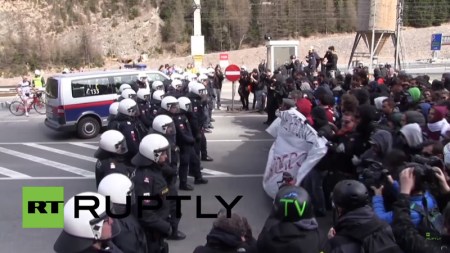
1573Austrian police prepare to hold the line at the Brenner Pass border crossing with Italy, as a crowd tries to break through during a violent protest on April 3, 2016, against Austria’s introduction of border controls to stem the flow of migrants. (Image source: RT video screenshot)

While the bureaucrats of the EU bicker with their member states over those states’ unwillingness to follow EU regulations — evidently not made to cope with a migration crisis of these huge proportions — Turkey’s President, Recep Tayyip Erdogan is threatening to drop his obligations under a recent EU-Turkey migration deal. Those obligations include taking back all new “irregular migrants” crossing from Turkey into Greek islands, as well as taking any necessary measures to prevent the opening of new sea or land routes for migration from Turkey to the EU. “There are precise conditions. If the European Union does not take the necessary steps, then Turkey will not implement the agreement,” Erdogan warned recently in a speech in Ankara.

Erdogan knows that in the current European reality, his words have the effect he intends: When he threatens to flood Europe with migrants unless it does what he wants — in other words, blackmail — EU leaders will do what he says. German Chancellor Angela Merkel, one of the driving forces behind the EU-Turkey deal, also recently bowed to Erdogan’s demands that Germany prosecute the satirist Jan Böhmermann, after he mocked and insulted the Turkish president in a poem. The German criminal code prohibits insults against foreign leaders, but leaves it to the government to decide whether to authorize prosecutors to pursue such cases. Angela Merkel gave her authorization, a decision widely criticized. Her own ministers — Foreign Minister Frank-Walter Steinmeier, and Justice Minister Heiko Maas — said they did not believe that the authorization should have been granted.

Another indication that Erdogan has no reason to fear any misbehavior on the part of the European Union regarding the EU-Turkey deal is that the European Parliament just voted in favor of making Turkish an official European Union language. Ostensibly, the vote came about in order to back an initiative by the president of Cyprus, Nicos Anastasiades, who asked the Dutch EU Presidency to add Turkish to the bloc’s 24 official languages in order to boost attempts to reach a reunification agreement for Cyprus.

In his letter to the EU presidency, Anastasiades noted that Cyprus had already filed a similar request during its EU entry talks in 2002, but, at that time, it “was advised by the [EU] institutions not to insist, taking into account the limited practical purpose of such a development … as well as the considerable cost”. Turkey’s occupation of northern Cyprus, which Turkey invaded in 1974, is one of the issues blocking Turkey’s accession negotiations with the EU.

Making Turkish an official language is seen by Turkey, according to a senior Turkish official, as “a very important, very positive gesture” for the Cyprus peace talks and for EU-Turkish ties more broadly. “If the blockage is lifted because of Cyprus being solved, then we can proceed very quickly,” the Turkish official said.

All of the other official and working languages of the European Union are tied to states which are full members of the EU. Although the vote has to be approved by the European Commission before the decision can come into effect, it speaks volumes about the EU’s deference to Erdogan.

In light of these developments, the granting of visa-free travel to European Union states for 80 million Turks looks as if it is a done deal, despite the 72 conditions, which Turkey, at least on paper, is expected to live up to. These include increasing the use of biometric passports and other technical requirements. So far, Turkey has only met half of these conditions. Perhaps that is why European Commission President Jean-Claude Juncker recently felt the need to mention that, “Turkey must fulfill all remaining conditions so that the Commission can adopt its proposal in the coming months. The criteria will not be watered down.” The question is whether Juncker himself even believes his own words.

With the provisions on visa-free travel for 80 million Turks, the EU may just have gone from the frying pan into the fire. The visa-free admission of Turks into Europe would give Erdogan completely free rein to control the influx of migrants into Europe. Moreover, anyone believing that Erdogan would not take great advantage of this opportunity would have to be dangerously naïve. The European Union may yet conclude that the migrant crisis, in all its enormity, is the far lesser evil.

Erdoğan Calls for Faith-Based UN Reform

April 29, 2016

Erdoğan Calls for Faith-Based UN Reform, Hurriyat Daily News, Burak Bekdil, April 27, 2016

(Please see also, Turkey’s Islamic Supremacist Foreign Policy. — DM)

Tragically, and in his own words, Turkish President Recep Tayyip Erdoğan thinks (or pretends to think) that “the primary reason behind terror in Turkey is to prevent Turkey from getting into the world’s top 10 economies.”

In fact that diagnosis explains why Turkey must still fight the war it has been fighting since 1984 – wrong diagnosis. But it does not explain if Turkey, three decades ago, was also heading for the top 10 list but was barred by a global network of conspirators who all of a sudden sparked terrorism on Turkish soil. So it was all because the world’s top 10 economies did not want Turkey on the list; they held secret meetings and decided that the best way to stop Turkey’s rise was to plot terror in a land that was best known for its peaceful past?

But then, ironically, Mr. Erdoğan also thinks that Turkey (or a Muslim) country should be sharing the same seat and powers as the same countries that are most probably the culprits of the global plot against Turkey: The United Nations Security Council (or the five permanent members of the UNSC).

In a recent speech, Mr. Erdoğan renewed his famous “the-world-is-greater-than-five” dictum. “There is no Muslim country among the five – all of them are Christian, non-Muslim. What is that approach? Is it fair? It’s not!” he roared, reminding everyone that he wants a Muslim member state at the UNSC “only to make the world fair” (not to be confused with the fact that Mr. Erdogan is Muslim).

Just smile and forget the fact that Mr. Erdoğan thinks that permanent member China is a Christian country.

There may be a boom in the number of house churches in the country but I have not read about the Communist Party declaring the country’s official religion to be Christianity.

If not five, what does the world equal, then, in Mr. Erdogan’s thinking? All 193 U.N. member nations as permanent members of the Security Council, all with veto powers? That would not be practical. Then, one country representing each monotheistic faith? Is Mr. Erdoğan implying that he wants Israel as a permanent member?

Should China and North Korea spell each other off and represent the atheist seat? Then the new UNSC should have India as a permanent member representing Hinduism and Japan representing Shintoism.

But the Muslim representation in UNSC could be more problematic than Mr. Erdoğan envisages. To begin with, which Islamic sect should win a seat at UNSC? Sunni or Shiite, or both? If it would be Sunni only, would that not go against Mr. Erdoğan’s preaching that all faiths must be represented? So, it will be Iran and a Sunni permanent member. But which Sunni country? It is not too hard to guess Mr. Erdoğan’s idea on the ideal candidate. But what would be the fair criteria? The world’s “most Muslim Sunni country?” Sadly science has not yet invented a Muslim-meter.

One natural candidate could be Saudi Arabia, the custodian of Islam’s holy place. It would also be fun to have both Saudi Arabia and Iran sitting on the UNSC together and in peace – and with Israel, too.

Another criterion could be to nominate the most populous Muslim country in the world. That would point to Indonesia and even Pakistan and Egypt would come before Turkey. Not just that: India where, according to the 2011 population census, the Muslim population is twice as big as Turkey, would be a far better candidate than the Crescent and Star.

Mr. Erdoğan complains that all five permanent members are Christian but since in the new “faith-based setting” there will be Sunni and Shiite members, what if the Christians want representation on the grounds of Catholic, Orthodox and Protestant (and other) faiths? What about the animists in Africa? Or Zoroastrians – for whom Mr. Erdoğan has never hidden his deep disdain?

And, by the way, are we talking about a security council or a world congress of the faithful including those with faith in no faith?

Turkey’s Islamic Supremacist Foreign Policy

April 29, 2016

Turkey’s Islamic Supremacist Foreign Policy, Gatestone InstituteUzay Bulut, April 29, 2016

♦ “We have never been involved in an attack against Turkey … we were never involved in such an action… Davutoglu wants to pave the way for an offensive on Syria and Rojava and cover up Turkey’s relations with the ISIS which is known to the whole world by now.” — YPG (Kurdish) General Command.

♦ “Thousands of settlers from Anatolia were shipped in by the Turkish government to occupy former Greek villages and to change Cypriot demography — in the same manner the occupying Ottoman Empire once did in the 16th century.” — Victor Davis Hanson, historian.

♦ Turkey, for more than 40 years, has been illegally occupying the northern part of the Republic of Cyprus, historically a Greek and Christian nation, which it invaded with a bloody military campaign in 1974.

♦ What Turkey would call a crime if committed by a non-Turkish or a non-Sunni state, Turkey sees as legitimate if Turkey itself commits it.

Between March 29 and April 2, 2016, Turkey’s president, Recep Tayyip Erdogan, paid a visit to Washington D.C. to participate in the 4th Nuclear Security Summit hosted by U.S. President Barack Obama.

In an interview with CNN broadcast March 31, Erdogan said, “We will not allow an act such as giving northern Syria to a terrorist organization… We will never forgive such a wrong. We are determined about that.”

Asked which terror organization he was referring to, Erdogan said: “The YPG [Kurdish People’s Protection Units], the PYD [Democratic Union Party] … and if Daesh [ISIS] has an intention of that sort then it would also never be allowed.”

Erdogan was thereby once again attempting to equate Islamic State (ISIS), which has tortured, raped, sold or slaughtered so many innocent people in Syria and Iraq, with the Kurdish PYD, and its YPG militia, whose members have been fighting with their lives to defeat genocidal jihadist groups such as al-Nusra and ISIS.

The question is not why Erdogan or his government have such an intense hatred for Kurds. Turkey’s genocidal policies against the Kurds are not a secret. Turkey’s most recent deadly attacks are ongoing in Kurdish districts even now. The more important question is why Erdogan thinks that Turkey is the one to decide to whom the predominantly Kurdish north of Syria will belong — or who will not rule that part of Syria.

On February 17, Turkey’s capital, Ankara, was shaken by a car bomb that killed 28 people and wounded 61 others.

Turkey’s Prime Minister, Ahmet Davutoglu, immediately announced that the perpetrator was a Syrian national with links to the Syrian Kurdish People’s Protection Units (YPG).

“A direct link between the attack and the YPG has been established,” Davutoglu said. “The YPG attack was carried out with logistical support from the Kurdistan Workers’ Party (PKK) inside Turkey. Just as al-Qaeda or Daesh do not have seats at the table, the YPG, which is a terrorist organization, cannot have one.” He then once again refused to permit Kurdish YPG participation in U.N.-brokered Syria peace talks in Geneva.

Saleh Muslim, the head of Syria’s Kurdish Democratic Union Party (PYD), replied via Agence France-Presse: “We deny any involvement in this attack. These accusations are clearly related to Turkish attempts to intervene in Syria.”

The General Command of the YPG also denied any involvement in the attack:

“Under challenging conditions, we are protecting our people from barbaric gangs such as ISIS and Al-Nusra. Countless states and media outlets have repeatedly reported about the support Turkey has been providing to these terrorist groups. Apart from the terrorist groups attacking us, we as YPG have engaged in no military activity against the neighboring states or other forces.

“We would like to repeat our message to the people of Turkey and the world: We have no links to this incident… We have never been involved in an attack against Turkey. The Turkish state cannot possibly prove our engagement in any kind of attack on their side because we were never involved in such an action. Turkish Prime Minister Davutoglu’s remarks ‘Ankara attack was conducted by YPG’ is a lie and far away from the truth. With this statement, Davutoglu wants to pave the way for an offensive on Syria and Rojava and cover up Turkey’s relations with the ISIS which is known to the whole world by now.”

The Middle East is going through mass murders, kidnappings, rapes, the sexual slavery of women and other crimes. And Turkey’s aggressive and supremacist foreign policy, which does not respect the sovereignty of its neighbors, has played a large role in this situation.

Syria and Iraq, Turkey’s southern neighbors, are now the breeding ground of genocidal jihadist groups, foremost the Islamic State (ISIS). Many reporters, experts and eyewitnesses have revealed that Turkey has contributed to the rise of jihadist terrorists in the region — by letting ISIS members get in and out of Turkey and even by providing funds, logistics, and arms for ISIS.

Inside its own boundaries, Turkey has been engaged in an all-out war against its own Kurdish citizens since last August. Turkey has been murdering them indiscriminately and destroying their homes and neighborhoods.

Turkey’s hatred of Kurds is so intense that it also targets Kurdish defense forces in Syria.

On February 13, Davutoglu confirmed shelling the Kurdish YPG group in Syria, after the YPG advanced on the rebel-held town of Azaz in Syria. “We will retaliate against every step [by the YPG],” Davutoglu said. “The YPG will immediately withdraw from Azaz and the surrounding area and will not go close to it again.”

The rebels in Azaz and elsewhere in Syria are mostly Islamist jihadists. According to the scholar Aymenn Jawad Al-Tamimi, Azaz was mostly controlled in early 2015 by the group Liwa Asifat al-Shamal (“Northern Storm Brigade”), affiliated with the Islamic Front. Syria’s al-Qaeda affiliate Jabhat al-Nusra (“Al-Nusra Front”) also had a presence there.

“Azaz is a symbol for Turkey,” said Fabrice Balanche of the Washington Institute For Near East Policy. “Prime Minister Davutoglu fears that if the Kurds capture Azaz, they could start a big offensive from Kobane to the west and from Afrin to the east,” he told BBC.

As widely reported, the crisis in the region reached a peak when a Turkish Air Force F-16 fighter jet shot down a Russian Air Force Su-24 bomber along the Turkey-Syria border on November 24, killing the pilot, Lieutenant-Colonel Oleg Peshkov. The Turkish government tried to excuse the attack by claiming that the jet was downed after it had violated Turkish airspace for 17 seconds.

The Russia Defense Ministry, however, denied the aircraft ever left Syrian airspace, and released a video they claimed shows that the Su-24 was not in Turkish airspace when it was shot down.

Meanwhile, Turkey’s neighbor to its West, Greece, has long been a victim of Turkey’s violations of its sovereign airspace. According to data recorded by the Greek military, in 2014 alone, Turkish aircraft violated Greek airspace 2,244 times. On just one day, February 15, Turkish warplanes violated Greek airspace 22 times, according to Athens News Agency.

After Syria, Greece and Russia, Turkey’s next target was its other southern neighbor, Iraq. In December, Iraq’s President, Fuad Masum, said, “The presence of the Turkish Army Forces in Mosul Province without our permission violates international rules. I want Turkish officials to get its force out of Iraq’s territory immediately.”

Iraq’s Prime Minister Haider al-Abadi also condemned Turkey’s action: “We have not asked Turkey for any force and no one had informed us about the arrival of the force.”

Two neighbors of Turkey, Cyprus and Armenia, have also been victims of Turkish aggression — for an even longer time.

Turkey, for more than 40 years, has been illegally occupying the northern part of the Republic of Cyprus, which it invaded with a bloody military campaign in 1974. According to historian Victor Davis Hanson:

“Thousands of settlers from Anatolia were shipped in by the Turkish government to occupy former Greek villages and to change Cypriot demography — in the same manner the occupying Ottoman Empire once did in the 16th century. … The island remains conquered not because the Greeks have given up, but because their resistance is futile against a NATO power of some 70 million people. Greeks know that Turkey worries little about what world thinks of its occupation.”

Turkey has also been blockading yet another neighbor since 1993: “Turkey and Azerbaijan have effectively been exercising an illegal unilateral economic blockade against Armenia, which has hurt the latter economically,” wrote Armen V. Sahakyan, the executive director of the Eurasian Research and Analysis Institute. “Turkey and Azerbaijan are in clear violation of the Principle of Good Neighborliness, as well as all of the General Assembly resolutions condemning unilateral coercive measures.”

Turkey has been assaulting its neighbors in what appears as outbursts of Turkish Islamic supremacy. What Turkey would call a crime if committed by a non-Turkish or a non-Sunni state, Turkey sees as legitimate if Turkey itself commits it.

When Turkey invaded Cyprus, historically a Greek and Christian nation, it is not called an invasion. Turkey still refers to the 1974 military campaign as a “peace operation.” Senior politicians and military officials from Turkey also participate in the official ceremonies called “the Peace and Freedom Festival,” organized in occupied northern Cyprus on July 20 every year, to celebrate what they “achieved” more than 40 years ago — namely, an ethnic cleansing and colonization campaign that they conducted through many crimes, including mass murders, wholesale and repeated rapes, torture and inhuman treatment, plundering Cypriot cultural heritage and destroying churches, among others.
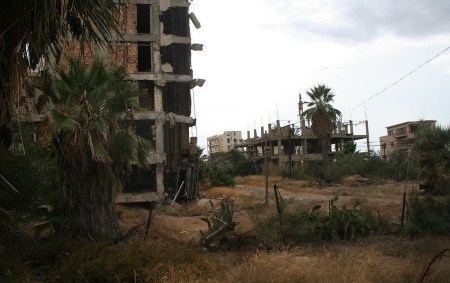
1569The crumbling buildings of the Varosha district of Famagusta, Cyprus, photographed in 2009. The area lies within Turkish-controlled northern Cyprus. The inhabitants fled during the 1974 Turkish invasion and the district has been abandoned since then. (Source: Wikimedia Commons)

If anyone blockaded another state, especially a Sunni state, Turkey would most certainly condemn it. But when Turkey itself blockades a Christian nation, it is always “justified” — most often as a response to some “unacceptable wrongdoing” by the other side.

If a non-Turkish, or non-Sunni state, treated a Turkish or Sunni minority brutally, Turkey would passionately condemn it. But Turkey sees no harm in slaughtering its own Kurdish citizens, and devastating their towns. Turkey claims this is a just way of “fighting against terrorism.”

Turkey can shoot down a Russian plane in the blink of an eye, because supposedly no one can violate Turkish airspace even for a few seconds — or even if no such violation takes place. But Turkey can violate the Greek sovereign airspace countless times as a national sport or hobby whenever it feels like it?

If Western authorities criticize Turkey for its policies, Turkey accuses them of “intervening in Turkey’s internal affairs.”

For instance, when a group of journalists close to the movement of the Islamic cleric Fethullah Gulen were detained in a mass arrest operation on December 14, 2014 in Turkey, the European Commission, in a joint statement, criticized the police raids and arrests of the media representatives.

EU foreign affairs chief Federica Mogherini and the commissioner heading EU enlargement talks also said the arrests went “against European values.”

Turkish President Recep Tayyip Erdogan responded in a public speech:

“When we take a step, someone in the European Union immediately comes up and makes a statement. According to what do you make this statement? What do you know?

“Those who have made this country wait at the gate of the European Union for 50 years, do you ever know what this [our] step is? The elements that threaten our national security — be they members of the press, or this or that — will get the required response. It is impossible for us to make them sovereign in this country.

“And when we take such a step, we do not think about ‘what will the European Union say?’ or ‘will the EU accept us [as a member]?’ We do not have such concerns. We will pull ourselves up by our own bootstraps. Please keep your intellect to yourselves.”

Erdogan also said that the detentions were not an “issue” of press freedom and claimed that the Fethullah Gulen movement was backed by Israel, which Erdogan referred to as “the country in the south that he [Gulen] loves.”

So, the European Union, of which Turkey is allegedly “striving” to be a member, cannot even issue a critical statement concerning Turkey’s policies because that would “intervene in Turkish steps for national security,” but Turkey can send jihadist fighters, arms or funds into Syria or Iraq and destroy lives and civilizations there?

Turkey seems to believe it always has to be strong and a leading force in the region. But if Kurds — an indigenous, stateless and persecuted people — are to gain a single right anywhere in the world, does Turkey find that unacceptable?

The entire history of Turkey as well as its current policies demonstrate that Turkey believes Kurds are inferior to Turks. Turkey does not even recognize the Kurds’ right to be educated in Kurdish, evidently in an attempt to separate them from their identity.

“The policy of Republican Turkey since its establishment in 1923,” wrote the author Amir Hassanpour, “is a typical case of what has been called ‘linguicide’ or ‘linguistic genocide.’ Forcing the Kurds to abandon their language and become native speakers of Turkish is the primary goal of the language policy.”

Freedom and sovereignty are for Turks only. Kurds are just to be murdered or to be Turkey’s servants. This has been the state policy of Turkey ever since it was founded in 1923.

“The master in this country is the Turk,” said Mahmut Esat Bozkurt, Turkey’s first Minister of Justice, in 1930. “Those who are not genuine Turks can have only one right in the Turkish fatherland, and that is to be a servant, to be a slave. We are in the most free country of the world. They call this Turkey.”
 

Germany: “We Need an Islam Law”

April 28, 2016

Germany: “We Need an Islam Law” Gatestone InstituteSoeren Kern, April 28, 2016

♦ “All imams need to be trained in Germany and share our core values. … It cannot be that we are importing different, partly extreme values from other countries. German must be the language of the mosques. Enlightened Europe must cultivate its own Islam.” – Andreas Scheuer, the General Secretary of the Christian Social Union party (CSU).

♦ The Turkish government has sent 970 clerics — most of whom do not speak German — to lead 900 mosques in Germany that are controlled by a branch of the Turkish government’s Directorate for Religious Affairs. Turkish clerics in Germany are effectively Turkish civil servants who do the bidding of the Turkish government.

♦ Erdogan has repeatedly warned Turkish immigrants not to assimilate into German society. During a trip to Berlin in November 2011, Erdogan declared: “Assimilation is a violation of human rights.”

A senior German politician has called for an “Islam law” that would limit the influence of foreign imams and prohibit the foreign financing of mosques in Germany.

The proposal — modelled on the Islam Law promulgated in Austria in February 2015 — is aimed at staving off extremism and promoting Muslim integration by developing a moderate “European Islam.”

The move comes amid revelations that the Turkish government is paying the salaries of nearly 1,000 conservative imams in Germany who are leading mosques across the country. In addition, Saudi Arabia recently pledged to finance the construction of 200 mosques in Germany to serve migrants there.

In an interview with the newspaper Die Welt, Andreas Scheuer, the General Secretary of the Christian Social Union (CSU), the Bavarian sister party to German Chancellor Angela Merkel’s Christian Democrats (CDU), said that Berlin should restrict Turkish financing of mosques in Germany and begin training and certifying its own imams. Otherwise, he argued, Muslim integration will be difficult or impossible to achieve. He said:

“We need to become more critical in our dealings with political Islam, because it hinders Muslim integration in our country. We need an Islam Law. The financing of mosques or Islamic kindergartens from abroad, e.g. from Turkey or Saudi Arabia, should be banned. All imams need to be trained in Germany and share our core values.

“It cannot be that we are importing different, partly extreme values from other countries. German must be the language of the mosques. Enlightened Europe must cultivate its own Islam.

“We are still at the beginning of our efforts. We must start now. We cannot on the one hand enact an Integration Law and on the other side close our eyes to what is being preached in mosques and by whom.”

Scheuer’s comments come amid reports that the Turkish government has sent 970 clerics — most of whom do not speak German — to lead 900 mosques in Germany that are controlled by the Turkish-Islamic Union for Religious Affairs (DITIB), a branch of the Turkish government’s Directorate for Religious Affairs, known in Turkish as Diyanet.

Successive German governments are responsible for this state of affairs. An essay in Der Tagesspiegel states: “Over past decades, the federal government has welcomed the fact that the Turkish religious authority exercises a great influence on German mosques. Turkey was considered a secular state, and their influence was viewed as a shield against religious extremism.”

This was before Turkish President Recep Tayyip Erdogan embarked on a mission to turn the formerly secular nation an Islamic country.

According to Die Welt, Erdogan has increased the size, scope and power of the Diyanet, which now has a budget of 6.4 Turkish lira ($2.3 billion; €1.8 billion), which is more than the budgets of 12 Turkish government ministries, including the interior ministry and the foreign ministry. The Diyanet now has 120,000 employees, up from 72,000 in 2004.

The Turkish clerics in Germany are effectively Turkish civil servants who do the bidding of the Turkish government. Critics accuse Erdogan of using DITIB mosques to prevent Turkish migrants from integrating into German society.

German politician Cem Özdemir, co-chairman of the Green Party, said that DITIB is “nothing more than an extended arm of the Turkish state.” He added: “Rather than being a legitimate religious organization, the Turkish government has turned DITIB into a political front organization of Erdogan’s AKP party. Turkey must let go of the Muslims in Germany.”

Erdogan has repeatedly warned Turkish immigrants not to assimilate into German society.

1567 (1)The Cologne Central Mosque, run by DITIB, is used as a key base in Germany for Turkey’s intelligence agency, where they run a local “thug squad” to mete out “tough punishments” to Turkish dissidents in Germany. (Image source: © Raimond Spekking/CC BY-SA 4.0, via Wikimedia Commons)

During a trip to Berlin in November 2011, Erdogan declared: “Assimilation is a violation of human rights.” In February 2011, Erdogan told a crowd of more than 10,000 Turkish immigrants in Düsseldorf: “We are against assimilation. No one should be able to rip us away from our culture and civilization.” In February 2008, Erdogan told 16,000 Turkish immigrants in Cologne that “assimilation is a crime against humanity.”

For his part, Saudi Arabia’s King Salman recently announced a plan to finance the construction of 200 mosques in Germany to provide for the spiritual needs migrants and refugees who arrived there in 2015. The mosques would, presumably, adhere to Wahhabism, the official and dominant form of Sunni Islam in Saudi Arabia. Wahhabism is an austere form of Islam that insists on a literal interpretation of the Koran.

On April 11, Hans-Georg Maassen, the head of Germany’s domestic intelligence agency (BfV), expressed alarm at the growing number of radical Arab-language mosques in Germany. “Many mosques are dominated by fundamentalists and are being monitored because of their Salafist orientation,” Maassen said in an interview with Welt am Sonntag. He added that many of the mosques were being financed by donors in Saudi Arabia.

It remains uncertain, however, whether Merkel will back the “Islam Law,” which is certain to antagonize Erdogan, who effectively controls the floodgates of Muslim mass migration to Europe. If Merkel were openly to support a ban on foreign financing of mosques in Germany, Erdogan likely would threaten to pull out of the EU-Turkey deal on migrants, a deal Merkel desperately needs to stanch the flow of mass migration to Germany. It is yet another indication of the tremendous leverage Erdogan has gained over Merkel and German policymaking.

Germany’s coalition government has, however, reached a compromise deal on a new “Integration Law.”

On April 14, Merkel announced the broad outlines of the law, which will spell out the rights and responsibilities of migrants in Germany. Under the law, the text of which will be finalized by May 24, asylum seekers must attend German language classes and integration training or have their benefits cut.

The government pledged to make it easier for asylum seekers to gain access to the German labor market by promising to create 100,000 new “working opportunities.” The government will also suspend a law requiring employers to give preference to German or EU job applicants over asylum seekers.

In an effort to prevent the spread of migrant ghettoes in Germany, the new law, which is expected to enter into force this summer, will prohibit refugees from choosing where they live until they have secured asylum. Migrants who abandon state-assigned housing would face unspecified sanctions.

The new law also includes a counter-terrorism provision, which would allow German intelligence agencies to work more closely with their European, NATO and Israeli counterparts.

“We will have a German law on integration,” Merkel said. “This is the first time in post-war Germany that this has happened. It is an important, qualitative step.”

But critics say the proposed law does not go far enough because it does not threaten with deportation those migrants who refuse to integrate. In his interview with Die Welt, Scheuer insisted that Muslim immigrants must integrate or be deported:

“Anyone who fails to attend integration and language courses attests that they are not prepared to integrate and accept our values. Moreover, it is important that people who want to stay in Germany register with the Federal Employment Agency [Bundesagentur für Arbeit] and provide for their own livelihood. The message is clear: Those who are not integrated cannot stay here. We need to cease having romantic views of integration. Multiculturalism has failed. Those who are not integrated must count on deportation.”

Turkish Parliamentary Speaker Calls For Islamic State

April 27, 2016

Turkish Parliamentary Speaker Calls For Islamic State, Jonathan Turley’s Blog, Jonathan Turley, Apri 27, 2016

(What difference does it make now? — DM)

220px-recep_tayyip_erdogan (1)


ismail_kahraman_ankara_cropped

We have followed the rapid decline of civil liberties under the authoritarian rule of Recep Tayyip Erdoğan in the past few years as well as his empowering of Islamic parties in the once secular state. When Erdogan first ran, he assured Turks that he was committed to the secular traditions and constitution of the country. He then did precisely the opposite in power by chipping away at secular laws, introducing Islamic governing principles, and assuming authoritarian power. Now, Turkish Parliament Speaker Ismail Kahraman has finally taken Erdogan’s policies to their natural conclusion and called for the dismantling of secular government and the creation of an Islamic state.

The call confirms what was long obvious about Erdogan’s true intent to eradicate civil liberties and secular government — destroying the original model of the founder of modern Turkey, Mustafa Kemal Ataturk, after the collapse of the Islamic Ottoman Empire. Turkey was once the greatest hope among Muslim countries in maintaining a nation based of secular values. Then came Erdogan who sought to introduce Islamic law as well as authoritarian measures. This includes the arrest of Mehmet Emin Altunses, 16, who allegedly committed the crime of “insulting” Erdoğan. calling people who use birth control “traitors” and saying Muslims discovered America, you are not allowed to be disrespectful or insulting in discussing Erdoğan. Then there was the prosecution of model and former Miss Turkey Merve Buyuksarac, 26, for criticizing Erdogan for quoting a few lines from a poem called the “Master’s Poem” from weekly Turkish satirical magazine Uykusuz. Erdoğan’s totalitarian measures have earned him the nickname “Buyuk Usta” (the Big Master). Even a joking reference to Gollum and Erdoğan is enough to land you in jail today in Turkey.

Just as Erdogan has dropped any pretense of civil liberties, Kahraman wants to drop any pretense of secularism. He lamented that fact that the Constitution does not expressly name Allah and insisted that “[w]e are a Muslim country and so we should have a religious constitution.”

He added that “Secularism would not have a place in a new constitution.”

Kahraman is a member of the Justice and Development Party (AKP), which favors Islamic principles in government and is the largest political party in the country. His move reinforces the view by some that Islamic parties are naturally at odds with secular government and many civil liberties, particularly free speech and free exercise. His dubious legacy will be to add yet another Islamic state by destroying secular government in Turkey.