Archive for the ‘Erdogan’ category

Russian-Turkish clash building up over Syria

February 14, 2016

Russian-Turkish clash building up over Syria, DEBKAfile, February 14, 2016

Turkish-self-propelled_howitzers_13.2.16

Turkish President Tayyip Erdogan clearly took a calculated risk when he ordered a two-our cross-border artillery bombardment Saturday, Feb. 13 of Syrian army forces positioned around the northern Syrian town of Azaz and the Kurdish YPG militia units which two days earlier took control of the former Syrian military air base of Minagh some six kilometers from the Turkish border.

Kurdish troops backed by the Russian air force seized that base last week from rebel militias as part of the operation for cutting the rebel groups under siege in Aleppo from their supply routes. The Turkish bombardment was therefore an indirect attack on the Russian forces backing pro-Assad forces against the rebels in the Syria war.

Erdogan knows that Moscow hasn’t finished settling accounts with Turkey for the shooting down of a Russian Su-24 on Nov. 24 and is spoiling for more punishment. After that incident, the Russians deployed top-of-line S-400 ground-to-air missile batteries and advanced Sukhoi Su-35 warplanes to their base in Latakia near the Turkish border. Ankara therefore limited its strike to a two-hour artillery bombardment from Turkish soil, reasoning that a Turkish warplane anywhere near the Syrian border would be shot down instantly.

Emboldened by the delay in the Russian response, the Turks took another step: Prime Minister Ahmet Davutoglu threatened the Kurdish YPG militia with more attacks if they failed to withdraw from the Menagh air base.

Although the Turkish prime minister had called on “allies and supporters” to back the operation against the Russian-backed  Syrian Kurds, Washington took the opposite line by urging Turkey, a fellow member of NATO, to desist from any further attacks.

Washington’s concern is obvious. An outright clash between Turkey and Russia would entitle Ankara to invoke the NATO charter and demand allied protection for a member state under attack.

The Obama administration would have had to spurn this appeal for three reasons:

1. To avoid getting mixed up in a military clash between two countries, just as the US kept its powder dry in the Russian-Ukraine confrontation after Moscow’s annexation of the Crimean Peninsula in February 2014.

2. To avoid upsetting the secret Obama-Putin deal on the allocation of spheres of influence in Syria: the Americans have taken the regions east of the Euphrates River, and the Russians, the west.

The Kurdish YPG militia forces near Aleppo and the city itself come under the Russian area of influence.

3. Regional tensions were tightened another notch Saturday by Russian comments: Russian Prime Minister Dmitry Medvedev said that his country and the West have “slid into a new Cold War period,” and Foreign Minister Sergei Lavrov said a third World War is actually underway -“I call this struggle a third World War by other means.,” he said.

Washington will avoid any action that risks further stoking this high state of international tension, but will act instead to de-escalate the cross-border Turkish-Russian confrontation over Syria.

All eyes are now on Moscow, Much depends on Russia’s response to the artillery bombardment of its Syrian and Kurdish allies. It is up to Putin to decide when and how to strike back – if at all.

Turkey planning $5 billion for Gaza seaport

February 5, 2016

Turkey planning $5 billion for Gaza seaport, Israel National News, Ari Yashar, February 5, 2016

In the midst of ongoing normalization talks with Israel, Turkey is planning to invest $5 billion in reconstructing the Hamas stronghold of Gaza including a seaport – which Israel has fiercely opposed due to the blatant threat of weapons smuggling.

The Turkish Hurriyet Daily News on Friday reported that a team of the Union of Chambers and Commodity Exchanges of Turkey (TOBB) announced the expensive rebuilding plan, which is being prepared by the Center for Multilateral Trade Studies at the Economic Policy Research Foundation of Turkey (TEPAV).

The plans to reconstruct the Hamas-held region came after meetings with Palestinian Authority (PA) and Hamas officials, as well as Israeli officials.

“As the Turkish business world, we can fulfill this work,” said TOBB chairman Rifat Hisarciklioglu, who led the group. TEPAV claims that by 2020, Gaza will be “unlivable” with no drinking water left.

Indicating the subversive nature of the plan, TEPAV Executive Director Guven Sak said, “we made a strategic plan. A Gaza port will be one of the most important projects in this plan.”

Prime Minister Binyamin Netanyahu has rejected the idea of a port or lifting the maritime blockade on Gaza, which is meant to block the influx of weapons and which is fully legal according to international law, contrary to the claims of Israel’s opponents. Surprisingly, Agriculture Minister Uri Ariel (Jewish Home) in December called to build a seaport in Gaza.

The matter of the naval blockade has been a key sticking point in the reconciliation talks with Turkey, which continues to firmly support the Hamas terrorist organization. Turkey also continues to host Hamas terrorists, including those planning attacks in Israel.

With Israeli permission

Regarding the Turkish plan, TEPAV’s Sak said, “Turkish contractors will be an important part of this project,” while Hisarciklioglu said, “our contractors are materializing world-class works. They rank second in the world.”

The group met with Israeli officials unnamed in the report, and also met with Palestine Liberation Organization (PLO) Prime Minister Rami Hamdallah as well as several PA ministers and officials, in addition to Hamas officials and the Gaza Chamber of Commerce.

Israel gave the Turkish team permission to visit Gaza and plan the project according to the report, in an apparent sign of the growing rapprochement between the two states.

“It is not possible to go to Gaza without the permission of Israel,” said Hisarciklioglu. “But we did this. This is an indicator that the tensions between Turkey and Israel are easing.”

Israel’s normalization talks with Turkey have caused outrage in Egypt, where officials have urged Israel not to normalize ties.

Turkish defense sources revealed in December that Turkey is primarily interested in rapprochement so as to buy Israeli military hardware, with Ankara interested in buying more advanced Israeli drones as well as reconnaissance and surveillance systems for its fighter jets.

Turkish Prime Minister Ahmet Davutoglu in December also said that Turkey is only interested in the normalization talks so as to “benefit…Palestine and Gaza.”

Senior Israeli security sources for their part said they doubt Turkey is serious about rapprochement, noting on the crisis in ties with Russia – a key gas supplier for Turkey – that apparently prompted the desire for natural gas trade with Israel as Ankara hurts financially.

Bilateral ties disintegrated in the infamous 2010 Mavi Marmara flotilla incident, when IDF soldiers were forced to board the Turkish ship that had ignored repeated warnings to stop its attempt to breach the maritime blockade on Gaza.

The soldiers were brutally attacked by IHH Islamist extremists on board wielding knives and metal bars, and had no choice but to open fire, killing ten of the IHH members on board. After an investigation, Israeli authorities discovered the vessel to be carrying no humanitarian aid, despite the flotilla’s claims that it was on a “humanitarian” mission.

Turkey’s All-Out War on Kurds and Media

January 28, 2016

Turkey’s All-Out War on Kurds and Media, Gatestone InstituteUzay Bulut, January 28, 2016

(Oh, nonsense. According to UN Secretary General Ban Ki-Moon, the Middle East would be a place of happiness and tranquility if Israel simply ended her occupation of Palestine and committed suicide. Turkey good, Israel bad. Besides, Turkey is a valued member of NATO. /sarc — DM)

♦ On January 20, Turkish police opened fire at a group of civilians who were holding up white flags as they tried to remove the dead and wounded from the street in Cizre, one of the Kurdish towns under Turkish military siege. The Turkish police murdered two people from the group and wounded 12 others.

♦ As the military siege and attacks in Turkey’s Kurdistan intensify with each passing day, the Kurdish media are under a new wave of repression — through arbitrary arrests, psychical violence or blocks on their website content.

♦ “Our only aim today was to share what had happened in Van with the public in a healthy way. Today it was not us, but the people’s right to information that was taken into custody. We will not be silent.” — Reporter Bekir Gunes (from IMC TV), on Twitter. He was taken into custody for trying to report on the murders, but later released.

Since August, Turkey has been bombing and destroying its Kurdistan region in the same pattern: The Turkish government first declares curfews on Kurdish districts; then Turkish armed forces, with heavy weaponry, attack Kurdish neighborhoods and everyone living there. Much of this slaughter is presumably due to the Kurds having gained a large number of seats the latest elections — thereby preventing Turkey’s President Recep Tayyip Erdogan from attaining the super-majority he sought in order to change the Constitution and become “Sultan” for life, to rule as an autocrat. Kurds are also now asking for their right to rule themselves in their native lands, where they have lived for centuries.

Curfews in 19 Kurdish towns (from August 10, 2015 to the present) have penned Kurds in and enabled Turks to murder them more easily. So far, according to the Diyarbakir Branch of the Human Rights Association (IHD), in the past few months, 170 civilian Kurds have been killed. Of these, 29 were children, 39 were women and 102 were men. At least 140 people were wounded; some have lost eyes, legs or arms; others are the victims of brain trauma.

On January 20, Turkish police opened fire at a group of civilians who were holding up white flags as they tried to remove the dead and wounded from the street in Cizre, one of the Kurdish towns under Turkish military siege. The Turkish police murdered two people from the group and wounded 12 others.

1449On Jan. 20, Turkish police in Cizre opened fire at a group of Kurdish civilians who were holding up white flags as they tried to remove the dead and wounded from the street. The Turkish police murdered two people from the group and wounded 12 others.

Refik Tekin, a cameraman of IMC TV and an award-winning journalist, was among the wounded but kept filming the attack even after he was shot. He is now in a hospital.

“The state implements a policy of subjugation on the Kurdish demand for a political status. It has become clear once again that this problem is not about ditches [which some Kurdish youths have dug, over objections by officials, to try to stop the progress of the Turkish troops]. The state attempts to annihilate the Kurdish demand for political status by using the ditches as an excuse,”said Raci Bilici, the head of the Diyarbakir branch of the Human Rights Association.

As the military siege and attacks in Turkey’s Kurdistan intensify with each passing day, the Kurdish media are under a new wave of repression — through arbitrary arrests, psychical violence or blocks on their website content.

On January 1, police used water cannons and tear gas against local people marching from central Diyarbakir to the district of Sur to protest the curfews. Meanwhile, masked Turkish police detained Baran Ok, a cameraman of Kurdsat News Channel. Ferat Mehmetoglu, the local representative of Kurdsat, kept trying to explain to the police that Baran Ok was his cameraman. Disregarding Mehmetoglu’s pleas, the masked police drove off at high speed. At one point, after Mehmetoglu had gotten in front of the police vehicle, he barely avoided being run over when the officers drove off with his cameraman.

Meanwhile, the Dicle News Agency (DIHA) alleged that it obtained a restricted and official document, signed by the local Tank Battalion Command (part of the Turkish armed forces). The document instructs the Turkish armed forces operating in Kurdish towns and offers impunity: “No personnel shall forget not even for a moment that any personnel’s restraint from using arms for fear of prosecution might have very grave consequences, result in martyrs on our side; endanger the survival of the state and nation, [and] help traitors, terrorists and enemies of the state feel more powerful,” it said in part.

A day after DIHA covered this alleged document; its website was blocked for the 28th time by the Turkish Telecommunications Authority (TIB).

On January 5, Peoples’ Democratic Party (HDP) MP Ferhat Encu, in a parliamentary motion, asked Turkish Prime Minister Ahmet Davutoglu about the document. He has not yet received a reply. No Turkish authority has so far either confirmed or denied the existence of such a document.

Kurdish journalists are also exposed to physical violence. On January 5, the special operations police forcibly gathered 37 people from their homes and took them to an indoor sports hall. One of them was Nedim Oruc, a journalist who had extensively covered the military assaults against the Kurdish town Silopi.

At first, no information could be obtained about Oruc who, according to DIHA news agency, had been battered, dragged on the ground and kidnapped by police in an armored vehicle. As a result of the public pressure brought to bear by the Twitter hashtag #NedimOrucNerede Where is Nedim Oruc), Silopi Security Directorate admitted that Oruc was in custody. He is now in Sirnak Prison.

The same day, the police raided a student dormitory and houses in the province of Van. The all-female, pro-Kurdish Jin (Women’s) News Agency reporter and university student Rojda Oguz and many other students were arrested. Rojda is now in Van prison.

“The Turkish public has a right to information from a variety of sources and perspectives, but the government is clearly trying to stifle pro-Kurdish news outlets with these arrests,” said Nina Ognianova, Europe and Central Asia Program Coordinator of Committee to Protect Journalists. “We call on Turkish authorities to release Nedim Oruç and Rojda Oğuz without delay and to stop harassing and obstructing journalists.”

On January 9, the “Women for Peace” group staged a demonstration in Izmir’s Bornova district to protest the recent military siege and attacks against Kurdish districts. Police detained theEvrensel reporter Eda Aktas, along with 12 others, while she was reporting on the protest — on the grounds that the press statement of the protesters violated the article 301 of the penal code, which makes it illegal “to insult Turkey, the Turkish nation, or Turkish government institutions.”

On January 5, in Silopi, three female Kurdish politicians — Sêvê Demir, Pakize Nayir, and Fatma Uyar — were murdered by state forces.

On January 10, in Izmir, when the Kurdish Congress of Free Women (KJA) organized a protest to commemorate the slain politicians, the police attacked the protestors, and detained 35 — including Dilek Aykan, the co-head of the Izmir branch of the Peoples’ Democratic Party (HDP).

The police also prevented Serfiraz Gezgin, a reporter from the Kurdish DIHA agency, and Hatice Erhan, a reporter from the left-wing magazine Kizil Bayrak, from filming the police crackdown. Other journalists just barely stopped police from detaining Gezgin and Erhan.

For months, the Turkish armed forces have been using hospitals and schools as military quarters, threatening, and even murdering medical personnel, and forcing thousands of Kurds to flee their native lands.

The state violence in Turkish Kurdistan escalates daily: On January 10, Turkish soldiers murdered 12 Kurds at close range in the province of Van. The office of the governor of Van announced that 12 PKK members were killed in the province. Photos of the slain Kurds were shared on the social media, apparently by Turkish security forces. A YouTube account called “Special Operations Team,” for instance, published a video entitled “The carcasses of the PKK – Van/Edremit” showing the bodies of slain Kurds, with upbeat music playing in the background.

Reporter Bekir Gunes, and cameraman Mehmet Dursun, working for IMC TV, were trying to follow up on news concerning the murders, but were prevented from doing so by the police. Both were taken into custody and released 11 hours later. “Our only aim today was to share what had happened in Van with the public in a healthy way,” Gunes wrote on his Twitter account. “Today it was not us, but the people’s right to information that was taken into custody. We will not be silent.”[1]

According to the 2015 World Press Freedom Index of Reporters without Borders, Turkey, out of 180 states, ranked 149.[2] “Turkey’s ‘underlying situation’ score,” it wrote, “covering such areas as cyber-censorship, lawsuits, dismissals of critical journalists and gag orders — actually worsened, showing that freedom of information continues to decline.” [3]

Lately, pressures on free speech and free press have been gaining new momentum in Turkey. The latest victim was a Turkish comedian and television host, Beyazit Ozturk (“Beyaz”) known for being apolitical and pro-establishment.

Beyaz found himself in the midst of violent threats after a teacher from Diyarbakir phoned into his popular live chat show and called for an end to violence in the region. She said: “Children are dying here. All of these bomb sounds, bullet sounds… People — especially babies and children — are struggling with a lack of water, with starvation. Please show some sensitivity. See us, hear our voice, extend your hand to us. Please let no more people die. Let no more children die.”

Beyaz thanked the caller, said that he too supported her message of peace and asked the audience to applaud her.

Kanal D [Channel D], the mainstream TV channel broadcasting the show, issued a statement saying they were tricked into allowing the caller on. The television channel’s officials added: “Dogan TV and Kanal D have always been on the side of the state from day one.”

The Turkish ministry of national education started an exhaustive hunt to find the caller. They said that no teacher with that name admitted to having called the show.

The teacher on the phone had not even said who killers were, but for some unfathomable reason, the Turkish nationalists, including state authorities, appear to have taken the remark personally, and interpreted it as an “insult to Turkish security forces” and “terrorist propaganda.”

Beyaz thereupon received a negative reaction from Turkish nationalists, and even death threats on social media. Many Twitter users and pro-government media outlets accused him “of allowing PKK propaganda on his show” and “not showing the required reaction to the caller.”

A popular hashtag said: “Beyaz! Apologize from the Turkish Police!”

A masked individual, allegedly a special operations police officer, posted on YouTube a video entitled, “We will not forget,” threatening Beyaz for allowing a caller from Diyarbakir to say on his show that children are dying.

In the end, Beyaz appeared on Kanal D again, apologizing:

“I am a son of a police officer. Whatever the entire Turkish nation thinks about that place [Turkey’s predominantly Kurdish southeast], I also have the same thoughts. Of course, with all our hearts and souls, we want the terrorist organization to lay down its arms and this issue to be resolved as soon as possible. May Allah make it easy for all of our security forces in the southeast. We are on the side of our state and our nation.”

Finally, the police found the “criminal.” Ayse Celik, the art teacher who phoned in, is now being prosecuted for “making propaganda for the terrorist organization”. Eleven lawyers in the province of Antep who declared their support for the Celik’s message are also being prosecuted for “terrorist propaganda.”

This is the level of political and social pressure that a TV personality — who has had nothing to do with political activism throughout his entire career — is exposed to, in response to the most innocent and humanitarian wishes for peace uttered by a caller on his show. Imagine the enormity of the pressure on Kurds and journalists who try to expose the real crimes Turkey is committing against its Kurdish minority.

_______________________

[1] On January 10, which marks the Working Journalists Day in Turkey, Murat Verim, a Kurdish reporter of Dicle News Agency (DIHA), was detained following a police raid on his home in Mardin’s Dargecit district. On January 12, gendarmerie special operations forces attacked Mursel Coban, a journalist and photographer, as he was reporting on the funeral of the youths murdered in the Sur district of Diyarbakir. Coban said that the police beat him and tried to detain him, while threatening him with “disappearance.”

[2] In 2014, Turkey ranked 154 in the list. “Turkey’s rise in the index must be put in context,” wrote Reporters Without Borders. “It was due above all to the conditional release in 2014 of around 40 imprisoned journalists who nonetheless continue to face prosecution and could be detained again at any time.

[3] In another mass arrest on December 20, 2011, 58 people (many of whom were Kurdish journalists) were taken into custody in a police raid on their offices or houses in 8 provinces.

A new US-Russian-Turkish military buildup over Syria: In unison or at odds?

January 25, 2016

A new US-Russian-Turkish military buildup over Syria: In unison or at odds? DEBKAfile, January 25, 2016

TurkishAirBase480

The US and Russia are in the process of a military buildup in the Kurdish areas of northern Syria. It is ranged along a narrow strip of land 85 km long, stretching from Hassakeh in the east up to the Kurdish town of Qamishli on the Syrian-Turkish border. Facing them from across that border is a parallel buildup of Turkish strength. This highly-charged convergence of three foreign armies athwart a tense borderland is reported here by DEBKAfile’s military sources. It is too soon to determine whether the three armies are operating in sync or at odds, especially in view of the bitter relations between Moscow and Ankara.

US Forces 

American Special Operations troops and Air Force attack helicopters landed first at Remelan airport. They are the first US troops to operate from a ground base in Syria, accommodated in living quarters built for them in advance by a US engineering corps unit. The airport runway has been widened for US warplanes.

American Special Operations troops and Air Force attack helicopters landed first at Remelan airport. They are the first US troops to operate from a ground base in Syria, accommodated in living quarters built for them in advance by a US engineering corps unit. The airport runway has been widened for US warplanes.

Russian Forces

Next came two Russian military missions on Jan. 16.  One group, led by a general and consisting of air force and Special Operations officers, is preparing to take over a small abandoned base in Syrian army-controlled territory just 80 km from the new US facility at Remelan, and adapt it for Russian use.

The other group, which consists of intelligence officers – some from Russia’s FSB federal security service, the FSB – indicates that Moscow has decided it is high time for professionals to protect the classified information moving around the Russian Task Force in Syria and safeguard it from reaching the wrong hands. .

The abandoned base is less than 3.5 km from the Turkish border, and would act as a Russian barrier between US forces in northern Syria and the Turkish border contingents.

Turkish Forces

This Russian deployment set off alarm bells in Ankara, and so the Turkish army responded with the third troop buildup, arraying tanks and mobile artillery on the border across from Qamishli.

Over the weekend, Turkish President Tayyip Erdogan stated, “We have said this from the beginning: we won’t tolerate such formations (in northern Syria) along the area stretching from the Iraqi border up to the Mediterranean.”

At the same time, US Vice President Joe Biden said Saturday, Jan. 23, that  the U.S. and Turkey are prepared for a military solution against ISIS in Syria should the Syrian government and rebel-opposition forces fail to reach a peace agreement during its upcoming meeting in Geneva.

However, Ankara views its war on terror as focused on both Kurdish separatists and ISIS, which is subjecting Turkey to multi-casualty attacks.

DEBKAfile’s military and intelligence sources note that Turkey’s military options are very limited. Its leaders know they dare not put a foot wrong because the Russian force in Syria is just waiting for an opportunity to avenge the downing of a Russian Su-24 warplane by the Turkish air force on November 24.

Another group of actors stirring the pot in northern Syria is the Kurds, particularly the YPG militia, the only fighting force in Syria capable of defeating ISIS, which has been reinforced by the Iraqi autonomous Kurdish region’s Peshmerga, as well as the outlawed Turkish PKK Kurdish organization.

At this stage, it is impossible to determine how this triple buildup will play out tomorrow – how far the US and Russia are in concert, at what point they may decide to vie for footholds in the Kurdish region of northern Syria and how far the Turks are clued into the joint US-Russian strategy for bludgeoning ISIS.

Russian Media Outlets Slam Turkey: Discuss Option Of Nuclear Attack On It, Accuse President Erdogan Of Supporting ISIS

January 19, 2016

Russian Media Outlets Slam Turkey: Discuss Option Of Nuclear Attack On It, Accuse President Erdogan Of Supporting ISIS, MEMRI, January 19, 2016

The Russian-Turkish conflict is reflected not only in the military, political and economic tension between the two countries but also in the Russian media, which expresses extreme hostility towards Turkey and its president.

This is evident, for example, in articles in English published recently on the Russian websites NEO[1] and Pravda.[2] One of these articles cites “a leading military expert” as saying that, in the event of a war between the two countries, “Russia will have to use nuclear weapons immediately, because the existence of the nation will be at stake.” The others focus on Turkish president Recep Tayyip Erdogan, presenting him as an enabler and supporter of the Islamic State (ISIS) and calling him a “madman” and a “murderer.” One even suggests that Turkey was “a prime mover in the [November 13] Paris attack.”

The following are excerpts from the articles.
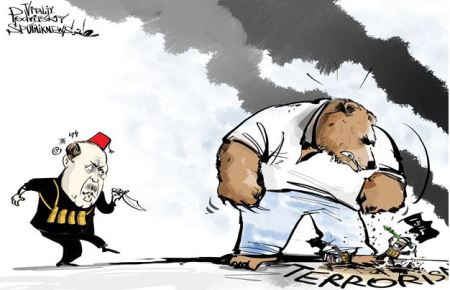
26473The Russian bear stamps out terror, but Erdogan prepares to stab it in the back (Sputniknews.com, November 24, 2015)

‘It Would Be A Mistake For Russia Not To Use Nuclear Weapons’ In A War With Turkey

A Pravda.ru article titled “‘Scenarios For Real War Between Russia And Turkey” states:

“The possibility of a full-fledged war between Russia and Turkey has been a talk of the day for conspiracy theorists, analysts, couch warriors and experts on international politics for several weeks already… Let’s assume that a real war sparks between Russia and Turkey (NATO) – what kind of war would it be? What results would it bring?

“Politonline.ru[3] discussed the topic with leading military experts that follow various approaches to international armed conflicts.

“A leading expert of the Center for Military and Political Studies,[4] Mikhail Alexandrov, is convinced that in case of a real war, Russia will have to use nuclear weapons immediately, because the existence of the nation will be at stake.

“‘It would be a mistake for Russia not to use nuclear weapons in this case,’ [he said]. ‘The West and Turkey will try to drag us into a war such as the Crimean war, where escalation will be slow, combat actions in the Caucasus will erupt, and the Russian group in Syria will be destroyed. The West will be helping Turkey – there will be military units and state-of-the-art aviation deployed there. It will be a war of the wearing-out strategy’, he said.

“‘From my point of view, should the war with Turkey start, it must be a determined, ambitious and quick war. Russia will have to strike a nuclear blow on main infrastructure and military targets in Turkey immediately’…

“‘During the first few hours of this war, Russia must destroy the entire military infrastructure of Turkey’, Mikhail Alexandrov said. ‘One does not even have to use ballistic missiles in this strike – Iskander-M with nuclear warheads would be enough. As soon as the military infrastructure is destroyed, the Russian troops will go and take the area of the straits’, he added.

“‘The West will not even have time to do anything. European countries will be so horrified that they will not even dare to intervene. The Americans will face a choice – either they begin a strategic nuclear war against Russia or not. As a result, Russia will take the area of the straits, and the rest will be left to Turkey’, said the expert.

“In turn, non-nuclear scenario of a hypothetical possibility, but deputy head of the Tauric information-analytical center at Russian Institute for Strategic Studies,[5] Sergey Ermakov, suggested a non-nuclear scenario.

“‘Hopefully, the real conflict will not happen. Using nuclear weapons is an extreme option. As for a  regional war, there are non-military tools in the region. There are many anti-Turkish players in the region. In the case of a military conflict, the Kurds will rip the region to pieces, so for Turkey, a war is a game not even with the zero, but with a negative sum’, he said.

“‘If Turkey provokes the conflict, NATO may not resort to the fifth article. Aggression is one thing, but a country asking for a conflict and pulling NATO into it is another thing. In such cases, NATO tries not to get involved’, Sergei Ermakov said.

“‘No one wants to get involved in a direct military conflict with Russia. This conflict is fraught with a nuclear war and a global tragedy’, he added.”[6]

‘The Leader Of The Turkish Nation Is Not Just An Islamist, He’s A Supporter Of International Terrorism”

An article on NEO titled “What Fate Awaits Turkey?” states:

“It is now clear that Tayyip Erdogan’s political career is heading to a closure, slowly but surely. He had a chance of saving it if he had the courage to immediately offer his apologies to Moscow after the downing of the Russian Su-24 bomber over Syria, that was in fact heading away from Turkey, not toward it.

“Instead, he got tangled in a web of ridiculous lies and explanations, all while being rude to Russia. On top of it all, he framed Washington, by trying to excuse the actions of the Turkish Air Force with alleged orders he personally received from Barack Obama at the G20 summit held in Antalya.

“But even with his back against the wall, Turkey’s President proved to be stubbornly shortsighted, which forced Russia to go even further by uncovering the role Turkey and Erdogan’s family played in the smuggling of stolen Syrian oil, which is a direct violation of the UN Security Council Resolution that was adopted on February 12, 2015. This means that the Turkish state is directly responsible for the sponsorship of international terrorism, which, according to the UN, should be punished in a particularly harsh manner.

“But what’s even more grave – the president has publicly disgraced himself before the country. His had already been steadily losing his position, but once he dropped his mask, his ratings started falling abruptly. It turns out that the leader of the Turkish nation is not just an Islamist, he’s a supporter of international terrorism.

“Now we are presented with a situation in which the AKP leader and the sitting Prime Minister Ahmet Davutoglu who are largely secured by the victory for the ruling party, has obtained as much influence as the president. And after the downing of Russia’s bomber he strengthened his positions even more, even though he decided not to distance himself publicly from the president. It’s safe to assume that he’s just quietly waiting for a perfect opportunity to strike a mortal blow. He’s nothing short of a dangerous contender that is prepared to replace Erdogan at any given moment.

“But the deposing of Erdogan is a relatively positive scenario. Those who remember Turkish history should know that Erdogan is hated by the military command of the Turkish Armed Forces, which has traditionally played a crucial role in the maintaining of country’s stability… The army is not getting any revenues from the illegal oil smuggling, so, should the ties between ISIL and Ankara be maintained, the military command, while enjoying the support of NATO allies, can launch a coup d’etat and return to the power they had three decades ago. But this scenario won’t satisfy local Kurds and other ethnic and religious minorities, who have experienced the cruelty of the army in the suppression of their rights first hand.

“Turkey is going to be plunged into political chaos, when the ruling AKP will find itself opposed by both the army and the legal opposition, along with 22 million Kurds led by the banned Kurdistan Workers Party (PKK). In this case, the civil conflict could result in the collapse of the Turkish state with the Kurdish areas (the entire South-East Anatolia) breaking away, seeking ways to create an independent Kurdistan that will absorb certain areas in Syria in Iraq, changing the whole balance of power in the Middle East.

“Whatever happens, one thing is clear: Tayyip Erdogan will be forced to answer for his stubbornness, inability to respect others, dictatorship, corruption, and connections with ISIL. And above all, he must answer to the people of Turkey. And also to Russia for the cowardly attacks that claimed the lives of two Russian soldiers who fought valiantly against terrorism.”[7]

‘Turkey May Well Have Been A ‘Prime Actor’ In The Paris Attack’

Another NOE article, titled “Mad King Erdogan’s Oil Lies,” stated: “Erdogan is claiming he stole no oil. He has threatened to resign if he receives proof. There is little doubt that Erdogan is insane, those who have been watching his dance of death with ISIS have known this all along.

“However, while Erdogan talks only of oil, there are other issues to note as well. First of all, let’s talk about arms shipments that cross Turkey and move into Syria and Iraq. By Erdogan’s claim of total innocence, we must assume that ISIS, al Qaeda and the other openly terrorist groups that make up 95% of those fighting against Iraq and Syria are operating without any outside supplies.

“Where Erdogan’s wild claims fail is simple as looking at a map. When Russia publishes surveillance photos of not just hundreds but thousands of oil trucks, how can there be denial? The roads that these trucks use only go to Turkey.

“They don’t go anyplace else, there is no place else. There is absolutely no vehicle traffic between the Turkish occupied areas of Iraq and Syria, and we might as well call them that, and the areas under control of the legitimate governments in Baghdad and Damascus.

“What is support of terrorism if it isn’t trading oil for arms or, moreover, trading oil and the other loot of Iraq and Syria, for the cooperation of Turkish politicians and, just perhaps, their European and American friends as well.

“Yet no one considers that Turkey may well have been a ‘prime actor’ in the Paris attack. Would Erdogan have downed a Russian plane if it weren’t for the Paris attack? What about the Russian airliner downed over Syria? When you add MH17 and examine what is now known, that Ukraine and Turkey have been working closely together all along, with ISIS troops joining Kiev forces against NovoRussians, do we see a pattern?”[8]

‘Turkey’s “Leader” Should Be Charged With Murder’

A Pravda.ru article titled “Turkey: Treacherous Turncoat,” stated:

“Turkey’s ‘leader’ should be charged with murder. The sanctimonious West is in denial. NATO, partly complicit if not the instigator, vows to defend the murderer. Washington, which knows every detail, feigns ignorance. Why is there no Western condemnation in absence of Turkey’s compunction?

“Turkey, though paying lip service to Obama’s ‘coalition of the coerced’ to at long last fight ISIS in Syria with military force, is loath to do so. More important Turkey has its political/economic motives to do just the opposite: not lift a finger (against ISIS). That is because, as President Putin already disclosed to Russia’s Western ‘partners’ at the G20 Summit, Turkey is in reality a turncoat. Russian military intelligence provided the evidence: Turkey, including its President, are really aiding and abetting the ISIS terrorists. Detailed satellite images show that Turkey provided the egress for the stolen oil that ISIS has been trucking in and through Turkey.

“From there the contraband, once brokered by the Turks, is sold elsewhere. The ‘buyers’ list includes Israel, the European Union and as some have suggested, even America. The scale and the scope of the covert theft equates to over 50 million barrels. Moreover, Turkey has profited from this nefarious heist for almost four years. Russia has more proof. The laundered money trail flows straight to the Turkish President’s palace. Using a labyrinth of the Erdogan’s financial network including his own son, the ill-gotten gains are then spirited outside the country.

“While the Kurds fight ISIS, Erdogan courts the terrorists by providing them military cover. Russia, now wiser as to Erdogan’s true colors, should endeavor to be ever more vigilant in its Syria campaign as to joining the West’s coalition of ‘partners’.

“That same portent applies to the newest ‘partners’: Hollande and Cameron. The two turkeys are even bigger U.S. vassals. Neither one is trustworthy. Syria’s war is about oil; both Putin and Assad know that well.”[9]


Endnotes:


[1] NEO (New Eastern Outlook) is the journal of the Russian Academy of Science’s Institute of Oriental Studies, a leading research institution dealing with Asian and African countries and cultures. NEO presents itself as follows: “We cover political and religious issues, economic and ideological trends, regional security topics and social problems. We are committed to develop NEO into a notable international networking platform offering unbiased expert opinions and open dialogue among all thinking people worldwide regardless of their nationality, race or religion… We are focused on creating a new culture of partnership where opinions influence decisions.” (Journal-neo.org, “About” section, accessed January 12, 2016).

[2] Pravda.ru is a pro-government news and opinion website. According to its former Director General, Vadim Gorshenin, it is the successor of Pravda, the official mouthpiece of the Soviet Union’s Communist Party. It was founded by prominent members of Pravda’s editorial staff who left it in 1999, and today it is privately owned by Pravda.ru Holding, of which Gorshenin is the head.  Its current Director General, Inna Novikova, is Gorshenin’s wife.

The Pravda website publishes in four languages: Russian, English, Italian, Portuguese, and has more than 200,000 visitors daily. According Gorshenin, the English version is the second most popular English-language Russian website, after Russia Today (Pravda.ru, September 16, 2013).

[3] Politonline.ru is a political website, part of the Pravda media network.

[4] The Center for Military-Political Studies is a division of the Russian foreign ministry’s Moscow State Institute of International Relations. The center studies trends and affairs in the domains of defense policy, weaponry, military industry, military cooperation and state security (Eurasian-defence.ru).

[5] The Russian Institute for Strategic Studies (RISS) is a research center established by the President of the Russian Federation. Its main task is to inform various Russian state institutions on the political, economic and socio-political situation in the Black Sea countries and  Mediterranean region (En.riss.ru).

[6] Pravdareport.com, December 8, 2015. The Russian version of the article was published on Politonline.ru on November 27, 2015.

[7] Journal-neo.org, December 7, 2015. The author, Peter Lvov, is described by NEO as a Ph.D in political science.

[8] Journal-neo.org, December 7, 2015. The author, Gordon Duff, is described by NEO as a U.S. Marine combat veteran of the Vietnam War and a senior editor and board chairman of the Veterans Today website.

[9] Pravdareport.com, December 16, 2016. The author’s name is given as “Montresor.”

Iran-Saudi crisis spurs Hizballah strike on Israel

January 4, 2016

Iran-Saudi crisis spurs Hizballah strike on Israel, DEBKAfile, January 3, 2016

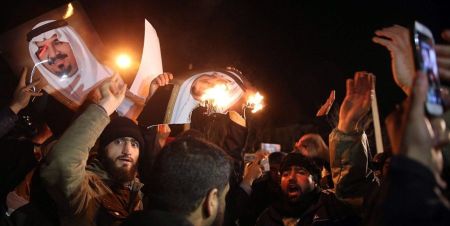
Iranian_protesters_set_fire_to_pictures_of_the_Saudi_royal_family_3.1.16

The heated verbal battle between Tehran and Riyadh over Saudi Arabia’s execution of a Shiite cleric escalated Sunday night, Jan 3, with the severance of diplomatic relations. On the broader front, the repercussions from the quarrel between the two leaders of the Muslim world’s Shia-Sunni split are widely seen in Middle East military and intelligence circles as spurring a fast-track Hizballah attack on Israel.

Among the 47 people executed by Saudi Arabia Saturday on terrorism charges was Sheikh Nimr al-Nimr, Saudi Shiite leader and a prominent Shiite cleric in the region. Put to death with him were several Saudi Shiite and Sunni activists, which enraged Iran’s supreme leader Ayatollah Ali Khamenei to the point of threatening the Saudi royal family with “divine revenge.”

From Iran’s perspective, the Saudis committed the unpardonable act of executing Shiites together with Sunni Al Qaeda and ISIS terrorists. This made the House of Saud the first ruling power ever to treat Shiite and Sunni terrorists alike. This, more than anything, incensed Iran and its Lebanese proxy Hizballah, who are deep in a bloody war against the Sunni Islamic State and the Nusra Front terrorists in Syria. Iran’s Revolutionary Guards are additionally locked in a bitter conflict with ISIS in Iraq.

The Iranian war effort is backed by the US in Iraq and by Russia in Syria.

By the mass executions of both classes of terrorist at the same time, Riyadh issued four messages:

1. Washington and Moscow are wrong. The Iranians and the forces they back in the Persian Gulf, Syria and Iraq are just as much terrorists as ISIS and Al Qaeda.

2. The House of Saud is determined to fight both with equal resolve and severity

3. Riyadh has already taken Tehran on in Yemen, and indirectly in Syria, and is now ready to take the fight against Tehran all the way to the war on terror.

4. Taking off the diplomatic gloves, Saudi Foreign Minister Adel al-Jubeir Monday night severed relations with Iran and ordered all Iranian diplomats to leave the kingdom within 48 hours. The foreign ministry said that by condemning the Nimr execution, Iran was supporting terrorism.

Saudi diplomats were already gone after protesters in Tehran torched and ransacked the Saudi embassy Saturday.

Amid all the sound and fury, Tehran’s attention was drawn to comments made by Israeli Prime Minister Binyamin Netanyahu in the light of a major terrorist attack in Tel Aviv. He pointed out that, in addition to the Palestinians, Israel is threatened by two streams of radical Islam, the Shiites and the Sunnis.

He was clearly referring to Iran and its terrorist arm, Hizballah, on the one hand, and ISIS and Al Qaeda, on the other, inspired less by the Tel Aviv outrage than by the gathering clouds of terror darkening the region, which place the Saudi royal family and Israel on the same side, sharing a similar perception of the two foes facing both countries.

Policymakers in Jerusalem noted the odd statement by Turkish President Tayyip Erdogan to reporters on Saturday, January 1 on the way home from a visit to Riyadh. After years of reviling the Jewish state, he said, “Israel is in need of a country like Turkey in the region. We have to admit that we also need Israel.”

He sounded as though he was urging the resumption of the old political and military alliance binding the two countries years ago.

DEBKAfile’s Middle Eastern sources point out that, since his comment came directly after his talks with Saudi King Salman in Riyadh, it appeared to open a path toward the possible creation of a new Middle East bloc consisting of Turkey, Saudi Arabia, perhaps Egypt, and Israel, bound by the same enemies. This grouping could serve as a counterweight against the Sunni-Shiite bloc of Iran, Iraq, Syria and Hizballah, which has the backing of the US and Russia on one hand, and fights ISIS on the other.

Iran’s leaders may curse the House of Saud without restraint, but they are canny enough not to go from words to deeds, knowing they would be on their own if they attacked the oil kingdom and earn no backing from either Washington or Moscow.

However, it might be easier for Tehran to take advantage of Netanyahu’s tough predicament in his war on terror, by sending Hizballah to strike Israel and, meanwhile, pre-empt the formation of a new anti-Tehran alliance. Speeding up Hassan Nasrallah’s promised revenge for the assassination of its master terrorist Samir Quntar would serve this purpose.

This possibility has prompted the IDF to keep artillery units pounding areas bordering on Israel during the past few days. The IDF says this action is necessary to stop Hizballah exploiting the stormy, snowy winter weather to attack Israel. Its military chiefs appear to be acting on information received of an approaching Hizballah operation as its leader has threatened.

Turkey and Israel: A Rickety Handshake

December 23, 2015

Turkey and Israel: A Rickety Handshake, Gatestone InstituteBurak Bekdil, December 23, 2015

(What benefit beyond oil sales to Turkey — a minor one that Turkey could extinguish at its pleasure — would Israel receive? — DM)

♦ It would be truly embarrassing if a Turkey-Israel normalization results in new arms shipments into Gaza and rockets over Israeli skies — with the only achievement being a temporary peace with Turkey’s Islamists, who never hide their ideological kinship with Hamas.

♦ The future Turkish and Israeli ambassadors would always have to keep their bags packed, ready to return to their own capitals at the first dispute – which could be caused by Israeli retaliation against Arab terrorism or anything that may make Erdogan roar in front of cameras.

♦ How do you shake hands with a man whom you know ideologically hates you and wishes to mess up things at his earliest convenience?

None of this happened half a century ago; the timeline here covers only a span of a year and a half: A Turkish-Kurdish pop star wrote on her Twitter account, “May God bless Hitler. He did far less [than he should have done to Jews].” The mayor of Ankara replied: “I applaud you!” Hundreds of angry Turks, hurling rocks, tried to break into the Israeli diplomatic missions in Ankara and Istanbul. The mayor of Ankara said: “We will conquer the consulate of the despicable murderers.” He blamed the Charlie Hebdo massacre in Paris on Israel’s Mossad. Islamist columnists close to the government suggested imposing a “wealth tax” on Turkish Jews (who are full citizens). A governor threatened to suspend restoration work at a synagogue. And a credible research group at the Kadir Has University in Istanbul found in a poll that Turks view Israel as the top threat to Turkey.

Against such a background, Turkish and Israeli diplomats are negotiating a historical deal that will, in theory, end Turkey’s hostility toward the Jewish state and normalize diplomatic ties between Ankara and Jerusalem.

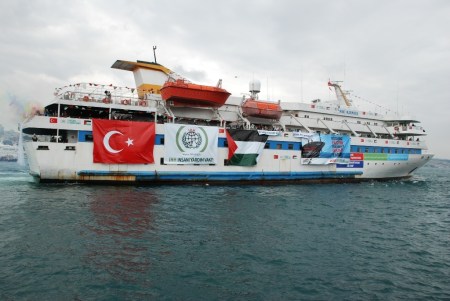
In 2010, a Turkish flotilla, led by the Mavi Marmara with hundreds of jihadists and anti-Israeli “intellectuals” aboard, sailed toward the coast of Gaza, aiming to break Israel’s naval blockade of the Hamas-run strip. Israel’s naval blockade aims to prevent weapons such as rockets being smuggled into Gaza. To stop the flotilla, naval commandos of the Israel Defense Forces boarded the vessel and, during clashes, killed nine aboard.

1080The Turkish-owned ship Mavi Marmara, which took part in the 2010 “Gaza flotilla” that attempted to break Israel’s naval blockade of Gaza. (Image source: “Free Gaza movement”/Flickr)

Since the incident, Turkey’s Islamist leaders have pledged to isolate Israel internationally and have downgraded diplomatic ties with Jerusalem. They have put forward three conditions before any normalization could take place: an Israeli apology, compensation for the families of the victims and the removal of the naval blockade on Gaza.

After President Barack Obama’s intervention, Israeli Prime Minister Benjamin Netanyahu in 2013 apologized for “any error that may have led to the loss of life.” Turkey’s two other conditions remain unfulfilled. But diplomatic teams from Ankara and Jerusalem are apparently working on a deal. There are good reasons why an accord may or may not be possible.

Since the nearest Turkish election is four years from now, neither Turkish President Recep Tayyip Erdogan nor his prime minister, Ahmet Davutoglu, has any reason to cultivate further anti-Semitism at election rallies in order harvest votes from conservative masses who are deeply hostile to Israel and Jews. These are days when Turkey’s leaders need not practice their usual anti-Israeli rhetoric.

There is another reason related to “timing” that makes a deal attainable. After pledging to isolate Israel, Turkey has become the most isolated country in the region, especially after the recent crisis with Russia that emerged after two Turkish F-16 fighters shot down a Russian SU-24 aircraft along Turkey’s Syrian border on Nov. 24.

In its region, Turkey does not have diplomatic relations with Cyprus and Armenia. It has downgraded diplomatic relations with Israel and Egypt. It is confronted by Shiite and Shiite-dominated regimes in Iran and Iraq, respectively. On top of all that, an angry Vladimir Putin, Russia’s president, curses and threatens every day to punish Turkey. Turkey buys over half of its natural gas and 10% of its oil from Russia.

Therefore, a third incentive could be a mutually beneficial future deal for Turkey to buy natural gas from Israel. If the two countries build an underwater pipeline, Turkey can compensate for the potential loss of Russian gas supplies, starting in 2019. For Israel, a pipeline to Turkey would be the most commercially feasible route to export its gas to Turkey and other potential buyers beyond.

A Turkish-Israeli handshake would also be music to ears in Washington. Deep hostility and occasional tensions between its two allies in the Middle East have always been unnerving for the U.S. administration.

The road ahead has its problems. Turkey’s second condition for normalization, compensation, is not too difficult to overcome. But the third condition, that Israel should remove the naval blockade of Gaza — and risk weapons being smuggled into the hands of Hamas (or other terrorist groups) — could be an unsafe move for Israel.

It would be truly embarrassing if a Turkey-Israel normalization results in new arms shipments into Gaza and rockets over Israeli skies — with the only achievement being a temporary peace with Turkey’s Islamists, who never hide their ideological kinship with Hamas.

If Netanyahu decides to take risks and go for a deal, he must make sure that however the naval blockade of Gaza would be eased, it does not expose Israel to the risk of new acts of terror.

Another risk is the potential psychological domino effect any deal could cause. It is certain that Turkish Islamists will portray any deal as a success story — that they were able to “bring Israel to its knees.” This message, relayed through a systematic propaganda machine, could set a dangerous precedent and potentially encourage Arab Islamists to consider more assertive policies toward Israel in the future.

The future Turkish and Israeli ambassadors would always have to keep their bags packed, ready to return to their own capitals at the first dispute – which could be caused by Israeli retaliation against Arab terrorism or anything that may make Erdogan roar in front of cameras, “Our Palestinian brothers … Those murderer Jews again … Go back to your pre-1967 borders or you’ll suffer the consequences!”

Netanyahu’s problem is that he does not trust Erdogan in the least. He is right not to trust Erdogan. But then how do you shake hands with a man whom you know ideologically hates you and wishes to mess up things at his earliest convenience?

Oh by the way, Turkey is trying to get into a war w/Iraq

December 6, 2015

Oh by the way, Turkey is trying to get into a war w/Iraq, Front Page Magazine, Daniel Greenfield, December 6, 2015

hqdefault_1

Open question: What does Turkey’s deranged Islamist leader have to do to be disavowed by NATO, Europe and the US?

Erdogan armed terrorists in Syria, but pretty much everyone is doing that. He nearly began a war with Russia. Now Iraq keeps ordering Turkish troops off its soil. But they’re there at the supposed request of Sunnis militias around Mosul. Possibly to fight ISIS. But considering Turkey’s track record and Baghdad’s protests, probably not.

It’s a given that Baghdad, which has become a puppet regime for Iran, would oppose arming Sunni militias. Its preferred means of operation is through Iranian trained Shiite militias.

Since Turkey is really in Syria to overthrow Assad, it looks like its version of the Sunni-Shiite conflict is spreading to Iraq. Essentially Turkey is advancing into a war with the Shiite axis of Iran-Syria and its Russian patron, not to mention all the various Shiite terror militias.

I won’t object if Sunni and Shiite terrorists and their state sponsors shoot and bomb each other. Especially if it’s Turkey and Iran, but as long as Turkey is in NATO, its lunatic tyrant trying to revive the Ottoman Empire has the ability to drag us into his wars.

And that’s an obvious problem.

Turkey should not be in NATO. And only a madman would consider it for EU membership.

But Erdogan’s migrant games have forced Germany to come crawling to him offering cash and EU membership acceleration.

Obama, who was once closest to Erdogan, is obviously not about to cut him off no matter what he does. But the United States is now in the strange position of having a ridiculously confused presence in a Muslim civil war.

Obama is backing Sunni Jihadists in Syria and Shiite Jihadists in Iraq. He refuses to arm Sunni militias in Iraq, but stands by while Turkey carries out what is effectively an illegal invasion of Iraq. (Remember that one the next time Kerry squeals about Jews living in Jerusalem.) He backs Kurdish militias that Turkey is bombing. He’s trying to appease Iran and Turkey at the same time and it can’t work.

The only thing Obama has managed to do is shove the United States in the middle of a Muslim civil war while making occasional noises about un-Islamic ISIS.

Europe cuts refugee deal

November 29, 2015

Europe cuts refugee deal, Washington ExaminerPaige Winfield Cunningham, November 29, 2015

(Please see also, Does ISIS Owe Its Success to Turkey? — DM)

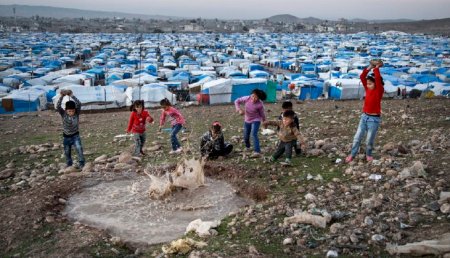
730x420-4dd28666e754459c14faa8917f5c133cThe agreement is expected to significantly stem the tide of hundreds of thousands of refugees from Syria, Iraq and Afghanistan seeking asylum in other countries who are hesitant to let them in their borders. (AP Photo)

Turkey will contain more Middle Eastern refugees within its owns borders so fewer of them flee to other European countries, under a deal it reached Sunday with the European Union.

In return for tightening its border control, Turkey will get several billion dollars from the EU and assistance in its efforts to join the coalition of 28 countries. The agreement is expected to significantly stem the tide of hundreds of thousands of refugees from Syria, Iraq and Afghanistan seeking asylum in other countries who are hesitant to let them in their borders.

The U.S. has admitted fewer than 2,000 Syrian refugees since 2012, yet the flood of migrants in Europe has incited a fierce political debate over whether they are sufficiently screened before entering the country.

President Obama wants to admit 10,000 Syrian refugees next year, saying that a robust vetting process will be in place. Refugees currently have to wait an average of 18-24 months before entering the U.S., as they’re screened by several different government agencies.

But many Republicans running for president have said they should be blocked until stricter screening measures are put in place and some GOP governors have tried to prohibit them from entering their own states. Former Florida Gov. Jeb Bush, who has suggested only refugees who prove they are Christian should be admitted to the U.S., reiterated that position on Sunday, saying on CNN’s “State of the Union” that refugees should be screened for their religion.

And Ben Carson, who is currently polling second in the GOP primary battle, said Middle Eastern countries that are closer geographically to refugees’ home countries should get more financial assistance to help them. Carson spoke with CNN from Jordan, where he has visited Syrian refugee camps.

Carson said instead of focusing on how to let more refugees into the U.S., which is much more difficult for them to travel to, policymakers should figure out how to allow more to settle in countries at closer proximity where they wouldn’t have to experience as big a change in culture. Jordan, for example, should get more money to admit more refugees, Carson said.

“It seems like everybody in the international community is spending more time saying how can we bring refugees here rather than support a facility that is already in place that the refugees are finding perfectly fine — when it’s fully funded,” Carson said.

Does ISIS Owe Its Success to Turkey?

November 29, 2015

Does ISIS Owe Its Success to Turkey? Clarion Project, Meira Svirsky, November 29, 2015

(Please see also, Obama’s favorite Muslim dictatorships. — DM)

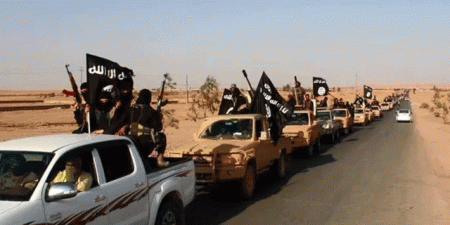
Islamic-State-Victory-Parade-HP_3An Islamic State victory parade (Photo: Video screenshot)

The downing of a Russian fighter jet on its way back from an Islamic State bombing mission has put Turkey in the crosshairs of scrutiny regarding their role in facilitating the success of the Islamic State.

Turkey’s arms transfers to Al-Qaeda-linked Islamist jihadis in Syria has been long-documented and largely ignored by the Western media. Similarly, the fact the Turkey has been the top financial sponsor of Hamas since 2012, with President Recep Tayyip Erdogan arranging for the transfer of $250-300 million to the terrorist group annually, is another inconvenient fact that has been studiously ignored.

This summer, a major raid by the U.S. on an Islamic State safe house in Syria this summer gleaned large amounts of intelligence linking Turkey to the Islamic State. In the words of one senior Western official, the connection is now “undeniable.”

As investigative journalist Nafeez Ahmed writes, “In a rare insight into this brazen state-sponsorship of ISIS, a year agoNewsweek reported the testimony of a former ISIS communications technician, who had travelled to Syria to fight the regime of Bashir al-Assad.

“The former ISIS fighter told Newsweek that Turkey was allowing ISIS trucks from Raqqa to cross the ‘border, through Turkey and then back across the border to attack Syrian Kurds in the city of Serekaniye in northern Syria in February.’ ISIS militants would freely travel ‘through Turkey in a convoy of trucks,’ and stop ‘at safehouses along the way.’

“The former ISIS communication technician also admitted that he would routinely ‘connect ISIS field captains and commanders from Syria with people in Turkey on innumerable occasions,’ adding that ‘the people they talked to were Turkish officials… ISIS commanders told us to fear nothing at all because there was full cooperation with the Turks.’”

Trucks, arms and fighters are not the only commodities that are flowing freely between Turkey and the Islamic State in Syria and Iraq. The life-blood of the Islamic State, crude oil, which serves to finance the terror group’s operation, is being sold in Turkey. Estimates of ISIS oil sales in Turkey to date are as high as $1 billion.

Senior Iraqi politician Mowaffak Baqer al-Rubaie announced yesterday that the Islamic State is selling oil through Turkish black-market channels at $20 per barrel, less than half the current market price.

Rubaie also pointedly commented that Turkey is the recruitment hub for all new Islamic State fighters – both foreign and Arab. “The new recruits meet with ISIS officials in Istanbul and are then transferred over the Turkish borders with Iraq, to Mosul, and over the border with Syria to Raqqa,” he said.

Rubaie also blamed Turkish security forces for “studiously ignoring the transfer of ISIS terrorists from Turkey to north Iraq and Syria. [In addition,] the wounded of the ISIS gangs … are getting treatment and medical care in the hospitals of Turkey.”

Besides their ideological similarities, Erdogan and his ruling AK Islamist party view the Islamic State as an easy ticket to smashing their nemesis, the Kurds, an ethnic group vying for independence from Turkey. As one AK party member said, “They are like us, fighting against seven great powers in the War of Independence.” Another senior party member said, “Rather than the PKK [Kurdistan Working Party] on the other side, I would rather have ISIL as a neighbor.”

Hundreds of flash drives and documents were seized in the summer raid on the Islamic State safe house in Syria last summer. At the time, a senior Western official predicted that “the links [between Turkey and ISIS] are already so clear that they could end up having profound policy implications for the relationship between us and Ankara.”

Yet, this has clearly not been the case. Turkey, a member of NATO, has been flaunting its support of the Islamic State under Western leaders’ noses. After finally agreeing to get involved in the fight between coalition forces and the Islamic State (after years of sitting out the fight militarily), Turkish planes have mainly used the bombing raids to attack Kurdish forces in Syria, Iraq and Turkey.

And the oil keeps flowing, filling Turkey’s coffers. As Professor David Graeber of the London School of Economics notes, “Had Turkey placed the same kind of absolute blockade on ISIS territories as they did on Kurdish-held parts of Syria… that blood-stained ‘caliphate’ would long since have collapsed — and arguably, the Paris attacks may never have happened. And if Turkey were to do the same today, ISIS would probably collapse in a matter of months. Yet, has a single western leader called on Erdoğan to do this?”

Sadly, the answer is an obvious “no.”