Archive for the ‘Donald Trump’ category

What do YOU belong to?

April 30, 2016

What do YOU belong to? Dan Miller’s Blog, April 30, 2016

(The views expressed in this article are mine and do not necessarily reflect those of Warsclerotic or its other editors. –DM

The Demorat and Publican parties appear to believe that since we belong to them they own us and can control us. Until recently, they were right. Now, at least for the Publican Party, not so much.

The Federal Government also believes that we belong to it, that it owns us and that hordes of unelected bureaucrats can and should control us; it’s all for our own good, of course, they would say (but it’s mainly for theirs). Perhaps, if we continue to change the Publican Party, we will have opportunities to change the Federal Government as well. The Demorat Party is hopeless.

Doesn’t thinking about the loving, benign dictators who believe they own us send warm, pleasant tingles down your leg? Or was that just a painful muscle spasm? They don’t mind, so it doesn’t matter.

The Political Parties

Many if not most now belong, or have belonged, to either the Democrat or Publican party. They tend to reward us by selecting the candidates, particularly the presidential candidates, whom they believe can keep or put them in power. They work very hard to save us from having to make such difficult choices. Since we “belong” to them, it must be only fair to accede gratefully to their wishes and vote as directed. At least that seems to be their view.

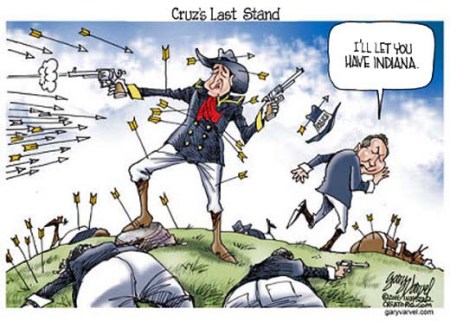
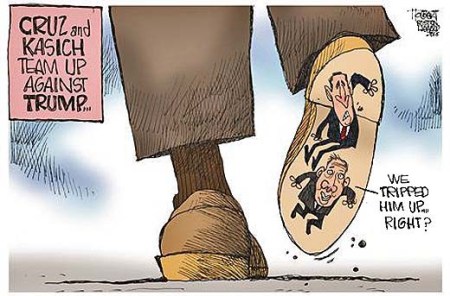
Until the current presidential election cycle, it worked quite well for the establishments of both parties. This time, it has not worked at all well for the Publican establishment. Despite its efforts to have a congenial establishment member nominated, it has not succeeded. Trump now has about 1,002 of the 1,273 delegates needed to get the nomination on the first ballot; the only other candidate with a significant number of delegates, Cruz, has only 571 and appears to be crumbling in his “must win” state of Indiana, where Trump has a substantial lead in the polls.

Trump is the top choice among the solely self-reported Republicans surveyed, taking 42 percent compared to 34 percent for Cruz and 17 percent for Kasich.

The businessman is also the top choice among the self-reported independents and Democrats deemed likely to vote in the primary, leading Cruz by 10 points among that group.

While Trump holds a 13-point lead over Cruz among men, 45 to 32 percent, his lead among women is narrower — 36 to 32 percent.

According to an article by W. James Antle III at The Washington Examiner, a generally anti-Trump publication,

Ted Cruz has a problem that a win in Indiana Tuesday may or may not be able to fix.

Not only might he be unable to stop Donald Trump from winning the 1,237 delegates needed to win the Republican presidential nomination on the first ballot, but Cruz is now so far behind Trump that it will detract from the credibility of a contested convention choosing anyone else even if he is still able to force one. [Emphasis added.]

The Tea Party senator from Texas is well ahead of John Kasich, but is now in Kasich territory. He will likely need hundreds of delegates to switch in order to push him over the top.

That’s not really what Republicans had in mind.

Most reasonable contested convention scenarios assumed a certain degree of closeness in the race. “Donald is going to come out with a whole bunch of delegates,” Cruz explained in February. “We will come out with a whole bunch of delegates.”

Cruz is now 431 delegates behind Trump and 672 short of a majority. He has won 3.2 million fewer votes while Trump’s tally is now higher than Mitt Romney’s at the end of the 2012 primaries. [Emphasis added.]

Are Republicans really still contemplating handing Ted Cruz the nomination in Cleveland? Or worse, Kasich who has won only Ohio? Or some white knight who has received zero votes?

“Those are the rules!” anti-Trump Republicans exclaim. In widely misinterpreted comments, Marco Rubio argued that as a private organization it’s up to GOP delegates to decide the nomination.

“That’s the meaning of being a delegate,” he said, “is choosing a nominee who can win.”

But the delegates’ role in the nomination process has largely been a formality for forty years. The American public has come to understand their primary votes as deciding the major party nominees. And in practice, that is how it has now worked for decades. [Emphasis added.]

For the nominee selection to be made by ignoring the primary votes at a contested convention,

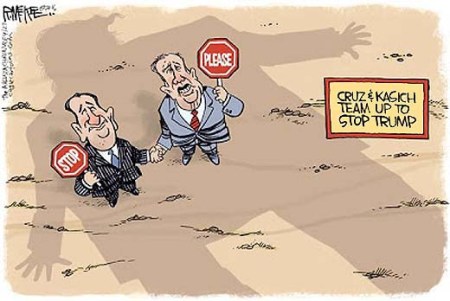
The delegates would regain their power at the precise time faith in the Republican establishment is at an all-time low and its preferred candidates were all rejected by the voters. Some GOP voters don’t even like the alleged Cruz-Kasich alliance. [Emphasis added.]

And it would all clearly be happening because influential Republicans didn’t like the outcome of the election. [Emphasis added.]

Yes, Trump is at risk of a contested convention because he is a weak front-runner. He is facing higher than normal intraparty opposition at this phase of the campaign.

The alternative is to nominate candidates from other factions of the party that have demonstrated that they are even weaker, people who have been rejected by an even higher percentage of Republicans.

For all the talk of Trump’s inability to win in November, national polling shows Trump with comparable support to Clinton on the Democratic side, with Cruz and Kasich not doing as well as Bernie Sanders.

Even if Cruz wins in Indiana, Trump should have easy wins in most of the remaining primary states and should, therefore, win substantially more than a majority on the first convention vote. If he does not, Cruz and Jeb Bush will be happy; or at least Cruz will be happy until the nomination goes to someone else.

Cruz cheating in Jesus name amen

I do not “belong” to any party; I am merely a registered Publican. Being either a member or a registered Publican allows one to vote in Publican primaries when they are generous enough to have them. Party caucuses? In some cases, members considered sufficiently subservient to the party establishment have at least a modest say in selecting the delegates to the national Publican convention. Those merely registered get to gripe if delegates pledged to someone they don’t want are chosen, but that’s about it.

The public has, to a greater extent than I can recall, been focused on this year’s selection of delegates. That may well be due in large part to Trump and his supporters. The public will very likely be no less focused on what those delegates do at the nominating conventions. Assuming that the Publican establishment is aware of that focus and takes it seriously, it may well affect the outcome.

The Feral Federal Government

bugblatter-beast

Our selected, and elected, Congresscriters and Presidents get to shape “our” enormous unelected bureaucracies which usurp the role of Congress in legislating. Then, “our” unelected civil “servants” selflessly undertake the difficult task of interpreting the rules they created as well as those the Congress bothered to enact and the President didn’t veto. As noted at The Federalist,

Administrative agencies are creatures of legislation but directed by the executive branch, which has no constitutional authority to pass laws. Their powers derive from statutes that delegate the quasi-legislative authority to issue binding commands in specified contexts. Administrative agencies generally operate independently from Congress and the courts and possess discretionary rulemaking authority.

. . . .

It will take a new kind of president to roll back the administrative state altogether. State resistance alone is no longer enough. Without any pressure from the executive branch, Congress will remain content to pass off touchy political decisions to administrative agencies, which, unlike politicians, cannot be voted out of power. Congress, in turn, can blame the agencies for any negative political consequences of those choices. [Emphasis added.]

We may never recover the framework of ordered liberty that the Founding generation celebrated and enjoyed. But for the sake of our future, and to secure the hope of freedom for our sons and daughters, our grandchildren and their children, we must expose and undo the regulatory regime of administrative agencies. It’s our duty to do so. [Emphasis added.]

In far too many ways, “our” Feral Federal Government resembles that of the European Union. The de facto seat of the EU is in Brussels, Belgium, where hordes of unelected bureaucrats dictate to the member states and their citizens. The seat of “our” Federal Government is in Washington, D.C., where hordes of unelected bureaucrats dictate to the States and to the “folks” who live there. According to Pat Condell, the EU is on the verge of collapse. Will that also be the fate of “our” own little EU? And of the political parties which empower it?

Conclusions

A more efficient and less costly Federal Government would be nice. A smaller, more efficient and less costly Federal Government, much of the power of which has been returned to the States, will be much better. Perhaps the return of significant powers to the States will even awaken some of the more somnolent States and their citizens. For the most part, people in States far removed from Washinton pay little attention to Federal actions until they have significant direct impact on them. Decisions made locally are more likely to have direct local impacts and to attract higher levels of local interest. “Mere” local citizens seem likely to demand voices in what is to be done and how.

Which of the still viable candidates for President is likely to give us the type of Federal Government I envision? Hillary Clinton and her supporters? They like their party and the Federal Government as they are. Trump and his supporters have done much to diminish the power of the Publican Party establishment. They have broken some stuff that needed to be broken and are rebuilding the system on a more populist foundation. As I wrote last September, To bring America back we need to break some stuff. Perhaps they can begin to break “our” bloated Nanny State and recast it in ways comparable to what they have done to the Publican establishment. Doing so could and should put power back where it belongs, in the hands of the States and of the people.
The problem with Ted Cruz

April 29, 2016

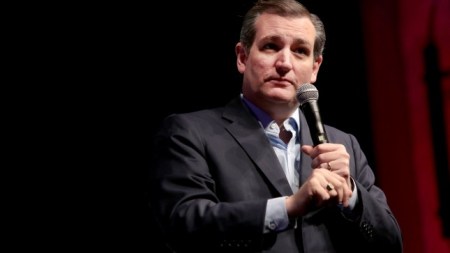
The problem with Ted Cruz, The Hill, Charles Hurt, April 29, 2016

Ted Cruz1

In the past eight years, no one has captivated the realistic hopes of conservative constitutionalists the way that Cruz has in this election. On every single issue of importance to conservatives, Cruz is right. He is a walking, living, breathing Supreme Court dissent, masterfully articulated and extensively annotated on paper.

Then, he opens his mouth. And people scream. They run for the exits as if their hair is on fire. They want to take a shower.

********************

Real estate mogul Donald Trump has run an outsider’s juggernaut campaign, the likes of which nobody has seen in modern politics.

Democrats publicly say they are thrilled to face him in the general election. But, privately, they fret that the master marketer and media maestro is so unpredictable and so original and so fearless that they just might regret getting the match-up they had hoped for.

Trump has done all this in the face of unprecedented opposition from establishment Republican Party officials and many principled conservatives who make up the core base of the GOP. At this point in the primary cycle, any other candidate with numbers like Trump’s would have been granted “presumptive nominee” status by party bosses as well as any final remaining active candidates.

It is not new that party establishment types are terrified of doing anything outside of their regular playbook — like recognizing the game-changing power of an apolitical populist who is winning millions of supporters by turning everything upside down. While the media attention has focused entirely on the exuberant and entertaining traveling carnival nature of the Trump campaign, this overlooks another, deeper problem conservatives have today: Sen. Ted Cruz (Texas).

In the past eight years, no one has captivated the realistic hopes of conservative constitutionalists the way that Cruz has in this election. On every single issue of importance to conservatives, Cruz is right. He is a walking, living, breathing Supreme Court dissent, masterfully articulated and extensively annotated on paper.

Then, he opens his mouth. And people scream. They run for the exits as if their hair is on fire. They want to take a shower.

Even hardcore conservatives still stewing over the shabby defenestration of Robert Bork find Cruz cloying and unctuous. Leading conservatives who publicly support Cruz’s presidential campaign groan in private when he starts talking.

Cruz may entertain himself by impersonating characters from “The Simpsons,” but it is hard to get out of your mind that Cruz just might, in fact, be Mr. Burns, with those evil snake eyes and the sharp, downward curved beak. Heartless, robotic, ever-calculating, willing to do anything to maximize profits at his nuclear power plant.

“Who is that firebrand, Smithers?” you can almost hear Cruz inquire of a top campaign staffer as he suspiciously eyes Trump and taps his fingertips together.

Or, maybe he is the unholy spawn of Count Dracula and “The Penguin” from Batman.

So, what, exactly, is the problem with Cruz? Why is he so terrible?

For starters, his face and natural demeanor appear bionically opposed to a sunny disposition. The forced smiles only make him look more demonic. And because his facial contortions are so clearly faked, he always looks like he must be lying. “Lyin’ Ted,” you might say.

Then there are the promises he makes and the things he says.

Again and again in recent years, Cruz promised supporters that he would mount a great filibuster in the Senate and defund ObamaCare. Of course, there was no hope of success since even if he had miraculously managed to get such legislation to the president, the president for whom Obamacare is named most definitely would have vetoed it. And Cruz knew that even as he repeated his bold promises to frustrated supporters. Even Dr. Seuss got maligned in the spectacle.

In the end, Cruz utterly and predictably failed and turned the anti-Obamacare effort into something of a mockery. That year a kid in my neighborhood showed up for Halloween dressed as Cruz, carrying a copy of Dr. Seuss’s “Green Eggs and Ham.”

With every such stunt, Cruz’s grand promises always failed. His only success was raising his own profile, raking in piles of donations and advancing his own professional political career. This is the reason Cruz is so despised on both sides of the aisle in the U.S. Senate — not because he is some kind of heroic stalwart standing up the leadership.

He is every bit the Harvard master debater, the professional politician he claims not to be and denounces at every opportunity. And if that is not odious enough, he now wears the hat of an election lawyer as he taunts Trump about his own prowess at using arcane and arbitrary electoral rules to wheedle convention delegates out of election losses.

Now in desperate collusion with hopeless Ohio Gov. John Kasich to block Trump from clinching the nomination, Cruz’s campaign issued talking points to supporters, urging them to say: “We never tell voters who to vote for.”

Really? Isn’t that the whole purpose of a campaign?

A shameless professional politician capable of such blatant and ludicrous distortions will soon become indistinguishable from Democratic front-runner Hillary Clinton.

Lyin’ Ted. Crooked Hillary. Is there any difference?

It is true that Clinton’s cackles are like claws on a chalkboard for even many Democrats. But that visceral, revolting antipathy is nothing compared to people’s reaction to Cruz.

Even when he says things you agree with, Cruz sounds and looks like the oiliest money-grubbing television evangelist. He invokes Almighty God and Jesus Christ at every campaign event. He talks about praying for this and praying for that and then undulates about “God’s will.”

He turns his face to heaven and splays his arms back as if willing to be crucified for his political convictions. He tightens his fists and brings them to his chin as if in prayer.

After imploring and haranguing and intoning, Cruz drops into a prayerful whisper, the way preachers do when they are winding up their sermons. Except Lyin’ Ted never seems to get to the end of his sermons. He just goes on and on and on. For eternity, one might say.

One of his most famous surrogates, Glenn Beck, actually invoked divine intervention in the untimely death of Supreme Court Justice Antonin Scalia. As an altar-call to vote for Cruz.

All this desperate sermonizing, as if God is sitting on his golden throne in the clouds looking down at His errant creation with all man’s problems and for some reason is rooting for Cruz to win the Republican nomination for president of the United States of America.

“I will get that Donald Trump. Finally!” God grumbles, clinching his giant Michelangelo fist.

“Two Corinthians,” He scoffs under his divine breath. “‘The Art of the Deal’ is not even a close second!”

Cartoons of the Day

April 29, 2016

H/t Vermont Loon Watch

stop-trump-01stop-trump-02


Clay Bennett, Chattanooga Times Free Press

Clay Bennett, Chattanooga Times Free Press


stop-trump-04


stop-trump-05

Horowitz: The Biggest Election Deception

April 28, 2016

Horowitz: The Biggest Election Deception, Truth Revolt, David Horowitzz, April 28, 2016

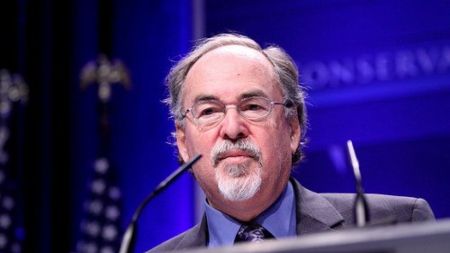
David Horowiz

One thing we do know, however, because Republican primary voters have already spoken: The political landscape is changing before our eyes, and the Republican Party will never be the same. This is true whether the GOP falls apart at the convention in August and cedes the election to Hillary Clinton, or whether its standard-bearer is an anti-establishment Republican like Trump or Cruz.

******************************

We hear a lot of talk about the November election especially from John Kasich who has lost 45 of 46 primary contests but stays in the race because he’s the only Republican who beats Hillary head on in the polls. “Remember this,” Kasich told Fox, “I’m beating Hillary Clinton in every single poll… I’m the only one with the positive ratings so we ought to be focusing on what happens in the fall not just who wins the nomination.”

But as Kasich knows – and everyone else should – polls are merely snapshots of the way people think when they are taken. Polls taken before the actual campaigns, whose purpose is to influence people’s opinions, are meaningless. They are also meaningless because events like the Iranian hostage crisis in the Reagan-Carter election of 1980 can change everything.

There have already been campaigns in the primaries. On the Republican side this is a good part of the reason why the negatives for Trump and Cruz are so high. Republicans have spent more than 100 million dollars to convince voters to never vote for Trump, and Trump has fought back by flooding the TV airwaves with character attacks on “Lyin’ Ted” that have driven his negatives almost as high. Perhaps in the next election cycle Republicans will have learned to design their primary advertising and debates so that they don’t destroy their potential candidates before the Democrats even get a crack at them. But don’t bet on it.

Fortunately for Republicans, Hillary has raised her own negatives high enough by her own efforts that the two may cancel each other out. No one knows what the effects of such negatives on both sides will be, because no one knows what the electorate’s opinion in November will be.

In any case a simple glance at the facts is enough to show why all polls about the November elections taken in April are virtually meaningless, especially when the spread is 10 or 11 points as most of those polls are now.

In April 1980 Carter led Reagan 40% to 34%. In November, Reagan beat Carter by 50.7% to 41%

In May 1988 Dukakis led Bush 54% to 38%. In November Bush beat Dukakis by 53.4% to 45.6%

In April 1992, Bush led Clinton 44% to 25%. Clinton won in November 43% to 37.4%.

That’s three important elections. But one need look no further than this year’s Republican primaries to see how campaigns can change the numbers. At first it was said that Trump would be toast in September, then that he couldn’t break a 20% ceiling in winning Republican support. Then the ceiling became 30%, then 40%, then 50%. In the latest primaries, Trump won 60% of the Republican vote. Obviously he has overcome a lot of negatives and a lot of hostile political ads to reach those figures. Could he do the same in a general campaign? At this point nobody knows.

One thing we do know, however, because Republican primary voters have already spoken: The political landscape is changing before our eyes, and the Republican Party will never be the same. This is true whether the GOP falls apart at the convention in August and cedes the election to Hillary Clinton, or whether its standard-bearer is an anti-establishment Republican like Trump or Cruz.

A Quick Reaction to Trump’s Speech

April 28, 2016

A Quick Reaction to Trump’s Speech, Front Page MagazineDavid Horowitz, April 28, 2016

Trump foreign policy

If Mitt Romney had given the speech that Donald Trump did today, and if he had followed its strategy during the third presidential debate with Obama on foreign policy, he would have won the 2012 election. Trump’s themes were straightforward: Make America strong again, put America’s interests first. The Obama-Clinton-Kerry foreign policy has strengthened our enemies, disparaged our allies, and earned us global disrespect. It has led to disasters that include the rise of ISIS and the destabilization of the Middle East. The theme of the Obama-Clinton-Kerry years has been the weakening of America – point Trump with maximum bite: “If President Obama’s goal had been to weaken America, he could not have done a better job.” And of course the Jeremiah Wright-Billy-Ayers-radical-Barack Obama did set out deliberately to do just that.  Obama’s agenda is American weakness, which leads to losing. Trump’s agenda: we must start winning.

There were specifics. First a rejection of the neo-conservative dream of democratizing the world, and in its place old-fashioned conservatism: limited foreign policy goals and stability, as the framework of peace: “We are getting out of the nation-building business, and instead focusing on creating stability in the world.” And second, a rejection of liberal internationalism, and a defense of the nation state, in particular this nation state with its unique political culture: “Under a Trump Administration, no American citizen will ever again feel that their needs come second to the citizens of foreign countries. I will view the world through the clear lens of American interests. I will be America’s greatest defender and most loyal champion. We will not apologize for becoming successful again, but will instead embrace the unique heritage that makes us who we are.” And the (accurate) justification for this nationalism: The world is most peaceful, and most prosperous, when America is strongest.”

These were reassuring clarifications by Trump about his foreign policy views and should be a step towards satisfying his conservative critics although obviously a speech can also be only that – words to pacify critics. We’ll have to wait and see how he elaborates it further in response to specific event. But this was a very good beginning.

For me the most reassuring aspect of the speech was its political toughness, an indication of what is waiting for Hillary in November should Trump win the nomination:

“After Secretary Clinton’s failed intervention in Libya, Islamic terrorists in Benghazi took down our consulate and killed our ambassador and three brave Americans. Then, instead of taking charge that night, Hillary Clinton decided to go home and sleep! Incredible. Clinton blames it all on a video, an excuse that was a total lie…. And now ISIS is making millions of dollars a week selling Libyan oil.”

Can’t wait for those Trump-Hillary debates.

Gingrich – Trump is “One of the Most Amazing Experiences in Political History”

April 28, 2016

Gingrich – Trump is “One of the Most Amazing Experiences in Political History” via YouTube, April 27, 2016

(I am not aware of any discussion about it, but how about a Trump – Gingrich ticket? — DM)

Donald J. Trump Foreign Polity Speech

April 27, 2016

Donald J. Trump Foreign Polity Speech, DonaldTrump.com, April 27, 2016

Thank you for the opportunity to speak to you, and thank you to the Center for the National Interest for honoring me with this invitation.

I would like to talk today about how to develop a new foreign policy direction for our country – one that replaces randomness with purpose, ideology with strategy, and chaos with peace.

It is time to shake the rust off of America’s foreign policy. It’s time to invite new voices and new visions into the fold.

The direction I will outline today will also return us to a timeless principle. My foreign policy will always put the interests of the American people, and American security, above all else. That will be the foundation of every decision that I will make.

America First will be the major and overriding theme of my administration.

But to chart our path forward, we must first briefly look back.

We have a lot to be proud of. In the 1940s we saved the world. The Greatest Generation beat back the Nazis and the Japanese Imperialists.

Then we saved the world again, this time from totalitarian Communism. The Cold War lasted for decades, but we won.

Democrats and Republicans working together got Mr. Gorbachev to heed the words of President Reagan when he said: “tear down this wall.”

History will not forget what we did.

Unfortunately, after the Cold War, our foreign policy veered badly off course. We failed to develop a new vision for a new time. In fact, as time went on, our foreign policy began to make less and less sense.

Logic was replaced with foolishness and arrogance, and this led to one foreign policy disaster after another.

We went from mistakes in Iraq to Egypt to Libya, to President Obama’s line in the sand in Syria. Each of these actions have helped to throw the region into chaos, and gave ISIS the space it needs to grow and prosper.

It all began with the dangerous idea that we could make Western democracies out of countries that had no experience or interest in becoming a Western Democracy.

We tore up what institutions they had and then were surprised at what we unleashed. Civil war, religious fanaticism; thousands of American lives, and many trillions of dollars, were lost as a result. The vacuum was created that ISIS would fill. Iran, too, would rush in and fill the void, much to their unjust enrichment.

Our foreign policy is a complete and total disaster.

No vision, no purpose, no direction, no strategy.

Today, I want to identify five main weaknesses in our foreign policy.

First, Our Resources Are Overextended

President Obama has weakened our military by weakening our economy. He’s crippled us with wasteful spending, massive debt, low growth, a huge trade deficit and open borders.

Our manufacturing trade deficit with the world is now approaching $1 trillion a year. We’re rebuilding other countries while weakening our own.

Ending the theft of American jobs will give us the resources we need to rebuild our military and regain our financial independence and strength.

I am the only person running for the Presidency who understands this problem and knows how to fix it.

Secondly, our allies are not paying their fair share.

Our allies must contribute toward the financial, political and human costs of our tremendous security burden. But many of them are simply not doing so. They look at the United States as weak and forgiving and feel no obligation to honor their agreements with us.

In NATO, for instance, only 4 of 28 other member countries, besides America, are spending the minimum required 2% of GDP on defense.

We have spent trillions of dollars over time – on planes, missiles, ships, equipment – building up our military to provide a strong defense for Europe and Asia. The countries we are defending must pay for the cost of this defense – and, if not, the U.S. must be prepared to let these countries defend themselves.

The whole world will be safer if our allies do their part to support our common defense and security.

A Trump Administration will lead a free world that is properly armed and funded.

Thirdly, our friends are beginning to think they can’t depend on us.

We’ve had a president who dislikes our friends and bows to our enemies.

He negotiated a disastrous deal with Iran, and then we watched them ignore its terms, even before the ink was dry.

Iran cannot be allowed to have a nuclear weapon and, under a Trump Administration, will never be allowed to have a nuclear weapon.

All of this without even mentioning the humiliation of the United States with Iran’s treatment of our ten captured sailors.

In negotiation, you must be willing to walk. The Iran deal, like so many of our worst agreements, is the result of not being willing to leave the table. When the other side knows you’re not going to walk, it becomes absolutely impossible to win.

At the same time, your friends need to know that you will stick by the agreements that you have with them.

President Obama gutted our missile defense program, then abandoned our missile defense plans with Poland and the Czech Republic.

He supported the ouster of a friendly regime in Egypt that had a longstanding peace treaty with Israel – and then helped bring the Muslim Brotherhood to power in its place.

Israel, our great friend and the one true Democracy in the Middle East, has been snubbed and criticized by an Administration that lacks moral clarity. Just a few days ago, Vice President Biden again criticized Israel – a force for justice and peace – for acting as an impediment to peace in the region.

President Obama has not been a friend to Israel. He has treated Iran with tender love and care and made it a great power in the Middle East – all at the expense of Israel, our other allies in the region and, critically, the United States.

We’ve picked fights with our oldest friends, and now they’re starting to look elsewhere for help.

Fourth, our rivals no longer respect us.

In fact, they are just as confused as our allies, but an even bigger problem is that they don’t take us seriously any more.

When President Obama landed in Cuba on Air Force One, no leader was there to meet or greet him – perhaps an incident without precedent in the long and prestigious history of Air Force One.

Then, amazingly, the same thing happened in Saudi Arabia — it’s called no respect.

Do you remember when the President made a long and expensive trip to Copenhagen, Denmark to get the Olympics for our country, and, after this unprecedented effort, it was announced that the United States came in fourth place?

He should have known the result before making such an embarrassing commitment.

The list of humiliations goes on and on.

President Obama watches helplessly as North Korea increases its aggression and expands even further with its nuclear reach.

Our president has allowed China to continue its economic assault on American jobs and wealth, refusing to enforce trade rules – or apply the leverage on China necessary to rein in North Korea.

He has even allowed China to steal government secrets with cyber attacks and engage in industrial espionage against the United States and its companies.

We’ve let our rivals and challengers think they can get away with anything.

If President Obama’s goal had been to weaken America, he could not have done a better job.

Finally, America no longer has a clear understanding of our foreign policy goals.

Since the end of the Cold War and the break-up of the Soviet Union, we’ve lacked a coherent foreign policy.

One day we’re bombing Libya and getting rid of a dictator to foster democracy for civilians, the next day we are watching the same civilians suffer while that country falls apart.

We’re a humanitarian nation. But the legacy of the Obama-Clinton interventions will be weakness, confusion, and disarray.

We have made the Middle East more unstable and chaotic than ever before.

We left Christians subject to intense persecution and even genocide.

Our actions in Iraq, Libya and Syria have helped unleash ISIS.

And we’re in a war against radical Islam, but President Obama won’t even name the enemy!

Hillary Clinton also refuses to say the words “radical Islam,” even as she pushes for a massive increase in refugees.

After Secretary Clinton’s failed intervention in Libya, Islamic terrorists in Benghazi took down our consulate and killed our ambassador and three brave Americans. Then, instead of taking charge that night, Hillary Clinton decided to go home and sleep! Incredible.

Clinton blames it all on a video, an excuse that was a total lie. Our Ambassador was murdered and our Secretary of State misled the nation – and by the way, she was not awake to take that call at 3 o’clock in the morning.

And now ISIS is making millions of dollars a week selling Libyan oil.

This will change when I am president.

To all our friends and allies, I say America is going to be strong again. America is going to be a reliable friend and ally again.

We’re going to finally have a coherent foreign policy based upon American interests, and the shared interests of our allies.

We are getting out of the nation-building business, and instead focusing on creating stability in the world.

Our moments of greatest strength came when politics ended at the water’s edge.

We need a new, rational American foreign policy, informed by the best minds and supported by both parties, as well as by our close allies.

This is how we won the Cold War, and it’s how we will win our new and future struggles.

First, we need a long-term plan to halt the spread and reach of radical Islam.

Containing the spread of radical Islam must be a major foreign policy goal of the United States.

Events may require the use of military force. But it’s also a philosophical struggle, like our long struggle in the Cold War.

In this we’re going to be working very closely with our allies in the Muslim world, all of which are at risk from radical Islamic violence.

We should work together with any nation in the region that is threatened by the rise of radical Islam. But this has to be a two-way street – they must also be good to us and remember us and all we are doing for them.

The struggle against radical Islam also takes place in our homeland. There are scores of recent migrants inside our borders charged with terrorism. For every case known to the public, there are dozens more.

We must stop importing extremism through senseless immigration policies.

A pause for reassessment will help us to prevent the next San Bernardino or worse — all you have to do is look at the World Trade Center and September 11th.

And then there’s ISIS. I have a simple message for them. Their days are numbered. I won’t tell them where and I won’t tell them how. We must as, a nation, be more unpredictable. But they’re going to be gone. And soon.

Secondly, we have to rebuild our military and our economy.

The Russians and Chinese have rapidly expanded their military capability, but look what’s happened to us!

Our nuclear weapons arsenal – our ultimate deterrent – has been allowed to atrophy and is desperately in need of modernization and renewal.

Our active duty armed forces have shrunk from 2 million in 1991 to about 1.3 million today.

The Navy has shrunk from over 500 ships to 272 ships during that time.

The Air Force is about 1/3 smaller than 1991. Pilots are flying B-52s in combat missions today which are older than most people in this room.

And what are we doing about this? President Obama has proposed a 2017 defense budget that, in real dollars, cuts nearly 25% from what we were spending in 2011.

Our military is depleted, and we’re asking our generals and military leaders to worry about global warming.

We will spend what we need to rebuild our military. It is the cheapest investment we can make. We will develop, build and purchase the best equipment known to mankind. Our military dominance must be unquestioned.

But we will look for savings and spend our money wisely. In this time of mounting debt, not one dollar can be wasted.

We are also going to have to change our trade, immigration and economic policies to make our economy strong again – and to put Americans first again. This will ensure that our own workers, right here in America, get the jobs and higher pay that will grow our tax revenue and increase our economic might as a nation.

We need to think smarter about areas where our technological superiority gives us an edge. This includes 3-D printing, artificial intelligence and cyberwarfare.

A great country also takes care of its warriors. Our commitment to them is absolute. A Trump Administration will give our service men and women the best equipment and support in the world when they serve, and the best care in the world when they return as veterans to civilian life.

Finally, we must develop a foreign policy based on American interests.

Businesses do not succeed when they lose sight of their core interests and neither do countries.

Look at what happened in the 1990s. Our embassies in Kenya and Tanzania were attacked and seventeen brave sailors were killed on the USS Cole. And what did we do? It seemed we put more effort into adding China to the World Trade Organization – which has been a disaster for the United States – than into stopping Al Qaeda.

We even had an opportunity to take out Osama Bin Laden, and didn’t do it. And then, we got hit at the World Trade Center and the Pentagon, the worst attack on our country in its history.

Our foreign policy goals must be based on America’s core national security interests, and the following will be my priorities.

In the Middle East, our goals must be to defeat terrorists and promote regional stability, not radical change. We need to be clear-sighted about the groups that will never be anything other than enemies.

And we must only be generous to those that prove they are our friends.

We desire to live peacefully and in friendship with Russia and China. We have serious differences with these two nations, and must regard them with open eyes. But we are not bound to be adversaries. We should seek common ground based on shared interests. Russia, for instance, has also seen the horror of Islamic terrorism.

I believe an easing of tensions and improved relations with Russia – from a position of strength – is possible. Common sense says this cycle of hostility must end. Some say the Russians won’t be reasonable. I intend to find out. If we can’t make a good deal for America, then we will quickly walk from the table.

Fixing our relations with China is another important step towards a prosperous century. China respects strength, and by letting them take advantage of us economically, we have lost all of their respect. We have a massive trade deficit with China, a deficit we must find a way, quickly, to balance.

A strong and smart America is an America that will find a better friend in China. We can both benefit or we can both go our separate ways.

After I am elected President, I will also call for a summit with our NATO allies, and a separate summit with our Asian allies. In these summits, we will not only discuss a rebalancing of financial commitments, but take a fresh look at how we can adopt new strategies for tackling our common challenges.

For instance, we will discuss how we can upgrade NATO’s outdated mission and structure – grown out of the Cold War – to confront our shared challenges, including migration and Islamic terrorism.

I will not hesitate to deploy military force when there is no alternative. But if America fights, it must fight to win. I will never send our finest into battle unless necessary – and will only do so if we have a plan for victory.

Our goal is peace and prosperity, not war and destruction.

The best way to achieve those goals is through a disciplined, deliberate and consistent foreign policy.

With President Obama and Secretary Clinton we’ve had the exact opposite: a reckless, rudderless and aimless foreign policy – one that has blazed a path of destruction in its wake.

After losing thousands of lives and spending trillions of dollars, we are in far worse shape now in the Middle East than ever before.

I challenge anyone to explain the strategic foreign policy vision of Obama-Clinton – it has been a complete and total disaster.

I will also be prepared to deploy America’s economic resources. Financial leverage and sanctions can be very persuasive – but we need to use them selectively and with determination. Our power will be used if others do not play by the rules.

Our friends and enemies must know that if I draw a line in the sand, I will enforce it.

However, unlike other candidates for the presidency, war and aggression will not be my first instinct. You cannot have a foreign policy without diplomacy. A superpower understands that caution and restraint are signs of strength.

Although not in government service, I was totally against the War in Iraq, saying for many years that it would destabilize the Middle East. Sadly, I was correct, and the biggest beneficiary was Iran, who is systematically taking over Iraq and gaining access to their rich oil reserves – something it has wanted to do for decades. And now, to top it all off, we have ISIS.

My goal is to establish a foreign policy that will endure for several generations.

That is why I will also look for talented experts with new approaches, and practical ideas, rather than surrounding myself with those who have perfect resumes but very little to brag about except responsibility for a long history of failed policies and continued losses at war.

Finally, I will work with our allies to reinvigorate Western values and institutions. Instead of trying to spread “universal values” that not everyone shares, we should understand that strengthening and promoting Western civilization and its accomplishments will do more to inspire positive reforms around the world than military interventions.

These are my goals, as president.

I will seek a foreign policy that all Americans, whatever their party, can support, and which our friends and allies will respect and welcome.

The world must know that we do not go abroad in search of enemies, that we are always happy when old enemies become friends, and when old friends become allies.

To achieve these goals, Americans must have confidence in their country and its leadership again.

Many Americans must wonder why our politicians seem more interested in defending the borders of foreign countries than their own.

Americans must know that we are putting the American people first again. On trade, on immigration, on foreign policy – the jobs, incomes and security of the American worker will always be my first priority.

No country has ever prospered that failed to put its own interests first. Both our friends and enemies put their countries above ours and we, while being fair to them, must do the same.

We will no longer surrender this country, or its people, to the false song of globalism.

The nation-state remains the true foundation for happiness and harmony. I am skeptical of international unions that tie us up and bring America down, and will never enter America into any agreement that reduces our ability to control our own affairs.

NAFTA, as an example, has been a total disaster for the U.S. and has emptied our states of our manufacturing and our jobs. Never again. Only the reverse will happen. We will keep our jobs and bring in new ones. Their will be consequences for companies that leave the U.S. only to exploit it later.

Under a Trump Administration, no American citizen will ever again feel that their needs come second to the citizens of foreign countries.

I will view the world through the clear lens of American interests.

I will be America’s greatest defender and most loyal champion. We will not apologize for becoming successful again, but will instead embrace the unique heritage that makes us who we are.

The world is most peaceful, and most prosperous, when America is strongest.

America will continually play the role of peacemaker.

We will always help to save lives and, indeed, humanity itself. But to play that role, we must make America strong again.

We must make America respected again. And we must make America great again.

If we do that, perhaps this century can be the most peaceful and prosperous the world has ever known. Thank you.

LIVE Stream: Donald Trump Speaks on Foreign Policy in Washington, DC (4-27-16)

April 27, 2016

LIVE Stream: Donald Trump Speaks on Foreign Policy in Washington, DC (4-27-16) via YouTube, April 27, 2016

What Is More “Annoying” Than A Suicide Bomber?

April 26, 2016

What Is More “Annoying” Than A Suicide Bomber? CounterJihad, April 25, 2016

(Dear me! Trump lacks Islamist moral values. Tsk tsk. — DM)

According to the International Union of Muslim Scholars, the answer is Donald Trump.

Secretary-General of the International Union of Muslim Scholars (IUMS) Ali Qara Daghi told the AFP that his organization finds it annoying that so many Americans support business magnate Donald Trump in the 2016 election.  “This is really annoying us so much that he has these levels of support,” he told reporters.  “His remarks are not consistent with common sense or moral values because he is not honest and exploits attacks on Islam in order to gain access to power.”

It is good to hear that Daghi thinks that remarks by important people should be consistent with common sense and moral values.  The IUMS and its leadership have issued a number of statements we should revisit in light of this new standard.

[T]he International Union of Muslim Scholars [is] run by Muslim Brotherhood chief jurist Yusuf Al Qaradawi. Under Qaradawi the IUMS issued fatwas in support of Hamas suicide bombings, and the targeting of Americans in Iraq during the Iraq War, and on called for jihad against secular leaders in Syria, Egypt and Libya. IUMS is considered a terrorist organization by the United Arab Emirates.

Is it consistent with common sense and moral values to endorse suicide bombings?  Should Americans have been “annoyed” when someone called for their sons and daughters to be targeted in Iraq?  What should we think of the common sense or moral values of people who have endorsed these practices?

Qaradawi and the IUMS also took a hand in the attacks on Danish embassies in the wake of the publication of Mohammed cartoons.  Qaradawi says this in his own words.

[I]n the matter of the cartoons of the Prophet  Muhammad in Denmark, that wronged the Prophet. We called on [da’awna] the Islamic umma, the International Union of Muslim Scholars, and the umma rose up, from one end to the next, in the Easts and the Wests, in the North and the South, hundreds of millions rose up. The Islamic umma, if it found who to awaken it, would rise up and responded [to the call]. The umma has not died.

Qaradawi is facing a demand for extradition by Egypt for his role in the Muslim Brotherhood’s attempt to overthrow the constitution in that country in 2013.  In the wake of the Egyptian army’s move to prevent the destruction of their constitution, Qaradawi issued a formal call for jihad against Egypt.

Yet somehow Qaradawi has managed to pass as a “moderate” in the Western press even while he was expressing support for Hamas’ suicide attacks.  No one should be fooled.  Neither Qaradawi or the IUMS is moderate.  However annoying Donald Trump may be, the reason his rhetoric garners such widespread support is because of people like them.

Trump and the Contest to Control Conservatism

April 25, 2016

Trump and the Contest to Control Conservatism, American ThinkerMichael Finch, April 25, 2016

What lies at the heart of the Trump movement and those who are critical of it is the very basic question:  What is a conservative and what is conservatism?

In reading Derek Hunter’s anger filled invective at Townhall.com, I had to wonder, where is the intensity of the anger coming from?

Trump’s campaign themes are very simple, perhaps too simple, but you can sum them up in a few points:  He is for protecting American industry and manufacturing; he is against foreign intervention unless Americans national security is threatened; he is for closing the borders to all illegal immigration; and he has taken a very un-nuanced position on Islam, from a temporary moratorium on Muslim immigration to statements that Islam hates us.  Unsophisticated, but still, a very different take from the rest of the candidates, from either party.  He has been running on those themes since last August, with very little variation.

One can certainly disagree with one or all of those positions.  But why the chalkboard screeching hatred?  For Trump as a personality, the screeching, at times, could be understandable, but why the hatred for what Trump represents?  After all, these positions are all, or at least, once were, common “conservative” positions, represented by, if not a majority, certainly a sizable minority of the movement.

And therein is the problem, which is easy to define.  The current conservative movement is in a crisis and those who have been running the movement for the past 30 years seem to feel threatened that their reign in running it might be over.  And thus the long knives are coming out.

The leaders of the movement, the same who run the major think tanks, the conservative foundations and influential journals, have been able to define conservatism, unchecked, for over three decades.  There are many themes in that movement that almost any conservative would agree with, but there are some that have caused great ruptures.  I will focus on those issues.

In his article, Hunter asks of Sean Hannity and others, “Did They Ever Believe?”(in being conservative) and then answers the question by giving two options, either they didn’t believe or they are lying.

But lying about what?  What if, in 1980, I was for an American First foreign policy, reluctant to send our young men to fight in wars unless our vital national security was threatened, for closing our borders to illegal immigration and the repeal of 1965 Immigration Law, for higher tariffs to protect American manufacturing and industry, took a position in the aftermath of the Iranian Revolution and a decade of terror, that Islam is simply incompatible with Western Civilization.  You can disagree with every one of these, but you simply cannot deny that they are “conservative” positions and had been well within the conservative and some even Republican Party, tradition since the Party’s founding.

For instance, one needs to remind the free traders and free marketers that the Republican Party was founded on high tariffs and protection of American industry and that remained a bedrock principle of the Party from 1854 through the 1920’s.

There is a strong tradition in both the Republican Party and the conservative movement for a non interventionist “realist” view of foreign policy. That tradition has been part of our nation since the Founding; it has been the liberal, Democratic view that we are compelled to travel the world to slay dragons.  That was the view of Republicans or conservatives until late in the 20th Century. Our sieve that serves as a border, the movement that pushed through the 1965 Ted Kennedy disastrous law, which turned a century of immigration policy on its head and then the subsequent flooding into our country of millions of illegal aliens?  These are not conservative achievements.

The conservative movement shifted in the decades from the 70’s to the 90’s so that the movement came to be dominated by a free trade, loose borders and democracy building, interventionist foreign policy. We can argue the points, we should argue the points, but let’s have the debate.  You can be all of these things represented by this new brand of conservatism and still be a conservative, though a very strong argument can be made that you can also believe in the opposite and still rightly and proudly call yourself a conservative.

What we are seeing in the Trump phenomena, as oafish or politically incorrect (depending on your point of view) as he is, is the revolt of Middle America that is tired of seeing their country torn from under them.  That its middle class values and standard of living have taken a beating for over three decades is not arguable.  This is Christopher Lasch’s “Revolt of the Elites” in spades.  You might not agree with any of this, you might not like it, it might even threaten your place in the “movement” and you surely are not happy that Trump is the one who is riding this wave.  But don’t say it is not conservative.