Trump won by calling attention to the errors of his opponents and by dominating the news cycle. He played continuous offense. At the White House, by contrast, Trump has appeared cautious in stating his foreign policy goals, and defensive in responding to attacks on his performance and propriety. The policy issues that stood out clear during the campaign and helped Trump outflank the Republican Establishment have become fuzzy, especially after the firing of Gen. Flynn.
With the policy issues out of focus, Trump has lost control of the news cycle, and risks letting the news cycle control him. His opponents won’t succeed in dislodging him. But they have succeeded in distracting Trump from his policy agenda.
***************************
A ranking Republican statesman this week told an off-the-record gathering that a “coup” attempt was in progress against President Donald Trump, with collusion between the largely Democratic media and Trump’s numerous enemies in the Republican Party. The object of the coup, the Republican leader added, was not impeachment, but the recruitment of a critical mass of Republican senators and congressmen to the claim that Trump was “unfit” for office and to force his resignation.
It’s helpful to fan away the psychedelic fumes of allegation and innuendo and clarify just what Trump might have done wrong. Trump will not be impeached, and he will not be harried out of office. But he faces a formidable combination of media hostility—what the president today denounced as a “witch hunt”—and a divided White House staff prone to press leaks. The likely outcome will be a prolonged dirty war of words that will delay Trump’s domestic agenda and tie down his loyalists with the chores of fire-fighting.
One thinks of Gulliver tied down by the Lilliputians. Trump was elected by campaigning against the Republican Establishment as well as Obama, ridiculing their policy blunders in Iraq and Afghanistan and questioning their credibility. In the flurry of personal attacks, the underlying policy issues have faded into the background, and that gives the initiative to Trump’s enemies.
Nothing that has been alleged, much less proven, about President Trump comes close to the threshold for impeachment, as Prof. Jonathan Turley of George Washington University’s law school explained in a May 17 comment in The Hill. Even if Trump asked then FBI Director James Comey to go easy on Gen. Michael Flynn, Prof. Turley notes, “Encouraging leniency or advocating for an associate is improper but not necessarily” illegal. The charge of obstruction of justice presumes that there is an issue before the bar of justice, but as Turley adds, “There is no indication of a grand jury proceeding at the time of the Valentine’s Day meeting between Trump and Comey. Obstruction cases generally are built around judicial proceedings — not Oval Office meetings.”
The appointment of respected former FBI Director Robert Mueller as special counsel to look into allegations of Russian interference in the November 2016 election strongly suggests that the Trump team feels it has nothing to fear from a thorough review. In this case Trump’s detractors appear to be bluffing. Press reports of contacts between Trump’s campaign and Russian diplomats and businessmen appear to reflect the sort of conversations that every presidential campaign conducts with important foreign governments. It is not clear that Russia was responsible for the delivery of embarrassing Democratic National Committee emails to Wikileaks, moreover. Pro-Trump media report that DNC staffer Seth Rich was Wikileaks’ source. Rich was murdered on a Washington street in July 2016, and a counter-conspiracy theory is circulating about his death.
Then there is the alleged leak of highly classified intelligence on the laptop bomb threat to airliners, of which Wall Street Journal editors intoned, “Loose Lips Sink Presidencies.” Exactly what the president told the Russians is under dispute, but the salient fact in the case is that presidents and cabinet members frequently leak classified information without prompting the condemnations that piled up on Trump. Obama’s then Defense Secretary Leon Panetta leaked the role of Pakistani physician Shakil Afridi in locating Osama bin Laden’s lair, and President Obama himself revealed that Seal Team 6 had killed Osama, making the unit a subsequent target for terrorists. Apart from inadvertent leaks, the Obama administration deliberately leaked British nuclear secrets to Russia, over bitter protests from London.
Why did Obama get a pass while Trump got the bum’s rush? Apart from the antipathy of the major media to a candidate who campaigned against them, there is the hostility of the intelligence agencies. That, the Wall Street Journal editors said, is Trump’s own fault: “Mr. Trump’s strife and insults with the intelligence community were also bound to invite blowback,” their May 17 editorial scolded. “In that case the public leaks about Mr. Trump’s actions, if true, will do more damage than whatever he said in private.”
The Journal editors imply that disaffection in the intelligence community is the result of Trump’s obstreperousness, but the source of the dispute is policy and accountability. Trump’s first national security adviser, Gen. Michael Flynn, was fired by Obama as head of the Defense Intelligence Agency for claiming that U.S. intelligence agencies bore some responsibility for the emergence of ISIS. The CIA funded Sunni rebels against the Assad regime including many from a branch of al-Qaeda, the al-Nusra Front, in its campaign to overthrow Syrian President Bashar al-Assad. Trump has shifted America’s priority to stopping the bloodshed in Syria rather than forcing out al-Assad, and is willing to work with Russia to achieve this—provided that the result doesn’t give undue influence to Iran, a senior administration official explained.
A shift to peacemaking and the limited possibility of a regional deal with Russia away from the covert war operations of the CIA under the Obama administration represents a major policy change. It threatens the credibility of Sen. McCain, the Wall Street Journal editorial page, and the Republican Establishment, not to mention the CIA officials who made their careers on collaboration with Syria’s Sunni rebels.
During the campaign, candidate Trump delivered an effective message that he would abandon the costly and unpopular nation-building campaigns of his predecessors and focus instead on America’s own security. He attacked not only Obama but the George W. Bush administration and the Republican Establishment which had fostered a failing policy in the region.
Trump won by calling attention to the errors of his opponents and by dominating the news cycle. He played continuous offense. At the White House, by contrast, Trump has appeared cautious in stating his foreign policy goals, and defensive in responding to attacks on his performance and propriety. The policy issues that stood out clear during the campaign and helped Trump outflank the Republican Establishment have become fuzzy, especially after the firing of Gen. Flynn.
With the policy issues out of focus, Trump has lost control of the news cycle, and risks letting the news cycle control him. His opponents won’t succeed in dislodging him. But they have succeeded in distracting Trump from his policy agenda.
(The views expressed in this article are mine and do not necessarily reflect those of Warsclerotic or its other editors. — DM)
President Trump’s initial executive order imposed a temporary ban on refugees from seven countries where terrorism is endemic and information on potential refugees is scant, pending development of a workable vetting procedure. He later vacated the initial order and replaced it with one affecting only six countries and making other changes not relevant to the points addressed in this article.
The initial executive order was rejected as unconstitutional, apparently because in violation of the First Amendment (freedom of religion), by several district court judges and the replacement order has had the same fate. The rulings were based, not on the text of the orders, but on Candidate Trump’s campaign references to a “Muslim ban.” Both orders applied equally to non-Muslims and Muslims from the subject countries. Neither mentioned, nor banned, nor applied to anyone from, any other Muslim majority country. According to the Pew Research Center, in 2010 there were “49 countries in which Muslims comprise more than 50% of the population.”
On May 11th, law Professor Jonathan Turley wrote an article titled Sally in Wonderland: The “Curiouser and Curiouser” Position of The Former Acting Attorney General. It deals with the testimony of now-former (fired) acting Attorney General Sally Yates concerning her refusal to allow the Department of Justice to support President Trump’s initial executive order. Ms. Yates was a hold-over from the Obama administration.
Professor Turley opined on Ms. Yates’ decision in the context of this graphic:
Sometimes congressional hearings bring clarity to controversies. Many times they do not. Controversies can become “curiouser and curiouser,” as they did for Alice in Wonderland. That was the case with the testimony of fired acting Attorney General Sally Yates before the Senate Judiciary Committee this week discussing her unprecedented decision to order the entire Justice Department not to assist President Trump in defending the first immigration order. Yates was lionized by Democratic senators as a “hero” and has been celebrated in the media for her “courageous stand.” However, for those concerned about constitutional law and legal ethics, there is little to celebrate in Yates’ stand. Indeed, her explanation before the Senate only made things more confusing. It was a curious moment for the new Alice of the Beltway Wonderland: “Curiouser and curiouser!” cried Alice (she was so much surprised, that for the moment she quite forgot how to speak good English).”
There has been considerable speculation on why Yates would engineer such a confrontation, but what is more important is her justification for ordering an entire federal department to stand down and not to assist a sitting president. Yates’ prior explanation fell considerably short of the expected basis for such a radical step. She dismissed the review of the Office of Legal Counsel (OLC) by insisting that those career lawyers only look at the face of the order and did not consider Trump’s campaign statements and his real motivations. Of course, many question the use of campaign rhetoric as a basis for reviewing an order written months later by an administration. Most notably, Yates did not conclude that the order was unconstitutional (in contradiction with her own OLC). Rather, she said that she was not convinced that the order was “wise or just” or was “lawful.” She does not explain the latter reference but then added that she was acting on her duty to “always seek justice and stand for what is right.” That is a rather ambiguous standard to support this type of obstruction of a sitting president. [Emphasis added.]
. . . .
Sen. John Kennedy, R-La., asked, “Did you believe, then, that there were reasonable arguments that could be made in its defense?” In an astonishing response, Yates said no because she decided on her view of Trump’s real intent and not the language of the order. However, many judges disagree with implied motive as the appropriate standard for review, as evidenced by the oral argument this week before the Fourth Circuit. More importantly, at the time of her decision, many experts (including some of us who opposed the order) were detailing how past cases and the statutory language favored the administration. It is ridiculous to suggest that there were no reasonable arguments supporting the order. [Emphasis added.]
I agree with Professor Turley’s analysis and posted the following comment arguing that there is Supreme Court precedent for ignoring politically oriented campaign rhetoric such as Candidate Trump’s reference to a “Muslim ban.”
Ms. Yates testified that substantially the same standards of review apply to executive orders as to acts of Congress.
When Obamacare was under discussion prior to enactment and when it was enacted, its basis was claimed to be the Commerce Clause of the Constitution. Those who wrote Obamacare and those who voted for it rejected the notion that it was a tax because to accept that classification would have been political suicide. President Obama did not suggest to the public that Obamacare was a tax. He claimed that it was appropriate under the Commerce Clause. As I recall, counsel for the Government rejected classification as a tax during oral argument, relying instead on the commerce clause.
The majority opinion written by Chief justice Roberts held that although violative of the Commerce clause, Obamacare was permissible instead under the powers granted by the Constitution to impose taxes and was, therefore, compliant with the Constitution. Even after the decision was released, President Obama continued to claim that it was not a tax.
Chief Justice Roberts cited the Congressional power to tax the non-purchase of gasoline — something the Congress had never done as to gasoline or any other commodity or service. He did not suggest how it could be done: tax everybody who fails to purchase gasoline, only the owners of automobiles, only the owners of gasoline reliant automobiles, only those owning such automobiles but failing to purchase specified quantities, and so on. As I recall, Prof. Turley wrote an article questioning the majority opinion’s reliance on the taxing powers of Congress. [Professor Turley wrote about the decision in an article title Et tu, Roberts? Federalism Falls By The Hand Of A Friend.– DM]
The evident basis of the Obamacare decision was the notion that acts of Congress are to be upheld if there is any Constitutional basis for doing so — despite politically motivated statements by members of Congress who had voted for it and despite assertions by the President and others that it was not a tax. Under the standard applied by Ms. Yates to President Trump’s executive order, such statements would have rendered Obamacare unconstitutional and obligated her, as Acting Attorney General, to refuse to support it in court. [Emphasis added.]
Ms. Yates was asked neither about the standard applied by the Supreme Court in upholding Obamacare nor her application of an apparently different standard to President Trump’s executive order.
The judges who have thus far rejected President Trump’s initial and second executive order adopted the same rationale as Ms. Yates. The judges who upheld the orders obviously did not.
It is probable that the Supreme Court will eventually decide on the constitutionality of President Trump’s revised executive order, particularly if (as seems likely) there is a split in the circuits. Justice Gorsuch will likely be among the justices who decide the case and the executive order will very likely be held constitutional. There will probably be more than five votes for its affirmation.
In the meantime, America will continue to receive substantial numbers of unvetted and potentially dangerous refugees whose admission the executive orders were intended to prevent. Oh well. What’s a few more American deaths by jihadists? What difference at this point does it make?
It’s happening all across the country, not just at bastions of photo-fascism like Berkeley and Middlebury. The University of Arkansas one of many recent instances. Wherever Democrats predominate, they enforce orthodoxy. I seriously believe they would shut us all up, if they could get away with it.
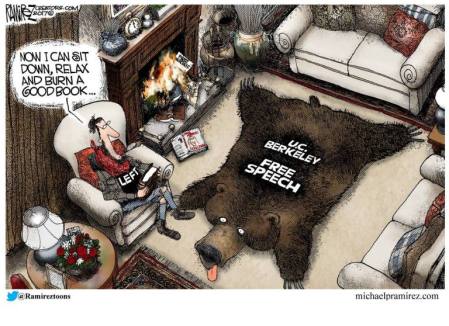
The way Michael Ramirez portrays Berkeley goes for the entire Left. Click to enlarge:
“Now I can sit down, relax, and burn a good book.” Heh.
A movement that has so much to say about the value of black lives, of transgender lives, of women’s lives, of Latino lives, of Muslim lives, of the lives of the disabled and the poor and the weak, but becomes mealy-mouthed and contingent about the lives of Jews when those Jews happen to live in the land of Israel should make any person of conscience question the sincerity of that movement.
Indeed, what’s perhaps even more disturbing is the increasing tendency on the part of Jews to silence themselves on these fundamental moral matters to fit in or to avoid accusations of being soft on Trump. On this, our leaders must do better, even though it will surely mean fewer likes and retweets from popular progressives. It’s incumbent upon those who assert themselves as representatives of the Jewish community not to paper over this disturbing hypocrisy—especially if what they are trying to do is convince amcha that it’s still in their best interest to be at the anti-Trump table.
Somehow it seems that Jews are always the ones being asked to check their identity at the door in movements driven by identity politics. We may assiduously follow the “two-thirds and 51 percent” rule, but our partners often do not. If asking for something so minimal—to disassociate and condemn a woman who murdered innocent Jews—seems impolite or greedy, then perhaps the compromise we have made is rotten.
*************************************
In the week leading up to the presidential election, like hockey players who refuse to shave during the playoffs, the women of the Weiss family lived in their “Pussy Grabs Back” T-shirts. For months, our family texts had buzzed day and night with emoji-laden reactions to the latest Trump outrage, while my mother waged a very personal campaign against the Republican candidate. When the first Tuesday in November was upon us, my dad, who has a giant poster of William F. Buckley in his office, bowed to shalom bayit and wrote in Steph Curry.
All of this camaraderie put me in a strange position. Since the crucible of my college years—in which being an outspoken Zionist made you fascist, supporting the war in Iraq made you an imperialist, and believing that some cultures are indeed more enlightened than others a hegemon—I’ve gotten used to feeling politically homeless. I’m typically the hardass among the squishes. All of a sudden, I found myself making common cause with those whom I disagree with vehemently on, say, the Iran deal (bad), the necessity of teaching Western Civ. (good), and most certainly Israel. It is the difference on the Jewish state that has been the starkest and the most painful, as anyone who has paid any attention to the increasingly leftward tilt of the Democratic Party will not be surprised to learn.
One of the rising stars of this new generation of progressive politicos is Linda Sarsour, who was honored as a “champion of change” by the Obama administration and is now one of the anti-Trump movement’s most visible leaders. Sarsour, a longtime Arab-American community organizer, was one of the heads of the Women’s March in Washington and is the named plaintiff in the high-profile lawsuit against Trump’s immigration ban. The image of her, hijab-clad and flashing a defiant smile, rivaled the pink knitted hat as the unofficial symbol of the march.
She is also a proudly outspoken supporter of BDS. “Nothing is creepier than Zionism,” she has tweeted, a remark that, along with the fact that in December she posed for a photo with a former Hamas operative, stirred a series of critical pieces on right-wing websites in the days following the march on the capital. Within hours, Sarsour’s newfound friends and supporters—do I even need mention that Mark Ruffalo and Susan Sarandon were among them?—burst forth with a social-media-driven campaign dubbed #IMarchWithLinda, in which the stories about her background and views were presented as vicious hatchet jobs by pro-Trump legions determined to slow the momentum of the anti-Trump brigades. Indeed, how could a woman who last week made headlines for organizing a fundraising drive that raised more than $56,000 to repair the desecrated Jewish cemetery in St. Louis harbor hostility to Jews?
Among those who have pledged allegiance to Sarsour are prominent Jewish leaders and rabbis. Criticism of the Muslim activist was nothing but “a deliberate smear campaign from the far right to delegitimize the march itself,” said Los Angeles Rabbi Sharon Brous, expressing the view of many other anti-Trump Jews. “This is a time for serious coalition-building, for standing beside other minority populations that are targeted. It is time for people to stand for and with each other. There will be in the mix a number of different perspectives. I don’t feel at all uncomfortable about that,” Brous has said. “A much greater problem would be if the Jewish community stepped out of activism because we’re afraid that someone on the stage has a position on BDS different than our own.”
This was something of a dodge, because, as Brous and others must know, Sarsour’s odious views aren’t limited to BDS, and stretch particularly into issues that directly relate to the systemic oppression of women. “You’ll know when you’re living under Sharia Law if suddenly all your loans & credit cards become interest-free. Sound nice, doesn’t it?” Sarsour tweeted about the Islamic law code that justifies beating women and considers the testimony of a woman half that of a man. She has also denigrated the anti-Islamist feminist Ayaan Hirsi Ali in astonishingly vulgar terms, insisting that Hirsi Ali is “not a real woman” and joking that she wishes she could take away Ali’s vagina—a particularly vicious bon mot, given that Hirsi Ali was well-known as a victim of genital mutilation in her native Somalia.
Still, anti-Trumpers argued, Sarsour’s personal imperfections didn’t come close to forcing Jews to disavow her and her movement. Echoing Brous, Yehuda Kurtzer, president of the Shalom Hartman Institute of North America, pushed back against those who use support of Israel as a single-issue litmus test. In a piece in the Jewish Journal, he made the case that American Jews should stick to what he dubbed the “two-thirds and 51 percent” rule: “We identify in political communities, or organize for particular causes, with people who share, or at least do not operate in contradistinction to, two-thirds of our core moral imperatives, and with whom we agree on a minimum of 51 percent of our moral concerns,” he writes. By this standard, Sarsour’s leadership role is not a deal breaker. “Rotten compromise, the kind we must not do,” wrote Kurtzer, “entails making common cause with evil.”
So what does boundary-crossing evil look like? Is it OK, for example, to support the civil rights of Palestinians, undocumented immigrants, and women who wear hijab while also calling for the denial of the national and indigenous rights of Jews, and rejecting the rights of women in Muslim-majority countries to control their own bodies? Is that a fair definition of Kurtzer’s 51-percent rule? If you call for the death of Zionists but support Palestinian nationalism, is being against Donald Trump the moral tie-breaker that makes you a legitimate ally of American Jews like me—and immune from our criticism? Kurtzer doesn’t say, but the assumption was that nothing had thus far emerged in the anti-Trump movement to meet the rotten compromise test.
That logic resonated with almost all the anti-Trump Jews I know, who either actively rallied around Sarsour, or—like me—held their tongues. I justified it by telling myself that no political movement is perfect, no coalition entirely pure. Opposing this president, I reasoned, is too critical a priority.
Now, unhappily, the anti-Trump movement has produced a leader far worse than Sarsour: a woman whose actions must surely qualify as evil. If they don’t, the problem doesn’t belong to Zionists or Jews, but to the movement itself—and even more so to the spiritual health of the political party angling to benefit from it.
***
The names Leon Kaner and Edward Jaffe are now lost to history, but Rasmea Odeh surely remembers them well. Kaner and Jaffe are the 21-year-old and 22-year-old who went to a Jerusalem supermarket on Feb. 21, 1969 to pick up food for a trip and were blown up thanks to a bomb that Odeh and an accomplice had placed there. Nine others were injured in the blast. Four days later, a second bomb that the duo planted exploded at the British Consulate. Odeh was sentenced to life in prison by Israel but was released in a prisoner exchange in the early 1980s.
This convicted terrorist has surfaced since the march on Washington as a new leader of the women’s movement, announcing its next global action in the pages of the Guardian: a worldwide women’s strike on March 8. Along with Angela Davis and several others, Odeh called for a day of “striking, marching, blocking roads, bridges, and squares, abstaining from domestic care and sex work, boycotting, calling out misogynistic politicians and companies, striking in educational institutions.” And the organizers of the Washington March followed Odeh’s lead, recently announcing their participation in this international “day without women.”
The political stupidity of embracing Odeh is plain. What better ammunition could there possibly be for a White House all too keen to dismiss a genuine grassroots movement as paid professional protestors and anti-American anarchists than the public participation of a bona fide terrorist? If the anti-Trump movement is going to stand for tolerance, genuine liberalism, civility, and decency—everything we disdain Trump for disdaining—Odeh and her ilk can have no place in it.
But there is a deeper, darker point here beyond strategy: It concerns the alarming cheapness of Jewish blood. A movement that has so much to say about the value of black lives, of transgender lives, of women’s lives, of Latino lives, of Muslim lives, of the lives of the disabled and the poor and the weak, but becomes mealy-mouthed and contingent about the lives of Jews when those Jews happen to live in the land of Israel should make any person of conscience question the sincerity of that movement.
Indeed, what’s perhaps even more disturbing is the increasing tendency on the part of Jews to silence themselves on these fundamental moral matters to fit in or to avoid accusations of being soft on Trump. On this, our leaders must do better, even though it will surely mean fewer likes and retweets from popular progressives. It’s incumbent upon those who assert themselves as representatives of the Jewish community not to paper over this disturbing hypocrisy—especially if what they are trying to do is convince amcha that it’s still in their best interest to be at the anti-Trump table.
Somehow it seems that Jews are always the ones being asked to check their identity at the door in movements driven by identity politics. We may assiduously follow the “two-thirds and 51 percent” rule, but our partners often do not. If asking for something so minimal—to disassociate and condemn a woman who murdered innocent Jews—seems impolite or greedy, then perhaps the compromise we have made is rotten.
While America as a whole will suffer from the radicalization of the Democratic Party, perhaps no group will suffer more from the far Left’s takeover of the party than the American Jewish community. The vast majority of American Jews give their partisan allegiance to the Democratic Party and their ideological allegiance to the Left.
With each passing day, the Left becomes more open in its embrace of anti-Jewish voices. If Sarsour’s leadership role last month in the anti-Trump women’s protests constituted a new low in progressive politics, a month later the bar has dropped even lower. At the next round of women’s protests, Ramsea Odeh is one of the announced organizers.
Whereas Sarsour simply supports the terrorist murder of Jews, Odeh is an actual terrorist murderer of Jews. Odeh participated in a PLO terrorist attack at a Jerusalem supermarket in 1970 in which two Jews were murdered.
****************************
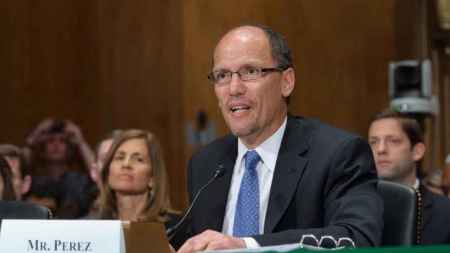
Was former secretary of labor and assistant attorney-general Tom Perez’s victory over Congressman Keith Ellison over the weekend in the race to serve as the new chairman of the Democratic National Committee a victory of centrist Democrats over radical leftists in the party? That is how the mainstream media is portraying Perez’s victory.
Along these lines, Prof. Allen Dershowitz, a lifelong Democrat who promised to quit the party if Ellison was elected due to his documented history of antisemitism and hostility toward Israel, hailed Perez’s election. Speaking to Fox News, Dershowitz said that Perez’s election over Ellison “is a victory in the war against bigotry, antisemitism, the anti-Israel push of the hard Left within the Democratic Party.”
There are two problems with Dershowitz’s view. First, Perez barely won. Ellison received nearly half the votes in two rounds of voting.
Tipping his hat to Ellison’s massive popularity among the party’s leadership and grassroots, Perez appointed the former Nation of Islam spokesman to serve as deputy DNC chairman as soon as his own victory was announced.
There is a good reason that Perez is so willing to cooperate with Ellison in running the DNC. And this points to the second problem with the claim that Perez’s election signals a move toward the center by Democratic leaders.
Perez is ready to cooperate with Ellison because the two men have the same ideological worldview and the same vision for the Democratic Party. As Mother Jones explained, “There’s truly not much ideological distance between the two.”
Far from being a victory for the centrist forces in the party, Perez’s win marks the solidification of the far Left’s control over the party of Harry Truman. Only hard leftists participated in a meaningful way in the race for leadership of the second largest party in America – a party that less than a decade ago controlled the White House and both houses of Congress.
The implications of this state of affairs are disastrous for the US generally. It is inherently destabilizing for a nation when one of the parties in a two-party political system is taken over by people who have a negative view of the country.
While America as a whole will suffer from the radicalization of the Democratic Party, perhaps no group will suffer more from the far Left’s takeover of the party than the American Jewish community. The vast majority of American Jews give their partisan allegiance to the Democratic Party and their ideological allegiance to the Left.
While Perez made a name for himself by fighting the enforcement of US immigration and naturalization laws against illegal immigrants, and Ellison rose to prominence for his activism in radical African American and Islamic circles, thanks to the so-called intersectionality of the far Left, that makes the cause of one faction the cause of all factions, today Perez is as much an apologist for Israel bashers as Ellison.
Perhaps in response to the danger that the far Left’s takeover of the Democratic Party represents, Malcolm Hoenlein, the long-serving professional head of the Conference of Presidents of Major American Jewish Organizations called on Sunday for the convening of a global conference on antisemitism. In a meeting with The Jerusalem Post’s editorial board, Hoenlein said that one of the goals of the proposed conference would be to reach a universally accepted definition of antisemitism.
At the same meeting at the Post, Hoenlein insisted that “we can’t afford a split” on Israel among the Republicans and the Democrats.
On the surface, Hoenlein’s position makes sense. Israel and the Jewish community in the US are both endangered by the partisan split. If a broad consensus can be reached on the definition of antisemitism, in theory, such a move could force the radical Left, which now controls the Democratic Party, to eschew Jew hatred.
The problem with Hoenlein’s view is that to get everyone on board, it is necessary to pretend that even antisemites oppose antisemitism.
This sad state of affairs has been on prominent display in the wake of the recent spate of antisemitic attacks against Jewish cemeteries in the US. Muslim Americans with records of antisemitism have been quick to condemn the attacks.
On the face of it, statements by Ellison, Hamas supporter Linda Sarsour and others condemning the attacks on Jewish cemeteries are welcome. Sarsour’s support for Palestinian mass murderers of Jews and open calls for Israel’s destruction have been ongoing for more than a decade. It’s nice that she is suddenly raising money to repair broken Jewish graves in St. Louis.
The problem is if Sarsour and her Jew hating comrades are viewed as legitimate partners in fighting antisemitism, when they themselves are abetting and popularizing antisemitism, then the notion of fighting antisemitism is destroyed.
If Sarsour, who wrote in 2012 that “nothing is creepier than Zionism,” is a legitimate voice in the fight against anti-Jewish discrimination and violence, then the fight against anti-Jewish discrimination and violence is reduced to farce.
Sarsour, like Ellison, is no fringe figure on the Left. She has become a major mover and shaker in the second party in America. Sarsour was one of the organizers of the anti-Trump women’s protests the day after the president was inaugurated.
Sarsour’s rising prominence in progressive and Democratic circles despite her open support for Hamas shows why it is important today to draw a line in the sand and reject the notion that antisemites can suddenly become defenders of Jews.
With each passing day, the Left becomes more open in its embrace of anti-Jewish voices. If Sarsour’s leadership role last month in the anti-Trump women’s protests constituted a new low in progressive politics, a month later the bar has dropped even lower. At the next round of women’s protests, Ramsea Odeh is one of the announced organizers.
Whereas Sarsour simply supports the terrorist murder of Jews, Odeh is an actual terrorist murderer of Jews. Odeh participated in a PLO terrorist attack at a Jerusalem supermarket in 1970 in which two Jews were murdered.
According to Politico, the radical Left’s takeover of the Democratic Party apparatus through Perez and Ellison isn’t enough to satisfy the party’s young activists. They also want for long-serving Democratic lawmakers in Congress to retire and clear the path for their takeover of the Democratic congressional roster.
Following my column last week, where I harshly criticized Senator Robert Menendez for questioning the loyalty of David Friedman, Trump’s ambassador designate to Israel, a number of prominent American Jews insisted that in asking the question Menendez was not embracing the antisemitic dual loyalty slur. He was trying to protect Friedman from his more radical Democratic colleagues.
There is good reason to accept their argument. Menendez has a long record of standing up for Israel and he has paid a political price for that support.
The problem is that such justifications of Menendez’s actions indicate that American Jews have already lowered the bar on what constitutes antisemitism too far and made defending their own interests all but impossible.
The Democrats are in a dangerous place for themselves, for the US and for the American Jewish community. They will not move back to the center if standards for judging what it means to be antisemitic are lowered. The only chance that they will return to their senses is if they are made to choose between the Sarsours of the world and the Dershowitzes. And this cannot happen by looking for a consensus on what antisemitism means. It can only be done – if it can be done at all – by drawing a line and demanding that it be respected.
America’s elites still praise FDR for partnering with one of the great mass murderers of human history, Stalin, to defeat Hitler. They still applaud Nixon for going to China to achieve a rapprochement with the greatest mass murderer of the 20th century, Mao Zedong.
Yet Trump is not to be allowed to achieve a partnership with Putin, whose great crime was a bloodless retrieval of a Crimea that had belonged to Russia since the 18th century.
The anti-Putin paranoia here is astonishing.
***************************
Among the reasons Donald Trump is president is that he read the nation and the world better than his rivals.
He saw the surging power of American nationalism at home, and of ethnonationalism in Europe. And he embraced Brexit.
While our bipartisan establishment worships diversity, Trump saw Middle America recoiling from the demographic change brought about by Third World invasions. And he promised to curb them.
While our corporatists burn incense at the shrine of the global economy, Trump went to visit the working-class casualties. And those forgotten Americans in Pennsylvania, Ohio, Michigan and Wisconsin, responded.
And while Bush II and President Obama plunged us into Afghanistan, Iraq, Libya, Yemen, Syria, Trump saw that his countrymen wanted to be rid of the endless wars, and start putting America first.
He offered a new foreign policy. Mitt Romney notwithstanding, said Trump, Putin’s Russia is not “our number one geopolitical foe.”
Moreover, that 67-year-old NATO alliance that commits us to go to war to defend two dozen nations, not one of whom contributes the same share of GDP as do we to national defense, is “obsolete.”
Many of these folks are freeloaders, said Trump. He hopes to work with Russia against our real enemies, al-Qaida and ISIS.
This was the agenda Americans voted for. But what raises doubt about whether Trump can follow through on his commitments is the size and virulence of the anti-Trump forces in this city.
Consider his plan to pursue a rapprochement with Russia such as Ike, JFK at American University, Nixon and Reagan all pursued in a Cold War with a far more menacing Soviet Empire.
America’s elites still praise FDR for partnering with one of the great mass murderers of human history, Stalin, to defeat Hitler. They still applaud Nixon for going to China to achieve a rapprochement with the greatest mass murderer of the 20th century, Mao Zedong.
Yet Trump is not to be allowed to achieve a partnership with Putin, whose great crime was a bloodless retrieval of a Crimea that had belonged to Russia since the 18th century.
The anti-Putin paranoia here is astonishing.
That he is a killer, a KGB thug, a murderer, is part of the daily rant of John McCain. At the Munich Security Conference this last weekend, Sen. Lindsey Graham promised, “2017 is going to be a year of kicking Russia in the ass in Congress.” How’s that for statesmanship.
But how does a president negotiate a modus vivendi with a rival great power when the leaders of his own party are sabotaging him and his efforts?
As for the mainstream media, they appear bent upon the ruin of Trump, and the stick with which they mean to beat him to death is this narrative:
Trump is the Siberian Candidate, the creature of Putin and the Kremlin. His ties to the Russians are old and deep. It was to help Trump that Russia hacked the DNC and the computer of Clinton campaign chief John Podesta, and saw to it WikiLeaks got the emails out to the American people during the campaign. Trump’s people secretly collaborated with Russian agents.
Believing Putin robbed Hillary Clinton of the presidency, Democrats are bent on revenge — on Putin and Trump.
And the epidemic of Russophobia makes it almost impossible to pursue normal relations. Indeed, in reaction to the constant attacks on them as poodles of Putin, the White House seems to be toughening up toward Russia.
Thus we see U.S. troops headed for Poland, Bulgaria, Romania, NATO troops being sent into the Baltic States, and new tough rhetoric from the White House about Russia having to restore Crimea to Ukraine. We read of Russian spy ships off the coast, Russian planes buzzing U.S. warships in the Black Sea, Russians deploying missiles outlawed by the arms control agreement of 1987.
An Ohio-class U.S. sub just test-fired four Trident missiles, which carry thermonuclear warheads, off the Pacific coast.
Any hope of cutting a deal for a truce in east Ukraine, a lifting of sanctions, and bringing Russia back into Europe seems to be fading.
Where Russians saw hope with Trump’s election, they are now apparently yielding to disillusionment and despair.
The question arises: If not toward better relations with Russia, where are we going with this bellicosity?
Russia is not going to give up Crimea. Not only would Putin not do it, the Russian people would abandon him if he did.
What then is the end goal of this bristling Beltway hostility to Putin and Russia, and the U.S.-NATO buildup in the Baltic and Black Sea regions? Is a Cold War II with Russia now an accepted and acceptable reality?
Where are the voices among Trump’s advisers who will tell him to hold firm against the Russophobic tide and work out a deal with the Russian president?
For a second cold war with Russia, its back up against a wall, may not end quite so happily as the first.
(The views expressed in this article are mine and do not necessarily reflect those of Warsclerotic or its other editors. — DM)
Evidence of political corruption should be.
It has been obvious since the early Republican primaries that most media coverage of a Trump presidency would be adverse and presented out of context. Perhaps a recent editorial at The Week Magazine explains why, albeit inadvertently. Or maybe this cartoon better explains the media view:
Trump and Putin as seen by the lamebrain media
According to The Week Magazine, all leaks are equal. However, we approve of those which fit our politics and disapprove of those which don’t.
Live by the leak, die by the leak. When WikiLeaks was releasing a steady stream of embarrassing emails hacked from Democratic officials during the presidential campaign, Hillary Clinton and her supporters cried foul, and urged the press not to report their contents. Donald Trump applauded every new revelation, saying the leaks provided voters with important information, and gleefully invited the Russians to find and publish emails she had deleted. “Boy, that WikiLeaks has done a job on her, hasn’t it?” Trump exulted. Now that it’s Trump who is being tortured by leaks, he’s complaining they’re illegal and “un-American.” Democrats, meanwhile, are welcoming the torrent like a rainstorm after a long drought. (See Main Stories.) When it comes to leaks, everyone is a hypocrite. “Good” leaks are ones that damage our opponents. “Bad” leaks are those that hurt Our Side. [Emphasis added.]
But let’s set partisanship aside for a moment. Is it always in the public interest for government officials to leak, and for the media to publish leaked material? Crusading journalist Glenn Greenwald—who angered the Obama administration by publishing Edward Snowden’s trove of stolen NSA documents—argues in TheIntercept.com this week that all leaks exposing “wrong-doing” are good ones, regardless of the leaker’s motives. “Leaks are illegal and hated by those in power (and their followers),” Greenwald says, “precisely because political officials want to be able to lie to the public with impunity and without detection.” The implication of this argument, of course, is that governments, politicians, and organizations should not keep any secrets—that when people in power conceal documents, emails, or information that could embarrass them, they are by definition deceiving the public. Radical transparency certainly sounds noble—but I suspect it’s a standard no public official, or indeed most of us, could survive. It’s so much more convenient to have a double standard: Transparency for thee, but not for me.
I disagree. Leaks of unclassified materials demonstrating corruption of the political process by either party are necessary for an effectively functioning democracy. Leaks of highly classified national security information — particularly in the area of foreign policy — endanger our democracy, are crimes and the perpetrators should be dealt with accordingly. When the media sensationalize leaks of the latter type, they are complicit and must be criticized vigorously.
The press has long served as an objective fail-safe to protect the public from the powers-that-be. That objectivity is now absent and the media’s role in our democratic society is in jeopardy. Rather than self-reflect as to how they got off course, the press have opted to label the man who exposed this derailment as un-American.
What’s un-American is the belief that the press should be unaccountable for its actions. What’s un-American is the belief that any attempt to criticize the press should be viewed as heresy. What’s un-American is the belief that the press is akin to a golden calf that compels Americans, presidents included, to worship the press.
Two very different types of leaks
a. DNC and Podesta e-mails:
The DNC and Podesta e-mails were released as written and posted by DNC officials and Podesta for transmission on unsecured servers easily hacked by modestly competent teenage hackers. I have seen no suggestion that the e-mails were classified. The intelligence community opined that Russian agents had done the hacking, but offered no significant proof beyond that the methods used by the hacker(s) were comparable to those used by Russian hackers in the past.
They found no discrepancies between the original e-mails and those posted by WikiLeaks (which denied that Russia had been the source). The e-mail leaks damaged the Clinton campaign because they portrayed, accurately — and in their own words — dishonest efforts of high-level DNC and Clinton campaign personnel to skew the Democrat primary process in Ms. Clinton’s favor. They did not involve American foreign policy until Obama — who had previously done nothing of significance to halt Russia’s hacking of highly classified information from our intelligence establishment beyond asking, “pretty please, stop” — decided that Russia must be punished for Hillary’s loss of the general election through sanctions and by the expulsion of thirty-five of its diplomats.
Russian president Vladimir Putin had been expected to respond in kind, with the expulsion of US diplomats from its territory.
Neither transcripts nor audio recordings of the Flynn telephone conversations were released. Instead, conclusions of the leakers were released. According to House Intelligence Chair Devin Nunes,
“I think there is a lot of innuendo out there that the intelligence agencies have a problem with Donald Trump. The rank and file people that are out doing jobs across the world — very difficult places — they don’t pay attention to what is going on in Washington,” the California representative told CBS “Face the Nation” host John Dickerson.
“What we have is we do have people in the last administration, people who are burrowed in, perhaps all throughout the government, who clearly are leaking to the press,” Nunes added. “And it is against the law. Major laws have been broken. If you believe the Washington Post story that said there were nine people who said this, these are nine people who broke the law.” [Emphasis added.]
Nunes said the FBI and other intelligence agencies ought to investigate who has leaked information to the press because so few people in the administration knew these secrets, that it would have had to have been someone at the “highest levels of the Obama administration” who is an acting official until Trump replaces him or her.
Did the leaker(s) try to present the conversations honestly, or to damage President Trump’s efforts to deal with Russia in matters of foreign policy where American and Russian interests coincide? To disrupt America’s badly needed “reset” with Russia which seemed likely to succeed under President Trump after Clinton’s and Obama’s efforts had failed?
Remember the Obama – Romney debate when Romney characterized Russia as America’s greatest geopolitical threat and Obama responded that the cold war was over and that “the 1980’s are calling and want their foreign policy back”?
The position now asserted by the Democrats and the media seems rather like the position that Obama rejected. If the position(s) of the Democrats and the media are now correct and Russia is again our enemy, might it be due to actions which Obama took or failed to take over the past eight years?
On January 22, 2017, the Russian media outlet Pravda.ru published an analysis on Russia-Iran relations. According to the article’s author, Dmitri Nersesov, Iran is becoming a problem for Russian interests. Nersesov also added that Iran wants Russia to choose between Iran and Washington. “Iran wants Russia to recognize that Teheran holds the key to the regulation of the Syrian crisis. Should Russia decide that the real strategy is built on the cooperation between Moscow and Washington, rather than Moscow and Teheran; the Islamic Republic will be extremely disappointed,” Nersesov wrote. [Emphasis added.]
An American – Russian realignment in areas of mutual concern — which as suggested below had seemed to be progressing well until General Flynn ceased to be involved — would be good, not bad. We have many areas of mutual concern, and Iran is one of them. The war in Syria is another. When were Russians last directed to yell Death to America? Or to refer to America as the “Great Satan?”
c. General Flynn, Russia and Iran
General Flynn had, at President Trump’s request, been dealing with Russia concerning the future roles of Iran, Russia and America in the Syria debacle:
Overlaying US President Donald Trump’s extraordinary, hour-long skirmish with reporters Thursday, Feb. 16, was bitter frustration over the domestic obstacles locking him out from his top security and foreign policy goals. [Emphasis added.]
Even before his inauguration four weeks ago, he had arranged to reach those goals by means of an understanding with President Vladimir Putin for military and intelligence cooperation in Syria, both for the war on the Islamic State and for the removal of Iran and its Lebanese surrogate Hizballah from that country. [Emphasis added.]
But his antagonists, including elements of the US intelligence community, were turning his strategy into a blunderbuss for hitting him on the head, with the help of hostile media.
Thursday, in a highly unconventional meeting with the world media, he tried to hit back, and possibly save his strategy.
That won’t be easy. The exit of National Security Adviser Mike Flynn, the prime mover in the US-Russian détente, sent the Kremlin a negative signal. The Russians began unsheathing their claws when they began to suspect that the US president was being forced back from their understanding. The SSV 175 Viktor Leonov spy ship was ordered to move into position opposite Delaware on the East Coast of America; Su-24 warplanes buzzed the USS Porter destroyer in the Black Sea.
Before these events, Washington and Moscow wre moving briskly towards an understanding. debkafile’s intelligence sources disclose that the Kremlin had sent positive messages to the White House on their joint strategy in Syria, clarifying that Moscow was not locked in on Bashar Assad staying on as president. [Emphasis added.]
They also promised to table at the Geneva conference on Syria taking place later this month a demand for the all “foreign forces” to leave Syria. This would apply first and foremost to the pro-Iranian Iraqi, Pakistani and Afghan militias brought in by Tehran to fight for Assad under the command of Revolutionary Guards officers, as well as Hizballah. [Emphasis added.]
Deeply troubled by this prospect, Tehran sent Iran’s supreme commander in the Middle East, the Al Qods chief Gen. Qassem Soleimani, to Moscow this week to find out what was going on.
Flynn’s departure put the lid on this progress. Then came the damaging leak to the Wall Street Journal, that quoted an “intelligence official” as saying that his agencies hesitated to reveal to the president the “sources and methods” they use to collect information, due to “possible links between Trump associates and Russia.. Those links, he said “could potentially compromise the security of such classified information.”
A first-year student knows that this claim is nonsense, since no agency ever share its sources and methods with any outsider, however high-placed.
What the leak did reveal was that some Washington insiders were determined at all costs to torpedo the evolving understanding between the American and Russian presidents. The first scapegoat was the strategy the two were developing for working together in Syria. [Emphasis added.]
Defending his policy of warming relations with Moscow, Trump protested that “getting along with Russia is not a bad thing.” He even warned there would be a “nuclear holocaust like no other” if relations between the two superpowers were allowed to deteriorate further.
It is too soon to say whether his Russian policy is finally in shreds or can still be repaired. Trump indicated more than once in his press briefing that he would try and get the relations back on track.
Asked how he would react to Russia’s latest provocative moves, he said: “I’m not going to tell you anything about what responses I do. I don’t talk about military responses. I don’t have to tell you what I’m going to do in North Korea,” he stressed.
At all events, his administration seems to be at a crossroads between whether to try and salvage the partnership with Russia for Syria, or treat it as a write-off. If the latter, then Trump must decide whether to send American troops to the war-torn country to achieve his goals, or revert to Barack Obama’s policy of military non-intervention in the conflict. [Emphasis added.]
Substantially more is generally involved in matters of foreign policy than is facially apparent or than government officials should discuss publicly, particularly while negotiations with foreign powers are underway. Leaks by held-over members of the intelligence community did much to reveal the opinions of the leakers but little to reveal what General Flynn had been doing, while upsetting the chances of better American – Russian relations in areas of mutual concern.
Conclusions — The Administrative State
The Federal Government has grown far too big for its britches, giving the unelected “administrative state” substantially more authority, and hence power, than is consistent with a properly functioning democracy. As they have been demonstrating in recent months, holdovers from one administration can succeed, at least partially, in paralyzing a new and democratically elected president. Holdovers with political appointee status can generally be fired. Few others who should be can be.
Getting rid of the obstructionist “civil servants” who have become our masters should rank very high on President Trump’s “to do” list and should be accomplished before it’s too late. The task may be difficult but is not impossible. Perhaps some particularly obnoxious Federal agencies (or departments within those agencies) can be relocated to places less congenial than Washington. Inner City Chicago comes to mind. So do otherwise pleasant cities in California, where housing prices are much higher than in the Washington, D.C. area. How many Federal employees faced with the choice of relocating or resigning would choose the latter option?
There are likely other and probably better ways to get rid of the fatheads. President Trump’s administration should devise them.
Recent Comments