Archive for the ‘Defense of Israel’ category

The Iran deal and the Israeli veto

August 24, 2015

The Iran deal and the Israeli veto, Power LinePaul Mirengoff, August 23, 2015

(How long can Israel wait? Please see also, Thinking About the Unthinkable: An Israel-Iran Nuclear War and WHY IRAN IS NUCLEAR NOW. — DM)

CNN’s report thus raises this obvious question: Will Israel attack Iran now that the U.S. and its European allies are about to enter a deal that effectively grants Iran the right to become a nuclear power?

***********************

This weekend, CNN reported that in recent years, Israeli leaders planned three attacks on military targets in Iran. CNN bases this story on an audio recording with former Defense Minister (and one-time Prime Minister) Ehud Barak. The recording was leaked to an Israeli television station.

Why didn’t Israel carry through with the planned attacks? In the first case (2010), Israeli military leaders reportedly nixed the idea. The head of the Israeli Defense Force (IDF) simply didn’t believe the planned attack was “operational.”

In the second case (2011), the IDF signed off on an attack. However, two key ministers had doubts that could not be overcome.

In the third case (2012), the attack didn’t come off because of scheduling issues. Supposedly, the planned strike conflicted with a joint military exercise with the United States. The Israeli didn’t want to embarrass Washington by attacking Iran just as it was set to engage in the joint military exercise because this would give the appearance that the Americans were involved. (The explanation in CNN’s report for why the attack wasn’t rescheduled is garbled).

In all three instances, Prime Minister Netanyahu wanted to attack. In all three instances, Barak, who is not a member of Netanyahu’s party, concurred.

In none of these instances does it appear that President Obama’s obvious opposition to an Israeli attack on Iran was the dealbreaker, if CNN’s report is to be believed (though Obama’s views may have contributed to the two ministers getting cold feet in 2011).

CNN’s report thus raises this obvious question: Will Israel attack Iran now that the U.S. and its European allies are about to enter a deal that effectively grants Iran the right to become a nuclear power?

One might think not. The deal has the support of European governments eager to allow their businessmen to take advantage of Iranian markets. Here in the U.S., the deal is unpopular, but Obama considers it the main element of his foreign policy legacy.

There will be hell to pay if Israel upsets these expectations by attacking Iran.

But the more we learn about the farcical nature of this deal, the more Israel’s calculus may tilt in favor of an Israeli attack — if not in 2015 or 2016, then in 2017 when Obama is no longer president. After all, the hell Israel would pay if it attacks Iran must be weighed against the threat of a nuclear Iran. CNN’s report, if accurate, adds plausibility to the view that Israel sees the latter as more hellacious.

In a very real sense, then, the key people evaluating Obama’s deal aren’t U.S. Senators and Representatives, but rather Israeli generals, intelligence chiefs, and ministers. They are the ones who, effectively, can nullify the deal.

It seems to be that with every revelation of a major Obama/IAEA concession to the mullahs, the prospect that Israel will exercise its veto increases.

Jihad, Iranian-style

August 21, 2015

Jihad, Iranian-style, Israel Hayom, Ruthie Blum, August 21, 2015

The new twist in the controversy surrounding the nuclear agreement is an argument over the veracity of a report on a side deal giving Iran the right to inspect its own nuclear facilities for potential violations. The idea is so preposterous that it must be true, judging by the rest of the top-secret document on which the U.S. Congress is going to vote in September.

But as the debate heats up over whether the deal furthers or hinders Iran’s nuclear weapon capabilities, an equally serious issue keeps being marginalized. This is the more immediate and tangible danger posed by Iran’s terrorist proxies, and the sudden financial and ideological boost the deal is providing them.

The reason it is crucial to keep an eye on their activities is that they constitute Iran’s global army — the boots on the ground, so to speak — who perform the legwork necessary for the ultimate aim of regional and global jihadist hegemony. Their role is to set the stage for that time in the not-so-distant future when Iran’s power and reach are so extensive that its leaders won’t need to waste their nuclear warheads by firing them.

This is where Israel comes in. As the only democracy in the Middle East, an ally of the West and a Jewish state, it has key strategic value. It is like the central card in a house of cards, whose removal topples the whole structure.

It is also tiny and surrounded by rogue states with an endless supply of Muslim would-be “martyrs” willing to die in the “holy” endeavor to take it down.

On Thursday, Israel received its latest message to this effect, when four rockets, launched from Syria, landed in the Upper Galilee and the Golan Heights. The Iran-backed Islamic Jihad terrorist organization was behind the attack, which spurred Israel to retaliate.

Also on Thursday, Israel deployed anti-missile Iron Dome batteries in the south of the country, in the areas between Ashkelon and Ashdod, as well as in Beersheba. This was in response to threats of rocket fire by Iran-baked terrorists in Gaza — whose excuse was the worsening condition of hunger-striking Palestinian terror suspect Mohammed Allan.

A review of recent Iranian rhetoric and activity, released by the Investigative Project on Terrorism, puts all of the above in context.<

Last month, the General Assembly of Islamic Resistance Ulema (scholars) held a weekend conference titled “Unity for Palestine.”

At the gathering, Hezbollah chief Hassan Nasrallah said, “We believe with certainty that Israel, this cancerous tumor, is headed for extinction, and that Palestine and Jerusalem will be returned to their people. It is only a matter of time and is linked to the will, action, jihad, and sacrifices of the Ummah [Islamic nation], according to the principle: If you achieve victory for Allah, Allah will lead you to achieve victory.”

From Iran, Ayatollah Mohsen Araki, secretary general of the World Forum for Proximity of Islamic Schools of Thought, agreed.

“Annihilation of the Zionist regime is a sure thing and Quranic pledge,” he said, adding that it is important to unify “Muslims in countering the regime of Zionism and the arrogant world.”

Muhammad Hasan Zamani, a former Iranian cultural attache in Egypt who heads the Department of International Islamic Madrasas (educational institutions) for the General Assembly of Islamic Resistance Ulema, reiterated this position.

“Israel must be erased from the map of the world,” he said. “These are the golden words Imam Khomeini, may God have mercy on him, uttered.”

Sheikh Abdel Halim Qadhi, a professor at Zahedan University in Iran, said, “The holy Quran makes it known that Jews are the enemies of Islam and the Muslims and their holy places and rites. … Jihad is the most powerful and only way to liberate Palestine and defend Jerusalem. … God loves those who fight in his way.”

Earlier this month, Iranian Supreme Leader Ali Khamenei published “Palestine,” a 416-page tome devoted to the issue of Israel’s inevitable demise, with a blurb on its back cover calling the author the “flagbearer of jihad to liberate Jerusalem.”

This week, Khamenei gave an abbreviated version of this on Twitter: “We spare no opportunity to support anyone #FightingTheZionists,” he wrote.

At the same time, a clip produced by the Islamic Revolution Design House, a media outlet associated with the Iranian Revolutionary Guard Corps, began to circulate on YouTube. The minute-and-a-half animated video depicts an Islamist invasion of Jerusalem.

The brief silent film shows soldiers from the Revolutionary Guards, Shia Badr, Hezbollah, Hamas and Qassam Brigades, clad in military gear and keffiyehs, marching to and standing on a hill overlooking the Temple Mount, as thousands upon thousands of additional terrorists amass.

An inscription in Farsi on a black screen at the end says: “Israel must be erased from the annals of history, and the youth will definitely see that day when it comes.”

Lest anyone imagine the mullahs pulling the strings in Iran don’t mean business, all one has to do is observe how they are executing their grand plan, part of which is the nuclear deal with the “Great Satan” and the other P5+1 countries. Among these is Russia, which confirmed on Wednesday that it will supply Iran with four upgraded batteries of S-300 surface-to-air missiles as soon as the deal is finalized.

Such missiles give Iran the extra benefit of being able to stave off attack. At that point, will it really matter if Iran is in charge of its own inspections?

Netanyahu: ‘You Rush to Embrace Iran, They Fire Rockets at Us’

August 21, 2015

Netanyahu: ‘You Rush to Embrace Iran, They Fire Rockets at Us’, Israel National News, August 21, 2015

The attack ordered by Iran comes after a report in April, when  Iranian officials reportedly told the Syrian regime to strike Israel and open a war front on the Golan Heights.

**************************

PM warns ‘we’ll harm those who try to harm us,’ slams world powers for nuclear deal after ‘Iranian commander ordered rocket strike.’

Prime Minister Binyamin Netanyahu released a statement on Friday, shortly after the IDF airstrike that took out the Islamic Jihad terror cell backed by Iran that launched four rockets into Israel from Syria the day before.

“I said this week that those who try to harm us – we will harm them. And that’s what we did,” said the prime minister.

“The IDF struck the cell that conducted the (rocket) fire, and the Syrian forces that enabled it. We don’t intend to escalate the incidents, but our policy remains as it was,” he said. At least 14 targets were hit by the IDF overnight, including a strike on an army post which Syria said killed one soldier.

Turning his attention to the IDF reports that Iranian military sources funded and directed the Islamic Jihad cell, Netanyahu condemned the world powers that sealed a nuclear deal with Iran just last month and are now advancing economic trade and diplomatic ties.

“The countries that rush to embrace Iran need to know that an Iranian commander is the one who gave the cover and direction to the cell that fired on Israel,” he said.

As noted by Netanyahu, the one who gave the order for the rocket strike was said to be the head of the Palestinian department in Iran’s Al-Quds force, the covert foreign operations unit of the Iranian Revolutionary Guards.

Netanyahu on Friday ordered the Foreign Ministry to send an official letter to Western governments, saying Israel has “reliable information that this attack was carried out by the Palestinian Islamic Jihad, ordered directly by the Iranian terrorist Said Izadhi of the Iranian Revolutionary Guards.”

“This is further clear indication of Iran’s increasing involvement in attacks against Israel in particular and against regional targets in general. The ink on the nuclear agreement has not yet dried, and this attack shows clearly how Iran plans to act the moment after the international sanctions are removed.”

The attack ordered by Iran comes after a report in April, when  Iranian officials reportedly told the Syrian regime to strike Israel and open a war front on the Golan Heights.

The four rockets fired on Galilee came from the new Iranian terror front on the Golan

August 20, 2015

The four rockets fired on Galilee came from the new Iranian terror front on the Golan, DEBKAfile, August 20, 2015

Netanyahu_northern_border_B_18.8.15Israel leaders at Northern Command HQ this week

According to our military sources, it is this Iranian-backed network which Thursday, Aug. 20, fired a salvo of four rockets from the Golan into upper Galilee and the Golan. The impact set off brush fires but caused no casualties. A red alert had sent most people running to shelters.

****************

Israel’s top government and military went on a high level of preparedness Tuesday, Aug. 18 in expectation of the first terrorist attack to be orchestrated by Iran from Syrian or Lebanese borders. That is what brought Prime Minister Binyamin Netanyahu, Defense Minister Moshe Ya’alon and Chief of Staff Lt. Gen. Gady Eisenkott on a tour of inspection to the Golan and Northern Command headquarters. Netanyahu said then that Israel is ready for any scenario and would “harm anyone trying to harm us.”

DEBKAfile’s military sources report that these events were sparked by the knowledge reaching Israeli intelligence that Iranian Al Qods and Hizballah officers were building a new terrorist network for mounting large-scale terrorist attacks on Israel from the Syrian border opposite the Golan.

The officers had handed out anti-tank and anti-air rockets to the terrorists, raising Israeli suspicions that one of their plans was to seize an Israeli location or part of one and try and hold out against an Israeli counter-offensive of tanks and assault helicopters.

Our counter-terrorism sources disclose that three radical terrorist movements staff the new network:

One is the hard-line rejectionist Popular Front for Liberation of Palestine – General Command (PFLP-GC).

Another is the Golan-based Syrian Druze group known as Liberators of the Golan. It is headed by the notorious Samir Kuntar, a Lebanese Druze who has set up a Golan terror ring based in the Druze village of Al-Khadar opposite the Israeli border fence.

Also harnessed to Iran’s new Golan terror organization is the Syrian Social Nationalist Party (SSNP) which is made up of radical Christian terrorists. This old timer violent group, which is run by Syrian intelligence, took part in the 1982-3 Hizballah bombing massacres at the US Embassy and Marine headquarters in Beirut.

The first SSNP activists have arrived in the Quneitra district of the Golan.

According to our military sources, it is this Iranian-backed network which Thursday, Aug. 20, fired a salvo of four rockets from the Golan into upper Galilee and the Golan. The impact set off brush fires but caused no casualties. A red alert had sent most people running to shelters.

This was an unusually long-range attack: Previous launches from within Syria, whether deliberate or stray fire from the civil war there, hit the Israeli-held Golan without reaching the Israeli interior. It is now up to Israel to decide how and when to respond to an act of war orchestrated by Tehran, after the prime minister’s warning Tuesday had no deterrent effect.

Captured Hamas Operative Details Group’s Terrorist Plans

August 11, 2015

Captured Hamas Operative Details Group’s Terrorist Plans, Investigative Project on Terrorism, August 11, 2015

A Hamas operative provided a treasure trove of intelligence during Israeli interrogation concerning the terrorist group’s rebuilding efforts and future terrorist plans, Israel’s intelligence agency Shin Bet disclosed on Tuesday.

The terrorist, Ibrahim Adal Shahada Sha’ar, 21, described about Hamas’ tunnel reconstruction efforts, planned terrorist attacks against Israel, military strategy, and coordination with Iran, the Jerusalem Post reported.

He admitted working on rebuilding underground tunnels and described how some would be used in future attacks against Israel. Sha’ar disclosed the location of digging sites, tunnel entrances and underground routes, and reportedly said that a road built along the border with Israel is intended partly for terrorist attacks involving vehicles charging into Israeli territory.

He admitted that he stored several 50 kg explosive charges in his home and said that fighters kept explosives and other material in their own homes since Hamas commanders worried that the organization’s weapons depots would be targeted by Israel.

Israeli authorities arrested Sha’ar last month at the Erez Crossing after he attempted to enter Israel for “personal or humanitarian reasons.” Officers were aware of Sha’ar’s terrorist background and immediately detained him.

During last summer’s war between Israel and Hamas, Sha’ar participated in specific battlefield operations, including field logistics, transferring terrorists and weapons, and even admitted to setting up an anti-tank improvised explosion device (IED).

Sha’ar provided details of Iranian-Hamas military cooperation, including how Iran transfers funds and supplies weapons and electronics to the terrorist group. Those supplies include devices intended to jam radio frequencies to bring down Israeli drones deployed over Gaza. Furthermore, Sha’ar described how Iran trained Hamas terrorists to use hang gliders for attacks against Israel – a tactic revealed by previous Israeli interrogations of captured terrorists.

Critics of the recent Iran nuclear agreement argue that newly released funds to the Islamic Republic will bolster their regional hegemonic ambitions and global terrorist activities, including transferring more money and weaponry to its terrorist proxies.

According to Israeli intelligence, the Sha’ar detailed plans using tunnels to conduct cross-border attacks against Israeli targets, akin to Hamas’ attempts during last summer’s war. The Hamas operative confirmed that the terrorist group is diverting civilian reconstruction material for the purposes of rebuilding its terrorist infrastructure and underground tunnel network.

Sha’ar was indicted July 31 in the Beersheba District Court for being a member and engaging in activities with a banned organization, attempted murder, and forbidden military training.

Israel is working at speed to convert Boeing 767 into a long-flight refueling tanker

August 10, 2015

Israel is working at speed to convert Boeing 767 into a long-flight refueling tanker, DEBKAfile, August 10, 2015

kc46aAmerica Boeing KC-46A refueling tanker

In an interview published by the German newspaper Der Spiegel on Aug. 8, Defense Minister Moshe Ya’alon said: “Ultimately it is very clear, one way or another, Iran’s military nuclear program must be stopped. We will act in any way, including taking military action, and are not willing to tolerate a nuclear-armed Iran. We prefer that this be done by means of sanctions, but in the end, Israel should be able to defend itself.”

*****************

US defense and air industry sources report that the Israeli Air Force may give up on the US Boeing’s KC-46A Pegasus as its future refueling tanker for long-range flights because of delays in its delivery. Israel had first planned to take the Pegasus to replace its converted Boeing 707 when delivery was first to the US Air Force was scheduled for August 2017. But this week, the company put the date back by another eight months and the price increased by half a billion dollars.

American sources point out that if Israel wants to retain the option of attacking Iran’s nuclear facilities when Barack Obama exits the White House in January 2017, it can’t wait for the brand-new US Pegasus tanker, which doubles as a military transport plane, to come off the Boeing production line and be delivered to its air force. The Boeing 707 in current service, after a multibillion investment in its conversion to a long-flight refueling tanker, no longer meets the fluctuating conditions in the Middle East. Work is therefore going ahead on the conversion of the Boeing 767 as its replacement.

On July 22, DEBKAfile’s military sources revealed a mammoth transaction for Iran to purchase Russian UL78 MK1 (Midas) tankers with a range of 7,300km. (The distance from Iran to Israel is 1,200km). Each tanker is capable of spontaneously feeding 6-8 fighter craft.

This purchase represented Tehran’s aspiration – not just to draw level with Israel but to outdo its air force in range and fueling capability. This transaction no doubt spurred the decision by Israel’s defense chiefs to go ahead on its own project, instead of waiting for the American KC-46A to become available.
Israel Aerospace Industries [IAI] is therefore working at top speed on the Boeing 767, a long-range, wide-body, twin-engine jet airliner with a range of 7,000 to 11,000 km. The converted aircraft will be designated 767-200ER MRTT.

In an interview published by the German newspaper Der Spiegel on Aug. 8, Defense Minister Moshe Ya’alon said: “Ultimately it is very clear, one way or another, Iran’s military nuclear program must be stopped. We will act in any way, including taking military action, and are not willing to tolerate a nuclear-armed Iran. We prefer that this be done by means of sanctions, but in the end, Israel should be able to defend itself.”

Column One: Obama’s enemies list

August 6, 2015

Column One: Obama’s enemies list, Jerusalem Post, Caroline Glick, August 6, 2015

ShowImage (8)US President Barack Obama at the Rose Garden of the White House. (photo credit:OFFICIAL WHITE HOUSE PHOTO / PETE SOUZA)

[T]he real question lawmakers need to ask is whether the deal is good for America. Is Obama right or wrong that only partisan zealots and disloyal Zionists could oppose his great diplomatic achievement? To determine the answer to that question, you need to do is ask another one. Does his deal make America safer or less safe? The best way to answer that question is to consider all the ways Iran threatens America today, and ask whether the agreement has no impact on those threats, or whether it mitigates or aggravates them.

***********************

In President Barack Obama’s defense of his nuclear deal with Iran Wednesday, he said there are only two types of people who will oppose his deal – Republican partisans and Israel- firsters – that is, traitors.

At American University, Obama castigated Republican lawmakers as the moral equivalent of Iranian jihadists saying, “Those [Iranian] hard-liners chanting ‘Death to America’ who have been most opposed to the deal… are making common cause with the Republican Caucus.”

He then turned his attention to Israel.

Obama explained that whether or not you believe the deal endangers Israel boils down to whom you trust more – him or Prime Minister Benjamin Netanyahu. And, he explained, he can be trusted to protect Israel better than Netanyahu can because “[I] have been a stalwart friend of Israel throughout my career.”

The truth is that it shouldn’t much matter to US lawmakers whether Obama or Netanyahu has it right about Israel. Israel isn’t a party to the deal and isn’t bound by it. If Israel decides it needs to act on its own, it will.

The US, on the other side, will be bound by the deal if Congress fails to kill it next month.

So the real question lawmakers need to ask is whether the deal is good for America. Is Obama right or wrong that only partisan zealots and disloyal Zionists could oppose his great diplomatic achievement? To determine the answer to that question, you need to do is ask another one. Does his deal make America safer or less safe? The best way to answer that question is to consider all the ways Iran threatens America today, and ask whether the agreement has no impact on those threats, or whether it mitigates or aggravates them.

Today Iran is harming America directly in multiple ways.

The most graphic way Iran is harming America today is by holding four Americans hostage. Iran’s decision not to release them over the course of negotiations indicates that at a minimum, the deal hasn’t helped them.

It doesn’t take much consideration to recognize that the hostages in Iran are much worse off today than they were before Obama concluded the deal on July 14.

The US had much more leverage to force the Iranians to release the hostages before it signed the deal than it does now. Now, not only do the Iranians have no reason to release the hostages, they have every reason to take more hostages.

Then there is Iranian-sponsored terrorism against the US.

In 2011, the FBI foiled an Iranian plot to murder the Saudi ambassador in Washington and bomb the Saudi and Israeli embassies in the US capital.

One of the terrorists set to participate in the attack allegedly penetrated US territory through the Mexican border.

The terrorist threat to the US emanating from Iran’s terrorist infrastructure in Latin America will rise steeply as a consequence of the nuclear deal.

As The Wall Street Journal’s Mary Anastasia O’Grady wrote last month, the sanctions relief the deal provides to Iran will enable it to massively expand its already formidable operations in the US’s backyard. Over the past two decades, Iran and Hezbollah have built up major presences in Cuba, Venezuela, Nicaragua, Ecuador and Bolivia.

Iran’s presence in Latin America also constitutes a strategic threat to US national security. Today Iran can use its bases of operations in Latin America to launch an electromagnetic pulse attack on the US from a ballistic missile, a satellite or even a merchant ship.

The US military is taking active steps to survive such an attack, which would destroy the US’s power grid. Among other things, it is returning the North American Aerospace Defense Command (NORAD) to its former home in Cheyenne Mountain outside Colorado Springs.

But Obama has ignored the findings of the congressional EMP Commission and has failed to harden the US electronic grid to protect it from such attacks.

The economic and human devastation that would be caused by the destruction of the US electric grid is almost inconceivable. And now with the cash infusion that will come Iran’s way from Obama’s nuclear deal, it will be free to expand on its EMP capabilities in profound ways.

Through its naval aggression in the Strait of Hormuz Iran threatens the global economy. While the US was negotiating the nuclear deal with Iran, the Revolutionary Guards unlawfully interdicted – that is hijacked – the Marshall Islands-flagged Maersk Tigris and held its crew hostage for weeks.

Iran’s assault on the Tigris came just days after the US-flagged Maersk Kensington was surrounded and followed by Revolutionary Guards ships until it fled the strait.

A rational take-home message the Iranians can draw from the nuclear deal is that piracy pays.

Their naval aggression in the Strait of Hormuz was not met by American military force, but by American strategic collapse at Vienna.

This is doubly true when America’s listless response to Iran’s plan to use its Houthi proxy’s takeover of Yemen to control the Bab el-Mandab strait is taken into consideration. With the Bab el-Mandab, Iran will control all maritime traffic from the Persian Gulf and the Red Sea. Rather than confront this clear and present danger to the global economy, America abandoned all its redlines in the nuclear talks.

Then there is Iran’s partnership 20-year partnership with al-Qaida.

The 9/11 Commission found in its report that four of the 9/11 terrorists transited Iran before traveling to the US. As former Defense Intelligence Agency director Lt.-Gen. (ret.) Mike Flynn told Fox News in the spring, Iranian cooperation with al-Qaida remains deep and strategic.

When the US Navy SEALs killed Osama bin Laden in 2011, they seized hard drives containing more than a million documents related to al-Qaida operations. All but a few dozen remain classified.

According to Flynn and other US intelligence officials who spoke to The Weekly Standard, the documents expose Iran’s vast collaboration with al-Qaida.

The agreement Obama concluded with the mullahs gives a tailwind to Iran. Iran’s empowerment will undoubtedly be used to expand its use of al-Qaida terrorists as proxies in their joint war against the US.

Then there is Iran’s ballistic missile program.

The UN Security Council resolution passed two weeks ago cancels the UN-imposed embargoes on conventional arms and ballistic missile acquisitions by Iran. Since the nuclear deal facilities Iranian development of advanced nuclear technologies that will enable the mullahs to build nuclear weapons freely when the deal expires, the Security Council resolution means that by the time the deal expires, Iran will have the nuclear warheads and the intercontinental ballistic missiles required to carry out a nuclear attack on the US.

Obama said Wednesday that if Congress votes down his nuclear deal, “we will lose… America’s credibility as a leader of diplomacy. America’s credibility,” he explained, “is the anchor of the international system.”

Unfortunately, Obama got it backwards. It is the deal that destroys America’s credibility and so upends the international system which has rested on that credibility for the past 70 years.

The White House’s dangerous suppression of seized al-Qaida-Iran documents, like its listless response to Iran’s maritime aggression, its indifference to Iran’s massive presence in Latin America, its lackluster response to Iran’s terrorist activities in Latin America, and its belittlement of the importance of the regime’s stated goal to destroy America – not to mention its complete collapse on all its previous redlines over the course of the negotiations – are all signs of the disastrous toll the nuclear deal has already taken on America’s credibility, and indeed on US national security.

To defend a policy that empowers Iran, the administration has no choice but to serve as Iran’s agent. The deal destroys America’s credibility in fighting terrorism. By legitimizing and enriching the most prolific state sponsor of terrorism, the US has made a mockery of its claimed commitment to the fight.

The deal destroys the US’s credibility as an ally.

By serving as apologists for its worst enemy, the US has shown its allies that they cannot trust American security guarantees. How can Israel or Saudi Arabia trust America to defend them when it is endangering itself? The deal destroys 70 years of US nonproliferation efforts. By enabling Iran to become a nuclear power, the US has made a mockery of the very notion of nonproliferation and caused a nuclear arms race in the Middle East.

The damage caused by the deal is already being felt. For instance, Europe, Russia and China are already beating a path to the ayatollahs’ doorstep to sign commercial and military deals with the regime.

But if Congress defeats the deal, it can mitigate the damage. By killing the deal, Congress will demonstrate that the American people are not ready to go down in defeat. They can show that the US remains committed to its own defense and the rebuilding of its strategic credibility worldwide.

In his meeting with Jewish leaders Tuesday, Obama acknowledged that his claim – repeated yet again Wednesday – that the only alternative to the deal is war, is a lie.

Speaking to reporters after the meeting, Greg Rosenbaum, chairman of the National Democratic Jewish Council, which is allied with the White House, said that Obama rejected the notion that war will break out if Congress rejects the deal with veto-overriding majorities in both houses.

According to Rosenbaum, Obama claimed that if Congress rejects his nuclear deal, eventually the US will have to carry out air strikes against Iran’s nuclear facilities in order to prevent them from enriching uranium to weapons-grade levels.

“But,” he quoted Obama as saying, “the result of such a strike won’t be war with Iran.”

Rather, Obama said, Iran will respond to a US strike primarily by ratcheting up its terrorist attacks against Israel.

“I can assure,” Obama told the Jewish leaders, “that Israel will bear the brunt of the asymmetrical responses that Iran will have to a military strike on its nuclear facilities.”

What is notable here is that despite the fact that it will pay the heaviest price for a congressional defeat of the Iran deal, Israel is united in its opposition to the deal. This speaks volume about the gravity with which the Israeli public views the threats the agreement unleashed.

But again, Israel is not the only country that is imperiled by the nuclear deal. And Israelis are not the only ones who need to worry.

Obama wishes to convince the public that the deal’s opponents are either partisan extremists or traitors who care about Israel more than they care about America. But neither claim is true. The main reason Americans should oppose the deal is that it endangers America. And as a consequence, Americans who oppose the deal are neither partisans nor turncoats.

They are patriots.

Hizballah presses elite Radwan Force for conquering Galilee into saving stalled Zabadani battle

August 1, 2015

Hizballah presses elite Radwan Force for conquering Galilee into saving stalled Zabadani battle, DEBKAfile, August 1,2015

New_ninja_uniforms_of_Hezbollahs_elite_forcesNew “ninja” uniforms for Hizballah’s Radwan Force

Hizballah’s elite Radwan Force was originally designed to push in from Lebanon and conquer the Israeli Galilee. DEBKAfile’s exclusive military sources report that on Thursday, July 30 Hassan Nasralla saw he had no option but to press this high-value contingent into service, to extricate the combined Hizballah-Syrian armies from their month-long failure to recapture the key town of Zabadani – or even breach the defenses set up by the Al-Qaeda affiliated rebel Nusra Front.

This standoff with heavy casualties over the key town, which commands the main Damascus-Beirut highway, has become a symbolic make-or-break duel between the Iran-backed Shiite Hizballah and Al Qaeda’s Sunni Nusra Front. Nasrallah loses it at the cost of his organization’s credibility as a formidable fighting force.

Defeat would make western Damascus and eastern Lebanon more vulnerable to attack. And for Iran’s Lebanese proxy, it would leave an embarrassing question hanging in the air: If Hizballah under Iranian command combined with Syrian troops and backed by heavy artillery fire and air strikes can’t win a relatively small battle against no more than 1,200 rebel fighters across a nine-km square battleground, how much are its leaders’ boasts worth when they claim unbeatable prowess for winning major battles, including a war on Israel?

To save face in this landmark showdown, Hizballah decided to press into battle its most prestigious unit, named for Al-Hajj Radwan, the nom de guerre of Hizballah’s renowned military chief Imad Mughniye, whom Israel took out in February 2008.

Eight months ago, the Radwan Force lost its senior commanders. An Israeli air strike on Jan. 18 targeted a group of high Iranian and Hizballah officers on a visit to Quneitra on the Syrian Golan. They were surveying the terrain before relocating this elite unit to confront IDF positions on the Israeli Golan border. Iranian Gen. Ali Reza al-Tabatabai and the Hizballah district commander Jihad Mughniye (son of Imad) lost their lives in the Israeli raid and the plan was provisionally set aside.

If the Radwan Force manages to haul Hizballah out of its impasse in Zabadani, it may next be assigned to take up battle positions on the Golan.

But for now, its mission in the battle for Zabadani has three dimensions:

1.  To disarm the enemy by commando raids, a tactic to be borrowed from the rebels defending the town. On the night of July 24, the rebels preemptively struck Hizballah and Syrian army positions around the town and captured some of them. The decision to deploy Radwan appears to have come in response to that painful setback.

2.  To pull off a quick battlefield success at Zabadani, in view of intelligence reports that the Nusra Front and the Islamic State of Iraq and the Levant in northern Syria were preparing together to open a second front in Lebanon, in order to relieve the rebel force pinned down in Zabadani.

The two groups plan to cross into Lebanon and start attacking pro-Hizballah Shiite populations in the Beqaa Valley and the North. They propose to cut through the Bequaa Valley and head up to the important northern Lebanese city of Tripoli on the Mediterranean coast.

3.  Syrian President Bashar Asad is under extreme pressure for a battlefield success after admitting in a public speech last week to the loss of strategic territory to rebel forces and shrinking military manpower. He has earmarked a Zabadani victory – both as a turning-point for his flagging fortunes and for holding back the constant draining of his army by desertions and defections.

Our military sources reveal that, after Assad leaned hard on the Lebanese government and army to round up Syrian troops who went AWOL, Lebanese security forces went into action. They are picking up Syrian army deserters and putting them on buses driving in armored convoys into Syria. It doesn’t take much imagination to conjure up the fate of these unwilling returnees.

When Is It a War Crime to Defend Yourself? If You’re an Israeli.

July 31, 2015

When Is It a War Crime to Defend Yourself? If You’re an Israeli.

by Jonathan S. Tobin July 31, 2015 Via Commentary Magazine


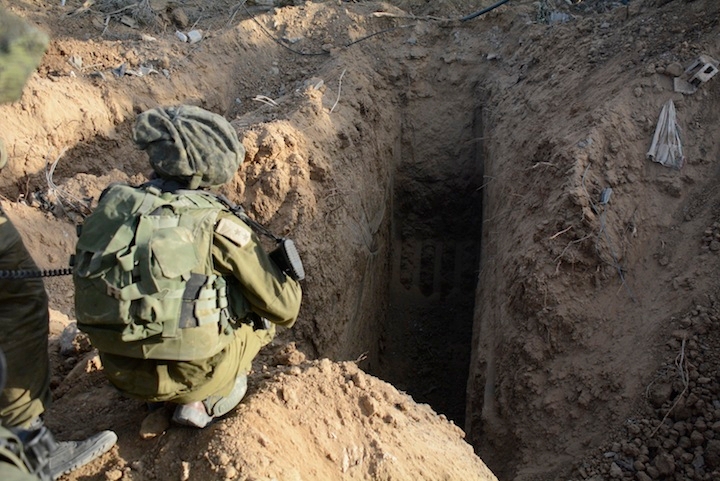
Israeli paratroopers inspect the entrance of a tunnel they discovered in the northern Gaza Strip, July 18, 2014. (IDF Spokesperson/Flash 90)

(That dangerous double standard just won’t go away. – LS)

Yesterday, Amnesty International issued its latest broadside at the State of Israel. The group’s report, titled “Black Friday: Carnage in Rafah” dutifully reported at length by the New York Times, seeks to portray an incident from last summer’s war in Gaza as an example of  particularly awful Israeli war crimes involving shelling of civilian areas and egregious loss of life. But, as with most such accusations, the closer you look at the charge the more it becomes clear that the point of the exercise isn’t merely a supposed quest for justice for dead Palestinians. While this must be seen in the context of a campaign to prepare war crimes charges against the Israel Defense Forces before the International Criminal Court that was recently joined by the Palestinian Authority, the effort has a broader purpose than merely beginning a human rights prosecution before that body. By expending a great deal of its limited resources on this one incident, Amnesty is seeking to make a much broader political point: delegitimizing Israeli self-defense under virtually any circumstances.

The incident that generated the reported took place on August 1, 2014. On that morning, a cease-fire between Israel and Hamas was put into effect that sought to end the war that had begun a month earlier. The conflict started when a Hamas terror cell kidnaped and murdered three Israeli teenagers and then escalated when the group began firing rockets at Israeli cities and towns. Several thousand of these missiles would be launched at Israel before the war ended. In addition to that, Hamas attempted to employ tunnels it had dug underneath the border with Israel to conduct more such kidnap/murder raids. Though the Israelis tried at first to halt the attacks with air power, when that didn’t work, ground forces were required to stop the terrorists. Though the August 1st cease-fire — like the one that later finally did end the shooting — left Hamas in place and in possession of its rocket arsenal, Israel agreed to it.

But only an hour after the fighting was supposed to stop, a Hamas terror squad ambushed a group of Israeli soldiers in the city of Rafah along the border with Israel. Two were killed and the body of one, Second Lieutenant Hadar Goldin, was dragged into the tunnel from which his attackers had emerged. That set off a desperate search and counter-attack aimed at recovering him and/or his body. That directive, known by the code name, “Hannibal” aims to use maximum force to prevent terrorists from escaping with a hostage. The order is always controversial because some interpret it as encouraging Israeli forces to even endanger the life of the captured soldier rather than standing down and subjecting both the individual and his country to a protracted hostage negotiation that inevitably involves the release of a disproportionate number of terrorist murderers.

In this case, Amnesty accuses Israel of using artillery fire in such a way as to conduct “disproportionate or otherwise indiscriminate attacks” on civilian areas with no regard for the lives of innocents who might be killed in the barrage. According to Amnesty and its Palestinian sources, the Israelis fired 1,000 shells and 40 bombs on the area where the Hamas assault took place resulting in 135 Palestinian deaths.

But while the loss of life during this battle was regrettable, the focus of the Amnesty report is remarkably skewed.

After all, the one war crime that we can be sure that took place was the attack on Goldin and his squad. It was a deliberate violation of a cease-fire that might have been a godsend for ordinary Palestinians, but which didn’t serve the purposes of Hamas. Having bled Gaza white for weeks, the leaders of the terrorist group were not yet satisfied with the toll of casualties among their own people. Hamas places its missile launchers and terror squads among civilians in order to deliberately expose them to Israeli fire. While there are plenty of fortified shelters in the strip for Hamas fighters and their massive arsenal, there are few for civilians. In Hamas-run Gaza, the shelters are for the bombs, not the people.

That means that any fair-minded observer of the events of August 1, 2014 must concede that the responsibility for all of the casualties the ensued as Israeli and Hamas forces fought in Rafah that day belongs to those who cynically ordered the attack on the Israeli soldiers that ended the cease-fire. The tunnel they used ran through residential areas, and the flight of these terrorists was such that they deliberately and with malice aforethought endangered the lives of all those who lived in the area. Their goal was not only to spirit away a hostage but also to create the kind of havoc that would result in more accusations against Israel.

But the minute analysis of every round fired by the Israelis by Amnesty not only doesn’t take that into account or put their accusations in a reasonable context. It also treats the effort to rescue Goldin — who probably did not survive the initial attack — as wrong while treating the assault on the Israelis as a reasonable and even legal action. But even in the course of its effort to demonize the Israeli actions by pouring on the details of bullets and shells fired amid a chaotic battle amid the fog of war, Amnesty cannot help falsifying their indictment. The report fails to take into account that along with the civilians who were sadly killed or wounded as a result of terrorist actions, some of the casualties they lament were actually Hamas or Islamic Jihad personnel.

But no matter how you break down the battle, the talk of disproportionate fire frames the discussion in a way that inevitably skews it toward treating the Israelis as the transgressors rather than a combatant. Would any nation, including Western democracies or the United States, be any less “indiscriminate” in its fire on terrorists attacking its cities and its troops than the Israelis? The answer is obviously not. As General Martin Dempsey, the chairman of the Joint Chiefs of Staff said in his comments about the Gaza war, the conduct of the Israelis in the fighting was a model that U.S. forces seek to emulate in their own conflicts in the Middle East. Indeed, the same accusations of “disproportionate” fire are often, and sometimes with more reason, lodged against Americans fighting in Afghanistan or bombing Taliban or al-Qaeda targets in Pakistan.

As for the “Hannibal” directive, the discussion is a controversial one even within Israel. But the assumption that it means that soldiers are ordered to kill one of their own rather than let them be taken is probably a misunderstanding. Any hostage in a war zone is, by definition, in harm’s way and faces a good chance of becoming a casualty. The Israelis rightly seek to prevent the capture of their people. Doing so spares the country and the individual from a terrible ordeal. Efforts to prevent these crimes deserve the praise of fair-minded people, not their condemnation.

The effort to turn the effort to save Hadar Goldin was, like the entire counter-offensive that Israel conducted in Gaza last summer, entirely justified. The blame for the deaths of Palestinians needs to be placed at the door of the Hamas terrorists that started the conflict and then broke a cease-fire in a conscious effort to set in motion the tragic events that then unfolded.

In the meantime, the family of Lt. Goldin still awaits the return of his body from Hamas that may be holding his remains in order to exact another gruesome exchange for live killers. If Amnesty wants to live up to its claim of advocacy for human rights, it might want to get involved in that issue. More to the point, the group and its financial backers need to understand that by conducting such attacks on Israel, it cannot pretend that is rationalizing the actions of one side in the conflict. In this case, their version of human rights advocacy appears to be indistinguishable from rationalizing the crimes of terrorists and seeking to hamstring the efforts of those seeking to stop them.