Archive for the ‘China’ category

Senators: Obama Admin Hiding Secret Iran Deal Letters

August 20, 2015

Senators: Obama Admin Hiding Secret Iran Deal Letters, Washington  Free Beacon, August 19, 2015

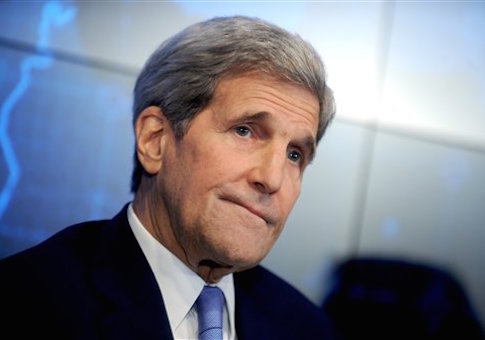
Photo by: Dennis Van Tine/STAR MAX/IPx 8/11/15 John Kerry participates at a discussion on Iran. (NYC)

Photo by: Dennis Van Tine/STAR MAX/IPx
8/11/15  John Kerry participates at a discussion on Iran.(NYC)

Two leading U.S. senators are calling on the Obama administration to release secret letters to foreign governments assuring them that they will not be legally penalized for doing business with the Iranian government, according to a copy of a letter sent Wednesday to the State Department and obtained by the Washington Free Beacon.

Sens. Mark Kirk (R., Ill.) and Marco Rubio (R., Fla.) disclosed in the letter to the State Department that U.S. lawmakers have been shown copies of several letters sent by the Obama administration to the Chinese, German, French, and British governments assuring them that companies doing business with Iran will not come under penalty.

The Obama administration is purportedly promising the foreign governments that if Iran violates the parameters of a recently inked nuclear accord, European companies will not be penalized, according to the secret letters.

Congress became aware of these promises during closed-door briefings with the Obama administration and through documents filed by the administration under a law requiring full disclosure of all information pertaining to the accord.

The issue of sanctions on Iran has become a major issue on Capitol Hill in the weeks since the Obama administration agreed to a deal that permits Iran to enter the international community in exchange for temporarily constraining its nuclear program.

Iran will receive more than $150 billion in sanctions relief as part of the deal and many of its military branches will be removed from international sanctions designations.

“The documents submitted by the Administration to Congress include non-public letters that you sent to the French, British, German, and Chinese governments on the consequences of sanctions snap-back,” Kirk and Rubio wrote to Secretary of State John Kerry.

“These letters appear to reassure these foreign governments that their companies may not be impacted if sanctions are re-imposed in response to Iranian violations of the agreement,” they claim. “While Administration officials have claimed that this is not the case, we think it is important for the American public to be able to read your assurances to foreign governments for themselves as their elected representatives review this deal in the coming weeks.”

Kirk and Rubio are demanding that the Obama administration release these letters to the public so that the full nature of the White House’s backroom dealings are made known.

“We therefore request the Administration to publicly release these letters, which are not classified, so that the full extent of the Administration’s non-public assurances to European and Chinese governments can be discussed openly by Congress and analyzed by impartial outside experts,” they write.

“Given the conflicting interpretations hinted at by the deal’s various stakeholders, it would also ease congressional review of the deal if you were to receive assurances from the other members of the P5+1 about the guidance they will provide to companies about the inherent risks of investing in Iran due to Iran’s ongoing support for terrorism and use of its financial system for illicit activities and the potential for sanctions to snap back if Iran violates the nuclear agreement,” the letter states.

As Iranian companies and government entities are removed from sanctions lists, they will be permitted to do business on the open market. A number of governments, including the Russia and Italy, have already expressed interest in partnering with Iran.

U.S. lawmakers remain concerned that if Iran violates the nuclear accord, sanctions will not be reimposed in a meaningful way.

“The conditions under which foreign investment in Iran would proceed under the nuclear agreement remain unclear,” Kirk and Rubio wrote. “On July 23, 2015, Secretary of the Treasury Jack Lew told the Senate Foreign Relations Committee that companies that have invested in Iran would ‘not be able to continue doing things that are in violation of the sanctions’ if sanctions snap back.”

“Foreign investment in Iran will involve long-term contracts in many cases, however, and some interpretations of the Iran agreement indicate these contracts might be protected from the snap-back of sanctions by a so-called ‘grandfather clause,’” they write.

Under the terms of the agreement, sanctions on Iran’s Revolutionary Guard Corps (IRGC), a paramilitary force known to commit acts of terrorism across the globe, will be lifted.

A multi-billion dollars financial empire belonging to Iranian Supreme Leader Ali Khamenei also will be removed from sanctions lists, according to the parameters of the deal.

Iran orders from China 150 J-10 fighter jets that incorporate Israeli technology

July 30, 2015

Iran orders from China 150 J-10 fighter jets that incorporate Israeli technology, DEBKAfile, July 30, 2015

J-10Chinese Chengdu J-10 for Iranian air force

The scale of Iran’s multibillion acquisitions from China and Russia – 550 warplanes in all so far – indicates that Tehran’s top spending priority upon receipt of the funds released by the removal of sanctions, is to be a spanking new air force.

**********************

Iran is about to conclude a transaction with China for the purchase of the Chengdu J-10 multirole jet fighter, known in the West as the Vigorous Dragon, according to an exclusive report from DEBKAfile’s military and intelligence sources. Beijing has agreed to sell Tehran 150 of these sophisticated jets.

While the Chinese J-10 is comparable to the US F-16, our sources report that it is virtually a replica of the Lavi, the super-fighter developed by Israel’s aerospace industry in the second half of the 80s. Israel sold China the technology, after Washington insisted on Its discontinuing the Lavi’s production. The US also objected to the sale of the Lavi’s avionics, claiming that it contained some American components.

The Chinese plane comes in two versions – the multirole single-seat J-10A and the two-seat J-10B, which serves for training, ground assaults and electronic warfare.

Iran has additionally weighing the purchase in Moscow of 250 highly-advanced Sukhoi-Su-30MK1 twinjet multirole air superiority fighters, known in the West as Flanker-H.

On Wednesday, July 29, an Indian Air Force Su-30MK1 took part for the first time in a British air maneuver, Rainbow, where it dueled with the European Typhoon fighter.

The sophisticated Flanker has been found to have a major shortcoming. To carry eight tons of ordnance, it must use both of its AL-31FP engines, and the transition from one to two – and the reverse – often causes engine failure.

The Indian Air Force has reported three such malfunctions in a month, as well another shortcoming: The time needed for making the aircraft serviceable is too long. As a result, only half of the Indian fleet can be airborne at one time.

In a confrontation, the Iranian Air Force may find that, because of these drawbacks, the Chinese Su-30MK1 is outmatched by its American and European counterparts in the service of the Israeli, Saudi and UAE air forces.

On July 22, DEBKAfile revealed that Moscow and Tehran had concluded a giant transaction for the acquisition of a fleet of 100 IL78 MK1 (Midas) in-flight refueling planes for extending the range of its warplanes up to 7,300 km and able to refuel 6-8 planes at once.

DEBKAfile: The scale of Iran’s multibillion acquisitions from China and Russia – 550 warplanes in all so far – indicates that Tehran’s top spending priority upon receipt of the funds released by the removal of sanctions, is to be a spanking new air force.

The Iran scam worsens — Part II, North Korea – China connection

June 17, 2015

The Iran scam worsens — Part II, North Korea – China connection, Dan Miller’s Blog, June 17, 2015

(The views expressed in this article are mine and do not necessarily reflect those of Warsclerotic or its other editors. — DM)

It is likely that the P5+1 nuke “deal” with Iran will be approved soon. Military and other nuke sites which Iran has not “disclosed” will not be inspected. Nor will Iran’s nuke ties with North Korea — which P5+1 member China seems to be helping, Iran’s massive support for terrorism and abysmal human rights record be considered because they are also deemed unnecessary for “deal” approval. Sanctions against Iran are moribund and will not be revived regardless of whether there is a “deal.” However, a bronze bust of Obama may soon be displayed prominently in Supreme Leader Khamenei’s office and one of Khamenei may soon be displayed proudly in Dear Leader Obama’s office.

Iran fenced in

Part II — The North Korea – China connection

The North – Korea connection is a “natural,” and its basis should be obvious: Iran has been receiving funds through sanctions relief and will get substantially more when the P5+1 “deal” is made. North Korea needs money, not to help its starving and depressed masses, but to keep the Kim regime in power and for its favorites to continue their opulent lifestyles.

As I have written here, here and elsewhere, North Korea has been making substantial progress on nuclear weapons and means to deliver them, which it shares with Iran. Now, China appears to be intimately involved in their transfers of nuclear and missile technology as well as equipment.

As noted in an April 15, 2015 article titled Obama Hid North Korea Rocket Component Transfer to Iran,

US intelligence officials revealed that during the ongoing Iran nuclear negotiations, North Korea has provided several shipments of advanced missile components to the Islamic regime in violation of UN sanctions – and the US hid the violations from the UN. [Emphasis added.]

The officials, who spoke to the Washington Free Beacon on Wednesday on condition of anonymity, said more than two shipments of missile parts since last September have been monitored by the US going from North Korea to Iran.[Emphasis added.]

One official detailed that the components included large diameter engines, which could be used to build a long-range missile system, potentially capable of bearing a nuclear warhead. [Emphasis added.]

The information is particularly damaging given that Admiral Bill Gortney, Commander of North American Aerospace Defense Command (NORAD) and US Northern Command (USNORTHCOM), admitted this month that the Pentagon fears that North Korea and possibly Iran can target the US with a nuclear EMP strike.

Critics have pointed out that the nuclear framework deal reached with Iran earlier this month completely avoids this question of Iran’s intercontinental ballistic missile (ICBM) program, which would allow it to conduct nuclear strikes. [Emphasis added.]

US President Barack Obama was given details of the shipments in his daily intelligence briefings, but the officials say the information was hidden from the UN by the White House so that it would not take action on the sanctions violations. [Emphasis added.]

On June 17th, Secretary Kerry stated, just before leaving to participate in P5+1 negotiations, that the

“US and its negotiating partners are not fixated on the issue of so-called possible military dimensions [of the Iranian nuclear program] because they already have a complete picture of Iran’s past activities.”

This comment was a compendium of contradictions and untruths.

Sure, John. A June 17th article at Power Line on the same subject is titled Kerry’s absolute idiocy.

Here are the highlights from a March 29, 2015 article at The Daily Beast titled Does Iran Have Secret Nukes in North Korea?

As can be seen from the North Korean base housing Tehran’s weapons specialists, Iran is only one part of a nuclear weapons effort spanning the Asian continent. North Korea, now the world’s proliferation superstar, is a participant. China, once the mastermind, may still be a co-conspirator. Inspections inside the borders of Iran, therefore, will not give the international community the assurance it needs. [Emphasis added.]

Inspections? We don’t need and won’t get no stinkin inspections since His Omniscience Kerry knows everything and is not troubled by it.

The cross-border nuclear trade is substantial enough to be called a “program.” Larry Niksch of the Center for Strategic and International Studies in Washington, D.C., estimates that the North’s proceeds from this trade with Iran are “between $1.5 billion and $2.0 billion annually.” A portion of this amount is related to missiles and miscellaneous items, the rest derived from building Tehran’s nuclear capabilities.

Iran has bought a lot with its money. Mohsen Fakhrizadeh, thought to be Tehran’s chief nuclear scientist, was almost certainly in North Korea at Punggye-ri in February 2013 to witness Pyongyang’s third atomic test. Reports put Iranian technicians on hand at the site for the first two detonations as well.

. . . .

The North Koreans have also sold Iran material for bomb cores, perhaps even weapons-grade uranium. The Telegraph reported that in 2002 a barrel of North Korean uranium cracked open and contaminated the tarmac of the new Tehran airport.

The relationship between the two regimes has been long-lasting. Hundreds of North Koreans have worked at about 10 nuclear and missile facilities in Iran. There were so many nuclear and missile scientists, specialists, and technicians that they took over their own coastal resort there, according to Henry Sokolski,  the proliferation maven, writing in 2003.

As noted in a January 31, 2014 Daily Beast article titled Iran and North Korea: The Nuclear ‘Axis of Resistance,’

Last September, at the same time Iran was secretly meeting with U.S. officials to set up the current nuclear talks, North Korea leaders visited Tehran and signed a science and technology agreement that is widely seen as a public sign the two countries are ramping up their nuclear cooperation.

“Iran declared Sept. 1, 2012 North Korea was part of their ‘Axis of Resistance,’ which only includes Iran, Syria, and Hezbollah. They’ve announced to the world they are essentially allies with North Korea,” said David Asher, the State Department’s coordinator for North Korea from 2001 to 2005. [Emphasis added.]

On February 13, 2013, DEBKAfile reported that North Korea —  Iran nuclear connection is substantial.

There is full awareness in Washington and Jerusalem that the North Korean nuclear test conducted Tuesday, Feb. 12, brings Iran that much closer to conducting a test of its own. A completed bomb or warhead are not necessary for an underground nuclear test; a device which an aircraft or missile can carry is enough. [Emphasis added.]

Mahmoud Ahmadinejad’s boast this week that Iran will soon place a satellite in orbit at an altitude of 36,000 kilometers – and Tehran’s claim on Feb. 4 to have sent a monkey into space – highlight Iran’s role in the division of labor Pyongyang and Tehran have achieved in years of collaboration: the former focusing on a nuclear armament and the latter on long-range missile technology to deliver it. [Emphasis added.]

Their advances are pooled. Pyongyang maintains a permanent mission of nuclear and missile scientists in Tehran, whereas Iranian experts are in regular attendance at North Korea’s nuclear and missile tests.[Emphasis added.]

Since the detonation of the “miniature atomic bomb” reported by Pyongyang Tuesday – which US President Barack Obama called “a threat to US National security”- Iran must be presumed to have acquired the same “miniature atomic bomb” capabilities – or even assisted in the detonation. [Emphasis added.]

On the same day, an article at Fox News observed,

In an exclusive interview with Fox News, Ambassador Thomas Graham, Jr, who has advised five U.S. presidents as a world renowned authority on arms control and nuclear non-proliferation, noted “If the assessments are correct as to his (Fakhrizadeh’s) role in the Iranian nuclear program, if China knowingly permitted him transfer from Iran across China to witness the North Korea test … then it would appear that China or at least some element in China are cooperating with nuclear programs in North Korea and Iran.” [Emphasis added.]

The Feb. 11 test has been described by experts as a miniaturized atomic bomb test of a relatively small yield of 6-7 kilotons, mounted on a Nodong missile.

. . . .

Ambassador Graham added: “The objective of this test has said to be the development of a compact highly explosive nuclear warhead mated with a North Korean missile. Iranian missiles were developed from North Korean prototypes. It could appear that North Korea is building nuclear weapons for transfer to Iran.” [Emphasis added.]

A June 11, 2015 Gatestone Institute article titled North Korea’s Serious New Nuclear Missile Threat, noted that North Korea already has upwards of twenty nukes and that

if North Korea’s technical advances are substantive, its missiles, armed with small nuclear weapons, might soon be able to reach the continental United States — not just Hawaii and Alaska. Further, if such missile threats were to come from submarines near the U.S., North Korea would be able to launch a surprise nuclear-armed missile attack on an American city. In this view, time is not on the side of the U.S. Submarine-launched missiles come without a “return address” to indicate what country or terrorist organization fired the missile.

The implications for American security do not stop there. As North Korea is Iran’s primary missile-development partner, whatever North Korea can do with its missiles and nuclear warheads, Iran will presumably be able to do as well. One can assume the arrangement is reciprocal.

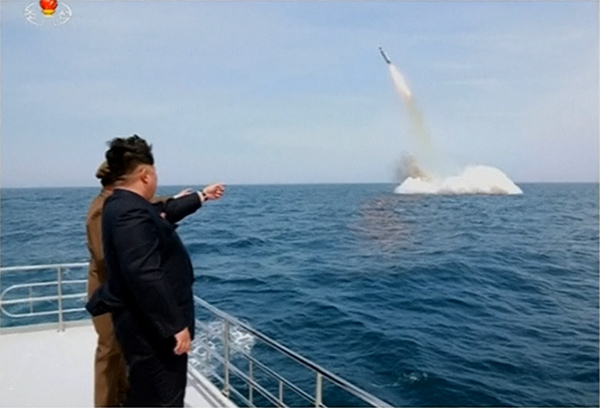
Although attempts have been made to debunk recent photoshopped images of North Korea firing of a missile from a submerged platform, the immediately linked Gatestone article offers substantial reasons to think that it was indeed fired and that it is troubling.

The linked Gatestone article continues, despite hopes that China may force or talk North Korea into halting its missile development program and sharing with Iran, such hopes are

painfully at odds with China’s established and documented track record in supporting and carrying out nuclear proliferation with such collapsed or rogue states as Iran, Syria, Pakistan, North Korea and Libya, as detailed by the 2009 book The Nuclear Express, by Tom C. Reed (former Secretary of the Air Force under President Gerald Ford and Special Assistant to the President of National Security Affairs during the Ronald Reagan administration) and Daniel Stillman (former Director of the Lawrence Livermore National Laboratory).(Emphasis added.]

Far from being a potential partner in seeking a non-nuclear Korean peninsula, China, say the authors, has been and is actually actively pushing the spread of nuclear weapons to rogue states, as a means of asserting Chinese hegemony, complicating American security policy and undermining American influence. [Emphasis added.]

The problem is not that China has little influence with North Korea, as China’s leadership repeatedly claims. The problem is that China has no interest in pushing North Korea away from its nuclear weapons path because the North Korean nuclear program serves China’s geostrategic purposes. [Emphasis added.]

As Reed and Stillman write, “China has been using North Korea as the re-transfer point for the sale of nuclear and missile technology to Iran, Syria, Pakistan, Libya and Yemen”. They explain, “Chinese and North Korean military officers were in close communication prior to North Korea’s missile tests of 1998 and 2006.″ [Emphasis added.]

Thus, if China takes action to curtail North Korea’s nuclear program, China will likely be under pressure from the United States and its allies to take similar action against Iran and vice versa. China, however, seems to want to curry favor with Iran because of its vast oil and gas supplies, as well as to use North Korea to sell and transfer nuclear technology to both North Korea and Iran, as well as other states such as Pakistan. As Reed again explains, “China has catered to the nuclear ambitions of the Iranian ayatollahs in a blatant attempt to secure an ongoing supply of oil.” [Emphasis added.]

What about Russia which, like China, is a P5+1 member? Russia announced in late May of this year that it would build an Iranian nuclear reactor for “peaceful” generation of electricity. It announced in April that it would provide accurate, long range S-300 missiles to Iran.

Iranian news sources are reporting that negotiations with Russia to buy the S-300 surface-to-air missile systems were “successful.”

Western officials say delivery of the system would essentially eliminate the military option to stop Iran from obtaining nuclear weapons.

During a press conference Monday, Iran’s Deputy Foreign Minister for Arab and African Affairs Hossein Amir-Abdollahian said that the missiles will be delivered as soon as possible.

On September 23, 2014, the Iranian FARS News Agency announced that Iran was completing its own version of the S-330 missile.

Last month, senior Iranian military officials announced that their home-grown version of the Russian S-300 missile defense system, called Bavar (Belief)-373, has already been put into test-run operation and has once shot at a target successfully.

Commander of Khatam ol-Anbia Air Defense Base Brigadier General Farzad Esmayeeli told the Iranian state-run TV that “Bavar-373 has fired a first successful shot”.

Might Russia have given Iran the plans needed to build its own version of the Russian missile? Why not?

Conclusions

We have to guess far more than we actually know about the North Korea – China – Iran nuclear connection. That is unfortunate. It is absurd that the P5+1 joint plan of action and the White House summary focus on Iran’s uranium enrichment to the exclusion of its militarization of nukes. Since nuke militarization, among other substantial matters, is deemed irrelevant to whether there is a “deal,” so is the connection with North Korea, China and possibly Russia.

Obama wants a “deal” with Iran, regardless of what it may say or — more importantly — what it may not say.

NK and Iran

North Korea’s Serious New Nuclear Missile Threat

June 11, 2015

North Korea’s Serious New Nuclear Missile Threat, The Gatestone InstitutePeter Huessy, June 11, 2015

China . . . seems to want to curry favor with Iran because of its vast oil and gas supplies, as well as to use North Korea to sell and transfer nuclear technology to both North Korea and Iran, as well as other states such as Pakistan. As Reed again explains, “China has catered to the nuclear ambitions of the Iranian ayatollahs in a blatant attempt to secure an ongoing supply of oil”.

***********************

  • China continues to transfer, through its own territory, nuclear weapons technology involving both North Korea and Iran.
  • In April, North Korea launched a ballistic missile from a submerged platform. The North Korean underwater launch test was closely related to the further development of a missile-firing submarine capable of hitting the U.S. — “a first step,” according to Uzi Rubin, “in achieving a very serious and dangerous new military capability… it will take many years to build up the missile defenses, so we had better use the time wisely.”
  • Although the Chinese profess to be against nuclear proliferation, documented evidence illustrates just the opposite — as a means of asserting Chinese hegemony, complicating American security policy and undermining American influence.
  • Unfortunately, no matter how attractive a strategy of diplomatically ending North Korea’s nuclear program might look, it is painfully at odds with China’s established record of supporting nuclear proliferation with such collapsed or rogue states as Iran, Syria, Pakistan, North Korea and Libya.
  • China’s nuclear assistance to Pakistan did not stay just in Pakistan.

North Korea appears to have made significant progress in extending its capability as a nuclear-armed rogue nation, to where its missiles may become capable of hitting American cities with little or no warning.

What new evidence makes such a threat compelling?

North Korea claims to have nuclear warheads small enough to fit on their ballistic missiles andmissiles capable of being launched from a submerged platform such as a submarine.

Shortly after North Korea’s April 22, 2015 missile test, which heightened international concern about the military capabilities of North Korea, U.S. Secretary of State John Kerry urged China and our regional allies to restart the 2003 “six-party talks” aimed at eliminating nuclear weapons from the Korean peninsula and reining in North Korea’s expanding nuclear missile program.

There are some “experts,” however, who believe that North Korea’s threat is highly exaggerated and poses no immediate danger to the United States. Consequently, many believe that, given China’s oft-repeated support for a “nuclear weapons free” Korean peninsula, time is on America’s side to get an agreement that will guarantee just such a full de-nuclearization.

But, if North Korea’s technical advances are substantive, its missiles, armed with small nuclear weapons, might soon be able to reach the continental United States — not just Hawaii and Alaska. Further, if such missile threats were to come from submarines near the U.S., North Korea would be able to launch a surprise nuclear-armed missile attack on an American city. In this view, time is not on the side of the U.S. Submarine-launched missiles come without a “return address” to indicate what country or terrorist organization fired the missile.

The implications for American security do not stop there. As North Korea is Iran’s primary missile-development partner, whatever North Korea can do with its missiles and nuclear warheads, Iran will presumably be able to do as well. One can assume the arrangement is reciprocal.

Given recent warnings that North Korea may have upwards of 20 nuclear warheads, the United States seems to be facing a critical new danger. Would renewed negotiations with China, Japan, South Korea and North Korea really be able to address this threat?

Two years ago, Andrew Tarantola and Brian Barrett said there was “no reason to panic;” that North Korea was “a long way off” — in fact “years” — before its missiles and nuclear weapons could be “put together in any meaningful way.”

At the same time, in April 2013, an official U.S. assessment by the Defense Intelligence Agency stated the U.S. had “moderate” confidence that “North Korea had indeed developed a nuclear device small enough to mount on a ballistic missile.”

That was followed up two years later, on April 7, 2015, when the commander of Northcom, Admiral Bill Gortney, one of the nation’s leading homeland security defenders, said the threat was considerably more serious. He noted that, “North Korea has deployed its new road-mobile KN-08 intercontinental ballistic missile and was capable of mounting a miniaturized nuclear warhead on it.”[1]

At a Pentagon press briefing in April, Admiral Cecil Haney, Commander of the US Strategic Command and America’s senior military expert on nuclear deterrence and missile defense, said it was important to take seriously reports that North Korea can now make small nuclear warheads and put them on their ballistic missiles.[2]

And sure enough, in April, North Korea launched a ballistic missile from a submerged platform. Media reaction to the North Korean test has been confused. Reuters, citing the analysis of two German “experts,” claimed the North Korean test was fake — a not-too-clever manipulation of video images.

The Wall Street Journal, on May 21, 2015, echoed this view, noting: “[F]or evidence of North Korea’s bending of reality to drum up fears about its military prowess,” one need look no further than a consensus that North Korea “doctored” pictures of an alleged missile test from a submarine. This, they claimed, was proof that the “technology developments” by North Korea were nothing more than elaborately faked fairy tales.

However, Israeli missile defense expert Uzi Rubin — widely known as the “father” of Israel’s successful Arrow missile defense program — explained to this author that previous North Korean missile developments, which have often been dismissed as nothing more than mocked-up missiles made of plywood, actually turned out to be the real thing — findings confirmed by subsequent intelligence assessments.

Rubin, as well as the South Korean Defense Ministry, insist that on April 22, the North Korean military did, in fact, launch a missile from a submerged platform.[3]
1104Kim Jong Un, the “Supreme Leader” of North Korea, supervises the April 22 test-launch of a missile from a submerged platform. (Image source: KCNA)

What gave the “faked” test story some prominence were the misunderstood remarks of the Vice Chairman of the Joint Chiefs of Staff, Admiral James Winnefeld. He had said, on May 19, that the North Korean missile launch was “not all” that North Korea said it was. He also mentioned that North Korea used clever video editors to “crop” the missile test-launch images. Apparently, that was exactly what the editors did. The Admiral, however, never claimed in his speech at the Center for Strategic and International Studies there had been no successful missile test.[4]

The same day, a high-ranking State Department official, Frank Rose — Assistant Secretary of State for Arms Control, Verification, and Compliance — told a Korean security seminar on Capitol Hill that North Korea had successfully conducted a “missile ejection” test, but from an underwater barge rather than a submarine.[5]

To confuse matters further, additional pictures were released by the South Korean media to illustrate stories about the North Korean test. Those pictures, however, were of American missiles, which use both solid and liquid propellant; as a result, one photo showed a U.S. missile with a solid propellant smoke trail and one, from a liquid propellant, without a smoke trail. These photographs apparently befuddled Reuters’ “experts,” who may have jumped to the conclusion that the photos of the North Korean test were “faked,” when they were simply of entirely different missile tests, and had been used only to “illustrate” ocean-going missile launches and not the actual North Korean test.[6]

According to Uzi Rubin, to achieve the capability to eject a missile from an underwater platform is a significant technological advancement. The accomplishment again illustrates “that rogue states such as North Korea can achieve military capabilities which pose a notable threat to the United States and its allies.”

Rubin also stated that the North Korean underwater launch test was closely related to the development of a missile-firing submarine, “a first step in achieving a very serious and dangerous new military capability.”[7]

Admiral Winnefeld and Secretary Rose, in their remarks, confirmed that the North Korean test was not the “dog and pony show” some have claimed. In other words, the U.S. government has officially confirmed that the North Koreans have made a serious step toward producing a sea-launched ballistic missile capability.

While such an operational capability may be “years away,” Rubin warns that “even many years eventually pass, and it will also take many years to build up the missile defenses, so we had better use the time wisely.”[8]

Will diplomacy succeed in stopping the North Korean threats? U.S. Secretary of State John Kerry seemed to think it worth a try; so he began the push to restart the old 2003 “six-party” talks between the United States, North Korea, Russia, China, South Korea and Japan, to bring North Korea’s nuclear weapons under some kind of international control and eventual elimination.

After all, supporters of such talks claim, similar talks with Iran appear to be leading to some kind of “deal” with Tehran, to corral its nuclear weapons program, so why not duplicate that effort and bring North Korea back into the non-nuclear fold?

What such a “deal,” if any, with Iran, will contain, is at this point unknown. Celebrations definitely seem premature. If the “deal” with North Korea is as “successful” as the P5+1’s efforts to rein in Iran’s illegal nuclear weapons program, the prognosis for the success of diplomacy could scarcely be more troubling.

Bloomberg’s defense writer, Tony Carpaccio, reflecting Washington’s conventional wisdom, recently wrote that of course China will rein in North Korea’s nuclear program: “What might be a bigger preventative will be the protestations of China, North Korea’s primary trade partner and only prominent international ally. Making China angry would put an already deeply impoverished, isolated North Korea in even more dire straits.”

Unfortunately, no matter how attractive a strategy of diplomatically ending North Korea’s nuclear program might look on the surface, it is painfully at odds with China’s established and documented track record in supporting and carrying out nuclear proliferation with such collapsed or rogue states as Iran, Syria, Pakistan, North Korea and Libya, as detailed by the 2009 book The Nuclear Express, by Tom C. Reed (former Secretary of the Air Force under President Gerald Ford and Special Assistant to the President of National Security Affairs during the Ronald Reagan administration) and Daniel Stillman (former Director of the Lawrence Livermore National Laboratory).

Far from being a potential partner in seeking a non-nuclear Korean peninsula, China, say the authors, has been and is actually actively pushing the spread of nuclear weapons to rogue states, as a means of asserting Chinese hegemony, complicating American security policy and undermining American influence.

The problem is not that China has little influence with North Korea, as China’s leadership repeatedly claims. The problem is that China has no interest in pushing North Korea away from its nuclear weapons path because the North Korean nuclear program serves China’s geostrategic purposes.

As Reed and Stillman write, “China has been using North Korea as the re-transfer point for the sale of nuclear and missile technology to Iran, Syria, Pakistan, Libya and Yemen”. They explain, “Chinese and North Korean military officers were in close communication prior to North Korea’s missile tests of 1998 and 2006”.

Thus, if China takes action to curtail North Korea’s nuclear program, China will likely be under pressure from the United States and its allies to take similar action against Iran and vice versa. China, however, seems to want to curry favor with Iran because of its vast oil and gas supplies, as well as to use North Korea to sell and transfer nuclear technology to both North Korea and Iran, as well as other states such as Pakistan. As Reed again explains, “China has catered to the nuclear ambitions of the Iranian ayatollahs in a blatant attempt to secure an ongoing supply of oil”.

North Korea is a partner with Iran in the missile and nuclear weapons development business, as Uzi Rubin has long documented. Thus, it is reasonable to believe that China may see any curtailment of North Korea’s nuclear program as also curtailing Iran’s access to the same nuclear technology being supplied by North Korea. Any curtailment would also harm the Chinese nuclear sales business to Iran and North Korea, especially if China continues to use the “North Korea to Iran route” as an indirect means of selling its own nuclear expertise and technology to Iran.

It is not as if Chinese nuclear proliferation is a recent development or a “one of a kind” activity. As far back as 1982, China gave nuclear warhead blueprints to Pakistan, according to Reed. These findings indicate that China’s nuclear weapons proliferation activities are over three decades old.[9]

Reed and Stillman also note that nearly a decade later, China tested a nuclear bomb “for Pakistan” on May 26, 1990, and that documents discovered in Libya when the George W. Bush administration shut down Libyan leader Muammar Kaddafi’s nuclear program revealed that China gave Pakistan the CHIC-4 nuclear weapon design.

Unfortunately, China’s nuclear assistance to Pakistan did not stay just in Pakistan. The nuclear technology made its way from Pakistan to North Korea. For example, high explosive craters, construction of a 50 megawatt nuclear reactor (finished in 1986) and a secret reprocessing facility begun in 1987 all were done in North Korea with major Pakistani help from the A.Q. Khan “Nukes R Us” smuggling group, as Reed and Stillman document in their book.

Reed and Stillman write that when, amid disclosures in 2003 of a major Libyan nuclear weapons program, the U.S. government sought help in shutting down the Khan nuclear smuggling ring, “Chinese authorities were totally unhelpful, to the point of stonewalling any investigation into Libya’s nuclear supply network.”

More recently, Chinese companies have now twice — in 2009 and 2011 — been indicted by the Attorney for the City of New York for trying to provide Iran with nuclear weapons technology.

The indictments document that Chinese companies were selling Iran steel for nuclear centrifuges and other banned technology. A leaked State Department cable, discussing the indictments at the time, revealed “details on China’s role as a supplier of materials for Iran’s nuclear program,” and that “China helped North Korea ship goods to Iran through Chinese airports.”

And more recently, in April 2015, the Czech government interdicted additional nuclear technology destined for Iran — the origin of which remains unknown — in violation of current sanctions against Iran.

From 1982 through at least the first part of 2015, the accumulation of documentary evidence on nuclear proliferation reveals two key facts:

First, despite literally hundreds of denials by Iran that it is seeking nuclear weapons, and amid current negotiations to end Iran’s pursuit of nuclear weapons, there is solid evidence that Iran still seeks nuclear weapons technology; and that North Korea has nuclear weapons and is advancing their capability.

Second, China continues to transfer, through its own territory, nuclear weapons technology involving both North Korea and Iran.

Although the Chinese profess to be against nuclear proliferation, their track record from the documented evidence illustrates just the opposite.

In summary, it is obvious North Korea’s nuclear weapons and ballistic missiles are a serious threat to America and its allies. And China, from its proliferation record for the past three decades, is making such a threat more widespread.

In this light, is dismissing North Korea’s advances in military technology and ignoring China’s record of advancing its neighbors’ nuclear weapons technology really best for U.S. interests?

_______________________

[1] The Washington Post, May 20, 2015, Anna Fifield, “North Korea says it has technology to make mini-nuclear weapons“; and Admiral Bill Gortney, US NORAD Commander, quoted in “NORAD commander: North Korean KN-08 Missile Operational“, by Jon Harper, in “Stars and Stripes”, of April 7, 2015; the Admiral said: “Our assessment is that they have the ability to put a nuclear weapon on a KN-08 and shoot it at the homeland.” He said “Yes sir” when asked if the U.S. thinks North Korea has succeeded in the complicated task of miniaturizing a warhead for use on such a missile. North Korea has conducted three nuclear tests since 2006.

[2] Department of Defense Press Briefing by Admiral Cecil Haney, Commander, U.S. Strategic Command, March 24, 2015.

[3] Personal communication with Uzi Rubin, President of Rubincon, May 21, 2015.

[4] Admiral James Winnefeld, Remarks at the Center for Strategic and International Studies (CSIS) Briefing on Missile Defense, May 20, 2015.

[5] U.S. Department of State, Daily Digest Bulletin, Frank Rose, Remarks on “Missile Defense and the U.S. Response to the North Korean Ballistic Missile and WMD Threat”, May 20, 2015.

[6] Explanation provided by Israel missile expert Uzi Rubin, personal communication, May 20, 2015.

[7] Ibid.

[8] Ibid.

[9] According to Reed and Stillman, in “The Nuclear Express,” none of China’s nuclear help to Pakistan and Iran could have been possible without China’s transfer of the nuclear technology through Chinese airspace.
Six powers agree on UN sanctions ‘snapback’ in push for Iran deal, sources say

May 31, 2015

Six powers agree on UN sanctions ‘snapback’ in push for Iran deal, sources say, Jerusalem Post, May 31, 2015

(Obviously, the tentative “deal” raises more questions than it answers, including its “non-binding” nature and whether Russia, China and even Iran would have vetoes.– DM)

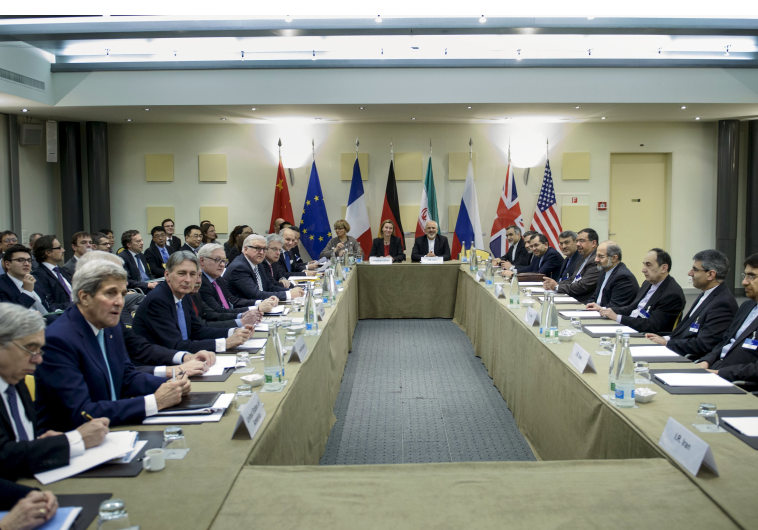
P5+1 meetingOfficials wait for a meeting with officials from P5+1, the European Union and Iran at the Beau Rivage Palace Hotel in Lausanne March 31, 2015.. (photo credit:REUTERS)

As part of the new agreement on sanctions snapback, suspected breaches by Iran would be taken up by a dispute-resolution panel, likely including the six powers and Iran, which would assess the allegations and come up with a non-binding opinion, the officials said.

As part of the new agreement on sanctions snapback, suspected breaches by Iran would be taken up by a dispute-resolution panel, likely including the six powers and Iran, which would assess the allegations and come up with a non-binding opinion, the officials said.

It was unclear exactly how the snapback mechanism would function, and the officials did not discuss the precise details. It was also unclear how the proposal would protect the United States and other permanent Council members from a possible Chinese or Russian veto on sanctions restoration.

**********************

New York, Paris, Ankara – Six world powers have agreed on a way to restore UN sanctions on Iran if the country breaks the terms of a future nuclear deal, clearing a major obstacle to an accord ahead of a June 30 deadline, Western officials told Reuters.

The new understanding on a UN sanctions “snapback” among the six powers – the United States, Britain, France, Germany, Russia and China – brings them closer to a possible deal with Iran, though other hurdles remain, including ensuring United Nations access to Iranian military sites.

The six powers and Iran struck an interim agreement on April 2 ahead of a possible final deal that would aim to block an Iranian path to a nuclear bomb in exchange for lifting sanctions. But the timing of sanctions relief, access and verification of compliance and a mechanism for restoring sanctions if Iran broke its commitments were among the most difficult topics left for further negotiations.

US and European negotiators want any easing of UN sanctions to be automatically reversible if Tehran violates a deal. Russia and China traditionally reject such automatic measures as undermining their veto power as permanent members of the UN Security Council.

As part of the new agreement on sanctions snapback, suspected breaches by Iran would be taken up by a dispute-resolution panel, likely including the six powers and Iran, which would assess the allegations and come up with a non-binding opinion, the officials said.

The International Atomic Energy Agency (IAEA) would also continue regularly reporting on Iran’s nuclear program, which would provide the six powers and the Security Council with information on Tehran’s activities to enable them to assess compliance.

If Iran was found to be in non-compliance with the terms of the deal, then UN sanctions would be restored.

The officials did not say precisely how sanctions would be restored but Western powers have been adamant that it should take place without a Security Council vote, based on provisions to be included in a new UN Security Council resolution to be adopted after a deal is struck.

“We pretty much have a solid agreement between the six on the snapback mechanism, Russians and Chinese included,” a Western official said. “But now the Iranians need to agree.”

Another senior Western official echoed his remarks, describing the agreement as “tentative” because it would depend on Iranian acceptance.

A senior Iranian diplomat said Iran was now reviewing several options for the possible “snapback” of Security Council sanctions against Tehran.

It was unclear exactly how the snapback mechanism would function, and the officials did not discuss the precise details. It was also unclear how the proposal would protect the United States and other permanent Council members from a possible Chinese or Russian veto on sanctions restoration.

US Ambassador to the United Nations Samantha Power has made it clear that Washington does not want Russia’s and China’s recent slew of vetoes on resolutions related to Syria to be repeated with an Iran nuclear agreement.

France’s Ambassador to the United States Gerard Araud said in Washington last week that, under a French idea, sanctions would be reinstated automatically in the event of non-compliance, avoiding the threat of a veto.

Under that idea, which Araud said had not to date been approved by the six powers, the onus would be on Russia or China to propose a Security Council vote not to re-impose sanctions.

Russian and Chinese officials did not respond immediately to requests for confirmation that they signed off on the snapback mechanism.

REVIEWING THE OPTIONS

US Secretary of State John Kerry met with Iranian Foreign Minister Mohammad Javad Zarif in Geneva on Saturday. They discussed progress and obstacles to an agreement in the Iran nuclear talks a month before the deadline for a deal aimed at reducing the risk of another war in the Middle East.

Restoring US and EU sanctions is less difficult than UN sanctions because there is no need for UN Security Council involvement.

For their part, Moscow, Beijing and Tehran have wanted assurances that Washington cannot unilaterally force a sanctions snapback – a risk they see rising if a Republican wins the US presidency in 2016.

A senior Iranian diplomat confirmed that discussions of specific snapback options were underway. He told Reuters Tehran was preparing its own “snapback” in the event the Western powers fail to live up to their commitments under the agreement.

“At least three or four different suggestions have been put on the table, which are being reviewed,” he said. “Iran also can immediately resume its activities if the other parties involved do not fulfill their obligations under the deal.”

He added that it was “a very sensitive issue.”

If Iran accepts the proposed snapback mechanism, there are other hurdles that must be overcome, including IAEA access to Iranian military sites and nuclear scientists and the pace of sanctions relief.

Iran says its nuclear program is entirely peaceful and rejects allegations from Western countries and their allies that it wants the capability to produce atomic weapons. It says all sanctions are illegal and works hard to circumvent them.

Trading Our Security for Politics and Cash

May 12, 2015

Pentagon Report: China Deploys MIRV Missile
By Hans M. Kristensen Posted on May 11, 2015


(Did campaign contributions influence Clinton’s policy toward China years ago? Given their behavior today, I’d say yes. Now virtually all of the western world is in danger of a nuclear strike from China.  Before the Clintons, China couldn’t even put a satellite in orbit.  Now they’ve got MIRV’s and this constitutes a very serious threat.  Thanks a lot Bill and Hillary Clinton. – LS)

For a little background to this dire situation, check out this article published back in 1998:
Red Face Over China

The biggest surprise in the Pentagon’s latest annual report on Chinese military power is the claim that China’s ICBM force now includes the “multiple independently-targetable re-entry vehicle (MIRV)-equipped Mod 3 (DF-5).”

This is (to my knowledge) the first time the US Intelligence Community has made a public claim that China has fielded a MIRVed missile system.

If so, China joins the club of four other nuclear-armed states that have deployed MIRV for decades: Britain, France, Russia and the United States.

For China to join the MIRV club strains China’s claim of having a minimum nuclear deterrent. It is another worrisome sign that China – like the other nuclear-armed states – are trapped in a dynamic technological nuclear arms competition.

A Little Chinese MIRV History

There have been rumors for many years that China was working on MIRV technology. Some private analysts have even claimed – incorrectly – that China had developed MIRV for the DF-31 ICBM and JL-2 SLBM.

Fifteen years ago, CIA’s National Intelligence Estimate on foreign missile developments concluded that “China has had the technical capability to develop multiple RV payloads for 20 years. If China needed a multiple-RV (MRV) capability in the near term, Beijing could use a DF-31-type RV to develop and deploy a simple MRV or multiple independently targetable reentry vehicle (MIRV) for the CSS-4 in a few years.” (For a review of earlier information and assessments, see here.)

The Pentagon echoed this conclusion in July 2002, when it stated that any Chinese multiple warhead capability will “most likely [be] for the CSS-4.”

Chinese MIRVing of a mobile ICBM such as the DF-31 “would be many years off” the CIA told Congress. This was also the conclusion of the CIA’s National Intelligence Estimate in 2001, which concluded that “Chinese pursuit of a multiple RV capability for its mobile ICBMs and SLBMs would encounter significant technical hurdles and would be costly.”

In an exchange with Senator Cochran in 2002, CIA’s Robert Walpole explained that MIRVing a mobile ICBM would require a much smaller warhead and possibly require nuclear testing:

Sen. Cochran. How many missiles will China be able to place multiple reentry vehicles on?

Mr. Walpole. In the near term, it would be about 20 CSS-4s that they have, the big, large ICBMs. The mobile ICBMs are smaller and it would require a very small warhead for them to put multiple RVs on them.

Sen. Cochran. … [D]o you think that China will attempt to develop a multiple warhead capability for its new missiles?

Mr. Walpole. Over time they may look at that. That would probably require nuclear testing to get something that small, but I do not think it is something that you would see them focused on for the near term.

What makes the Pentagon’s report on the MIRVed DF-5A payload noteworthy is that it was not included in several other intelligence assessments published in the past few months: the prepared threat assessment by the Director of National Intelligence; the prepared threat assessment by the Defense Intelligence Agency; and STRATCOM’s prepared testimony.

Nor were a MIRVed DF-5A mentioned in the Pentagon’s report from 2014 or the Air Force National Air and Space Intelligence Center (NASIC) report from July 2013.

The Pentagon report also repeats an earlier assertion that “China also is developing a new road-mobile ICBM, the CSS-X-20 (DF-41), possibly capable of carrying MIRVs.” STRATCOM commander Admiral Cecil Haney also mentioned this, saying China is “developing a follow-on mobile system capable of carrying multiple warheads.”

“Possibly capable of” and “capable of” are not equal assessments; the first includes uncertainty, the second does not. Assuming CIA’s prediction from 15 years ago is correct, the DF-5 MIRV payload might consist of three warheads developed for the DF-31/31A.

Whatever the certainty, the MIRVed version of the DF-5 – which I guess we could call DF-5B – is not thought to be loaded with warheads under normal circumstances. In a crisis, the warheads would first have to be brought out of storage and mated with the missile.

Moreover, The Pentagon lists two versions of the DF-5 deployed: the DF-5A (CSS-4 Mod 2) and the new DF-5 MIRV (CSS-4 Mod 3). So only a portion of the 20 missiles in as many silos apparently have been equipped for MIRV.

Why Chinese MIRV?

The big question is why the Chinese leadership has decided to deploy MIRV on the silo-based, liquid-fuel DF-5A.

Chinese officials have for many years warned, and US officials have predicted, that advanced US non-nuclear capabilities such as missile defense systems could cause China to deploy MIRV on some of its missiles. The Pentagon report repeats this analysis by stating that China’s “new generation of mobile missiles, with warheads consisting of MIRVs and penetration aids, are intended to ensure the viability of China’s strategic deterrent in the face of continued advances in U.S. and, to a lesser extent, Russian strategic ISR, precision strike, and missile defense capabilities.”

Conclusions

Chinese MIRV on the DF-5 ICBM is a bad day for nuclear constraint.

Seen in the context of China’s other ongoing nuclear modernization programs – deployment of several types of mobile ICBMs and a new class of sea-launched ballistic missile submarines – the deployment of a MIRVed version of the DF-5 ICBM reported by the Pentagon’s annual report strains the credibility of China’s official assurance that it only wants a minimum nuclear deterrent and is not part of a nuclear arms race.

MIRV on Chinese ICBMs changes the calculus that other nuclear-armed states will make about China’s nuclear intensions and capacity. Essentially, MIRV allows a much more rapid increase of a nuclear arsenal than single-warhead missile. If China also develops MIRV for a mobile ICBM, then it would further deepen that problem.

To its credit, the Chinese nuclear arsenal is still much smaller than that of Russia and the United States. So this is not about a massive Chinese nuclear buildup. Yet the development underscores that a technological nuclear competition among the nuclear-armed states is in full swing – one that China also contributes to.

Although it is still unclear what has officially motivated China to deploy a MIRVed version of the DF-5 ICBM now, previous Chinese statements and US intelligence assessments indicate that it may be a reaction to the US development and deployment of missile defense systems that can threaten China’s ability to retaliate with nuclear weapons.

If so, how ironic that the US missile defense system – intended to reduce the threat to the United States – instead would seem to have increased the threat by triggering development of MIRV on Chinese ballistic missiles that could destroy more US cities in a potential war.

The deployment of a MIRVed DF-5 also raises serious questions about China’s strategic relationship with India. The Pentagon report states that in addition to US missile defense capabilities, “India’s nuclear force is an additional driver behind China’s nuclear force modernization.” There is little doubt that Chinese MIRV has the potential to nudge India into the MIRV club as well.

Indian weapons designers have already hinted that India may be working on its own MIRV system and the US Defense Intelligence Agency recently stated that “India will continue developing an ICBM, the Agni-VI, which will reportedly carry multiple warheads.”

If Chinese MIRV triggers Indian MIRV it would deepen nuclear competition between the two Asian nuclear powers and reduce security for both. This calls for both countries to show constraint but it also requires the other MIRVed nuclear-armed states (Britain, France, Russia and the United States) to limit their MIRV and offensive nuclear warfighting strategies.


The World Bows to Iranian Regional Hegemony

March 4, 2015

The World Bows to Iranian Regional Hegemony, Asia Times Online via Middle East Forum, David P. Goldman, March 4, 2015. Originally published under the title, “World Bows to Iran’s Hegemony.”

1025The looming nuclear agreement is a dark cloud for countries within range of Iranian ballistic missiles.

The powers of the world hope to delay, but not deter, Iran’s eventual acquisition of nuclear weapons.

The US has tacitly accepted the guiding role of Iranian commanders in Iraq’s military operations against ISIS.

Washington destroyed the balance of power that defined the region’s politics when it pushed through majority rule in Iraq.

****************

The problem with Israeli Prime Minister Benyamin Netanyahu’s address to Congress March 3 was not the risk of offending Washington, but rather Washington’s receding relevance. President Barack Obama is not the only leader who wants to acknowledge what is already a fact in the ground, namely that “Iran has become the preeminent strategic player in West Asia to the increasing disadvantage of the US and its regional allies,” as a former Indian ambassador to Oman wrote this week.

For differing reasons, the powers of the world have elected to legitimize Iran’s dominant position, hoping to delay but not deter its eventual acquisition of nuclear weapons. Except for Israel and the Sunni Arab states, the world has no desire to confront Iran. Short of an American military strike, which is unthinkable for this administration, there may be little that Washington can do to influence the course of events. Its influence has fallen catastrophically in consequence of a chain of policy.

The best that Prime Minister Netanyahu can hope for is that the US Congress will in some way disrupt the Administration’s efforts to strike a deal with Iran by provoking the Iranians. That is what the White House fears, and that explains its rage over Netanyahu’s appearance.

Tehran may overplay its hand, but I do not think it will. The Persians are not the Palestinians, who discovered that they were a people only a generation ago and never miss an opportunity to miss and opportunity; they are ancient and crafty, and know an opportunity when it presents itself.

Most of the world wants a deal, because the alternative would be war. For 10 years I have argued that war is inevitable whatever the diplomats do, and that the question is not if, but how and when. President Obama is not British prime minister Neville Chamberlain selling out to Hitler at Munich in 1938: rather, he is Lord Halifax, that is, Halifax if he had been prime minister in 1938. Unlike the unfortunate Chamberlain, who hoped to buy time for Britain to build warplanes, Halifax liked Hitler, as Obama and his camarilla admire Iran.

China is Chamberlain, hoping to placate Iran in order to buy time. China’s dependence on Middle East oil will increase during the next decade no matter what else China might do, and a war in the Persian Gulf would ruin it.

Until early 2014, China believed that the United States would guarantee the security of the Persian Gulf. After the rise of Islamic State (ISIS), it concluded that the United States no longer cared, or perhaps intended to destabilize the region for nefarious reasons. But China does not have means to replace America’s presence in the Persian Gulf. Like Chamberlain at Munich, it seeks delay.

Obama, to be sure, portrays his policy in the language of balance of power. He told the New Yorker’s David Remnick in 2014,

It would be profoundly in the interest of citizens throughout the region if Sunnis and Shias weren’t intent on killing each other. And although it would not solve the entire problem, if we were able to get Iran to operate in a responsible fashion – not funding terrorist organizations, not trying to stir up sectarian discontent in other countries, and not developing a nuclear weapon – you could see an equilibrium developing between Sunni, or predominantly Sunni, Gulf states and Iran in which there’s competition, perhaps suspicion, but not an active or proxy warfare.

That, as the old joke goes, is the demo version.

On the ground, the US has tacitly accepted the guiding role of Iranian commanders in Iraq’s military operations against ISIS. It is courting the Iran-backed Houthi rebels who just overthrow a Saudi-backed regime in Yemen. It looks the other way while its heavy arms shipments to the Lebanese army are diverted to Hezbollah.

At almost every point at which Iran has tried to assert hegemony over its neighbors, Washington has acquiesced. “In the end, peace can be achieved only by hegemony or by balance of power,” wrote Henry Kissinger. The major powers hope for peace through Iranian hegemony, although they differ in their estimate of how long this will last.

Apart from its nuclear ambitions, the broader deal envisioned by Washington would leave Iran as a de facto suzerain in Iraq. It would also make Iran the dominant power in Lebanon (via Hezbollah), Syria (via its client regime) and Yemen (through its Houthi proxies). Although Sunni Muslims outnumber Shi’ites by 6:1, Sunni populations are concentrated in North Africa, Turkey and South Asia. Iran hopes to dominate the Levant and Mesopotamia, encircling Saudi Arabia and threatening Azerbaijan.

It is grotesque for America to talk of balance of power in the Persian Gulf, because America destroyed the balance of power that defined the region’s politics from the end of the First World War until 2006, when Washington pushed through majority rule in Iraq.

The imperialist powers in their wisdom established a power balance on two levels. First, they created a Sunni-dominated state in Iraq opposite Shi’ite Iran. The two powers fought each other to a standstill during the 1980s with the covert encouragement of the Reagan administration. Nearly a million soldiers died without troubling the world around them.

Second, the Sykes-Picot agreement of 1916 created two states, Syria and Iraq, in which minorities ruled majorities – the Alawite minority in Syria, and the Sunni minority in Iraq. Tyranny of a minority may be brutal, but a minority cannot exterminate a majority.

America’s first great blunder was to force majority rule upon Iraq. As Lt General (ret.) Daniel Bolger explained in a 2014 book,

The stark facts on the ground still sat there, oozing pus and bile. With Saddam gone, any voting would install a Shiite majority. The Sunni wouldn’t run Iraq again. That, at the bottom, caused the insurgency. Absent the genocide of Sunni Arabs, it would keep it going.

Under majority Shi’ite rule, Iraq inevitably became Iran’s ally. Iranian Revolutionary Guards are now leading its campaign against the Sunni resistance, presently dominated by ISIS, and Iranian officers are leading Iraqi army regulars.

This was the work of the George W Bush administration, not Obama. In its ideological fervor for Arab democracy, the Republicans opened the door for Iran to dominate the region. Condoleezza Rice, then Bush’s National Security Advisor, proposed offering an olive branch to Iran as early as 2003. After the Republicans got trounced in the 2006 Congressional elections, defense secretary Donald Rumsfeld got a pink slip, vice president Dick Cheney got benched, and “realist” Robert Gates – the co-chairman of the 2004 Council on Foreign Relations task force that advocated a deal with Iran – took over at Defense.

China and Russia

In the past, China has sought to strike a balance between Saudi Arabia and Iran with weapons sales, among other means. One Chinese analyst observes that although China’s weapons deliveries to Iran are larger in absolute terms than its sales to Saudi Arabia, it has given the Saudis its best medium-range missiles, which constitute a “formidable deterrent” against Iran.

1026A Chinese warship arrives in Bandar Abbas, Iran in September 2014.

As China sees the matter, its overall dependency on imported oil is rising, and the proportion of that oil coming from Iran and its perceived allies is rising. Saudi Arabia may be China’s biggest provider, but Iraq and Oman account for lion’s share of the recent increase in oil imports. China doesn’t want to rock the boat with either prospective adversary.

Among the world’s powers, China is the supreme rationalist: it views the world in terms of cold self-interest and tends to assume that others also view the world this way. One of China’s most respected military strategists told me bluntly that the notion of a nuclear exchange between Israel and Iran (and by implication any regional nuclear power and Iran) was absurd: the Iranians, he argued, know that a nuclear-armed Israel could destroy them in retaliation.

Other Chinese analysts are less convinced and view Iran’s prospective acquisition of nuclear weapons with trepidation. It is not only war with Israel but with Saudi Arabia that concerns the oil-importing Chinese. For the time being, Beijing has decided to accommodate Iran. In a March 2 commentary, Xinhua explicitly rejected Israeli objections:

The US Congress will soon have a guest, Israeli Prime Minster Benjamin Netanyahu, who is expected to try to convince lawmakers that a deal with Iran on its nuclear program could threaten the very existence of the Jewish state.

Despite the upcoming pressure, policymakers in Washington should have a clear mind of the potential dangers of back-pedaling on the current promising efforts for a comprehensive deal on the Iranian nuclear issue before a March 31 deadline …

With a new round of talks in Switzerland pending, it is widely expected that the P5+1 [the five permanent members of the UN Security Council plus Germany] could succeed in reaching a deal with Iran to prevent the latter from developing a nuclear bomb, in exchange for easing sanctions on Tehran.

The momentum does not come easy and could hardly withstand any disturbances such as a surprise announcement by Washington to slap further sanctions on Tehran.

The Obama administration needs no outside reminder to know that any measures at this stage to “overwhelm” Iran will definitely cause havoc to the positive atmosphere that came after years of frustration over the issue.

While it is impossible for Washington to insulate itself from the powerful pro-Israel lobbyist this time, the US policymakers should heed that by deviating from the ongoing endeavor on Iran they may squander a hard-earned opportunity by the international community to move closer to a solution to the Iran nuclear issue, for several years to come if not forever.

Russia has taken Iran’s side explicitly, for several reasons.

First, Russia has stated bluntly that it would help Iran in retaliation for Western policy in Ukraine, as I wrote in this space January 28. Second, Russia’s own Muslim problem is Sunni rather than Shi’ite. It has reason to fear the influence of ISIS among its own Muslims. If Iran fights ISIS, it serves Russian interests. Russia, to be sure, does not like the idea of a nuclear power on its southern border, but its priorities place it squarely in Iran’s camp.

Demographic Time Bomb

The Israeli prime minister asserted that the alternative to a bad deal is not war, but a better deal. I do not think he believes that, but Americans cannot wrap their minds around the notion that West Asia will remain at war indefinitely, especially because the war arises from their own stupidity.

Balance of power in the Middle East is inherently impossible today for the same reason it failed in Europe in 1914, namely a grand demographic disequilibrium: Iran is on a course to demographic disaster, and must assert its hegemony while it still has time.

Game theorists might argue that Iran has a rational self-interest to trade its nuclear ambitions for the removal of sanctions. The solution to a multi-period game – one that takes into account Iran’s worsening demographic weakness – would have a solution in which Iran takes great risks to acquire nuclear weapons.

Between 30% and 40% of Iranians will be older than 60 by mid-century (using the UN Population Prospect’s Constant Fertility and “Low” Variants). Meanwhile, its military-age population will fall by a third to a half.

Belated efforts to promote fertility are unlikely to make a difference. The causes of Iranian infertility are baked into the cake – higher levels of female literacy, an officially-sanctioned culture of sexual license administered by the Shi’ite clergy as “temporary marriage,” epidemic levels of sexually-transmitted disease and inbreeding. Iran, in short, has an apocalyptic regime with a lot to be apocalyptic about.

Henry Kissinger is right: peace can be founded on either hegemony or balance of power. Iran cannot be a hegemon for long because it will implode economically and demographically within a generation. In the absence of either, the result is war. For the past 10 years I have argued in this space that when war is inevitable, preemption is the least damaging course of action. I had hoped that George W Bush would have the gumption to de-fang Iran, and was disappointed when he came under the influence of Condoleezza Rice and Robert Gates. Now we are back in 1938, but with Lord Halifax rather than Neville Chamberlain in charge.