BREAKING : Nigel Farage Comments on Berlin Terror Attack & Russan Ambassador Killed in Ankara, TNTV Total News T.V via YouTube
(And more, including the future of BREXIT and relations with America. –DM)
BREAKING : Nigel Farage Comments on Berlin Terror Attack & Russan Ambassador Killed in Ankara, TNTV Total News T.V via YouTube
(And more, including the future of BREXIT and relations with America. –DM)
Nigel Farage says the EU is a threat to NATO nations, RobinHoodUKIP via YouTube, December 14, 2016
Nigel Farage reacts to the death of Fidel Castro, Fox News via YouTube, November 26, 2016
(And other stuff, such as BREXIT, Trump appointees, election recounts, etc. — DM)
FARAGE: I Am Prepared to Help Britain Work with President Trump, Breitbart, Nigel Farage, MEP, November 22, 2016
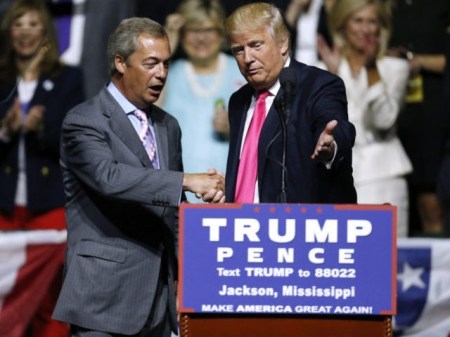
When historians look back at 2016, it will stand out as the year that changed everything.
The joyous Brexit result was the first brick knocked out of the establishment wall. What followed with the victory of Donald J. Trump has still not sunk in with the very establishment that he beat.
But the world has changed. And people need to face up to this.
For my own part I can scarcely believe what has happened. Twenty-five years of grind and constant disappointment has, after all, been worth it.
In some ways backing the Trump campaign was even harder than battling for Brexit. I received almost total condemnation including from many senior figures in my own party.
My belief that it was the right thing to do went as far as putting on a pretty big bet, at least by my standards.
It was a great surprise and pleasure when the President-elect made time to meet me. I was with Arron Banks and some close friends including Breitbart’s own Raheem Kassam.
We found a thoughtful, reflective Trump who was already working on ideas to make the lives of ordinary Americans better.
His energy and indomitable spirit are beyond doubt and I do believe he has all of the qualities needed to be a great President.
Nothing could have prepared me though for what came next. Like a bolt from the blue Trump tweeted out that I would do a great job as the UK’s Ambassador to Washington.
I can still scarcely believe that he did that though speaking to a couple of his long time friends perhaps I am a little less surprised.
They all say the same thing: that Trump is a very loyal man and supports those that stand by him.
It is called trust and it is how the whole world of business operates. Sadly, the cesspit that is career politics understands nothing of this. In their world the concept of trust is transitory.
The political revolution of 2016 now sees a new order in charge of Washington. In the United Kingdom the people have spoken but the players at the top have, I am afraid, stayed the same.
Those who supported Remain now hold senior positions. Worst still, those who were openly abusive about Trump now pretend to be his friend.
It is career politics at its worst and it is now getting in the way of the national interest.
I have said since the now famous photograph with Donald Trump ten days ago that I would do anything to help our national interest and to help cement ties with the incoming Anglophile administration.
At every stage I am greeted by negative comments coming out of Downing Street. The dislike of me, UKIP, and the referendum result is more important to them than what could be good for our country.
I have known several of the Trump team for years and I am in a good position with the President-elect’s support to help. The world has changed and its time that Downing Street did too.
Nigel Farage on The Year of Political Revolution, Front Page Magazine, November 18,2016
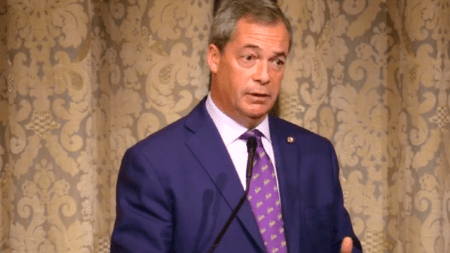
Below are the video and transcript of Nigel Farage’s address at the David Horowitz Freedom Center’s 2016 Restoration Weekend. The event was held November 10th-13th in Palm Beach, FL.
Nigel Farage from DHFC on Vimeo.
Nigel Farage: Wow, wow, well, thank you very much indeed, and thank you to David and the Freedom Center, and thank you for that wonderful warm introduction. You know, often there are decades in which very little happens. And occasionally there’s a year in which decades happen, and I think when our grandchildren, great–grandchildren look back at the history of this period of time, 2016 will be the year of political revolution; the year that changed everything.
Now, I never had any doubt after Brexit that what we managed to achieve was possible here in the United States of America, and the parallels, the crossover between the debates and the arguments and the type of people that were motivated to vote for Brexit and vote for Trump are really very interesting. But, what I’m really enjoying, what I’m really enjoying even more than the independence of my own nation, even more than President–Elect Trump, what I’m really enjoying are the faces of the media on CNN.
It is as if they’re in mourning, isn’t it? They simply can’t face up to the idea that there are people out there that don’t share their own very narrow metropolitan view, and I’m enjoying that enormously. My goodness me, they’re right to be worried because this revolution that has taken place in Britain and now on a much bigger scale here in the United States of America is, I hope and believe, gonna roll out over the course of the next couple of years across the entire Western world. We are going to get our democracy back.
Now, I got involved in this — I was actually in business. I had a proper job before politics. How about that? It seems pretty amazing, doesn’t it? You know, certainly Westminster is full of a group of college kids who go straight into the Houses of Parliament in their early 20s who have never had a job in their lives, who don’t really believe in very much, and they are professional career politicians. What they worry about is getting reelected. What they worry about is playing safe, and because of that, and because of the direction of the media, we have suffered now from decades of political correctness where no one dares stand up and speak their mind. They’re frightened of being criticized.
Actually, when we use the term political correctness, we aren’t really being accurate. What it really represents is a crackdown on our democratic rights and liberties, a crackdown on freedom of speech. That is what has been going on. And I know exactly what Donald Trump has gone through over the last few months. In fact, I think that Trump and myself are the most reviled people by the media across the entire West, but you know what, I’m happy to be judged by my enemies. I have no problem with that. But my journey on this was as a businessman who had never been actively involved in politics, although I was a massive supporter of Thatcher and Reagan back in the 1980s, and I thought they gave hope and wealth to tens and tens of millions of people.
But, I got involved in politics because I simply could not believe that my country, my ancient country, who had done more than anyone to develop the concept of parliamentary democracy had been happy for a career political class hand–in–glove with big multinational businesses and banks to progressively piece by piece give away our ability to make our own laws, to run our own country, and, crucially, to control our own borders. And, I thought, well the hell with this, I’m gonna stand and fight. And it was a very long fight. In fact, it took me nearly 25 years to win this battle. But, for the last 10 or 15 of them, the reason that I suffered personally at the hands of these people is because I dared to touch on a subject that through political correctness, through the crackdown on freedom of speech, had effectively become banned in the United Kingdom. You were not allowed in British politics to even discuss immigration. It had been banned. And despite the fact that we signed up to complete open borders with nearly half-a-billion people within the European Union, despite the fact we’ve had a growth of international jihadi terrorism, no, we weren’t allowed to even discuss the issue. So, I did talk about immigration, and I did take the brickbats for years, and I’m pleased to say that, actually, the main reason we got Brexit is because ordinary people had simply had enough of open door mass immigration driving down their wages, stopping them getting access to public services, and seeing social change within their communities the likes of which they’d never experienced before.
You know, it’s not just about controlling our borders and numbers and economics. There is an issue of culture here. There is a big issue of culture. You know, I come from a country that is a Christian country within its very constitution, and I believe that you can stand up and defend Christian values and Christian culture without giving offense to any other religious minority, but it’s time we had leaders that recognize that. And I think in the same way in this campaign here in America, Trump dared to talk about issues that everybody had brushed under the carpet that everybody else found too difficult. What kind of message does it send to people in this country if illegal immigrants that come into America from Mexico are given pardons after a few years? What message does that send to Mexicans who have actually gone through the process and done it legally and done it properly? And I have to say I admire Trump. I admire him for having the courage to put immigration at the front and center of this campaign. Well done him.
But something even worse than that had happened to our political classes. It’s what I call in Britain the “victory of social democracy.” It was parties that had been on the left and parties that had been on the right who decided to merge together in the middle where, frankly, you couldn’t put a cigarette paper between the manifestos of these parties at successive general elections. It was part of this process of professionalizing politics. It was part of the not wishing to cause offense. It was part of not wishing to take any risks and certainly, as far as the British political system had become, we were run by a group of people who all went to the same handful of schools, who all went to the same university, who all studied the same degree, who all went straight into politics and who all married each other’s sisters. That is what had happened to British politics.
And nobody was daring to say anything, but at the same time, look, it happened here, didn’t it? I mean, come on, look at the last presidential election. What were the big ideological fault lines that existed between Obama and Mitt Romney? I couldn’t spot them. I genuinely couldn’t spot them. It didn’t actually make a fundamental difference whether you had Obama or Romney. Yeah, sure, there are issues of policy, but there weren’t fundamental issues of principle. And all this was happening whilst our leaders in Britain, but yours, too, in America, were happy to give away increasingly your powers to make your own decisions, whether it’s signing up to the Paris Deal, whether it’s Hillary Clinton’s vision, which I’m pleased we got from that secret Wall Street tape recording where she saw the European Union as a prototype for a bigger form of world government; where you in America increasingly would have had your laws made somewhere else. This fight back matters, and I tell you above all what the history books will say is that 2016 was the year that nation state democracy and people being proud of their own identity came back onto the agenda.
And I was sneered at, condescended to for daring to say that I was proud to be British, for daring to say that I believed in our nation. It was as if I’d said something dreadful. Well, just to prove the point … [Laughter.] And, again, Trump’s big slogan “Make America Great Again.” You’re in no doubt, are you, when that guy speaks that he believes in this country, he believes in its people, and he believes in your ability to take things forward. So that’s good. And I also think what we’ve done similarly together is we have rejected this desperate creep of corporatism; the business by which the big businesses now effectively own the political class. They and the lobbyists basically set the rule book and set the agenda for how industries are run, and while it may be burdensome to big business to put up with laws, it suits them because it puts out of business or it prevents entry into the market of small and medium–sized business. And I think one of the debates that we need to have, and it probably will start in America — isn’t it funny? Normally, America catches a cold, and London sneezes. You are normally 20 years ahead of us in terms of most social and technological trends. I’m pleased to say that with Brexit this time we showed you the right way to go.
But here’s the debate that we need to have. We need to recognize, in my opinion, that we are no longer a free market capitalist society. That is gone. All those things that Reagan and Thatcher did so much to create, environments and societies and communities in which the individual, the small man or woman, could set up a business in whatever sector they chose and if they did well, make money and succeed. Increasingly, that is not happening, and increasingly, the voters who voted Brexit and who voted for Trump are recognizing that this world of big global corporatism gives them no room, and I hope and I pray that Trump quickly puts into place the Reaganite bits of his agenda. When he talked about deregulating small businesses to give them an even break — please, President Trump, do that as quickly as you can.
When he talks about tax cuts and giving people real incentives and giving a boost to spending within the economy, I totally agree and support that and, frankly, I think it is overdue but genius that somebody in this country recognizes that your rates of corporation tax are completely and totally absurd and that if Trump cuts corporation tax hundreds of billions of dollars will flow back into this country. So, I wish him Godspeed with all of those things.
Because it seems to me that for Trump to succeed with the rest of his agenda he first has to get the economy heading in the right direction, and I think all the ingredients are there. It was funny, wasn’t it, on that little video you saw, the IMF bus saying that if we voted Brexit there’d be some terrible economic decline. We also saw Obama coming to my country looking down his nose at us, telling us we weren’t good enough to run ourselves. Gosh, I’m pleased we’re all seeing the back of him.
And what of the future? Well, today is the 11th of November. Today is the 98th anniversary of the signing of the Armistice that ended the first World War, and I think it is worth reflecting. I really do believe it is worth reflecting. In fact, one of the things that got me into politics were the massive sacrifices that the generations that went before us had to make to overcome tyranny and to give us liberty and democracy, and I was damned if I was gonna see all of that sacrifice thrown away by career politicians. I really was.
But it is worth reflecting on today of all days that our two countries, between us, without us there would have been no victory over Nazi Germany. It simply couldn’t have happened. We held the fort, just about. Just about. We were lucky, but we got there, and by the way, we also were led by a man called Winston Churchill, and I want to see his bust back in the oval office. My critics in the British media always say, “Nigel Farage, he’s always photographed with a pint of beer” and “Does he drink too much to be in politics?” To which I always say, “Compared to Winston Churchill, I’m a mere beginner.”
We have done between us some fantastic things for the Free World. We’ve done it at great cost to ourselves. You guys even more than us. You know, we were directly in the line of fire. Yes, you had Pearl Harbor, but you came and helped us. You came and assisted us. And I now believe that a United Kingdom that has voted for Brexit, and a United Kingdom that will get Brexit — yes, of course, there’ll be attempts through the Houses of Parliament and through the courts. There’ll be attempts to slow us down. There’ll be attempts to delay us, but believe me, it isn’t going to work. If we get betrayed, if we were to get betrayed on our Brexit vote, you would then see a political revolution in Britain that we haven’t seen since the English civil war. So believe me, it is going to happen.
But I think it’s important in this modern world for both of us that we use the opportunity of an independent United Kingdom and a Trump presidency to start talking about some of these issues again, and I generally do. In terms of trade, I completely understand why Trump has reservations about China. I understand why he has reservations about countries undercutting, about countries dumping steel or whatever else it may be, but I do genuinely think that we don’t need to go through a big corporatist dream. We don’t need to go through resolution courts that go above our own parliaments and courts. I just simply believe that if you look at the business relationship between your country and my country we are both massive investors in each other’s country. We share a language, we share a similar legal system, we share many similar economic interests, and I think if there’s one country that President Trump might do a trade deal with, unlike Obama, sneering at us and telling us we’d be at the back of the line, I think Trump wants us to be at the front of the line, and what a great message that would be.
But, I also believe we need to think very seriously about security. Now, one of the reasons I think that in the end that although Trump was the anti–establishment candidate, he began to get the support of a big chunk of the establishment, and by that I mean the military and the police and who knows, maybe some even in the FBI. So, but one of the reasons is that Hillary could not even bring herself to say the words “Islamic terrorism.” Couldn’t even bring herself to say it. She was in complete denial, and I think we’ve all got to be honest and face up to the fact that the great challenge that the world faces, the great challenge our kids face, is this new evil that exists on this earth, and we’re going to have to be resolute and work together as friends and partners to deal with this problem. That, I think, is very important. Very important indeed.
And, then I think we need to talk and debate and think about the future of NATO. Now, NATO has served an enormously valuable role. But the difficulty with NATO is once the Berlin Wall fell, the clear enemy that had existed for all those decades suddenly wasn’t there. And at no point since 1990 have members of NATO sat down and genuinely debated what the role of NATO is in a post-Soviet Union world. I think we need to have a defensive alliance, but I think we need to redefine it, and I’m gonna say, I think President–Elect Trump is right when he says that America should not be expected to go on paying all the bills. I genuinely do.
And I think the conduit between President Trump when he’s there and the rest of NATO members is the United Kingdom. We are the people with a foot in both camps. We are the people, I hope and believe, who can bring us together. Let’s not throw NATO out because it has been valuable to us since the late 1940s, but let’s be grown up and let’s redefine what it’s there for and what it actually means, and that matters. And, I, for myself, have to say what an absolute honor it was to be invited by Trump’s team to come to America and to appear on that stage with him in Mississippi. I’ve tried to make British politics and European Parliament politics a little more spicy than perhaps people were used to. But I regularly get fined for behaving badly and it’s okay. It’s all cheap advertising, you know. But, I have to say coming to a Trump rally was quite unlike anything I’d ever attended in my life. It was amazing. It was amazing, and it’s perhaps worth reflecting that I’m the only elected politician in the entire United Kingdom who had a single good word to say about Trump during that whole campaign. Once again, I was taking abuse from everybody, but I’m used to it. It’s okay. It’s not a problem. No, I was pleased to do that and I was pleased to come back and to attend all of the debates and to act as a commentator from overseas on the relative merits of Trump versus Clinton. I just struggled to find the merits of Clinton. It wasn’t very easy to balance that, but I’m thrilled to have played a part in this, and I’m thrilled that Brexit has provided an inspiration, I think, for many campaigners out there. You know, we showed you that the little guys can beat the big guys. We showed you that a free people, provided their spirit is undiminished, can overcome, bad can beat evil, and you’ve now done it on an even bigger and better scale.
And I’m now gonna be going and doing a bit of tour of Europe. I spoke in Barcelona on Wednesday of this week. I spoke in Stockholm on Friday of last week, and I’m now traveling around the rest of the European Union, and my message to them is this: I am not, as they term me, anti–European. Of course I’m not. I’m married to a woman who was born in Germany. I mean no one needs to tell me about the dangers of living in a German–dominated household. I get it. (I know it’s a cheap shot, but I like it.) The point is this: Europe is very different to the United States of America. These are ancient countries that have no desire to merge together. They are different. There are different religions in the north and in the south. There are different cultures of work, different patents, different means of trade, and I actually want to champion a Europe of democratic independent nation states that work together, trade together, and act as good next–door neighbors with each other. But you could never get to that all the while you’ve got this monolithic European structure that intends to steal powers from all those individual countries. So, I will be going around the whole of Europe taking this message that actually you can beat the system. All you have to do is have the courage to stand up against what you’re being told, and if I’m told that I’ve wrecked Britain’s relationship with the European Union, well, I did my best to get Britain out of the European Union. I now want to get Europe out of the European Union. Thank you very much. Thank you. Thank you. Thank you. Thank you.
I noticed last night when I was bumping into you that lots of you, apart from those who wanted selfies, lots of you wanted to ask questions, and it’s been the same this morning. So what I’ve done is I’ve left lots of time for questions. So, please put your hands up, and we’ve got some roving microphones that are going to go around, and I will do my very best to answer as many of them as I can.
Audience Member:
Thank you, Nigel. It’s okay, I’m American now. Thank you for your bravery. You mentioned Churchill, and Churchill spent years in the wilderness, and we are very grateful for what you’ve done to come out of the wilderness and win the fight. What we’d like to hear from you now is some reassuring words about how the elite can’t disrail the Brexit reality. Can you talk to us about your expectations for the next year or two?
Nigel Farage:
Yes, the elite — they call themselves the liberal elite, and I can’t fathom this because, actually, in a historical sense, they’re the most illiberal people the world’s ever seen. You know, Gladstonian liberalism was about individual liberty and choice and helping the poor and the weak. This lot want to ban everything. This lot want to control everything. This lot have set the agendas of speech through political correctness and this lot don’t accept referendum results or election results that they don’t like. Look at those people rioting on the streets of New York and out in LA. You know, you’re seeing a taste of it here in America, aren’t you? You’re seeing people who simply can’t live up to it.
Now the European Union, when the Danes voted no to Maastricht back in the 1990s, they were forced to vote again until they got the right result. Twice the Irish have rejected European constitutions and been forced to vote again in completely rigged loaded referendums where one side outspent the other side by a factor of 100 to 1. We’ve seen the French referendum on the European constitution, the Dutch referendum on that and the Ukraine deal, and we’ve seen them simply be ignored. So, there is a tradition here of them ignoring. I remember being in the European parliament after the Irish had said no to the Lisbon Treaty, and it was an amazing day. I’d actually used a huge lump of the European Parliament’s money. It’s called the information budget. It’s supposed to be used to promote European Union values to member states. Well, my lawyer said there was nothing to say you couldn’t spend it saying that it was a bad idea. So, I sent a booklet, an eight–page booklet to every house in Ireland telling them why the Lisbon Treaty was a bad idea, and the Irish prime minister the next day said Nigel Farage almost single handedly has derailed the democratic process of Ireland, and I thought, “Oh, please.”
But the point is the victory was very short–lived. I remember that next day, Barroso, Jose Manuel Barroso, he was the European Commission President at the time, a former Maoist, so he was quite well suited for that job, wasn’t he really? I remember him saying, “Oh no, the people didn’t really vote no.” And, I said, “What part of the word ‘no’ don’t you understand?” Look, they’re trying. They’re trying to redefine the referendum result. They’re trying to say it wasn’t about the single market. There are lots of attempts being made and one of the ways that we do need help is we need help from America. Because if President Trump makes it clear that actually the United Kingdom is a priority in terms of security, defense, and trade, that signal starts to put massive pressure on the naysayers in our country, and, indeed, on the Brussels process. So, actually, Trump saying positive things is going to make our life one whole lot easier. They will try and stop us. They will try and delay us, but they won’t be able to because here’s the difference. When the Dutch and the French and the Irish and the Danes were overruled, they shrugged their shoulders, and said, “Oh well, there we are.” That ain’t gonna happen. You know, that isn’t going to happen. And, I promise you, if Brexit by 2019 has led into a betrayal, there will then be an earthquake in British politics and the existing parties will be swept off the table, and because of that they’ll wince, they’ll whine, they’ll moan, they’ll cry a bit on television, which I’ll like, but in the end, believe me, Brexit will mean Brexit.
Audience Member:
Thank you for your courage. I, too, am an American by choice. I guess it’s all immigrants today who are going to speak. But back in the ’60s when I was a young guy I lived in the former English city of London, and during that time you had a politician, Enoch Powell, who gave the famous River of Blood speech. Could you talk about what that speech meant to immigration?
Nigel Farage:
Yes I can. In fact, it was the 20th of April 1968 in Birmingham Town Hall, and I’m not very good at the accent, but he said, “Those whom the gods wish to destroy first they make mad. And we must be mad to allow the unqualified flow of tens of thousands of migrants into Britain every single year.” And he went on to say — and, in fact, he predicted this at the start of the speech. Because at the start of the speech he said, “Even now I can hear the howls of execration. How could I say such a horrible thing?” But he went on to say that if it continued like this — and he was a classical scholar. In fact, he was, just briefly for those who haven’t heard of Enoch Powell, this extraordinary fellow, was the youngest professor in the British Empire. He was professor of Greek at Sydney University age 25. It was then 1939, so he came back to England and joined the Royal Warwickshire Regiment, and by 1944 he was the youngest brigadier in the British Army. I mean, the bloke was extraordinary in every way. But he said, “I feel like the Roman standing on the banks of the Tiber foaming with much blood.” And, of course, it became known as the Rivers of Blood speech.
The problem with that speech was this: That you need to be in politics if you’re there, not just for a career, but you’re there to change things, to move things on, you need to be ahead of public opinion to try and be a magnet and to bring public opinion and bits of the media and change with you. I’ve done that throughout the last 20 years. I’ve tried to keep putting the flag further and further out in the ground, but there’s a problem if you go too far ahead, and you go to a place the people simply aren’t ready to even conceive. And it led to the destruction of the career of, without doubt, the most talented post–war politician in Britain. But it did something else. It also allowed that liberal media elite to make immigration a banned subject. And from 1968 until me in 2003–4, nobody with a sensible voice or view in British politics dared to touch the subject, so the irony was that Powell was right in many ways, not in every way, but right in many ways. The irony was he stopped it being a debate, and that’s my analysis.
One last quick point on Powell, he was the first Euro-skeptic. He was the first person who saw the European Union not as a common market but as a political project. And in the general election of February 1974 he said he would not stand as a candidate in the election, and nobody could quite believe that a man who was not very far away, perhaps, from becoming a prime minister at one point, wouldn’t stand in the election. And he, two days before the general election, booked the City Hall in Birmingham, his home city, and gave a speech at which he said he urged British voters to vote for the Labor Party. Now, my parents just simply couldn’t believe this. You know, how could the buttoned–up, conservative brigadier, the darling of the right of British politics, advocate voting for a socialist party, but the reason was that the socialists said we could have a referendum on our common market membership. So the very highly principled man — and there was an amazing moment in that speech when somebody at the back of the room shouted at Powell, “Judas.” And he stared at the man and he pointed. He said, “No, Judas was paid; I’m making a sacrifice.” How about that?
Moderator:
All right, we have time for one more question, and then after this question, we’re gonna move back into the breakout room. But last question here.
Audience Member:
I’m sure that President Trump would be honored to have the bust of Winston Churchill back in the White House. Do you think you can make arrangements to have that done?
Nigel Farage:
Yeah, I’ll tell you what. I’ll do my very best, and I’m gonna go one better than that in some ways. I was at the convention in Cleveland, which I went to. I became friendly with the Mississippi delegation, and I went down and stayed with the governor, Phil Bryant, in Mississippi, and he has got so many books and memorabilia about Churchill. I think we all admire, all of us in the Western world who believe in freedom and liberty, admire this amazing man who, of course, had an American mother, so the link is incredibly strong. Anyway, Governor Bryant is coming to England next April to the Farnborough Air Show, big international air show, and I’ve already agreed that I will take Governor Bryant to Chartwell, Churchill’s home, and give him a personal guided tour. And if anybody else wants to come and see Chartwell, I’m your man to show you around, so there you are. And can I just say thank you very much for this invitation, this opportunity to speak to you today, to meet many of you, and remember what I said at the beginning that in years to come people will look back in 2016 as the year that changed everything, and now we have to be strong. We have to be full of resolve. We have to make sure we don’t give any daylight in that door to let those bad people who gave away our democracy and risked our liberty and freedom a chance to come back. We’re in charge now, let’s stay there.
London Chronicle: Brexit & Free Speech, PJ Media, Roger Kimball, October 2, 2016
The last time I was in London, in June, I was witness to the amazing populist recovery of sovereignty the world now knows as Brexit. I reported on it several times in this space (here, for example, and here, here, here, and here). It was amusing, back then, to observe the evolution of respectable sentiment about Brexit. On the run-up to the vote on June 23 almost everyone who was anyone agreed on two things: 1) those supporting Brexit were ignorant, xenophobic yobs and 2) Brexit would never pass.
The smug certainty that, of course, Brexit could never happen yielded first to incredulity, then to rage when it was clear that not only had the referendum passed, but also that it had passed handily, 52% to 48%. It was partly amusing, partly alarming to watch the flailings of the politically correct mandarins attempting to explain to each other what happened. Some called for a new referendum, since the one that delivered Brexit was impossible, while others warned of imminent financial collapse and British isolation from the light-giving fish of EU dispensation.
In the event, nothing happened. Or, to be more precise, the British stock market stabilized and then shot up, the pound lost a small percentage of its value, making British exports more attractive, and life went on as usual.
The immediate question was, would Theresa May, the new prime minister, really pursue Brexit? She was known to be a mild “Remainer” but otherwise was something of a cipher.
In the event, her declaration that “Brexit means Brexit” turns out to have been in earnest. At the Tory Leadership Conference in Birmingham, which is ongoing as I write, Mrs. May just announced that she would trigger Article 50, which would formally initiate Britain’s exit from the tentacles of the EU, “before March next year.” That alone should console supporters of Brexit, as should her otherwise straightforward, no-nonsense tone. Negotiations would be complex, she acknowledged, but her administration would work tirelessly to get “the best deal” for Britain.
A preliminary step, she explained, is replaying the 1972 European Communities Act, which “enshrined” Britain’s new relationship with Europe. “It’s an important step we are taking,” Mrs. May said, “because first of all it makes clear to those who voted to leave the EU, that is exactly what we will be doing.”
That’s the news, and it is good news, as of a few minutes ago.
[Freedom of speech]
I came to England a few days ago in order to participate in a conference in Winchester on the fate of free speech in the academy, U.S. as well as British editions. We’ll be publishing the papers for that conference in The New Criterion come January, but I can reveal now one thing that struck me about our deliberations. Two years before, we had held a conference on a similar topic (which you can read about here): “Free Speech Under Threat.” To some extent, what transpired in Winchester a few days ago comes under the rubric of what the philosopher Yogi Berra called “déjà-vu all over again.”
But there are differences. In the couple of years since we last considered the issue of free speech, blatant assaults on free speech have grown much more common to the point where they are less scandalous than simply business as usual. People are harassed, shunned, sacked, fined, even jailed in some Western countries for expressing an unpopular opinion.
It is difficult to maintain a perpetual sense of emergency, however, and it’s my sense that many incursions upon free speech are now met more with a weary shrug than the outrage they would have occasioned even a few years back. Novelty is the handmaiden of outrage, and there is, alas, nothing novel about the assaults against free speech on campus today.
One of the most conspicuous strategies to limit free speech on campuses in the United States these last few years has been via the weaponization of victimhood. This is where the demand for “safe spaces” and “trigger warnings” and the anxiety over “micro aggressions” makes common cause with political correctness to curtail free speech and establish the reign of politically correct orthodoxy.
It’s my impression that this latest gift of American academia has yet to be fully transplanted to England. The toxic rhetoric of “safe spaces,” “trigger warnings,” and “micro aggressions” is beginning to catch on here and there but has not, so far as I can see, really taken root here.
I’m sure that will change before long. It’s just too potent a weapon to ignore.
What’s interesting about this efflorescence of infantilization is how sinuously it colludes with the imperatives of political correctness to stamp down on free speech and, beyond that, on the very processes of adult thought. Female students at Columbia University object to having to read Ovid’s Metamorphoses because the great Latin poet describes scenes of rape between the gods and human women. They find these classic tales “traumatizing.” Similarly, at Brown University, a public debate about whether there really is an endemic “rape culture” on American college campuses— by the way, there isn’t—traumatized some female students. In response, the university provided a “safe space” equipped with “cookies, coloring books, bubbles, Play-Doh, calming music, pillows, blankets and a video of frolicking puppies, as well as students and staff members trained to deal with trauma.”
That may seem merely risible. But it is a sterling illustration of the oft-neglected fact that the preposterous can cohabit seamlessly with the malevolent. Politics is full of examples. But the spread of political correctness offers its own sorts of examples. The ridiculous or preposterous nature of the demand for “safe spaces,” “trigger warnings,” and all the rest should not distract us from its sinister quality. It is profoundly anti-intellectual. Its fundamental demand might be expressed thus: “I am paying $65,000 per year to go to college. Please be sure I do not encounter any idea that challenges my settled prejudices or disturbs the delicate bloom of my ahistorical ignorance.” College administrators are only too happy to cater to these unethical demands. Consider Morton Schapiro, the president of Northwestern University, who recently said that anyone who decries the idea of “safe spaces” on colleges or opposes “trigger warnings” or ridicules the pain of those “microaggressed” is an “idiot” and a “lunatic.”
As I say, the bottom line in the metabolism between infantilization and political correctness is that it weaponizes victimhood. The target of the resulting barrage is the entire tradition of intellectual independence and spirit of free inquiry: hard-won achievements that are everywhere under assault. The ultimate aim, as in all totalitarian initiatives, is the subversion of truth by its subjection to political codes.
There are some signs of pushback. The University of Chicago, for example, recently advised students that its commitment to academic freedom means that “we do not support so called ‘trigger warnings,’ we do not cancel invited speakers because their topics might prove controversial, and we do not condone the creation of intellectual ‘safe spaces’ where individuals can retreat from ideas and perspectives at odds with their own.”
All well and good. But such examples of dissent are vanishingly rare. Much more common is what happened to Glenn Reynolds, the University of Tennessee law professor and doyen of the Instapundit weblog.
The other day, in a typical example of the racial healing that Barack Obama has brought to America, black protestors in Charlotte, Virginia, took to the streets to riot after police shot and killed a black man who was brandishing a loaded gun (which, as it turns out, he had stolen). When news reports came in that the protestors had swarmed on to a highway and were surrounding vehicles, Reynolds tweeted “Run them down.”
Twitter, which has displayed a growing appetite for censoring its users, suspended Reynolds’s account until he deleted the tweet. USA Today, for which Reynolds writes a regular and much-read column, suspended him for a month. And his university, through the mouthpiece of a dean, announced that it was “investigating” the tweet.
Exactly what it means to “investigate a tweet” might seem to pose a sort of minimalist hermeneutical puzzle. But the minatory atmosphere of the entire episode is patent. The world of Twitter is full of Black Lives Matter partisans calling for the murder and rape of whites, killing police, and sundry other goads to violence.
Does “Run them down” in this context constitute something similar? I say No. For one thing, as Reynolds points out on his blog, the behavior of the protestors was inherently threatening. Your best bet if angry protestors surround your car on the highway is to drive on. Reynolds acknowledged that his tweet lacked nuance, but that comes with the territory of a genre that imposes a limit of 140 characters on one’s compositions.
There was a period in which Evelyn Waugh habitually ended his letters with the injunction “Death to Picasso.” What if he had included this in a tweet? But of course, a character like Evelyn Waugh would be impossible in today’s Lilliputian regime of political correctness.
I should note that as I was winging my way to London Tuesday night, I got the news that Reynolds’s dean ended the investigation. Glenn Reynolds, she said, was exercising his First Amendment rights. No disciplinary action would be taken. But the dean did go on to bemoan the “hurt and frustration” felt by those who had been “offended” by the tweet. Brave soul that she is, however, the dean declared that she would “move forward to rebuild our law school community.”
What in heaven’s name can that possibly mean? What was there to “rebuild”? Reynolds had written an eleven-character tweet expressing a sentiment with which many observers would concur. What species of sensitive plant would be “offended” or overwhelmed by “hurt and frustration” at such a communication?
Really, the dean’s letter ought to have come with an air sickness bag. There was rejoicing in the blogosphere when it was announced that the University of Tennessee was ending its “investigation” into Reynolds’s tweet and that there would be no disciplinary action taken against him. But joy in that decision ought to be qualified by the fact that any “investigation” was initiated to begin with. The process might easily have taken a different tack and Reynolds could have found himself meshed in surreal, quasi-legal proceedings for months or years. In a way, what matters is not the outcome of the process but the fact that such mechanisms of intimidation have become common recourse for institutions bent on stifling free speech and enforcing conformity.
Brexit Disrupts Nonchalant European Union Meddling, Gatestone Institute, Malcolm Lowe, July 13, 2016
♦ In respect of the Palestinian problem, the European political elites have only the means to destabilize the status quo without installing an alternative. But Israel’s leaders can take heart. Any declarations made at French President François Hollande’s conference will be unenforceable, because the EU on its own lacks the means and because its energies must now focus on stopping its own disintegration.
♦ The underlying reasons for Brexit and for EU disintegration in general have still not been widely understood. Brexit was not merely a vote of no confidence in the EU but also in the UK establishment. Similar gaps between establishment and electorate now exist in several other major European states. In some cases, however, governments are united with their electorates in detesting the EU dictatorship in Brussels.
The June 23 vote by the United Kingdom electorate to leave the European Union should be seen in the context of two other recent European events. Three days earlier, on June 20, the EU’s Foreign Ministers Council decided to solve the Palestinian problem by Christmas with its endorsement of French President François Hollande’s “peace initiative.” Three days after the vote, on June 26, the second election in Spain within a few months failed once again to produce a viable majority for any government. Worse still, the steadily rising popularity of nationalist parties in France, Germany, Austria and the Netherlands suggests that political paralysis in other EU countries is on the way.
In short, the ambitions of the ruling political cliques of Europe to solve the problems of the world are being undermined by their own neglected electorates, which are increasingly furious at the failure of those cliques to solve the problems of Europe itself. Four years ago, we wrote about Europe’s Imminent Revolution. Two years ago, about the attempt and failure of those cliques to turn the EU into a make-believe copy of the United States. Today, that revolution is creeping ahead month by month.
Before threatening Israel’s security and local supremacy, the EU foreign ministers could have recalled the results of their previous nonchalant meddling in the area. We were all rightly horrified by the threat of Muammar Gaddafi to hunt down his enemies “street by street, house by house,” as he began by shooting hundreds in his capital, in February 2011. Hollande’s predecessor, Nicolas Sarkozy, rallied European leaders — first and foremost the UK’s David Cameron — to do something about it. President Obama turned up to give a speech, something that he is good at. More importantly, Obama supplied warplanes from the NATO base in Naples. The idea was to enable victory for the Libyan rebel forces by paralyzing Gaddafi’s own air force and bombing his land forces.
Victory was achieved. But the rebels were united only in their hatred of Gaddafi. So Libya has descended into a chaos that could have been prevented only by a massive long-term presence of European land forces, which Europe — after repeated cuts in army strength — does not have. Now it is the local franchise of the Islamic State, among others, that is hunting down enemies house by house.
Europe was incapable of achieving anything in Libya without the United States, and incapable of replacing a detestable regime with a superior alternative. The lesson could have been learned from Iraq. Here, a massive American military presence accompanied a constitutional revolution and the beginnings of parliamentary rule. But the whole costly achievement collapsed when Obama decided to remove even the residual military presence needed to perpetuate it.
In respect of the Palestinian problem, too, the European political elites have only the means to destabilize the status quo without installing an alternative. But Israel’s leaders can take heart. At Hollande’s conference in December, the UK will be half in and half out, if present at all. Neither Obama nor his by then elected successor will turn up to make a speech. Any declarations made at Hollande’s conference will be unenforceable because the EU on its own lacks the means and because its energies must now focus on stopping its own disintegration.
Of the authors of the Libyan adventure, David Cameron resigned after the vote for Brexit. Obama will shortly leave after what may charitably be called a mixed record in foreign affairs. Sarkozy’s aspiration to be reelected and succeed the unpopular Hollande, whose approval rate is now just 12%, has been challenge by a recent French court decision.
Sarkozy was trying to sue Mediapart, a French investigative agency, for publishing a letter of 2007 from Gaddafi’s intelligence chief about an “agreement in principle to support the campaign for the candidate for the presidential elections, Nicolas Sarkozy, for a sum equivalent to Euro 50 million.” (The maximum individual contribution permitted in French law is 1500 euros.) The judges investigating the corruption case against Sarkozy have ruled that the letter is genuine. The suspicion, then, is that Sarkozy’s campaign to eliminate Gaddafi was at least partly motivated by the need to eliminate the supplier of a bribe.
The underlying reasons for Brexit and for EU disintegration in general have still not been widely understood. Brexit was not merely a vote of no confidence in the EU but also in the UK establishment. Out of 650 members in the House of Commons, only around 150 — nearly all Conservatives — are estimated to have voted for Brexit. Against Brexit was also a clear majority of leading figures in commerce, academia and the churches. Similar gaps between establishment and electorate now exist in several other major European states. In some cases, however, governments are united with their electorates in detesting the EU dictatorship in Brussels.
That glaring discrepancy between the UK establishment and the electorate explains the establishment’s quick acceptance of Brexit, for fear of becoming totally discredited. A contributory reason was the broad consensus on both sides of the debate that the operative style of EU institutions is deeply flawed and often detrimental to UK interests. The concessions obtained by Cameron from the EU before the vote were widely regarded as derisory. Moreover, the President of the European Parliament, Martin Schulz, had loudly proclaimed that he could obtain a vote to cancel those concessions. The real issue, therefore, was whether a Remain vote could help to reform the EU, in cooperation with other member states, or whether the EU was fundamentally unreformable. The UK electorate decided for the latter view and the establishment is committed to implementing it.
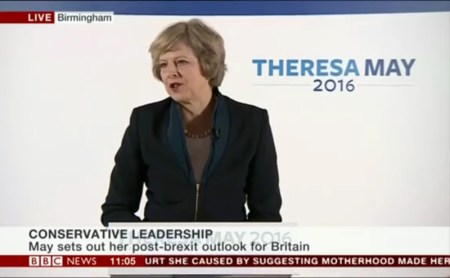 The glaring discrepancy between the UK establishment and the electorate explains the establishment’s quick acceptance of Brexit, for fear of becoming totally discredited. Pictured above: Theresa May launches her campaign for leader of the UK Conservative party on July 11, 2016, saying “Brexit means Brexit.”
The two earlier articles mentioned above first spotted the phenomenon of European disintegration and then explained it. Today, the intervening events have made the explanation all the simpler. Basically, the European political elites were correctly convinced, long ago, that considerable European integration was desirable, but their very successes in this area made them grossly overestimate what could and should be done further.
Up to a decade ago, it seemed that a similar pattern was becoming established in one EU country after another: the parliament was dominated by a large center-right party and a large center-left party that alternated in power from one election to another. The parallel to the United States seemed obvious, but the parallel was illusory, as we shall show.
Emboldened, the political parties concerned made the fatal mistake of trying to combine for the purpose of elections to the EU Parliament. Thus emerged a pan-European center-right pseudo-party, the “European People’s Party” (EPP), whose origins go back to a get-together of Christian Democrat parties in 1976. And a pan-European center-left pseudo-party, the “Party of European Socialists” (PES), founded in 1992 as an alliance between old-style Social Democrat parties and the former so-called Eurocommunist parties. The latter first emerged during the decline and discreditation of the Soviet Union in the 1970s and 1980s, then changed their names after its disappearance in December 1991. Thus, the core of Italy’s current Democratic Party derives from the Italian Communist Party (PCI), the major opposition party of post-war Italy.
Curiously but inevitably, the more those parties tried to unite, the more they lost support in their own countries of origin. Thus the Dutch Christian Democrats (CDA) are today a minor party of the right and the Panhellenic Socialist Movement (PASOK) barely crosses the threshold of 5% needed for entry into the Greek Parliament. (Incongruously, the last PASOK Prime Minister of Greece, George Papandreou, continues to be President of the Socialist International.) The reason for this development, however, is not far to seek.
Nationalism, it was forgotten, is an essential component of center-right sentiment. So a center-right party that prefers an international interest at the expense of the national interest of its own country loses credibility among its own core supporters; it becomes vulnerable to the rise of far-right upstart parties. Examples of this process in the EU are now so evident as not to need enumeration.
The attraction of socialism, it was forgotten, is that its core supporters expect increases in government social spending at the expense of financial stability. This becomes more difficult, the more a country is constrained by participation in a shared international framework. It becomes impossible to maintain once a country joins a common currency, since the usual remedy for socialist overspending is devaluation of the national currency. This is why PASOK has been eclipsed in Greece by the far-left SYRIZA, why the Spanish franchise of the PES (the PSOE) has lost severely to the upstart Podemos, and why support for its Dutch franchise (the PvdA) is now down to about the same as for each of two other left-wing parties.
It is also why in Britain, where the electoral system obstructs the rise of new parties, Jeremy Corbyn was voted leader by the Labour Party membership to the horror of the party establishment. Corbyn himself was a pronounced Euroskeptic until recently and only half-heartedly spoke in public for Remain, creating suspicions that he secretly voted for Leave.
A far-right party, like the Freedom Party (OFP) of Austria, has an easy sales pitch. Not so the far-left ones: after they come to power, it quickly and painfully becomes evident that they have no more ability than their derided Social Democrat predecessors to defy the constraints imposed by membership in the Eurozone.
Thus SYRIZA came to power in Greece and won a referendum to end austerity. The result was that all Greeks found that their bank accounts were virtually frozen: they were allowed to withdraw only sixty Euros a day. SYRIZA then split. The larger faction won the resulting general election and accepted the harsh conditions that the referendum had rejected. The paradoxical result in Greece is that the current government is a coalition of an upstart far-left party, SYRIZA, and an upstart nationalist party (the Independent Hellenes) that lies to the right of New Democracy (the Greek franchise of the EPP).
In other EU countries, however, the typical development has been the opposite: the erstwhile competing franchises of the EPP and the PES are in coalition against the motley upstart breakaway parties, since neither of the two gets an absolute majority in parliament any more. That is, their former raison d’être as competing alternatives has been abandoned in the need to survive in power at all. The paralysis in Spain comes from the fact that the two local franchises there are descended from the two sides in the murderous Civil War of 1936-1939. Joint government is still hardly imaginable especially for the losing socialists, who continued to suffer persecution long after the war.
Likewise, in the elections to the EU Parliament in May 2014, the EPP and the PES won only 221 and 191 seats respectively out of 751, each far short of a majority. So they clubbed together to make the top candidate of the EPP, Jean-Claude Juncker, President of the EU Commission and to retain the top candidate of the PES, Martin Schulz, as President of the Parliament. The incredible response of Juncker to Brexit has been to demand even tighter integration: he wants to force into the Eurozone the eight EU member states (other than the UK) that still have independent currencies. He also reiterated his proposal, originally made last March, to unite the armed forces of all states (with the UK gone) into a European army. For this he has the support of Schulz’s home party, the German SPD. That is, they want more and more of what the European electorates want less and less.
Especially in Eastern Europe, there are now also governments that resent the relentless centralizing urges of the EU establishment. In Hungary, for example, the government has rejected the demand of the EU Commission to absorb a quota of the immigrants currently streaming into Europe; it has scheduled a referendum on the matter for October 2. On the same day, Austria will hold a revote for the presidency, which the Freedom Party may narrowly win after narrowly losing the first time around.
These governments are among the new friends of Israel described in a recent Reuters article, titled “Diplomatic ties help Israel defang international criticism.” As it notes:
“Whereas a few years ago Israel mostly had to rely on Germany, Britain and the Czech Republic to defend its interests in the EU, now it can count Italy, Greece, Cyprus, Austria, Hungary and a handful of others among potential allies.”
These allies have no desire to penalize Israel on behalf of increasingly tedious Palestinians. On the contrary:
“Like Turkey, which last week agreed to restore diplomatic ties with Israel after a six-year hiatus, they see a future of expanding business, trade and energy ties.”
By “energy ties” is meant Israel’s recently discovered vast fields of natural gas, the phenomenon that we earlier dubbed “Israel as a Gulf State.” That is: just as governments care little for the human rights record of, say, Qatar in their eagerness to acquire its natural gas, so also the self-righteous moaning of the Palestinian Authority does not deter those governments from going for what Israel has to offer. As the Reuters article quotes a European ambassador: “There’s just no appetite to go toe-to-toe with Israel and deliver a really harsh indictment. No one sees the upside to it.”
Israel’s government is not, of course, gloating over the discontent spreading in the EU. But it surely appreciates some of the side effects.
We Saved Our Democracy, Pat Condell via YouTube, July 7, 2016
(Perhaps American will vote for her own Brexit on November 8th. — DM)
Trump, Brexit, Iceland, Turin, and Rome, Gingrich Productions, Newt Gingrich, June 29, 2016
There has been a lot of commentary about the British decision to leave the European Union and its implications for Trump and the American presidential race.
Trump was at his golf course in Turnberry, Scotland the day after the vote. He was enthusiastic about Brexit and claimed it was a model for the American choice. He suggested the British hostility to bureaucracy in Brussels paralleled the American hostility to bureaucracy in Washington. He felt the concerns about massive immigration and Syrian refugees were the same in both countries. He drew a direct comparison between the British desire to be independent again and the American desire to put America first in foreign relations. And of course, he did the entire press conference wearing a “Make America Great Again” hat.
Clinton took the opposite approach. Despite the defeat of the British establishment and its “Remain” campaign, she was committed to stability and risk avoidance. She emphasized the dangers of Brexit whereas Trump had emphasized the opportunities.
Yet focusing on Brexit creates much too narrow a basis for understanding the winds of change sweeping through the Western world.
The first harbinger of change this year was May 23, the day of the Austrian presidential elections.
In the first round, the two parties that had dominated Austria for the past half-century came in fourth and fifth. An independent came in third. The two formerly minor parties in the run-off were a hardline conservative anti-immigrant candidate and a green who favored more immigration. The entire national establishment mobilized to block the anti-immigrant candidate. He got 49.65 percent of the vote.
The second big signal of change was the Italian municipal elections. Out of disgust with widespread corruption, an Italian comedian named Beppe Grillo launched the Five Star Movement in 2009. In the 2013 elections, it came in second. This month, the Five Star Movement candidates won the mayor’s offices in both Turin and Rome.
Virginia Raggi, 37, became the first female mayor in Rome’s 2,800-year history. In the midst of a corruption scandal which forced the previous mayor to resign, Raggi got 67 percent of the vote against the Prime Minister’s party. In Turin, the results were similar and the reform movement won in 17 other cities.
Brexit, then, was at least the third big-change election in the West this year. The entire British establishment, the business leadership, President Obama and Hillary Clinton all came out for the Remain side. They lost 52-48 in a stunning upset which the polls did not predict. In England and Wales, the margins were much higher as people voted to make Britain independent again.
Fourth and finally, last Sunday was the little-noticed election of a new president in Iceland. The former president had resigned in a scandal caused by release of the Panama Papers. He had broken no laws but his previously secret investments were very unpopular. The winner of the presidential elections with 39 percent of the vote was Gudni Johannesson, a history teacher. Second, with 28 percent of the vote, was Halla Tomasdottir, a businesswoman. The leading professional politician, a former prime minister, got 13 percent.
These results from four different countries show a consistent momentum toward throwing out established politicians and rejecting the establishment.
There are real warnings here for Clinton and real signs of encouragement for Trump.




 anneinpt
 artaxes
 danmillerinpanama
 davidking1530
 Peter Hofman
 Joseph Wouk
 Peter
Peter Louisiana Steve
 WarSclerotic
Recent Comments