Archive for the ‘Benghazi’ category

Documents: Feds Knew Benghazi Attack Planned in Advance

May 19, 2015

Documents: Feds Knew Benghazi Attack Planned in Advance, Washington Free Beacon, May 18, 2015

(Please see also, Arab military chiefs approve Egyptian-led intervention in Libya — DM)


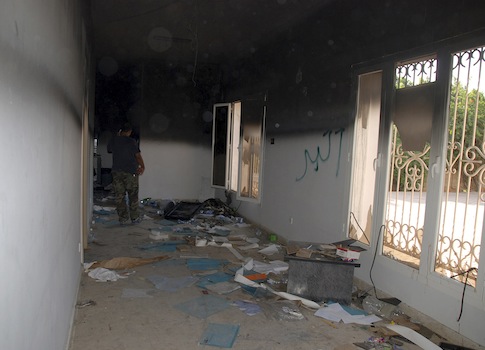
Gutted U.S. consulate in Libya / AP

Documents obtained by Judicial Watch from their May 2014 Freedom of Information Act (FOIA) lawsuits filed against the State Department and the Department of Defense revealed that the Obama administration knew about the attacks on the U.S. Consulate in Benghazi at least 10 days before the attack.

The documents also revealed that the DOD immediately reported the attacks on the consulate.

The documents included an August 2012 analysis predicting the failure of President Obama’s policy of a regime change in Syria as well as a warning about the rise of the Islamic State. The documents also included a confirmation that United States was aware of an arms shipment from Benghazi to Syria.

One of the documents from the DOD’s Defense Intelligence Agency dated September 12, 2012, the day after the attacks in Benghazi, lays out the details of the attack on the consulate and assesses that it was carefully planned by the terrorist group “Brigades of the Captive Omar Abdul Rahman.”

The group is known to have connections to the Muslim Brotherhood as well as  to al Qaeda. Rahman is serving a life sentence in prison for his role in the 1993 bombing of the World Trade Center.

The group’s goal was to “kill as many Americans as possible,” according to the documents, which were sent to Secretary of State Hillary Clinton, Defense Secretary Leon Panetta, the Joint Chiefs of Staff, and the National Security Council.

An October 2012 DOD document contained the first official document that the Obama administration knew of the shipment of weapons from the Benghazi to rebel forces in Syria.

Weapons from the former Libya military stockpiles were shipped from the port of Benghazi, Libya to the Port of Banias and the Port of Borj Islam, Syria. The weapons shipped during late-August 2012 were Sniper rifles, RPG’s, and 125 mm and 155 mm howitzers missiles.

During the immediate aftermath of, and following the uncertainty caused by, the downfall of the (Qaddafi) regime in October 2011 and up until early September of 2012, weapons from the former Libya military stockpiles located in Benghazi, Libya were shipped from the port of Benghazi, Libya to the ports of Banias and the Port of Borj Islam, Syria. The Syrian ports were chosen due to the small amount of cargo traffic transiting these two ports. The ships used to transport the weapons were medium-sized and able to hold 10 or less shipping containers of cargo.

The heavily redacted document did not reveal which weapons were sent to Syria

The DIA consistently warned of the deterioration of the situation in Iraq and warned that it creates an ideal situation for Al Qaeda to return to Mosul and Ramadi, according to an August 2012 report. During this time the U.S. was monitoring weapons flows from Libya to Syria. The agency warned of dire consequences but blocked out what most of what those consequences were.

The State Department produced a single document from a separate lawsuit that Judicial Watch had filed against the department. The document was created by Hillary Clinton’s office the morning after the attacks on the consulate in Benghazi and was sent throughout the State Department.

Neither the State Department nor Hillary Clinton have turned over any documents in regards to Benghazi or her personal email account that was used during her as well as other top aides during her time as Secretary of State.

Judicial Watch has filed multiple FOIA requests and has waited over two years for the documents that they have received.

“These documents show that the Benghazi cover-up has continued for years and is only unraveling through our independent lawsuits,” said Tom Fitton, president of Judicial Watch. “The Benghazi scandal just got a whole lot worse for Barack Obama and Hillary Clinton.”

Benghazi, Bergdahl, and the Bomb

April 3, 2015

Benghazi, Bergdahl, and the Bomb, Washington Free Beacon, April 3, 2015

Column: President Obama’s stories haven’t held up before. How is the Iran deal any different?

ObamaAP

What the president and Secretary of State John Kerry unveiled Thursday was another fancy, another fairy-tale, another fable about what might happen in an ideal world where enemies and allies share common interests and objectives, autocratic and theocratic regimes adhere to compacts, and moral sincerity is more important than results. Best be skeptical—these so-called triumphs of Obama’s diplomacy have a way of falling to pieces like ancient parchment. And keep in mind this rule: When the president enters the Rose Garden, run for cover.

******************

President Obama strode to the lectern in the Rose Garden Thursday to announce a “historic” agreement between the United States and the Islamic Republic of Iran. The preliminary deal made in Lausanne, Switzerland, the president said, “cuts off every pathway Iran could take to develop a nuclear weapon.” I hope he’s right.

But I’m not counting on it. The president has a terrible record of initial public pronouncements on national security. He has a habit of confidently stating things that turn out not to be true. Three times in the last four years he has appeared in the Rose Garden and made assertions that were later proven to be false. He and his national security team have again and again described a world that does not correspond to reality. No reason to assume these concessions to Iran will be any different.

The U.S. consulate in Benghazi, Libya, was attacked on September 11, 2012. Four Americans were killed, including our ambassador. Obama delivered remarks on the attack in the Rose Garden the following day. “No acts of terror will ever shake the resolve of this great nation,” he said. What he didn’t say was that the killings in Benghazi specifically were a “terrorist attack” or “terrorism.” On 60 Minutes,when asked if he believed Benghazi was a “terrorist attack,” the president replied, “It’s too early to know how this came about.” On September 14, neither the president nor Secretary of State Hillary Clinton called what had happened a terrorist attack. On September 15, Obama referred to Benghazi as a “tragic attack.” On September 16, Susan Rice, then U.N. ambassador, called it a “spontaneous attack.”

By September 24, when Obama recorded a campaign interview with The View, he again refused to say Benghazi was an attack by terrorists. “We’re still doing an investigation,” he told Joy Behar. It was not until two days later that administration officials began referring to Benghazi as a terrorist attack—something the Libyan government had been saying since September 13.

The story originally put out by the White House, that Benghazi was the result of spontaneous anger at an Internet video offensive to Muslim extremists, fell apart in a matter of days. Yet the White House persisted in its false description of reality, declining to confirm what was widely accepted as a premeditated terrorist assault on a U.S. compound, and chose to ascribe responsibility for the events in question to anti-Islamic bias. The evidence continues to mount that Ansar al-Sharia, the Qaeda affiliate in lawless Libya, was behind the events of September 11, 2012, not the stupid video.

In August 2013 President Obama announced in the Rose Garden that Syrian dictator Bashar Assad had crossed the “red line” by gassing his own people. “Now, after careful deliberation, I have decided that the United States should take military action against Syrian regime targets,” the president said. Then he punted the issue to Congress. But no action against Syrian regime targets was ever taken, because the president reversed himself and accepted a Russian proposal to ship Assad’s WMD out of Syria. “This initiative has the potential to remove the threat of chemical weapons without the use of force, particularly because Russia is one of Assad’s strongest allies,” Obama said in a September 10, 2013, televised address. Almost two years later, Assad is dropping barrel bombs filled with chlorine gas on civilians. Success.

Last May, President Obama again walked purposefully to a lectern in the Rose Garden, and informed the world that he had released five Taliban commanders from Guantanamo Bay in exchange for Sergeant Bowe Bergdahl, who had been held prisoner by the Islamic militia for almost half a decade. “Right now,” the president said, “our top priority is making sure that Bowe gets the care and support that he needs and that he can be reunited with his family as soon as possible.”

Criticism of the prisoner swap was immediate, and intensified when Bergdahl’s platoon-mates said he had deserted his post. The White House, as usual, struck back against the critics and repeated its story. On June 2, Susan Rice, now national security adviser, went onThis Week with George Stephanopoulos and said Bergdahl “served the United States with honor and distinction.”

The Government Accountability Office concluded that the Obama administration’s actions were illegal. Bergdahl himself was kept isolated as the Army reviewed the circumstances of his capture by the enemy. Completed in the fall of 2014, the report by Brigadier General Kenneth Dahl still has not been released to the public.

Last week, however, the Army charged Bergdahl with desertion and misbehavior before the enemy. Has the White House reevaluated its trade? Of course not. On the contrary: Pentagon officials suggested on background that Bergdahl wasn’t a deserter, he was a whistleblower!

Three stories that collapsed under the weight of the evidence, three instances of the White House doggedly sticking to its policy line despite everything. This president’s resistance to events in the actual world of space and time is more than ideology, however. It’s also good politics: By refusing to concede the facts of the case, Obama is able to hold his base and stay on offense against his true adversaries: Republicans, conservatives, and Bibi Netanyahu.

And now we have the Iran story. Iran, the president says, will reduce its centrifuges, dilute its enriched uranium, open its nuclear sites to inspectors, and turn its fortified underground reactor into a “research” facility in exchange for sanctions relief. The only alternatives, Obama goes on, are bombing Iran or ending negotiations and re-imposing sanctions. “If, in fact, Prime Minister Netanyahu is looking for the most effective way to ensure Iran doesn’t get a nuclear weapon, this is the best option. And I believe our nuclear experts can confirm that.”

Sure they can. Though I believe other nuclear experts, such as Charles Duelfer, can also confirm that this agreement has major holes, such as the spotty effectiveness of inspections and the failure to get Iran to disclose fully the possible military dimensions of its nuclear program. And there’s always the tricky issue of sanctions relief: The United States says the process of lifting sanctions will be gradual and contingent on Iranian compliance, but Iranian foreign minister Javad Zarif says it will be immediate.

What the president and Secretary of State John Kerry unveiled Thursday was another fancy, another fairy-tale, another fable about what might happen in an ideal world where enemies and allies share common interests and objectives, autocratic and theocratic regimes adhere to compacts, and moral sincerity is more important than results. Best be skeptical—these so-called triumphs of Obama’s diplomacy have a way of falling to pieces like ancient parchment. And keep in mind this rule: When the president enters the Rose Garden, run for cover.

Humor: Brian Williams should replace Secretary Kerry

February 7, 2015

Brian Williams should replace Secretary Kerry, Dan Miller’s Blog, February 6, 2015

(The views expressed in this article are not necessarily mine or those of Warsclerotic or its other editors. — DM)

Although it would be hypocritical for NBC to fire Mr. Williams for mis- speaking  lying, it would enhance his chances of becoming our next Secretary of State. Like Hillary Clinton, Williams sorta told some truth when he admitted to lying for a dozen years. Hillary became Obama’s Secretary of State in 2009. Williams, also a very good liar, deserves no less this year. After that? Perhaps “our” next President.

brian_williams_airwolf_2-5-15-1

Here is a timeline of the progression of Williams’ tall tales, based on a Stars and Stripes article:

In late March 2003, the New York Daily News reported that “the one (helicopter) carrying Williams and (Retired General and current NBC consultant Wayne) Downing landed” after another chopper ahead of them had been hit by “a rocket-fired grenade.” Even this early report appears to have been exaggerated. Larry O’Connor at Truth Revolt, reacting to Williams’ on-air statement Wednesday night, noted that Williams was really “in an aircraft that followed the one hit by RPG fire by an entire hour.”

Several days later, USA Today reported that Williams “was stranded in the Iraqi desert for three days.” That hardly appears to be the case. In a comment at an NBC Facebook page, a clearly frustrated Lance Reynolds, the flight engineer on the helicopter that was hit, wrote: “I remember you guys taking back off in a different flight of Chinooks from another unit and heading to Kuwait to report your ‘war story’ to the Nightly News.”

By 2007, the helicopter that was hit was, according to a Williams blog entry, “the chopper flying in front of ours.” A University of Notre Dame press release in 2010, the year he gave the commencement address there, referred to how “the lead helicopter was shot down.”

In March 2013, Williams told Alec Baldwin of “being in a helicopter I had no business being in in Iraq with rounds coming into the airframe,” and, after prompting, said that he “briefly” thought he would die.

Later that month, Williams crossed the fairy-tale Rubicon, telling David Letterman that “two of the four helicopters were hit by ground fire, including the one I was in,” and that after that, the problem was how “we figure out how to land.” We?

Finally, on January 30, Williams, applying even more mustard, told the nation on Nightly News that “the helicopter we were travelling in was forced down after being hit by an RPG.”

The indispensable Kristinn Taylor at Gateway Pundit has found that “speech promotional bios touted Williams’ bravery in returning to Iraq after he claimed being under fire.”

Here’s a video of Williams’ 2013 love feast with David Letterman. His Iraq narrative begins at 2:50.

According to Sharyl Attkisson, Presidential Candidate Clinton [like Brian Williams],

never fully explained how she could have made such a mistake as saying she had ducked sniper fire when there hadn’t been a sniper in sight. Initially, she stated “I was sleep deprived and I misspoke.”

But as my report below (“Clinton Doubles Down”) shows, Clinton told varieties of the embellishment over a long period of time, not just when she was sleep deprived.

Had Clinton somehow convinced herself that it had all really happened? Or did she knowingly advance a false story?

“So I made a mistake,” Clinton also stated at one point. “It proves I’m human, which you know, for some people, is a revelation.”

Whoops.

Clinton1web_2831249b

In the next video, Mr. Williams and a guest from NBC discuss Clinton’s Bosnia adventures, Senator Obama’s candidacy and their anticipated consequences for her 2008 Democrat presidential nomination. Note the apparent puzzlement about why Clinton confessed to having “misspoken.”

Clinton didn’t get the Democrat presidential nomination in 2008 but was confirmed as Obama’s Secretary of State in 2009. Doesn’t Williams deserve a promotion comparable to what Clinton got (from failed Presidential Candidate to SecState)? Shouldn’t he be held to the same standard?

Williams had seen what happened to Clinton just weeks earlier, yet kept telling his own fish tale. To paraphrase one of his own NBC colleagues, this isn’t Little League, it’s a nightly news anchor with an audience of millions. Will he be held to the same standards to which NBC and the rest of the media held Clinton?

What standards were those then and, of more importance, what have they been since? She still “deserves” to become “our” next President.

Tom Brokaw, also of NBC, contends that Williams should go. Perhaps, however, NBC will forgive and forget.

The Los Angeles Times, quoting anonymous NBC News execs, reported that Williams’s on-air apology has been accepted internally and that he’s expected to face no disciplinary action for his serious journalistic lapse, which included showing video of a combat-damaged helicopter and representing it wrongly as the Chinook on which Williams had been a passenger.

As noted by Howard Kurtz at Fox News,

When it comes to the NBC franchise, Brian Williams is too big to fail. He’s the face of the network, he hosts the top-rated network newscast, he guest-hosts “Saturday Night Live.” He’s a bankable asset. And in fairness, Williams has a pretty unblemished track record.

Oh well.

Reality is often unpleasant and hard to deal with, so we need a creative Secretary of State who will continue to reject reality, base policy on fantasy and do so with impunity for a decade or more.

Clinton, a likely Presidential Candidate for 2016, did her “best.”

Obama does what Obama does and gets away with it. According to an article at Breitbart, the seven Muslims at a recent White House meeting on domestic and foreign policy issues have been named.

According to a White House statement on the President’s meeting, the domestic issues discussed were the “Affordable Care Act, anti-Muslim violence and discrimination, the 21st Century Policing Task Force, and the upcoming White House Summit on Countering Violence Extremism.” On the foreign policy front, “the President discussed the need to continue countering ISIL and other groups that commit horrific acts of violence, purportedly in the name of Islam,” while also congratulating Muslims on their “remarkable contributions” to America. [Emphasis added.]

. . . .

Comedian and left-wing pundit Dean Obeidallah revealed that he was one of the fifteen Muslim-American “leaders” brought to the White House on Wednesday afternoon.

“The No.1 issue raised: The alarming rise in anti-Muslim bigotry in America,” Obeidallah said of the meeting with the President. Their chief collective concern was not the rise of the Sunni Islamic State, nor the expansion of the Caliphatist Shiite Iranian regime and its messianic drive towards nuclear weapons, but instead, “anti-Muslim bigotry in America.” [Emphasis added.]

. . . .

The Detroit Free Press also revealed that senior Obama advisers Valerie Jarrett and Ben Rhodes were present in the Muslim leaders’ meeting. [Emphasis added.]

Dean Obeidallah also revealed that Farhana Khera, executive director of Muslim Advocates, was behind the effort to get Muslim leaders to the White House.

Muslim Advocates reveals on its website that its three main objectives are to “end profiling,” “strengthen [Muslim] charities,” and “counter hate.” Its Press Center section is filled with posts demanding intelligence organizations, such as the New York Police Department and federal agencies, end their “Muslim Suspicionless Spying Program,” while also dictating to the media that it should “Report Accurately on Muslims.” Another post reads, “What You Need to Know About the New Federal Racial Profiling Policy.” Review of Muslim Advocates’ press releases reveals that the only foreign policy issue with which the group has concerned itself over the past year was urging Sec. of State John Kerry to ensureMuslim “Americans are able to safely perform the annual religious Hajj pilgrimage in Saudi Arabia.” [Emphasis added.]

Keep up the good work, Big Guy, Insha’Allah.

Fantasy Island Obama

Kerry has bravely continued the march.

Williams, who should be rehabilitated as quickly as was Senator Clinton, could not be worse and might even be better than Kerry. Then, his path to the presidency should be clear even if he (unlike Obama) is candid in public on rare occasions.

Hey, Grandpa! I need some of that stuff.

Analysis: Osama bin Laden’s documents pertaining to Abu Anas al Libi should be released

January 4, 2015

Analysis: Osama bin Laden’s documents pertaining to Abu Anas al Libi should be released, Long War Journal, Thomas Joscelyn, January 3, 2015

(Release of the documents should further diminish the U.S. Government’s claims that al Qaeda died with bin Laden. How about any documents in the possession of Abu Anas al Libi when he was captured in Turkey in 2013? Might they contradict governmental claims about what happened during the “unanticipated” September 11, 2012 terrorist attack on the U.S. installation in Benghazi, why it happened and the nature of the U.S response? — DM)
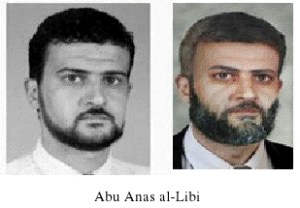
Anas-al-Libi

The Obama administration made a concerted push to portray Osama bin Laden as a doddering old man who was operationally irrelevant.

What we know about Abu Anas al Libi’s al Qaeda role challenges all of these assessments.

Releasing any bin Laden files further implicating al Libi in the East Africa attacks would only strengthen the US government’s case to the public.
***************

A senior al Qaeda operative known as Abu Anas al Libi has died in the US as he was awaiting trial. Al Libi was captured in Tripoli during a raid by US forces in late 2013. He had been wanted for his role in the August 1998 US Embassy bombings for more than a decade prior to his arrest.

The US government has in its possession numerous pieces of evidence concerning al Libi’s al Qaeda role, including files recovered in May 2011 from Osama bin Laden’s home in Pakistan.

The Long War Journal has consistently advocated for the release of bin Laden’s files. The Obama administration has released just 17 documents, and a handful of videos, from a total cache of more than 1 million files. Many more of these files, if not almost all of them, should be declassified and released. There are no sources or methods to protect, as everyone knows how this information was obtained. The only files that should remain classified are those that have a direct bearing on the US government’s current counterterrorism operations against al Qaeda.

Now that al Libi has passed away, the US government has another opportunity to be more transparent with respect to bin Laden’s files. After all, at least some of the documents probably would have been released to the public during al Libi’s trial.

Just weeks ago, in mid-December, Benjamin Weiser of The New York Times reported that US prosecutors were seeking to use files recovered during the raid on bin Laden’s compound in al Libi’s trial.

A close reading of the Times‘ account reveals that prosecutors intended to use at least five separate letters recovered in bin Laden’s safe house.

It does not appear that any of these letters were included in the set of 17 documents released by the Obama administration through the Combating Terrorism Center at West Point. None of Abu Anas al Libi’s letters to al Qaeda’s leaders were released.

The first letter described by the Times is from Atiyyah Abd al Rahman, a senior al Qaeda leader, to bin Laden dated June 19, 2010. Rahman explained that al Libi was one of “the last brothers” to be released from Iran. Al Libi “came only a week ago and I met him and sat with him,” Rahman wrote, according to the Times’ summary. Rahman appointed al Libi to al Qaeda’s security committee. “It is normal for any person after a long absence, especially in jail, that he needs some time to figure out how things work,” Rahman noted. Rahman recommended that bin Laden send al Libi a letter, because al Libi was seeking “reassurance.”

A second letter, dated Oct. 13, 2010, is a five-page missive from al Libi to Osama bin Laden. “Your forever lover, Your brother,” al Libi signs the letter. Al Libi explains, according to the Times, that the al Qaeda “brothers,” including bin Laden’s sons and other al Qaeda operatives, fled to Iran under orders from Taliban leader Mullah Omar.

A third letter from Rahman to bin Laden was written “[a]bout a month later,” according to the Times, meaning it was penned sometime in November 2010. Rahman recommended that al Libi be accepted back into al Qaeda’s leadership ranks. Rahman described al Libi as “determined,” “visionary,” and “difficult somewhat,” but also noted that bin Laden knew him. Interestingly, Rahman complained that al Libi had violated al Qaeda’s operational security regulations by “contacting his family in Libya, despite knowing that we don’t allow any communications.”

Al Libi “knows that he was wanted by the Americans,” Rahman wrote to bin Laden, according to the Times’ summary. “He contacted them via phone repeatedly!”

In a fourth letter, written in March 2011, al Libi requested permission to join some other operatives who were returning to Libya to fight against Muammar al Qaddafi’s regime. It is better to “move out sooner rather than later” al Libi wrote.

Rahman forwarded al Libi’s letter to bin Laden, the Times reported, and Rahman explained to bin Laden that he approved al Libi’s request. This is the fifth letter prosecutors sought to introduce. Rahman noted that al Libi was “a little upset with me for the delay in getting back to him.”

A “builder of al Qaeda’s network in Libya”

Al Libi did in fact return to his native Libya. As a member of al Qaeda’s security committee who returned to North Africa only after receiving permission from his superiors in al Qaeda (Rahman), it is safe to assume that he was doing the terrorist organization’s bidding when he set up shop in his homeland.

Indeed, as The Long War Journal previously reported, an unclassified report published in August 2012 highlighted al Qaeda’s strategy for building a fully operational network in Libya. The report (“Al Qaeda in Libya: A Profile”) was prepared by the federal research division of the Library of Congress (LOC) under an agreement with the Defense Department’s Combating Terrorism Technical Support Office (CTTSO).

Abu Anas al Libi played a key role in al Qaeda’s plan for the country, according to the report’s authors. He was described as the “builder of al Qaeda’s network in Libya.”

Al Qaeda’s senior leadership (AQSL) has “issued strategic guidance to followers in Libya and elsewhere to take advantage of the Libyan rebellion,” the report reads. AQSL ordered its followers to “gather weapons,” “establish training camps,” “build a network in secret,” “establish an Islamic state,” and “institute sharia” law in Libya.

Abu Anas al Libi was identified as the key liaison between AQSL and others inside the country who were working for al Qaeda. “Reporting indicates that intense communications from AQSL are conducted through Abu Anas al Libi, who is believed to be an intermediary between [Ayman al] Zawahiri and jihadists in Libya,” the report notes.

Al Libi is “most likely involved in al Qaeda strategic planning and coordination between AQSL and Libyan Islamist militias who adhere to al Qaeda’s ideology,” the report continues.

Al Libi and his fellow al Qaeda operatives “have been conducting consultations with AQSL in Afghanistan and Pakistan about announcing the presence of a branch of the organization that will be led by returnees from Iraq, Yemen, and Afghanistan, and by leading figures from the former LIFG.” The term “LIFG” refers to the Libyan Islamic Fighting Group, an al Qaeda-linked jihadist group formed in Libya in the 1990s.

One of al Libi’s key allies inside Libya was another senior al Qaeda operative, Abd al Baset Azzouz, who has been close to al Qaeda’s senior leaders for decades.

Azzouz was sent to Libya by Zawahiri and “has been operating at least one training center.” Azzouz “sent some of his estimated 300 men…to make contact with other militant Islamist groups farther west.”

Azzouz was reportedly captured in Turkey last month. [See LWJ report, Representative of Ayman al Zawahiri reportedly captured in Turkey.]

Release bin Laden’s files

The Obama administration made a concerted push to portray Osama bin Laden as a doddering old man who was operationally irrelevant. Citing bin Laden documents shown to him by the White House, the Washington Post’s David Ignatius described the jihadist leader as a “lion in winter.” CNN‘s Peter Bergen similarly reported that bin Laden was in retirement at the time of his death. The Combating Terrorism Center at West Point, working off of only those documents provided by the Obama administration, portrayed bin Laden as being sidelined.

What we know about Abu Anas al Libi’s al Qaeda role challenges all of these assessments. He was reintegrated into al Qaeda’s chain of command after his release from Iranian custody. His role was approved by Rahman, who served as one of bin Laden’s top subordinates before being killed in a US drone strike. Rahman made sure that al Libi joined al Qaeda’s security committee — an internal body that is not factored into any public assessments of al Qaeda’s structure or hierarchy. And al Qaeda approved al Libi’s return to Libya. Other evidence subsequently unearthed by the US government shows that al Libi was acting as one of al Qaeda’s top operatives in North Africa at the time of his capture.

This evidence should be released to the public, so we can judge for ourselves how al Qaeda operates.

In addition, any documents or files recovered from bin Laden’s compound that deal with the August 1998 US Embassy bombings should be released as well. After al Libi was captured in Libya, his family claimed he had played no role in the twin attacks, which were al Qaeda’s most successful operation prior to Sept. 11, 2001. However, there is abundant evidence, including testimony given before a US district court, indicating that al Libi was a key player in the bombings. Releasing any bin Laden files further implicating al Libi in the East Africa attacks would only strengthen the US government’s case to the public.

Rice Defends US Islamic State Strategy

October 13, 2014

Rice Defends US Islamic State Strategy, Washington Free Beacon, October 12, 2014

(Here’s a video clip of Susan “Blame it on the Video” Rice talking about Obama’s Islamic State strategy.

Does Obama have a problem? Do we? — DM)


Susan RiceSusan Rice / AP

While Rice insisted that there would not be any U.S. ground troops, or recommendations for them, statements by current and former military advisors suggested the comment was premature.

******************

On Sunday, National Security Advisor Susan Rice said the United States would not reevaluate the strategy to “degrade and destroy” the Islamic State of Iraq and the Levant (ISIS or ISIL), despite its recent territorial advances, and said that the Obama administration is still not considering boots on the ground.

“This is very early days of the strategy. The strategy is very clear. We’ll do what we can from the air. We will support the Iraqi security forces, the Kurds, and ultimately over time, the moderate opposition in Syria to be able to control territory and take the fight to ISIL,” Rice told NBC’s “Meet the Press.”

“There has been no recommendation from the American military commanders, either on the ground or here in Washington, that the United States put any ground combat forces into Iraq. That has not come up the chain to anyone at the White House and I don’t anticipate that it will,” Rice said. “The president has been very plain that this is not a campaign that requires, or even would benefit from, American ground troops in combat again.”

Rice’s defense of the American strategy came as many question its effectiveness as the Islamic State makes advances in Anbar province, a region that neighbors Baghdad, and Kobani, a Kurdish town in northern Syria, despite weeks of US-led airstrikes.

While Rice insisted that there would not be any U.S. ground troops, or recommendations for them, statements by current and former military advisors suggested the comment was premature.

Joint Chiefs of Staff General Martin Dempsey pointed to Mosul as an instance where U.S. ground troops may be recommended.

ABC’s Martha Raddatz asked Dempsey, “Would we be more effective against ISIS if we had U.S. troops on the ground spotting targets?”

“Yeah. There will be circumstances when the answer to that question will likely be yes, but I haven’t encountered one right now,” Dempsey said.

“Mosul will likely be the decisive battle in the ground campaign at some point in the future. When [the Iraqi Security Forces] are ready to go back on the offensive. My instinct at this point is that that will require a different kind of advising and assisting because of the complexity of that fight.”

Former Secretary of Defense Leon Panetta seemed to broadly echo that sentiment on CBS’s “Face the Nation,” and warned against taking options off the table.

“I’ve always felt that the President of the United States ought to keep every option available in dealing with this kind of enemy… I think you want to protect every possible option because we are dealing with a very resilient enemy and the only way you deal with a resilient enemy is with flexibility, adaptability, and the kind of determination that we’re going to need if we’re ever going to win this war.”

The overall strategy will take time, Panetta noted, but airstrikes alone will not win the war against ISIS.

“These airstrikes can help to a degree, I think they’ve helped kind of stifle some of the momentum in ISIS, but to make these airstrikes work you’ve got to have information on targets and you’ve got to be able to pinpoint where the enemy location is and that, frankly, is going to take time.”

“You’ve got to have boots on the ground,” Panetta continued, “maybe it doesn’t have to be American boots on the ground, but you have got to have people on the ground who can identify targets and who can help us develop the kind of effective airstrikes that are going to be needed if we’re going to be able to undermine, destroy this vicious enemy that we’re dealing with.”

Rice defended the air campaign, arguing that it was in the early stages, but “off to a strong start.”

“Our efforts have various, different lines of effort, as we call them. On the one hand, we’re trying to build up the capacity of the Iraqis, which means the Iraqi army, the Kurds – the Peshmerga inside of Iraq… we’re building up that capacity and we have seen some success in that regard. On the Syrian side, we also have a longer-term challenge of supporting the moderate opposition, and giving them, while they have great will, greater capacity to fight Assad and to fight ISIL.”

“So, this is going to take time,” Rice continued. “Our air campaign is off to a strong start… it can’t be judged by merely what happens in one particular town or in one particular region.”


