Archive for the ‘2016 elections’ category

Philadelphia Police Union Rips Clinton, DNC for Not Including Families of Slain Police Officers as Convention Speakers

July 21, 2016

Philadelphia Police Union Rips Clinton, DNC for Not Including Families of Slain Police Officers as Convention Speakers, Washington Free Beacon, July 21, 2016

Philadelphia’s police union is angry with Hillary Clinton and the Democratic National Convention for giving speaking roles to family members of police shooting victims but not to family members of police officers who died in the line of duty.

John McNesby, president of the Fraternal Order of Police Lodge 5, told Philadelphia’s local CBS affiliate that the speaker choices were “putting salt in the wound” and promoting an “anti-police movement.”

The union also released a statement that it was “insulted” by the exclusion of police widows and family members, according to the Philadelphia Inquirer:

“It is sad that to win an election Mrs. Clinton must pander to the interests of people who do not know all the facts, while the men and women they seek to destroy are outside protecting the political institutions of this country,” the statement read. “Mrs. Clinton, you should be ashamed of yourself if that is possible.”

The statement came days after the Clinton campaign announced that former President Bill Clinton would speak Tuesday night along with members of Mothers of the Movement, a group that includes Gwen Carr, mother of Eric Garner; Sybrina Fulton, mother of Trayvon Martin; and Lezley McSpadden, mother of Michael Brown.

Clinton’s campaign responded Wednesday, noting that two members of law enforcement are scheduled to speak at the convention, including former Philadelphia Police Commissioner Charles H. Ramsey.

President Of Pro-Kremlin Think Tank RIAC: Clinton, The Policy Professional, Preferable To Novice Trump

July 21, 2016

President Of Pro-Kremlin Think Tank RIAC: Clinton, The Policy Professional, Preferable To Novice Trump, MEMRI, July 21, 2016

(Please see also, Russian Commentator On U.S. Elections: Clinton Is Better For Russia. — DM)

Igor Ivanov, the President of the Russian International Affairs Council (RIAC), and a former Russian Federation foreign affairs minister (1998–2004) attempted to prepare his readers for Hillary Clinton’s expected victory (the article was obviously written before the polls narrowed Clinton’s margin over Donald Trump). [1] Ivanov realizes that Russian public and elite opinion dislikes Clinton as “obsessed with human rights” and believes that Donald Trump can turn the page on US-Russia relations as he is not bound by Obama’s legacy. Moreover, the Russian elites have bitter memories of former U.S. president Bill Clinton whom they view as the architect of NATO’s eastward expansion into countries that were formerly Warsaw Pact members or Soviet republics. [2] Ivanov paints a rosier picture of Russia-US relations under Bill Clinton. Contrasting the rational and predictable behavior he expects from Hillary Clinton with the inconsistent and unpredictable behavior expected from Trump, Ivanov regards a Clinton victory as the preferable outcome.

In addition to bowing before an “inevitable” Clinton victory the Russian leadership maybe warming to the Democratic candidate due to Secretary of State John  Kerry’s visit to Moscow and his lengthy talks with Russian President Vladimir Putin and Russian Foreign Minister Sergey Lavrov on greater US military cooperation with Russia in Syria.[3]

While some commentators take a cynical view of the talks and claim that ramped-up cooperation with Russia is an attempt by the Obama Administration to impress the American voters prior to the elections, or an admission that Washington’s Syria policy is bankrupt, Russia probably regards institutionalized cooperation mechanisms as a step forward. Ivanov claims that such cooperative mechanisms in all spheres and on all levels were missing in the 1990s, and their establishment would put US-Russia relations on a firmer footing.

Ivanov’s article appears below:

‘It Is…Easier To Achieve An Agreement With Experienced Professionals…A ‘Newcomer’ In International Politics Is… Harder To Work With’

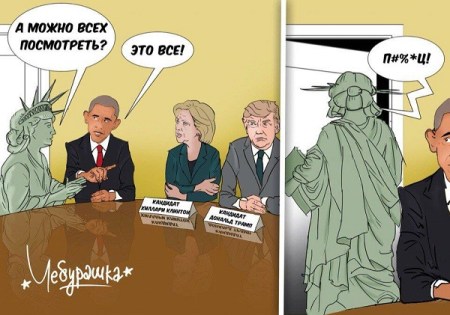
29166Twitter.com/sharzhipero, May 23, 2016.

On the table badges: candidate Hillary Clinton, candidate Donald Trump.
Statue of Liberty: Can I see all of them [all candidates for the U.S. presidency]?
U.S. President Barack Obama: That’s all of them
Statue of Liberty: Oh, f**k..

“Less than four months remain before America elects its President; the dramatic struggle has entered its final phase. […] As the polls show, it is widely assumed in Russia that the arrival of Donald Trump in the White House would benefit this country more than victory by Hillary Clinton. A populist and fierce opponent of the Washington establishment, Trump could, they say, turn the page in U.S.-Russia relations, which have seen better times, and open a new chapter without regard to the ‘legacy’ of Democrat Barack Obama.

“Hillary Clinton is known to arouse mixed feelings among Russians. Some know her as a relentless and at times inflexible negotiator. Others view her as a politician obsessed with human rights. And still others say that Moscow has always gotten along better with Republicans than with Democrats.

“My experience over the years – and I have talked face-to-face to the leaders of many countries – is telling me that there are hardly any substantial grounds for such fears or hopes. It is usually easier to achieve an agreement with experienced professionals, even if they are inflexible negotiators and difficult partners. They are predictable, rational, and they are well aware of their limitations. A ‘newcomer’ in international politics is usually harder to work with: the lack of experience often translates into inconsistent and unpredictable behavior; it leads to subjective, emotional and at times erroneous decisions that can be very hard to rectify later on.

“Speaking on June 17 [2016] at the Saint-Petersburg International Economic Forum, President Putin recalled his positive experience of working with the forty-second President of the United States, Bill Clinton.[4] I was Minister of Foreign Affairs at the time and remember those days very well. There was more than enough disagreement and difference between our countries back then too. But, unlike recent years, mutually respectful dialogue was never broken off and there was an understanding of how important U.S.-Russia relations were in terms of international stability. Naturally, Mrs. Clinton has her own view of American foreign policy. However, there is evidence that the ‘family experience’ will to a certain extent influence her actions if she wins the November election.

‘It Would Be Naïve To Believe That The State…Of Our Relations With The U.S Are Defined Exclusively By Who Sits In The Oval Office’

“This is not, however, the most important point. It would be naïve to believe that the state and dynamics of our relations with the United States are defined exclusively by who sits in the Oval Office, and that there is some easy and painless way to overcome the deep crisis in our bilateral relations. Miracles don’t happen in international politics. U.S. foreign policy has always been bipartisan, greatly inert, and the outcome of the presidential race alone cannot overturn the existing state of affairs.

‘It is hardly realistic to hope that the new administration will ‘come to its senses’ and be easy to deal with. No matter who wins the presidency, the strategic goal of preserving global leadership will remain unchanged, [all emphases added] though certain adjustments to the international agenda are, of course, possible.

“U.S.-Russia relations have entered a phase where the negative attitude that has accumulated over recent years has essentially grown into full-blown confrontation. This runs counter to our national interests and those of the United States as well. So it is important to take steps that would help reverse this dangerous trend. If we decide to wait and see what the new U.S. President and his or her team do, we lose time, and with it we lose the initiative.

“Frankly speaking, we failed to create a solid foundation for U.S.-Russia relations after the end of the Cold War. We did not try hard enough, engrossed in solving current international problems. This, in my view, makes the launch of a new negotiation process between Washington and Moscow the key goal, a process that would help develop common principles for our relations and jointly developed mutual commitments reflecting the interests of both sides.”

‘To Meet Just To Look Into Each Other’s Eyes Is Not Enough Anymore’

“What should we do first? This is the hardest part.

“In my mind, we first need to start working on arranging a bilateral summit. The longer it takes for such a meeting to happen, the more negative feelings will pile up. The meeting must be thoroughly worked through and it must have a strategic and future-oriented outcome. In today’s situation, to meet just to ‘look into each other’s eyes’ is not enough anymore.[5]

“Clearly, such a meeting will not solve all the numerous controversies we have at once. But this should not be the goal either. The meeting must set the course for the development of bilateral relations and form the necessary mechanisms for cooperation, which would help gradually overcome the present situation where cooperation in matters of strategic importance is held hostage by existing differences.

Interaction at the presidential level will of course continue to remain the key element of the U.S.-Russia dialogue. But such interaction has to be complemented with a wide range of bilateral mechanisms, each devoted to a key area of cooperation. We need to breathe new life into the Strategic Stability Group,[6] where our two countries are represented by the leaders of the foreign and defense ministries. Dialogue between intelligence agencies has to be institutionalized as well. This would enhance mutual trust and create an atmosphere conducive to cooperation in fighting terrorism and in other fields. Particular attention needs to be paid to economic cooperation. Business-to-business cooperation has not become the shock-absorber that would limit or at least reduce the negative impact of differences in other areas. There is need for a mechanism that would stimulate economic cooperation at the governmental level, which would in turn promote better relations between our two countries in general.

Another consultation mechanism should be created at the level of civil society. It should involve political and public figures, representatives of the media, science and culture – all those who influence public opinion in Russia and in the U.S. The proposed streamlining of U.S.-Russia dialogue might seem cumbersome and unrealistic at first. Unfortunately, it is the very lack of such a tight framework for dialogue on a wide range of pressing issues that has brought us to where we are today.

“In his telegram to President Obama on the occasion of Independence Day on July 4 this year, President Putin emphasized that ‘the history of US-Russia relations shows that when we act as equal partners and respect each other’s lawful interests, we are able to successfully resolve the most complex international issues for the benefit of both countries’ peoples and all of humanity.’

“Let us hope that Washington would take this invitation to dialogue seriously.”


Endnotes:


[1] Russiancouncil.ru, July 16, 2016

[2] See MEMRI Special Dispatch no. 6520, Russian Commentator On U.S. Elections: Clinton Is Better For Russia, July 19, 2016.

[3] Wall Street Journal, July 14, 2016.

[4] During the Plenary session of St Petersburg International Economic Forum, Putin said: “I worked with Bill Clinton, although for a very short time, and we had a very good relationship. I can even say that I am grateful to him for certain moments as I was entering the big stage in politics. On several occasions, he showed signs of attention, respect for me personally, as well as for Russia. I remember this and I am grateful to him. About Ms. Clinton. Perhaps she has her own view on the development of Russian-U.S. relations. You know, there is something I would like to draw [your] attention to, which has nothing to do with Russian-U.S. relations or with national politics. It is related, rather, to personnel policy. In my experience, I have often seen what happens with people before they take on a certain job and afterward. Often, you cannot recognize them, because once they reach a new level of responsibility they begin to talk and think differently, they even look different. We act on the assumption that the sense of responsibility of the U.S. head of state, the head of the country on which a great deal in the world depends today, that this sense of responsibility will encourage the newly elected president to cooperate with Russia and, I would like to repeat, build a more secure world.” Kremlin.ru, June 17, 2016.

[5] Ivanov appears to be referring to the June 2001 summit between Vladimir Putin and George W. Bush at the conclusion of which Bush told the press” “I looked the man in the eye. I found him very straight-forward and trustworthy – I was able to get a sense of his soul.” BBC.co.uk, June 16, 2001.

[6] Russia has established strategic stability groups with other countries and not only with the U.S. For example, in January 2003, the first meeting of the strategic stability group of Russia and Pakistan met to thrash out questions of proliferation of weapons of mass destruction and their delivery systems. Mid.ru, January 16, 2003.

GOP lawmaker: ‘Narcissistic’ Cruz just ended his career

July 21, 2016

GOP lawmaker: ‘Narcissistic’ Cruz just ended his career, Fox News via YouTube, July 21, 2016

Chris Christie Made a Case Against Hillary Clinton. We Fact-Checked.

July 20, 2016

Chris Christie Made a Case Against Hillary Clinton. We Fact-Checked, NY Times

Like many indictments, the facts presented to the Republican jury were sometimes selective: not necessarily false, but often ignoring exculpatory evidence.

*********************************

CLEVELAND — Gov. Chris Christie of New Jersey, whom Donald J. Trump passed over to be his running mate, was one of the stars of the Republican convention’s second night on Tuesday, delivering a detailed case against Hillary Clinton with a prosecutorial zeal.

For about 15 minutes, he laid out one indictment of Mrs. Clinton after another, asking the audience after each one, “Guilty or not guilty?” It was part red meat, part courtroom procedural, and with each query, “GUILTY!” rang through the hall, interrupted only by an occasional, “Lock her up!”

Like many indictments, the facts presented to the Republican jury were sometimes selective: not necessarily false, but often ignoring exculpatory evidence. Below is a closer look at Mr. Christie’s case.

On Libya

Mr. Christie started in North Africa, accusing Mrs. Clinton of being the “chief engineer of the disastrous overthrow of Qaddafi in Libya.” Pretending to be a prosecutor speaking to a jury, he urged the raucous crowd to render a verdict. The crowd roared, “Guilty!”

Fact check: Mrs. Clinton was secretary of state during the period in question, and she did make a humanitarian case for intervening to prevent Col. Muammar el-Qaddafi from taking over Benghazi in 2011, when it appeared that his forces might kill more than 10,000 Libyan citizens. President Obama has expressed regret that plans for the aftermath of the strikes were not well thought-out, and that the world was wrong to expect the rebels to build a stable government there.

On Terrorism

In Nigeria, Mr. Christie said, Mrs. Clinton “amazingly fought for two years to keep an Al Qaeda affiliate off the terrorist watch list.” He said her actions had led directly to the kidnapping of hundreds of young girls by the group, Boko Haram, and demanded a verdict for “an apologist for an Al Qaeda affiliate.”

Fact check: The Clinton State Department did decline to add Boko Haram to its list of terrorist groups, in part because Islamic scholars and regional experts had urged it to try other means of confronting the group’s tactics. It did, however, put several Boko Haram leaders on other terrorist lists, and added the group in 2013.

On Trade

Mr. Christie accused Mrs. Clinton of being “desperate for Chinese cash” and said that in exchange for money to finance the Obama administration’s stimulus package, she had promised China that she would oppose the “Buy America” provision in the legislation. For supporting “big-government spending financed by the Chinese,” he called, “guilty or not guilty?”

Fact check: The Obama administration and Mrs. Clinton opposed the “Buy America” provision because, they said, it was a protectionist measure that could cause a trade war with China in the midst of an economic crisis.

On Syria

When Mr. Christie got to the topic of Syria, he reminded the crowd that Mrs. Clinton had called President Bashar al-Assad a reformer and “a different kind of leader.” He said she bore some responsibility for the deaths of the 400,000 people who have been killed in Syria’s civil war: as he put it, “dead at the hands of the man that Hillary defended.”

“As an awful judge of the character of a dictator and butcher in the Middle East,” he said, “guilty or not guilty?”

Fact check: Mrs. Clinton’s comments about Mr. Assad came in an interview in 2011, before much of the bloodshed, when she said that some members of Congress in both parties “believe he’s a reformer.” Some in the George W. Bush administration had also expressed hope that he would be a better leader than his father, Hafez al-Assad. And Mrs. Clinton did not “defend” the atrocities committed by Mr. Assad during the later period of the civil war.

On Iran

Mr. Christie delivered a familiar critique of the signature agreement of the Obama administration, though it was reached a year ago last week, or two and a half years after Mrs. Clinton left the State Department. “She launched the negotiations that brought about the worst nuclear deal in history,” he said.

Fact check: Mrs. Clinton did indeed press the effort, sending two secret emissaries to feel out the Iranians about beginning talks. Mr. Christie’s assertion that “America and the world are measurably less safe” because of the deal is far more questionable: Iran gave up 98 percent of its nuclear fuel, dismantled vast numbers of centrifuges and other nuclear infrastructure, and so far appears to have stuck to everything it agreed to. (It is in the areas outside the agreement — missile launches and support for terrorism — that Iran is pushing the envelope.)

On Russia

Mr. Christie accused Mrs. Clinton of giving President Vladimir V. Putin “that stupid, symbolic reset button,” and said she had harmed the United States’ security and sought instead to strengthen Russia.

Fact check: Mrs. Clinton did support a “reset” of relations with Russia early in the Obama administration, pursuing a hope of Mr. Obama’s that the United States could pull Russia into a closer and more effective working relationship. That effort failed as Mr. Putin consolidated power.

On Cuba

Mr. Christie said that Mrs. Clinton had “supported concessions to the Castro brothers” as part of the Obama administration’s outreach to Cuba. He also accused her of supporting the decision not to demand the release of a “cop killer” from Cuba who had murdered a New Jersey trooper. “As a coddler of the brutal Castro brothers,” he demanded, “guilty or not guilty?”

Fact check: Mrs. Clinton was already gone from the administration when Mr. Obama pursued secret negotiations with Cuba, though she did express support for his efforts.

On Her Emails

Finally, Mr. Christie accused Mrs. Clinton of choosing to set up a private email server in her home in order to protect her personal secrets. “Let’s face the facts: Hillary Clinton cared more about protecting her own secrets than she cared about protecting America’s secrets,” he said.

Fact check: Mrs. Clinton’s motivations for setting up the personal server have never been entirely clear. She said it was for her “convenience,” so she would not have to use multiple devices, though the F.B.I. director, James B. Comey, said recently that she had used several devices anyway. The F.B.I. investigation did find that Mrs. Clinton sent email over the unsecured network while in adversarial countries, though it did not determine whether she “cared more” about protecting her own secrets.

Chris Christie plays judge, jury and executioner at RNC (Full speech)

July 20, 2016

Chris Christie plays judge, jury, and executioner at RNC (Full speech), NJ.com via YouTube, July 19, 2016

A Big Night for Republicans

July 20, 2016

A Big Night for Republicans, Power LineJohn Hinderaker, July 19, 2016

Trump wasn’t my first choice for the nomination, or my second or fifth, or tenth. I labored pretty hard to help others get the nomination. But Trump was, obviously, the story of the election season. He may be an imperfect vessel, but he speaks powerfully to a great many Americans. For myself, I am feeling unified behind the nominee these days.

**********************

Day two of the Republican convention was a success. The first speaker I saw was Tiffany Trump. I read somewhere that Tiffany was the weak link in the family, I guess because she is Marla Maples’ daughter. In fact, she was great–a 22-year-old (or so) graduate of Penn, she was cool as a cucumber, and her speech was terrific. My wife, whose emotional intelligence is superior to mine, pointed out that Tiffany told the sorts of personal anecdotes that warm peoples’ attitudes toward Donald, and that Melania didn’t. It was a remarkable performance by an intelligent and poised young Republican.

She was followed by Chris Christie. Christie has taken a fair amount of abuse lately, but he is a formidable guy. Let me put it this way: for four decades, I was a litigator. I spent years of my life in court, tried over 100 jury cases, took thousands of depositions and argued hundreds if not thousands of motions. And I would not have liked to go up against Chris Christie. He is very, very good.

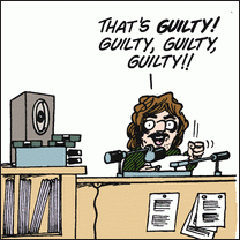
Christie put Hillary Clinton on trial. Maybe there was a teleprompter somewhere, but Christie wasn’t using it. He was on a roll, indicting Hillary for one failure, disaster or lie after another. The convention audience pronounced her guilty, bringing to mind the old Doonesbury cartoon:

guilty

Christie’s indictment was overwhelming, so Democratic commentators no doubt scrambled to term his speech dark, overly intense, too negative, and so on. I just hope millions were watching.

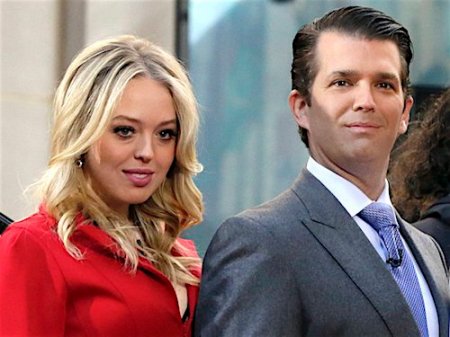
After Christie, Donald Trump Jr. took the stage. He spoke longer than his sister Tiffany, and was more nervous. But he did a very good job. He portrayed his father as a sort of blue-collar hero, and pointed out that Hillary Clinton is the first presidential candidate who couldn’t pass a background check. (That is true, actually, not hyperbole.) The Fox commentators thought Trump Jr. was dynamite; I wasn’t quite that impressed by him, but no doubt he moved the ball forward for the GOP.

trump kidsTiffany Trump and Donald Trump, Jr.

Ben Carson wrapped up the evening, but by the time he took the stage delegates were on their way out to enjoy, I guess, the pleasures of Cleveland’s night life. Dr. Carson did fine, I think, but I confess that I started this post before he was done.

It was a good night, because of the combination of Christie’s fiery denunciation of the eminently vulnerable Hillary and two very good appearances by members of the Trump family. Maybe liberals will be able to find words in Donald Jr’s speech that were previously uttered by a Democrat: “a,” “the,” “and,” who knows. But I doubt that they will be able to blunt the positive effect of the evening’s festivities.

A key goal of the convention is to unite the Republican Party behind Donald Trump. Trump wasn’t my first choice for the nomination, or my second or fifth, or tenth. I labored pretty hard to help others get the nomination. But Trump was, obviously, the story of the election season. He may be an imperfect vessel, but he speaks powerfully to a great many Americans. For myself, I am feeling unified behind the nominee these days.

Russian Commentator On U.S. Elections: Clinton Is Better For Russia

July 19, 2016

Russian Commentator On U.S. Elections: Clinton Is Better For Russia, MEMRI, July 19, 2016

“The U.S. is now in a very difficult situation. It is far from certain that Trump’s reforms will save it. It is far from certain that Trump will be allowed to implement them. But Trump is the U.S.’s chance at revival, after which it will be able to return to an aggressive foreign policy under more favorable conditions. Whereas Hillary Clinton is Washington’s guaranteed way into the abyss. After her, no Trump will be able to save America.”

******************

Rotislav Ischenko, an analyst for ‘Russia Today’ had an interesting take on the American elections. While the Russian public prefers Trump because he is viewed as an antagonist of the American elite epitomized by Hillary Clinton, Ischenko is rooting for Clinton. Republicans, excluding George W. Bush, generally proved themselves more skillful practitioners of international politics who skillfully manipulated Russia. The Clinton Administration began the American overstretch that committed resources to meaningless and unachievable goals. Therefore those who would prefer a weakened America should hope for a Clinton victory that would translate into America’s continued decline.

A translation of Ischenko’s article appears below:[1]

‘A Democrat Means A Guaranteed And Accelerated Continuation Of The Current Decline Of The American Supremacy’

RT ClintonVitaly, Vk.com/13studiya, May 27, 2016. While Clinton and Trump are fighting in the ring, the public cheers for Russian President Vladimir Putin.

“Most Russian experts, observers and even ordinary citizens who exhibit as much interest in the American electoral campaign as in the Olympics or the Football World Cup, side with Donald Trump in this race. This comes as no surprise.

“Firstly, Hillary Clinton is a lady who is too unpleasant in all respects. Secondly, her revoltingly negative attitude to Russia is widely known. Thirdly, Trump is outrageously flamboyant and he fights the traditional American elite. Who in this world likes the traditional American elite? In short, the Russians, without any reservations, are giving the People’s Choice Award to Donald Trump.

“One must admit that Donald Trump can become a better president for America than Hillary Clinton. At least, a Republican may give it a chance, whereas a Democrat means a guaranteed and accelerated continuation of the current decline of the American supremacy.

“But the Russians who side with Trump are hoping he will be a better American president for Russia as well. This view is, however, problematic. I would even call such hopes groundless and, if we could vote in the American elections, I would deliberately give my support to the former State Secretary and the wife of the 42nd president of the U.S. [Hillary Clinton].

“Here are my considerations: Firstly, historically the policies of the Republicans have always been more flexible and less dogmatic. Even [U.S. President Ronald] Reagan who proclaimed the USSR to be ‘The Empire of Evil’ quickly realized what advantages Washington could gain from the [former President of the Soviet Union] Mikhail Gorbachev’s version of de-escalation of tension and became the best friend of the Soviet Union. His successor, George Bush senior, also a Republican, even actively campaigned against the USSR breakup. He even visited Kiev specifically in order to convince the Ukrainian elites aspiring for independence that they would be much more comfortable in the Soviet Union.

“The 40th and the 41st U.S. presidents [Reagan and George H. W. Bush] were not altruists. Their thinking was less straightforward than that of the Democrats, and they knew that the direct way to their goal is not necessarily the shortest. As part of the theory of indirect action, they tried to hug the USSR to death, and they almost succeeded. In fact, they did not need the Soviet Union to collapse. They only wanted to weaken it and reduce it to the rank of a junior partner who would pull chestnuts out of the fire for the American hegemony even more effectively than the EU.

“It was a beautiful operation that should have led to the clear victory of the U.S. with the least costs. Even the collapse of the USSR did not invalidate it – just made it more complicated: now it was Russia that had to be hugged to death.

But then the Democrats came, represented by the Clintons, and they ruined everything. They rushed to stake out a claim on seemingly important but, in reality, strategically meaningless territories (in particular, in Yugoslavia). At the same time, the policy of deterrence against Russia was applied more and more noticeably in the post-Soviet territories.

Moscow grew wary, and public opinion in Russia, initially favorable to the U.S., became diametrically opposite. The chance was wasted, and the U.S. entered an exhausting race to maintain its supremacy, which has by now stretched its battle lines and eaten practically all the free resources, at the same time allowing Russia to concentrate, consolidate and launch a counter-offensive.

‘The Foreign Policy Paradigm Determined By The Clintons… Did Not Allow The U.S. To Choke The USSR/Russia In The Least Costly And Most Effective Way’

Obama’s Democratic administration proclaimed that it was aware of the necessity for significant reforms. The Nobel Peace Prize laureate [U.S. President Barack Obama] did make an attempt to break with the past, fold military activity all over the world, avoid confrontation with Russia and China, and concentrate on the domestic problems of the U.S. He failed for a number of reasons.

“Firstly, [Obama], personally, was not ready for the presidential office. Obama pronounced stirring speeches more often than tried to implement his own ideas.

“Secondly, since he understood little in foreign policy, he tried to focus on his domestic reforms (necessary, but insufficient), and gave the run of the foreign affairs to the same people who had implemented the idea of global ‘pawn-grabbing’ [a tendency of foolish chess-players] during Clinton’s term, neglecting the U.S. strategic interests.

“Thirdly, by the time of Obama’s presidency, the U.S. had advanced so far in the implementation of the idea of violent suppression of all potential foreign opponents, it had adhered so long to the tactics of ‘conquer everything, lose nothing,’ that without a single iron directing will that would implement an alternative comprehensive concept, neither the military nor the politicians nor the diplomats were able to break out of the vicious circle of decisions the inevitability of which was dictated by previous decisions.

“As a result, Obama became trapped by Clinton’s foreign policy, ruinous for the U.S., which had been implemented before by Clinton himself and then by the Republican administration of Bush junior. During the latter’s term, the inability of Washington to suppress all its opponents by force became evident, but Bush junior had neither experience nor will sufficient to turn the state ship around. Besides, for most of Bush’s term, the U.S. was euphoric about its formal foreign victories (Iraq, Afghanistan), and this inertial motion did not arouse any significant concern in anyone except a small number of domain specialists.

“On the whole, the foreign policy paradigm determined by the Clintons that has lasted as the leading one for six presidential terms of three presidents did not allow the U.S. to choke the USSR/Russia in the least costly and most effective way. The same paradigm caused the U.S. to overstrain itself; its resource base is no longer up to the task of global domination.

‘When We Deal With Hillary, We Deal With An Unpleasant But Predictable [Politician]… Trump Is Not Burdened By Rules Of Morality, At Least Not More Than Hillary’

Today, the Washington elites are facing a choice again. They can pig-headedly continue the same policy of pressure by force, hoping that the opponent will break before the U.S. is exhausted. In fact, today it means hoping for a miracle, like the coup of 1917, which took Russia out of the First World War and delayed Germany’s downfall by 18 months. Hillary Clinton is a supporter of this policy.

We understand what she will do and how. We understand we will have to deal with hysterics, attempts to apply pressure, blatant rudeness and undisguised threat of war. But we also understand that it is not Hillary who will decide whether or not to push the button. And the people who will decide are much more level-headed. In short, when we deal with Hillary, we deal with an unpleasant but predictable and see-through politician who will continue to lead the U.S. along the way towards resource overstrain.

“Trump is no Bush junior. He is the focus of all the strong points of the Republican party. He is not burdened by rules of morality, at least no more than Hillary. But he is more flexible and sees other ways of solving the American problem, besides the pig-headed direct pressure. Above all, Donald Trump understands that without stabilizing the economy and the financial system of the U.S., all its claims to world domination are no more than wishful thinking, and the U.S. is in danger of quickly becoming ‘Upper Volta’ with missiles”.

“One must realize that Trump is not alone. Of course, he speaks against the traditional Republican establishment, but it does not mean he does not enjoy the support of influential back-stage circles, who have become aware of the ruinous character of Clinton’s policy and are trying a more creative approach. Without powerful support (taking into account how the American press is controlled by the party elites), Trump would simply never have been given the opportunity to speak. All his billions would not have sufficed for a serious campaign. One can assume that Trump will try to offer the U.S. something like the policy Putin has been implementing in Russia.

“Firstly, [Trump seeks] an acceptable compromise in foreign policy. The U.S. reduces its activity in the major conflict areas, on condition that it saves its face. Secondly, [he will shift to] focusing on domestic problems. That is, tough reforms leading to painful but decisive revitalization of the financial and economic systems, in particular, at the expense of the outside world (Trump has already acknowledged the possibility of the U.S. defaulting). Thirdly, play on the contradictions of the remaining major players, whom the U.S. will find it easier to play off against each other in the context of reduced international activity, because their necessity to defend themselves from common danger – Washington – will disappear, but the mutual contradictions will exacerbate.

“The U.S. is now in a very difficult situation. It is far from certain that Trump’s reforms will save it. It is far from certain that Trump will be allowed to implement them. But Trump is the U.S.’s chance at revival, after which it will be able to return to an aggressive foreign policy under more favorable conditions. Whereas Hillary Clinton is Washington’s guaranteed way into the abyss. After her, no Trump will be able to save America.”


Endnote:

[1] Ria.ru, May 19, 2016.
Cartoons of the Day

July 19, 2016

H/t Vermont Loon Watch

endorse


H/t Freedom is Just Another Word

loco-logo-1


Will the American voters be concerned with Hillary Clinton's history as she interviews for job as President?

Will the American voters be concerned with Hillary Clinton’s history as she interviews for job as President?

Cartoons of the Day

July 16, 2016

H/t Freedom is Just Another Word

sheeple


H/t Power Line

Hill pokeman


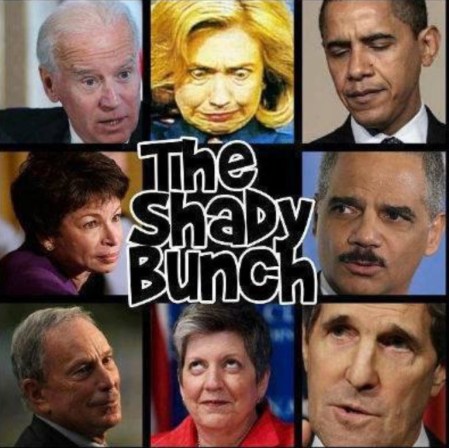
shady bunch


hill and bern


ginsburg sleeps

H/t Joopklepzeiker

political correctness

Why We Must Elect Donald Trump

July 16, 2016

Why We Must Elect Donald Trump, Power LineY John Hinderaker, July 16, 2016

(This is the first Power Line post to present vigorous support for Trump. — DM) 

Some people think that Hillary Clinton, for all her corruption, is at least smarter than Barack Obama. Others observe her ruthlessness toward political opponents and infer that, unlike Obama, she will be a tough defender of American interests. No: for goodness’ sake, the woman has a four-year history as Secretary of State! If there is one thing we know for certain about Hillary, it is that as president she would preside over an inept and America-destructive foreign policy.

And, to put the most charitable construction on her words, the woman is an idiot. Andy McCarthy records, and places in context, Hillary’s first comment on the latest terrorist attack in France:

Let’s be clear: Islam is not our adversary. Muslims are peaceful and tolerant people and have nothing whatsoever to do with terrorism.

We simply cannot afford another four years of such mind-numbing stupidity in the White House. Donald Trump has many faults as a presidential candidate. You don’t need me to list them for you. But he is not Hillary Clinton, he is not committed to a view of the world’s dangers that is almost literally insane, and he will not give us a third Obama term in either domestic or foreign policy. He also won’t appoint people like Ruth Bader Ginsburg to the Supreme Court. Our next president will be either Donald Trump or Hillary Clinton; we desperately need for it to be Trump. He deserves, and badly needs, our financial support.