(Those who don’t learn from history’s mistakes are doomed to repeat them…..or something like that. – LS)
(Those who don’t learn from history’s mistakes are doomed to repeat them…..or something like that. – LS)
Poll: 47 percent of Israelis back Iran strike following nuke deal
By AFP and Times of Israel staff July 17, 2015, 11:18 am

An Israeli Air Force F-16 warplane…all dressed up and nowhere to go.(Ofer Zidon/Flash90)
(Unbelievable that so many of the world’s democracies are split on key issues today. In terms of America (Israel included), I ask myself when will the ‘sleeping giants’ of the world awaken from this self-induced coma? – LS)
Almost half of Israelis would support a unilateral strike to prevent Iran obtaining the atomic bomb, an opinion poll carried out after Tuesday’s nuclear deal between Tehran and major powers found.
In survey by Maariv, 71% say they believe accord brings Iran closer to bomb, and 51% support bypassing Obama in effort to nix it.
Nearly three-quarters of respondents in the poll published by the Maariv newspaper on Friday said they thought the agreement would accelerate Iran’s development of a nuclear weapon, not prevent it as claimed by the powers.
Asked “Do you support independent military action by Israel against Iran if such action is needed to prevent Iran from obtaining a nuclear weapon?” 47 percent said yes, 35% said no and 18% expressed no opinion.
Additionally, a majority of Israelis (51%) felt Jerusalem should use whatever means necessary to convince the US Congress to reject the deal, while only 38% said it was now time to engage with US President Barack Obama on the execution of the deal in order to achieve conditions preferable to Israel. Eleven percent said they did not know what the best course of action was.
Asked: “In your view, does the agreement that was signed bring Iran closer to obtaining a nuclear weapons capability?” 71% said yes.
The paper did not give a sample size or margin of error for the poll carried out by Panels Politics Polling Institute.
Israel has long opposed any deal with its arch-foe Iran, and Prime Minister Benjamin Netanyahu has lambasted the landmark agreement as a “historic mistake.”
He has repeatedly threatened to take military action if necessary to prevent Iran obtaining a nuclear weapon.
Netanyahu has said Israel is not bound by the deal between Iran and the six world powers and on Wednesday said the agreement was “not the end of the story.”
Israel is believed to have the Middle East’s sole, if undeclared, nuclear arsenal. Iran has always denied any ambition to acquire one, insisting its nuclear program is for peaceful energy and medical purposes only.
Israel’s air force commander Major-General Amir Eshel said earlier this year that while the use of military force against Iran’s nuclear facilities would be an act of “last resort,” the military had “the genuine capacity to get the job done.”
The Channel 10 TV report in April said that Israel had invested “immense resources” in preparing for a possible strike on Iran. “The Israeli Air Force has been building the capacity to attack Iran for more than a decade,” it said.
‘All evidence suggests Iran already has nuclear warheads’
By Garth Kant, April 2, 2015 Via World Net Daily (Note: published four months ago!)

The Three Stooges…or are they? [Source: Unknown]
(Does Iran have the bomb? Seems pretty important given all that’s transpired lately. It they do, that would be a real game changer and everyone’s credibility would be on the line. Regardless, even the source of this article could come under question. Still, it makes a lot of sense. Why wouldn’t they have the bomb at this point? – LS)
Analyst: Obama administration almost certainly knows and is ‘fine’ with it
WASHINGTON – On a day when Iran and Western powers announced they had reached a framework of a deal, a highly informed and keen-eyed analyst believes the Obama administration wasn’t actually trying to stop Iran from obtaining nuclear weapons.
In fact, just the opposite.
“If Iran wanted to be nuclear, that was fine with this administration. I really think that’s their policy,” said Middle East specialist Clare Lopez of the Center for Security Policy.
Lopez described the talks with Iran talks as a diplomatic kabuki dance intended to cover up the awful truth: Iran already has what it wants.
“All the evidence suggests Iran already has nuclear warheads,” she told WND.
Worse yet, she said the Obama administration almost certainly knows that.
“IAEA (International Atomic Energy Agency) reporting over recent years indicates at a minimum they strongly suspect that Iran already has built nuclear warheads. It’s certainly known that Iran has long range ICBMs (intercontinental ballistic missiles.)”
“The only thing I don’t think we know for sure is whether the Iranians have been able to marry the nuclear warheads to missiles, which is a technically difficult thing to do,” said the woman whose analytical acumen was honed by 20 years as a CIA field operative.
The New York Times described the framework deal announced Thursday as a “surprisingly specific and comprehensive general understanding about the next steps in limiting Tehran’s nuclear program.”
But it doesn’t appear the parties agree upon what they agreed to, because after the announcement, Iran immediately accused the U.S. of lying about what was in the agreement.
Chief Iranian negotiator Mohammad Javad Zarif told reporters the agreement would allow Iran to keep operating its nuclear program.
“We will continue enriching; we will continue research and development,” and not close any facilities, Zarif said.
He also crowed that essentially all economic sanctions against Iran will be removed after the deal is signed, by the deadline of June 30.
The proposed deal would also allow Iran to keep operating 6,000 centrifuges capable of producing enriched uranium, a fuel for nuclear weapons. After 15 years, Iran would be free to produce as much fuel as it wishes.
What do YOU think? Is America taking Islam seriously enough? Sound off in today’s WND poll!
Israeli Prime Minister Benjamin Netanyahu had a stark assessment of the agreement, tweeting, “A deal based on this framework would threaten the survival of Israel.”
Nonetheless, President Obama claimed the deal “cuts off every pathway” for Iran to develop a nuclear weapon. And, he insisted, “If Iran cheats, the world will know it.”
But from what Lopez surmises, whatever is in the deal is largely irrelevant, because Iran basically already has what it wants.
WND asked Lopez, if Iran already has warheads, did it buy or build them?
“I think they built them,” she said. “I don’t see how not, after this many years of working closely with other countries’ programs.”
So, if the objective wasn’t to prevent Iran from getting the bomb, why was the Obama administration so desperate to get a deal?
“To sort of rack up a political win,” said Lopez. “It’s for appearances. A political notch in the gun belt. But it’s not real. I mean, they know it’s not real.”
The administration’s eagerness for a deal was expressed as far back as January 2013, when national security council staffer Ben Rhodes told liberal activists it was as important to the president as Obamacare, saying, “This is probably the biggest thing President Obama will do in his second term on foreign policy. This is health care for us, just to put it in context.”
That zeal for a deal has made the rest of the world wary.
“What bothers me is it looks like the administration is so hungry for a deal just to have a deal so they can say they have a deal,” House Speaker John Boehner said Thursday, before the deal was announced and upon returning from a trip to Israel and five other countries in the Middle East. “The rest of the world wants something real out of this.”
“And we’re in these talks with the people who describe us as Satan, like we’re going to come to some agreement with the Iranians, while they’re spreading terror all over the Middle East,” he added.
Lopez told WND, “I’m not sure if architects of this policy agenda, including the president, actually understand the history of Islamic jihad and what it’s done in, and to, the world – especially the non-Muslim world, much of which was forcibly subjugated to Islamic rule over the centuries. Or else, how could they possibly follow such a policy?”
She also warned that the administration may not fully recognize Iran is so dangerous because it is not seeking peaceful coexistence; ultimately, it is seeking world domination and has not shied from expressing that openly.
“According to its own constitution, it is dedicated to jihad and a global Islamic government under Shariah. Its ideology says it can accelerate the return of the 12th Imam by instigating Armageddon: a frightening thought about a regime driving for a nuclear bomb.”
Lopez noted a distinct peculiarity to keep in mind when negotiating with Iran: “Islamic law obligates Muslims to lie to non-Muslims. Why on earth would anyone expect Iran, a jihad and Shariah state, to negotiate with Westerners in good faith?”
Lopez does see “a tremendous naivete about what jihad and Shariah really mean” on the part of the Obama administration.
She detects “an apparent trust that if the U.S. adopts a more accommodating attitude, well, then so will the Iranians. I’m not sure how Ivy League graduates could be so ignorant of world history. I cannot imagine they’d want to inflict the legacy of Islamic jihad on anyone if they knew what it has meant historically.”
The Washington Post reported another possible motivation for Obama to strike a deal, almost any deal, with Iran: personal pride.
“The negotiations are also personal for the president. Obama was dismissed as dangerously naive in 2007 by then-candidate Hillary Rodham Clinton for suggesting that he would engage in ‘aggressive personal diplomacy’ with Iran,” reported the paper Wednesday.
“There’s a determination to prove the Republicans wrong, and to prove the world wrong,” Julianne Smith, a former deputy national security adviser to Vice President Biden, told the Post.
Lopez enumerated four more reasons why she believed the president pushed so hard for a deal:
•Obama has decided to remove U.S. power and influence from the Middle East and North Africa.
•He has a worldview that sees America as influence for ill in the world; therefore, he must diminish that influence wherever and however possible.
•He has a worldview that sees Islam as suppressed and oppressed by Western (colonial) powers and the U.S. as the inheritor of that oppressive role.
•He has a desire to “rectify” what is viewed as “injustice” suffered by Islam at the hands of the West and has decided that best way to do that is for the U.S. to withdraw and allow and empower Islam to rise back up again to what is seen as its “rightful” place in the world.
Why does Lopez believe the evidence suggests Iran already has built nuclear warheads? Because so much of that evidence has been publicly available for so long.
In 2004, the AP reported an Iranian opposition group revealed that the regime had bought blueprints for a nuclear bomb from the same black-market network that provided Libya such diagrams, and that it was continuing to enrich uranium despite a commitment to suspend that effort.
The National Council of Resistance of Iran, or NCRI, said the diagram was provided by Abdul Qadeer Khan, the Pakistani head of the network linked to nuclear programs in both Iran and Libya.
The NCRI has a long record of providing accurate information on Iran’s nuclear weapons program.
On Aug. 15, 2002, the exiled group revealed that Iran was building two secret nuclear sites: a uranium enrichment plant at Natanz and a heavy water production plant in Arak.
In 2005, the New York Times reported senior U.S. intelligence officials provided the IEAE with the contents of “stolen Iranian laptop containing more than a thousand pages of Iranian computer simulations and accounts of experiments – studies for crucial features of a nuclear warhead.”
NPR reported that in 2006 nuclear bomb blueprints were discovered “on computers belonging to three Swiss businessmen under investigation for their ties to the smuggling ring directed by Khan,” according to former U.N. weapons inspector David Albright.
The information was made public in 2008, by which time Khan was under “house arrest for having sold nuclear secrets to Libya and other countries.”
The Guardian reported in 2006 the U.S. had evidence that Iran was designing “a crude nuclear bomb, like the one dropped on Nagasaki in 1945.”
The U.S. said bomb blueprints were “found on a laptop belonging to an Iranian nuclear engineer, and obtained by the CIA in 2004.”
Lopez said if “you read between the lines” of its report back in November 2011, it was clear that even the IAEA believed Iran had been working on a nuclear warhead as well as the explosive triggers for initiating the implosion sequence.
“So, yes, they’ve had the information how to build a warhead for a long time. They’ve had expert assistance from, at a minimum, North Korea and Pakistan,” she said. “They’re documented by the IAEA as having engaged in activities related to warhead development. There are satellite images from Parchin of what are believed to be ‘containers’ in which warhead triggers were tested. And Iranian officials have been reported present in North Korea during nuclear tests.”
Parchin is one of the sites where Iran does not permit IAEA inspectors to go.
Secretary of State John Kerry said Thursday that, under the deal, Iran would allow the IEAE to inspect anywhere it wants.
But, before the deal was announced, Lopez warned, “The whole inspection thing is kind of voluntary. The IEAE submits a request to tell the Iranians where they want to go and they can comply or not.”
Lopez described the Iranians’ transparency and honesty about its program as nonexistent. And, she noted, Iran has always avoided compliance with the international obligations it has already agreed to.
“Every single facility that we know about, publicly, in their nuclear weapons program was revealed by someone other than Iran. As a signatory to the NPT (Non-Proliferation Treaty) they are responsible for reporting to the IEAE all of their facilities and opening them up to inspection. They have never, ever volunteered admission of a single one. It all came from satellite photos, intelligence services or the Iranian opposition.”
Since satellite photography showed the structures at Parchin were designed for the testing of the explosive charges used to detonate nuclear warheads, Lopez said it begged the question: “On what do you test these explosive triggers, if you don’t have a warhead?”
Lopez said the Iranians were conducting research and development on nuclear warheads at Lavizan, the existence of which was revealed by the NCRI in 2002.
“Once it was exposed, the Iranians razed it to the ground. Leveled all the buildings, every tree, bush, and blade of grass and carted it off to I-don’t-I-know-where, and then they turned the place into a city park with picnic benches and tennis courts. This is how they act.”
Lopez said the key threshold for the Iranians is perfecting a delivery system for a warhead.
“I don’t know if they’ve married it to a missile. Until it’s on top of a missile it’s not deliverable, at least, in the usual way.”
She described Iran’s missiles as an enormous problem the West is ignoring at its own peril.
“Iran’s ICBMs are not even on the table for discussion. They are explicitly excluded from these talks.”
Furthermore, “The Pentagon has open-source reporting available now for at least two-to-three years that Iran’s ICBMs would be able to reach the continental U.S. this year, 2015. It has the range to hit the US, I don’t know about accuracy. They’ve got solid rocket-propellant fuel, all the things that help a missile increase its range.”
So, it all boils down to whether they can marry the warhead to the rocket?
“Yes.”
When they accomplish that, can they both attack Israel and launch an EMP attack over the United States?
“Yes. All they need is one missile to attack America. It wouldn’t even have to be an inter-continental missile. It could be a ‘Scud in a bucket.’ They could put a shorter range missile on a fishing trawler, park it outside the international water boundary, and send it over Kansas.”
Former CIA Director James Woolsey wrote in the Wall Street Journal in August of a study that concluded an electromagnetic pulse, or EMP, attack, which could knock out America’s electrical grid with a single nuclear explosion over the nation’s heartland, would kill up to 90 percent of the U.S. population within a year, due to starvation, disease and societal breakdown.
In other words, a single nuclear bomb would give Iran the ability to inflict an apocalypse upon the United States, and effectively destroy it, with merely the flip of a switch.
“There’s an open-source report about an Iranian military document that showed their military doctrine explicitly calls for the use of an EMP weapon against the United States. That doesn’t mean they have the capability already but they are thinking about it,” warned Lopez.
“We’re dealing with a regime that not only was responsible, in part, for collaboration in the 9/11 attacks, which has attacked, killed and tortured our people for 36 years, but is also a regime with an ideology that has a messianic and apocalyptic theology that envisions an Armageddon to bring on the end times according to their beliefs. It is also an eschatology that is absolutely imbued with Jew hatred. So, why on earth, should we negotiate with a regime like that? Knowing that, ever since the beginning, they have never negotiated in good faith. Ever.”
She clarified how different this was than negotiating with the Soviets during the Cold War because they were just as concerned about their own survival as were Americans, unlike the mullahs in Tehran.
The Cold War doctrine of deterrence relied upon the belief that neither side would launch an attack if it was assured the other side would launch an equally devastating counter-attack.
The theory was that “mutually assured destruction,” or MAD, guaranteed neither side would launch an attack because it would also be committing suicide.
However, that theory does not necessarily apply to Iran.
Lopez recalled the words of Mideast scholar Bernard Lewis that, when it comes to the apocalypse-seeking mullahs of Iran, “Mutually assured destruction is not a deterrent factor, but rather an inducement.
“And that’s how they think,” lamented Lopez. “They think they’re going to bring back the 12th imam to launch the end times, by bringing Armageddon on Earth.”
The analyst also described a number of other problems with the administration’s negotiations with Iran.
First, the U.N. Security Council has passed six resolutions demanding that Iran halt all nuclear enrichment, period.
Before the plan was announced, she observed, “All we know about the talks is what’s leaked; we don’t have an official version, but we are given to understand that our side is ready to concede that Iran may continue enriching.”
That proved to be true when it was reported the deal will allow Iran to keep running 6,000 centrifuges, and, after 15 years, as many as it wishes.
She noted the Joint Plan of Action agreed to by world powers and Iran in 2013 said very explicitly it’s envisioned that Iran will continue to enrich.
“Right there, they’ve flouted six U.N. resolutions,” she said. “Iran has 19,000 centrifuges for enriching uranium that they’ve admitted to. Only about 10,000 are hooked up and operating. The others are not attached yet. The deal will reportedly let Iran run 6,000 centrifuges, and the remainder do not have to be destroyed. All they have to do is say they unhooked them. So they don’t have to destroy any centrifuges. They don’t have to remove any centrifuges. They just have to say they unplugged them.”
Another major problem, Lopez pointed out, is that Iran already has quite a stockpile of enriched uranium, a key ingredient to a nuclear weapon.
“They diluted some of it into a less-readily accessible form, but they kept it all,” she said. “It only takes a week or two to reverse that process and get back up to enriched uranium.”
WND mentioned that Israeli Prime Minister has pointed out that any Iranian enrichment capability was an unacceptable danger. And WND recently reported that former U.N. Ambassador John Bolton was amazed the U.S. had moved from an original position, 15 years ago, of insisting Iran have no enrichment capabilities, to negotiating over how much enrichment capability the terrorist state could have.
“How do you, in negotiations, all of a sudden decide you’re going to overturn six U.N. Security Council resolutions?” asked Lopez, both rhetorically and incredulously. “What authority do they have to do that?”
And one more major problem cited by Lopez: “The Iranians reportedly are permitted to continue working on more advanced generations of centrifuges. They are developing newer centrifuges that can make more enriched uranium, faster.”
WND then pointed to yet another problem: reports that Iran is outsourcing much of its nuclear program, so that any deal struck with the West wouldn’t even cover much of the mullahs’ effort to become a nuclear power.
On Sunday, Gordon Chang wrote in the Daily Beast a description of the vast breadth of Iranian outsourcing.
North Korea and Iran announced a technical cooperation pact in September of 2012, and one month later, “Iran began stationing personnel at a military base in North Korea, in a mountainous area close to the Chinese border. The Iranians, from the Ministry of Defense and associated firms, reportedly are working on both missiles and nuclear weapons.”
“Mohsen Fakhrizadeh, thought to be Tehran’s chief nuclear scientist, was almost certainly in North Korea at Punggye-ri in February 2013 to witness Pyongyang’s third atomic test. Reports put Iranian technicians on hand at the site for the first two detonations as well.”
Chang also reported the North Koreans have also sold Iran material for bomb cores, “perhaps even weapons-grade uranium.”
Additionally, “Hundreds of North Koreans have worked at about 10 nuclear and missile facilities in Iran.”
Indications are China is cooperating with the two countries.
“There have been continual reports of transfers by Chinese enterprises to Iran in violation of international treaties and U.N. rules. Chinese entities have been implicated in shipments of maraging steel, ring-shaped magnets, and valves and vacuum gauges, all apparently headed to Iran’s atom facilities. In March 2011, police in Port Klang seized two containers from a ship bound to Iran from China.”
Chang’s conclusion about Iranian outsourcing was alarming: “[T]hey will be one day away from a bomb – the flight time from Pyongyang to Tehran – not one year as American and other policymakers hope.”
Lopez told WND, “I would say the Daily Beast story is accurate. That is my understanding of how things have been for many, many years. A working relationship between Iran and North Korea makes sense to them.”
Why?
“Iran has the world breathing down its neck. North Korea has taken itself out of the nuclear non-proliferation treaty, but Iran is still a signatory. The Iranians and North Koreans have been working together for many, many years on warheads and on missiles.”
If this information is so publicly known, why would State Department spokeswoman Marie Harf dismiss as “bizarre” reports from top analysts that Iran was likely hiding key nuclear-related assets in North Korea, and that the two regimes were transferring enriched uranium and ballistic missile technology back and forth?
“I think it is known inside the State Department, and certainly inside the INR (Bureau of Intelligence and Research), their research branch, a small division within the department that’s part of the intelligence community. They for sure know about this. Whether Marie Harf knows, maybe not.”
So, then Secretary of State John Kerry and the other negotiators know about the vast Iranian outsourcing, too?
“Of course he does! At his level, he would have to know.”
So, if the administration is not disclosing so much information about what Iran is doing behind the scenes, WND asked Lopez, would Obama would ever utilize the military option to destroy the country’s nuclear program?
“No.”
Does Israel have a viable military option?
“Yes.”
She referred to multiple reports in February that Saudi Arabia had leaked word it would let Israel fly over its airspace to attack Iran if necessary.
But does Israel have the ability to take out Iran’s radar and air defenses and reach Iranian facilities located deep underground without U.S. bunker-buster bombs?
Lopez referred to the book “A Time to Attack” by Georgetown professor and former Pentagon strategist Matthew Kroenig, which, she said, described how “Israel by itself cannot knock out Iran’s entire program or bring down the regime, the only sure way to stop the program. But if the Israelis took out four key facilities they could buy time, at least one or two years.”
As for reaching buried sites, Lopez said bunker-buster bombs might not be needed if Israel were to drop “multiple bombs down the same hole.”
Besides, they don’t need to destroy the facilities: merely collapsing the entrance of a site “would turn it into a sarcophagus.”
That, she said, would cripple Iran’s program for a while.
Would that be worth the risk of massive Iranian retaliation and a full-scale regional war?
“I think it depends on the Israeli assessment of how close they are to deliverable nuclear weapons capability. Everything depends on that assessment. If Israel thinks Iran is close, they have to go,” concluded the analyst.
“They can’t wait.”
Jewish peer organising rescue mission for Christians in Syria and Iraq
By Rosa Doherty, July 14, 2015 Via The Jewish Chronicle

Debt repaid many times over. [Source: Unknown]
(We are so blessed to still have these folks in our midst. – LS)
Lord Weidenfeld is funding a rescue mission of up to 2,000 Christian families from Syria and Iraq.
Weidenfeld’s Safe Havens Fund flew 150 Syrian Christians who were fleeing Daesh (sometimes known as Isis) to Warsaw on Friday to seek refuge in Poland.
But the project has faced criticism over Lord Weidenfeld’s decision not to include Muslims in the rescue effort.
The United States refused to take part and other countries made claims of discrimination.
Funding was also given by other Jewish philanthropists and charitable groups such as the JNF, and aims to offer 12 to 18 months of support to the refugees.
Lord Weidenfeld defended the project and said: “I can’t save the world, but there is a very specific possibility on the Jewish and Christian side.
“Let others do what they like for the Muslims.”
The publisher, who co-founded Weidenfeld and Nicolson in 1948, was rescued from Nazi-occupied Austria thanks to the generosity of members of the Plymouth Brethren, a Christian group, which took him in, fed and clothed him.
He said: “I had a debt to repay. It applies to so many of the young people who were on the Kindertransports. It was Quakers and other Christian denominations who brought those children to England.
“It was a very high-minded operation and we Jews should also be thankful and do something for the endangered Christians.”
The peer paid for the privately chartered plane to carry the first batch of refugees with the agreement of the Polish government and the Assad regime in Syria.
Lord Weidenfeld, 95, told the Times: “The primary objective is to bring the Christians to safe haven. Isis is unprecedented in its primitive savagery compared with the more sophisticated Nazis.
“When it comes to pure lust for horror and sadism, they are unprecedented. There never was such scum as these people.
“My main concern is — and this is terribly important for me as a member of the generation that can look back to the time before World War Two — the lack of will to defend oneself; to get boots on the ground and to get rid of these people. The lack of desire to fight the enemy, to slay the dragon in his lair.
“I am appalled by the lack of action. The brave Kurds have shown in the battle for Kobani that you can defeat them. In a disunited world, the road is wide open for the terrorists.”
He said that he hoped to mirror the work done by Sir Nicholas Winton, who helped 669 children escape from Nazi persecution.
Christians are among the religious groups who have been murdered in Daesh attacks, along with Druze, the Yazidi sect, Alawites and Shia Muslims.
There were 1.1 million Christians in Syria in 2011, but in March a report from the European Parliament said that 700,000 had fled since the start of the conflict.
Nuke Deal Helps Qasem Soleimani, The Top Iranian General With ‘American Blood on His Hands’
by Shane Harris 14 Jul 2015 Via The Daily Beast

Stay scared my friends.[Source: AP]
(A lot of wounded Marines would love to even the score with this snake. – LS)
John Kerry denied it. So did Iran’s foreign minister. But the world’s most notorious spymaster stands to benefit—big time—from the accord with Tehran.
Among the big winners in the agreement to curtail Iran’s nuclear program, count a notorious and shadowy Iranian general who helped Shiite militias in Iraq kill American soldiers and who has come to the rescue of Syrian dictator Bashar al-Assad.
You’ll find his name, Qasem Soleimani, buried in an annex (PDF) of the unremittingly dense Joint Comprehensive Plan of Action, along with some of his colleagues from the senior ranks of the Iranian Revolutionary Guard Corps, as well as its various divisions and corporate fronts. They’ll all be granted some sanctions relief as part of the U.S.-brokered deal to curtail Iran’s development of a nuclear weapon.
That Soleimani—who runs Iran’s elite paramilitary and covert operations group, the Quds Force—was even on the list appeared to catch some U.S. officials by surprise. A senior administration official briefing reporters on Tuesday morning didn’t have a ready response when asked when and why Soleimani was added. Secretary of State John Kerry reportedly denied that the 58-year-old general was on the list to be freed from the sanctions yoke. Iranian foreign minister Javad Zarif, agreed, saying Soleimani—whom the U.S. accused in 2011 of plotting to launch a terrorist attack in the United States—had been confused with someone else with a similar name.
They were all wrong—or maybe didn’t want to be right. Soleimani is, in fact, on the list, a Treasury Department official later confirmed to The Daily Beast. And his presence definitely surprised some powerful lawmakers, who are already sharpening their knives for a filleting of the Iran deal.
“He’s got American blood on his hands,” Sen. John Cornyn said of Soleimani. “I’m not sympathetic to lifting sanctions on him, that’s for sure.”
“Soleimani is the guy that sent the copper-tipped IEDs into Iraq,” said Senate Armed Services Committee Chairman John McCain, referring to powerful improvised explosive devices, which Marine Corps Commandant Gen. Joseph Dunford testified last week were responsible for the deaths of 500 soldiers and Marines. “That is really unbelievable,” McCain said when asked about Soleimani’s name showing up in the bowels of the Iran nuclear deal.
And Soleimani is not alone. The man whom retired general and ex-CIA director David Petraeus once called “truly evil” is joined in the get-out-of-sancitons club by other military officers, including a Revolutionary Guard Corps general, Mohammad Reza Naqdi, who said that “erasing Israel off the map” should still be Iran’s objective, even if the country’s isn’t allowed to build a nuke.
Joining him are Brigadier General Mostafa Mohammad Najjar, a former interior minister and minister of defense who also advocated attacking Israel; Brigadier General Mohammad Naderi, who runs Iran’s Aerospace Industries Organization (also getting sanctions relief); and Brigadier General Hossein Salami, who said Iran’s quest for modern weapons was guided not by military strategy, but by religion.
There are plenty more where they came from. But why bother counting? The entire Quds Force, the Revolutionary Guard’s Air Force, and the Al-Ghadir Missile Command are also getting sanctions relief in the years to come—presuming that Iran hasn’t reneged on its commitments by then or a future U.S. president hasn’t tried to roll back the deal, as Republican contenders Scott Walker, Marco Rubio, and Rick Perry have all said they’d do if elected.
This international rogues gallery of spies, soldiers, and anti-Semites were thrown into the deal like ingredients in a stew. Who put them there is still unclear. But Kerry’s apparent misunderstanding aside, U.S. officials would have negotiated every name on the list, making it almost impossible that Soleimani was snuck in by surprise.
There are hundreds of companies, government entities, and individuals slated to get sanctions relief. “Presumably, in the beginning, the Iranians put a list across the table and said, ‘We want these people off the sanctions list,’” Zachary Goldman, a former senior official in the Treasury Department’s Office of Terrorism and Financial Intelligence, told The Daily Beast.
Goldman, who helped develop Iran sanctions policy, said that an array of U.S. government departments review such proposals, just as they do when deciding whether to impose sanctions. Obama administration officials were certainly aware of who was on the final list of the Iran agreement, Goldman added.
Sanctions relief is the very heart of the nuclear deal, but you need a panel of experts to explain how it works. Annex II, and its corresponding “attachments,” describe the international choreography by which Iran submits to a series of inspections of its nuclear facilities by United Nations experts and, in return, the United States and the European Union lift one set of sanctions after another.
There are two “phases” in which sanctions are removed. The first should come relatively soon—probably in the next few months—after Iran makes good on its commitments and the inspectors give the thumbs up. Then the Europeans and the Americans lift a raft of sanctions, mostly on companies that have had some connection to Iran’s nuclear weapons program.
Next comes phase two. That’s much later—as many as eight years from now. And this is the round where Soleimani and his IRGC buddies finally get their big day. But only the Europeans will be helping them out.
Why? The Obama administration has opted only to lift only nuclear-related sanctions, because, it says, the Iran deal is strictly limited to the country’s nuclear program, not its status as a leading sponsor of global terrorism or its abysmal human rights record. Granting concessions to Soleimani, who is accused of helping to kill American soldiers, propping up a brutal dictator who gassed his own people, and conspiring to blow up a Saudi Arabian official in a popular Washington, DC, restaurant frequented by U.S. politicians, would eviscerate the Obama administration’s entire premise in the Iran negotiations.
Why the Europeans felt fine giving Soleimani a hand is still unclear. But even those who will be unshackled from U.S. sanctions are hardly free of terrorist ties. “Some of them are also involved in terrorist activities or human rights abuses, and yet they’ve only been hit for their proliferation activities,” Matthew Levitt, the Director of the Stein Program on Counterterrorism and Intelligence at the Washington Institute, told The Daily Beast. Like them, Soleimani will have his reward, regardless of who’s giving it to him. He and his fellow generals “will almost definitely be able to open bank accounts in Europe,” Levitt noted.
Plenty of financial penalties will remain in place. But Obama officials are sensitive to any lightening of Soleimani’s load.
“His designation under U.S. sanctions will in no way be impacted by the Joint Comprehensive Plan of Action reached today,” the Treasury Official said. She added that “secondary sanctions remain in place on the U.S. side,” which means that anyone or any company doing business with Soleimani can also be penalized.
Even if sanctions aren’t lifted on Soleimani and the Iranian military establishment right away, however, they will undoubtedly reap some short-term benefit. Iran has billions in frozen assets that, once thawed, the regime could pour into military adventures and terrorist plots.
“We are of course aware and concerned that, despite the massive domestic spending needs facing Iran, some of the resulting sanctions relief could be used by Iran to fund destabilizing actions,” a State Department official recently told The Daily Beast.
Such is the price of a deal. Whether the United States comes to regret paying it, we’ll find out. Maybe in eight years.
Tom Cotton Defies Obama: ‘I Believe That Congress Will Kill The Deal’
by Charlie Spiering14 Jul 2015 Via Breitbart

Kerry: If you agree I promise everyone a free case of Heinz ketchup.[Source: Joe Klamar – AFP – Getty Images]
(Having more faith in this country than most folks and a belief that wiser men will prevail, I have to say (and pray) Mr. Cotton is right. Besides, it’s not over until the proverbial fat lady sings. – LS)
Sen. Tom Cotton (R-AR) denounced the Iranian nuclear deal hailed by President Obama early Tuesday morning, calling it a mistake.
“This proposed deal is a terrible dangerous mistake that’s going to pave the path for Iran to get a nuclear weapon while giving them tens of billions of dollars of sanctions relief,” he said in an interview on MSNBC’s Morning Joe.
Cotton, a freshman senator, has made his opposition to the deal the center of his emerging political career.
He described Iran as an “outlaw, terrorist sponsoring, anti-American regime” and criticized the deal for leaving its nuclear program intact.
Cotton appeared confident that Congress would oppose the deal, once the full details of the deal were released, exposing key provisions such as lifting the arms embargo on Iran, and the weakness of requirements of nuclear inspections.
“The American people will repudiate this and I believe Congress will kill the deal,” he stated.
Iran Is Responsible for More Than 1,000 American Military Deaths Since 9-11
by David French July 14, 2015 12:26 PM Via The National Review
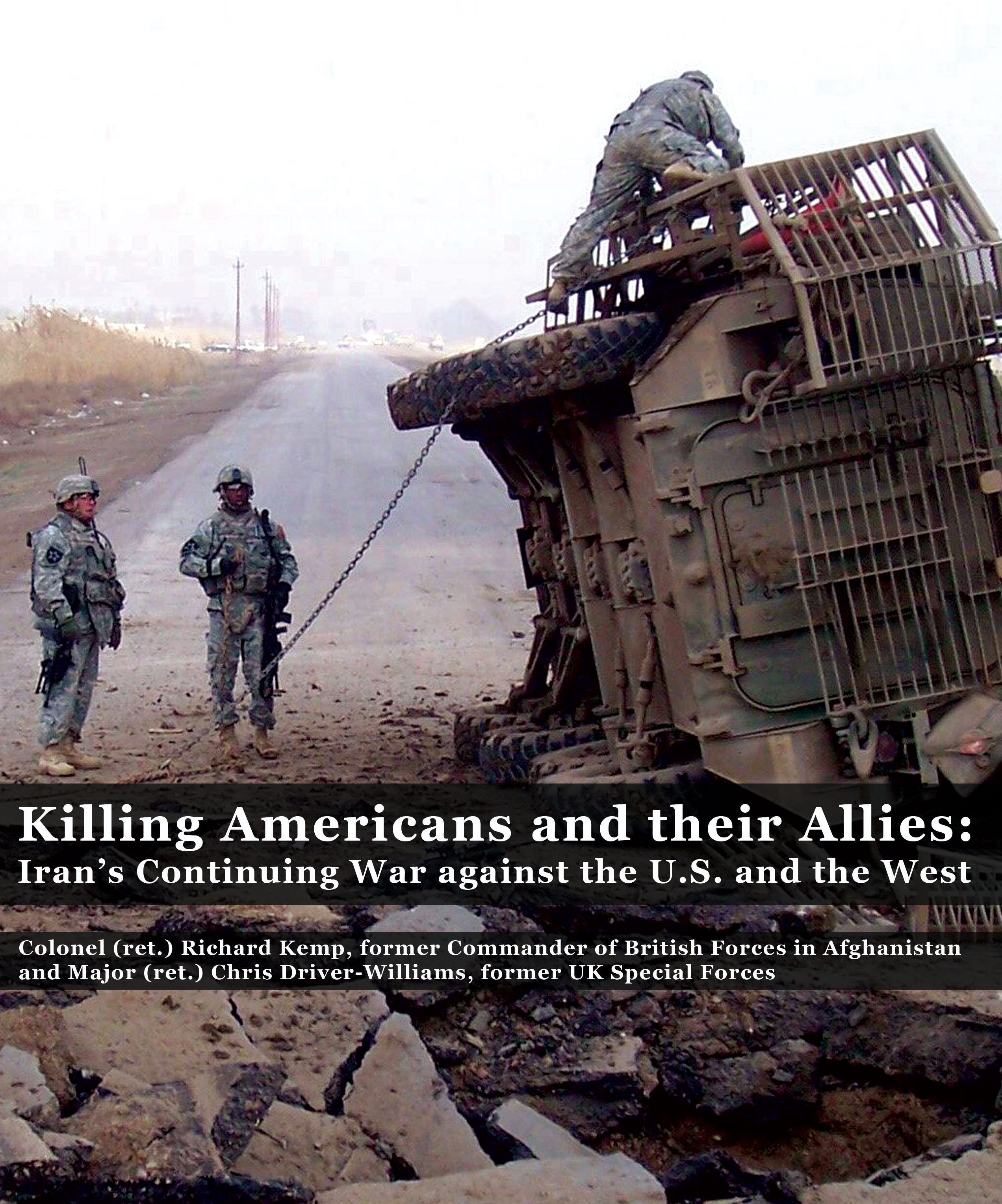
Killing Americans and Their Allies [Source: Jerusalem Center for Public Affairs]
(I encourage you to follow the link in this overview and take a look at the report. – LS)
I’m going to say more about the Iran deal in a piece that will go up shortly on the homepage, but I wanted to highlight this report, by Colonel (ret.) Richard Kemp and Major (ret.) Chris Driver-Williams, that comprehensively outlines Iran’s acts of war against the United States. Some lowlights:
Iranian military action, often working through proxies using terrorist tactics, has led to the deaths of well over a thousand American soldiers in Iraq and Afghanistan over the last decade and a half. Throughout the course of the Iraq campaign, a variety of weapons flowed into the country through direct purchases by the government of Iran. These included Explosively Formed Penetrators (EFPs), a shaped charge designed to penetrate armor. These weapons – often camouflaged as rocks – were identical to those employed by Hizbullah against Israeli forces. In 2006, the British Telegraph revealed that three Iranian factories were “mass producing” the roadside EFP bombs used to kill soldiers in Iraq . . . Iran paid Taliban fighters $1,000 for each U.S. soldier they killed in Afghanistan. The Sunday Times reported that a Taliban operative received $18,000 from an Iranian firm in Kabul as reward for an attack in 2010 that killed several Afghan government troops and destroyed an American armored vehicle.
The Obama administration’s nuclear agreement is nothing more than a stimulus package for jihad. Billions of dollars will flow into the world’s worst terror-exporting country — a sworn enemy of the United States — and it will soon enough even have (legal) access to international conventional-arms markets. It can continue to export terror and even kill American soldiers without breaching the nuclear agreement. Until Iran stops trying to kill Americans and stops imprisoning Americans (including Saeed Abedini, a pastor prosecuted merely because of his Christian faith), how can any rational person trust its good faith?
YOU CAN READ THE REPORT AT: http://jcpa.org/killing-americans-allies-irans-war/
Michael Oren: Why Israel Won’t Be Celebrating the Iran Deal
Michael B. Oren 7:28 AM ET Via Time 7-14-2015

[Source: Wikipedia]
(Sounding the alarm. Anyone listening? – LS)
The present deal with Iran poses a threat not only to Israel, but to the U.S. and the world
In Israel, one of the world’s rowdiest democracies, politicians rarely agree on anything. Which is why their reaction to the nuclear arms deal with Iran is so unique. For the first time in living memory, virtually all Israelis – left, right, religious, secular, Arabs, Jews – are together calling the deal disastrous.
The reasons might not be clear to many readers of the agreement. According to preliminary reports, its 100 pages contain bewilderingly complex provisions for supposedly delaying Iran from making a bomb. There are international inspections of the Iranians’ nuclear facilities but none that would actually catch them off guard. There are limits to the number of centrifuges with which Iran can enrich uranium to weapons grade, but only for a decade during which not a single centrifuge will be dismantled. And Iran can continue to research and develop more advanced technologies capable of producing nuclear weapons even faster. Most mystifying still, the deal recognizes Iran’s right to peaceful nuclear power without demanding that Iran cease promoting war throughout the Middle East and terror worldwide.
For Israelis, though, there is nothing mystifying about this picture. We see an Iranian regime that will deceive inspectors and, in the end, achieve military nuclear capabilities. We see an Iranian nuclear program that, while perhaps temporarily curtailed, will remain capable of eventually producing hundreds of nuclear weapons.
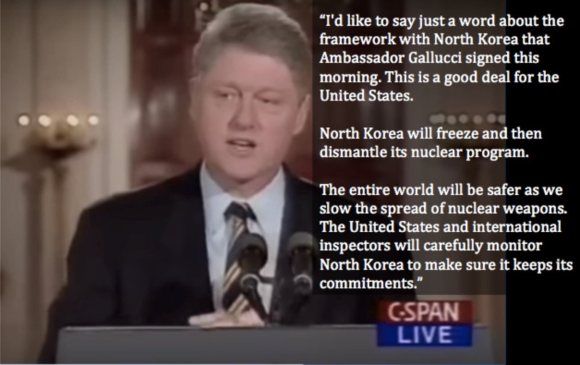
This is a picture that we’ve all seen before. Back in 1994, American negotiators promised a “good deal” with North Korea. Its nuclear plants were supposed to be frozen and dismantled. International inspectors would “carefully monitor” North Korea’s compliance with the agreement and ensure the country’s return to the “community of nations.” The world, we were told, would be a safer place.
It wasn’t. North Korea never forfeited its nuclear plants and the inspections proved useless. The community of nations is threatened by North Korean atomic bombs and the world is anything but safe. And yet, against all logic, a very similar deal has been signed with Iran.
And Iran is not North Korea. It’s far worse. Pyonyang’s dictators never plotted terrorist attacks across five continents and in thirty cities, including Washington, D.C. Tehran’s Ayatollahs did. North Korea is not actively undermining pro-Western governments in its region or planting agents in South America. Iran is. And North Korea – unlike Iran – did not kill many hundreds of U.S. soldiers in Iraq.
So why, then, are only Israelis united in opposing this deal? The answer is that we have the most to lose, at least in the short run. We know that the deal allows Iran to break out and create nuclear bombs in as little as three months, too quickly for the world to react. We know that the Ayatollahs, who have secretly constructed fortified nuclear facilities that have no peaceful purpose and have violated all of their international commitments, will break this deal in steps too small to precipitate a powerful global response. And we know that the sanctions, once lifted, cannot be swiftly revived, and that hundreds of billions of dollars Iran will soon receive will not be spent on better roads and schools. That treasure will fund the shedding of blood – of Israelis but also of many others.
Israelis know that, while the world might weather its deception by North Korea, they cannot afford to be duped by Iran. But neither, in fact, can the United States. Just last week, Iran’s President attended a rally in Tehran where tens of thousands of protesters chanted “Death to America.” The deal will better enable them to carry out that attack – if not today, then against future generations. And Iran’s Supreme Leader has publicly pledged to do just that.
The planned celebrations in Tehran and Iranian declarations of victory contrast starkly with the gloom hanging today over almost all Israelis. We believe that with stronger sanctions and tougher demands, a better deal is still possible. But we also understand that the present deal poses grave dangers not only to us, but ultimately to America and the world.
(UPDATE: Thought I’d throw this in for good measure. – LS):
Iran’s Rouhani says ‘God has accepted nation’s prayers’
Via Yahoo News 7-14-2015

Hmmm. [Source: Unknown]
(I chose this short post because it demonstrates the lack of news reporting by our press coming OUT of Iran. Like most, I sat painfully as I watched Obama announce his ‘victory’ over Iran. The coverage was detailed and in real time. Surprisingly, one of the networks, which one escapes me now, actually went live for Rouhani’s announcement to the Iranian people, in Farsi of course. The translator struggled along and said something that struck me. She translated Rouhani saying, ‘Iran has a new cage.’ No one seemed to notice. Then it struck me. What else is he telling his people and how does it reconcile with what the western press is telling us. We may never know. Therein lies the real news, in my humble opinion. – LS)
Tehran (AFP) – Iranian President Hassan Rouhani said in a live televised address Tuesday that “God has accepted the nation’s prayers”, hailing a nuclear deal with world powers that will lift sanctions.
Rouhani spoke minutes after US President Barack Obama’s comments on the agreement struck in Vienna were also broadcast live on state television.
If Iran Succeeds in Going Nuclear
by LEWIS LIBBY & HILLEL FRADKIN July 10, 2015 4:00 AM Via the National Review

Iran’s grand plan. [Source: Unknown]
(According to Debka, ‘The Revolutionary Guards chief then added obliquely: Before long we will present the West with a fait accompli. He refused to elaborate on this when questioned by the president, but it was taken as a reference to some nuclear event.’ – LS)
What can we, and the world, expect?
The Obama administration has trapped America. It is now ever clearer that current negotiations will not achieve a reliable, verifiable halt to Iran’s nuclear-weapons program. Absent such terms, a non-nuclear Middle East rests on Iran’s “good faith” and on Iran’s neighbors’ faith in her — both thin reeds. No magic rescue looms. Very hard choices and dark fates may await.
What if the Obama administration suddenly switched its approach on negotiations and sanctions? Sadly, it is almost certainly too late to force Iran to abandon its long-coveted goal. Three obstacles bar an effective reversal: Iran is so close it can taste nuclear-weapon status; the world is no longer willing to credit and follow President Obama’s “red lines”; and any new sanctions would take months to enact and years to bite. The end of all our retreats is this: Either we trust current and future Iranian leaders, or we or someone else someday uses force. Calls for prudence, humanity, and morality paved this road. But we now may face a fate much less humane and moral.
Some think that we can avoid painful dilemmas by relying on the efficacy and supposedly superior morality of Cold War–style nuclear deterrence. In effect, we would threaten nuclear retaliation against millions of Iranian civilians, many of whom do not support their government. Such barbarism was considered unthinkable before the Cold War. Necessity justified it then. Is this the most moral course now? If it ever came to pass, would we compliment ourselves on our restraint in not striking earlier? Or take comfort that we reasonably relied on the ayatollahs’ affection for their people?
Worse yet, this scenario assumes that the principles and practices of Cold War deterrence will apply neatly and consistently to Iran and the rest of the Middle East. It assumes the ayatollahs and their regional adversaries will be as stable internally as we and the Soviets were, will avoid direct conventional conflict as assiduously, will be as risk-averse with nuclear threats, will build and operate their nuclear systems as carefully, will be as invulnerable to a disabling first strike, will safeguard their arsenals as successfully, will abjure proliferation as completely, and would only attack openly, in the manner associated with Cold War calculations of mutual assured destruction. Is it safe to assume that all of these conditions will apply? In fact, do any? If they do now, would they consistently over many years? The Middle East is very far from stable or quiet — and it contains terrorist “wild cards” to boot. Indeed, terrorism is not an occasional tool, but a common one. Radical infiltration is not a rare occurrence, but a regular one.
Nor was the Cold War as safe as many recall. Would a Middle Eastern Missile Crisis turn out the same way as the 1962 Cuban Missile Crisis? Would the Arab states of the Middle East respond to Iranian adventurism with the same restraint the West showed when Soviet troops quashed the Hungarians in 1956 or the Czechs in 1968? In truth, no one knows. Even a cursory listing of plausible scenarios illustrates what might follow within a few years of Iran’s obtaining, or perhaps just claiming to have obtained, nuclear weapons:
1. To deter Saudi Arabia from getting nukes, America promises nuclear retaliation against Iran if it were to attack the Saudis. The House of Saud, doubting that Iran will credit American promises and politically reluctant to rely on infidel America, purchases nuclear weapons anyway. A year later, two Saudi weapons are stolen by Islamist soldiers or terrorists. Our intelligence agencies have reason to believe the intention is to smuggle the weapons into America.
Variation: The House of Saud itself falls under the sway of Islamists, who then control Saudi weapons.
2. Fearing intimidation by nuclear Iran, two neighboring Sunni states go nuclear. Unlike the United States and the Soviet Union, the antagonists are so close to each other geographically that missile warning times are in the minutes; in addition, regional early-warning systems are primitive, and Cold War–style controls over weapons release are nonexistent. In the midst of a regional confrontation, one side mistakenly believes the other has launched a preemptive strike (as happened during the Cold War). A fervent local commander promptly launches on warning. The other side retaliates. One million die. Oil production crashes.
Variation: In the melee, missiles pre-programmed for retaliation against Israel are launched. Israel retaliates massively. The Arab world believes Israel started it all.
3. The ayatollahs brutally crush renewed pro-democracy demonstrations in Tehran. Violence spirals into a slow-motion, Syrian-style civil war, with Sunni support stoking the flames. Iranian moderates appeal to the U.S. president for arms. The nuclear-armed ayatollahs declare that if the U.S. supplies them, it will be considered an act of war. The U.S. is defiant, but secretly fears that prolonged Iranian civil war risks radicals, revolutionaries, or criminals seizing Iranian nuclear weapons. So the U.S. refuses to aid the revolutionaries, in effect protecting the regime.
Variation: Opposition forces or rogue regime elements obtain two nuclear weapons and, facing defeat, trade them to anti-American groups for support or sanctuary.
4. Following provocations on both sides and repression of Shiites in majority-Sunni states, Iranian proxy forces threaten to take control of one or more of those states. Brutal killings escalate. The governments of oil-rich Saudi Arabia and Kuwait totter. Iranian troops stage nearby, threatening to enter if any other Arab country or the U.S. intervenes. The Joint Chiefs estimate that securing the area would require 400,000 U.S. troops for an indefinite period and would lead to hundreds of casualties; U.S. ships would be too vulnerable in nearby waters to direct attacks against Iran. The Joint Chiefs further estimate that all-out conventional war, perhaps even requiring an invasion of Iran for a decisive victory, would require 1.2 million American forces and, if it appeared to be nearing success, would risk an Iranian nuclear attack on deployed U.S. forces in final defiance. Meanwhile, Iran, suspecting that the U.S. would not risk an unprecedented head-to-head war with a nuclear power, escalates, attacking Saudi oil terminals and closing the vital Strait of Hormuz to all foreign oil tankers.
5. A terrorist bomb at a Washington event kills or maims 188 people, including three U.S. congressmen and two Arab ambassadors. Evidence points to Iranian agents. The U.S. president hesitates to launch conventional retaliatory air attacks against a nuclear-armed foe — a situation never faced in the Cold War. Congress calls for investigations. The U.S. requests U.N. sanctions, which Russia and China veto. Months pass. A new regional crisis arises. Soon additional terrorist attacks of uncertain origin kill hundreds more Americans. Frustrated and under increasing political pressure at home, the U.S. president sends planes to attack Iran’s Revolutionary Guards Corps outside Tehran. The president also sends troops to assist regional forces fighting Iranian proxies. Iran retaliates.
6. Nuclear weapons are launched at New York City and Washington, D.C., from the deck of a derelict African-flagged freighter 50 miles off our coast. The freighter then sinks. More than 100,000 Americans die, and there are 800,000 other casualties. Parts of both cities are uninhabitable. The U.S. suspects Iranian weaponry, but Iran denies any official involvement. A limited U.S. nuclear response against Tehran would mean killing at least 200,000 Iranians, and a successful U.S. conventional attack to topple the ayatollahs is impractical given the likely losses to our troops. Either limited course risks additional Iranian nuclear attacks either in the Middle East or against the U.S. homeland. China, dependent on Middle Eastern energy, mobilizes. The U.S. president launches a surprise massive nuclear response against Tehran and all suspected Iranian weapons sites. Iranian Revolutionary Guard forces escape with several nuclear weapons.
None of these scenarios are inevitable. All are plausible if Iran gets a nuclear weapon, given Middle Eastern realities, which are so different from the Cold War ones. Afterwards, a future U.S. president would surely ask whether the losses — to Americans and to civilians abroad — did not exceed what his predecessor would have faced for attempting to destroy the ayatollahs’ nuclear-enrichment facilities years earlier.
Welcome to the new prudent, humane, and moral world that may await.





Recent Comments