Author Archive

Iran Reminds the World How Much They Love Us

July 10, 2015

Chanting ‘Death to America, Israel,’ millions march in Iran on al-Quds Day

By Times of Israel staff, AP and AFP July 10, 2015, 12:08 pm


Iran’s version of a friendly gesture. [Source: Unknown]

(I’d burn the Iranian flag but it’s not worth my time. Like most folks, I’m busy earning a living, providing for my family, and making a promising future for my children and grandchildren. – LS)

Protesters burn US, Israeli flags at annual rallies; condemn Saudi Arabia over Yemen conflict

Millions of Iranians took part in anti-Israel and anti-US rallies across Iran on Friday, chanting “Down with America” and “Death to Israel” on Al-Quds Day, internationally observed annually on the last Friday of the month of Ramadan.

The controversial holiday was proclaimed in 1979 by Iran’s Ayatollah Ruhollah Khomeini as a religious duty for all Muslims to rally in solidarity against Israel and for the “liberation” of Jerusalem. Tehran says the occasion is meant to express support for Palestinians and emphasize the importance of Jerusalem for Muslims.

Iranian President Hassan Rouhani attended the protest on Friday but did not speak at the main rally in Tehran, which coincided with seemingly deadlocked nuclear talks between Iran and world powers led by the United States.

Large demonstrations were also held in Iraq and Lebanon.

Some protesters in Tehran burned Israeli and American flags. Posters showed Israeli Prime Minister Benjamin Netanyahu, Saudi King Salman and US President Barack Obama in flames.

Iranian protesters set dummies depicting US President Barack Obama and Israeli Prime Minister Benjamin Netanyahu on fire on top of an Israeli flag during a demonstration to mark the Quds (Jerusalem) International day in Tehran on July 10, 2015.

Using the al-Quds Day hashtag, supreme leader Ayatollah Ali Khamenei tweeted: “There are two sides in oppression: oppressor & the oppressed. We back the oppressed and are against oppressors.”

At a mock checkpoint, several men and a woman dressed in Israeli army uniforms shouted at people who wanted to pass and pushed them back, threatening them with batons and guns.

“We are all here to see the freedom of Quds. The people of Palestine are oppressed and their lands occupied,” said Ahmad Moghadam, a 67-year-old clerk.

“We stand behind Palestine until its people are freed.”

Iranian military commanders also attended, with General Yahya Rahim Safavi, a senior adviser to Khamenei, saying the al-Quds march was different this year because of a worsening regional security situation.

Iran has backed Iraqi forces against IS and Syrian government forces against rebels including Al-Qaeda affiliate Al-Nusra Front.

“Terrorist groups such as Daesh and Al-Nusra, with the support of the Zionists and Saudi’s cruel war against the oppressed people of Yemen… have created a new situation in the region and the world,” the official IRNA news agency quoted Safavi as saying.

Fereshteh Ashuri, 23, a law student, said: “We still recognize Israel as the enemy of Islam. I tell Israel to stop daydreaming and rest assured that you will collapse.”

The annual event drew massive crowds, despite the scorching temperatures in Tehran, which were set to climb to 97 degrees Fahrenheit. Rallies were held in cities throughout the country.

Arch-rival Saudi Arabia was also publicly condemned at the mass rallies over its air campaign against the Iran-backed Houthi rebels in Yemen since March, AFP reported, with the main slogan of the event denouncing the killing of children in “Gaza and Yemen.”

The crowd in Tehran chanted “Down with US, Israel and the House of Saud,” and carried placards that declared “Zionist soldiers kill Muslims” and “the Saudi family will fall.”

Demonstrators also set fire to a large effigy representing the Islamic State, labeled “Saudi’s doll.”

It was later burned along with American, Israeli and British flags, a common gesture at public demonstrations ever since the Islamic revolution of 1979.

The rallies come as Iran and six world powers hold talks in Vienna aimed at working out a deal to limit Iran’s nuclear program in exchange for easing tens of billions of dollars in economic penalties on the Islamic Republic.

Earlier this week, a top Iranian general said Iran will never view the US positively, even if a deal is signed with world powers over the Islamic Republic’s nuclear program.

The commander of the Iranian ground forces, Brigadier General Ahmad Reza Pourdastan, declared Sunday that a rapprochement was out of the question, as the enemy is “exploiting nations and putting them in chains,” the semi-official Iranian FARS News Agency reported.

“The US might arrive at some agreements with us within the framework of the Group 5+1 [the US, Russia, China, Britain and France plus Germany], but we should never hold a positive view of the enemy,” Pourdastan said.

“Our enmity with them is over principles and rooted in the fact that we are after the truth and nations’ freedom, but they seek to exploit nations and put them in chains,” he added.

A Vow of Terror

July 9, 2015

Iran ‘Shouts Hatred’ for Israel, Backs Palestinian Terror

BY: Adam Kredo July 8, 2015 Via The Washington Free Beacon


We will bury you. [Source: AP]

(Lest we forget who the real enemy is. – LS)

Support for terror, hatred of Jews comes as nuke deal inches closer

VIENNA—Iranian President Hassan Rouhani urged the entire country to “shout its hatred for the Zionists” and back Palestinian efforts to seize territory from Israel, according to comments made Wednesday in celebration of Quds Day, which marks the last Friday in Ramadan and has historically been used to tout Palestinian violence against the Jewish state.

As Iranian and Western negotiators in Vienna meet around the clock in a bid to strike a final nuclear accord, the Iranian president expressed his support for the Palestinian cause and urged the Islamic Republic to unite in its hatred of Israel.

“People will tell the world on the Quds Day that the Muslim nations will never forget Palestine and occupation of this territory,” Rouhani was quoted as saying on state-run television by the Fars News Agency.

Rouhani went on to state “that the Iranian nation will shout its hatred for the Zionists on the Quds Day,” according to Fars’ report.

“The Islamic Ummah will actually shout the call of unity on the Quds Day,” the leader added.

Iran’s Foreign Ministry—the head of which is currently in Vienna leading efforts to strike a nuclear deal—also released a statement explaining the need to confront “the Zionists.”

“Reaching this goal” of retaking Jerusalem from the Israelis “needs confronting the Zionist regime’s aggression and expansionism and empowerment of Palestinians to resist against such measures, since resistance is the only way to restore their rights and free the Palestinian territories and the Holy Quds,” the Iranian Foreign Ministry said in its statement.

“Based on the guidelines of Supreme Leader of the Islamic Revolution (Ayatollah Seyed Ali Khamenei) the Islamic Republic of Iran believes that peace and tranquility will not be established in the Middle-East region but by full restoration of the oppressed Palestinian people’s rights, and the Palestinian nation will continue its legitimate and legal fight to restore its rights,” the statement added.

In related remarks, the General Staff of the Iran’s Armed Forces vowed to continue backing terror organizations and remain aggressive in fighting Israel.

“The Iranian nation will remain in the frontline of support for the Islamic resistance and freedom of Quds [also known as Jerusalem],” the official was quoted as saying.

Meanwhile, a senior U.S. official who briefed reporters in Vienna on Tuesday indicated that the talks could end in a stalemate.

“Quite frankly, I’m astonished by the speculation in the press about the likelihood of getting to an agreement soon,” the official told reporters. “I just put that down to the fact that you all would like to go home.”

Differences still remain on several key issues, including the extent of Iran’s future nuclear work and the timing of sanctions relief.

If decisions on these issues are made in the coming days, “we’ll get a deal. If they’re not, obviously we won’t,” the official said.

‘Never threaten an Iranian’: nuclear talks get feisty

July 9, 2015

‘Never threaten an Iranian’: nuclear talks get feisty

Agence France Presse July 8, 2015 Via The Daily Star


Iranian Foreign Minister Javad Zarif talks to media from bacon of the Palais Coburg Hotel, venue of the nuclear talks in Vienna, Austria on July 2, 2015. AFP PHOTO/SAMUEL KUBANI

(Really? – LS)

VIENNA: A top-level meeting at the Iran nuclear talks this week was a stormy affair, Iranian media reported Wednesday, with the country’s foreign minister warning: “Never threaten an Iranian.”

The altercation happened Monday evening as foreign ministers from Iran and six major powers including US Secretary of State John Kerry met in Vienna seeking to nail down a historic nuclear accord.

They failed to overcome their remaining differences, and have given themselves until Friday to finalize the accord to end a 13-year standoff over Iran’s nuclear ambitions.

The spark, during a discussion on lifting an arms embargo as part of the nuclear deal, came when other ministers expressed concerns about Iran being a destabilizing influence in the Middle East, Iranian media reported.

This prompted Iranian Foreign Minister Mohammad Javad Zarif to threaten to drag the others before an international court for supporting former Iraqi leader Saddam Hussein, an arch enemy of Iran, the reports said.

Diplomats stopped short of confirming the comments, but one senior Western envoy said the meeting saw a “very heated exchange of views.”

The reported remarks from Zarif to EU foreign policy chief Federica Mogherini have since trended on Twitter under the hash tag #NeverThreatenAnIranian.

Russian Foreign Minister Sergei added at the talks, jokingly, that no one should ever threaten a Russian either, Iranian media reported.

During a separate meeting between Kerry and Zarif, other residents at the posh Coburg hotel heard shouting and raised voices, prompting a Kerry aide to poke his head round the door and advise the two to pipe down, a diplomatic source said.

The normally smiley Zarif, 55, who has spearheaded Iran’s efforts to seal the nuclear deal for the past almost two years, is known to have something of a fiery temper.

According to the IRNA news agency, Zarif said he was asked in February by supreme leader Ayatollah Ali Khamenei “why are you shouting in the meetings? Smile and talk as you usually do.”

A second Western diplomat said that Zarif has an “explosive temper. He is passionate, with a booming voice.”

A spokeswoman for Mogherini tweeted only that “relationships are based on openness, frankness and mutual respect.”

And a spokesman for the Iranian delegation, Alireza Miryoussefi, tweeted comments from Zarif saying that Mogherini “has always had a very positive and constructive role” and “our relations have always been governed by mutual respect.”

“The same stands true with regard to other ministers present in the negotiations and despite political differences,” he said.

Yes We Can’t Get Other Countries to Defeat ISIS

July 8, 2015

US asked Indonesia to send troops to fight Islamic State, says former Jakarta foreign minister

David Wroe 29 June 2015 Via The Sydney Morning Herald


Indonesia’s former foreign minister Marty Natalegawa prefers the USA do all the heavy lifting. [Source: AFP]

(One rejection among many, I’m sure. Indonesia of all places. The ‘ask’ list must be growing short for boots on the ground. So I ask, why the hell should the US commit our young brave troops to yet another Mideast meat grinder? – LS)

Indonesia was asked by the United States to send troops to join the fight against the Islamic State terror group in Iraq but declined because it feared a backlash among radical Muslims at home, the country’s former foreign minister has revealed.

Marty Natalegawa, the long-serving top envoy under Jakarta’s previous administration, said Indonesia felt it could better contribute by tackling its own domestic extremism problem, whereas sending forces would be “cosmetic”.

Despite Washington’s eagerness to pull together as broad a coalition as possible to fight the terror group, the US had accepted Jakarta’s refusal, Dr Natalegawa said at an event at the Australian National University’s Crawford School.

“When Indonesia was asked to join in the coalition of forces to fight ISIS on the ground at one time, our response at that time was our best contribution to fighting the ISIS menace would be to ensure such an ideology, such a menace, does not proliferate in what is the world’s largest Muslim-populated country,” he said, using an alternative acronym for the group.

“That to us is a more meaningful contribution … Having to join such an effort to simply make up the numbers … makes for a wonderful photo opportunity whenever these friends or groups meet in Geneva or some other European capitals, but it can create a backlash, an unintended backlash, back home.”

Dr Natalegawa did not name the US. But asked which country had made the request of Jakarta, he joked: “Who would be the main proponent of the gathering of [countries]? So that country would be the one.”

The US pulled together a broad coalition including many Muslim countries in the Middle East. While deciding the Islamic State group needed to be stopped, the Obama administration was wary of creating perceptions of another Western invasion of Iraq.

Dr Natalegawa continued: “To be fair, the country concerned got the point that we could do far more by addressing our own internal situation rather than deploying just for superficial, cosmetic, perception purposes of this small number of troops.”

His mention of fighting “on the ground” apparently refers to a request for trainers or advisory troops, as Washington has so far refused to get involved in ground combat in Iraq.

Australia is the second-largest contributor to the fight against the Islamic State after the US, having sent about 500 training and advising troops, as well as about 400 RAAF forces as part of an air campaign.

RAAF Hornets are carrying out bombing raids, while air-to-air tankers are refuelling coalition aircraft and a Wedgetail radar plane is helping co-ordinate the air campaign.

(Excerpts from CNN article dated FEB 14, 2015 – LS)

http://www.cnn.com/2014/10/06/world/meast/isis-coalition-nations/

Six months into the conflict, this is the coalition against ISIS:

Australia: Australia has participated in airstrikes and humanitarian missions in Iraq, and has sent special forces and other troops to help train Iraqi security forces in first aid, explosive hazards, urban combat and working dog programs. NO BOOTS ON THE GROUND.

Belgium: The country has conducted airstrikes against ISIS targets, according to U.S. Central Command. NO BOOTS ON THE GROUND.

Canada: Its warplanes have flown 310 sorties against ISIS targets as of February 11, the Canadian armed forces reported. Canadian aircraft have also flown dozens of aerial refueling and reconnaissance missions in support of the anti-ISIS fight, and its cargo aircraft have been used to deliver military aid from Albania and the Czech Republic, the Canadian military said. NO BOOTS ON THE GROUND

Denmark: It has conducted airstrikes against ISIS targets, according to U.S. Central Command. NO BOOTS ON THE GROUND

Egypt: The country struck ISIS targets in Libya on Monday after the group reportedly executed 21 Egyptian Christians, and called on anti-ISIS coalition partners to do the same, saying the group poses a threat to international safety and security. Egypt had previously agreed to join the anti-ISIS coalition, but details about its role, if any, have been scarce. POSSIBLE BOOTS UNCONFIRMED

France: French planes have taken part in airstrikes against ISIS in Iraq, and the nation has flown reconnaissance flights over Iraq, contributed ammunition and made humanitarian drops over the nation. NO BOOTS ON THE GROUND

Germany: Although it has declined to participate in airstrikes, Germany has provided Kurdish forces in Iraq with $87 million worth of weapons and other military equipment, along with a handful of troops to help with training, German broadcaster Deutsche Welle reported. NO BOOTS ON THE GROUND

Italy: It has sent weapons and ammunition valued at $2.5 million to Kurdish fighters in Iraq, along with 280 troops to help train them, according to Foreign Policy magazine. NO BOOTS ON THE GROUND

Iraqi Kurdistan: The Kurdish fighting force, the Peshmerga, is battling ISIS on the ground. BOOTS ON THE GROUND!!

Jordan: The country initially joined in airstrikes against ISIS but suspended its participation when one of its aircraft went down in Syria, leading to the capture of pilot Lt. Moath al-Kasasbeh. NO BOOTS ON THE GROUND

Netherlands: The Dutch government sent F-16 fighter jets to bomb ISIS targets and troops to help train Kurdish forces. NO BOOTS ON THE GROUND

Qatar: The small but rich Gulf nation that hosts one of the largest American bases in the Middle East has flown a number of humanitarian flights, State Department officials said. NO BOOTS ON THE GROUND

Saudi Arabia: The kingdom has sent warplanes to strike ISIS targets in Syria and agreed to host efforts to train moderate Syrian rebels to fight ISIS. NO BOOTS ON THE GROUND

Turkey: Though the NATO member initially offered only tacit support for the coalition, Turkey’s government in 2014 authorized the use of military force against terrorist organizations, including ISIS, as the militant group’s fighters took towns just south of Turkey’s border. NO BOOTS ON THE GROUND

United Arab Emirates: Like its ally Jordan, the UAE initially took part in anti-ISIS airstrikes — the country’s first female fighter pilot led one of the missions. NO BOOTS ON THE GROUND

United Kingdom: The UK began airstrikes against ISIS in October, hitting targets four days after its Parliament approved its involvement. British planes helped Kurdish troops who were fighting ISIS in northwestern Iraq, dropping a bomb on an ISIS heavy weapon position and shooting a missile at an armed pickup, the UK’s Defence Ministry said. Since then, warplanes have struck targets in Iraq dozens of times, and British planes had been involved in reconnaissance missions over that country. The British military is also helping train Kurdish Peshmerga and has sent advisers to help Iraqi commanders. Britain has also pledged more than $60 million in humanitarian aid. NO BOOTS ON THE GROUND

Other nations: Also participating in one way or another are the Arab League and the European Union as well as the nations of Albania, Andorra, Austria, Bosnia and Herzegovina, Bulgaria, Croatia, Cyprus, the Czech Republic, Estonia, Finland, Georgia, Greece, Hungary, Iceland, Ireland, Japan, Kosovo, Kuwait, Latvia, Lebanon, Lithuania, Luxembourg, Macedonia, Malta, Moldova, Montenegro, Morocco, New Zealand, Norway, Oman, Panama, Poland, Portugal, South Korea, Romania, Serbia, Singapore, Slovakia, Slovenia, Somalia, Spain, Sweden, Taiwan and Ukraine. NO BOOTS ON THE GROUND

Some countries — such as Kuwait — are providing bases. Some, like Albania, the Czech Republic and Hungary, have sent weapons and ammunition. Others are providing humanitarian support, taking legal steps to curb recruitment or providing other, unspecified aid. NO BOOTS ON THE GROUND

Stop Blaming America for Every Damned Thing Wrong with this World.

July 7, 2015

Let’s stop blaming America

Dr. Khalid Alnowaiser (Yep, an Arab) Published — Saturday 28 May 2011 (Many years ago) Via Arab News


The easy way out. [Source: Unknown]

(Pardon me while I release a little steam. – LS)

We are still the prisoners of a culture of conspiracy and inferiority.

I AM a proud and loyal Saudi citizen, but I am tired of hearing constant criticism from most Arabs of everything the United States does in its relations with other countries and how it responds to global crises. No nation is perfect, and certainly America has made its share of mistakes such as Vietnam, Cuba and Iraq. I am fully aware of what happened when the atomic bombs were dropped on Hiroshima and Nagasaki and the unprecedented abuses at Guantanamo and Abu Ghraib. However, what would we do if America simply disappeared from the face of the earth such as what happened to the Soviet Union and ancient superpowers like the Roman and Greek empires? These concerns keep me up day and night. It’s frustrating to hear this constant drumbeat of blame directed toward the United States for everything that is going wrong in the world. Who else do we think of to blame for our problems and failures? Do we take personal responsibility for the great issues that affect the security and prosperity of Arab countries? No, we look to America for leadership and then sit back and blame it when we don’t approve of the actions and solutions it proposes or takes.

For instance, if a dictator seizes and holds power such as Egypt’s Mubarak and Libya’s Qaddafi, fingers are pointed only at America for supporting these repressive leaders. If the people overthrow a dictator, fingers are pointed at America for not having done enough to support the protestors. If a nation fails to provide its people with minimum living standards, fingers are pointed at America. If a child dies in an African jungle, America is criticized for not providing necessary aid. If someone somewhere sneezes, fingers are pointed at America. Many other examples exist, too numerous to mention.

I am not pro-American nor am I anti-Arab, but I am worried that unless we wake up, the Arab world will never break out of this vicious and unproductive cycle of blaming America. We must face the truth: Sadly, we are still the prisoners of a culture of conspiracy and cultural inferiority. We have laid the blame on America for all our mistakes, for every failure, for every harm or damage we cause to ourselves. The US has become our scapegoat upon whom our aggression and failures can be placed. We accuse America of interfering in all our affairs and deciding our fate, although we know very well that this is not the case as no superpower can impose its will upon us and control every aspect of our lives. We must acknowledge that every nation, no matter how powerful, has its limitations.

Moreover, we conveniently forget that America’s role is one of national self-interest, not to act as a Mother Teresa. Every great nation throughout history has used its power and gained ascendancy in order to serve its own strategic interests. America is not just its foreign policy. We must not forget who promoted education and respected learning, who took on research as a way to discovery, who made the airplane that carries us to our destination and the luxurious car we want to own, who created the Internet and developed social media that has transformed the way we do business and interact with one another, who conducted the scientific research that has saved lives and treated cancer, renal failure, AIDS, malaria, poliomyelitis, and who discovered genetic engineering. When man walked on the Moon, it was an American. Who did Japan turn to for help after the devastating earthquake and tsunami? America that led and organized the international relief effort of the Red Cross. Who do people turn to for support when their leaders seek to brutalize them? Who organized NATO air cover and saved the Libyan city of Benghazi from certain destruction by Qaddafi’s brutal armed forces?

Anyone who is a student of history knows that America is simply doing what all other civilizations before it have done for thousands of years, which is to protect and further its own self-interest. The Greek civilization could not have lasted had it not served its own interests, and the same applies to the Persian, Roman, and Chinese civilizations. All of these civilizations put their own welfare before all others, and by doing so, they strived to achieve great things. The truth is that no nation can ever become great without understanding this reality. Indeed, the Islamic civilization has been through horrible and cruel phases. Hideous events that send goose bumps up one’s spine can be extracted from Islamic history, such as that of As-Saffah (The Shedder of Blood), founder of the Abbasid Caliphate, who took out the remains of the caliphs of Bani Umayyah, one after the other, but found nothing but the tip of a nose from the remains of Hisham Bin Abdul Malak. He took him out and whipped him. He then crucified and burned him and sprinkled his ashes in the wind, without mercy, oblivious to any religious or moral restraints.

There are many other similar examples. But does this mean that Islam is unholy? Of course not. Does this imply that Islamic civilization only had Saffahs? Absolutely not. Islamic civilization has given the world brilliant examples in the areas of art and education and promoted a culture of forgiveness, peace and love. However, today, we as people, not Islam, are in desperate need of an intellectual earthquake, a cultural tsunami to get us back on track, to revive Islam’s cultural intellect and combat our undeniable inferiority complex.

The Holy Qur’an states Allah will not change the condition of a people until they change what is in themselves. He has the power to change them, but He prefers that they change with their own will power which He respects.

What we are seeing now in the Arab streets is a new hope and a step forward to change what is in ourselves. I remain very optimistic because we have now begun to realize that simply blaming the United States for our problems will not help us progress toward great personal freedoms. Our enemy is not America but an inferiority complex from which I am sure the Arab world with its rich culture and history will eventually recover.

— Dr. Khalid Alnowaiser is a columnist and a Saudi attorney with offices in Riyadh and Jeddah. He can be reached at: Khalid@lfkan.com and/or Twitter (kalnowaiser).

4574 Years and Counting

July 6, 2015

ISIS: Destroying Egypt’s Sphinx, Pyramids Is ‘Religious Duty’

by Jordan Schachtel3 Jul 2015 Via Breitbart


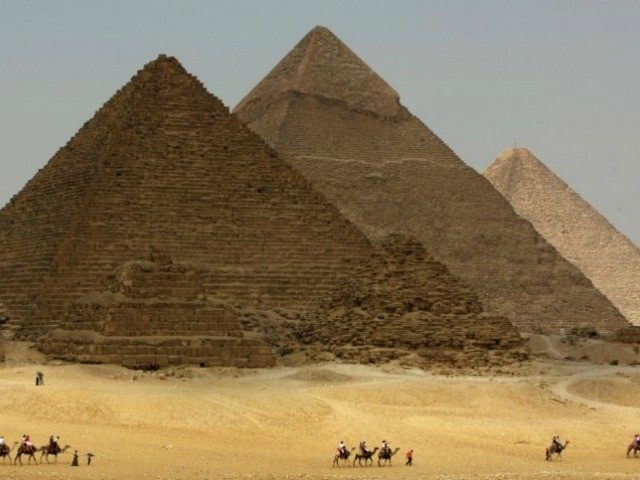
Will they stand the test of time? [Source: Reuters]

(Unthinkable. – LS)

ISIS “caliph” Abu Bakr al-Baghdadi told followers of his terror group that destroying Egypt’s national monuments, such as the pyramids and the sphinx, is a “religious duty” that must be carried out by those who worship Islam, as idolatry is strictly banned in the religion, according to reports.

UK radical Islamist Anjem Choudary echoed Baghdadi’s sentiments, telling The Telegraph: “When Egypt comes under the auspices of the Khalifa [Caliphate], there will be no more pyramids, no more Sphinx, no more idolatry,” saying that the ancient statues’s destruction “will be just.”

Another Islamist preacher, Ibrahim Al Kandari, agrees that the cultural monuments need to be destroyed to comply with the Shariah.

“The fact that early Muslims who were among prophet Mohammed’s followers did not destroy the pharaohs’ monuments upon entering Egypt does not mean that we shouldn’t do it now,” he told Al-Watan.

The jihadi terror threat to Egypt has steadily increased following the fall of its Muslim Brotherhood regime and the installation of President Abdel-Fattah el-Sisi, who has pledged to rid the country of its radical elements.

This week, Egyptian military personnel have faced an onslaught of terror attacks, particularly in the Sinai Peninsula, where a terror group loyal to ISIS remains the dominant jihadi outfit.

On Wednesday, the ISIS-affiliated Sinai Province (formerly known as Ansar Bayt Al Maqdis) claimed responsibility for a series of simultaneously attacks against Egyptian military checkpoints, killing, by some estimates, as many as 70 Egyptian soldiers.

Egyptian special forces struck back with several airstrikes against terror positions, including a raid at a Cairo apartment stocked with Muslim Brotherhood leaders.

Egyptian authorities claimed that the Muslim Brotherhood (and Palestinian terrorist group Hamas) helped to coordinate the Sinai attacks against military checkpoints.

The Brotherhood has responded by calling for an open “rebellion” against President el-Sisi and the Egyptian government.

In Russia, Country Leaves You.

July 6, 2015

Jews Are Fleeing Russia Because Of Putin

By Roman Super and Claire Bigg July 03, 2015 Via Radio Free Europe


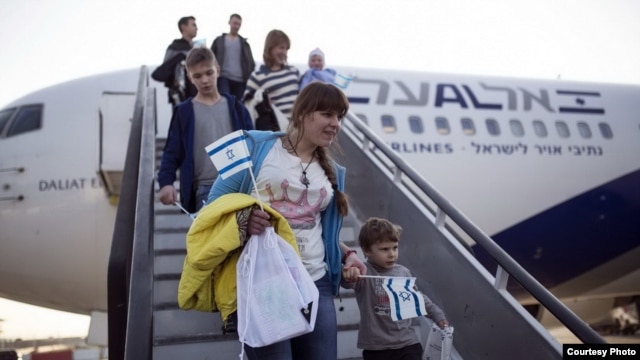
Nearly 5,000 Russians migrated to Israel in 2014 [Source: Courtesy Photo]

(Still, a lot of folks wonder why Israel builds all those settlements. – LS)

Just a year ago, Russian journalist Vladimir Yakovlev was one of Moscow’s most influential media figures.

Today, he lives a quiet life in Tel Aviv and has swapped his Russian passport for an Israeli one.

Yakovlev, the founder of the respected Kommersant publishing house and the Snob magazine, belongs to a new wave of disillusioned Russian Jews deserting their country for the relative stability of Israel.

“The big problem with Russia, and the main reason why I left, is the fact that our value system was destroyed,” he says. “Life in Russia has turned into Russian roulette. Every morning you turn the roulette wheel, you never know what is going to happen to you.”

Spooked by Russia’s actions in Ukraine and by the increasingly stringent punishments for anyone deemed critical of the Kremlin, Russians of Jewish descent have been fleeing in droves over the past 18 months.

Surge From Eastern Europe

According to Israeli authorities, as many as 4,685 Russian citizens relocated to Israel in 2014 — more than double than in any of the previous 16 years.

And the trend seems to be accelerating.

The nongovernmental Jewish Agency for Israel has released figures showing a 40-percent surge in immigration to the country between January and March of this year, compared to the same period in 2014.

The study suggests that while the majority of immigrants still come from Western Europe, Russians and Ukrainians are responsible for this increase. The number of Jews migrating from Western Europe has remained largely the same.

Yakovlev, however, doesn’t consider himself a simple immigrant. He is, in his own words, a refugee.

“People usually emigrate due to domestic circumstances,” he says. “People are now leaving because they are scared to stay where they would like to live. They are running from Russia.”

Zeyev Khanin, an official at Israel’s Immigrant Absorption Ministry, says the average Russian immigrant has changed dramatically since the last mass exodus of Jews from Russia ebbed in the late 1990s.

He says newcomers from Russia are significantly younger, more educated, and, as a rule, hail from Moscow or St. Petersburg.

“The average education level is on the rise and the number of people with degrees in humanities has increased massively,” he tells RFE/RL. “Today’s repatriates are mostly the creative intelligentsia.”

Mikhail Kaluzhsky was among the 4,685 Russians who moved to Israel last year.

A journalist and playwright from Moscow, he is typical of the new wave of Russian immigrants described by Khanin.

Kaluzhsky says his decision to leave Russia is “directly linked to politics.”

In January 2014, he traveled to Ukraine to witness the Maidan pro-democracy protests that toppled Russia-friendly President Viktor Yanukovych.

He says the unwavering determination of Maidan protesters left a deep impression on him, together with an uncomfortable realization that Russian antigovernment activists lag far behind their Ukrainian counterparts.

“I understood that our protests were worthless,” he says. “After the Bolotnaya protests [in Moscow in 2012] in our country, demonstrators went to the restaurant. Activists on Maidan did not go anywhere, they stayed until victory.”

Then, Kaluzhsky lost his job with the Sakharov human rights organization as a result of Russia’s new “foreign agent” law.

The controversial law, signed by Russian President Vladimir Putin in 2012, forces NGOs that receive foreign funding and are deemed to carry out political activities to register as “foreign agents.”

“The center’s financial situation deteriorated as soon as talk about foreign agents started in Russia,” says Kaluzhsky. “Western foundations said they could no longer fund initiatives that may be shut down tomorrow.”

In fall 2014, the Sakharov Center was forced to scrap its theater projects, to which Kaluzhsky had actively contributed.

Crimea Seizure

Russia’s annexation of Crimea from Ukraine was the last straw.

“After Crimea, our family decided to distance itself from all of this, most of all from the government,” he says.​

The Kaluzhskys now live in the outskirts of Tel Aviv. Their son attends a local Jewish pre-school and already speaks good Hebrew.

They have sold all their belonging in Russia and do not plan to return.

Vladimir Yakovlev, too, sees his future in Israel.

He and his wife have settled in downtown Tel Aviv, in a bright flat with a balcony full of flowers.

Most of their friends are other Russian intellectuals, and many of these friendships date back from their life in Moscow.

Yakovlev says Israel offers the best of both worlds — a sunny, friendly climate and the same circle of liberal, educated Muscovites that surrounded him in Russia.

“My group of friends here is almost the same as I had in Moscow,” he says. “We live in the same house as friends from Moscow, and I keep meeting people in the streets whom I regularly spent time with in Moscow.”

“No one,” he adds, “should be forced to spend their life dealing with this Russian nonsense.”

Fireworks for Iran

July 5, 2015

U.S. stockpiles powerful bunker-buster bombs in case Iran nuclear talks fail

By W.J. HENNIGAN For The L.A. Times July 3, 2015


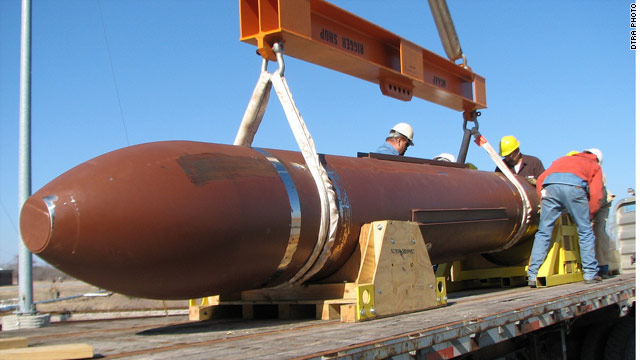
Loading the MOP during a 2007 test in New Mexico [Source: Unknown]

(Happy 4th of July everyone! – LS)

As diplomats rush to reach an agreement to curb Iran’s nuclear program, the U.S. military is stockpiling conventional bombs so powerful that strategists say they could cripple Tehran’s most heavily fortified nuclear complexes, including one deep underground.

The bunker-busting bombs are America’s most destructive munitions short of atomic weapons. At 15 tons, each is 5 tons heavier than any other bomb in the U.S. arsenal.

In development for more than a decade, the latest iteration of the MOP — massive ordnance penetrator — was successfully tested on a deeply buried target this year at the White Sands Missile Range in New Mexico. The test followed upgrades to the bomb’s guidance system and electronics to stop jammers from sending it off course.

U.S. officials say the huge bombs, which have never been used in combat, are a crucial element in the White House deterrent strategy and contingency planning should diplomacy go awry and Iran seek to develop a nuclear bomb.

Obama has made it clear that he has no desire to order an attack, warning that U.S. airstrikes on Iran’s air defense network and nuclear facilities would spark a destabilizing new war in the Middle East, and would only delay Iran by several years should it choose to build a bomb.

“A military solution will not fix it,” Obama told Israeli TV on June 1. An attack “would temporarily slow down an Iranian nuclear program, but it will not eliminate it.”

Secretary of Defense Ashton Carter, speaking to reporters Thursday at the Pentagon, sought to downplay the likelihood or the utility of an attack. He said no plan under consideration, including use of the bunker-busters, could deliver a permanent knockout blow to Iran’s nuclear infrastructure and enrichment plants.

“A military strike of that kind is a setback, but it doesn’t prevent the reconstitution over time,” he said. “And that basically has been the case as long as we’ve had those instruments and those plans, and I don’t think there’s anything substantially changed since then.”

U.S. officials have publicized the new bomb partly to rattle the Iranians. Some Pentagon officials warned not to underestimate U.S. military capabilities even if the bunker-busters can’t eliminate Iran’s nuclear program.

Gen. Martin Dempsey, chairman of the Joint Chiefs of Staff, suggested at the same Pentagon news conference Thursday that airstrikes might be ordered multiple times if Iran tries to build a bomb.

The military option “isn’t used once and set aside,” he said. “It remains in place. … We will always have military options, and a massive ordnance penetrator is one of them.”

A dynamic of escalation, action, and counteraction could produce serious unintended consequences that would … lead, potentially, to all-out regional war.

With negotiators in Vienna facing a self-imposed deadline of Tuesday, the White House views a layered military response as a potential fallback if the emerging deal — which would block Iran’s nuclear weapons capability for at least a decade in exchange for easing of economic sanctions — collapses and evidence shows that Iran is building a bomb.

Contingency plans include airstrikes by cruise missiles and stealth bombers on Iran’s major nuclear facilities, including the uranium enrichment plant at Natanz, a heavy-water reactor at Arak and a nuclear enrichment site at Fordow, which is inside a mountain and fortified with steel and concrete.

B-2 stealth bombers would be required to drop the MOP, which is designed to burrow 200 feet underground before it detonates. Multiple MOPs probably would be aimed at the same target to bore deeper and achieve maximum destruction.

The U.S. began secretly developing the MOP in 2004 after U.S. forces scoured caves in eastern Afghanistan in the hunt for Osama bin Laden. They discovered some sites so deeply buried they appeared impervious to existing bombs.

The Air Force and bomb builder Boeing Co. flight-tested the GPS-guided MOP in 2008 at the White Sands range, where the first atomic bomb was tested during World War II. The 20-foot-long bombs were dropped on multistory buildings with hardened bunkers and tunnels.

But development ramped up in 2010 after Fordow was uncovered and concern about Iran’s nuclear capabilities rose. Since then, the military has spent at least $400 million — including $40 million this year — to build and upgrade 20 bombs, according to budget documents.

Analysts offered mostly pessimistic predictions of how Iran would respond to a U.S. attack on its nuclear facilities.

“A military strike would result in the worst of all worlds,” said Dalia Dassa Kaye, director of the Center for Middle East Public Policy at the nonpartisan Rand Corp. “It may eliminate some facilities. But it would not eliminate Iranian scientists’ technical know-how and would likely further incentivize Iran to pursue a weapon at all costs.”

Iran could increase support for regional militant groups, such as Hezbollah, and perhaps back a terrorist attack on the United States, she said. U.S. forces battling Islamic State fighters in Iraq could find themselves targeted by Iranian-backed militias who are in tacit alignment in the war against the Sunni extremists.

A U.S. attack also could spark a broader war in the world’s most volatile region. Iran has hundreds of medium-range missiles capable of hitting Israel, Jordan and other American allies, according to defense intelligence estimates.

“A dynamic of escalation, action, and counteraction could produce serious unintended consequences that would … lead, potentially, to all-out regional war,” according to a recent study by the Woodrow Wilson International Center for Scholars that was endorsed by 32 high-ranking former military and government officials.

Iran’s nuclear program has already been attacked through covert digital action. In 2010, the U.S. and Israel reportedly slipped a destructive computer worm called Stuxnet into Iranian computer systems controlling the fast-spinning centrifuges that enrich uranium.

The cyberattack destroyed centrifuges and delayed enrichment, but Tehran soon recovered, according to the International Atomic Energy Agency, the United Nations nuclear watchdog agency.

Stuxnet did not lead to overt Iranian retaliation. U.S. airstrikes, and the casualties they would cause, almost certainly would spark a different response.

“It would create huge problems,” said Michael E. O’Hanlon, a military analyst at the Brookings Institution. “That said, it’s hard to rule out if talks fail.”

Vietnam…again!

July 2, 2015

(Mr. President, stop screwing with our young and brave soldiers NOW! – LS)

Live by the Sword, Die by the Sword

July 2, 2015

Syrian rebels turn tables on ISIS fighters by releasing slick execution video of them shooting jihadis while dressed in orange jumpsuits

By Jay Akbar For Mailonline Published: 03:36 EST, 1 July 2015

(Workplace violence. – LS)

A rebel group battling ISIS in Syria has turned the tables on its enemies by capturing and slaughtering dozens of Islamic State soldiers on camera.

Dressed in orange jumpsuits – attire usually worn by ISIS’s victims – the Jaysh Al-Islam soldiers lead 13 shackled jihadis to their deaths.

Jaysh Al-Islam calls itself the ‘Army of Islam’ and reportedly commands as many as 25,000 loyal fighters following the merger of around 60 rebel factions inside Syria.

Islamic State’s captured soldiers are forced to kneel as a commander announces: ‘Allah did not make a disease without appointing a remedy to it.’

Revenge: The rebels, dressed in orange - attire usually worn by ISIS's victims - has executed 13 ISIS militants (pictured)
Revenge: The rebels, dressed in orange – attire usually worn by ISIS’s victims – has executed 13 ISIS militants (pictured)
Long walk: Jaysh Al-Islam fighters lead the shackled ISIS soldiers to their deaths in an unknown part of Syria
Atrocity: They then unmask the ISIS militants before a commander refers to their group as the 'most serious calamity for our jihad today' 
Atrocity: They then unmask the ISIS militants before a commander refers to their group as the ‘most serious calamity for our jihad today’
Eye for an eye: A Jaysh Al-Islam commander (pictured) reads a statement before Islamic State militants are shot from point blank range

The jihadis – dressed entirely in black – are then given something to drink before each of their faces are clearly shown in the 19 minute-long propaganda video. They are then shot in the back of the head at point blank range with shotguns.

Before they are killed, a Jaysh Al-Islam militant says: ‘The most serious calamity for our jihad today is a group of people who grow at a time of division among Muslims.

‘This group claimed to be the mother state and made Takfir [accused of apostasy] on other Muslims, shed their blood and looted their properties and dignities.

‘They worsened… the ordeal of Muslims by corrupting their religion and livelihood and killing the jihadi leaders who did their best to help our stricken nation.

‘They wreaked havoc on our people in liberated areas and cut the supply route of jihadis. They left… Tehran intact and instead they attacked our mosques.

‘This is the penalty for what they have committed. We also call on their fellows to repent.’

In April this year, Jaysh Al-Islam released a striking video showing off 1,700 troops, a fleet of armoured tanks and special forces soldiers in an impressive military parade.

Deceased: The 19 minute-long propaganda video focuses on the faces of the ISIS militants before they are shot
Network: The gruesome footage was then shared online by Jaysh Al-Islam, just as ISIS has done with some many videos in which its militants are the executioners 

Strength: Four armoured tanks and thousands of soldiers formed part of a graduation ceremony (pictured) held by Jaysh Al-Islam, a militant group that opposes ISIS and the Syrian regime
Might: Jaysh Al-Islam (pictured) calls itself the 'Army of Islam' and reportedly commands as many as 25,000 loyal fighters
Might: Jaysh Al-Islam (pictured) calls itself the ‘Army of Islam’ and reportedly commands as many as 25,000 loyal fighters
Powerful: The group, who are allegedly being funded by Saudi Arabia, show of a fleet of armoured tanks (pictured) during the graduation ceremony for its recruits

It operates in the war-ravaged Syrian city of Damascus and its ongoing battle against President Bashar Al-Assad is reportedly funded by the wealthy nation of Saudi Arabia.

The Arab kingdom has sent millions of dollars to arm and train their fighters so they can defeat the Syrian regime and ‘increasingly powerful Jihadi organisations’, according to the Guardian.

Known as the Army of Islam, the insurgent group was created in 2011 when Saudi Arabia allegedly engineered the merger of over 50 rebel factions after growing alarmed at the rise if Al-Qaeda and ISIS in Syria.

It is a fierce enemy of both those Islamist groups as well as Jabhat Al-Nusra, but embraces independent rebel forces and ‘non-Jihadi’ units.

Their graduation ceremony for trainee soldiers in the Ghouta suburb of Damascus was attended by the militants’ leadership who watch proudly as their troops march in perfect unison across the expanse.

Jaysh Al-Islam is led by Sheikh Zahran Aloush who addresses the thousands of armed soldiers and tanks once they have assembled on the vast concrete ground below.