Author Archive

Spokesman: Senior Hamas official shot in the head

January 10, 2018

By Adam Rasgon, The Jerusalem Post
January 9, 2018 13:11

Article Link

{I never realized examining your gun could be so dangerous. – LS}

Imad al-Alami is in critical condition.

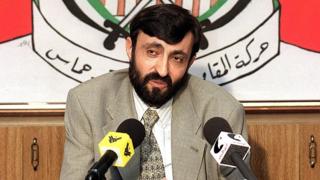
Senior Hamas official Imad al-Alami on Tuesday was admitted to a hospital in Gaza City after being shot in the head “while examining his personal weapon in his home,” Hamas Spokesman Fawzi Barhoum said.

Alami is known as a hardliner and has supported Hamas’s ties with Iran.

In a Facebook post, Barhoum said that Alami is in “critical condition.”

On Tuesday afternoon, Senior Hamas officials including Hamas Politburo Chief Ismail Haniyeh and Hamas Chief in Gaza Yahya Sinwar visited Alami in the intensive care unit in Gaza City’s Shifa Hospital, Gaza-based media reported.

Alami has been a Hamas member since the late 1980s and was the first Hamas representative in Tehran.

In 2012, he returned to Gaza after spending a number of years outside of the Palestinian territories.

In 2014, one of his feet was injured in an Israeli air raid during Operation Protective Edge, according to Hamas’s official website.


Report: Iran test fires long-range ballistic missile

October 11, 2015

Report: Iran test fires long-range ballistic missile
AP News 10-11-2015

(Meanwhile, under the cover of Putin’s war, his buddies in Iran continue to upgrade their campaign to destroy Israel. – LS)

TEHRAN, Iran (AP) — Iran successfully test fired a new guided long-range ballistic surface-to-surface missile, state TV reported on Sunday. It was the first such a test since Iran and world powers reach a historical nuclear deal.

Iran’s Defense Minister Gen. Hossein Dehghan, told the channel that the liquid-fuel missile “will obviously boost the strategic deterrence capability of our armed forces.”

He said the missile, named Emad or pillar in Farsi, was a technological achievement for Iran — able to be controlled until the moment of impact and to hit targets “with high precision.”

The channel showed footage of the huge missile being launched in a desert area, but it did not elaborate on the range of the missile or the specifics of the test firing.

This is the first test of a ballistic surface-to-surface missile by Iran since U.N. Security Council Resolution 2231 in July, which endorsed a landmark nuclear deal reached between Iran and world powers. The resolution called on Iran not to undertake any activity related to ballistic missiles capable of delivering nuclear weapons. Iran says none of its missiles are designed for that purpose. (LOL – LS)

Since 1992, Iran has emphasized a self-sufficient and indigenous military production industry, producing missiles, tanks and light submarines. The government frequently announces military advances which cannot independently verified.

The Islamic Republic already claims to have surface-to-surface missiles with a range of 2,000 kilometers (1,250 miles) that can hit Israel and U.S. military bases in the region.

Putin’s Syria strikes are a long-term play for higher oil prices

October 11, 2015

Putin’s Syria strikes are a long-term play for higher oil prices
By Alexander Termerko 10-10-2015 Via The Guardian

(Putin’s saving the Mideast….for himself. – LS)

Russian airstrikes in Syria, the first launched by Moscow outside the former Soviet Union since 1979, have set the tone for what’s to come. The escalating attacks have mainly targeted moderate, western-backed rebels. Civilians have also been hit, while Russian jets have twice violated Turkish airspace.

These immediate transgressions have shown that Putin, as always, will go his own way in this war. He will draw on as much of his military strength as he needs to, he will use indiscriminate force, and he will bully and intimidate the west’s regional allies.

In short, Putin will stop at nothing in pursuit of his goals and the international community needs to understand exactly what those goals are. Putin’s game is bigger than many commentators currently realise.

Yes, this is about Russia’s international standing, but more importantly it is also a long-term play for higher oil prices and, ultimately, a flow of oil dollars into Russia to strengthen his popularity at home.

The international aspect is relatively transparent. Putin has to prop up his ally and force his way back in from the cold on the global stage. Syria is home to Russia’s only naval base in the Middle East and has long been a buyer of Russian arms and a supplier of regional intelligence.

More importantly, however, he cannot be seen to stand by and allow Assad to fall. He needs to show the US and the world that he will not retreat from the position he staked out at the start of the conflict.

By wading into such a complicated international situation, he is also deflecting attention from Ukraine and weaving a new narrative for himself. Putin is now the bold peacekeeper, leading the charge against terrorism ahead of a hesitant US and earning a renewed place at the top table.

Whether they like it or not, western leaders now have to talk to him again. He can risk Russian lives without losing political capital at home, and can point to this sacrifice to leverage a blind eye towards continued aggression in Ukraine.

Of course Russia will also target Islamic State. The territory currently held by Isis contains important oil assets and Putin will be eager to bring these under his control. He can then play the “godfather”, dispensing cheap oil from previously Isis-held areas to his allies in the region.

Which brings us back to his primary aim. The more he can entrench himself in the Middle East, the more he can exert control over energy markets. With Iran and Iraq in his sphere he can begin to force Europe to rely on him again for supplies.

Prolonged war in the Middle East would serve Putin’s interests perfectly. The deeper and more widespread the conflict, the more world oil and gas prices are likely to rise, helping him stage an economic recovery at home and render the sanctions useless.

Ushering in better times at home is therefore Putin’s ultimate aim as he seeks to prop up a system that takes advantage of people’s patriotism and public spirit. The grand plan is for his vital oil and gas revenues to recover so he can buy the loyalty of Russia’s 140 million-strong population.

SHOT OUT OF THE SKY– Turks down ‘Russian plane violating their airspace’

October 11, 2015

SHOT OUT OF THE SKY– Turks down ‘Russian plane violating their airspace’
By Scott Campbell / Published 10th October 2015 Via The Daily Star

(This may be just the beginning. – LS)

According to reports, eyewitnesses saw a large explosion in Huraytan, northern Syria, while three fighter jets were hovering above.

One journalist tweeted that three Turkish planes were responding to “mysterious” lock-ons from Mig-29 jets, which are used by Putin’s forces.

Daily Star Online has contacted the Turkish government and the Russian military but neither could be reached for comment.

It comes amid heightening tensions between Putin and the West just days after another Russian bomber violated Turkish airspace.

F-16 fighters were scrambled after a MIG-29 twin-engined jet locked radar on Turkish planes near the town of Yayladagi, in Hatay province close to the border with Syria.

Turkish jets then escorted the Soviet-era aircraft back into Syrian airspace.

The incursion followed nearly a week of Russia’s devastating bombing campaign in Syria after President Vladimir Putin declared war on Islamic State (ISIS).

Turkey’s Prime Minister Ahmet Davutoglu said Russia’s entry into the conflict in Syria had escalated the crisis and that Moscow admitted its warplane’s violation of Turkey’s airspace was a “mistake”.

Russia’s ambassador in Turkey was also summoned in protest at the provocative action.

Turkish officials have warned Moscow would be held “responsible for any undesired incident” that may occur in the future.

And earlier this week former MI6 chief Sir John Sawers warned of a cataclysmic clash between Russia and the US as tensions boil between both superpowers.

It came after Defence Secretary Michael Fallon announced Britain is to station a “small number” of troops in the Baltic states in a further move to deter Russian aggression.

Mr Sawer said: “It is going to be quite hard to continue this campaign unless there is a degree of military co-ordination between the Russians and the West.

“You can’t really have two air forces fighting different campaigns aimed at different objectives over the same territory without the real risk of a clash.”

Giant Oil Deposit Found in Golan

October 9, 2015

Giant Oil Deposit Found in Southern Golan
By Arutz Sheva Staff 10-7-2015

(With Russia playing ‘good cop – bad cop’ just across the border, this could be a real game changer. The stakes for the Golan Heights just went up. How ironic…from the ‘depths’ of the Golan Heights. Just imagine the impact this could have on Israel’s economy if the deposit is as huge as the estimates. – LS)

A giant oil deposit has been found in the southern Golan Heights and estimates are that the amount of oil found will suffice to make Israel self sufficient for many years to come.

Globes quoted Afek Oil and Gas Chief Geologist Dr. Yuval Bartov as saying, “We are talking about a stratum which is 350 meters thick, and what is important is the thickness and the porosity.”

“On average in the world, strata are 20-30 meters thick, so this is ten times as large as that, so we are talking about significant quantities. The important thing is to know the oil is in the rock and that’s what we now know.”

Large amounts of oil have thus far been found in three drillings that have taken place in the southern Golan Heights. The potential for production is in the billions of barrels. Israel consumes about 100 million barrels of oil per year.

“Although the existence of the oil in the ground is a fact,” wrote Globes, “the critical phase now is to check how easily it can be extracted and whether it involves high production costs. In a period of very low oil prices, extraction will have to be relatively cheap to make exploitation of the field profitable.”

Bartov said, “There is enormous excitement. It’s a fantastic feeling. We came here thinking maybe yes or maybe no and now things are really happening.”

Israeli entrepreneurs have succeeded in finding huge natural offshore gas reserves in recent years, but their exploitation has been held up by leftist pressure to abrogate contracts the government made with the entrepreneurs and increase the government’s share in the gas fields.

Exploitation of the Golan oil discovery is opposed by environmental groups. “This is likely to make any potential extraction from the ground and production a more protracted process lasting many years,” according to Globes.

Hamas Leader: Time for ‘Third Intifada’ Against Israel

October 9, 2015

Hamas Leader: Time for ‘Third Intifada’ Against Israel
by Jordan Schachtel 6 Oct 2015 Via Breitbart

(Hamas and the Palestinians seem emboldened by the the Axis of Evil’s war in Syria. Apparently they feel Russia’s got their backs covered. Could be. I just wonder why so little is said of this possiblilty in the media. To me, it’s like ignoring the proverbial 1000 pound gorilla in the room. – LS)

A senior member of the Gaza-ruling terrorist group Hamas has called for a third intifada, or terror uprising, against the Jewish state of Israel.

Mahmoud al-Zahar, who previously served as Foreign Minister of the Palestinian National Authority, but now helps lead Hamas, said that now is the time for Palestinians to rise up against Israel.
Al-Zahar told the website of Hamas that an intifada is the only way to protect Jerusalem’s Al Aqsa mosque from Israel. Notably, Palestinian and regional leaders have decried Israel’s supposed “desecration” of the mosque. However, Israeli authorities are not even in charge of the grounds surrounding the mosque, and there has been no evidence presented of Israel tampering with the status quo around the holy site.

“The image of Palestinians from the West Bank and Jerusalem throwing stones and Molotov cocktails has dealt a blow to the occupier,” Al-Zahar said in approval of Palestinian riot tactics.
The Palestinian Authority (PA), however, is refusing to openly call for another intifada, although their leadership continues to justify and incite violence against Israelis.

PA President Mahmoud Abbas instructed his security forces to ramp up preventive measures in the West Bank in order to quell the surge in Palestinian violence, the Jerusalem Post reports. The office of President Abbas said the additional security measures were taken to “ensure security for the homeland and the people.”

Although Palestinian leaders continue to incite terror and refuse to condemn the murder of innocents, Abbas made clear that he does not want to square off against the might of the Israel Defense Forces (IDF).

Abbas said Tuesday at a meeting with the Palestine Liberation Organization (PLO): “We tell them (the Israelis) that we do not want either military or security escalation. All our instructions to our (security) agencies, our factions and our youth have been that we do not want escalation.”

Separately, the Israeli Defense Ministry announced on Tuesday that workers had completed construction of a security fence that provides protection for the Israeli communities situated near Israel’s Gaza border. The fence was built in anticipation of a future conflict with Hamas, which started a war with Israel in the summer of 2014 when its henchman assassinated three Israeli teenagers.

Beware Putin and his ‘anti-Hitler coalition’

October 9, 2015

Beware Putin and his ‘anti-Hitler coalition’
By Victor Davis Hanson 10-8-2015 Via Jewish World Review
Victor Davis Hanson, a classicist and military historian, is a senior fellow at the Hoover Institution and a recipient of the 2007 National Humanities Medal.

(This little love affair with the Russians has got some folks jumping into bed with them so fast it would make a prostitute blush. – LS)

Contrary to the principles of American foreign policy of the last 70 years, President Barack Obama and Secretary of State John Kerry tacitly invited Russia to “help” monitor things in the Middle East. Now they are learning that there are lots of Middle East scenarios far worse than the relative quiet Iraq that the Obama administration inherited in January 2009 — and soon abandoned.

Russian President Vladimir Putin liked the American invitation so much that he now has decided to move in permanently. Putin now wants the West to join his new Syria-Iran-Hezbollah-Iraq axis against the Islamic State — or to at least sit back and allow Russia to straighten out the Middle East as it sees fit.

To fight the Islamic State, Putin has called for something similar to the “anti-Hitler coalition” of World War II that once saw the Soviet Union and the West unite to defeat Nazi Germany.
Certainly, the Islamic State, like Nazi Germany, is a savage regime. So far it has grown unchecked at the very center of the Middle East. Yet under the cloak of fighting the Islamic State, Putin has two greater visions.

One, he is intervening to save his client in Syria, strongman Bashar al-Assad — and with him a new Middle East Shiite axis of Iran, Iraq, Syria and Russia. Putin says he wishes to destroy the terrorists of the Islamic State. But for now he is bombing moderate opponents of Assad and bolstering the anti-Western terrorists of Hezbollah and perhaps Hamas as well.

Two, Putin is sending a warning to the oil-exporting Sunni monarchies of the Persian Gulf, who are as rich as they are militarily weak: Russia, not the United States, is the new cop on the Middle Eastern beat.

If oil-rich and nuclear Russia and a soon-to-be-nuclear Iran can bully the Sunni monarchies, Putin’s new cartel may control the spigot of some 75 percent of the world’s daily export of oil.
Putin’s recall of history is as fishy as his proposed coalition. Since he has invoked the “anti-Hitler” alliance of World War II, we would all do well to remember the circumstances that led to the totalitarian Soviet Union of Josef Stalin joining with democracies to defeat Hitler.

Stalin, remember, was originally a de facto ally of Adolf Hitler. Stalin signed a nonaggression pact with Nazi Germany on August 23, 1939. That devil’s agreement greenlighted the start of World War II just over a week later.

Germany invaded neutral Poland on Sept. 1, 1939. It was joined soon after by Russian troops attacking from the east. With a now-friendly Russia at his rear, Hitler was then free to turn westward against the European democracies.

Russia still seems embarrassed by its 1939 sellout. Marshal Stalin would supply the Third Reich for 22 months with key resources that helped Hitler to attack Belgium, Denmark, France, Great Britain, Greece, Holland, Luxembourg, Norway and Yugoslavia.

There is no reason to believe the Soviet Union would ever have flipped to join Great Britain against Nazi Germany had Hitler not double-crossed Stalin and invaded the Soviet Union on June 22, 1941. After all, Stalin’s communist regime had liquidated more than 15 million of its own citizens during 1920s and 1930s, and was a kindred genocidal state to Hitler’s National Socialist Third Reich.

That embarrassing deal with Hitler still haunts Russia. Poland has complained bitterly about absurd statements made by a Russian ambassador who recently claimed that Poland was partly to blame for the outbreak of WWII because it blocked the formation of a coalition against Germany.

Russia’s dalliance with Hitler proved nearly suicidal. Russia lost nearly 30 million soldiers and civilians on the Eastern Front during its four-year struggle against its onetime Nazi partner.

True, the Red Army was responsible for more than two-thirds of the German casualties in WWII and helped to wreck the Wehrmacht. Yet cynical and opportunistic Russia at one time or another cut some sort of friendship deal with every major combatant on both sides of WWII: America, Britain, Germany, Italy and Japan.

Ironically, Stalin kept his word to the Axis alliance of Germany, Italy and Japan far better than he later did to the Allied partners, Britain and the United States, who helped save him. The Western allies provided nearly 20 percent of all Russian wartime resources. Without key Anglo-American resources like aluminum and heavy transport trucks, Russia might well have been knocked out by Hitler.

Yet after the war, Stalin renounced all his prior commitments to hold free and fair elections in those countries liberated from Nazism by the Red Army.

Putin’s sloppy historical perspective on World War II is a window into his soul. And we should be as distrustful of him as our disillusioned forefathers finally were of Stalin’s Soviet Union.

The way to end the murderous rampage of a savage, radical Islamic State is not by joining a Russian-Iranian cartel propping up Shiite terrorists and lapdog dictatorships in the Middle East as it seeks to strong-arm moderate Sunni states and oil-exporting monarchies.

AP INVESTIGATION: Nuclear smugglers sought extremist buyers

October 7, 2015

AP INVESTIGATION: Nuclear smugglers sought extremist buyers
By Desmond Butler And Vadim Ghirda Associated Press October 6, 2015

This undated photo provided by the Moldova General Police Inspectorate shows Alexandr Agheenco, a Russian citizen based in Moldova’s breakaway region of Trans-Dniestr, and called “the Colonel” by his cohorts. Authorities said a 2011 uranium-235 smuggling operation was led by him with Teodor Chetrus, a former KGB informant, as his middleman. (Moldova Police via AP) (AP)


(This article pretty much speaks for itself. With Russians like these guys, who needs enemies. – LS)

CHISINAU, Moldova (AP) — In the backwaters of Eastern Europe, authorities working with the FBI have interrupted four attempts in the past five years by gangs with suspected Russian connections that sought to sell radioactive material to Middle Eastern extremists, The Associated Press has learned. The latest known case came in February this year, when a smuggler offered a huge cache of deadly cesium — enough to contaminate several city blocks — and specifically sought a buyer from the Islamic State group.

Criminal organizations, some with ties to the Russian KGB’s successor agency, are driving a thriving black market in nuclear materials in the tiny and impoverished country of Moldova, investigators say. The successful busts, however, were undercut by striking shortcomings: Kingpins got away, and those arrested evaded long prison sentences, sometimes quickly returning to nuclear smuggling, AP found.

Moldovan police and judicial authorities shared investigative case files with AP in an effort to spotlight how dangerous the nuclear black market has become. They say the breakdown in cooperation between Russia and the West means that it has become much harder to know whether smugglers are finding ways to move parts of Russia’s vast store of radioactive materials — an unknown quantity of which has leached into the black market.

“We can expect more of these cases,” said Constantin Malic, a Moldovan police officer who investigated all four cases. “As long as the smugglers think they can make big money without getting caught, they will keep doing it.”

In wiretaps, videotaped arrests, photographs of bomb-grade material, documents and interviews, AP found a troubling vulnerability in the anti-smuggling strategy. From the first known Moldovan case in 2010 to the most recent one in February, a pattern has emerged: Authorities pounce on suspects in the early stages of a deal, giving the ringleaders a chance to escape with their nuclear contraband — an indication that the threat from the nuclear black market in the Balkans is far from under control.

Moldovan investigators can’t be sure that the suspects who fled didn’t hold on to the bulk of the nuclear materials. Nor do they know whether the groups, which are pursuing buyers who are enemies of the West, may have succeeded in selling deadly nuclear material to extremists at a time when the Islamic State has made clear its ambition to use weapons of mass destruction.

The cases involve secret meetings in a high-end nightclub; blue-prints for dirty bombs; and a nerve-shattered undercover investigator who slammed vodka shots before heading into meetings with smugglers. Informants and a police officer posing as a connected gangster — complete with a Mercedes Benz provided by the FBI — penetrated the smuggling gangs. The police used a combination of old-fashioned undercover tactics and high-tech gear, from radiation detectors to clothing threaded with recording devices.

The Moldovan operations were built on a partnership between the FBI and a small team of Moldovan investigators — including Malic, who over five years went from near total ignorance of the frightening black market in his backyard to wrapping up four sting operations.

“In the age of the Islamic State, it’s especially terrifying to have real smugglers of nuclear bomb material apparently making connections with real buyers,” says Matthew Bunn, a Harvard professor who led a secret study for the Clinton administration on the security of Russia’s nuclear arsenal.

The Moldovan investigators were well aware of the lethal consequences of just one slip-up. Posing as a representative’s buyer, Malic was so terrified before meetings that he gulped shots of vodka to steel his nerves. Other cases contained elements of farce: In the cesium deal, an informant held a high-stakes meeting with a seller at an elite dance club filled with young people nibbling on sushi.

In the case of the cesium, investigators said the one vial they ultimately recovered was a less radioactive form of cesium than the smugglers originally advertised, and not suitable for making a dirty bomb.

The most serious case began in the spring of 2011, with the investigation of a group led by a shadowy Russian named Alexandr Agheenco, “the colonel” to his cohorts, whom Moldovan authorities believe to be an officer with the Russian FSB, previously known as the KGB. A middle man working for the colonel was recorded arranging the sale of bomb-grade uranium, U-235, and blueprints for a dirty bomb to a man from Sudan, according to several officials. The blueprints were discovered in a raid of the middleman’s home, according to police and court documents.

Wiretapped conversations repeatedly exposed plots that targeted the United States, the Moldovan officials said. At one point the middleman told an informant posing as a buyer that it was essential that the smuggled uranium go to Arabs.

“He said to the informant on a wire: ‘I really want an Islamic buyer because they will bomb the Americans,'” said Malic, the investigator.

As in the other cases, investigators arrested mostly mid-level players after an early exchange of cash and radioactive goods.

The ringleader, the colonel, got away. Police cannot determine whether he had more nuclear material. His partner, who wanted to “annihilate America,” is out of prison.

When Is It a War Crime to Defend Yourself? If You’re an Israeli.

July 31, 2015

When Is It a War Crime to Defend Yourself? If You’re an Israeli.

by Jonathan S. Tobin July 31, 2015 Via Commentary Magazine


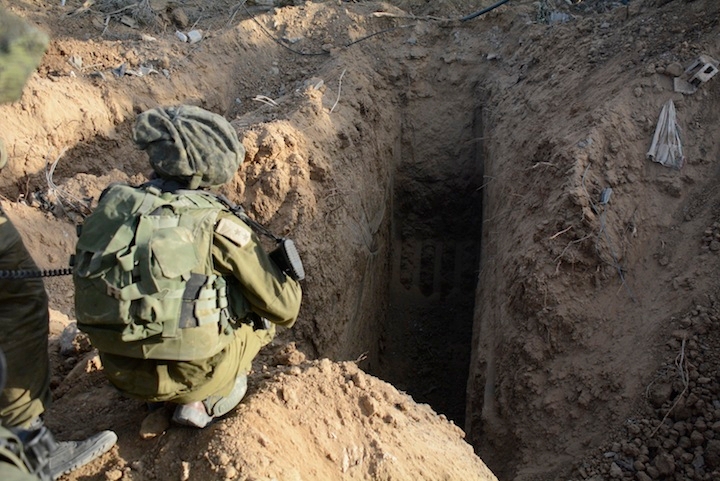
Israeli paratroopers inspect the entrance of a tunnel they discovered in the northern Gaza Strip, July 18, 2014. (IDF Spokesperson/Flash 90)

(That dangerous double standard just won’t go away. – LS)

Yesterday, Amnesty International issued its latest broadside at the State of Israel. The group’s report, titled “Black Friday: Carnage in Rafah” dutifully reported at length by the New York Times, seeks to portray an incident from last summer’s war in Gaza as an example of  particularly awful Israeli war crimes involving shelling of civilian areas and egregious loss of life. But, as with most such accusations, the closer you look at the charge the more it becomes clear that the point of the exercise isn’t merely a supposed quest for justice for dead Palestinians. While this must be seen in the context of a campaign to prepare war crimes charges against the Israel Defense Forces before the International Criminal Court that was recently joined by the Palestinian Authority, the effort has a broader purpose than merely beginning a human rights prosecution before that body. By expending a great deal of its limited resources on this one incident, Amnesty is seeking to make a much broader political point: delegitimizing Israeli self-defense under virtually any circumstances.

The incident that generated the reported took place on August 1, 2014. On that morning, a cease-fire between Israel and Hamas was put into effect that sought to end the war that had begun a month earlier. The conflict started when a Hamas terror cell kidnaped and murdered three Israeli teenagers and then escalated when the group began firing rockets at Israeli cities and towns. Several thousand of these missiles would be launched at Israel before the war ended. In addition to that, Hamas attempted to employ tunnels it had dug underneath the border with Israel to conduct more such kidnap/murder raids. Though the Israelis tried at first to halt the attacks with air power, when that didn’t work, ground forces were required to stop the terrorists. Though the August 1st cease-fire — like the one that later finally did end the shooting — left Hamas in place and in possession of its rocket arsenal, Israel agreed to it.

But only an hour after the fighting was supposed to stop, a Hamas terror squad ambushed a group of Israeli soldiers in the city of Rafah along the border with Israel. Two were killed and the body of one, Second Lieutenant Hadar Goldin, was dragged into the tunnel from which his attackers had emerged. That set off a desperate search and counter-attack aimed at recovering him and/or his body. That directive, known by the code name, “Hannibal” aims to use maximum force to prevent terrorists from escaping with a hostage. The order is always controversial because some interpret it as encouraging Israeli forces to even endanger the life of the captured soldier rather than standing down and subjecting both the individual and his country to a protracted hostage negotiation that inevitably involves the release of a disproportionate number of terrorist murderers.

In this case, Amnesty accuses Israel of using artillery fire in such a way as to conduct “disproportionate or otherwise indiscriminate attacks” on civilian areas with no regard for the lives of innocents who might be killed in the barrage. According to Amnesty and its Palestinian sources, the Israelis fired 1,000 shells and 40 bombs on the area where the Hamas assault took place resulting in 135 Palestinian deaths.

But while the loss of life during this battle was regrettable, the focus of the Amnesty report is remarkably skewed.

After all, the one war crime that we can be sure that took place was the attack on Goldin and his squad. It was a deliberate violation of a cease-fire that might have been a godsend for ordinary Palestinians, but which didn’t serve the purposes of Hamas. Having bled Gaza white for weeks, the leaders of the terrorist group were not yet satisfied with the toll of casualties among their own people. Hamas places its missile launchers and terror squads among civilians in order to deliberately expose them to Israeli fire. While there are plenty of fortified shelters in the strip for Hamas fighters and their massive arsenal, there are few for civilians. In Hamas-run Gaza, the shelters are for the bombs, not the people.

That means that any fair-minded observer of the events of August 1, 2014 must concede that the responsibility for all of the casualties the ensued as Israeli and Hamas forces fought in Rafah that day belongs to those who cynically ordered the attack on the Israeli soldiers that ended the cease-fire. The tunnel they used ran through residential areas, and the flight of these terrorists was such that they deliberately and with malice aforethought endangered the lives of all those who lived in the area. Their goal was not only to spirit away a hostage but also to create the kind of havoc that would result in more accusations against Israel.

But the minute analysis of every round fired by the Israelis by Amnesty not only doesn’t take that into account or put their accusations in a reasonable context. It also treats the effort to rescue Goldin — who probably did not survive the initial attack — as wrong while treating the assault on the Israelis as a reasonable and even legal action. But even in the course of its effort to demonize the Israeli actions by pouring on the details of bullets and shells fired amid a chaotic battle amid the fog of war, Amnesty cannot help falsifying their indictment. The report fails to take into account that along with the civilians who were sadly killed or wounded as a result of terrorist actions, some of the casualties they lament were actually Hamas or Islamic Jihad personnel.

But no matter how you break down the battle, the talk of disproportionate fire frames the discussion in a way that inevitably skews it toward treating the Israelis as the transgressors rather than a combatant. Would any nation, including Western democracies or the United States, be any less “indiscriminate” in its fire on terrorists attacking its cities and its troops than the Israelis? The answer is obviously not. As General Martin Dempsey, the chairman of the Joint Chiefs of Staff said in his comments about the Gaza war, the conduct of the Israelis in the fighting was a model that U.S. forces seek to emulate in their own conflicts in the Middle East. Indeed, the same accusations of “disproportionate” fire are often, and sometimes with more reason, lodged against Americans fighting in Afghanistan or bombing Taliban or al-Qaeda targets in Pakistan.

As for the “Hannibal” directive, the discussion is a controversial one even within Israel. But the assumption that it means that soldiers are ordered to kill one of their own rather than let them be taken is probably a misunderstanding. Any hostage in a war zone is, by definition, in harm’s way and faces a good chance of becoming a casualty. The Israelis rightly seek to prevent the capture of their people. Doing so spares the country and the individual from a terrible ordeal. Efforts to prevent these crimes deserve the praise of fair-minded people, not their condemnation.

The effort to turn the effort to save Hadar Goldin was, like the entire counter-offensive that Israel conducted in Gaza last summer, entirely justified. The blame for the deaths of Palestinians needs to be placed at the door of the Hamas terrorists that started the conflict and then broke a cease-fire in a conscious effort to set in motion the tragic events that then unfolded.

In the meantime, the family of Lt. Goldin still awaits the return of his body from Hamas that may be holding his remains in order to exact another gruesome exchange for live killers. If Amnesty wants to live up to its claim of advocacy for human rights, it might want to get involved in that issue. More to the point, the group and its financial backers need to understand that by conducting such attacks on Israel, it cannot pretend that is rationalizing the actions of one side in the conflict. In this case, their version of human rights advocacy appears to be indistinguishable from rationalizing the crimes of terrorists and seeking to hamstring the efforts of those seeking to stop them.

Enemy Manifesto: The Ayatollah’s Plan for Israel and Palestine

July 31, 2015

The Ayatollah’s Plan for Israel and Palestine

by Amir Taheri July 31, 2015 at 10:30 am


Iran’s Supreme Leader, Ayatollah Khamenei (center), is shown meeting in May 2014 with Iran’s military chief of staff and the commanders of the Islamic Revolutionary Guards Corps. (Image source: IRNA)

(Quote: ‘…U.S., which has supported the Jewish state for decades, might decide that the cost of doing so [supporting Israel] is higher than possible benefits.’ End Quote. The Ayatollah fails to realize that America’s ties to Israel are much deeper than reaping ‘possible benefits’. – LS)

“The flagbearer of Jihad to liberate Jerusalem.”

This is how the blurb of “Palestine,” a new book, published by Islamic Revolution Editions last week in Tehran, identifies the author.

The author is “Grand Ayatollah Seyyed Ali Husseini Khamenei,” the “Supreme Guide” of the Islamic Republic in Iran, a man whose fatwa has been recognized by U.S. President Barack Obama as having the force of law.

Edited by Saeed Solh-Mirzai, the 416-page book has received approval from Khamenei’s office and is thus the most authoritative document regarding his position on the issue.

Khamenei makes his position clear from the start: Israel has no right to exist as a state.

He uses three words. One is “nabudi” which means “annihilation”. The other is “imha” which means “fading out,” and, finally, there is “zaval” meaning “effacement.”

Khamenei claims that his strategy for the destruction of Israel is not based on anti-Semitism, which he describes as a European phenomenon.

His position is based on “well-established Islamic principles”, he claims.

One such is that a land that falls under Muslim rule, even briefly, can never again be ceded to non-Muslims. What matters in Islam is control of a land’s government, even if the majority of inhabitants are non-Muslims. Khomeinists are not alone in this belief.

Dozens of maps circulate in the Muslim world, showing the extent of Muslim territories lost to the infidel that must be recovered. These include large parts of Russia and Europe, almost a third of China, the whole of India and parts of the Philippines and Thailand.

However, according to Khamenei, Israel, which he labels as “adou” and “doshman,” meaning “enemy” and “foe,” is a special case for three reasons. The first is that it is a loyal “ally of the American Great Satan” and a key element in its “evil scheme” to dominate “the heartland of the Ummah.”

The second reason is that Israel has waged war on Muslims on a number of occasions, thus becoming a “hostile infidel” (“kaffir al-harbi”).

Finally, Israel is a special case because it occupies Jerusalem, which Khamenei describes as “Islam’s third Holy City.” He intimates that one of his “most cherished wishes” is to one day pray in Jerusalem.

Khamenei insist that he is not recommending “classical wars” to wipe Israel off the map. Nor does he want to “massacre the Jews.” What he recommends is a long period of low-intensity warfare designed to make life unpleasant if not impossible for a majority of Israeli Jews so that they leave the country.

His calculation is based on the assumption that large numbers of Israelis have dual-nationality and would prefer emigration to the United States or Europe to daily threats of death.

Khamenei makes no reference to Iran’s nuclear program. But the subtext is that a nuclear-armed Iran would make Israel think twice before trying to counter Khamenei’s strategy by taking military action against the Islamic Republic.

In Khamenei’s analysis, once the cost of staying in Israel has become too high for many Jews, Western powers, notably the U.S., which has supported the Jewish state for decades, might decide that the cost of doing so is higher than possible benefits.

Thanks to President Obama, the U.S. has already distanced itself from Israel to a degree unimaginable a decade ago.

Khamenei counts on what he sees as “Israel fatigue.” The international community would start looking for what he calls “a practical and logical mechanism” to end the old conflict.

Khamenei’s “practical and logical mechanism” excludes the two-state formula in any form.

“The solution is a one-state formula,” he declares. That state, to be called Palestine, would be under Muslim rule but would allow non-Muslims, including some Israeli Jews who could prove “genuine roots” in the region, to stay as “protected minorities.”

Under Khamenei’s scheme, Israel plus the West Bank and Gaza would revert to the United Nations’ mandate for a brief period during which a referendum would be held to create the new state of Palestine.

All Palestinians and their descendants, wherever they are, would be able to vote, while Jews “who have come from other places” would be excluded.

Khamenei does not mention any figures for possible voters in his dream referendum. But studies by the Foreign Ministry in Tehran suggest that at least eight million Palestinians across the globe would be able to vote, against 2.2 million Jews “acceptable” as future second-class citizens of the new Palestine. Thus, the “Supreme Guide” is certain of the results of his proposed referendum.

He does not make clear whether the Kingdom of Jordan, which is located in 80 percent of historic Palestine, would be included in his one-state scheme. However, a majority of Jordanians, who are of Palestinian extraction, would be able to vote in the referendum and, logically, become citizens of the new Palestine.

Khamenei boasts about the success of his plans to make life impossible for Israelis through terror attacks from Lebanon and Gaza. His latest scheme is to recruit “fighters” in the West Bank to set-up Hezbollah-style units.

“We have intervened in anti-Israel matters, and it brought victory in the 33-day war by Hezbollah against Israel in 2006 and in the 22-day war between Hamas and Israel in the Gaza Strip,” he boasts.

Khamenei describes Israel as “a cancerous tumor” whose elimination would mean that “the West’s hegemony and threats will be discredited” in the Middle East. In its place, he boasts, “the hegemony of Iran will be promoted.”

Khamenei’s book also deals with the Holocaust, which he regards either as “a propaganda ploy” or a disputed claim. “If there was such a thing,” he writes, “we don’t know why it happened and how.”

Khamenei has been in contact with professional Holocaust deniers since the 1990s. In 2000, he invited Swiss Holocaust-denier Jürgen Graf to Tehran and received him in private audiences. French Holocaust-denier Roger Garaudy, a Stalinist who converted to Islam, was also feted in Tehran as “Europe’s’ greatest living philosopher.”

It was with Khamenei’s support that former President Mahmoud Ahmadinejad set up a “Holocaust-research center” led by Muhammad-Ali Ramin, an Iranian functionary with links to German neo-Nazis who also organized annual “End of Israel” seminars.

Despite efforts to disguise his hatred of Israel in Islamic terms, the book makes it clear that Khamenei is more influenced by Western-style anti-Semitism than by classical Islam’s checkered relations with Jews.

His argument about territories becoming “irrevocably Islamic” does not wash, if only because of its inconsistency. He has nothing to say about vast chunks of former Islamic territory, including some that belonged to Iran for millennia, now under Russian rule.

Nor is he ready to embark on Jihad to drive the Chinese out of Xinjiang, a Muslim khanate until the late 1940s.

Israel, which in terms of territory accounts for one per cent of Saudi Arabia, is a very small fry.

Khamenei’s shedding of tears for “the sufferings of Palestinian Muslims” are also unconvincing. To start with, not all Palestinians are Muslims. And, if it were only Muslim sufferers who deserved sympathy, why doesn’t the “Supreme Guide” beat his chest about the Burmese Rohingya and the Chechens massacred and enchained by Vladimir Putin, not to mention Muslims daily killed by fellow-Muslims across the globe?

At no point in these 416 pages does Khamenei even mention the need to take into account the views of either Israelis or Palestinians regarding his miracle recipe. What if Palestinians and Israelis wanted a two-state solution?

What if they chose to sort out their problems through negotiation and compromise rather than the “wiping-off-the-map” scheme of he proposes?

Khamenei reveals his ignorance of Islamic traditions when he designates Jerusalem as “our holy city.” As a student of Islamic theology, he should know that “holy city” and “holy land” are Christian concepts that have no place in Islam.

In Islam, the adjective “holy” is reserved only for Allah and cannot apply to anything or anyone else. The Koran itself is labeled “al-Majid” (Glorious) and is not a holy book as is the Bible for the Christians.

The “Supreme Guide” should know that Mecca is designated as “al-Mukarramah” (the Generous) and Medina as “al-Munawwarah” (the Enlightened). Even the Shi’ite shrine cities of Iraq are not labeled “muqqaddas” (holy). Najaf is designated as “al-Ashraf” (the Most Noble) and Karbala as “al-Mualla” (the Sublime).

In the early days of his mission, the Prophet Muhammad toyed with the idea of making Jerusalem the focal point of prayers for Islam. He soon abandoned the idea and adopted his hometown of Mecca, where the black cube (kaabah) had been a magnet for pilgrims for centuries before Islam. For that reason, some classical Muslim writers refer to Jerusalem as “the discarded one” (al-yarmiyah) like a first wife who is replaced by a new favorite. In the 11th century, the Shiite Fatimid Caliph, Al-Hakim, even ordered the destruction of “discarded” Jerusalem.

The Israel-Palestine issue is not a religious one. It is a political conflict about territory, borders, sharing of water resources and security. Those who, like Khamenei, try to inject a dose of religious enmity into this already complex cocktail deserve little sympathy.