Author Archive

Sirens, clashes in north after IDF shoots down Iranian drone

February 10, 2018

Air force bombs Iranian targets in Syria in response to border breach, meeting heavy anti-aircraft fire; F-16 crashes in Israeli territory, pilots safe

F-35 fighter jets fly over Israel in an undated photograph. (Israel Defense Forces)

An Iranian unmanned aircraft entered Israeli territory from Syria early Saturday morning and was shot down by the Israeli Air Force, the army said. In response to the breach, the air force struck Iranian targets in Syria.

The Syrian army targeted Israeli jets with anti-aircraft missiles during the raid, setting of alarm sirens across the Golan Heights and the Jordan Valley. One anti-aircraft missile fell inside Israeli territory, causing no damage.

An Israeli F-16 went down during the incident. The army said the pilots ejected after being targeted by missiles. The two pilots landed safely and the plane fell in a field near a road in Israeli territory, in the Jezreel valley.

In a statement, the military said the drone incident was “a serious breach of Israeli sovereignty by Iran.” Tehran, it added, was “dragging the region into an adventure, and will pay the price.”

The drone was identified approaching Israeli airspace at around 4 a.m., setting off alarms in the Beit Shean area near the Sea of Galilee. It was identified by air defenses and downed by an Apache helicopter upon entering Israeli territory. The army said the drone’s remains were in Israeli hands.

The IDF said it attacked the drone’s launch site in Syria, the Tiyas Military Airbase near Palmyra, in “a complicated surgical strike.” The strike reportedly targeted a facility housing the unmanned aircraft’s Iranian operators.

 
 The air force was met with heavy Syrian anti-aircraft fire. During the activity an F-16 targeted by anti-aircraft missiles went down in Israeli territory, crashing near Kibbutz Harduf in the Jezreel Valley. The pilots ejected and landed safely. They were taken to hospital for medical examination.

Syrian state media said air defenses repelled an Israeli raid, hitting more than one warplane.

Watch: F-16 pilots evacuated after ejecting from plane

Shaul Pinkerfeld, a security officer at Kibbutz Harduf, told Walla news: “A little bit after 6 a.m. we heard explosions. We woke up and understood that there was a plane or the remains of a plane on fire near the kibbutz entrance.

“There have been no special instructions for residents but there is no entering or leaving the kibbutz, and we don’t know for how long.”

Residents of northern Israel reported multiple alarm sirens in the early morning hours, which apparently came both in response to the drone and to Syrian missile launches. Some posted videos of the smoke-filled early morning skies.

The army said Chief of Staff Lt. Gen. Gadi Eisenkot and Air Force chief Maj. Gen. Amikam Norkin were leading operations.

“The IDF is following events and is fully prepared for further action according to decisions and need,” the military said.

Moscow slams ‘illegal’ US presence in Syria as Pentagon reserves right for ‘defensive’ attacks

February 9, 2018

Published time: 9 Feb, 2018 04:03

https://www.rt.com/news/418281-illegal-us-presence-syria-crime/

FILE PHOTO: A Lockheed Martin F-22 Raptor fighter. © Peter Nicholls / Reuters

Russia has reminded the US that its presence in Syria is illegal after the coalition struck pro-government militias. Washington however reserved the right for “defensive” attacks to achieve peace “from a position of strength.”

The US presence in Syria is “actually illegal,” the Russian Ambassador to the UN reminded his Western counterparts on Thursday at a closed-door meeting of the UN Security Council. “Nobody invited them there,” Vasily Nebenzya stated, emphasizing that a hard fought for stability in Syria is being jeopardized by US actions.

On Wednesday, the US-led coalition said it carried out several “defensive” airstrikes on Syrian forces in Deir Ez-Zor province in retaliation for what they described as an “unprovoked” attack on the so-called Syrian Democratic Forces (SDF) and foreign military “advisers.”

Read more

FILE PHOTO. Oil well on the outskirts of the city of Deir ez-Zor. © Mikhail Voskresenskiy

According to the Russian Defense Ministry, the Syrian militia unit was advancing against a “sleeper cell” of Islamic State (IS, formerly ISIS/ISIL) terrorists near the former oil processing plant of al-Isba, when it suddenly came under massive air strikes. At least 25 militiamen were injured in the attack, the Russian MoD noted, clarifying that pro-government troops targeted by the coalition did not coordinate their operation with the Russian command.

The US, however, maintains that the militia attacked the SDF. The Pentagon said Syrian forces moved “in a battalion-sized unit formation, supported by artillery, tanks, multiple-launch rocket systems and mortars.” The battle which lasted over three hours, the US claims, began after 30 artillery tank rounds landed within 500 meters of the SDF unit’s location.

“At the start of the unprovoked attack on Syrian Democratic Forces and coalition advisers, coalition aircraft, including F-22A Raptors and MQ-9B Reapers, were overhead providing protective overwatch, defensive counter air and [intelligence, surveillance and reconnaissance] support as they have 24/7 throughout the fight to defeat ISIS,” Air Forces Central Command spokesman Lt. Col. Damien Pickart told Military.com.

“Following a call for support from Air Force Joint Terminal Attack Controllers, a variety of joint aircraft and ground-based artillery responded in defense of our SDF partners, including F-15E Strike Eagles,” he said in a statement Thursday. “These aircraft released multiple precision-fire munitions and conducted strafing runs against the advancing aggressor force, stopping their advance and destroying multiple artillery pieces and tanks.”

Damascus called the attack a “war crime,” while the Russian military asserted that Washington’s true goal is to capture “economic assets” in Syria. The Russian Foreign Ministry spokeswoman Maria Zakharova affirmed that the US military presence in Syria poses a dangerous threat to the political process and territorial integrity of the country, while Foreign Minister Sergey Lavrov called the strike another violation of Syria’s sovereignty by the US.

The US, however, remained unmoved, promising to continue to support the US-allied forces in Syria at any cost. “We continue to support SDF with respect to defeating ISIS… ISIS is still there, and our mission is still to defeat ISIS,” Pentagon spokeswoman Dana White said Thursday. “We will continue to support them. Our goal is to ensure that our diplomats can negotiate from a position of strength, with respect to the Geneva process.”

“They [US] constantly assert that they are fighting international terrorism there, but we see that they go beyond this framework,” Nebenzya told the UNSC. He warned the US-led coalition members that it is “criminal” to engage the only forces “who actually fight” international terrorism in Syria.

US-Led Coalition Bombs Syrian Forces Following Israeli Strike Near Damascus

February 9, 2018

A US-led coalition has conducted several “defensive” airstrikes against Syrian forces allied with President Bashar al-Assad on Wednesday in Syria’s Deir al-Zor province, in retaliation for what the coalition said was an “unprovoked” attack on the US-backed left-wing Syrian Democratic Forces (SDF) headquarters.

Furthermore, CNN reported late Thursday that US forces are now investigating whether Russian contractors were involved in the initial attack against the SDF, after a US official told the news outlet that the possibility could not be ruled out.

The retaliatory airstrikes are said to have occurred 8km (5 miles) east of the Euphrates River, while no U.S. troops embedded with the local fighters at their headquarters are believed to have been wounded or killed in the attack on the headquarters, reports Reuters.

The US-led coalition did not say whether any pro-Syrian forces were killed in the retaliatory strike.

“Syrian pro-regime forces initiated an unprovoked attack against well-established Syrian Democratic Forces headquarters,” reads a Feb 7 press release from Central Command. “In defense of Coalition and partner forces, the Coalition conducted strikes against attacking forces to repel the act of aggression against partners engaged in the Global Coalition’s defeat-Daesh mission.”

Although no U.S. servicemembers were reportedly involved in the attack on the SDF, the US-led coalition has previously asserted a “non-negotiable right to act in self-defense,” pointing to the fact that coalition service members are embedded with the SDF “partners” on the ground in Syria.

Syrian President Bashara al-Assad has repeatedly stated that the presence of the US-led coalition on Syrian soil is an act of aggression and a violation of Syrian sovereignty. Officially, Russian and Syrian air forces are the only military allowed to operate in Syria – however Syria and Iran are close strategic allies, with the latter providing logistical, technical and financial support to the Syrian government during the ongoing Syrian Civil War. Syria has repeatedly asked the United Nations to convince the United States to leave following the defeat of most ISIS forces in the country, however US Secretary of State Rex Tillerson says US troops will remain in Syria as a counter to Syrian President Bashar al-Assad and Iranian forces.

Secretary of State Rex Tillerson

News of the retaliatory coalition airstrike comes on the heels of what we reported was an overnight attack against Syrian government locations near Damascus, in yet another attempt to provoke war with Syria.

Bombs Away

As we discussed earlier, for at least the third time since the start of the 7-year long war in Syria, Israeli jets attacked a site just outside of Syria’s capital city called Jamraya – believed to be a military research facility related to chemical weapons.

Jamraya’s government facilities are well known – and include a branch of Syria’s Scientific Studies and Research Center – the site of two previous Israeli attacks in 2013 and December of 2017.

Like with other recent attacks, Israeli jets are reported to have fired from over Lebanon, with a Syrian military media statement saying that its air defenses intercepted most of the inbound missiles, though no further details were given. Unconfirmed international media reports, however, indicate one or more of the Israeli missiles may have impacted parts of the Syrian government facility during the strikes which occurred at 03:42 am local time Wednesday morning.

In response to Israel’s most recent attack – apparently timed to coincide with recent allegations against repeated chemical attacks conducted by the Syrian government against al-Qaeda held pockets of the country, the Syrian military said “The general command of the armed forces holds Israel fully responsible for the dangerous consequences of its repeated, aggressive and uncalculated adventures.”

Though admitting “no evidence” US Defense Secretary Jim Mattis suggested last week that the Syrian Army may be using sarin gas while also alleging multiple smaller scale chlorine attacks.

Israel, however, has lately been quick to justify what Damascus has condemned as unprovoked “acts of aggression” in humanitarian terms as retribution for supposed gas attacks. Israel has long been on record as condemning Iran’s presence in the region, however, Israeli leaders lately appear increasingly reliant on chemical attack claims as rationale for bombing Syrian government sites. 

Looks like more regime change is on the menu. The only question is when, and whether or not chocolate cake will be served for dessert.

READ ALSO :

US air, artillery strike Hizballah, Iranian forces in E. Syria

https://www.debka.com/us-air-artillery-strike-hizballah-iranian-forces-e-syria/

More on US strike: Russians who laid Euphrates bridge among targets

https://www.debka.com/us-strike-russians-laid-euphrates-bridge-among-targets/

Egypt launches major operation in Sinai against terrorists

February 9, 2018

Egypt’s army has launched a major operation in northern Sinai to “eradicate terrorism.” The army’s spokesperson announced the operation in a televised statement.

Becca Noy
http://www.jerusalemonline.com/news/middle-east/the-arab-world/egypt-launches-wide-scale-operation-in-sinai-34491
Egyptian military vehicle in Sinai Photo Credit: EPA

The Egyptian Army announced on Friday morning that its forces have launched a large-scale operation against terrorists in the Nile Delta and northern Sinai.

 In a televised statement, the army’s spokesperson explained that the goal of the operation is “to eradicate terrorism in Sinai and cleanse the area of terrorists,” Israel’s Channel 10 News network reported. Residents of the area reported hearing air activities above Ismailia, a city near the Suez Canal.

In recent years, Egypt has experienced a wave of terror attacks targeting military forces, police officers and the Coptic Christian minority. Many of the attacks have taken place in the northern Sinai area. However, some were carried out in central cities such as Cairo and Alexandria.

About a month and a half ago, two terrorists opened fire on worshipers in a Coptic church in the Helwan City district south of Cairo. The Egyptian authorities reported that at least nine people were murdered, among them three police officer

Confronted on CNN, Holocaust-denying GOP House candidate calls Shoah ‘poppycock’

February 8, 2018

‘You Jews media, you’ve gone absolutely nuts,’ former American Nazi Party chair Arthur Jones says. ‘You think that Adolf Hitler has revived from the grave or something’

Today, 6:06 pm

https://www.timesofisrael.com/confronted-on-cnn-holocaust-denying-gop-house-candidate-calls-shoah-poppycock/

Neo-Nazi leader and US House candidate Arthur Jones (right) appears on CNN New Day on February 7, 2018 (Screen capture)

WASHINGTON — An outspoken Holocaust denier and anti-Semite poised to become the Republican nominee for a US House seat reiterated his vitriolic views on Thursday, when he was confronted by on CNN.

In a six-minute segment with Alisyn Camerota during the news network’s morning program, Arthur Jones, a former chair of the American Nazi Party, dismissed the Holocaust as “poppycock” and a “scam,” blamed the pro-Israel lobby for miring America in endless Middle East wars, and said the Jews controlled the nation’s government, its economy and the media.

“It is shocking to hear how vocally and unapologetically racist you are,” Camerota began the segment, after airing remarks he made at a neo-Nazi rally last April. “Are you a Nazi?”

After staying that he had not had any affiliation with a “national socialist organization” for 15-20 years, Jones answered: “I don’t call myself a Nazi. I call myself an American patriot and statesman.”

He did, however, stress that he only belonged to one organization — his own, the America First Committee.

A crowd of over 4,000 people filled the Gospel Tabernacle in Fort Wayne, Indiana, to hear Col. Charles Lindbergh, seen on the speaker’s stand in the center, address a rally of the America First Committee. (AP Photo/File)

The group’s name is an homage to the Nazi sympathizer and white supremacist Charles Lindbergh, a spokesman for the original America First Committee, which advocated against US entry into World War II.

“You can call it whatever you want, Mr. Jones, but your website is filled with the most vile, rancid rhetoric I think I’ve ever read,” Camerota shot back.

(His campaign website, indeed, has a page devoted to “The Holocaust Racket,” espousing anti-Semitic conspiracy theories and calling Jews “blood-thirsty criminal vampires.”)

Jones, for his part, took exception to Camerota’s characterization of his views.

“It’s not vile and rancid. It’s the truth,” he said. “There’s nothing on that website that’s not true. I personally put that stuff on there. I personally picked out the articles on there, because they’re true. Now I can’t help that you don’t want to accept the truth. You Jews media, you’ve gone absolutely nuts. You think that Adolf Hitler has revived from the grave or something. It’s one man, one man, myself, that’s standing for the truth. And the news media can’t stand that. The Democrats and the Republicans. The cursed two-party, Jew-party system can’t stand it.”

Since the 1990s, Jones has been a perennial candidate for Illinois’ 3rd Congressional district, which represents Chicago and its nearby southwestern suburbs.

He has never before come close to being a serious contender, but this year he’s the only GOP candidate on the ballot, leaving him poised to clinch the nomination on March 20.

When pressed Thursday on his notorious, decades-long history of Holocaust denial, Jones reverted to his oft-repeated theory that the German genocide was a Jewish invention to make money.

Neo-Nazi leader Arthur Jones speaks in Kentucky, April 2017 (YouTube screenshot)

“Yes, I deny the Holocaust,” he said. “It was an extortion racket. Pure and simple. If you did any investigation, if you did any honest investigation of the Holocaust, you’d realize that it is nothing but an international extortion racket by the Jews to bleed, blackmail, extort and terrorize their enemies. And to suck us into one war after another in Mideast.”

Cameron then cited facts from the Holocaust. “I don’t want to quote you, but here’s the deal,” she said. “You can have your own conspiracy theories, but you can’t have your own facts.”

“Not conspiracy theories, it’s the facts,” Jones screamed back. “The Jews control basically the country, the Congress, the economy, the media — ”

“Hitler perpetrated a genocide. The Auschwitz death camp existed. And the Nuremberg trial existed.”

“Poppycock! It’s poppycock! It’s a scam!”

From there, the 70-year-old retired insurance salesman held up a paper that he claimed were forged records of Holocaust survivors getting special social security benefits.

The file picture taken just after the liberation by the Soviet army in January 1945, shows a group of children wearing concentration camp uniforms including Martha Weiss who was ten years old, 6th from right, behind barbed wire fencing in the Oswiecim (Auschwitz) Nazi concentration camp. (AP Photo)

Jones’ candidacy has elicited widespread denunciation from his own party, both nationally and locally.

“We condemn this candidate and his hateful rhetoric in the strongest possible terms,” RNC spokesman Michael Ahrens told The Times of Israel in an email on Tuesday.

The Illinois Republican Party, meanwhile, has also spoken out against Jones. Its chairman Tim Schneider told the Sun-Times his party and “our country have no place for Nazis like Arthur Jones. We strongly oppose his racist views and his candidacy for any public office, including the 3rd Congressional District.”

US President Donald Trump — whom Jones called a “Jew-loving fool” — and the White House have not yet made a public statement on the candidate.

On Thursday, Camerota asked Jones how, given his hateful positions, he could represent his constituents, when his district of 700,000 included roughly 7,000 Jews.

“A handful of them are Jew Zionists, but the overall majority are white Christian patriots,” he said. “And I might add black Cristian patriots and Latino Christian patriots. And they don’t want any more wars in the Middle East. And the Israeli lobby controls the Congress of the United States and has sucked us into one war after another — and that’s what I’m running against. Not the Holocaust. I’m running against trying to prevent a Holocaust in the Middle East.”

Camerota closed the interview by mentioning his history as a failed candidate and predicted that, despite his likelihood to capture his party’s nomination because he has no opponent in the primary, this election cycle would again not see him win office.

“You have a long track record of losing,” she told him. “You lose virtually everything that you run for. You’ve run for Congress and you’ve lost — for mayor and alderman. We’re not in the business of predicting the news. But I can say that you will lose this race. You couldn’t win dog catcher.”

Erdogan: Turkey’s Syria op will move to Idlib after mission completed in Afrin

February 8, 2018
https://www.rt.com/news/418196-erdogan-afrin-operation-idlib/
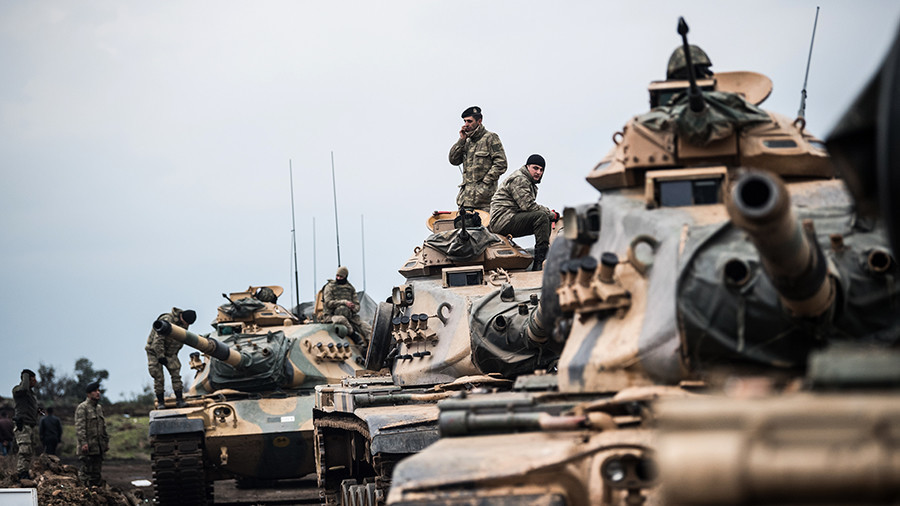
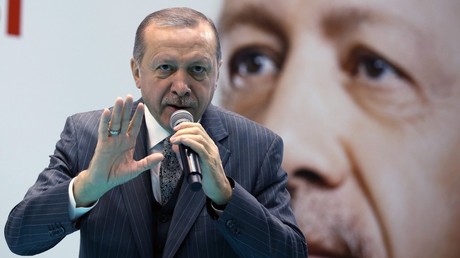
Turkish President Recep Tayyip Erdogan has promised to take Ankara’s Syria operation to Idlib after completing the current mission in Afrin, where they are targeting Kurdish militants.

“We want our Syrian brothers and sisters to return to their land, and now we want to do the same in Idlib what we have done in Afrin,” Erdogan said.

It’s not the first time the Turkish leader has stated that the campaign against Kurdish militia in Syria could actually spread beyond Afrin.

Read more

Erdogan in Amasya on January 28

“Our heroic soldiers…are making history today in Afrin. And they will make history tomorrow wherever there are terrorists along our borders,” the Turkish President said late last month.

On January 20, the Turkish General Staff officially declared the start of the military campaign in Syria’s northwestern Afrin region, calling it ‘Operation Olive Branch’. Ankara launched airstrikes against Kurdish positions, with Turkish troops advancing into the Kurd-held territories. The Turkish armed forces are supported by the Free Syrian Army (FSA) – an Ankara-backed paramilitary opposition group which consists mainly of Syrian Arab and Syrian Turkmen groups, which hold the territories in Afrin.

The Turkish General Staff said last week that as many as 899 fighters of the Syrian Kurdish militias – which they said included the People’s Protection Units (YPG), Kurdistan Workers’ Party (PKK) militants and Islamic State (IS, former ISIS) terrorists – were “neutralized” since the launch of Operation Olive Branch.

Formed as an armed wing of the Syrian Kurdish Democratic Union Party, the YPG rapidly expanded during the Syrian civil war. The group also fought against IS and received backing from the US-led coalition, which supplied them with weapons.

Such US support has greatly contributed to ongoing hostilities in the Afrin region, the Russian Foreign Ministry said in a statement on Thursday.

“The US backing of their ‘clients’ in violation of Washington’s statements in support of the Syrian Arab Republic’s territorial integrity have led to the escalation in the Afrin region, where there are no government troops at all at the moment,” the Ministry said.

In a telephone conversation earlier on Thursday, Erdogan spoke with Russian President Vladimir Putin regarding the situation in Syria. They agreed to hold another three-way summit on Syria with Russia, Turkey and Iran; a source in Erdogan’s administration said. The event is expected to take place in Istanbul.

Erdogan and Putin have also discussed the need to expedite the establishment of observation posts in the de-escalation zone of Idlib governorate, Turkish media report.

In early October, Turkish military forces were deployed to Idlib province to monitor one of four de-escalations zones located there. The proposal to establish the zones, championed by Russia, was finalized in September at a round of Syrian peace talks in Astana.

The first three-way summit between the leaders of Russia, Turkey and Iran, which was aimed at ending the bloodshed in Syria, took place in the southern Russian resort of Sochi in November.

Feminism, Swedish Style

February 8, 2018

Secret Iranian missile factory in Lebanon requires preemptive Israeli attack

February 8, 2018

February 7, 2018

Latest News from Israel

While Netanyahu declares “Israel is not seeking war,” top Israeli analysts say that the conflict over a secret Iranian missile plant in Lebanon makes an Israeli strike almost inevitable.

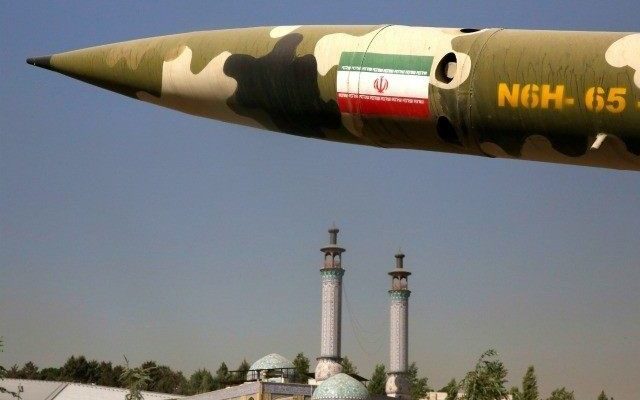
An Iranian missile. (AP/Vahid Salemi/File)

By: Steve Leibowitz, World Israel News

Analysts looking at Prime Minister Netanyahu’s Sunday briefing to the Cabinet on the subject of his recent talks with Russian President Putin pointed at the particular significance of a remark he made after usual comments about Israeli readiness in the face of military threats. Netanyahu told the ministers that he and Putin, discussed “Lebanon, which is becoming a factory for precision-guided missiles that threaten Israel. These missiles pose a grave threat to Israel, and we will not accept this threat.”

Netanyahu went on to say that the weapons factories are currently “in the process of being built” by Iran and Israel is “determined to do whatever is necessary to prevent those two developments.”

Indeed top Israeli analysts say that the Iranian “missile factory” being built in Lebanon is a game changer that has placed Israel and Hezbollah on a collision course that could lead to a third Lebanon war. The analysts also say that the coming conflict in Lebanon could spill over into Syria. As Netanyahu said to reporters, “The question is: Does Iran entrench itself in Syria, or will this process be stopped. If it doesn’t stop by itself, we will stop it.”

Lebanese officials have not issued any comment concerning the alleged Iranian plan According to Smadar Perry from Ynet, “Either Lebanon is not in on the secret or they’re choosing to keep quiet.” According to Perry, the Revolutionary Guards are building the factory in Lebanon without asking Iranian leadership for permission.”

Meir Javadanfan who teaches Iranian Studies at the IDC told World Israel News (WIN), “The story could be true, but the Iranians have never confirmed the existence of a Lebanese missile plant.”

Asked about the possibility of another war with Hezbollah in Lebanon, Professor Ephraim Inbar, Director of the Jerusalem Institute for Strategic Studies told WIN, “This is entirely possible. The Iranians are building a plant in Lebanon to produce long range missiles. They are doing so because they have difficulties transporting those missiles from Iran to Lebanon because Israel strikes and destroys their convoys time and time again. Iran is advancing on two fronts…the Syrian border and Lebanon. I don’t think Hezbollah wants a conflict now, but they want the missiles and this is unacceptable to Israel.”

According to Inbar, Israel is now considering its options. “We must decide if we will preempt to prevent this plant from becoming operational. Already Hezbollah has 100 thousand missiles aimed at Israel. No army in the world has more missiles. There is growing support for a preemptive strike because if we allow this plant to be built on Lebanese soil without an Israeli reaction, it will be a clear sign of weakness. Israel knows where the missiles plant is located and the air force is capable of destroying it. “This cannot be hidden from our intelligence and a preemptive attack is an option. ” Inbar said.

Israel’s problem in the war in 2006 was in identifying the short range missile launchers, and that is still a problem today because the short range missiles are hidden among the civilian population and can be moved. “The way to shorten the war is to occupy south Lebanon. Capture the territory and then hunt for the missile launchers,” Inbar said. Beyond 40 kilometers is less of a problem because that’s where long range missiles are deployed and they are easier to find and destroy. It took only one day to destroy Hezbollah’s long-range missile arsenal in the second Lebanon war in 2006. “The other problem is the quantity of missiles. They have over 100 thousand missiles loaded with warheads. We now have the capacity to intercept missiles. But it will difficult to intercept all the missiles fired in large salvos.

Is the world watching Hezbollah?

French Intelligence Online reported that the “Hezbollah terrorist group is constructing at least two underground facilities in Lebanon for manufacturing missiles and other weaponry.” The French magazine quoted sources saying that one of the factories is being built in northern Lebanon, near the town of Hermel in the eastern Bekaa Valley. The second facility is reportedly being constructed along the southern coast, between the towns of Sidon and Tyre. They also report that the Hermel facility is being used to produce the Fateh 110, a medium-range missile and the southern facility will be used to make smaller munitions.

Dr. Martin Sherman, Director of the Israel Institute for Strategic Studies believes that the inevitable conflict would have come sooner if not for the civil war in Syria.

“I think the conflict was only delayed because of the civil war. Otherwise Hezbollah would have attacked Israel during the Gaza war in 2014 with Hamas. Things are worse now because the Iranians feel empowered. The mistake was to leave Hezbollah intact in the second Lebanon war in 2006. These are the bitter fruits of President Obama’s policy including the ill-conceived Iran deal strengthening Iran financially,” Sherman said.

According to Sherman, “There needs to be a credible military response inflicting major damage. Hezbollah is not deterred by war. They have increased their missile stockpile by tenfold. They were distracted by the war in Syria but now they are back, and they can make the 2006 war look like a picnic. The only option is preemption. Israel has been led into a grave situation. Trying to avoid the inevitable confrontation can result in even heavier loses.”

“At this time Hezbollah is not ready to coordinate a two front conflict along with Hamas in Gaza. But the tensions are escalating and the thing that ties it all together is the support both receive from Iran. If they launch a two front war in a coordinated assault, it could be a real problem for Israel. Preemption is the answer,” Sherman said.

One of the few press reports on the Iranian missile plant in Syria came from the London-based daily Asharq al-Awsat. They reported, “Russia has prevented an inevitable Israeli attack” on what the daily characterizes as “Iran’s missile factories in Lebanon and Syria.” Israel and Russia have not reacted to Asharq al-Awsat’s report.


Lebanon’s Higher Defense Council orders army to stop Israeli border wall

February 7, 2018

Council says if Israel continues building its border wall on territory Beirut considers to be Lebanese, it would be seen as an act of aggression against Lebanon; Israeli energy minister: ‘Israel seeks diplomatic solution to border disputes.’

Attila Somfalvi and Nir Cohen

Published:  02.07.18 , 15:13

https://www.ynetnews.com/articles/0,7340,L-5096426,00.html

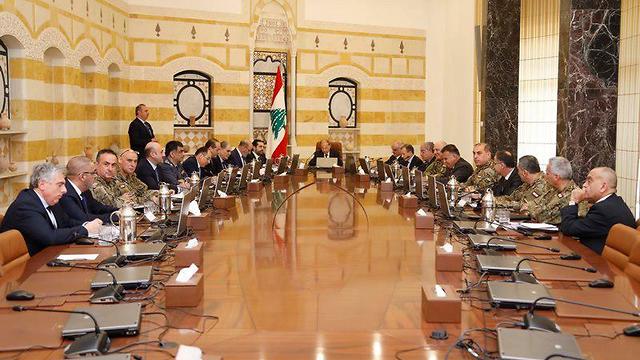
Lebanon’s Higher Defense Council said Wednesday it has ordered the army to prevent Israel from building a border wall on Lebanese territory.

The council also announced that if Israel does build its border wall on what Beirut views as Lebanese territory, it would be considered an Israeli act of aggression.

“We grant the army forces with the political backing to act against any Israeli aggression on the border—on land and at sea,” the council said in a statement. “The Israeli fence on our border constitutes a violation of our sovereignty and of Resolution 1701. We will continue acting on all levels, the regional and international, to oppose and prevent Israel from building the separation fence.”

Lebanon's Higher Defense Council

Lebanon’s Higher Defense Council

Lebanon’s Higher Defense Council is headed by President Michel Aoun and also includes Prime Minister Saad Hariri and the ministers of defense, foreign affairs, finance, interior and economics.

Earlier Wednesday, Energy Minister Yuval Steinitz stressed that Israel seeks a diplomatic solution to the dispute with Lebanon over territorial and maritime boundaries, but warned any aggression will be met with force.

“I think both Israel and Lebanon are interested in a diplomatic solution. They should not make any threats, though, and definitely not infiltrate our economic waters,” Steinitz told Ynet.

He warned that “if heavens forbid we are attacked, the response would be a lot more severe, quick and unequivocal than in the past.”

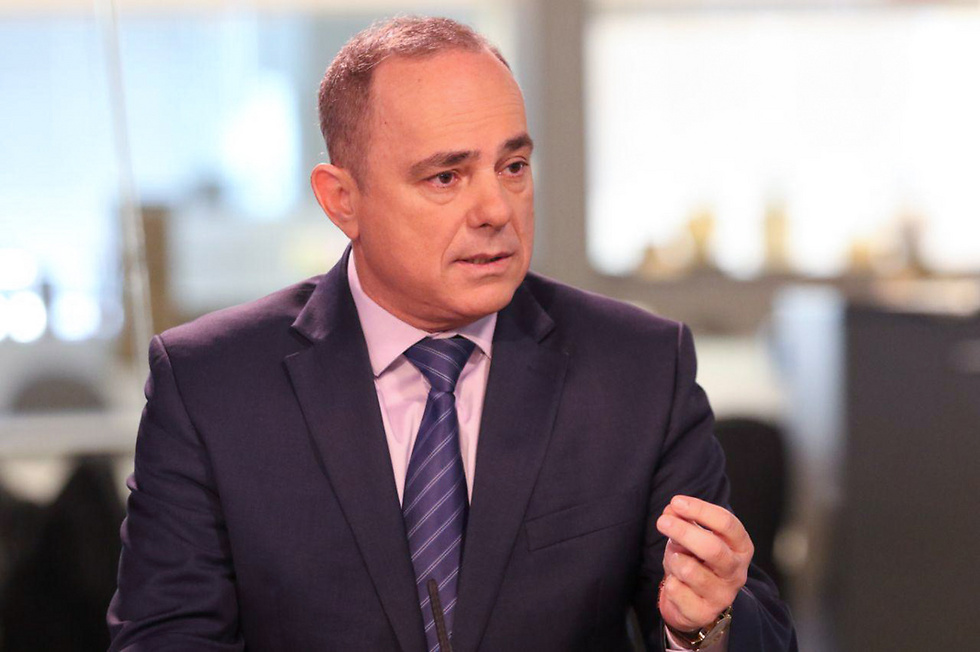
Energy Minister Yuval Steinitz (Photo: Avi Moalem)

Energy Minister Yuval Steinitz (Photo: Avi Moalem)

Lebanon’s leadership vowed on Tuesday to act to prevent Israel from building a wall on Lebanese land at the frontier, and threatening an offshore energy block in disputed waters.

Israel says the wall it is building is on Israeli sovereign land. The Lebanese government says it passes through territory that belongs to Lebanon but which lies on the Israeli side of the Blue Line, where the UN demarcated Israel’s withdrawal from southern Lebanon in 2000.

Lebanon also has an unresolved maritime border dispute with Israel over a triangular area of sea of around 860 sq km (330 square miles) that extends along the edge of three of five blocks Lebanon put to tender early last year.

Lebanon in December approved a bid by a consortium of France’s Total, Italy’s Eni and Russia’s Novatek for two blocks. One of the awarded blocks, Block 9, borders Israeli waters, and Israel claims it belongs to it.

The Leviathan gas field

The Leviathan gas field

Steinitz said Israel was willing to accept American mediation to resolve the issue diplomatically. “There was international mediation on the matter in the past. We were close to reaching a compromise in 2013, but the whole thing collapsed at the eleventh hour,” he said.

The energy minister stressed, however, that “let there be no doubt, the State of Israel is the strongest nation in the region, and we will defend our economic waters and our gas rigs and fields.”

US Secretary of State Rex Tillerson is expected to visit the Middle East, and particularly Lebanon, soon to help in mediation between Jerusalem and Beirut over the two issues.

Washington has already sent the Assistant Secretary of State for Near Eastern Affairs, David Satterfield, to Lebanon for a surprise visit. He met with senior government officials on Tuesday to discuss the border disputes.

The United Nations Interim Force in Lebanon (UNIFIL) is also trying to calm down the tensions by facilitating talks between IDF representatives and their counterparts in the Lebanese army.

The Shiite Lebanese terror group Hezbollah, meanwhile, began disseminating flyers Tuesday with an overt threat to Israel, saying, “Whoever harms gas and oil sites in Lebanese economic waters, their own sites will be harmed, and they know Lebanon is fully capable of doing so.”

“I didn’t need these explicit threats,” Steinitz said. “Energy security and the protection of our energy installations—and to a great extent the gas rigs as well—is at the top of our list of priorities,” he said.

Describing the threat of anti-ship and ballistic missiles from Lebanon, Steinitz said that “On this matter, there is also a lot being done to defend ourselves. Israel is more or less the world champion in anti-missile technology: The Iron Dome, David’s Sling, Barak 8, and other things we will no doubt develop in the future. But we are definitely concerned, and we are not idle on this matter.”

Steinitz stressed that despite the threats from Hezbollah, Israel will continue drilling for gas.

“We have to open up our energy sources, primarily the massive gas fields we found in the Mediterranean Sea—Leviathan, Karish and Tanin,” he said. “It’s important not just for economic and geopolitical reasons, but also for diplomatic reasons—our ability to sell gas to Europe.”

Maj. Gen. (res.) Amos Yadlin, the head of the Institute for National Security Studies (INSS) and the former head of Military Intelligence, said Hezbollah was merely trying to find other pretenses to attack Israel.

“The Iranians and Hezbollah are planning on building a precision missiles factory in Lebanon. Hezbollah can’t justify this to the Lebanese people and is looking for other reasons that it could possibly explain. One of these reasons is the gas field, and the other is an overground obstacle that Israel is building on the border,” Yadlin said.

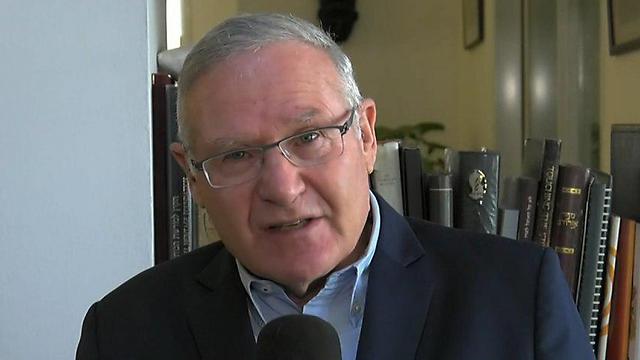
Amos Yadlin (Photo: Matan Turkia)

Amos Yadlin (Photo: Matan Turkia)

Yadlin rejected Lebanese claims that the Israeli border wall was being built on Lebanese territory. “There is no complete overlap between the border as it was determined by the UN as part of Resolution 425 in 2000 and the security fence Israel built,” he explained. “Between the fence and the real border there is an area referred to as an enclave. The Lebanese got used to it being theirs, even though it’s ours. The obstacle… is definitely south of the line marked by the UN. Hezbollah is trying to create a border dispute that doesn’t exist. It’s the same with the gas field.”

 The INSS chief said that while Hezbollah has precise Russian P-800 Oniks (Yakhont) missiles they got from Syria, which could hit the gas rigs, Israel has its own defensive and offensive measures against such missiles. “We’ll see the results if a conflict breaks out,” he said.


Bombshell: UK Govt Review into Sharia Admits Systemic Discrimination Against Women, Unknown Number of ‘Councils’, Forced Marriage Victim Made to Appear with Abusers

February 6, 2018

by Raheem Kassam 5 Feb 2018

http://www.breitbart.com/london/2018/02/05/bombshell-review-sharia-systemic-discrimination-women-unknown-number/

Rachel Megawhat/Breitbart London

A controversial review into the state of Sharia law in the United Kingdom and the bodies administering it has revealed the British government to be unaware of exactly how many of the Islamic law councils are operating in the country, an admission of systemic discrimination against women, including the victim of forced marriage being asked to appear alongside her family, with an “inappropriate” adoption of civil legal terms used.

The document — entitled ‘The independent review into the application of sharia law in England and Wales’ — was criticised for taking a theological approach to the issue after Islamic theologian Mona Siddique OBE, as well as Imam Qari Muhammad Asim MBE and Imam Sayed Ali Abbas Razawi, were appointed to the panel and advisory board. Other members included Sam Momtaz QC, Anne-Marie Hutchinson OBE QC (Hon), and Sir Mark Hedley DL.

Described as having an “inappropriate theological approach” by women’s rights groups, the report recommends the recognition of Islamic marriage in civil law, and vice versa, so that Muslim women do not necessarily feel their only option for divorce is through Sharia councils. The sole focus of the report appears to be divorce, despite an admission that a smaller amount of Sharia councils’ works are not in this area.

The report stunningly admits:

The exact number of sharia councils operating in England and Wales is unknown. Academic and anecdotal estimates vary from 30 to 85. The review has identified 10 councils operating with an online presence. The sharia councils identified by the review were mostly in urban centres with significant Muslim populations, such as London, Birmingham, Bradford and Dewsbury.

The investigators also concede they were not actually privy to any Sharia council processes and did not witness their active work:

The review panel did not observe first hand either the councils’ process for obtaining information from the individuals seeking their assistance or the decision-making process used by the councils.

There was — as the report’s methodology states — a public call for evidence on July 4th, 2016, with closed, oral evidence sessions with users of Sharia councils, women’s rights groups, academics, and lawyers, as well as other interested parties.

One of the primary recommendations of the investigation is the idea of “linking Islamic marriage to civil marriage” to ensure “that a greater number of women will have the full protection afforded to them in family law and they will face less discriminatory practices. This will be a positive move aimed at giving women maximum rights should the marriage end in divorce”.

This would require alterations to the Marriage Act 1949 and the Matrimonial Causes Act 1973, “to ensure that civil marriages are conducted before or at the same time as the Islamic marriage ceremony, bringing Islamic marriage in line with Christian and Jewish marriage in the eyes of the law”.

Despite numerous admissions that men have an upper hand in Sharia councils, the report concludes the system should not only remain in place, but should be self-regulated by imams:

  1. It could invite, encourage or even urge sharia councils to adopt a system of uniform self-regulation.

  2. The state could provide a system of regulation for sharia councils to adopt and then to self-regulate.

  3. It could impose such a system and provide an enforcement agency similar to OFSTED. However, proportionality is not the only issue. Just as the state does not confer legitimacy on the Beth Din or on Catholic tribunals by seeking to regulate them, the state may be reluctant to regulate sharia councils. That raises a dilemma: either the state withholds further intervention or it risks intervention being perceived as conferring legitimacy upon sharia councils and thereby creating a parallel legal system.

Despite the difficulties, we have concluded that intervention/regulation carries more advantage than no intervention.

Men are revealed to have an advantage in Sharia councils because of the ease of routes to divorce offered to them ahead of women. The report appears to want to ease this problem, rather than eradicate it, and lend the legitimacy of the British state to Sharia law.

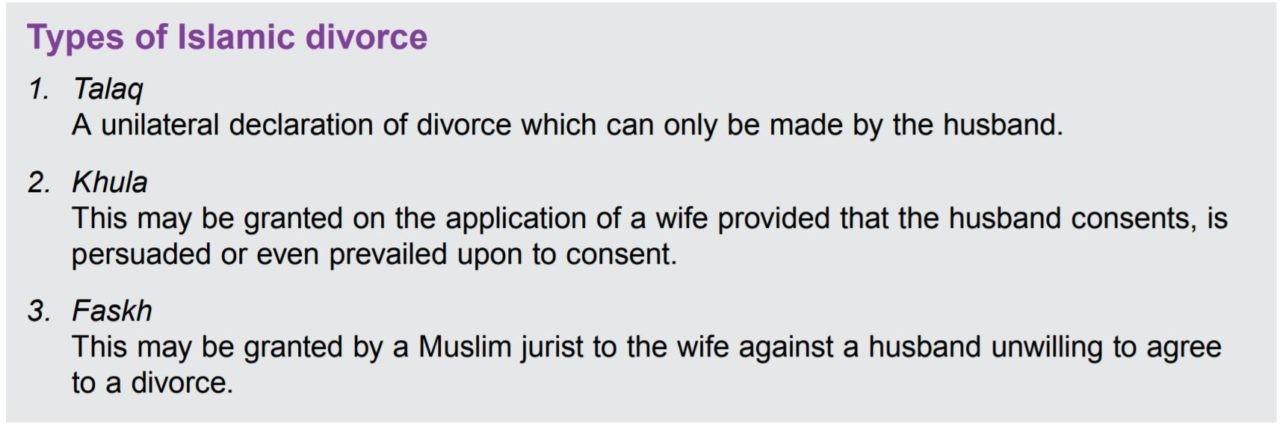
Men seeking an Islamic divorce have the option of ‘talaq’, a form of unilateral divorce that they can issue themselves. Women do not have this option, unless inserted as a term in the marriage contract (which varies from school to school) and therefore have to seek a ‘khula’ or ‘faskh’ from a sharia council.

The review also heard evidence “that in some instances, during khula divorces, women were asked to make some financial concessions to their husband in order to secure the divorce”.

Rather than a condemnation of such practices, the review seeks to create “a body by the state with a code of practice for sharia councils to accept and implement. This body would include both sharia council panel members and specialist family lawyers. This body could go on to monitor and audit compliance of the code of practice.”

The report also contains an unassailable admission — historically rejected or even ridiculed by left-wing politicians and campaigners — that “[t]he primary and underlying principle of sharia councils is the application of sharia law”, and that this is indeed taking place in Britain, and to an extent that the government is unaware.

https://twitter.com/RaheemKassam/status/960369808712839168/photo/1?ref_src=twsrc%5Etfw&ref_url=http%3A%2F%2Fwww.breitbart.com%2Flondon%2F2018%2F02%2F05%2Fbombshell-review-sharia-systemic-discrimination-women-unknown-number%2F

The most well established sharia councils in England and Wales have been in existence since the 1980s. Anecdotal evidence indicates that the numbers of sharia councils in England and Wales has increased in the last 10 years.

The review also wrestles with the idea of [in effect giving] a quasi-legal status to the councils:

Such regulation will indeed endorse and add legitimacy to the perception of the existence of a parallel legal system whilst the outcomes of the sharia council processes in terms of religious divorces have no standing in civil law.

Another problem arising from such an endorsement is the fact the review revealed a misinterpretation of British law:

The sharia councils that were visited all had a very loose definition of mediation. In all cases there appeared to be confusion between mediation and what is in effect reconciliation counselling. All councils visited within the context of the review made provision for reconciliation counselling at the commencement of the process. The reconciliation was invariably described as ‘mediation’ when it is clearly not.

Save for one individual, the review found that those conducting the mediation at sharia councils have not received mainstream training from the recognised mediation organisations, nor was there any evidence of accreditation. The sharia councils appear to use the term mediation in a much looser sense than that of the highly trained and accredited mediators practicing in family law.

The authors add:

The creation of state endorsed regulation sends the message that certain groups have separate and distinct needs and further that sharia councils are an appropriate forum for resolution of their family law disputes. In short it would perpetuate the myth of separateness of certain groups. The acceptance of the premise that sharia councils only deal with, engage in or touch upon the dissolution of the religious marriage aspect of the dispute is naïve and unrealistic. In any family law or relationship dispute the issues are multi-faceted. Ancillary outcomes which arise out of the ‘mediation and other functions’ that sharia councils undoubtedly perform may be given legitimacy. Those functions where they deal with dowry forfeiture (or return) financial remedies, arrangements for children and issues regarding future behaviour and conduct will impact on the civil rights of those to whom they relate.

While the report praised some “good practice” in the Sharia councils, these are arguably overshadowed by the “bad practice” revelations.

Examples of “good practice” according to the authors included:

  • reporting of family violence and child protection issues to the police;
  • women unable to pay fees have them lowered/no payment taken;
  • religious divorce granted as formality upon civil divorce;
  • councils’ signposting to civil remedies, such as civil courts for child arrangements;
  • little evidence of women being asked to reconcile relationships rather than obtain divorce;
  • councils declining to deal with any ancillary issues and referring users to civil courts;
  • in practically every case where a woman was seeking divorce, a divorce was granted;
  • some councils had women panel members;
  • some councils said they have safeguarding policies in relation to children and domestic violence.

Evidence of bad practice however included:

  • inappropriate and unnecessary questioning in regards to personal relationship matters;
  • a forced marriage victim was asked to attend the sharia council at the same time as her family;
  • insistence on any form of mediation as a necessary preliminary;
  • women being invited to make concessions to their husbands in order to secure a divorce (men are never asked to make these concessions). For example in khula agreements, husbands may demand excessive financial concessions from the wife;
  • lengthy process so that while divorces are very rarely refused they can be drawn out;
  • inconsistency across council decisions and processes;
  • no safeguarding policies and/or the recognition for the need of safeguarding policies;
  • no clear signposting to the legal options available for civil divorce;
  • even with a decree absolute a religious divorce is not always a straightforward process and the council will consider all the evidence again;
  • adopting civil legal terms inappropriately, leading to confusion for applicants over the legality of council decisions;
  • very few women as panel members;
  • panel members sitting on sharia councils who have only recently moved to the UK, and who do not have the required language skills and/or wider understanding of UK society;
  • varying and conflicting interpretations of Islamic law which may lead to inconsistencies.

Addressing the calls to ban Sharia in the UK, the authors note (emphasis added): “Th[e] demand [for Sharia councils] will not end if the sharia councils are banned and closed down and could lead to councils going ‘underground’, making it even harder to ensure good practice and the prospect of discriminatory practices and greater financial costs more likely and harder to detect. It could also result in women needing to travel overseas to obtain divorces, putting themselves at further risk. We consider the closure of sharia councils is not a viable option. However, given the recommendations also proposed in this report include the registration of all Islamic marriages as well as awareness campaigns it is hoped that the demand for religious divorces from sharia councils will gradually reduce over time.”

Critics from across the political spectrum noted of the review: “It is evident from the limited terms of reference and the makeup of the review panel that the review is in danger of becoming seriously compromised and as such, we fear that it will command little or no confidence”, citing the make-up of the panel:

Although some of those appointed to the panel come from judicial and family/ children law backgrounds, two Islamic ‘scholars’ have been appointed as advisers to the chair, Mona Siddiqui who is herself a theologian. This is cause for alarm: the government has constituted a panel more suited to a discussion of theology than one which serves the needs of victims and is capable of investigating the full range of harms caused by sharia councils and tribunals, particularly for women.

They called for the government to “[d]rop the inappropriate theological approach, and appoint experts with knowledge of women’s human rights, those who can properly and independently examine how sharia systems of arbitration in family matters contravene key human rights principles of equality before the law, duty of care, due diligence and the rule of law. The inquiry must be clearly framed as a human rights investigation not a theological one.”

Supporters of the review included Iman Abou Atta — a director at the discredited TellMAMA group that seeks to shut down criticism of Islam, as well as Labour Party councillor Neghat Khan, the extremist-linked East London mosque’s manager Sufia Alam, and Guardian journalist Alia Waheed.