Author Archive

Iran, Russia, and China’s Central Role in the Venezuela Crisis

February 14, 2018

Damascus warns Israel of ‘more surprises’ in Syria

February 13, 2018
Syrian government official warns Israel of ‘more surprises’ being in store in the wake of the downing of the F-16 jet that attacked Iranian positions in the country Saturday; ‘God willing they will see more surprises whenever they try to attack Syria,’ the assistant foreign minister said.
https://www.ynetnews.com/articles/0,7340,L-5111825,00.html

The Syrian government said on Tuesday that Israel would face “more surprises” in future attacks on Syria’s territory, after Syrian air defenses shot down an Israeli F-16 jet during the fiercest flare-up between the old foes in 36 years.

Syrian anti-aircraft fire downed the F-16 as it returned from a retaliatory bombing raid on Iran-backed positions in Syria after the incursion of an Iranian drone into Israeli airspace early on Saturday. Both Iran and Russia are supporting President Bashar Assad in Syria’s near seven-year civil war.”Have full confidence the aggressor will be greatly surprised because it thought this war—this war of attrition Syria has been exposed to for years—had made it incapable of confronting attacks,” assistant foreign minister Ayman Sussan said.

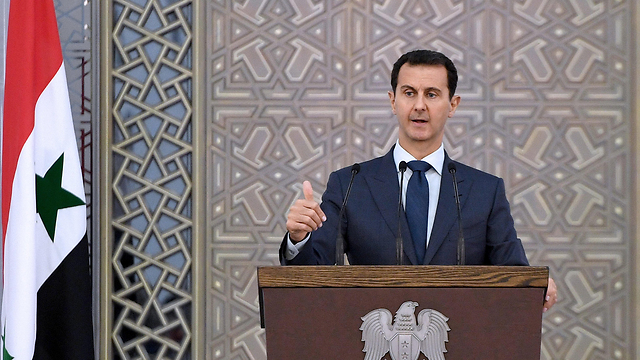
An official in Bashar al-Assad's regime said Syria had 'more surprises' in store for Israel (Photo: EPA)

An official in Bashar al-Assad’s regime said Syria had ‘more surprises’ in store for Israel (Photo: EPA)

“God willing they will see more surprises whenever they try to attack Syria,” Sussan said during a Damascus news conference.The downed F-16 was the first warplane Israel has lost to enemy fire since its 1982 Lebanon war. Its two-man crew survived, with injuries, after bailing out of the stricken jet.

Israel retaliated by destroying around half of Syria’s anti-aircraft batteries, according to an initial assessment shared with Reuters by an Israeli official who requested anonymity.

Prime Minister Benjamin Netanyahu said on Sunday that Israeli forces would press ahead with Syria operations in Syria, where it has launched scores of sorties against suspected arms transfers to Iranian-sponsored Lebanese Hezbollah terrorists.In Kiryat Shmona on Tuesday, Defense Minister Avigdor Lieberman told reporters, “There are no limitations (on military operations), and nor do we accept any limitations … We will respond to every provocation.”

“We will continue to defend our vital security and other interests. And I would like to paraphrase the well-known saying: ‘This is not the time to bark, this is the time to bite.'”

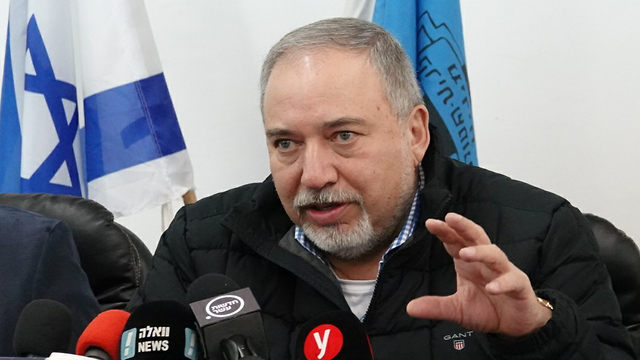
Defense Minister Lieberman said, 'Now is the time to bite' (Photo: Effi Sharir)

Defense Minister Lieberman said, ‘Now is the time to bite’ (Photo: Effi Sharir)

Tehran’s involvement in Syria, including the deployment of Iran-backed forces near the Golan Heights, has alarmed Israel. It has also has accused Iran of building precision-guided missile factories for Hezbollah in Lebanon.

Syria and Hezbollah celebrated the F-16 shoot-down as a blow to Israeli military superiority. Israel’s Army Radio said on Tuesday that investigators believed pilot error—rather than Syrian capabilities—were mainly at fault for the F-16’s failure to evade what was probably an aged SA-5 missile.

Saturday’s incident stirred up further questions in Israel about the effectiveness of a coordination mechanism set up with Russia, which has also been reinforcing and arming Assad’s army.

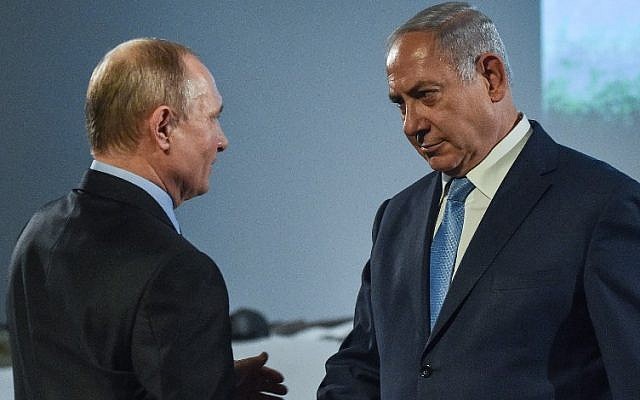
Russian President Vladimir Putin responded to the flare-up by urging Prime Minister Netanyahu to avoid escalation in Syria. Moscow said on Monday it did not have information to support Israel’s allegation about an Iranian military presence in the site bombed for launching the drone.

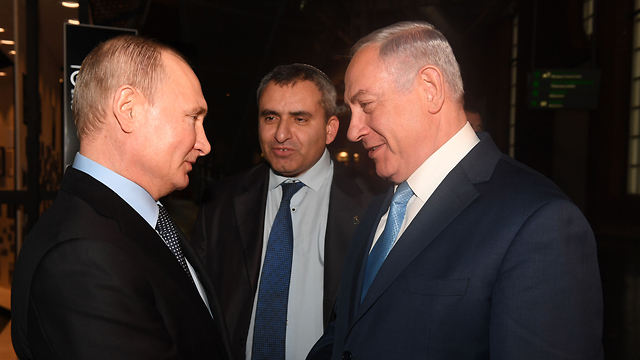
Minister Elkin (center) was present at the meeting between Russian President Putin (L) and PM Netanyahu (Photo: Kobi Gideon/GPO)

Minister Elkin (center) was present at the meeting between Russian President Putin (L) and PM Netanyahu (Photo: Kobi Gideon/GPO)

Ze’ev Elkin, a Russian-speaking Israeli cabinet minister who serves as Netanyahu’s interpreter in the talks with Putin, defended the coordination mechanism on Tuesday as granting Israel “freedom of action in the skies above Lebanon and Syria.”

“I don’t think the Russians ever pledged that they would take military action against the Iranians and the Syrians for us,” Elkin told Israel Radio.

“We are going one-on-one against the Syrians. We don’t need assistance from the Russians. We know how to deal with Syrian anti-aircraft fire, as everyone ultimately saw.”


Erdogan: We have suffered from Ottoman aftermath

February 13, 2018

This week, US Secretary of State Rex Tillerson is to meet with Turkish President Recep Tayyip Erdogan in Turkey. The two will likely discuss the US’ support of the Kurdish fighters in Syria.

Valerie Berkley
http://www.jerusalemonline.com/news/world-news/around-the-globe/erdogan-and-tillerson-to-meet-34570
Protestor demonstrates against Turkish violence against Kurds Photo Credit: Gili Yaari /Flash90

US Secretary of State Rex Tillerson is said to visit Turkey this week to meet with Turkish President Recep Tayyip Erdogan. The two are likely to discuss the ongoing civil war in Syria and the US’ decision to back the Kurdish rebel group, YPG.

The two countries remain divided about the respective attitudes towards the Kurds, in Syria and Turkey. The US financially supports Kurdish organizations that Turkey considers to be dangerous terrorist organizations, which threaten stability in Turkey. More than 20% of Turkey’s citizens are Kurds. Erdogan stated, “Anyone interfering in Northern Syria has not suffered from Ottoman repercussions.”

Erdogan said during a speech to Turkish parliament “Turkey was furious at the US for its support of the Kurdish militias.” Erdogan spoke to members of the Turkish Justice and Development Party following the publication of the US Defense Department budget for 2019, which includes funds to train local forces in the struggle against the Islamic State in Syria. Erdogan stated, “Our ally’s decisions to support the YPG will affect our policy.”

Last month, Turkey launched an invasion of Syria intended to push the YPG out of the Ofrin region, near the southern boundary. During the speech, Erdogan sent a clear message and warned the American forces stationed in Syria not to interfere with the operation.

Breaking point? Turkey demands ‘concrete steps’ from US while Washington wavers

February 13, 2018
https://www.rt.com/news/418592-turkey-us-breaking-point/
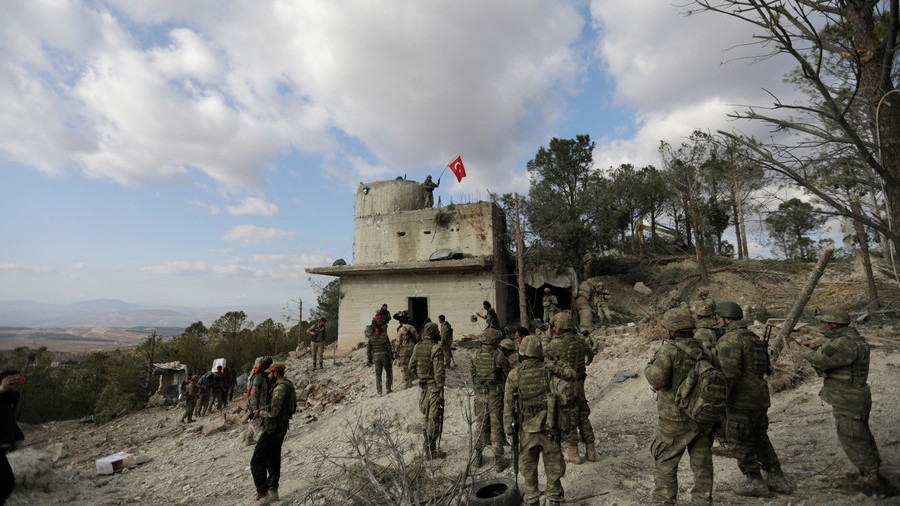
Turkish forces wave a flag on Mount Barsaya, northeast of Afrin, Syria, on January 28, 2018. © Khalil Ashawi / Reuters
Strained relations between Turkey and the US seem to have reached a critical point. Ankara is seeking clarity from the US, threatening to ‘break’ ties. Washington meanwhile continues to hide behind vague statements.

US actions are the reason for the “missing trust” between the two NATO allies, Turkish Foreign Minister Mevlut Cavusoglu told journalists on Monday. He went on to say Ankara expects “concrete steps” from Washington, aimed at mending ties that have almost reached the point of no return.

Read more

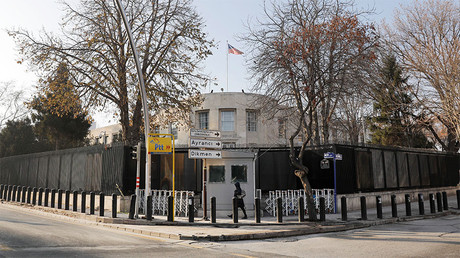
General view of the U.S. Embassy in Ankara, Turkey. © Umit Bektas

Turkey’s “ties with the US are at [a] very critical point,” the minister said. The two sides “will either fix these relations or they will break [down] completely,” he added. Ankara was provoked by the mixed signals coming from the US about its support for Kurdish militias in Syria amid the ongoing Turkish military campaign against these forces in Afrin.

The US has tried to prove to Ankara that it takes its interests in Syria seriously. Late in 2017, US President Donald Trump promised to end arms supplies to the Kurds. In January 2018, Washington repeated this promise, when US National Security Adviser H.R. McMaster told Turkish Presidential Spokesman Ibrahim Kalin that the US would no longer provide weapons to fighters of the Kurdish People’s Protection Units (YPG) and the Democratic Union Party (PYD).

At the same time, Washington also made it clear that US troops would not leave Manbij – another northern Syrian town controlled by the Kurdish militias – even though Ankara said it could extend its operation into this area. Nor is it apparently ready to end support for the “Kurdish elements of the SDF [Syrian Democratic Forces],” an umbrella Syrian armed opposition group.

Read more

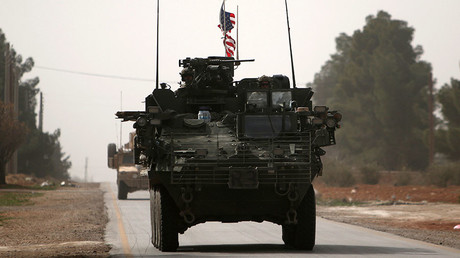
FILE PHOTO: American army vehicles drive north of Manbij city, in Aleppo Governorate, Syria March 9, 2017. © Rodi Said

On Sunday, US Defense Secretary James Mattis admitted that “some of the Syrian Democratic Forces” had been “drawn off” from the battle against Islamic State (IS, formerly ISIS/ISIL), to the Afrin area by what he called a “distraction,” apparently referring to the Turkish operation. He went on to say that around 50 percent of all SDF fighters are Kurds, who “see their fellow Kurds in Afrin under attack.” The Pentagon chief made no indication that Washington tries to prevent its allies on the ground from aiding those whom Ankara considers terrorists.

That did not, however, stop Mattis from calling Turkey’s reasons for waging a military campaign in the region legitimate. “They [Turkey] have a legitimate security concern, and we do not dismiss one bit of that, along that border with Syria,” he said, adding that the US is “assisting Turkey” and is “going to work closely” with Ankara.

However, Turkish officials do not seem to be satisfied with these ambiguous statements anymore. “Our demands from the US are clear and have already been conveyed. We no longer want to hear about promises; we want to hear about concrete steps. Trust needs to be rebuilt so we can start to talk about some issues,” Cavusoglu said on Monday.

Read more

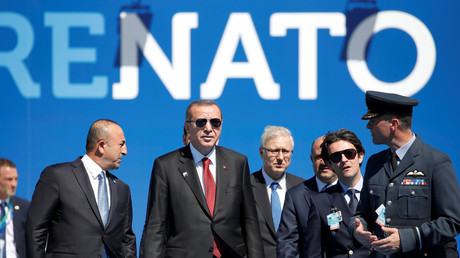
Turkish President Recep Tayyip Erdogan arrives to NATO Summit in Brussels, Belgium, May 25, 2017. © Christian Hartmann

His words were echoed by Turkish Prime Minister Binali Yildirim, who urged Washington to “pull itself together and make a sound decision.” “America’s decision to fight against one terror organization with the cooperation of another terror organization has nothing to do with dignity of a state,” Yildirim told reporters.

The Turkish officials went as far to accuse the US of deliberately sparing terrorists in its operations to justify the extension of its cooperation with Kurdish forces in Syria. “The US is not touching [IS] members in Syria [to have] an excuse to continue working with the YPG,” Cavusoglu said.

The Turkish military operation in the Kurdish area of Afrin entered its fourth week on February 10. Ankara also repeatedly said it plans to expand it with Manbij and Idlib being mentioned as the possible next targets.

In the meantime, Turkey, a NATO member since 1952, seems to be straining its relations with other allies. During the first week of the Afrin campaign, Germany froze all decisions on supplying weapons to Ankara, including upgrades to the German-made Leopard tanks used by Turkish troops. Later, the French president and foreign minister warned Ankara against the invasion and accused it of “adding war to war.”

Netanyahu says he’s talking with Trump about annexing areas of Judea and Samaria

February 13, 2018

February 12, 2018

Latest News from Israel

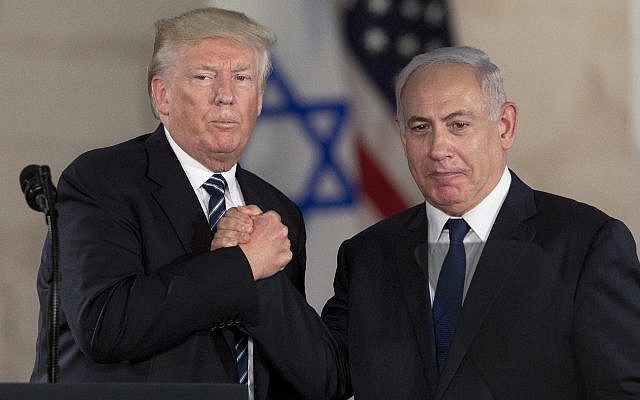
US President Donald Trump (L) and PM Benjamin Netanyahu at the Israel Museum in Jerusalem, May 23, 2017. (AP/Sebastian Scheiner, File)

Netanyahu says he’s been discussing Israeli sovereignty in Judea and Samaria with the White House for quite some time.

By: Batya Jerenberg, World Israel News

At a Likud faction meeting on Monday, Prime Minister Benjamin Netanyahu told his colleagues that he is in close contact with the Trump administration regarding the possibility of applying Israeli sovereignty to Jewish settlements in Judea and Samaria.

This follows hard on the heels of Sunday’s meeting of coalition heads in which it was decided to postpone an upcoming vote at the Ministerial Committee for Legislation on an annexation bill sponsored by Likud Member of Knesset Yoav Kisch. The official reason given for the delay was the aftermath of the Israel Air Force’s incursion into Syria after an Iranian drone, launched from Syria, violated Israeli airspace over the weekend and was destroyed.

However, as Netanyahu has said many times before in connection with proactive moves regarding Judea and Samaria, it is of utmost important to the prime minister to coordinate such decisions with the Americans.

“I’m guided by two principles in this issue,” he said. “Optimal coordination with the Americans, whose relationship with us is a strategic asset for Israel and the settlement movement, and the fact that it must be a government initiative rather than a private one, because it would be a historic move.”

The proposed bill is a copy of the resolution on sovereignty that recently passed in the Likud Central Committee by a unanimous vote.

“It’s time to put the Likud Central Committee’s resolution into practice and begin applying sovereignty over the settlement areas in Judea and Samaria,” Kisch said. “There will be no better historic opportunity to do this.”


Freed from shroud of ‘foreign reports,’ Israel-Iran fight steps out from shadows

February 11, 2018

Today, 3:25 pm

https://www.timesofisrael.com/israel-iran-fight-once-waged-according-to-foreign-reports-enters-limelight/

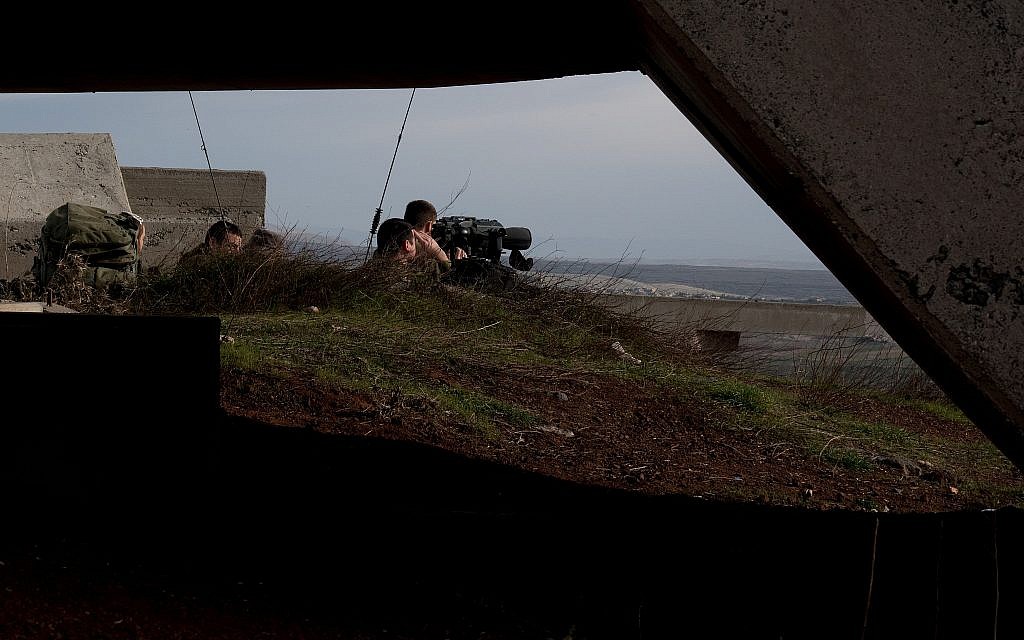
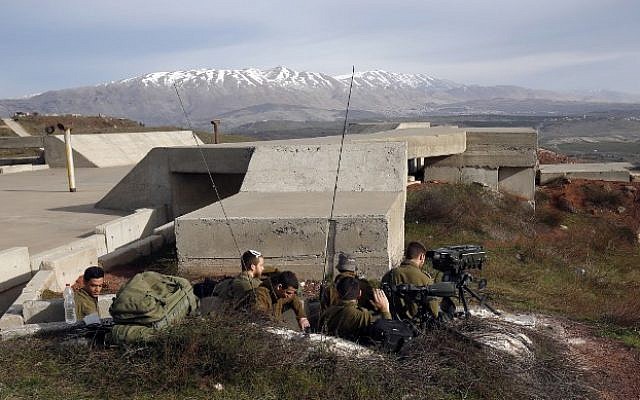
Israeli soldiers survey the border with Syria from a military post in the Golan Heights, following a series of aerial clashes with Syrian and Iranian forces in Syria, on February 10, 2018. (Flash90)

On Thursday, the International Crisis Group think tank and advocacy firm warned in a new comprehensive report that Israel and Iran (plus its proxies) were barreling toward open conflict in Syria.

Those prescient warnings came true — in part, at least — throughout Saturday morning, beginning shortly before 4:30 a.m., with the violation of Israeli airspace by a drone that the Israeli military says was piloted by an Iranian operator from an airfield that Tehran had taken control of months before, with Syrian permission.

Israeli jets conducted reprisal raids in Syria, during which one of the F-16 fighter planes was apparently hit by shrapnel from an exploding anti-aircraft missile and crashed in northern Israel, in what appears to be the first downing of an Israeli plane since 1982.

The aircraft’s pilots bailed out; one of them was seriously injured.

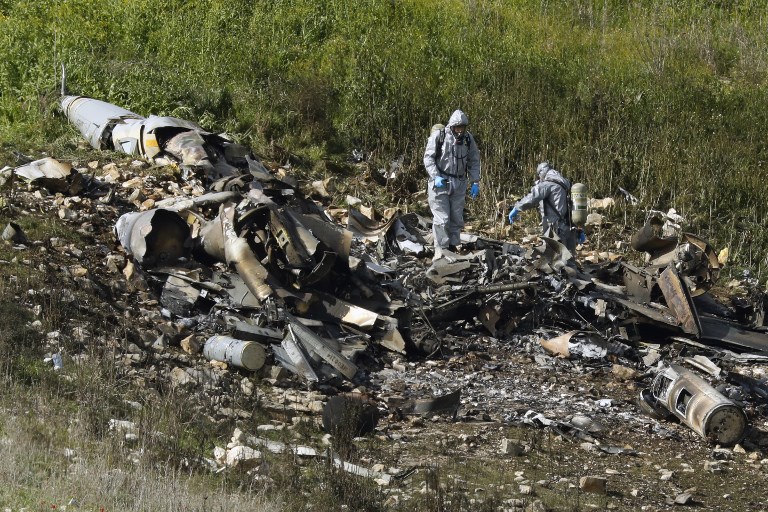
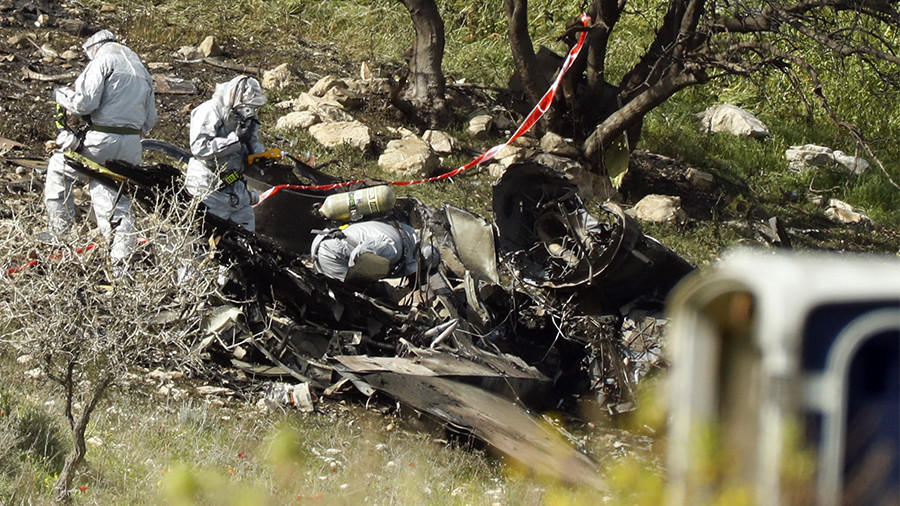
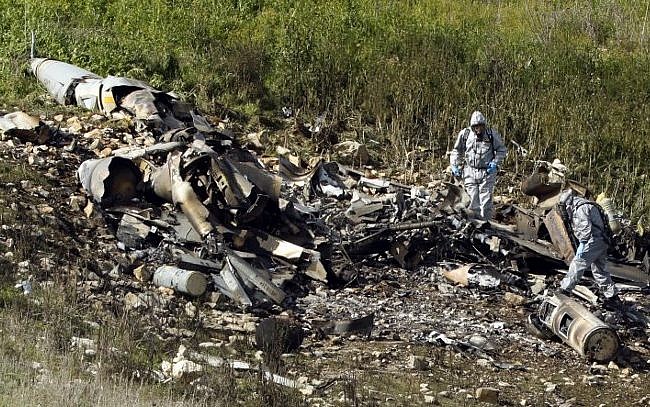
A picture taken in the northern Israeli Jezreel Valley on February 10, 2018, shows the remains of an Israel F-16 that crashed after coming under fire by Syrian air defenses during attacks against ‘Iranian targets’ in the war-torn country. (AFP PHOTO / Jack GUEZ)

Air force jets then completed a second set of retaliatory strikes. In the two rounds, the Israeli military said, its aircraft targeted several Syrian air defense systems as well as four Iranian positions in the country.

This was the first time Israel publicly acknowledged conducting airstrikes against Iranian-held locations in Syria, though not the first time it had done so, according to foreign reports.

IDF Chief of Staff Gadi Eisenkot (L) attends a briefing with Prime Minister Benjamin Netanyahu and Defense Minister Avigdor Liberman (R) in response to the escalation of tensions along the northern border on February 10, 2018. (Ariel Harmoni/Defense Ministry)

In the aftermath of the Saturday morning clash, Israeli, Syrian and Iranian politicians released tough, threatening statements aimed at one another. The United States backed Israel’s right to self-defense. Russia called for calm on all sides, but singled out Israel for violating Syrian sovereignty with its strikes, while conspicuously ignoring the Iranian drone’s airspace violation.

The aerial exchange thrust what had previously been a long-simmering but largely quiet conflict into the international spotlight and raised concerns that this bout will be the first of many clashes — and, in the nightmare scenario, the start of a full-fledged war across Syria, Lebanon and northern Israel.

I don’t think it’s the last time we’ll see such an event, but for the time being both sides will restrain their responses

However, the prevailing belief among Israeli defense analysts is that Saturday’s events were not the prelude to open war, but the beginning of an extended period of increased tension, which is liable to see additional clashes.

“I don’t think it’s the last time we’ll see such an event, but for the time being both sides will restrain their responses,” Sima Shine, a career defense official and current senior researcher at Tel Aviv’s Institute for National Security Studies think tank, told reporters on Sunday.

She added, during the phone briefing organized by the Media Central group, that escalation is in neither side’s best interest.

Amos Yadlin, a former fighter pilot and Military Intelligence chief, described Saturday as the “most significant day of fighting” in what Israel describes as its “campaign between wars,” often referred to in Hebrew by its acronym, Mabam.

“Despite the containment of the incident, the campaign is expected to continue,” Yadlin said.

In its report, released two days before Saturday’s flareup, the Crisis Group laid out how this campaign between Israel and the Iran-Syria-Hezbollah axis has developed and how it can be prevented from escalating further.

The organization tracks the current tensions to the Syrian regime’s battlefield victories over the past two and a half years, which it has achieved in large part due to support from the Russian military, which has provided significant air power since September 2015.

These have opened the Iran-led axis to shift toward preparing for a future conflict with Israel.

Only Moscow is in a position to mediate a bolstering of the deescalation agreement. Unless it does, the rules of the Syrian game are likely to be worked out through attack and response, with risk of escalation

According to the think tank, Russia is also the only entity able to prevent such a bloody war, having emerged from the Syrian civil war as the region’s sole remaining superpower after the United States dramatically scaled back its involvement in the conflict.

“Only Moscow is in a position to mediate a bolstering of the deescalation agreement. Unless it does, the rules of the Syrian game are likely to be worked out through attack and response, with risk of escalation,” according to the report.

In this photo released by an official website of the office of the Iranian Presidency, Iran’s President Hassan Rouhani, right, shakes hands with Russian President Vladimir Putin during their meeting at the Saadabad Palace in Tehran, Iran, Wednesday, Nov. 1, 2017. (Iranian Presidency Office via AP)

The group outlines three main issues that need to be addressed: the presence of Iranian and Shiite forces near the Israeli Golan Heights; the construction of Iranian military infrastructure in Syria; and ensuring any clashes that do take place remain confined to Syria.

The Crisis Group has also been working directly with Russia to try to persuade it to accept the role of mediator between Israel, Hezbollah, Iran and Syria.

“And we are seeing some traction with Russian officials,” Ofer Zalzberg, a senior Jerusalem-based analyst for the group and one of the report’s authors, told The Times of Israel last Wednesday ahead of the document’s publication.

The recipe for disaster

As Syrian dictator Bashar Assad vanquishes the remaining pockets of resistance in the country, the Israeli concern is that his allies — Iran, Hezbollah and Iran-backed Shiite militias — will be freed to focus on establishing positions along the Israeli border from which to antagonize the Jewish state, as well as permanent naval and air bases to bring in more advanced weaponry and conduct attacks.

Israel has designated these issues to be “red lines,” which it will not allow to be violated, and has said it will take military action if they are.

In its report, the Crisis Group warned that if the Iranian axis presses on with these efforts and Israel retaliates in kind, there is significant potential for escalation or even a large-scale war that could destabilize the entire region.

Israeli security forces inspect damage to a house after a Katyusha rocket attack by Hezbollah from southern Lebanon in the northern Israeli town of Nahariya, July 15, 2006. (Pierre Terdjman / Flash90)

The military assessments of what a war between Israel and Hezbollah would look like are chilling: Hezbollah launching over 1,000 rockets and missiles at Israeli cities and strategic sites each day, along with attempted infiltrations of Israeli communities along the Lebanese border. Israel conducting wave after wave of airstrikes against Hezbollah infrastructure, which the terrorist group has embedded deep inside civilian areas, ensuring significant noncombatant deaths, as well as large-scale IDF ground force maneuvers in southern Lebanon.

Zalzberg said a major part of the problem is that there are no established “rules of the game” between Israel and Iranian proxies in Syria, as there are in Lebanon, where Israel has been fighting Hezbollah off-and-on for decades.

That means the “rules” will be sorted out through back-and-forth, tit-for-tat clashes like Saturday’s. But this is a perilous path, fraught with opportunities for miscalculation and resulting in unintended casualties on both sides.

For instance, Israeli officials often refer to the “proverbial kindergarten” — the type of target that if hit, even accidentally, would prompt Israeli citizens to demand harsh and swift reprisals. As Iran and Hezbollah lack civilian targets in Syria, their equivalent might be a case of significant casualties from an Israeli airstrike, which would forced them to retaliate.

This is a current concern, following Saturday’s exchange, as the Syrian Observatory for Human Rights, a watchdog group, reported that at least six pro-regime fighters — including both Syrians and foreign nationals — were killed in Israel’s strikes and that “the death toll is expected to rise because there are some people in critical situation.”

Zalzberg added the potential for escalation in Syria is driven higher by the fact that different sides do not have a clear grasp of one another’s goals and viewpoints, citing a year’s worth of interviews by the Crisis Group with officials in Jerusalem, Tehran, Beirut, Amman, Moscow and Washington.

The report and its authors argue that it is ultimately in Russia’s best interest to avoid an all-out war between Israel and the Lebanon-based, Iran-backed Hezbollah, which would have the potential to completely destabilize the region.

Unlike in the 2006 Second Lebanon War between Israel and Hezbollah when the fighting was primarily limited to northern Israel and southern Lebanon, the view of both Israeli and Hezbollah officials is that the next conflict between the two groups would also include fighting in Syria.

Israeli artillery howitzers fire on Hezbollah targets at the Israeli-Lebanese border on July 18, 2006. (Olivier Fitoussi/Flash90)

“A massive campaign by Israel will do enormous damage to [Damascus and its backers’] achievements, perhaps even destabilizing the regime itself,” the report noted.

According to Zalzberg, this is not a desirable situation for Russia, as Moscow would like to see Assad regain near-total control over Syria.

The analyst noted that this is at odds with Iran, which wants to see Assad in power, but does not necessarily want to see him becoming too powerful, preferring instead to have Syria controlled by a coalition, similar to Lebanon, so that its Shiite militias could play a more significant role in the country.

Russia and only Russia

Moscow’s active support for Assad and his other main supporters, Iran and Hezbollah, has left Israeli officials decidedly wary of their Russian counterparts.

The Crisis Group report quotes an unnamed Israeli Foreign Ministry official as saying of the Russians, “It’s hard to trust them. They tell us they are not selling weapons to Hezbollah, but we know for a fact that they do. Their policies are cynical. They are not an enticing mediator.”

Russian President Vladimir Putin, left, shakes hands with Israeli Prime Minister Benjamin Netanyahu during an event marking International Holocaust Victims Remembrance Day at the Jewish Museum and Tolerance Center in Moscow, January 29, 2018. (Vasily MAXIMOV/AFP)

Yet there is an understanding among some in Israel that, while not enticing, Russia is the only mediator that has significant leverage over Iran and Hezbollah.

Israel has already had to maintain a close, if uneasy, relationship with Moscow due to its involvement in the region.

After Turkey shot down a Russian fighter jets that had invaded its airspace, Moscow installed an S-400 missile defense system in Syria. With the system, one of the world’s most advanced anti-aircraft batteries, Russia can monitor the overwhelming majority of Israel’s active airspace, including Israeli military flights.

Or, as one Israeli official told the Crisis Group, “A fly can’t buzz above Syria without Russian consent nowadays.”

This came as a shocking blow to the Israeli Air Force, which had, until then, enjoyed aerial superiority in the region, and required Jerusalem and Moscow to set up a hotline to prevent any potential conflicts between the two militaries.

Israel has also worked diplomatically with Russia to secure a buffer zone around the southwestern Syrian border, in which Hezbollah and other Iran-backed Shiite militias would not be allowed to maintain a presence.

In this photo released on Friday, Dec. 29, 2017 by the Syrian official news agency SANA, Syrian government forces stand next to a bus which is waiting to evacuate Syrian rebels and their families from Beit Jinn village, in the southern province of Daraa, Syria. (SANA via AP)

The border area has naturally been of significant concern for Israel, which is loath to see Hezbollah set up military positions along the Golan Heights to join the significant infrastructure it has already put in place in southern Lebanon.

Last month, the Syrian military, with some assistance from Shiite militias, regained control over the area of Beit Jinn, or Beit Jann, which is located just 13 kilometers (8 miles) from Israel’s Mount Hermon ski resort.

Though it is currently focused on retaking the area of Idlib in northwestern Syria, this coalition is likely to soon focus its attention on the Quneitra and Daraa regions, near the Israeli border.

Though Israel secured its buffer zone for that area this summer, the Crisis Group report notes that it would be relatively easy for these groups to get around the restriction, “for instance by integrating the fighters into the Syrian army or simply having them don its uniforms.”

The advocacy group argues that before the Syria-Iran-Hezbollah axis moves toward the southwest, Russia should work to negotiate an agreement between it and Israel.

There is still time for Russia to try to broker a set of understandings to prevent a confrontation, protecting both its investment in the regime and Syrian, Israeli and Lebanese lives

The Crisis Group notes that Israel’s insistence that Iranian and Iran-backed troops stay out of southern Syria will be the most difficult to negotiate, as Hezbollah and the Shiite militias would not be inclined to accept it and could easily cheat by disguising themselves as Syrians.

However, the authors say this could be resolved by getting Russia to agree to prevent Iran from setting up the types of infrastructure most concerning to Israel, like a seaport through which the Islamic Republic could carry out attacks against Israeli natural gas fields, an airport to transport weapons to Hezbollah, or a factory for the production of precise missiles.

“There is still time for Russia to try to broker a set of understandings to prevent a confrontation, protecting both its investment in the regime and Syrian, Israeli and Lebanese lives,” the Crisis Group wrote.

‘We are at war’: Turkish helicopter ‘downed’ amid Afrin operation, 2 soldiers dead

February 10, 2018
https://www.rt.com/news/418412-turkish-helicopter-downed-operation/
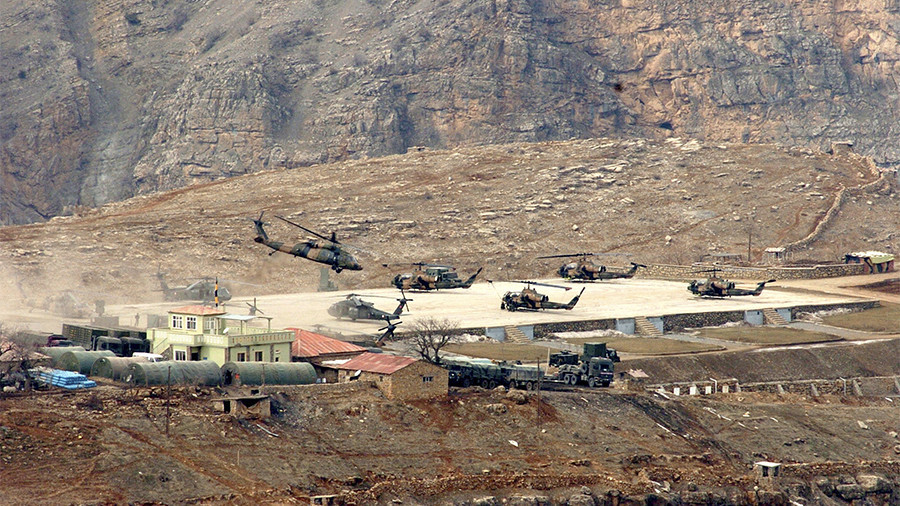
FILE PHOTO: A Turkish military helicopter takes of from a military base near Cukurca © Reuters
A Turkish military chopper was downed amid the country’s Olive Branch operation in northern Syria, President Recep Tayyip Erdogan said. Two soldiers were killed in the incident.

“One of our helicopters was downed just recently,” Erdogan said as he spoke to a member of the ruling Justice and Development Party (AKP) in Istanbul. “These things will happen, we are in a war,” the president said, adding that even though Turkey “might lose a helicopter,” the perpetrators of the attack will “pay a heavy price.”

Read more

Turkish President Recep Tayyip Erdogan arrives to NATO Summit in Brussels, Belgium, May 25, 2017. © Christian Hartmann

The president also said the Turkish Armed Forces “destroyed many missile depots” of the Kurdish militias they are battling in the Afrin region.Turkish Prime Minister Binali Yildirim later told journalists that two soldiers were killed in the crash. However, he said that the cause of the incident is still unclear.

“We don’t have exact evidence or document to determine that it went down with any outside interference,” Yildirim told reporters on Saturday, as cited by AP. A representative of the Kurdish militias said that the chopper was shot down by Kurdish fighters over an area located northwest of Afrin, as reported by AP.

The Turkish Armed Forces also confirmed the incident and the deaths, saying that the helicopter had “crashed.” It is also unclear where the incident took place. Yildirim said that it occurred in Syria’s northern Afrin province. However, Anadolu Agency earlier reported that the helicopter crashed in the southern Turkish province of Hatay.

The Turkish General Staff also said on Saturday that the armed forces “destroyed” 36 targets and “neutralized” 79 militants in the airstrikes carried out in the Afrin region overnight.The Turkish Operation Olive Branch in the Afrin region in northern Syria entered its fourth week on Saturday. The campaign followed Ankara’s promises to “strangle” the new Border Security Force (BSF) in Syria.

Read more

Turkish army tanks gather close to the Syrian border on January 21, 2018 at Hassa, in Hatay province © Bulent Kilic

Earlier in January, the US-led coalition announced that it would help create the 30,000-strong BSF, half of which would be made up of the Kurdish Syrian Democratic Forces (SDF) alliance. Ankara was angered by the fact that the main force behind the SDF is the Kurdish People’s Protection units (YPG), linked to the Kurdistan Workers’ Party (PKK). The latter is designated as a terrorist group by Turkey.

Erdogan has recently stated that once the Afrin operation is over, Turkey’s next target could be Idlib.“We want our Syrian brothers and sisters to return to their land, and now we want to do the same in Idlib what we have done in Afrin,” he said on Thursday.

As the operation in northern Syria continues, Turkey, a NATO member since 1952, now seems to be straining the patience of its allies. During the first week of the campaign, Germany froze all decisions on supplying weapons to Ankara, including upgrades to the German-made Leopard tanks currently used by Turkey.

Earlier this week, the French president and foreign minister warned Ankara against the invasion and accused it of “adding war to war” – albeit in interviews, not official statements. Ankara’s operation in Afrin has also caused serious tensions with its major ally, the US. Washington later said it would cease providing military aid to the Kurds. The US’ arming of the Kurdish Forces – especially the YPG – has been repeatedly slammed by Turkey.

Iran & Syria ‘are playing with fire,’ Israeli military warns amid flare-up of tensions

February 10, 2018
https://www.rt.com/news/418406-israel-iran-syria-fire/
A picture shows the remains of an Israel F-16 that crashed after coming under fire by Syrian air defences during attacks against “Iranian targets” in the war-torn country, February 10, 2018 © Jack Guez / AFP
The IDF warned Syria and Iran against ‘violating Israeli sovereignty,’ otherwise they would pay a heavy price. The Israeli military also insisted that Israel does not seek an escalation in tensions in the region.

“Iran and Syria are playing with fire,” the Israel Defense Forces (IDF) said in a statement on Twitter. The military added that it acts “with determination” against “the attempt of the Iranian-Syrian attack and the violation of Israeli sovereignty.” “The IDF is prepared for a variety of scenarios and will continue to act as necessary.”

The IDF lashed out at the Syrian military, accusing the state of interference in the Israeli-Iranian incident, as well as at Iran for “using Syria as a launchpad for activity against Israel.”

However, the IDF insisted that Israel does not seek escalation with the two states. “We are willing, prepared and capable to exact a heavy price from anyone that attacks us, however we are not looking to escalate the situation,” the IDF said, insisting that what they’ve done was merely “a defensive effort triggered by an Iranian act of aggression and we are defending our airspace our sovereignty and civilians.”

Tensions between Israel, Iran, and Syria have been heating up since early Saturday after the IDF intercepted an Iranian UAV, which crossed from the territory of Syria into Israel. The Israeli military responded by targeting a Syrian military base, where they believed the operator of the drone to be located. Later that day, an Israeli F-16 fighter jet crashed after Damascus responded with anti-aircraft fire to an Israeli operation in its territory. The pilots ejected and survived the incident.


In response, the IDF said it struck 12 Iranian and Syrian targets in Syria, including air defense batteries, adding that that during the attack, “anti-aircraft missiles were fired towards Israel, triggering alarms that were heard in Northern Israel.”

Following an exchange of fire, Israeli Prime Minister Benjamin Netanyahu held security consultations, approving the necessary actions in real time following the incidents, official Israeli sources told Haaretz.

Air traffic at Ben Gurion International Airport, 20km from Tel Aviv, was halted for around 15-20 minutes amid security tensions, Israeli media reported.

Tehran, Syria deny ‘lies’ that Iranian drone entered Israeli territory

February 10, 2018

Damascus claims UAV that sparked northern clashes was gathering intel on IS; Iran: ‘Syrian response was a warning, era of Israeli strikes is over’

A picture taken on February 10, 2018 show Israeli solders taking positions in the Golan Heights near the border with Syria. (AFP PHOTO / JALAA MAREY)

Iran and Syria on Saturday denied that the unmanned drone Israel said it shot down violated the Jewish state’s airspace, calling Israeli allegations “lies” and saying the drone was on a regular mission gathering intelligence on Islamic State.

A statement on Central Military Media, which is allied with the Syrian military, called a subsequent Israeli attack on a drone station in Syria’s central Homs province a “terrorist act,” warning of “a tough and serious response.”

The Israeli military called the drone infiltration a “severe and irregular violation of Israeli sovereignty” and said Iran would be held responsible for its outcome, marking a dramatic escalation in tensions along Israel’s northern border.

The drone incident led to a barrage of Israeli airstrikes on Iranian and Syrian targets in Syria. Syria responded with heavy anti-aircraft fire that set off multiple warning sirens in Israel and managed to down one Israeli F-16 in Israeli territory, seriously wounding a pilot.

A spokesman for Iran’s Supreme National Security Council said the Syrian response to Israel’s air force was “a clear warning to Israel. The era of Israeli strikes on Syria is over.”

He vowed a “relentless response” to “all further aggression.”

A Syrian statement said Israeli jets targeted a drone base in central Syria whose mission is to gather intelligence on IS in the area. It said the station was hit while drones were on regular missions in the country’s desert in Homs province. The statement said it was “a lie and misleading” to say the drone had entered Israel’s airspace.

Iranian foreign ministry spokesman Bahram Ghasemi said Syria “has the right to legitimate self-defense. To cover their crimes in the region, Israeli officials are resorting to lies against other countries.”

The deputy chief of Iran’s Revolutionary Guards warned, meanwhile, that his country could “bring hell upon the Zionist regime.”

Brigadier General Hossein Salami refused to confirm to the Tasnim news agency that an Iranian drone had been shot down. “We cannot confirm this report on the drone because Israelis are liars … if Syrians confirm it, Iran will confirm it as well,” said Salami, according to a Reuters translation.

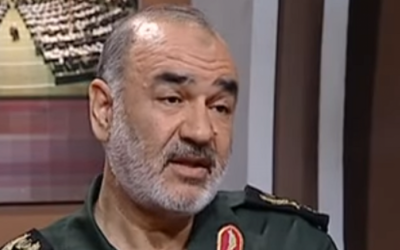
IRGC Deputy Commander Hossein Salami (YouTube screen capture)

But he warned that Tehran had the capability to destroy all US army bases in the region and to “bring hell upon the Zionist regime.”

A Syrian military official said that his country would continue to respond in kind to all attacks on its soil.

“Our defense systems hit a number of missiles as well as an Israeli aircraft that had been carrying out attacks south of the Damascus capital, to its west and on the outskirts of Homs,” the Syrian official told the Lebanese El Nashra news outlet.

He added that the damage sustained from the Israeli aircraft fire was limited to property, but acknowledged that a number of soldiers had been injured as well.

The Hezbollah-affiliated Al Mayadeen TV station claimed that the Syrian military had managed to intercept 70 percent of the dozens of missiles fired by Israel’s warplanes.

The Israeli army responded to the drone infiltration with strikes on Iranian targets, including the drone’s launch site — the Tiyas Military Airbase near Palmyra — which the army said it hit in “a complicated surgical strike.” The strike reportedly targeted a facility housing the unmanned aircraft’s Iranian operators.

Israeli warplanes flying over Syria met heavy anti-aircraft fire. The military said one of its pilots was seriously wounded as a result of an emergency evacuation from his F-16 jet targeted by missiles. The F-16 crashed in northern Israel. One pilot was evacuated to a hospital in serious condition. A second pilot was lightly wounded.

A picture taken in the northern Israeli Kibbutz of Harduf on February 10, 2018, shows the remains of an Israeli F-16 that crashed after coming under fire by Syrian air defenses (AFP PHOTO / Jack GUEZ)

If the plane was in fact shot down by enemy fire, it could mark the first such instance for Israel since 1982 during the first Lebanon war.

Damascus residents celebrated the news.

Wassim Elias, 39, a government employee, called it retribution for the many Israeli raids on Syrian soil before. “This earned the Syrian army and every Syrian citizen prestige. This is what we have always demanded,” he said.

Firas Hamdan, 42, a public servant, said such Syrian responses will ensure no more Israeli attacks in Syria. “Such attacks should be confronted and the response should be tougher to give the Israelis a lesson.”

A Syrian lawmaker, Feras Shehabi, said the response marked a “major shift in the balance of power in favor of Syria and the axis of resistance.” He said “Israelis must realize they have no longer superiority in the skies or on the ground.”

Israel said it later targeted at least 12 other sites “including three aerial defense batteries and four Iranian targets that are part of Iran’s military establishment in Syria,” according to a military statement.

Military spokesman Jonathan Conricus said the army had information on the drone’s mission, but would not go into details, saying only that it was “on a military mission sent and operated by Iranian military forces.”

He warned that Syria and Iran were “playing with fire,” but stressed that his country was not seeking an escalation.

Watch: IDF pilot parachutes down after ejecting from aircraft

“This is the most blatant and severe Iranian violation of Israeli sovereignty in the last years,” Conricus told journalists in a phone conference. “That’s why our response is as severe as it is.”

The confrontation was the most serious between Israel and Iran since the start of the civil war in Syria in 2011.

Diplomatic sources said Israel has appealed to Russia to intervene and prevent further escalation. Similar calming messages were reportedly passed on to Washington.

Sirens sounded in northern Israel throughout the morning as a result of the massive Syrian anti-aircraft fire. Several Syrian anti-aircraft missiles fell inside Israeli territory, causing no damage.

A picture taken in Alonei Abba, east of Haifa, in northern Israel on February 10, 2018, shows bomb experts inspecting the remains of a missile. (AFP PHOTO / Jack GUEZ)

Photos from Jordan showed the remains of anti-aircraft missiles that exploded in a field.

In Lebanon, too, missile parts rained down from the sky.

A picture taken on February 10, 2018, shows the remains of a missile that landed in the southern Lebanese village of Kaoukaba, near the border with Syria, after Israel’s military attacked 12 Syrian and Iranian targets inside Syria (AFP PHOTO / Ali DIA)

IDF Spokesman Brig. Gen. Ronen Manelis said Israel held Iran directly responsible for the incident.

“This is a serious Iranian attack on Israeli territory. Iran is dragging the region into an adventure in which it doesn’t know how it will end,” he said in a special statement. “Whoever is responsible for this incident is the one who will pay the price.”

IDF Chief of Staff Lt. Gen. Gadi Eisenkot and Air Force chief Maj. Gen. Amikam Norkin were leading operations from army headquarters in Tel Aviv, with Prime Minister Benjamin Netanyahu holding security assessments and approving operations in real time.

By noon Defense Minister Avigdor Lieberman was convening the top brass at military headquarters in Tel Aviv to discuss a further response.

“The IDF is following events and is fully prepared for further action according to decisions and need,” the military said.

Retired Lt. Col. Reuven Ben-Shalom, a former Air Force pilot, said the fierce Israeli response was meant not only to counter the immediate threat but also to send “very clear messages” to show Iran how deep Israel’s knowledge was of its activity in Syria.

“The fact that a drone like this is identified, tracked and intercepted so smoothly by the Israeli air force demonstrates our capabilities, demonstrates our resolve not to allow the breach of Israeli sovereignty,” he said. “I think it’s good that our enemies learn and understand these capabilities.”

Ministers in the security cabinet, led by Prime Minister Benjamin Netanyahu, receive briefings from IDF officers while touring the Golan Heights, February 6, 2018. (Kobi Gideon/GPO)

Israel has been warning of late of the increased Iranian involvement along its border in Syria and Lebanon. It fears Iran could use Syrian territory to stage attacks or create a land corridor from Iran to Lebanon that could allow it to transfer weapons more easily to Hezbollah.

The Israeli Cabinet recently held a meeting on the Golan Heights near the border with Syria to highlight new threats, which are attributed to Iran’s growing confidence given Assad’s apparent victory in Syria thanks to their help.

Agencies contributed to this report.

Israel urges Russia to prevent further escalation in Syria

February 10, 2018

Moscow calls for ‘restraint’ on all sides following clashes, says risk to lives of Russian soldiers ‘absolutely unacceptable’

Russian President Vladimir Putin, left, shakes hands with Israeli Prime Minister Benjamin Netanyahu during an event marking International Holocaust Victims Remembrance Day at the Jewish Museum and Tolerance Center in Moscow, January 29, 2018. (Vasily MAXIMOV/AFP)
in Moscow, January 29, 2018. (Vasily MAXIMOV/AFP)

Israel has appealed to Russia to intervene and prevent further escalation after an Iranian drone was shot down over Israel Saturday, leading to “large-scale” Israeli strikes in Syria and heavy Syrian counterfire.

Diplomatic sources said Israel was in contact with officials in Moscow, seeking to convey a message to Syria and Iran that though it had landed a heavy blow in response to the drone incident, it was not interested in further violence.

Similar calming messages were reportedly passed on to Washington.

Moscow, in a statement, called for “restraint” of all parties in Syria and said it considered risking the lives of Russian soldiers “absolutely unacceptable” following large-scale Israeli air strikes inside Syria.

“We strongly call on all sides involved to show restraint and avoid all acts that could lead to complicating the situation further,” the Russian foreign ministry said.

“It is absolutely unacceptable to create threats to the lives and security of Russian soldiers that are in the Syrian Arab Republic on the invitation of the legal government to assist in the fight against terrorism,” it added.

Israel has told Moscow that Saturday’s events are proof that its warnings of Iranian entrenchment and growing boldness in Syria were merited, sources told the Ynet news site.

Israeli Prime Minister Benjamin Netanyahu has held a series of meetings in recent months with Russian President Vladimir Putin on Iran’s influence in war-torn Syria and Lebanon.

Netanyahu has been seeking to persuade Russia to limit Iran’s presence near Israeli territory and to stop it from entrenching itself militarily in Syria.

Israel struck a dozen Syrian and Iranian targets inside the civil war-torn country on Saturday in what it said was a “large-scale” attack, after the Iranian drone was shot down over Israeli territory, and an Israeli fighter jet subsequently crashed under fire from Syrian air defenses in a severe increase in tensions.

The confrontation was the most serious between Israel and Iran since the start of the civil war in Syria in 2011.

Russia, Iran and Lebanon’s Hezbollah — which is backed by Tehran — all support Syrian President Bashar Assad in the civil conflict.

A picture taken on February 10, 2018 show Israeli solders taking positions in the Golan Heights near the border with Syria. (AFP PHOTO / JALAA MAREY)

In a meeting in Moscow last month, Netanyahu reiterated Israel’s concerns with what he described as Iranian attempts to establish a military presence in Syria and produce weapons capable of precision strikes against Israel there.

“We won’t accept either of those, and will act according to our needs,” Netanyahu said following the meeting with Putin.

Israel remains technically at war with Syria and occupies a swathe of the strategic Golan Heights that it seized in the Six Day War of 1967 and later annexed in a move never recognized by the international community.

On Tuesday, Netanyahu took members of his security cabinet for a tour of the Israeli side, where they were briefed by the military on the situation.

“We want peace, but are prepared for any scenario, and suggest that nobody tries us,” he said.

Israel has sought to avoid direct involvement in the Syrian war, but acknowledges carrying out air strikes there to stop what it says are advanced arms deliveries to Hezbollah.