Author Archive

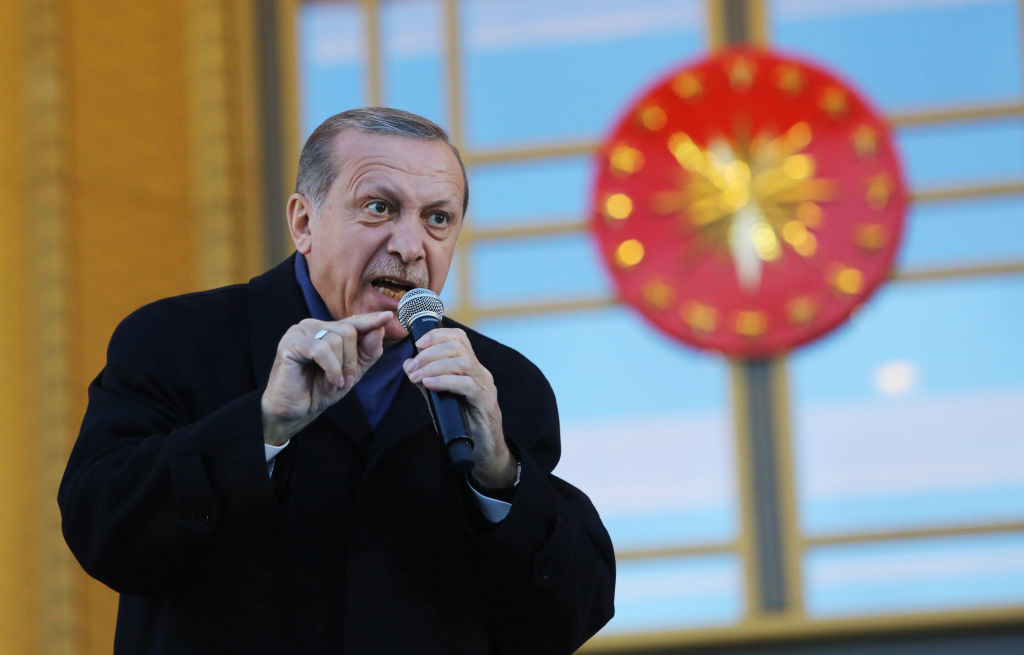
Turkey Threatens to Invade Greece

February 19, 2018

US Tanks finally upgrading with Israel’s battle tested anti-missile system

February 19, 2018

brian wang

February 14, 2018

US Tanks finally upgrading with Israel’s battle tested anti-missile system

The US Army’s 2019 budget will upgrade 261 M1 tanks, enough for three brigades, to carry Israeli-made Trophy Active Protection Systems (APS) to counter anti-tank missiles. There is also an increase in artillery and equipment to deter Russia from attempting to overrun Eastern Europe or to fight in a longer, high-intensity war with North Korea.

The Trophy APS comes on top of other long-planned improvements in the M1 Abrams main battle tank, including new infrared sights, reinforced armor, and improved horsepower and electrical power to handle all the upgrades.

Trophy has been operational on Israeli tanks since 2009. Russia has had various active protection systems on its tanks since the 1980s.

The US Army has selected the Israeli Trophy APS anti-missile system for the M1 Tank and other military vehicles.

The Trophy system, designed by Rafael Advanced Defense Systems, is the only APS in testing that has seen combat and actually defeated advanced anti-tank guided missile (ATGM) threats.

“We intend to field those to first responding units, and we will eventually field them throughout the force for the entire total Army — Guard, Reserve and active,” Milley said.

Trophy intercepts and destroys incoming missiles and rockets with a shotgun-like blast. Trophy was the product of a ten-year collaborative development project between the Rafael Advanced Defense Systems and Israel Aircraft Industries’ Elta Group. Its principal purpose is to supplement the armor of light and heavy armored fighting vehicles.

Called Active Protection Systems, or APS, the technology uses sensors and radar, computer processing, fire control technology and interceptors to find, target and knock down or intercept incoming enemy fire such as RPGs and Anti-Tank Guided Missiles, or ATGMs.

The sensors detect the incoming threat and a computer controlled shotgun blasts the missile.


The U.S Jewish Establishment’s War Against Israel

February 18, 2018

By – on

The U.S Jewish Establishment’s War Against Israel

In many ways it should be the best of times for Israeli Prime Minister Benjamin Netanyahu, after successfully surviving eight grueling years of the pro-jihad Obama administration. Israel’s economy is booming. Its tech sector (along with Silicon Valley) is the envy of the world. Israel’s per capita GDP has just surpassed Britain, France, and Japan. Israel’s unemployment rate is at an impressive four percent. The once-isolated Jewish state has relations with over 150 countries. Israel’s cooperation with its Arab neighbors, including Egypt, Jordan, Bahrain, and Saudi Arabia, has never been stronger. Israel’s military, by most accounts, is the strongest and most advanced in the Middle East. Prime Minister Netanyahu is now working with President Donald Trump, who has asserted himself as the most pro-Israel President ever.

Unfortunately, the incredible accomplishments of Israel’s greatest-ever Prime Minister have not softened the disdain that much of the Jewish establishment in the United States has toward him, and even toward Israel itself. The Jewish left, which is represented by organizations such as Jewish Voice for Peace, the Soros-funded J-Street and the New Israel Fund, have become increasingly hostile to Israel, as Israel has rapidly moved away from its socialist roots. Many of these organization’s talking points are expressed by disgusting leftists including Peter Beinart, Noam Chomsky, Bernie Sanders, and Norman Finkelstein. They will go out of their way to slander Israel for defending itself, and for its unwillingness to commit national suicide by allowing a terror state to be created on its doorstep.

The left-leaning U.S Jewish community, for the most part, has no conception of what it is like to live in the most dangerous neighborhood on the planet. They don’t understand the geopolitical issues, the security issues, or the urgencies that can come when living in Israel. When Deputy Foreign Minister Tzipi Hotovely expressed her frustration about the U.S Jewish community’s lack of understanding about life in Israel, she stated that “people that never send their children to fight for their country, most of the Jews don’t have their children serving as soldiers, going to the Marines, going to Afghanistan, or to Iraq. Most of them are having quite convenient lives. They don’t feel how it feels to be attacked by rockets, and I think part of it is to actually experience what Israel is dealing with on a daily basis.” For the most part, Hotovely is absolutely correct. As a result, many U.S Jews are growing uncomfortable with Israel, and more specifically, with Prime Minister Netanyahu’s Likud party. 2017 was a contentious year between Israel and the U.S Jewish community, and much of the blame went to Netanyahu.

In 2016, Donald Trump announced that he would run for U.S President. A significant majority of the Jewish community in the United States despise the pugnacious Trump, and spent billions of dollars trying to keep him out of office. Many accused Trump (and still do) of anti-Semitism, and subsequently voted for Hillary Clinton in overwhelmingly large numbers. On January 20, 2017, President Trump took office. No one outside of the U.S was happier than Prime Minister Netanyahu. Netanyahu (and his cabinet) knew that it would be much better for Israel to deal with a President Donald Trump than with a President Hillary Clinton. Clinton would no doubt have appeased the Democrat Party’s growing radical-left constituents, who despise Israel intensely.

Many U.S Jews are infuriated with Netanyahu for having the audacity to support a President who is a genuine friend to his country, and who also conflicts with their liberal values. In December 2017, President Trump acknowledged Jerusalem as Israel’s capital and promised to move the U.S embassy from Tel Aviv to Jerusalem. Many Jews in the U.S were mortified by this decision. Members of the biased media elite such as Thomas Friedman were appalled. Friedman, who is a Trump hater and a long-time critic of Prime Minister Netanyahu, complained that Trump “gave away the crown jewel.” J-Street condemned the decision, as did 100 Jewish scholars. Jewish politicians such as Vermont’s Bernie Sanders and California’s Diane Feinstein also criticized the decision. In Israel, the response could not have been more different. Trump has become revered in Israel. Trump’s approval rating among Israel’s Jews is between 70 -79 percent, compared to a 25 percent approval rating among the U.S Jews. The U.S Jewish community has also accused Netanyahu of expanding settlement activities due to his friendship with Trump.

In June 2017, Netanyahu received another slap from the U.S Jewish establishment when the Israeli government decided to suspend a plan to build an egalitarian prayer section at the Western Wall, and would only allow Orthodox Jewish law for conversions. Many prominent U.S Jews were outraged, including longtime supporters of Israel such as Miami’s Isaac Fisher. Fisher threatened to end his significant charitable work in Israel. Daniel Gordis, a leading voice for Conservative Judaism, urged American Jews to cancel their El Al tickets and fly Delta or United. He also proposed the withholding of donations to Israeli hospitals, so that “they start running out of money and begin to falter.” Jewish politicians such as Eliot Engel, Nita Lowey, and Jerry Nadler slammed the decision. The situation had deteriorated to such an extent that the Israel lobbying group AIPAC was forced to fly to Israel and call an emergency meeting with Netanyahu, after being inundated with irate phone calls from AIPAC donors.

In 2018, Netanyahu decided to deport the 40,000 African migrants who have arrived in Israel over the last several years. The migrants arrived in Israel illegally from Sudan and Eritrea. As in Europe, the migrants have created havoc in the tiny Jewish state. Crime in South Tel Aviv has skyrocketed, and it has essentially turned into a dangerous slum. Many in Tel Aviv are afraid even to enter the dreadful neighborhoods inhabited by African migrants. In February, the Netanyahu government gave the migrants 60 days’ notice to leave Israel or face jail.

Predictably, this decision generated significant opposition from Jews all over the United States. Many Jews (from the comfort zones of Manhattan, Bethesda, Los Angeles, and others) had the audacity to compare African migrants in Israel to Jews trying to escape the Holocaust in Europe. The ADL’s CEO Johnathan Greenblatt compared the plight of the African migrants in Israel to that of the “dreamers” in the United States. The Soros-funded New Israel Fund organized protests in Tel Aviv. Rabbi Rick Jacobs, head of the Reform movement in the United States, indicated that it would be “at odds with Jewish values” to deport illegal migrants. 850 U.S rabbis and cantors signed a petition to support settling the migrants in Israel. Many other liberal Jewish organizations are livid with Netanyahu because he will not allow South Tel Aviv to turn into East London or North Marseilles.

Then on February 13, 2018, the left-leaning Jewish community in the U.S received some great news. The Israeli Police recommended that Netanyahu be indicted for breach of trust and bribery. They have been salivating over the idea that Netanyahu might resign or even go to jail. They will call Netanyahu corrupt, which is an interesting accusation against the Israeli Prime Minister given the fact that vast majority of the U.S establishment supports the truly corrupt and immoral Democrat Party. In Netanyahu’s place they would love to see a compliant Israeli such as Yair Lapid or Isaac Herzog, who would no doubt embrace their policies of Liberal insanity for the state of Israel. If they succeed, it will be one of the greatest tragedies in Israel’s history.

Israel hits target in Gaza with tank fire after ‘device explodes’ near border – IDF

February 17, 2018
https://www.rt.com/news/419107-israel-gaza-tank-fire/
FILE PHOTO: Israel Defense Forces training © Yin Dongxun / Global Look Press
An Israeli tank fired at an observation post located in the southern Gaza Strip, the country’s Defense Forces (IDF) said. The shelling followed an explosive device being detonated near the Israeli patrol in the area.

IDF troops were patrolling an area near the security fence in the Gaza Strip, the military tweeted. It is still unclear if the explosion resulted in any casualties. In response, the IDF used a tank to target an observation post in the area.

The shots were reportedly fired at a Hamas facility located east of the city of Khan Yunis, according to Israeli media.

DETAILS TO FOLLOW

Hezbollah threatens attacks against Israeli offshore oil & gas operations (VIDEO)

February 17, 2018

Published time: 17 Feb, 2018 09:24

https://www.rt.com/news/419086-hezbollah-threatens-israel-offshore-drilling/

An Israeli gas platform is seen in the back as a sailor in the Israeli navy stands aboard a patrol boat in the Mediterranean sea some 15 miles (24 km) west of the port city of Ashdod February 25, 2013. © Amir Cohen / Reuters

Hezbollah Secretary General Sayyed Hassan Nasrallah has threatened to attack Israel’s offshore oil and gas exploration and drilling operations in yet another escalation in the two countries’ increasingly hostile war of words.

During a televised address in Beirut on Friday, Nasrallah said Hezbollah could “disable [Israel’s offshore oil installations] within hours.”

“If you prevent us, we prevent you; if you open fire at us, we will open fire,” he added during a ceremony commemorating the death of Imad Mughniyeh, the party’s former military commander who was assassinated in Damascus in 2008.

“In the battle for oil and gas, the only power you have, you the Lebanese people, is the resistance, because the Lebanese army is not allowed to own missiles,” Nasrallah began the address, as cited by Al Masdar News. Nasrallah also took the opportunity to condemn US interference in the region’s diplomacy.

“The Americans are not honest mediators, especially when the other party is the Israeli entity,” he concluded.

This isn’t the first time that the Lebanese militant group has threatened to attack Israel’s oil and gas installations in the Levant basin. Lebanon issued an offshore oil and gas exploration tender in late January along the country’s maritime border with Israel, instantly ramping up tensions in the region and sparking increasingly antagonistic rhetoric from both sides.

Israeli Defense Minister Avigdor Lieberman described the move as “very provocative” and said such a tender was illegitimate as it was for a gas field “that is by all accounts ours,” as cited by The Times of Israel. Lebanese Prime Minister Saad Hariri fired back calling Lieberman’s statement a “blatant provocation that Lebanon rejects.”

Hezbollah also recently disseminated flyers in Lebanon that read: “Whoever harms gas and oil sites in Lebanese economic waters, their own sites will be harmed, and they know Lebanon is fully capable of doing so,”Ynet News reports.

Lebanese officials previously announced plans to begin exploratory drilling in 2019. Israel is already producing gas at the Tamar field and expects to bring the much larger Leviathan field online next year. For context, the specific contested area at the heart of the recent spat, nicknamed Block 9, extends over an area of roughly 854 square kilometers.

Caroline Glick: It’s All Politics: Why Netanyahu Is Likely to Beat the Rap and Keep Leading Israel

February 16, 2018

by Caroline Glick

15 Feb 2018

http://www.breitbart.com/big-journalism/2018/02/15/caroline-glick-investigation-netanyahu-will-hurt-israel/

AP/Giannis Papanikos

Foreign observers may have a hard time squaring Benjamin Netanyahu’s international stature as a statesman with his suddenly vulnerable position at home.

Abroad, both those that hate the Israeli prime minister and those that admire him view him as a successful leader. His diplomatic skills have transformed Israel from an international pariah, at the mercy of the Palestine Liberation Organization and the international left, to a rising star on the international scene.

Economically, Netanyahu is credited worldwide with shepherding Israel from a sclerotic socialist backwater in the early 1990s into a first world economy and a global leader in innovation and technological advancement.

In the context of these extraordinary achievements, and as Israel faces mounting security challenges from Iran in Syria, Lebanon and Gaza — challenges amplified last Saturday with the violent clashes between Iran and the Syrian military and Israel — the police’s sudden announcement that they recommend indicting Netanyahu for bribery seems incongruous.

But as Tip O’Neill, the late, long-serving Speaker of the U.S. House of Representatives, famously said, “all politics is local.”

This truth was borne out in spades on Tuesday night in Israel, when the Israeli police announced that they are recommending that Israel’s Attorney General Avichai Mandelblit indict Netanyahu on two counts of bribery and two counts of breach of trust in two separate investigations.

The reason these events are happening is because Netanyahu is hated by Israel’s entrenched elites, who benefited most from the way things used to be. And they would like very much to unseat him and replace him with someone who would change the direction of Israel’s foreign, defense and economic policies.

To be sure, there would be nothing untoward or inappropriate about a police investigation of a sitting prime minister if the suspicions were of significant seriousness to warrant endangering the stability of Israel’s political leadership.

But the cases for which Netanyahu has been investigated, and for which the police now recommend his indictment, are not serious. Indeed, officials at the Israeli justice ministry blasted the police Wednesday in conversations with reporters. According to Hadashot news, justice ministry attorneys say the police “inflated the balloon” of suspicions against Netanyahu to its bursting point, and that the investigation reports the police submitted do not support their conclusions.

So why did the police rush to announce their conclusions? Why did they time the release of their recommendations to the start of the primetime news broadcasts on Tuesday night?

advertisement

Likud lawmakers Wednesday accused investigators of trying to carry out a coup. Specifically, the lawmakers accused the police of abusing their power to carry out criminal investigations to conduct a spurious investigation of Netanyahu for the sole purpose of overthrowing him and replacing him with a leader who is more to their liking.

For their part, the police are doing nothing to dispel the notion that they are behaving not as dispassionate crime-stoppers but as adjuncts of political forces. The police’s star witness in one of the probes is Netanyahu’s chief political challenger for the premiership, Yair Lapid. Lapid, Netanyahu’s former finance minister, is the leader of the center-left Yesh Atid party, which has been polling in second place behind the Likud for more than a year.

Lapid’s conflicts of interests with Netanyahu, with the police, and with the other principle suspects in the case — businessman Arnon Milchan and newspaper publisher Arnon Mozes — are legion.

Furthermore, Lapid recently brought Yoav Segalovich — the retired police superintendent and the head of the police’s investigations and intelligence department — into his party.

In addition, police spokeswoman Deputy Superintendent Merav Lapidot served as Lapid’s spokeswoman when he was finance minister, and has publically supported him politically and disparaged Netanyahu.

Moreover, Police Commissioner Roni Alsheich exposed his personal hatred and betrayed his desire to see Netanyahu thrown from office in a scandalous interview last Wednesday on Israel’s top rated television news magazine, Uvda.

Lapid is the central witness in what the police have dubbed Case 1000, which involves allegations that Netanyahu and his wife Sara received exorbitant gifts from Hollywood movie producer and Israeli businessman Arnon Milchan, and in exchange intervened on his behalf in multiple instances. For example, Netanyahu asked then-U.S. Secretary of State John Kerry to renew Milchan’s residency visa to the US.

In his testimony to police, Lapid alleged that in 2013, during his tenure as finance minister in Netanyahu’s government, Netanyahu had two conversations with him where he told Lapid that he supported an amendment to Israel’s income tax law that Milchan was trying to advance.

In 2008, the government of then-Prime Minister Ehud Olmert government passed a law through the Knesset that gave tax exemption on global income and an exemption on reporting on global income for a period of ten years for new immigrants and returning Israeli expatriates.

In 2013, in two separate meetings, Milchan lobbied Lapid, a close friend, to back an amendment to the law that would extend the tax and reporting exemptions for another ten years.

Lapid told investigators that he told Milchan that he opposed his proposal. Notably, according to media reports, no one at the finance ministry remembers the meetings.

Lapid told police that after both meetings, Netanyahu called him up and told him that he thought Milchan’s proposal was a good idea and that it would increase immigration of high net worth individuals to Israel.

On the basis of these conversations, the police recommended that Attorney General indict Netanyahu for bribery.

(Lapid, for his part, was never the subject of a criminal probe for his friendship with Milchan.)

As for Mozes, the police allege that he offered Netanyahu a bribe whereby Netanyahu would help his newspaper, Yediot Ahronot, by working to curtail circulation and government advertising in Israel Hayom, a free daily owned by U.S. billionaire and Netanyahu supporter Sheldon Adelson. In exchange, Mozes allegedly offered to scale back his newspaper’s implacably hostile editorial line against Netanyahu.

Although Netanyahu never agreed to Mozes’s terms, and instead disbanded his government and went to early elections partly to protect Israel Hayom (see below), Lapid did everything he could to advance Mozes’s goal of expanding his paper’s market share by wiping out his chief competitor.

Lapid had a long history with Mozes. He worked for him as a columnist at Yediot Ahronot for decades. Lapid also launched his political career at a party Mozes threw for him.

In 2014, Lapid’s lawmakers were co-sponsors of a draft law referred to as the Israel Hayom law. The purpose of the law, which Yediot Ahronot’s lawyers helped to draft, was to shut down Israel Hayom. Half of his Knesset faction voted in favor of the law in a preliminary reading. It was in response to that preliminary reading, where the bill passed through the first of three formal readings with with 43 “yea” votes, that Netanyahu fired Lapid and two other faction heads in his government, disbanded the Knesset, and called for new elections barely a year after the 2013 elections.

And yet, neither Lapid – who enjoys overwhelmingly positive coverage in Yediot Ahronot – nor any of the members of his Knesset faction were ever investigated for their role in advancing Mozes’s agenda.

Watching this drama unfold, Israelis and foreigners alike are wondering how Netanyahu’s legal troubles will affect his ability to lead the country.

Given the political nature of the police’s actions, the answer is that Netanyahu will be able to continue to carry out his duties so long as he retains the support of his base of voters. So far, he is maintaining his voters’ support.

A poll conducted for Hadashot news Wednesday showed that the Likud gained a seat in a hypothetical Knesset election. Lapid’s Yesh Atid lost two seats.

But the police recommendations do hurt him. They hurt him by casting a shadow over his legitimacy. Over the coming months, that shadow can erode his support base.

And they hurt him because they place enormous pressure on the attorney general to indict him. Justice ministry officials reportedly believe that the police put them in an impossible situation. On the one hand, investigators exaggerated Netanyahu’s alleged misdeeds — and on the other hand, they didn’t provide the prosecutors with the evidence needed to sustain an indictment, let alone a conviction.

Netanyahu recently told associates that he can handle the criminal probes while leading the country because he is a multitasker. “When I went through the tests to serve in [my commando unit] in the IDF,” he said, “they were amazed at my score for multitasking. They had never seen a score that high,” he said.

Netanyahu’s multitasking skills – and mainly his political skills — are going to be tested as never before in the coming months, as he is called upon to satisfy his voters in a brutal political environment.

But what is clear enough is that so long as he is able to keep their support, there is no reason to expect a change in the general direction of Israel’s foreign, defense, or economic policies.

India: Close to 100K at “Largest Pro-Israel Rally in History” in Calcutta

February 16, 2018

By – on

https://gellerreport.com/2018/02/india-huge-proisrael-rally.html/

Bravo, India! Not everyone is terrified of invoking anger and hatred from the Muslim world. Lovers of freedom are starting to stand up and speak, tired of Islamic bullying and violence. The Trump effect.

Note to readers regarding the article below: The Times of Israel is a hard-left publication. Anyone or any group pro-Israel or anti- jihad is “far-right.” Anyone who opposes jihad or sharia is “anti-Muslim,” you know the drill. Smear, defame, libel.

TOI is rather notorious and loathsome.

In Calcutta, tens of thousands at pro-Israel rally by far-right Hindu movement

Marking 10 years of the Hindu Samhati movement, demonstration includes violent dust-up with media, arrests of protesters, and mass conversion of 14-member Muslim family

By Amanda Borschel-Dan, Times of Israel, February 15, 2018 (thanks to mark):

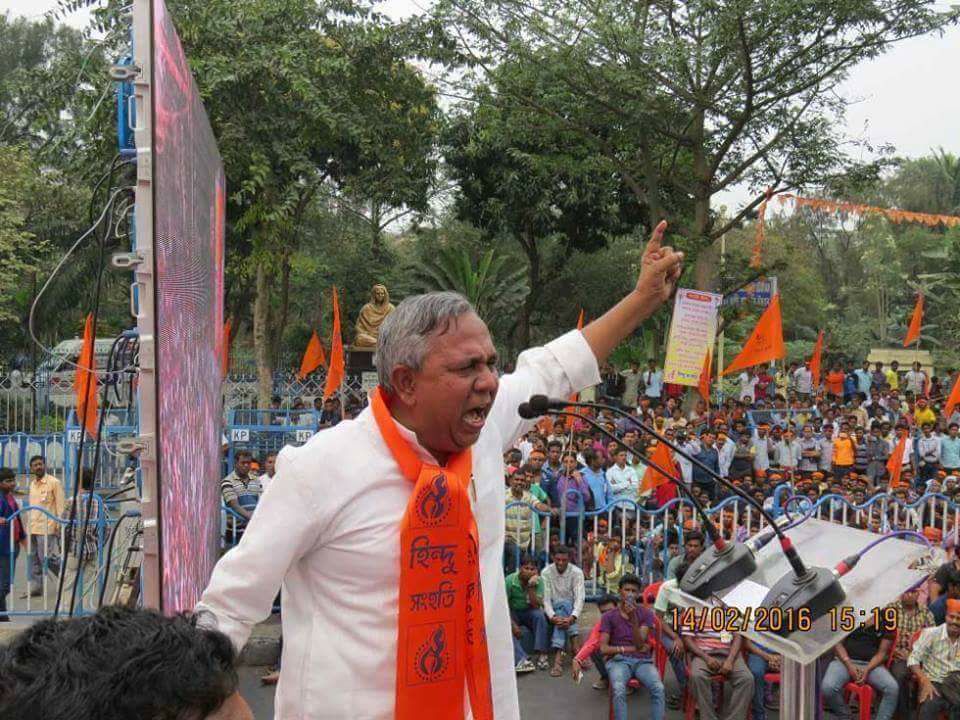
Holding pro-Israel banners aloft, some 70,000 people assembled in the center of Calcutta on Wednesday to mark the tenth anniversary of the founding of the far-right, anti-Muslim Hindu Samhati nationalist movement.

The rally, which organizers are claiming is the “largest pro-Israel rally in history,” eclipses a similar demonstration held in 2014, which saw a reported crowd of 20,000.

Wednesday’s rally included speeches by nationalist figures such as Maj. Gen. Gagandeep Bakshi, a decorated career soldier expert in counter-terrorism, from a stage in the heart of one of the poorest areas of India. The event culminated in a celebratory presentation to the crowd of a family of 14 former Muslims who converted to Hinduism.

Banner slogans included, “Jerusalem: Eternal Capital of Israel,” “India-Israel: Ancient Cultures, Modern Miracles,” and the inclusive “India-Israel Represents Honoring Women’s rights, Freedom of Speech, Respect for Human Rights, Liberty and Equality for All, Democracy.”

According to a press release, Hindu Samhati founder Tapan Ghosh passed a resolution “by voice vote” urging the Indian government to move its embassy to Jerusalem. Ghosh told the large Hindu nationalist crowd, “Moving our embassy to Jerusalem will honor Israel’s long-standing commitment to peace and strengthen the bond between our two ancient peoples.”

70,000 Hindus in India rally for Israel under Hindu Samhati Banner in Kolkata, February 14, 2018 (Vijeta Uniyal)

Ghosh compared the millennia-long struggle of the Jewish people for a homeland in Israel to the battle Hindus now wage in India, according to the press release. “In West Bengal… Hindus are being attacked by hostile neighbors just as Jews are fighting for their existence in little Israel. This struggle for survival unites Hindus and Jews, apart from the 2,500 years of glorious history that unites both the communities,” according to the release.

The rally ended as violence broke out among Hindu Samhati members and journalists after the on-stage presentation of the family of converts.

70,000 Hindus in India rally for Israel under Hindu Samhati Banner in Kolkata, February 14, 2018 (Vijeta Uniyal)

According to The Indian Express, Hindu Samhati leader Ghosh told the crowd, “Hussain Ali and his wife Moyna Bibi, as well as 12 family members, have been reconverted. Their ancestors were converted, and now we welcome them as Hindus on stage. Earlier we used to do this (conversion) secretly, but now we will do this in public.”

According to The Hindu, when journalists attempted to interview the family, Hindu Samhati supporters attacked and pushed them.

Among the detained or arrested Hindu Samhati members was Ghosh, who was taken for questioning, according to online news site The Hindu.

70,000 Hindus in India rally for Israel under Hindu Samhati Banner in Kolkata, February 14, 2018 (Vijeta Uniyal)

Joint commissioner of Kolkata police Praveen Kumar Tripathi told The Hindustan Times that “Hindu Samhati chief Tapan Ghosh and three other activists have been arrested in the case of assault on media persons in Kolkata on Wednesday evening.”

What is Hindu Samhati and what does it stand for?

Ghosh founded Hindu Samhati in West Bengal after leaving the RSS (Rashtriya Swayamsevak Sangh) Hindu nationalist movement in 2008. The RSS supported the establishment of Israel in 1948. West Bengal has seen increased Hindu-Muslim tensions in recent years.

According to news source NDTV, “Till recently, the Hindu Samhati was viewed as a fringe group and, politically, largely ignored. But over the last couple of years, it has grown a public profile by being vocal and active during the communal tensions at Bashirhat and earlier at Dhulagarh.”

70,000 Hindus in India rally for Israel under Hindu Samhati Banner in Kolkata, February 14, 2018. Pictured: Sri Tapan Ghosh, head of the Hindu Samhati. (Vijeta Uniyal)

Ghosh describes himself on Twitter as an “Uncompromising Hindu activist of Bengal. Determined to fight against Islamic aggression & expansion.” In its media material following Wednesday’s rally, the movement states it was founded “to serve the poorest of poor Hindus in rural heartland of Eastern Bharat, which is plagued by Islamist violence, insecurity and thereby poverty.”

“It has emerged as a powerful voice for human rights. Today’s turnout is testimony of the fact that Hindus believe in the India-Israel alliance. The Hindu Samhati leadership promise to work towards closer India-Israel relations in times to come, as these two ancient cultures become modern miracles which together can make the world a better place.”

70,000 Hindus in India rally for Israel under Hindu Samhati Banner in Kolkata, February 14, 2018 (Vijeta Uniyal)

In October, Ghosh made headlines in London when he was invited to speak in the House of Commons complex by Conservative party MP Bob Blackman, chair of the All Party Parliamentary Group (APPG) for British Hindus.

According to The Hindu, Ghosh is accused of making anti-Muslim statements during a session called “Tolerating the intolerant: The abuse of Hindu human rights in Europe and India.” During his London trip, Ghosh was photographed on a social call with British far-right nationalist Tommy Robinson.

Home Secretary Amber Rudd and Cabinet Minister Damian Green, who attended a Diwali celebration with Ghosh in October, distanced themselves from the event. The Home Office issued a statement that was quoted in The Middle East Eye, saying Rudd “fundamentally disagrees with Mr Ghosh’s views on Islam… The Home Secretary accepted an invitation from the Hindu Forum of Britain to attend an event in Parliament last week to celebrate Diwali. She did not speak to Mr. Ghosh and was not present when he spoke.”

70,000 Hindus in India rally for Israel under Hindu Samhati Banner in Kolkata, February 14, 2018 (Vijeta Uniyal)

At Wednesday’s rally, Ghosh appeared unaffected by the London rebuke.

Addressing the crowd, he is quoted in The Indian Express as calling on all Muslim Indians who had converted or reconverted to Hinduism, “When you return, initiate this movement in your districts and blocks — let us welcome all Muslims to Hinduism.”

Haley Tells UN: Iran’s attack on Israel is ‘wake-up call’ to the world

February 16, 2018

February 15, 2018

Latest News from Israel

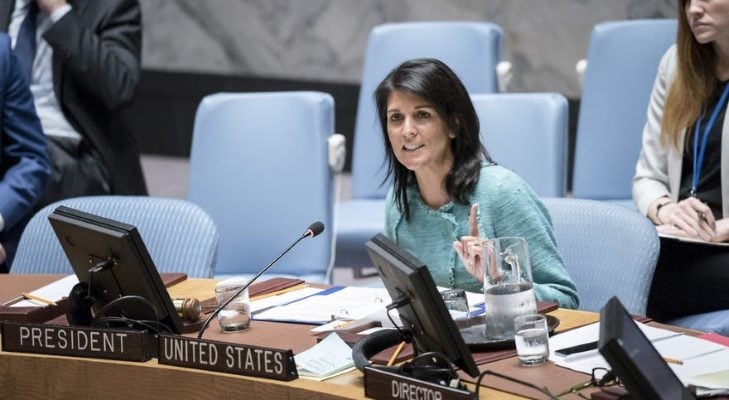
US Ambassador to the UN Nikki Haley (UN/Rick Bajornas)

Haley told the UN Security Council that Iran’s attack on Israel from Syria last weekend was a “wake-up call” to the world.

By: JNS.org

US Ambassador to the United Nations (UN) Nikki Haley told the Security Council on Wednesday that Iran’s drone incursion into Israel last weekend was a “wake-up call” to the world over the Islamic Republic’s belligerence in the Middle East.

An Iranian drone breached Israeli territory from Syria last weekend and was shot down by an IAF attack helicopter. As a result of the incursion, Israeli jets attacked a Iranian mobile command center near Damascus, where the drone originated from. However, Syrian forces responded with anti-aircraft fire at the Israeli jets, damaging one jet and forcing the pilots to eject after they crossed back into Israeli airspace.

Haley told the UNSC that the incident was an “egregious and unprompted escalation” by Iran.

“Iran was once again doing what it does—risking conflict and testing the will of its neighbors and opponents to resist its aggression,” said Haley. “Israel rightly took action to defend itself. The United States will always stand by our ally when confronted with provocations from Iran, Hezbollah or the Assad regime.”

Haley further asserted that “this incident shines a spotlight on the reality in Syria today. We are seeing actors engage in a dangerous game of pushing boundaries, instead of behaving responsibly and committing to peace.”

She added that “the Assad regime has become a front for Iran, Hezbollah and their allies to advance the irresponsible and dangerous agenda for the Middle East.”

The drone flight, she said, serves as “a wake-up call for all of us. Iran and Hezbollah are making plans to stay in Syria.”


Israel said to fear Assad chemical weapons spillover into Golan Heights

February 15, 2018

In classified cable to envoys in 15 key countries, Foreign Ministry reportedly stresses Israel would respond to such a situation in ‘strongest possible terms’

Illustrative photo: this image, from a video posted on September 18, 2013, shows Syrians in protective suits and gas masks conducting a drill on how to treat casualties of a chemical weapons attack, in Aleppo, Syria (AP)

The Foreign Ministry fears poison gas may leak into Israel if the Assad regime uses chemical weapons against rebels near the Golan Heights, and has reported warned of a punishing response should such a situation unfold.

The ministry sent a classified cable to 15 Israeli ambassadors around the world, providing the envoys with guidelines for sending strong messages against Iran, Syria and Hezbollah to their host countries, following last week’s infiltration of an Iranian drone and subsequent downing of an Israeli F-16, Channel 10 news reported Wednesday.

In acknowledging Jerusalem’s fear of chemical spillover into the Golan Heights, the cable directed the envoys to convey that “it must be made clear that such an incident would require Israel to respond in the strongest possible terms.”

The Foreign Ministry asked its ambassadors to emphasize to the senior political leaders in the countries where they are stationed that Iran’s entrenchment in Syria could increase the Islamic Republic’s desire to carry out additional attacks on Israel, which would lead to an escalation of hostilities in the entire region.

An unconscious Syrian child receives treatment at a hospital in Khan Sheikhun, a rebel-held town in the northwestern Syrian Idlib province, following a suspected toxic gas attack on April 4, 2017. (AFP Photo/Omar Haj Kadour)

“We must convey the message that Israel will not allow this and will defend itself, its citizens, and its sovereignty,” the cable said, according to the report.

In July 2012, a similar concern reverberated across Israel that terror groups could gain control of Syria’s large stockpile of chemical weapons. Officials at the time said Assad could transfer the weapons to the Hezbollah terrorist group. The number of gas masks distributed to civilians subsequently saw an immediate and significant rise.

The Syrian government on Wednesday denied it possessed chemical weapons and branded the use of such arms “immoral and unacceptable.”

A joint investigation team comprising experts from the UN and the Organization for the Prohibition of Chemical Weapons concluded that the Syrian government used chlorine gas in at least two attacks in 2014 and 2015 and used the nerve agent sarin in an aerial attack on Khan Sheikhoun last April 4 that killed about 100 people and affected about 200 others.

On February 1, Washington said Assad’s regime could be making new chemical weapons and warned it was considering fresh strikes against the regime.

Other messages that the Israeli envoys were asked to convey included calls on the international community to pressure Iran to halt its support of the Hezbollah terror group and to prevent the organization from purchasing and manufacturing precision missiles which could be used to target Israel, Channel 10 reported.

A senior Israeli official told Channel 10 that the ambassadors were asked to pass along the warnings in light of Jeruslem’s “sense” that the international community has not been taking Israel’s willingness to act against Iran’s entrenchment in Syria seriously.

A senior Syrian official on Tuesday warned Israel that it would face “surprises” if it launches any attacks on his country, claiming the Jewish state mistakenly thinks Syrian forces are incapable of defending the country.

Before dawn on Saturday, an Iranian drone was flown into Israeli airspace near the Jordanian border before it was shot down by an Israeli attack helicopter. Israel then conducted a series of airstrikes against positions in Syria, including the Iranian unmanned aerial vehicle’s mobile command center, according to the Israel Defense Forces.

Defense Minister Avigdor Liberman has since hinted that Israel would continue carrying out airstrikes where necessary, calling on Syria and Iran “to not be silly” or “provocative.”

During the reprisal raid, one of the eight Israeli F-16 fighter jets that took part in the operation was apparently hit by a Syrian anti-aircraft missile and crashed. The Israeli Air Force then conducted a second round of airstrikes, destroying between a third and half of Syria’s air defenses, according to IDF spokesperson Lt. Col. Jonathan Conricus.

Macron Vows to Reform Islam in France

February 14, 2018

“It is time to bring in a new generation.”

He can not even stop moslims praying in the streets .

  • The overall objective of President Macron’s plan is to ensure that French law takes precedence over Islamic law for Muslims living in the country.
  • The plan, as currently conceived, is vague and short on details, but appears to involve three broad pillars: determining who will represent Muslims in France; delineating how Islam in France will be financed; and defining how imams in France will be trained.
  • “It is time to bring in a new generation. We have seen fifteen years of debate to defend the interests of foreign states.” — Hakim el-Karoui, a French-Tunisian expert on Islam who is advising Macron on the reforms.

French President Emmanuel Macron, in a declared effort to “fight fundamentalism” and “preserve national cohesion,” has promised to “lay the groundwork for the entire reorganization of Islam in France.”

According to Macron, the plan, similar in ambition to Austria’s Islam Law, is aimed at seeking to “better integrate” Islam in France in order to “place it in a more peaceful relationship with the state.”

A key priority is to reduce outside interference by restricting foreign funding for mosques, imams and Muslim organizations in France. The plan’s overall objective is to ensure that French law takes precedence over Islamic law for Muslims living in the country.

In a February 11 interview with the Journal du Dimanche, Macron said that the plan, which is being coordinated by the Interior Ministry, will be announced within the next six months: “We are working on the structuring of Islam in France and also on how to explain it,” Macron said. “My goal is to rediscover what lies at the heart of secularism—the possibility of being able to believe as well as not to believe—in order to preserve national cohesion and the possibility of having free religious conscience.”

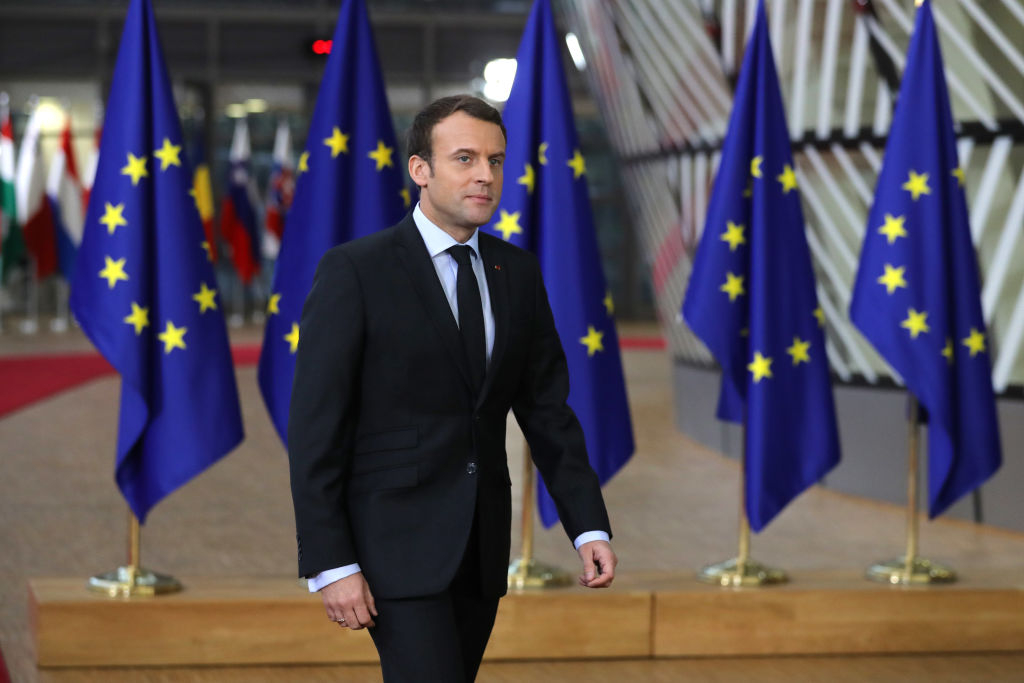
Emmanuel Macron, President of France. (Photo by Dan Kitwood/Getty Images)

Macron also said that he was consulting a broad array of experts and religious leaders for their input into the reform plan: “I see intellectuals and academics, such as [French Islam expert] Gilles Kepel, and representatives of all religions, because I think we need to draw heavily on our history, the history of Catholics and Protestants.” He added:

“I will never ask any French citizen to be moderate in his religion or to believe moderately in his God. That would not make much sense. But I will ask everyone, constantly, to absolutely respect all the rules of the Republic.”

Macron’s plan, as currently conceived, is vague and short on details, but appears to involve three broad pillars: determining who will represent Muslims in France; delineating how Islam in France will be financed; and defining how imams in France will be trained.

Representation of Muslims in France

A key aspect of Macron’s plan is to reform the French Council of the Muslim Faith (Conseil français du culte musulman, CFCM), the official interlocutor between Muslims and the state in the regulation of Islam in France. The organization, which represents approximately 2,500 mosques in France, was established in 2003 by then Interior Minister Nicolas Sarkozy.

The CFCM has long faced criticism for being ineffective and contentious, largely because the rotating presidency has allowed interference by foreign countries—mainly Algeria, Morocco and Turkey—seemingly to prevent Muslims from integrating into French society. Macron said the objective was to end what he called “consular Islam” and to open the CFCM to “the most integrated” Muslims.

“It is time to bring in a new generation,” said Hakim el-Karoui, a French-Tunisian expert on Islam who is advising Macron on the reforms. “We have seen fifteen years of debate to defend the interests of foreign states.”

The Interior Ministry intends to have its reforms in place by 2019, when the CFCM will hold elections to renew its leadership. “The moment is propitious for advancing the necessary reforms,” said Anouar Kbibech, former president of the CFCM.

Macron’s plan also reportedly involves establishing a “Grand Imam of France,” modeled on the position of Chief Rabbi. The individual would have the “moral authority” to represent Islam in front of the state. It remains unclear how such an individual would reconcile the competing strains of Islam to be able to represent them all.

Financing Islam in France

Macron’s second priority is to “reduce the influence of Arab countries,” which, he argues, “prevent French Islam from returning to modernity.” His plan would restrict foreign governments or entities from funding Muslim places of worship and training imams in France. Hundreds of French mosques are being financed by countries in the North African Maghreb and Persian Gulf.

The new plan would also attempt to illuminate the financial dealings of mosques by bringing them under the jurisdiction of a French law that regulates cultural associations. French mosques currently adhere to a law that regulates non-profit associations, which allows for more opaque bookkeeping.

Macron raised the possibility of revising the 1905 “Law on the Separation of the Churches and State,” which established state secularism in France. The 1905 law, among other provisions, banned government funding of religious groups in France. Addressing the prospect that French taxpayers might soon be asked to pay for Muslims to worship in France, Macron said: “The 1905 law is part of a treasure that is ours, but it did not consider the religious fact of Islam because it was not present in our society, as it is today.”

Macron’s plan reportedly also envisages establishing a so-called Halal Tax, a sales tax on halal products to finance Islam in France. The proposal faces fierce resistance from French Muslims, 70% of whom are opposed to establishing the tax, according to an Ifop poll for JDD.

Training Imams in France

Several hundred imams in France are civil servants whose salaries are paid by foreign governments. Interior Minister Gérard Collomb said the French government “should intervene” in the training of imams so that they are “imams of the French Republic,” not “imams of foreign countries.”

In an interview with Radio France Inter, Collomb said: “We can see that today we have a number of difficulties simply because nowadays everyone can proclaim himself to be an imam.”

Macron’s plan has been received with a mix of optimism, skepticism and derision.

Ghaleb Bencheikh, a French-Algerian Islamic reformist and a former president of the Great Mosque of Paris, said that Macron’s approach was “legitimate” and “interesting.” In an interview with Radio France, Bencheikh said:

“There is a terrible paradox that you have to know how to break. We are in a secular state and this sacrosanct principle of secularism stipulates that political authority should not interfere in the structure of a cult, whatever it may be. At the same time, there must be structure and privileged interlocutors of political power. The Muslim leaders are cautious, pusillanimous, they have not managed this structure. As a result, it is legitimate for both the President of the Republic and Interior Minister Gérard Collomb to insist on a healthy structure.”

Le Figaro noted with skepticism that previous French presidents have made similar pledges which ended in failure:

“Will Emmanuel Macron succeed where his predecessors have failed? The urgency, in any event, is very real. Last December, a Muslim leader from Bouches-du-Rhône declared: ‘The Salafists have taken control of the ground in France. There is a void, notably with the problem of imams who do not speak French.'”

In an interview with Les Echos, National Front Leader Marine Le Pen said she was worried about a possible challenge to the law separating churches and state: “There are a whole series of tracks, some of which are unbearable, unacceptable: for example, the idea of ​​a Concordat, the idea of ​​touching the law of 1905.”

She called for France to take hard line on foreign financing of Islam: “I suggest stopping foreign financing of mosques and closing Salafist mosques. Any foreign imam who makes a speech contrary to the values ​​of the Republic must be expelled.”

Florian Philippot, former vice president of the National Front and a Member of the European Parliament, said that Macron’s plan was not aimed at returning to a “secular Republic” but to “protect Muslims.”

In early January, during a meeting at the Elysée Palace with representatives of the six main religions in France (Catholic, Protestant, Orthodox, Muslim, Jewish and Buddhist), Macron announced that he would deliver a “major” but “dispassionate” speech on secularism during his presidency: “My wish for 2018 is that France become, with you, a model of secularism, knowing how to listen to the country’s voices in their diversity, capable of building on this diversity a great nation reconciled and open to the future.”

Less than a week later, however, Macron abruptly backtracked. The speech apparently was “removed from the agenda” because talking about secularism “in the context only of Islam” would be a “fatal mistake.”

Columnist Hélène Jouan accused Macron of trying to play both sides against the middle:

“Emmanuel Macron is credited with holding a subtle balance between unfailing attachment to Republican principles, and absolute firmness vis-à-vis radical Islam.

“The president prefers to evade. I’m not sure that this will last. A tragic event in France would push him, of course, to reveal himself, at the risk, then, of alienating those who would judge, from the right or left, that he does too much or not enough, to lose his position of ‘centrality’ which he thinks he holds on the question. In the meantime, however, he buys time.”