Author Archive

Trinidad: How a Tiny Nation Became ISIS Recruiting Ground

February 5, 2018

By – on

Trinidad: How a Tiny Nation Became ISIS Recruiting Ground

Trinidad, a South African nation usually considered part of the Caribbean, may be home to a population of just 1.3 million.

But it’s one of the biggest recruiting grounds for ISIS — and so is neighboring, and equally small, Tobago.

So how does that happen?

The Guardian reports:

Five years ago, Tariq Abdul Haqq was one of Trinidad and Tobago’s most promising young boxers, a Commonwealth Games medallist with Olympic dreams.

Now he lies dead somewhere in Iraq or Syria, buried in the ruins of the self-declared caliphate, along with dozens of his countrymen. Together they formed one of the most unlikely, and most underreported groups of fighters drawn to Isis.

The tiny Caribbean nation, with a population of just 1.3 million, lies about 10,000km from the former Isis capital in Raqqa. Yet at the bloody peak of the group’s power, Trinidad and Tobago had one of the highest recruitment rates in the world.

More than 100 of its citizens left to join Islamic State, including about 70 men who planned to fight and die. They were joined by dozens of children and women, the latter including both willing and unwilling companions, security officials say.

By way of comparison: Canada and the US, with populations many times larger, are each thought to have produced fewer than 300 recruits who made the journey east.

The power of this story – the flight from a balmy Caribbean island state rich in oil and gas to the frontlines of a desert war – was not lost on the propagandists of Isis.

Their Dabiq magazine, aimed at potential recruits and sympathisers, featured a long interview with fighter Abu Sa’d al-Trinidadi – formerly Shane Crawford – in the summer of 2016. He detailed his conversion, his trip to Syria and ended threatening death to Christians and bloodshed in the streets of his former home.

An unnerved Trinidad government raced to introduce new controls on travel and finance that would make the journey to any new jihadi project harder, and would track anyone attempting to return.

There has never been a terror attack on the islands, a plot uncovered, or even any formal Isis threat against Trinidad and Tobago.

But the country now faces the possibility that citizens trained by Isis could return to radicalise a younger generation – or that would-be recruits no longer able to make that dark pilgrimage will seek other targets for extremism.

The island has a thriving international oil and gas industry, and for the US there are potential worries about a more direct threat. Trinidad’s citizens can travel through the Caribbean without visas, and a Trinidadian has already been jailed for his role in a 2007 plot to attack New York’s JFK airport.

Within a month of taking office, Donald Trump called Trinidad’s prime minister, Keith Rowley, to discuss terrorism. The UK government has also recently warned of possible terrorist attacks in the country – although it issued similar travel warnings for countries including Spain and France.

Trinidad’s Muslims make up around one in 10 of the country’s population, and the overwhelming majority follow moderate forms of Islam.

But a tiny minority have been drawn to a more extreme creed. In 1990 a group called Jamaat al Muslimeen launched the western hemisphere’s first and only Islamist coup attempt, taking the prime minister and legislators hostage for several days.

Eventually the army regained control, but the imam behind the coup, Yasin Abu Bakr, was released from jail within a couple of years under an amnesty deal and has resumed preaching.

At a sermon recently attended by the Guardian, Abu Bakr argued that European nations had no moral grounds to criticise Isis beheadings, because of the use of the guillotine during the French revolution.

The attorney general, Faris Al Rawi, denied that Trinidad had a particular problem with Isis recruitment or religious extremism.

“The number may look larger than somewhere else, but I don’t accept for one moment that we have a problem that is much larger than anywhere else,” he said in an interview. “I don’t think that we are any more vulnerable than any other country is.”

For many Trinidadian Isis recruits, religion was more excuse than driving motivation, said anthropologist Dylan Kerrigan, a lecturer at the University of the West Indies.

Young men, many of them recent converts, were drawn to the caliphate mostly by promises of money and a sense of community – an appeal similar to that of gangs in an increasingly violent country, he said.

“[A gang] provides a family, male role models, social order and it promises access to what many young men might think they want: money, power, women, respect,” said Kerrigan who has researched extremism for UN counter-terrorism units.

“[One] imam told me that instead of joining a local gang, some see traveling to the Middle East as like joining another gang.”

Al Rawi said a string of new measures, including intelligence sharing with the US, UK and Israel, mean it will be very hard for those who have left to slip back into Trinidad undetected.

People who knew some of the Isis volunteers say most of them – and some of their dependents – are dead. The only Trinidadians known to have returned to the island were a family group picked up from a Turkish refugee camp, after apparently trying and failing to reach Isis-held territory. They are now under close surveillance, Faris said.

He dismissed concerns about further radicalisation, arguing that many of those who travelled to Syria were simply criminals looking to return with an extra edge over rivals.

“There are many people who are willing to make a trip to a war-torn area just to say you have been there – for the ‘cred’,” he said. “You have to disaggregate the genuine jihadi – who may potentially die as a martyr for a cause – from a pure criminal borrowing the look and persona of terrorism.”

Joining Isis may also have offered a practical escape to those facing the law. Before he was lionized in Dabiq, Shane Crawford, was a petty criminal who had been detained several times including on suspicion of planning to assassinate the then prime minister. He travelled to Syria with two friends who had been released from jail pending an investigation.

But some members of prominent families were drawn in too – perhaps none more high-profile than boxer Tariq Abdul Haqq. His aunt, Pamela Elder, is one of the country’s most respected lawyers and his father Yacoob Abdul Haqq had been a senior boxing official until his 2012 death.

Abdul Haqq was also an acquaintance of Fuad Abu Bakr, the son and heir apparent of the 1990 coup leader Abu Bakr.

The schools, clinics, soup kitchens and factories that filled Jamaat al Muslimeen’s compound were mostly destroyed after Abu Bakr senior’s arrest, but the government spared his large, airy mosque, where both father and son now teach. There is space for hundreds of men to pray from the main floor, and dozens of women to gather on a balcony to hear Friday sermons.

A preacher and politician, Fuad appears to have inherited his father’s extreme religious views along with his imposing height and charisma.

In an interview with the Guardian he described the men who went to fight for Isis in glowing terms, and slammed a new law banning child marriage as a violation of religious rights.

He dismissed reports of Isis brutality, denied that the jihadi group’s widely documented revival of sexual slavery was real, and compared the organisation’s self-declared caliphate to Israel and the Vatican.

“They want independence and an Islamic State, and they have the right to self-determination … so how can you say to these people that you cannot have an Islamic State because that is not an acceptable political status? There is a Jewish State, there is a Catholic state.”

Bakr said he knew several of those who travelled to Syria. Saying that he had to choose his words carefully when discussing their journeys, to avoid violating Trinidadian laws against supporting terrorism, he was still open in his admiration.

“They are not bad people, they are some of the most excellent people I knew, some of them,” he said. “People from all walks of life, businessmen, who just decided this is the right thing to do.”

Then, in an extraordinary invocation of one of the greatest champions of non-violent resistance, he paraphrased lines from a 1963 speech by Martin Luther King Jr in tribute to the Trinidadians who signed up for Isis’s project of extreme violence.

“Martin Luther King said a man who is not willing to die for something is not really fit to live, and I respect someone who is willing to sacrifice themselves for the betterment of their fellow man, and that is what those individuals think they are doing.”

King Abdullah II: Washington Does Not Understand Islam

February 5, 2018

King Abdullah II: Washington Does Not Understand Islam

King Abdullah II of Jordan on Sunday told CNN’s Fareed Zakaria that the American leadership does not get what Islam is about—which goes without saying and which could explain the catastrophic US Mid-East policy since Desert Storm, if not earlier.

“Whether I’m in Washington in the Congress or with the administration, I think maybe there’s a lack of understanding of Islam,” the King told his host, who is a self-described secular and nonpracticing Muslim born in India.

Advertisement

The king said Trump’s recognition of Jerusalem as the capital of Israel was “a complication,” because “Jerusalem is such an emotional subject for everybody.” But repeating his argument that Washington misunderstands the Arabs, then he asked, “How do we build the confidence and trust between the Palestinian leadership and the American leadership so that we can get Americans, Israelis and Palestinians at the table?”

As if Abbas et al were children who are unable to realize on their own that they must save their people from a life of poverty and suffering, and must be manipulated emotionally to negotiate with their far stronger neighbor.

King Abdullah was responding to repeated references by President Trump describing Islam and the United States as being at odds with each other. Trump said on the campaign trail that Muslims hate the US.

The king defended Islam, saying “it is not a religion of hate. We as Muslims believe in Jesus Christ as the Messiah. We believe in the Holy Virgin Mother. We believe in the Bible and the Torah, and I think this is the way that all of us were brought up,” he said, misrepresenting the repugnant views against Jews and Judaism which are common among scholars and politicians in his own country.

“When we all greet each other as Arabs and Muslims, we say, ‘As-salamu alaykum’ – peace be unto you,” the King argued, suggesting this was “the basis of Islam.” The king, who is the actual heir of the prophet Muhammad, omitted another popular Muslim saying, “the religion of Muhammad is enforced by the sword.”

The king did admit that “fringe groups” have created a series of problems and challenges, but insisted that most Muslims are fighting against the extremists.

“This is a civil war between all of us – and those that, not only consider us heretics, but consider Christians, Jews and other religions all heretics, who should be put to the sword,” he said about what he described as a “fight inside of Islam.”

“The problem that we have now, and maybe the lack of understanding, is that it is us Muslims working side by side with Christians, Jews and other religions to fight this scourge, which is still going to be a long-term problem,” he stated, but warned that the fight against extremist would fail if the Muslims feel “victimized and isolated,” because this creates “a breeding ground of contempt.”

“We all want a better future for our children and their children. For them to feel isolated, that’s the danger. And the rhetoric that moves in that direction is not a good story for any of us,” he said.

Someone should encourage the king to read the newspapers that are being sold just a stone’s throw away from his own palace in Amman…

Turkey Warns US Troops In Northern Syria May Be Targeted By Its Army

February 5, 2018

IDF strikes Hamas armed wing targets in response to rocket fire

February 4, 2018

IDF attacked two Hamas targets in southern Gaza on Friday night in response to Thursday’s rocket fire. A Red Alert siren that was sounded at the time of the attack proved to be a false alarm.

Avital Zippel
http://www.jerusalemonline.com/news/in-israel/local/idf-strikes-hamas-armed-wing-targets-in-gaza-34067
IAF fighter jets (archive) Photo Credit: IAF website

IDF fighter jets attacked two Hamas targets in southern Gaza on Friday night. The targets were located in a complex used by Hamas’ armed wing, the IDF Spokesperson’s Unit said in a statement.

 A Red Alert siren was sounded at the time of the attack. The IDF clarified that the siren was a false alarm. Friday’s airstrikes were a further response to the rocket fired from the Gaza Strip late Thursday night.

As previously reported by JOL, IDF forces attacked a Hamas observation post in northern Gaza on Thursday following the launch towards Israel. No rocket remnants were found.

Earlier on Thursday, Israeli security forces apprehended four Palestinians after they crossed into Israel from Gaza carrying knives and a grenade. The suspects were taken into questioning.

Tensions have been escalating in southern Israel ever since US President Donald Trump recognized Jerusalem as Israel’s capital. Dozens of projectiles have been fired from Gaza at Israel since the declaration. No injuries were reported.

Hamas Gaza chief orders highest security alert over fear of imminent war with Israel

February 4, 2018

According to Arabic-language reports, the political leader of Hamas in Gaza has ordered most of the terrorist group’s headquarters in Gaza evacuated over fear that Israel plans to launch a military conflict within coming days.

Omri Ariel
http://www.jerusalemonline.com/news/middle-east/israeli-palestinian-relations/hamas-gaza-chief-predicts-war-with-israel-within-days-34370
Photo credit: Abed Rahim Khatib, Flash 90

Yahya Sinwar, the leader of Hamas in Gaza, reportedly believes war with Israel is likely to erupt within the next few days.

According to the London-based Arabic-language newspaper Al-Hayat, Sinwar has ordered Hamas headquarters in Gaza evacuated and has declared the highest level of security alert.

Sinwar’s moves come amid reports of multiple upcoming military exercises set to be conducted by Israel along its southern border, including the joint US-Israel Juniper Cobra exercise.

Russian Su-25 jet downed in Syria, pilot killed – Defense Ministry +video

February 4, 2018
https://www.rt.com/news/417798-russian-jet-crashes-syria/

A Russian Su-25 jet has crashed in Idlib province in north-western Syria, the Russian Defence Ministry confirmed, adding that it was probably shot down by MANPAD. The pilot ejected but was killed by militants on the ground.

Preliminary data showed the Su-25 plane was downed by a man-portable air-defense system (MANPAD), the ministry said in a statement on Saturday.

READ MORE: Russian missiles strike area of Su-25 downing, killing at least 30 terrorists – MoD

The attack took place when the jet was flying over the Idlib de-escalation zone on Saturday. The pilot parachuted down into the area controlled by Al-Nusra terrorist group, the statement said. He was killed during a confrontation with the militants from an unspecified group.

READ MORE: First alleged footage of Russian Su-25 jet shot down over Syria’s Idlib (VIDEO)

Russian Reconciliation Center for Syria together with Turkey which is also responsible for the Idlib de-escalation zone is now trying to retrieve the body of the Russian pilot, the Defense Ministry confirmed.

Tahrir al-Sham, the extremist group linked to Al-Nusra terrorists, has claimed responsibility for the downing of the Russian aircraft, according to Reuters.

Earlier, another militant group, Jaysh al-Nasr, which claims affiliation to the Free Syrian Army, also posted videos and statements about the Russian plane on its Twitter account. It said the jet was shot down by some air defense systems.

In July 2016, two pilots were killed when a Russian military helicopter was downed by Islamic State militants near Palmyra. They had been attacking advancing terrorists at Damascus’ request when it was shot down.

The Russian air campaign supporting anti-terrorist efforts by Syrian authorities lasted from September 2015 to December 2017. In mid-December, President Vladimir Putin visited the Khmeimim Airbase to announce the withdrawal of most of the Russian troop contingent from the country.

Moscow played a vital role in the defeat of Islamic State (IS, formerly known as ISIS) terrorist group in Syria, as well as other jihadist groups, including Al-Nusra. Around 60,000 fighters were eliminated during the campaign, according to the defense ministry.

Palestinian Authority preparing to ‘disengage’ from Israel

February 4, 2018

PA Chairman, who also serves as Palestine Liberation Organization official, orders preparation of plans to ‘disengage’ from Israel.

Arutz Sheva Staff, 03/02/18 23:29

http://www.israelnationalnews.com/News/News.aspx/241505

Mahmoud Abbas

Reuters

The Palestine Liberation Organization’s (PLO) top leadership on Saturday ordered preparations for disengagement from Israel.

Withdrawing the PLO’s 1988 recognition would threaten decades of Israeli relations with the Palestinian leadership and raise doubts over ongoing security coordination between the two.

It would also be seen as a fatal blow to the two-state solution, already on life support following the White House’s December recognition of Jerusalem as Israel’s capital.

The PLO’s Executive Committee released a statement after a three-hour meeting Saturday saying it would set up a committee to study the derecognition move.

The organization’s top body was meeting for the first time since the Palestinian Central Council, another arm of the PLO, called for the step last month.

The Executive Committee, led by Palestinian Authority Chairman Mahmoud Abbas, ordered the preparation of “plans and projects for disengagement steps with the Israeli government at the political, administrative, economic and security levels.”

Last month the PLO’s Central Council voted to suspend recognition of Israel until it recognizes “Palestine” and halts the building of Jewish communities in Judea and Samaria.

Western countries have been lobbying senior Palestinian officials to convince them not to take such a step, multiple diplomats said.

The US considered the PLO to be a terrorist organization until 1991. In 1993, as part of the Oslo Accords, the PLO recognized Israel’s right to exist in peace, accepted United Nations Security Council resolutions, and “rejected” “violence and terrorism.”

However, the PLO has not kept its promise, consistently involving itself in violence and terrorism and paying terrorists stipends in proportion to their success in murdering Jews. Abbas recently declared the Oslo Accords “dead.”

Erekat says US is pushing a Palestinian ‘coup,’ tells Nikki Haley to ‘shut up

February 4, 2018

Top PLO official rails against the Trump administration for criticisms of PA President Mahmoud Abbas, but insists Palestinians are not looking for confrontation with US

3 February 2018, 10:26 pm

https://www.timesofisrael.com/erekat-slams-us-for-pushing-palestinian-coup-tells-nikki-haley-to-shut-up/

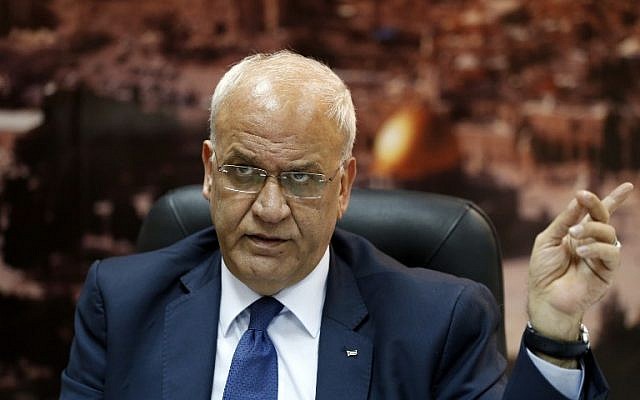
PLO Secretary General Saeb Erekat in his Ramallah office, November 23, 2015. (AFP/Abbas Momani)

Senior Palestinian official Saeb Erekat on Saturday accused the Trump administration of trying depose the Palestinian leadership in a “coup” and told the “impudent” US envoy to the United Nations Nikki Haley she should “shut up” with her criticism of Palestinian Authority President Mahmoud Abbas.

Erekat, who has led the Palestinian peace negotiations and is secretary general of the Palestine Liberation Organization, singled out Haley, who slammed Abbas for a recent speech that was full of anti-Semitic tropes.

Erekat said that Haley’s “impudence” has gone as far as calling for removing Abbas from power.

“She called for overthrowing the democratically elected Palestinian president,” Erekat complained in an interview with the Palestinian Al-Watan Voice news website.

“This is the president who led the peace process and promoted the principle of the two-state solution,” Erekat said, referring to Abbas. “Now this [US] ambassador is accusing him of lacking courage, and is calling for replacing him.”

Only the Palestinian people have that right, he said. “The Palestinian people are loyal to their martyrs, prisoners, wounded, struggles, steadfastness, and heroism. This is the reality. The Palestinians are the only ones who are entitled to hold their leaders accountable.”

Erekat was reacting to a speech given by Haley to the UN on January 25.

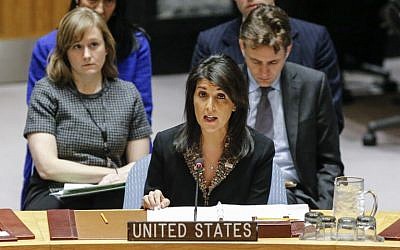
US Ambassador to the UN Nikki Haley speaks during a UN Security Council meeting on the Middle East on December 18, 2017, at UN Headquarters in New York. (AFP Photo/Kena Betancur)

“President Abbas declared the landmark Oslo Peace Accords dead. He rejected any American role in peace talks. He insulted the American President. He called for suspending recognition of Israel. He invoked an ugly and fictional past, reaching back to the 17th century to paint Israel as a colonialist project engineered by European powers,” Haley said.

“A speech that indulges in outrageous and discredited conspiracy theories is not the speech of a person with the courage and the will to seek peace,” she said.

“I ask here today, where is the Palestinian King Hussein? Where is the Palestinian Anwar Sadat,” she said, referring to the Jordanian and Egyptian leaders who made peace with Israel. “If President Abbas demonstrates he can be that type of leader, we would welcome it. His recent actions demonstrate the total opposite.”

Erekat insisted that Trump’s recognition of Jerusalem as the capital of Israel, together with Haley’s remarks, amounted to an attempt to stage a “coup” against the “Palestinian political system.”

“Nikki Haley needs to shut up and realize that the Palestinian leadership is not the problem,” the top PLO official added. “Instead, the problem is the Israeli occupation and the policies it continues to pursue. I’m not saying that we don’t make mistakes; every society and every government makes mistakes.”

Erekat said the goal of Israel and the US was to “undermine the Palestinian national project.”

“US and Israeli officials are saying that any Palestinian leader who insists on East Jerusalem becoming the capital of Palestine and is committed to the right of return, in accordance with United Nations resolution 194, should be removed from power and replaced,” he said.

The US and Israel are searching for Palestinian leaders who will accept the “liquidation of the Palestinian national project,”  Erekat said.

“The Palestinian leadership has told the Americans and Israelis that, even after 1,000 years, they will not find any Palestinian who will collaborate with their scheme,” Erekat said.

Palestinian Authority President Mahmoud Abbas (C-R) speaks during a meeting in the West Bank city of Ramallah on January 14, 2018. (AFP PHOTO / Abbas Momani)

The Palestinians, Erekat stressed, are determined to pursue diplomatic efforts at the UN Security Council and other international forums in response to the policies of the Trump administration.

“We will take Trump’s decision [to recognize Jerusalem as the capital of Israel] to the International Court of Justice and we will seek membership in more international agencies,” he said.

In the wake of the recognition, formally declared by President Donald Trump on December 6, the Palestinians have said the US cannot be an honest broker in the peace talks and have refused to meet with US officials, including Vice President Mike Pence, who visited the region last month.

Nevertheless, Erekat insisted that the Palestinians were not looking for a fight with the US.

“We don’t seek a confrontation or a fight with the US administration,” Erekat said. “On the contrary — they are the ones taking several steps. The US administration is itself saying that it’s not an honest broker in the peace process. Therefore, we are seeking, together with international parties, to convene an international conference for peace.”

Syrian Rebels Shoot Down Russian Sukhoi 25 Fighter Jet, Kill Pilot

February 4, 2018

Syrian Rebels Shoot Down Russian Sukhoi 25 Fighter Jet, Kill Pilot

Photo Credit: Staff Sgt. Dean Wagner via Wikimedia

An Iraqi Su-25 fighter jet destroyed in Operation Desert Storm.

A Russian Aerospace Force Su-25 fighter jet was shot down by Syrian rebels on Saturday in Idlib Province in northwestern Syria, near the Turkish border. The pilot ejected but was killed in an exchange of gunfire, the Russian defense ministry reported.

“On February 3, 2018, a Sukhoi 25 Russian fighter jet crashed when flying over the Idlib de-escalation zone. The pilot was able to report ejection from an area controlled by Jabhat al-Nusra militants. The pilot was killed while fighting against terrorists. According to preliminary information, the jet was brought down with a portable anti-aircraft missile system,” the defense ministry said.

 “The Russian center for reconciliation of warring sides in Syria alongside the Turkish side, responsible for the Idlib de-escalation zone, are taking steps to retrieve the Russian pilot’s body,” the ministry noted.

Earlier reports said that Syrian governmental forces were fighting against Jabhat al-Nusra units in the Idlib province.

The de-escalation zones were set up in Syria in May 2017, based on an agreement signed by Russia, Iran and Turkey. The zones are not recognized by the rebels, and Israel is vehemently opposed to such a zone being established in al-Quneitra Province in southern Syria, on Israel’s Golan Heights border.

The downing of the plane came as Syrian government forces, backed by Russian air support and Iranian infantry, have intensified their offensive in Idlib, one of the last rebel-held bastions in Syria.

So, no one is observing the de-escalation zone idea up there. In fact, Rami Abdel Rahman of the London-based Syrian Observatory for Human Rights has reported on Saturday that “there have been dozens of Russian air strikes in the area over the past 24 hours. This plane was also carrying out raids there.”

Israel operates against ISIS terrorists inside Egypt, report says

February 3, 2018

A New York Times report claimed Israel has been operating to defeat ISIS in Egypt for over two years with the approval of Egyptian President Abdel Fattah el-Sisi. According to the report, Israel has sent unmarked aircraft that frequently conducted airstrikes in the Sinai Peninsula.

Avital Zippel
http://www.jerusalemonline.com/news/middle-east/israel-and-the-middle-east/report-israel-operates-against-isis-in-egypt-34073
Israeli fighter jet (archive) Israeli Air Force/Wikimedia Commons

Israel has carried out a covert campaign against ISIS in Egypt, a report in the New York Times claimed on Saturday. As ISIS militants and Islamists spread in the Sinai desert since 2015, unmarked Israeli aircraft conducted over 100 airstrikes within Egypt, the Times said.

 The report cited current and former UK and US officials involved in Middle East policy as sources, all speaking on the condition of anonymity. The frequent airstrikes were allegedly carried out with the approval of Egyptian President Abdel Fattah el-Sisi and with full cooperation between the two countries. Furthermore, the US officials said Israel’s covert campaign has played a major role in enabling Egypt’s military to gain an upper hand against terrorists in the Sinai Peninsula.

Both Israel and Egypt allegedly sought to conceal the operation, as the two countries maintain a fragile and fraught relationship. In order to avoid detection, the Israeli aircraft reportedly flew circuitous routes in an attempt to create the impression that they were based in Egypt.

Spokesmen for the Israeli and Egyptian militaries declined to comment. The Egyptian Foreign Ministry also declined to address the report.

As previously reported by JOL, president el-Sisi declared in November that he has instructed the Egyptian authorities to use “all the force necessary” to defeat the terrorist groups in Sinai within three months. “This isn’t logical,” el-Sisi said during a speech, referring to the spread of terrorism in the region. “Within three months, we will fight with all our might and achieve security.”