Author Archive

Iranian Resistance Sends a Message to the UN Security Council

January 5, 2018

Iranian Resistance Sends a Message to the UN Security Council, Iran News Update, January 5, 2018

(Please see also, Russia: US demand for UN meeting on Iran is ‘destructive’.  The Iranian Resistance movement does not have a chance at the UN. — DM)
.

INU – On January 5, 2018, the Secretariat of the National Council of Resistance of Iran issued an important statement regarding the today’s UN Security Council session on the current uprising against the Iranian regime, the following is the full text of the statement:

Security Council upbraids Iran regime for mass murder and arrest of protesters

  • Legitimate right of people to overthrow religious fascism and establishment of democracy must be recognized

The Iranian Resistance asks today’s UN Security Council to defend the legitimate and natural right of the Iranian people to overthrow the religious fascism ruling Iran and to achieve the freedom they have been uprising for, and to strongly condemn and hold accountable the mullahs’ regime for killing defenseless and unarmed demonstrators; measures that are a clear indication of a crime against humanity, and confronting them is  the responsibility of the United Nations Security Council.

According to reliable reports obtained by the Iranian Resistance, at least 50 demonstrators have been martyred by the direct fire of the Revolutionary Guards since the beginning of the uprising (during eight days) and more than 3,000 have been arrested. Children and teenagers as young as 12 or 13 years old are among the martyrs. The actual number of martyrs and arrestees is much more; a reality that the Iranian regime is trying hard to hide.

The clerical regime has blocked social networks in Iran since the first days of the uprising and cut off the Internet or has boosted severe restrictions on it. The IRGC commander, major general Jaafary, and the Minister of Communications, Azari Jahromi, and many other officials in the clerical regime officially acknowledged cutting off internet communications and announced that they would continue it until the unrest ends.

Welcoming the convening of today’s UN Security Council on Iran’s uprising, the Iranian Resistance emphasizes the need for the following actions to be taken by the UN Security Council:

  1. Recognizing the legitimate right of the people of Iran to overthrow the ruling religious fascism and establish freedom and sovereignty of the people.
  2. Strongly condemning and holding accountable the Iranian regime for massacre and mass arrests of defenseless and unarmed protesters.
  3. Sanctioning the regime for the systematic violations of human rights, including the 1988 massacre and the killings during current uprising.
  4. Condemning cutting off the Internet and social networks, and ensuring the free access of the public to the Internet.
  5. Enforcing binding decisions for the release of thousands of arrested demonstrators and for establishing a monitoring system; and warning the Iranian regime that more serious actions will be taken should such trend continues.

Secretariat of the National Council of Resistance of Iran

January 5, 2018

Sexual Harassment East and West

January 5, 2018

Sexual Harassment East and West, Gatestone InstituteDenis MacEoin, January 5, 2018

“I say that when a girl walks about like that, it is a patriotic duty to sexually harass her and a national duty to rape her.” — Nabih Wahsh, Islamist lawyer, on Egypt’s al-Assema TV, October 19, 2017.

The Iranian Revolution of 1979 sparked off increasingly revolutionary movements across the Islamic world, and in the process saw women in many countries denied the freedoms they had started to acquire under earlier regimes. The veil returned widely, notably in Turkey, following the growing power of authoritarian and fundamentalist President Recep Tayyip Erdogan, with women’s rights being increasingly denied.

We urgently need to drop our unwillingness to contrast Western and Islamic values — whether regarding violence, treatment of religious minorities, anti-Semitism, or treatment of women. There are also growing numbers of Muslims, as we are seeing today in Iran, who find wider Islamic attitudes abhorrent and work hard, mostly against the odds, to bring their faith closer to modern values.

For a time, one could not open a newspaper or visit an online news site without finding yet another scandal about sexual harassment. Lawyers are presumably going to have a field day for years to come. In the UK, a further wave of accusations has shaken an already shaky parliament and the Government, whose Cabinet is increasingly in disarray. In the US Congress, Hollywood and elsewhere, similar claims are still being made, with #MeToo stories being shared by women, while there is an unknown number of accusations in US statehouses.

Sex scandals in the West are far from new.[1] The irony is that this brings us face to face with attitudes to the same problem in the Islamic world.

For many years in the West, it was common practice for sexual harassment and rape among celebrities and public figures to be hushed up. To secure silence, abusers often used bribes or threats. Young women feared the loss of their careers or reputations; in many instances, the police would reject claims of abuse. This happened more than once in the UK, when young victims of “Asian” grooming gangs were not believed by social workers and police; in Europe authorities tried — and still try (see herehere and here) — to cover up harassment and rape committed by Muslim migrants. There will be a lot of work to do to protect women and children from the excesses of so many men.

Just watch and marvel at this short clip from a debate on Egypt’s al-Assema TV, aired on October 19, 2017, or read an English transcript. The Director-General of al-Assema is Brigadier-General Muhammad Samir, a former spokesman for the Egyptian armed forces. His appointment has been criticized on the grounds that it is “a miserable attempt by the military regime authorities to nationalize the media, unify its message, and block any opposing voices against the government”. In that sense, al-Assema represents a semi-official voice.

The debate on Egypt’s al-Assema TV included a lawyer, Nabih [el] Wahsh, an Islamist who has filed countless hesba [2] cases against intellectuals, artists, religious leaders and government ministers for acts he deems immoral or blasphemous. With Wahsh on air were three women: Shadia Thabet, a member of the Egyptian parliament, Abeer Soleiman, a women’s rights activist, and Ashgaan Nabil, a life coach.

Wahsh began by stressing that, regardless of Egypt being a civil state, it had to conform to Islamic religious rules and norms. On that basis, he engages in an argument which leads him to the following confrontation with Soleiman, whom he effectively silences by bullying her:

Nabih Wahsh: “Are you happy when you see a girl walking down the street with half of her behind showing?”

Abeer Suleiman: “Do you think that we don’t care about our girls?”

Nabih Wahsh: “I say that when a girl walks about like that, it is a patriotic duty to sexually harass her and a national duty to rape her.”

Abeer Suleiman: “No, no, no, no! I totally oppose this kind of talk. This is sexual harassment live on air…”

Nabih Wahsh: “It is a national duty to rape such a girl! What she allows herself to do constitutes depravity.”
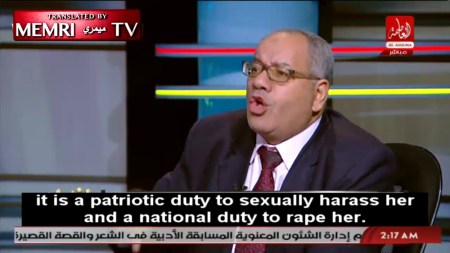
Egyptian lawyer Nabih Wahsh recently advocated on television for sexual harassment and rape in retaliation for the temptation caused by uncovered women. (Image source: MEMRI)

This open espousal by a lawyer of sexual harassment and rape in retaliation for the temptation caused by uncovered women was backed by a heavily-covered member of parliament and followed by a “life coach” urging ten-year prison terms for homosexuals — all during a television broadcast — would, of course, finish their careers anywhere in the Western world within minutes. Men behave badly in Europe and the United States, and some very badly indeed; but to boast publicly about wishing to do so would be unthinkable.[3]

In the West, however, women have been fighting back for generations. The rise of sane feminism (as distinct from its shrill and politically-correct cousin)[4] has elevated the status of women in all the democracies and given courage to the many women who now find themselves empowered to call out powerful men who have sexually abused, groped and raped them.

There are feminists in the Islamic world. Countless books have been written about them and the growth of feminism in countries from Egypt and Iran to Indonesia. During the twentieth century, progress in establishing women’s rights was made in several places: the veil was abandoned, more women moved into professional life and even into politics — notably, the assassinated Benazir Bhutto, the first Muslim woman democratically elected (twice) as Prime Minister of Pakistan.

Real advances, nevertheless, have been slow. Even as things were starting to improve for women, religious minorities, and others in some countries, such as Turkey, the Salafi style of fundamentalist Islam, based on a demand to return to the practices of the Islamic prophet Muhammad and the first three generations of his followers (salaf means “predecessors”), was already underway from the early years of the twentieth century, notably through the work of the Egyptian writer Rashid Rida. For Rida, and later for Salafis down to the Islamic State enterprise, reform meant turning away from the Western models that had inspired new legislation, and back to the earliest days of Islam as embodied in the Qur’an, the ahadith (sayings and acts of the prophet), and the biographies of Muhammad. In 1928, another Egyptian, the schoolteacher Hasan al-Banna, established the Muslim Brotherhood, the leading revivalist movement in Islam since the 1920s, which remains to this day a major international force for reviving fundamentalist Islam.

Ironically, one prominent individual to have been caught up in the current wave of harassment revelations is Tariq Ramadan, Professor of Contemporary Islamic Studies at Oxford University. Ramadan’s grandfather was none other than Hasan al-Banna, founder of the Muslim Brotherhood. Masquerading as the respectable voice of modern Islamic thought and practice, Ramadan has been exposed by several writers as a front for the Brotherhood and its anti-Western values. French journalist Caroline Fourest published an exposé, Brother Tariq: The Doublespeak of Tariq Ramadan, in which she shows how he says one thing to his Western audience and quite another to Muslims in France and abroad.

The American author Paul Berman wrote clearly of this in a long article about Tariq Ramadan in New Republic:

Ramadan’s harsher critics would argue that in speaking… the way he did on these abstract and historical questions, not to mention on his grandfather’s ideals, he was cagily deploying a “double discourse” — a language intended to deceive Western liberals about the grain of his own thought. An accusation of “double discourse” has dogged Ramadan for many years in France. It is a chief complaint against him, and a big source of anxiety among his critics. Fourest, in Brother Tariq, documents what appears to be rather a lot of “double discourse,” instances in which Ramadan appears to have said one thing to the general public and something else to his Muslim audiences.

In his many books and lectures, Ramadan has promoted the worldview of the hardline Brotherhood while posing as a Western-style philosopher in tune with modern liberal values. That is the basis for his duplicity: the Islam he promulgates in carefully phrased and disingenuous terms has nothing in common with Western values at all. It is this ability to pull the wool over the eyes of thinkers and politicians, a deception that has given him a professorship at Oxford University, that makes him a truly dangerous individual.

In addition to Caroline Fourest’s series of articles in the French journal Marianne, detailing Ramadan’s use of sexual harassment, rape, and general misogynist practices, he has also been accused by the American academic Phyllis Chesler “of having violently raped, battered, humiliated, confined, and death threatened them [his victims] if they talked”.

In response to these claims, Oxford University acted promptly, placing him on leave while his predations are investigated and, as seems likely, subjected to criminal charges. Not surprisingly, as the journalist Abigail Esman has pointed out:

Tariq Ramadan’s many fans – more than 600,000 people follow him on Twitter and he has more than 2 million Facebook followers – have had plenty to say. He is innocent, they are certain. In their comments on both social media sites, they assure him that Allah will protect him. The women are liars, or part of a conspiracy: against Muslims, against the Muslim leader himself, against Islam – all the insidious, but entirely predictable, work of the world’s Jews.

The Iranian Revolution of 1979 sparked off increasingly more revolutionary movements across the Islamic world, and in the process saw women in many countries, across the Islamic world, denied the freedoms they had started to acquire under earlier regimes. The veil returned widely, notably in Turkey, following the growing power of authoritarian and fundamentalist President Recep Tayyip Erdogan, with women’s rights being increasingly denied. Erdogan recently condemned Saudi Crown Prince Muhammad ibn Salman’s vow to engender a “moderate Islam,” calling it a fake Islam supposedly imposed by the West.

Men in Western democracies certainly have much to be ashamed of; the women who call out predators are right to do so. If identifying powerful figures who manipulate vulnerable women will help create a more level playing field for both sexes in countries that have worked hard to put all citizens on a basis of equality, it cannot but be a boon for democracy. Whatever we have done wrong, we have also done much to rectify distortions in our societies. The very fact that in the West, such men are considered shameful and contrary to our better values is itself a sign of how far things have changed.

The Islamic world in general remains enmeshed in ancient attitudes, going backwards rather than forwards, despite sterling efforts by various reformers to confront patriarchy in several Muslim countries, efforts backed by many Muslim women.[5] Those attitudes are rooted in a wide range of assaults on women and their lives: female genital mutilation (FGM) sanctioned by religious tradition; honor killings even for girls who have been raped; legally-enforced marriage to a woman’s rapistfloggings and stonings for women suspected of marital or pre-marital adultery, or even who have been raped; veiling; marital rape; and denial of independence (a woman must always be subject to a male guardian – father, brother, uncle, male cousin — whose permission is needed for most things). Beyond this, it has always been permissible for Muslim men to capture or buy non-Muslim women as sex slaves, as we have seen recently with Boko Haram and Islamic State, and in Saudi ArabiaMauritania, Singapore, Sudan, Mauritius, Libya, the United States and Europe.

Muslim men, however, have enormous freedoms. They may marry four women; they can divorce a wife by merely pronouncing “I divorce you”; if they are Shi’is, they can take temporary wives through nikah mut’a,[6] (“pleasure marriage”), that can be contracted for hours or months or years, and as easily terminated. If they are Sunnis, they can take temporary wives through nikah misyar, (“traveller’s marriage”), used in Saudi Arabia and the Gulf to allow men to keep wives in towns they visit from time to time or, more widely, by married men who seek legal mistresses.

Polygamy continues to be popular, even for Muslim men living in the West. A website set up by British businessman Azad Chaiwala, “Secondwife.com“, which enables men to find further wives in the way non-Muslims use dating sites, has over 100,000 members, including 25,000 in the UK. Although polygamy in Britain carries a seven-year prison term for men, the Muslim version is seemingly exempt as it is considered a religious arrangement. Muslim men in Britain and on the Continent are never prosecuted as polygamists, even though Islamic marriage laws place women in jeopardy in respect of divorce and child custody. The government has even encouraged polygamous marriages to be contracted abroad, and at one point offered £10,000 in benefits for families with four wives.

We urgently need to drop our unwillingness to contrast Western and Islamic values — whether regarding violence, treatment of religious minorities, anti-Semitism, or treatment of women. It is not only non-Muslim Westerners who are entitled to make such comparisons — there are also growing numbers of Muslims, as we are seeing today in Iran, who find wider Islamic attitudes abhorrent and work hard, mostly against the odds, to bring their faith closer to modern values.

Many Western politicians, churchmen and sundry do-gooders choose to find no fault in Islam and describe any form of criticism as “Islamophobia” — even punishing honest critics of the religion or the actions of some of its followers for daring to breach the code of silence and multicultural acquiescence. These would-be moralists do no favours to us, to Muslim women and children, or to Muslim reformers. Ours is not a perfect civilization. But crying mea culpa, while passing over the problems of a civilization that also has faults, does not seem the way to assuage a communal guilt.

Dr. Denis MacEoin taught Islamic Studies at a UK university, has published books and articles on Islamic themes, and contributed to academic encyclopedias dealing with the subject, such as the second edition of the massive Encyclopedia of Islam. He is a Distinguished Senior Fellow at the Gatestone Institute.


[1] The harm they do has been dissected by Northwestern University professor Laura Kipniss, in her study How to Become a Scandal: Adventures in Bad Behavior, New York, 2010, and in her recent exposure of witch hunts in US colleges, Unwanted Advances: Sexual Paranoia Comes to Campus, New York, 2017.

[2] Hesba or hisba is the duty to identify and prevent or punish contraventions of Islamic law in Muslim states.

[3] To give credit to the Egyptian government, Wahsh was arrested for these remarks and is currently serving a three-year prison term. See here.

[4] For an intelligent discussion of the differences, see Christina Hoff Sommers, Who Stole Feminism?: How Women Have Betrayed Women, New York, 1995.

[5] Note, in particular, Ida Lichter, Muslim Women Reformers: Inspiring Voices against Oppression, Amherst, NY, 2009. See here.

[6] For a full academic account, see Shahla Haeri, Law of Desire: Temporary Marriage in Shi’i Iran, rev. ed., Syracuse University Press, 2014; and see Sachiko Murata, Temporary Marriage in Islamic Law, privately published, 2017.
FBI tries to claw back credibility – and maybe get on Trump’s good side

January 5, 2018

FBI tries to claw back credibility – and maybe get on Trump’s good side, American ThinkerMonica Showalter, January 5, 2017

(The Department of Justice Inspector General probably has more to do with getting the Clinton Foundation investigation on track than any staff desires to make nice with President Trump. — DM)

Suddenly, suddenly, the FBI isn’t so blase about the doings of the Clinton Foundation, launching a new investigation into its apparently corrupt activities. Might it really be a quest for its lost credibility?

According to a report from John Solomon of The Hill:

The Justice Department has launched a new inquiry into whether the Clinton Foundation engaged in any pay-to-play politics or other illegal activities while Hillary Clinton served as Secretary of State, law enforcement officials and a witness tells The Hill.

FBI agents from Little Rock, Ark., where the Foundation was started, have taken the lead in the investigation and have interviewed at least one witness in the last month, and law enforcement officials said additional activities are expected in coming weeks.

The officials, who spoke only on condition of anonymity, said the probe is examining whether the Clintons promised or performed any policy favors in return for largesse to their charitable efforts or whether donors made commitments of donations in hopes of securing government outcomes.

The probe may also examine whether any tax-exempt assets were converted for personal or political use and whether the Foundation complied with applicable tax laws, the officials said.

More than a year ago, author Peter Schweizer and the New York Times did a sort of joint investigation showing just how bad things were with money flowing into the Clinton Foundation and favors flowing out of Hillary Clinton’s State Department, notably in the case of the Uranium One giveaway to the Russians. The Times and Schweizer are hardly ideological coevals, so the fact that the two could work together and come to the same conclusion says something. The Times utilized a preview of Schweizer’s upcoming blockbuster, Clinton Cash, and then augmented the research with its own reporting. The Times’ editorial page didn’t like it, but seemed to accept that facts are facts and no corrections were issued on the story.

Pay for play was hardly confined to Russians and uranium. A Swiss company called Firmenich reportedly was experiencing a lime shortage for its fragrance industry and somehow got Bill Clinton to get some lime trees (as opposed to other things) planted in Haiti via the Clinton Foundation. After that, a $260,000 check was waiting for him for a brief speech in Switzerland, so the reports say.

There were countless instances of funds rolling in to the Clinton Foundation as favors rolled out, either from State or the foundation leaning on foreign governments.

The Hill reported  that the FBI’s Little Rock office found all sorts of problems in its local investigation but were rebuffed in their findings by headquarters and the highly politicized Obama Department of Justice. The investigation apparently died.

Until, well, now. Which raises questions about just how the FBI does business. Far from fear or favor, it let itself be rolled by positively Chavista-level politicizers from Team Obama. It was so bad the private sector with its far feebler investigative resources was able to show them up. Now they are scrambling to recover some lost credibility, as a law enforcement agency, not an Obama enforcer.

They may also be trying to restore credibility with President Trump, who has berated them for their politicization on Twitter. After all, they are going to have to work with him for the next three or seven years, and there will be resources and prerogatives they will want.

Well, glad they got on it.  Better late than never.

Netanyahu urging Americans not to cut funding for UNRWA — TV report

January 5, 2018

Netanyahu urging Americans not to cut funding for UNRWA — TV report, Times of Israel, January 4, 2018

(Credible? — DM)

Palestinians receive their monthly food aid at a UN distribution center in the Rafah refugee camp in the southern Gaza Strip in November 2012 (Abed Rahim Khatib/Flash 90)

Concerned that a threatened cut in US funding for the UN’s Palestinian refugee agency UNRWA could lead to a humanitarian disaster in Gaza, Prime Minister Benjamin Netanyahu is privately urging the Trump Administration not to implement the threat, a TV report claimed Thursday.

“Behind the scenes, the prime minister is now in contact with the Americans in order to prevent the massive cut [in US funding for UNRWA] — to prevent it, you heard right,” the Hadashot news report claimed.

There was no comment from Foreign Ministry on the report. Netanyahu serves as his own foreign minister.

Netanyahu’s public position is to support the Trump administration’s threats to cut funds to UNRWA, and Jerusalem agrees that “real steps” must be taken so that UNRWA — the United Nations body that provides humanitarian aid to the Palestinians — solves the Palestinian refugee issue rather than perpetuating it, the TV report said. “This comes up often in cabinet meetings.”

Furthermore, the prime minister backs US President Donald Trump’s tweeted conviction that the Palestinians should be made to pay for refusing to come to the negotiating table. And he does not want to undermine the US president, the report said.

Nonetheless, Netanyahu is anxious to avoid further destabilizing Gaza. He “wants to steer between the desire to publicly back Trump and to prevent a disaster in Gaza,” the TV report said.

The Foreign Ministry, the report added, flatly opposes the idea of cutting UNRWA’s funding. “Professional sources in the Foreign Ministry are ‘determinedly opposed’ to ending aid to UNRWA,” it said, quoting these sources as arguing that a cut would “make matters worse” and could lead to a “humanitarian catastrophe, especially in Gaza.”

IDF sources, the report further said, “also think it will hurt, not help.”

The Trump administration is currently evaluating its financial backing of UNRWA, a US official said Wednesday, while noting that the US views UNRWA’s work as vital to stability in the region.

Those comments came a day after US envoy to the UN Nikki Haley warned US support for UNRWA could end if the Palestinians refused to engage in peace negotiations.

The US was the biggest donor to UNRWA in 2016, giving $368,429,712. It is also the largest overall supplier of financial support for the Palestinians.

Conditions in the Gaza Strip, controlled by terror group Hamas, are already dire, with electric power only available for a few hours a day and inadequate drinking water and sewage infrastructure. A recent spate of rocket and mortar attacks from Gaza aimed at southern Israeli communities near the Palestinian enclave has drawn Israeli responses in the form of air strikes on Hamas targets. Israel holds Hamas responsible for all fire that comes from its territory, even if it is carried out by other terror groups.

Tensions between the US and Palestinians reached a breaking point after Trump’s December 6 recognition of Jerusalem as the Israeli capital, with the Palestinian leadership declaring that it would no longer accept Washington as a peace broker.

Acknowledging his push to broker peace in the Middle East had stalled, Trump on Tuesday threatened to cut off all aid to the PA, asking why Washington should make “any of these massive future payments” when the Palestinians were “no longer willing to talk peace.”

The United States currently gives the Palestinian Authority some $600 million in annual aid.

In a tweet, the US president dismissed Palestinian fury over his recognition of Jerusalem as Israel’s capital, saying he had planned for Israel “to pay” in future negotiations for his declaration. But Palestinian intransigence was now preventing any progress on peace talks, he said.

Palestinian officials have slammed Trump’s threat, with Saeb Erekat, long-time leader of the Palestinian peace talks negotiation team, saying Wednesday the threatened aid cut would leave children starving in refugee camps.

On December 21, the UN General Assembly defied threats by the administration and voted 128-9 to reject Trump’s recognition of Jerusalem as Israel’s capital. A binding vote on the issue at the Security Council was vetoed by the US earlier that week.

Russia: US demand for UN meeting on Iran is ‘destructive’

January 5, 2018

Russia: US demand for UN meeting on Iran is ‘destructive’, Israel National News, Chana Roberts, January 5, 2018

(Russia will, of course, veto anything that might otherwise pass and, if passed, Iran would ignore it. — DM)

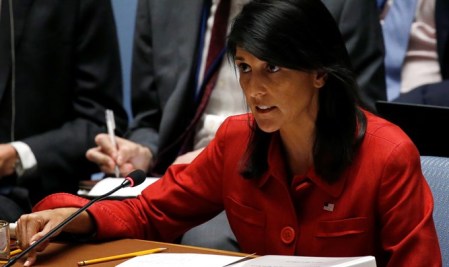
Nikki HaleyReuters

The United Nations Security Council on Friday afternoon will hold an emergency meeting to discuss the recent protests in Iran.

The uprising, the largest since a series of mass protests in 2009, began in the city of Mashhad, when demonstrators denounced Iranian President Rouhani over the failure to reduce the country’s high unemployment rates.

Efforts to contain the protests have led to the deaths of at least 21 people.

However, Russia considers the US-initiated meeting to be “harmful and destructive,” RIA reported.

“We see no role for the United Nations Security Council in this issue,” the news agency quoted Russian Deputy Foreign Minister Sergei Ryabkov as saying Thursday.

“Iran’s domestic affairs have nothing to do with the United Nations Security Council’s role.”

On Thursday, Iran accused the US of “meddling” in its affairs.

Meanwhile, US Ambassador to the UN Nikki Haley said that “the international community has a role to play” in the drama in Iran.

“The freedoms that are enshrined in the United Nations’ charter are under attack in Iran,” she explained. “Dozens have already been killed. Hundreds have been arrested.

“The UN must speak out… We must not be silent. The people of Iran are crying out for freedom. All freedom-loving people must stand with their cause. The international community made the mistake of failing ot do that in 2009. We must not make that mistake again.”

China building military base in Pakistan

January 4, 2018

China building military base in Pakistan, Washington TimesBill Gertz, January 3, 2018

Chinese planes will be flying from a facility at Jiwani, Pakistan — a port close to the Iranian border on the Gulf of Oman — as part of a push for greater power projection capabilities along strategic sea routes. (Associated Press/File)

President Trump on Monday issued a harsh rebuke of Pakistan, tweeting that the United States “foolishly” supplied Pakistan with $33 billion in aid over 15 years and stating that “they have given us nothing but lies & deceit.”

“They give safe haven to the terrorists we hunt in Afghanistan, with little help. No more!” Mr. Trump tweeted.

Reuters reported that China’s investment has included $500 million in grants and $230 million for an international airport.

**************************

China is constructing its second overseas military base in Pakistan as part of a push for greater power projection capabilities along strategic sea routes.

The facility will be built at Jiwani, a port close to the Iranian border on the Gulf of Oman, according to two people familiar with deal.

Plans call for the Jiwani base to be a joint naval and air facility for Chinese forces, located a short distance up the coast from the Chinese-built commercial port facility at Gwadar, Pakistan. Both Gwadar and Jiwani are part of Pakistan’s western Baluchistan province.

Plans for the base were advanced during a visit to Jiwani on Dec. 18 by a group of 16 Chinese People’s Liberation Army officers who met with about 10 Pakistani military officers. Jiwani is located on a peninsula about 15 miles long on a stretch of land with one small airfield.

According to sources, the large naval and air base will require the Pakistani government to relocate scores of residents living in the area. Plans call for their relocation to other areas of Jiwani or further inland in Baluchistan province.

The Chinese also asked the Pakistanis to undertake a major upgrade of Jiwani airport so the facility will be able to handle large Chinese military aircraft. Work on the airport improvements is expected to begin in July.

The naval base and airfield will occupy nearly the entire strategic peninsula.

Jiwani will be China’s second major overseas military base. In August, the PLA opened its first foreign base in Djibouti, a small African nation on the Horn of Africa.

The Pentagon has dubbed China’s foreign military basing ambitions the “string of pearls” strategy. The Chinese are planning to set up bases along a line of states stretching from the Persian Gulf through the Indian Ocean and Southeast Asia.

The military bases are part of a bid by Beijing to protect strategic sea lanes used to transport oil and other resources for China’s large energy-consuming modernization.

Chinese Communist Party and military leaders fear the country could be crippled by foreign powers through a blockade or other military interdiction operations to disrupt oil shipments to China along the sea route during a crisis or conflict.

China’s government has sought to downplay the Djibouti base as merely a logistics facility for anti-piracy sea patrols in the region and not a power-projection tool. Similar propaganda will be used to limit international reaction to the Jiwani base.

Some Pentagon officials, however, regard the Djibouti base and the future second base at Jiwani as part of efforts to control oil shipping in and out of the Persian Gulf and the Red Sea. Both Chinese bases are located near strategic chokepoints — Djibouti near the Bab el Mandeb on the Red Sea and Jiwani close to the Strait of Hormuz on the Persian Gulf.

Pakistan’s military also has been moving additional troops and security forces into nearby Gwadar, where China has invested heavily in building a commercial port and other infrastructure projects.

President Trump on Monday issued a harsh rebuke of Pakistan, tweeting that the United States “foolishly” supplied Pakistan with $33 billion in aid over 15 years and stating that “they have given us nothing but lies & deceit.”

“They give safe haven to the terrorists we hunt in Afghanistan, with little help. No more!” Mr. Trump tweeted.

Reuters reported that China’s investment has included $500 million in grants and $230 million for an international airport.

China is also promoting what Beijing calls the Belt and Road Initiative, a development program of land and sea routes over 60 nations in Asia, Europe and Africa.

As part of that initiative, China plans to turn Gwadar into a megaport for transshipping goods worldwide, along with energy pipelines, roads and rail links connecting to western China. Chinese naval and air forces at nearby Jiwani would then provide protection for that base.

China also has leased a port on the Indian Ocean island of Sri Lanka that recently opened at Hambantota. The facility has raised concerns in India that views China as a growing regional and global threat.

MATTIS ON SYRIA OPERATIONS

Defense Secretary James Mattis recently voiced concerns that foreign jihadis being driven from Syria and Iraq will move to other parts of the region and around the world to conduct terrorist attacks.

But the retired four-star Marine Corps general told reporters Dec. 29 that U.S. and allied forces are working to crush all remnants of the Islamic State terrorist group.

Mr. Mattis said the strategy put into place by the Trump administration is producing good results, despite criticism that the military efforts were not moving fast enough.

“We deal with reality,” he said. “We told you that the caliphate was going to go down. Well, there were numerous people who thought perhaps the strategy was wrong when it was initiated by the last administration, thought it was too slow when I came in, thought there was this complexity with Turkey or that complexity with the Russian regime or the Iranians.

“We sit here today at the end of 2017, [and] the caliphate is on the run,” he added. “We are breaking them.”

The terrorists’ capital of Raqqa in Syria was retaken along with other Islamic State strongholds at Manbij and Tabqa.

“Some people escaped,” he said. “That’s what happens in war. They moved, clearly, into the Middle Euphrates River Valley. We are in the process of crushing the life out of the caliphate there while trying to keep the innocent people safe, which is very hard with this group.”

Mr. Mattis said the fleeing terrorists are “not a big issue.”

“They’ll have to be hunted down,” he noted, adding that the remnants of the organized terrorists have been launching counterattacks.

So far, the Islamic State does not appear capable of regrouping within some safe havens in the region, such as central Iraq.

“They’ve been shattered, and then the remnants gather somewhere, which is what we expect them to do, and so we have repeatedly said in this room the war is not over,” Mr. Mattis said.

The defense secretary said the objective is to so weaken the Islamic State where the danger can be handled by local forces and police.

But hunting down Islamic State fighters is continuing.

“Am I worried about it? Not in the least,” Mr. Mattis said. “These guys have not proven they can stand against the Iraqi security forces. They cannot stand against the [Syrian Democratic Forces]. Their best bet is against unarmed men, women and children, and once they’re confronted with this, it’s mostly an intelligence fight. Once the intelligence fight is won, once we identify where they’re at, it’s just a matter of: Can we surround them so they don’t get away to fight another, and then kill them? It’s not who’s going to win.”

PENTAGON REPORTERS MEET MATTIS

The comments on Syria by Defense Secretary James Mattis last week came during one of his infrequent press briefings that in the past took place unannounced in the small reporters’ office near the Pentagon press office in the eastern wing of the five-sided building.

Mr. Mattis often conducted the press sessions after picking up his laundry from the Pentagon dry cleaners. That format forced press outlets to keep reporters in the office at all times to avoid missing a potential news story.

Mr. Mattis told the gathered scribes last week that he would try to provide more notice for his impromptu stop-bys.

The defense chief said he was pressed by The Associated Press’ Bob Burns, a veteran Pentagon reporter, to regularize the press meetings and promised to try to announce them in advance.

“The problem with that is that, if I do that and tell you in advance, and then something comes up and I don’t show up, then that becomes the story,” said Mr. Mattis, who is considered one of the Trump administration’s senior officials who is very cautious when speaking to reporters.

“You just have to understand, there are times when other things come up that intrude on my schedule,” he said. “And it’s like anything else on my schedule. I may just dismiss the forward officers who spent two weeks preparing the brief for me because something’s come up and I’ve got to go over to State Department or need to run out to some other place.”

Mr. Mattis said his press meetings generally will take place later in the week since Monday is “when I have the least control of my schedule, and it actually gets better during the week.”

“But, if something goes on in Korea or something like that, then things change. That’s the way it is.”

Are Iranians Really Protesting Against Islam?

January 4, 2018

Are Iranians Really Protesting Against Islam?, FrontPage MagazineRaymond Ibrahim, January 4, 2018

Protesters could also potentially face the death penalty when their cases come to trial, according to the head of Tehran’s Revolutionary Court, the AP reported. Iran’s semiofficial Tasnim news agency quoted Mousa Ghazanfarabadi as saying: “Obviously one of their charges can be Moharebeh,” or waging war against God [Allah], which is a death penalty offense in Iran.

Moharebeh is precisely what al-Zawahiri was referring to in the above excerpt: the only legitimate reason to overthrow an Islamic ruler is his failure to govern according to Islam—which Khamenei and his regime can hardly be accused of. Seeking to depose him because he is personally corrupt, despotic, cruel, or spending more money on jihad than food is forbidden, and makes the protestors aggressors against Allah, a crime worthy of punishment, including death.

**************************************

What began on December 28 as local protests against high food prices in the northern city of Mashhad, Iran, has spiraled into mass protests consisting of some hundreds of thousands of Iranians in some two dozen cities, including if not especially Tehran, the seat of government.  So far over 20 people have been killed and many hundreds arrested in what has been widely described as “the most serious internal crisis the country has faced this decade.”

The protests have morphed from mundane topics concerning the economy to more existential topics concerning Islamic leadership. Reportedly hundreds of thousands of protesters have been heard shouting “We don’t want an Islamic Republic,” and calling blessings on Reza Shah, the staunch secularist and political reformer who did much to Westernize Iran, until his son and successor, Muhammad Reza Shah was deposed during the Islamic Revolution of 1979.   According to Mideast media, women—such as Maryam Rajavi—are spearheading the current protests (and symbolically rejecting Islamic impositions by publicly removing their hijabs). 

Even the Iranian regime sees the current unrest as a revolt against Islam.  In his initial remarks after demonstrations first erupted, Supreme Leader Ayatollah Khamenei said, “All those who are against the Islamic Republic … have all joined forces in order to create problems for the Islamic Republic and the Islamic Revolution” (note the recurrent and telling adjective “Islamic”).

Even so, “mainstream media” see growing poverty and frustration at the lack of social freedoms as the only reasons behind the current unrest.  Overlooked in their analysis is that, because Islam is not meant to be a “spiritual thing” one does privately, but is rather a complete system of governance, permeating the whole of private and social life, the ongoing protests in Iran, while ostensibly revolving around economic, social, and political issues, are ultimately protests against Islamic teachings concerning economic, social, and political issues, which the Islamic Republic of Iran has been imposing on the populace since coming to power in 1979.

This is evident even in the new rallying cry of the protestors—“Death to the Dictator”—in reference to Supreme Leader Ayatollah Ali Khamenei himself.  By its very nature, Islamic law—both Sunni and Shia—calls for dictatorial rule.  So long as the caliph, sultan, or emir governs society according to Sharia, Muslims must obey him—even if he is a despicable and cruel personage.  After examining a number of Islamic rulings from authoritative exegetes, as well as a number of statements attributed to Muslim prophet Muhammad and in the Koran concerning the importance for Muslims to follow Islamic law—which is the only relevant question of when Muslims should and should not seek to overthrow their ruler—Ayman al-Zawahiri writes,

To summarize: It is forbidden to overthrow a tyrant, but it is a duty to overthrow an infidel. If the ruler is despotic, it is unlawful for a Muslim to rally other Muslims in order to condemn him, for if they do so then they become the aggressors and it becomes incumbent for the sultan to fight them (Al Qaeda Reader, p. 122).

As it happens, the social oppression currently being protested against in Iran—from second-class status for women, to bans on all forms of expression critical of Islam, its prophet, and his representative on earth—is mandated by Islamic law, making the protestors “the aggressors.”

But even the economic aspects of the protests are largely by-products of Islamist aspirations.  As Donald Trump tweeted last Friday, the Iranian “people are finally getting wise as to how their money and wealth is being stolen and squandered on terrorism. Looks like they will not take it any longer.” Indeed, the economic suffering of the people has come at a time when the regime has grown rich—not least by Obama giving them over $100 billion as part of a nuclear deal.  The reason for this disparity is that the regime has been and continues to spend much of its wealth in trying to realize its stated Islamic ideals; it prefers supporting Hezbollah (currently Forbes wealthiest terrorist organization) and Hamas (third wealthiest) against the nearest “infidel” enemy, Israel, in the name of and for the greater glory of Islam, rather than feed its people.

Incidentally, because the right to protest is a given in the West, and thus occurs often, including over trivial and/or absurd matters—as when university students planned a “sh*t-in,” occupying restrooms as a way of demanding more “gender-neutral facilities”—the grave consequences of the current protests in Iran are indicative of just how fed up Iranians are—and the fatal risks they are willing to take—which, unsurprisingly, also trace back to Islam:

Protesters could also potentially face the death penalty when their cases come to trial, according to the head of Tehran’s Revolutionary Court, the AP reported. Iran’s semiofficial Tasnim news agency quoted Mousa Ghazanfarabadi as saying: “Obviously one of their charges can be Moharebeh,” or waging war against God [Allah], which is a death penalty offense in Iran.

Moharebeh is precisely what al-Zawahiri was referring to in the above excerpt: the only legitimate reason to overthrow an Islamic ruler is his failure to govern according to Islam—which Khamenei and his regime can hardly be accused of. Seeking to depose him because he is personally corrupt, despotic, cruel, or spending more money on jihad than food is forbidden, and makes the protestors aggressors against Allah, a crime worthy of punishment, including death.

Europe’s deafening silence

January 4, 2018

Europe’s deafening silence, Israel Hayom, Eldad Beck, January 4, 2018

It took until Tuesday evening for Federica Mogherini, the European Union’s senior representative for foreign affairs, to break her silence on the mass protests against the Iranian regime. Mogherini, who wastes no time when it comes to responding to every announcement on the expansion of Jewish construction in Judea and Samaria, found it fitting to wait until demonstrators began to clear out of city streets out of fear of a violent response by the Revolutionary Guards before she called on “all concerned” in Iran to abstain from violence and said the killing of dozens of protesters at the hands of Iranian forces was “unacceptable.”

German Chancellor Angela Merkel also remained silent for far too long. Her spokesman waited until Wednesday to express admiration for the bravery of the people taking to Tehran’s streets to express their financial and political concerns. By the time the statement was issued, protests against the mullah regime had already subsided.

French President Emmanuel Macron was slightly more energetic in his approach. Macron called Iranian President Hassan Rouhani directly to express his concern for the number of protesters killed and the violation of the freedom of expression. He also decided to postpone a visit by Iran’s Foreign Minister Mohammad Javad Zarif that had been scheduled for this week.

The timing of the popular uprising in Iran may have been less than convenient for the Europeans, as it coincides with the holiday season, but this was not the only reason for their silence: Their reaction was muted because the protests across Iran served to shatter the Europeans’ central argument in their defense of the nuclear deal with Tehran. The nuclear agreement, which the EU sees as its greatest achievement, was justified by arguing that should Rouhani and the “moderates” around him not be able to present the deal to the Iranian people, a deal that would lift international sanctions, improve the economy, contribute to the welfare of the population and preserve that nation’s dignity, the path would be paved for the “extremists” to return to power.

This desire to keep the “moderates” in power led the Europeans to shut their eyes to Tehran’s advancement of its ballistic missile program, Iranian efforts to undermine Middle East stability and its continuing human rights violations. But it is against the policies of these so-called moderates – the darlings of Europe, that the masses have now come out to demonstrate. It is possible that the Europeans will now argue for more open economic policies toward Iran and the removal of obstacles they still believe will spare the “moderates” from the wrath of the people and prevent the strengthening of the “extremists.” There are already those comparing the most recent wave of protests to the student protests of 1999, which undermined the position of Iran’s then-“moderate” President Mohammad Khatami.

Then as now, silence does not help the masses in Iran, who expect the European Union to be loyal not to its historical hypocrisy and economic calculations but to its founding principles.

Trump’s national security strategy holds the hidden key to defeating jihadism

January 4, 2018

Trump’s national security strategy holds the hidden key to defeating jihadism, Washington ExaminerBen Weingarten, January 4, 2017

Domestically, the administration’s failed “countering violent extremism” policy at best ignored Islamic supremacist ideology in counterterrorism efforts, and at worst actively empowered the Islamic supremacist ideologues themselves under the guise of “community engagement.”

If the Trump administration’s newly released national security strategy is to govern U.S. national security and foreign policy, this long national and international nightmare may soon be over.

According to the strategy, the “most dangerous threat” to America is no longer “violent extremists” (or climate change), but rather “jihadist terrorists.”

The Trump administration should be applauded for this monumental change in our national security strategy. It should be encouraged to make the strategy concrete by drafting and implementing a modern-day NSC-68 for the global jihadist movement: A comprehensive plan to defeat jihadist actors state and non-state, violent and non-violent, overt and covert, availing ourselves of every resource and tool we have in every realm. The fate of Western civilization – facing an enemy that as the national security strategy suggests wishes to subjugate us to Sharia tyranny – hangs in the balance.

***************************************

The Obama administration’s purge of the lexicon of Islamic supremacism from our national security and foreign policy apparatus was one of the single most detrimental manifestations of its delusional worldview.

The scrubbing of Islamic terms and concepts from government training and policy materials, while Islamic terrorists engaged the U.S. in battle, reflected an inability or unwillingness to openly and honestly recognize our jihadist enemy and their threat doctrine. If you do not know or refuse to understand your enemy, and their goals, tactics, and strategies, they will be well-positioned to defeat you.

In the Obama administration’s purge could be found the seeds of its singularly disastrous policy towards the Islamic world, in which it found itself actively colluding with those who wish to destroy us.

Globally, the administration aidedabetted, and enabled the world’s leading state sponsor of jihad in Iran and its proxies (as the new drug-running-for-Iran Deal revelations regarding Project Cassandra remind us) elevated the Muslim Brotherhood on the Sunni side and Hezbollah on the Shia side as “political Islamist” forces with whom the U.S. could do business, and sought to create “daylight” by punishing and endangering our staunchest moral, ideological, and strategic ally in Israel.

Domestically, the administration’s failed “countering violent extremism” policy at best ignored Islamic supremacist ideology in counterterrorism efforts, and at worst actively empowered the Islamic supremacist ideologues themselves under the guise of “community engagement.”

If the Trump administration’s newly released national security strategy is to govern U.S. national security and foreign policy, this long national and international nightmare may soon be over.

According to the strategy, the “most dangerous threat” to America is no longer “violent extremists” (or climate change), but rather “jihadist terrorists.”

These jihadists are no longer deemed “nihilistic,” nor are their aims considered nonsensical.

The document says:

Jihadist terrorists such as ISIS and al-Qa’ida…spread a barbaric ideology that calls for the violent destruction of governments and innocents they consider to be apostates. These jihadist terrorists attempt to force those under their influence to submit to Sharia law.

Further, the administration asserts that we are at war with “fanatics who advance a totalitarian vision for a global Islamist caliphate that justifies murder and slavery, promotes repression, and seeks to undermine the American way of life.”

The ramifications of accurately defining our enemy and describing what animates them go many orders of magnitude beyond just supplanting political correctness with truth.

As the national security strategy details, the U.S. intends to fight its adversaries using every means of federal government power. To the degree to which we have a clear-eyed understanding of the jihadist enemy, we can orient all of our assets towards its threat doctrine and defeat it.

If indeed the U.S. government is allowed to study the Islamic supremacist threat doctrine and devise a national security and foreign policy commensurate with it, we could reverse the tide of a war with the global jihadist movement that I believe we have been losing.

The Trump administration should be applauded for this monumental change in our national security strategy. It should be encouraged to make the strategy concrete by drafting and implementing a modern-day NSC-68 for the global jihadist movement: A comprehensive plan to defeat jihadist actors state and non-state, violent and non-violent, overt and covert, availing ourselves of every resource and tool we have in every realm. The fate of Western civilization – facing an enemy that as the national security strategy suggests wishes to subjugate us to Sharia tyranny – hangs in the balance.

Ben Weingarten is a Senior Fellow at the London Center for Policy Research, and the Founder & CEO of ChangeUp Media, a conservative media consulting and production company.

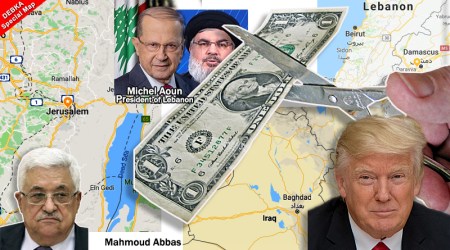
Trump is serious about slashing aid to Palestinians and Hizballah-dominated Lebanon

January 4, 2018

Trump is serious about slashing aid to Palestinians and Hizballah-dominated Lebanon, DEBKAfile, January 4, 2017

In view of the Trump administration Middle East policies, which meet Israel’s most vital security concerns, the attitude adopted towards Hamas by Israel’s defense minister Avigdor Lieberman and IDF Chief of Staff Lt. Gen. Gady Eisenkott is incomprehensible. At a time that Washington is clamping down hard on Iran’s anti-Israel friends, pawns and proxies in the Middle East, Israel’s own security leaders are talking quietly to Hamas. They believe they can coax the leaders of this Iranian-funded terrorist organization into stopping the rocket and mortar fire from Gaza which beset Israel almost daily. Still worse, they are using as their main intermediaries local UNRWA officers, who are notoriously antagonistic to Israel and represent a UN body targeted by the Trump administration for the cutoff of aid. They are assisted by a UN Middle East envoy, Nikolay Mladenov of Bulgarian.

These talks have achieved very little. Hamas has only consented to its own operatives refraining from firing the rockets, but shuts both eyes when fellow terrorist factions keep the rockets coming, so long as they are kept to a “moderate” trickle. Given these contacts with Hamas, it is hard for Israel to raise an outcry when a Palestinian Authority official gets together with its arch-foe, Hassan Nasrallah. Meanwhile, “moderate” rocket fire is a continuous bane for hundreds of thousands of Israelis who are trying to live normal lives.

***************************************

Palestinian leaders in Ramallah were wrong to assume that President Donald Trump does not seriously mean to cut off US aid. He meant exactly what he said when he tweeted on Wednesday, Jan. 3: …we pay the Palestinians HUNDRED OF MILLIONS OF DOLLARS a year and get no appreciation or respect. They don’t even want to negotiate a long overdue… peace treaty with Israel. We have taken Jerusalem, the toughest part of the negotiation, off the table, but Israel, for that, would have had to pay more.” He then asked rhetorically: “But with the Palestinians no longer willing to talk peace, why should we make any of these massive future payments to them?”

DEBKAfile points out that, in the first place, Donald Trump is always serious when he discusses money, and, in the second, he is ready to wield the axe on US aid programs,  not just for Ramallah (and Pakistan), but across the Middle East. Nations and organizations even slightly tainted with Iranian influence are especially targeted.

Hizballah’s secretary general Hassan Nasrallah was fast on the uptake. In a speech on Wednesday night, he stressed that Iran and his own organization were financing the Palestinian struggle over Jerusalem. He disclosed a recent meeting he had in Beirut with Azzam Al-Ahmed of Fatah, PA Chairman Mahmoud Abbas’ special emissary for negotiations with Hamas.
In his speech, he made four points which represented Tehran’s reply to Trump:

  1. The Palestinians need not worry. They can rely on Iran and Hizballah to make up the funding shortfall resulting from the cutoff of US aid.
  2. The Fatah-Hamas reconciliation talks brokered by Egypt depend above all on Hizballah’s say-so for a Hamas decision.
  3. Even Abbas is forced to accept this, which is why he had no choice but to send a representative of his Fatah party for a secret meeting with the Hizballah leader. Since Hamas’ deputy chief, Salah Arouri, had already spent time with Nasrallah before traveling to Tehran, Abbas had decided he had better place his party and the Palestinian Authority in Ramallah on an equal footing with Hams vis-a-vis Tehran.
  4. Just as Iran and Hizballah are bankrolling Hamas and Jihad Islami for fighting Israel from the Gaza Strip, they are also backing the Palestinian struggle for Jerusalem. This cuts Jordan out of the picture. Whether or not this is the truth, Nasrallah’s rhetoric made an impression on Palestinian and wider Arab opinion.

Until recently, some US administration officials were certain they had managed to extract Lebanese President Michel Aoun and the Lebanese army from the Iranian-Hizballah orbit. Trump was not sold on this and acted to neutralize this assumption. He inserted Andrew L. Peek into the State Department as deputy assistant secretary of state covering Iran and Iraq. Peek, who has no diplomatic record, comes from US military intelligence, a world which never shared the State Department’s patience with Iran and Hizballah. His appointment quickly touched off an administration reassessment of the US economic and military aid program for Lebanon. It was coupled with a recommendation of political action to head off a pact between President Aoun and Nasrallah, which could give this pro-Iranian duo a majority in parliament in Lebanon’s next election. It was also decided to discontinue US support for the Lebanese army in view of its domination by Hizballah.

President Trump is contemplating similar steps in Baghdad for curtailing Iranian domination of Iraq’s political leadership.

In view of the Trump administration Middle East policies, which meet Israel’s most vital security concerns, the attitude adopted towards Hamas by Israel’s defense minister Avigdor Lieberman and IDF Chief of Staff Lt. Gen. Gady Eisenkott is incomprehensible. At a time that Washington is clamping down hard on Iran’s anti-Israel friends, pawns and proxies in the Middle East, Israel’s own security leaders are talking quietly to Hamas. They believe they can coax the leaders of this Iranian-funded terrorist organization into stopping the rocket and mortar fire from Gaza which beset Israel almost daily. Still worse, they are using as their main intermediaries local UNRWA officers, who are notoriously antagonistic to Israel and represent a UN body targeted by the Trump administration for the cutoff of aid. They are assisted by a UN Middle East envoy, Nikolay Mladenov of Bulgarian.

These talks have achieved very little. Hamas has only consented to its own operatives refraining from firing the rockets, but shuts both eyes when fellow terrorist factions keep the rockets coming, so long as they are kept to a “moderate” trickle. Given these contacts with Hamas, it is hard for Israel to raise an outcry when a Palestinian Authority official gets together with its arch-foe, Hassan Nasrallah. Meanwhile, “moderate” rocket fire is a continuous bane for hundreds of thousands of Israelis who are trying to live normal lives.