Author Archive

The end of an era

January 4, 2018

The end of an era, Israel Hayom, Dr. Reuven Berko, January 3, 2018

Most of the Palestinians in Judea, Samaria, and the Gaza Strip are waking up. The sparsely attended “days of rage” Hamas and the PA initiated over the issue of Jerusalem signal a disappointing finale because the city used to be an issue that would light up both the Palestinians and Arab nations.

The Gazans are sick of Hamas, and in Judea and Samaria they are tired of the corruption in the PA, and once again an interim government devoted to economic issues that would have Israel’s blessing is being discussed. Some reject the militant candidates for Abbas’ position (Majid Faraj and Mohammed Dahlan) as representatives of the same old organizational approach and would prefer Salam Fayyad, who has already proven his ability to make the vision of a flourishing Palestinian society a reality. That might work well for us.
*******************************

In the late 1990s, author and political commentator Fouad Ajami published his book “The Dream Palace of the Arabs: A Generation’s Odyssey,” in which he laid out the failures in the worldviews of Arab leaders and their self-criticism as the reason for their lack of achievement.

Two decades later, as 2017 was drawing to a close, the Palestinians’ dream palace sustained three serious blows in quick succession. First, U.S. President Donald Trump declared that the U.S. recognizes Jerusalem as the capital of Israel. This was followed by the Likud Central Committee’s decision to annex the settlements and the Jordan Valley. Finally, the Knesset passed a law that removes the teeth from any future peace deal involving Jerusalem (by requiring a special majority of 80 MKs to vote in favor of handing any part of the city over to any foreign government).

If the Palestinians were to look at them in a sober light, they would see that the U.N. resolutions that followed Trump’s announcement were meaningless. In light of the continuing historic drama that began with the landmark Balfour Declaration, the U.N. resolutions condemning Trump’s announcement carried no operative significance and merely served as a faint echo of the detached institution’s fading anti-Israelism.

The latest provocations from Hamas are not a lust for battle, but an expression of how desperate and lost – operatively, politically, and ideologically – the organization is. This beaten and battered group made an immense investment in missiles and attack tunnels, at a heavy cost to its people. These have become a pointless burden. Hamas is currently in a political situation in which the world is sick of Islamism, and the entities that aid and abet it (Qatar, Iran, and Turkey) are bogged down in their own domestic troubles.

The Palestinian Authority is at the end of an era. PA President Mahmoud Abbas is trying fruitlessly to use a diplomatic atmosphere that is hostile to Israel to wring concessions out of it, while simultaneously avoiding direct negotiations with Israel or recognizing it as a Jewish state. The PA is wasting time trying to paint Israel as an apartheid state through a South Africa-style boycott movement, while continuing to coordinate on security because it is afraid of Hamas.

The Israeli convoy is moving on while the PA is gritting its teeth over absurd demands (Jerusalem as the Palestinian capital and a “right of return” for Palestinian refugees), not realizing the effect the processes at work in the world are having on their delusional dreams. Indeed, Islamist terrorism, the Iranian threat, the breakdown of many countries in the region, the masses of Muslim refugees into sinking Europe, the persecution of Christians in the Middle East – these are the factors that have sidelined the Palestinian problem, which was never the cause of the regional unrest.

As these developments take place, Abbas is claiming that the U.S. is sponsoring an Israeli strategy to eradicate the Palestinians and their irrefutable right to kill off the peace process. A range of voices in Fatah and the Popular Front for the Liberation of Palestine and Hamas – responded to Trump’s declaration and Israel’s decision about Jerusalem and the settlements with the language of a declaration of war that demands that they revoke any recognition of Israel and the peace process and resume resistance (the armed struggle).

Most of the Palestinians in Judea, Samaria, and the Gaza Strip are waking up. The sparsely attended “days of rage” Hamas and the PA initiated over the issue of Jerusalem signal a disappointing finale because the city used to be an issue that would light up both the Palestinians and Arab nations.

The Gazans are sick of Hamas, and in Judea and Samaria they are tired of the corruption in the PA, and once again an interim government devoted to economic issues that would have Israel’s blessing is being discussed. Some reject the militant candidates for Abbas’ position (Majid Faraj and Mohammed Dahlan) as representatives of the same old organizational approach and would prefer Salam Fayyad, who has already proven his ability to make the vision of a flourishing Palestinian society a reality. That might work well for us.

International Responses to Iran’s Mass Protests are Beginning to Emerge

January 3, 2018

International Responses to Iran’s Mass Protests are Beginning to Emerge, Iran News Update, January 3, 2018

Perhaps equally important is the escalation in the overall tone of protesters’ messages, respective to the 2009 demonstrations. While the earlier movement was primarily focused on the disputed reelection of President Mahmoud Ahmadinejad, current slogans include calls for “death to the dictator,” in reference to Supreme Leader Khamenei and, by extension, the entire system of clerical rule.

It is reasonable to conclude that the suppression of previous demonstrations combined with the regime’s inability or unwillingness to address the underlying grievances is leading a growing number of Iranians to the conclusion that regime change is a necessary prerequisite for the improvement of their own future prospects.

*****************************************

INU – International coverage of Iran’s nationwide protests continued on Tuesday and began to display common narratives as the demonstrations entered their sixth day. The initial protests in the city of Mashhad, allegedly organized around economic issues by conservative opponents of President Hassan Rouhani, led to unexpected expansion in both the geographic and ideological scope of subsequent gatherings. This in turn led to highly predictable government crackdowns, resulting in numerous arrests and several deaths.

CNBC was among the outlets to report that nine people had been killed in the midst of the demonstrations on Monday night. One hundred people were reportedly arrested that night in the capital city of Tehran alone, after 250 others had been arrested in the same locality over the previous two nights. Figures for the total numbers of deceased and arrested protesters appeared more inconsistent as of Tuesday. It was generally agreed that the nine deaths from the previous night had raised the total to more than 20.

Al Jazeera placed the figure at 22 and also reported that at least 530 people had been arrested. But the National Council of Resistance of Iran, drawing upon its intelligence network inside the Islamic Republic, specified higher figures in both instances, saying that at least 30 people had been killed and 663 arrested. The NCRI also provided a breakdown on the location of a number of these arrests, in addition to the 450 that took place in Tehran.

That breakdown demonstrates one key fact that has been widely observed about the current wave of protests: they are different from the 2009 Green Movement and generally unusual among Iranian protest movements insofar as they are not geographically diffuse, involving a number of rural areas that are considered to be conservative strongholds rather than being focused primarily on socially progressive urban areas like Tehran.

In fact, Iranian officials appear to have responded to the growing protests in part by insisting that their original economic focus remained the only significant driving force and that the demonstrations held limited appeal in the capital and in other major cities apart from Mashhad.

Following the first day of protests, it was reported that Tehran officials had declared that only 50 people attended a local gathering and that most of them dispersed immediately following police warnings. Similar messaging seemed evident in quotations cited in the Los Angeles Times, with officials asserting that despite 450 arrests in three days, the demonstrations in the capital were naturally dying down. Those remarks went on to speculate that the rest of the country would soon follow suit.

The nearly simultaneous claims about mass arrests and waning popularity are not the only instances of self-contradiction in the regime’s response to the protests, Al Jazeera raised this issue in the context of Supreme Leader Ali Khamenei’s personal response to the situation, which emerged for the first time on Tuesday. Khamenei sought to portray the protests as primarily the work of outside agitators. Business Insider quoted him as specifically blaming “wicked enemies backed by westerners, easterners, as well as reactionaries of the region”.

In the first place, his decision to weigh in is at odds with other officials’ attempts to downplay the significance of what is happening. At the same time, Al Jazeera notes that by giving credit to foreign infiltrators for such widespread demonstrations, Khamenei is contradicting the regime’s official position that such infiltrators have little real influence in the Islamic Republic. In fact, Al Jazeera asserts that the latter position is correct and that Khamenei’s claims regarding a foreign hand in the protests are not at all credible.

This, of course, is not to say that there hasn’t been an outpouring of foreign interest as the demonstrations have stretched on. Neither does this observation lead to the conclusion that foreign support for a domestically-driven movement hasn’t been welcomed by Iranian activists. Indeed, aBBC report consisting of direct commentary from Iranian citizens includes one quotation embracing the supportive remarks delivered by Israeli Prime Minister Benjamin Netanyahu via Instagram.

The Iranian activist, identified only as Zahi, addressed Netanyahu directly and then turned his attention to other countries: “Thanks a lot for supporting the oppressed. I expect the same from all other countries. This cruel regime is harsh on its own people. We shouldn’t be under batons and bullets. This isn’t our destiny. We have the right to protest and we ask other countries to support us.”
Netanyahu’s use of social media to express support for the protest movement was predictably emulated on Twitter by US President Donald Trump, who has posted on the topic several times since the demonstrations started. His messages repeated familiar condemnations of the Iranian regime and praised the Iranian people for speaking out about the misappropriation of their wealth for terrorism and projects of regional intervention. These issues had previously been raised by many of the protestors themselves with slogans such as “forget about Syria; think about us!”

Apart from offering personal support for the protesters’ cause, Trump has also overseen responses from the White House that are passing through more official channels. ABC News reported on Tuesday that the administration was keeping up pressure to prevent Iran from blocking the social media platforms that have been used as effective organizing tools for the ongoing demonstrations. The Associated Press added that the White House was actively encouraging Iranian citizens to use virtual private networks in order to evade some of the new blockages that the Iranian government is imposing on specific websites.

Both outlets quoted Undersecretary of State Steve Goldstein as saying that the US has “an obligation not to stand by.” He added, “We want to encourage the protesters to continue to fight for what’s right and to open up Iran.”

Much of the international press has criticized President Trump over his direct commentary on the protests, suggesting that any American effort to influence their trajectory would feed into the Iranian supreme leader’s efforts to discredit the demonstrations as the work of foreign agents. Nevertheless, many of the same outlets have expressed earnest support for what the Trump administration is doing at the policy level, as opposed to at the level of pure public relations.

The Atlantic, for instance, insisted that any active American interference would help hardliners, but then advocated for Western powers the help facilitate the free flow of communication within Iranian society. Also, in an interview with PBS NewsHour, Karim Sadjadpour of the Carnegie Endowment for International Peace recommended that the US could help to inhibit Iran’s ability to control communication, adding that one way of doing this would be by censuring any information technology companies that provide Iranian leaders with the tools to limit access within their country.

Sadjadpour also highlighted the considerable impact that the continued flow of information could have on the future of the still-emerging movement, which has reportedly been spreading in absence of centralized leadership or specific, across-the-board demands. He pointed out that whereas Twitter had been a highly successful organizing force in the 2009 Green Movement protests, those protests took place at a time when only one million Iranians could access the platform via smartphones. Today, 48 million Iranians have such devices.

The continued use of those devices as organizational tools would no doubt contribute to a situation that the BBC described as an “unpredictable challenge” for the ruling regime. The BBC also observed on Tuesday that momentum was still building for the grassroots movement. According to theIndependent, that momentum is such that protesters in some areas have actually overpowered security forces and members of the basij civilian militia, disarming and dispersing some of the forces that might otherwise have violently repressed the gatherings.

Of course, it is still widely expected that state authorities will implement a campaign of such repression on the orders of the supreme leader. Sadjadpour noted that the weeks-long protests in 2009 were a case study in the regime’s highly developed capacity for violent repression, which has likely grown since then. And the Washington Post described the office of the supreme leader as having “many loyal and ruthless troops at his disposal.”

This fact, combined with the lack of any notable defections near the top of the regime, leads the Washington Post to conclude that the current demonstrations are unlikely to lead directly to a political tipping point. But the same report suggests that the suppression of those demonstrations will lead to the later recurrence of the same. Other outlets agree with this assessment, and Reuters cited the likelihood of repression leading to further protests as one of the main points of interest for Western leaders who are watching the situation unfold.

Perhaps equally important is the escalation in the overall tone of protesters’ messages, respective to the 2009 demonstrations. While the earlier movement was primarily focused on the disputed reelection of President Mahmoud Ahmadinejad, current slogans include calls for “death to the dictator,” in reference to Supreme Leader Khamenei and, by extension, the entire system of clerical rule.

It is reasonable to conclude that the suppression of previous demonstrations combined with the regime’s inability or unwillingness to address the underlying grievances is leading a growing number of Iranians to the conclusion that regime change is a necessary prerequisite for the improvement of their own future prospects.

Would Iranians really bring back the Shah?

January 3, 2018

Would Iranians really bring back the Shah? American ThinkerMonica Showalter, January 3, 2017

[T]here once was another Iran, one where women had freedoms; living standards were rising; human rights were improving (he learned that the Shah’s much vilified SAVAK secret police, for instance, committed far fewer crimes than Soviet-linked propagandists had claimed); and the country was integrated with, not isolated from the world community.  The Shah, Cooper argued, really did want to see his country advance in the world, and he enacted many democratic reforms.

Is it really that far-fetched that the [deceased] Shah[‘s son, Reza Pahlavi] might be seen as a legitimate alternative for Iran?  Not with these current things going on.  Right now, U.S. policymakers should be ignoring the Stanford establishmentarian elites on Iran and reading Cooper’s book as fast as they can.

He appears to have no ulterior motive other than doing what he can to help his countrymen in Iran and his willingness to become the necessary catalyst to dislodge the current brutal regime.  Reza Pahlavi wants the Iranian people to rise up against the regime and establish a parliamentary democracy based on democratic values, freedom, and human rights.

***********************************

Pundits have marveled at what a big surprise it is that ordinary Iranians have revolted against the mullahs.  It’s a surprise to them, but no surprise to American Thinker’s readers, whose Iranian contributors have kept us posted for years about what is really going on in Iran.

Just look at these pieces by Hamid BahramiReza ShafieeHassan MahmoudiAmil Imani, and Shahriar Kia.  Over and over again, these writers warned there is a problem, and now Iranians’ protests against corruption, soaring prices, environmental ruin, Revolutionary Guards thuggery, poverty, and bank collapses have become the “surprise” story of the day.

One writer at Politico correctly noted that the “surprise” stems from reporters covering only Tehran’s elites, not the doings in the hinterlands.  The hinterlands, of course, are where the trouble started, beginning in Mashhad, and these are the parts of the country American Thinker’s writers have been bringing us information on.  These writers showed long ago that what we are seeing now isn’t your garden-variety protests of city elites seeking “reform” or “fair elections.”  These protests are smaller, but they’re the real kind, revolutionary ones, actual calls for the overthrow of the regime and the initiation of a new government.  Protests now aren’t coming from the comfortable elites who just want a little bit of tweaking.

Now with eyes on Iran, one essay, published six months ago at American Thinker, stands out: Amil Imani’s piece titled “Is Reza Pahlavi the Only Hope to Overthrow the Mullahs?

On the surface, it sounds ridiculous that anyone would want to bring back a king, even as a constitutional monarch in a democracy.  But it’s real.  Here is an account by Voice of America about the rise of the late Shah’s son, Reza Pahlavi, a smart, photogenic, democracy-oriented leader, waiting in the wings as an alternative to the corrupt, sneering mullahs.

 As Imani noted:

Reza Pahlavi is the son of the late Shah of Iran.  I have never had the honor of meeting or speaking with him, although I judge any man based on what he says and what he does.

As I watched this man grow and become a seasoned politician, my admiration for him grew stronger.  In my opinion, Mr. Pahlavi has become the very asset that the opposition has needed for many years.

He appears to have no ulterior motive other than doing what he can to help his countrymen in Iran and his willingness to become the necessary catalyst to dislodge the current brutal regime.  Reza Pahlavi wants the Iranian people to rise up against the regime and establish a parliamentary democracy based on democratic values, freedom, and human rights.

American Thinker’s writers, most recently Hassan Mahmoudi, have noted that in the shouted slogans in the crowds, many were calling for the return of the Shah.  Russian propaganda organ Sputnik has noted the phenomenon in the streets, too.

It’s worth noting that kings are easily understood by average people and for that reason have appeal, especially in light of the failure of the current regime.

I have one story of my own that suggests that a return to the Shah may not be as far-fetched as it seems.

An old friend, Andrew Scott Cooper, spent years of research to write a fascinating scholarly book about the last days of the shah of Iran, titled The Fall of Heaven, published by Henry Holt & Co. last year.  He actually managed to reach and interview the former shabanu, or, queen, of Iran, Farah Diba, who was living in exile in Europe.  From that, he wrote a fascinating, unique account of the Shah’s last days, largely told through her eyes.

It was a sympathetic analytic history, intended, as he told an audience at the Nixon Library last year, to show that there once was another Iran, one where women had freedoms; living standards were rising; human rights were improving (he learned that the Shah’s much vilified SAVAK secret police, for instance, committed far fewer crimes than Soviet-linked propagandists had claimed); and the country was integrated with, not isolated from the world community.  The Shah, Cooper argued, really did want to see his country advance in the world, and he enacted many democratic reforms.

Naturally, saying something out of the ordinary, or contradicting the conventional wisdom, is a good way to get panned, and so publication of the book was followed by several critical book reviews – in the top papers, often by Iranian-Americans affiliated with the elite establishment centers of Iran research, such as Stanford.  These were scholars who had an interest in maintaining the conventional wisdom and who may have had interests getting contracts from the mullahs.  These are the same people whom policymakers and newspaper editors tend to consult as experts and were the people who said all was well; just stay out of Iranian affairs and let them handle it.  In addition, there was a creepy campaign on Amazon to drive down the ratings of the book by similar people who had never even read it – and Amazon put a stop to it.  What this all showed is that there existed a large entrenched establishment with an interest in maintaining the status quo, and its operators were aghast at the idea – now being shouted in the streets of Iran – that maybe bringing back the Shah could be good.  Of course, they hated this louche idea.

But this came against another subplot of the publishing of this book, which was that a hell of a lot of those books, thousands of them (showing Iranians their own history and teaching them that Iran was once a very different place), somehow got smuggled into Iran, and the locals lapped them up.

As a result of this, within a few days, a full Farsi translation of the book will be coming out, which should stoke conversation about this in Iran even further, given the interest shown.  Publishers don’t publish books in non-Western languages if they don’t think they will sell.  Obviously, the publishers knew that something big is going on and published the costly translation.  Iranians, starved of information about their own history, are likely to lap this up just as they lapped up the English-language version.

Given what is going on in Iran now, call it fat on the fire.

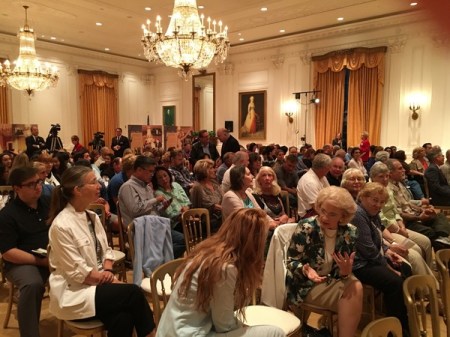
Don’t think there hasn’t been wild interest on this side of the hemisphere, too.  Iranian-Americans on the West Coast flooded an author’s event held at the Nixon Library last year in September, shortly after the publication of Cooper’s book.  It was standing room only, and it’s important to note that the Nixon Library is not all that close to where most Iranian-Americans live in the Los Angeles area, which is Beverly Hills and its outskirts.  The Nixon Library is about an hour’s drive away from that in Yorba Linda, Calif., and it’s an arduous drive, through a truck-convoy-route highway.  Here is a photo I took of how the audience that night looked:

Here is Andrew Cooper signing copies of his book – which sold out with a line waiting.

Is it really that far-fetched that the Shah might be seen as a legitimate alternative for Iran?  Not with these current things going on.  Right now, U.S. policymakers should be ignoring the Stanford establishmentarian elites on Iran and reading Cooper’s book as fast as they can.

Old Chestnuts to Mark a New Year

January 3, 2018

Old Chestnuts to Mark a New Year, PJ MediaBruce Bawer, January 2, 2018

(AP Photo/Thibault Camus)

Only to the East could you find guts, straight talk, substance. Czech president Miloš Zeman spoke not like a parent lullabying his children to sleep but like a CEO being accountable to his shareholders: “The Czech Republic is the sixth safest country in the world…..We have the lowest level of unemployment in the European Union and also the lowest degree of income disparity.” Economic growth is high, public investment low; GDP is going up, but so should living standards. Welfare rolls and government bureaucracy should be cut; the EU must protect its external border and NATO must combat Islamic terrorism more vigorously. (Yes, he actually used the words “Islamic terrorism.”) “Nobody can dictate to us,” Zeman said, “whom we will allow onto our territory.”

Polish prez Andrej Duda also talked like a grown-up, focusing on his country’s economic growth and national security, celebrating its freedom and “the greatness of our history.” And Hungary’s Viktor Orbán was even more blunt, vowing that, unlike many peoples elsewhere in Europe, Hungarians would not “retreat behind concrete blocks” on Christmas or be “harassed in the New Year’s Eve crowd.” He emphasized the importance of protecting “Christian culture” at a time when “fundamentals of European life are under attack.” Where does Europe’s future lie? These Christmas and New Year’s speeches certainly left no doubt about the matter.

************************************

Another year, another raft of televised Christmas and New Year’s speeches by the Western European heads of state and government who are busy whitewashing terrorism, buttressing the EU, and generally running their countries into the ground. As always, the Christmas addresses tended to be short on meaningful references to Christianity, while pretty much all the leaders skirted the harsh realities of mass immigration and steady Islamization, preferring instead to speak, in sunny, saccharine, and consistently vague terms, about community and volunteerism.

Take Sweden’s King Carl XVI Gustav. His country is racing toward its doom, but you’d never know that from his fatuous Christmas oration, which began on a religious note (“A child is born”) only to pivot to the idea that Christmas’s message of “peace, joy, and fellowship” can be grasped by everybody, no matter “where one comes from or what one believes.” Similarly, while referencing the April 7, 2017, terrorist attack in Stockholm, in which five people died, the king did so within the context of praising those who’d helped others on that day – which enabled him to leave terrorism behind pronto and begin waxing poetic about mutual respect and community service. It was as if he believed one could heal social divisions with platitudes.

In the Netherlands, which are also undergoing galloping Islamization, King Willem-Alexander observed that even as Christmas is a family time, it “connects us emphatically with each other” – a fact that should lead us to ask “What are we doing for our community?” and “How do we live with differences?” His prescription: volunteer, help strangers, show curiosity about others, and seek out similarities with them. Like his brother monarch in Sweden, Willem-Alexander spoke as if his subjects’ problems could be cured with clichés.

King Harald V of Norway seemed to be using the same hack speechwriters as his Swedish and Dutch cousins. After lecturing his subjects about the good in every person, he celebrated – what else? – volunteerism and community service and argued that building a better society means including people from every background and letting them “contribute on their own terms” (whatever that means). Harald, who has previously dismissed the importance of Norwegian culture and identity, went there again, proclaiming that “there are over five million different stories about who we are” (that’s Norway’s population) and that “we shouldn’t be surprised that different people in Norway live by different values.” Even more than Carl Gustav and Willem-Alexander, this clown has no business on a throne.

Belgium’s King Philippe is no prize either. In his annual salutation, he recalled a palace visit by a group of children, one of whom “mentioned how lucky we are to live in a country as beautiful as Belgium.” This led to a stretch of insipid rhetoric about the “rich inner beauty” in each of us “that deserves to be cultivated.” Philippe also recounted a recent meeting with some “young people of immigrant origin” who “developed social-integration projects” to cultivate their “self-esteem” and whose “beautiful” facial expressions “spoke volumes.” (Philippe spoke on Christmas Eve, but was mum on the holiday itself, even though his opening bit about those children visiting the palace would’ve made it natural to precede it with a reference to “a child being born.”)

Which one of these kings is worst? Hard to say. As usual, Queen Margrethe of Denmark outdid them all: she didn’t say anything brave or profound, but at least she didn’t say anything downright idiotic. And Queen Elizabeth was even better, perorating with refreshing candor and near-eloquence about her Christian faith at the end of a year when London and Manchester had undergone “appalling attacks.” (Unlike others, QE2 didn’t feel called upon to be religiously inclusive when speaking on a Christian holy day as head of an established church.)

Then there were the elected nabobs. Were they worse than the crowned heads or better? You decide. In France, the streets of whose major cities have become crowded with immigrant tent camps, President Emmanuel Macron promised to “end homelessness” but not mass immigration, which he framed as a moral issue. (Meanwhile, as a result of that mass migration, more than 1,000 cars were burned up across France in what has become a cherished New Year’s Eve tradition, and French cops were being beaten up by culture-enhancers, a development that Interior Minister Gerard Collomb called “savage.”)

As for Angela Merkel, she admitted that while many Germans like their country as it is – and even work with refugees – others “are worried about social cohesion,” apparently because they’re “unable to keep up with the pace of our time.” (Get it? If they have a problem, it’s their fault.) After agreeing that high crime and immigration levels are “realities” and thanking the police – who at that very moment, she said, were “protecting our country’s many New Year’s parties” (you’d think there’d have been a glint of embarrassment in her eyes when she brought up the cops, but nope) – Merkel stressed that Europe should remain “one community.” (It’s presumably in pursuit of that objective that Beatrix von Storch, deputy leader of the Alternative für Deutschland party, risks being charged with “incitement to hatred” after criticizing Cologne cops for tweeting a New Year’s message in Arabic.)

Theresa May, for her part, was brisk and businesslike, claiming to make progress toward Brexit and promising more cash for “our schools, our police, and our precious NHS.” After some predictable pabulum about “peace” (good) and “extremism” (bad), May asserted her goal of “eliminat[ing] all prejudice and discrimination” and of establishing “a public sphere where debate is constructive and courteous.” (Which, I suspect, means: we’ll keep letting in jihad preachers but retain the ban on Islam critics like Robert Spencer and Pamela Geller, and continue the policy of ignoring actual crimes while vigorously investigating and prosecuting “hate speech.”)

So much for Western Europe. Only to the East could you find guts, straight talk, substance. Czech president Miloš Zeman spoke not like a parent lullabying his children to sleep but like a CEO being accountable to his shareholders: “The Czech Republic is the sixth safest country in the world…..We have the lowest level of unemployment in the European Union and also the lowest degree of income disparity.” Economic growth is high, public investment low; GDP is going up, but so should living standards. Welfare rolls and government bureaucracy should be cut; the EU must protect its external border and NATO must combat Islamic terrorism more vigorously. (Yes, he actually used the words “Islamic terrorism.”) “Nobody can dictate to us,” Zeman said, “whom we will allow onto our territory.”

Polish prez Andrej Duda also talked like a grown-up, focusing on his country’s economic growth and national security, celebrating its freedom and “the greatness of our history.” And Hungary’s Viktor Orbán was even more blunt, vowing that, unlike many peoples elsewhere in Europe, Hungarians would not “retreat behind concrete blocks” on Christmas or be “harassed in the New Year’s Eve crowd.” He emphasized the importance of protecting “Christian culture” at a time when “fundamentals of European life are under attack.” Where does Europe’s future lie? These Christmas and New Year’s speeches certainly left no doubt about the matter.

Assaults on Police Officers Horrify France

January 2, 2018

Assaults on Police Officers Horrify France, Power LineJohn Hinderaker, January 2, 2018

(Please see also, Sadiq’s London: Knife Crime, Gun Crime, Theft, Burglary, Rape, Homicide all MASSIVELY Up. — DM)

France has a terrible immigration problem. It is easy to criticize that country’s failure to assimilate immigrants, but it is not clear that the immigrant groups that have made portions of the Paris area unlivable were ever willing to be assimilated.

****************************

French officials are vowing to crack down–and also to send more cash to Paris’s immigrant-heavy suburbs–in the wake of a series of attacks that included the savage beating of a police woman in Champigny-sur-Marne:

French political leaders have vowed justice and promised a crackdown after a shocking attack on a female police officer on New Year’s Eve was filmed and posted online.

The attack in the eastern Paris suburb of Champigny-sur-Marne saw the officer knocked to the ground before being repeatedly kicked and punched in the head and body.

President Emmanuel Macron called the crime a “cowardly and criminal lynching”, and vowed that those responsible would be caught and punished.

Here is the video, which apparently was uploaded by a member of the mob. What is most striking to me is the large number of people who were rioting, and who did nothing to intervene as some in the mob beat the police officers:


France has a terrible immigration problem. It is easy to criticize that country’s failure to assimilate immigrants, but it is not clear that the immigrant groups that have made portions of the Paris area unlivable were ever willing to be assimilated.


Sadiq’s London: Knife Crime, Gun Crime, Theft, Burglary, Rape, Homicide all MASSIVELY Up

January 2, 2018

Sadiq’s London: Knife Crime, Gun Crime, Theft, Burglary, Rape, Homicide all MASSIVELY Up, BreitbartRaheem Kassam, January 2, 2018

Getty

The Guido Fawkes blog notes: “In the years before Khan became mayor the numbers had fallen significantly – the Tories had got the numbers down to between 10 and 15 deaths of young people per year from over 30” and asks: “Why isn’t Sadiq facing more pressure on this? It should really be a much bigger story…”

************************************

Britain’s media celebrated in droves when London elected its first Muslim mayor, Sadiq Khan, in May 2016.

Now the cacophony caused by the “we’re not racist” backslapping has ended, the true implications of a Khan mayoralty are being realised.

In Britain’s capital over the past year, Khan presided over rises in knife crime, gun crime, theft, burglary, rape, homicide, and more. And not just by a little bit, either.

Some in the media — by which I mean basically just me — predicted Khan might be a disaster for London, but the extent to which this is true was beyond even our worst nightmares.

Parking the anecdotal evidence of Khan giving preference to genital mutilation-linked groups, and using his platform to agitate against the U.S. President, the statistics reveal a terrifying incompetence in keeping London safe — one of the mayor’s core areas of responsibility.

Data from the Mayor of London’s Police and Crime Office — led by former lobbyist-turned-Deputy Mayor Sophie Linden — reveals a sharp uptick in violent crime in Khan’s first year.

From the years 2015/16 to 2016/17, homicides in London rose by 27.1 per cent. Youth homicide jumped 70 per cent. Serious youth violence was up 19 per cent. Robbery was up 33.4 per cent, while home burglaries rose by 18.7 per cent.

Theft went up by over 10,000 incidents in a year, up 33.9 per cent, and there were more than 4,000 additional knife crime incidents under Khan than under his predecessor, a rise of 31.3 per cent.

Rape in the capital rose by 18.3 per cent, while there were 2,551 incidents of gun crime, representing a rise of 16.3 per cent on the previous year.

The Mayor has continuously blamed central government “police cuts” for the problems faced, but statistics reveal London only lost around 1,000 police officers (3 per cent) in the past year, reducing the workforce from 31,343 to 30,379.

The report compares November to October data from the years 2015/16 and 2016/17.

Earlier this year London overtook New York City as one of the most dangerous cities in the world. The House of Commons recently revealed the UK capital has more acid attacks per capita than any other city in the world.

The Guido Fawkes blog notes: “In the years before Khan became mayor the numbers had fallen significantly – the Tories had got the numbers down to between 10 and 15 deaths of young people per year from over 30” and asks: “Why isn’t Sadiq facing more pressure on this? It should really be a much bigger story…”

Of 40 categories, crime in just six areas fell: anti-social behaviour calls (1.2 per cent), domestic abuse incidents (four per cent), domestic abuse with injury (one per cent), non-home or business burglaries (10 per cent), criminal damage (1.6 per cent) and disability-related hate crime (34 per cent).

Raheem Kassam is the editor in chief of Breitbart London

January 2, 2018: Sen. Cotton join the Hugh Hewitt Show to discuss Iranian Protests

January 2, 2018

January 2, 2018: Sen. Cotton join the Hugh Hewitt Show to discuss Iranian ProtestsSenator Tom Cotton via YouTube, January 2, 2017


Former Obama advisers tell Trump to be quiet about the Iranian protests

January 2, 2018

Former Obama advisers tell Trump to be quiet about the Iranian protests, Jihad Watch

Several key advisers to former President Barack Obama have poured scorn on President Donald Trump’s support for the protests sweeping Iran in recent days.

The former Obama administration, over a year later, still has not accepted that it is no longer leading America, and that the American people exercised their democratic right to vote in Trump as their leader. The public lost confidence in a so-called leader who betrayed American principles of democracy. Among Obama’s misdeeds, he:

  • Signed the Iranian deal, which released over 100 billion dollars into Iran’s coffers, enabling it to further fund its jihadi proxies such as Hizballah, Hamas, Islamic Jihad, etc.
  • Airlifted 400 million dollars to Iran, which happened to coincide with the January 2016 release of four Americans detained in Tehran, such that critics called it a ransom payout.
  • Paid Iran some $33.6 billion in secret cash and gold payments, in monthly installments of $700,000,000, between 2014 and 2016, according to testimony provided before Congress by an expert on the Iran nuclear agreement.
  • Hid intel on Iranian jihadis in Syria in order to push the Iranian nuclear deal.
  • Tried to convince Argentina to give Iran nuclear fuel, according to former Argentine President Cristina Fernandez de Kirchner.
  • Ordered the CIA not to support the 2009 Green Movement in Iran, because he was too committed to “diplomatic” outreach to Ayatollah Khamenei.

In fact:

In 2009, when the “Green Revolution” threatened the Iranian regime, Obama and his administration refrained from supporting the protests. Obama said that “we respect Iranian sovereignty and want to avoid the United States being the issue inside of Iran.

Respect for this brutal regime that oppresses its people, aims to obliterate Israel and funds jihadi terror globally?

Should Donald Trump’s support help bring the Iranian people closer to freedom with any measure of success — weakening the Iranian regime — then it would further show up the incompetence within the Obama administration as leader of the free world. Otherwise, the new Iranian uprising could expose even more about the unscrupulous partnership between the Obama administration and Iran, none of which is flattering or useful to Obama and his cronies.

“Former Obama Advisers Tell Trump to ‘Be Quiet’ on Iran Protests”, by Joel Pollak, Breitbart, January 1, 2017:

Several key advisers to former President Barack Obama have poured scorn on President Donald Trump’s support for the protests sweeping Iran in recent days.

In 2009, when the “Green Revolution” threatened the Iranian regime, Obama and his administration refrained from supporting the protests. Obama said that “we respect Iranian sovereignty and want to avoid the United States being the issue inside of Iran.”

That weak response, and the administration’s general lack of support for the demonstrators, allowed the regime to consolidate power.

Obama was more concerned with preserving the possibility of an eventual deal on Iran’s nuclear program than he was in removing the Iranian regime as a strategic threat or in standing up for human rights. Critics charge that Obama missed a golden opportunity.

President Trump has taken the opposite approach, vigorously supporting the protests and criticizing the regime.

But the Obama brain trust rejects Trump’s approach, and apparently believes the approach Obama took in 2009 remains the best one.

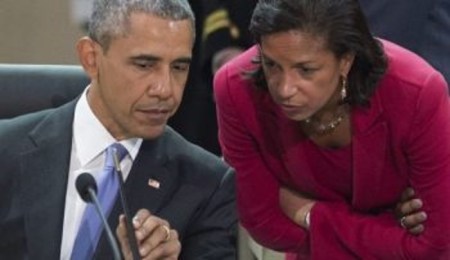
Former National Security Advisor Susan Rice tweeted a New York Times op-ed by former Obama aide Philip Gordon, “How Can Trump Help Iran’s Protesters? Be Quiet.” The author argues that supporting the protests, and taking steps to end the Iran nuclear deal, will only help the regime to delegitimize its internal opponents.

Rice offered no other statement of solidarity for the demonstrators.

Rob Malley, who had once been dropped from the Obama campaign for meeting with the Hamas terrorist group but found his way back into the administration in negotiations with Iran, also praised Gordon’s op-ed.

Former Secretary of State Hillary Clinton, who was in office during the Green Revolution, was more supportive of the protesters, but said merely that she “hope[d]” the Iranian regime would listen to them…..

Finally, an Iranian Spring

January 2, 2018

Finally, an Iranian Spring, Al ArabiyaDr. Khaled M. Batarfi, January 2, 2017

Over 60 towns have joined the rebellion, so far. Iran is awakening. Iranians are demanding their freedom, democracy and rights. They regretted supporting a revolution that turned against them.

********************************

When Iranians protested, mostly in Tehran, for the best half of 2009, they were angry about the rigged presidential election in which Mahmoud Ahmadinejad defeated his “reformist” rival Mehdi Karroubi. The “Green Revolution,” was about the government —not the regime change. It was led by an elite, educated and well-to-do metropolitans supporting to the reformist movement.

Recent protests are different in many ways. It started in Mashhad, a conservatively religious city, and the birthplace of Supreme Leader Ayatollah Ali Khamenei, where some 160,000 angry investors lost their life savings in a fraud residential project.

Banks owned by the Revolutionary Guards suddenly closed down wiping out all deposits. And many companies haven’t paid salaries for up to a year! For a couple of years, after the burning of the Saudi Embassy, Shiite tourists from wealthy Gulf region ceased to come and hundreds of business closed down.

Poor, unemployed and hungry people went out to call for a new revolution. They were calling Khamenei a dictator who lives in luxury while his people suffer, wishing him and President Hassan Rouhani death, as both of the are two sides of the same coin.

The city is governed by two of Khamenei top allies, Ayatollah Ahmad Alamolhoda and Ayatollah Ebrahim Raisi. The latter had participated and lost in the last presidential elections as representative of the supreme leader’s camp and the hardline movement.

Instead of calming the crowd, Alamolhoda advises the authorities: “If the law-enforcement agencies do not punish the troublemakers, the enemies will publish tapes and pictures telling the world that the regime of the Islamic Republic has lost its revolutionary spirit in Mashhad.”

These slogans summarize the sentiments of the Iranian people about their regime’s foreign policies and their devastating repercussions on development, economy and society

Dr. Khaled M. Batarfi

A religious and conservative town

Other cities followed. Isfahan, the third largest city in Iran, after Tehran and Mashhad joined the ranks. Teachers and retirees came out demanding their salaries and money lost in the failing banks and projects. The city is also a religious and conservative town. Its support of the Khomeini revolution in the late seventies was a decisive factor in its victory. Tens of thousands of their sons were killed in the Iran-Iraq war.

One protester has lost four sons in Iraq, and a fifth in Syria. Instead of rewarding him, they took away his pension, he complains. Now, he cannot support what is left of his family. He is not alone, according to official statistics, 20 percent of the population is below poverty line and 40 percent of them need food aid, that is 60 percent of the 80 million Iranians.

Twenty millions live in shantytowns. Not to mention an inflation rate exceeding 20 percent, and a currency rapidly losing value. The result is a hike in rates of crime, drug addiction and prostitution.

The slogans raised in the demonstrations are telling: “Neither for Gaza, nor for Lebanon, my life is only for Iran,” “Forget Syria, remember us!,” “May your soul rest in peace, Reza Shah,” “freedom or death,” “Release political prisoners,” “Leaders live in paradise, people live in Hell,” “Death to Hezbollah.”

Sentiments of the people

These slogans summarize the sentiments of the Iranian people about their regime’s foreign policies and their devastating repercussions on development, economy and society. While austerity measures worsened an already tough life, the Syrian regime received $20 billion to kill its own people, and Hizbollah gets $1,200 billion a year to do the regime’s dirty business.

Not to mention other costly expenses to support militias in Iraq, Yemen and Bahrain. As a protester put it, “We give an Afghan, Pakistani or Arab terrorist up to $1500 a month, with accommodation, food and transportation, while I live in a shack, and my hard-earned income of $250 is delayed or stolen.

Few former Iranian leaders sided with their people. Former President Mahmoud Ahmadinejad has just revealed the existence of 63 bank accounts for the head of the judiciary Ayatollah Sadeq Larijani and the corruption of his brother Ali Larijani, the Parliament Speaker.

Others exposed the extent of criminality that reached the highest offices. Top bosses in ministries, banks, charities and religious institutions were found guilty of embezzlement, fraud, sexual harassment and child abuse. Worse, the leadership, including the Supreme Leader, has protected and defended the guilty and tried to hid their crimes.

If the large, industrial and commercial metropolitans groan, imagine the suffering in the remote and marginalized areas. The racist and sectarian regime has always ignored the mostly Sunni Kurdish, Baluchi, Kurdish, Azeri, Turkmen and Afghan communities. Shiite Arabs fared no better.

Over 60 towns have joined the rebellion, so far. Iran is awakening. Iranians are demanding their freedom, democracy and rights. They regretted supporting a revolution that turned against them. The world is watching, as it did in the spring of 2008. This time around it should interfere if the regime terrorizes its own people. Since they pretend to be a democracy, they should be held to its standards.

This article was first published in the Saudi Gazette on January 2, 2018.
________________________
Dr. Khaled M. Batarfi is a Saudi journalist and writer based in Jeddah.

EU Politicians Call on EU to Stand With Iranian People

January 2, 2018

EU Politicians Call on EU to Stand With Iranian People, Iran News Update, January 2, 2018

INU – Struan Stevenson, the president of the Brussels Based European Iraqi Freedom Association, said in a statement. “ “It is time the EU stopped its wretched, handwringing policy of appeasement to one of the most repressive regimes in the world. Instead, Europe must now demonstrate solidarity with the 80 million Iranian citizens who are struggling to overthrow the fascist clerical regime and replace it with a modern, democratic government, able to restore freedom, justice, women’s rights and human rights, while abolishing the death penalty, torture and the export of terror and conflict”.

The Statement adds: “Ayatollah Ahmad Alam-Al Hoda, the Friday Prayer Leader in the city of Mashhad, where the mass protests began on Thursday 28th December, said: “Is it proper that the Monafeqin (the regime’s pejorative description of the Mujahedin-e Khalq, MEK or PMOI), who are the mercenaries of America and Europe and whose leader is a … woman, to come and say that she thanks you? …. Now, the Imam of Age (the twelfth Shi’ite Imam), his representative {Khamenei] and all Hezbollahis are angry that a woman, who is the leader of the Monafeqin, would say I thank you!” The Ayatollah was, of course, referring to Mrs Rajavi and the fact that she had thanked and congratulated the people of Mashhad and cities throughout Iran for rising up against the corruption and oppression of the clerical regime.”

“The fascist mullahs are deeply concerned at the mass street protests. They have plundered the Iranian people’s resources to finance brutal conflicts in Syria, Iraq, Yemen and Lebanon, while they live in supreme luxury themselves. Meanwhile the people are faced with spiraling costs and dire living conditions. Tens of thousands of ordinary Iranian civilians, including huge numbers of women and young people, have bravely taken to the streets, shouting ‘Death to Rouhani’, ‘Death to Khamenei’, ‘Down with the Dictator’, ‘Free Political Prisoners in Iran’ and other anti-government and political slogans.”

He added “The mullahs, fearful that their repressive rule is about to crumble, have mobilized huge numbers of police and security forces to put down the rebellion, but the people have courageously marched on, often calling to the police to arrest the ‘thieves’ who control Iran. It is clear that these protests, the most significant for ten years, are an indication that the beleaguered Iranian people are fed up with the turbaned tyrants who have allowed their country to become an international pariah, exporting terror worldwide and fomenting sectarian conflict throughout the Middle East.

Stevenson emphasizes, “The corrupt Ayatollahs are right to identify the PMOI and Mrs. Rajavi as the main threat to their continued tyrannical rule. As the most formidable and best-equipped democratic opposition movement, the PMOI is poised to restore order and call democratic elections whenever the mullahs are driven from office. The massive street protests now spreading like wildfire across Iran show that the downfall of this evil regime is imminent.”

In a very strongly worded message goes on to call on EU members: “It is time the EU stopped its wretched, handwringing policy of appeasement to one of the most repressive regimes in the world. Instead, Europe must now demonstrate solidarity with the 80 million Iranian citizens who are struggling to overthrow the fascist clerical regime and replace it with a modern, democratic government, able to restore freedom, justice, women’s rights and human rights, while abolishing the death penalty, torture and the export of terror and conflict.”

In similar move, EP Vice- President Ryszard Czarnecki issued the following press release on 31 Dec 2017

“The heroic people of Iran are demonstrating against the religious dictatorship. They have had enough of the high costs of living, government corruption and dreadful living conditions. They are shouting Death to Khamenei, Death to Rouhani, Down with the Dictator, Free Political Prisoners in Iran….

As Vice-President of the European Parliament, I express my full solidarity with the people of Iran who want a regime change. The Iranian opposition under the leadership of Ms. Maryam Raja vi have called for these protests to continue. This uprising which began in Mashhad on Thursday 28 December has now extended to other big cities and tens of thousands of Iranians, especially the younger generation and women, are at the forefront of these protests.

The Iranian regime, in a desperate move has organized a rally against the PMOI opposition movement and had called for more executions. This is unacceptable for us. We strongly condemn the regime’s behavior. The European Union must condemn the violent reaction of the Iranian regime’s security forces and the IRGC against the demonstrators.

Also, Gérard Deprez MEP, the President of Friends of a Free Iran in the European Parliament in a separate statement on 30 December 2017 called on “the EU High Representative Ms. Mogherini and the European governments to publicly express solidarity with the current uprising of the Iranian people and to strongly condemn the brutal reaction of the Iranian government and the security forces against the peaceful demonstrators.”

The full text of his statement is as follow:

“On behalf of Friends of a Free Iran in the European Parliament, I wish to salute the people of Iran who started protesting against the high costs and terrible living conditions. This great uprising, which began in Mashhad, Iran’s second biggest city, on Thursday 28 December, is continuing and spreading to all over Iran. Many people our shouting Down with the Dictator, Free Political Prisoners, Long Live Freedom,…

“My colleagues and I in the European Parliament have been campaigning for a free, secular Iran for many years and there is a lot of sympathy in our Parliament for the Iranian democratic opposition under the leadership of Madam Maryam Rajavi who was our guest speaker, a few weeks ago on 6 December in Brussels.

“It was interesting to note that some senior leaders of this regime, including the Friday Prayer leader of Mashhad, have blamed the PMOI for leading this uprising. This shows once again that Mrs. Rajavi and her movement are most feared by the mullahs and are the alternative to this religious dictatorship.

“I call on the EU High Representative Ms. Mogherini and the European governments to publicly express solidarity with the current uprising of the Iranian people and to strongly condemn the brutal reaction of the Iranian government and the security forces against the peaceful demonstrators.”