These are the most sophisticated systems Israel has ever sold to any Arab country.
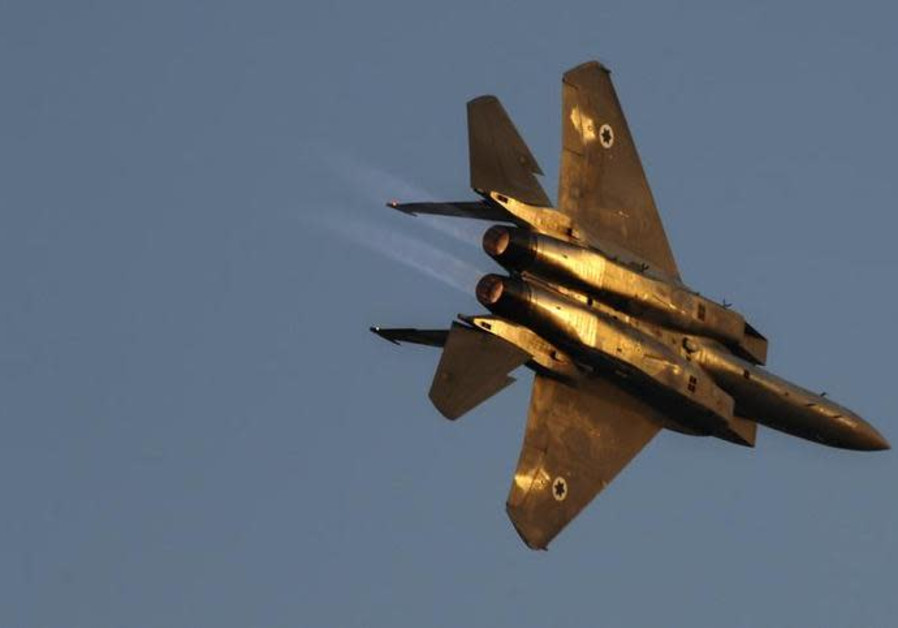
Syria downed the Russian plane after an Israeli attack on an Iranian target.
The official said that the military coordination with Moscow is continuing as it did before the downing of the plane, in which 15 Russian airmen were killed.
That incident, where Syria downed the Russian plane after an Israeli attack on an Iranian target, triggered a mini-crisis in ties between Jerusalem and Moscow, and led Moscow to transfer S-300 anti-aircraft missile batteries to Syria.
Defense Minister Avigdor Liberman alluded to continued Israeli attacks in Syria during a KAN Bet radio interview earlier this month, saying that just because you don’t hear something, doesn’t meant nothing is happening.
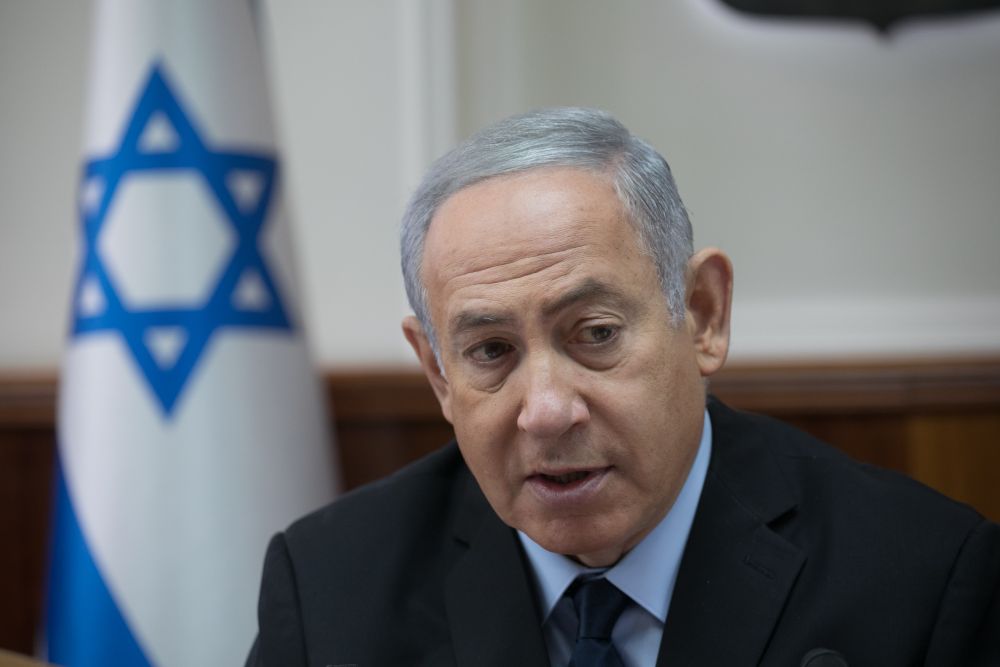
Prime Minister Benjamin Netanyahu, who said three weeks ago that he would be meeting “shortly” with Russian President Vladimir Putin to discuss the situation in Syria following the downing of the plane, may meet with the Russian leader in Paris at the end of next week.
Netanyahu is scheduled to fly to Paris on November 10 for two days to take part in events marking the 100th anniversary of the armistice ending World War I. French President Emmanuel Macron has invited some 80 world leaders to attend, including Putin, Netanyahu and US President Donald Trump.
Soon after Russia became actively engaged in the Syrian civil war in September 2014, Netanyahu flew to Moscow to set up a deconfliction mechanism between Israel and Russia to prevent accidental confrontation between the two countries in Syrian skies. That mechanism worked well until the incident last month. Russia accused Israel of using their intelligence plane as cover in carrying out an attack near Latakia, something which Israel has flatly denied, saying it was a lack of professionalism that led the Syrians to accidentally shoot down the Russian aircraft.
Source: Netanyahu’s Gaza policy: De-escalation without war – DEBKAfile
Prime Minister Binyamin Netanyahu chose to elaborate on his security policy in the face of the Gaza Strip conflict for the first time on the day before Israel’s municipal elections on Oct, 30.
Israel’s military restraint in the face of escalating Palestinian terrorist provocations from the Gaza Strip over the past seven months has drawn criticism and general perplexity about the Netanyahu government’s and IDF policy. On Monday, Oct. 29, a “senior official” called reporters to hear a detailed elucidation of the prime minister’s policy for first time.
Netanyahu found this step necessary – not only to sway the local elections, but because recent events have raised questions about his handling of the soaring violence from the Gaza Strip – which peaked with heavy missile fire against two Israeli cities last Wednesday, and the standstill of Israeli operations against Iran in Syria. Confidence in his reputation as “Mr Security” who can be relied on to navigate Israel on a safe course with a steady hand has begun to falter.
Netanyahu’s trip to Oman last Friday, Oct. 26, and talks with Sultan Qaboos bin Said were intended to impress the people with his wide range of strategic contacts in the Arab world and re-burnish his image. But by bad luck, its impact was drowned out by the massive rocket barrage from the Gaza Strip that same Friday and the tragic Pittsburgh synagogue massacre of 11 Jewish worshipers the next day. Some critics faulted him for not getting on a plane and flying there at once, to demonstrate the highest level of Israeli solidarity with the American Jewish community, instead of sending Education Minister Naftali Bennett. But fatigue clearly won out,
The prime minister had carefully timed his Oman trip to demonstrate that his good connections in the Gulf region were solid – even after the cloud cast by the Khashoggi murder over the Saudi kingdom and Saudi Crown Prince Mohammed bin Salman, with whom he has close relations.
Before laying out the rationale behind his current security doctrine, Netanyahu would certainly have canvassed its popular reception by a privately-commissioned opinion poll, to find out if he could expect the elections results in Tuesday’s municipal poll to be a vote of confidence. The ideas laid out by the “senior official” (Netanyahu himself) can be summed up as follows:
There is no gainsaying the large holes in the prime minister’s propositions and the strategy he has laid out, which hinges essentially on waiting patiently for Egypt, Qatar and the UN to sort out Israel’s security problems. Their efforts in recent months have not produced calm, but the reverse, a greater Palestinian appetite for violence while mocking Israeli deterrence.
But lurking in the background of the prime minister’s thinking is a possible snap election in the early months of 2019, ahead of the scheduled November date. The strategy he laid out may well represent the outline of a campaign platform which he believes will draw the popular vote. Meanwhile, he hopes to influence the municipal poll of Oct. 30 in favor of the candidates of his Likud party.
Source: Why We Cling To The Tree Of Life | Daily Wire

On Saturday, in a constantly-repeating story as old as the Jewish people, a Jew-hating murderer decided to slaughter as many Jews as possible. This murderer shouted the slogan of Jew-haters throughout time: “All Jews must die.”
That slogan has served to justify slaughter in the name of nationalism, in the name of communism, in the name of Christianity, in the name of Islam. Indeed, Jew-hatred is unique because Jew-hatred is infinitely chameleonic.
The Jews, however, are not.
Traditional Jewish thought suggests that every Jewish soul was present at the foot of Mount Sinai when God spoke to the nation of Israel, born and unborn. The Jews were bound in an inextricable covenant; we all consented, and we all became part of that covenant.
While the history of the Jewish people is filled with fractious division, the evidence suggests that this basic principle was fundamentally true – and history has treated the Jews as a closely-bound unit. Jewish identity wasn’t a choice. It was a reality.
Modernity has obscured this basic truth for many Jews. The enlightenment allowed Jews to believe they could exit the Jewish lineage, to abandon the faith of their fathers; freedom of choice came with freedom to exit. But the world is not that malleable. Jews, for better or worse, remain Jews.
Every Jew knows this in his or her marrow. When we meet another Jew, the first thing we do is play Jewish geography: who knows whom, who is related to whom. That’s the rich side of being part of a global tribe – everyone is one degree removed from everyone else.
We’re reminded of that in joy, and we’re reminded of that in horror.
America is the most tolerant and accepting and loving country the Jews have experienced, outside of Israel, in the long span of recorded time – but the curse of anti-Semitism never leaves the Jews. I grew up and live in Los Angeles, the second-largest Jewish community in the United States; I wear my yarmulke publicly. I have never felt unsafe. Still, nearly every Jew is one degree removed from tragedy. In 1991, a synagogue in my community was firebombed. In 1999, a white supremacist shot up a local Jewish Community Center. In 2002, a radical Muslim terrorist shot up the El-Al counter at the Los Angeles International Airport, killing a member of my local community. When I attended the Yeshiva University High School of Los Angeles, our school was evacuated multiple times per year thanks to bomb threats; we were located next to the Simon Wiesenthal Center in Los Angeles, which was similarly evacuated routinely.
So why don’t Jews treat anti-Semitism in the United States as a crisis? Because Jews live with a certain background knowledge: we know how bad things can get, and therefore how good we have it. The Holocaust still exists in living memory; the genocidal screams of tyrants still resonate throughout the Middle East; Jews in Europe are still fleeing the shocking escalation of anti-Jewish hatred in countries from Sweden to France.
But even in the United States, hatred of the Jews is on the rise. That rise is indicative of a deeper problem of the Western soul. As Western civilization tears itself apart, anti-Semitism comes bursting through the seams.
That anti-Semitism can be fought. It can only be fought by choosing life.
In that Pittsburgh synagogue on Saturday morning, the Jew-hating murderer rushed into a room in which a brit milah was taking place: a circumcision ceremony, a ceremony as old as the Jewish people, a ceremony welcoming an eight-day-old child into the community of the Jews. In other parts of the synagogue, different minyanimwere reading the story of Abraham’s near-sacrifice of Isaac on a mountain.
Why would Jews continue to inaugurate children into the most targeted community in human history? Jewish destiny may be inescapable, but why embrace that destiny? The members of the Tree of Life Synagogue were shot to death in a synagogue. So why continue to cluster in synagogues, fulfilling age-old commandments, the elderly passing down their traditions to infants?
Because, as the Tree of Life Synagogue’s name attests, the Torah – the Jewish destiny – is a “tree of life for all those who cling to it.” (Proverbs 3:18) And we are enjoined to choose life. That, after all, is the story of Abraham and Isaac: a story not of God asking Abraham to kill his son, but a story of God asking if Abraham is willing to place his son in mortal danger in service to God – and God’s grace in saving Isaac thanks to Abraham’s commitment. That is the story of the Jewish people. That is the story members of the Tree of Life Synagogue were reading as they died al kiddush Hashem, in the sanctification of God’s name.
And that is the story of our civilization. An attack on the Tree of Life is an attack on all of us – those of us who wish to imbue our own children with a sense of Godliness in a dark world, a sense of eternal value in a society eating away at itself. Inside the sanctuary, all was peaceful on the Sabbath — until the gunshots rang out.
The only proper response is the same response Jews have given throughout time: to fight back. To stubbornly cling to that which stamps us with the image of God. To fight darkness with light, untruth with truth, and death with life.
Source: Trump hits Iran-funded Hezbollah with sanctions
While observing the 35th anniversary of the attack on United States servicemen in Beirut, Lebanon, the commander-in-chief stressed how the new restrictions he is applying against the Lebanese-based jihadist organization are the toughest to date.
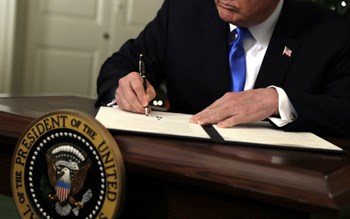
“Over the past year, we have levied the highest sanctions ever imposed on Hezbollah in a single year – by far,” Trump proclaimed after signing the legislation, according to CNN. “Just a few moments ago, I signed legislation imposing even more hard-hitting sanctions on Hezbollah to further starve them of their funds … and they are starving for them.”
Disabling terrorists
While increasing accountability through stiffer reporting requirements, the Hizballah International Financing Prevention Amendments Act (HIFPAA) levies additional sanctions against Hezbollah to help dry up its funds.
“We will target, disrupt and dismantle their operational and financing networks – of which they had plenty,” Trump assured, according to The Washington Free Beacon. “We will never forget what they did to our great Marines in Beirut.”
He was referring to Hezbollah’s 1983 bombing that killed 241 U.S. Marines while in their barracks in Beirut, and the commander-in-chief went on to credit Iran for establishing the militant group of terrorists.
“The attack was carried out by Hezbollah, which Iran was instrumental in founding a year earlier to advance its radical agenda – and remain its main patron today,” Trump pointed out. “And we are doing a big number on Iran today – in case you haven’t noticed.”
Rebuilding what Obama destroyed
Trump emphasized how he is restoring America’s safety by putting a final nail in the coffin of former President Barack Obama’s notorious Iran nuclear deal that essentially funded, enabled and empowered Islamic terrorists around the world by lifting much-needed sanctions against the Islamic regime so it could build its militant nuclear program.
“Trump is also taking credit for re-imposing sanctions on Iran after he pulled out of the 2015 Iran nuclear accord – in part by citing its support for international terrorist groups,” The Associated Press (AP) reported. “Trump is promising even tougher actions against Iran after most sanctions against the country return to effect on Nov. 5.”
Under HIFPAA, more countries and organizations around the world – including in Europe – will be suffer stiff penalties for dealing with the Lebanese terrorist group.
“The bill expands the list of those who can be sanctioned for doing business with Hezbollah,” the AP report continued.
It was then stressed by the president how the new sanctions will play an integral role in a larger strategy aimed at opposing Iran, which was identified as the world’s greatest sponsor of terrorism.
“That is one reason why last year I withdrew the United States from the Iran nuclear disaster,” Trump explained, referring to scrapping the Obama administration’s failed Iran nuke deal. “On November 5, all U.S. sanctions against Iran lifted by the nuclear deal will be back in full force.”
He then blamed Obama and his then-Secretary of State John Kerry for making a mess of things through the deal to appease the jihadist leaders of Iran.
“Every sanction that we had on there originally, which would have – if they would have just left it a little bit longer – … would have been so much easier than what we’ve been through over the last number of years,” Trump noted.
The president impressed how Obama and Kerry foolishly brokered the dangerous deal with Iran, which essentially allowed its terror-funding officials to continue building the Islamic nation’s nuclear arsenal that poses a real threat to the U.S., Israel, Europe and the rest of the world.
“All they had to do was leave it the way it was – it was eating them away,” Trump insisted about Obama’s and Kerry’s pro-Iranian dealings. “But we’ve started it all over again – and it will be just as good. [It] wasted time – and lives – unfortunately, and they will be followed up with even more sanctions to address the full range of Iran’s malign conduct.”
Staying tough on terror …
As sponsor of the act, Sen. Marco Rubio (R-Fla.) applauded the president’s remarks about HIFPAA’s necessity and the need to counter the ongoing threat of Hezbollah and its supporters in the Islamic Republic.
“As Beirut Marine families seek justice in U.S. courts against those responsible for this heinous attack, I urge the administration – through the Solicitor General – to tell the U.S. Supreme Court that it opposes the Iranian terrorist regime’s request to overturn a federal appeals court decision preventing $1.7 billion in frozen assets from returning to the Central Bank of Iran,” Rubio expressed in a statement, according to the Free Beacon.
Source: US officials worried about Israel’s strikes against Iranian forces in Syria
BEIRUT, LEBANON (11:15 A.M.) – U.S. military officials are growing concerned over Israel’s ongoing campaign to strike Iranian troops in Syria, the Wall Street Journal reported on Sunday.
According to the Wall Street Journal, U.S. officials are concerned Iran may retaliate against the U.S. for the Trump administration’s support of the Israeli attacks inside Syria.
“It’s a growing concern for us,” a senior military official told the Wall Street Journal.
In particular, the unnamed U.S. officials are concerned that Israel’s military actions against Iran could endanger the lives of the American troops in Syria.
While Iran has not conducted any retaliatory attacks against the U.S. forces in Syria, their close proximity to one another in the Deir Ezzor and Homs governorates leaves the latter at risk of being targeted in a reprisal strike.
Last month, Iran’s Islamic Revolutionary Guard Corps (IRGC) fired several missiles at the Islamic State’s (ISIS) positions near the U.S. front-lines in southeast Deir Ezzor.
This attack by the IRGC was monitored by the U.S. forces, who later reported that the missile strikes did little-to-no damage to the Islamic State’s positions.
Source: Israel’s non-confrontational stance led to Hamas ransom demand – DEBKAfile
Fork out $15m in cash per month to else face more missile and border attacks. Hamas slapped this ultimatum (ransom demand) before Israel on Saturday night, Oct. 27, just hours after more 50 Palestinian missiles slammed into Israel from the Gaza Strip during Friday night and Saturday morning.
This demand found Israeli military officials again working overtime to let the Palestinian Hamas terrorists off the hook, as they have done in the seven months of violence. The IDF spokesman’s latest dodge was to blame not Hamas, but the pro-Iranian Palestinian Islamic Jihad for the latest barrage, claiming that it was ordered by Al Qods chief Gen. Qassem Soleimani, commander of Iran’s regional warfronts, with Damascus’ approval.
Hamas, in recognition of the Israeli gesture, held its fire from Saturday noon. Israel too halted its tit-for-tat air strikes on 87 Hamas and Jihad targets in the Gaza Strip.
The IDF’s playdown of Hamas’ conduct is consistent. Last Wednesday, when heavy Grad missiles were aimed at Beersheba and central Israel, the IDF spokesman came up with this narrative: They were not fired deliberately by terrorists, but set off when their launchers’ electrics were triggered by lightning. He did not explain how the battery released only two missiles in different directions – one flying north and the other east, where it smashed into a Beersheba home. Hamas picked up on this opening and said the volley had been a mistake.
But there are no mistakes about the mobs attacking Israeli soldiers guarding the border fence – not just on Fridays, but almost every day, along with the daily terror-by-arson incendiary balloons. Saturday night, Hamas demanded an Israeli pledge of a regular $15m per month in cash – to be delivered before the end of the week, else the raging Gaza mobs – 15,000 strong last Friday – will be out again on the border fence this Friday with their home-made bombs, grenades, rocks and burning tires for the soldiers, and more missiles for the Israeli communities next door.
Israel’s “reward” for withholding effective action for keeping Hamas’s seven-month violence in check is therefore a demand for ransom, or protection money, under threat of violence.
Prime Minister Binyamin Netanyahu, in his first response to this outrageous demand, told the weekly cabinet meeting on Sunday: “Israel will not at any stage meet an ultimatum from Hamas.” He did not explain how Hamas had been allowed to become brazen enough to slap an ultimatum in Israel’s face. The prime minister’s next move was to warn the Palestinian Authority Chairman Mahmoud Abbas against carrying out his threat to cut off all financial transfers from Ramallah to Gaza in order to starve Hamas into submission. He already withholds payment for the enclave’s electric bills. In other words, Israel has passed the buck for the Hamas ultimatum to the Palestinian leader.
Another notable feature of IDF finger-pointing at the Islamic Jihad was a threat: “No one is safe from Israeli punishment which may also take place outside the Gaza Strip,” said the spokesman, issuing Israel’s first open threat to attack Iran’s Al Qods Brigades in Syria.
DEBKAfile’s military sources report that these brigades, composed mainly of Iraqi Shiite militias under Iranian officers, are posted in the eastern Syrian town of Abu Kamal and Al Qaim in western Iraq. Additional groups are located outside the Syrian towns of Hama and Aleppo. The latter are close enough to the Syrian town of Masyaf to be shielded by the newly-deployed Russia S-300 air defense missiles.
It is hard to imagine the Israeli air force which, since this deployment, has stayed out of Syrian skies. risking strikes on those Iranian Al-Qods forces. However, the militias Iran has positioned in eastern Syria are another matter. If Israel decides to target Iranian forces in Syria, those positoned close to the Syrian-Iraqi border would be the most vulnerable. Such an attack would also serve the purpose of severing Iran’s coveted land bridge through Iraq to Syria.
Source: Iran’s Khamenei calls for fight against enemy ‘infiltration’ – Israel Hayom
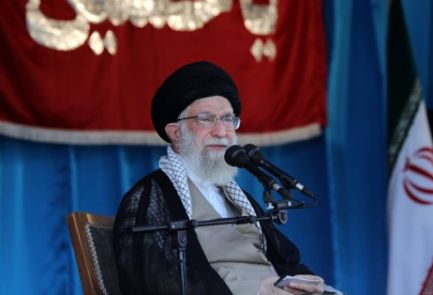
Supreme Leader Ayatollah Ali Khamenei tells civil defense officials to take scientific action to confront “enemy’s complex practices” • Head of Iranian civil defense agency says Iran recently neutralized a new version of the Stuxnet computer virus.
|
Iranian Supreme Leader Ayatollah Ali Khamenei speaks at Tehran’s Azadi Stadium, Oct. 4
| Photo: Reuters
|
Iranian Supreme Leader Ayatollah Ali Khamenei called for increased efforts to combat enemy “infiltration,” in a speech to officials in charge of cyber defense, state television reported on Sunday.
“In the face of the enemy’s complex practices, our civil defense should … confront infiltration through scientific, accurate, and up-to-date … action,” Khamenei told the officials.
The report did not detail the “infiltration” to which Khamenei was referring.
Iranian officials have long warned of Western cultural influences through entertainment, social media and the internet as a threat against Islamic and revolutionary values.
A decade ago, Iran’s nuclear program was hit by Stuxnet, a virus deployed by U.S. and Israeli intelligence agencies to sabotage Iran’s uranium enrichment facility.
Gholamreza Jalali, head of Iran’s civil defense agency, said on Sunday that Iran had recently neutralized a new version of Stuxnet.
“Recently we discovered a new generation of Stuxnet which consisted of several parts … and was trying to enter our systems,” Jalali was quoted as saying by the semi-official ISNA news agency at a news conference marking Iran’s civil defense day. He did not give further details.
Source: Days after truce reached, Islamic Jihad threatens to pound Israel – Israel Hayom
Palestinian terrorist group vows to retaliate for deaths of three Palestinian teens killed in Israeli airstrike while approaching Gaza border fence • Israeli residents of communities near Gaza border launch nationwide protests over government inaction.
|
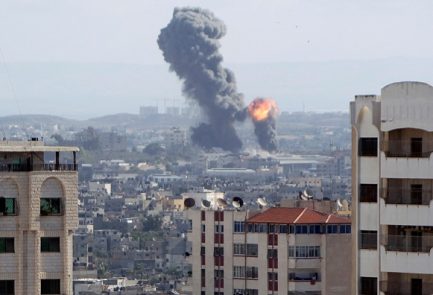
An explosion is seen during Israeli airstrikes on terrorist targets in the Gaza Strip, Saturday
| Photo: Reuters
|
Two days after agreeing to a cease-fire with Israel, the Gaza-based terrorist organization Islamic Jihad on Monday threatened to renew its attacks on Israeli communities in retaliation for the deaths of three Palestinian teenagers.
Gaza health ministry officials reported that three Palestinian boys were killed in an Israeli airstrike on Sunday. The IDF said its aircraft targeted “three terrorists approaching the security fence, who were trying to sabotage it and were apparently planting a bomb.”
Islamic Jihad is an Iranian-backed terrorist group that sometimes operates independently of Gaza’s Hamas rulers.
“We vow to retaliate for the killing of children on the Gaza Strip border in a way that will befit the scope of the crime,” an Islamic Jihad spokesman said.
On Sunday, Gaza authorities reported that two of the boys were 13 years old and the third was 14. The Health Ministry said ambulance crews had brought the bodies from the border fence to a hospital.
The latest strike came after a surge in violence in the conflict on the Gaza border. Over the weekend, Hamas sent its largest volley of rockets in months over the Israeli border. The Iron Dome defense system intercepted all the rockets that posed a threat to populated areas, and the rest detonated in open areas.
In retaliation, the Israeli Air Force struck at least 80 targets in the Gaza Strip, including terrorist training sites and weapons storage facilities.
Meanwhile, residents of Israeli communities near the border – whose lives have been disrupted and whose fields have burned in the eight months since Hamas began staging its weekly “marches of return” along the border and launching firebomb balloons and kites into Israel – launched a nationwide protest on Monday against the government’s lack of decisive action against terrorism from Gaza.
The residents marched to the Kerem Shalom border crossing – the only entry point of commercial goods from Israel into the Gaza Strip – and cut off access to it in protest against the transfer of goods into Gaza while Hamas continues to terrorize Israel’s southern communities.
Monday’s march was just one of many planned demonstrations, including a protest at a major junction in Tel Aviv the previous day.
“When there is a Color Red [rocket alert] near Gaza, the entire country will hear it,” organizers vowed.
The protests began on Saturday night, when several dozen residents of border communities staged a protest at the Yad Mordechai intersection.
Yifat Ben Shoshan of Moshav Netiv Haasara, one of the organizers, said, “We refuse to remain quiet about the situation. Our voice isn’t being heard and disaster is closer than ever.”
During the demonstration on Saturday, activists disclosed that they were planning to shut down high schools in their communities, and some parents kept younger children home from school on Sunday.
Merav Cohen of Kibbutz Ein Hashloshah, who initiated the school protest, said, “We need to take action on our own behalf because no one will do it for us. We don’t want tragedy to strike before something is done to prevent it.”
Naama Shaked-Levy of Kibbutz Gvulot spent Sunday preparing placards with her three children, whom she did not send to school as part of the protest.
“My kids know why they’re staying home and we sat down to make picket signs,” she said. “It’s an important lesson in democracy. It doesn’t make sense for kids to be frightened of balloons and kites, and that everything here is burning.”
Speaking of the mass shooting at a Pittsburgh synagogue on Saturday in which 11 people were murdered, Shaked-Levy said that “when the disaster in Pittsburgh happened, Diaspora Affairs Minister Naftali Bennett flew there right away. But here, people are ignoring the catastrophe.”
Miri Assulin, one of the organizers of Sunday’s Tel Aviv demonstration, said, “We don’t intend to resume our routine and accept the ‘battered wife’ reality, where we’re promised that everything will be OK and then it happens again.”
Source: Israeli cabinet observes moment of silence for Pittsburgh synagogue victims | The Times of Israel
Leaders and institutions condemn slaying of 11 worshipers at Tree of Life synagogue, ‘murdered just because they were Jews’
The weekly cabinet meeting on Sunday began with a minute of silence to honor the 11 Jewish worshipers killed in an anti-Semitic shooting attack a day earlier at the Tree of Life synagogue in Pittsburgh in the US state of Pennsylvania.
“It is hard to overstate the horror of a murder of Jews gathered in a synagogue on Shabbat, who were murdered just because they were Jews,” Prime Minister Benjamin Netanyahu said at the start of the meeting, held at the Prime Minister’s Office in Jerusalem.
“The entire people of Israel is mourning with the families of those murdered in the shocking massacre at the synagogue,” he said after the moment of silence was observed. “In my name and in the name of the people of Israel, I send our condolences to the grieving families. We all pray for the speedy recovery of the wounded.”
Noting that the shooting apparently constituted the “biggest anti-Semitic crime in American history,” Netanyahu added that Israel “stands in a united front with the Jewish community in Pittsburgh, with the American Jewish public and with the American people. We stand together in a single front against anti-Semitism and these expressions of barbarity.”
The gunman, identified as Robert Bowers, is said to have yelled, “All Jews must die” as he entered the Tree of Life Synagogue, a Conservative congregation in the city, and began firing. He engaged in a shootout with responding police officers and barricaded himself inside the building before surrendering. In all, 11 people were killed and at least six wounded in the attack, at least four of them police officers, according to authorities.
Throughout Israel, the attack was greeted with expressions of shock and mourning.
Education Minister Naftali Bennett, who also serves as Israel’s minister for Diaspora affairs, announced late on Saturday that he was “flying tonight, as Minister of the Diaspora, to Pittsburgh to be with our sisters and brothers on their darkest hour. When Jews are murdered in Pittsburgh, the people of Israel feel the pain. Our hearts are with our brothers and sisters and with the entire American people.”
Chief Rabbi Yitzhak Yosef said he was “horrified to hear of the murder of innocent Jews in Pittsburgh, Pennsylvania, simply for being Jews by a despicable murderer steeped in anti-Semitic hate. My heart is with the bereaved families and all our Jewish brethren who reside in the United States. Sadly, anti-Semitism is again rearing its head of late in the United States.”
Haifa’s Rambam Medical Center, one of the largest hospitals in Israel, lowered the flags at its facilities to half staff for a week. The hospital’s director Prof. Rafi Beyar, who is visiting Pennsylvania this week, called the attack “a horrible anti-Semitic act, senseless and soaked in hate, directed at hurting Jews and all lovers of humanity.”
The Hatzalah emergency medical organization said it was sending a team with experts in emotional trauma to the community, with funding from Israel’s Diaspora Affairs Ministry, Israel’s Channel 10 reported.
An Israeli emissary in the Jewish community in Pittsburgh put out a call on Sunday urging Israelis to post pictures of themselves online holding a sign that reads “Pittsburgh — we are with you!”
Recent Comments