Archive for July 2018

Report: Hamas to curb kite terrorism to avoid escalation

July 18, 2018

Source: Report: Hamas to curb kite terrorism to avoid escalation – Israel Hayom

Trump and Putin praise Israel in Helsinki, diverge on Syria and Iran 

July 18, 2018

Source: Trump and Putin praise Israel in Helsinki, diverge on Syria and Iran – Israel News – Jerusalem Post

Trump spoke as “we,” which apparently indicated Moscow and Washington both working with Israel and “Israel working with us.”

BY SETH J. FRANTZMAN
 JULY 17, 2018 17:50
U.S. President Donald Trump receives a football from Russian President Vladimir Putin

US President Donald Trump and Russian President Vladimir Putin discussed Israel, Syria and Iran at their meeting in Helsinki on Monday and in subsequent comments to the press. The public comments provide some insight into their view of the future Middle East. With the Syrian regime conducting a major offensive in the south, the US deeply involved in eastern Syria and Israel demanding that the Iranians leave, these were central topics of concern.

Trump spoke first with a discussion of Israel. “We’ve worked with Israel long and hard for many years,” he said, adding that the US has never been closer to Israel than it is today. “President Putin also is helping Israel, and we both spoke with ‘Bibi’ Netanyahu and they would like to do certain things with respect to Syria, having to do with the safety of Israel.”

Trump said “we,” which apparently indicated that Moscow and Washington are both working with Israel and “Israel working with us.” He continued, “I think their working with Israel is a great thing – and creating safety for Israel is something both President Putin and I would like to see very much.”

Putin argued that Russia was helping to “crush terrorists in the southwest of Syria.” He mentioned the 1974 cease-fire lines on the Golan. “This will bring peace to the Golan Heights and bring a more peaceful relationship between Syria and Israel – and also provide security for the State of Israel.” Putin said he paid “special attention” to the issue when sitting with Trump.

The two also discussed the future of Syria. Trump claimed the US military was successfully coordinating with Russia in Syria. “Our military do [sic] get along very well,” he said. Putin then remarked that Russia was working to establish peace and reconciliation. “Russia and the United States apparently can act proactively and take leadership on this issue,” he said, emphasizing that coordination between the US and Russian militaries in Syria had helped avoid “dangerous incidents and unintentional collisions.”

Putin said the crucial issue now was relating to refugees in Turkey, Lebanon and Jordan. “If we help them, the migratory pressure upon the European states will drop.” He mentioned that Russia was working closely with Turkey and Iran, “so that we will be able to maximize our fighting chance together for ultimate success on the issue of Syria.”

The Russian leader shrugged off a question about the “ball” being in Russia’s court in deciding what’s next in Syria. He said he would hand the ball to Trump, making a joke about the World Cup. Trump agreed that humanitarian concerns were a key issue for the people of Syria.

On Iran, Putin said the Iranian nuclear deal had helped ensure “the peaceful nature of its nuclear program.” Trump emphasized the need to pressure Iran and “stop its campaign of violence throughout the area – throughout the Middle East.” He then said the US would not allow Iran to benefit from the defeat of ISIS. Trump claimed ISIS had been 99% defeated, and said Russia was helping.

So what was said and what was left unsaid?

Both Putin and Trump appeared to understand, and to some extent support, Israel’s concerns regarding Syria. They were keyed in to Jerusalem’s policy, which has included air strikes on Iranian targets in Syria over the last six years. The use of the words “us” and “we” to describe Israel’s relationship with Moscow and Washington points to an unprecedented level of understanding between Jerusalem and the two world powers.

Probably never before have Moscow and Washington been closer in terms of listening to Israel’s concerns. The fact that both Washington and Moscow have their own agendas in Syria – neither of which always mesh with Israel’s agenda – was left unsaid. The fact is, Russia cannot remove Iran from Syria, which is Israel’s main goal. Washington also has not committed to removing Iran from Syria, since it is still concentrating resources on defeating ISIS.

Putin sees Iran as an important player in the region, not as an adversary. He would also like to work more closely with Turkey. Trump, meanwhile, is adamantly opposed to Iran. Here the two leaders expressed differences. Putin was noticeably tight-lipped about his views regarding Tehran’s policies. This could point to growing daylight between Moscow and Iran, but it more likely points to Putin’s tendency toward generalization that allows Russia more room to maneuver. The US prefers clearly-stated goals; Russia prefers the veneer of discussing international law, while maintaining the opaque nature of Moscow’s actual policy relating to Iran in places like Syria.

Overall, the meeting between the two leaders was weak on substance. Prior to the summit, some in Israel had pushed stories about Russia agreeing to some sort of concept in which Iran leaves Syria when the conflict is done. But after Netanyahu’s meeting with Putin and then with Trump, it is clear there will be no clear comment about Iran’s future role in Syria – or about Israel’s continued opposition to any Iranian forces remaining there.

Satellite images show destruction of Syria site allegedly hit by Israel

July 18, 2018

Source: Satellite images show destruction of Syria site allegedly hit by Israel

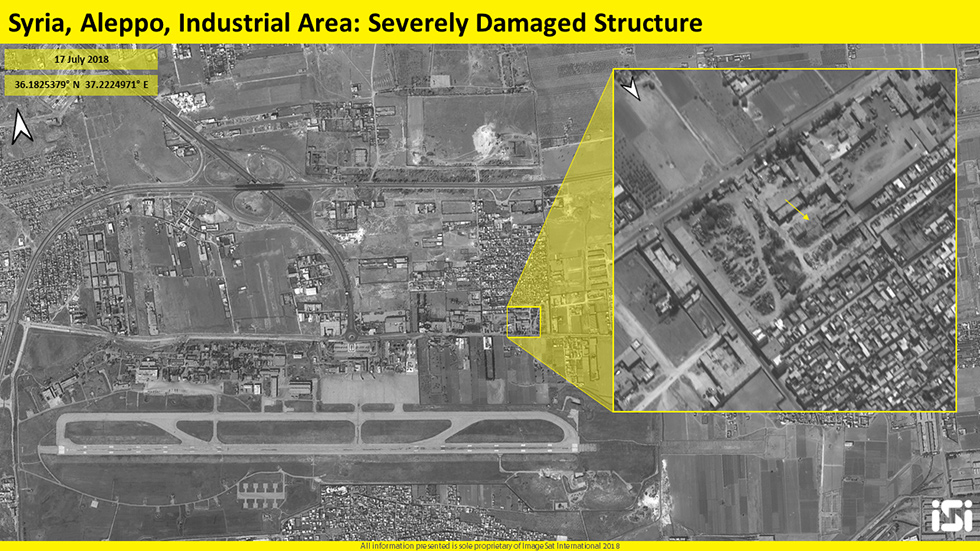
Photos taken after attack on industrial site near Aleppo International Airport, which was attacked earlier this week, show it was completely destroyed; site may have been used to store Iranian weapons.

Satellite images taken by the Israeli satellite company ImageSat show the destruction of a building that was attacked earlier this week near the Aleppo International Airport in Syria, some 350 kilometers from the border with Israel.

Syrian state media attributed the strike to the Israeli Air Force. Israel has neither confirmed nor denied the reports.

Based on the satellite photos, it appears that the site was completely destroyed.

 (Photo: ImageSat International (ISI))

(Photo: ImageSat International (ISI))

 The industrial building that was attacked may have been used to store weapons, possibly a new shipment of advanced weapons intended for the Iranian forces operating in Syria.It is located only 500 meters from the Aleppo International Airport in northern Syria, which Iran occasionally makes use of to bring aircraft parts and weapons into the country.

The Syrian Observatory for Human Rights war monitor said the strikes killed nine people—six Syrians and three others whose nationality was not made known—at a logistics site used by Iran’s Revolutionary Guards near the airport. State media said the strikes caused only “material damage”.

 (Photo: ImageSat International (ISI))

(Photo: ImageSat International (ISI))

Al Jazeera claimed that 22 people were killed in the attack, including nine Iranians.

The Observatory said the attack, which it too said was likely carried out by Israel, targeted a Syrian regime site.

An official military source in Syria on Sunday accused Israel of an attack. “The Zionist enemy returned in its desperate attempts to support defeated terror organizations in Daraa and in Quneitra, and it attacked using missiles one of our military outposts north of the Al-Nayrab airport. Damage was caused to property only,” a Syrian statement said.

With IDF poised to strike Hamas, is Israel’s Northern Front forgotten? 

July 18, 2018

Source: With IDF poised to strike Hamas, is Israel’s Northern Front forgotten? – DEBKAfile

The Syrian army and Hizballah advanced to a point on Tuesday, July 17, that was close enough to Israel’s Golan border to bomb its northern cities. Yet Israel’s leaders had shifted their attention to Gaza and a possible counter-terror operation against Hamas.

An approaching operation was signaled by the IDF’s troop build-up around the Gaza border, the deployment of extra Iron Dome anti-rocket batteries in Greater Tel Aviv and video presentations of soldiers geared for battle run on TV screens. Commanders interviewed by military reporters outlined their targets and the sectors of the Gaza Strip to which their units were assigned. Adding to the drama, both Prime Minister Binyamin Netanyahu and Defense Minister Avigdor Lieberman paid visits to the IDF formations with pep talks. With them was the Chief of Staff, Lt. Gen. Gady Eisenkot. The day before, Netanyahu paid his first visit to Sderot, the town long battered by Palestinian rockets from next-door Gaza.

Suddenly, no one remembered that a Gaza operation had been ruled out for months because the danger to the northern front was deemed more pressing, even though the worst-case scenario was now at hand. On Tuesday, while Israel’s top officials toured the south, the Syrian army, eighty percent of whose troops are members of Hizballah and Shiite militias loyal to Iran, had pressed forward to the Quneitra region and reached a point 4km from the Israeli border.

Seeing the Syrian and Hizballah troops so close, dozens of Syrian refugees came up to the Israeli Golan border waving pieces of white clothing and appealing for help. IDF officers told them through loudspeakers to go back to their tents in the demilitarized zone.

IDF officers posted on the Golan reported anonymously that Syrian and Hizballah forces had captured the hilltop town of Tel Al-Harra, from which they could not only blast all parts of the Golan, but even reach Israel’s northern Galilee and Mediterranean coastal towns, like Nahariya.

No official bothered to tell the Israeli public why the Netanyahu government had suddenly abandoned the northern front. The first clue came from the abrupt halt in Israeli air force flights over the embattled districts of southern Syria on Tuesday, July 16, as US President Donald Trump and Russian President Vladimir Putin sat down in Helsinki for their first full meeting.

It was Putin who shed light on the change when he disclosed that he and the US president had agreed that Israel’s border with Syrian should be secured according to the terms of the 1974 separations of forces agreement for the Golan, thereby endorsing a demand made in the last two weeks by the Israeli prime minister.

The full connotations for Israel of this format have yet to be revealed to the public. Meanwhile, popular attention has swung round to the Gaza front to see whether the government and IDF actually go through with their plans for an operation to finally cut Hamas down,

Army told to prepare for large-scale military operation in Gaza 

July 18, 2018

Source: Army told to prepare for large-scale military operation in Gaza — report | The Times of Israel

IDF drills to conquer all of Gaza, as Israel said to have warned Hamas it is prepared to embark on campaign in Strip if arson kite launches don’t cease by Friday

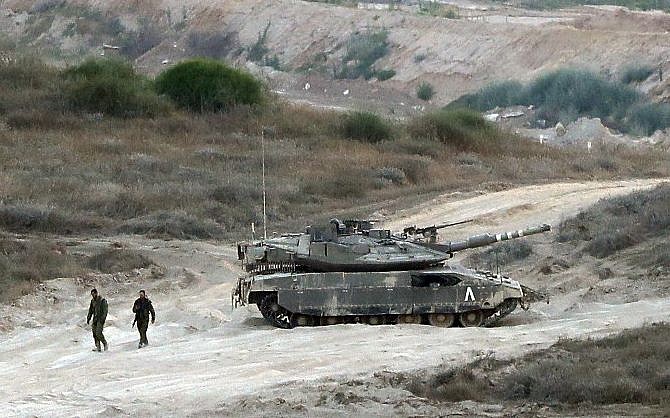
Israeli soldiers walk near an army tank patrolling along the border between Israel and the Gaza Strip on May 29, 2018. (AFP/Jack Guez)

Israeli soldiers walk near an army tank patrolling along the border between Israel and the Gaza Strip on May 29, 2018. (AFP/Jack Guez)

Israel’s political leadership has reportedly instructed the army to prepare for a military offensive in the Gaza Strip, to be initiated if the launching of incendiary devices from the Hamas-run coastal enclave into Israeli territory continues.

According to a Channel 10 news report Tuesday, Israel has set Friday as a deadline for the flaming kite and balloon launches to cease. If this does not happen, Israel may decide it has no choice but to embark on a military campaign in the Strip, the report said.

Israel sent a similar message to Hamas through Egyptian intelligence, Channel 10 reported, with the Palestinian terror group in turn indicating its forces will work to stop the launching of burning materials by Friday.

On Sunday, the IDF’s 162nd Armored Division launched an exercise simulating a war in the Gaza Strip, including the capture of Gaza City. While the military said it was planned in advance and was not related to the weekend’s exchange of fire, the manner in which the exercise was publicized by the military led many to see it as a tacit threat to Hamas.

Hamas is manning some 60 percent of its positions along the border fence in order to stop the launches, according to the TV report, and is expected to dispatch its forces to all of its posts by Friday.

Citing Palestinian sources, the report said Hamas would only put a complete stop to the flaming kite launches if it can achieve some sort of accomplishment, such as the reopening of the Rafah border crossing with Egypt. The Palestinian Liberation Organization’s ambassador to Egypt said earlier Tuesday the crossing would reopen on Wednesday after being shuttered for more than 24 hours over technical issues.

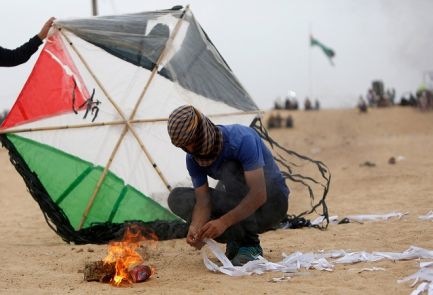
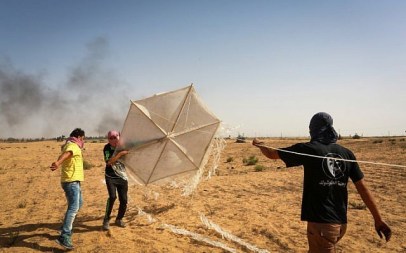
Palestinians prepare a kite with flammable materials that they will fly into southern Israel from Rafah, in the southern Gaza Strip, on June 22, 2018. (Abed Rahim Khatib/Flash90)

The report came as Israeli leaders touted the IDF’s readiness for a military conflict with Hamas amid ongoing violence along the Gaza border.

During a tour on Tuesday of the army’s Gaza Division, Prime Minister Benjamin Netanyahu said Israel was already in a “military campaign.”

“We are in a military campaign in which there have been exchanges of blows. I am prepared to say that the Israel Defense Forces is prepared for any scenario,” Netanyahu said.

Over the weekend, Hamas fired some 200 rockets and mortar shells at Israel and the IDF carried out multiple strikes inside the Palestinian enclave. That escalation began after an IDF officer was moderately injured by a hand-grenade thrown by a Gaza assailant at the border on Friday.

On Saturday night, a ceasefire of sorts was brokered by Egypt and other international bodies, though Israel was not directly involved in the talks. The violence has abated, but tensions endured and cross-border attacks continued.

From right, Defense Minister Avigdor Liberman, Prime Minister Benjamin Netanyahu, IDF Chief of Staff Gadi Eisenkot, Military Secretary to the Prime Minister Brig. Gen. Eliezer Toledano, and head of the Shin Bet Nadav Argaman speak during a visit to the IDF’s Gaza Division on July 17, 2018, amid an increase in violence from the Gaza Strip. (Kobi Gideon/GPO)

Asked if Israel was working to prevent a military conflict with Hamas, Netanyahu defended the government’s actions.

“I believe that we are doing the right things. It would be worthwhile to pay attention not only to what we are saying, but to what we are doing,” he said.

Netanyahu was joined on the visit by Defense Minister Avigdor Liberman, IDF Chief of Staff Gadi Eisenkot, and the head of the Shin Bet security service, Nadav Argaman.

While the senior officials were meeting in the Gaza Division on Tuesday, a number of incendiary and apparently booby-trapped balloons were launched into Israel from the Gaza Strip. A total of 17 fires started by airborne devices from Gaza were reported on Tuesday, including one that landed in the yard of a preschool where children were playing.

In response to the arson attacks, an Israeli drone conducted an airstrike near a group of Palestinians launching incendiary balloons from the northern Gaza Strip, injuring two of them, according to the Hamas-linked Shehab news outlet.

The Israeli military confirmed that one of its aircraft carried out the strike.

In recent days, the Israel Defense Forces has stepped up this practice, after the security cabinet called on it to take a more forceful stance against the airborne arson attacks on Sunday.

Recent months have seen daily arson attacks from Gaza with incendiary kites and balloons that have burned thousands of acres of Israeli land; regular riots and clashes along the border, which have resulted in over 130 Palestinians killed by IDF gunfire; and occasional outbursts of mortar and rocket fire by Gaza terrorist groups, which have prompted dozens of Israeli retaliatory airstrikes against Hamas positions. Dozens of the dead were members of Hamas and other terror groups, they have acknowledged.

This violence has raised tensions between Israel and Hamas to the highest they have been since the 2014 Gaza war.

In recent days, many officials and commentators in Israel, Gaza, and the international community have warned that another war in the Palestinian enclave was imminent in light of increased violence along the border, unless actions were taken to calm the situation.

Iran Hints at Nuclear Cooperation with U.S.

July 17, 2018


Iranian Supreme Leader Ayatollah Ali Khamenei attends a meeting with lawmakers in Tehran. (Office of the Iranian Supreme Leader via AP)

OAN Newsroom
UPDATED 12:55 PM PT — Tues. July 17, 2018 One America News Network

Source Link: Iran Hints at Nuclear Cooperation with U.S.

{Iran’s armor is starting to crack? – LS}

The Ayatollah regime in Iran is signaling that it is open for nuclear cooperation with the United States.

Officials at the Iranian nuclear agency said, Tehran could be more transparent in its nuclear endeavors to alleviate some of America’s concerns. However, the Ayatollah regime said the U.S. must stop what it calls “hostile” policies toward Iran.

This comes as the Treasury Department is set to slap two rounds of sanctions on the Islamic republic, while the country is mired in a wave of domestic civil unrest.

Ayatollah regime officials urged for better relations between the U.S. and Iran.

“America is a country that has good technology, if it had good leaders too, it would be able to work very well with Iran and other countries, in a way that both parties could benefit,” said Behrouz Kamalvandi, spokesman for Iran’s Atomic Energy Agency. “There is ground for nuclear cooperation if a political situation is ready, but that’s highly unlikely — first they need to stop being selfish.”

Israeli intelligence recently exposed — what it says– is a military component of Iran’s nuclear program.

Some say Tehran could be seeking better relations with the U.S. for the purposes of regime protection.


Iran’s ‘Supreme Leader’ Khamenei Celebrates Birthday With Genocidal Message for Israel

July 17, 2018

by Ben Cohen July 16, 2018 Algemeiner

Source Link: Iran’s ‘Supreme Leader’ Khamenei Celebrates Birthday With Genocidal Message for Israel

{This man’s obsession with the destruction of Israel seems to permeate every aspect of his life. – LS}

Visitors to the Twitter feed of Iran’s “supreme leader”on Monday were treated to the incongruous sight of multicolored balloons floating above a series of incendiary anti-Israel tweets.

The celebratory mood on what is normally a rather somber feed marks Ayatollah Ali Khamenei’s 79th birthday — which falls on Tuesday, July 17, in the Gregorian calendar.

But as the last balloon disappeared from the screen, so did the jollity — leaving only a thread of threatening messages warning of the Jewish state’s coming destruction.

Denouncing US President Donald Trump’s “deal of the century” proposal for an Israeli-Palestinian peace as a “satanic, vicious plot,” Khamenei declared, “The turbulent dream that Al-Quds [Jerusalem] would be given to the Zionists will never come true.”

He continued: “The Palestinian nation will stand against it and Muslim nations will back the Palestinian nation, never letting that happen.”

As to his ultimate intentions towards Israel, Khamenei left little to the imagination in a further tweet.

“By God’s grace, the Palestinian nation will certainly gain victory over the enemies and will witness the day when the fabricated Zionist regime will be eradicated,” he vowed.

Khamenei’s birthday rant was excerpted from a speech he delivered in Tehran on Monday to organizers of Iran’s hajj — the annual pilgrimage to the holy city of Mecca in Saudi Arabia that faithful Muslims are required to make at least once during their lifetimes.

In the same breath as attacking Israel, Khamenei also turned his ire on the Saudis — an increasingly common linkage among Iran’s leaders anxious about the common strategic interests between Jerusalem and Riyadh that have emerged in recent years.

With the hajj scheduled to begin on Aug. 19, Khamenei fanned tensions with Iran’s Saudi neighbor, asserting that Mecca’s holy sites “belong to all Muslims, not to the rulers of Saudi Arabia.”

Arguing that a “true” hajj must include a “disavowal of the infidels,” Khamenei told the gathered Islamic leaders that the pilgrimage “is the best opportunity and a practical scene to demonstrate the unification of religion and politics.”

Khamenei also called for a fresh investigation into a 2015 crush during the hajj that killed hundreds of pilgrims, blaming the tragedy on the Saudi authorities’ alleged indifference to the safety of the participants.

The defiant tone of Khamenei’s rhetoric has not wavered in the face of mounting pressures on Iran’s regime in the wake of the US decision in June to abandon the 2015 nuclear deal with Tehran. With the US expecting renewed sanctions on Iran to be locked in by November, the Islamic Republic has been convulsed by anti-regime protests in several cities, leading to thousands of arrests.

Protests against Iran’s rulers spilled into neighboring Iraq on Sunday, as two demonstrators were killed and dozens more were wounded by security forces during rallies and marches demanding an end to Iranian interference in Iraq’s national affairs.

In Baghdad, hundreds of protesters closed a highway at the entrance to the Iraqi capital’s northwestern Shula neighborhood, chanting “Iran, out out! Baghdad is free!” and “The people want to overthrow the regime,” the AFP news agency reported.

Long Overdue: Congress Wants Recognition of Israeli Sovereignty Over Golan Heights

July 17, 2018

By – on

Long Overdue: Congress Wants Recognition of Israeli Sovereignty Over Golan Heights

While the Democrats have become the party and the face of the new antisemitism, the Republicans are doing what is right, rational and righteous.

The Golan is  critical to Israel’s security. This key territory could help Israel defend itself from attacks by Iranian forces and others operating in Syria. Syria lost the Golan Heights to Israel in the June 1967 war — when the United Arab Republic, Jordan, and Syria attacked the tiny Jewish state.

Iran’s vow to annihilate the Jewish state and the continuing political turmoil in the Muslim world and its accompanying Jew-hatred only reinforce Israel’s need for long-term defensible borders.

Israeli Control of the Golan Heights: High Strategic and Moral Ground for Israel
By Ephraim Inbar

MAP 1: Northern Israel


Security Needs

The Golan Heights is a sloping plateau, ascending from 300 meters on its west end to 1,000 meters on its east end, and covering a total area
of 1,800 km (695 sq. mi.). The Jordan River and the Sea of Galilee (part of the Syrian-African Rift) mark its western border, the Yarmuk River demarcates its southern perimeter, and the hills along the watershed line and the Rokad River bound it on the east. The 2,814 meter-high Hermon Mountain (partially in Israeli territory) marks the northern boundary of the Heights (see Map 1 and 2). The Hermon provides an excellent vantage point for the entire region – up to Damascus, only some 60 kilometers to the east, and over to the Haifa Bay, on the Mediterranean to the west (see Map 2). The Golan Heights dominate the Jordan River valley, the Israeli Galilee to its west, and the area leading to Damascus to its east.

Map 2: Mount Hermon Overlooks Damascus and Haifa (A North to South Perspective)

Militarily, withdrawal from the Golan Heights would be extremely problematic. Control of this area gives Israel several important advantages, including those that were crucial in repelling the surprise Syrian military onslaught in October 1973, and has enabled Israel to maintain stability along this border. Indeed, despite the absence of a peace treaty, and despite regional tensions that eventually led to violent clashes between Israel and Arab actors, the border between Israel and Syria has remained quiet since 1974. Even the military confrontation between Israeli and Syrian units in 1982, in the Lebanese arena, did not extend to the Golan Heights.

The current border along the watershed line – the hills in the Eastern part of the plateau – is the best defense line against a conventional
military attack from the east. Such an attack must overcome the topographical superiority of the defensive force, as the

terrain requires the attacking side to channel its forces in between the hills. These natural terrain bottlenecks allow a small defending force to repel an attack and bring in reinforcements if needed. In the 1973 October War, the Golan’s topography enabled 177 defending tanks to stop approximately 1,500 Syrian tanks and gave the IDF the critical time to call up and deploy its reserve formations.6 An armored attack can hardly be successful and cannot be sustained for long without taking the hills that Israel presently controls.

No other line on the plateau can confer such defensive advantages as the current border is based on the watershed line and the whole terrain west of this line descends toward the eastern cliffs on the Jordan River. A withdrawal from the Golan would place Israeli troops at its bottom, about 200 meters below sea level, with a very steep gradient toward the plateau at about 300 meters above sea level, making recapturing this territory in a crisis a very complicated military operation (see Topographical Cross-Section on Map 1 and Map 3).

Map 3: The Golan Heights

Control over the Golan Heights enhances the safety of the strategic Haifa Bay area on the Mediterranean Coast by increasing its distance from Syrian positions to almost 90 kilometers. The Bay area is an important industrial hub, houses one of two main Israeli ports, and forms part of the strategically vital triangle, alongside Jerusalem and Tel Aviv, that holds most of the country’s infrastructure and population.

Israeli military presence in the Golan Heights also prevents the formation of an indefensible pocket in the narrow strip (about 7 kilometers wide and 26 kilometers long) of the Upper Galilee, the northernmost part of Israel, an area sandwiched between Hizballah- controlled southern Lebanon and the Golan Heights (see Map 4).

Tens of thousands of Israeli citizens in this “Finger of the Galilee” could be easily disconnected from Israel and taken hostage in the case of a coordinated attack by Syria, if it controlled the Golan, and an Iranian-inspired Hizballah.7 The capacity of this organization to inflict damage upon Israel has grown considerably since the end of the 2006 Lebanon War.

Map 4: “Finger of the Galilee”

Read the rest.

Congress Wants Recognition of Israeli Sovereignty Over Golan Heights

Despite failed bid, hearing will press Trump admin to support Israeli ownership of contested land

By Adam Kredo, Free Beacon, July 15, 2018:

Congress is renewing efforts to press the Trump administration into recognizing Israeli sovereignty over the contested Golan Heights region on Israel’s northern border with Syria, bucking efforts by GOP leadership to kill the effort, according to conversations with lawmakers.

The House’s National Security Subcommittee, led by chairman Rep. Ron DeSantis (R., Fla.) will hold a hearing Tuesday to examine how recognizing Israel’s sovereignty over the territory could bolster U.S. national security efforts to stem the flow of terrorists in the Jewish state and elsewhere in the region by giving the Jewish state unilateral control over the Syrian territory, where Iranian-backed fighters and other jihadists have been spotted since the start of a bloody civil war.

The push to have the Trump administration formally recognize Israel’s sovereignty over the territory comes following a Monday afternoon press conference between President Donald Trump and Russian President Vladamir Putin, where the two leaders discussed efforts to decrease tension in Syria.

When DeSantis and other Republicans pushed a congressional resolution recognizing Israeli control over the Golan Heights in May, it was nixed by GOP leadership who were seeking to prevent such a vote on the heels of the Trump administration’s successful effort to relocate the U.S. embassy in Israel from Tel Aviv to Jerusalem.

The resolution had won support from Sen. Ted Cruz (R., Texas) and others.

DeSantis expressed disappointment at the time in comments to the Free Beacon.

“I don’t know why my Golan Heights amendment was not made in order and thus denied a vote,” DeSantis said. “It was a germane amendment that would have provided the House with a chance to add clarity to the broader U.S. policy vis-a-vis Syria.  How could we even contemplate supporting anything other than the application of Israeli sovereignty to such a strategically significant area, especially given the plethora of malevolent forces that undermine security in the region?”

DeSantis, who will chair Tuesday’s hearing, told the Washington Free Beacon he will not stand down despite opposition by some to formally recognizing Israeli control over the territory, which Israel annexed in 1981.

“U.S. recognition of the Golan Heights is overdue and I hope this hearing demonstrates that the time is right for the Trump administration to do so,” DeSantis told the Free Beacon. “As we’ve seen with the successful relocation of our American embassy to Jerusalem, when the U.S. leads with purpose and conviction good things happen.”

The United States has declined for decades to take a position on the status of this territory, but lawmakers such as DeSantis argue the time is right for this effort, particularly in light of the chaos in Syria and the threat it poses to Israeli and U.S. security assets in the region.

sraeli officials, including Prime Minister Benjamin Netanyahu, have supported such efforts and also have requested the Trump administration move to recognize Israeli sovereignty over the territory. Public calls for the recognition increased after the Free Beacon first reported on the now-dead congressional resolution on the matter.

The Tuesday hearing will focus on Iran’s destabilizing efforts in Syria and how it has impacted regional security, according to information viewed by the Free Beacon.

Congressional officials and other supporters argue that U.S. recognition of Israeli control of the Golan Heights could thwart Russia and Iran’s growing influence in Syria and also send a powerful message that the United States sides with the Jewish state’s security interests as regional tensions grow.

The United States, under numerous governments, has assured the Israeli government that it supports Israel’s annexation of the territory, but has declined to go as far as backing a full recognition of sovereignty. The area remains a key territory that could help Israel defend itself from attacks by Iranian forces and others operating in Syria, supporters argue.

Iranian militants who are still operating freely in Syria as they defend embattled President Bashar al-Assad have used the Golan Heights and areas near it to target Israel.

In February, for instance, Israel intercepted an armed Iranian drone that had entered its airspace via Syria.

In May, Iranian forces in Syria fired at least 20 rockets at Israeli military personnel stationed in the Golan Heights, leading the Trump White House to issue public statements supporting Israel’s right to self-defense in the face of such attacks.

Witnesses testifying at the Tuesday hearing include Dore Gold, a veteran Israeli official who most recently served as director general of Israel’s Ministry of Foreign Affairs from 2015 to 2016; Michael Doran, a former senior director of the White House’s the National Security Council during the George W. Bush administration; Morton Klein, president of the Zionist Organization of America; and Eugene Kontorovich, a Northwestern University professor of law who has studied Israel’s legal claims to the Golan Heights.

Incendiary balloon lands in kindergarten

July 17, 2018

Source: Incendiary balloon lands in kindergarten

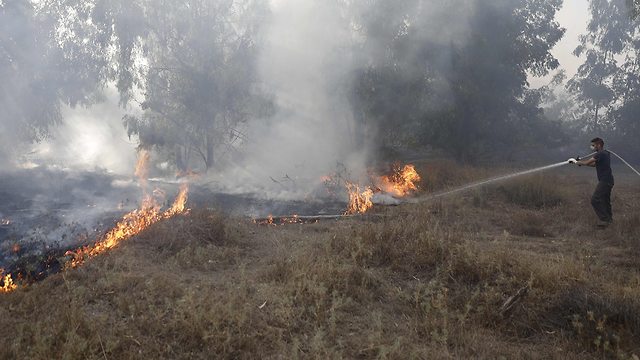
Hours after Netanyahu and Lieberman visit the Gaza border region, threat posed by incendiary balloons becomes particularly tangible when one lands in a kindergarten yard; there were no casualties; Firefighting crews continue their battle against the rampant fires caused by incendiary balloons flown from Gaza.

An incendiary balloon launched Tuesday from Gaza landed a kindergarten’s yard in the Sdot Negev Regional Council where children were present at the time but none were hurt. A police sapper was called to neutralize the dangerous article.

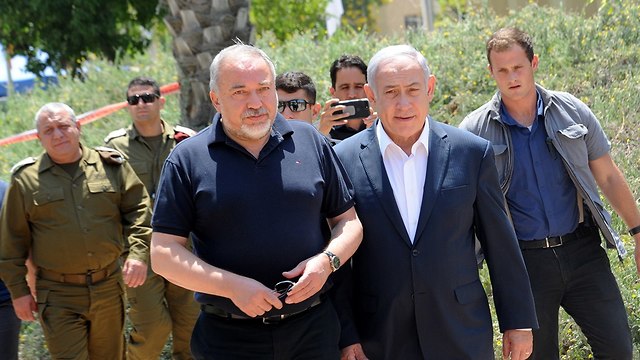
The incident occurred only hours after a visit by Prime Minister Benjamin Netanyahu and Defense Minister Avigdor Lieberman in the region.

Incendiary balloon

Incendiary balloon

Earlier, IDF aircraft targeted a group of Gazans who launched incendiary balloonsfrom the northern Gaza Strip into Israel. Firefighters have put out nine different fires caused by incendiary balloons flown from Gaza during the day.

Fires caused by Gazans (Photo: AFP)

Fires caused by Gazans (Photo: AFP)

Speaking during a visit to a regional military base, Netanyahu said: “We are in the midst of a campaign, there is an exchange of blows, and I can say that the IDF is prepared for every scenario. Like me, all Israeli citizens believe in and support the IDF ahead of any possible development.”

Netanyahu and Lieberman in Gaza region (Photo: Haim Horenstein)

Netanyahu and Lieberman in Gaza region (Photo: Haim Horenstein)

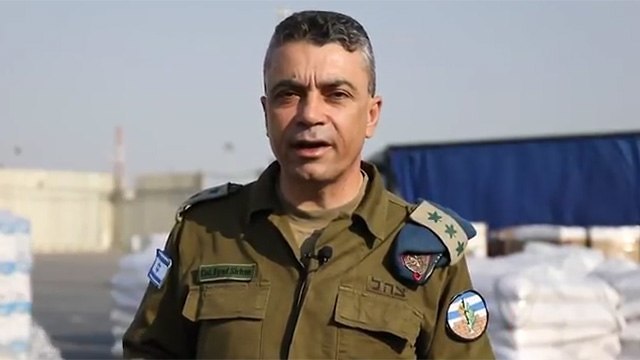
Coordinator of Government Activities in the Territories for the Gaza Strip Col. Iyad Sarhan addressed residents of the Gaza region via Facebook saying Hamas is responsible for the closing of the Kerem Shalom Crossing.

“The heavy price you are paying is a result of the balloon and kite terror; yes, we absolutely consider these incidents terrorism, therefore the response will be harsh,” he wrote.

Col. Iyad Sarhan

Col. Iyad Sarhan

“We can double the number of trucks entering the Gaza Strip every day, double or triple or even multiply them ten times. You, the merchants, the citizens and the people living in the Gaza Strip are paying the price of terrorism led by the Hamas leadership. We are not the address, questions should be referred to Hamas,” he added.When asked if the current crisis in the Gaza Strip could be resolved without embarking on a broader campaign, the prime minister replied, “I believe that we are doing the right thing. It is advisable that they start paying attention not only to what we are saying, but also to what we are doing.”

Adressing  the reports about the leaks from the security Cabinet meeting, Defense Minister Avigdor Lieberman said, “We heard a lot of talk about the security policy of the government. So first of all, it’s worth explaining that security policy should not be a response to political or media pressure. We are operating both with force and intelligently. What we need now is coolness and nerves of steel… not media hysteria. We are doing what needs to be done. ”

At the cabinet meeting Monday, Netanyahu ordered that all incidents of incendiary devices launched from Gaza be met with a response. “We are not prepared to accept any attacks against us and we will respond accordingly,” the prime minister stated on Sunday.

Putin: Trump ‘paid particular attention’ to Israel’s security at summit 

July 17, 2018

Source: Putin: Trump ‘paid particular attention’ to Israel’s security at summit – International news – Jerusalem Post

( This has to be a trick and a lie.  After all, the MSM says Trump’s an antisemite as well as a fascist. – JW )

The leaders of the two countries said Russia and the United States are working together to ensure Israel’s security.

BY JERUSALEM POST STAFF
 JULY 16, 2018 19:36

U.S. President Donald Trump receives a football from Russian President Vladimir Putin

Russia and the United States are working together to ensure Israel’s security with regards to the advancement of the Syrian regime against rebels near the Golan Heights, US President Donald Trump said to reporters after a summit with Russian President Vladimir Putin on Monday. Trump “paid particular attention” to Israel’s security during the summit, the Russian leader said at a joint press conference after the summit Monday.

Russian cooperation with Israel is a “great thing” Trump said.

“As far as Syria is concerned the task of establishing peace and reconciliation in this country could be the first showcase example of successful joint work,” the US leader said.

Putin also said Washington knows the Kremlin’s position on the Iran nuclear deal, from which Trump withdrew last year.

“We can do something to help people of Syria head in some form of shelter… both of us would be very interested in doing that,” Trump said. “We also discussed at length the crisis in Syria. Cooperation between our countries has the potential to save hundreds of thousands of lives.”

Putin said he agrees with Trump that the two countries’s armies are working successfully in Syria.

“As far as Syria is concerned the task of establishing peace and reconciliation in this country could be the first showcase example of successful joint work,” Putin said.

Prime Minister Benjamin Netanyahu “welcomed the deep commitment” of the US, his office said in a statement released after the summit. Netanyahu “greatly appreciates the security coordination between Israel and Russia and expressed the clear position President Putin on the need to maintain the separation agreements between Israel and Syria in 1974,” the statement also read.

Reuters contributed to this report.