Archive for July 16, 2018

Trump-Putin summit could pave way to Mideast war, or avert it

July 16, 2018

The crucial talks, centered on Iran nuclear deal and Syria conflict, will have major ramifications for the region.

By CHARLES BYBELEZER/THE MEDIA LINE
July 16, 2018 13:26
https://www.jpost.com/International/Trump-Putin-summit-could-pave-way-to-Mideast-war-562624

US President Donald Trump will meet his Russian counterpart Vladimir Putin in Helsinki on Monday, in a much-anticipated summit against the backdrop of an ongoing American investigation into Moscow’s alleged meddling in the 2016 presidential elections. Despite complimentary allegations of collusion between then-candidate Trump’s campaign and Russian agents casting a shadow over the meet, there are many issues on the table that, however approached and the resulting deals cut, will go a long way towards determining the course of global events, especially in the Middle East.

In fact, both the war in Syria and the Iran nuclear deal are expected to top the agenda, with speculation already swirling about potential arrangements that could, for example, see the US recognize Russia’s annexation of Crimea in return for the Kremlin’s support for renewed American sanctions on Tehran; or, perhaps, a commitment by Moscow to expel Iranian forces from Syria in exchange for a partial withdrawal of US troops from the country.

Overall, analysts are speaking of a “grand bargain” of sorts that would update and formalize the terms of the Washington-Moscow relationship.

Notably, Israeli Prime Minister Binyamin Netanyahu traveled to Russia last week to reiterate his “red lines” with respect to Syria, a combustible arena where the competing interests of regional and global powers intersect, thus making it a perennial hotspot for the possible emergence, whether intentional or otherwise, of new and protracted military engagements. Most acutely, the Israeli leader insists that Shi’ite forces under Iranian control, including Hezbollah, be banned from operating anywhere near the Golan Heights, and, more broadly, that these fighters, along with their Revolutionary Guard Corps commanders, ultimately be completely removed from the country.

Over the weekend, Netanyahu further pressed these positions in a phone conversation with President Trump, whom he again thanked for taking a hardline approach to Iran. As to the atomic pact specifically, which the Europeans are feverishly trying to salvage following the White House’s withdrawal from the agreement earlier this year, Sunni Arab nations are as concerned as the Jewish state about the Islamic Republic’s potential nuclearization and, like Netanyahu, have made their voices heard, albeit mainly behind-the-scenes.

Accordingly, from Jerusalem to Riyadh, Amman to Beirut, all eyes will be on the Finnish capital, as the former Cold War foes plot a path forward.

“There is an intention by the US and Russia to arrive at a form of worldwide agreement about their respective ‘spheres of influence,'” Dr. Zaki Shalom, a Senior Research Fellow at Israel’s Institute for National Security Studies and an expert on the role of superpowers in the Middle East, told The Media Line. “It is similar to what took place after the Second World War when there was a deal between [then-U.S. president] Roosevelt, [former British leader] Churchill and [Soviet chief] Stalin regarding who controls what in order to avoid any direct clashes.

“[In this respect], the Americans have sent a message to Moscow that they are willing to give Putin free reign in Syria and that Assad can remain in power. Also, President Trump realizes that Russia’s hold of Crimea is essentially a fait accompli. Given this understanding,” Dr. Shalom elaborated, “President Trump is likely to push for the Iranians to leave Syria, while asking Russia to accept dramatic changes to the nuclear accord between world powers and Tehran. As per North Korea, Washington will want Russian support for the demilitarization [of the Peninsula].”

Regarding the Middle East, strengthening the atomic deal and curbing Iran’s territorial expansionism are viewed by many analysts as make-or-break issues that, in the absence of progress, could have devastating consequences.

Already, Tehran has assumed a stranglehold over Lebanon through its Hezbollah proxy and has made inroads in Yemen and Iraq. Syria, however, could be the straw that shatters the camel’s back as Israel seems intent on preventing Iran from gaining a permanent foothold in the country and has conducted well over one hundred cross-border strikes over the past years to this end. Should the Islamic Republic continue its military build-up, Jerusalem’s hand may be forced and a full-blown conflict could ensue.

Yet it appears that both the US and Russia share an interest in averting such an eventuality.

As the war in Syria winds down, Moscow has become less dependent on Iranian-backed fighters to do its dirty work on the ground and, overall, wants to avoid future instability that could threaten regime and, as a corollary, jeopardize its military gains. Therefore, according to Dr. Zaki, “while Putin might not be able to forcibly evict Iranian troops, he can give Israel the green-light to continue attacking their assets inside Syria. Without Russian protection, the Iranians will essentially be left alone without the ability to respond to Israel. In the end, it may be that only a limited number of ‘advisers’ will remain in order for Tehran to save face.”

Avi Melamed, Salisbury Fellow of Intelligence and Middle East Affairs at the Washington-based Eisenhower Institute, similarly believes that a US-Russia deal on Syria will come at Iran’s expense. “Putin is at the phase in which he wants to collect dividends in Syria. While he has to take into consideration the needs of all actors, he does not want the Iranians to become too powerful. This is not to say that Tehran will be fully [neutralized], but rather forced to make concessions. It will be a disappointment from their perspective given the massive investment made.”

In terms of the US military presence, Melamed contended to The Media Line that he does not expect any major changes to the current dynamic. “In the context of Syria, the American military deployment is not like the one in Afghanistan or Iraq. There is an aerial component largely [taking flight] from northern Jordan and another one through [allied] Kurdish forces east of the Euphrates. I do not see this being drawn down.”

Finally, he concluded, as regards the nuclear deal “President Trump has the upper hand because the major blow is the withdrawal of Western companies from the Iranian economy and Putin cannot compensate for the losses.” This, coupled with the fact that France, Britain and Germany have to date been unable to reach a new compromise with Iran and will not be sheltered from US secondary sanctions, suggests the atomic pact may soon be totally abrogated.

Superficially, then, it appears that Israel and its Sunni neighbors stand to have their positions advanced in Helsinki by two of the world’s greatest superpowers. Whether this fosters a period of wait-and-see quiet or increased tensions will depend primarily on how aggressively Iran responds to the prospective setback.

Trump Blames Washington for Poor Russian Ties Ahead of Putin Summit

July 16, 2018

“Our relationship with Russia has NEVER been worse thanks to many years of US foolishness and stupidity and now, the Rigged Witch Hunt!”

Lior Sharon

http://www.jerusalemonline.com/news/world-news/around-the-globe/trump-blames-washington-for-poor-russian-ties-ahead-of-putin-summit-36338

Putin and Trump Photo: Steffen Kugler / BPA via Getty

HELSINKI – Hours before he was due to sit down for his first ever summit with Vladimir Putin, US President Donald Trump blamed “US foolishness” for bad relations between Washington and Moscow, while the Kremlin said it expected a tough meeting.

Trump’s comments show how much domestic political pressure he is under over the meeting in the Finnish capital Helsinki, while the Kremlin’s gloomy comments reflect its belief that the fact the summit is even happening is a win for Russia.

Critics and his own advisers have urged Trump to use the summit to press Putin hard about election meddling and other “malign” activities. But hours before he was due to meet the Russian president, Trump focused his ire on his own country and the investigation into possible links between his 2016 campaign and Russia. The president has denied any collusion took place.

“Our relationship with Russia has NEVER been worse thanks to many years of US foolishness and stupidity and now, the Rigged Witch Hunt!” wrote Trump on Twitter, referring to the investigation into possible collusion

During a breakfast meeting with Finland’s president before the meeting with Putin in the Finnish capital, Trump appeared upbeat. Asked what he would say to the Russian president, Trump said: “We’ll be just fine, thank you.”

Trump also repeated his belief that predecessor Barack Obama had failed to act on Russian meddling.

While Trump has been abroad since last week, the special prosecutor investigating allegations that Russia interfered to help Trump win the 2016 presidential election indicted 12 Russians on Friday for stealing Democratic Party documents.

Trump’s foes at home have been scathing about his apparent refusal to criticize Putin. His 2016 opponent Hillary Clinton tweeted: “Great World Cup. Question for President Trump as he meets Putin: Do you know which team you play for?”

Neither side expects major breakthroughs from the talks and the outcome is uncertain given sharp differences between Washington and Moscow over everything from Syria to Ukraine.

For Putin, the fact that the summit is even happening despite Russia’s semi-pariah status among some Americans and US allies is a geopolitical win because, in Russian eyes, it shows that Washington recognizes Moscow as a great power that cannot be isolated or ignored.

The Kremlin made clear beforehand it did not expect an easy meeting, taking Trump to task over his criticism of a planned Russian gas pipeline to Germany and suggesting it would be hard to find common ground on Syria because of differences over Iran.

Trump wants Russia to help Moscow to use its influence in Syria where it is backing President Bashar al-Assad militarily to push Iranian and Iranian-allied forces out. Kremlin spokesman Dmitry Peskov told Russia’s RT TV station ahead of the summit that was unlikely.

“Of course Syria will be discussed by the two presidents,” said Peskov. “We all know what Washington thinks of Iran. But at the same time Iran is a good partner to us in terms of trade, economic cooperation and political dialog. So this will not be an easy exchange of views.”

Russia hoped however that the summit would be “the first step” in overcoming a crisis in relations, he said.

“Presidents Trump and Putin respect each other and they get along well. There is no clear agenda. It will be determined by the heads of state themselves as they go along.”

LOW EXPECTATIONS

Trump has predicted he will be accused of being too soft on Putin no matter how the summit goes. .”..If I was given the great city of Moscow as retribution for all of the sins and evils committed by Russia…I would return to criticism that it wasn’t good enough – that I should have gotten Saint Petersburg in addition!” he tweeted on Sunday.

He has said he will raise the issue of Russian election meddling with Putin, but does not expect to get anywhere.

The most analysts believe the summit could yield, beyond warm words, is an agreement to begin repairing battered US-Russia relations, and maybe a deal to start talks on issues such as nuclear arms control and Syria.

The two men could also agree to start restocking their respective embassies and returning confiscated diplomatic property after a wave of expulsions and retaliatory action prompted by the poisoning of a former Russian spy in Britain.

The Helsinki summit is the capstone to a nearly week-long trip for Trump during which he has sown doubts about his commitment to the NATO military alliance, Washington’s so-called special relationship with Britain, and US relations with the European Union that he called “a foe” on trade.

Against that backdrop and swirling uncertainty about what Trump might do or say next, his summit with Putin, which will include a one-on-one session with the Russian leader with only interpreters present, has both US allies and US politicians worried lest he make hasty and sweeping concessions.

Some politicians in the West believe the summit is happening at one of the most crucial junctures for the West since the 1991 fall of the Soviet Union. Certain NATO allies fear Putin might seek a grand deal that would undermine the U.S.-led transatlantic alliance.

Trump has spoken vaguely about the possibility of halting NATO war games in the Baltic region, and has said repeatedly that it would be good if he could get along with Russia.

When asked last month if he would recognize Russia’s 2014 annexation of Ukraine’s Crimea, he replied: “We’re going to have to see.”

Gaza War of Attrition Continues as Israel Lets Hamas Decide Next Phase

July 16, 2018

Gaza War of Attrition Continues as Israel Lets Hamas Decide Next Phase

Iron Dome Missile Battery seen near Tel Aviv on July 15, 2018.

At Sunday’s cabinet meeting, an argument broke out between Education Minister Naftali Bennett (Habayit Hayehudi) and Chief of Staff Gadi Eizenkot over a new class of privileged terrorists: children who burn down swaths of forests and fields alongside the Gaza Strip border. Bennett reiterated his demand, heavily supported by most government ministers, including from the Likud, for the IDF to hit squads who launch firebomb kites and balloons.

Eizenkot, who runs the army, asked Bennett, who runs the Education ministry, “Do you justify harming children?” and declared that dropping bombs from airplanes on a squad of balloons or kites launchers is contrary to “the value and operational position of the IDF.” Perhaps Israel would do better with Eizenkot running state education and Bennett instructing the IDF?

Bennett, incidentally, did not pick up the glove to provide a leak-worthy quote about how a child terrorist is a terrorist, and instead suggested the IAF be instructed to evaluate the age of the firebomb launchers, if they are adults – kill them, if they are children, let them burn down a kibbutz.

Risking yet another Holocaust-comparison fiasco, it should be mentioned that during the last days of Berlin, in 1945, enormous numbers of youths, as young as 10, were removed from school and sent on suicide missions against the attacking allies – who had no problem slaughtering them. Someone should enlighten the men and women in charge of Israel’s security.

In practice, the cabinet instructed the IDF to “stop the kite terror,” that is, to intensify the retaliation measures in response to the kites, issue more warning shots at the kite and balloon cells, damage the logistics chain that supports them, and sometimes damage the launchers directly. Indeed, over the past two days, the IDF has injured—but not killed—several Arabs of various ages who were trying to burn down Israeli land.

The IDF on Sunday deployed an Iron Dome battery in Metropolitan Tel Aviv, also on the instructions of the Cabinet. The deployment was given publicity, including in a video in Arabic released by the IDF Spokesperson, signaling to Hamas that Israel was preparing for a high-level confrontation. You want war? We’ll give you war.

It feels like 2014 all over again. The cabinet ministers were told that Hamas had made desperate requests for a ceasefire on Saturday, but most of the cabinet ministers (save for Kahlon) were there in 2014, when military intelligence insisted that Hamas wanted to end the fighting, but in reality the terror group was fully invested in war, forcing the confrontations to last 51 days. The Hamas political interest then was identical to its interest today: no one in the Arab world gives half a hoot about Gaza, the humanitarian crisis, blah, blah, so Hamas will force them to pay attention by getting thousands of its citizens killed by Israel. In other words, folks, unless there’s a radical change on the ground, war is inevitable this summer.

War could start this coming Friday, at the border fence. Even if only a few hundred Hamas recruits show up, if they manage to kill IDF soldiers, as they tried to do last Friday, throwing six different explosive charges, including one hand grenade that injured an IDF officer – the Netanyahu cabinet will have to mobilize, and, if we are to believe Defense Minister Avigdor Liberman, mobilize decisively in Gaza.

For now, as long as the number and severity of the casualties on either side remains low, we’re still dealing with a war of attrition, albeit one that’s waiting to escalate. The Iron Dome batteries in the center of Israel are intended to respond to an escalation, while the IDF this week conducts extensive exercises to sharpen the readiness of the ground forces ahead of a confrontation.


Syria airstrike blamed on Israel said to kill 9 pro-regime fighters

July 16, 2018

Source: Syria airstrike blamed on Israel said to kill 9 pro-regime fighters | The Times of Israel

UK-based Syrian Observatory for Human Rights says at least six of the dead are Syrians; Iranians also stationed at Al-Nayrab airbase in north of country

Illustrative: Missiles rise into the sky as Israeli missiles hit air defense position and other military bases, in Damascus, Syria, May 10, 2018. (Syrian Central Military Media, via AP)

Illustrative: Missiles rise into the sky as Israeli missiles hit air defense position and other military bases, in Damascus, Syria, May 10, 2018. (Syrian Central Military Media, via AP)

BEIRUT, Lebanon — At least nine pro-regime fighters died in an overnight strike in northern Syria blamed on Israel, a monitor said Monday.

Syrian state media accused Israel of bombing a military position in Aleppo province late Sunday, in what would be a rare Israeli attack so far north in the war-ravaged country.

The Syrian Observatory for Human Rights, a Britain-based monitor, said Monday that those killed included at least six Syrians and that Iranian fighters were also stationed at the base.

Earlier, the country’s official news agency SANA reported there was only damage to the site, identified as the Al-Nayrab airbase, adjacent to Aleppo’s international airport.

“The Zionist enemy (Israel)… targeted with its missiles one of our military positions north of the Nayrab military airport, but the damage was only material,” SANA said citing a military source.

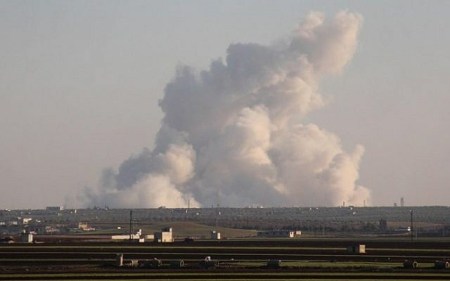
A picture taken from a rebel-held area shows smoke billowing in the Al-Nayrab area, near Idlib, following reported Syrian government air strikes on January 22, 2017. (AFP Photo/Omar Haj Kadour)

Al-Nayrab has in the past been linked with Iran’s Islamic Revolutionary Guards Corps militia.

The Observatory, which relies on a network of sources inside the country, said it had recorded a wave of blasts around Neirab on Sunday night.

It said that a suspected Israeli missile strike had targeted “positions held by Syria’s regime and its allies at the Nayrab airport” and its surroundings.

The base was reportedly previously struck by Israel on April 29 as part of a large raid that also targeted weapons depots near Hama.

There was no immediate comment from Israel, which rarely confirms such attacks.

Suspected Israeli air strikes have hit Syrian army positions near Damascus and in the central provinces of Homs and Hama in the past.

However, they rarely occur as far north as Aleppo.

The raid came hours before a high-stakes summit between Russian president Vladimir Putin and US President Donald Trump, where Syria and Iran are expected to be on the agenda.

Israel has been pushing Russia to remove Iranian-aligned militia fighters from Syria, and has vowed to stop them from getting a foothold anywhere in the country. Russia has reportedly only agreed to removing them from the Golan border region.

Prime Minister Benjamin Netanyahu, who met with Putin in Moscow last week, said Sunday he had discussed the issue with Trump a day earlier.

Netanyahu reportedly told Putin during their Wednesday meeting that Israel would not challenge Assad’s control of Syria, in exchange for freedom to act against Iran.

On July 8, Israel was accused of carrying out an airstrike on the T-4 military base near Homs, also thought to be used by IRGC fighters.

Israel announces nationwide military drills amid war preparedness on northern and Gaza fronts 

July 16, 2018

Source: Israel announces nationwide military drills amid war preparedness on northern and Gaza fronts – DEBKAfile

Saturday night, July 14, the Israeli military announced nationwide IDF exercises would be conducted until the end of the week – an effective measure for placing the armed forces on the ready for war.

The public was advised to expect unusual military traffic on the roads. This announcement appeared to conflict with earlier IDF assurances that large-scale tank and special units were standing by on the Gaza border ready for Hamas to further escalate the massive, continuous rocket barrage it launched against southern Israel as of Friday night (more than 100 rockets). A second large IDF force was on the ready on Israel’s northern border while Syrian, Hizballah and pro-Iranian troops were on the move in southwestern Syria and getting closer. 

However, launching military drills is a useful maneuver for underpinning a government’s policies, and the government in Jerusalem undoubtedly faces three fateful policy decisions:

  1. An Israeli ultimatum has been issued to Hamas to halt its various forms of anti-Israel violence from the Gaza Strip – ranging from rocket fire on civilian communities; protests riots on the border fence as the pretext for terrorist attacks and infiltration; and the destructive incendiary balloon and kites. If Hamas fails to meet this demand, the IDF will continue to escalate its attacks on the strongholds and infrastructure of Hamas and other terrorist groups in the Gaza Strip. DEBKAfile is skeptical of Hamas accepting these terms of surrender, since its leaders are flush with victory after getting away with a series of terrorist harrasments for four months. Its leaders may simply pause their rockets attacks without accepting Israel’s terms and then wait and see how Israel reacts.
  2. Another key decision depends on the outcome of the Trump-Putin summit on Monday, July 16 in Helsinki, with regard to the continued presence of Iran in Syria. If this issue is left open, the Syrian army and its Iranian allies, including an Iraqi Shiite militia, will feel free go forward for a showdown over the Quneitra region opposite Israel’s Golan border. They will be fighting under Iranian Revolutionary Guards officers.
  3. Israel is concerned that this showdown will start in the hours leading up to, or during, the Helsinki summit.

For dealing with flareups on the two fronts – north and south – the Israeli military needs roads cleared of heavy traffic and open skies.

How the Mossad stole Iran’s nuclear secrets

July 16, 2018

Following on from this previous post…

How did the Mossad get the nuclear papers out of Iran?
https://warsclerotic.com/2018/05/31/how-did-the-mossad-get-the-nuclear-papers-out-of-iran/

… is the following article from the New York Times.

How Israel, in Dark of Night, Torched Its Way to Iran’s Nuclear Secrets

//www.nytimes.com/2018/07/15/us/politics/iran-israel-mossad-nuclear.html

TEL AVIV — The Mossad agents moving in on a warehouse in a drab commercial district of Tehran knew exactly how much time they had to disable the alarms, break through two doors, cut through dozens of giant safes and get out of the city with a half-ton of secret materials: six hours and 29 minutes.

The morning shift of Iranian guards would arrive around 7 a.m., a year of surveillance of the warehouse by the Israeli spy agency had revealed, and the agents were under orders to leave before 5 a.m. to have enough time to escape. Once the Iranian custodians arrived, it would be instantly clear that someone had stolen much of the country’s clandestine nuclear archive, documenting years of work on atomic weapons, warhead designs and production plans.

The agents arrived that night, Jan. 31, with torches that burned at least 3,600 degrees, hot enough, as they knew from intelligence collected during the planning of the operation, to cut through the 32 Iranian-made safes. But they left many untouched, going first for the ones containing the black binders, which contained the most critical designs. When time was up, they fled for the border, hauling some 50,000 pages and 163 compact discs of memos, videos and plans.

In late April, Prime Minister Benjamin Netanyahu announced the results of the heist, after giving President Trump a private briefing at the White House. He said it was another reason Mr. Trump should abandon the 2015 nuclear deal, arguing that the documents proved Iranian deception and an intent to resume bomb production. A few days later, Mr. Trump followed through on his longstanding threat to pull out of the accord — a move that continues to strain relations between the United States and European allies.

Last week, at the invitation of the Israeli government, three reporters, including one from The New York Times, were shown key documents from the trove. Many confirmed what inspectors from the International Atomic Energy Agency, in report after report, had suspected: Despite Iranian insistence that its program was for peaceful purposes, the country had worked in the past to systematically assemble everything it needed to produce atomic weapons.

“It’s quite good,” Robert Kelley, a nuclear engineer and former inspector for the agency, said in Vienna, after being shown some of the fruits of the document theft. “The papers show these guys were working on nuclear bombs.”

There is no way to independently confirm the authenticity of the documents, most of which were at least 15 years old, dating from the time when an effort called Project Amad was ordered halted and some of the nuclear work moved deeper under cover. The Israelis handpicked the documents shown to the reporters, meaning that exculpatory material could have been left out. They said some material had been withheld to avoid providing intelligence to others seeking to make weapons.

The Iranians have maintained that the entire trove is fraudulent — another elaborate scheme by the Israelis to get sanctions reimposed on the country. But American and British intelligence officials, after their own review, which included comparing the documents to some they had previously obtained from spies and defectors, said they believed it was genuine.

From what the Israelis showed to the reporters in a secure intelligence facility, a few things are clear.

The Iranian program to build a nuclear weapon was almost certainly larger, more sophisticated and better organized than most suspected in 2003, when Project Amad was declared ended, according to outside nuclear experts consulted by The Times. Iran had foreign help, though Israeli officials held back any documents indicating where it came from. Much was clearly from Pakistan, but officials said other foreign experts were also involved — though they may not have been working for their governments.

The documents detailed the challenges of integrating a nuclear weapon into a warhead for the Shahab-3, an Iranian missile. One document proposed sites for possible underground nuclear tests, and described plans to build an initial batch of five weapons. None were built, possibly because the Iranians feared being caught, or because a campaign by American and Israeli intelligence agencies to sabotage the effort, with cyberattacks and disclosures of key facilities, took its toll.

David Albright, a former inspector who runs the Institute for Science and International Security, said in an interview that the documents contained “great information.”

“Iran conducted many more high-explosive tests related to nuclear weapons development than previously known,” he told Congress last month.

But the archive also shows that after a burst of activity, a political mandate delivered at the end of 2003 slowed the program dramatically, just as American officials had concluded in a 2007 intelligence report.

Israel, which has its own undeclared nuclear program, has long claimed that the Iranian program continued after 2003, and some documents show senior officials in Tehran’s program — including two who were later assassinated, presumably by Israeli agents — debating how to split it into overt and covert elements.

One of the scientists warned that work on neutrons that create the chain reaction for a nuclear explosion must be hidden. “‘Neutrons’ research could not be considered ‘overt’ and needs to be concealed,” his notes read. “We cannot excuse such activities as defensive. Neutron activities are sensitive, and we have no explanation for them.” That caution, the documents show, came from Masoud Ali Mohammadi, an Iranian nuclear physicist at the University of Tehran, who was assassinated in January 2010.

Mr. Netanyahu argues that the trove proves that the 2015 agreement, with its sunset clauses allowing the Iranians to produce nuclear fuel again after 2030, was naïve. The fact that the Iranians went to such lengths to preserve what they had learned, and hid the archive’s contents from international inspectors in an undeclared site despite an agreement to reveal past research, is evidence of their future intent, he has said.

But the same material could also be interpreted as a strong argument for maintaining and extending the nuclear accord as long as possible. The deal deprived the Iranians of the nuclear fuel they would need to turn the designs into reality.

Former members of the Obama administration, who negotiated the deal, say the archive proves what they had suspected all along: that Iran had advanced fuel capability, warhead designs and a plan to build them rapidly. That was why they negotiated the accord, which forced Iran to ship 97 percent of its nuclear fuel out of the country. Tehran would never have agreed to a permanent ban, they said.

The archive captures the program at a moment in time — a moment 15 years ago, before tensions accelerated, before the United States and Israel attacked Iran’s nuclear centrifuges with a cyberweapon, before an additional underground enrichment center was built and discovered.

Today, despite Mr. Trump’s decision to exit the deal with Iran, it remains in place. The Iranians have not yet resumed enrichment or violated its terms, according to international inspectors. But if sanctions resume, and more Western companies leave Iran, it is possible that Iranian leaders will decide to resume nuclear fuel production.

The warehouse the Israelis penetrated was put into use only after the 2015 accord was reached with the United States, European powers, Russia and China. That pact granted broad rights to the International Atomic Energy Agency to visit suspected nuclear sites, including on military bases.

So the Iranians, Israeli officials said in interviews, systematically went about collecting thousands of pages spread around the country documenting how to build a weapon, how to fit it on a missile and how to detonate it. They consolidated them at the warehouse, in a commercial district with no past relationship to the nuclear program, and far from the declared archives of the Ministry of Defense. There were no round-the-clock guards or anything else that would tip off neighbors, or spies, that something unusual was happening there.

What the Iranians did not know was that the Mossad was documenting the collection effort, filming the moves for two years, since the relocation began in February 2016. Last year, the spies began planning a heist that one senior Israeli intelligence official said bore a strong resemblance to George Clooney’s adventures in “Ocean’s 11.”

In most Mossad operations, spies aim to penetrate a facility and photograph or copy material without traces. But in this case, the Mossad chief, Yossi Cohen, ordered that the material be stolen outright. That would drastically shorten the time that the agents — many, if not all, of them Iranians — spent inside the building. But the Israelis wanted to be able to counter Iranian claims that the material was forged and offer it up for examination by international groups.

Clearly, the Israeli spies had inside help. They had learned which of the 32 safes held the most important information. They watched the habits of the workers. They studied the workings of the alarm system, so that it would appear to be working even though it would not alert anyone when the agents arrived around 10:30 p.m.

For all the cinematics of the raid, the immediate aftermath was absent much drama. There was no chase, said Israeli officials, who would not disclose whether the documents left by land, air or sea — though an escape from the coast, just a few hours’ drive from Tehran, appears the least risky.

Fewer than two dozen agents took part in the break-in. Fearing that some of them would be caught, the Israelis removed the materials on several different routes. At exactly 7 a.m., as the Mossad expected, a guard arrived and discovered that the doors and safes were broken. He sounded the alarm, and the Iranian authorities soon began a nationwide campaign to locate the burglars — an effort that, according to an Israeli official, included “tens of thousands of Iranian security and police personnel.”

The effort yielded nothing. And until Mr. Netanyahu’s speech, the Iranians never said a word in public about what had happened.

Among the most fascinating elements of the archive are pictures taken inside what were once key facilities in Iran, before the equipment was dismantled in anticipation of international inspections. One set of photos taken by the Iranians appears to show a giant metal chamber built to conduct high-explosive experiments, in a building at Parchin, a military base near Tehran.

Intelligence agencies had long suspected nuclear activity at the Parchin site, and Iran had refused to allow international inspectors in, saying that as a military base, it was off limits to inspectors and not part of any nuclear experiments.

By the time the head of the International Atomic Energy Agency, Yukiya Amano, was finally permitted to visit the site in 2015, it was empty, though the agency’s report indicated that it looked as if equipment had been removed. The photos indicate that is exactly what happened: They show a large chamber that nuclear experts say is tailor-made for the kind of experimental activity that the international inspectors were looking for.

It was part of a larger, previously known effort: Satellite photographs show that Parchin was so sanitized before the inspectors’ arrival that tons of soil in the area had been removed, to eliminate any traces of nuclear contamination.

The chamber appears to be part of neutron experiments that strongly point to an effort to build nuclear weapons. Nuclear explosions start when fast-moving particles known as neutrons split atoms of nuclear fuel in two, producing chain reactions that release more neutrons and enormous bursts of energy. At the core of an atom bomb, a device known as a neutron initiator — or sometimes a spark plug — creates the initial wave of speeding neutrons.

The Iranian papers repeatedly mention a specific substance used for making neutron initiators: uranium deuteride. Experts say it has no civil or military use other than making nuclear arms, and is known to have been used for that purpose by China and Pakistan. The initiator appears to be one of the key technologies that A.Q. Khan, the Pakistani nuclear expert who ran a black market in atomic goods, sold to Iran, North Korea and other nations.