Archive for May 2018

Amid talk of war, Israelis are keeping calm and carrying on | The Times of Israel

May 10, 2018

Source: Amid talk of war, Israelis are keeping calm and carrying on | The Times of Israel

As northern border heats up, residents say they trust IDF to successfully counter threat of Iran’s entrenchment in Syria
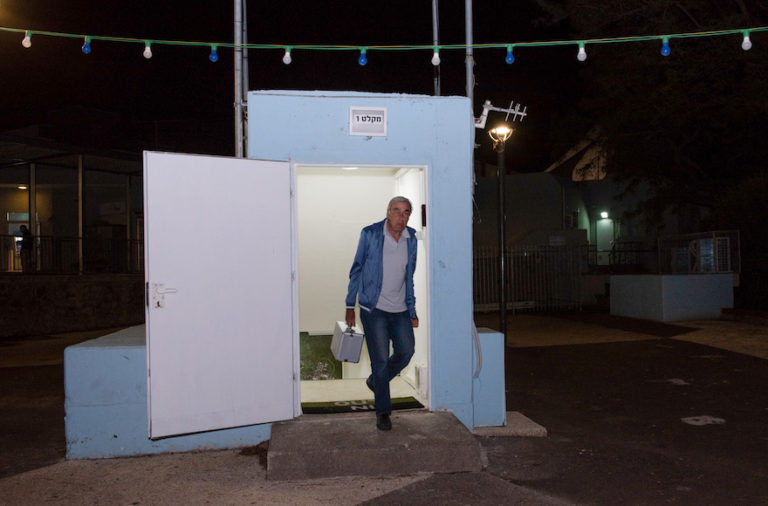
A man seen at the entrance to a bomb shelter that was opened in the Golan Heights, in northern Israel, May 8, 2018, (Basel Awidat/Flash90)

A man seen at the entrance to a bomb shelter that was opened in the Golan Heights, in northern Israel, May 8, 2018, (Basel Awidat/Flash90)

TEL AVIV (JTA) — When war broke out on Israel’s northern border in 2006, Avigdor Guy remained calm. He lived in the northern port city of Haifa, but he didn’t think the war would hit home — until, that is, it did.

“Twelve years ago, they asked me if I was worried, and I said no, of course I’m not worried,” Guy said. “And then missiles began to fall in Haifa, and it felt really bad.”

Now, as fears of a war on Israel’s northern border heat up once more, Guy, again feels fine. But this time, he says his confidence is justified. Guy, 50, thinks that Israel is better prepared on its northern front than it was in 2006, when the month-long conflict with Hezbollah ended in a draw that was seen as a failure by most Israelis. Recently, he says, Israel has been appropriately focused on threats coming from Syria.

“I’m pretty optimistic that everything will be calm,” he said. “I think that all in all, our government is taking Iran’s deepening presence in Syria seriously.”

Israelis who spoke with JTA echoed Guy’s feelings on Wednesday, a day after President Donald Trump’s decision to withdraw from the Iran nuclear deal sparked heightened fears of conflict between Israel and Iranian forces in Syria. Israelis expressed no desire for war, but said that if one breaks out, they trust their army to protect them.

(The Israelis spoke before a barrage of 20 missiles was fired at Israel just after midnight on Thursday. There were no injuries in the attack, which Israel attributed to Iranian forces in Syria. The volley sent Golan residents to bomb shelters).

As Trump was preparing on Tuesday to withdraw from the deal, which rolls back Iran’s nuclear program in exchange for sanctions relief, Israel alerted residents of the Golan Heights to open their bomb shelters. The Golan, which Israel captured from Syria in the 1967 Six-Day War, has endured fire from forces in Syria, and could be vulnerable if Iran or its proxies attacked Israel.

“I believe in our army, our strength,” said Gracia, who declined to give her last name, a 52-year-old resident of the northern city of Nahariya, which was hit hard in 2006. “We’re stronger. Even if it comes to war, everything will be all right. We’ll get along. We’re not weak and we’ll be OK.”

On Wednesday, Israel Defense Forces Chief of Staff Gadi Eizenkot visited Israel’s north for a situation assessment. The front page of Yediot Aharonot, one of Israel’s leading papers, had a split headline: Above a picture of Trump, it read: “Shut the door.” Next to that, above a picture of a bomb shelter, it read: “Opening the shelters.”
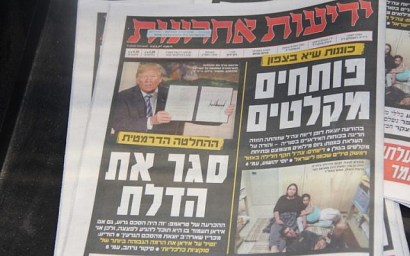
The front page of Yediot Aharonot, one of Israel’s leading papers, on May 9, 2018 juxtaposed pictures of President Donald Trump withdrawing from the Iran deal and a family sitting in a bomb shelter. (Ben Sales/JTA)

But the government has urged Israelis to keep calm and carry on. Schools in the Golan opened as normal on Wednesday. And in Tel Aviv, far from the threats up north, there was no sign of impending conflict: People strolled the boulevards, sipped their coffee and rode their bikes.

Fears of conflict have been building here for months. Iran is a principal ally of the Syrian government, and as it has entrenched its forces in that country, it has reached the brink of clashes with Israel. In February, an Iranian drone was shot down over Israeli territory. And Israel has allegedly conducted countless airstrikes in Syria, including a reported one Tuesday night. Israeli leaders have vowed to prevent Iran from establishing a military base across the Golan border.
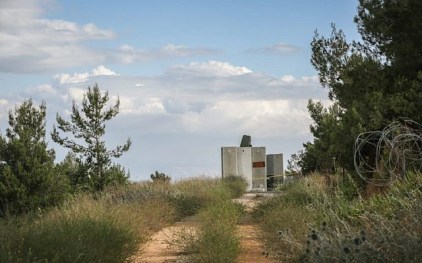
An anti-rocket missile battery seen on a mountain in northern Israel on May 9, 2018. (David Cohen/Flash90)

“It feels like something is about to happen,” said Amit Hagin, 30, a native of Haifa who has lived in Berlin for the past three years. “Obviously it’s not yet at this point [of the Lebanon War] but it can definitely get to this point. If it’s a war against Iran it means it’s going to get quite crazy.”

Despite the tensions, most of the Israelis who spoke with JTA said they supported Trump’s decision. Israeli Prime Minister Benjamin Netanyahu has made opposing the deal — and Iran’s nuclear ambitions — the centerpiece of his tenure. When the deal was passed in 2015, both the Israeli governing coalition and its opposition came out against it.

“Even if there are tensions, it’s important for us to have security,” said Yogev Yosef, 56, of Tel Aviv. “In general I think we needed to cancel the agreement. I don’t trust Bibi at all, but Bibi isn’t relevant to whether there should be an agreement.”

Israelis also said that threats of war are nothing new. Terror groups have existed on Israel’s border for decades, so the possibility of conflict is always there. This, they said, was just another one of those times.

“We’re already used to tension, so it hasn’t crossed the line where I really start to worry,” said Moria, 34, a Tel Aviv resident who declined to give her last name. “Every so often there’s something it seems like we need to be worried about, and we’ve already become jaded. So in some ways, yes, it’s troubling, but I don’t feel existential angst.”

Times of Israel staff contributed to this report.
After alleged Iranian barrage, Israel launches massive counterattack in Syria 

May 10, 2018

Source: After alleged Iranian barrage, Israel launches massive counterattack in Syria | The Times of Israel

IDF warns Syrian military not to interfere as it pummels Iranian targets in largest direct exchange between Jerusalem, Tehran

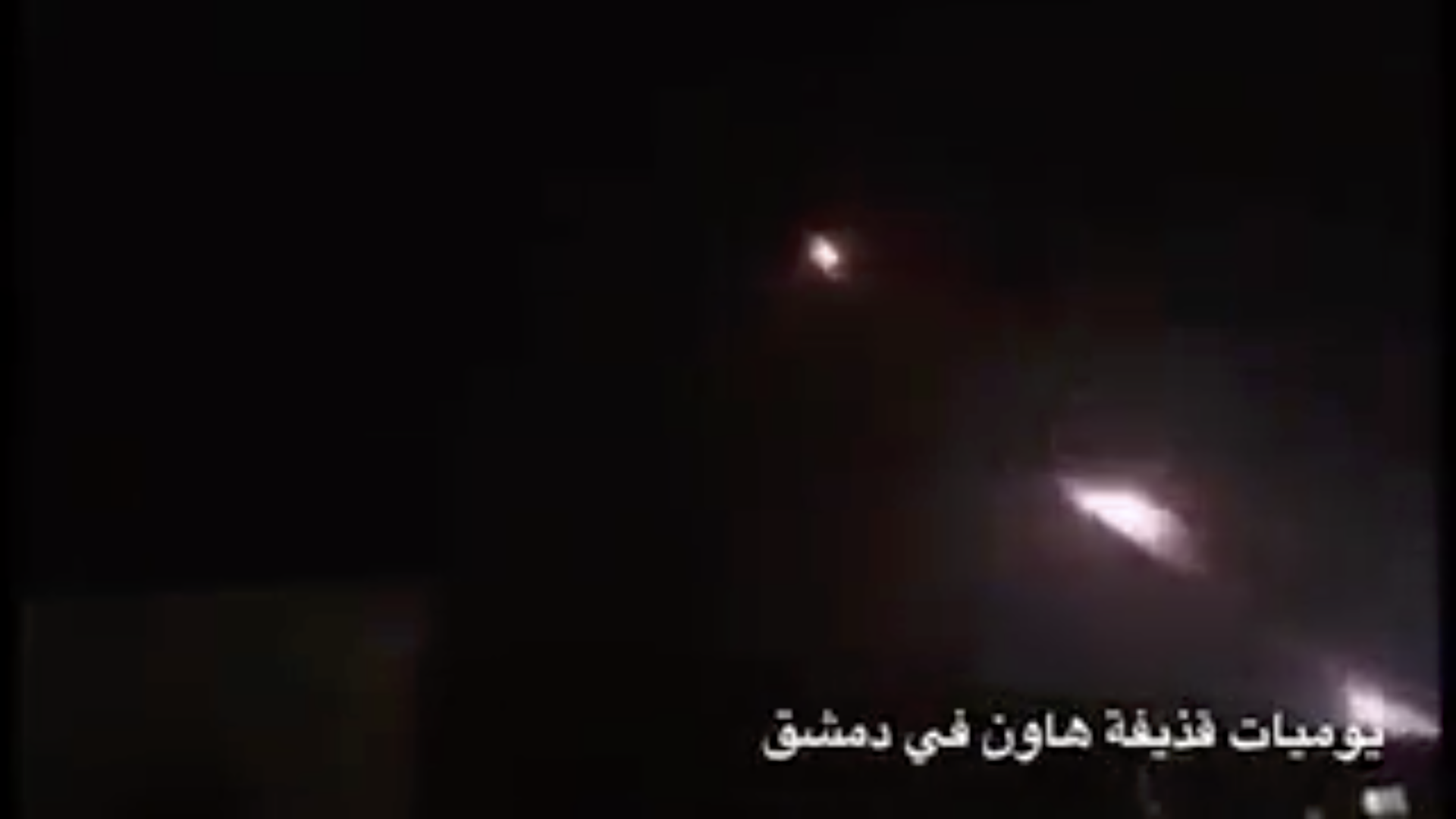
Still image from a video shared on social media, apparently showing an Iranian rocket barrage targeting Israeli military positions on the Golan Heights on May 10, 2018. (Twitter)

Still image from a video shared on social media, apparently showing an Iranian rocket barrage targeting Israeli military positions on the Golan Heights on May 10, 2018. (Twitter)

Some 20 rockets were fired at Israeli military bases by Iranian forces from southern Syria just after midnight on Thursday, sparking the largest ever direct clash between Jerusalem and Tehran, with Israeli jets targeting numerous Iranian-controlled sites across Syria.

The Israeli army said the initial missile barrage was carried out by members of the Iranian Revolutionary Guard Corps’ Quds Forces. This appeared to be the first time that Israel attributed an attack directly to Iran, which generally operates through proxies.

“The Israel Defense Forces is taking action at this moment against Iranian targets in Syria. Any Syrian involvement against this move will be met with the utmost seriousness,” wrote Avichay Adraee, the Israeli military’s Arabic-language spokesperson, on Twitter.
 According to Arabic media reports, the Israel Defense Forces struck numerous targets across Syria, including weapons depots and Assad regime radar and air defense systems.

The Israeli military would not immediately comment on its specific targets.

Syria’s state news agency, after initially reporting that the country’s air defenses were intercepting dozens of “hostile Israeli missiles,” later said Israeli jets hit military bases, as well as an arms depot and military radar, without specifying the locations.

Syrian rebels said these strikes targeted three airfields: the Shayrat air base, which was targeted by the United States last year for its role in an alleged chemical attack in the Syrian town of Khan Shaykhun; the Tha’lah air base, in southwest Syria, which has been tied to Hezbollah; and the Mezzeh military air field outside Damascus, which is reportedly home to Assad’s elite republican guard.

A large Israeli bombing raid was reported near the northwestern Syrian town of Qusayr near the Lebanese border, a known Hezbollah stronghold.

In the days and weeks before the Iranian barrage, defense officials repeatedly warned that Israel would respond aggressively to any attack from Syria.

On Wednesday, Prime Minister Benjamin Netanyahu met with Russian President Vladmir Putin in Moscow about Iran’s “explicit goal of attacking the State of Israel as part of their strategy to destroy the State of Israel,” he said. Netanyahu told reporters after the meeting that Putin was receptive to Israel’s demand that it be allowed to operate freely in Syria’s skies in order to defend itself.

The late-night Iranian rocket barrage and Israeli counterattack appeared to be the largest exchange in Syria since the 1973 Yom Kippur War.

In light of the aerial battles, numerous cities and towns in northern Israel decided to open their public bomb shelters, though the army did not require all of them to do so. In one case, residents of the northern Israeli town of Metula, along the Lebanese border, were instructed to take shelter after a loud explosion was heard in the area. They were later cleared to leave as no signs of impact were found.

Shortly before 3 a.m., a loud blast was also heard in the northern city of Safed, prompting its mayor to release a statement to residents reassuring them that the explosion was “not a missile strike or anything else, but rather an IDF launch from our area.”

Residents of central Israel reported hearing fighter jets flying overhead.

Tehran has repeatedly vowed revenge after the T-4 army base in Syria was struck in an air raid — widely attributed to Israel — on April 9, killing at least seven members of the IRGC, including a senior officer responsible for the group’s drone program.It apparently attempted to exact that revenge at 12:10 a.m. on Thursday, with its bombardment on Israeli military bases on the Golan Heights.

Sirens blared across the Golan Heights throughout the exchange, sending residents into bomb shelters. The IDF Home Front Command called on residents to adhere to security instructions as needed. Residents of the Golan Heights were told they could leave the bomb shelters around 2 a.m., but were instructed to remain near the fortified areas until further notice.

The pro-Syrian government Al-Mayadeen TV said more than 50 missiles — not 20, as the IDF said — had been fired from Syria toward Israeli forces on the Golan Heights. A Syrian parliamentarian claimed on Twitter that Damascus, not Tehran, had launched the attack.

Immediately following the barrage, Syrian state media reported that Israeli artillery fire targeted a military post near the city of Baath in the Quneitra border region, where Syrian regime forces were stationed.

An Israeli artillery unit takes position near the Syrian border on the Golan Heights on May 9, 2018. (Jalaa Marey/AFP)

In the hours that followed, this Israeli retaliation expanded to include more artillery strikes and aerial bombings, according to Syrian reports.

Following the initial exchange, IDF spokesperson Lt. Col. Jonathan Conricus said the army was still sorting out many of the specific details related to the missile attack, such as which army bases were targeted, what types of projectiles were used, how many rockets were fired, from where they were launched, and how many were intercepted.

A video shared on social media shortly after midnight on Thursday appeared to show the barrage of missiles apparently being fired by a  multiple launch rocket systems, or MLRS, from Syria toward Israel.

Residents of both the Israeli and Syrian Golan Heights reported hearing loud, repeated explosions.

A man inside a bomb shelter in the northern Israeli city of Safed, May 8, 2018. (David Cohen/Flash90)

The attack came a day after the military called on local governments on the Golan Heights to open bomb shelters, in light of “abnormal” activities by Iranian forces in Syria. The barrage also followed US President Donald Trump’s announcement on Tuesday night that he was pulling the United States out of the Iran nuclear deal and reimposing sanctions on Tehran.

On Tuesday, eight Iranians were among 15 foreign pro-regime fighters killed in a suspected Israeli strike in Syria on a weapons depot of Iran’s elite Revolutionary Guards, a monitor said. The raid struck the area of Kisweh south of Damascus late Tuesday, the Britain-based Syrian Observatory for Human Rights monitoring group said on Wednesday.

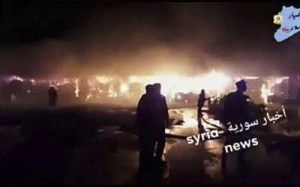
This frame grab from video provided on Wednesday, May, 9, 2018 by Syria News, shows people standing in front of flames rising after an attack on an area known to have numerous Syrian army military bases, in Kisweh, south of Damascus, Syria on Tuesday. (Syria News, via AP)

Syria’s official news agency SANA said on Tuesday the army had intercepted two Israeli missiles fired toward Kisweh, with state television broadcasting images of fires in the nearby area.

Since the start of Syria’s civil war in 2011, Israel has repeatedly targeted positions of the Syrian army and the Lebanese Hezbollah terror group backing it inside the country.

On April 29, missile strikes — “probably Israeli” — fired on regime military positions near the cities of Hama and Aleppo in northern Syria killed at least 26 mostly Iranian fighters, according to the Observatory.

On April 9, missiles targeted the T-4 air base in the central province of Homs, killing up to 14 fighters, including seven Iranians, two days after an alleged chemical attack carried out by the Syrian regime.

Russia, Iran and Syria accused Israel of carrying out the strike.

In light of both the general tension and specific intelligence, the IDF went on high alert this week, deploying additional missile defense batteries in northern Israel. “There is high preparedness of IDF troops for an attack,” the army said on Tuesday.

A number of army reservists were called upon Tuesday night, the army said. An IDF spokesperson would not elaborate on which units they came from, but media reports indicated they served in air defense, intelligence and Home Front Command units.

Earlier on Tuesday, the US embassy in Israel also prohibited American government employees from visiting the Golan Heights without approval in light of the security situation on the border.

“The IDF is ready and prepared for a variety of scenarios and warns that any action against Israel will be answered with a fierce retaliation,” the army said.

On Sunday night, Israeli defense officials warned that Iran was planning to retaliate for recent deadly airstrikes in Syria, which have been attributed to the Jewish state, by having its proxies fire missiles at military targets in northern Israel sometime in the near future.

Security forces were also preparing for the possibility of attempted infiltrations of military bases and communities in the north, Hadashot TV news reported on Monday.

Agencies contributed to this report.

Iranian Forces Launch 20 Rockets at Israel, Israelis Rush to Bomb Shelters

May 10, 2018

Iranian Forces Launch 30 Rockets at Israel, Israelis Rush to Bomb Shelters

The IDF reported in a statement at about 1 am Thursday that Iranian forces fired 20 rockets at Israel on the Golan Heights, shortly after midnight late Wednesday night. Iron Dome shot down some of the rockets. The statement continued that there are no wounded and no known damage is reported.

There were reports of Syrian air defenses firing towards the border town of Quneitra. Arab sources reported that Israel Defense Forces were shelling areas near the city of Quneitra, perhaps related to reports of an IDF attack that began shortly before midnight. Arab sources claim the IDF hit a Hezbollah position, and that anti-aircraft fire was emanating from Syria.

Video of shooting towards towards Israel. May 10, 2018

Red Alert incoming rocket siren blared through the Golan Heights shortly after midnight, sending area residents racing for shelter in their safe spaces. The alert was heard in areas of the Golan Heights and in the city of Katzrin. Residents have been told to stay in their shelters.

Parents leaped out of beds, grabbed sleeping children and made a beeline for the bomb shelters that were opened in preparation for just such a possibility a day or two earlier.

Hezbollah has threatened to strike harder and deeper into Israel, if Israel responds to this attack.

1:35 AM: Syrians report explosions in Damascus and Kuneitra countryside. There is no more attacking coming from the Syrian side.

Jubeir: Saudi Arabia will seek nuclear weapon if Iran does

May 9, 2018


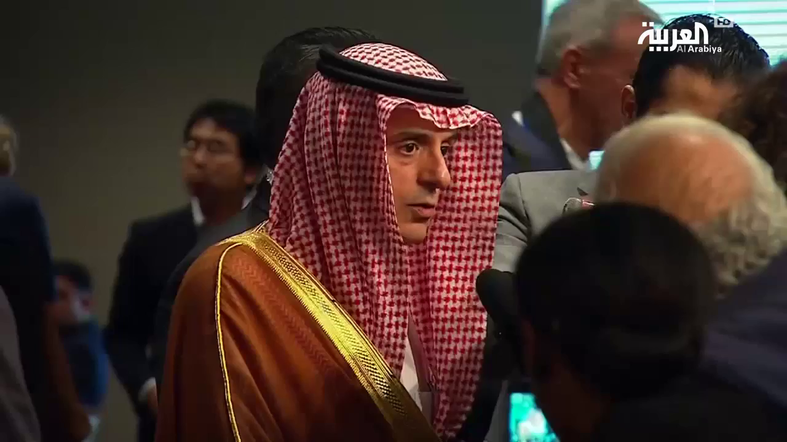
Foreign Minister Adel al-Jubeir made the statement during his interview with CNN. (Al Arabiya)

AFP Wednesday, 9 May 2018

Source: Jubeir: Saudi Arabia will seek nuclear weapon if Iran does

{Iran’s list of enemies grows longer. – LS}

Saudi Arabia will seek to develop its own nuclear weapons if Iran does, Foreign Minister Adel al-Jubeir told CNN on Wednesday, amid spiraling tension between the regional rivals.

Asked whether Riyadh would “build a bomb itself” if Tehran seizes on Washington’s withdrawal from the 2015 Iran deal to resume a nuclear weapons program, Jubeir said: “If Iran acquires nuclear capability we will do everything we can to do the same.”

Saudi Arabia has long said it would match any Iranian weapons development, but Jubeir’s renewed vow came after US President Donald Trump pulled the United States out of an accord designed to prevent Tehran’s alleged quest for the bomb.

And it came amid growing tension over Iran’s support for the Houthi rebels in Yemen, who have been firing rockets across the border.

Riyadh, which is part of a regional coalition that intervened in Yemen’s civil war to fight the Houthis, accuses Iran of supplying the militia with ballistic missiles.

“These missiles are Iranian manufactured and delivered to the Huthis. Such behavior is unacceptable. It violates UN Resolutions with regards to ballistic missiles. And the Iranians must be held accountable for this,” Jubeir told CNN.

“We will find the right way and at the right time to respond to this,” he warned. “We are trying to avoid at all costs direct military action with Iran, but Iran’s behavior such as this cannot continue. This amounts to a declaration of war.”


Israel  BOMBING Damascus right now…

May 9, 2018


“Eye of the Tiger ” with on-screen lyrics – Israel Air force


Donald Trump Announces Freedom for American Citizens Detained in North Korea

May 9, 2018

President Donald Trump announced Wednesday morning that Secretary of State Mike Pompeo was returning from North Korea after successfully negotiating the release of three American citizens.

by Charlie Spiering9 May 2018

http://www.breitbart.com/big-government/2018/05/09/donald-trump-announces-freedom-for-american-citizens-detained-in-north-korea/

AFP/Getty Images

“I am pleased to inform you that Secretary of State Mike Pompeo is in the air and on his way back from North Korea with the 3 wonderful gentlemen that everyone is looking so forward to meeting,” Trump announced on Twitter. “They seem to be in good health.”

Kim Dong-chul of Virginia was detained in 2015, sentenced to ten years in prison on charges of espionage and subversion. Accounting Professor Tony Kim and Pyongyang University Professor Kim Hak-song were both detained in 2017.

Trump also announced he would travel to Andrews Air Force Base to personally welcome the three freed detainees home to the United States.


“Secretary Pompeo and his ‘guests’ will be landing at Andrews Air Force Base at 2:00 A.M. in the morning,” he wrote. “I will be there to greet them. Very exciting!”

Trump praised Pompeo’s successful meeting with Kim, looking forward to his upcoming summit with the North Korean dictator.

“Also, good meeting with Kim Jong Un,” he wrote. “Date & Place set.”

Better think twice !

May 9, 2018

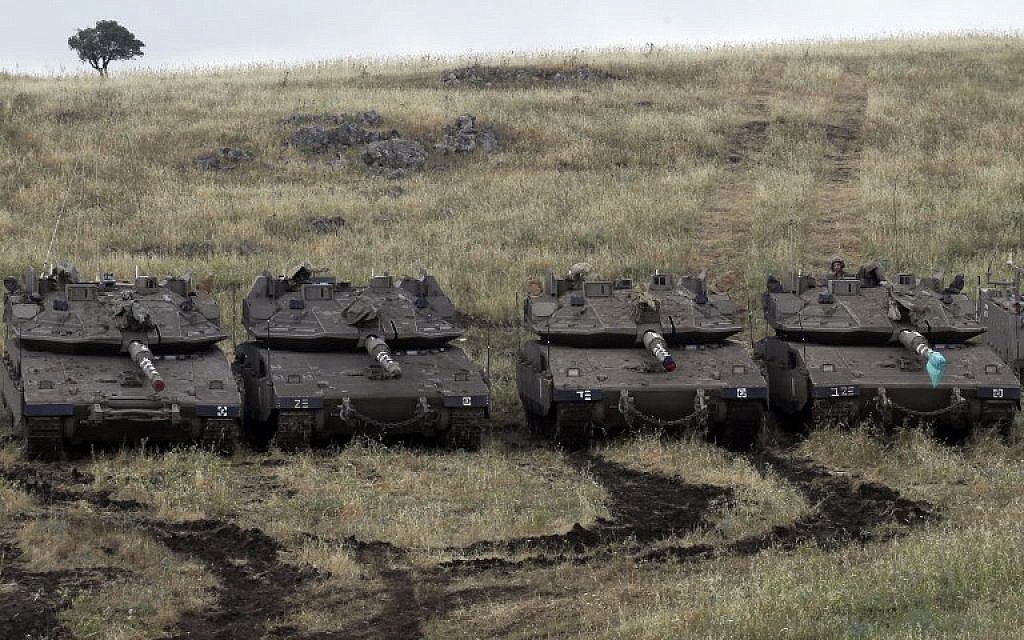
Israeli Merkava Mark IV tanks take positions near the Syrian border in the Golan Heights on May 9, 2018. (AFP PHOTO / JALAA MAREY)

Frequently Asked Questions Regarding the Re -Imposition of Sanctions Pursuant to the May 8, 2018 National Security Presidential Memorandum Relating to the Joint Comprehensive Plan of Action (JCPOA)

May 9, 2018

U.S. Treasury Department 5-08-2018

Source: Frequently Asked Questions Regarding the Re -Imposition of Sanctions Pursuant to the May 8, 2018 National Security Presidential Memorandum R elating to the Joint Comprehen sive Plan of Action

{Here are the official details regarding sanctions and the JCPOA withdrawal. – LS}

Note: This document is in PDF format. Click HERE or the source link above to view.

3 Americans detained in North Korea ‘in good health’ and on their way back to US, Trump says 

May 9, 2018

Source: 3 Americans detained in North Korea ‘in good health’ and on their way back to US, Trump says | Fox News

Three Americans detained in North Korea “seem to be in good health” and are on their way back to the United States, President Trump announced in a Wednesday tweet.

“I am pleased to inform you that Secretary of State Mike Pompeo is in the air and on his way back from North Korea with the 3 wonderful gentlemen that everyone is looking so forward to meeting. They seem to be in good health. Also, good meeting with Kim Jong Un. Date & Place set,” Trump tweeted Wednesday morning.

Trump’s Iran deal withdrawal: It should never have come to this 

May 9, 2018

Source: Trump’s Iran deal withdrawal: It should never have come to this | The Times of Israel

Now we have the US on one side, Iran on the other, and 5 others in between. Iran will exploit the disunity. But don’t blame Trump for that. Blame the original sin

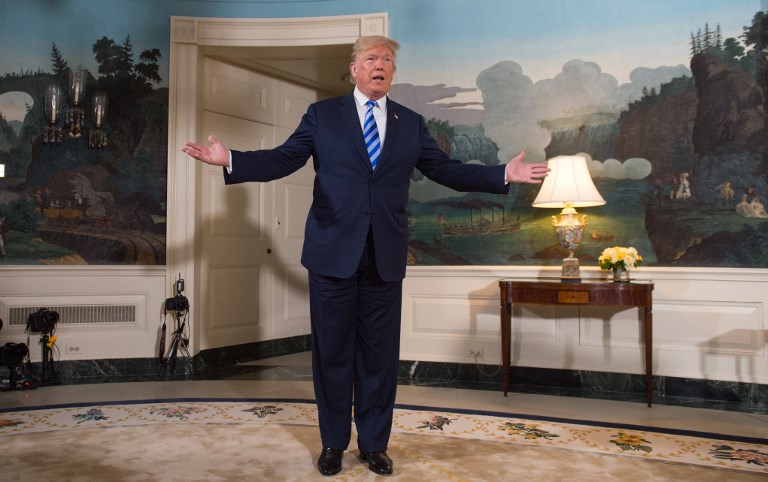
US President Donald Trump speaks to the press as he leaves after announcing his decision about the nuclear deal with Iran during a speech from the Diplomatic Reception Room at the White House in Washington, DC, May 8, 2018. (AFP / SAUL LOEB)

One line in US President Donald Trump’s withering dissection of the 2015 P5+1 negotiators’ inadequate and now tottering agreement with Iran is worth particular attention. “A constructive deal could easily have been struck at the time, but it wasn’t,” said the president, announcing the US withdrawal from the accord on Tuesday.

The Obama administration, chef and champion of the deal, would, obviously, take issue with that assertion. But even if the “easily” is an overstatement, Trump is right. A proper, adequate deal was there for the making. The P5+1 — as in, the Obama administration — failed to make it.

And as the Trump administration must now restart the work that the 2015 deal was supposed to achieve but didn’t, its task will be more complicated than the original mission the previous US administration so signally failed to achieve.

A “constructive deal” — that is, a deal to dismantle Iran’s rogue nuclear program —  could indeed have been struck in the Obama years, when economic pressure had dragged the Iranian regime kicking and screaming to the negotiating table. The ayatollahs feared for their hold on Iran; the West had maximal leverage. The Russians and Chinese would have sought to resist a stringent agreement that put Iran out of the nuclear weapons business for the long term, but a US administration that made plain the top priority it placed on the imperative for an agreement to keep the world’s most dangerous regime from attaining the world’s mass dangerous weapons of mass destruction could have got its way.

Israel, the Little Satan in the ayatollahs’ rapacious sights, could have injected some Middle East nous into the battle of wills, but was kept at a firm distance by the Americans. The only truly dependable ally of the West in this region, with the best intelligence apparatuses, was told to butt out. Worse, we were haughtily informed that since we didn’t know what was in the deal when it was taking shape we shouldn’t be objecting to it, and then, when it was done, we were falsely accused of being opposed to any deal, no matter what it contained.

Then US president Barack Obama, right, and Prime Minister Benjamin Netanyahu hold a meeting in the Oval Office of the White House on November 9, 2015. (AFP/Saul Loeb)

Meanwhile, the US-led negotiators were outsmarted and outmaneuvered. The Iranians were let off the hook. The regime got the deal it wanted. And it was entrenched in power — bolder and richer, the better to oppress its people, cause havoc in the region, and keep its eye on the nuclear prize.

Iran is currently threatening that it may resume uranium enrichment and boasting that it has improved its technology so that it can enrich to higher levels than ever before — all while complying with the deal. That tells you all you need to know about the agreement. It did not require Iran to trash all of its centrifuges, and it allowed Iran to continue research and development on enrichment. Good job, negotiators. Well done.

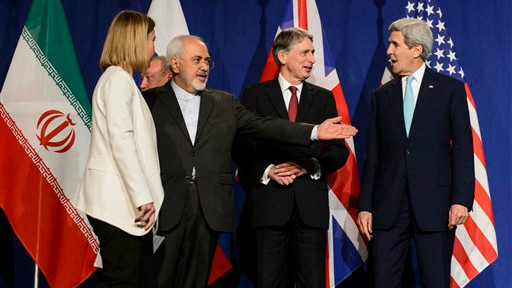
From left, EU High Representative for Foreign Affairs and Security Policy, Federica Mogherini, Iranian Foreign Minister, Mohammad Javad Zarif, British Foreign Secretary, Philip Hammond, and US Secretary of State, John Kerry, after a new round of Nuclear Iran Talks in the Learning Center at the Swiss federal Institute of Technology (EPFL) in Lausanne, Switzerland, April 2, 2015 (AP/Keystone, Jean-Christophe Bott, File)

The P5+1’s failure to stop the ayatollahs dead in their would-be nuclear tracks is mirrored by the demonstrably lackadaisical approach of the International Atomic Energy Agency, the UN body charged with policing the deal. How it can allow itself to certify that Iran is complying with the accord when the terms of the deal do not allow it to carry out anytime-anywhere inspections of suspect sites is beyond comprehension. And its response to the Mossad’s astonishing haul of Iran’s own nuclear weapons documentation in the past few days simply beggars belief.

Imagine that your entire life’s work is dedicated to one acutely sensitive area of expertise, that you are constantly hampered by restricted access to your core research material, but that you are nonetheless the world authority in your field. Then imagine that someone else manages, through extraordinary enterprise and courage, to gain access to more core material, much more, than you could ever have imagined existed. And offers to make it available to you.

Would you a) express your profound gratitude and rush to pore over the new discoveries or b) dismiss the material, sight unseen, as irrelevant? No prizes for guessing which course of action the IAEA adopted hours after Prime Minister Benjamin Netanyahu unveiled and began to detail Iran’s own nuclear weapons documentation, spirited out of Tehran from under the noses of the Islamic “We have never sought nuclear weapons” Republic.

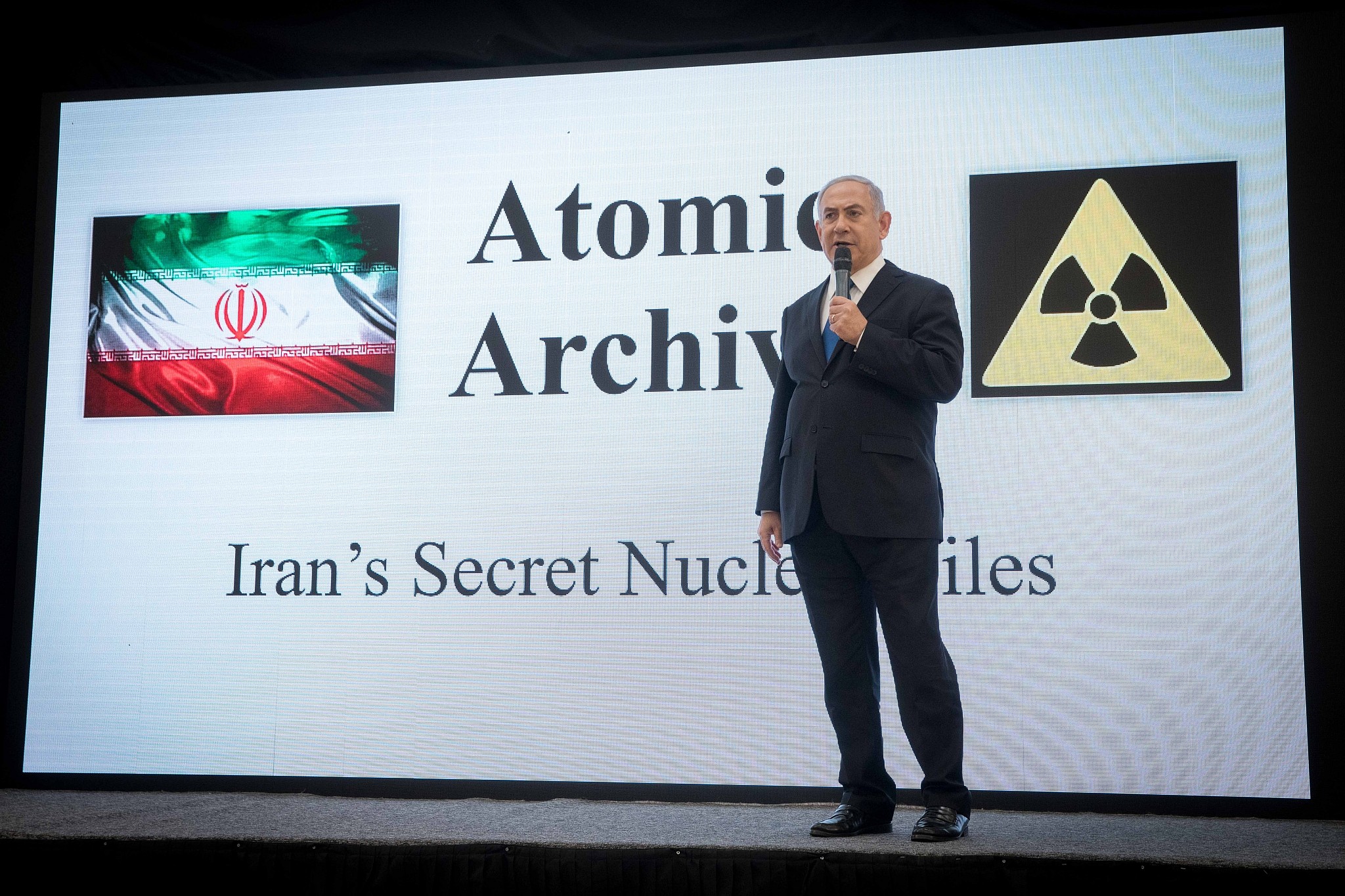
Prime Minister Benjamin Netanyahu presents Iran’s own documentation of its nuclear weapons program, at a press conference in Tel Aviv, on April 30, 2018. (Miriam Alster/Flash90)

Trump’s decision to nix rather than fix the 2015 agreement creates a highly complex new reality. Hitherto, the P5+1 countries, however strained the ties between them, were at least ostensibly lined up together, behind their infirm accord, against the ayatollahs.

Now, we have the US on one side, Iran on the other, and Britain, France, Germany, China and Russia all pulling in slightly different directions in between. Iran can be relied upon to exploit the disunity.

But don’t blame Donald Trump for that. Blame the original sin — a deal that was supposed to dismantle Iran’s rogue nuclear weapons program, but, simply, didn’t.