Archive for May 2018

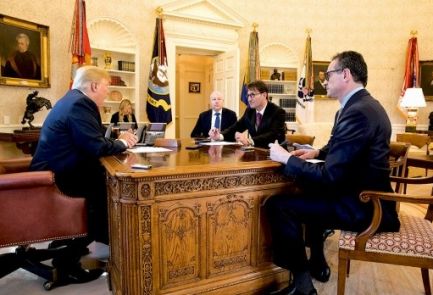
A man of his word

May 11, 2018

Source: A man of his word – Israel Hayom

( His personal behavior { Stormy et al } is truly sickening.  At the same time he may well be the best policy President of my 64 years.  Can you imagine where we’d be if Clinton had won? – JW )

Hamas: Riots on Day of US Embassy Opening in Jerusalem Will Be ‘Decisive’

May 11, 2018

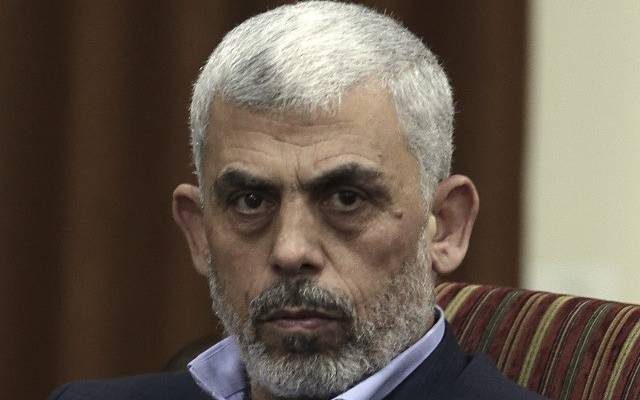
Yahya Sinwar, the Gaza-based leader of Hamas, says the riots planned for next week will be “like a tiger running in all directions.”

By: The Tower

https://unitedwithisrael.org

Tigers are almost extinct. ( added by JK )

Hamas leader in the Gaza Strip Yahya Sinwar (AP/Khalil Hamra)

In an apparent threat to Israel, the leader of Hamas, the Gaza-based terrorist organization, said that next week’s riots at the border fence with Israel would be “decisive,” Israeli media reported.

The Hamas-led riots, which had originally been described as non-violent, involve rioters attempting to tear down the border fence with Israel, throwing rocks at soldiers, and sending kites over the fence with burning fuel in attempts to start fires inside Israel. Last week, rioters entered the Kerem Shalom crossing and set storage facilities on fire, including pipelines that bring gas into Gaza. This is the seventh consecutive week that riots are being held.

Yahya Sinwar, the Gaza-based leader of Hamas, said that the riot next week planned for May 14, the day the United States Embassy is slated to open in Jerusalem, will be “decisive.” Israel imposed the blockade when Hamas expelled Fatah, the main Palestinian political party, from Gaza in 2007 and took control of the enclave. Hamas remains committed to Israel’s destruction, has accumulated an arsenal of rockets, and built terror tunnels with the aim of attacking Israel.

“We can’t stop these protests. We are supporting, even leading, them,” Sinwar said. The riots will be “like a tiger running in all directions,” he said.

Hamas has claimed that the goal of the riots is to gain the “right” to return to all of Israel, meaning the destruction of Israel. Israel has charged that the goal is to cover for violent activities, including efforts to breach the border fence.

Sinwar made the comments in a speech to activists, who have been leading the riots. According to media reports, Hamas has been indicating that it could encourage the rioters to storm the fence.

The Hamas-run health ministry in Gaza claims that 48 rioters have died since the first protest too place on March 30. According to the Meir Amit Intelligence and Terrorism Information Center, which uses publicly available information to identify casualties, 80% of the rioters who have been killed were a member of, or otherwise affiliated with terrorist organizations.

In a conference call hosted by The Israel Project, Maj.-Gen. (ret.) Israel Ziv, former head of IDF’s Gaza Division, assessed that the rioters would use grenades, improvised explosives, “anything that can fly over the fence and burn.”

He added, “we don’t expect anything terribly new.” However, if Hamas attempts to use the riot to “maneuver a terror unit, commando units or things of that kind …, to penetrate to Israel, to go to some of the settlements, the IDF is ready for those options as well,” Ziv asserted.

Everything Destroyed: IDF Releases Aerial Images of Attacked Iranian Targets

May 11, 2018


 http://www.jewishpress.com/news/middle-east/syria/everything-destroyed-idf-releases-aerial-images-of-attacked-iranian-targets/2018/05/11/
Iranian Intelligence sites in Syria that were attacked
On Friday morning, the IDF Spokesperson’s Office issued aerial photographs of several Iranian facilities that were attacked by the Israeli Air Force during Operation House of Cards early Thursday morning. The published photographs show the Tel Gharba, Tel Kleb, Tel Maqdad, Tel Nabi Yusha, and the logistic military installations of the Revolutionary Guards’ Quds Force near Damascus.
Iranian logistical site near Damascus that was attacked / Photo credit: IDF Spokesperson
During the operation, about 50 Iranian targets were attacked in Syria, reaching intelligence positions, outposts, headquarters and equipment storage facilities in 16 different locations across the country.
Quds Force Military compound that was attacked / Photo credit: IDF Spokesperson

Reports in Israeli media on Friday morning suggested the Russians were not necessarily unhappy to see Iran get a severe nose bleed from the Israeli attacks, since Iran has introduced an unacceptable level of instability to the area the Russians have been trying to tame back for their client, President al-Assad.

It is roughly estimated that Iran has some 4,000 Revolutionary Guards military personnel, instructors, advisers and soldiers stationed in Syria. In addition, about 8,000 Hezbollah fighters are deployed in Syria as well, along with some 40,000 fighters in Shi’ite militias from Iraq, Pakistan, and Afghanistan. None of these are particularly loyal to the Russian mission statement in Syria…

Russia seeks mediator role between Israel and Iran

May 11, 2018

Source: Russia seeks mediator role between Israel and Iran | The Times of Israel

With no way to get Jerusalem and Tehran at the same table, Moscow will seek to make sure the conflict does not spiral out of control

Russian President Vladimir Putin, right, meets with Prime Minister Benjamin Netanyahu at the Kremlin in Moscow on May 9, 2018. (SERGEI ILNITSKY/AFP)

Russian President Vladimir Putin, right, meets with Prime Minister Benjamin Netanyahu at the Kremlin in Moscow on May 9, 2018. (SERGEI ILNITSKY/AFP)

MOSCOW, Russia (AFP) — Following Israeli strikes on Iranian targets in Syria, Russia has positioned itself as a mediator between the Middle Eastern rivals as it has maintained good relations with both countries.

“The Kremlin is sitting on two chairs,” Russian analyst Alexei Malashenko told AFP.

“It is a complex and difficult situation for Russia that has links with both of the sworn enemies.”

Israel carried out raids on dozens of Iranian military targets on Thursday after it said around 20 rockets were fired from Syria at its forces in the Golan Heights.

Russia was quick to call for restraint, with Russian Foreign Minister Sergei Lavrov saying on Thursday that “all issues should be solved through dialogue.”

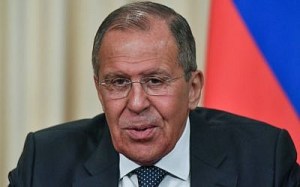
Russian Foreign Minister Sergei Lavrov attends a joint press conference with his German counterpart following their talks in Moscow on May 10, 2018. (AFP PHOTO / Yuri KADOBNOV)

He added that Russia had warned Israel to avoid “all actions that could be seen as provocative” the day before the strikes, when Prime Minister Benjamin Netanyahu was in Moscow for talks with President Vladimir Putin.

Russian analyst Fyodor Lukyanov said relations between Putin and Netanyahu were “very good” and that the meeting, on the eve of the strikes, showed Russia could play a major role in the Israel-Iran dispute.

“Moscow could use its good relations with the two countries to help them communicate and make sure confrontation does not exceed certain limits,” Lukyanov said.

Major player

Russia has become a major player in the Middle East since intervening in the Syrian war on the side of the Damascus regime in September 2015. Analysts also highlight its role as mediator in other conflicts in the area.

“The role of Russia as a mediator is strongly appreciated in the region. This role will be reinforced if the crisis between Israel and Iran worsens,” said Alexander Krylov, a foreign policy expert at the Moscow State Institute of International Relations.

Krylov told AFP that Russia’s “additional value” is that it has good relations with forces that other actors refuse to speak to such as with Hamas, Hezbollah, Iran, and the Kurds.

Russia’s good ties to Israel were demonstrated by Netanyahu’s visit, he said.

“I do not rule out the idea that Israel gave some clues to Russia about the strikes,” Krylov said.

But even if Russia considers Israel’s security concerns over Iran legitimate, Lukyanov said, it sees Iran as an “indispensable partner on many issues, especially in Syria.”

Turkish President Recep Tayyip Erdogan (C), Russian President Vladimir Putin (R), and President of Iran, Hassan Rouhani (L) pose for a photo ahead of the Turkey-Russia-Iran Tripartite summit in Ankara, Turkey on April 04, 2018. (AFP PHOTO / POOL / TOLGA BOZOGLU)

Russia, Iran, and Turkey regularly meet to discuss the regulation of the Syrian war, where the three countries have positioned themselves as major players.

Unlike Turkey, Iran and Moscow are unflinching allies of the Bashar Assad regime and often maintain a united diplomatic front.

Analyst Alexei Malashenko said Russia would do everything possible to maintain relations with both Israel and Iran without taking a stand, especially since Israel’s strikes “do not threaten” Moscow’s position in Syria.

“If Israel were to defy Russia’s dominant role, Russia would react and take a stand. This is unlikely to happen because Israel knows Russia defines the rules in Syria,” said Lukyanov.

‘Anti-Iranian sentiment’

But if escalation continues, Moscow will find it difficult to keep playing a mediator’s role.

“Even with the best intention, nobody can bring Iran and Israel to the same table,” said Malashenko.

He added that Russia is also closely watching Washington’s exit from the Iran nuclear deal, which the Kremlin has opposed. On Thursday Moscow said it would continue a “close collaboration” with Iran on the agreement.

Lukyanov said it may not have been coincidental that the Israeli strikes took place shortly after US President Donald Trump announced his country’s withdrawal from the deal.

“Iran’s enemies can only be inspired by this decision: there is a very strong anti-Iranian sentiment,” Lukyanov said. “Increased US pressure on Iran has certainly helped Israel fulfill its agenda.”

COLUMN ONE: Netanyahu’s finest hour

May 11, 2018

Source: COLUMN ONE: Netanyahu’s finest hour – Opinion – Jerusalem Post

BY CAROLINE B. GLICK
 MAY 10, 2018 21:24
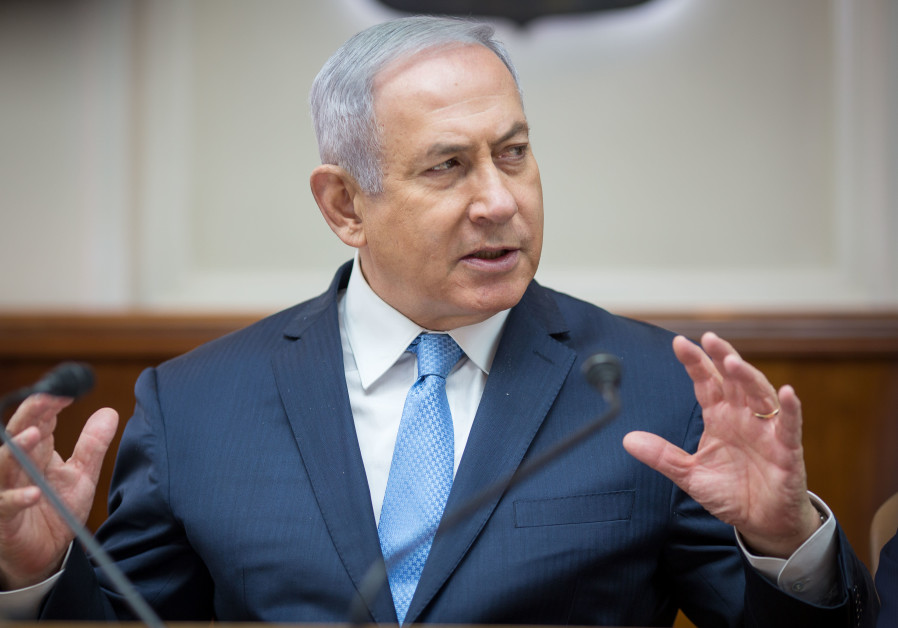
Prime Minister Benjamin Netanyahu at a weekly cabinet meeting, May 6th, 2018.

Prime Minister Benjamin Netanyahu at a weekly cabinet meeting, May 6th, 2018.. (photo credit: EMIL SALMAN/POOL)

At the start of his cabinet meeting on Wednesday, President Donald Trump discussed his announcement Tuesday afternoon that he is removing the US from his predecessor Barack Obama’s nuclear deal with Iran and reinstating the nuclear sanctions that were suspended with the deal’s implementation in January 2016.

European and other international leaders responded angrily to Trump’s move. The EU’s foreign policy commissioner Federica Mogherini was downright indignant.

Apparently unaware that the US is a more important EU ally than Iran, Mogherini insisted, “The European Union is determined to preserve it. Together with the rest of the international community, we will preserve this nuclear deal.”

The liberal US media outlets were also aghast. Commentators joined the chorus of former Obama administration officials condemning Trump and insisting his move will isolate the US from the international community.

Trump brushed off his critics by noting, “You saw [Prime Minister] Benjamin Netanyahu get up yesterday and talk so favorably about what we did.”

In other words, as far as Trump is concerned, Israel’s support is just as valuable as Mogherini’s. He’s perfectly willing to suffice with Israeli support. Having Israel in his corner means that the US is not isolated.

From moving the US Embassy to Jerusalem, to walking away from the nuclear deal which guaranteed Iran’s eventual acquisition of nuclear weapons and financed its regional aggression and terrorism sponsorship, to unconditionally supporting Israel’s military operations against Iranian positions in Syria, Trump has demonstrated that he is the most pro-Israel president in US history. No other president comes close.

The difference between Trump and his predecessors is that Trump accepts Israel on its own terms. He doesn’t expect Israel to do anything to “earn” American support. So long as Israel is in America’s corner, he respects the Jewish state as America’s ally.

Trump has earned all the credit for transforming the US-Israel relationship into a full-blown strategic relationship. But it was another leader that prepared the groundwork for his actions.

That leader is Netanyahu.

For many Republicans, Netanyahu is the most important foreign leader of our times. In the ranks of their esteem he ranks a close second to Winston Churchill. Netanyahu’s high standing is all the more remarkable given that Israel has no British Empire behind it. In the vast scope of things, Israel is a tiny country with no coattails.

Republicans aren’t the only ones who admire him. World leaders from Russian President Vladimir Putin to Indian Prime Minister Narendra Modi to Chinese Premier Xi Jinping welcome him to their capitals like a visiting monarch. Sandwiched between two major Israeli air assaults on Iranian military assets in Syria Tuesday and Wednesday night, Netanyahu flew to Moscow. He stood next to Putin in Red Square as the Red Army Band played “Hativka” during the parade marking the 73rd anniversary of the Allied victory over Nazi Germany.

What explains his meteoric rise? How is it possible that an Israeli politician from the political Right, a man castigated for decades by the local and Western leftist elites as a fanatic and an extremist, is so revered today?

To understand Netanyahu’s success, a comparison with the late Shimon Peres is in order. Until his death, the same elites who revile Netanyahu revered Peres as the greatest Israeli statesman of all time.

Peres had a clear formula for statesmanship. He identified the interests of key actors – first and foremost, the Europeans – and he adopted them.

Consider his central foreign policy initiative, the Oslo peace process with the PLO.

Since the 1970s, the Europeans sought to legitimize the PLO – at Israel’s expense. In 1993, then-foreign minister Peres turned their goal into an ideology of peace and adopted it as his own.

On Monday, Labor MK Eitan Cabel said that if the late Yitzhak Rabin had known the toll the Oslo process would take on Israel, he never would have adopted it.

In his words, “From my dealings with [Rabin], in my view, if he had known the price the State of Israel would pay for the Oslo agreements, he never would have agreed to them.”

Peres, of course, was different. As the Israeli casualties of his peace process mounted from the tens to the hundreds to the thousands, and as Israel’s international position sunk ever lower, Peres became more dogmatic in its defense.

For his efforts, Peres was personally glorified by the A-list crew of European and American elites. They came to his extravagant birthday parties and had their photos shot embracing him. But none of his triumphs were shared with the country.

Netanyahu, has a different approach to diplomacy. Netanyahu identifies Israel’s national interests. Then he scans the international community for actors with aligned interests. He uses his considerable power of persuasion to convince those actors to achieve common goals.

The discrepancy between the two men’s approaches is nowhere more apparent than in their divergent moves to develop ties with the Arab world.

Peres viewed the Arab world from a European perspective. The EU views the Arab world as a monolithic presence moved only by Israel’s willingness to give Jerusalem to the PLO. So long as Israel refuses to give up Jerusalem, the Arabs will reject the Jewish state. Once Israel has conceded its eternal capital – and Judea and Samaria along with Gaza – the Arabs will be placated in one fell swoop and immediately embrace Israel as a neighbor and friend.

This view, which Peres gave voice to in his book The New Middle East, bears no relationship whatsoever to the realities of the Middle East.

Consequently, rather than embrace his vision, the Arabs viewed it as a Jewish conspiracy to take over the Arab world.

In stark contrast, Netanyahu has built his regional strategy on the real Middle East. During the Obama years, Netanyahu realized that Obama’s policies toward Iran and the Muslim Brotherhood imperiled Sunni Arab states no less, and perhaps even more, than they imperiled Israel.

Netanyahu developed relations with Egypt, Saudi Arabia and the UAE on the basis of these shared concerns and shared interests in diminishing the deleterious consequences of Obama’s policies. Although Netanyahu’s moves are unlikely to generate extravagant signing ceremonies with doves and balloons, they did bring about a situation where the Saudis, Egyptians and the UAE sided with Israel against Hamas, Qatar and Turkey during Operation Protective Edge in 2014.

That united front prevented Obama from coercing Israel into accepting Hamas’s cease-fire terms in the war.

So too, the relationships Netanyahu built formed the basis of a united Israeli-Arab front opposing Obama’s deal with Iran.

Now with Trump in the White House, Netanyahu’s regional policies have fomented a strategic transformation of the US’s system of alliances in the Middle East. Whereas in 1990, then-president George H.W. Bush built a coalition of Arab states against Iraq at Israel’s expense, in 2017, Trump reframed the US’s alliance structure to one based on the common Israeli-Sunni front against Iran and the Muslim Brotherhood.

Throughout Obama’s eight years in office, politicians from the Left accused Netanyahu of destroying Israel’s alliance with the US. Yesh Atid leader Yair Lapid, for instance, chastised Netanyahu in 2015 insisting, “Your understanding of America is obsolete and irrelevant and it is causing damage to the State of Israel.”

Netanyahu did understand America though. He understood the Obama administration was incurably hostile to Israel and that Obama viewed Israel as the main obstacle to achieving his goals in the Middle East. Netanyahu understood that under those circumstances, he had to find partners inside the US – in Congress and among the general public – to lessen the damage Obama was causing Israel.

Netanyahu’s approach to the US during the Obama years, and indeed, during the Clinton administration as well, was to recognize that the administration, while a key actor, is just one actor in a much wider American society, which is by and large deeply supportive of Israel. This insight informed Netanyahu’s decision to bring his opposition to Obama’s nuclear diplomacy with Tehran to the American people directly, through his address before a joint session of Congress in March 2015.

Netanyahu was reviled and attacked brutally by the Israeli and American Left for his move. Both groups insisted that he was undermining and even destroying US ties with Israel.

But the truth was that to a significant degree, Netanyahu’s speech in March 2015 safeguarded and protected the US alliance with Israel.

Netanyahu recognized that the White House’s propaganda campaign on behalf of Obama’s nuclear deal was even more dangerous to Israel than the deal itself. Obama’s campaign centered on delegitimizing all of the deal’s critics, by castigating them as Israeli agents and warmongers. If Obama’s efforts had succeeded, US support for Israel would have crashed, as that support would have been effectively rendered toxic and somehow treasonous.

Netanyahu’s address to Congress stopped Obama’s efforts in their tracks. He preserved the political legitimacy of opposition to the Iran deal and of support for Israel. His speech presented a clear case for how the nuclear deal harmed America’s national interests and how support for Israel advanced America’s national interest. Although Netanyahu’s speech represented the most significant substantive challenge Obama’s foreign policy ever suffered, Netanyahu offered nothing but praise for Obama in his address. In so doing, Netanyahu insulated himself and Israel from charges that he was hostile to Obama or in any way disrespectful of the presidency.

By coming to Washington and preserving the legitimacy of Obama’s opponents, Netanyahu blocked Obama from securing the support of either a majority of US lawmakers or a majority of the US public for his nuclear accord. His speech was the foundation of the Republican Party’s rejection of Obama’s deal. It created the political space for Democratic lawmakers to oppose their president’s most important foreign policy initiative.

If Netanyahu had not deliver his speech, opposition to the nuclear deal might not have become the consensus view of the Republican presidential candidates in the 2016 primaries. If Netanyahu not ensured the continued legitimacy of opponents of the nuclear deal, Trump might not have promised to abandon it.

Trump is the only person who decides his policies and so he has earned the admiration of the people of Israel, who are rightly moved by his extraordinary, unprecedented acts of friendship and support since entering office. But the man who set the conditions that afforded Trump the opportunity to transform the US-Israel relationship into a fullboard alliance is Netanyahu.

Israel is now reaping the rewards of Netanyahu’s visionary statesmanship. For his efforts, over the course of 30 years, Netanyahu has roundly earned the ever growing acknowledgment at home and abroad that he is the greatest statesman in Israel’s history.

http://www.CarolineGlick.com

Putin stops neither Iran, nor Israel, in Syria

May 11, 2018

So far the Russians have stayed out of the way and enabled Israel to act as it sees fit – and that is neither a given or something to be taken lightly.

By Herb Keinon
May 11, 2018 03:23
https://www.jpost.com/Middle-East/Putin-stops-neither-Iran-nor-Israel-in-Syria-556151
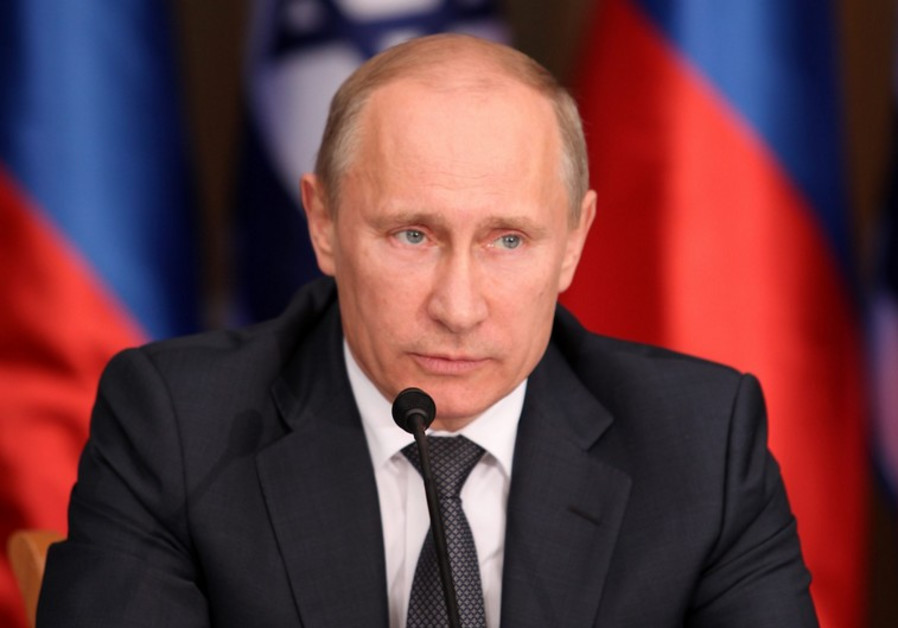
Vladimir Putin. (photo credit: MARC ISRAEL SELLEM/THE JERUSALEM POST)

Tellingly, the Russians did nothing on the ground; their Mideast envoy, Mikhail Bogdanov, issued a neutral statement saying that the developments were “alarming,” that there was a need to de-escalate tensions, and that the situation distracts from the fight inside Syria against Islamic State.

The working assumption in Jerusalem for weeks, since Iranian fighters were killed in two recent attacks in Syria attributed to Israel, was that Tehran would respond. The clear message coming from Jerusalem was that Israel would not let such a response go unanswered, and it would deliver a pulverizing counterpunch.

It is highly likely that the nature of that counterpunch – perhaps not the exact targets to be attacked, but the breadth and magnitude of the operation – was discussed with the Russians to avoid, as Israel is meticulously trying to do, accidentally engaging the Russians and surprising Moscow.

Nobody wants Israel to surprise them: not US President Donald Trump, and not Putin – and it is very much in Israel’s interests to have a good, open channel of communications with both men.

Netanyahu speaks often about the close coordination that exists between the Israeli and Russian militaries and the good relationship he has developed with Putin – a relationship very much on display when the Russian president invited him to Moscow on Wednesday to watch the military parade marking the victory over Germany 73 years ago.

And one of the reasons that relationship remains as good as it has is because there are few surprises. The Russians by now know very well what will trigger an Israeli response and what form that response is likely to take.

So far the Russians have stayed out of the way and enabled Israel to act as it sees fit – and that is neither a given or something to be taken lightly.

Netanyahu’s critics say if the premier’s relationship is so good with the Russian leader, and if the coordination is so close, then why doesn’t Putin put an end to Iran’s attempts to entrench itself in Syria?

Russian diplomats, when asked this question, say Iran is a sovereign state over which Russia does not have control. Just as Moscow cannot tell Israel not to operate in Syria, they say, it cannot tell Iran not to operate there either.

But what Moscow does obviously tell both sides is not to harm Russian interests or assets. The primary Russian asset in Syria is President Bashar Assad, in whose regime Moscow has invested millions of rubles and for whom Russian soldiers have been killed.
Other assets include the Russian naval base at Tartus and the air base at Latakia.

Russia enjoys good relations with Iran, just as it enjoys good relations with Israel. Putin meets periodically with Iranian President Hassan Rouhani, just as he meets with Netanyahu, though perhaps not as much. But they do meet, and they do talk. For instance, the two men last met in April and before that last November.

One can assume that just as Netanyahu from time to time entreats Putin to curb Iranian actions in Syria, Rouhani appeals to Putin to stop Israeli actions there also. Putin listens to both and does nothing against either side: He doesn’t curb Israel, and he doesn’t restrict Iran.

As long as Russia’s interests are not harmed, from Putin’s point of view, this particular fight is not Russia’s.

Quds Force’s Bravest Runs Under Zionist Missile

May 11, 2018

BY:

Quds Force’s Bravest Runs Under Zionist Missile

In response to Iranian rocket attacks on the Golan Heights on Wednesday, Israel attacked nearly all of Iran’s military infrastructure inside of Syria.

Video captured one Israeli air strike on a Pantsir-S1 surface-to-air missile, and as one journalist put it, some nearby Syrian or Iranian troops appeared to have no idea the Israeli strike was incoming. One figure appeared to run inside the truck right before impact.

The Quds, the special forces unit of the Iranian Revolutionary Guard Corps, aid the Bashar al-Assad regime in Syria.

Israeli Defense Minister Avigdor Lieberman said Israel’s air force had destroyed “nearly all” of Iran’s military infrastructure in Syria. The Islamic Republic and Russia are allied with the brutal Assad regime.

“If there is rain on our side, there will be a flood on their side,” Lieberman said at a conference in near Tel Aviv. “I hope we have finished with this round and that everybody understood.”

According to Israel, the Iranian rockets were either intercepted by the Iron Dome missile defense system or fell short of their intended targets. According to the New York Times, Israeli children in the Golan Heights were already going to school like normal on Thursday morning.

Israeli military spokesman Lieutenant-Colonel Jonathan Conricus said the Iranian attack was “commanded and ordered by (Quds Force chief General) Qassem Soleimani and it has not achieved its purpose.”

The Iran Deal’s Disastrous Legacy Has Nothing to Do with Nukes

May 10, 2018


AP Photo/Ebrahim Noroozi

Noah Rothman / May 9, 2018 Commentary Magazine

Source: The Iran Deal’s Disastrous Legacy Has Nothing to Do with Nukes

{In other words, things are a whole lot worse. – LS}

In March, State Department veteran and former adviser to Barack Obama, Frederic Hof, bid farewell to public life with a stunning admission. Amid a confession regarding his failure to prevent the expansion of the Syrian civil war into a regional crisis, Hof laid the blame for that all-consuming conflict (as well as a notable uptick in Russian aggression) at the feet of Barack Obama’s nuclear deal with Iran.

“[T]he administration sacrificed Syrian civilians and American credibility for the mistaken notion that Iran required appeasement in Syria as the price for a nuclear agreement,” Hof wrote. Today, with 500,000 dead, millions displaced, and the norm prohibiting chemical-weapons use shattered, we can confirm that the price of appeasement is as high as ever.

Indeed, the Iran nuclear deal was supposed to have a variety of positive knock-on effects entirely unrelated to the development of nuclear weapons, but they never materialized. As New York Times reporters David Sanger and David Kirkpatrick observe, Obama “regarded Iran as potentially a more natural ally” of the United States than America’s Sunni allies in Cairo, Abu Dhabi, and Riyadh. Iran is urbane, young, educated, and chafing under its theological government. The opening up of the Iranian economy in a post-deal world, so the thinking went, would facilitate—even necessitate—domestic liberalization. Purely out of self-interest, the Mullahs would soon agree to pare back their support for destabilizing activities in the region and cooperate with the West to “defeat the Islamic State.”

All these ambitious objectives went unrealized in the years that passed since the Joint Comprehensive Plan of Action’s (JCPOA) adoption. That is not to say that the JCPOA failed to induce some tectonic shifts in the region. The Obama administration’s effort to empower Iran and its Shiite proxies in the region compelled the Middle East’s Sunni states to rethink their alliances. The regularization of contacts between Washington and Tehran for the first time in nearly 40 years forced longtime foes, Israel and the Kingdom of Saudi Arabia, into a de facto pact. And just like that, the region’s all-consuming Palestinian question faded into the background. The remarkable diminution of the central issue of what we used to call the Middle East Peace Process underscores how stabilizing America’s forward posture can be, for good or for ill. It also demonstrates how American withdrawal can scramble regional dynamics with unforeseeable consequences.

Ultimately, the most welcome revelation the Iran nuclear deal has wrought is one to which only the accord’s most prideful defenders remain resistant. There can be no permanent accommodation with the regime in Tehran. The Islamic Republic can only be contained and weakened, with the eventual—if unstated—aim of nudging it toward radical democratic reform and, ultimately, dissolution.

Since Donald Trump announced his decision to withdraw from the JCPOA, the deal’s defenders and its detractors have largely argued over one another’s heads. The deal’s champions insist that everyone from IAEA inspectors to the Trump administration’s defense secretary and former secretary of state has certified that Iran is abiding by the arrangement. This is a red herring. Most of the deal’s opponents do not dispute that Iran is nominally in compliance with the terms of the deal. That’s the problem.

Iran can unilaterally deny international observers access to military sites, and it can shield an extensive trove of technical knowledge related to its nuclear program from inspectors. It can import tons of low-enriched uranium, manufacture nuclear fuel, test nuclear-capable delivery vehicles, and restart its centrifuges and develop a stockpile of fissionable material within weeks rather than a year. None of this is a violation of the terms of the JCPOA and its annexes. This experience has led even some of the deal’s defenders to confess that the regime in Tehran will never be a stabilizing and responsible force. Even Iran-deal proponents like Democratic Connecticut Senator Chris Murphy have confessed as much. “We have to continue to send signals to the Iranian people that, ultimately, what will secure the United States and our friends in Israel, in the long run, is for the Iranian people to demand that moderate, internationalist leadership ultimately prevail in the power struggles that are happening inside that country,” he said.

Bad news, Senator Murphy: This is what “moderate, internationalist leadership” in the Islamic Republic of Iran looks like. Iranian president Hassan Rouhani’s supposedly moderate credentials led Barack Obama to attempt to elevate and legitimize him through direct personal contacts, but there is nothing moderate about any element of the Iranian regime. A half a million deaths later and with no end in sight, this moderate Iranian president continues to back up the blood-soaked Assad regime. It has used the unfrozen assets and access to new markets attributable to the Iran deal to increase its defense spending by 30 percent and augment its support for rogue elements in Syria, Lebanon, Iraq, and Yemen even as consumer-goods prices skyrocket and the public takes to the streets. This is the moderate regime that holds American sailors hostage and parades them on television in violation of the Geneva Conventions. This regime persecutes and jails journalists, disenfranchises Christians, and executes homosexuals. These acts, Rouhani said in 2014, are “God’s commandments.”

If Murphy’s admission that the current Iranian regime will not be able to guarantee American security or regional peace is a cognitive breakthrough, it is one of many that the Iran deal has wrought. The Saudi awakening, the disillusionment of Obama officials like Hof, and the realignment of the Middle East follow in the wake of the Iran deal, as do bloody conflicts in Yemen, Syria, and Ukraine that resulted from great powers testing their boundaries in a new post-JCPOA environment.

When a full accounting of the Iran deal is done, it will be hard to avoid the conclusion that nuclear weapons were the least of our concerns.


VIDEO: Israeli Missile Destroys Russian-Made Missile Defense System

May 10, 2018

By David Steinberg May 10, 2018 PJ Media

Source: VIDEO: Israeli Missile Destroys Russian-Made Missile Defense System

{Ouch ! That’s got to hurt. – LS}

The Twitter account representing the Israeli Defense Forces, @IDFSpokesperson, posted a stunning video of an Israeli missile descending towards an SA22 Greyhound short range air defense system. According to Military Today, the SA22 is capable of shooting down cruise missiles and guided bombs.

This one wasn’t.

Per Military Today:

The Pantsyr-S1 (Western reporting name SA-22 Greyhound) was designed to protect strategic military and civil point targets. It was originally designed to meet requirements of Russian Air Defense Forces (PVO). This system is capable of engaging a wide variety of aerial targets, such as aircraft, helicopters, ballistic and cruise missiles, guided bombs and UAVs.

Developers claim that it is also capable of engaging stealthy aircraft, such as the F-22 and F-35.

It was first publicly revealed in 1995 and entered service in 2007-2008. The first 10 Pantsyr-S1 air defense systems were delivered to the Russian Air Force in 2010. It is claimed that by 2014 more than 200 of these air defense systems were produced. It has also been exported to Algeria, Syria (up to 40 units) and United Arab Emirates (50 units). This air defense system was recently ordered by Iraq. The Pantsyr-S1 saw action during the military conflict in Ukraine.

Here’s what the SA22 looks like when not evaporated:

SA-22 Air Defense System. (VITALY V. KUZMIN/WIKIMEDIA COMMONS)

Back in 2015, Israeli Foreign Ministry Director-General Dore Gold specifically mentioned Iran’s attempts to transfer SA22s to Hezbollah as yet another reason for the world to reject the Obama-negotiated nuclear deal with Iran:

IRAN TRYING TO MOVE YAKHONT MISSILES AND SA-22 AIR DEFENSE SYSTEMS TO HEZBOLLAH

Iran is trying to transfer state-of the-art weaponry, including the SA-22 (Pantsir-S1) air defense system and the Yakhont anti-ship cruise missile, from military storehouses in Syria to Hezbollah, Foreign Ministry director-general Dore Gold told The Jerusalem Post on Thursday from Berlin.

Gold, on his first trip to a European capital for high-level talks in his new role, said that Iran is busy trying to convert its signing of the Joint Comprehensive Plan of Action into diplomatic benefits in Europe.

[Gold] said that … the regional situation has become more complicated as a result of the Iranian nuclear deal, and … there is no evidence that Iran is moving in a more moderate direction in 2015.

[Gold] briefed his interlocutors on the continued subversive efforts of the Iranians in the Middle East. He said that such efforts have included trying to transfer arms to Hezbollah, recent attempts by the terrorist group to move explosives from Iraq into Kuwait, and efforts over the last six months to set up a new Hezbollah front against Israel on the Golan Heights.

If this type of activity has been going on for the last six months, Gold asked, “then what happens when the sanctions on Iran are lifted, and they get a cash bonus of up to $150 billion?” He answered, “Iran will then be equipped to radically increase its destabilizing activities along Israel’s borders.”

Gold said that his meetings in Berlin come at a time when “there is an underlying assumption in the West that Iran may be adopting a more moderate course of action.”


UN Disengagement Observer Force Evacuating Golan Heights

May 10, 2018

UN Disengagement Observer Force Evacuating Golan Heights

UNDOF multinational force evacuating Golan Heights

Photo Credit: Oshri Weizman / Rotter

Unconfirmed reports said Thursday that the United Nations Disengagement Observer Force is pulling out of the Golan Heights.

The multinational forces were evacuating their positions, according to the report, posted on the Rotter website.

UNDOF vehicles evacuating Golan Heights neutral zone

UNDOF was established by UN Security Council Resolution 305 on May 31 1974, to implement Resolution 338, calling for an immediate cease-fire and disengagement between Israeli and Syrian forces on the Golan Heights to end the 1973 Yom Kippur War.

The mandate that maintains the force has been renewed every six months since that time and is due to be renewed again on June 30 of this year.

During the Syrian civil war, the buffer zone between Israeli and Syrian forces has led UN observer forces to reconsider the mission “due to safety issues,” stemming from the Quneitra clashes between the Syrian regime forces and the opposition fighters, according to an article on Wikipedia. The violence intensified between 2012 and 2014, spilling into the UN-supervised neutral demilitarized zone in the Golan Heights.

Firing from the war has sometimes also spilled over into Israel as well; in response to such cases, the Israel Defense Force returns fire to remind those behind the gunfire that Israel is not in that war.

It is possible the UNDOF is evacuating due to the current tensions between Iran and its proxies, and Israel. There was no response to a query sent by JewishPress.com to the headquarters of the United Nations Disengagement Observer Force.

The escalation has led to a direct exchange of hostilities between Iran and Israel for the first time ever, over the past several weeks, with Iran launching its first missile barrage at Israel shortly after midnight on late Wednesday night, May 9.