Archive for May 2018

US sanctions seek regime change 

May 23, 2018

Source: US sanctions seek regime change – Israel Hayom

Dr. Raz Zimmt

There is only one way to understand the list of conditions U.S. Secretary of State Mike Pompeo gave to the Iranians: America means to push for a regime change in Iran.

Maybe the American administration did not admit this but we can assume that Washington knows full well that no Iranian regime – certainly not the current one – would agree to the 12 demands. In the same vein, Pompeo might as well have demanded Iran holds free and democratic elections or stops enforcing Islamic dress code in public spaces.

The Iranian regime cannot agree to these demands. First of all, this is because some of them, such as shifting its approach to Israel and ceasing its support of terrorist organizations, are completely contrary to the regime’s DNA, requiring a perversion of Islamic Revolution values unacceptable to Supreme Leader Ali Khamenei. Second, the Iranian leadership sees Pompeo’s presentation of demands as additional proof of Iran’s standpoint that the sole goal of the U.S. is to replace the Islamic regime. Third, the fulfillment of some of these demands requires Iran to dismantle assets that, in the regime’s eyes, are a security guarantee of their continued survival, such as long-range missiles and the option to use nuclear technology for military purposes. Iranian willingness to give up these capabilities, particularly at a time when it has conditions placed on it in the context of an escalating U.S. threat, is unreasonable even under heightened economic pressure.

The American administration currently striving for regime change comes as no surprise. National Security Adviser John Bolton, known as a staunch supporter of regime change in Iran, even maintains open ties with the Iranian resistance abroad. But a regime change requires recruiting the Iranian public to take down its leaders, unless the American administration intends to drag the country into another Middle Eastern war and force a regime change on Iran through military means, including a land invasion. The process of change in Iranian society depends on its potential for political change. Increasing the economic pressure through more crippling sanctions will likely strengthen popular protest.

Washington possibly hopes the faltering Iranian economy and protracted public protest will create an opportunity for the regime to fall. All that is needed is to increase the pressure on Iran. Although the Americans’ hope may be realized, those who base strategy on hopes risk discovering their hopes to be false.

Dr. Raz Zimmt is a research fellow at the Institute for National Security Studies and the Alliance Center for Iranian Studies at Tel Aviv University.

A message to the radical axis 

May 23, 2018

Source: A message to the radical axis – Israel Hayom

Yoav Limor

We can assume that Maj. Gen. Amikam Norkin’s speech left his audience of fellow air force chiefs green with envy on Tuesday. There isn’t an air force in the world that wouldn’t want the most advanced fighter jet on the planet in its arsenal.

Beyond having it, they would love even more to be able to use it for operational purposes. Norkin told his counterparts he has checked both those boxes – after revealing that Israel is the first country in the world to use the F-35 in combat.

Cynics will certainly wonder how much money the manufacturer, Lockheed Martin, paid for Norkin to say what he said in front of such an audience. The F-35 is the most ambitious weapons project in history, but after all the well-documented malfunctions and delays Lockheed needs success stories like it needs oxygen – and there’s nothing quite like Israeli airstrikes, with the bonus of photographic evidence of an F-35 flying invisible to radar over Beirut, to bolster its image and consumer confidence.

Even greater cynics would say this was a clever ploy by the defense establishment to justify its request for a budget bonus of NIS 1 billion. The air force is openly seeking additional F-35 squadrons and wants to expand its existing arsenal from 50 stealth planes to 75 – and although the planes are funded by American aid dollars, a budgetary bonus would give the establishment more flexibility regarding other procurements.

Israel has ‘reality changing’ weapons

The answer, it appears, is far less conspiratorial. The purpose of Norkin’s comments was twofold. First, he wanted to share the air force’s accomplishments with his colleagues. After delivering a strategic briefing he went on to discuss the air force’s evolution from 1948 to today, expanding on the use of its most sophisticated weapon. It was a professional overview for an audience of professionals, and even if there was an element of “braggadocio,” this isn’t unreasonable within such an exclusive circle. To be sure, in attendance were air force chiefs from the United States, Great Britain, Germany, Italy, India and Brazil – among whom the IAF stands as an equal, at the very least.

Norkin’s second and essentially primary objective was to send a message to the radical Tehran-Damascus-Beirut axis. Beyond showcasing an Israeli weapon none of its enemies can contend with, because they can’t see it, Israel has “reality changing” tools to effectively counter any aggression.

Israel’s qualitative military advantage, which isn’t particularly new, has always afforded it maximum maneuverability. The anomalous downing of an Israeli F-16 in February stemmed from a technical malfunction; it certainly doesn’t indicate an erosion of Israel’s absolute aerial dominance in the region, amply exhibited by the hundreds of airstrikes it has carried out in recent years. But now, with the F-35 in its arsenal, the air force has a different dimension at its disposal whose impact is sure to reverberate throughout the region (and beyond, to Moscow for example, which is likely examining how its own defenses can contend with this new player in the arena).

On a side note, it’s impossible to ignore the disconcerting gap between the air force and land army. The army presented by Norkin on Tuesday is cutting-edge, sophisticated and a global trailblazer, which along with quality intelligence gathering capabilities positions Israel light years ahead of its enemies. In the next war, however, on every front, the land army will also be thrust into action, and there, unfortunately, Israel’s advantage is significantly smaller.

Iran’s Secret ICBM Program Expose by California Researchers

May 23, 2018

Iran’s Secret ICBM Program Exposed by California Researchers

The funeral rites of Gen. Hassan Moghaddam and his entire team of rocket scientistsPhoto Credit: Courtesy of Ali Khamenei’s website

A team of California-based weapons researchers stumbled on a series of clues that led them to conclude that Gen. Hassan Tehrani Moghaddam, an Iranian scientist who had been killed in a 2011 explosion that destroyed Iran’s Bid Kaneh long-range missile research facility, was also running another secret facility in the remote Iranian desert which they believe continues to operate to this day, the NY Times reported Wednesday.

The researchers examined satellite photos of the facility, concluding that the work there is being conducted mostly at night, and appears to focus on advanced rocket engines and rocket fuel.

An analysis of the grounds and structures of the remote facility “strongly suggests” it is developing technology for long-range missiles, according to the report. When completed, Iran could threaten Europe and even the United States with its ICBM war heads.

The Times consulted five outside experts who reviewed the findings independently and agreed there’s compelling evidence that Iran is developing long-range missile technology.

IRGC Major General Hassan Tehrani Moghaddam was a ballistic missile aerospace Engineer, the founder and main architect and designer of the Iranian ballistic missile project. He sought the expertise and blueprint designs from North Korea in order to help develop Iran’s missile technology, and designed the Shahab, Ghadr and Sejjil missiles with an operational range of more than 1,250 miles, specifically to use against Israel.

The researchers, based at the Middlebury Institute of International Studies at Monterey, Calif., discovered the Iranian facility after Fabian Hinz, a young research fellow, proposed studying recent Iranian state media material on the late General Moghaddam, to see if it contained clues about Iran’s missile program. Judging by offhand remarks from the late General’s colleagues and relatives cited by Iranian media, it appeared that his work had quietly continued, the NY Time reported.

Hinz also found a 2017 post by an Iranian journalists association, with photo of General Moghaddam alongside a top lieutenant and a box marked “Shahrud.” Shahrud is the name of a town 25 miles from the site of a single missile test-launch that took place in 2013, and which had been considered dormant. But a timeline examination of satellite images of the site showed a steady growth in the number of buildings at the facility, and they were painted “a striking aquamarine.” Aquamarine happened to be General Moghaddam’s favorite color, who used it to paint all the structures under his command.

The researchers found in satellite images of a crater in the area around Shahrud, what they described as two “telltale ground scars,” both recent: one from 2016, the other June 2017. The researchers believe these are concrete stands that supported the tested engines. They say the 2017 test used a 370 ton stand, suggesting the engine powered up to 90 tons of thrust — enough for an intercontinental ballistic missile.

Palestinians: Americans Now Legitimate Targets

May 23, 2018


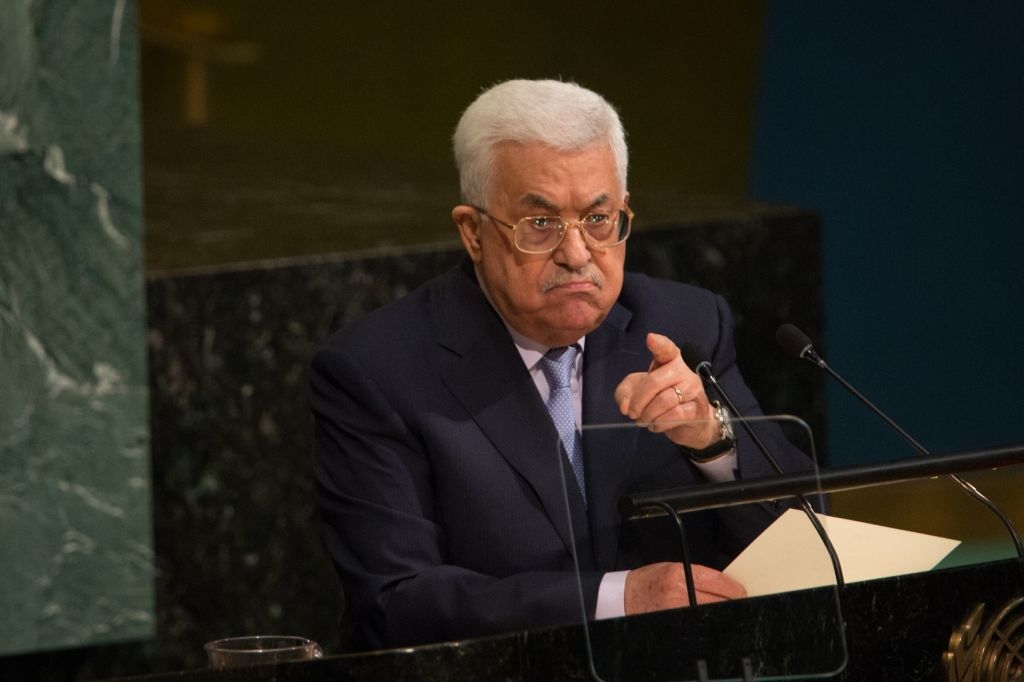
Pictured: Palestinian Authority President Mahmoud Abbas.(Photo by Kevin Hagen/Getty Images)

Now it is official: Palestinians view the US as an enemy. Anti-US rhetoric comes from Palestinians representing all walks of life — from President Mahmoud Abbas to ordinary citizens in the West Bank and Gaza Strip. Some Palestinians even see US citizens and officials as “legitimate targets” for violent assaults.

by Bassam Tawil May 23, 2018 Gatestone Institute

Source Link: Palestinians: Americans Now Legitimate Targets

{I have to ask….just how much will it cost for you to like us again? – LS}

Ultimately, it is all about money. The Palestinian Authority is desperate for US financial aid; without it the Palestinian leadership would not be able to survive. So the Palestinians are hoping to extort protection money from the Americans. It is like saying, “You see what will happen to you if you stop funding me? It could always get worse for you. I suggest that you restore my accountability-free funding, and perhaps I will see to it that you do not get hurt.”

The Americans should call the Palestinian bluff and send a warning to the Palestinian leadership that there will be consequences for their rhetoric and actions if they do not cease the incitement and brainwashing. The US should use the money as leverage to demand this from the Palestinians. The Palestinian Authority needs your money and you have the right to demand something good in return for it. There is no reason why any American should be funding the same Palestinian propaganda machine that is inciting not only against Israel, but also against the US and its citizens.

There is a new development in Palestinian hatred of the Trump administration: the Palestinian leaders’ verbal attacks on the US are now being translated into acts of violence against US delegations visiting Palestinian communities in the West Bank.

The Palestinian campaign against the US began in December 2017, when President Donald Trump made his announcement recognizing Jerusalem as Israel’s capital, and escalated after he announced that the US embassy in Tel Aviv would be moved to Jerusalem.

The anti-US rhetoric has come from Palestinians representing all walks of life — from the most senior, including President Mahmoud Abbas, to ordinary citizens in the West Bank and Gaza Strip, and from secular groups such as the ruling Fatah faction to extremist Islamist organizations such as Hamas and Palestinian Islamic Jihad.

If there is anything that unites the vast majority of Palestinians, it is their hatred of the Trump administration’s representatives and policies.

It is hard to find even one Palestinian who is prepared to say a good word about the US administration or its policies, especially with respect to the Israeli-Palestinian conflict.

Now, however, it is official: Palestinians view the US as an enemy. Even more worrying, some Palestinians even see US citizens and officials as “legitimate targets” for violent assaults. It does not seem to matter to these Palestinians whether the Americans they are targeting have come to help them or express sympathy with their cause.

Attacks on Americans visiting Palestinian cities in the West Bank are no longer uncommon. It is only by luck that no US citizen has thus far been hurt as a result of these assaults, which are being carried out by Palestinian activists who have been told by their leaders that the US is an enemy of the Palestinians.

The latest incident took place on May 21 in the town of Bet Jala, near Bethlehem. Activists belonging to the Palestinian Popular Resistance group attacked a US consular vehicle with eggs and shoes, forcing it to flee the town. The protesters chanted slogans denouncing the US as the “head of the snake” and carried banners which said, “US Government, You Are Not Welcome in Palestine” and “America is a State of Terror.”

A video posted on social media showed the protesters surrounding and kicking the US vehicle as it sped away. This was a rather humiliating scene for the Americans who came to Bet Jala to attend a graduation ceremony for Palestinian students who participated in a US-sponsored educational program.

“Our message to the Americans today is that there is no room for the US Government in Palestine because this Government is in collusion with Israel,” explained Mazen Al-Ezah, one of the leaders of the anti-US protest. “We love the American people, but their Government is part of the Israeli occupation of our land and people.”

Another protester, Mahmoud Brejiyeh, said that the goal of the protest was to convey to the Americans that they are “not welcome in Palestine. We are here to tell the Americans that the Palestinians no longer trust them and they can no longer play any role in the peace process [with Israel].”

This was the second incident of its kind in the Bethlehem area since the beginning of this year. In January, a group of Palestinian activists expelled an American delegation that was visiting the Bethlehem Chamber of Commerce and Industry as part of a cooperative effort between Palestinian businessmen and the US Consulate in Jerusalem.

In February, Palestinian Authority (PA) policemen had to rescue an American delegation that was visiting a research center in Ramallah. The delegation, which included New York legislators and civil society groups, was pelted with eggs as Palestinians chanted, “America is the head of the snake.” Again, no one was hurt.

In addition to the violent attacks directed against Americans in the West Bank, Palestinians have also been burning effigies and photos of Trump, as well as US flags. During one protest in the Al-Aydah refugee camp near Bethlehem, Palestinian protesters staged a mock trial for Trump and Vice President Mike Pence. The verdict: a death sentence. The Palestinians then carried out the “death sentence” by hanging effigies of Trump and Pence in a public square in the camp.

All these anti-US protests have a common feature: the Palestinian activists always coordinated their moves in advance with the local media. Palestinian journalists and photographers were invited to cover the protests to make sure that their message reaches the White House and the rest of the world.

It is also worth noting that the Palestinian Authority security forces, which are partially funded and trained by Americans, did not take pre-emptive measures to stop the anti-US protests. It is hard to imagine that these security forces, which enjoy excellent intelligence information, did not know what several Palestinian journalists and photographers knew in advance about the planned protests. In fact, some Palestinians say that the anti-US protests could not have taken place without the prior approval of the Palestinian security forces.

Why should the Palestinian security forces prevent such protests when President Mahmoud Abbas and many other Palestinian officials are engaged in almost daily rhetorical attacks against the US administration and its representatives? Why should these security forces prevent such protests when the Palestinian Authority itself has been boycotting the US administration and launching scathing attacks on Trump’s “Jewish advisors” — David Friedman, Jason Greenblatt and Jared Kushner?

Hardly a day passes without the Palestinians gushing forth venom concerning the US administration. And as time goes on, the Palestinian tone gets more and more vicious. Trump and his advisors are being denounced as Zionists and settlers and accomplices in Israeli “war crimes.”

In addition, the Palestinians continue to accuse the Trump administration of “conspiring to liquidate the Palestinian cause and national rights” through the yet-to-be-announced US plan for peace in the Middle East. Under the current circumstances, it is hard to see how any representative of the Trump administration would ever be able to set foot in Ramallah or Bethlehem.

The Palestinian Authority has whipped up anti-US sentiments to a point where no American can feel safe visiting any Palestinian city. Not even an American who comes to offer help in the business or educational fields. The Palestinian Authority leadership has made it clear to Palestinians that the Americans are now the enemy, and this puts the lives of US citizens and diplomats at risk. US diplomats and officials who continue to visit Ramallah and Bethlehem with good intentions to help the Palestinians are jeopardizing their lives in order to help those who are spitting into the cup they are drinking from.

It is only a matter of time before one of the attacks on Americans in the West Bank ends in tragedy. Yet the Palestinian leadership is showing no signs of bringing down the volume of its verbal attacks on the US. On the contrary, each day brings more violent rhetoric by Palestinian leaders and spokesmen about the US administration. For some time now, Israeli Jews have been banned from entering Palestinian cities, out of concern for their safety. This ban by the Israeli authorities is not unjustified, as some Israeli Jews have been violently attacked after entering Palestinian cities.

Perhaps soon we will see such signs warning US citizens against entering Palestinian cities, out of concern for their safety. Unless someone calls out the Palestinian leadership for its incitement against the US.

Why are the Palestinians doing this? This is a bullying tactic to scare the US administration into supporting their cause and abandoning its “bias” in favor of Israel. This is a new/old tactic that the Palestinian leadership has long used to extract political support and financial aid from the world. It is like saying: Give me everything I want or I will exact revenge.

The Palestinians consider the present US administration one of the most hostile American governments in history towards the Palestinians. They are hoping that the bullying, threats and violent attacks on US citizens and officials will make the White House backtrack on its support for Israel and start appeasing them.

Ultimately, it is all about money. The Palestinian Authority is desperate for US financial aid; without it, the Palestinian leadership would not be able to survive. So the Palestinians are hoping to extort protection money from the Americans. It is like saying, “You see what will happen to you if you stop funding me? It could always get worse for you. I suggest that you restore my accountability-free funding, and perhaps I will see to it that you do not get hurt.”

The Americans should call the Palestinian bluff and send a warning to the Palestinian leadership that there will be consequences for their rhetoric and actions if they do not cease the incitement and brainwashing. The US should use the money as leverage to demand this from the Palestinians. The Palestinian Authority needs your money and you have the right to demand something good in return for it. There is no reason why any American should be funding the same Palestinian propaganda machine that is inciting not only against Israel, but also against the US and its citizens.

Bassam Tawil is an Arab Muslim based in the Middle East.

Israeli fighter jets target Hamas terror tunnel, naval sites

May 23, 2018

The strike was part of Israel’s response to an arson attack carried out by Gazan terrorists yesterday.

Raz-Haviv Dahan

http://www.jerusalemonline.com/news/politics-and-military/military/idf-attacks-hamas-terror-tunnel-naval-targets-35895

Israeli airstrike in Gaza Photo Credit: Nati Shohat/Flash90

The IDF attacked a terror tunnel and two naval sites of Hamas during the night in response to yesterday’s infiltration during which an empty IDF position was set on fire, according to the IDF Spokesperson’s Unit.

“The Hamas terror organization is accountable for all threats originating from the Gaza Strip, above and below ground, and will bear the consequences for its actions against Israeli civilians and Israeli sovereignty,” the IDF spokesperson tweeted. “The IDF views these continued attempts with great severity, specifically Hamas’ daily attempts to damage Israeli security infrastructure & threats to the safety of Israeli civilians. The IDF is determined to fulfill its mission to protect Israeli civilians.”

The infiltration was recorded and published by Al-Jazeera. In the video, the terrorists are seen cutting the border fence and crossing into Israel before setting fire to the empty IDF sniper’s position.

Israeli Defense Minister Avigdor Liberman, in response to the IDF attack, tweeted, “Tonight, the IDF destroyed another tunnel that belongs to the Hamas terror organization. The attempts to attack Israel from the air, at the fence and underground will be blocked with an iron wall and the IDF’s might. The heads of Hamas should realize that their military project is a failure and invest in improving the lives of the Gaza residents.”


Syria says Iranian withdrawal not up for discussion

May 23, 2018

Source: Syria says Iranian withdrawal not up for discussion – Middle East – Jerusalem Post

US Secretary of State Pompeo said Iran must withdraw all forces under its command in Syria.

BY REUTERS
 MAY 23, 2018 12:49
Syrian Deputy Foreign Minister Faisal Mekdad gestures during a news conference in Damascus, Syria

BEIRUT – The withdrawal of Iranian forces is not up for discussion, the Syrian deputy foreign minister was quoted as saying on Wednesday, after Washington demanded they pull out of Syria’s conflict.

US Secretary of State Mike Pompeo has demanded Iran make sweeping changes — from dropping its nuclear program to leaving the Syrian war — or face severe economic sanctions.

“Whether Iranian forces or Hezbollah withdraw or stay in Syria is not up for discussion because it’s the (business) of the Syrian government,” Lebanon’s al-Mayadeen TV cited Syrian Deputy Foreign Minister Faisal Mekdad as saying.

In Syria’s seven-year conflict, Iran has provided vital support to President Bashar Assad’s military. Its forces and the militias it backs from the region, including Lebanon’s Hezbollah, helped Damascus claw back control of major cities from militants and rebels.

Russia has also deployed forces to help the Syrian state.

Pompeo said Iran must withdraw all forces under its command in Syria. Tehran dismissed the US ultimatum and one senior official said it showed the United States seeks “regime change” in Iran.

Mekdad added that Damascus plans to take back every inch of the country, and the next target could be north or south after crushing insurgents in a string of enclaves around the capital.

“This is our decision and the decision of our friends,” the pro-Syrian government channel cited him as saying in an interview with Russian state news agency Sputnik.

“After ending the direct terrorist danger to Damascus, the door is open to heading north or south.”

IAF commander: Israel still striking targets in Syria 

May 23, 2018

Source: IAF commander: Israel still striking targets in Syria – Arab-Israeli Conflict – Jerusalem Post

The IDF had said earlier that the Iranian Revolutionary Guard Corp’s Quds Force had launched 20 Fajr-5 and Grad missiles towards Israel’s front defensive line in the Golan Heights.

BY ANNA AHRONHEIM
 MAY 22, 2018 09:45

Israeli jets have continued to strike targets in Syria following the recent Iranian missile barrage against IDF posts in the Golan Heights, a senior Israel Air Force officer said on Tuesday.

“We can assume that there have been strikes since the last events in Syria. We have maintained our freedom of action over Syria,” he said during the Senior Air Force Conference in Herzliya.

Stressing that Israel will continue to carry out air strikes in the war-torn country, he said that Israel will continue to work with “determination” to thwart the entrenchment of Iran in Syria and the arming of Hezbollah.

“The Iranian resolve in the region continues and we keep operating and disrupting below the threshold of war,” he said.

Speaking earlier at the conference, Israel Air Force Commander Maj.-Gen. Amikam Norkin said that Iran had launched 32 missiles toward Israel earlier in May.

“Iran launched 32 missiles… we intercepted four of them and the rest fell outside of Israeli territory,” he said at the conference, which was attended by more than 20 air force commanders from around the world.

The IDF had said earlier that the Iranian Revolutionary Guard Corp’s Quds Force had launched 20 Fajr-5 and Grad missiles towards Israel’s front defensive line in the Golan Heights. In response, Israel struck 50 mainly Iranian targets in Syria in an operation called “House of Cards.”

According to Norkin, Syria fired over 100 anti-aircraft missiles at Israeli jets; in response, Israel destroyed the anti-aircraft batteries.

Israel has been “managing a campaign against Iranian forces, especially on Israel’s northern border” for the past two years, Norkin said.

He said that the country had been preparing for a direct attack from the Quds Force since mid-April in response to a strike allegedly carried out by the Jewish state against an Iranian-operated airbase in Syria, which killed seven IRGC soldiers.

“We have been watching what the Iranians were doing around us,” Norkin said. “The Quds Force is set up at the T4 base, which is some 250 kilometers from Israel. From this base they tried to attack using an armed drone that infiltrated Israel several months ago from our eastern border. After that incident, we determined that they were continuing to store weapons at the base, including aerial defense capabilities that we attacked over the past month.”

The IAF had received extensive intelligence several days earlier that the Quds Force in Syria was planning an attack on Israel; it carried out a preventative strike on a base in Kisweh outside Damascus, effectively thwarting the attack.

“In recent weeks, we realized Iran had sent missiles and long-range rockets to Syria, including [BM-27] Uragan launchers that we attacked north of Damascus,” Norkin said.

It is believed that due to that strike Iran carried out their backup plan, the launching of 32 Fajr-5 and Grad missiles towards Israel at midnight.

The night before the missile salvo, the military instructed local governments to open bomb shelters to residents of the Golan Heights following the identification of “abnormal movements of Iranian forces in Syria.”

The army had raised the preparedness of “troops for an attack” and deployed air defenses at several locations in the north of the country.

During the Israeli retaliation, the Syrian regime fired dozens of air-defense missiles from SA2, SA17, SA22 and SA5 missile batteries. No Israeli jets were hit and all returned to base safely.

European Companies Flee Iran to Avoid US Sanctions

May 23, 2018

“Washington has threatened to hold anyone doing prohibited business in Iran to account.” Germany’s state-run DW News confirms

Posted by Vijeta Uniyal Tuesday, May 22, 2018 Legal Insurrection

Source Link: European Companies Flee Iran to Avoid US Sanctions

{Money talks,  political bullshit walks. – LS}

European companies are leaving the Islamic Republic of Iran in droves fearing U.S. sanctions after President Donald Trump’s decided to withdraw from the 2015 nuclear deal earlier this month. The regime in Tehran is “particularly concerned by the decisions of various European companies to halt their Iranian operations until the future of sanctions was clear,” several German newspapers reported on Monday.

“The cascade of decisions by EU companies to end their activities in Iran makes things much more complicated,” Iranian Foreign Minister said. The statement comes days after the French oil company Total pulled out $5 billion worth of investments from the country fearing U.S. sanctions.

The EU, backed by the governments of France and Germany, has been scrambling to save the European business interests in Iran. German and French companies had made huge investments in Iranian oil and industrial sectors since the nuclear deal eased sanction on the regime three years ago.

The EU Commission President Jean-Claude Juncker, who heads the bloc’s executive arm, proposed enacting laws to allow European companies to ignore the U.S. sanctions. This so-called ‘blocking statute’ could protect European firms from prosecution by the U.S. Treasury and other agencies.

The Trump administration has made its intentions clear to go after any foreign player found guilty of sanctions-busting in Iran. “US withdrawal and new raft of sanctions will hurt a number of European firms with connections to Iran. Washington has threatened to hold anyone doing prohibited business in Iran to account.” Germany’s state-run DW News confirmed.

German daily Süddeutsche Zeitung reported Iranian Foreign Minister Zarif’s comments that were made at a meeting with a senior EU official in Tehran:

Iran has called for EU’s support in saving the nuclear deal–primarily through more European investments.

Europe declares its political commitment to the deal, but large European companies want to pull out of the country, complained the Iranian Foreign Minister.

Iran doesn’t consider the political support from the European Union to be sufficient to save the nuclear deal. Country’s Foreign Minister Javad Zarif made that clear during his meeting with the EU Commissioner for Energy, Miguel Arias Cañete. The EU needs to undertake practical measures “in order to increase investments in Iran,” Zarif said–as reported by Iran’s state-run news agency. The EU commitment to the nuclear deal is not in tune with the calls made by big European companies to leave Iran.

Several foreign companies have suspended their operations in Iran while they wait for the outcome of the talks within the EU. Last week, the French oil company Total announced its decision to end an investment project worth $4.8 billion if the company fails to get an approval from Washington. [Translation by the author]

The exodus of European investments from Iran is a diplomatic win for the Trump administration that has been urging the Western companies to end operations in Iran.

Earlier this month, National Security Adviser John Bolton announced that “it’s possible” for the European companies to face sanctions if they continued doing business with Tehran. The U.S. ambassador to Germany, Richard Grenell called upon the German firms to stop trading with Iran. “US sanctions will target critical sectors of Iran’s economy. German companies doing business in Iran should wind down operations immediately,” Ambassador Grenell said.

On Monday, Secretary of State Mike Pompeo issued a list of demands to Tehran: calling on the regime to immediately cease its nuclear program, end military activity throughout the Middle East and release all U.S. nationals held on spurious charges. He threatened “strongest sanctions in history” if Iran fails to comply.

The reaction from Tehran shows that European investors aren’t buying the assurances being given by the EU commissars. Many of the French and German companies fleeing Iran have profitable operations in the U.S. and don’t want to jeopardize their business relations across the Atlantic just to make a quick buck in Iran. With President Trump and the members of his administration acting in unison on the issue of Iran, European companies–unlike the EU officials–seem to have grasped the firmness of the U.S. resolve.

Iran Rejects Russia’s Call to Remove All Foreign Troops from Syria

May 23, 2018

by The Tower.org Staff | 05.22.18 4:07 pm

Source Link: Iran Rejects Russia’s Call to Remove All Foreign Troops from Syria

{On the contrary, Iran would rather everyone else get out. – LS}

Iran on Monday rejected a call from Russia to pull Iranian forces out of Syria in the event a permanent peace agreement is reached in the war-stricken country, The Times of Israel reported.

“No one can force Iran to do anything,” Iran’s Foreign Ministry spokesperson Bahram Qasemi said, according to the Tasnim news website. {I beg to differ. – LS}

“As long as terrorism exists and the Syrian government wants, Iran will have presence [in Syria],” Qasemi said. “Those who have entered Syria without the consent of the Syrian government should leave.”

After a meeting with Syrian regime President Bashar al-Assad on Thursday, Russian President Vladimir Putin said that foreign powers must pull their troops out of Syria to respect any final political settlement in the country.

“We presume that, in connection with the significant victories and success of the Syrian army in the fight against terrorism… with the onset of the political process in its more active phase, foreign armed forces will be withdrawn from the territory of the Syrian Arab Republic,” Putin said, according to CNN.

Russia’s envoy for Syria, Alexander Lavrentiev, later added that Putin’s comment was aimed at Iran, Iranian-backed terrorist group Hezbollah, the United States and Turkey.

“This statement involves all foreign troops in Syria including the Turkish, American, Iranian and Hezbollah.” The envoy clarified that Russia had no immediate plans for withdrawal.

Israel has time and again demanded Iran’s withdrawal from Syria, accusing the regime in Tehran of building a permanent military infrastructure in the country and using it as a base for its expansionist behavior in the region, including direct attacks against the Jewish State.

The U.S. echoed Israel’s demand this week, when U.S. Secretary of State Mike Pompeo said in a speech Monday that “Iran must withdraw all forces under Iranian command throughout the entirety of Syria.” The condition was part of 12 requirements spelled out by Pompeo for a new agreement with Tehran, following the collapse of the JCPOA, that aims to put an end to the Islamic Republic’s “malign” behavior in the Middle East.

In an op-ed for The Hill published last month, TIP CEO and President Joshua S. Block, wrote that the U.S. must “make clear to Moscow” that American forces will not pull out of Syria “before the Iranians are out of the picture. Anything short of that is not up for debate.”

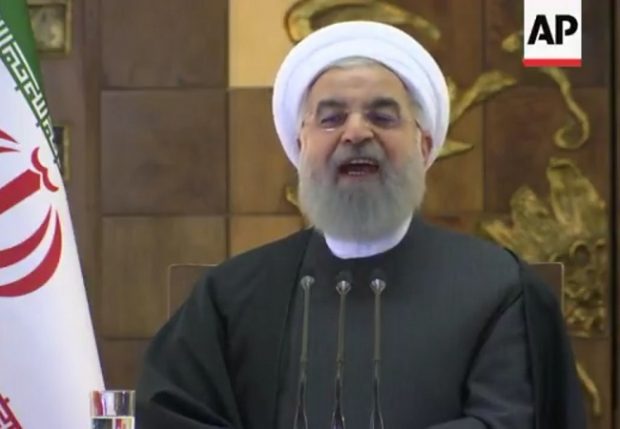
[Photo: Darius Bazargan / YouTube ]

Netanyahu Orders Security Cabinet Meetings to be Held in Secret Underground Jerusalem Bunker

May 22, 2018

Netanyahu Orders Security Cabinet Meetings to be Held in Secret Underground Jerusalem Bunker

A security council meeting in the Kirya. Feb. 10, 2018

Photo Credit: Ariel Hermony/Ministry of Defense

Until further notice, PM Benjamin Netanyahu has ordered that all security cabinet meetings will be held in the secret, underground, secure bunker that hosts the National Crisis Management Center, hidden somewhere in the Jerusalem area, according to a report by Israel’s Channel 10 Barak Ravid.

Two security cabinet meetings have already been held in the secret bunker, instead of the Prime Minister’s office. The next four security cabinet meetings are already scheduled to be held in the bunker.

Cabinet Ministers told Barak Ravid that the reason is to stop the leaks coming out of the meetings, in particular regarding discussions on Syria and Iran.

Only a limited group of people are authorized to enter the underground bunker. There’s also no cellphone service in the area of the bunker.

As an aside, the new Jerusalem train station also has a bunker 80 meters underground that can withstand a nuclear attack. It can hold up to 4000 people.