Archive for May 15, 2018

Journalists Should Stop Falling For Hamas’ Deadly PR Efforts Against Israel

May 15, 2018

The terrorist organization uses its own people as cannon fodder so it can play victim.

By David Harsanyi May 14, 2018 The Federalist

Source Link: Journalists Should Stop Falling For Hamas’ Deadly PR Efforts Against Israel

{Of course, you know they won’t stop. I just wonder if these so-called journalists realize the amount of violence they inspire. – LS}

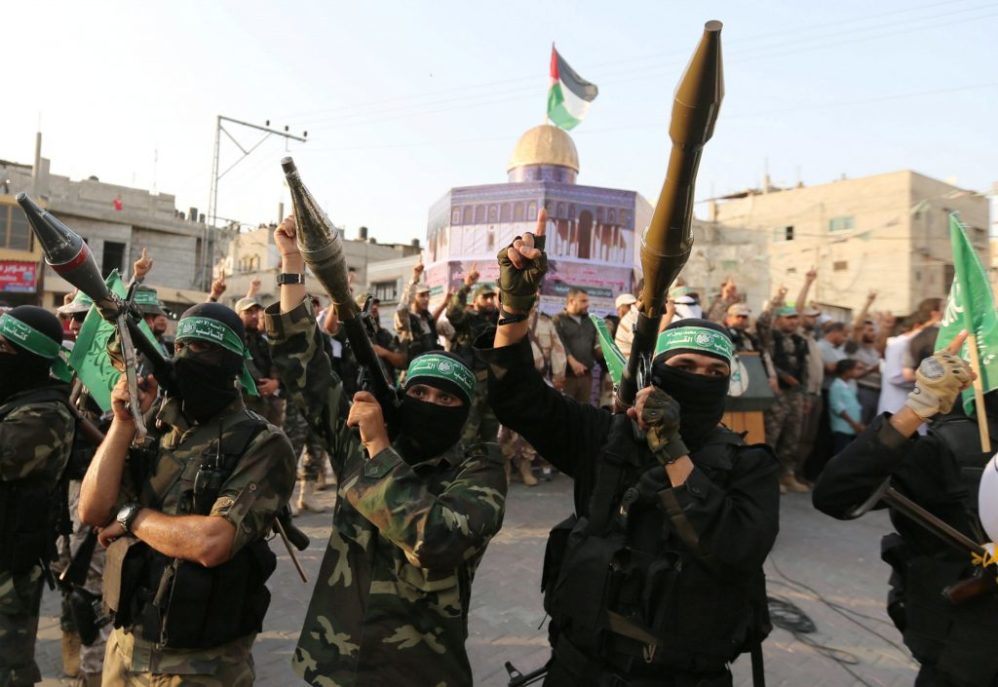
Hamas isn’t merely a terrorist organization committed to murdering Jews, it’s a terrorist organization that urges its own people to become cannon fodder as a means of appealing to Western journalists and intellectuals. The higher the death toll, the happier Hamas will be. And few things have more of a detrimental effect on the Palestinian cause than the media’s asymmetrical coverage of this conflict with the Jews.

Until Palestinians shed their hatred, turn from the Israeli fences, and march towards their own governments, they will remain pawns and saps in a decades-long suicide mission. That’s because no amount of bad press about Israel’s efforts to stop violence coming from Gaza will impel that nation to create a terror state on its borders. It’s untenable, not to mention immoral. We would never contemplate such a thing. Nor would any rational country.

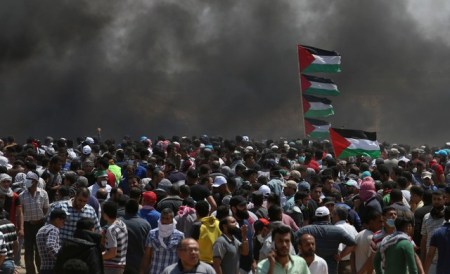
Despite what you’ve heard, the 35,000 Palestinian “demonstrators” massed along the security fence between Israel and Gaza — the ones throwing firebombs and other explosives, burning tires, chucking rocks (if you think these are aren’t deadly, you should see one landing; I have), and those attempting to light fires to burn crops and vegetation — are only ostensibly protesting the United States moving its embassy to Israel’s capital. I know this because Hamas doesn’t accept a U.S. embassy anywhere in Israel, as it doesn’t recognize Israel at all.

Hamas has openly asserted that it’s attempting to create incursions into Israel, and that has absolutely nothing to do with East or West or North or South Jerusalem. For Palestinians this is about the 70th anniversary of Israel — or, as they see it, Nakba. It’s about an ongoing historic effort — an intermittently theocratic or nationalistic effort, depending on the trends — to play victim.

https://twitter.com/ElliottRHams/status/996039101823569920?ref_src=twsrc%5Etfw&ref_url=http%3A%2F%2Fthefederalist.com%2F2018%2F05%2F14%2Fjournalists-should-stop-falling-for-hamas-deadly-pr-efforts%2F&tfw_creator=davidharsanyi&tfw_site=FDRLST

So while it might grate against the sensibilities and preconceived notions of those covering the mess, Hamas is the oppressor in this situation. And while rioters might think they’re fighting a “war,” Israel is merely trying to stop a mob from breaching a fence. To frame this as a battle between occupier and occupied is deeply simplistic. Gaza is unoccupied territory. It is only after a Hamas coup d’etat that dispatched the opposition political party of Fatah led by Mahmoud Abbas, the internationally recognized leader of the Palestinians, that both Israel and Egypt imposed a blockade on Gaza. Like Israel, Egypt was rightly worried about the increase of Iranian influence and terrorism.

Although there is occasionally talk of a unity government with Hamas, Fatah leader Abbas still threatened Gaza with more blockades. Now, if Hamas can’t even adhere to agreements with the supposed moderates of the Palestinian government, what is Israel expected to do?

Hamas might regularly crush political dissent, torture opponents, and limit every freedom imaginable, but let’s not forget that it’s also plagued by corruption. Since Israel conferred semi-autonomy on Gaza, Hamas has created one of the highest unemployment rates in the world, at more than 40 percent. The government siphons off hundreds of millions in international aid it should be using to promote economic growth and for basic necessities for the people, to fund the making and use of thousands of rockets and mortars (rendered ineffective by the Iron Dome; and the reason Hamas has not turned to riots), concrete-bolstered tunnels that shuffle terrorists into Israel, and other unnecessary terror activity.

One of those activists is ginning up mobs to rush a fence separating Gaza and Israel. At one gathering near Gaza City, The Washington Post reported, Hamas organizers encouraged rioters to push through the fence, “telling them Israeli soldiers were fleeing their positions, even as they were reinforcing them.” The purpose, of course, was to create casualties.

On the other hand, Israel dropped leaflets urging Palestinians to stay away from the fence. “Save your lives and work on building your futures,” the papers read. Israelis also fired warning shots at people as they began breaching the fence. Snipers only fired real shots at those who had already crossed the first fence despite warnings and were trying to breach the main security fence.

Using civilians as human shields and canon fodder, and the resulting death tolls as propaganda, has been a tool for Palestinian groups for more than half a century. In 2015, the United Nations was forced to admit that Hamas was storing explosives in at least three UN schools (where displaced people as well as children were housed) that Israel targeted during the mini-war of 2014. Using international aid buildings as staging grounds for terrorism is part of Yasser Arafat’s legacy.

Of course Israel makes mistakes. Many of them. But what is Israel supposed to do when a mob of violent rioters march towards them? Should it shut down the IDF and allow Hamas to overtake their military positions? Should it tear down the fences and allow a million Gazans, propagandized over a generation by violent regimes and steeped in virulent anti-Semitism, to walk into Israel proper?

Should they give full autonomy to Hamas and allow it to create a mini Iran right on its border? Should Jews pick up and leave Jerusalem? Even if Israel wanted to make a deal, Hamas makes no genuine demands, much less offers any concessions. It wants to provoke death. They want to become the victim. Sadly for the Palestinian people, they get plenty of help creating that fiction.

 

Russian deputy FM says Iran must make concessions to save nuke deal

May 15, 2018

Source: Russian deputy FM says Iran must make concessions to save nuke deal | The Times of Israel

But Sergei Ryabkov says accord cannot be altered to address Tehran’s Mideast policy, missile program, as demanded by Trump; Zarif says talks with EU on ‘right track’

Russian Deputy Foreign Minister Sergei Ryabkov at the State Department in Washington, July 17, 2017 (AP Photo/Carolyn Kaster)

Russian Deputy Foreign Minister Sergei Ryabkov at the State Department in Washington, July 17, 2017 (AP Photo/Carolyn Kaster)

Russian Deputy Foreign Minister Sergei Ryabkov said Tuesday the nuclear deal with Iran could not be preserved without some concessions from Tehran, Reuters reported, citing the Interfax news agency.

However, Ryabkov added that Moscow did not believe the accord could be amended to include limits on Iran’s actions in the Middle East or its ballistic missile program, as has been demanded by US President Donald Trump.

Ryabkov said the missile program was a legitimate measure by Tehran in preserving its security.

And he warned that Iran could yet follow in Washington’s footsteps in withdrawing from the 2015 accord.

Meanwhile, Iran’s foreign minister began talks in Brussels Tuesday on the final leg of a global tour rallying diplomatic support for the deal after the abrupt withdrawal by the United States.

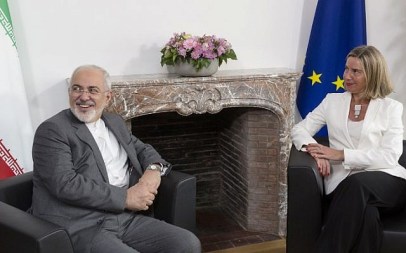
Mohammad Javad Zarif said he had a “constructive meeting” with EU Foreign Policy Chief Federica Mogherini, Reuters reported.

Iranian Foreign Minister Mohammad Javad Zarif (L) meets with European Union Foreign Policy Chief Federica Mogherini, to discuss Iran’s nuclear deal, on May 15, 2018 at the EU headquarters in Brussels. (AFP PHOTO / POOL / Thierry Monasse)

“We are on the right track to make sure the interests of the remaining signatories of the (nuclear accord), especially Iran, are guaranteed,” he said.

Zarif will also hold talks with counterparts from Britain, France and Germany — the three European signatories to the landmark deal who are scrabbling to preserve it.

Tehran has warned it is preparing to resume “industrial-scale” uranium enrichment “without any restrictions” unless Europe can provide solid guarantees that it can maintain the economic benefits it gained from the nuclear agreement despite the US reimposing sanctions.

The EU insists the deal is working, pointing to repeated UN inspections verifying the Islamic Eepublic’s compliance with its side of the bargain, and Mogherini’s spokeswoman Maja Kocijancic told AFP ahead Zarif’s arrival that “we must do our utmost to preserve it.”

But European diplomats have sought to play down expectations of Tuesday’s meetings, stressing the enormous challenge of finding a way around US sanctions punishing foreign businesses trading with Iran, which have global reach.

European firms, especially those from France and Germany, rushed to invest in Iran following the 2015 agreement, under which Tehran agreed to freeze its nuclear program in return for the repeal of punishing international sanctions.

German exports to Iran totaled nearly 3 billion euros ($2.3 billion) in 2017, while French exports soared from 562 million euros ($670 million) in 2015 to 1.5 billion ($1.8 billion) in 2017 and oil giant Total has pledged to invest some $5 billion in the South Pars gas field.

When he quit the deal last week, Trump gave businesses a maximum of six months to wind up operations in Iran or face severe penalties under American sanctions.

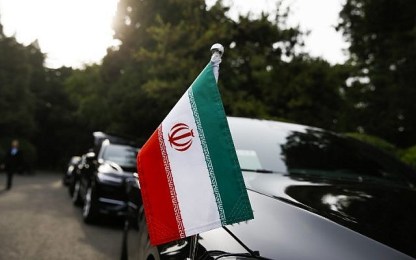
Cars of the Iranian delegation are parked outside a building of the Diaoyutai state guesthouse in Beijing on May 13, 2018. (AFP PHOTO / POOL / THOMAS PETER)

Zarif’s meetings in Brussels cap a whirlwind global tour, including trips to both Russia and China, the two other signatory nations, in a bid to bolster support.

Washington’s decision to go against its European allies’ advice and abandon the deal has pushed them closer to Beijing and Moscow on the issue as diplomats scramble to keep the pact alive.

French President Emmanuel Macron held phone talks with his Russian counterpart Vladimir Putin on Tuesday, according to a Kremlin statement, which said they had “confirmed Russia and France’s commitment to make the deal work.”

On Monday Zarif sent a letter to the United Nations in which he accused the US of showing a “complete disregard for international law” in pulling out of the deal.

Putin has already spoken with German Chancellor Angela Merkel and Turkey’s President Recep Tayyip Erdogan about efforts to save the accord, after voicing his “deep concern” over Trump’s decision.

Russian President Vladimir Putin, right, and French President Emmanuel Macron, left, at the Palace of Versailles, near Paris, France, Monday, May 29, 2017. (AP Photo/Alexander Zemlianichenko, pool)

And on Monday Putin met Yukiya Amano, the head of the International Atomic Energy Agency, telling him that Russia was “ready to continue to uphold the Iran nuclear deal despite the withdrawal of the United States.”

On Sunday, US Secretary of State Mike Pompeo said Washington still wants to work with Europe to counter Iran’s “malign behavior” and was working hard to thrash out a more wide-ranging deal with its European partners.

But while he talked up the prospect of renewed coordination with America’s allies, another top aide reminded Europe its companies could face sanctions if they continue to do business with the Middle Eastern power.

Russian efforts to save the accord will boost its role as a power player in the Middle East, after its intervention on the side of Bashar Assad’s regime in Syria.

This, along with its diplomatic moves to orchestrate an end to the Syrian conflict, has put Moscow at loggerheads with the US and Europe, which have intervened against the regime.

Merkel is set to visit Russia and meet Putin in the Black Sea resort of Sochi on Friday, while French President Emmanuel Macron will be in Saint Petersburg later this month for an economic forum.

Australian PM: Hamas is to blame for Gaza deaths 

May 15, 2018

Source: Australian PM: Hamas is to blame for Gaza deaths | The Times of Israel

Terror group ‘pushing people to the border,’ Turnbull says; Canberra also calls on Israel to avoid excessive use of force

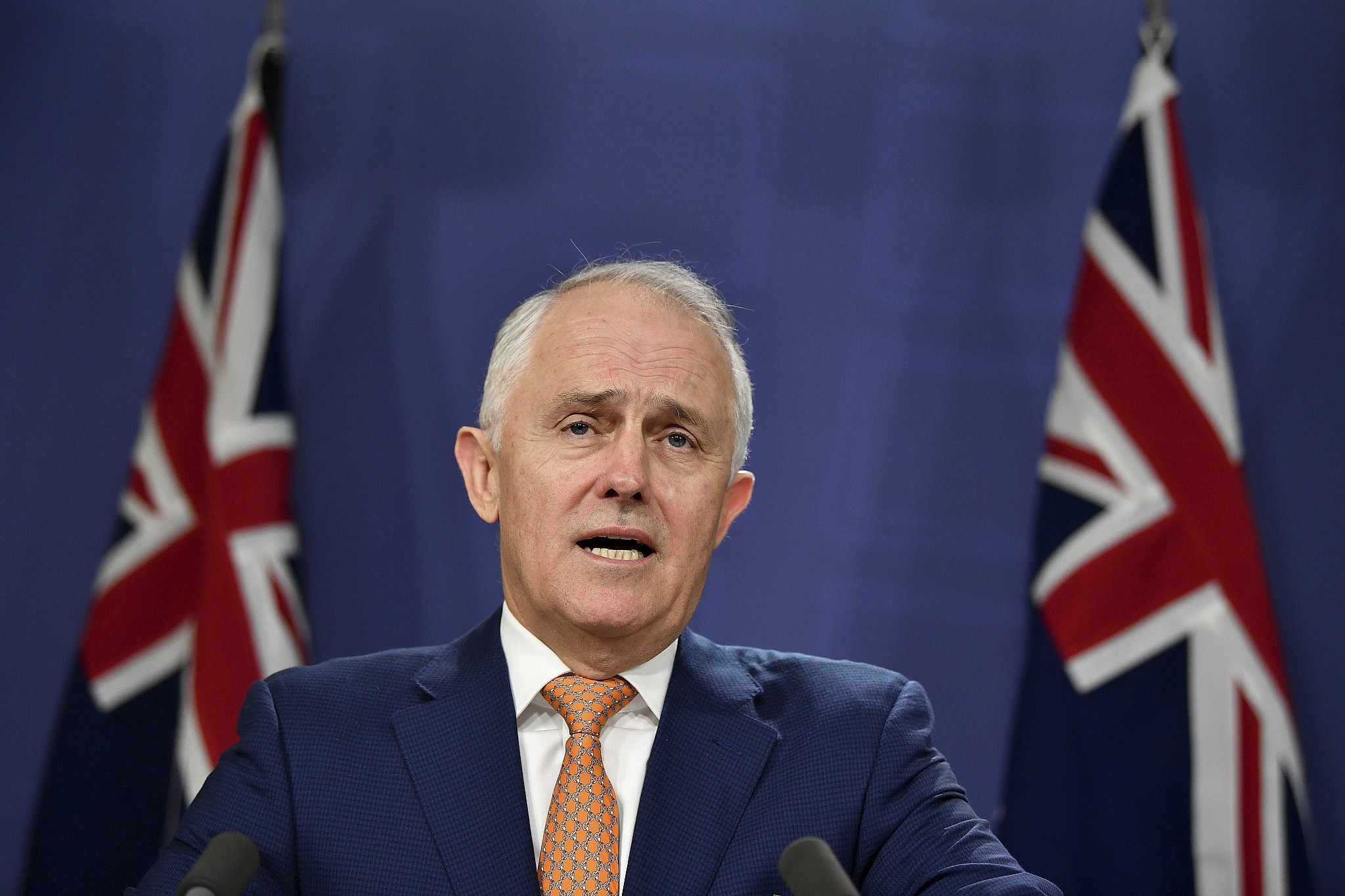
Australian Prime Minister Malcolm Turnbull speaks during a press conference in Sydney, October 28, 2017. (Joel Carrett/AAP Image via AP)

Australian Prime Minister Malcolm Turnbull speaks during a press conference in Sydney, October 28, 2017. (Joel Carrett/AAP Image via AP)

Australia’s prime minister on Tuesday blamed Hamas for the dozens of deaths in Gaza in violent clashes the previous day between Palestinians protesters and Israeli forces along the border.

It was the bloodiest day in the Israeli-Palestinian conflict since the 2014 Gaza war, with at least 58 Palestinians killed and more than 2,700 Palestinians wounded, according to figures from the Hamas-run Gazan health ministry. The dead included six minors, the health ministry said.

Prime Minister Malcolm Turnbull told Melbourne Radio 3AW the loss of life was “tragic” but that “Hamas’s conduct is confrontational. They’re seeking to provoke the Israeli Defense Forces.”

Turnbull said the terror group was “pushing people to the border. In that conflict zone, you’re basically pushing people into circumstances where they are very likely to be shot at.”

Meanwhile Australian Foreign Minister Julie Bishop called on Israel to be proportionate in its response and refrain from excessive use of force. She added in a statement that Israel had the right to protect it population and called on Palestinians “to refrain from violence and attempting to enter into Israeli territory.”

The clashes began before Israeli officials and a White House delegation including US President Donald Trump’s daughter Ivanka formally opened the embassy in Jerusalem, and continued throughout the day. Monday’s demonstrations, which were timed to coincide with the move, were also part of the weeks-long March of Return campaign marking the 70th anniversary of the establishment of Israel, or the Nakba (“catastrophe”), as Palestinians call it.

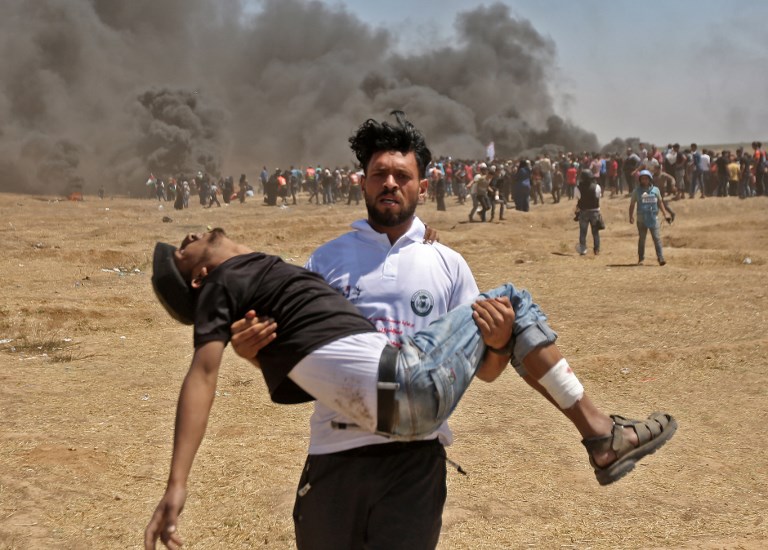
A Palestinian carries an injured protester during clashes with Israeli forces near the border between the Gaza strip and Israel east of Gaza City on May 14, 2018. (AFP / MAHMUD HAMS)

Israel has blamed Hamas for the deadly violence, saying the terror group encouraged and led the protests, which included attacks on Israeli troops and attempts to breach the border fence.

The IDF’s spokesman said Hamas deployed 12 separate terrorist “cells” to try to breach the border at different locations, and that all were rebuffed. Citing Palestinian sources, Israel’s Hadashot TV news said 10 of the terror group’s members were among those killed in the clashes, including a son of its co-founder Abdel Aziz al-Rantisi.

Several countries condemned the events, questioning the proportionality of Israel’s response while urging Hamas to refrain from violence. The EU called for “utmost restraint” by all sides. South Africa and Turkey said they were recalling their ambassadors from Israel, with Ankara accusing Jerusalem of “genocide.”

The United States was one of the only countries to endorse Israel’s version of the events and fully blame Hamas for the deaths on the border. Later Monday it also blocked the adoption of a UN Security Council statement that would have called for an independent probe of the violence.

A draft of the statement read, “The Security Council expresses its outrage and sorrow at the killing of Palestinian civilians exercising their right to peaceful protest. The Security Council calls for an independent and transparent investigation into these actions to ensure accountability.

“The Security Council calls upon all sides to exercise restraint with a view to averting further escalation and establishing calm,” it said.

The council is due to hold an emergency meeting on the violence Tuesday, called at the request of Kuwait. It’s not immediately clear what will come out of the discussion. At an emergency meeting after similar protests in March, council members urged restraint on both sides but didn’t decide on any action or joint message.

US foils anti-Israel Security Council move over deadly Gaza riots

May 15, 2018

Source: US foils anti-Israel Security Council move over deadly Gaza riots – Israel Hayom

Why is it that Latin American countries are moving their embassies?

May 15, 2018

I was interested in this question when I saw who the first countries to follow the US were: why is it that Latin American countries are moving? I didn’t know of any particular connection between these countries and Israel.

This article gives 3 possible reasons. The one about the historical ties of these countries to Israel is interesting.

Why these Latin American countries support moving their embassies to Jerusalem

https://www.timesofisrael.com/why-these-latin-american-countries-support-moving-their-embassies-to-jerusalem/

Guatemala, Paraguay and Honduras look to strengthen ties with the US by supporting Israel, plus their leaders have personal connections to the Jewish state

(JTA) — US President Donald Trump’s decision in December to recognize Jerusalem as Israel’s capital drew wide international criticism, with 128 countries including the United Kingdom, Germany and Canada voting in favor of a United Nations resolution condemning it.

But several countries saw Trump’s decision in a different light: as an example to follow.

Shortly after the United States officially moves its embassy from Tel Aviv to Jerusalem on Monday, it will be joined by Guatemala and Paraguay. Both countries are planning to make the move this month, and Honduras may be next: Its Congress recently passed a resolution urging its foreign ministry to move its embassy.

Along with the Czech Republic, whose president said last month it will begin the process of moving its embassy to Jerusalem, these countries belong to a small club (albeit one with a superpower). On a visit to Venezuela on Monday, Palestinian Authority President Mahmoud Abbas urged other Latin American countries not to move their embassies.

So how come? Why do these Latin American countries go where others fear to tread?

Observers suggest a number of reasons, or a combination thereof: The countries are likely motivated by a desire to curry favor with the Trump administration, their leaders’ personal views of the Jewish state and strong historic ties to Israel.

In the cases of Guatemala and Honduras, both countries are facing or recently faced political crises — Guatemalan President Jimmy Morales is mired in a corruption scandal and Honduran President Juan Orlando Hernandez’s recent re-election was dogged by allegations of voter fraud. Their leaders are looking to the US for support, said Arie Kacowicz, a professor at the Hebrew University of Jerusalem specializing in Latin America.

“They pretty much need and want support and legitimacy from the US and one way of achieving that is by being on friendly, cordial or even extraordinary terms with Israel,” he told JTA. “So if the U.S. is showing the way on this particular issue of Jerusalem, the natural candidates to follow would be those two Central American countries.”

Though the countries are looking to strengthen ties with Israel, that is not their primary focus, Kacowicz said.

“For Guatemala and Honduras, the US is primordial. It’s much more important than Israel,” he said.

The two countries also have large immigrant populations in the US that are facing threats of deportation. Those immigrants contribute to their home countries’ economies — for example, one-tenth of Guatemala’s gross domestic product comes from remittances sent back by Guatemalans living abroad. It makes sense to want to be on the Trump administration’s good side.

Moving their embassies or expressing support for doing so “is a show of good will” to Trump and the US, agreed Mariano de Alba, associate director of the Adrianne Arsht Latin America Center at the Atlantic Council, a think tank focusing on international affairs.

The embassies of Guatemala, Paraguay and Honduras in Washington, DC, did not respond to requests for comment by JTA in time for publication.

Trump has signaled that it cares about how other countries respond to its policies regarding Jerusalem. In December, the president said the US was watching the votes of its allies on the UN condemning his recognition of Jerusalem as Israel’s capital. One hundred and twenty eight countries voted to pass the resolution with only nine — including Guatemala and Honduras — voting against it and 35 countries abstaining — including Paraguay. The resolution asserted the traditional position that “Jerusalem is a final status issue to be resolved through negotiations in line with relevant United Nations resolutions.”

Following the vote, UN ambassador Nikki Haley even threw a party for the 65 countries that did not support the resolution. The event was labeled as a means to thank the countries for “their friendship to the United States,” according to a copy of the invite obtained by CNN.

But it’s not all about Trump. The three countries have ties to Israel that date back to its founding.

Latin American countries were largely sympathetic to Israel in its early days, said Dina Siegel Vann, director of the American Jewish Committee’s Arthur and Rochelle Belfer Institute for Latino and Latin American Affairs.

 “Most Latin American countries are relatively young, and they were very much captivated by Israel’s story, a young country beating the odds after destruction in the Holocaust, and trying to make it in a very hostile environment,” Vann said.

Guatemala and its UN ambassador Jorge Garcia Granados played a crucial role in the adoption of the UN partition plan for Palestine in 1947, which recommended creating a Jewish and an Arab state in pre-state Israel. In 1948, Guatemala became the first in Latin America to recognize Israel, setting off a domino effect in the region.

Following Israel’s establishment, the country focused on achieving international recognition of Jerusalem as its capital, said Jonathan Grossman, a postdoctoral research fellow at the Institute for Israel Studies at the University of Texas at Austin. He has researched ties between Israel and Latin America.

“Latin America was a major target in this struggle because they were mostly very friendly toward Israel,” Grossman said.

The campaign was successful and some 11 Latin American countries opened up embassies in Jerusalem, starting with Guatemala in 1948.

But ties soured in 1967, following the Six-Day War, which drew wide international condemnation. Then in 1980, when the Knesset passed a law that declared the entire city of Jerusalem to be Israel’s capital, all the Latin American countries as well as the Netherlands and Haiti, decided to move their embassies out of Jerusalem. Venezuela turned hostile under its late dictator, Hugo Chavez, and ties between Argentina and Israel have blown hot and cold since the the 1992 terrorist attack on Israel’s embassy in and the 1994 bombing of the AMIA Jewish center, both in Buenos Aires.

The last 15 years have once again seen improved ties between Israel and some Latin American countries, including Guatemala, Honduras and Paraguay, said Daniel Mariaschin, CEO of B’nai B’rith International, which has projects in Latin America.

“The leadership in these countries in this past 15-year period has made the point of reaching out to Israel, as Israel has reached out to them,” Mariaschin said.

In addition to trade interests, each of the countries’ leaders also have personal reasons for supporting Israel.

Morales of Guatemala is an evangelical Christian, as is 40 percent of Guatemala’s population, and evangelicals have strong religious attachments to Israel. Paraguay’s president, Horacio Cartes, has close ties with Israeli Prime Minister Netanyahu, and one of his campaign advisers, Ari Harow, is an Israeli-American who previously served as Netanyahu’s chief of staff.

Hernandez of Honduras participated early in his career in an outreach program by Mashav, Israel’s Agency for International Development Cooperation.

Grossman said that Trump’s decision opened the door for Latin American countries that have good relations with Israel to follow suit.

“This move kind of removes the barrier for many of those small countries who have excellent relations with Israel, very developed trade relations and security cooperation,” he said.

Will the upcoming moves by Guatemala and Paraguay spark a trend? De Alba said it is “very highly unlikely” that a large number of Latin American countries will follow suit because such a move is seen as “too forceful.”

“The position of the majority of the Latin American countries will be not to do so and try not to take sides on the [Israeli-Palestinian] conflict,” he said.

Meanwhile Mariaschin thinks the Latin American countries’ decisions may lead others to at least rethink their policies.

“I think these moves will spur other countries to reconsider because there’s a critical mass which is assembling here, not only in Latin America but in other places as well.”


Behind The Smoke Screen

May 15, 2018

Published on May 4, 2018

From inside Gaza, the reality of the so called “peaceful demonstrations”. Watch Hamas hate speeches. See how they build their propaganda at the expense of brainwashed, deceived and manipulated unfortunate people. Understand why Israel has no choice but to protect itself using lethal force

Aussie ex-Prime Minister Tony Abbot says move embassy to Jerusalem

May 15, 2018

Tony Abbot is a great guy, a true conservative and tough as nails. Did boxing at Uni, rides his bike for a zillion miles before breakfast and has done surf lifesaving.  He is also a volunteer bush fire fighter, and was even working putting out fires with other volunteers when he was Prime Minister. Top bloke.

And he is a strong supporter of Israel.

Blogger Andrew Bolt is also a top guy, high profile here in Australia and is also a strong supporter of Israel, and aware of the dangers of islam.

Abbot: Move our embassy to Jerusalem

http://www.heraldsun.com.au/blogs/andrew-bolt/abbott-move-our-embassy-to-jerusalem/news-story/8ae0a23b8b4b452dd186e97a07922d50

Tony Abbott is right: Australia should indeed consider moving its embassy in Israel to Jerusalem. In fact, we should do it. It recognises a reality and says the terrorists cannot scare us into shunning either the truth or Israel.

Tony Abbott
✔@TonyAbbottMHR

The US embassy is now in West Jerusalem, which has been Israel’s capital for nearly 70 years. Australia should consider following Trump’s move.

10:19 AM – May 15, 2018

But Malcolm Turnbull [current Prime Minister – Ed.] immediately rejects it, claiming it’s “more conducive to the peace process” not to.

But what “peace process”?

Staying in Tel Aviv just emboldens the hardliner rejectionists.


World slams disproportionate force in Gaza as IDF kills dozens of Gazans 

May 15, 2018

Source: World slams disproportionate force in Gaza as IDF kills dozens of Gazans – Arab-Israeli Conflict – Jerusalem Post

( All together now: BLAME THE JEWS ! – JW )

After more than 50 Palestinians were killed in the day’s protest, South Africa and Turkey recalled their ambassadors to Israel.

BY TOVAH LAZAROFF
 MAY 15, 2018 00:08

A female Palestinian demonstrator during a protest in Gaza against US embassy move to Jerusalem

The international community urged Israel to stop shooting Palestinian protesters on the Gaza border, with South Africa and Turkey recalling their ambassadors in protest, after a day of violent riots left 58 Palestinians dead on Monday.

“The South African government condemns in the strongest terms possible the latest act of violent aggression carried out by Israeli armed forces along the Gaza border,” the South African government said. “Given the indiscriminate and grave manner of the latest Israeli attack, the South African government has taken a decision to recall Ambassador Sisa Ngombane with immediate effect until further notice,” it added.

Turkey’s Foreign Ministry minced no words and called Israeli actions on the Gaza border “a massacre,” and the country’s President, Recep Tayyip Erdogan, labelled it a “genocide.” At a speed in London he said his country had recalled its ambassadors to both the US and Israel, according to the Turkish web site the Daily Sabeh.

The United Nations Security Council plans to hold an emergency meeting on Gaza in New York on Tuesday, with the US appearing to have quashed calls for an investigation into the

The IDF did its best to make its case that the Hamas-led protests, known as the Great March of Return, were not peaceful demonstrations but violent riots designed to break through the border fence and kidnap soldiers.

But Israel’s allies in Europe, who earlier in the week spoke of Israel’s right to defend itself against Iran, called for restraint after Monday turned out to be the bloodiest day of protests since the Great March began on March 30.

The number of casualties was reported by the Hamas-led Ministry of Health in Gaza and there was no independent corroboration.

The German Foreign Office and the French Foreign Ministry expressed concern that Israeli actions in Gaza amounted to a disproportional use of force.

“Israel has the right to defend itself and to secure the fence against violent incursion. However, the principle of proportionality applies. That includes only using live ammunition when other, less forceful methods of deterrence do not work and in cases of concrete threats,” the German Foreign Office said.

At the same time, it also urged Hamas not to exploit the protest for violent ends.

“The right to peaceful protest must also apply in Gaza. At the same time, we have always made clear that this right must not be abused, taken as a pretext or exploited in order to escalate the situation, deploy violence or incite others to do so,” the German Foreign Office said.

“Those who wield power in the Gaza Strip must renounce violence and the Palestinian Authority must once again be in control in Gaza,” it added.

French Foreign Minister Jean-Yves Le Drian called for restraint on both sides, but unlike Germany did not make any statement against Hamas.

“France again calls on the Israeli authorities to exercise discretion and restraint with respect to the use of force, which must be strictly proportionate. It reaffirms the duty to protect civilians, especially minors, and the right of Palestinians to demonstrate peacefully,” Drian said.

French President Emmanuel Macron condemned Israel’s actions in Gaza. “(Macron) lamented the large number of Palestinian civilian casualties in Gaza today and over the past few weeks,” the French presidency said.

“He condemned the violence of Israeli armed forces against demonstrators.”

Macron talked with Jordan’s King Abdullah and Palestinian President Mahmoud Abbas on Monday and is planning to talk with Israeli Prime Minister Benjamin Netanyahu on Tuesday, the presidency said.

The European Union, the United Nations and Great Britain’s Theresa May also called for restraint. The EU, in addition, urged Israel not to use disproportional force and for Hamas to ensure that the demonstrations were peaceful.

UN Secretary-General António Guterres said, “it is imperative that everyone show the utmost restraint to avoid further loss of life, including ensuring that all civilians and particularly children are not put in harm’s way.

Zeid Ra’ad, the Office of UN High Commissioner for Human Rights tweeted a much sharper note out of Geneva.

The “shocking killing of dozens, injury of hundreds by Israeli live fire in #Gaza must stop now. The right to life must be respected. Those responsible for outrageous human rights violations must be held to account. The [international] community needs to ensure justice for victims.”

Reuters contributed to this report.

Turkey recalls envoys from Israel, U.S. over Gaza deaths, embassy move 

May 15, 2018

Source: Turkey recalls envoys from Israel, U.S. over Gaza deaths, embassy move – Israel News – Jerusalem Post

Turkey had promised back in December to recall its ambassador to the US should it move its embassy to Jerusalem.

BY TOVAH LAZAROFF
 MAY 15, 2018 05:11
Turkish President Tayyip Erdogan addresses members of parliament from his ruling AK Party (AKP) duri

Turkish President Tayyip Erdogan addresses members of parliament from his ruling AK Party (AKP) during a meeting at the Turkish parliament in Ankara, Turkey, March 6, 2018. (photo credit: UMIT BEKTAS / REUTERS)

 Turkey on Monday recalled its ambassadors from Israel and the United States to demonstrate its anger over the mounting Gaza death toll and the relocation of the American Embassy to Jerusalem, according to the Turkish newspaper the Daily Sabah.

Already in December Turkey had warned that it would recall its ambassador should the US make good on its pledge to open relocate its embassy from Tel Aviv to Jerusalem.

Turkish President Recep Tayyip Erdogan announced the removal of the envoys at a speech he delivered in London. Israel’s Foreign Ministry has yet to confirm the report.

Turkish-Israeli ties have been fragile since the IDF killed nine Turkish activists in 2010 when it raided a Turkish ship, called the Mavi Marmara.

The boat was part of a Gaza bound flotilla that hoped to break Israel’s naval blockade of the Strip.

The two countries broke off diplomatic ties in 2011 and they only fully re-established formal diplomatic ties toward the end of 2016.

‘Unprecedented’ violence in Gaza leaves 58 Palestinians dead, thousands wounded 

May 15, 2018

Source: ‘Unprecedented’ violence in Gaza leaves 58 Palestinians dead, thousands wounded – Arab-Israeli Conflict – Jerusalem Post

Monday’s death toll was the highest in a single day since Operation Protective Edge in 2014.

BY ANNA AHRONHEIM
 MAY 14, 2018 23:49
‘Unprecedented’ violence in Gaza leaves 58 Palestinians dead, thousands wounded

A Palestinian demonstrator uses a sling to hurl stones at Israeli troops during a protest at the Israel-Gaza border east of Gaza City May 14, 2018. (photo credit: REUTERS/MOHAMMED SALEM)

It was the highest Palestinian death toll in the Gaza Strip by Israeli fire since Operation Protective Edge in 2014.

The Hamas-run Health Ministry said 58 Palestinians were killed by IDF fire, including several teenagers, and 2,771 others were wounded, many by tear gas, with 116 in serious or critical condition.

Gazans have been protesting along the border with Israel for the past six weeks as part of what organizers have called the “Great March of Return.” But the mass protests on Monday were “unprecedented,” according to IDF Spokesman Brig.-Gen. Ronen Manelis.

According to the army, the violence began at 11:30 a.m. with hundreds of rioters running towards the fence in the northern part of the Strip. A number of Palestinians climbed the fence at several points.

Some 40,000 Palestinians took part in violent demonstrations at 13 different locations along the fence, throwing stones, explosive devices and Molotov cocktails at the fence and IDF troops, as well as burning tires and launching burning objects such as kites with charcoal or containers of burning fuel with the intention of setting fires in Israeli fields, the IDF said.

There were 25 kites flown over the course of the day, 17 of which had incendiary materials, causing 23 to set fire to a field before being extinguished by firefighting teams deployed to the area. More than 4,000 dunams of agricultural fields have been burned by such devices in the past month, an official from the Keren Kayemeth LeIsrael-Jewish National Fund told The Jerusalem Post.

Early on Monday, an IDF quadcopter, a drone with four rotors, was shot down near Jabaliya, in the northern Gaza Strip, leading the IDF to fire gas grenades and warning shots at protesters.

Amnesty International said the IDF response was deplorable.

“This is another horrific example of the Israeli military using excessive force and live ammunition in a totally deplorable way,” said Philip Luther, its research and advocacy director for the Middle East and North Africa. “This is a violation of international standards, in some instances committing what appear to be willful killings constituting war crimes.”

UN High Commissioner for Human Rights Zeid Ra’ad al-Hussein took to Twitter to condemn the “shocking” deaths, writing that “those responsible for outrageous human rights violations must be held to account. The international community needs to ensure justice for victims.”

The UN Security Council is expected to convene an emergency meeting on Tuesday over the violence following a request by Kuwait.

“The policy of Israeli authorities to fire irrespective of whether there is an immediate threat to life on Palestinian demonstrators in Gaza, caged in for a decade and under occupation for a half century, has resulted in a bloodbath that anyone could have foreseen,” said Sarah Leah Whitson, executive director of Human Rights Watch’s Middle East division.

According to the IDF, while the number of protesters was higher than in previous weeks, “it wasn’t as high as Hamas had hoped for, which is why the organization raised its level of violence.”

“Hamas placed many women at the front in an effort to make it difficult for us to deal with terror targets. This is the most significant level of violence we have seen since the start of the protests,” the IDF said, adding that despite intelligence that Hamas planned to breach the border fence en masse, that had yet to happen.

Hadashot TV news quoted Israeli security officials as warning Hamas via Egypt that if there were violent clashes along the border, Israel would resume the targeted killing of the group’s leaders, saying: “If the protests continue, the assassinations will return.”

Soldiers, including snipers, used tear gas and live fire to keep the thousands of protesters away from the fence. Intense gunfire was heard a few times close to areas where Gazans were demonstrating.

In response to terrorist attacks, Israeli jets and other aircraft struck 11 Hamas targets on Monday, and IDF tanks also struck two terrorist positions in the northern and southern Gaza Strip.

Late Monday afternoon, IDF fighter jets struck five Hamas targets in a training camp in Jabaliya following two attempts to plant explosive devices on the border fence near Rafah and Khan Yunis and gunfire toward soldiers near Jabaliya.

“The IDF will not allow damage to the infrastructure of the security fence and will act in a determined manner to defend and secure the citizens of Israel and its sovereignty,” the IDF said in a statement.

IDF Chief of the General Staff Lt.-Gen. Gadi Eizenkot held a situational assessment with Southern Command Commander Maj.-Gen. Eyal Zamir, Gaza Division Commander Brig.-Gen. Yehuda Fuchs and other commanders regarding the army’s ongoing operational activity.

Thousands of soldiers from 11 battalions, including from the Nahal and Givati brigades, special forces, intelligence-gathering units, the Armored Corps and snipers, and drones have been deployed to reinforce the troops already in the area. The training of regular combat troops has been put on hold to focus on the violent disturbances.

The IDF accuses Hamas of using the protests as cover to carry out terrorist attacks. On Sunday, its said it had identified protesters’ intentions to burn engineering tools belonging to the army, damage security infrastructures on the fence, including pillboxes, as well as attempts to kidnap soldiers under the guise of the protests.

Prime Minister Benjamin Netanyahu addressed the violence saying that “every nation has the right to defend its borders. Hamas clearly says its intentions are to destroy Israel and sends thousands to break through the border for that end. We will continue to act with resolve to defend our sovereignty and our citizens.”