Archive for May 11, 2018

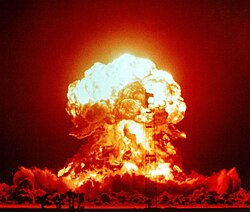
Trump Asked What Would Happen If Iran Tried To Make A Nuke — His Answer Is Radioactive

May 11, 2018

Benny Johnson Reporter At Large 1:09 PM 05/09/2018 Daily Caller

Source: Trump Asked What Would Happen If Iran Tried To Make A Nuke — His Answer Is Radioactive

{I’m sure Trump means a conventional response. Going radioactive is a choice the Iranians must make. – LS}

President Trump recently made the historic decision to pull America out of the controversial Iran Deal enacted by his predecessor.

The agreement was a keystone accomplishment of President Barack Obama’s foreign policy. Trump has been deeply critical of the deal, promising multiple times on the campaign trail to negotiate a better deal or get the U.S. out of the current one.

Trump called the deal  “a horrible deal that should never, ever have been made,” yesterday in a speech from the White House before signing a presidential memorandum to officially exit the U.S. from the agreement and reinstate blistering sanctions on the Iranian regime.

At a cabinet meeting Wednesday, a reporter asked Trump, “What will you do if Iran starts up their nuclear program again?”

President Trump paused for a moment and said ominously, “Iran will find out.”

When pressed again by the reporter, Trump said, “I would advise Iran not to start their nuclear program. I would advise them very strongly.”

“If they do,” he continued, “there will be very severe consequence. Okay? Thank you very much.”

US Moves To Strangle Iranian Efforts To Secure Hundreds Of Millions Of Dollars To Fund Its Troubling Military Activities

May 11, 2018


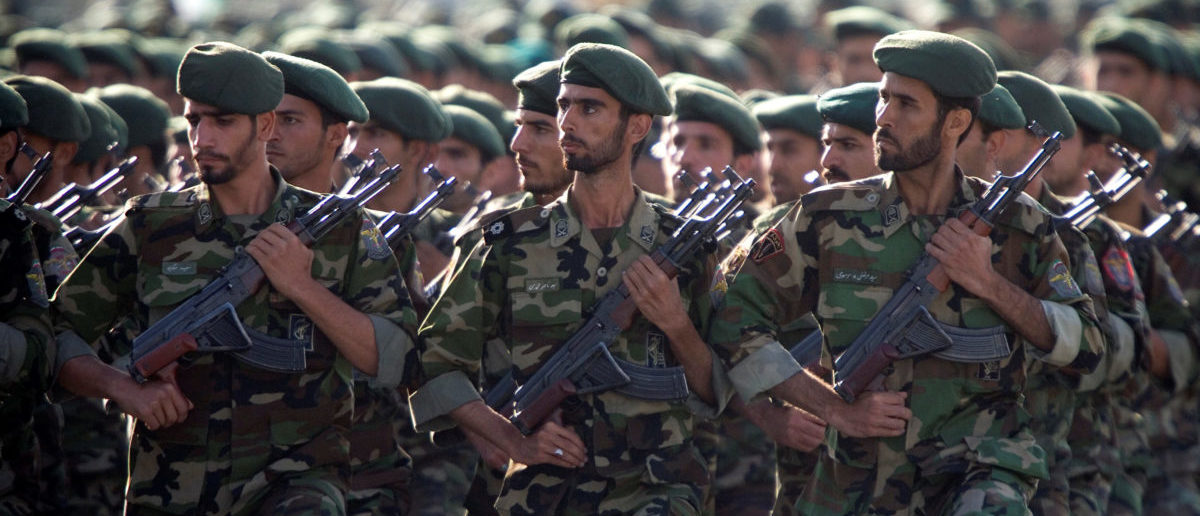
Members of Iran’s Revolutionary Guards march during a military parade to commemorate the 1980-88 Iran-Iraq war in Tehran September 22, 2007. REUTERS/Morteza Nikoubazl/File Photo

Ryan Pickrell China/Asia Pacific Reporter 3:01 PM 05/10/2018 Daily Caller

Source: US Moves To Strangle Iranian Efforts To Secure Hundreds Of Millions Of Dollars To Fund Its Troubling Military Activities

{It’s no wonder why the Iranian people are going broke. – LS}

The U.S. Department of the Treasury imposed new sanctions on Iran Thursday, just two days after President Donald Trump announced that the U.S. is withdrawing from the Iran deal.

Treasury’s Office of Foreign Assets Control blacklisted nine Iranian entities — six individuals and three firms — involved in an illegal currency-exchange network in the United Arab Emirates. Network exchangers and couriers converted and transferred hundreds of millions of U.S. dollars to the Iranian Revolutionary Guard Corps (IRGC), specifically the Quds Force (IRGC-QF), a recognized supporter of international terrorism, to “fund its malign activities and regional proxy groups,” the department said in a statement. Iran’s Central Bank is said to have been “complicit in the IRGC-QF’s scheme and actively supported this network’s currency conversion and enabled its access to funds that it held in its foreign bank accounts.”

One of the sanctioned entities Jahan Aras Kish, a front company for the IRGC-QF, retrieved oil revenues from the Central Bank of Iran and transferred the money to couriers who exchanged it for U.S. dollars by way of two other now-sanctioned companies, Rashed Exchange and Khedmati & Co. Using forged documents, network operatives were able to operate under the radar in the UAE, distributing funds to Iran’s most radical military units and regional proxies. The sanctioned persons identified by Treasury worked for either the firms or the IRGC-QF directly.

The latest move by Treasury, which was taken in cooperation with the UAE, follows the president’s announcement Tuesday that the U.S. will no longer be party to the Joint Comprehensive Plan of Action (JCPOA), more commonly known as the Iran nuclear deal.

“As I said following the President’s announcement on Tuesday, we are intent on cutting off IRGC revenue streams wherever their source and whatever their destination,” Secretary of the Treasury Steven Mnuchin said Thursday. “Today we are targeting Iranian individuals and front companies engaged in a large-scale currency exchange network that has procured and transferred millions to the IRGC-QF.”

“Countries around the world must be vigilant against Iran’s efforts to exploit their financial institutions to exchange currency and fund the nefarious actors of the IRGC-QF and the world’s largest state sponsor of terror,” the secretary added.

The IRGC-QF has been blacklisted since October 25, 2007, and the broader IRGC has been designated since October 13, 2017. Later this year, the U.S. will, as a result of the president’s decision to withdraw from the Iran deal, re-impose sanctions on the Government of Iran.


White House Examining Plan to Help Iranian People Oppose Regime

May 11, 2018

White paper pushes bid to help Iranians topple already weak hardline regime

BY: Adam Kredo May 10, 2018 3:35 pm The Free Beacon

Source: White House Examining Plan to Help Iranian People Oppose Regime

{The question is, how long will it take for the people of Iran to reach ‘critical mass’? – LS}

The Trump administration is examining a new plan to help Iranians fighting the hardline regime in Iran following America’s exit from the landmark nuclear deal and reimposition of harsh economic sanctions that could topple a regime already beset by protests and a crashing economy, according to a copy of the plan obtained by the Washington Free Beacon.

The three-page white paper being circulated among National Security Council officials in the White House offers a strategy by which the Trump administration can actively work to assist an already aggravated Iranian public topple the hardline ruling regime through a democratization strategy that focuses on driving a deeper wedge between the Iranian people and the ruling regime.

The plan, authored by the Security Studies Group, or SSG, a national security think-tank that has close ties to senior White House national security officials, including National Security Adviser John Bolton, seeks to reshape longstanding American foreign policy toward Iran by emphasizing an explicit policy of regime change, something the Obama administration opposed when popular protests gripped Iran in 2009.

The regime change plan seeks to fundamentally shift U.S. policy towards Iran and has found a receptive audience in the Trump administration, which has been moving in this direction since Bolton—a longtime and vocal supporter of regime change—entered the White House.

It deemphasizes U.S military intervention, instead focusing on a series of moves to embolden an Iranian population that has increasingly grown angry at the ruling regime for its heavy investments in military adventurism across the region.

“The ordinary people of Iran are suffering under economic stagnation, while the regime ships its wealth abroad to fight its expansionist wars and to pad the bank accounts of the Mullahs and the IRGC command,” SSG writes in the paper. “This has provoked noteworthy protests across the country in recent months.”

Jim Hanson, SSG’s president, told the Free Beacon that the Trump administration has no appetite for U.S. military intervention in Iran, but is very focused on efforts to rid Iran of its hardline ruling regime.

“The Trump administration has no desire to roll tanks in an effort to directly topple the Iranian regime,” Hanson said. “But they would be much happier dealing with a post-Mullah government. That is the most likely path to a nuclear weapons-free and less dangerous Iran.”

An NSC official declined to comment directly on the report, but confirmed the administration is consistently working to “change the Iranian regime’s behavior.”

“Our stated policy is to change the Iranian regime’s behavior of continuous destabilizing regional acts and support of terrorism,” the official said, adding that the White House reviews multiple plans and proposals from organizations. “The National Security Council is in receipt of reams of policy papers and reports, some are read with interest, others are not. Receipt of a policy paper in no way means that we are going to adopt the position of that paper.”

One source close to the White House who has previewed the plan told the Free Beacon that the nuclear deal, also known as the JCPOA, solidified the Iranian regime’s grip on power and intentionally prevented the United States from fomenting regime change

“The JCPOA purposefully destroyed the carefully created global consensus against the Islamic Republic,” said the source, who would only speak on background about the sensitive issue. “Prior to that, everyone understood the dangers of playing footsie with the world’s largest state sponsor of terrorism. It’s now Trump, Bolton, and [Mike] Pompeo’s job to put this consensus back in place.”

Bolton is said to be acutely aware of the danger the Iranian regime poses to the region, the source said.

“John is someone who understands the danger of Iran viscerally, and knows that you’re never going to fundamentally change its behavior—and the threats against Israel and the Saudis especially—until that revolutionary regime is gone,” the source said, adding that “nothing’s off the table right now if Israel is attacked.”

A second source close to the White House and familiar with the thinking on this issue told the Free Beacon the administration recognizes the chief impediment to the region is Iran’s tyrannical regime.

“The problem is not the Iran nuclear deal it’s the Iranian regime,” said the source, who would only speak on background. “Team Bolton has spent years creating Plans B, C, and D for dealing with that problem. President Trump hired him knowing all of that. The administration will now start aggressively moving to deal with the root cause of chaos and violence in the region in a clear-eyed way.”

Regional sources who have spoken to SSG “tell us that Iranian social media is more outraged about internal oppression, such as the recent restrictions on Telegram, than about supporting or opposing the nuclear program. Iranian regime oppression of its ethnic and religious minorities has created the conditions for an effective campaign designed to splinter the Iranian state into component parts,” the group states.

“More than one third of Iran’s population is minority groups, many of whom already seek independence,” the paper explains. “U.S. support for these independence movements, both overt and covert, could force the regime to focus attention on them and limit its ability to conduct other malign activities.”

American policy towards Iran has failed to explicitly support Iranian opponents of the regime who are thirsty for a change.

“U.S. policy toward Iran currently does not publicly articulate two components vital to success: That a new birth of liberty based in self-determination for the Iranian people should be official policy; and that military action should be anticipated if other measures fail,” the paper states.

In addition to preventing Iran from ever building a nuclear weapon, the Trump administration must articulate a credible military threat should Iran choose to launch full-scale attacks on Israel and U.S. forces.

“A credible hard power option exists,” according to the plan. “That option does not consist of large invasion forces or long, costly occupations.”

Without a regime change, the United States will continue face threats from Iranian forces stationed throughout the region, including in Iraq, Yemen, Syria, and Lebanon.

“The probability the current Iranian theocracy will stop its nuclear program willingly or even under significant pressure is low,” the plan states. “Absent a change in government within Iran, America will face a choice between accepting a nuclear-armed Iran or acting to destroy as much of this capability as possible.”

U.S. officials must make efforts to publicly differentiate between Iran’s ruling regime and its people, a point that was also emphasized by Trump in his statement about exiting the deal earlier this week.

“Any public discussion of these options, and any messaging about the Iranian regime in general, should make a bright line distinction between the theocratic regime along with its organs of oppression and the general populace,” according to the plan. “We must constantly reinforce our support for removing the iron sandal from the necks of the people to allow them the freedom they deserve.”

Lieberman calls on Assad to get rid of Iranian forces in Syria

May 11, 2018

Source: Lieberman calls on Assad to get rid of Iranian forces in Syria

Defense Minister Avigdor Lieberman on Friday called on Syrian President Bashar Assad to “get rid” of Iranian forces in his country, warning their continued presence would only cause trouble.

Speaking while touring the Israeli side of the Golan Heights in the wake of Iranian rocket fire on northern Israel, to which the IAF retaliated with attacks on Iranian targets in Syria, Lieberman said Israel is not looking for friction.

“We did not come to the Iranian border, they came here,” he said.

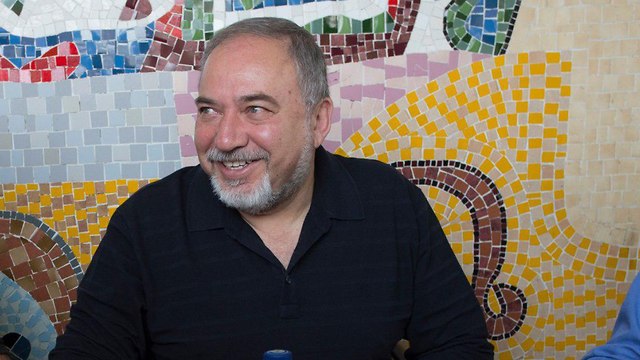
Lieberman tours Golan Heights (Photo: Ido Erez)

Lieberman tours Golan Heights (Photo: Ido Erez)
Iran has advisers and experts and has backed tens of thousands of militiamen who are fighting alongside Assad forces in the civil war. Israel has warned it will not tolerate its archenemy Iran establishing a military presence on its doorstep.”I will take this opportunity to send a message to Assad: Get rid of the Iranians, get rid of Qasem Soleimani, and the Quds Force, they are not helping you, they only cause damage, and their presence will only cause problems and damages,” Lieberman said.

Soleimani is the head of the Iranian Revolutionary Guard’s elite Quds expeditionary force which is fighting in both Iraq and Syria.

“Get rid of the Iranians and maybe it will be possible to have a different kind of life,” Lieberman added.

Lieberman tours Golan Heights (Photo: Gil Nechushtan)

Lieberman tours Golan Heights (Photo: Gil Nechushtan)

Israel attacked dozens of Iranian targets in Syria in overnight strikes in response to an Iranian rocket barrage. It was the most serious military confrontation between the two bitter enemies to date. The cross-border exchange gave way to a war of words.

Iran’s President Hassan Rouhani told German Chancellor Angela Merkel in a telephone call that he did not want “new tensions” in the Middle East.

Rouhani did not mention Israel’s strikes in Syria, or those against the Golan Heights.

Iranian President Rouhani (Photo: Reuters)

Iranian President Rouhani (Photo: Reuters)

Nevertheless, Lieberman noted that “The Iranian president’s message is an important one. I hope it’s a real one too.”

The defense minister, meanwhile, said that he didn’t think exchange of blows between Israel and Iran was over. “We remain vigilant and using discretion. We’re constantly on alert and monitoring events,” he said.

UN Secretary-General Antonio Guterres called late Thursday for an immediate halt to “all hostile acts” to avoid “a new conflagration” in the Middle East.

Guterres’ comments came as a calm night followed intense attacks on parts of Syria by Israel. Israel has called on the UN Security Council and secretary-general to condemn Iran’s attack on its positions in the Golan Heights.

The Security Council, deeply divided over Syria, is highly unlikely to issue a statement and as of Friday morning no council member had asked for a meeting.

After instructing Israeli residents in the Golan Heights to open their bomb shelters on Tuesday in light of Iranian intentions to carry out an attack against Israel, the IDF said Friday shelters can now be closed.

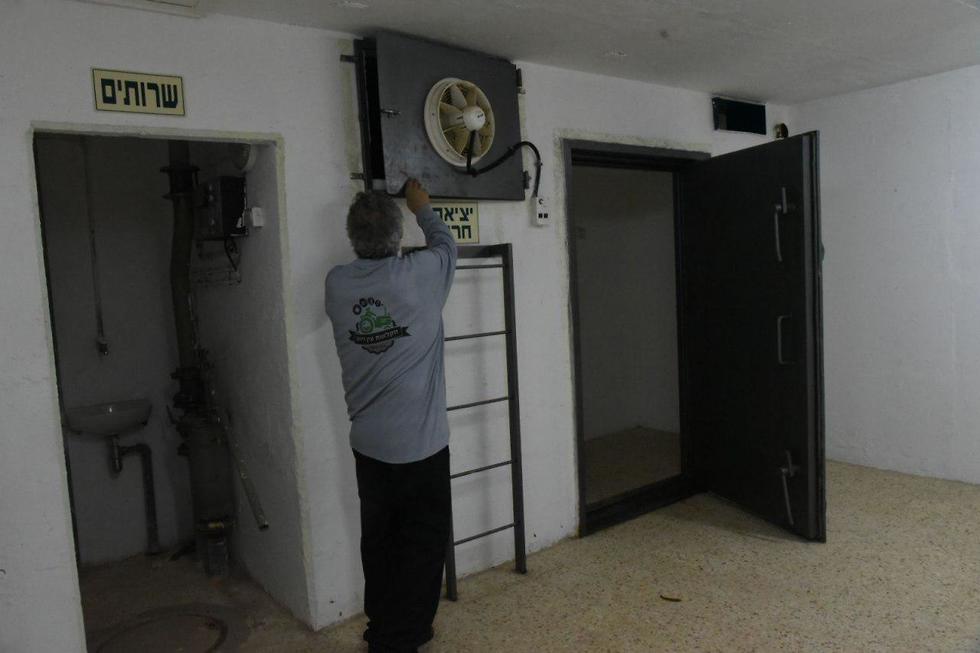
Readying bomb shelters in the Golan on Tuesday (Photo: Avihu Shapira)

Readying bomb shelters in the Golan on Tuesday (Photo: Avihu Shapira)

Israel and Iran have long fought each other through proxies, and with the new exchange each seemed to be sending a warning that a direct clash between them could swiftly escalate.

The scope of the attacks — which Israel called its largest in Syria since the 1973 Yom Kippur War — raised the specter of a full-fledged war between Iran and Israel in Syria, a conflict that could potentially drag the militant Hezbollah and Lebanon into the mix with devastating effects, although both sides appeared to signal they wanted the confrontation to remain contained, at least for now.

The rising tension in Syria came just as the United States decided to withdraw from the 2015 nuclear deal with Iran and impose new sanctions, adding to the pressure on Tehran.

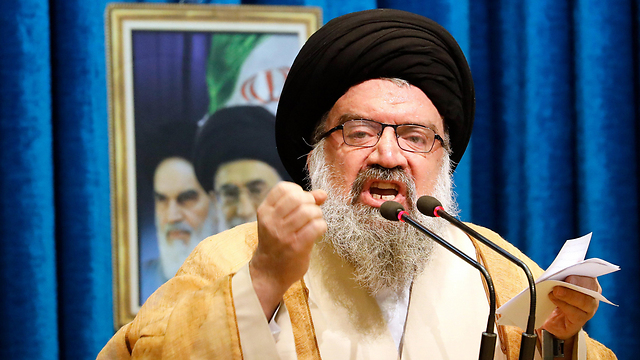
In Tehran, senior cleric Ayatollah Ahmad Khatami said the Western pressure will backfire, threatening that Israel will pay the price.

“The holy system of Islamic Republic will step up its missile capabilities day by day so that Israel, this occupying regime, will become sleepless and the nightmare will constantly haunt it that if it does anything foolish, we will raze Tel Aviv and Haifa to the ground,” the hard-line cleric said during Friday sermons. The worshipers chanted: “Death to America,” and “Death to Israel.”

Ayatollah Ahmad Khatami  (Photo: EPA)

Ayatollah Ahmad Khatami (Photo: EPA)

In a first official reaction to the confrontation on Wednesday night, Tehran said Damascus has the legitimate right to respond to what it said were repeated violations of the country’s sovereignty “under fabricated and baseless excuses.”

Iran’s Foreign Ministry spokesman Braham Ghasemi added that the international silence in the face of such “aggressive moves” is in effect a “green light” to more such attacks.

Ghasemi went on to note that the direct attacks on Syria come as the government of Assad is regaining control of territories from rebel fighters, accusing Israel and the United States of supporting the opposition which he called “terrorists.”

Yoav Zitun and Ahiya Raved contributed to this story.

After Netanyahu visit, Russia backs off delivering S-300 missiles to Syria 

May 11, 2018

Source: After Netanyahu visit, Russia backs off delivering S-300 missiles to Syria – Israel Hayom

A man of his word

May 11, 2018

Source: A man of his word – Israel Hayom

( His personal behavior { Stormy et al } is truly sickening.  At the same time he may well be the best policy President of my 64 years.  Can you imagine where we’d be if Clinton had won? – JW )

Hamas: Riots on Day of US Embassy Opening in Jerusalem Will Be ‘Decisive’

May 11, 2018

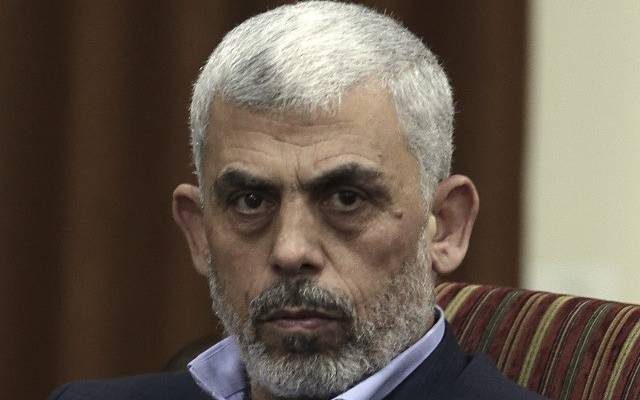
Yahya Sinwar, the Gaza-based leader of Hamas, says the riots planned for next week will be “like a tiger running in all directions.”

By: The Tower

https://unitedwithisrael.org

Tigers are almost extinct. ( added by JK )

Hamas leader in the Gaza Strip Yahya Sinwar (AP/Khalil Hamra)

In an apparent threat to Israel, the leader of Hamas, the Gaza-based terrorist organization, said that next week’s riots at the border fence with Israel would be “decisive,” Israeli media reported.

The Hamas-led riots, which had originally been described as non-violent, involve rioters attempting to tear down the border fence with Israel, throwing rocks at soldiers, and sending kites over the fence with burning fuel in attempts to start fires inside Israel. Last week, rioters entered the Kerem Shalom crossing and set storage facilities on fire, including pipelines that bring gas into Gaza. This is the seventh consecutive week that riots are being held.

Yahya Sinwar, the Gaza-based leader of Hamas, said that the riot next week planned for May 14, the day the United States Embassy is slated to open in Jerusalem, will be “decisive.” Israel imposed the blockade when Hamas expelled Fatah, the main Palestinian political party, from Gaza in 2007 and took control of the enclave. Hamas remains committed to Israel’s destruction, has accumulated an arsenal of rockets, and built terror tunnels with the aim of attacking Israel.

“We can’t stop these protests. We are supporting, even leading, them,” Sinwar said. The riots will be “like a tiger running in all directions,” he said.

Hamas has claimed that the goal of the riots is to gain the “right” to return to all of Israel, meaning the destruction of Israel. Israel has charged that the goal is to cover for violent activities, including efforts to breach the border fence.

Sinwar made the comments in a speech to activists, who have been leading the riots. According to media reports, Hamas has been indicating that it could encourage the rioters to storm the fence.

The Hamas-run health ministry in Gaza claims that 48 rioters have died since the first protest too place on March 30. According to the Meir Amit Intelligence and Terrorism Information Center, which uses publicly available information to identify casualties, 80% of the rioters who have been killed were a member of, or otherwise affiliated with terrorist organizations.

In a conference call hosted by The Israel Project, Maj.-Gen. (ret.) Israel Ziv, former head of IDF’s Gaza Division, assessed that the rioters would use grenades, improvised explosives, “anything that can fly over the fence and burn.”

He added, “we don’t expect anything terribly new.” However, if Hamas attempts to use the riot to “maneuver a terror unit, commando units or things of that kind …, to penetrate to Israel, to go to some of the settlements, the IDF is ready for those options as well,” Ziv asserted.

Everything Destroyed: IDF Releases Aerial Images of Attacked Iranian Targets

May 11, 2018


 http://www.jewishpress.com/news/middle-east/syria/everything-destroyed-idf-releases-aerial-images-of-attacked-iranian-targets/2018/05/11/
Iranian Intelligence sites in Syria that were attacked
On Friday morning, the IDF Spokesperson’s Office issued aerial photographs of several Iranian facilities that were attacked by the Israeli Air Force during Operation House of Cards early Thursday morning. The published photographs show the Tel Gharba, Tel Kleb, Tel Maqdad, Tel Nabi Yusha, and the logistic military installations of the Revolutionary Guards’ Quds Force near Damascus.
Iranian logistical site near Damascus that was attacked / Photo credit: IDF Spokesperson
During the operation, about 50 Iranian targets were attacked in Syria, reaching intelligence positions, outposts, headquarters and equipment storage facilities in 16 different locations across the country.
Quds Force Military compound that was attacked / Photo credit: IDF Spokesperson

Reports in Israeli media on Friday morning suggested the Russians were not necessarily unhappy to see Iran get a severe nose bleed from the Israeli attacks, since Iran has introduced an unacceptable level of instability to the area the Russians have been trying to tame back for their client, President al-Assad.

It is roughly estimated that Iran has some 4,000 Revolutionary Guards military personnel, instructors, advisers and soldiers stationed in Syria. In addition, about 8,000 Hezbollah fighters are deployed in Syria as well, along with some 40,000 fighters in Shi’ite militias from Iraq, Pakistan, and Afghanistan. None of these are particularly loyal to the Russian mission statement in Syria…

Russia seeks mediator role between Israel and Iran

May 11, 2018

Source: Russia seeks mediator role between Israel and Iran | The Times of Israel

With no way to get Jerusalem and Tehran at the same table, Moscow will seek to make sure the conflict does not spiral out of control

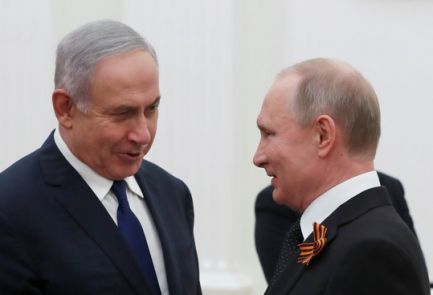
Russian President Vladimir Putin, right, meets with Prime Minister Benjamin Netanyahu at the Kremlin in Moscow on May 9, 2018. (SERGEI ILNITSKY/AFP)

Russian President Vladimir Putin, right, meets with Prime Minister Benjamin Netanyahu at the Kremlin in Moscow on May 9, 2018. (SERGEI ILNITSKY/AFP)

MOSCOW, Russia (AFP) — Following Israeli strikes on Iranian targets in Syria, Russia has positioned itself as a mediator between the Middle Eastern rivals as it has maintained good relations with both countries.

“The Kremlin is sitting on two chairs,” Russian analyst Alexei Malashenko told AFP.

“It is a complex and difficult situation for Russia that has links with both of the sworn enemies.”

Israel carried out raids on dozens of Iranian military targets on Thursday after it said around 20 rockets were fired from Syria at its forces in the Golan Heights.

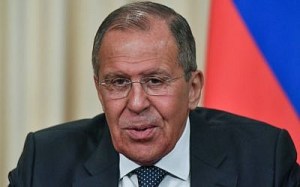
Russia was quick to call for restraint, with Russian Foreign Minister Sergei Lavrov saying on Thursday that “all issues should be solved through dialogue.”

Russian Foreign Minister Sergei Lavrov attends a joint press conference with his German counterpart following their talks in Moscow on May 10, 2018. (AFP PHOTO / Yuri KADOBNOV)

He added that Russia had warned Israel to avoid “all actions that could be seen as provocative” the day before the strikes, when Prime Minister Benjamin Netanyahu was in Moscow for talks with President Vladimir Putin.

Russian analyst Fyodor Lukyanov said relations between Putin and Netanyahu were “very good” and that the meeting, on the eve of the strikes, showed Russia could play a major role in the Israel-Iran dispute.

“Moscow could use its good relations with the two countries to help them communicate and make sure confrontation does not exceed certain limits,” Lukyanov said.

Major player

Russia has become a major player in the Middle East since intervening in the Syrian war on the side of the Damascus regime in September 2015. Analysts also highlight its role as mediator in other conflicts in the area.

“The role of Russia as a mediator is strongly appreciated in the region. This role will be reinforced if the crisis between Israel and Iran worsens,” said Alexander Krylov, a foreign policy expert at the Moscow State Institute of International Relations.

Krylov told AFP that Russia’s “additional value” is that it has good relations with forces that other actors refuse to speak to such as with Hamas, Hezbollah, Iran, and the Kurds.

Russia’s good ties to Israel were demonstrated by Netanyahu’s visit, he said.

“I do not rule out the idea that Israel gave some clues to Russia about the strikes,” Krylov said.

But even if Russia considers Israel’s security concerns over Iran legitimate, Lukyanov said, it sees Iran as an “indispensable partner on many issues, especially in Syria.”

Turkish President Recep Tayyip Erdogan (C), Russian President Vladimir Putin (R), and President of Iran, Hassan Rouhani (L) pose for a photo ahead of the Turkey-Russia-Iran Tripartite summit in Ankara, Turkey on April 04, 2018. (AFP PHOTO / POOL / TOLGA BOZOGLU)

Russia, Iran, and Turkey regularly meet to discuss the regulation of the Syrian war, where the three countries have positioned themselves as major players.

Unlike Turkey, Iran and Moscow are unflinching allies of the Bashar Assad regime and often maintain a united diplomatic front.

Analyst Alexei Malashenko said Russia would do everything possible to maintain relations with both Israel and Iran without taking a stand, especially since Israel’s strikes “do not threaten” Moscow’s position in Syria.

“If Israel were to defy Russia’s dominant role, Russia would react and take a stand. This is unlikely to happen because Israel knows Russia defines the rules in Syria,” said Lukyanov.

‘Anti-Iranian sentiment’

But if escalation continues, Moscow will find it difficult to keep playing a mediator’s role.

“Even with the best intention, nobody can bring Iran and Israel to the same table,” said Malashenko.

He added that Russia is also closely watching Washington’s exit from the Iran nuclear deal, which the Kremlin has opposed. On Thursday Moscow said it would continue a “close collaboration” with Iran on the agreement.

Lukyanov said it may not have been coincidental that the Israeli strikes took place shortly after US President Donald Trump announced his country’s withdrawal from the deal.

“Iran’s enemies can only be inspired by this decision: there is a very strong anti-Iranian sentiment,” Lukyanov said. “Increased US pressure on Iran has certainly helped Israel fulfill its agenda.”

COLUMN ONE: Netanyahu’s finest hour

May 11, 2018

Source: COLUMN ONE: Netanyahu’s finest hour – Opinion – Jerusalem Post

BY CAROLINE B. GLICK
 MAY 10, 2018 21:24
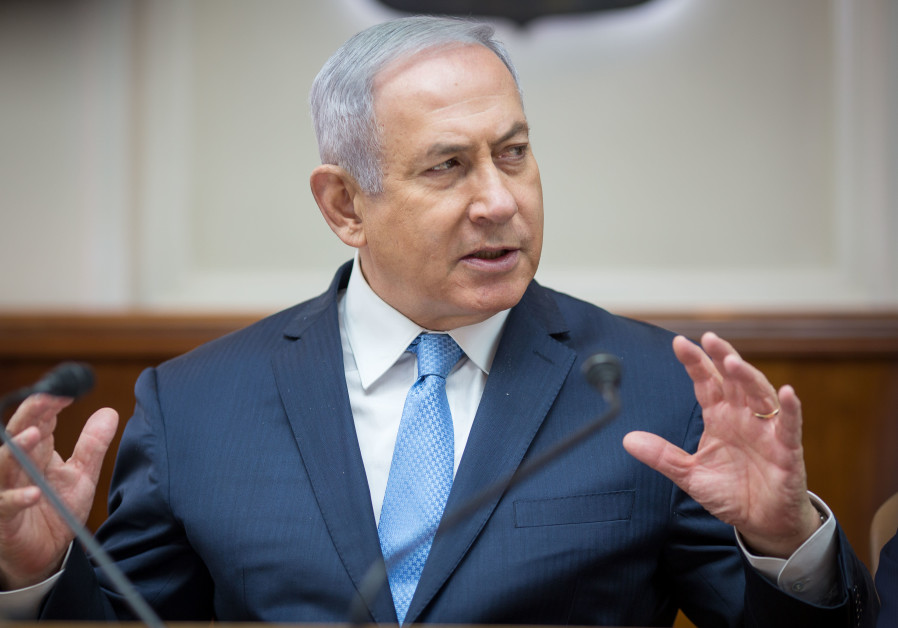
Prime Minister Benjamin Netanyahu at a weekly cabinet meeting, May 6th, 2018.

Prime Minister Benjamin Netanyahu at a weekly cabinet meeting, May 6th, 2018.. (photo credit: EMIL SALMAN/POOL)

At the start of his cabinet meeting on Wednesday, President Donald Trump discussed his announcement Tuesday afternoon that he is removing the US from his predecessor Barack Obama’s nuclear deal with Iran and reinstating the nuclear sanctions that were suspended with the deal’s implementation in January 2016.

European and other international leaders responded angrily to Trump’s move. The EU’s foreign policy commissioner Federica Mogherini was downright indignant.

Apparently unaware that the US is a more important EU ally than Iran, Mogherini insisted, “The European Union is determined to preserve it. Together with the rest of the international community, we will preserve this nuclear deal.”

The liberal US media outlets were also aghast. Commentators joined the chorus of former Obama administration officials condemning Trump and insisting his move will isolate the US from the international community.

Trump brushed off his critics by noting, “You saw [Prime Minister] Benjamin Netanyahu get up yesterday and talk so favorably about what we did.”

In other words, as far as Trump is concerned, Israel’s support is just as valuable as Mogherini’s. He’s perfectly willing to suffice with Israeli support. Having Israel in his corner means that the US is not isolated.

From moving the US Embassy to Jerusalem, to walking away from the nuclear deal which guaranteed Iran’s eventual acquisition of nuclear weapons and financed its regional aggression and terrorism sponsorship, to unconditionally supporting Israel’s military operations against Iranian positions in Syria, Trump has demonstrated that he is the most pro-Israel president in US history. No other president comes close.

The difference between Trump and his predecessors is that Trump accepts Israel on its own terms. He doesn’t expect Israel to do anything to “earn” American support. So long as Israel is in America’s corner, he respects the Jewish state as America’s ally.

Trump has earned all the credit for transforming the US-Israel relationship into a full-blown strategic relationship. But it was another leader that prepared the groundwork for his actions.

That leader is Netanyahu.

For many Republicans, Netanyahu is the most important foreign leader of our times. In the ranks of their esteem he ranks a close second to Winston Churchill. Netanyahu’s high standing is all the more remarkable given that Israel has no British Empire behind it. In the vast scope of things, Israel is a tiny country with no coattails.

Republicans aren’t the only ones who admire him. World leaders from Russian President Vladimir Putin to Indian Prime Minister Narendra Modi to Chinese Premier Xi Jinping welcome him to their capitals like a visiting monarch. Sandwiched between two major Israeli air assaults on Iranian military assets in Syria Tuesday and Wednesday night, Netanyahu flew to Moscow. He stood next to Putin in Red Square as the Red Army Band played “Hativka” during the parade marking the 73rd anniversary of the Allied victory over Nazi Germany.

What explains his meteoric rise? How is it possible that an Israeli politician from the political Right, a man castigated for decades by the local and Western leftist elites as a fanatic and an extremist, is so revered today?

To understand Netanyahu’s success, a comparison with the late Shimon Peres is in order. Until his death, the same elites who revile Netanyahu revered Peres as the greatest Israeli statesman of all time.

Peres had a clear formula for statesmanship. He identified the interests of key actors – first and foremost, the Europeans – and he adopted them.

Consider his central foreign policy initiative, the Oslo peace process with the PLO.

Since the 1970s, the Europeans sought to legitimize the PLO – at Israel’s expense. In 1993, then-foreign minister Peres turned their goal into an ideology of peace and adopted it as his own.

On Monday, Labor MK Eitan Cabel said that if the late Yitzhak Rabin had known the toll the Oslo process would take on Israel, he never would have adopted it.

In his words, “From my dealings with [Rabin], in my view, if he had known the price the State of Israel would pay for the Oslo agreements, he never would have agreed to them.”

Peres, of course, was different. As the Israeli casualties of his peace process mounted from the tens to the hundreds to the thousands, and as Israel’s international position sunk ever lower, Peres became more dogmatic in its defense.

For his efforts, Peres was personally glorified by the A-list crew of European and American elites. They came to his extravagant birthday parties and had their photos shot embracing him. But none of his triumphs were shared with the country.

Netanyahu, has a different approach to diplomacy. Netanyahu identifies Israel’s national interests. Then he scans the international community for actors with aligned interests. He uses his considerable power of persuasion to convince those actors to achieve common goals.

The discrepancy between the two men’s approaches is nowhere more apparent than in their divergent moves to develop ties with the Arab world.

Peres viewed the Arab world from a European perspective. The EU views the Arab world as a monolithic presence moved only by Israel’s willingness to give Jerusalem to the PLO. So long as Israel refuses to give up Jerusalem, the Arabs will reject the Jewish state. Once Israel has conceded its eternal capital – and Judea and Samaria along with Gaza – the Arabs will be placated in one fell swoop and immediately embrace Israel as a neighbor and friend.

This view, which Peres gave voice to in his book The New Middle East, bears no relationship whatsoever to the realities of the Middle East.

Consequently, rather than embrace his vision, the Arabs viewed it as a Jewish conspiracy to take over the Arab world.

In stark contrast, Netanyahu has built his regional strategy on the real Middle East. During the Obama years, Netanyahu realized that Obama’s policies toward Iran and the Muslim Brotherhood imperiled Sunni Arab states no less, and perhaps even more, than they imperiled Israel.

Netanyahu developed relations with Egypt, Saudi Arabia and the UAE on the basis of these shared concerns and shared interests in diminishing the deleterious consequences of Obama’s policies. Although Netanyahu’s moves are unlikely to generate extravagant signing ceremonies with doves and balloons, they did bring about a situation where the Saudis, Egyptians and the UAE sided with Israel against Hamas, Qatar and Turkey during Operation Protective Edge in 2014.

That united front prevented Obama from coercing Israel into accepting Hamas’s cease-fire terms in the war.

So too, the relationships Netanyahu built formed the basis of a united Israeli-Arab front opposing Obama’s deal with Iran.

Now with Trump in the White House, Netanyahu’s regional policies have fomented a strategic transformation of the US’s system of alliances in the Middle East. Whereas in 1990, then-president George H.W. Bush built a coalition of Arab states against Iraq at Israel’s expense, in 2017, Trump reframed the US’s alliance structure to one based on the common Israeli-Sunni front against Iran and the Muslim Brotherhood.

Throughout Obama’s eight years in office, politicians from the Left accused Netanyahu of destroying Israel’s alliance with the US. Yesh Atid leader Yair Lapid, for instance, chastised Netanyahu in 2015 insisting, “Your understanding of America is obsolete and irrelevant and it is causing damage to the State of Israel.”

Netanyahu did understand America though. He understood the Obama administration was incurably hostile to Israel and that Obama viewed Israel as the main obstacle to achieving his goals in the Middle East. Netanyahu understood that under those circumstances, he had to find partners inside the US – in Congress and among the general public – to lessen the damage Obama was causing Israel.

Netanyahu’s approach to the US during the Obama years, and indeed, during the Clinton administration as well, was to recognize that the administration, while a key actor, is just one actor in a much wider American society, which is by and large deeply supportive of Israel. This insight informed Netanyahu’s decision to bring his opposition to Obama’s nuclear diplomacy with Tehran to the American people directly, through his address before a joint session of Congress in March 2015.

Netanyahu was reviled and attacked brutally by the Israeli and American Left for his move. Both groups insisted that he was undermining and even destroying US ties with Israel.

But the truth was that to a significant degree, Netanyahu’s speech in March 2015 safeguarded and protected the US alliance with Israel.

Netanyahu recognized that the White House’s propaganda campaign on behalf of Obama’s nuclear deal was even more dangerous to Israel than the deal itself. Obama’s campaign centered on delegitimizing all of the deal’s critics, by castigating them as Israeli agents and warmongers. If Obama’s efforts had succeeded, US support for Israel would have crashed, as that support would have been effectively rendered toxic and somehow treasonous.

Netanyahu’s address to Congress stopped Obama’s efforts in their tracks. He preserved the political legitimacy of opposition to the Iran deal and of support for Israel. His speech presented a clear case for how the nuclear deal harmed America’s national interests and how support for Israel advanced America’s national interest. Although Netanyahu’s speech represented the most significant substantive challenge Obama’s foreign policy ever suffered, Netanyahu offered nothing but praise for Obama in his address. In so doing, Netanyahu insulated himself and Israel from charges that he was hostile to Obama or in any way disrespectful of the presidency.

By coming to Washington and preserving the legitimacy of Obama’s opponents, Netanyahu blocked Obama from securing the support of either a majority of US lawmakers or a majority of the US public for his nuclear accord. His speech was the foundation of the Republican Party’s rejection of Obama’s deal. It created the political space for Democratic lawmakers to oppose their president’s most important foreign policy initiative.

If Netanyahu had not deliver his speech, opposition to the nuclear deal might not have become the consensus view of the Republican presidential candidates in the 2016 primaries. If Netanyahu not ensured the continued legitimacy of opponents of the nuclear deal, Trump might not have promised to abandon it.

Trump is the only person who decides his policies and so he has earned the admiration of the people of Israel, who are rightly moved by his extraordinary, unprecedented acts of friendship and support since entering office. But the man who set the conditions that afforded Trump the opportunity to transform the US-Israel relationship into a fullboard alliance is Netanyahu.

Israel is now reaping the rewards of Netanyahu’s visionary statesmanship. For his efforts, over the course of 30 years, Netanyahu has roundly earned the ever growing acknowledgment at home and abroad that he is the greatest statesman in Israel’s history.

http://www.CarolineGlick.com