Reports emerged this week in the Israeli media that President Trump would be releasing a peace plan that would include requiring Israel hand over four Jerusalem neighborhoods to the Palestinian Authority, 40% of Judea and Samaria to the PA and internationalize the Old City of Jerusalem.
But Caroline Glick says the reports are all lies.
I asked a senior US official about the Israeli media reports regarding the US peace plans – Partition Jslem, transfer 40% of J&S to PLO. He denied the whole thing. It’s fake news. Source apparently Israeli @Israel_MOD or @idfonline. Terrible. Shameful.
Caroline Glick spoke with a senior US government official who is familiar with the American plan, and he denied all the details in the report. He says the reports on the peace plan are fake news.
Glick believes the source of that report is an Israeli from the Ministry of Defense or the IDF.
Survey finds 58% of Israelis support PM Netanyahu’s strategy on Iran, only 15.5% oppose it • 31% oppose a strike on Iran • 80% of the public believes homefront is ready for potential war • 60% believe the U.S. would help Israel in case of war with Iran.
Shlomo Cesana
Prime Minister Benjamin Netanyahu during his press conference in Tel Aviv, Monday
A majority of Israelis support Prime Minister Benjamin Netanyahu’s strategy against Iran, according to a Geocartography Knowledge Group poll released Thursday.
The survey was conducted following Netanyahu’s press conference on Monday, when he presented secret documents proving that Iran pursued a military nuclear program, and ahead of the coming 18th Herzliya Conference, scheduled to take place May 8-10 at the Interdisciplinary Center Herzliya. It questioned 500 Jewish respondents ages 18 and up and has a margin of error of 4.38%.
The survey shows that 58% of respondents support the prime minister’s policies on Iran, 15.5% oppose his policies, and 26.5% have no opinion.
It also finds that 60% of respondents believe the United States would come to Israel’s political and military aid in case of a confrontation with Iran.
Some 26.3% of respondents say they are “absolutely sure” the U.S. would help Israel, 34.3% say the U.S. would “probably” help Israel, 19% say it would only back Israel politically, 13.5% are “not sure” the U.S. would help Israel, 0.9% say the U.S. would not help Israel in any way, and 6% have no opinion.
On the question of whether Israel should strike Iran, 44.2% are in a favor of a strike designed to prevent Iran from obtaining nuclear weapons, 31.1% oppose a strike and 24.7% have no opinion.
Further analysis shows that more men than women are in favor of an Israeli strike on Iran.
Asked whether Israel is better prepared for a war today than in the past, 28.9% said the country’s war readiness has not changed much through the years, 28% said Israel is “somewhat better” prepared, 22.4% said Israel is far better prepared, 8.4% said it is somewhat less prepared, 4.9% said the country is grossly underprepared, and 7.4% had no opinion.
Touching on the controversial law passed this week that gives the prime minister the authority to declare war after consulting with the defense minister alone and not with the Diplomatic-Security Cabinet as previously required, 42.8% of respondents said they support the move, 37.6% oppose it and 19.6% have no opinion.
Asked whether they believe American Jewry’s support for Israel is increasing or decreasing, 35.8% said there has been no change, 34.1% said Israel is steadily losing that support, 15.2% said U.S. Jewry’s support for Israel is increasing, and 14.9% had no opinion.
What the assorted apologists for the Iran nuclear deal have failed to grasp is a simple distinction: the difference between suspicions and confirmation. The IAEA based its assessments on “over a thousand pages” of documents; now we have a hundred thousand.
Moreover, these are in effect a hundred thousand signed confessions of the Iranian regime that it intended to create nuclear weapons and load them on missiles manufactured by itself. The miniature minds of the apologists are simply incapable of grasping the historic magnitude of the Mossad’s discovery.
The picture of Israeli Prime Minister Benjamin Netanyahu standing before two displays, one of file folders and one of compact discs, symbolizes possibly the greatest coup in the history of espionage: the Mossad’s acquisition of the archive of Iran’s program to create nuclear weapons. A runner up for that title might be the advance information about Operation Overlord, the Allied landing in France at the end of World War II, supplied by Elyesa Bazna from Ankara and Paul Fidrmuc from Lisbon.
Nazi Germany failed to act on that information about the intended landing site on D-Day. Instead, it fell victim to false information provided by a supposed spy who was working for the Allies. The parallel to that failure is the present rush of politicians and so-called experts who pretend that the Mossad’s coup tells us nothing new and merely proves that the deal is more justified than ever. They claim, in particular, that before the deal was agreed the International Atomic Energy Agency (IAEA) already knew the broad details of what the new information reveals.
What the assorted apologists for the Iran nuclear deal have failed to grasp is a simple distinction: the difference between suspicions and confirmation. The IAEA based its assessments on “over a thousand pages” of documents; now we have a hundred thousand.
Moreover, these are in effect a hundred thousand signed confessions of the Iranian regime that it intended to create nuclear weapons and load them on missiles manufactured by itself. The miniature minds of the apologists are simply incapable of grasping the historic magnitude of the Mossad’s discovery.
Pictured: Two images from Iran’s secret nuclear archive, as presented publicly by Israeli Prime Minister Netanyahu on April 30, 2018. In possibly the greatest coup in the history of espionage, Israel’s Mossad acquired over 100,000 documents from the archive of Iran’s program to create nuclear weapons. (Photo by Israel GPO)
Apart from Netanyahu himself, the most significant individual who understands that magnitude is President Trump. In February 2018, Trump informed the three European countries involved in the Iran deal about the defects that he wanted corrected in order to continue to certify the deal. As Reuters reported at the time:
“Trump sees three defects in the deal: its failure to address Iran’s ballistic missile program; the terms under which international inspectors can visit suspect Iranian nuclear sites; and ‘sunset’ clauses under which limits on the Iranian nuclear program start to expire after 10 years. He wants all three strengthened if the United States is to stay in the deal.”
The Mossad’s coup has turned Trump’s three proposals into three imperatives, not just to the Europeans but also to the two other states involved in the deal: Russia and China. (Russia, in particular, must grasp that major Russian cites are within missile range from Iran.) That is, if the deal is to survive, the sunset clauses must be cancelled, the IAEA must have freedom to inspect whatever it demands, and Iran’s long-range missile capacity must be curtailed. This is because the Mossad has also supplied us with a hundred thousand signed confessions that the Iranian regime will resume and complete its plans for nuclear-armed missiles as soon as the deal permits it — indeed authorizes it — to do so.
Malcolm Lowe is a Welsh scholar specialized in Greek Philosophy, the New Testament and Christian-Jewish Relations. He has been familiar with Israeli reality since 1970.
Less than two months ago the State Department hosted members of the White Helmets at Foggy Bottom. At the time, the humanitarian group was showered with praise for saving lives in Syria.
“Our meetings in March were very positive. There were even remarks from senior officials about long-term commitments even into 2020. There were no suggestions whatsoever about stopping support,” Raed Saleh, the group’s leader, told CBS News.
Now they are not getting any U.S funding as the State Department says the support is “under active review.” The U.S had accounted for about a third of the group’s overall funding.
“This is a very worrisome development,” said an official from the White Helmets. “Ultimately, this will negatively impact the humanitarian workers ability to save lives.”
The White Helmets, formally known as the Syrian Civil Defense, are a group of 3,000 volunteer rescuers that have saved thousands of lives since the Syrian civil war began in 2011. A makeshift 911, they have run into the collapsing buildings to pull children, men and women out of danger’s way. They say they have saved more than 70,000 lives.
Having not received U.S. funding in recent weeks, White Helmets are questioning what this means for the future. They have received no formal declaration from the U.S. government that the monetary assistance has come to a full halt, but the group’s people on the ground in Syria report that their funds have been cut off.
The group has an “emergency plan” if the funding is halted for one or two months — but they are worried about the long-term freeze.
“If this is a long-term or permanent halt, it would have a serious impact on our ability to provide the same intensity and quality of services that we currently provide to civilians,” said Saleh.
An internal State Department document said that its Near East Bureau needed confirmation from the administration to green light funding for the White Helmets in Syria by April 15th or the department would initiate “shut-down procedures on a rolling basis.” That document also said that the department needed to be notified by April 6th that it could continue programs that focus on removing land mines, restoring essential services and providing food to moderate forces and their families or those programs would also have to be shut down.
However, U.S. government officials are not talking on the record about the date of the actual funding cutoff for each program, which is leading to confusion.
State Department spokesperson Heather Nauert has previously called the White Helmets “selfless men” and asked journalists to watch a documentary about their work. But the State Department did not respond to a CBS News inquiry earlier this week about which programs are still receiving funding, and the date for when certain programs will lose their funding.
President Trump put a freeze on the $200 million in U.S. funding for recovery efforts in Syria in late March. This freeze means that U.S. support for the White Helmets is not the only project in jeopardy. There are also many other stabilization efforts that are backed by the U.S. — including the clearing of explosive devices, bringing back electricity, rebuilding schools, and getting water running — that may end soon.
U.S. officials are working to see if there is a way to adjust existing funding to cover the costs for these projects. They are also trying to get other countries, such as Germany, to cover some of the costs. Earlier this year, at the Brussels for the donor conference for Syria, German Foreign Minister Maas pledged more than $1.1 billion to help people in need in Syria. But as of now, Germany has not officially committed to stepping in beyond this initial commitment.
Observers are also increasingly concerned about Syria’s young people, who are more prone to radicalization if they don’t get the security and support that they need. As a result of the fighting in the country, thousands of schools have been destroyed. The handful of schools that opened their doors again have received simple necessities like chairs, tables and blackboards from the U.S. — but in most schools children are still sitting on the ground, and teachers are extremely hard to come by.
“The amount of U.S. support is very limited but it is better than nothing, so if that will stop, that will be a disaster. After ISIS they started to open the schools and if money stops, that will be done,” said a senior member of the Deir ez-Zor city council. “Without education the people only have ISIS ideas.”
This week, the State Department said it would continue to defend its partners on the ground in Syria when they announced the final operations to liberate ISIS strongholds in the country.
“The fighting will be difficult, but we and our partners will prevail. We will defend United States, Coalition, and partner forces if attacked. The days of ISIS controlling territory and terrorizing the people of Syria are coming to an end,” wrote State Department Spokesperson Heather Nauert. She did not write anything about the stabilization projects.
Meanwhile, much of Syria that has been cleared of ISIS control — such as Raqqa, its self-proclaimed capital — is still in ruins and almost impossible to live in.
“Raqqa is like a sick person in an emergency room. So the money or treatment should come faster than the routine way. He is not a normal sick person,” Abdullah al-Arian, a lawyer in Raqqa advising the governing Civil Council.
“The passion and power the U.S. put in to liberate Raqqa does not at all equal the passion to rebuild Raqqa. It is very much different, much less, much more slow,” says al-Arian. “They give us very beautiful words and promises but not much else.”
It is a creeping ethnic cleansing. Not coordinated, not centrally directed. It is without cold-blooded generals, unscrupulous local officers and desktop criminals, who could then later be brought to trial in front of a war crimes tribunal. All the while the methods are age-old — and they begin with the ghettoization of Jews.
Said ghettoization follows a new template in Europe: Jews are simply not left with a choice but to ghettoize themselves. In Paris and Belgium, long since the central hubs of the European jihad, the state schools are as good as “judenrein”, Jew free, according to the latest report of the Moshe Cantor Database for the Study of Contemporary Anti-Semitism and Racism. In the past few years no fewer than 40,000 Jews have left France — the majority of them having moved to Israel. 7,900 alone in the year 2015.
About 60,000 Jews go into inner exile. They leave their apartments and their neighborhoods, which have become too dangerous for Jews, and they move on like nomads. This is how macabre history can be at times: The mob which refuses to integrate itself forces the very well-integrated Jew into social isolation — and the state looks on apathetically.
The Jew in Europe is constantly hiding. He hides his kippa, he hides his Star of David pendant, he hides his identity at school. On the school playgrounds his cultural world, his religion, has morphed into a swear word. When it comes to Jews, the mob prohibits them from being what they are — human beings of the Jewish faith.
But these are not sporadic attacks that force Jews slowly into the new ghetto or even off the continent. After all, attacks happen in Israel as well. They are also not isolated individual people — lone wolves — who drive Jews into self-isolation and emigration. They are in the meantime entire city districts, boroughs, and neighborhoods.
A provocation against the Arabs living in Malmö
In Malmö, the third-largest city in Sweden, it already wasn’t possible to guarantee the security of the Israeli tennis players against the rioting anti-Semitic mob in 2015.The then-mayor, Ilmar Reepalu, who saw the game as a “provocation against the Arabs living in Malmö”, found a solution: The Davis Cup game between Israel and Sweden took place without an audience. It was a decision that meant nothing but contempt, scorn, and abuse of the state monopoly on the legitimate use of force.
Since then the younger generation of Jews especially has been leaving cities, moving either to Stockholm, or emigrating entirely. In a survey in Great Britain, 31% of the 4,000 Jews who were asked answered that they had been playing around with the idea of leaving the country based on anti-Semitic discrimination. Districts such as Neukölln and Wedding in Berlin have long ago become no-go zones for Jews. There, for mystical reasons, German legislation promptly loses all power and strength.
And while the press celebrated solidarity rallies for the Jewish community in the bourgeois Fasanenstraße in Berlin, the participants in a different solidarity rally in Neukölln were spit on, insulted and berated.
They have found each other: The broader spectrum of the pseudo-intellectual political Left — for example the Labour Party in Great Britain and among the Social Democrats in Sweden — which had smoothed the road for hatred against Jews from the edge of society into the living rooms of the middle class, and the imported anti-Semites.
They operate side by side together, not in the name of the state, but undisturbed and uninterrupted by the state, unofficially but effective. One thing we should not forget, though: What starts with the Jews never ends with just the Jews.
There have been coups and revolutions, external invasions and proxy conflicts, but the Middle East hasn’t seen a head-to-head war between major regional powers since the 1980s.
There’s a growing risk that one is about to break out in Syria, pitting Israel against Iran.
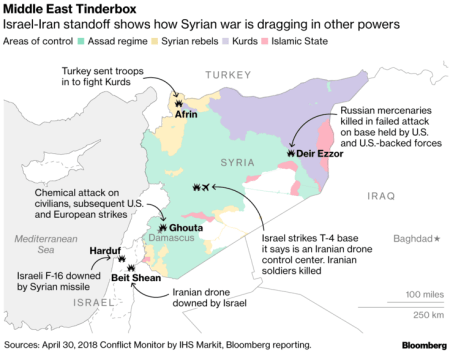
The Islamic Republic’s forces are entrenching there, after joining the fight to prop up President Bashar al-Assad. The Jewish state, perceiving a direct threat on its border, is subjecting them to an escalating barrage of airstrikes. Nobody expects those strikes to go unanswered.
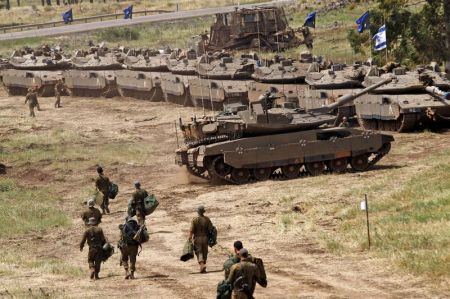
Israeli soldiers in the Golan Heights.
Photographer: Sameer Al-Doumy/AFP via Getty Images
The path to escalation is clear, and the rhetoric is apocalyptic. “We will demolish every site where we see an Iranian attempt to position itself,’’ Israel’s Defense Minister Avigdor Liberman told the London-based Saudi newspaper Elaph, adding that the Iranian regime is “living its final days.’’
In Tehran, Hossein Salami, deputy commander of the Revolutionary Guards, said that “100,000 missiles are ready to fly’’ in Israel’s direction, and warned they could bring about its “annihilation and collapse.’’
Light a Match
Iran and Israel have been exchanging threats for decades. What’s different now is that Syria’s civil war, which sucked in both countries, provides a potential battlespace — one that’s much closer to Jerusalem than to Tehran.
Israeli officials say there are 80,000 fighters in Syria who take orders from Iran. As they help Assad recapture territory, militiamen from Hezbollah have deployed within a few kilometers of the Golan Heights on Israel’s border. Iran has vowed to avenge its citizens killed by the Israeli airstrikes, and it has plenty of options for doing so.
It’s a tinderbox, says Ofer Shelach, a member of the foreign affairs and defense committee in Israel’s parliament. “I’m worried about the possibility that a match ignited in the Golan will light up a war going all the way to the sea.’’
Even more troubling is the absence of firefighters.
Israelis lament that Washington has become a bit-part player, unable to impose a Syrian settlement that would guarantee its ally’s security. Absent that, “we can only represent our interests through force,’’ Shelach says.
Asked about Israel-Iran tensions at a press briefing on Thursday, Pentagon spokeswoman Dana White said the U.S. is concerned by Iranian actions that “destabilize the region,” including through its proxy Hezbollah. “Wherever Iran is, chaos follows,” she said.
Able or Willing
Far from tamping down tensions, President Donald Trump-– egged on by Israel –- has been ramping them up. By threatening to withdraw next week from the international agreement to curb Iran’s nuclear program, he’s added another volatile element to the regional mix.
The only power with channels open to both sides, and the clout to play mediator, is Russia.
President Vladimir Putin’s intervention in 2015 to shore up Assad has left Russia as the strongest actor in Syria. Putin is seeking to impose a peace that would lock in his political gains, so he has every interest in averting any spread of the war.
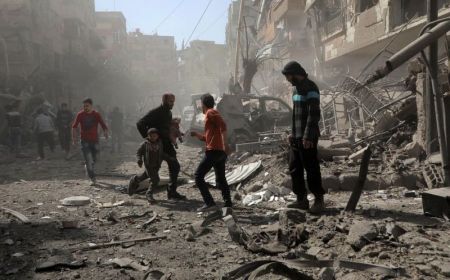
Syrians run for cover following Syrian government air strikes in Douma.
Photographer: Hamza Al-Ajweh/AFP via Getty Images
But that doesn’t mean he’s able or willing to rein in Iran. While Russia has cordial ties with Israel, they’re likely outweighed by the confluence of interests with the Islamic Republic, whose ground forces were crucial to the success of Putin’s Syrian gambit. Repeatedly threatened with attack or regime-change by its enemies, Iran sees the sympathetic governments in Damascus and Beirut as providing strategic depth.
‘Unstable, Unmanaged’
Now, the Iranians in Syria have graduated from helping Assad to “building their strategic presence against Israel,’’ said Paul Salem, senior vice president at the Middle East Institute in Washington. “It appears that neither the Russians nor the Assad regime are in control or can limit these things,’’ he said. “The situation is highly unstable and highly unmanaged.’’
One test of Russia’s ability to manage it may come in southern Syria, where Islamic State and other jihadists and rebels still hold territory near Israel’s border — enclaves that are among the likely next targets for Assad’s advancing army.
“Before they do that, the Russians need to have an arrangement with the Israelis,’’ said Yuri Barmin, a Middle East expert at the Russian International Affairs Council, which advises the Kremlin. Russia is “willing to negotiate on the issue of Iran and Iran’s presence’’ in those regions, he said.
‘It’s Shortsighted’
That may not be enough to meet Israeli concerns, which extend far beyond the border.
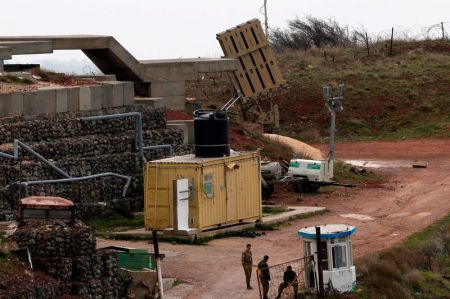
Israeli Iron Dome defence system at Golan Heights near the border with Syria.
Photographer: Ali Dia/AFP via Getty Images
Earlier in the Syrian conflict, Israel’s airstrikes typically aimed to destroy weapons convoys bound for Hezbollah in Lebanon. There’s been a significant change. Two strikes in the past month -– widely attributed to Israel, though the Jewish state doesn’t comment on such matters –- targeted permanent infrastructure used by Iran’s forces. Both took place deep inside Syrian territory.
“It’s shortsighted to look at it in terms of how many kilometers from the border Iran is sitting,’’ said Amos Gilad, who recently stepped down as director of political-military affairs at Israel’s Defense Ministry. “Iran cannot be allowed to base themselves militarily in Syria. And Israel is fully determined to prevent that.’’
To be sure, the goal could be achieved without a full-blown war. Salem, at the Middle East Institute, says the likeliest outcome is that Israel and Iran will avoid a conflict that neither really wants — though he says the risk that they’ll end up fighting is higher than at any time since the Israel-Hezbollah war in 2006.
And although hostilities have effectively begun with the airstrikes, many analysts say that they can be contained to Syria -– where Israel and Iran can square off without their allies necessarily being drawn into the fight.
‘Never!’
“Never!’’ said Liberman, when asked if clashes with Iran could lead to clashes with Russia. “There will be no confrontation with them.’’
In Beirut, Sami Nader of the Levant Institute for Strategic Studies said that Russia may not oppose an Israeli attack on Iranian positions in Syria, provided it doesn’t threaten to topple the Assad regime that is “the Russians’ main card at the negotiating table.” Barmin, the Kremlin adviser, said there’s plenty of daylight between the “diverging interests” of Russia and Iran.
So far, Russia’s response to Israeli airstrikes has been muted. But after the U.S. bombed Syrian targets last month, to punish Assad for an alleged chemical attack, Russian officials said they may deliver state-of-the-art S-300 missile defense systems to Syria. That would pose new risks for the Israeli air force -– and increase the chance of a flashpoint.
Israel’s parliament this week passed a law empowering the prime minister and defense to declare war without wider Cabinet approval in “extreme circumstances.”
Half a century ago, Israel launched a surprise attack against its Arab enemies. A few years later, in 1973, the tables were turned. In both cases, one of the combatants consciously opted for war.
But that’s not how Israel’s more recent conflicts have started, says Shelach. “It always happened because the situation escalated, deteriorated, without any of the sides making a decision.’’
And that’s the risk he sees now, with no obvious off-ramp.
— With assistance by Hayley Warren, and Daniel Flatley
{Settlements in Syria? Where’s the outcry from the UN? – LS}
Hezbollah “settlers” are reportedly replacing the native Syrian population as part of a conscious plan to change the country’s demographics.
Under Iranian direction, the Lebanese Shi’ite terrorist group has been fighting on behalf of Syrian dictator Bashar al-Assad’s regime since the Syrian civil war broke out in 2011. It also dominates southern Lebanon, where it has established a massive terrorist infrastructure in order to threaten Israel.
According to a column in the Lebanese paper Al-Nahar written by Ahmad Ayyash and translated by the Middle East Media Research Institute (MEMRI), Hezbollah’s “involvement in the Syria war is not confined to military action aimed at propping up the Syrian regime. [Its goals] extend much further than that, and have to do with an Iranian settlement project whose implementation began several years ago. The aim [of this project] is changing the demography [of Syria] by settling [it with members of] Iran-backed [Shi’ite] militias from Afghanistan, Lebanon, and other countries in the region.”
Ayyash accused the world of “ignoring the ongoing plan of demographic cleansing, as part of which tens of thousands of Syrians were transferred from their homes in Ghouta to northern Syria several days ago, and thousands of others left eastern Al-Qalamun, near Damascus, [as part of a move] ‘brokered by Russia,’”
“[These] tens of thousands of Syrians left their ancestral homes,” added Ayyash, “where their families had been living for generations.”
Ayyash attributed this policy directly to Iran, which is Hezbollah’s chief financier and uses the group as a proxy to influence events in Lebanon and Syria.
“The world is oblivious [to the fact] that Iran has been acting vigorously to fill the demographic vacuum [left by these Syrians],” Ayyash wrote, with Hezbollah “acting as the chief executive arm of this [project].”
Hezbollah, Ayyash asserted, was actively preventing Syrian refugees from returning to their homes. “Several weeks ago,” he says, “Al-Nahar received information that people from Al-Qusayr had appealed to the Syrian regime for permission to return to their properties in that town, and had received permission to do so. But when they reached the town, they found themselves facing Hezbollah militiamen, who are still militarily occupying the town, and who ordered them back, saying: ‘Whoever gave you permission [to return is welcome] to give you back your property.’”
The ambitions of Hezbollah’s settlement project are large, Ayyash noted. “According to the information [we received], Hezbollah is investing in developing thousands of acres in this area, known for its fertile fields, and will directly reap the profits,” he said.
“One of the most disturbing aspects of the Iranian plan in Syria,” he added, “was reported by our colleague, [Lebanese journalist] Randa Taqi Al-Din, in the dailyAl-Hayat. She cited French sources, who assessed that Hezbollah will transform from the ‘Lebanese Hezbollah’ into the ‘Syrian Hezbollah,’ because its members are currently settling in Syria along with the Iranians.”
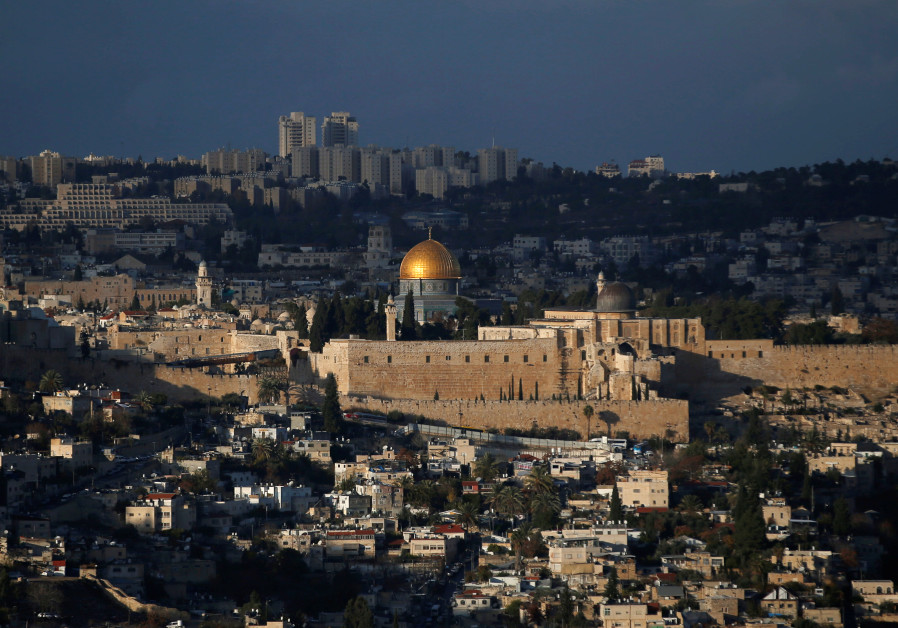
A general view of Jerusalem shows the Dome of the Rock, located in Jerusalem’s Old City on the compound known to Muslims as Noble Sanctuary and to Jews as Temple Mount December 6, 2017.. (photo credit: REUTERS)
The Trump administration will ask Israel to withdraw from four Arab neighborhoods in east Jerusalem, which will likely become the capital of a future Palestinian state, US officials told Defense Minister Avigdor Liberman during his visit to Washington last week.
The transfer of control over the neighborhoods – Jebl Mukabar, Isawiya, Shuafat and Abu Dis – was presented to Liberman as just one piece of the larger peace plan the administration has been working on over the last year. Israel, the officials indicated, would be expected to accept the plan once it is presented despite the potentially painful concessions.
News of the demand come less than two weeks before the US Embassy officially moves to Jerusalem on May 14. The full plan is expected to be unveiled shortly after the embassy moves.
During his visit to Washington, Liberman met with Jared Kushner, President Donald Trump’s son-in-law and senior adviser, National Security Adviser John Bolton, Secretary of Defense James Mattis, and the president’s Middle East envoy, Jason Greenblatt.
“We do not comment on the content of the minister’s meetings,” Liberman’s office said in response to the report.
Kushner and Greenblatt have been working on a peace plan together with US Ambassador to Israel David Friedman for the last year, and few details have leaked out.
Alongside the concessions expected of Israel, the administration has promised its full support in the event of a widespread conflict with Iran or Syria. The administration has told Israel it would supply the IDF with significant support, including advanced weaponry, if a war broke out with Iran, even one instigated by Israeli action against Iran’s presence in Syria.
Last month, PA President Mahmoud Abbas said the Palestinians will not accept any US plan to resolve the Israeli-Palestinian conflict.
“We honestly will not wait for anything from them, and we will not accept anything from them,” Abbas said at a conference in Ramallah last month.

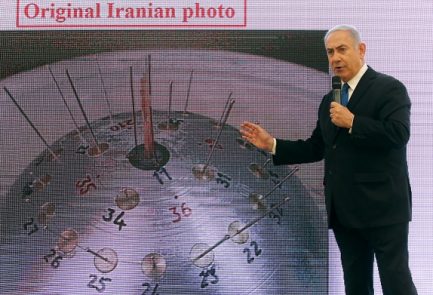
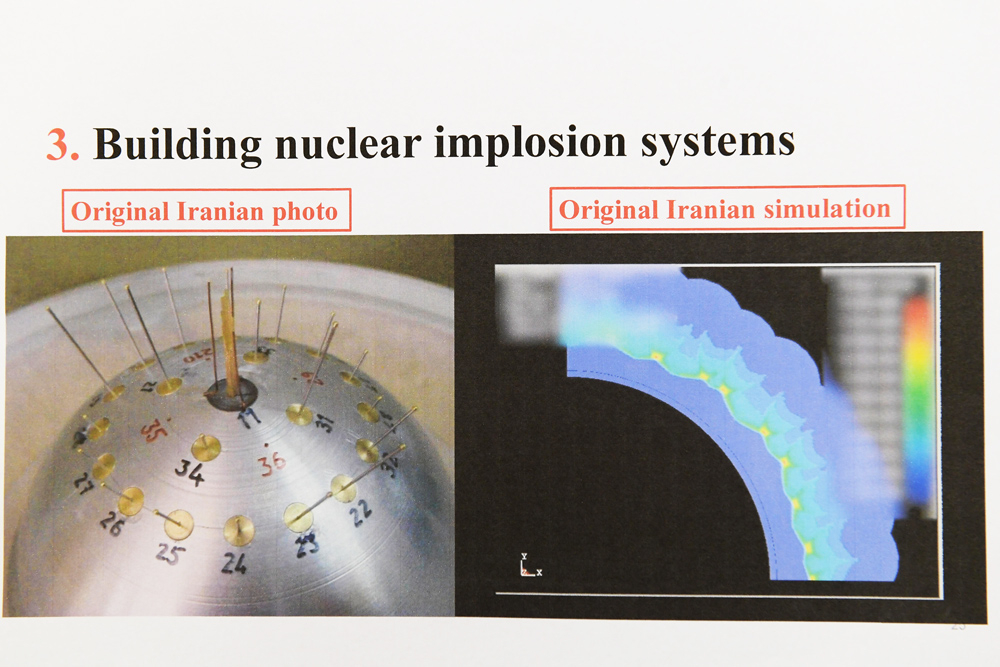 Pictured: Two images from Iran’s secret nuclear archive, as presented publicly by Israeli Prime Minister Netanyahu on April 30, 2018. In possibly the greatest coup in the history of espionage, Israel’s Mossad acquired over 100,000 documents from the archive of Iran’s program to create nuclear weapons. (Photo by Israel GPO)





 WarSclerotic
Recent Comments