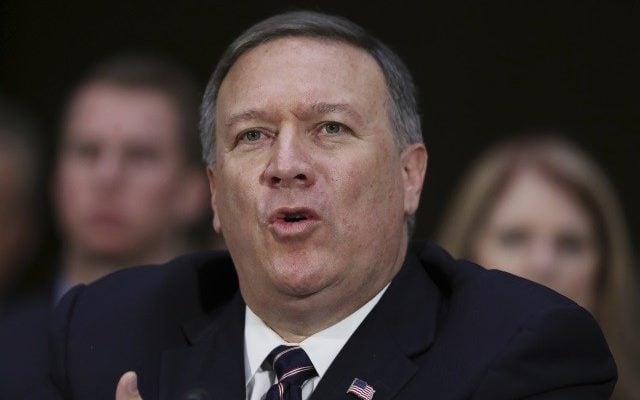
President Donald Trump’s firing of Rex Tillerson and appointment of CIA director Mike Pompeo as new US secretary of state is great news for Israel and bad news for Iran. Pompeo is a great admirer of Israel and a vocal opponent of diplomacy with the Iranian ayatollah regime.
A recent Gallup poll recorded the highest American support for Israel since the 1990s. While 75% of Americans today view Israel favorably, the US State Department has a long history of hostility towards the Jewish state and pro-Arab bias. Tillerson was part of this history, and the State Department disapproved of Trump’s decision to recognize Jerusalem as Israel’s capital. Tillerson even tried to belittle Trump’s historic decision by stating that it would take at least three years to move the US embassy from Tel Aviv to Jerusalem.
Trump recently announced that the American embassy will be inaugurated in Jerusalem on the State of Israel’s 70th anniversary.
Unlike Tillerson, Pompeo shares Trump’s and Israeli Prime Minister Benjamin Netanyahu’s skepticism towards the controversial Iran nuclear agreement. In late 2014, before the deal was signed, Pompeo indicated that he believed that military strikes on Iran’s nuclear facilities were more efficient than diplomacy to stop Iran’s quest for nuclear weapons.
At his Senate confirmation hearing in January 2017, Pompeo did not mince his words of criticism towards the Iranian regime. “Iran, the world’s largest state sponsor of terror, has become an even more emboldened and disruptive player in the Middle East,” he stated.
The Iranian regime and its supporters are clearly unhappy with the appointment of Pompeo as America’s top diplomat. This unease is also shared by the Europeans, who overwhelmingly support the nuclear agreement with Iran, which also opens up the large Iranian market for European businesses.
President Trump has repeatedly stated his displeasure with the Iran deal, vowing to pull out if Iran does not fix its “flaws.”
The appointment of Pompeo may indicate a prelude to Washington’s withdrawal from the agreement with the terror-sponsoring regime in Tehran. This is exactly what Netanyahu predicts. Addressing his ministers, Netanyahu said: “I believe Trump is very close to canceling the nuclear agreement.”
Not only Israel, but also Sunni Arab states have expressed their concerns regarding the Iran deal, which has already emboldened Tehran and likely paves the path to eventual Iranian nuclear weapons. This would make the volatile Middle East even more unstable by triggering a nuclear arms race. Saudi Arabia recently warned that it would also seek nuclear weapons if Iran gets an atomic arsenal.
Only time will tell what Trump intends to do about the Iran agreement. Meanwhile, Israel enjoys the pleasantly rare combination of a friendly US president and a friend heading the State Department.
If and when Hamas is ever removed from power in the Gaza Strip, Palestinian Islamic Jihad (PIJ) will most likely seize control of the coastal enclave, where nearly two million Palestinians live.
PIJ’s new “political document” exposes the Palestinian terror group’s plan for “real peace” in the Middle East. This “real peace,” according to the jihadi group, can be achieved by eliminating Israel after “liberating Palestine, from the river to the sea, and after the original owners of the land return to their homes.”
This genocidal “peace” plan appears to be shared by other Palestinian terror groups, such as Hamas, the Popular Front for the Liberation of Palestine, the Democratic Front for the Liberation of Palestine and even certain parts of Mahmoud Abbas’s ruling Fatah faction.
The Palestinian Islamic Jihad (PIJ) group is the second-largest terror group in the Gaza Strip after Hamas. Like Hamas, PIJ does not recognize Israel’s right to exist and believes that violence and terrorism are the only way to “liberate all Palestine, from the Mediterranean Sea to the Jordan River.”
Like Hamas, in the past three decades PIJ has carried out thousands of terror attacks against Israel, including suicide bombings.
Recently, the PIJ wished to remind us again of its dangerous and poisonous ideology. This reminder came in the form of a new “political document” published by the Iranian-backed terror group in the Gaza Strip.
The document contains important information about the group’s strategy to destroy Israel and provides insight into the role Islam plays in the Israeli-Arab conflict.
Some may argue that there is nothing new in the PIJ document. However, PIJ is not just another Palestinian “resistance” faction, as some Middle East experts tend to describe it. Rather, it is one of the most dangerous Palestinian terror groups. It aspires to eliminate Israel and kill as many Jews as possible.
If and when Hamas is ever removed from power in the Gaza Strip, PIJ will most likely seize control of the coastal enclave, where nearly two million Palestinians live.
Western journalists often ignore the power and threat of PIJ, mainly because the representatives of the terror group rarely give interviews to the foreign media.
Besides, it is easier for Western journalists to take the short trip from Jerusalem to Ramallah to interview a Palestinian Authority official, who uses his or her fluent English to lie about the Palestinians’ desire for peace and coexistence with Israel.
Western journalists rarely, if ever, present to their readers and viewers what the terrorists preach to their own people.
That is precisely why there is a need to bring the main points of the PIJ document to the attention of the international media and decision-makers around the world. The PIJ is a major player in the Palestinian arena, and its political and military power can be ignored only at great peril.
Pictured: Members of Palestinian Islamic Jihad hold a parade in Gaza City. (Photo by Spencer Platt/Getty Images)
Here is what the preface to the terror group’s document states:
“Palestine is the homeland of the Palestinian people, from the early days of history. Palestine is an integral part of the Arab and Islamic homeland, and it was usurped by the Zionist Jews with the support and encouragement of Western colonialist powers.”
Explaining the timing of the publication of its document, PIJ said:
“To maintain a clear vision and the unity of our goals, away from intellectual chaos dominating the Palestinian landscape, Palestinian Islamic Jihad saw the need to formulate this document to explain and affirm the intellectual basis and features governing its jihad and policies.”
Translation: the PIJ fears that it has fallen off the world’s radar. It worries that its ideology and plans to destroy Israel may be lost amid the “intellectual chaos” plaguing the Palestinian arena.
Defining its ultimate mission, PIJ says in its new document:
“Our number-one priority and main task is to carry out the duty of jihad and resistance to liberate Palestine. We are an Islamic national liberation movement and part of the Palestinian people’s and Muslim’s jihad against invaders and colonialists. We see ourselves as being part of the general Islamic trend in the world, which regards Islam as the source of our power and pride.”
Which “Islamic trend” the Palestinian terror group is talking about is not clear. Does it referring to the Islamic State terror group, ISIS, which has slaughtered tens of thousands of innocent civilians, mostly Muslims, in the past few years? Or perhaps the PIJ is referring to Al Qaeda, the murderous terror group founded by Osama bin Laden?
What is certain, however, is that PIJ is not referring to the Muslim Brotherhood organization. Why? Because PIJ believes that Muslim Brotherhood’s ideology and policies are too “moderate” compared with its genocidal agenda. Ironically, the PIJ views the Muslim Brotherhood as being too “pragmatic,” largely because of the latter’s failure to engage in a worldwide jihad against Jews and all infidels.
The PIJ document, which the Western media is doing a fine job ignoring, states:
“Palestine is an Arab, Islamic land, where the Arabs and Muslims possess natural religious and historic rights. It is forbidden to give it up or compromise it under any pretext.”
The Jews, the document emphasizes, “have no right in the land of Palestine.” It says that the fact that some Arabs and Muslims have recognized Israel does not give the Jews any right to the land.
“The Palestinian people’s right to all their lands and homeland, Palestine, is a comprehensive right that can’t be fragmented. This includes our right to own the land, our right to resist and liberate it, and our right to return to it and live in it. No one is entitled to give up the right of the Palestinians to return to their homeland. This is a non-negotiable issue.”
The PIJ document views Israel as a Zionist colonialist project imposed on Arabs and Muslims by Western powers. Revealingly, these are the same words that Israel’s secular peace partner and the darling of the West, Palestinian Authority President Mahmoud Abbas, recently used in a speech he delivered in Ramallah, during a conference of the Palestine Liberation Organization’s Central Council:
“The Europeans wanted to bring the Jews here to preserve their interests in the region. They asked Holland, which has the world’s largest fleet, to move the Jews. Israel is a colonial project that has nothing to do with the Jews.”
Abbas and PIJ also share more of the same views. In its document, the Palestinian terror group states:
“The Zionist entity is a functional colonialist entity and a tool of the [Western] project to seize control and dominance over Palestine. The source of this entity’s power lies with Western parties, especially the US.”
The PIJ document defines the conflict with Israel as an “existential conflict, and not a border conflict.” The Palestinian cause, it says,
“is not about the Palestinian territories occupied in 1967, or parts of them. Rather, it is the issue of the occupation of the entire land of Palestine, from the river to the sea. It is the central cause of all Arabs and Muslims, and not the Palestinians alone.”
In its document, PIJ outlines its plan to achieve its goal through “jihad and resistance against the Zionist enemy, with all means and methods, first and foremost the armed struggle.” The armed struggle, it adds, is the “main method and strategy in our struggle.”
For those who do not know, “armed struggle” is the euphemism for all forms terrorism, including rocket attacks and suicide bombings. The “armed struggle” also means that a Palestinian terrorist can storm the home of a Jewish family and murder women and children as they prepare dinner.
The PIJ document, which has been distributed among the group’s followers in the West Bank and Gaza Strip, also praises suicide bombings against Israel by describing them as the “most noble acts of self-defense.”
The document also warns Arabs and Muslims against recognizing Israel’s right to exist or establishing any ties with it. “We reject all forms of normalization with the Israeli enemy by any Arab or Muslim,” it stresses.
Finally, the document exposes the Palestinian terror group’s plan for “real peace” in the Middle East. This “real peace,” according to the jihadi group, can be achieved by eliminating Israel after “liberating Palestine, from the river to the sea, and after the original owners of the land return to their homes.”
This genocidal “peace” plan appears to be shared by other Palestinian terror groups, such as Hamas, the Popular Front for the Liberation of Palestine, the Democratic Front for the Liberation of Palestine and even certain parts of Mahmoud Abbas’s ruling Fatah faction.
The peace they seek is one that would result in the total destruction of Israel and the expulsion of all Jews from the Middle East. As the remarks of Abbas and PIJ show, Palestinians see Israel only as an alien body that was imposed upon Arabs and Muslims by imperialist Westerners, and not as people who have lived on that land for more than 3,000 years.
The PIJ document, which serves as the group’s “national charter,” is a valuable text. Every word in the document reflects the true sentiments on the Arab and Islamic street, especially with regards to recognizing Jews’ rights and history.
This is a document that is currently being taught in Islamic Jihad training bases, and schools and mosques. It is a document that will help raise another generation of Palestinians on the glorification of terrorism and anti-Semitism.
This is a document that deserves to be placed on the desks of all those Westerners who continue to tell us that peace is possible and that Israel just needs to make more concessions to achieve that goal.
Bassam Tawil is a Muslim based in the Middle East.
A Palestinian terrorist crashed his car Friday, March 16, into a group of Israeli soldiers killing an officer and a soldier and injuring two others, one seriously.
Doctors are fighting for his life at the Beilinson hospital, to which the victims were evacuated by helicopter. There was a driver and a passenger in the car which rammed into a IDF unit on Highway 585 outside Mevo Dotan, 10km west of Jenin, which was patrolling the highway in northern Samaria. The terrorist, Allah Kabha, 26, from the Palestinian village of Barta’a, was slightly hurt and captured. He is being interrogated in hospital. Kabha was found to have a previous record: he had been jailed for eighteen months on security violations and banned from entering Israel. The second Palestinian in the car appears to have fled.
Defense Minister Avigdor Lieberman vowed after the attack to “take action in pursuit of the death sentence for this terrorist, the demolition of his home and the punishment of his confederates in this crime. There are no lone wolf [Palestinian] terrorists,” he said. “Abu Mazen and the Palestinian Authority pay money to their families. We will stop this.”
DEBKAfile’s military sources: The IDF investigation of the event will also question why the military patrol had no back-up against a vehicular attack.
It is with deep sadness that I report to our readers that my good friend and fellow editor of this site, Dan Miller, has passed away.
Those of you who have been with the site over the last three years know how important his contributions were.
He will be sorely missed by all of us.
May he truly rest in peace… – JW
I received the following from his wife:
______________________________________________
Dear Joe,
Dan asked me to communicate with you should he not make it through the latest of his health problems.
He felt a deep connection with Isreal, with Warsclerotic, and with you, Joe.
Please forgive my delay in communicating with you. It, as you must know, has been a tremendously difficult time for me. I needed some time to recover even the tinyest bit of perspective.
Please keep him in your prayers.
Best, Jeanie
Here is what I wrote to our families:
*********
Dan and I started our adventures together almost 26 years ago. Over the years, we’ve laughed, we’ve cried, we’ve won and we’ve lost. Always, our
mutual
love and respect made it possible to overcome the inevitable obstacles that present themselves over a lifetime.
Dan died last Sunday afternoon. I will miss him forever. He has preceded me in this last and greatest adventure of all.
As was his wish, I will spread his ashes over the finca he loved so well.
Rest in peace
and
Namaste, MyDarling
Curriculum Vitae and subsequent life:
Herbert Daniel Miller was graduated from Yale University, cum laude, and the University of Virginia Law School where he was notes editor of Law Review and a member of The Order of the Coif. After he graduated, he joined the United States Army JAG Corp where he was Special Courts Marshall Judge for the Country of Korea. Upon returning to civilian life, he joined the law firm of Koteen and Naftalin in Washington, D.C. until he retired as a partner in 1996.
Thereupon, he and his wife cruised in the Eastern Caribbean as well as Trinidad, Venezuela and Colombia in their sailboat, Namaste. They achieved their Dive Master certificates in Bonaire, Netherlands Antilles. In 2002, they reached Panama, spending a month in the Kuna Yala Islands on their sailboat before settling in Western Panama.
He leaves behind his wife, Jean Fiester Miller, his son, Nicolas Miller, his daughter, Elizabeth Korchnak and his sister, Margaret Zilm, his nephews Andrew and Gregory Zilm, as well as three grandchildren.
The IDF’s special forces units may carry out their missions under the radar, but their reputation is legendary • Israel Hayom offers an exclusive glimpse into the inner workings of units responsible for hundreds of daring and clandestine operations.
Yoav Limor
Naval commandos during an scaling exercise
|
Photo: Ziv Koren
Intelligence operations are best kept secrets. Their details remain clandestine, at times for years and at times forever. That is the way every defense apparatus operates, and the Israel Defense Forces are no different.
If information is power, which is the premise of the digital age, information leaks spell the loss of power and may cost lives. This is why the secrecy surrounding such intelligence operations – inside and outside of the military – is so fiercely protected.
This is also the nature of the covert operations carried out near Israel’s borders, let alone deep in enemy territory, which is why the world of special operations is out of bounds not only for the general public but also for many in the defense establishment itself.
The Mossad intelligence agency and the Shin Bet security agency both keep classified operational activity on a need-to-know basis with respect to other units in the organizations; the Police Counterterrorism Unit operates separately from other units in the force, and only a few are privy to the secrets harbored by the military’s special forces.
Information about covert operations or special forces units usually becomes public only when something goes wrong and an operation goes awry or results in casualties. The success stories remain clandestine and for the most part, go unnoticed by the public.
This is why the rare glimpse afforded to Israel Hayom’s readers into the inner working of these units is such an unusual event. No journalist, let alone photographer, has ever had such unmitigated access to the IDF’s top reconnaissance and commando units. Convincing the officers and soldiers to step into the spotlight was no easy feat, as most of them feel more comfortable facing off an enemy agent than they do meeting a reporter.
Moreover, many of them believe that not only does any media exposure go against their training, it could potentially compromise them operationally.
One could argue that the “special unit” designation has been eroded in recent years, as it seems it is handed out far more frequently than in the past, but the Israeli military numbers only four elite units: Sayeret Matkal, its top special forces unit; Shaldag (“Kingfisher”), the Israeli Air Force commando unit; the Shayetet 13 naval commandos; and Unit 669, which carries out heliborne search, rescue and extraction missions.
While the former three are combat units, the latter is a specialized unit whose troops undergo unique professional training. Unlike the commandos, Unit 669 troops do not conduct raids or engage enemy combatants. They do, however, come to the rescue – any rescue, anywhere, anytime, including under fire in enemy territory.
Tip of the spear
The origins of Sayeret Matkal are traced back to 1954 and the founding of Unit 101, the IDF’s first special forces unit. Sayeret Matkal is akin to the United States Army’s Delta Force and the British Army SAS Force, after which it was modeled. The aura surrounding Sayeret Matkal is nothing short of legendary, and while what little the public knows about its operations has to do with its rare failures, in reality, the ground forces’ elite commando unit has marked numerous successes.
Unlike most other units, Sayeret Matkal’s operations are never improvised, but rather are carried out only following meticulous planning based on extensive intelligence gathering. Reconnaissance is also one of its primary objectives and according to foreign media, it also plants measures – some of which are developed exclusively for its use – that help various Military Intelligence branches gather the information they need.
Ziv Koren
Sayeret Matkal troops in training
Missions sometimes require weeks of preparations and every detail and contingency are accounted for and drilled via simulations. When the unit prepares for a particularly complex mission, its simulations are scrutinized by the top military echelon and at times, the political echelon as well. The lieutenant colonel who commands Sayeret Matkal also frequently meets with the defense minister and prime minister – a testament to the sensitivity of the unit’s work.
The commandos’ training is extensive, but the unit does not engage in routine operational activity. Sayeret Matkal, whose operations are usually carried out in the enemy’s rear, is called in only when its troops’ unique skill set is required or in times of war. For example, it was called in during Operation Protective Edge in 2014, to sweep the terror tunnel used by Hamas to abduct the remains of Givati Brigade Lt. Hadar Goldin.
Unlike the IAF and naval commandos, Sayeret Matkal is not a strike force. The quality of its troops allows it to carry out any mission, but its true prowess lies in counterterrorism, and it is credited with world-renowned counterterrorism operations, such as Operation Entebbe in 1976; Operation Isotope in 1972, better known as the Sabena Flight 571 hostage crisis; and the 1975 Savoy Hotel hostage crisis.
While in recent years the Police Counterterrorism Unit has taken center stage, no one doubts that if need be, Sayeret Matkal will be there and no one doubts it will continue to cement its iconic status.
Stealth strike
Shaldag, the IAF’s commando unit, was founded in 1974 and operates in a manner similar to that of combat control teams in the United States Air Force.
The unit has the most modest history among the IDF’s elite forces, and while it may not enjoy the same heroic aura as Sayeret Matkal, Shaldag troops are very busy in time of peace and doubly so in times of war. Officially designated as “the IAF’s reconnaissance and strike unit,” its troops are involved in almost every military campaign or war.
Shaldag troops carried out more missions than all other special forces units combined during the 2006 Second Lebanon War, but only one of them gained notoriety: a raid on a hospital in the city of Baalbek that was being used as headquarters by the Hezbollah terrorist group.
The precise objectives of the raid remain classified, but it is believed it placed the troops in harm’s way unnecessarily and to no real aim. Both the top military and political echelons were criticized for it, as it appeared they sought to mark operational achievements at all costs to dim the overall failures of the war.
Ziv Koren
Shaldag troops are involved in all major military campaigns
This does not take away from the dozens of successful operations the troops carried out during the campaign. Shaldag was the first unit to enter Lebanon during the first day of fighting and it was the last to leave when the war ended. The same is true for all other major military campaigns in recent decades, from Operation Accountability (1993) and Operation Grapes of Wrath (1996) in southern Lebanon, to operations Cast Lead (2008), Pillar of Defense (2012) and Protective Edge (2014) in the Gaza Strip.
As a special forces unit, Shaldag’s distinct advantage is in the fact it is a “one-stop shop,” meaning it can handle every stage of the mission, from intelligence gathering and operational planning to execution, and with the logistic and operational backing of the IAF, it can get anywhere, anytime.
The unit was formed in the wake of the 1973 Yom Kippur War, as a means for the IAF to boost its intelligence gathering abilities. Foreign media claims Shaldag’s main objective is to provide ground support to the air force, mostly by marking targets ahead of airstrikes.
But the unit’s advanced capabilities is why its troops participate in more mundane operations that are usually not part of regular special forces’ missions, such as raids across Judea and Samaria or scouting for terror tunnels on the Israel-Gaza border.
As the IAF has been tasked with hedging the strategic threats Israel faces, Shaldag’s future is assured, and the air force is bound to need its special forces unit on the ground.
Still waters run deep
The Israeli Navy has several combat formations, but only one is considered the corps’ top commando unit.
Shayetet 13 was formed in 1949 and specializes in sea-to-land incursions, counterterrorism, sabotage, maritime intelligence gathering, maritime hostage rescue and boarding. As such, the naval commandos are trained for sea, air and land action and have taken part in almost all of Israel’s wars. A former commander of the naval commandos once said that there was no enemy shore, near or far, that the unit’s fighters had not visited. The ethos of Shayetet 13 is simple – leave no mark behind. They pride themselves on going unseen and unheard, and if, by chance, anything is inadvertently left behind, they go back and get it.
Shayetet 13’s escapades can be traced back to the Palmach, the elite fighting force of the Haganah, the underground paramilitary organization of the Jewish community during the British Mandate of Palestine. It is also considered the toughest unit in the entire military, as the physical challenges it poses are the most grueling. The result is a versatile unit whose troops wield a wealth of skills, some exclusively their own.
Ziv Koren
The physical challenges Shayetet 13 training poses is the most grueling of all commando units
Over the years, some operations have proven more successful than others: The 2002 interception of Karine A, carrying 50 tons of weapons, including short-range rockets, antitank missiles, and high explosives to Gaza was a resounding success, while the 2010 raid on the Gaza-bound Mavi Marmara, though successful, was clouded by the fact that it involved civilian casualties and the damage it caused Israel’s international image was very serious.
Alongside their clandestine operations, the naval commandos also take on the grunt work, mostly in Judea and Samaria. When the Second Intifada erupted, naval commandos were the first to deploy, logging in more operational hours on land than at sea, and their contribution to quelling terrorism was invaluable.
Such a robust operational record, however, comes with a heavy price and the unit is no stranger to losses. The unit sustained one of the most devastating losses in its history in 1997, when 11 commandos and an auxiliary fighter were killed when a raid in Lebanon went awry.
The future of Shayetet 13 is also guaranteed, for the mere reason that it is irreplaceable.
The IDF’s increased focus on the “campaign between the wars” – a term that encompasses a host of covert and low-intensity military and intelligence efforts to prevent enemy entities from becoming stronger – and the need to operate in farther arenas and the growing intensity of special operations all but ensure the naval commandos will be called upon in the years to come.
To the rescue
In 1972 two Phantom fighter jets collided off Israel’s coast. Three crewmen survived but the fourth drowned and his body was never recovered. The commission of inquiry established following the incident recommended a unit be formed to specialize in rescuing airmen who had to eject, and so Unit 669 was born.
Since its inception, the unit has rescued thousands of Israelis, the majority of them civilians, and it is credited with dozens of operational rescues.
Ziv Koren
No mountain too high, no valley low too low. Unit 669 troops in training
But the unit was not involved in perhaps one of the most painful incidents in the IAF’s history: the 1986 downing of a Phantom jet by Amal terrorists during in operation over Sidon, Lebanon. Pilot Yishai Aviram and navigator Ron Arad ejected, but while a wounded Aviram was extracted, Arad was taken captive, never to be heard from again.
Unit 669 is the only special forces unit to include women. While none of the female members of the unit serve in combat roles, it is not unthinkable for a doctor to find herself flying off to an undisclosed location in the Middle East as part of a rescue mission mounted in the middle of the night.
For the greater good
The prolonged training and service allow the members of all of the IDF’s elite units to engage in community outreach projects that involve both regular servicemen and reservists.
Sayeret Matkal alumni, for example, logged more than 20,000 volunteering hours in 2017, with an average of five weekly hours from each of them, organized by the unit’s veterans’ association.
The IAF and naval commando units also pitch in, with alumni committing to some 130 of volunteering hours a year each.
Former Sayeret Matkal commandos have recently begun storming the world of public diplomacy, countering the damage done by various anti-Israel groups worldwide. Shaldag veterans, for their part, pride themselves on mentoring new recruits in the military.
This activity enables the special forces to continue in leadership roles in civilian life, but just like while in uniform, here, too, mum’s the word. It is all part of the ethos of contributing to the country and society without asking for praise, fanfare or credit.
Media screens from Israeli media show Prime Minister Benjamin Netanyahu.. (photo credit: REUTERS)
By any objective standard, Prime Minister Benjamin Netanyahu’s trip to Washington last week was a stunning success. US President Donald Trump and first lady Melania Trump greeted the premier and his wife, Sara, as old friends. The substantive talks Netanyahu held with Trump on Iran and a host of other key issues were extraordinarily positive.
Then of course, there was the rock-star welcome Netanyahu received at the AIPAC conference.
If Israelis were astounded by the royal treatment Netanyahu received during his visit to India last year, his visit to Washington made clear that what happened in India was no fluke. He is quite clearly one of the most well-regarded statesmen in the world.
Then again, most Israelis could be excused for having little idea either that Netanyahu was treated like a king in India or that he was treated like a second coming of Winston Churchill in the US.
The Israeli media barely covered his trip to India. As for his trip to the US, the media presented everything Netanyahu said and did in the context of the police’s obsessive-compulsive criminal probes of Netanyahu.
The political crisis over the haredi draft law, which this week brought the Knesset to the brink of dissolution and Israel to a new general election, was entirely the result of the joint efforts of police investigators and the media to delegitimize Netanyahu as a leader and criminalize him as a person.
Several ministers from parties in Netanyahu’s coalition, together with the media, presented Netanyahu’s handling of the crisis as self-serving.
Netanyahu, the media and his coalition partners alleged, was putting his personal interest above the national interest. Netanyahu, they insisted, was allowing a minor crisis (ostensibly about whether or not a bill would pass that sets out draft quotas for haredi youths before the annual budget bill went through the Knesset), to become a major crisis that would bring down the government. He was doing so, they said, because he wanted an early election to strengthen his position vis-a-vis the police investigators.
In other words they said, Netanyahu wanted to plunge Israel into political uncertainty for months on end, at the cost of billions of shekels, just to win another election.
Unlike the egotistical premier, the ministers and media said, Netanyahu’s coalition partners worked around the clock to solve the crisis without him and force him to accept the compromise they hammered out. Unlike Netanyahu, they sneered, they put the national interest first.
“We know the public doesn’t want an election.
And we’re serving the public,” they declared. The media delightedly agreed.
In truth, those denunciations of Netanyahu were little more than spin.
In reality, the public has an interest in renewing the government’s mandate. Working together, the police and the media have used the probes against Netanyahu to destabilize the government and delegitimize its power.
Like their borderline delusional coverage of Netanyahu’s trip to the US, the media present every move made by every government minister from every party in the coalition in the context of the police probes and the prospects for an early election.
In this framework, everything the government does is suspect. The fact that the police have demonstrated no credible proof of their claims that Netanyahu accepted bribes in any of their leaks or official statements regarding any of their multiple probes is of no consequence. As far as the major radio, television and print media are concerned, Netanyahu is a crook.
And since the media portray Netanyahu as a crook, everything he says and does and everything his ministers say and do is presented against the backdrop of that specious, unsupported and certainly unproven conclusion.
Under the circumstances, the need for a new mandate is self-evident. The public is the source of the government’s power. The police and media insist that the mandate the government received is no longer legitimate. So the public has to express its views on the government in one way or another.
In other words, to the extent Netanyahu wanted to disband the Knesset and announce an election this week, he was right to feel the way he did.
He wasn’t being egotistical. The public’s interest is harmed by the delegitimization of its government.
Broadly speaking there are three ways the public can make its position known.
First, its elected representatives can assert it.
Netanyahu’s coalition members could issue a declaration supporting him. The 67 members of Knesset and the ministers from the parties in the governing coalition can put out a declaration announcing that as they do in all of their endeavors, with everything related to the police probes of Netanyahu, they intend to respect the rule of law.
Since under Basic Law: The Government, a prime minister is only expected to resign from office if he receives a final judgment convicting him of committing crimes, the coalition members could assert that in conformance with the rule of law, they expect Netanyahu to serve out his term and will support him through the end of the term.
A statement along these lines from the ministers and lawmakers in the coalition would constitute a renewed mandate for Netanyahu and the government to govern. It would send the message that in Israel the public chooses its leader.
The police and even the attorney-general cannot replace the public.
For whatever reason, to date, no such declaration has been produced. Which left Netanyahu with two other options this week.
First, he could have brought down his government, disbanded the Knesset and called an election in June. Since the public has an interest in having a legitimate government and since the media and the police are calling the legitimacy of the government into question, going to an election would serve the public’s interest. Certainly, elections are the most direct way to find out if the public agrees with the police and the media commentators and thinks Netanyahu should go, or if the public wants him to stay on and continue leading the country.
While elections are the most direct way to get a mandate, the commentators and ministers are right that elections are an extreme step. They cost a lot of money. What’s more, war can break out at any moment with Hezbollah-controlled Lebanon. Israel would be worse off if an interim government was leading it in time of war.
And this brings us to the final way a government can renew its mandate. It’s what happened this week.
Two things happened this week.
First, news organizations had pollsters for the big news companies ask the public a few key questions.
The pollsters asked whether the public wanted an early election. Seventy percent said no. If the public thought the police and media were right, and that Netanyahu should be thrown out of office, the polls would have received opposite results. Everyone would have wanted an election.
The public was then asked whom it supported for prime minister. Netanyahu out-polled his closest rival – media and police favorite Yesh Atid Party leader Yair Lapid – 3 to 1. If the public agreed with the media and the police, which both support Lapid, the former television talk show host, then the results would have reflected that agreement.
Finally, the pollsters asked which party the public intended to vote for in the next election. The Likud under Netanyahu gained three Knesset seats. Yesh Atid lost two.
The implications, again, are self-evident. The public wants Netanyahu to keep leading the country.
But a poll taken on any given day isn’t a mandate.
Which brings us to the second thing that happened this week. Both the opposition parties and every coalition member other than the Likud made clear that they completely opposed an election.
This rare unanimity demonstrated clearly that the political world is certain the public supports Netanyahu and wants him to continue in office.
Taken together, the polls and the wall-to-wall opposition to an election among coalition and opposition parties alike provided Netanyahu and the government with a renewed mandate to govern.
This then brings us back to the investigations that triggered the coalition crisis and fomented Netanyahu’s need for a new mandate. From the police leaks over the past couple of weeks it is fairly clear that investigators have hit the wall.
They recommended that Netanyahu be indicted for accepting bribes in Cases 1000 and 2000 and the public yawned and rolled its eyes. The attorney-general sent them back to get real evidence.
Case 3000 is so weak the police can’t even figure out how to begin investigating Netanyahu for anything.
As for Case 4000, the latest leaks suggest the police have nothing whatsoever to accuse Netanyahu of having done. The notion that he would give preferential treatment to telecommunications giant Bezeq because Bezeq’s owner Shaul Elovitch had Walla website reporters write a couple of nice articles about him and his wife is absurd on its face. And this week the police leaked their new smoking gun: Netanyahu allegedly tried to convince his billionaire friends to start an Israeli version of Fox News.
To which his voters reply: Good for him! That latest leak indicates two things. First, again, the police have no proof that Netanyahu committed any wrongdoing. And second, the police is completely cut off from the public. Netanyahu has run for prime minister four times and won every race by running against the media. If the public didn’t share his conviction that the media are impossibly biased, he would either have lost the elections or run on a different platform. The fact that the police think that the public will turn against Netanyahu because he tried to get fair media coverage is ridiculous.
But who knows? Maybe the police will pull a rabbit out a hat and prove something truly terrible.
In the meantime, Netanyahu received a new mandate to lead the country from the public this week. So whatever happens with the investigations, he and his ministers can credibly and comfortably lead the country until November 2019.
Trump administration officials are defending new plans to provide Qatar with nearly $200 million in advanced military equipment amid efforts by Congress to investigate the country’s ties to terror groups and backing for a recent stealth spy operation on American citizens, U.S. officials told the Washington Free Beacon.
The administration has come under fire in recent days from conservative allies for signing off on a $197 million military sale to Qatar, the source of much regional controversy due to its ongoing financing of terror groups and efforts to spy on American citizens via its propaganda network Al Jazeera.
The military sale has come under criticism from some White House allies who told the Free Beacon that Qatar’s behavior continues to undermine the United States, particularly its efforts via Al Jazeera to spy on the U.S. Jewish community.
Asked if the sale is being reviewed in light of Qatar’s terror financing and efforts to undermine the United States in the region, a State Department official defended the $197 million sale.
“Qatar is an important partner in the Global Coalition to Defeat ISIS and we share the common goal of working collectively to establish a stable, secure, and prosperous Middle East,” the official, speaking on background, told the Free Beacon.
The U.S. administration continues to honor a memorandum of understanding, or MOU, reached between America and Qatar in July. This includes increased information sharing on regional terror groups, the administration official said.
“As a result of the MOU the [former] secretary signed with the Qatari foreign minister in July, the United States and Qatar have increased information sharing on terrorists and terrorist financiers, participated in counterterrorism technical trainings, and rolled out programs to improve aviation security and passenger screening measures,” the official explained.
“We continue to work with Qatar to crack down on terrorists and their financiers through the implementation of an improved terrorist designation program,” according to the administration.
Qatar has promised the United States that it will review funding efforts identified as benefiting terror groups, the administration official maintained.
“Qatar is also reviewing their charitable and financial sectors to identify and eliminate the vulnerabilities exploited by terrorist financiers,” the official disclosed.
“All of our Gulf partners do important work to fight the terrorist threat, and all must do more to combat terrorism and terrorism finance.”
Despite criticism of the latest military sale, the United States remains committed to ensuring that “Qatar is able to safely and effectively coordinate their military air operations, and be interoperable with the United States,” the official said.
Information provided by the Trump administration has not assuaged fears that the military sale will moderate Qatar’s terror financing activities, according to multiple sources who spoke to the Free Beacon.
Jonathan Schanzer, a former U.S. terrorism finance analyst, said the United States is continuing to look the other way when it comes to Qatar’s support for regional terror groups, which include Hamas.
“It’s understandable that Qatar needs weapons,” said Schanzer, senior vice president of the Foundation for Defense of Democracies. “They are under a blockade by their Gulf Arab neighbors and therefore feel threatened. But Washington continues to ignore the fact that Qatar’s support for a range of terrorist groups—from Hamas to the Taliban to al-Qaeda—makes them an entirely unreliable ally. It sends the wrong message, indeed a dangerous one, when we throw our weight behind them without holding them to account.”
Another source with knowledge of the matter said the latest military sale is part of a rogue policy pursued by recently fired Secretary of State Rex Tillerson. The Free Beacon first reported earlier this week that Tillerson’s efforts to balk White House policy, particularly regarding Iran, led to his dismissal from the administration.
“This isn’t exactly why the president replaced Tillerson with [Mike] Pompeo, but it’s also not unrelated,” said the source, a veteran foreign policy adviser who works closely with Congress on Middle East issues.
“The State Department under Tillerson tried to lock in many of Obama’s worst Middle East policies, including turning a blind eye to Qatar’s support of terrorist groups and anti-American groups including the Muslim Brotherhood,” added the source. “It may take years for Pompeo to unwind all of this, but at least he’ll be pursuing the right policies instead of making up excuses for the wrong ones.”
Other sources pointed to Al Jazeera’s recent spy operation on American Jews as a reason to revaluate the sale.
“Qatar still finances Hamas and allows its state propaganda outlet, Al Jazeera, to spy on Americans on U.S. soil,” said the source, who has been working on efforts to see Al Jazeera designated as a foreign agent under U.S. law.
“We’ve seen that Congress has taken the lead in standing up to the Qataris and Al Jazeera in a strong, bipartisan way,” the source said. “I’m surprised that the Trump administration is taking a back seat on fighting terror. This seems more like a Tillerson move than a Trump move. Someone should check with him.”
Several improvised explosive devices (IED) were detonated adjacent to the Israel-Gaza border fence Thursday morning. No ןnjuries were reported, and IDF tanks returned fire at Hamas targets inside the Strip, including at least one Hamas lookout point.
The incident was the latest in a series of incidents along the border fence in recent weeks. Last month, four IDF soldiers were injured, including two seriously, when an IED exploded as sappers checked for suspicious devices. Two days before that attack, hundreds of Palestinians rioted on the Gaza side of the border fence; IDF officials believe the events served as cover to place the explosives that seriously injured the soldiers.
In response to that incident, the IDF launched one of the largest strikes against targets in the Gaza Strip since the 2014 Operation Protective Edge, including a Hamas attack tunnel running from the Zeitoun neighborhood of Gaza City toward Israeli territory, and Hamas military compounds in the Netzarim and Khan Younes regions.
Vast majority of Americans, 74%, have favorable view of Israel, the highest score recorded since 1991, when Iraq fired Scud missiles at Israel in the Persian Gulf War • Republicans account for much of overall increase in support for Israel, poll finds.
Israel Hayom Staff
Americans’ favorable views of Israel are at a 17-year high, according to a new Gallup poll
|Photo: Reuters
Americans’ favorable views of Israel are at 17-year high, according to a Gallup poll published Tuesday.
The vast majority of Americans, 74%, have a favorable view of Israel, the highest score recorded since 1991, when Iraq launched Scud missiles at Israel during the Gulf War.
In contrast, only 21% of Americans view the Palestinian Authority favorably.
As for the Israeli-Palestinian conflict, 64% of respondents said their sympathies were with Israel, while just 19% said their sympathies were with the Palestinians.
The percentage of Americans who said they did not support either side is the lowest to date, at 16%, indicating that more Americans are choosing sides in the conflict.
According to the poll, while Democrats and Independents are more sympathetic to Israel than the Palestinian Authority, at 64% and 72% respectively, Republicans account for much of the overall increase in support for Israel since 2001. Of all the Republicans polled, 84% said they held favorable views of Israel.
Gallup further noted that Americans aged 55 and older were the most likely, at 80%, to hold favorable opinions of Israel.
Americans aged 35 to 54 held slightly less favorable views of Israel, with 72% saying they viewed Israel favorably.
In what could be a cause for concern, support for Israel is the lowest among Americans aged 18 to 34, with just 31% of respondents in this age bracket saying they had a positive opinion of Israel.
Polling results were based on telephone interviews conducted between Feb. 1 and Feb. 10, 2018 among a random sample of 1,044 adults living in all 50 U.S. states and the District of Columbia with a 4% margin of error.
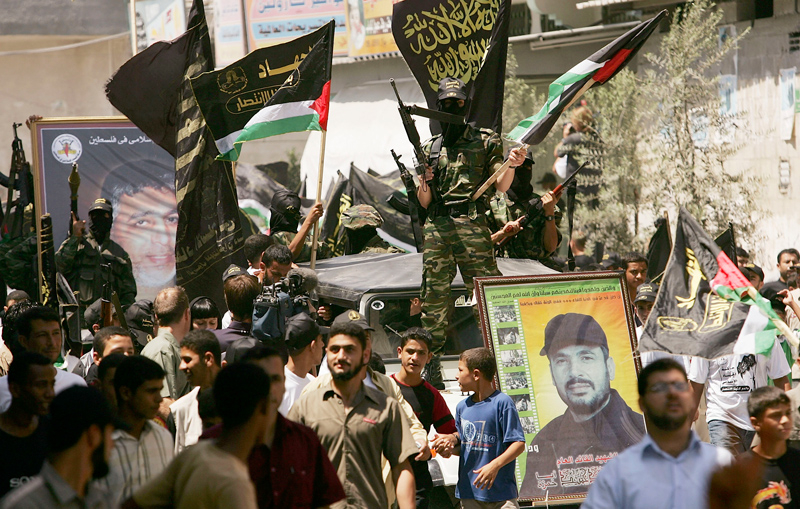 Pictured: Members of Palestinian Islamic Jihad hold a parade in Gaza City. (Photo by Spencer Platt/Getty Images)








 anneinpt
 artaxes
 danmillerinpanama
 davidking1530
 Peter Hofman
 Joseph Wouk
 Peter
Peter Louisiana Steve
 WarSclerotic
Recent Comments