Archive for December 2017

Trump’s Energy Success

December 30, 2017

Trump’s Energy Success, American ThinkerJeffrey Folks, December 30, 2017

The president’s accomplishments are many, but energy stands out.  America is now the world’s premier producer of fossil fuels.  In just one year, we have gone from a dismal future, in which the government planned to shut down fossil fuels almost entirely by mid-century, to a nation on the cusp of total energy independence.  “Make America Great Again” was not just a clever campaign slogan; it is a reality in the field of energy production, as in so many other areas under President Trump.

**************************

Just six months ago, the Trump administration was attacked for its “slow start.”  It was said to be “in disarray,” in “chaos,” “at war” with itself, and incapable of governing.  Now the list of successes has piled up, making it clear that, if the trend continues, President Trump will become one of our more important presidents.  Far from being a do-nothing administration, the Trump team is a White House on steroids.

One of the president’s major successes is in the area of energy policy.  Along with energy secretary Rick Perry, the president is overseeing the recovery of the American energy sector from the low point it hit under the Obama administration.  By a combination of executive orders totally restrictiong drilling on federal lands and EPA assaults on fracking and coal-mining, including a total ban on mountaintop-mining, Obama prosecuted a “war” not just on coal, but on fossil fuels generally.

Now America has become the largest producer of oil and gas and a major exporter of natural gas.  The U.S. now produces significantly more hydrocarbons than second-place Russia and twice as much as Saudi Arabia.  As coal-mining is restored, pipelines are laid, and new wells are drilled, hundreds of thousands of jobs are being created across the economy, not just in drilling and mining, but in support services.

The effect on the economy is already being felt.  According to Monster.com, a leading employment recruitment site, oil jobs are making a “huge comeback,” with “100,000 new jobs by 2018.”  And these are high paying jobs: “the average pay of the oil and gas industry is 85% higher than the national average.”  Each new job in the energy field creates others in areas like steel production, rig technology, transportation, and general services.  And the money earned in these high paying fields circulates through the economy.

With the passage of a provision in the Tax Cuts and Jobs Act allowing oil exploration in ANWR, the president has another success.  The Arctic National Wildlife Refuge contains vast reserves of recoverable oil currently estimated at10.4 billion barrels.  Development has been blocked by misguided and ill informed opposition from environmental groups.  Now, with great care for the environment, oil companies will have the opportunity to produce vast amounts of energy while drilling only 3% of ANWR.

According to a report from the House Committee on Natural Resources, “total governmental revenue” from ANWR drilling will run $440 billion.  ANWR alone will create between 55,000 and 130,000 new high paying jobs.

It is not just ANWR.  By removing unnecessary restrictions on fracking and by opening other federal lands to drilling, President Trump is promoting energy independence rather than standing in its way.  He has opened federal lands for drilling, including land in two national monuments in southern Utah.  Vast federal lands in the Western U.S. offer other opportunities.

In April, the president signed an executive order reversing Obama’s ban on new offshore drilling in the Arctic and Atlantic.  Current estimates show that almost 90 billion barrels of oil and 327 trillion cubic feet of natural gas lie under the U.S. Outer Continental Shelf.  Those estimates have a way of being revised upward, especially for regions such as these that have not been explored with modern technology due to past restrictions.  Offshore drilling has the potential to produce ten times the number of jobs and government revenue projected for ANWR.  At the high end, that would be 1,300,000 high paying jobs and $4.4 trillion in state and federal revenue.

Under President Obama, American coal-mining suffered a near-death experience.  Now, under EPA director Scott Pruitt, the Trump administration is taking steps to restore coal to its rightful place in America’s energy supply mix.  Though it will take years to complete, the reversal of Obama’s Clean Power Plan that began back in October will take government out of the frame of “picking winners and losers.”  Coal will still have to compete with natural gas, but at least it will be allowed to compete.

The president’s accomplishments in the field of energy policy are not limited to fossil fuels.  His Energy Department recently committed $100 million to promoting Transformative Energy Projects intended to spur early-stage innovators.  The department continues to promote alternative energy sources and energy conservation, important contributors to energy independence.  Energy conservation in particular can go a long way toward making America energy-independent.

With the opening of new lands to fracking and conventional drilling and the restoration of mining in the Appalachian region, the energy sector has gone from moribund to robust practically overnight.  One of the president’s first actions wasthe elimination of the Steam Protection Rule, which imposed crippling burdens of regulation on the industry.  As a result, production has begun to increase.

As the U.S. Energy Information Agency’s annual “Outlook” makes clear, the future for American energy production is bright.  The Outlook models future production across a wide range of different scenarios, and it concludes that the U.S. “is projected to become a net energy exporter by 2026” in its Reference Case projections but that it may do so earlier under three side cases.  After 2026, the scale of exports expands rapidly in all cases.

Perhaps the most consequential of the president’s actions in the field of energy is his decision to withdraw from the Paris climate accord.  While withdrawal from the accord does not have significant immediate consequences, its long-term effect is great.  Its most important effect will be to reduce the possibility of a deluge of environmental lawsuits based largely on the agreement signed by President Obama.  These lawsuits would have blocked American energy production to gratify a self-appointed global environmental elite – at the expense of the American people.

The president’s accomplishments are many, but energy stands out.  America is now the world’s premiere producer of fossil fuels.  In just one year, we have gone from a dismal future, in which the government planned to shut down fossil fuels almost entirely by mid-century, to a nation on the cusp of total energy independence.  “Make America Great Again” was not just a clever campaign slogan; it is a reality in the field of energy production, as in so many other areas under President Trump.

Saving up !

December 30, 2017

SO…how much money would American taxpayers save if Trump made good on his threat to cut aid to any country that voted against us on the Jerusalem move?

http://barenakedislam.com/2017/12/30/so-how-much-money-would-american-taxpayers-save-if-trump-made-good-on-his-threat-to-cut-aid-to-any-country-that-voted-against-us-on-the-jerusalem-move/

There was a global outcry after President Trump announced his intention to move the U.S. Embassy in Israel from Tel Aviv to Jerusalem. However, that might actually turn out to be good for America’s economy if the White House stopped giving billions of dollars every year to countries that take it for granted.

Daily Caller

(h/t Marvin W) What if Trump actually gutted funding for those 128 countries? Well, The Daily Caller did the math.

According to USAid.gov, which catalogs all country-by-country financial obligations the U.S. holds with the rest of the world, Trump’s threat would save the United States more than $24 billion — in just one year.

Here are the countries that voted against the U.S., listed alphabetically, along with America’s 2016 financial obligation to each country:

Afghanistan — $5,060,306,050

Albania — $27,479,989

Algeria — $17,807,222

Andorra — $0

Angola — $64,489,547

Armenia — $22,239,896

Austria — $310,536

Azerbaijan — $15,312,389

Bahrain — $6,573,352

Bangladesh — $263,396,621

Barbados — $5,442,370

Belarus — $11,166,107

Belgium — $3,101,636

Belize — $8,613,838

Bolivia — $1,378,654

Botswana — $57,252,922

Brazil — $14,899,949

Brunei — $354,829

Bulgaria — $20,066,715

Burkina Faso — $74,469,144

Burundi — $70,507,528

Cabo Verde — $5,044,716

Cambodia — $103,194,295

Chad — $117,425,683

Chile — $2,266,071

China — $42,263,025

Comoros — $1,057,063

Congo — $8,439,457

Costa Rica — $14,650,552

Cote d’Ivoire — $161,860,737

Cuba — $15,776,924

Cyprus — $0

Democratic People’s Republic of Korea (North Korea) — $2,142,161

Denmark — $3,455

Djibouti — $24,299,878

Dominica — $616,000

Ecuador — $26,014,579

Egypt — $1,239,291,240

Eritrea — $119,364

Estonia — $15,937,295

Ethiopia — $1,111,152,703

Finland — $33,492

France — $4,660,356

Gabon — $31,442,404

Gambia — $3,197,858

Germany — $5,484,317

Ghana — $724,133,065

Greece — $8,508,639

Grenada — $690,300

Guinea — $87,630,410

Guyana — $9,691,030

Iceland — $0

India — $179,688,851

Indonesia — $222,431,738

Iran — $3,350,327

Iraq — $5,280,379,380

Ireland — $0

Italy — $454,613

Japan — $20,804,795

Jordan — $1,214,093,785

Kazakhstan — $80,418,203

Kuwait — $112,000

Kyrgyzstan — $41,262,984

Laos — $57,174,076

Lebanon — $416,553,311

Liberia — $473,677,614

Libya — $26,612,087

Liechtenstein — $0

Lithuania — $15,709,304

Luxembourg — $0

Madagascar — $102,823,791

Malaysia — $10,439,368

Maldives — $1,511,931

Mali — $257,152,020

Malta — $137,945

Mauritania — $12,743,363

Mauritius — $791,133

Monaco — $0

Montenegro — $2,118,108

Morocco — $82,023,514

Mozambique — $514,007,619

Namibia — $53,691,093

Nepal — $194,286,218

Netherlands — $0

New Zealand — $0

Nicaragua — $31,318,397

Niger — $144,122,239

Nigeria — $718,236,917

Norway — $100,000

Oman — $5,753,829

Pakistan — $777,504,870

Papua New Guinea — $14,836,598

Peru — $95,803,112

Portugal — $207,600

Qatar — $95,097

Republic of Korea (South Korea) — $3,032,086

Russia — $17,195,004

Saint Vincent and the Grenadines — $612,000

Saudi Arabia — $732,875

Senegal — $99,599,642

Serbia — $33,062,589

Seychelles — $223,002

Singapore — $468,118

Slovakia — $2,585,685

Slovenia — $715,716

Somalia — $274,784,535

South Africa — $597,218,298

Spain — $81,231

Sri Lanka — $27,192,841

Sudan — $137,878,835

Suriname — $232,672

Sweden — $1,269

Switzerland — $1,168,960

Syria — $916,426,147

Tajikistan — $47,789,686

Thailand — $68,182,970

The Former Yugoslav Republic of Macedonia — $31,755,240

Tunisia — $117,490,639

Turkey — $154,594,512

United Arab Emirates — $1,140,659

United Kingdom — $3,877,820

United Republic of Tanzania — $628,785,614

Uruguay — $836,850

Uzbekistan — $20,067,933

Venezuela — $9,178,148

Vietnam — $157,611,276

Yemen — $305,054,784

Zimbabwe — $261,181,770

TOTAL — $24,485,383,599

AVERAGE PER COUNTRY — $205,795,526

Liberal Humiliation: Trump vs. Obama on Iran

December 30, 2017

Liberal Humiliation: Trump vs. Obama on Iran, PJ MediaRoger L Simon, December 29, 2017

(Please see also, Iranian Officials Inconsistent in Describing Protestors’ Motives and Goals. — DM)

Hundreds of thousands of supporters of opposition presidential candidate Mir Hossein Mousavi turn out to protest the result of the election at a mass rally in Azadi (Freedom) square in Tehran, Iran in 2009. (AP Photo/Ben Curtis, File)

Back in those pre-9/11 days when I identified as a liberal, the one thing I was sure drew all my then cohort together was opposition to fascism, whether secular or religious.

Boy, was I wrong and never was that more clear than in 2009 when the Green Movement demonstrators were marching through the streets of Tehran and other Iranian cities, demanding freedom from the mullahs. The whole world was watching, as we used to say in the sixties, only their cause was purer than ours was then. The horrifying theocrats who ran the “Islamic Republic” regularly raped women in prison before they killed them, hanged homosexuals in the streets and tortured just about everyone else who didn’t comply with the edicts of their Islamofascist regime.

The students and others marching in the streets to overthrow these tyrants desperately wanted America’s help, specifically the support of our “oh-so-liberal-progressive” president. they shouted, “Obama, Obama, are you with us or are you with them?”

Obama was silent.

I can’t think of a moment I was more disgusted by the acts (inaction actually) of an American president. What did he stand for? What did we stand for?

Well, who knows? What we do know is he wanted to deal with Iran his way — whether to get the glory for himself or for other even less attractive reasons we will never know. He was secretly communicating with Ahmadinejad and Khamenei even before he took office, hinting at accommodation.

He wanted an Iran deal and he got it, the Iranian people and the U.S. Constitution be damned. (I have met several of the student demonstrators from that period who spent years being tortured in Tehran’s Evin Prison. Their faces resembled Picassos of the Cubist Period. They were the lucky ones. Their brothers and sisters just disappeared.)

Obama was silent for those students and millions of other decent Iranians. He wanted his deal so much that, as we know, he sent still more millions to the mullahs in cash, so they could use those dollars in any untraceable manner they wished — such as funding Hezbollah and the Houthis.

And speaking of Hezbollah, we all know now, due to reporting about Project Cassandra by Josh Meyer at Politico, that Obama was so determined to make his creepy deal that he acceded to the mullahs’ demand to pull the FBI off a detailed investigation of the Hezbollah thugs’ extensive involvement in the U.S. drug trade. Are we sick yet?

Now, it is being widely reported, the demonstrators are back in the streets of various cities in Iran. We don’t know the extent of the protests or where they are going. I’m a bit skeptical. The time was probably more ripe in 2009, but we can be hopeful. What we do know is that these demonstrators are complaining that money garnered from the Iran nuclear deal is not going to them, the Iranian people, to make their lives better, as promised, but to carry out the mullahs’ murderous military adventures across the Middle East. Was anything ever more predictable? (For ongoing updates, I recommend the Islamic State of Iran Crime Research Center.)

What we also know is that the Donald J. Trump administration has taken the exact opposite approach from the Obama administration to events in Iran. They are unqualifiedly — and immediately — supporting the demonstrators and democracy. Bravo!

Iranian Officials Inconsistent in Describing Protestors’ Motives and Goals

December 30, 2017

Iranian Officials Inconsistent in Describing Protestors’ Motives and Goals, Iranian News Update, Edward Carney, December 30, 2017

Please see also, The First Anti-American President, the thrust of which is

Donald Trump is certainly the opposite of an anti-American president, and he has no affection for our enemies. He has enabled the Ukrainians to fight, perhaps effectively, against the Russians. So why can’t he enable the Iranians to fight against the ayatollahs?

In the Ukrainian case we’re talking about military weapons; in the Iranian conflict the weapons are political.

If the Iranians rose up against the regime when Obama entered the White House, you can be sure they are at least equally motivated to do it with Trump in office. There are many protests in Iran today, and the Khamenei/Rouhani regime has responded by executing half as many Iranians as in the past. We should relentlessly expose this mass murder, and we should publicize the ongoing protests.

The target audience for such exposes is the great mass of the population. Paradoxically, Iranians are better informed about events in Jerusalem and Washington than in Iranian Kurdistan, the southern oil regions, and cities like Mashad and Qom.

— DM)

[T]he protest against foreign intervention has taken on a life of its own, with activists chanting such slogans as “forget about Syria; focus on us” and “no Gaza, no Lebanon; I will give my life only for Iran.” Despite the prevalence of these sorts of messages in social media and public accounts of the demonstrations, Iranian officials continue to maintain that the regional military prestige of the Islamic Republic remains broadly popular. For instance, the Huffington Post quotes hardline cleric Ahmad Alamolhoda as claiming that only about 50 protestors had expressed regional concerns within a gathering of several hundred.

**************************************

On Friday, mass protests continued throughout Iran after having started the previous day in reaction to rising rates of inflation and other uncontrolled economic conditions that had contributed, for instance, to a doubling of the price of eggs in just one week’s time.

Deutsche Welle quotes one Iranian lawmaker as blaming these problems on “illegal financial institutions” that had been established under the administration of former President Mahmoud Ahmadinejad. The closure of one such bank, called Mizan, reportedly had a particularly marked impact on Iran’s second most populous city, Mashhad, which has been the focal point of protests that spanned much of central and northern Iran as of Thursday.

The lawmaker’s account of the protests seemingly absolves the current government of responsibility for the conditions that are being protested by victims of a widening income gap in the Islamic Republic. But the DW article also points out that a major target of those protests has been current President Hassan Rouhani’s slow progress in following through on a promise to reimburse citizens whose investments were wiped out by the collapse of state-linked financial institutions.

https://www.youtube.com/watch?v=mGDCH3lWA3E


At the same time, DW and various other outlets have highlighted a trend toward broader focus in those protests, targeting not just rising prices and not just financial indicators as a whole but also the Rouhani administration’s failure to uphold a wide variety of promises regarding domestic reform. Insofar as the abandonment of these promises represents closure of the political gap between Rouhani’s political allies and those of hardline authorities like Supreme Leader Ali Khamenei, the protests seemingly double as an expression of opposition to the clerical system as a whole.

Indeed, the BBC refers to the demonstrations as “anti-government” protests in its reporting on Friday, as well as identifying them as the most serious and widespread such gatherings since the 2009 Green Movement, which emerged out of protests against Ahmadinejad’s disputed reelection. Those protests lasted for eight months and ended with a severe crackdown by government authorities, but many Iran watchers have observed that the resentments voiced by that movement continued to simmer under the surface in anticipation of another mass demonstration.

https://www.youtube.com/watch?v=JKrV_VJ-1Bk


This is not to say that there have been no major protests in the ensuing year. Indeed, the National Council of Resistance of Iran has identified thousands in the past year alone. But these have tended to be more geographically confined than the current demonstrations, and many have been focused not on politics but on specific demands such as the payment of overdue wages.

The content of Thursday’s and Friday’s protests was evidently broad enough in scope that even some Iranian officials were compelled to acknowledge the “anti-government” nature of chants and slogans, even while downplaying the scope of their appeal. The Associated Press reports that the governor of Tehran, Mohsen Hamedani, had acknowledged the spread of the protests to the Iranian capital, yet insisted that the gathering involved fewer than 50 people, most of whom dispersed after being warned by police.

Hamedani added that those who remained were “temporarily” arrested, and these remarks seemed also to downplay the severity of the government’s response to what might be regarded as a serious threat to its legitimacy. However, social media posts from various cities depicted peaceful protests being met with tear gas and water cannons, and the crowds in each of those gatherings numbered in the hundreds or in the thousands. By the end of Thursday, there had been at least 52 arrests in Mashhad alone, according to the BBC.

This is not to say that there have been no major protests in the ensuing year. Indeed, the National Council of Resistance of Iran has identified thousands in the past year alone. But these have tended to be more geographically confined than the current demonstrations, and many have been focused not on politics but on specific demands such as the payment of overdue wages.

The content of Thursday’s and Friday’s protests was evidently broad enough in scope that even some Iranian officials were compelled to acknowledge the “anti-government” nature of chants and slogans, even while downplaying the scope of their appeal. The Associated Press reports that the governor of Tehran, Mohsen Hamedani, had acknowledged the spread of the protests to the Iranian capital, yet insisted that the gathering involved fewer than 50 people, most of whom dispersed after being warned by police.

Hamedani added that those who remained were “temporarily” arrested, and these remarks seemed also to downplay the severity of the government’s response to what might be regarded as a serious threat to its legitimacy. However, social media posts from various cities depicted peaceful protests being met with tear gas and water cannons, and the crowds in each of those gatherings numbered in the hundreds or in the thousands. By the end of Thursday, there had been at least 52 arrests in Mashhad alone, according to the BBC.

https://www.youtube.com/watch?v=8LBt9pr-Vow


Political imprisonment is rampant in the Islamic Republic, and the BBC report also indicates that this was one of the topics that had been advanced by some protestors. But political focus of any given participant in the demonstrations might be different from those of any other, as evidenced by media reports identifying chants as targeting economic issues, political imprisonment, Iran’s paramilitary interventions in the surrounding region, and so on.

This latter topic is closely related to the economic issues that reportedly sparked the protests, since the Iranian government has spent billions of dollars in recent years on propping up the Syrian dictatorship of Bashar al-Assad, as well as on promoting the growth of the Houthi rebellion in Yemen and the various Shiite militias operating in Iraq. A recent editorial in Forbes points out that the new Iranian national budget, introduced by Rouhani in early December, includes the provision of 76 billion dollars to the Iranian Revolutionary Guard Corps and its foreign special operations Quds Force, at a time when tens of thousands of victims of a November earthquake are still awaiting basic shelter and government services.

https://www.youtube.com/watch?v=fPs6Z4N7R1M


But the protest against foreign intervention has taken on a life of its own, with activists chanting such slogans as “forget about Syria; focus on us” and “no Gaza, no Lebanon; I will give my life only for Iran.” Despite the prevalence of these sorts of messages in social media and public accounts of the demonstrations, Iranian officials continue to maintain that the regional military prestige of the Islamic Republic remains broadly popular. For instance, the Huffington Post quotes hardline cleric Ahmad Alamolhoda as claiming that only about 50 protestors had expressed regional concerns within a gathering of several hundred.

Interestingly, the same report also quotes Alamolhoda as advocating for an intensified crackdown on the protestors. In absence of this, he suggested, enemies of the regime would claim that the government had lost its “revolutionary base”. The Huffington Post indicates that Tehran security personnel have promised that any demonstrations in the capital would be “firmly dealt with”. This seems to be at odds with the Tehran governor’s commentary about temporary arrests and also with the initial reaction from Mashhad Governor Mohammad Rahim Norouzian, whom the AP quoted as saying that security forces had shown “great tolerance”

https://www.youtube.com/watch?v=ESosshsoUYc


Since that initial reaction, Iranian officials seem to have increasingly justified crackdowns through acceptance of the broader characterizations of the protests’ grievances and goals. Norouzian himself came to describe the protests as having been organized by “counter-revolutionaries”, according to DW. According to other sources, officials have also referred to the organizers as “hypocrites,” a term often applies to members of the leading Iranian opposition group the People’s Mojahedin Organization of Iran.

The PMOI has also been a driving force in a number of activist campaigns within the Islamic Republic, including the push for international attention and independent inquiry into the 1988 mass execution of political prisoners, which primarily targeted that same resistance organization. In a Huffington Post editorial on Friday, former US Ambassador Ken Blackwell sought to connect that massacre, which killed an estimated 30,000 people, to the current protests. He said that Thursday’s and Friday’s chants of “death to the dictator” emerged out of “a political climate punctuated by growing demands for justice for the regime’s massacre.”

But even if the initial economic focus of the latest protests had been voiced in isolation, there is an argument to be made that this also would constitute an expression of opposition to the continued rule of the clerical regime. In fact, this argument was made by historian Ellen Ward on Friday in an editorial published by Forbes. Ward observes that despite some officials’ efforts to blame the previous presidential administration for ongoing problems, it is really the underlying clerical system that is responsible for the economic future of the Iranian people.

This is to say that it is the clerical authorities, and not the elected branches of government, who establish and enforce policies with tremendous economic impact, including the interventionist foreign policy. Ward’s argument is reminiscent of the statement put out on Thursday by the PMOI’s parent coalition the National Council of Resistance of Iran. That statement quoted NCRI President Maryam Rajavi as saying that the economic prospects of the Iranian people cannot be expected to improve until the resistance movement has brought about the emergence of democratic governance in place of the theocratic dictatorship.

https://www.youtube.com/watch?v=LZxePyDYAcg


Humor? | My Predictions for 2018

December 29, 2017

My Predictions for 2018, PJ MediaAndrew Klavan, December 29, 2017

Harvey Weinstein

It’s time for me to peer through the veil of the future into the face of tomorrow in order to describe the features of the New Year. Here are some events that are approximately 97 percent likely to happen in 2018.

The Super Bowl will be played between the New England Patriots and some other team. Approximately 76 people will attend the game, but the audience will be boosted by the hundreds who tune in for its live broadcast on Spike TV. The halftime show will feature Chelsea Handler singing her new hit, “Screw You, America, And Your Stinking Flag Too,” and will include a massive dance number representing the United States Army’s oppression of indigenous peoples around the world. After the Patriots win, NFL executives will hold a meeting to discuss the mysterious decline in their ratings. They will conclude they need more outreach to transgender people.

CNN will break an exclusive story detailing how President Trump personally funneled top-secret defense information to Russian ambassador Anatoly Antonov in exchange for a permit to open a new Trump resort in Moscow. Several hours later, CNN will issue a clarification stating it was not President Trump but his personal friend Melvin Hankey and it was not defense information but a bottle of wine and it was not the Russian ambassador but some girl named Lily Bernstein and it was not in exchange for a building permit in Moscow but in exchange for twenty dollars and that Hankey never met Trump but works in a liquor store Trump sometimes used to walk past. A day later, CNN will issue a clarification stating that Trump never walked past the liquor store.

The Academy of Motion Picture Arts and Sciences will hold its annual Academy Awards ceremony at which every presenter will be played by Christopher Plummer. The star-studded event will be held at the San Pedro Elks Lodge, the only available venue large enough to handle the audience of 54 people without leaving a lot of empty seats. The audience, however, will be boosted by the hundreds of out-of-work NFL executives watching the simultaneous telecast on the Golf Channel. Ultimately Mr. Plummer will deliver the Best Picture honors to the independent production Loving Me, Loving Ewe, which the New York Times will describe as “an important look at society’s oppression of African-American lesbians forced to transition to manhood in order to consummate their relationships with farm animals.” After the event, Academy executives will meet to discuss the mysterious decline in the show’s ratings. They’ll conclude they need more outreach to out-of-work NFL executives.

The New York Times, a former newspaper, will run an issue in which the headline to every story is Donald Trump’s name with an obscenity next to it. Times editor Blithering Prevarication III will later give a press conference admitting that the paper may have strayed somewhat from its traditional standards of objective reporting. He’ll then begin repeatedly muttering Donald Trump’s name interspersed with obscenities and will finally burst into tears, sobbing, “God help me, I love him!”

Former Arizona Senator Jeff Flake will make a dramatic run for elective office, promising to solve Flagstaff’s stray dog problem once and for all. He’ll be defeated by a local businessman running on the slogan, “Make Flagstaff’s Dog Pounds Great Again.”

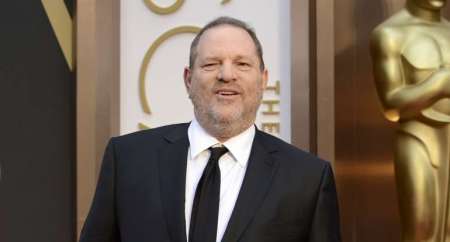
After a judge sentences him to 39 hours of community service, Harvey Weinstein will be forced to take a job leading a workshop on sexual harassment in Hollywood. Calling a particularly attractive actress to the front of the room, Weinstein will demonstrate what men should never do on set by placing his hands on the actress’s breasts, buttocks and groin. The two will marry shortly thereafter

Working in a secret lab in the White House basement, Donald Trump will develop a cure for cancer while directing military operations that wipe out radical Islam during the greatest economic boom in American history. In reaction, National Review will run a cover story entitled, “Yes, But Is He Really an Intellectual?”

I’ll return at the end of the year to discuss how everyone else got their predictions so wrong.

Trump’s First Year Accomplishments Compiled In Shockingly Long List

December 29, 2017

Trump’s First Year Accomplishments Compiled In Shockingly Long List, Rasmussen Reports, Richard Baris, December 29, 2017

Looking back on President Donald Trump’s first year in office, he has compiled a shockingly strong record and long list of accomplishments. As was also the case with his rise to the presidency, President Trump has broken several records for a first-year commander-in-chief and fulfilled many of his key campaign promises.

Now, that’s not to say he hasn’t had failures and it’s not to mask the fact that many of these accomplishments were unilateral. But it is also true that President Trump has faced an unprecedented level of never-ending obstruction throughout the year. He was the first president in memory to be deprived of the “honeymoon” period after Inauguration Day and, frankly, opposition at times has risen to levels that could arguably constitute downright treason.

Sure, his presidency, much like his campaign, has been unconventional and his governing style appears to pundits and mediates to be rather messy.

And that’s exactly what America should’ve expected.

America didn’t elect Donald J. Trump to get more of the same and D.C. wouldn’t have had such a vial backlash had he not been trying to keep the promises he made to the American people. Had it been business as usual this year, then we would have grown suspect.

Here’s a long but still incomplete list of accomplishments during his first year in office. For those who believe the list isn’t at all long, we challenge you to read the whole article in one sitting. Some you will recognize and some you will not. But these are just some of the actions we believe will impact Americans’ lives and, in some cases, the human race.

Tax Cuts and Jobs Act

President Trump signed the Tax Cuts and Jobs Act before Christmas, ensuring U.S. business commitments for bonus payouts to at least hundreds of thousands of Americans workers. Within hours, numerous businesses announced wage increases and billions of dollars in various industry investments.

It was the first overhaul to the U.S. tax code in 31 years, but that’s not all it was.

Repealed Individual Mandate

The tax overhaul also repealed the individual mandate in ObamaCare. Republicans targeted the individual mandate during arguments before the U.S. Supreme Court and lost because the Bush-appointed Chief Justice John Roberts rewrote the law to uphold it.

The U.S. Senate attempted to half-hearted ObamaCare repeal after 7 years of campaign promises, and failed. They attempted to pass a so-called “skinny repeal,” and failed again. It was the businessman outsider with no political experience who worked with a few senators to sneak in a repeal of the least popular ObamaCare provision at the last minute, and it worked.

Big Media was working overtime for the Democratic Party to mislead the American people about the bill and they didn’t see it coming until it was too late. Democrats were left to pretend as if they were happy the individual mandate was repealed because they could pass off the blame for already-rising premiums on Republicans.

It remains to be seen whether that tactic works. But for Republican voters freedom and choice are more important than scoring political points. The Internal Revenue Service (IRS) — an agency that once targeted them for their political beliefs — has been weakened.

Arctic National Wildlife Refuge (ANWR)

For nearly 40 years, Republicans have tried and failed to open the Arctic National Wildlife Refuge (ANWR) for oil drilling. Since the 1980s, the effort always failed in the face of intense opposition because weak congressional Republicans were too afraid of the Democrat-Big Media coalition.

They repeatedly abandoned the decades-old campaign promise.

Yet, a provision for drilling in ANWR was included in the President’s signature tax bill with minimal backlash.

Justice Neil Gorsuch

President Trump nominated and the U.S. Senate confirmed Justice Neil Gorsuch, despite unprecedented opposition and obstruction by Senate Democrats. Many of those same Democratic senators, including Minority Leader Chuck Schumer, D-N.Y., unanimously confirmed Justice Gorsuch to his prior role in a voice vote back in 2006.

As People’s Pundit Daily (PPD) has previously examined, the Democratic Party historically has been the party of obstruction with judicial appointments, particularly relating to the Supreme Court.

“We’ve cemented the Supreme Court right-of-center for a generation,” Senate Majority Leader Mitch McConnell, R-Kty., said while rattling off his own list of year-one accomplishments during the celebration for tax reform at the White House. “Mr. President, thanks to your nominees, we’ve put 12 circuit court judges in place — the most since the circuit court system was established in 1891.”

Set Record for First-Year Judicial Appointments to Federal Appellate Courts

President Trump on December 14 officially set a record for the most federal appeals judges appointed during the first year of a presidency, more than any other before him. The U.S. Senate pushed through the twelfth federal appeals court nominee that day, breaking the previous record held jointly by Presidents Richard Nixon and John F. Kennedy.

As we’ve seen front-and-center during the first year of the Trump Administration, judicial appointments can have a very significant impact on public policy and a president’s legacy. Democrats are particularly inclined to engage in “judge-shopping” when they fail to muster enough support for an initiative at the ballot box or implement policy through the legislative process.

That was the case with same-sex marriage, abortion, unfettered illegal immigration and numerous landmark decisions that have real-world impact on everyday life and the future of the nation.

For context, Barack Obama nominated and the Democrat-controlled Senate successfully confirmed only 3 appeals court judges in his first year in office in 2009. Former President George W. Bush got six federal judges confirmed.

As of mid-December, 19 of President Trump’s 66 total nominees this year have been confirmed.

Historic Reduction in Illegal Immigration

President Trump made cracking down on illegal immigration the centerpiece of his campaign and end-of-year statistics from the Department of Homeland Security (DHS) show historic success during the first year of his administration.

The U.S. Customs and Border Protection (CBP) in FY 2017 reported a 23.7% decline over the previous year. Illegal migration along the Southwest border declined sharply from January 21 to April, which was the lowest month of border enforcement activity on record. In FY 2017, CBP reported the lowest level of illegal cross-border migration ever on record.

The U.S. Immigration and Customs Enforcement (ICE) and Removal Operations (ERO) conducted 143,470 arrests and removed 226,119 illegal aliens, an increase of 40% from the previous fiscal year. From the start of the Trump Administration on January 20, 2017 through the end of the fiscal year, ERO made 110,568 arrests juxtaposed to 77,806 in FY 2016, also an increase of 40%.

Worth noting, 92%, or 101,722 illegal aliens arrested by ICE during the Trump Administration, either had a criminal conviction or a pending criminal charge, were an ICE fugitive, or were an illegal re-entrant. In other words, he isn’t ripping babies out of their mother’s arms and dreamers out of their homes en masse as the hysterical media portray.

Crushing ISIS Caliphate

In October, the U.S. Pentagon confirmed to People’s Pundit Daily (PPD) that Raqqa, the “capital of terrorism” in Syria, had fallen. Secretary Rex Tillerson said the fall of the Islamic State (ISIS) capital was accelerated by “critical decisions” made by President Trump.

“In January, ISIS was actively plotting terrorist attacks against our allies and our homeland in Raqqa,” Secretary Tillerson noted. “Nine short months later, it is out of ISIS’s control due to critical decisions President Trump made to accelerate the campaign.”

U.S. military officials said this week that ISIS has lost 98% of the territory it once held and the latest U.S. intelligence assessment reveals fewer than 1,000 ISIS militants remain in Iraq and Syria, down from a peak of nearly 45,000 when the Islamic caliphate rose to power under Mr. Obama just two years ago.

The fall of the caliphate is a crushing blow to ISIS because the physical caliphate served as validation to would-be recruits that Allah was on their side. With the caliphate gone, it appears to the believer that Allah has abandoned their cause.

Resurgence of U.S. Economy — the American Spirit

In February, Dow Chemical CEO Andrew Liveris said that the Trump Administration is “probably the most pro-business administration since the founding fathers.” His remarks came after attending a meeting with President Trump, who hosted manufacturing leaders at the White House almost one month exactly after his inauguration.

Roughly 10 months later, forecast models project the U.S. economy to grow by 3% or higher in the fourth quarter (4Q) 2017.

Under Mr. Obama, “experts” told us we just had to live with the new normal — 2% annual economic growth.

Now, if the 4Q forecasts are matched or exceeded, it’ll mark the third straight quarter of economic growth at or above 3% for the first time since 2004. It also means the first year of economic growth under President Trump is all but certain to surpass the strongest under his predecessor Mr. Obama.

Under Mr. Obama, “experts” told us we just had to live with the new normal — no manufacturing base.

Now, the National Association of Manufacturers (NAM) said manufacturers’ optimism in the 4Q of 2017 is the highest in the 20-year history of the Manufacturers’ Outlook Survey. The NAM said the survey has “risen to unprecedented heights” as a result of the tax reform bill.

As with tax reform, this should be broken down into separate subcategories of accomplishments. But make no mistake, President Trump’s policies have fueled historic levels of optimism among consumers and businesses.

Stock Market Records, Wealth Creation

The Dow Jones Industrial Average has hit record highs nearly 70 times in 2017 and U.S. markets have created roughly 6.3 trillion in new wealth. In 2017, Americans’ 401Ks appreciated by 25% to 33% and Bank of America is forecasting the S&P 500 and NASDAQ Composite to rise at least another 12% and 16%, respectively, in 2018.

Deregulation: Rolling Back the Militant Administrative State

“What the economists and market strategists have totally underestimated in their GDP forecasting is the positive effect from the multi-agency regulatory roll back from the Trump Administration,” TJM Investments analyst Tim Anderson said. “This has led to a record high level of business confidence indicators and most recently the highest level of industrial production in 3 years.”

Mr. Anderson is in part referring to what is known as a Congressional Review Act (CRA), a tool used by the Trump Administration to unravel regulations put in place by his predecessor. President Trump also signed an executive order requiring agencies to rollback 2 regulations for every new one they created.

However, as of mid-December, President Trump’s policies have resulted in a 22-to-1 deregulation ratio, crushing his goal.

The window for using the CRA closed in early May. President Trump and congressional Republicans made historic use of it. The 21-year-old law that created CRAs, a fast track for reversing “midnight rules” finalized within the last 60 days of a presidential administration, had been used only once before the Trump Administration.

Republicans had hoped for 6 to 12 rollbacks, but were successful in 14 of their 15 attempts. It saved the U.S. economy billions.

The Trump Environmental Protection Agency (EPA) under Scott Pruitt dismantled the Waters of the United States and the Clean Power Plan, a slew of significant and unpopular Obama-era regulations. The Trump Federal Communications Commission (FCC) under Ajit Pai repealed net neutrality.

The Trump Department of Education under Betsy DeVos revoked Title IX, which created “kangaroo courts” that rob the accused of due process and too often destroyed their lives without cause.

Reviving the National Aeronautics and Space Administration (NASA)

In his first 100 days, President Trump signed the National Aeronautics and Space Administration Transition Authorization Act of 2017, which acting Administrator Robert Lightfoot said was vital for “our nation’s space, aeronautics, science, and technology development programs to thrive.”

While it garners little attention – no doubt because we tend to view legislation in terms of partisan victories – the authorization act will have longstanding impact on the nation and humankind. Mr. Lightfoot added that the bill “ensures our nation’s space program will remain the world’s leader in pioneering new frontiers in exploration, innovation, and scientific achievement.”

In December, President Trump signed White House Space Policy Directive 1, a public-private partnership for human missions to the Moon, Mars and beyond. The U.S.-led program represents the latest change in national space policy under the Trump Administration aimed at renewing U.S. engagement in space.

In July, President Trump revived the National Space Council and empowered them to help implement his space policy — to make human exploration of the solar system a national priority. White House Space Policy Directive 1 was the result of a unanimous recommendation made by the new council, which is chaired by Vice President Mike Pence, after its first meeting on October 5.

We don’t think we have to explain how important of an impact the Trump Administration’s policy could have on the human race. We’ll just leave you with this on the subject.

“This work represents a national effort on many fronts, with America leading the way. We will engage the best and brightest across government and private industry and our partners across the world to reach new milestones in human achievement,” Administration Lightfoot said of the directive. “The next generation will dream even bigger and reach higher as we launch challenging new missions, and make new discoveries and technological breakthroughs on this dynamic path.”

VA Accountability and Whistleblower Protection Act (VA Reforms)

In June, President Trump signed the VA Accountability and Whistleblower Protection Act. The legislation fulfilled a major campaign promise and was the most significant reform bill in the history of the Department of Veterans Affairs.

It gave Secretary David Shulkin and VA leadership the power to fire bad employees for misconduct and provided more whistleblower protection to those who report wrongdoing. The VA is now required to release a monthly report detailing whatever disciplinary actions have been taken during that month each month since the bill was signed.

And it’s working. After the very first month, more than 500 employees had been fired for bad behavior as a result. The Adverse Actions Report also showed more than 180 had been put on suspension for a period greater than 14 days.

The Trump Administration has taken veterans’ issues head on since taking office. The White House created the VA accountability office, launched a website posting wait-times at hospitals and a same-day mental health care initiative at each facility.

The President also signed the The Veteran’s Affairs Choice and Quality Employment Act of 2017, which begins permitting qualified veterans to get the care of their choice.

North Atlantic Treaty Organization (NATO) Reforms

As People’s Pundit Daily (PPD) recently explained, there are two main strategies nation-states use to gain power and prevent aggressors from tipping the balance of power: balancing and buck-passing .

Balancing is when states make a serious commitment to deter and contain a rival, by force if necessary. With buck-passing, states will attempt to get another great power to shoulder the costly burden, which is what most NATO-member nations have done to the U.S. for decades. President Trump made it clear in Brussels that the era of buck-passing is over.

Prior to the Trump Administration, only 5 North Atlantic Treaty Organization (NATO) countries had met their obligations: the United States, the United Kingdom, Greece, Poland and Estonia. Germany, which has opened their door and welfare programs to more than a million refugees, was not meeting their obligation.

After years of U.S. administrations allowing NATO to ignore their obligations, President Trump is now employing what is known as “structural realism.” It dominates international relations in security studies and yet it was met with ridicule from D.C. dummies. In truth, once that demand was delivered, they never really had a choice.

President Trump was just the first with enough gall to make it.

81 Signed Legislative Accomplishments

Whether you agree with them all policy-wise or consider them significant accomplishments, is irrelevant. As a data journalism-centered site, we find records noteworthy and this is yet another record. The previous record was held by President Harry S. Truman.

Richard Baris is editor-in-chief of People’s Pundit Daily , where this article first appeared.

See Other Political Commentaries.

Views expressed in this column are those of the author, not those of Rasmussen Reports. Comments about this content should be directed to the author or syndicate.

Cotton: We Should Support the Iranian People’s Protests Against ‘Hateful’ Ayatollahs

December 29, 2017

Cotton: We Should Support the Iranian People’s Protests Against ‘Hateful’ Ayatollahs, Washington Free Beacon, December 29, 2017

(Please see also, Iranian Protesters Hit the Streets Against President Rouhani, Ayatollah Khamenei. — DM)

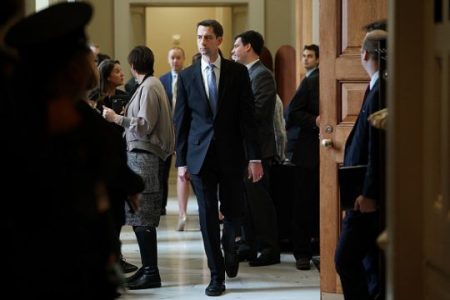
Sen. Tom Cotton (R-AR) leaves the weekly Senate Republican policy luncheon in the U.S. Capitol November 14, 2017 in Washington, DC. (Photo by Chip Somodevilla/Getty Images)
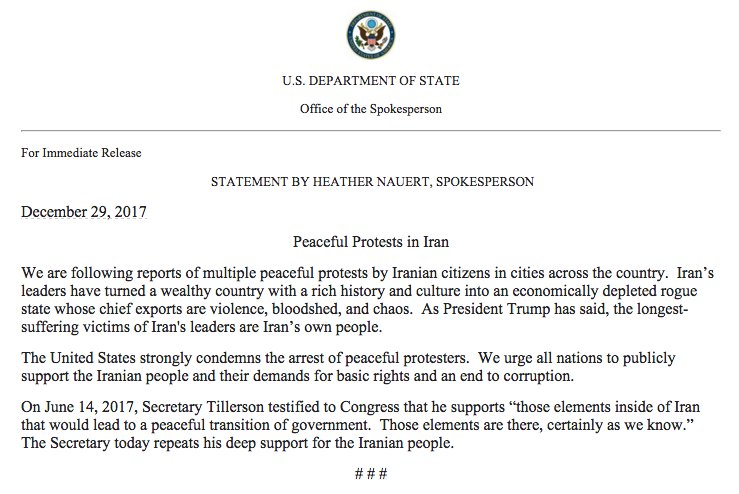
Sen. Tom Cotton (R., Ark.) issued a statement of support Thursday for Iranian citizens protesting the regime, condemning the government’s “hateful ideology” as more committed to regional conflicts than the needs of its people.

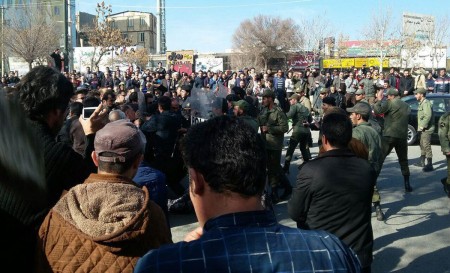
Hundreds of citizens protested Thursday in Mashad, Iran’s second-largest city, over high prices and economic mismanagement. According to Reuters, they shouted slogans like “death to (President Hassan) Rouhani” and “death to the dictator.”

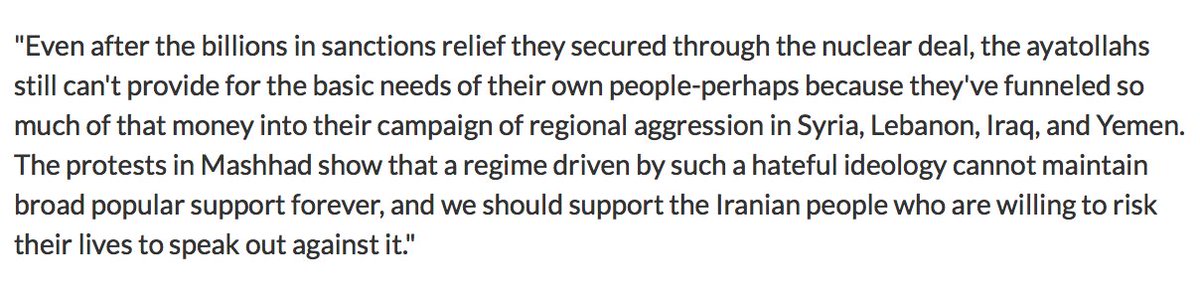
“Even after the billions in sanctions relief they secured through the nuclear deal, the ayatollahs still can’t provide for the basic needs of their own people—perhaps because they’ve funneled so much of that money into their campaign of regional aggression in Syria, Lebanon, Iraq, and Yemen,” Cotton said. “The protests in Mashhad show that a regime driven by such a hateful ideology cannot maintain broad popular support forever, and we should support the Iranian people who are willing to risk their lives to speak out against it.”

View image on Twitter

Cotton is a staunch critic of the Iranian regime and the Iran nuclear deal brokered by the Obama administration. He urged President Donald Trump to decertify Iranian compliance with the deal in October.

Iranians are frustrated with their economic situation and failure to gain benefits from the nuclear agreement, Reuters reported:

Unemployment stood at 12.4 percent in this fiscal year, according to the Statistical Centre of Iran, up 1.4 percent from the previous year. About 3.2 million Iranians are jobless, out of a total population of 80 million.

Some Protesters chanted “leave Syria, think about us,” referring to Iranian troops assisting Bashar al-Assad’s regime in the Syrian civil war.

How Russia is Helping North Korea Build the Bombs that Could Start World War III

December 29, 2017

How Russia is Helping North Korea Build the Bombs that Could Start World War III, Newsweek, December 28, 2017

But the greatest evidence of this Russian-North Korean collaboration is reportedly the similarities observed between features in missiles recently tested by Pyongyang and Soviet-era designs. In June 2016, for example, North Korea tested the Hwasong-10, or Musudan, an intermediate-range ballistic missile, which apparently had distinct similarities to the R-27 Zyb, or Ripple, manufactured by the Makeyev Rocket Design Bureau––including using the same engine. Subsequently, in August 2016, North Korea tested a submarine-launched missile that also had similar features to the Ripple––the Pukguksong-1. Joshua Pollack, an analyst at the James Martin Center for Nonproliferation Studies, told The Washington Post both of these North Korean missiles are “generally regarded as derived from the designs of the Makeyev Bureau’s R-27.”

*********************************

Some of the more advanced missile technology recently put on display for the wider world by North Korea was acquired by the rogue state with the help of Russia, according to new documents acquired by The Washington Post from one of the top Soviet-era missile manufacturers.

In the early 1990s, after the fall of the Soviet Union, U.S. investors reportedly attempted to work with Russian scientists, who were largely unemployed and desperate for money, to acquire advanced Soviet military technology. But the investors ran into a number of legal hurdles, which reportedly provided an opportunity for North Korea to swoop in. Pyongyang was apparently willing to pay some of the scientists, who previously worked for Makeyev Rocket Design Bureau, more than 200 times what they made at home to provide it with Soviet missile designs.

In some cases, some of these Russian scientists were prevented from going to North Korea to provide it with Soviet military technology. But U.S. and South Korean intelligence officials have confirmed that Makeyev scientists ultimately did indeed obtain employment as consultants to North Korea, The Washington Post reported.

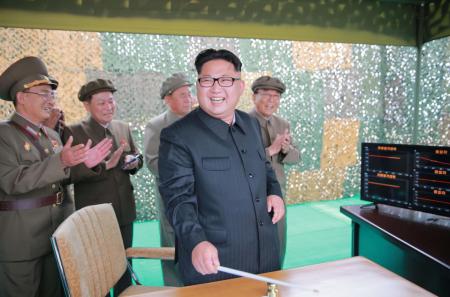
North Korean leader Kim Jong Un attends a Hwasong-10 missile test at an undisclosed location in North Korea on June 13, 2016. GETTY IMAGES

But the greatest evidence of this Russian-North Korean collaboration is reportedly the similarities observed between features in missiles recently tested by Pyongyang and Soviet-era designs. In June 2016, for example, North Korea tested the Hwasong-10, or Musudan, an intermediate-range ballistic missile, which apparently had distinct similarities to the R-27 Zyb, or Ripple, manufactured by the Makeyev Rocket Design Bureau––including using the same engine. Subsequently, in August 2016, North Korea tested a submarine-launched missile that also had similar features to the Ripple––the Pukguksong-1. Joshua Pollack, an analyst at the James Martin Center for Nonproliferation Studies, told The Washington Post both of these North Korean missiles are “generally regarded as derived from the designs of the Makeyev Bureau’s R-27.”

In 2017, North Korea has made major leaps in its missile technology. The reclusive nation tested its most powerful intercontinental ballistic missile yet in late November, which reached an altitude of 2,800 miles (over 10 times higher than the International Space Station) and traveled for 50 minutes before crashing into the Sea of Japan. The more advanced missile technology Pyongyang has put on display over the course of the year could be a sign it has more access to Soviet-era designs and blueprints than previously thought, according to The Washington Post report.

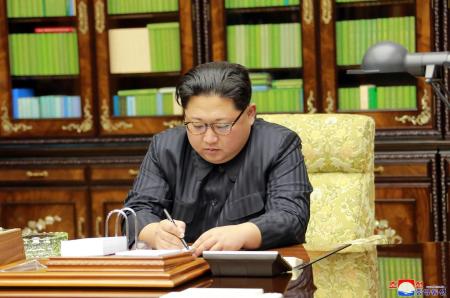
This photo taken on November 28, 2017 and released on November 29, 2017 by North Korea’s official Korean Central News Agency shows North Korean leader Kim Jong-Un signing an order document of a test-fire of an intercontinental ballistic missile, the Hwasong-15. GETTY IMAGES

North Korea’s missile tests and pursuit of a nuclear weapon capable of reaching the United States have led to major tensions across the world over the course of the year. As the United Nations has sought to pressure North Korea to give up on its nuclear ambitions via harsh economic sanctions, President Donald Trump has issued boisterous threats toward Kim Jong Un’s regime––leading some to fear war is on the horizon. Republican Senator Lindsey Graham, who sits on the Senate Armed Services Committee and often plays golf with the president, recently said there’s a 30 percent chance Trump takes military action against North Korea. A strike would have an array of consequences and would almost undoubtedly lead to a response, in some capacity, from China and Russia, who both share a border with North Korea.

North Korea is believed to have as many as 60 nuclear weapons. If war broke out, it could potentially use them on South Korea or Japan and millions could die. A November report from the Congressional Research Service concluded a conflict between the U.S. and North Korea would lead to roughly 300,000 deaths in the first few days alone, even without the use of nuclear weapons.

Iranian Protesters Hit the Streets Against President Rouhani, Ayatollah Khamenei

December 29, 2017

Iranian Protesters Hit the Streets Against President Rouhani, Ayatollah Khamenei, Jewish PressDavid Israel, December 29, 2017

(Please see also The First Anti-American President which, after a brief discussion on the Iran scam, suggests what President Trump should do to get the Iranian people to rebel. Here are the guts of it:

There are many protests in Iran today, and the Khamenei/Rouhani regime has responded by executing half as many Iranians as in the past. We should relentlessly expose this mass murder, and we should publicize the ongoing protests.

The target audience for such exposes is the great mass of the population. Paradoxically, Iranians are better informed about events in Jerusalem and Washington than in Iranian Kurdistan, the southern oil regions, and cities like Mashad and Qom.

All Iranians need this information, which shows them that they are not alone. The technology for such a campaign exists. It is the same as it was when we deployed it against the Soviet Union with such powerful consequences: our broadcasting network, starting with the Voice of America. Today, Farsi-language VOA is often a vehicle for anti-American polemics, since personnel is virtually unchanged from the Obama years. We need a thorough housecleaning, but there are few signs that our national security team understands its urgency.

— DM)

https://www.youtube.com/watch?v=yWuQo27a8CU

Thousands of Iranians in several major cities, including Mashhad, Neyshabur, Shahroud, and Yazd, rallied in the streets on Thursday against poverty, unemployment, and the rising cost of living. They carried signs with the slogans “Death to Rouhani, and Death to the Dictator,” the term “dictator” referring to Supreme Leader Ali Khamenei. The protesters also denounced Iran’s promotion of violence around the Middle East.

The country is holding its breath in anticipation of events on Friday, the Muslim day of rest.

 People chant: “Akhoonds [Mullahs/ Shia clerics] be ashamed, and leave Iran”. Today when a Mullah popped up among crowd of people protesting financial corruptions of Islamic regime authorities in Mashhad, 2nd largest city of Iran
(Video at the link — DM)
 Journalist and author Babak Taghvaee tweeted on Thursday that when a Mullah (Shia cleric) popped up among crowd of people protesting financial corruption of Islamic regime authorities in Mashhad, the second largest city in Iran, people chanted, “Akhoonds (the Mullahs) be ashamed, and leave Iran.”

“Protesters in Iran chant ‘Reza Shah, Bless Your Soul’ – referring to Reza Shah the Great, the founder of the Pahlavi dynasty, the nemesis of the clerics, the modernizer of #Iran,” Taghvaee tweeted, adding, “People of Mashhad shout ‘Islamic revolution was our mistake’ during their protests against corrupted authorities of Iran Islamic regime today.”

According to Taghvaee, calls for peaceful rallies to protest poor living condition and the corruption of the regime can be found in Instagram. Not only in large cities of Iran such as Tehran, Shiraz, Isfahan, and Tabriz, but people in small towns also support people of Mashhad ahead of Friday’s rallies.

According to IranFocus.com, Thursday’s demonstrators pointed to the billions the regime has spent on the war to keep Assad in power, and chanted, “Leave Syria, think about us.”

President Rouhani expected the nuclear deal of 2015 to restore Iran’s economy, as most international sanctions were lifted. But those economic benefits did not trickle down to ordinary Iranians, who believe their desperate economic situation is the result of government corruption and mismanagement.

An estimated 3.2 million Iranians are unemployed, out of a population of 80 million, with unemployment rates rising to 12.4% in 2017.

Iran’s Supreme Leader Ali Khamenei blamed President Trump for Iran’s economic woes. Trump refused to certify that Tehran is complying with its nuclear deal and warned he would eventually terminate the deal. Trump also promised a more aggressive approach to Iran over its nuclear and ballistic missile programs, as well as its spreading terrorism in the Middle East.

Taghvaee tweeted Thursday that Iranian Police completely suppressed the protests in Mashhad people at 4 PM local time. Almost 50 people are arrested and tens of others were slightly injured. No one died.

Merry Christmas from the Iranian mullahs 

December 29, 2017

https://www.youtube.com/watch?v=GV-W_5iTXxM&feature=youtu.be

Published on Dec 29, 2017

Get a load of this: A few days ago, Iran’s foreign minister tweeted “a very happy and peaceful Christmas to all.” I wonder what the Christians jailed this month in Iran would think about that tweet. I wonder what Iranian youth would think about that tweet, but sadly the regime bans Twitter. Except, of course, if you’re a high ranking official. Now imagine praying quietly in your home, surrounded by your family. And all of a sudden, armed thugs burst in and drag you away to prison. They torture you merely for practicing your Christian faith. Welcome to Iran. Saying “Merry Christmas” while jailing Christians in your own country is the height of hypocrisy. If you stand for freedom, share this message. If you stand against hypocrisy, share this message. And above all, say a quiet prayer for our Christian brothers and sisters suffering at the hands of this cruel Iranian regime. We stand with you, brothers and sisters. The world stands with you.