Archive for December 2017

D.C. Transit Cop’s Trial Details Ties Between Neo-Nazism and Islamist Terrorism

December 17, 2017

D.C. Transit Cop’s Trial Details Ties Between Neo-Nazism and Islamist Terrorism, Investigative Project on Terrorism, Abha Shankar, December 17, 2017
Material seized from Young’s home and computer included photos of Young and his associates in Nazi SS uniforms in front of a Nazi flag, a framed photo of Adolf Hitler, a photo of Young’s arm tattoo showing the official insignia of the 9th SS Panzer Division “Hohenstaufen,” a picture of the swastika imposed on an Israeli flag with the caption “The Greatest Devil,” and a cartoon depicting a pig with a giant hooked nose, titled “Jewish swine.” A photo found on Young’s phone showed billowing smokestacks with the caption, “Together we can finish what Hitler started.”

*************************************

ALEXANDRIA, Va. – Jury deliberations begin Monday in the federal terrorism support trial of a former Washington, D.C. Metro Transit Police officer accused of trying to provide support to ISIS.

Nicholas Young could be imprisoned for up to 60 years if convicted of attempting to provide ISIS with material support and lying to federal agents.

The 36-year-old Muslim convert from Fairfax, Va., is the first U.S. police officer to face terrorism charges. Evidence and testimony in his five-day trial showed Young’s unusual affinity for both Nazism and radical Islam.

“Don’t discount an alliance with Muslims to combat the Jews,” Young said after attending a neo-Nazi gathering in 2000, testified college friend, Ian Campbell, an Arlington County police corporal.

Young gave Campbell a copy of Serpent’s Walk, a 1991 novel published by the white supremacist National Alliance. Set nearly 100 years after World War II, it tells a story of SS officers who continued to fight for their cause until they were poised for global dominance. Agents also found a copy in Young’s home.

A Nazi-Muslim alliance occurred during World War II, and prosecutors showed picturesof Jerusalem’s Grand Mufti Amin al-Husseini’s meetings with Adolf Hitler that were found in Young’s house during his August 2016 arrest.

“This is an alliance based on the idea that the enemy of my enemy is my friend,” testified prosecution expert witness Daveed Gartenstein-Ross.

Al-Husseini helped recruit the Bosnian SS division and was the author of Islam in Judaism, which “encouraged violence against Jewish people,” Gartenstein-Ross said.

He explained for jurors the “areas of convergence between Nazism and Islamist militancy.” Things that attract people to neo-Nazism and to militant Islam are similar, and “once you succumb to one of those ideologies, you become more prone to succumbing to the other ideology.” Both totalitarian movements view the world in terms of “good” and “evil” and “share overlapping sets of enemies: the Jewish people and the West more broadly.”

Long before Young met with the government informants, “he represented this alliance,” Assistant U.S. Attorney John Gibbs said in his closing argument.

That’s a key element of the case, since defense attorneys argue Young was entrapped and would not have tried to provide support to ISIS had the informants not been involved.

Material seized from Young’s home and computer included photos of Young and his associates in Nazi SS uniforms in front of a Nazi flag, a framed photo of Adolf Hitler, a photo of Young’s arm tattoo showing the official insignia of the 9th SS Panzer Division “Hohenstaufen,” a picture of the swastika imposed on an Israeli flagwith the caption “The Greatest Devil,” and a cartoon depicting a pig with a giant hooked nose, titled “Jewish swine.” A photo found on Young’s phone showed billowing smokestacks with the caption, “Together we can finish what Hitler started.”

Young’s truck had the license plate “FRI-KRP,” a reference to the Freikorps – volunteer German paramilitary groups that preceded Hitler’s rise. A bumper sticker on the truck read: “Boycott the Terrorist State of Israel.” His prayer list included fascist leaders Adolf Hitler, Benito Mussolini, Saddam Hussein, and Otto Skorzeny. He used an Israeli flag as a doormat in front of his house.

Songs on Young’s iPod included “ISIS Techno Remix” and “Jihad Nasheed [chant].” “He would watch videos all the time” about “the guy talking about the Quran” and “stereotypical terrorist kind of videos” a former roommate, Fairfax County Police Officer Kenneth McNulty testified.

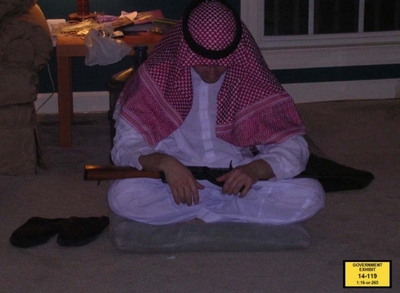
2006 photo shows Young dressed up in Islamic garb holding a gun. Investigators found electronic copies of The Book of Jihad and issues of al-Qaida’s Inspire Magazinedownloaded on the defendant’s computer before he met with an informant who identified himself as Khalil Sullivan in December 2010. Websites bookmarked on Young’s computer from 2009-2010 related to Jew-hatred, Neo-Nazis, Hitler, Osama bin Laden, Anwar al-Awlaki, and other radicals. Agents also found a CD of Awlaki’s lecture series.

Young published pro-ISIS comments on the video sharing website, Liveleak, under the nom de guerre “dusselkamp,” named after SS Stormtrooper Klaus Dusselkamp.

Young collected Nazi paraphernalia and militant Islamist material because he had an interest in European history, defense attorneys said. When he and his friends dressed up in Nazi uniforms and Islamic garb, it was mere “re-enactments” and “cosplay.”

Other evidence showed Young used the encrypted instant messaging app Threema to send Google gift card codes worth $245 to “Mo,” a man Young thought had traveled to Syria to join ISIS. ISIS would use the gift cards to communicate with and recruit more Westerners to join the group.

“Inshallah more cards will come your way. Many sting operations and set ups in the area.” Young wrote.

“Mo,” however, was an FBI source.

Prosecutors described Young as “incredibly paranoid.” He suggested Mo use “burner phones” and “frequently took the battery out of his cell phone” to circumvent surveillance by agents.

Prosecutors also showed images of Young and Mo visiting a FedEx Office store to set up email accounts to communicate with each other after Mo left to join ISIS in Syria. Young used what he believed was Hitler’s birthday to set up his account Essakobayashi@mail.com.

Young traveled to Libya twice in 2011 and associated with rebels attempting to overthrow Muammar Qaddafi. Authorities discovered body armor, a Kevlar helmet, and several other military-style items in Young’s baggage. In one email communication with Mo, Young mentioned serving with the “Abo Salem Suhada Brigade” in Libya, which is a reference to the Abu Salim Martyrs Brigade that has ties to al-Qaida.

Young’s actions disprove the entrapment argument, said Assistant U.S. Attorney John Gibbs. Young “agreed to send the codes without inducement or pressure.” His association with Islamist radicals and convicted terrorists occurred long before government informants Khalil and Mo came on the scene.

Young’s circle of friends included Islamist extremists such as Zachary Chesser, Saleh Al-Barmawi, Farouque Ahmed and Amine El-Khalifi.

Chesser was sentenced to 25 years in prison in 2011 for threatening the writers of the Comedy Central show “South Park” for including a character said to be Islam’s prophet Mohammed dressed in a bear suit to mock radical Muslim reaction. Chesser also tried to support the Somali terrorist group al-Shabaab. Ahmed was sentenced the same year for plotting attacks on D.C.-area metro stations, and Khalifi pleaded guilty in 2012 to plotting a suicide bombing on the U.S. Capitol.

“Those were the circles Nick Young ran in,” Gibbs told jurors. “Young spent a lot of time with them, knew them a lot better” than Khalil and Mo. In fact, it was Young who showed ISIS propaganda videos to Mo, he added.

Khalil Sullivan testified he met Young at a 2010 wedding party, where investigators wanted him to meet with another man under investigation named Saleh Al-Barmawi. Al-Barmawi called for “jihad against Israelis” and said “Israel and America were his enemies,” Sullivan said.

“Mo” also testified that he, Young, and two others would watch “ISIS-propaganda recruiting videos and talk about jihad.” “Go join them,” one of the men, Hicham Hall, told the others. “And that, and talk about being away from…from civilization in a place where you can practice real Islam, you can walk the Hajj, you can have four wives, you can build yourself a masjid, you can fight jihad, you can do it all.” Hall called former Taliban leader Abdullah Mehsud, the “Lion of Khorasan.”

Another of Young’s former roommates, Brian Michael Menzies, remembered speaking with Al-Barmawi at Young’s house and at events sponsored by the Muslim Students Association (MSA). “Nick and Saleh were friends, hung out a lot together,” Menzies said.
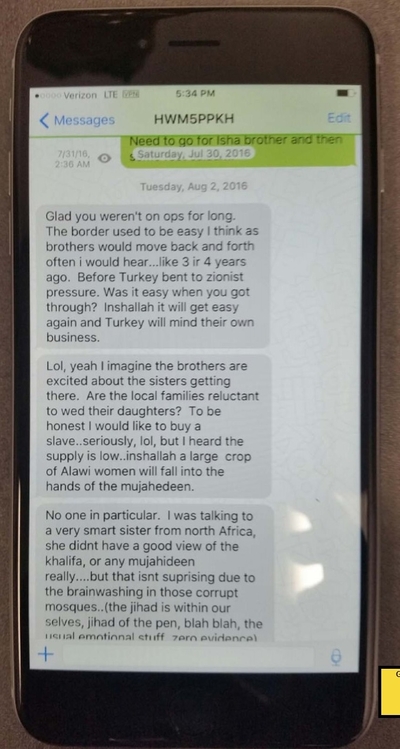
Young also told “Mo” about his desire to obtain a slave: “To be honest, I would like to buy a slave.. seriously, lol, but I hear the supply is low. inshallah a large crop of Alawi women will fall into the hands of the mujahideen.” He called local mosques corrupt because they preached that “the jihad is within ourselves, jihad of the pen, blah blah blah, the usual emotional stuff, zero evidence.”

That attitude is proof of Young’s inherent desire to support ISIS, prosecutors argued. “You can measure someone’s predisposition even from the way they act now. A police officer in Washington, D.C., says I want a slave,” said Assistant U.S. Attorney Gordon Kromberg.

Young also watched “ISIS propaganda videos during his lunch break at work while serving as a police officer,” Gibbs said.

Young’s co-worker, former Metro Transit Police Officer Joanne Dill, testified she was “suspicious of him.”

“He believed in the caliphate and thought it was a good thing for that part of the world.”

In the prosecution’s final argument, Kromberg said Young “yearned being a terrorist, this is who he was, this is who he is.”

How do you say “Kill the Jews” in Swedish?

December 17, 2017

How do you say “Kill the Jews” in Swedish?, Israel National News, Giulio Meotti, December 16, 2017

The most impressive aspect of what happened in Sweden in the past week is not that there are people shouting anti-Semitic slogans, but that the Swedish authorities not only were unable to protect the Jewish minority, but often sided with those who would like to “shoot the Jews”.

******************************

Last weekend, after the just US decision to recognize Jerusalem as the capital of Israel, anti-Jewish slogans were hurled at the American embassy in London and under the Brandenburg Gate in Berlin. But it is in Sweden that anti-Semitism has shown its most chilling face.

Molotov cocktails were launched against a synagogue in Gothenburg, while a group of Jewish boys barricaded themselves in the adjacent Jewish center. A few hours later, Israeli flags were burned in Stockholm. In Malmö, the third largest city in the country, hundreds of people gathered to scream “we will shoot the Jews”. The next day, more Molotov cocktails were thrown at a Jewish chapel in Malmö.

Swedish police increased security around Jewish community buildings after these events that shocked the country. Prime Minister Stefan Lofven has condemned “incitement to violence against Jews”. But the fact is that even Swedish parliamentarians (who defend themselves by saying that they did not understand the slogans in Arabic) took part in a rally in which “death to the Jews” was shouted casts a sinister light on Swedish social democracy.

Jews in Sweden are fearful and Jewish parents are afraid to leave their children at Jewish kindergartens. They are afraid to go to the synagogue and there are many people who are puttig away their Stars of David because they are too afraid to wear them. Expressing public support for Israel can be dangerous, but the police do not always provide adequate protection for pro-Israel events. During a demonstration in Malmö, the small crowd of supporters of Israel was forced to abandon the event after the police were unable to prevent thousands of Palestinian supporters from attacking and rushing toward the group.

Following the attack in Gothenburg, some observers, including the Simon Wiesenthal Center, linked the incidents to the Swedish government’s hostile attitude towards Israel. In 2014, Sweden became the first member state of the European Union to recognize the “State of Palestine”. More recently, Foreign Minister Margot Wallström was criticized by Israel for suggesting that the motivation of the terrorist attacks in Paris, during which Islamic terrorists killed 130 people, stemmed from the frustration of the Palestinians. Hanif Bali, a member of parliament for the Moderate Party, the largest opposition party, received a myriad of hate letters because of his open support for Israel.

A few years ago, the Wall Street Journal published an article entitled “Eurabia is a place in Sweden”. And it will only become worse. In recent days, the Pew Forum explained that, depending on migratory flows, Sweden will have between a 20 to 30 percent Islamic population within thirty years. In that scenario, the slogan “Itbah al Yahud” (slaughter the Jew) is likely to become a soundtrack in the clumsy Scandinavian social democracy.

The most impressive aspect of what happened in Sweden in the past week is not that there are people shouting anti-Semitic slogans, but that the Swedish authorities not only were unable to protect the Jewish minority, but often sided with those who would like to “shoot the Jews”.

Austrian government’s platform refers to Israel as Jewish state for first time

December 17, 2017

Austrian government’s platform refers to Israel as Jewish state for first time, Israel Hayom, Eldad Beck and Israel Hayom Staff, December 17, 2017

(Please see also, Austria: New Government to Resist “Islamization”. DM)

Austrian Prime Minister Sebastian Kurz | Photo: GettyImages

The move by Kurz’s nationalistic Freedom Party to include these points in the new government’s platform indicates its new policy with respect to Israel and Austria’s Nazi past.

********************************

The new Austrian government, headed by conservative Prime Minister Sebastian Kurz, has, for the first time, included a clear reference to Israel’s Jewish character in its new platform.

The platform also states Austria’s commitment to the Israeli-Palestinian peace process based on the two-state solution, with aim of meeting Israel’s security needs while establishing a viable Palestinian state.

So far, Germany has been the only European nation whose government, under Chancellor Angela Merkel, has recognized Israel’s Jewish character.

The new government’s platform also includes explicit references recognizing Austria’s culpability in the Holocaust. This, too, is a political precedent, as the government has pledged to officially commemorate the 80th anniversary of the Anschluss, the annexation of Austria to the Nazi Reich, which takes place next year, and the Holocaust, as “one of the greatest tragedies in human history.”

The move by Kurz’s nationalistic Freedom Party to include these points in the new government’s platform indicates its new policy with respect to Israel and Austria’s Nazi past.

Austria: New Government to Resist “Islamization”

December 17, 2017

Austria: New Government to Resist “Islamization”, Gatestone InstituteSoeren Kern, December 17, 2017

Austria has emerged as a major base for radical Islam. Austria’s Agency for State Protection and Counterterrorism (BVT) has warned of the “exploding radicalization of the Salafist scene in Austria.” Salafism is an anti-Western ideology that seeks to impose Islamic Sharia law.

“The immigration seen in recent years is changing our country not in a positive but in a negative way,” said Kurz, who campaigned on a “law and order” platform: “Uncontrolled immigration destroys the order in a country.”

Strache, a supporter of Israel who has distanced his party from the rhetoric of the Austrian far right, insists that anti-Semitism had no place in his party and has urged a common front against Islamists. He has also pledged “to ensure that boycotts [against Israeli products] get taken off the agenda.”

During an April 2016 visit to the Yad Vashem Holocaust memorial in Jerusalem, at the invitation of at the invitation of Israeli Prime Minister Benjamin Netanyahu’s Likud party, Strache said:

“For us, it’s important to act against anti-Semitism, and also against Islamism and terrorism, and to discuss the issues we have in common. Anti-Semitism often emerges anew from Islamism and from the left.

“We have a lot in common [with Israel]. I always say, if one defines the Judeo-Christian West, then Israel represents a kind of border. If Israel fails, Europe fails. And if Europe fails, Israel fails.”

Strache has called Merkel “the most dangerous woman in Europe” because of her migration policies, and has repeatedly said that Islam is “not part” of Austria. Strache has also warned that the “uncontrolled influx of migrants who are alien to our culture, who seep into our social welfare system … makes civil war in the medium-term not unlikely.” A Eurosceptic, Strache has called the European Union a “bureaucratic monster” and has said that Britain will “probably be better off after Brexit.”

***********************************

A coalition between the anti-immigration Austrian People’s Party and the anti-establishment Austrian Freedom Party, which will be sworn into office on December 18, is poised to catapult Austria to the vanguard of Western Europe’s resistance to mass migration from the Muslim world.

The massive demographic and religious shift underway in Austria, traditionally a Roman Catholic country, appears irreversible. Austria has also emerged as a major base for radical Islam.

“We have a lot in common [with Israel]. I always say, if one defines the Judeo-Christian West, then Israel represents a kind of border. If Israel fails, Europe fails. And if Europe fails, Israel fails.” — Heinz-Christian Strache, leader of the Austrian Freedom Party.

The anti-immigration Austrian People’s Party and the anti-establishment Austrian Freedom Party have reached a deal, creating a new coalition to govern Austria for the next five years. The ground-breaking political alliance, which will be sworn into office on December 18, is poised to catapult Austria to the vanguard of Western Europe’s resistance to mass migration from the Muslim world.

Chancellor-elect Sebastian Kurz, 31, who won Austria’s national election on October 15 after campaigning on a promise to halt illegal immigration, will govern with Heinz-Christian Strache, 48, the Freedom Party leader, who has warned that mass migration is “Islamizing” Austria. Under the agreement, Strache will become the vice-chancellor; the Freedom Party will also take control of the ministries of defense, interior and foreign affairs.

Austrian Chancellor-elect Sebastian Kurz (pictured), who won Austria’s national election after campaigning on a promise to halt illegal immigration, will govern with Heinz-Christian Strache, 48, the Freedom Party leader, who has warned that mass migration is “Islamizing” Austria. (Image source: Raul Mee/EU2017EE/Flickr)

Kurz has been a strong critic of German Chancellor Angela Merkel’s open-door migration policy, which has allowed more than a million mostly male migrants from Africa, Asia and the Middle East to enter the country during the past two years.

During his time as foreign minister, Kurz was instrumental in garnering parliamentary approval of a groundbreaking new law that regulates the integration of immigrants. The so-called Integration Law — which bans full-face Muslim veils in public spaces and prohibits Islamic radicals from distributing the Koran — establishes clear rules and responsibilities for recognized asylum seekers and refugees granted legal residence in the country.

The new law requires immigrants from non-EU countries to sign an “integration contract” which obligates them to learn written and spoken German and to enroll in courses about the “basic values of Austria’s legal and social order.” Immigrants are also required to “acquire knowledge of the democratic order and the basic principles derived from it.”

Previously, Kurz was instrumental in reforming Austria’s century-old Islam Law (Islamgesetz), governing the status of Muslims in the country. The new law, passed in February 2015, is aimed at integrating Muslims and fighting Islamic radicalism by promoting an “Islam with an Austrian character.” It also stresses that Austrian law must take precedence over Islamic Sharia law for Muslims living in the country.

Austria’s Muslim population now exceeds 700,000 (or roughly 8% of the total population), up from an estimated 340,000 (or 4.25%) in 2001, and 150,000 (or 2%) in 1990, according to data compiled by the University of Vienna.

The massive demographic and religious shift underway in Austria, traditionally a Roman Catholic country, appears irreversible. In Vienna, where the Muslim population now exceeds 12.5%, Muslim students already outnumber Catholic students at middle and secondary schools. Muslim students are also on the verge of overtaking Catholics in Viennese elementary schools.

At the same time, Austria has emerged as a major base for radical Islam. Austria’s Agency for State Protection and Counterterrorism (BVT) has warned of the “exploding radicalization of the Salafist scene in Austria.” Salafism is an anti-Western ideology that seeks to impose Islamic Sharia law.

“The immigration seen in recent years is changing our country not in a positive but in a negative way,” said Kurz, who campaigned on a “law and order” platform: “Uncontrolled immigration destroys the order in a country.”

Strache, a supporter of Israel who has distanced his party from the rhetoric of the Austrian far right, insists that anti-Semitism had no place in his party and has urged a common front against Islamists. He has also pledged “to ensure that boycotts [against Israeli products] get taken off the agenda.”

During an April 2016 visit to the Yad Vashem Holocaust memorial in Jerusalem, at the invitation of at the invitation of Israeli Prime Minister Benjamin Netanyahu’s Likud party, Strache said:

“For us, it’s important to act against anti-Semitism, and also against Islamism and terrorism, and to discuss the issues we have in common. Anti-Semitism often emerges anew from Islamism and from the left.

“We have a lot in common [with Israel]. I always say, if one defines the Judeo-Christian West, then Israel represents a kind of border. If Israel fails, Europe fails. And if Europe fails, Israel fails.”

Strache has called Merkel “the most dangerous woman in Europe” because of her migration policies, and has repeatedly said that Islam is “not part” of Austria. Strache has also warned that the “uncontrolled influx of migrants who are alien to our culture, who seep into our social welfare system … makes civil war in the medium-term not unlikely.” A Eurosceptic, Strache has called the European Union a “bureaucratic monster” and has said that Britain will “probably be better off after Brexit.”

At Strache’s insistence, Karin Kneissl, an independent Middle East expert who speaks eight languages, including Arabic and Hebrew, will become Austria’s new foreign minister. Kneissl has been a vocal critic of EU Commission President Jean-Claude Juncker, whom she has described as the “Caesar of Brussels.” She has also criticized Merkel’s migrant policy as “grossly negligent.”

Kneissl has said that most of the “refugees” arriving in Europe are overwhelmingly young males between the ages of 20 and 30 who are “economic migrants controlled by testosterone.” In an interview on Austrian television, Kneissl said that one of the main reasons for the revolts in the Arab world was “many young Arab men can no longer find a wife because they have neither work nor their own home, and thus cannot achieve the status of a man in a traditional society.”

Freedom Party Chairman Herbert Kickl, a speechwriter for the late party leader Jörg Haider and a close confidant of Strache, will become interior minister, a key position for domestic security and border control, while Mario Kunasek, a professional soldier, will run the defense ministry. Of the 16 future government ministers, only Kurz has Cabinet experience.

A 180-page document explains the new government’s agenda between now and 2022. It promises to crack down on political Islam; to crack down on illegal immigration; to speed up asylum decisions and to sponsor an EU summit on immigration when Austria holds the EU presidency in the second half of 2018.

The document also pledges to give Austrians more opportunities to vote in referendums — although it explicitly refuses to allow a referendum on the country’s continued membership in the European Union.

In addition, the document promises to: require migrants to learn German; require migrant kindergartners who have insufficient German language skills to repeat kindergarten before progressing to the first grade; increase the legal penalties for sexual crimes; strengthen Austrian defense; hire more police officers; reduce the bureaucracy and not raise taxes.

At the same time, however, the document pledges a strong commitment to the European Union: “Only in a strong Europe can there be a strong Austria in which we are able to take advantage of the opportunities of the 21st century.”

Some observers have said that Kurz’s professed commitment to the European Union was aimed at calming worries in Europe about the Freedom Party’s Euroskeptic and anti-Islamization policy objectives. Others have described Kurz as a pragmatist “who is anti-establishment and establishment at the same time.”

Kurz has nevertheless pledged to reject the European Union’s compulsory migrant quota. “I will work towards changing this erroneous refugee policy,” he said. “Without the proper protection of the external borders of the EU, we will not come to grips with the problem of illegal migration.”

Soeren Kern is a Senior Fellow at the New York-based Gatestone Institute.

Multiculturalists Working to Undermine Western Civilization

December 16, 2017

Multiculturalists Working to Undermine Western Civilization, Gatestone InstitutePhilip Carl Salzman, December 16, 2017

Postcolonialism holds that peoples across the globe all got along with each other comfortably and peacefully until Western imperialists invaded, divided, conquered, exploited and oppressed them. Unlike postmodernism, which sees Western culture as no better than other cultures, postcolonialism considers Western culture inferior to other cultures.

If Western civilization is to survive this defamation, it would do well to remind people of its historical accomplishments: its humanism and morality derived from Judeo-Christian traditions; its Enlightenment thought; its technological revolutions; the agricultural and industrial revolutions of the 18th century, and the digital revolution of the 20th century; its political evolution into full democracy; the separation of church and judiciary from state; its commitment to human rights and most of all its gravely threatened freedom of speech. Around the world, all advanced societies have borrowed many features of Western culture; they could hardly be called advanced if they had not. Much of what is good in the world is thanks only to Western civilization. It is critical not to throw it out or lose it.

***************************************

Unlike postmodernism, which sees Western culture as no better than other cultures, postcolonialism considers Western culture inferior to other cultures.

Rather than enhancing Western culture through the enrichment different ethnic and religious groups provide in countries with a Judeo-Christian foundation, multiculturalists have actually been rejecting their own Western culture.

The West, even flawed, has nevertheless afforded more freedoms and prosperity to more people than ever before in history. If Western civilization is to survive this defamation, it would do well to remind people its historical accomplishments: its humanism and morality derived from Judeo-Christian traditions; its Enlightenment thought; its technological revolutions; its political evolution into full democracy; the separation of church from state; its commitment to human rights and most of all its gravely threatened freedom of speech. Much of what is good in the world is thanks only to Western civilization. It is critical not to throw it out or lose it.

For the past decade, many in the West have been honing a historically unprecedented narrative — one that not only renounces the culture they have inherited but that denies its very existence. A few examples:

During a press conference in Strasbourg in 2009, for instance, then-President Barack Obama began by downplaying the uniqueness of the United States. “I believe in American exceptionalism, just as I suspect that the Brits believe in British exceptionalism and the Greeks believe in Greek exceptionalism.”

In addition, in 2010, Mona Ingeborg Sahlin, the leader at that time of the Swedish Social Democratic Party, told a gathering of the Turkish youth organization Euroturk:

“I cannot figure out what Swedish culture is. I think that’s what makes many Swedes jealous of immigrant groups. You [immigrants] have a culture, an identity, a history, something that brings you together. And what do we have? We have Midsummer’s Eve and such silly things.”

In October 2015, Ingrid Lomfors, head of the Swedish governmental “Forum for Living History,” later told a group officials, “There is no native Swedish culture.”

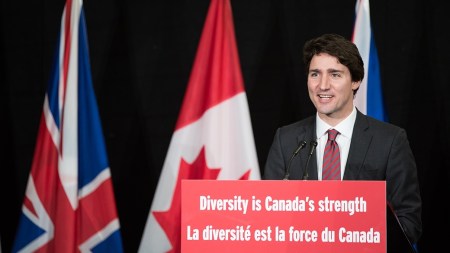
In November 2015, the newly sworn-in Canadian President, Justin Trudeau, gave an interview to the New York Times, and published a month later, in which he said:

“There is no core identity, no mainstream in Canada. There are shared values — openness, respect, compassion, willingness to work hard, to be there for each other, to search for equality and justice. Those qualities are what make us the first postnational state.”

In 2015, Canadian President Justin Trudeau said, “There is no core identity, no mainstream in Canada. There are shared values — openness, respect, compassion, willingness to work hard, to be there for each other, to search for equality and justice. Those qualities are what make us the first postnational state.” (Image source: Canadian PM’s Office)

In December 2015, Former Swedish Prime Minister Fredrik Reinfeldt, president of the European Council in 2009, gave an interview to TV4 ahead of his departure from the leadership of the Moderate Party, in which he asked rhetorically:

“Is this a country that is owned by those who have lived here for three or four generations or is Sweden what people who come here in mid-life makes it to be?… For me it is obvious that it should be the latter and that it is a stronger and better society if it may be open… Swedes are uninteresting as an ethnic group.”

Notably, such statements emanated from leaders in the United States, Sweden and Canada — countries with distinct literature, music, art and cuisine, as well as distinct judicial and governmental systems. What the views of the five leaders have in common, however, are a postmodern ideology and a need for minority and immigrant votes.

Postmodernism has two key elements: cultural relativism and postcolonialism. Cultural relativism — developed by American anthropologist Ruth Benedict, author of the 1934 worldwide best-seller Patterns of Culture, and her mentor, the “father of American anthropology,” Franz Boas — posited that researchers must set aside their own cultural values and biases, and maintain an open mind about those of other peoples’ cultures, in order to understand them. In the second half of the 20th century, anthropological theorists extended this to the field of ethics, arguing that judgements arising from one culture could not be applied to others — thereby rendering all cultures equally good and valuable. This view led the American Anthropological Association in 1947 to reject the Declaration on the Rights of Man, which became the U.N. Universal Declaration of Human Rights, prepared in 1947 by the Commission on Human Rights of the United Nations.

Postcolonialism holds that peoples across the globe all got along with each other comfortably and peacefully until Western imperialists invaded, divided, conquered, exploited and oppressed them. Unlike postmodernism, which sees Western culture as no better than other cultures, postcolonialism considers Western culture inferior to other cultures.

Three factors appear to underlie this repudiation of Western culture: guilt, globalization and demography. Many Western societies — such as Britain, France, Belgium, Holland, Spain, Portugal and Italy — had empires in the South and East between the 17th and 20th centuries. Today, however, those past conquests are deemed evil by the very countries that engaged in them, and are also viewed negatively by non-imperial nations, such as Sweden and Canada, itself a Western colony. Germany, a late and marginal imperial power, seems still guilt-ridden over the Holocaust. Ironically, admitting countless newcomers to Europe as if they were the “new Jewish refugees” of this century has caused the second flight of Jews.

The guilt does not end there. Western countries are affluent, with most of their citizens enjoying at least a comfortable standard of living, while vast populations in Africa and Asia live in poverty. Many Westerners thus feel that redemption is required — in the form of financial aid to ex-colonies, and in the unfettered entry of migrants and refugees from those areas into Western countries.

Meanwhile, economic globalization has led to Western countries having customers and investors around the world, from a wide range of disparate cultures, but Western triumphalism is viewed as ill-suited to productive business relations.

Where demography is concerned, the last decades have seen an increase in the flow of populations, occasioned in part by the low birthrate in the West — with many far below replacement level. That, in turn, has highlighted the need for labor to sustain, if not grow, economies. The result is that the population in every Western country has become more ethnically, religiously and culturally mixed. To be welcoming to immigrants, and to aid in their integration into, and solidarity with, their new societies, Western countries have encouraged a multicultural openness while downplaying the particularity of their own cultures.

This brings us to elections: Politicians in Western democracies seeking election often downplay their own cultures to garner immigrant and minority votes. The larger the immigrant communities are, the stronger the incentive to curry favor with them. Some growing minority groups, such as Muslims in Europe, are now forming their own political parties to compete with traditional ones.

This marriage of postmodernism and electoral politics is having a terrible effect on societies that pride themselves on openness and diversity. Rather than enhancing Western culture through the enrichment different ethnic and religious groups provide in countries with a Judeo-Christian foundation, multiculturalists have actually been rejecting their own Western culture. While they encourage diversity of race, religion, and heritage, they forbid diversity of opinions, particularly those that do not conform to the postmodern narrative that rejects that the West. They also seem not to want to acknowledge that the West, even flawed, has nevertheless afforded more freedoms and prosperity to more people than ever before in history.

This skewed view of the West is only possible if one stubbornly refuses to see who, historically, the real colonizers were. How do they think virtually all of the Middle East and North Africa and the Middle East became Muslim — through a democratic referendum? Muslims invaded and transformed the Christian Byzantine Empire, now an increasingly Islamized Turkey; Greece; the Middle East, North Africa, the Balkans; Hungary; northern Cyprus and Spain.

If Western civilization is to survive this defamation, it would do well to remind people of its historical accomplishments: its humanism and morality derived from Judeo-Christian traditions; its Enlightenment thought; its technological revolutions; the agricultural and industrial revolutions of the 18th century, and the digital revolution of the 20th century; its political evolution into full democracy; the separation of church and judiciary from state; its commitment to human rights and most of all its gravely threatened freedom of speech. Around the world, all advanced societies have borrowed many features of Western culture; they could hardly be called advanced if they had not. Much of what is good in the world is thanks only to Western civilization. It is critical not to throw it out or lose it.

Philip Carl Salzman is professor of anthropology at McGill University, Middle East Forum Fellow, and Frontier Centre Senior Fellow.

Arab world taken by storm by Saudi arrest of top Palestinian-Jordanian banke[r]

December 16, 2017

Arab world taken by storm by Saudi arrest of top Palestinian-Jordanian banke[r], DEBKAfile, December 16, 2017

(Please see also, Palestinian claims to Jerusalem lose Saudi as well as US support. — DM)

Saudi Crown Prince Muhammed bin Salman (MbS) suddenly detained the Palestinian-Jordanian billionaire businessman Sabih al-Masri, aged 80, who has majority holdings in the Palestinian territories, Jordan and Saudi Arabia. His detention could impact on major economic interests in all three. DEBKAfile reveals that the Saudi and UAE rulers demanded that Palestinian leader Mahmoud Abbas present himself at once in Riyadh.  MbS acted after his warning to Abbas and King Abdullah to stay away from Erdogan’s Islamic conference in Istanbul, for launching a campaign against Donald Trump’s recognition of Jerusalem as Israel’s capital, was not heeded. (Emphasis added — DM)

Palestinian claims to Jerusalem lose Saudi as well as US support

December 16, 2017

Palestinian claims to Jerusalem lose Saudi as well as US support, DEBKAfile, December 16, 2017

Abbas (Abu Mazen) paid an urgent visit to Riyadh to meet Prince Muhammed. Since then, a continuous stream of tidbits is emanating from their conversation. According to one report, the Saudi prince put before the Palestinian leader an American-Saudi blueprint. It proclaims Abu Dis, a village located on the fringes of east Jerusalem, as the capital of the future Palestinian state. That state would have limited sovereignty in parts of the West Bank, while all the Jewish communities would remain in place. East Jerusalem would not be declared its capital; and the Palestinian refugees’ “right of return” was dropped, as was mention of the pre-1967 boundaries.

***************************************

The Palestinians have three major grievances with the Trump administration on Jerusalem, but are most irked by Saudi backing for the Trump peace plan.

Palestine rage over President Donald Trump Jerusalem decisions was further fueled Friday, Dec. 17 by the comment from Washington: “We cannot envision any situation under which the Western Wall would not be part of Israel. But, as the president said, the specific boundaries of sovereignty of Israel are going to be part of the final status agreement.”   It came with the announcement that Vice President Mike Pence will pay a visit to the Western Wall next Wednesday’ Dec. 20, during his Middle East tour.

Not too long ago, President Trump himself visited the Western wall on May 22. But then, American security officers excluded their Israeli counterparts from safeguarding the visit, claiming it took place outside Israeli territory. border. Eight months later, Trump has restored Israel’s sovereignty to the Western Wall, which encloses the hallowed compound of  the last Jewish Temple, in time for his vice president to pray there.

For the Palestinians, this is another Trump-administration shift in Israel’s favor and its consequent loss of credibility as an honest broker for the Palestinian-Israeli dispute. The Palestinian Authority in Ramallah reiterated this position Saturday, after announcing a boycott of the Pence visit and severing contact with Washington – a position they can’t really afford to sustain for long.

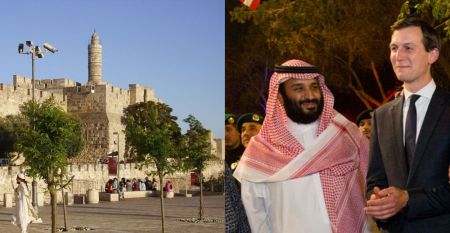
But what is really irking them even more than the Trump administration’s pro-Israeli stance on Jerusalem is its endorsement by their longstanding champion, Riyadh. The impression gaining ground in recent weeks is that Trump’s son-in-law Jared Kushner has reached an understanding with Saudi Crown Prince Muhammed bin Salman (MbS) on a new plan for resolving the Israeli-Arab conflict, which departs fundamentally from the traditional core issues that scuttled all past peace processes.

The first inkling of such a plan came on the pages of the The New York Times of Nov. 11, under the title “Trump Team Begins Drafting Middle East Peace Plan.” This plan was described as pushing ahead on the fast track due to three factors:

  1. Its support by the Saudi crown prince and Egyptian President Abdel-Fatteh El-Sisi.
  2. The uncertainty of Prime Minister Binyamin Netanyahu’s future in the face of long-running police probes against him.
  3. The constant erosion of Mahmoud Abbas’ standing as Palestinian Authority Chairman, whose rapidly diminishing popularity, due to his advanced age of 82 and the corruption rife in Ramallah, is reflected in the latest Palestinian opinion poll on Dec. 7-10. (70 percent want him to retire: 84 percent on the West Bank and 26 percent in the Gaza Strip).

Washington has therefore chosen a moment of leadership weakness to push ahead with its plans to resolve the Israeli-Palestinian dispute.

A week before the NYT report, Abbas (Abu Mazen) paid an urgent visit to Riyadh to meet Prince Muhammed. Since then, a continuous stream of tidbits is emanating from their conversation. According to one report, the Saudi prince put before the Palestinian leader an American-Saudi blueprint. It proclaims Abu Dis, a village located on the fringes of east Jerusalem, as the capital of the future Palestinian state. That state would have limited sovereignty in parts of the West Bank, while all the Jewish communities would remain in place. East Jerusalem would not be declared its capital; and the Palestinian refugees’ “right of return” was dropped, as was mention of the pre-1967 boundaries.

Notwithstanding flat Palestinian denials of all these reports, they continue to gain ground and credence. The picture emerging from the Saudi prince’s conversation with Abu Mazen is taking shape as underlining the following points:

  • The old Saudi-Arab League peace plan of 2003 is a dead letter;
  • Riyadh has dropped its demand that Israel accept a Palestinian State with East Jerusalem as its capital;
  • Since the original Saudi Peace proposal which the prince called Plan A was dead, it is necessary to move forward to Plan B.
  • Plan B is essentially as follows: The State of Palestine would be established in the Gaza Strip plus large tracts of territory to be annexed from northern Sinai. Egypt has agreed to this outline. This deal would essentially render irrelevant the Palestinian demand to restore the pre-1967 boundaries for their state.
  • When Abu Mazen asked what would happen to the West Bank, MbS reportedly replied: “We can continue to negotiate about this.”
  • And when he pressed further: What about Jerusalem, the settlements, Areas B and C, the answer was: “These will be issues for negotiation between two states, and we will help you.”

These reports are furiously denied by Palestinian officials and, although no other official source, including Prince Muhammad, has verified them, they continue to abound. The Palestinians now have three major grievances against the Trump administration for which they are cutting off ties with Washington in protest:  Recognition of Jerusalem as Israel’s capital, the promise to move the US embassy from Tel Aviv to Jerusalem and, now, the declaration of the Western Wall as part of Israel in any political solution. This will be underlined by the Pence visit. Yet neither Washington nor Riyadh shows any sign of backtracking on their far-reaching plan which defies all former conventions.

Abu Mazen is in a jam. Even if he tries to distance himself from Washington, he cannot possibly divorce the Palestinians from the two leading Arab nations, Saudi Arabia and Egypt, which would lop off the branches of the Arab tree on which they sit. Doing so might well thrust Ramallah on the path of the anti-West Turkish-Iranian-Hizballah axis and its extremist ideology. There are early signs that his rivals in Gaza, the radical Hamas, may be adopting this path. After Friday prayers in the mosques of Gaza, on Dec. 15, some of the demonstrators at the Israel border force were seen for the first time holding aloft huge placards with depictions of Gen. Qassem Soleimani, Commander of Iranian Revolutionary Guards Al Qods. If Iran can gain solid inroads into the Palestinian community at large, its dispute with Israel would assume an entirely new dimension.

Cartoons and Video of the Day

December 16, 2017

LatmaTV via YouTube


H/t Power Line


Tillerson Walks Back Offer of Unconditional Talks With North Korea, Says Regime ‘Must Earn Its Way Back to the Table’

December 16, 2017

Tillerson Walks Back Offer of Unconditional Talks With North Korea, Says Regime ‘Must Earn Its Way Back to the Table’, Washington Free Beacon, December 15, 2017


Secretary of State Rex Tillerson on Friday walked back his offer from earlier this week to have unconditional talks with North Korea, telling the United Nations Security Council that Pyongyang must “earn” the right to negotiate with Washington.

“As I said earlier this week, a sustained cessation of North Korea’s threatening behavior must occur before talks can begin. North Korea must earn its way back to the table,” Tillerson said at a special ministerial meeting at the U.N. Security Council. “The pressure campaign must and will continue until denuclearization is achieved. We will in the meantime keep our channels of communication open.”

Tillerson’s words were a noticeable shift from Tuesday, when he said at the Atlantic Council in Washington, D.C. that the U.S. is “ready to have the first meeting without precondition.”

“Let’s just meet, and we can talk about the weather if you want,” Tillerson said at the think-tank event. “Talk about whether it’s going to be a square table or a round table, if that’s what you are excited about. But can we at least sit down and see each other face to face, and then we can begin to lay out a map, a road map of what we might be willing to work towards.”

Those comments received instant blowback from the White House.

Tillerson also reemphasized on Friday that the U.S. wants a diplomatic solution to the North Korean issue rather than a military one.

“We have been clear that all options remain on the table in the defense of our nation, but we do not seek nor do we want war with North Korea,” Tillerson said. “The United States will use all necessary measures to defend itself against North Korea aggression, but our hope remains that diplomacy will produce a resolution.”

America’s top diplomat said that North Korea remains the “greatest national security threat” to the U.S. and called on China and Russia to put greater pressure on Pyongyang.

“Upon taking office, President Trump identified North Korea as the United States’ greatest national security threat,” Tillerson said. “That judgment remains the same today.”

“Each U.N. member state must fully implement all existing U.N. Security Council resolutions,” Tillerson added. “For those nations who have not done so or who have been slow to enforce Security Council resolutions, your hesitation calls into question whether your vote is a commitment to words only, but not actions.”

Tillerson specifically called out Russia and China for cooperating with the North Korean regime.

“We particularly call on Russia and China to increase pressure, including going beyond full implementation of the U.N. Security Council resolutions,” Tillerson said. “Continuing to allow North Korean laborers to toil in slave-like conditions inside Russia in exchange for wages used to fund nuclear weapons programs calls into question Russia’s dedication as a partner for peace.”

“Similarly, as Chinese crude oil flows to North Korean refineries, the United States questions China’s commitment to solving an issue that has serious implications for the security of its own citizens,” he said.

Trump Has Made Our Government More Moral

December 16, 2017

Trump Has Made Our Government More Moral, PJ Media, Andrew Klavan, December 15, 2017

Melania_trump_and_seventies-feminists_banner_7-19-16

Trump has delivered conservatives an astoundingly successful year and made the government more moral in the process. You don’t have to like him, to salute him. I salute him. Well done.

***********************************

Here is a funny thing about the human mind: when we didn’t see something coming, we often can’t see it came. There’s a good reason for this. Wrong predictions are an indication that there is something off or unrealistic about your worldview. When your predictions are vastly incorrect, you have to choose: will I paper over my mistakes and pretend to myself I was actually right in some way, or will I admit the error and adjust the way I look at life?

People almost never adjust the way they look at life. It would mean risking their sense of their own wisdom and virtue.

This is why so many pundits both on the left and right are completely blind to what happened this year in politics.

Donald Trump — a political neophyte, a New York loudmouth who plays fast and loose with the truth, a massive egotist and a not altogether pleasant human being — has delivered conservatives one of the greatest years in living memory and has made our government more moral in the process. The left and many on the right didn’t see it coming because they hate the man. And because they didn’t see it coming, they won’t see that it’s come.

The first assertion is easily proven. After a year of Trump, the economy is in high gear, stocks are up, unemployment is down, energy production is up, business expansion is up and so on; ISIS — which took more than 23,000 square miles of territory after Obama left Iraq and refused to intervene in Syria — is now in control of a Port-o-San and a book of matches; 19 constitutionalist judges have been appointed and 40 more nominated; the biggest regulatory rollback in American history has been launched (boring but yugely important); the rule of law has been re-established at the border; we’re out of the absurd and costly Paris Accord; net neutrality, the most cleverly named government power grab ever, is gone; our foreign policy is righted and revitalized; and a mainstream news media that had become little more than the information arm of the Democratic Party is in self-destructive disarray. If the tax bill passes before Christmas, it will cap an unbelievable string of conservative successes.

Now you can tie yourself in knots explaining why none of this is Trump’s doing or how it’s all just a big accident or the result of cynical motives or whatever. Knock yourself out, cutes. For me, I’ll say this. I hated Trump. I thought he’d be a disaster or, at best, a mediocrity. I was wrong. He’s done an unbelievably great job so far.

But even more important is my second assertion. Our government is more moral now. How is this possible when Trump has sex with Vladimir Putin disguised as a Russian prostitute, when he kills and eats black people in his spare time, when he hates women and goes into insane temper tantrums fueled by 48 cans of Diet Coke a day? Okay, even leaving Maggie Haberman’s fantasy life aside, Trump is not always statesman-like, not always nice to people and not always strictly honest.

But Trump’s outsized New York personality and the feeling it evokes in us only obscure what he has done to the government he leads. As Aristotle knew, a thing can only be good if it fulfills its purpose. What is the moral purpose of government? We know the answer because our Founders told us in no uncertain terms.

“We hold these truths to be self-evident, that all men are created equal, that they are endowed by their Creator with certain unalienable Rights, that among these are Life, Liberty and the pursuit of Happiness. — That to secure these rights, Governments are instituted among Men…”

That’s right. Government does not exist to make us equal, but to treat us equally. It does not exist to make life fair, but to treat us fairly. Most importantly, it exists to secure our rights to life, liberty and the pursuit of happiness. Only in liberty can we treat each other ethically, because only in liberty can we make the choices that are the necessary condition for ethical life.

Trump has made our government more moral by making less of it: fewer regulations, fewer judges who will write law instead of obeying the law, fewer bureaucrats seeking to expand the power of their agencies, less money for the government to spend on itself. He has made government treat us more fairly and equally by ceasing to use the IRS and Justice Department for political ends like silencing enemies and skewing elections.

This is what moral government looks like. And if every male senator in America is grabbing the buttocks of some unsuspecting female while, at the same time, voting for more limited and less corrupt government, the senators are immoral, yes, but the government is more moral. That is why we should never let the leftist press game us with scandal hysteria, but should keep focused on voting in those who will help fulfill government’s moral ends.

Trump has delivered conservatives an astoundingly successful year and made the government more moral in the process. You don’t have to like him, to salute him. I salute him. Well done.