Archive for December 16, 2017

Multiculturalists Working to Undermine Western Civilization

December 16, 2017

Multiculturalists Working to Undermine Western Civilization, Gatestone InstitutePhilip Carl Salzman, December 16, 2017

Postcolonialism holds that peoples across the globe all got along with each other comfortably and peacefully until Western imperialists invaded, divided, conquered, exploited and oppressed them. Unlike postmodernism, which sees Western culture as no better than other cultures, postcolonialism considers Western culture inferior to other cultures.

If Western civilization is to survive this defamation, it would do well to remind people of its historical accomplishments: its humanism and morality derived from Judeo-Christian traditions; its Enlightenment thought; its technological revolutions; the agricultural and industrial revolutions of the 18th century, and the digital revolution of the 20th century; its political evolution into full democracy; the separation of church and judiciary from state; its commitment to human rights and most of all its gravely threatened freedom of speech. Around the world, all advanced societies have borrowed many features of Western culture; they could hardly be called advanced if they had not. Much of what is good in the world is thanks only to Western civilization. It is critical not to throw it out or lose it.

***************************************

Unlike postmodernism, which sees Western culture as no better than other cultures, postcolonialism considers Western culture inferior to other cultures.

Rather than enhancing Western culture through the enrichment different ethnic and religious groups provide in countries with a Judeo-Christian foundation, multiculturalists have actually been rejecting their own Western culture.

The West, even flawed, has nevertheless afforded more freedoms and prosperity to more people than ever before in history. If Western civilization is to survive this defamation, it would do well to remind people its historical accomplishments: its humanism and morality derived from Judeo-Christian traditions; its Enlightenment thought; its technological revolutions; its political evolution into full democracy; the separation of church from state; its commitment to human rights and most of all its gravely threatened freedom of speech. Much of what is good in the world is thanks only to Western civilization. It is critical not to throw it out or lose it.

For the past decade, many in the West have been honing a historically unprecedented narrative — one that not only renounces the culture they have inherited but that denies its very existence. A few examples:

During a press conference in Strasbourg in 2009, for instance, then-President Barack Obama began by downplaying the uniqueness of the United States. “I believe in American exceptionalism, just as I suspect that the Brits believe in British exceptionalism and the Greeks believe in Greek exceptionalism.”

In addition, in 2010, Mona Ingeborg Sahlin, the leader at that time of the Swedish Social Democratic Party, told a gathering of the Turkish youth organization Euroturk:

“I cannot figure out what Swedish culture is. I think that’s what makes many Swedes jealous of immigrant groups. You [immigrants] have a culture, an identity, a history, something that brings you together. And what do we have? We have Midsummer’s Eve and such silly things.”

In October 2015, Ingrid Lomfors, head of the Swedish governmental “Forum for Living History,” later told a group officials, “There is no native Swedish culture.”

In November 2015, the newly sworn-in Canadian President, Justin Trudeau, gave an interview to the New York Times, and published a month later, in which he said:

“There is no core identity, no mainstream in Canada. There are shared values — openness, respect, compassion, willingness to work hard, to be there for each other, to search for equality and justice. Those qualities are what make us the first postnational state.”
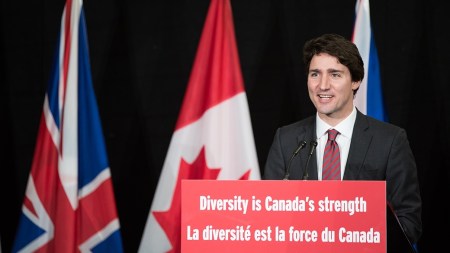
In 2015, Canadian President Justin Trudeau said, “There is no core identity, no mainstream in Canada. There are shared values — openness, respect, compassion, willingness to work hard, to be there for each other, to search for equality and justice. Those qualities are what make us the first postnational state.” (Image source: Canadian PM’s Office)

In December 2015, Former Swedish Prime Minister Fredrik Reinfeldt, president of the European Council in 2009, gave an interview to TV4 ahead of his departure from the leadership of the Moderate Party, in which he asked rhetorically:

“Is this a country that is owned by those who have lived here for three or four generations or is Sweden what people who come here in mid-life makes it to be?… For me it is obvious that it should be the latter and that it is a stronger and better society if it may be open… Swedes are uninteresting as an ethnic group.”

Notably, such statements emanated from leaders in the United States, Sweden and Canada — countries with distinct literature, music, art and cuisine, as well as distinct judicial and governmental systems. What the views of the five leaders have in common, however, are a postmodern ideology and a need for minority and immigrant votes.

Postmodernism has two key elements: cultural relativism and postcolonialism. Cultural relativism — developed by American anthropologist Ruth Benedict, author of the 1934 worldwide best-seller Patterns of Culture, and her mentor, the “father of American anthropology,” Franz Boas — posited that researchers must set aside their own cultural values and biases, and maintain an open mind about those of other peoples’ cultures, in order to understand them. In the second half of the 20th century, anthropological theorists extended this to the field of ethics, arguing that judgements arising from one culture could not be applied to others — thereby rendering all cultures equally good and valuable. This view led the American Anthropological Association in 1947 to reject the Declaration on the Rights of Man, which became the U.N. Universal Declaration of Human Rights, prepared in 1947 by the Commission on Human Rights of the United Nations.

Postcolonialism holds that peoples across the globe all got along with each other comfortably and peacefully until Western imperialists invaded, divided, conquered, exploited and oppressed them. Unlike postmodernism, which sees Western culture as no better than other cultures, postcolonialism considers Western culture inferior to other cultures.

Three factors appear to underlie this repudiation of Western culture: guilt, globalization and demography. Many Western societies — such as Britain, France, Belgium, Holland, Spain, Portugal and Italy — had empires in the South and East between the 17th and 20th centuries. Today, however, those past conquests are deemed evil by the very countries that engaged in them, and are also viewed negatively by non-imperial nations, such as Sweden and Canada, itself a Western colony. Germany, a late and marginal imperial power, seems still guilt-ridden over the Holocaust. Ironically, admitting countless newcomers to Europe as if they were the “new Jewish refugees” of this century has caused the second flight of Jews.

The guilt does not end there. Western countries are affluent, with most of their citizens enjoying at least a comfortable standard of living, while vast populations in Africa and Asia live in poverty. Many Westerners thus feel that redemption is required — in the form of financial aid to ex-colonies, and in the unfettered entry of migrants and refugees from those areas into Western countries.

Meanwhile, economic globalization has led to Western countries having customers and investors around the world, from a wide range of disparate cultures, but Western triumphalism is viewed as ill-suited to productive business relations.

Where demography is concerned, the last decades have seen an increase in the flow of populations, occasioned in part by the low birthrate in the West — with many far below replacement level. That, in turn, has highlighted the need for labor to sustain, if not grow, economies. The result is that the population in every Western country has become more ethnically, religiously and culturally mixed. To be welcoming to immigrants, and to aid in their integration into, and solidarity with, their new societies, Western countries have encouraged a multicultural openness while downplaying the particularity of their own cultures.

This brings us to elections: Politicians in Western democracies seeking election often downplay their own cultures to garner immigrant and minority votes. The larger the immigrant communities are, the stronger the incentive to curry favor with them. Some growing minority groups, such as Muslims in Europe, are now forming their own political parties to compete with traditional ones.

This marriage of postmodernism and electoral politics is having a terrible effect on societies that pride themselves on openness and diversity. Rather than enhancing Western culture through the enrichment different ethnic and religious groups provide in countries with a Judeo-Christian foundation, multiculturalists have actually been rejecting their own Western culture. While they encourage diversity of race, religion, and heritage, they forbid diversity of opinions, particularly those that do not conform to the postmodern narrative that rejects that the West. They also seem not to want to acknowledge that the West, even flawed, has nevertheless afforded more freedoms and prosperity to more people than ever before in history.

This skewed view of the West is only possible if one stubbornly refuses to see who, historically, the real colonizers were. How do they think virtually all of the Middle East and North Africa and the Middle East became Muslim — through a democratic referendum? Muslims invaded and transformed the Christian Byzantine Empire, now an increasingly Islamized Turkey; Greece; the Middle East, North Africa, the Balkans; Hungary; northern Cyprus and Spain.

If Western civilization is to survive this defamation, it would do well to remind people of its historical accomplishments: its humanism and morality derived from Judeo-Christian traditions; its Enlightenment thought; its technological revolutions; the agricultural and industrial revolutions of the 18th century, and the digital revolution of the 20th century; its political evolution into full democracy; the separation of church and judiciary from state; its commitment to human rights and most of all its gravely threatened freedom of speech. Around the world, all advanced societies have borrowed many features of Western culture; they could hardly be called advanced if they had not. Much of what is good in the world is thanks only to Western civilization. It is critical not to throw it out or lose it.

Philip Carl Salzman is professor of anthropology at McGill University, Middle East Forum Fellow, and Frontier Centre Senior Fellow.
Arab world taken by storm by Saudi arrest of top Palestinian-Jordanian banke[r]

December 16, 2017

Arab world taken by storm by Saudi arrest of top Palestinian-Jordanian banke[r], DEBKAfile, December 16, 2017

(Please see also, Palestinian claims to Jerusalem lose Saudi as well as US support. — DM)

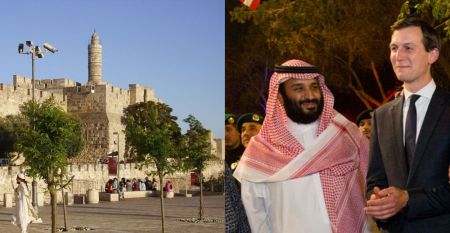
Saudi Crown Prince Muhammed bin Salman (MbS) suddenly detained the Palestinian-Jordanian billionaire businessman Sabih al-Masri, aged 80, who has majority holdings in the Palestinian territories, Jordan and Saudi Arabia. His detention could impact on major economic interests in all three. DEBKAfile reveals that the Saudi and UAE rulers demanded that Palestinian leader Mahmoud Abbas present himself at once in Riyadh.  MbS acted after his warning to Abbas and King Abdullah to stay away from Erdogan’s Islamic conference in Istanbul, for launching a campaign against Donald Trump’s recognition of Jerusalem as Israel’s capital, was not heeded. (Emphasis added — DM)

Palestinian claims to Jerusalem lose Saudi as well as US support

December 16, 2017

Palestinian claims to Jerusalem lose Saudi as well as US support, DEBKAfile, December 16, 2017

Abbas (Abu Mazen) paid an urgent visit to Riyadh to meet Prince Muhammed. Since then, a continuous stream of tidbits is emanating from their conversation. According to one report, the Saudi prince put before the Palestinian leader an American-Saudi blueprint. It proclaims Abu Dis, a village located on the fringes of east Jerusalem, as the capital of the future Palestinian state. That state would have limited sovereignty in parts of the West Bank, while all the Jewish communities would remain in place. East Jerusalem would not be declared its capital; and the Palestinian refugees’ “right of return” was dropped, as was mention of the pre-1967 boundaries.

***************************************

The Palestinians have three major grievances with the Trump administration on Jerusalem, but are most irked by Saudi backing for the Trump peace plan.

Palestine rage over President Donald Trump Jerusalem decisions was further fueled Friday, Dec. 17 by the comment from Washington: “We cannot envision any situation under which the Western Wall would not be part of Israel. But, as the president said, the specific boundaries of sovereignty of Israel are going to be part of the final status agreement.”   It came with the announcement that Vice President Mike Pence will pay a visit to the Western Wall next Wednesday’ Dec. 20, during his Middle East tour.

Not too long ago, President Trump himself visited the Western wall on May 22. But then, American security officers excluded their Israeli counterparts from safeguarding the visit, claiming it took place outside Israeli territory. border. Eight months later, Trump has restored Israel’s sovereignty to the Western Wall, which encloses the hallowed compound of  the last Jewish Temple, in time for his vice president to pray there.

For the Palestinians, this is another Trump-administration shift in Israel’s favor and its consequent loss of credibility as an honest broker for the Palestinian-Israeli dispute. The Palestinian Authority in Ramallah reiterated this position Saturday, after announcing a boycott of the Pence visit and severing contact with Washington – a position they can’t really afford to sustain for long.

But what is really irking them even more than the Trump administration’s pro-Israeli stance on Jerusalem is its endorsement by their longstanding champion, Riyadh. The impression gaining ground in recent weeks is that Trump’s son-in-law Jared Kushner has reached an understanding with Saudi Crown Prince Muhammed bin Salman (MbS) on a new plan for resolving the Israeli-Arab conflict, which departs fundamentally from the traditional core issues that scuttled all past peace processes.

The first inkling of such a plan came on the pages of the The New York Times of Nov. 11, under the title “Trump Team Begins Drafting Middle East Peace Plan.” This plan was described as pushing ahead on the fast track due to three factors:

  1. Its support by the Saudi crown prince and Egyptian President Abdel-Fatteh El-Sisi.
  2. The uncertainty of Prime Minister Binyamin Netanyahu’s future in the face of long-running police probes against him.
  3. The constant erosion of Mahmoud Abbas’ standing as Palestinian Authority Chairman, whose rapidly diminishing popularity, due to his advanced age of 82 and the corruption rife in Ramallah, is reflected in the latest Palestinian opinion poll on Dec. 7-10. (70 percent want him to retire: 84 percent on the West Bank and 26 percent in the Gaza Strip).

Washington has therefore chosen a moment of leadership weakness to push ahead with its plans to resolve the Israeli-Palestinian dispute.

A week before the NYT report, Abbas (Abu Mazen) paid an urgent visit to Riyadh to meet Prince Muhammed. Since then, a continuous stream of tidbits is emanating from their conversation. According to one report, the Saudi prince put before the Palestinian leader an American-Saudi blueprint. It proclaims Abu Dis, a village located on the fringes of east Jerusalem, as the capital of the future Palestinian state. That state would have limited sovereignty in parts of the West Bank, while all the Jewish communities would remain in place. East Jerusalem would not be declared its capital; and the Palestinian refugees’ “right of return” was dropped, as was mention of the pre-1967 boundaries.

Notwithstanding flat Palestinian denials of all these reports, they continue to gain ground and credence. The picture emerging from the Saudi prince’s conversation with Abu Mazen is taking shape as underlining the following points:

  • The old Saudi-Arab League peace plan of 2003 is a dead letter;
  • Riyadh has dropped its demand that Israel accept a Palestinian State with East Jerusalem as its capital;
  • Since the original Saudi Peace proposal which the prince called Plan A was dead, it is necessary to move forward to Plan B.
  • Plan B is essentially as follows: The State of Palestine would be established in the Gaza Strip plus large tracts of territory to be annexed from northern Sinai. Egypt has agreed to this outline. This deal would essentially render irrelevant the Palestinian demand to restore the pre-1967 boundaries for their state.
  • When Abu Mazen asked what would happen to the West Bank, MbS reportedly replied: “We can continue to negotiate about this.”
  • And when he pressed further: What about Jerusalem, the settlements, Areas B and C, the answer was: “These will be issues for negotiation between two states, and we will help you.”

These reports are furiously denied by Palestinian officials and, although no other official source, including Prince Muhammad, has verified them, they continue to abound. The Palestinians now have three major grievances against the Trump administration for which they are cutting off ties with Washington in protest:  Recognition of Jerusalem as Israel’s capital, the promise to move the US embassy from Tel Aviv to Jerusalem and, now, the declaration of the Western Wall as part of Israel in any political solution. This will be underlined by the Pence visit. Yet neither Washington nor Riyadh shows any sign of backtracking on their far-reaching plan which defies all former conventions.

Abu Mazen is in a jam. Even if he tries to distance himself from Washington, he cannot possibly divorce the Palestinians from the two leading Arab nations, Saudi Arabia and Egypt, which would lop off the branches of the Arab tree on which they sit. Doing so might well thrust Ramallah on the path of the anti-West Turkish-Iranian-Hizballah axis and its extremist ideology. There are early signs that his rivals in Gaza, the radical Hamas, may be adopting this path. After Friday prayers in the mosques of Gaza, on Dec. 15, some of the demonstrators at the Israel border force were seen for the first time holding aloft huge placards with depictions of Gen. Qassem Soleimani, Commander of Iranian Revolutionary Guards Al Qods. If Iran can gain solid inroads into the Palestinian community at large, its dispute with Israel would assume an entirely new dimension.

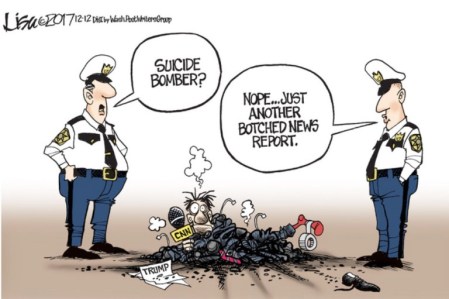
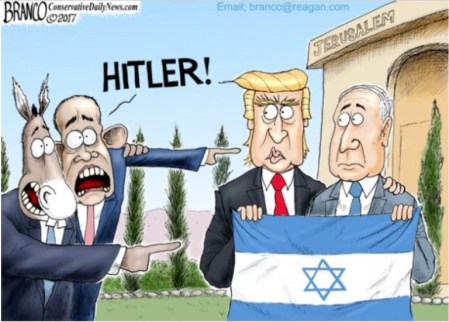
Cartoons and Video of the Day

December 16, 2017

LatmaTV via YouTube


H/t Power Line


Tillerson Walks Back Offer of Unconditional Talks With North Korea, Says Regime ‘Must Earn Its Way Back to the Table’

December 16, 2017

Tillerson Walks Back Offer of Unconditional Talks With North Korea, Says Regime ‘Must Earn Its Way Back to the Table’, Washington Free Beacon, December 15, 2017


Secretary of State Rex Tillerson on Friday walked back his offer from earlier this week to have unconditional talks with North Korea, telling the United Nations Security Council that Pyongyang must “earn” the right to negotiate with Washington.

“As I said earlier this week, a sustained cessation of North Korea’s threatening behavior must occur before talks can begin. North Korea must earn its way back to the table,” Tillerson said at a special ministerial meeting at the U.N. Security Council. “The pressure campaign must and will continue until denuclearization is achieved. We will in the meantime keep our channels of communication open.”

Tillerson’s words were a noticeable shift from Tuesday, when he said at the Atlantic Council in Washington, D.C. that the U.S. is “ready to have the first meeting without precondition.”

“Let’s just meet, and we can talk about the weather if you want,” Tillerson said at the think-tank event. “Talk about whether it’s going to be a square table or a round table, if that’s what you are excited about. But can we at least sit down and see each other face to face, and then we can begin to lay out a map, a road map of what we might be willing to work towards.”

Those comments received instant blowback from the White House.

Tillerson also reemphasized on Friday that the U.S. wants a diplomatic solution to the North Korean issue rather than a military one.

“We have been clear that all options remain on the table in the defense of our nation, but we do not seek nor do we want war with North Korea,” Tillerson said. “The United States will use all necessary measures to defend itself against North Korea aggression, but our hope remains that diplomacy will produce a resolution.”

America’s top diplomat said that North Korea remains the “greatest national security threat” to the U.S. and called on China and Russia to put greater pressure on Pyongyang.

“Upon taking office, President Trump identified North Korea as the United States’ greatest national security threat,” Tillerson said. “That judgment remains the same today.”

“Each U.N. member state must fully implement all existing U.N. Security Council resolutions,” Tillerson added. “For those nations who have not done so or who have been slow to enforce Security Council resolutions, your hesitation calls into question whether your vote is a commitment to words only, but not actions.”

Tillerson specifically called out Russia and China for cooperating with the North Korean regime.

“We particularly call on Russia and China to increase pressure, including going beyond full implementation of the U.N. Security Council resolutions,” Tillerson said. “Continuing to allow North Korean laborers to toil in slave-like conditions inside Russia in exchange for wages used to fund nuclear weapons programs calls into question Russia’s dedication as a partner for peace.”

“Similarly, as Chinese crude oil flows to North Korean refineries, the United States questions China’s commitment to solving an issue that has serious implications for the security of its own citizens,” he said.

Trump Has Made Our Government More Moral

December 16, 2017

Trump Has Made Our Government More Moral, PJ Media, Andrew Klavan, December 15, 2017

Melania_trump_and_seventies-feminists_banner_7-19-16

Trump has delivered conservatives an astoundingly successful year and made the government more moral in the process. You don’t have to like him, to salute him. I salute him. Well done.

***********************************

Here is a funny thing about the human mind: when we didn’t see something coming, we often can’t see it came. There’s a good reason for this. Wrong predictions are an indication that there is something off or unrealistic about your worldview. When your predictions are vastly incorrect, you have to choose: will I paper over my mistakes and pretend to myself I was actually right in some way, or will I admit the error and adjust the way I look at life?

People almost never adjust the way they look at life. It would mean risking their sense of their own wisdom and virtue.

This is why so many pundits both on the left and right are completely blind to what happened this year in politics.

Donald Trump — a political neophyte, a New York loudmouth who plays fast and loose with the truth, a massive egotist and a not altogether pleasant human being — has delivered conservatives one of the greatest years in living memory and has made our government more moral in the process. The left and many on the right didn’t see it coming because they hate the man. And because they didn’t see it coming, they won’t see that it’s come.

The first assertion is easily proven. After a year of Trump, the economy is in high gear, stocks are up, unemployment is down, energy production is up, business expansion is up and so on; ISIS — which took more than 23,000 square miles of territory after Obama left Iraq and refused to intervene in Syria — is now in control of a Port-o-San and a book of matches; 19 constitutionalist judges have been appointed and 40 more nominated; the biggest regulatory rollback in American history has been launched (boring but yugely important); the rule of law has been re-established at the border; we’re out of the absurd and costly Paris Accord; net neutrality, the most cleverly named government power grab ever, is gone; our foreign policy is righted and revitalized; and a mainstream news media that had become little more than the information arm of the Democratic Party is in self-destructive disarray. If the tax bill passes before Christmas, it will cap an unbelievable string of conservative successes.

Now you can tie yourself in knots explaining why none of this is Trump’s doing or how it’s all just a big accident or the result of cynical motives or whatever. Knock yourself out, cutes. For me, I’ll say this. I hated Trump. I thought he’d be a disaster or, at best, a mediocrity. I was wrong. He’s done an unbelievably great job so far.

But even more important is my second assertion. Our government is more moral now. How is this possible when Trump has sex with Vladimir Putin disguised as a Russian prostitute, when he kills and eats black people in his spare time, when he hates women and goes into insane temper tantrums fueled by 48 cans of Diet Coke a day? Okay, even leaving Maggie Haberman’s fantasy life aside, Trump is not always statesman-like, not always nice to people and not always strictly honest.

But Trump’s outsized New York personality and the feeling it evokes in us only obscure what he has done to the government he leads. As Aristotle knew, a thing can only be good if it fulfills its purpose. What is the moral purpose of government? We know the answer because our Founders told us in no uncertain terms.

“We hold these truths to be self-evident, that all men are created equal, that they are endowed by their Creator with certain unalienable Rights, that among these are Life, Liberty and the pursuit of Happiness. — That to secure these rights, Governments are instituted among Men…”

That’s right. Government does not exist to make us equal, but to treat us equally. It does not exist to make life fair, but to treat us fairly. Most importantly, it exists to secure our rights to life, liberty and the pursuit of happiness. Only in liberty can we treat each other ethically, because only in liberty can we make the choices that are the necessary condition for ethical life.

Trump has made our government more moral by making less of it: fewer regulations, fewer judges who will write law instead of obeying the law, fewer bureaucrats seeking to expand the power of their agencies, less money for the government to spend on itself. He has made government treat us more fairly and equally by ceasing to use the IRS and Justice Department for political ends like silencing enemies and skewing elections.

This is what moral government looks like. And if every male senator in America is grabbing the buttocks of some unsuspecting female while, at the same time, voting for more limited and less corrupt government, the senators are immoral, yes, but the government is more moral. That is why we should never let the leftist press game us with scandal hysteria, but should keep focused on voting in those who will help fulfill government’s moral ends.

Trump has delivered conservatives an astoundingly successful year and made the government more moral in the process. You don’t have to like him, to salute him. I salute him. Well done.

Abbas plans to use conflict of interest clause against Jerusalem recognition

December 16, 2017
Analysis: The Palestinian president, who has decided to go to the Security Council over full UN membership, will try to use a clause in the UN Charter that would prevent the US from vetoing a resolution against Trump’s declaration; the move indicates the Palestinians have decided to ‘stop playing by the rules’ vis-à-vis Washington.
https://www.ynetnews.com/articles/0,7340,L-5056819,00.html

Israeli officials believe the Palestinians have decided to “stop playing by the rules” in the international arena and ask the United Nations Security Council for full UN membership following US President Donald Trump’s recognition of Jerusalem as Israel’s capital.

The Palestinians wish to use the international momentum that has been created against Trump’s declaration and see the UN Security Council as a convenient place to do so.Speaking at the Muslim countries’ summit in Istanbul, which convened following Trump’s declaration, Palestinian President Mahmoud Abbas announced that the Palestinians would turn to the Security Council for a full UN membership instead of their current non-member observer state. He also called for the UN to replace the Americans as mediator in the peace negotiations.

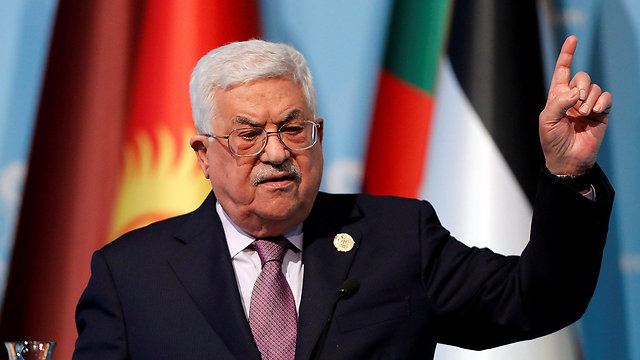
Palestinian President Abbas in Muslim countries’ summit in Istanbul  (Photo: Reuters)

Palestinian President Abbas in Muslim countries’ summit in Istanbul (Photo: Reuters)

On Monday, the Security Council is expected to hold a closed discussion on the implementation of Resolution 2334, which was adopted about a year ago—before Trump took office—and declared the settlements illegal. Israel managed to thwart a Palestinian move to get the UN to issue a written report about the resolution’s implementation. Instead, UN envoy to the Middle East Nikolay Evtimov Mladenov will brief the Security Council on Israel’s violations in the territories. Meanwhile, the Palestinians are pressing UN Secretary-General Antonio Guterres to physically attend the discussion and inform the members of his activities to implement the resolution.

Israeli officials estimate that Abbas is interested in going to the Security Council now in order to push the Americans into a corner and force them to use their veto right for the first time, in a bid to embarrass them as they go against the entire world.

According to procedures, the only way to join the UN as a member state is to submit a request to the Security Council through one of its members. The Palestinians will likely submit their request through Egypt, which is the Arab League representative, or through Bolivia.

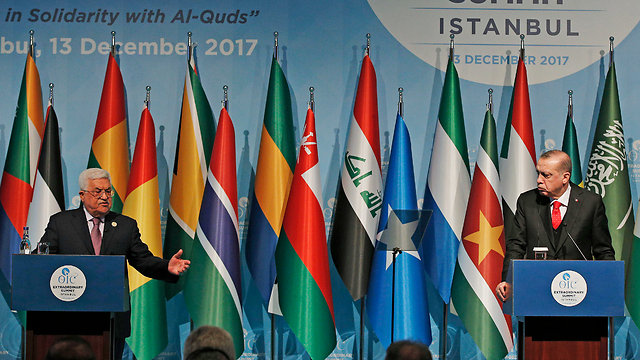
Abbas alongside Turkish President Erdogan  (Photo: AP)

Abbas alongside Turkish President Erdogan (Photo: AP)

Joining the UN as a member state with the right to vote requires a Security Council recommendation from a majority of nine of the 15 member states. Each of the five permanent Security Council members—the United States, Russia, China, Britain and France—could curb the move by vetoing it. If the decision is supported by a majority of nine states and isn’t vetoed, it is handed over to the General Assembly, where a majority of two-thirds is required to admit the new state. The Arab and Muslim votes give the Palestinians an autonomic majority at the UN General Assembly. Their problem will be to get through the Security Council and avoid an American veto.

‘This rhetoric has prevented peace for years’

Abbas said he would use a clause in the UN Charter preventing a state from participating in a vote on a controversial issue it is involved in. This means, according to the Palestinians, that if they try to pass a resolution against Trump’s declaration at the Security Council, the US purportedly won’t be able to veto the decision. The last time such a clause was used at the Security Council was in 1960, when Argentina didn’t participate in the vote on whether the transfer of Adolf Eichmann to Israel from Argentina constituted a violation of the country’s sovereignty.

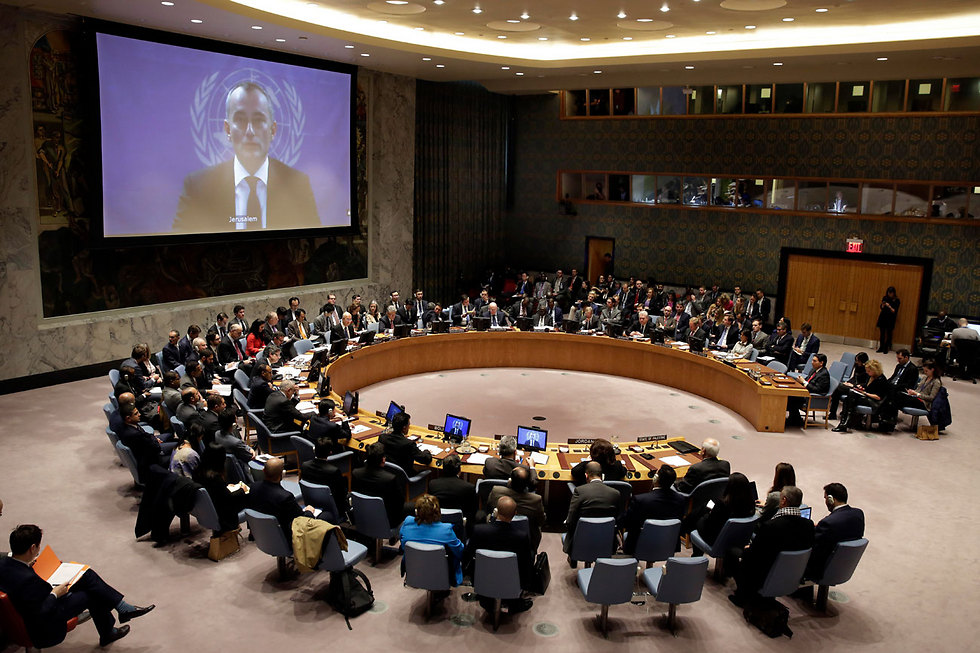
UN Security Council  (Photo: AP)

UN Security Council (Photo: AP)

US Ambassador to the UN Nikki Haley likely won’t let the Palestinians go ahead with such a manipulation and will do everything in her power to thwart it. This move indicates, however, that the Palestinians have decided to stop playing by the rules vis-à-vis the Americans and is in line with their declarations that they would no longer meet with Trump’s emissaries, Jared Kushner and Jason Greenblatt, and that the Americans would no longer play a role in the peace process.Fighting back, the Americans slammed Abbas. “The president remains as committed to peace as ever,” a senior White House official said. “This rhetoric, which has prevented peace for years, is not surprising, as we anticipated reactions like this. We will remain hard at work putting together our plan, which will benefit the Israeli and Palestinian peoples.

“It is also important to ignore the distortions and instead focus on what the president actually said last week—the specific boundaries of Israeli sovereignty in Jerusalem are subject to final status negotiations between the parties. The United States continues to take no position on any final status issues and the United States would support a two-state solution if agreed to by both sides. We will continue to work on our plan for peace that we hope will offer the best outcome for both peoples and look forward to unveiling it when it is ready and the time is right,” the official added.

A relatively convenient composition

According to a different scenario, Abbas won’t submit a full membership request at the first stage, but rather a proposal for a resolution condemning Trump’s Jerusalem announcement, while using the clause allegedly preventing the US from participating in the vote. As a non-member observer state, the Palestinian flag is raised at the UN alongside the flags of the member states and the Palestinians hold the same observer status as the Vatican.

The current composition of the UN Security Council is relatively convenient for the Palestinians: The US, Russia, China, Britain, France, Bolivia, Egypt, Ethiopia, Italy, Japan, Kazakhstan, Senegal, Sweden, Ukraine and Uruguay.
Prime Minister Benjamin Netanyahu responded to Abbas’ threats Wednesday, saying that “the Palestinians had better acknowledge reality and work for peace rather than for radicalization. They should recognize another fact about Jerusalem: Not only is it Israel’s capital, but we also maintain freedom of worship for all religions in Jerusalem. So we are unimpressed by all these declarations. The truth will eventually win, and many other countries will recognize Jerusalem as Israel’s capital and move their embassies there.”

Israeli Ambassador to the UN Danny Danon slammed Abbas: “The Palestinian leadership is doing everything in its power to prevent any chance for negotiations and is making an intentional effort to thwart any initiative that would lead to progress. The international community must not let Abbas flee the negotiating table again under different excuses. It must force the Palestinian leadership to recognize reality and stop the incitement threatening the region’s stability.”

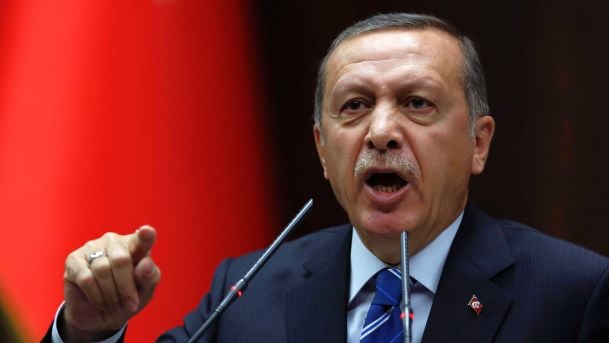
Turkey’s President Invokes Islamic Text Sanctioning Killing Jews

December 16, 2017

Turkish President Recep Tayyip Erdogan invoked a Muslim “hadith” commonly used by Hamas and other terrorist supporters to sanction the killing of Jews, during a party convention last Sunday.

By: John Rossomando, The Algemeiner

Dec 13, 2017

Turkey’s President Invokes Islamic Text Sanctioning Killing Jews

Turkish PM Recep Tayyip Erdogan (AP

[T]hose who think they own Jerusalem better know that tomorrow they won’t be able to hide behind trees,” Erdogan said, according to a translation by dissident Turkish journalist Abdullah Bozkurt. Last year, Erdogan shut down Bozkurt’s former newspaper, Today’s Zaman, which had Turkey’s largest circulation.

“[This is] a veiled threat of killing each and every Jew with a shocking reference to apocalyptic prophecy of tree story,” Bozkurt wrote.

The full hadith says: “The last hour would not come unless the Muslims will fight against the Jews, and the Muslims would kill them until the Jews would hide themselves behind a stone or a tree and a stone or a tree would say: ‘Muslim, or the servant of Allah, there is a Jew behind me; come and kill him;’ but the tree Gharqad would not say, for it is the tree of the Jews.”

 Erdogan invoked the passage during a Justice and Development Party (AKP) gathering on Sunday, just days after President Trump proclaimed Jerusalem to be Israel’s capital and pledged to move the US embassy there. Erdogan also accused Israel of being a terrorist state.

Under Erdogan, Turkey has harbored and funded Hamas terrorists, provided covert support to ISIS and other jihadists in Syria, and bombed civilians belonging to his own Kurdish minority.

But Erdogan is more interested in appealing to his base’s anti-Semitic sentiments than inspiring foreign jihadis to fight Israel, Bozkurt told the Investigative Project on Terrorism (IPT) via Twitter. The dictator’s comments also distract the Turkish public from the New York trial of an Iranian gold trader named Reza Zarrab and Turkish banker Mehmet Hakan Atilla, who — witnesses testified — worked with Erdogan to circumvent oil sanctions against Iran, Bozkurt said.

“It is a noise that will distract [the] public from damaging revelations going on in the US federal court where [Erdogan] was exposed for what he is: Corrupt, sanction buster, greedy politician,” Bozkurt said.

Anti-Semitism has always been in the background in Turkish society, but Bozkurt said that this marks one of the first times that Turkey’s head of state has publicly been involved with fueling it.

The Turkish Youth Foundation (TUGVA), run by Erdogan’s son, Bilal, participated in anti-Israel and anti-US rallies calling on Muslims to unite against Trump’s Jerusalem announcement.

On Friday, protesters in Istanbul chanted slogans including, “Jerusalem is ours and will remain so,” “Down with America” and “Down with Israel.”

Another Errant Anti-Trump Hit Piece From The Washington Post

December 16, 2017

Another Errant Anti-Trump Hit Piece From The Washington Post Power LinePaul Mirengoff, December 15, 2017

(WaPo jointed the “resistance” and abandoned whatever “honest journalism” it may once have published well before President Trump was elected. — DM)

Clearly, the Post is grasping at straws. That’s what one does when one abandons honest journalism and joins “the resistance.”

************************

Fresh off of its triumph in the Alabama Senate race, the Washington Post returns to its primary mission — taking down the President of the United States. It does so in a piece called (in the paper edition) “How Trump’s pursuit of Putin has left the U.S. vulnerable to the Russia threat.”

The hit piece, by Greg Miller, Greg Jaffe, and Phillip Rucker, takes up five pages in the front section of today’s Post. One searches in vain through the authors’ gossip and distortions for evidence of the article’s two themes: (1) that Trump is leaving the U.S. vulnerable to the Russian threat in question, cyber-attacks on our election process and (2) that Trump’s policies tilt in favor of Russia.

In support of its first theme, the Post notes that Trump hasn’t formed a task force to focus on election hacking or convened a Cabinet-level meeting on the subject. From this, it wants us to infer that little or nothing is being done to make such hacking more difficult. The inference is unreasonable. Task forces and Cabinet-level meetings are not the sine qua non of an effective approach to a problem.

The only other evidence the Post presents is this:

In congressional testimony in October, Attorney General Jeff Sessions was pressed on whether the administration had done enough to prevent Russian interference in the future. “Probably not,” Sessions said. “And the matter is so complex that for most of us we are not able to fully grasp the technical dangers that are out there.”

But the fact that this very complex technical set of problems has not been solved, or fully grasped in all of its dimensions, doesn’t mean that it’s being ignored or being given short shrift. I doubt we can ever prevent any sophisticated foreign power from interfering in our elections. In any event, the Post cites no technical danger our government is ignoring.

Instead, it talks about the need to sanction Russia in the hope of deterring future interference. But Russia has been sanctioned — once by Congress, with the president’s reluctant consent, and then by Trump himself when Russia retaliated for the sanctions. If there is anything more to be done on the sanctions front to “prevent Russian interference in the future,” the Post doesn’t describe it.

The Post cites intelligence reports that the Russians consider their efforts to interfere in our presidential election as “a resounding, if incomplete, success.” “U.S. officials” tell the Post that the Kremlin believes it got “a staggering return” on an operative thought to have cost less than $500,000 to execute.

Of course they believe this, and they are right. The “staggering return” consists of (1) the discrediting of our democracy caused by widespread claims that Trump and Putin stole the election from Hillary Clinton and (2) the enormous disruption caused by investigation of alleged collusion between Trump and Russia. The Washington Post has played a substantial role in both victories for Russia

The Post wants its readers to believe that the “return” for Russia also consists of a pro-Russia tilt in U.S. foreign policy. This is the second theme of the article.

It’s a non-starter. The Post concedes:

The annexation of Crimea from Ukraine has not been recognized. Sanctions imposed for Russian intervention in Ukraine remain in place. Additional penalties have been mandated by Congress. And a wave of diplomatic retaliation [note: by Trump] has cost Russia access to additional diplomatic facilities, including its San Francisco consulate.

Against all of this, the Post moans that Trump has discussed the possibility of returning property to the Russians. But nothing has been returned. If anything is, surely it will be in exchange for Russian concessions. At that time, if it comes, we can assess who got the better of the deal.

The Post, though, seems unhappy that Trump wants to deal with the Russians at all. I believe Trump’s quest for Russian cooperation in solving world problems is misguided — a fool’s errand.

However, dealing with Russia isn’t the same thing as making concessions. The deals Trump reaches with Putin, if and when they occur, must be analyzed on their merits before Trump’s Russia policy can be condemned.

Moreover, Trump’s desire to make deals with Russia cannot fairly be attributed to “collusion” or to excess regard for Putin. Trump’s predecessors also wanted to make deals. The Obama administration made doing so a core element of its foreign policy, even though Putin had already invaded Georgia.

Obama’s conciliatory policy towards Russia drew fire from critics in the U.S. Obama shrugged it off by telling Russia’s president he could be more flexible after the 2012 election. He was.

Russia is probably the second most powerful nation in the world. Misguided or not, it’s natural for an American president to seek to improve relations with it.

Once the “Russia reset” exploded in his face, President Obama made dealing with Iran the centerpiece of his foreign policy. He received applause from the Washington Post and other stalwarts of the present anti-Trump resistance for doing so. At the time, no state was more hostile to the U.S. than Iran and none has inflicted more harm on us.

Why, in the Post’s view, was it okay for Obama to strike a major deal with Iran, but not okay for Trump to pursue major deals with Russia? Given all of Iran’s bad acts, including killing American soldiers in Iraq, the Post’s answer better not be that Putin was mean to Hillary Clinton.

It’s never surprising when the Washington Post resorts to dishonesty and distortion. Given the thinness of today’s five-page expose, dishonesty and distortion were almost inevitable.

Let’s take the two worst examples. The Post says that during the 2016 campaign, Trump “prodded the Kremlin to double down on its operation and unearth additional Clinton emails.” It’s referring to when Trump remarked that maybe the Russians could locate Hillary’s 30,000 missing emails. This was obviously sarcasm –a joke — not an invitation. No fair-minded person who heard the comment could conclude otherwise (you can listen to ithere). It’s no accident that the Post strips it of all context.

In the same vein, there is this:

Rather than voice any support for the dozens of State Department and CIA employees being forced back to Washington [when Russia expelled them], Trump expressed gratitude to Putin.

“I want to thank him because we’re trying to cut down on payroll,” Trump told reporters during an outing at his golf club in Bedminster, N.J. — remarks his aides would later claim were meant as a joke. “We’ll save a lot of money.”

Again, no fair-minded person could believe that Trump’s remark was anything but sarcasm. As we noted at the time:

[W]e know [Trump] didn’t want our diplomatic presence in Russia slashed because (1) he could have cut it himself but didn’t and (2) following his election, he expressed satisfaction when Putin decided not to retaliate for Obama’s expulsion of Russian diplomats and seizure of property.

Clearly, the Post is grasping at straws. That’s what one does when one abandons honest journalism and joins “the resistance.”