Britain’s Hate Speech Police, Pat Condell via YouTube, November 30, 2017
(He’s back! — DM)
Islamic Jihad pounds IDF position with mortar fire, prompting airstrikes, tank fire in response. ‘This is just the beginning.’
David Rosenberg, 30/11/17 17:09
http://www.israelnationalnews.com/News/News.aspx/238713

Terrorists operating in the Gaza Strip fired at least a dozen mortar shells at an IDF engineering team inside Israeli territory near the border with Gaza Thursday afternoon, prompting the Israeli military to respond with airstrikes and tank fire.
Twelve mortar shells were fired at the engineering team which was carrying out work near the Gaza border fence. No injuries were reported, but the sudden attack prompted temporary shutdowns of the train system in Ashkelon and Sderot.
In response to the attack, Israel Air Force fighters struck targets inside the Gaza Strip. IDF tank units inside of Israel also opened fire on terrorist positions inside Gaza. A total of four targets were hit during the IDF operation.
Following the mortar attack, the IDF’s chief spokesperson, Brigadier General Ronen Manelis, claimed that the Islamic Jihad terrorist group was responsible for the mortar fire.
Manelis noted that the attack took place exactly one month after Israel destroyed a terror tunnel which extended from the Gaza Strip into Israel.
The demolition killed a dozen terrorists, most of them affiliated with the Islamic Jihad terror group. Israeli forces managed to recover the remains of five Islamic Jihad terrorists, and has refused to return them to Gaza.
In a press briefing Thursday afternoon, Manelis said the incident constituted a serious escalation.
“This was a serious attack by Islamic Jiahd, in which 10 to 12 mortars were fired at an army position north of the Gaza Strip, where work is being conducted on the fence.”
“The IDF’s initial response included strikes on four [terrorist] targets. Two of them belonged to Islamic Jihad, while two were [operated] by Hamas.”
Saudis Fed Up: “Palestinians Milking Us for Decades”, Gatestone Institute, Bassam Tawil, November 30, 2017
(Please see also, Report: Trump expected to move embassy to Jerusalem within days. Might the apparent changes in relations between the “Palestinians” and Arab states reflect abandonment of the moribund peace process and hence of American reluctance to move the US Embassy to Jerusalem? — DM)
Most Arabs, in fact, do not seem to care about the Palestinian “cause” any more, as pointed out in a previous article, which showed how the Arab League ministers were focusing on Iran and Hezbollah while ignoring the Palestinians.
Many people in the West are not aware that the Palestinians are trying to torpedo any peace initiative in order to blame others.
********************************************************
Like most Arab countries, the Saudis too have finally realized that the Palestinians are ungrateful and untrustworthy. Saudi Arabia and most of the Arab countries are obviously fed up with the recurring attempts by the Palestinians to blackmail them and extort money from them.
The Palestinians are crying Wolf, Wolf! — but only a few in the Arab world are listening to them. This, in a way, is encouraging and offers hope for them finally to be released from decades of repressive and corrupt governance.
These are just some of the challenges Saudi Crown Prince is facing. It is important to support him in the face of attacks by some Palestinians and other spoilers.
A young Saudi man has posted videos on social media in which he calls the Palestinians “dogs” and “pigs.” The man says that Saudi Arabia has provided the ungrateful Palestinians with “billions of dollars” during the past few decades. “The Palestinians,” the Saudi man charges, “have been milking us for decades.”
The videos, which have since gone viral, have understandably drawn strong condemnations from Palestinians, who say they would not have been made public without the tacit approval of the Saudi authorities. For the Palestinians, the abusive videos represent yet another sign of increased tensions in their relations with Saudi Arabia.
Further evidence of Saudi disdain for the Palestinians was provided in a video posted by Saudi Arabia featuring a Palestinian gunman as a terrorist.
Last July, the Saudi ambassador to Algeria, Sami Saleh, shocked many Palestinians when he described Hamas as a terror group. Hamas responded by saying that such remarks were “harmful to Saudi Arabia and its record and stances towards the Palestinian cause and the legitimate rights of the Palestinian people.”
The apparent shift in Saudi Arabia’s position towards the Palestinians should not come as a surprise. Like most Arab countries, the Saudis too have finally realized that the Palestinians are ungrateful and untrustworthy. Saudi Arabia and most of the Arab countries are obviously fed up with the recurring attempts by the Palestinians to blackmail them and extort money from them.
 Saudi Arabia and most of the Arab countries are obviously fed up with the recurring attempts by the Palestinians to blackmail them and extort money from them. Pictured: Palestinian Authority President Mahmoud Abbas embraces Saudi King Salman bin Abdul Aziz Al Saud in Riyadh, Saudi Arabia, December 30, 2015. (Photo by Thaer Ghanaim/Palestinian Press Office via Getty Images)
The Palestinians were ungrateful to Kuwait when they supported Saddam Hussein’s invasion of the tiny emirate in 1990. Kuwait was one of the wealthy Arab countries that used to give the Palestinians millions of dollars in aid. The Palestinians were ungrateful to Lebanon, a country that opened its doors to them and allowed the PLO to create its own state within Lebanon. The Palestinians played an important role in tearing the country apart and brought disaster and death to Lebanon, until they were finally expelled in 1982.
Before that, in Jordan, in the armed conflict known as “Black September” (1970-71), the Palestinians did the same thing until the late King Hussein ordered his army to eradicate the PLO and all the terror groups in the country.
Now, the Palestinians are being disrespectful towards Saudi Arabia — a country that has provided them with billions of dollars over the past few decades. It is no wonder, then, that a growing number of Saudis are beginning to voice their disgust for the way the Palestinians are behaving and talking.
The Palestinians seek to continue holding Saudi Arabia and the rest of the Arab countries hostage. In fact, the Palestinians wish to retain their death grip against Israel at the cost of their Arab brethren. Any Arab who dares to challenge the Palestinians is denounced as a traitor and a Zionist.
Palestinian officials say that Palestinian Authority (PA) President Mahmoud Abbas, who visited Saudi Arabia in early November, left the kingdom with a bad taste in his mouth. A senior Palestinian official was quoted as saying that Abbas feels that Saudi Arabia and some Arab countries are would like to see him removed from power and replaced with someone who would be more acceptable to the Americans and Israelis.
The Palestinians believe that Saudi Arabia’s crown prince, Mohammed bin Salman, is personally spearheading his country’s rapprochement with Israel. Some of them are even convinced that it is only a matter of time before Saudi Arabia and Israel establish diplomatic ties as part of a peace treaty.
The general feeling among the Palestinian public is that their Saudi brothers have decided to “throw them under the bus” by signing a peace treaty with Israel. The Palestinians claim that Saudi Arabia has accepted the Trump administration’s “ultimate solution” for peace in the Middle East — a plan the details of which remain largely unknown, but is said to promote peace between the Arab countries and Israel before the Israeli-Palestinian conflict is solved. Their biggest fear is that once Saudi Arabia embarks on such a dramatic move, many other Arab countries will follow suit, leaving the Palestinians isolated in the international arena and abandoned by their Arab brethren.
The Palestinian Authority, however, is keen not to be seen as taking a public stance against a powerful and wealthy country such as Saudi Arabia. In an attempt to defuse tensions between Saudi Arabia and the Palestinians, some Palestinian officials have come out in defense of the kingdom.
Mahmoud Al-Assadi, the PA Consul-General in Jeddah, for example, said that reports claiming that Saudi Arabia was headed towards normalizing its relations with Israel were false and based on malicious rumors. “Saudi Arabia’s position towards the Palestinian cause and people is historic and consistent,” Al-Assadi said in an interview. “The Saudi leadership has repeatedly made it clear that there will be no normalization with Israel until the Palestinian issue is solved.”
The PA ambassador to Saudi Arabia, Bassam Al-Agha, has also taken pains to exonerate the kingdom from the “allegation” that it is seeking to normalize its relations with Israel. In an interview with a Saudi newspaper, Al-Agha heaped praise on Saudi Arabia for its continued support for the Palestinians. The Palestinians, he added, “Will always remember Saudi Arabia’s generosity, hospitality and support.”
The public statements of Palestinian officials, however, stand in jolting contrast with the sentiments of the Palestinian public, which seems to be overtly hostile towards Saudi Arabia and its crown prince.
The Palestinians believe that the abusive videos posted by the Saudi man and other derogatory remarks by Saudi citizens in the past few days are part of a larger campaign by the Saudi authorities to prepare the Saudis for a peace treaty between the kingdom and Israel.
The Palestinians point to a Twitter campaign launched by Saudi citizens under the title of “Riyadh is more important than Jerusalem.” The campaign is accompanied by abusive remarks against the Palestinians, who are blamed for the “loss of Jerusalem and Palestine.” The campaign also repeats the charge made by many Arab countries, namely that the Palestinian “dogs” have always been ungrateful in the face of massive financial aid from their Arab brothers.
The Palestinians have been firing back with full force to this unprecedented online onslaught by the Saudis.
“This is a media campaign spearheaded by the boys of the [Saudi] monarch to pave the way for Saudi normalization with Israel,” commented Khalid Omar. He and many Palestinians claimed that Mohammed bin Salman was behind the online campaign “that smears and discredits the Palestinian cause.”
Yusef Jadallah wrote in response:
“We’re not surprised to hear some Saudis say that Riyadh is more important than Jerusalem. The Saudis are returning to their Zionist origin, which is hostile to Arabs and Muslims. We used to say that the Saudis support us. Unfortunately, the Saudis support Israel publicly.”
Another comment from Radwan Al-Akhras, of the Gaza Strip: “This online campaign is aimed at fomenting strife among the Arabs and Muslims. The only ones who benefit from it are the Zionists and those who are trying to be Zionists.”
The Palestinians also point to more troubling voices emerging from Saudi Arabia in recent days.
Here, for instance, is what Saudi academic Sa’ad Al-Hussein tweeted on November 25, in reference to the 2007 Fatah-Hamas “reconciliation” agreement:
“History relates that it’s the Palestinians who sold out their cause. History is also witness that the Palestinians fought amongst each other and betrayed and violated the Mecca accord.”
Again, many Palestinians took to social media to attack the Saudi academic and the royal family in Saudi Arabia. They accused the academic of being “ignorant” and “illiterate” and claimed that his charges were also designed at paving the way for normalization between Saudi Arabia and Israel.
Mustapha Anan, a Palestinian, retorted: “You are a trivial and despicable person; shame on you and your king!”
Another Palestinian, Yusri Yusef, responded:
“What’s the secret behind this Saudi smear campaign against the Palestinians? If you [the Saudis] want to make peace and form an alliance with the Zionists, that’s your business. But why these unjustified attacks on the Palestinians?”
Echoing the Palestinian public’s sentiment, Palestinian political analyst Majed Abu Diak also voiced concern over the apparent rapprochement between Saudi Arabia and Israel. He accused the Saudis of bowing to pressure from the Trump administration.
“Saudi Arabia and Israel appear to be in a hurry to normalize their relations,” Abu Diak claimed.
“The Saudi regime is preparing for Mohammed bin Salman to succeed his father. That’s why the regime is prepared to pay the price [to the Americans], which includes normalizing relations with Israel as a way to improve Saudi relations with the US. For Israel, this is an old-new dream of ridding itself of the status of an alien body in the Middle East.”
Most Arabs, in fact, do not seem to care about the Palestinian “cause” any more, as pointed out in a previous article, which showed how the Arab League ministers were focusing on Iran and Hezbollah while ignoring the Palestinians.
Many people in the West are not aware that the Palestinians are trying to torpedo any peace initiative in order to blame others.
The Palestinians are crying Wolf, Wolf! — but only a few in the Arab world are listening to them. This, in a way, is encouraging and offers hope for them finally to be released from decades of repressive and corrupt governance.
These are just some of the challenges Saudi Crown Prince is facing. It is important to support him in the face of attacks by some Palestinians and other spoilers.
The question now is whether the Saudis and the rest of the Arabs have had enough of the great Palestinian shakedown.
Bassam Tawil is a Muslim based in the Middle East.
Report: Trump expected to move embassy to Jerusalem within days, Israel National News, David Rosenberg, November 29, 2017
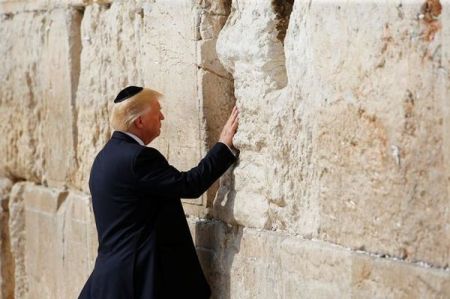 TrumpReuters
Israeli officials expect President Donald Trump to announce plans to relocate the US Embassy in Israel from Tel Aviv to Jerusalem in the coming days, and to officially recognize Jerusalem as the capital of the Jewish state.
According to a report by Channel 2, senior Israeli officials have claimed that the Israeli government expects an announcement from the president in the coming days regarding the Israeli capital, following a comment by Vice President Mike Pence at a special event in Manhattan on Tuesday.
Speaking at an event hosted by the Israeli mission to the United Nations to mark the 70th anniversary of the historic United Nations General Assembly vote on Resolution 181, endorsing the establishment of a Jewish state, Pence said that the president is “actively considering” moving the embassy, calling it a matter of “when and how”.
“President Donald Trump is actively considering when and how to move the American embassy in Israel from Tel Aviv to Jerusalem,” Pence said.
Senior officials in Jerusalem told Channel 2, President Trump is expected to authorize the relocating of the embassy even before his administration presents its plans for a regional peace deal.
The sources claim that Trump has resolved not to renew a waiver allowing the embassy to remain in Tel Aviv.
In 1995, Congress passed the Jerusalem Embassy Act, requiring the president to move the US embassy to Israel’s capital.
The law, which was signed by President Clinton, despite his own opposition to the bill, after it passed with broad bipartisan support.
Under the law, the president may delay implementation of the act for security reasons, renewing the waiver every six months.
In June, President Trump renewed the waiver, despite a campaign pledge to move the embassy.
Unconfirmed reports claim that President Trump is set to announce the formation of a special team to implement the embassy move.
Earlier this month, US Ambassador to Israel David Friedman reiterated his belief that President Trump would in fact relocate the embassy, calling the move a matter of ‘when, not if’.
“The president has also made clear that he intends to move the United States embassy from Tel Aviv to Jerusalem. It is not a question of if, it is a question of when. And I take the president at his word, and I’m personally committed to do all that I can to advocate for this move.”

The Hwasong-15 tested on Wednesday, Nov. 29, likely carried a dummy warhead equivalent in weight to a nuclear bomb, say US missile experts.
What this means is that North Korea had not just attained world-power ability to build an intercontinental ballistic missile, but had also most likely mastered the technology of trajectory re-entry to any point on earth it wished to target. Experts examining the photos released by Pyongyang Thursday found the just-launched missile to be much broader and bigger than the earlier Hwasong-14 model. It has multi-stage rockets, each containing its own engine and propellant for greater thrust and range. The experts were most impressed by what appeared to be “gimbaled engines” – meaning that the exhaust nozzles of the engines can be used for navigation while holding the missile in stable trajectory. These capabilities plus the ability to launch missiles by night from mobile launchers has put North Korea in the exclusive club of world powers in this field.
America’s UN ambassador Nikki Haley Wednesday night warned against “further acts of aggression like the latest launch,” adding, “Make no mistake, the North Korean regime will be utterly destroyed.”
No rhetoric can obscure North Korea’s breakthrough or Kim Jong-un’s success in blindsiding the intelligence services of the United States, Japan and South Korea. None of their surveillance agencies had caught on to the Pyongyang’s newfound capabilities and were caught napping by the timing of the Hwasong-15 launch. Some hard thinking is called for by American policy-makers and strategists on US intelligence capabilities following this eye-opener. It would also be interesting to find out if Chinese and Russian intelligence agencies had done better.
But, meanwhile, the time is long past for appeals, like the one President Donald Trump addressed once again to his Chinese counterpart, Xi Jinping to use “all available levers” to convince Kim Jong un to give up his “provocations.” Such appeals only serve to highlight American ineffectiveness in the face of those provocations and encourage rogue regimes like that of Iran to take advantage and follow suit. The Trump administration must come up fast with a way of dealing with Pyongyang – somewhere between smashing the Kim regime and the policy of swinging between sanctions and diplomacy, whose inefficacy was devastatingly proven now after 25 years of failure.

Fighters from the Iranian-backed Heshd al-Shaabi Shia militia in Iraqi Kurdistan. Photo: Screenshot.
The Kurdish people have an inalienable right to national self-determination, just like any other nation. The Kurds, who number some 30 million people, are the largest national group in the world to have no state of their own. The international community is obligated to see to it that they are done historic justice by supporting their dream of being a free nation in their own land.
A referendum was held in September by Iraqi Kurds on whether they should declare independence against a backdrop of threats from Turkey, Iran, the Iraqi government and even Syria’s Bashar Assad. Joining those voices were other states, including the US and Europe, all warning the Kurds — especially the head of the Kurdish region, Masoud Barzani — not to attempt a one-sided declaration of independence. The neighboring countries feared a snowball effect on their own minorities, especially their resident Kurds. More distant states feared another war in oil-rich regions, such as northern Iraq, that could lead to a much wider conflict.
The referendum showed that a vast majority, over 90% of those voting, supported independence. This resulted in Barzani’s acquiring powerful leverage over the Iraqi government, which was naturally unnerved by the results and tried its best to convince him not to declare independence.
The two main issues in the dialogue between Barzani and the Iraqi regime are:
Barzani is not, however, the only Kurdish actor on the stage. Jalal Talabani, his rival, did not support the push for Kurdish independence and was of the opinion that the Kurds must remain within the national framework of Iraqi sovereignty. He was the Iraqi president (mainly a ceremonial post) from 2005-2014, and died in Germany on October 3, 2017. A pragmatist, Talabani based his opinion on the realistic understanding that a declaration of independence would have a severely negative effect on the Kurds because the surrounding states would do their utmost to ensure its failure: They would not balk at the idea of starving the Kurds into submission by putting the region under siege.
The differences between Barzani and Talabani are nothing new. The two men’s families have been at odds for decades, and in the second half of the 20th century there were actual battles between the two resulting in dead and wounded. The Iraqi regime knew this and took advantage of it by setting one side against the other. The factionalism of the Kurds prevented them from taking a united stand and neighboring states — Turkey, Iran and Syria — were able to use this factionalism to their own ends.
The dispute led to these facts on the ground: the Iraqi army, supported by Shiite militias, moved towards Kirkuk, and the Kurdish Peshmerga fighting force left the city without doing battle. Within two days, the Iraqis took over the city and its adjacent oil field without resorting to violence, neutralizing an important part of the leverage that Barzani was hoping to wield during negotiations with the Iraqi government.
The Pershmega are not united, reflecting the ongoing internal dispute among the Kurds. Some follow Barzani’s orders, while others act under the continuing influence of Talabani. The forces guarding Kirkuk were under the sway of Talabani and gave up the struggle against the Iraqi army, to Barzani’s dismay. The internal strife among the Kurds distances them from their dream of independence, and will continue to do so as long as they cannot agree on its parameters.
The tragedy that has befallen the Kurds is even greater because their fighters, part of the coalition led by the US, were the most important force fighting ISIS. They were given weapons, funding and training by their coalition partners, and shed their blood in hand-to-hand fighting against the jihadists. Hundreds of Peshmerga fighters were killed and wounded in the long, exhausting battle to liberate Mosul from ISIS.
The Kurds expected the world, headed by the US, to stand behind them once ISIS was defeated, remembering their great contribution to that defeat and supporting their demand for independence. Those hopes were dashed very quickly.
The official American stand turned out to be, “We have no intention of interfering in internal Iraqi affairs” — that is, Washington will not support the Kurdish demand for independence led by Barzani, despite the referendum and the Kurdish people’s historic rights. Those Kurds who longed for independence feel betrayed by the nation with whom, for whom, and in whose name they fought a lengthy and bloody struggle with ISIS in which Kurdish victims were sacrificed.
It is possible that the American stand is based on Talabani’s approach, one that saw no need — certainly not an immediate one — to declare independence and preferred that the Kurds integrate into the Iraqi state for good. Naturally, Talabani’s loyalty to the Iraqi regime is being explained by rumors of bribery, jobs and other favors he and his men allegedly received from Iraq and Iran.
On the other hand, there are rumors that Barzani received his own favors from the Saudis, who are interested in preventing a Shiite axis led by Iran. Mideast news sources are full of these hard-to-prove stories. (Anyone who thinks Donald Trump invented the concept of “fake news” is unfamiliar with the media and political discourse of the Middle East.)
For the last several years, and particularly since the July 2015 Iran nuclear agreement, there has been a discernible warming of relations between Israel and the Arab nations that feel threatened by Tehran; those include Saudi Arabia, the Emirates, Kuwait, Egypt and Jordan. As a result, there are Israeli pundits, army officers and politicians who view the current regional situation as a golden opportunity. They believe Israel must seize the moment by accepting the Arab peace proposals, establishing a Palestinian state and embarking on a new era of cooperation with the “moderate Sunni axis” in order to bring peace and security to Israel and the entire region. Why? Because all these states fear Iran as much as Israel does, if not more.
But let us suppose that the Iranian threat disappears because Israel launches a successful attack on Tehran’s nuclear facilities. As a result, war breaks out between Israel and Iran (including Hezbollah), Israel sacrifices hundreds of soldiers and civilians — and the Iranian problem ceases to exist. Will the Arab and Western worlds be grateful to Israel and act to protect its interests?
The answer is simple: look to the Kurds. What happened to them will happen to Israel. The Kurds fought ISIS, sacrificed their soldiers and people, and were thrown to the wolves once they had outlived their usefulness. That is exactly what will happen to Israel once it saves the Arab states from the Iranian threat. And why not? The immediate interests of each state, not the moral rights of the Kurds and the Israelis, are what make the world go round.
Israel may indeed be the darling of the “moderate Sunni axis” — for as long as there is an Iranian threat. Once that is gone, the possible fracturing of Iran into ethnic components (on the lines of the former USSR, Yugoslavia and Czechoslovakia) will obviate the need for good relations with Israel. For this reason, Israel would do well not to give up land for a piece of paper with the word “peace” stamped on it. That paper can easily fly away in the desert wind while the words on it fade in the blazing Middle Eastern sun.
There are two unassailable confirmations of this phenomenon. The first is Israel’s peace with Egypt. That peace was the result of Anwar Sadat’s need for economic assistance from the West, which insisted that peace with Israel precede the granting of aid.
That peace treaty did not stand in Hosni Mubarak’s way when he allowed Hamas and its supporters to smuggle arms from Sinai to Gaza. It was in Mubarak’s interest to bring about a war between Israel and Hamas, because it allowed Israel to do Egypt’s dirty work with the Palestinian branch of the Muslim Brotherhood (Hamas). As soon as Sinai became a haven of jihadism and began fighting Egypt, the weapons smuggling from Sinai to Gaza ceased abruptly. In short, the peace between Israel and Egypt exists so long as it suits Egyptian interests.
The second confirmation is the peace with Jordan, which was the product of Yitzhak Rabin’s and King Hussein’s shared interest in preventing a Palestinian state from being established. This common interest prompted wide-ranging cooperation between the two countries. However, Hussein’s son, Abdullah II, changed his father’s policies and is a strong backer of the idea of a Palestinian state in the West Bank with its capital in East Jerusalem. He acts against Israel in every international forum, as if he were one of its greatest enemies. He relates to the peace treaty as an agreement to refrain from war and no more, while enjoying its attendant economic benefits.
The clear conclusion from the Kurdish, Egyptian and Jordanian situations is that Israel must not jeopardize its existence, security and interests by placing them in bankrupt Arab insurance companies. Israel must strengthen its position in the Land of Israel and create local governing “emirates” for the powerful West Bank Arab families while battening down Israeli control of the rural areas. No peace treaty can give Israel a lasting insurance policy. The sooner that Israel and the world internalize this truth, the better.
A version of this article was published by Arutz Sheva on October 23, 2017.
Dr. Mordechai Kedar is a senior research associate at the Begin-Sadat Center for Strategic Studies. He served for 25 years in IDF military intelligence specializing in Syria, Arab political discourse, Arab mass media, Islamic groups, and Israeli Arabs, and is an expert on the Muslim Brotherhood and other Islamist groups.
BESA Center Perspectives Papers are published through the generosity of the Greg Rosshandler Family.




 anneinpt
 artaxes
 danmillerinpanama
 davidking1530
 Peter Hofman
 Joseph Wouk
 Peter
Peter Louisiana Steve
 WarSclerotic
Recent Comments