Archive for September 2017

Powers may end up with Iranian model for NKorea

September 3, 2017

Powers may end up with Iranian model for NKorea, DEBKAfile, September 3, 2017

(Obama’s “deal” with Iran (also known as the Iran scam) worked perfectly — for Iran. An even better deal for North Korea? Great idea. Not. Perhaps the “Israeli option” is the only realistic option available. Please see also, Germany’s Merkel: Iran deal a model for solving North Korea problem. — DM)
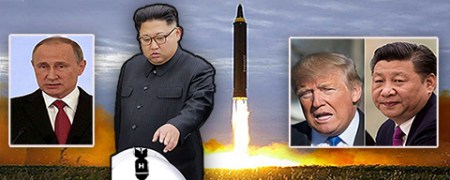
The only time military action was applied against a North Korean nuclear facility was on Sept. 6, 2007 when the Israeli Air Force and special forces blew up the plutonium reactor under construction by North Korea in the eastern Syrian province of Deir ez-Zour, in Operation Orchard. This plant was intended to be Iran’s main supplier of plutonium and had it been finished, would have accelerated Tehran’s advance towards a hydrogen bomb.

The North Korean leader will want much more than the deal won by Tehran, for a 10-year moratorium against a $150 billion pledge and many other rewards. Kim, whose arsenal is far more advanced, will certainly go a lot higher. His leverage for extortion is unassailable. He can either bargain for a mountain of cash or carry on looming over his Pacific neighbors and the United States, armed with advanced ballistic missiles and a nuclear bomb. He would then be faithful to the legacy of his father Kim Jong-Il, who declared in 1995 that a nuclear program was the only guarantee of his dynasty’s survival.

For now, both Iran and North Korea, long in cahoots on their weapons programs, are riding high.

*********************************

Even North Korea’s 150-kiloton hydrogen bomb and avowed ability to fit it onto an intercontinental ballistic missile, as Kim Jong-un demonstrated Sunday, Sept. 3, have so far drawn nothing more decisive from the world’s powers that words of condemnation and threats of stronger sanctions..

President Donald Trump called North Korea a rogue state whose words and actions were “hostile and dangerous to the United States” and convened a meeting with his national security team. Yet stronger sanctions are on the table, including stopping trade with countries doing business with North Korea.

Japan’s Shinzo Abe, already rattled by the North Korean missile that flew over his country, said the latest nuclear test, the most powerful thus far, “is completely unacceptable and we must lodge a strong protest.

South Korea said that its northern neighbor’s defiant sixth nuclear test should be met with the “strongest possible” response, including new UN Security Council sanctions to “completely isolate” the country.

Chinese President Xi Jinping and Russian President Vladimir Putin agreed Sunday to “appropriately deal with” the latest nuclear test by North Korea. The state news agency Xinhua said, “The two leaders agreed to stick to the goal of denuclearization on the Korean Peninsula and keep close communication and coordination to deal with the new situation.”

But still, there is no sign of all these powers getting together for tangible, effective concerted action.

Since the Kim regime’s the first underground nuclear test on Oct. 9, 2006, almost every conceivable penalty and deterrent has been tried to rein in the rogue nation’s gallop towards a nuclear weapon, barring full-blown military aggression.

None worked, mainly because they were imposed piecemeal and never fully followed through. But most of all, this was because the big powers never lined up as one and pooled all their resources at the same time for concerted action. Sanctions were never comprehensive and so were never a solution.

The only time military action was applied against a North Korean nuclear facility was on Sept. 6, 2007 when the Israeli Air Force and special forces blew up the plutonium reactor under construction by North Korea in the eastern Syrian province of Deir ez-Zour, in Operation Orchard. This plant was intended to be Iran’s main supplier of plutonium and had it been finished, would have accelerated Tehran’s advance towards a hydrogen bomb.

The Israeli example has long been set aside, mainly since it was overtaken by Obama’s pro-Iran policy. Successive governments led by Binyamin Netanyahu also set this precedent aside over heavy resistance among Israel’s politicians and some of its generals to an attack on Iran’s nuclear program before it matured.

North Korea’s latest nuclear test was estimated by experts to be five times more powerful than the WWII bomb which destroyed Nagasaki. The Vienna-based Comprehensive Nuclear-Test-Ban Treaty said it was evidence that Pyongyang’s nuclear program is “advancing rapidly.”

The leading world powers’ only real weapon against this advance is unity. But because this is so elusive, their governments – and because a military attack is seen as the worst option – those governments are apparently moving towards getting reconciled to living with a nuclear-armed Kim regime.

Against Iran, six world powers (the US, Russia, China, Britain, France and Germany), did team up and so were able to negotiate the 2015 nuclear accord with Iran, which left its weapons and missile programs intact although relatively free of effective oversight.

If a similar lineup confronted Kim front-un with a collective seven-day ultimatum to dismantle those programs or else face their destruction, he might decided to sit down and talk.. As things stand today, he is free to shoot ballistic missiles over Japan and detonate a hydrogen bomb like a child’s firecrackers, while the world begs him on bended knee to come and discuss freezing his belligerent programs on the Iranian model.

The North Korean leader will want much more than the deal won by Tehran, for a 10-year moratorium against a $150 billion pledge and many other rewards. Kim, whose arsenal is far more advanced, will certainly go a lot higher. His leverage for extortion is unassailable. He can either bargain for a mountain of cash or carry on looming over his Pacific neighbors and the United States, armed with advanced ballistic missiles and a nuclear bomb. He would then be faithful to the legacy of his father Kim Jong-Il, who declared in 1995 that a nuclear program was the only guarantee of his dynasty’s survival.

Attempts to starve his country and force the regime into submission have fallen short. Even South Korea does not dare stop sending aid to allay its compatriots’ endemic famine. For now, both Iran and North Korea, long in cahoots on their weapons programs, are riding high.
Head of U.S.-Saudi Business Council: Trump Has ‘Heralded a New Era’ in Economic Growth

September 3, 2017

Head of U.S.-Saudi Business Council: Trump Has ‘Heralded a New Era’ in Economic Growth, Washington Free Beacon, September 3, 2017

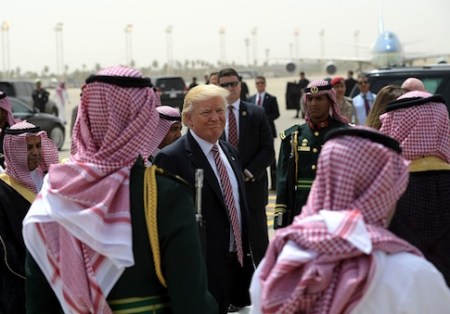
President Donald Trump makes his way to board Air Force One in Riyadh / Getty Images

President Donald Trump’s visit to Saudi Arabia in May “heralded a new era” in economic growth between the United States and its longtime ally, according to the head of the U.S.-Saudi Arabian Business Council.

Edward Burton, the president and chief executive of USSABC, which promotes bilateral investment between the United States and Saudi Arabia, said Trump’s visit “hit the reset button” between the two countries after more than a decade of strained relations.

“Certainly from a business perspective, it’s loud and clear the present administration respects the potency of Saudi capital invested in the U.S. and vice versa,” Burton told the Washington Free Beacon. “The Trump administration made clear it does not look at the Saudi market through its corporate community strictly through the lens of oil and weapons. It wants, and is encouraging, a broad-based engagement between American companies and Saudi companies.”

Burton, who served as commercial attaché at the U.S. embassy in Riyadh between 2003 and 2006, said the U.S.-Saudi business environment today is like “night and day” compared to ten years ago, when Americans were reeling from a series of Saudi-borne terrorist incidents, including the 2004 attack on the U.S. Consulate General in Jeddah.

Burton described a “pronounced retrenchment” at the time on the part of large U.S. companies due to terrorism concerns. Bilateral business relations worsened again last year after Congress unanimously passed a bill allowing the families of September 11 victims to sue the Saudi government over its alleged links to terrorism.

In response, the Saudi government, which has long denied involvement in the 9/11 attacks, threatened to sell off hundreds of billions of dollars of American assets.

The tide turned in May when United States and Saudi companies signed more than $55 billion in deals during a visit by Trump. The House of Saud sought to use the visit in part to promote its Vision 2030 plan to modernize the country’s economy and move away from its overreliance on oil.

“There’s a direct relationship between the president’s visit and at least some of the renewed optimism and interest,” Burton said. “Many times international business takes their cues from senior government leadership, and in this instance that’s surely the case.”

Three months after Trump’s trip, the U.S. company Dow Chemical announced plans to increase by 15 percent its stake in Saudi-based Sadara, the largest petrochemical project in the world. Dow said in a statement it signed a non-binding agreement with Saudi Aramco to boost equity in Sadara to 50 percent.

Burton said the move reflects conversations he’s had with both U.S. and Saudi business leaders, who have said the public should continue to expect a progression of such deals.

Trump says ‘appeasement’ will not work after N.Korea nuke test

September 3, 2017

Trump says ‘appeasement’ will not work after N.Korea nuke test, Breitbart, September 3, 2017

(Please see also, Getting Tough on North Korea: Iran and Other Mirages. The thrust of the linked article is that sanctions won’t work and that some form of “a broader political-military effort to stabilize the situation” is necessary.  As asked in my parenthetical comment on the article,

Do we need merely “to stabilize the situation,” or do we need to do something more drastic to change it so that North Korea will (a) cease to be a nuclear threat now and (b) be disabled from becoming one again? “

I think we need to disable North Korea from ever becoming a nuclear power again. While China urges patience, sanctions and appeasement of North Korea, China is threatening to “reunite” Taiwan with military force rather than through appeasement or sanctions. Please see also, Chinese Official Says China Might Invade Taiwan If “Peaceful Reunification Takes Too Long”. Getting rid of North Korea’s nuclear threat has already taken too long. — DM)

AFP

Washington (AFP) – US President Donald Trump declared Sunday that “appeasement with North Korea” will not work, after Pyongyang claimed it had successfully tested a missile-ready hydrogen bomb.

“North Korea has conducted a major Nuclear Test,” Trump said. “Their words and actions continue to be very hostile and dangerous to the United States.”

His comments came hours after the US Geological Survey picked up a 6.3 magnitude “explosion” in North Korea, which Pyongyang confirmed was a nuclear test, its sixth.

The isolated regime said this one was of a hydrogen bomb that could be fitted atop a ballistic missile, sharply raising the stakes in a US-North Korea confrontation.

Trump last month threatened North Korea with “fire and fury” if it continued to threaten the United States, but he refrained from direct threats in his latest tweets.

“South Korea is finding, as I have told them, that their talk of appeasement with North Korea will not work, they only understand one thing!” he said.

“North Korea is a rogue nation which has become a great threat and embarrassment to China, which is trying to help but with little success.”

Chinese Official Says China Might Invade Taiwan If “Peaceful Reunification Takes Too Long”

September 3, 2017

Chinese Official Says China Might Invade Taiwan If “Peaceful Reunification Takes Too Long”, Synglobe, September 3, 2017

(Please see also, Taiwan Receives U.S. Navy Frigates, Plans Purchase of American Fighter Jets. — DM)

Image by DrRandomFactor via Wikimedia Commons

With regard to Taiwan’s internal politics, Wang implicitly admitted that the majority of Taiwanese voters had rejected cross-strait unification.

“There is no longer a balance of power between the pan-blue and the pan-green coalition,” he said, adding that “the Guomindang cannot effectively counter the DDP anymore” and that “Taiwanese public opinion is increasingly opposed to reunification”. The probability of peaceful reunification “has not been completely lost”, but it is “gradually being lost”, he said.

Due to concerns over China’s growing military might, the Taiwanese government will increase its defence budget by 50% in 2018 and focus on developing its domestic defence industry.

*********************************

In a recent interview Wang Zaixi (王在希), a former vice-chairman of China’s Taiwan Affairs Office of the State Council, said that Beijing might resort to the use of force if “peaceful re-unification” between China and Taiwan “takes too long”.

Wang’s statements echo the increasingly assertive stance of the Chinese Communist Party (CCP) towards the island since Xi Jinping took office in 2012.

In the interview Wang Zaixi stated that although the Taiwan question is a complex issue that must be resolved in the long term, there “must be a sense of urgency towards cross-strait reunification.”

Wang blamed Taiwan‘s democratic process for slowing down the prospect of a peaceful solution of the cross-strait issue, arguing that because of the transfer of power from the pro-unification to the pro-independence coalition the possibility of peaceful unification “is gradually being lost.”

In 2014 and 2015 the Guomindang, Taiwan’s pro-unification party, suffered major electoral setbacks, losing the parliamentary majority to the Democratic Progressive Party (DPP), which rejects rapprochement with China.

Read: China-Taiwan Tensions and the Guomindang’s Existential Crisis

Wang stated that the DPP administration is slowly promoting “Taiwanese independence”. He warned that the path towards Taiwan’s de jure independence “is unfeasible and would be catastrophic for our Taiwanese compatriots”.

Wang signalled that although no timetable for unification can at present be set, the CCP will not tolerate the resolution of the issue to drag on for too long. He cited Article 8 of China’s Anti-Secession Law, which states that “[i]n the event that … possibilities for a peaceful reunification should be completely exhausted, the state shall employ non-peaceful means and other necessary measures to protect China’s sovereignty and territorial integrity.”

Calling unification “an irresistible trend that cannot be avoided” Wang said that “the Taiwan issue has been evolving for 68 years already, it cannot be allowed to drag on for a 100 years, 1.3 billion compatriots cannot accept [this issue] to continue indefinitely”.

As to how the Taiwan issue could be solved peacefully, Wang argued that a cross-strait agreement laying out gradual steps towards unification could be reached between the two sides.

He added that mainland China hopes for “peaceful reunification”, but that the option of “reunification by force”  (武統) cannot be ruled out. “Although peace might not bring about reunification, reunification will certainly bring about cross-strait peace,” he concluded.

In recent years China has been pushing more aggressively towards cross-strait unification. At a meeting with a Taiwanese envoy in October 2013, Chinese President Xi Jinping said that the solution of the Taiwan issue “cannot wait forever”.

Since at that time Taiwan was still ruled by the Guomindang, Xi’s statement was not a reaction to Taipei’s hostility, but a sign that the Chinese leader is determined to pursue a more assertive Taiwan policy than his predecessors.

Due to concerns over China’s growing military might, the Taiwanese government will increase its defence budget by 50% in 2018 and focus on developing its domestic defence industry.

Hydrogen bomb in NKorea’s biggest nuclear test yet

September 3, 2017

Source: Hydrogen bomb in NKorea’s biggest nuclear test yet

DEBKAfile Special Report September 3, 2017, 8:12 AM (IDT)


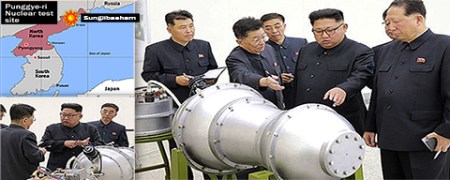
North Korea celebrated its sixth and most powerful nuclear test Sunday, boasting it had launched a hydrogen bomb outfitted for intercontinental ballistic missiles. The US Geological Survey recorded a 6.3 magnitude earth tremor, felt and confirmed in Seoul and China, from North Korea’s test side in Punggye-ri in the northeast region. It was manmade and attributed to this test, which seismic experts with Norway’s Norsar believe had an explosive yield of about 120 kilotons.

The Vienna-based Comprehensive Nuclear-Test-Ban Treaty said the test is evidence that North Korea’s nuclear program is “advancing rapidly.”

Seismologists also noted a second tremor of a 4.1 magnitude, which occurred at the same location minutes after the first one and they categorized as a “collapse.”

As tensions around the peninsula ratcheted up further, US National Security Adviser H.R. McMaster addressed the test in an emergency phone call with his South Korean counterpart, Chung Eui-yong, for about 20 minutes after the detonation.

No response was forthcoming from the White House or the State Department.

The North Korean leader Kim Jng-un inspected the new H-bomb at his nation’s Nuclear Weapons Institute, according to a Sunday statement from the state-run Korean News Agency. The bomb was portrayed as part of North Korea’s stated program to build a nuclear arsenal capable of reaching the U.S. mainland.

In July, North Korea conducted a pair of ICBM tests for the first time.

Weeks after a North Korean ballistic missile flew over Japanese air space, Prime Minister Shinzo Abe issued a statement on Sunday saying “If North Korea has indeed gone ahead with

Right Angle – Hey! Hey! Ho! Ho! These Chanting Fascists Got To Go!

September 2, 2017

Right Angle – Hey! Hey! Ho! Ho! These Chanting Fascists Got To Go! Bill Whittle Channel via YouTube, September 2, 2017


The blurb beneath the video states,

The Right Angle team discusses Antifa’s notoriously childish behavior and how those involved in the protests know nothing else besides chanting and protesting.

John Kelly blocking Breitbart, Daily Caller articles from reaching Donald Trump: Report

September 2, 2017

John Kelly blocking Breitbart, Daily Caller articles from reaching Donald Trump: Report, Washington Times

(On and on it goes; where (and if) it stops nobody knows. — DM)


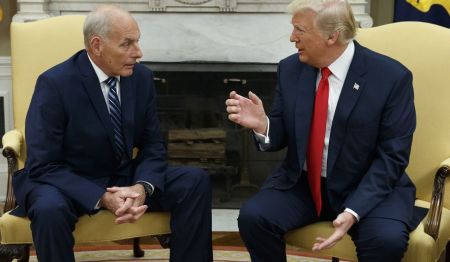
In this July 31, 2017 photo, President Donald Trump talks with new White House Chief of Staff John Kelly after he was privately sworn in during a ceremony in the Oval Office with President Donald Trump in Washington.

Mr. Kelly formally laid out the new review process in a pair of memos issued last month, Politico reported, “designed to ensure that the president won’t see any external policy documents, internal policy memos, agency reports and even news articles that haven’t been vetted.”

****************************************

President Trump’s chief of staff, John Kelly, has curtailed the flow of conservative-media reports reaching his boss amid a bid to block his access to unvetted articles, according to The New York Times.

Hardly one month into his tenure as Mr. Trump’s latest chief of staff, Mr. Kelly has made a noticeable impact on the president by reducing the number of right-wing news articles making their way to the oval office, The Times reportedFriday.

Mr. Trump does not have a web browser on his phone, and does not use a laptop, so he was dependent on aides like Stephen K. Bannon, his former chief strategist, to hand-deliver printouts of articles from conservative media outlets,” the Times reported.

“Now Mr. Kelly has thinned out his package of printouts so much that Mr. Trump plaintively asked a friend recently where The Daily Caller and Breitbart were,” conservative websites typically supportive of the administration and its policies, the report said.

Mr. Trump’s chief of staff hasn’t entirely curbed conservative news from reaching the president, however. “Mr. Kelly cannot stop Mr. Trump from binge-watching Fox News, which aides describe as the president’s primary source of information gathering,” according to The Times.

The president appeared to respond to The Times report Friday, tweeting: “General John Kelly is doing a great job as Chief of Staff.”

“I could not be happier or more impressed — and this administration continues to get things done at a record clip. Many big decisions to be made over the coming days and weeks. AMERICA FIRST!” the president tweeted.

Mr. Trump is routinely given packages of a printed-out articles, the White House acknowledged last month, but multiple reports have called into question the quality of the content the commander in chief regularly peruses. Mr. Bannon admitted in May that an uncorroborated article smearing the deputy chief of staff at the time was shared throughout the West Wing, and Axios indicated last week that Mr. Kelly was working to prevent the flow of articles from the likes of Infowars, the far-right website managed by noted conspiracy theorist Alex Jones.

Mr. Kelly formally laid out the new review process in a pair of memos issued last month, Politico reported, “designed to ensure that the president won’t see any external policy documents, internal policy memos, agency reports and even news articles that haven’t been vetted.”

Somalia: Jihad group’s “demented” beheadings, killing of Christians on the rise, 9,000 jihadis ready

September 2, 2017

Somalia: Jihad group’s “demented” beheadings, killing of Christians on the rise, 9,000 jihadis ready, Jihad Watch

Thirteen out of fourteen of the worst countries for Christian persecution on the Open Doors USA, World Watch List are Islamic countries. While the top persecutor is North Korea, the source of persecution in that country stems from “dictatorial paranoia”: worship of the ruling Kim family is mandated for all. Following North Korea as the biggest persecutor, however, is Somalia.

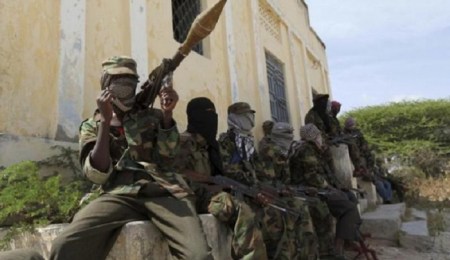
Islamic terrorist group al-Shabaab’s beheadings and attacks against Christians will continue to rise, with the Somali-based militants having an estimated 9,000 jihadis at their disposal.

Christians “are facing growing persecution around the world, fueled mainly by Islamic extremism and repressive governments.” Warnings of “a form of genocide” and “religio-ethnic cleansing” have been issued, and as Christian suffering expands globally, the West continues to bow in submission to the contrived victimology narrative of “Islamophobia,” while the real victims — peaceful Christians — continue to be slaughtered for their faith.

Western nations have virtually abandoned Christians, who are not only victims of war but are persecuted as well. Western governments are catering almost exclusively to Muslim refugees, many of whom have caused havoc across Europe, enough to cause Hungary, Poland and the Czech Republic to close their doors to Muslim asylum seekers to avoid jihad attacks, mass sex assaults against infidels, and lawlessness.

The former Archbishop of Canterbury, Lord George Carey, has stated bluntly of the UK — and his words apply across the Western world — that “politically correct” officials were “institutionally biased” against Christian refugees, who are not being resettled in the UK at the same rate as Muslim refugees.

As 9,000 jihadists in East Africa prepare to launch gruesome attacks against Christians, the American Center for Law and Justice has desperately urged:

This heinous jihadist army must be stopped. Al-Shabaab’s atrocities against Christians and brutal persecution of churches in Kenya can no longer be ignored or tolerated. We must be heard.

Christian persecution has been ignored and tolerated for far too long.

“Al-Shabaab’s ‘Demented’ Beheadings, Killing of Christians on the Rise; 9,000 Jihadis Ready”, by Stoyan Zaimov, Christian Post, September 1, 2017:

Islamic terrorist group al-Shabaab’s beheadings and attacks against Christians will continue to rise, with the Somali-based militants having an estimated 9,000 jihadis at their disposal, a law group monitoring religious persecution warned.

The American Center for Law and Justice listed on Thursday the growing list of barbaric attacks carried out by the terrorist group over the past couple of years, including door-to-door raids in villages in Kenya in July, where the militants hunted down and killed seven Christians.

In August, al-Shabaab militants killed another four Christians in Kenya’s Lamu County, beheading three and burning alive another.

The group is also infamous for the mass slaughter of 148 people at Garissa University in April 2015, when the militants specifically searched for Christian students to kill, separating them from the Muslims.

“This heinous jihadist army must be stopped. Al-Shabaab’s atrocities against Christians and brutal persecution of churches in Kenya can no longer be ignored or tolerated. We must be heard,” ACLJ urged.

“Al-Shabaab’s actions are clearly deadly, demented, disturbing, and disgusting. We must defeat and destroy these Islamic jihadists.”

The law group warned, however, that the Islamic radical group may have an “estimated 9,000 jihadist soldiers and a plethora of outside resources to draw upon,” making their terrorist activities “less and less likely to relent.”

The U.S. military has been carrying out air strikes against al-Shabaab’s bases in Somalia, looking to dismantle its operations, though Kenya has largely been unable to stop the cross-border attacks.

The law group pointed out that it has been warning about the spread of al-Shabaab for years, and echoed its words from 2015:

“[Y]et another radical Islamic jihadist army — just like ISIS, the Islamic State — is ruthlessly murdering Christians, targeting them for their faith. This global and historic persecution continues.”

The East African Centre for Law & Justice, an ACLJ affiliate, noted: “In the past few years, the Somalia-based terrorist group al-Shabaab carried out attacks in the counties of Mombasa, Mandera, Garissa, Wajir, Lamu, and Tana River and said it had targeted non-Muslims because of their faith.

“In Lamu County, al-Shabaab claimed responsibility for at least 65 deaths, with some witnesses reporting the terrorists asked the religion of victims, killing non-Muslims.”

The terrorist group, whose name translates to “The Youth,” has been active for over a decade, and has been looking to enforce Sharia law on the regions in Somalia it has gained control of.

Al-Shabaab has specifically been targeting the Church in Kenya, which it accuses of spreading the Christian faith in the region.

The Africa Center for Strategic Studies said in June that al-Shabaab has now become Africa’s deadliest terrorist group, surpassing even Nigeria’s Boko Haram. Data analyzed showed that al-Shabaab killed over 4,000 people in 2016.

Besides its terrorist activities, the Critical Threats monitoring group warned in April that al-Shabaab has also been targeting vulnerable populations in rural Somalia by providing them with humanitarian aid, as part of a strategy to cultivate support.

“The group is well-positioned to capitalize on devastating drought and impending famine…..

Steyn: Wasserman Schultz scandal is Russia and no one cares

September 2, 2017

Steyn: Wasserman Schultz scandal is Russia and no one cares, Fox News via YouTube, August 30, 2017


‘Lost years’ & ‘stagnation’? Doubts linger as longtime leader Merkel on way to securing new term — RT News

September 2, 2017

Source: ‘Lost years’ & ‘stagnation’? Doubts linger as longtime leader Merkel on way to securing new term — RT News

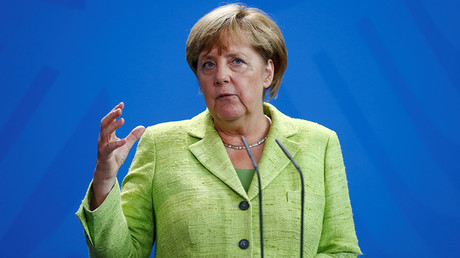
German Chancellor Angela Merkel © Reinhard Krause / Reuters

Angela Merkel could become the joint longest-serving modern German chancellor, according to the latest polls – that’s despite standing accused of “putting problems on the back burner” and lingering doubts that her new term may bring “stagnation” for Germany.

With less than a month to go until the next German federal parliamentary elections, Merkel’s Christian Democratic Union (CDU) party is leading the polls by a wide margin ahead of the Social Democrats, according to the latest surveys conducted by German public broadcasters. This means Merkel has a fair chance of securing a fourth term as German chancellor, after she was reelected CDU leader at the party’s 2016 congress and announced her bid for the chancellorship in November of this year.

What’s behind Merkel’s political longevity?

Merkel has been head of the CDU since 2000 and has held the post of chancellor for nearly 12 years, since September 2005, with her party winning three elections in a row.

If she is indeed victorious in the September polls and then serves a full term, Merkel would become one of the longest-ruling German leaders in the country’s entire history. The current chancellor would equal the tenure of former leader Helmut Kohl, who stayed in office for 16 years and outmatched the “Father” of the Federal Republic of Germany, Konrad Adenauer, whose tenure stretched over 14 years. In fact, Merkel would trail only Otto von Bismarck, the man behind the creation of the unified German Empire who served as chancellor under three monarchs in 1871–90.

Read more

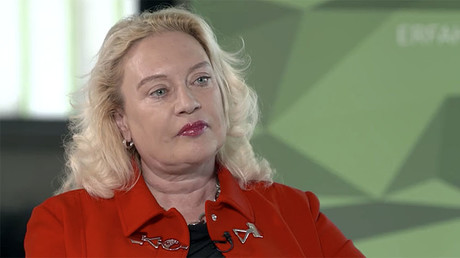
German freelance reporter Claudia Zimmermann © RT

While some may wonder about Merkel’s political longevity, German lawyer Maximilian Krah, a former CDU politician, explains that her long time in office is simply a result of placing all possible alternatives out of reach. “German democracy has become highly dysfunctional under Merkel’s government… so you have a politician who kicks out everyone who’s capable of replacing her,” he told RT. “There are literally no alternatives left,” Krah added.

Harold Amann, a spokesperson for the Bavaria Party, also told RT that Merkel was “very skillful in discovering and eliminating every potential rival.”

“A lot of the members in the big, established parties have joined them mainly as a career-option not because of their political opinion. After a long way to the top these people tend to be careerists and yes-men. They avoid risks and don’t challenge the party leadership,” he said.

And the problems run deeper, since the media in Germany is apparently not rushing to challenge the views and narrative of Merkel’s government, RT has been told. “I think it’s quite obvious that the mass media and TV are brought into line in favor of her leadership,” a former member of the CDU and current AfD member, Doris Von Sayn-Wittgenstein, told RT. She noted that people in Germany are not being told the truth about the scale of the migrant crisis and would re-think their support of Merkel otherwise.

The role of the media can differ though, Krah explained, noting that Merkel can simply sit back and wait to see how news outlets cover certain issues. “So she is just looking how the media and how the left-wing NGOs and civil society are reacting to something, and then she is taking their position,” he argued.

Europe’s veteran

Merkel’s longevity in her post is in contrast to many of her European allies. Four British prime ministers and four French presidents have served during her tenure. In Italy, the leadership has changed as many as seven times over the same period, with six different people taking the post of prime minister.

Read more

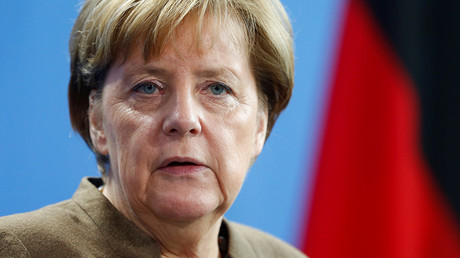
German Chancellor Angela Merkel  © Hannibal Hanschke

Merkel has already surpassed the “Iron Lady,” former British PM Margaret Thatcher, as Europe’s longest-serving female leader. Thatcher stayed in power for 11 years. Indeed, few European politicians have held such an influential office uninterrupted for a such a length of time. Portuguese politician Anibal Cavaco Silva had two separate 10-year terms from 1985, and the EU Commission president, Jean-Claude Juncker, who occupied the post of prime minister of Luxembourg for nearly 20 years.

Ironically, Merkel is already way ahead of Hungarian Prime Minister Viktor Orban, who is routinely accused by Western politicians and media of “eroding democracy” and creating an “illiberal state” to stay in power. Orban has so far been in power for seven years.

Fears of ‘stagnation & lost years’ under Merkel

Merkel’s announcement in November that she would run for a fourth term was met with mixed emotions. While her supporters praised the decision, others accused Merkel of not knowing when to quit and assumed that she had become addicted to power. According to Amann, Merkel’s victory would mean “stagnation” and “four more lost years…far from the restart that this country would need.”

Read more

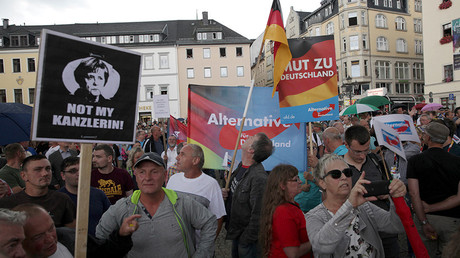
Alternative for Germany party supporters protest during the election rally of the German Chancellor Angela Merkel ) in Annaberg-Buchholz, Germany August 17, 2017 © Matthias Schumann

Even though the massive rallies under the slogan “Merkel must go!” (Merkel muss weg!) that Germany witnessed over the course of the refugee crisis seem to have become a thing of the past, the groups on social networks under the same slogan are still active and have amassed tens of thousands of followers.

Merkel’s latest election campaign rallies were at times hijacked by angry protesters. On August 26, a crowd of protesters yelled“Liar!” and whistled at Merkel during a 30-minute speech in Quedlinburg, a town in Saxony-Anhalt.

A similar incident took place at a previous rally in the town of Annaberg-Buchholz, where protesters held banners branding her a “traitor” and saying that she was “not my chancellor.”

In both cases, the demonstrators expressed their discontent with Merkel’s refugee policy, which they said had failed. Amann says he doesn’t believe the “rift” in society will go away after the election.

‘Putting problems on the back burner’

Key politicians in Germany also did not pull any punches on Merkel’s prolonged tenure. The leader of the Free Democrats, Christian Lindner, criticized her decision to run for chancellor for a fourth time and suggested that Merkel take up a UN post instead.

Read more

 German Chancellor Angela Merkel © Hannibal Hanschke

“Taking into account Angela Merkel’s weight in the international arena, she would surely be a good UN secretary general, but her interior policy during her tenure as chancellor was unfortunately unfounded,” Lindner told Germany’s DPA news agency in late 2016. Merkel’s election rival Schulz has recently gone as far as to accuse her of “neglecting her duty and putting the future of our country at risk.”

He also called Merkel “a professional in putting problems on the back burner” in an interview with the Der Spiegel weekly in early August.

Merkel “did not say a word” about “tattered schools, the suffering of refugees, tax evasion, the financial and banking crisis, the reform of EU institutions and attacks on democracy in Poland and Hungary,” he said at the time.

He claimed that Merkel “apparently lacks courage and skill” to address the issues that concern many Germans.

Amann seemed to agree, telling RT that Merkel “was of course very successful in telling the people that everything is all right. But a lot of problems are unsolved. Look at the Euro-crisis; this is far from over, or the refugee-crisis – also far from over. Her tendency to procrastinate over problems will be very bad for the people here in the long run.”

Sayn-Wittgenstein argued that Merkel in fact was the one “causing problems,” with Germany under her leadership turning into the “most disliked country in Europe… if you look at the financial crisis, how we deal with the southern states.”

‘Hope for change’

After 12 years in power, Merkel still enjoys significant support from the German public. According to recent polls cited by national media, there is a wide margin between the personal approval rating of Merkel and that of her closest competitor – the Social Democratic (SPD) chancellor candidate, Martin Schulz.

Read more

Merkel will run for a fourth term. © Hannibal Hanschke

Yet Andrej Hunko, an MP for Germany’s Left Party, told RT that Germans proved there was “discontent and hope for change” when Merkel’s approval rating dropped earlier this year, after Schulz announced his ambitions for the chancellery. However, such discontent needs to be articulated through a “really antagonistic strategy against Merkel and the CDU,” while Schulz’s SPD “seems to be more of a copy of Merkel’s policies with some small adjustments.”

A survey, conducted by UK-based market research company YouGov in August 2017, showed that only 42 percent of Germans would vote for Merkel if they had the opportunity to choose a chancellor directly.

Another poll conducted by the company and published in February showed that 42 percent of respondents strongly wanted Merkel out, while 22 percent said it was “probably” a good idea to elect a new leader. Hunko slammed Merkel’s election strategy, saying it is “basically to point out that compared to other countries in Europe and around the world, Germany is relatively calm.” Yet, under this apparent smoke screen “Merkel’s governments have pushed millions into precarious jobs, lowered retirement pensions and put the healthcare system into a constant crisis.”