Archive for September 2017

When nothing deters the clever brutal tyrant

September 5, 2017

When nothing deters the clever brutal tyrant, Washinton TimesWesley Pruden, September 4, 2017

(Words, words, I’m so sick of words.

Yep. But not in the same context — DM)

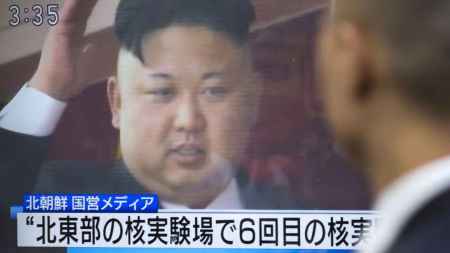
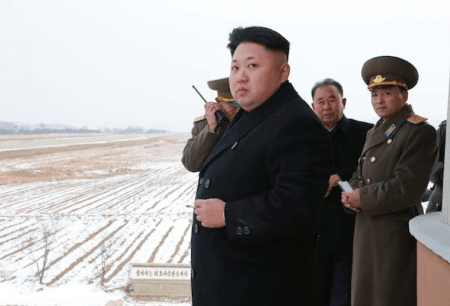
Kim Jong-Un

ANALYSIS/OPINION:

If words were bullets, the crazy fat kid in Pyongyang would have been dead a long time ago, with his ample carcass on display now within a shrine of marble, plaster and tears. But under that goofy haircut there’s a brain that is not so crazy at all.

Words, words, words. Nikki Haley, the U.S. ambassador to the United Nations, says North Korea is “begging for war,” which suggests that North Korea will get it if the begging continues. “Enough is enough. War is never something the United States wants. We don’t want it now. But our country’s patience is not unlimited.”

President Trump telephoned President Moon Jae-in in Seoul and they agreed that the fat kid’s explosion of a hydrogen bomb, underground or not, is not only a grave provocation, but “unprecedented,” too.

One after another, diplomats of America’s more or less reliable European allies, Britain, France and Italy, renewed demands for Kim Jong-un to behave himself, or else be sent to his room without supper. They demand that he halt his nuclear weapons program and ballistic missile scheme, or else — “else” being more of the sanctions that so far haven’t worked.

Francois Delattre, the French ambassador to the U.N., proposes “new” sanctions by the U.N., implementing the sanctions already in place, and new and separate sanctions that also might not work by the European Union. Words, words, words.

Sebastiano Cardi, the Italian ambassador, repeats the chorus as if he were singing the grace notes in an aria from Verdi: “Pyongyang poses a clear threat challenging the global nonproliferation regime.” Mr. Cardi is chairman of the U.N. North Korean compliance committee, and observes that North Korea is the only country to have tested a nuclear device in the 21st century. Mr. Cardi imagines this might shame the fat kid, but Kim takes it as a compliment. He has the toys that the other kids can only envy.

Japan and South Korea have unique critical concerns, sharing a neighborhood with the villains in the North. “We cannot waste any more time,” says the Japanese ambassador, Koro Bessho. “We need North Korea to feel the pressure, that if they go down this road there will be consequences.”

All true, all to the point, but Kim can count it all as just more yada, yada, yada from those he torments. He has his neighbors, and the lord protector the United States, backed into a corner, and he has never had so much fun. He doesn’t mind being the international pariah. He knows the United States dare not put the American boot with its hobnails on his neck, where it could squash him like a bug on the sidewalk, for fear of inviting massive retaliation on Seoul, killing upwards of a million innocents.

Nikki Haley suggests spreading the pain of sanctions, punishing nations that do business with Pyongyang, whether in contraband food and oil, or textiles, the profitable North Korean export so far untouched by the sanctions in place. Tighter limits on exporting North Korean laborers to other nations have been suggested, too. Much of the money these laborers earn is confiscated by the Pyongyang government, and important to the North Korean economy.

Russia and China, always eager to be helpful, suggest bartering Kim’s nuclear threat against the American guarantee of South Korean national security. Eliminate both and every conflict would be resolved, every rough place made smooth and plain. Both Russia and China know this is unacceptable to both Washington and Seoul, and it’s not a solution offered in good faith, anyway.

Some diplomats, pundits and other speculators argue that since nothing else works, returning to “diplomacy,” that vague and formless cure-all that usually cures nothing and invites only more yada, yada, yada, is the way to go. “Jaw, jaw beats war, war,” as Mr. Churchill said, but jaw, jaw has its limits, too.

Doing nothing is what brought the United States — and its allies — to the present moment. Bill Clinton, distracted by staining Monica Lewinsky’s little blue dress and spending the rest of his attention on the hot pursuit of other passing skirts, imagined that sending groceries to North Korea would transform the Kim family into small-d democrats, eager to make the world a happy place. They took the groceries and continued work on splitting the atom. Barack Obama, itching to reduce America’s size in the world, was always ready to make another speech, but not much else.

No one disputes that the way forward is hard, but the threat of an out-of-control regime armed with nuclear bombs and the missiles to deliver them to faraway places, is real and the hour is late. The strategy of three presidential administrations seems fashioned by Mr. Micawber, the Dickens character who could never quite succeed at anything but was always sure that “something will turn up.” Something must, and soon.

• Wesley Pruden is editor in chief emeritus of The Times.

Trump Steals Food from Black Kid

September 5, 2017

Trump Steals Food from Black Kid 😂, Mark Dice via YouTube, September 4, 2017

Fat Kim threatens Trump (again)

September 5, 2017

Fat Kim threatens Trump (again), American ThinkerGary Gindler, September 5, 2017

(This is the most fascinating, and best, suggestion on dealing with North Korean nukes I have read thus far –  force China to take care of the problem. Please see also, Chinese Official Says China Might Invade Taiwan If “Peaceful Reunification Takes Too Long.” — DM)

It’s time for Trump to make an unconventional move – a move no one expects.

It is better not to increase the U.S. military potential in the region.  On the contrary, it is better to completely withdraw all American troops from both South Korea and Japan.

In fact, American troops need to be relocated not into the continental U.S., but to Taiwan.

This move by Trump will make China stop playing the role of an outside observer.  China will be faced with a choice – either China joins Trump on this issue, or she will never get back Taiwan, where the headquarters of the 7th U.S. Navy Fleet will now be located.

Of course, America’s allies in the region, Japan and South Korea, in the face of the withdrawal of U.S. troops, will quite justifiably demand new guarantees of protection from the U.S. government.  America should renew its lend-lease program from the Second World War and lease over to Japan and South Korea, for a term of 99 years, all the nuclear weapons they will ask for.  The military budgets of these countries will skyrocket.  China’s inaction toward the Fat Kim regime will lead to the fact that in addition, China will get two unfriendly nuclear powers armed to the teeth at her own border.

***********************

After Kim Jong-un tested his hydrogen bomb, everything in the world went just as we could expect.  Someone started saber-rattling, and someone insisted that the problem of nuclear North Korea cannot be solved by military means under any circumstances.

Both use very serious arguments.  Those who support appeasement of Kim quite reasonably note that the capital of South Korea, with its 25 million-strong population, is at an artillery salvo distance from the border with North Korea.  Even a limited volley from the north will lead to hundreds of thousands of civilian casualties.  Supporters of a massive blow to North Korea argue that it is better to have thousands of casualties among Koreans than to wait until the hydrogen bomb explodes over San Francisco and Americans become the victims.

Both sides have numerous supporters in the highest echelons of power in Washington.

Meanwhile, Fat Kim does not present a threat to the United States at present.  Fat Kim is a threat to President Trump.

Fat Kim is not a dumb bump.  He’s just one of the players in the next political show of the Axis countries.  The North Korean crisis allows others hostile to America – countries such as Iran, Russia, and Syria (i.e., Axis countries) – to check Trump’s resolve.  China is not a member of this Axis, but it watches Trump with great pleasure as he tries to get out of this entrapment.

All the Axis countries are linked by longstanding nuclear technology ties.  Of all the Axis countries, only Syria lacks this technology (the Syrian nuclear reactor, which was built by North Korean engineers, was bombed by Israel in 2007).

The Axis countries are waiting for Trump’s move.  A standard geopolitical analysis shows that there are many options for Trump, but they all range from bad to very bad.

It’s time for Trump to make an unconventional move – a move no one expects.

It is better not to increase the U.S. military potential in the region.  On the contrary, it is better to completely withdraw all American troops from both South Korea and Japan.

In fact, American troops need to be relocated not into the continental U.S., but to Taiwan.

This move by Trump will make China stop playing the role of an outside observer.  China will be faced with a choice – either China joins Trump on this issue, or she will never get back Taiwan, where the headquarters of the 7th U.S. Navy Fleet will now be located.

Of course, America’s allies in the region, Japan and South Korea, in the face of the withdrawal of U.S. troops, will quite justifiably demand new guarantees of protection from the U.S. government.  America should renew its lend-lease program from the Second World War and lease over to Japan and South Korea, for a term of 99 years, all the nuclear weapons they will ask for.  The military budgets of these countries will skyrocket.  China’s inaction toward the Fat Kim regime will lead to the fact that in addition, China will get two unfriendly nuclear powers armed to the teeth at her own border.

If Trump adds to this the ban on trade with all countries that have trade relations with North Korea, then China, with four fifths of its economy dependent on the U.S. market, will suffer the most.

There is every reason to believe that China will make a reasonable choice.  Most likely, she will do this much earlier than the first transport from Japan with the U.S. Marine Corps docks in Taipei.  It is unreasonable to assume that China does not have a well conceived plan for rapid regime change in North Korea.

If wisdom escapes the Chinese communists, then as the icing on the cake, they will get a united Korea at their side.  Capitalistic.  And nuclear.


North Korea’s Ultimatum to America

September 5, 2017

North Korea’s Ultimatum to America, Front Page MagazineCaroline Glick, September 5, 2017

(We should strike North Korea and eliminate it as a nuclear threat. We have first-strike capability which, if used can eliminate the danger to South Korea and Japan as well as to America. Perhaps we should wait — but not long — until North Korea “tests” a missile directed toward Guam. Then we should act immediately and without warning. We can even do it successfully without using our own nukes. On the other hand, we have a new option. Please see also, How to neutralize the North Korea threat. It might, or might not, work. If it works as advertised, great. If it fails, we will have lost very little. –DM)

Originally published by the Jerusalem Post

If the US strikes North Korea in a credible manner and successfully diminishes its capacity to physically threaten the US, America will have taken the first step towards rebuilding its alliances in Asia.

On the other hand, if the current round of hostilities does not end with a significant reduction of North Korea’s offensive capabilities, either against the US or its allies, then the US will be hard pressed to maintain its posture as a Pacific power. So long as Pyongyang has the ability to directly threaten the US and its allies, US strategic credibility in East Asia will be shattered.

***********************************

The nuclear confrontation between the US and North Korea entered a critical phase Sunday with North Korea’s conduct of an underground test of a thermonuclear bomb.

If the previous round of this confrontation earlier this summer revolved around Pyongyang’s threat to attack the US territory of Guam, Sunday’s test, together with North Korea’s recent tests of intercontinental ballistic missiles capable of reaching the continental US, was a direct threat to US cities.

In other words, the current confrontation isn’t about US superpower status in Asia, and the credibility of US deterrence or the capabilities of US military forces in the Pacific. The confrontation is now about the US’s ability to protect the lives of its citizens.

The distinction tells us a number of important things. All of them are alarming.

First, because this is about the lives of Americans, rather than allied populations like Japan and South Korea, the US cannot be diffident in its response to North Korea’s provocation. While attenuated during the Obama administration, the US’s position has always been that US military forces alone are responsible for guaranteeing the collective security of the American people.

Pyongyang is now directly threatening that security with hydrogen bombs. So if the Trump administration punts North Korea’s direct threat to attack US population centers with nuclear weapons to the UN Security Council, it will communicate profound weakness to its allies and adversaries alike.

Obviously, this limits the options that the Trump administration has. But it also clarifies the challenge it faces.

The second implication of North Korea’s test of their plutonium-based bomb is that the US’s security guarantees, which form the basis of its global power and its alliance system are on the verge of becoming completely discredited.

In an interview Sunday with Fox News’s Trish Regan, former US ambassador to the UN John Bolton was asked about the possible repercussions of a US military assault against North Korea for the security of South Korea.

Regan asked, “What are we risking though if we say we’re going to go in with strategic military strength?… Are we going to end up with so many people’s lives gone in South Korea, in Seoul because we make that move?” Bolton responded with brutal honesty.

“Let me ask you this: how do you feel about dead Americans?” In other words, Bolton said that under prevailing conditions, the US faces the painful choice between imperiling its own citizens and imperiling the citizens of an allied nation. And things will only get worse. Bolton warned that if North Korea’s nuclear threat is left unaddressed, US options will only become more problematic and limited in the years to come.

This then brings us to the third lesson of the current round of confrontation between the US and North Korea.

If you appease an enemy on behalf of an ally then you aren’t an ally.

And eventually your alliance become empty of all meaning.

For 25 years, three successive US administrations opted to turn a blind eye to North Korea’s nuclear program in large part out of concern for South Korea.

Presidents Bill Clinton, George W. Bush and Barack Obama all sought to appease North Korea’s aggressive nuclear adventurism because they didn’t believe they had a credible military option to deal with it.

In the 1980s, North Korea developed and deployed a conventional arsenal of bombs and artillery along the demilitarized zone capable of vaporizing Seoul.

Any US military strike against North Korea’s nuclear installation it was and continues to be argued, would cause the destruction of Seoul and the murder of millions of South Koreans.

So US efforts to appease Pyongyang on behalf of Seoul emptied the US-South Korean alliance of meaning. The US can only serve as the protector of its allies, and so assert its great power status in the Pacific and worldwide, if it prevents its allies from being held hostage by its enemies.

And now, not only does the US lack a clear means of defending South Korea, and Japan, America itself is threatened by the criminal regime it demurred from effectively confronting.

Regardless of the means US President Donald Trump decides to use to respond to North Korea’s provocative actions and threats to America’s national security, given the nature of the situation, it is clear that the balance of forces on the ground cannot and will not remain as they have been.

If the US strikes North Korea in a credible manner and successfully diminishes its capacity to physically threaten the US, America will have taken the first step towards rebuilding its alliances in Asia.

On the other hand, if the current round of hostilities does not end with a significant reduction of North Korea’s offensive capabilities, either against the US or its allies, then the US will be hard pressed to maintain its posture as a Pacific power. So long as Pyongyang has the ability to directly threaten the US and its allies, US strategic credibility in East Asia will be shattered.

This then brings us to China.

China has been the main beneficiary of North Korea’s conventional and nuclear aggression and brinksmanship.

This state of affairs was laid bare in a critical way last month.

In mid-August, Trump’s then chief strategist Steve Bannon was preparing a speech Trump was set to deliver that would have effectively declared a trade war against China in retaliation for its predatory trade practices against US companies and technology. The speech was placed in the deep freeze – and Bannon was forced to resign his position – when North Korea threatened to attack the US territory of Guam with nuclear weapons. The US, Trump’s other senior advisers argued, couldn’t declare a trade war against China when it needed China’s help to restrain North Korea.

So by enabling North Korea’s aggression against the US and its allies, China has created a situation where the US has become neutralized as a strategic competitor.

Rather than advance its bilateral interests – like curbing China’s naval aggression in the South China Sea – in its contacts with China, the US is forced into the position of supplicant, begging China to restrain North Korea in order to avert war.

If the US does not act to significantly downgrade North Korea’s offensive capabilities now, when its own territory is being threatened, it is difficult to see how the US will be able to develop an effective strategy for coping with China’s rise as an economic and strategic rival in Asia and beyond. That is, the US’s actions now in response to North Korea’s threat to its national security will determine whether or not the US will be in a position to develop and implement a wider strategy for maintaining its capacity to project its economic and military power in the Pacific in the near and long term.

Finally, part of the considerations that need to inform US action now involve what North Korea’s success in developing a nuclear arsenal under the noses of successive US administrations means for the future of nuclear proliferation.

In all likelihood, unless the North Korean nuclear arsenal is obliterated, Pyongyang’s nuclear triumphalism will precipitate a spasm of nuclear proliferation in Asia and in the Middle East. The implications of this for the US and its allies will be far reaching.

Not only can Japan and South Korea be reasonably expected to develop nuclear arsenals. Saudi Arabia, Egypt, Jordan and other inherently unstable Arab states can be expected to develop or purchase nuclear arsenals in response to concerns over North Korea and its ally Iran with its nuclear weapons program linked to Pyongyang’s.

In other words, if the US does not respond in a strategically profound way to Pyongyang now, it will not only lose its alliance system in Asia, it will see the rapid collapse of its alliance system and superpower status in the Middle East.

Israel, for one, will be imperiled by the sudden diffusion of nuclear power.

Monday morning, North Korea followed up its thermonuclear bomb test with a spate of threats to destroy the United States. These threats are deadly even if North Korea doesn’t attack the US with its nuclear weapons. If the US does not directly defeat North Korea in a clear-cut way now, its position as a superpower in Asia and worldwide will be destroyed and its ability to defend its own citizens will be called into question with increasing frequency and lethality.

On a Quiet October Morning

September 5, 2017

On a Quiet October Morning, PJ MediaCharlie Martin, September 4, 2017

(Don’t worry. The UN is taking strong action by discussing the imposition of more sanctions. That’s always stopped North Korea in the past. Oh? It hasn’t? Well, this time it will work for sure. /sarc. — DM)

A submarine-launched ballistic missile is displayed in Kim Il Sung Square during a military parade on Saturday, April 15, 2017, in Pyongyang. (AP Photo/Wong Maye-E)

It was early, very early in Los Angeles. Dawn was just beginning — the horizon was a pure clear blue, the sky still dark enough that the constellations could be seen. The freeways were full, but the traffic was flowing well, and people on the road were congratulating themselves for their early start, or grateful their night shift was over and thinking about home and bed. Most people, though, were still asleep.

Hardly anyone was worrying about North Korea — China and Russia had finally come around on greater sanctions, and the common opinion was that a military coup was coming and Kim Jong Un was about to join his ancestors.

Until a new, very temporary star appeared in the western sky. People looking at it had a moment to wonder about the flash before seeing what seemed to be the aurora, something very rare in southern California. Then they were distracted, as their phones failed, many of their cars stalled, and they heard echoing muffled booms as power transformers all over the city exploded simultaneously. The entire Los Angeles basin went dark.

Chaos reigned. On the freeways, tens of thousands of cars traveling at highway speeds became uncontrollable missiles — engines stalled, lights out, skidding and scraping across the pavement out of control. Random fires were breaking out across the city — flammable buildings near exploding transformers, mostly, to start. The fires went largely unfought — the phone systems were out so the fire departments didn’t know about them, and the fire engines and ambulances wouldn’t start anyway (their computer-controlled ignition and fuel systems were dead).

By the time the sun was up, people were on the streets, worried, starting to panic. More explosions, big ones, were happening in El Segundo, Torrance, Wilmington, and being followed by massive fires filling the sky with black smoke — oil refineries and chemical plants had lost their control systems.

By noon, uncontrolled fires were sweeping across the valley. And that was just the first day.

Along with Harvey the Hurricane, and Melania’s shoes, and the possibility that Trump might announce tomorrow that Congress had six months to find a legislative solution for the “Dreamers” was the news that North Korea had exploded a nuclear bomb in the 150-kiloton range. North Korea’s government media called it a “hydrogen bomb,” but the yield better fits a boosted fissionweapon, one in which a small fusion reaction provides neutrons to make the fissioning uranium or plutonium more efficient.

In this case, however, it’s not the explosive force of the bomb that’s the problem. Exploded at a high altitude, the pulse of gamma rays and charged particles from the bomb interacts with the upper atmosphere and the Earth’s magnetic field, producing a gigantic electromagnetic field — essentially a very intense burst of radio energy. Conductors — like power lines, transformer coils, phone lines, even the conducting paths in small electronic components — “see” this as a rapidly changing magnetic field, which in turn accelerates electrons in the conductor. The effect is a massive electrical surge; weak points in each system fail as the surge hits them.

This is the “nuclear electromagnetic pulse” or NEMPJohn Moore here at PJ Media has been all over the possibility that North Korea is preparing for an EMP attack. With a true ICBM and a bomb that can be mated with it, North Korea has everything needed to make such an attack.

What this means is, as Ambassador Nicki Haley just said at the UN:

Nikki Haley on North Korea: “We have kicked the can down the road long enough. There is no more road left.”

In some ways, the U.S. was lucky — by detonating their bomb off the west coast, much of the U.S. mainland was not directly affected.

The president and secretary of Defense ordered a massive response. North Korea was rapidly obliterated with conventional and low-yield tactical nuclear weapons, the U.S. trying to limit the effects outside the Korean Peninsula.

South Korea wasn’t as lucky, as North Korea had attacked Seoul with their prodigious artillery forces simultaneously with the NEMP attack on the U.S. Hundreds of thousands, possibly millions, died; the destruction was so complete that a reliable count was never made. The South Korean military responded, attacking the artillery installations near the DMZ, while the U.S. and the Japanese Self-Defense Forces attacked Pyongyang itself, and every known location where the North Korean military might be protecting their high command. North Korea’s command and control infrastructure collapsed almost immediately, and rumors suggested Kim and his entire inner circle had been killed.

In the United States, military forces, National Guard, FEMA, and the Department of Homeland Security activated plans that suddenly seemed entirely inadequate. Reconnaissance aircraft and satellite imagery showed cities up and down the West Coast in flames, from Ensenada, Mexico, to Victoria, BC. The Air Transport Command was not far behind, as they delivered loads of fire equipment, military transport, and millions of bottles of water and MREs. In the Situation Room at the White House, no one was talking about the unfortunate arithmetic — fifty million people and not nearly enough supplies.


The possibilities of an EMP attack have been talked about for a long time, as John Moore’s articles show. It’s possible that the real risk is finally becoming clear to our politicians and our legacy press. The Boston Herald recently had an extended story on the danger of a North Korean NEMP attack, and Tucker Carlson recently showed interest in the problem.

Of course, there are others who don’t think it’s much of a risk, In that Boston Herald story, they quote Joshua Pollack, the editor of the Nonproliferation Review, as saying:

[A]n EMP attack doesn’t warrant more alarm than any other type of nuclear offensive because its efficacy is still uncertain — and it would have consequences for whichever nation launched it.

“It’s just an untested approach to trying to use a weapon, and just invites retaliation without doing a lot of damage,” Pollack said. “I’m much more concerned with blasting fire and radiation. Those will kill lots of people and destroy lots of stuff, and can do it very reliably.”

The problem here is that it’s based on a false assumption: that NEMP has not been tested. It’s never been applied as a weapon, but it has certainly been tested — and I don’t think my little fiction above is a worst-case scenario. So, how much damage from an inefficient NEMP attack should we plan on absorbing?

In 2015, Salon published an article pooh-poohing the notion of a NEMP attack, saying:

First, there’s Pry’s scenario. An EMP attack resulting from a high-altitude nuclear detonation seems a possible but not very plausible scenario. An adversary looking to carry out such an attack on the United States would need ballistic missiles and nuclear weapons. The missiles either need to be capable of an intercontinental launch or have a platform that can both move within range of the U.S. homeland undetected and launch a missile.

Well, now North Korea has the missiles, and North Korea has the bombs. Is it more plausible now?


Spring is finally coming to Los Angeles. Trees that survived the fires are blooming, birds are chirping. Millions of refugees have been relocated east of the Rockies, millions more are living in improvised shelters while the nation tries to plan what to do. Telephones and electrical systems are being restored, slowly, in a few places, limited by the number of transformers, phone switches, and other equipment that can be built. The state government is effectively gone, and the federal government has imposed martial law — but martial law that’s ineffective over much of the state. There are only so many soldiers.

And Iran has given Europe an ultimatum.

IDF simulates war-to-win strategy vs Hizballah

September 5, 2017

IDF simulates war-to-win strategy vs Hizballah, DEBKAfile, September 5, 2017

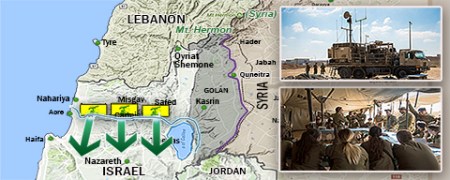
The IDF Tuesday, Sept. 5, embarked on its biggest military exercise against Hizballah in 19 years, with a radically revised mission in the face of a greatly empowered enemy (tanks and drones as well as 100,000 rocket and missiles) which is now embedded in Syria, not just in Lebanon.

Tens of thousands of ground, air, sea and intelligence units, including reservists – the IDF’s entire northern array – will simulate a Hizballah thrust across the border to occupy two Israeli locales in Galilee and the Golan. They will conduct simultaneous defensive and offensive operations deep behind enemy lines. The game plan is not to aim for a ceasefire and respite for the enemy to prepare for the next round, as the 2006 Lebanon war ended. This time, Israel strategists have set themselves the goal of defeating Hizballah convincingly enough to smash its morale and infrastructure and end its belief that it can destroy Israel the next time round

The exercise’s three military objectives are clearly laid out:

1.  Two sectors are defined for repelling a deep Hizballah thrust into northern Israel; (see map)

(a)  Hizballah is expected to go for the Metulla-Misgav sector on the Lebanese border, as well as the “Fatma Road” linking the Galilee hills north of Kiryat Shemona along the Israeli-Lebanese border.

(b)  Zarit-Shetula in western Galilee north of Nahariya, which is close enough to the Lebanese border for Hizballah troops to reach by land and through tunnels.

Israeli forces will practice driving the enemy out of occupied towns and villages, often using the element of surprise.

2. Another major IDF force will storm across the border into Lebanon for an effort to rapidly and decisively defeat Hizballah on its home ground. The defensive operation apart, the IDF is resolved to inflict on the enemy intolerable losses of life, infrastructure and territory.

This fighting-to-win strategy draws heavily on the negative lessons of the 2006 war, DEBKAfile’s military sources report. Then, the IDF’s overreliance on air might for winning the war proved counterproductive. By the time ground troops were deployed to cross the border and challenge Hizballah, they were too few and too late.

3.  This time, the air force is practicing a different role in the conflict, in coordination with Israel’s heavily upgraded, multi-tier air defenses. They will not only be geared for contending with Hizballah’s vast 100,000 rockets and missiles, but also, for the first time, with a formidable fleet of assorted UAVs, which are designed to serve the enemy in multiple tasks: intelligence-gathering, delivering rockets and guided  drones packed with explosives.

Also for the first time, the IDF will prepare to order the evacuation of civilians, up to 75,000, from towns and village within close range of Hizballah fire. Their evacuation may take place by roads that are under enemy attack.

Israel demands strong action against North Korea after nuclear test

September 5, 2017

September 4, 2017

Source: Israel demands strong action against North Korea after nuclear test

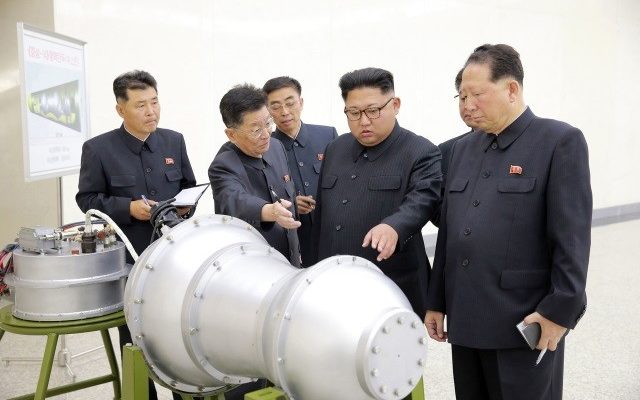
North Korean leader Kim Jong Un inspects an H-bomb. (Korean Central News Agency/Korea News Service via AP)

Israel condemned North Korea for its H-bomb test and called on the international community to take decisive action against Pyongyang. 

Israel’s Ministry of Foreign Affairs on Monday issued a sharp condemnation of North Korea’s testing of a hydrogen bomb the previous day – its sixth nuclear test.

“The State of Israel condemns the recent nuclear test conducted by North Korea. The test is a continuation of North Korea’s pattern of defiant activity,” the statement said.

Israel said that North Korea must comply with all Security Council resolutions on this issue and “refrain from testing and developing weapons of mass destruction and their delivery systems.”

“Only a determined international response will prevent other states from behaving in the same way,” the statement said.

Israel is closely monitoring the developing crisis between North Korea and the US and its allies, as its outcome can affect Israel’s security challenges.

The failed nuclear deal between the US and North Korea was perceived as a model of successful diplomacy after which the nuclear deal with Iran was modeled.

The international community’s response to Pyongyang’s will significantly affect how Tehran conducts itself in the future, as Israel fears that it is attempting to secretly develop nuclear weapons while outwardly abiding by the terms of the nuclear accord.

Israel also fears that a weak response against North Korea will embolden Iran to pursue its quest for weapons of mass destruction.

Similarly, a senior Israeli military official told reporters at a special briefing in April that rising tensions with North Korea may push the US to divert security resources from the Middle East to the Korean peninsula, which would have repercussions for Israel and the threats it is encountering in the region.

By: World Israel News Staff


North Korea Nuclear Progress Puts Iran on Renewed Pathway to Bomb

September 4, 2017

North Korea Nuclear Progress Puts Iran on Renewed Pathway to Bomb, Washington Free Beacon, September 4, 2017

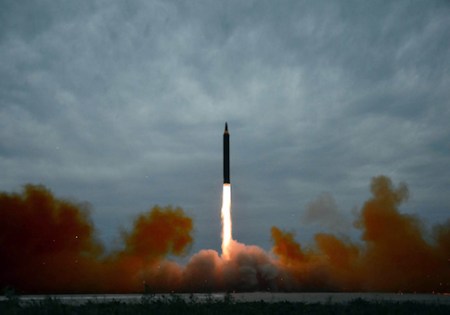
North Korea’s intermediate-range strategic ballistic rocket Hwasong-12 lifts off / Getty Images

Iran and North Korea have been sharing nuclear materials and know-how for well over a decade, according to sensitive intelligence community communications published by WikiLeaks and dating as far back as 2009.

The Obama administration took little action during its time in office to thwart this growing alliance, leading to increased nuclear ties between Iran and North Korea, multiple sources said.

In order to comply with the nuclear agreement, Iran outsourced much of its nuclear technology to North Korea, according to multiple sources, who pointed to evidence of a key 2015 meeting between the two countries surrounding the nuclear portfolio.

“Thanks to the Obama-Khamenei nuclear deal, Iran is flush with cash and has the capacity to be a willing buyer for nuclear material,” DeSantis said. “This represents a major threat to the United States and should be taken seriously.”

**************************

U.S. officials are closely monitoring an ongoing meeting between senior North Korean and Iranian officials that comes on the heels of a nuclear test by Pyongyang, according to senior Trump administration officials and other sources who expressed concern that North Korea is helping to put the Islamic Republic back on the pathway to a functional nuclear weapon.

Sources told the Washington Free Beacon that Pyongyang continues to stockpile illicit nuclear material on Iran’s behalf in order to help the Islamic Republic skirt restrictions implemented under the landmark nuclear deal.

North Korea’s latest nuclear test of a hydrogen bomb has roiled Trump administration officials and led President Donald Trump to consider multiple options for war. However, it also has renewed fears among U.S. officials and foreign policy insiders about Pyongyang’s long-standing relationship with Iran, which centers on providing the Islamic Republic with nuclear technology and know-how.

The head of North Korea’s parliament arrived this weekend in Iran for a 10-day visit aimed at boosting ties between the two countries amid an international crackdown on Pyongyang’s nuclear weapons program, a situation U.S. officials tell the Free Beacon is being closely monitored.

As North Korea makes progress in its nuclear pursuits, it is likely this information is being shared with senior Iranian officials who continue to maintain and build upon the country’s weapons program, despite the nuclear agreement, which only limits a portion of Iran’s nuclear enrichment and research abilities.

One senior U.S. official currently handling the Iranian and North Korean nuclear portfolios told the Free Beacon that the collaboration between these two countries is being closely monitored by the Trump administration, which will not hesitate to take action to disrupt this relationship.

“The history of collaboration between North Korea and Iran has been an ongoing concern and needs to be watched closely,” the official told the Free Beacon. “We’ve been laboring under the false assumption that these oppressive regimes are rational and that we can persuade them to act for the greater good. President Trump has made it clear those days are at an end, and that the United States will do what is necessary to prevent Iran from turning into another North Korea.”

Iran and North Korea have long collaborated on their missile programs and nuclear technology, and the U.S. intelligence community continues to monitor ongoing efforts by the two countries to boost cooperation.

Kim Yong Nam, the head of North Korea’s parliament, reportedly arrived in Iran on Thursday for a high-profile meeting with Iranian President Hassan Rouhani that is likely to center around Tehran’s quest for technology and North Korea’s need for hard currency and financial assets.

Iran has been flush with cash and other financial assets since the nuclear agreement lifted international sanctions and opened the Islamic Republic to new business ties.

Rep. Ron DeSantis (R., Fla.), a member of the House Foreign Affairs Committee and the National Security Subcommittee, told the Free Beacon that the increased ties are cause for concern, particularly in light of Iran’s renewed economic success.

“Given that Kim Jong Un is a plump, immature kid who only rules because of accident of birth, it is not clear that he can, through traditional means, be deterred from commencing an attack against the United States using his nuclear arsenal,” DeSantis told the Free Beacon. “What is completely clear is that Kim is willing to transfer nuclear technology to, and assist with nuclear development for, rogue regimes such as Iran.”

“Thanks to the Obama-Khamenei nuclear deal, Iran is flush with cash and has the capacity to be a willing buyer for nuclear material,” DeSantis said. “This represents a major threat to the United States and should be taken seriously.”

North Korea’s latest nuclear test has sparked a fierce war of words with the Trump administration, which announced on Monday that it is considering a range of military options.

United Nation’s Ambassador Nikki Halley said that North Korean leader Kim Jong Un is “begging for war” and urged the U.N.’s Security Council to consider a strong response.

“Enough is enough,” Haley was quoted as saying. “War is never something the United States wants. We don’t want it now. But our country’s patience is not unlimited.”

Israeli officials also have warned that North Korea’s latest test is a boon to Iran’s own nuclear program.

“The international response, led by the U.S., to the North Korean regime’s provocations, sheds light on how it will behave toward the Iranian regime on their nuclear efforts in the near future,” Moshe Ya’alon, a former Israeli defense minister, tweeted. “Although the nuclear test is not our issue, the tension should concern us.”

Iran and North Korea have been sharing nuclear materials and know-how for well over a decade, according to sensitive intelligence community communications published by WikiLeaks and dating as far back as 2009.

The Obama administration took little action during its time in office to thwart this growing alliance, leading to increased nuclear ties between Iran and North Korea, multiple sources said.

In order to comply with the nuclear agreement, Iran outsourced much of its nuclear technology to North Korea, according to multiple sources, who pointed to evidence of a key 2015 meeting between the two countries surrounding the nuclear portfolio.

Iran also has opened ballistic missile factories in Syria with the help of Russia and North Korea, according to regional reports.

“North Korea and Iran’s military and political ties are long-standing, and can be traced back to the 1980-1988 Iran-Iraq War, the same time that Tehran developed an interest in nuclear and missile technology,” said Behnam Ben Taleblu, an Iran analyst at the Foundation for Defense of Democracies.

“North Korea’s provision of the Nodong-A liquid fueled medium-range ballistic missile to Iran in the 1990s enabled the mullahs to make significant strides in the missile program and eventually even their satellite launch-vehicle technology,” Ben Taleblu explained.

“While some may see the long-standing missile relationship as merely evidence of the two countries’ interest in conventional munitions, these missiles are capable of carrying nuclear payloads, and offer both rogues the ultimate deterrent weapon with which to ensure regime survival,” he said.

Iranian officials and scientists have been spotted at several of North Korea’s key nuclear test, fueling speculation that the two countries are in close contact on the issue.

“What is almost certain, however, is the following: both in the post- and pre-JCPOA [or Joint Comprehensive Plan of Action, the formal name for the Iran deal] era, the two closely watched how each one negotiated with the international community, what deals it struck, the lies that worked and didn’t work, and where and how it could supplement resolve for material capability,” Ben Taleblu said.

Michael Rubin, a former Pentagon adviser and expert on rogue regimes, further told the Free Beaconthat it is suspected North Korean officials played a role in helping Iran recently test fire a series of ballistic missiles, which sparked international outrage and accusations the Islamic Republic is violating legally binding bans on such behavior.

“For those who want to deny the links between Pyongyang and Tehran, it’s easy so long as they ignore their military, diplomatic, and economic ties,” Rubin said. “It’s doubtful there has been a single Iranian missile test where North Korean scientists weren’t present, nor a North Korean test where Iranian scientists didn’t have a front row seat.”

One veteran congressional foreign policy adviser who works on the Iran portfolio told the Free Beacon that efforts to promote a new North Korean nuclear deal in the same vein as the Iran agreement are fruitless, and would only strengthen Pyongyang’s appetite to publicly test its nuclear weaponry.

“The same people who sold the Iran deal are now trying to sell what they call an ‘Iran deal for North Korea,'” the source said. “It’s the same groups, the same people, and the same playbook. Up until this weekend’s nuclear test, they were telling journalists that diplomacy has time to work, that North Korea is still years away from an H-Bomb, and—of course—that additional pressure would lead to war.”

“Now, all at once, their narratives about Iran and North Korea are both colliding with reality,” the source added. “The cost for American national security is staggering.”

Rubin went on to describe the North Korean stand-off as a glimpse into future situations with Iran.

“North Korea is a crystal ball into the future of the Iranian nuclear agreement, and the current diplomatic behavior in which there will be no support for inspections, which risk finding Iran in violation and imperiling the agreement, fits the pattern to a ‘T,'” Rubin said. “In addition, one of the biggest holes to which the Obama administration agreed was not recognizing that Iranian nuclear work doesn’t necessarily take place in Iran.”
South Korea, U.S. to scrap warhead weight limit on South Korean missiles: Blue House

September 4, 2017

South Korea, U.S. to scrap warhead weight limit on South Korean missiles: Blue House, ReutersChristine Kim, September 4, 2017

South Korea said earlier in the day it was talking to the United States about deploying aircraft carriers and strategic bombers to the Korean peninsula after signs North Korea might launch more missiles.

************************

SEOUL (Reuters) – South Korean President Moon Jae-in and his U.S. counterpart Donald Trump agreed on Monday to scrap a warhead weight limit on South Korea’s missiles in the wake of North Korea’s sixth nuclear test, South Korea’s presidential office said.

In a separate phone call with Russian President Vladimir Putin also on Monday, Moon said the U.N. Security Council should seek ways to sever North Korea’s foreign currency income, including from its workers employed abroad and oil shipments.

Under the existing missile pact between the United States and South Korea, Seoul’s warheads currently face a cap of 500 kg (1100 lb).

The agreement, last amended in 2012, was in the process of being changed in the wake of a series of missile tests by North Korea this year after Moon took office in May, including two intercontinental ballistic missile launches.

An unlimited warhead weight allowance would enable the South to strike North Korea with greater force in the event of a military conflict.

The missiles would still be bound by a flight range cap of 800 km. No changes to the flight range were mentioned in the Blue House statement.

The two presidents made the decision in a phone call, a statement from the Blue House said. They also agreed to apply the strongest sanctions and pressure on North Korea through the United Nations.

Most analysts and policymakers agree cutting off the oil pipeline to North Korea would hurt its economy. It remains to be seen whether China, the North’s biggest ally and trade partner, would cooperate.

South Korea said earlier in the day it was talking to the United States about deploying aircraft carriers and strategic bombers to the Korean peninsula after signs North Korea might launch more missiles.


Ex-Israeli Defense Minister: Iran Will Be Watching How World Reacts to North Korea’s Nuclear Provocations

September 4, 2017

Ex-Israeli Defense Minister: Iran Will Be Watching How World Reacts to North Korea’s Nuclear Provocations, AlgemeinerBarney Breen-Portnoy, September 3, 2017

(Another good reason for America to take prompt and decisive military action rather than merely sitting around at the UN and talking. — DM)

North Korean Supreme Leader Kim Jong-un. Photo: Twitter.

Iran will be watching how the world reacts to North Korea’s latest nuclear test, a former Israeli defense minister said on Sunday.

Following the news that Pyongyang had detonated what it claimed to be an advanced hydrogen bomb that could be put on an intercontinental ballistic missile, Moshe Ya’alon — a retired IDF lieutenant general who now heads the Manhigut Aheret NGO — tweeted, “The response of the international system, led by the US, to the North Korean regime’s provocations will be reflected in the Iranian regime’s behavior on the nuclear issue in the near future.”

“Although the nuclear test is not our concern, the tension should worry us,” Ya’alon continued.

תגובת המערכת הבינ״ל בהובלת ארה״ב להתגרויות המשטר הצפון קוריאני, תקרין על התנהלות המשטר האיראני בנושא הגרעין בעתיד הקרוב. 1/2

תגובת המערכת הבינ״ל בהובלת ארה״ב להתגרויות המשטר הצפון קוריאני, תקרין על התנהלות המשטר האיראני בנושא הגרעין בעתיד הקרוב. 1/2

למרות שהניסוי הגרעיני הוא לא מענייננו, המתיחות צריכה להדאיג אותנו. 2/2

In a March interview with The Algemeiner, proliferation expert David Albright said that paying attention to any potential nuclear cooperation between North Korea and Iran should be a priority for the Trump administration.