Archive for September 21, 2017

Presidential Executive Order on Imposing Additional Sanctions with Respect to North Korea

September 21, 2017

Presidential Executive Order on Imposing Additional Sanctions with Respect to North Korea, The White House, September 21, 2017

(As noted at Conservative Tree House,

President Trump and Secretary Mnuchin have structured this executive order in such a way that the downstream consequences from any economic engagement with the DPRK effectively cuts off that entity from ever engaging in commerce or economic activity with the United States.

— DM)

EXECUTIVE ORDER

– – – – – – –

IMPOSING ADDITIONAL SANCTIONS WITH RESPECT TO NORTH KOREA

By the authority vested in me as President by the Constitution and the laws of the United States of America, including the International Emergency Economic Powers Act (50 U.S.C. 1701 et seq.) (IEEPA), the National Emergencies Act (50 U.S.C. 1601 et seq.), the United Nations Participation Act of 1945 (22 U.S.C. 287c) (UNPA), section 1 of title II of Public Law 65-24, ch. 30, June 15, 1917, as amended (50 U.S.C. 191), sections 212(f) and 215(a) of the Immigration and Nationality Act of 1952 (8 U.S.C. 1182(f) and 1185(a)), and section 301 of title 3, United States Code; and in view of United Nations Security Council Resolution (UNSCR) 2321 of November 30, 2016, UNSCR 2356 of June 2, 2017, UNSCR 2371 of August 5, 2017, and UNSCR 2375 of September 11, 2017, I, DONALD J. TRUMP, President of the United States of America, find that:

The provocative, destabilizing, and repressive actions and policies of the Government of North Korea, including its intercontinental ballistic missile launches of July 3 and July 28, 2017, and its nuclear test of September 2, 2017, each of which violated its obligations under numerous UNSCRs and contravened its commitments under the September 19, 2005, Joint Statement of the Six‑Party Talks; its commission of serious human rights abuses; and its use of funds generated through international trade to support its nuclear and missile programs and weapons proliferation, constitute a continuing threat to the national security, foreign policy, and economy of the United States, and a disturbance of the international relations of the United States.

In order to take further steps with respect to the national emergency declared in Executive Order 13466 of June 26, 2008, as modified in scope by and relied upon for additional steps in subsequent Executive Orders, I hereby find, determine, and order:

Section 1. (a) All property and interests in property that are in the United States, that hereafter come within the United States, or that are or hereafter come within the possession or control of any United States person of the following persons are blocked and may not be transferred, paid, exported, withdrawn, or otherwise dealt in:

Any person determined by the Secretary of the Treasury, in consultation with the Secretary of State:

(i) to operate in the construction, energy, financial services, fishing, information technology, manufacturing, medical, mining, textiles, or transportation industries in North Korea;

(ii) to own, control, or operate any port in North Korea, including any seaport, airport, or land port of entry;

(iii) to have engaged in at least one significant importation from or exportation to North Korea of any goods, services, or technology;

(iv) to be a North Korean person, including a North Korean person that has engaged in commercial activity that generates revenue for the Government of North Korea or the Workers’ Party of Korea;

(v) to have materially assisted, sponsored, or provided financial, material, or technological support for, or goods or services to or in support of, any person whose property and interests in property are blocked pursuant to this order; or

(vi) to be owned or controlled by, or to have acted or purported to act for or on behalf of, directly or indirectly, any person whose property and interests in property are blocked pursuant to this order.

(b) The prohibitions in subsection (a) of this section apply except to the extent provided by statutes, or in regulations, orders, directives, or licenses that may be issued pursuant to this order, and notwithstanding any contract entered into or any license or permit granted before the effective date of this order. The prohibitions in subsection (a) of this section are in addition to export control authorities implemented by the Department of Commerce.

(c) I hereby determine that the making of donations of the types of articles specified in section 203(b)(2) of IEEPA (50 U.S.C. 1702(b)(2)) by, to, or for the benefit of any person whose property and interests in property are blocked pursuant to subsection (a) of this section would seriously impair my ability to deal with the national emergency declared in Executive Order 13466, and I hereby prohibit such donations as provided by subsection (a) of this section.

(d) The prohibitions in subsection (a) of this section include:

(i) the making of any contribution or provision of funds, goods, or services by, to, or for the benefit of any person whose property and interests in property are blocked pursuant to subsection (a) of this section; and

(ii) the receipt of any contribution or provision of funds, goods, or services from any such person.

Sec. 2. (a) No aircraft in which a foreign person has an interest that has landed at a place in North Korea may land at a place in the United States within 180 days after departure from North Korea.

(b) No vessel in which a foreign person has an interest that has called at a port in North Korea within the previous 180 days, and no vessel in which a foreign person has an interest that has engaged in a ship‑to‑ship transfer with such a vessel within the previous 180 days, may call at a port in the United States.

(c) The prohibitions in subsections (a) and (b) of this section apply except to the extent provided by statutes, or in regulations, orders, directives, or licenses that may be issued pursuant to this order, and notwithstanding any contract entered into or any license or permit granted before the effective date of this order.

Sec. 3. (a) All funds that are in the United States, that hereafter come within the United States, or that are or hereafter come within the possession or control of any United States person and that originate from, are destined for, or pass through a foreign bank account that has been determined by the Secretary of the Treasury to be owned or controlled by a North Korean person, or to have been used to transfer funds in which any North Korean person has an interest, are blocked and may not be transferred, paid, exported, withdrawn, or otherwise dealt in.

(b) No United States person, wherever located, may approve, finance, facilitate, or guarantee a transaction by a foreign person where the transaction by that foreign person would be prohibited by subsection (a) of this section if performed by a United States person or within the United States.

(c) The prohibitions in subsections (a) and (b) of this section apply except to the extent provided by statutes, or in regulations, orders, directives, or licenses that may be issued pursuant to this order, and notwithstanding any contract entered into or any license or permit granted before the effective date of this order.

Sec. 4. (a) The Secretary of the Treasury, in consultation with the Secretary of State, is hereby authorized to impose on a foreign financial institution the sanctions described in subsection (b) of this section upon determining that the foreign financial institution has, on or after the effective date of this order:

(i) knowingly conducted or facilitated any significant transaction on behalf of any person whose property and interests in property are blocked pursuant to Executive Order 13551 of August 30, 2010, Executive Order 13687 of January 2, 2015, Executive Order 13722 of March 15, 2016, or this order, or of any person whose property and interests in property are blocked pursuant to Executive Order 13382 in connection with North Korea‑related activities; or

(ii) knowingly conducted or facilitated any significant transaction in connection with trade with North Korea.

(b) With respect to any foreign financial institution determined by the Secretary of the Treasury, in consultation with the Secretary of State, in accordance with this section to meet the criteria set forth in subsection (a)(i) or (a)(ii) of this section, the Secretary of the Treasury may:

(i) prohibit the opening and prohibit or impose strict conditions on the maintenance of correspondent accounts or payable-through accounts in the United States; or

(ii) block all property and interests in property that are in the United States, that hereafter come within the United States, or that are or hereafter come within the possession or control of any United States person of such foreign financial institution, and provide that such property and interests in property may not be transferred, paid, exported, withdrawn, or otherwise dealt in.

(c) The prohibitions in subsection (b) of this section apply except to the extent provided by statutes, or in regulations, orders, directives, or licenses that may be issued pursuant to this order, and notwithstanding any contract entered into or any license or permit granted before the effective date of this order.

(d) I hereby determine that the making of donations of the types of articles specified in section 203(b)(2) of IEEPA (50 U.S.C. 1702(b)(2)) by, to, or for the benefit of any person whose property and interests in property are blocked pursuant to subsection (b)(ii) of this section would seriously impair my ability to deal with the national emergency declared in Executive Order 13466, and I hereby prohibit such donations as provided by subsection (b)(ii) of this section.

(e) The prohibitions in subsection (b)(ii) of this section include:

(i) the making of any contribution or provision of funds, goods, or services by, to, or for the benefit of any person whose property and interests in property are blocked pursuant to subsection (b)(ii) of this section; and

(ii) the receipt of any contribution or provision of funds, goods, or services from any such person.

Sec. 5. The unrestricted immigrant and nonimmigrant entry into the United States of aliens determined to meet one or more of the criteria in section 1(a) of this order would be detrimental to the interests of the United States, and the entry of such persons into the United States, as immigrants or nonimmigrants, is therefore hereby suspended. Such persons shall be treated as persons covered by section 1 of Proclamation 8693 of July 24, 2011 (Suspension of Entry of Aliens Subject to United Nations Security Council Travel Bans and International Emergency Economic Powers Act Sanctions).

Sec. 6. (a) Any transaction that evades or avoids, has the purpose of evading or avoiding, causes a violation of, or attempts to violate any of the prohibitions set forth in this order is prohibited.

(b) Any conspiracy formed to violate any of the prohibitions set forth in this order is prohibited.

Sec. 7. Nothing in this order shall prohibit transactions for the conduct of the official business of the Federal Government or the United Nations (including its specialized agencies, programmes, funds, and related organizations) by employees, grantees, or contractors thereof.

Sec. 8. For the purposes of this order:

(a) the term “person” means an individual or entity;

(b) the term “entity” means a partnership, association, trust, joint venture, corporation, group, subgroup, or other organization;

(c) the term “United States person” means any United States citizen, permanent resident alien, entity organized under the laws of the United States or any jurisdiction within the United States (including foreign branches), or any person in the United States;

(d) the term “North Korean person” means any North Korean citizen, North Korean permanent resident alien, or entity organized under the laws of North Korea or any jurisdiction within North Korea (including foreign branches). For the purposes of section 1 of this order, the term “North Korean person” shall not include any United States citizen, any permanent resident alien of the United States, any alien lawfully admitted to the United States, or any alien holding a valid United States visa;

(e) the term “foreign financial institution” means any foreign entity that is engaged in the business of accepting deposits, making, granting, transferring, holding, or brokering loans or credits, or purchasing or selling foreign exchange, securities, commodity futures or options, or procuring purchasers and sellers thereof, as principal or agent. The term includes, among other entities, depository institutions; banks; savings banks; money service businesses; trust companies; securities brokers and dealers; commodity futures and options brokers and dealers; forward contract and foreign exchange merchants; securities and commodities exchanges; clearing corporations; investment companies; employee benefit plans; dealers in precious metals, stones, or jewels; and holding companies, affiliates, or subsidiaries of any of the foregoing. The term does not include the international financial institutions identified in 22 U.S.C. 262r(c)(2), the International Fund for Agricultural Development, the North American Development Bank, or any other international financial institution so notified by the Secretary of the Treasury; and

(f) the term “knowingly,” with respect to conduct, a circumstance, or a result, means that a person has actual knowledge, or should have known, of the conduct, the circumstance, or the result.

Sec. 9. For those persons whose property and interests in property are blocked pursuant to this order who might have a constitutional presence in the United States, I find that because of the ability to transfer funds or other assets instantaneously, prior notice to such persons of measures to be taken pursuant to this order would render those measures ineffectual. I therefore determine that for these measures to be effective in addressing the national emergency declared in Executive Order 13466, there need be no prior notice of a listing or determination made pursuant to this order.

Sec. 10. The Secretary of the Treasury, in consultation with the Secretary of State, is hereby authorized to take such actions, including adopting rules and regulations, and to employ all powers granted to me by IEEPA and UNPA as may be necessary to implement this order. The Secretary of the Treasury may, consistent with applicable law, redelegate any of these functions to other officers and agencies of the United States. All agencies shall take all appropriate measures within their authority to implement this order.

Sec. 11. This order is effective at 12:01 a.m., Eastern Daylight Time, September 21, 2017.

Sec. 12. This order is not intended to, and does not, create any right or benefit, substantive or procedural, enforceable at law or in equity by any party against the United States, its departments, agencies, or entities, its officers, employees, or agents, or any other person.

DONALD J. TRUMP

THE WHITE HOUSE,

September 20, 2017.
South Korean President: Trump’s ‘Very Strong Speech’ Will ‘Help Contain North Korea’

September 21, 2017

South Korean President: Trump’s ‘Very Strong Speech’ Will ‘Help Contain North Korea’, Washington Free Beacon , September 21, 2017

https://www.youtube.com/watch?v=lvgiC7v5Qls


South Korean President Moon Jae-in expressed his support Thursday for President Donald Trump’s stance on North Korea’s nuclear program, indicating it will be effective to help contain its Northern neighbor.

At a meeting in New York City, Trump and Moon focused on responding to the North Korean regime’s development of nuclear weapons and long-range ballistic missiles. During the discussion, the South Korean president said, through an interpreter, that he is satisfied with Trump’s firm approach toward the North Korean regime and leader Kim Jong Un.

“North Korea has continued to make provocations and this is extremely deplorable and this has angered both me and our people,” Moon said. “But the United States has responded firmly and in a very good way and because of this I also believe that we have very close coordination between Korea and the United States and because of this I am very satisfied.”

Trump joked about the interpreter using “deplorable,” a word Hillary Clinton famously used during the election to describe Trump’s supporters.

Moon specifically praised Trump’s speech at the U.N., saying it will “help contain North Korea.”

“Mr. President, in the U.N. general assembly you made a very strong speech and I believe that the strength of your speech will also help contain North Korea,” Moon said. “Thank you very much.”

Trump’s initial words emphasized his cooperation with Moon and other allies in Asia.

“We are meeting on a constant basis,” Trump said. “We’ll be meeting in a little while also with Prime Minister Abe of Japan and that will be a tri-meeting, so we will see. But, I think we’re making a lot of progress in a lot of different ways. Stay tuned.”

Trump made a point to say North Korea was the more important issue, but also referred to ongoing negotiations regarding the United State’s trade deal with South Korea.

“We are on a very friendly basis working on trade and working on trade agreements and we’ll see how that all comes out,” Trump said. Later he remarked that the current deal has been “so bad for the United States and so good for South Korea.”

“We’re going to try to straighten out the trade deal and make it fair for everybody,” Trump said shortly before going into a meeting with Moon and Abe. “But our real focus will be on the military and our relationship with South Korea, which is excellent, really excellent.”

Moon also emphasized that he has spoken with Trump regularly about the Kim regime situation. He did not address trade deals.

“Mr. President, I have met with you several times and have also had many telephone conversations with you, and because of this I am becoming more and more familiar with you,” Moon said.

Trump also announced an executive order to bring new sanctions against countries who trade with North Korea.

The Making of Monsters

September 21, 2017

The Making of Monsters, Clarion ProjectAnne Speckhard, September 21, 2017


10-year old Yusuf, an American boy who appeared in an ISIS video threatening Trump and the U.S.

SULAYMANIYAH, Iraq – When a little boy who looked and sounded American appeared in propaganda video put out by the failing Islamic State this week, threatening “Trump: puppet of the Jews,” it caused a sensation as, of course, it was meant to do.

“How can a group make a child into a monster?” we ask.  Yet the answer comes to us in the voices of numerous ISIS defectors and prisoners who tell us precisely how ISIS takes the blank-slate minds of children and fills them with poisonous ideologies alongside dreams of Paradise.

Children are powerful tools in the hands of groups like the so-called Islamic State, as we’ve learned after interviewing 63 ISIS returnees, defectors, and prisoners.

Trained at “Cubs of the Caliphate” camps in both Iraq and Syria, children are indoctrinated to hate—and to kill all others who do not adhere to ISIS’s strict, brutal and intolerant views of Islam. They are also taught to give their own lives in acts of “martyrdom.” 

“I saw them train young kids to blow things up. From my camp, 15-year-and-younger kids went on bombing missions.  They tell us they are going to go to Paradise,” 15-year-old Syrian Ibn Omar told researchers for the International Center for the Study of Violent Extremism.

Ibn Omar ran off to join ISIS at age 13 after having his head filled with dreams from the preachers who took over his mosque when ISIS overran his region. Impoverished and young enough to be drawn in, Ibn Omar was motivated by the income he could bring home to his unsuspecting parents, and the promises of cars and other material rewards.

In the first days, the “brothers” also appeared to be “real Muslims,” preaching the “real Islam.” Little did he know.

“I liked them [ISIS] a lot in the beginning, but later…They taught us about God, the Prophet and our religion. We spent just one month training at the camp. It was military training, not compassionate at all.” (The classic Muslim invocation is to Allah the Compassionate, the Merciful).

“A lot of the training was with weapons,” said Omar. “ If you get distracted when you’re holding a real weapon they will put your finger in the barrel of the rifle and almost break it. Some of the kids were 13 to15.

Children drawn into the Cubs of the Caliphate camps serve many purposes for ISIS.  Some are trained as propagandists and used in face-to-face preaching in the region, as well as in videos sent out both to the West and to their own constituents. This was the newest ISIS video of 10-year-old Yusuf, the purported son of an American soldier now threatening the U.S. in ISIS’s latest release of a few days ago.

Abu Firas, an Iraqi media emir imprisoned in Baghdad, as well as many defectors from Raqqa, told ICSVE about how ISIS films all its battles, makes video interviews with its subjects, and videos all their heinous terrorist acts to use later for recruitment and propaganda purposes.

Abu Firas, who was responsible for supplying the media arm of ISIS in the southern Baghdad region, told us ISIS sets up TV screens in its territories where children and adults can sit –theater style –to view the various feats of ISIS, including those where children behead ISIS prisoners or go to their deaths driving suicide vehicles into enemy lines.

Claims of ISIS spreading the glories of Islam, winning over so-called “infidels” and sacrificing their own lives to move immediately to Paradise are powerful recruiting tools for young minds still unable to understand completely concepts like death, the nuances of religious interpretations and the afterlife. Part of the goal is to raise an army of children who are easily and cynically sacrificed.

Soldiers from a another jihadi faction that had been on the front lines against ISIS told us they were terrified of children carrying explosive-filled backpacks. They could never be sure, and rather than mistakenly shoot an innocent, these battle-hardened men fled their posts.

Similarly all of the former ISIS soldiers who spoke to us told us that ISIS has lines of warriors in battle, the first line always consisting of young people who either race into enemy lines driving bomb-rigged vehicles, or adult cadres, who wear suicide vests intending to explode themselves rather than surrender.  After all, the slogan of ISIS, taken from the Chechen rebels who joined, is “Victory or Paradise!”

They believe they win either way, in life or in death.

The dark side of the victory story is that these children can be as young as six, and ISIS is more than willing to destroy their lives. According to ISIS cadres we interviewed, some are exploded remotely. Others are cynically instructed, “Push the button and you will immediately go to Paradise.”  Some are even offered sedatives to calm them in their missions.

Speaking to Abu Islam, an ISIS emir in prison in Sulaymaniyah, we learned that ISIS doesn’t view young boys in the same manner as most cultures, with theirown definition of a man, whatever the age—which means a child as young as seven can be viewed as an adult man.

“We don’t have any age limit,” Abu Islam told us. “Instead we believe that when a man’s semen develops, then he’s considered a grown-up man. We only take them when they get to that point.”

Yet when Abu Islam was shown Ibn Omar’s video clip he hung his head in shame and admitted the cherubic faces of children proudly carrying ISIS flags in the video were not men.

“We were wrong,” he admitted as we discussed how ISIS manipulates children into becoming killers.

Manipulating sacred scriptures already revered, and well known, by believers is a powerful tactic that groups like al Qaeda and ISIS have learned to rely on in their recruitment of naïve and earnest believers.

Everyone we spoke to — from ISIS returnees and cadres in Europe, the Balkans, and Central Asia — had joined ISIS and its affiliates because they had come to believe in the ISIS dream of creating a new world governance with justice, dignity, security and inclusion for Muslims — Sunni Muslims in particular, in Iraq and Syria and beyond.

This is the dream that ISIS peddles over the Internet and through its face-to-face recruitment.

Indeed, although most of the defectors and prisoners had become disillusioned with the corruption, brutality and un-Islamic character they experienced inside ISIS, they often held fast to this dream.   ISIS knows that through the media, the amplifying power of videos of children — particularly, and the newly released video of 10-year-old Yusuf, who purportedly traveled with his mother to join ISIS two years ago and who claims he is the son of an American soldier who fought in Iraq.

An ISIS child threatening Donald Trump and repeating the oft-claimed ISIS mantra—that the battle will move to the West—garners widespread attention because it’s an innocent involved in brutality, the son of an American denouncing our own country. When this same child describes the constant airstrikes against ISIS, he also hits a sympathetic note—we all know that children unfortunately become both the pawns of terrorists and the victims in our battles against them.

Whether we look at the body of three-year-old Alan Kurdi on the shores of the Mediterranean, 7-year-old Julian Cadman who died on Las Ramblas in Barcelona, or the children unwittingly killed in aerial attacks against ISIS, our hearts are conflicted. All these children are the victims of violence. Videos of ISIS-indoctrinated children both horrify and tug at our heartstrings.

Ibn Omar was next in line for a suicide attack and only stopped by his parents when he took a home leave and shared his “glorious task” with them. They immediately forced him to flee ISIS and enter Turkey. Ibn Omar was so convinced by the ISIS claims that he told us that it took over a year away from the group before he felt the brainwashing of ISIS ideologies left him completely.

Abu Islam, the Iraqi ISIS emir, also tells us how successful they were in indoctrinating children into the “martyrdom” ideology teaching them that giving up their own lives to kill others would gain them a place in Paradise.  “There is an office. If anyone volunteers … ‘I want to my give my bayat [pledge],’ then he signs up for a martyrdom mission at the same time. It’s like a regular recruiting process,” he says.

In regard to the ISIS training camps with a steady stream of explosive-rigged cars being made to put the children into, to send them to their deaths at checkpoints and the frontlines, he says: “They instruct them. They know what will happen. They’re happy. It’s like a kid at Christmas. You know how happy they are? Calmly happy, knowing something good is going to happen.”

Referring to the joyful expectations of children and young people anticipating their final journey to Paradise, Abu Islam says, “They have a list of serial numbers and names. If I’m set to go next, then I’m next. If something changes the order and they aren’t sent, they start crying. If they aren’t the next one, they actually cry and get angry, and even complain, ‘My name is set to go!’ I’ve seen this with my own eyes.”  Abu Islam’s own eyes were shining in admiration for the zeal of these youth that he helped to indoctrinate.

When it comes to killing, we also need to understand that ISIS is a command and control organization. Not all young people, or even adults, who go to “martyr” themselves wish to do so.  Inside ISIS, orders are from the top and are not to be defied.  Once in, there are no more choices to be made.

Attempting to escape ends in beheading for males, being sent back to Raqqa for females.  “We were supposed to just obey,” Syrian ISIS defector Abu Abdullah explains. “If they tell you to slay others, you have to do it. Even if they tell you to behead your own father you have to do it. Whatever the sheikh tells you to do, you have to do it. When we hear the order, we have to execute it.”

According to defectors, children who were ordered to kill were often horrified, but knew that they had no choice. Follow orders and kill, or be killed. As Ibn Omar described one of his friends who was summoned, like many youths are, to carry out a beheading, “They picked him up in a truck and told him he was going to execute an infidel. He took the zarqawiya [knife] with him, and they led him to the prisoner. The person’s hands are tied, so he pulled his hair back, and sawed across his neck until he was beheaded.”

The groupthink of ISIS and their social coercion, backed up by brutal punishments, silenced any dissenters. “Some people felt upset deep down, but they wouldn’t say anything, Ibn Omar explains. If someone was executed, everyone would act happy and shout ‘Allahu-Akbar!’ They couldn’t say they were upset, or that it wasn’t right.”

“I was upset,” Ibn Omar admits.

For defectors like Ibn Omar, witnessing violence and injustices began to undermine sharia training from teachers who manipulated Islam to justify the brutality of the group.

In Iraq, the government estimates that half a million young people lived under or served ISIS. It may be even more in Syria. Now these children are returning to schools that were decimated by ISIS.  Some spent two or more years in ISIS schools where learning to kill and behead and taking on the ISIS ideology was central to their curriculum. It’s a huge job to reintegrate these children back into society.

At the International Center for the Study of Violent Extremism, we hope that raising the voices of ISIS insiders may be one way of smashing the ISIS illusion. Justice, dignity, security and inclusion in society are the tasks of good governance and are needed to put an end to ISIS terrorism, but as the struggle to achieve these larger goals continues at a slower pace than most would like, we work at breaking the ISIS brand—using insiders to tell the truth about ISIS.

“I lost my country…Everything,” Ibn Omar says while wiping away tears. “I would tell all the children of the world—I would tell them not to join this organization. This organization is not Muslim, they’re the infidels. They slaughter innocent people. And that they are not here for real jihad. They are just here for the money. And whoever joins them cannot leave. They pretend to be Muslim but they just teach people to blow themselves up and tell you that you’re going to Paradise—but none of it is true. I would tell them not to join this organization.”

Turkey’s Erdogan Tries (and Fails) to Censor an American Think Tank

September 21, 2017

by Winfield Myers

Source: Turkey’s Erdogan Tries (and Fails) to Censor an American Think Tank

  • Turkey’s descent into Islamist despotism distorts the NATO alliance: how can Turkey combat a external threat from without, Daniel Pipes asked, when a member state poses the same threat from within?
  • No one tells us what we can say. We are a free people, and we will act in complete freedom. – Daniel Pipes, President, Middle East Forum (MEF)
  • The purging of 120,000 government employees following last year’s failed coup means that “more police counter-terrorism experts are in prison than ISIS members.” A democratic Turkey is a must for NATO, both for the alliance’s success and for Turkey itself. – Emre Celik, Turkish dissident, at Middle East Forum-NATO conference in Philadelphia, September 2017
  • When Celik he began to speak, the Turks — and the NATO bureaucrats who support them — marched out in lockstep, thereby allowing a distant despot to control their actions in the birthplace of liberty. NATO’s willingness to ignore the principles it was founded to defend reveals the moral corruption at its heart….

Turkish President Recep Tayyip Erdogan often seems to fancy himself a world-striding figure capable of bullying anyone, anywhere he likes. As the world saw this past May, when his security forces launched what police called a “brutal attack” against peaceful demonstrators outside the Turkish ambassador’s residence in Washington, D.C., opponents of his dictatorial regime have good reason to fear for their safety, even in America.

Tuesday afternoon, however, Erdogan saw that his self-regard was no match for liberty buttressed by resolve: the Middle East Forum (MEF), a Philadelphia think tank, rejected his demand to disinvite a Turkish dissident, Emre Celik, from addressing a conference of thirty members of the Political Committee of the Parliamentary Assembly of NATO, that MEF sponsored — at NATO’s suggestion, on September 19, 2017.

Celik is president of the Rumi Forum for Interfaith Dialogue and Intercultural Understanding, founded by followers of the aging Muslim cleric Fethullah Gulen, Erdogan’s ally-turned-enemy, now living in exile in rural Pennsylvania. Erdogan has lodged unfounded charges that Gulen and his followers were behind the failed coup attempt against his regime in July 2016. Erdogan jailed thousands of Gulen’s supporters, and demanded his extradition.

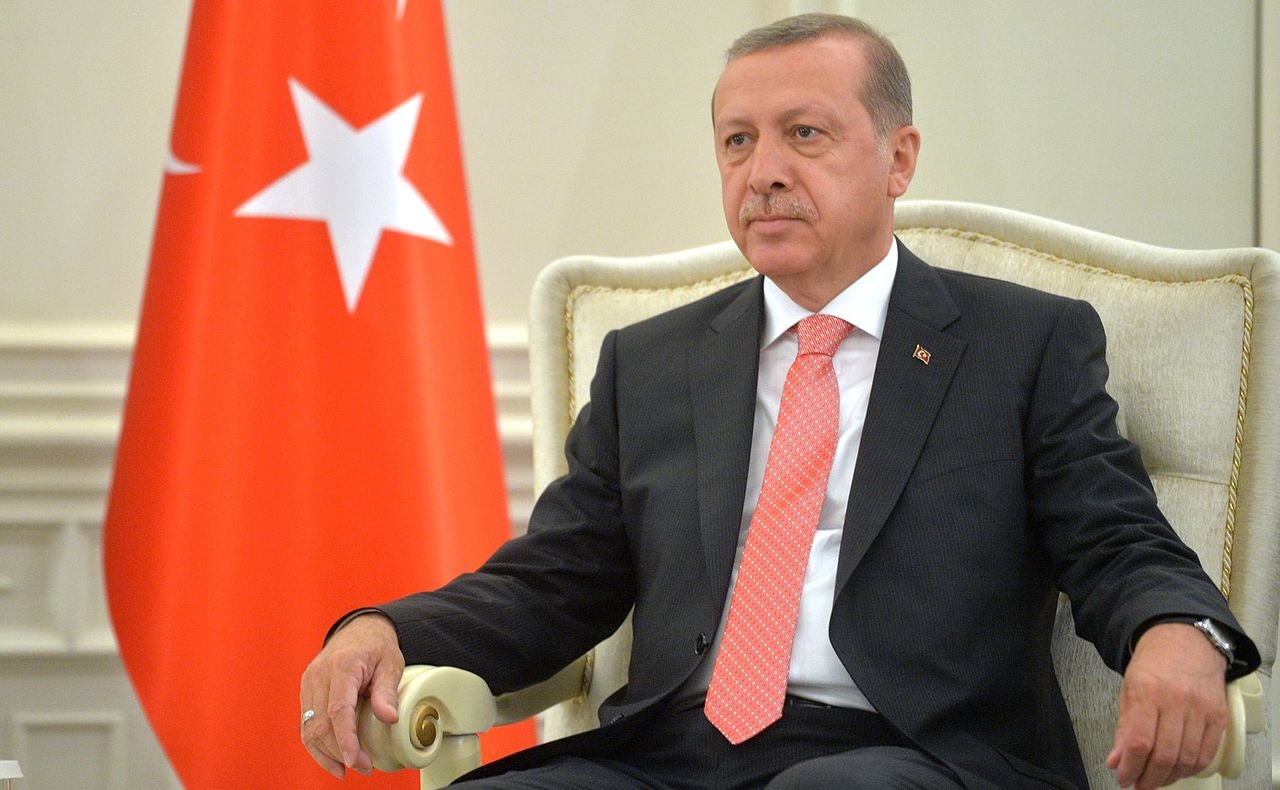
How can Turkey combat a threat from without , Daniel Pipes asked, when a member state such as Turkey poses the same threat from within? (Photo of President Erdogan: Wikimedia Commons).
Celik’s presence on the program went unopposed throughout the summer. A line-up of speakers was formally accepted by all parties. Then, one week before the event, NATO staff told MEF that Turkey had written letters to NATO’s Secretary General Jens Stoltenberg and Parliamentary Assembly President Paolo Alli, protesting Celik’s inclusion and demanding his withdrawal.

This meant that NATO, an institution founded to defend Western civilization against dictatorial regimes, was willing to serve as a pawn of Turkey’s dictator. Membership in NATO confers responsibility for mutual defense in the face of external aggression; it does not obligate the organization itself to obey rogue regimes that retain formal membership in the alliance despite their oppressive actions at home and abroad.

MEF president Daniel Pipes, in his keynote speech at the conference’s conclusion, argued that NATO’s primary task today is the defense of its members against the threat of Islamism, just as its founding mission had been a defense against communism. But Turkey’s descent into Islamist despotism seriously distorts the NATO alliance: how can Turkey combat a threat from without Daniel Pipes asked, when a member state poses the same threat from within?

Pipes told his largely European audience that when they leave the building in which they were meeting, they will see Independence Hall, the seat of American liberty where our founding documents were debated and adopted. Just down the street sits the Liberty Bell, the symbol of American freedom. MEF, said Pipes, is grateful that Americans are a free people. “No one tells us what we can say,” he emphasized; we are a free people, and we will act in complete freedom.

When MEF invited Celik, Pipes said, Ankara, 8,500 kilometers away, said no — and NATO dutifully fell into line by insisting that MEF cancel the conference rather than allow Celik to speak. MEF at the time felt it had no choice but to obey.

But then, Pipes continued, “we recalled Independence Hall and the Liberty Bell,” plus NATO’s mission, and accordingly “Mr. Celik is here and will address us.” “He will become an American citizen within days, for which we congratulate him.” And with that, Pipes asked the audience to welcome Celik to the podium.

As Celik approached it, the Turkish delegation leapt to its feet and rushed the stage, while shouting that Celik’s appearance was “unacceptable” and that “he cannot be on the stage” (video of this episode is here). While voices grew heated, Celik took a seat on stage alongside Pipes, while Michael Joping of the British House of Lords, and co-chair of the NATO PA delegation, took the microphone to object to Celik’s appearance. He convinced the Turks to remain through his own brief, impromptu talk about NATO’s future, at the end of which he attempted again to exclude Celik by ending the conference.

Pipes, however, was having none of this. He immediately joined Joping at the microphone and, unable to get the British gentleman to yield, pounded the podium and demanded that Celik be allowed to speak. Seeing himself outgunned (and outmanned), Joping exited the stage. “Thank you for having us,” he said. “Thank you for coming,” said Pipes as the two exchanged a curt handshake.

Free to speak, Celik warned that the under Erdogan’s “new regime of repression,” the “social mechanisms holding the nation together are falling apart.” The purging of 120,000 government employees following last year’s failed coup means that “more police counter-terrorism experts are in prison than ISIS members.” A democratic Turkey is a must for NATO, Celik said, both for the alliance’s success and for Turkey itself. At the end of his brief talk, he received a standing ovation.

Those who most needed to hear — and heed — Celik’s words regrettably missed their opportunity. When Celik he began to speak, the Turks — and the NATO bureaucrats who support them — marched out in lockstep, thereby allowing a distant despot to control their actions in the birthplace of liberty. NATO’s willingness to ignore the principles it was founded to defend reveals the moral corruption at its heart; but on this day, those principles proved resilient in the face of tyranny.

Winfield Myers is Director of Academic Affairs at the Middle East Forum.


Cartoon of the Day

September 21, 2017

H/t Powerline


It looks like Obama did spy on Trump, just as he apparently did to me

September 21, 2017

It looks like Obama did spy on Trump, just as he apparently did to me, The Hill, Sharyl Attkisson, September 20, 2017

Many in the media are diving deeply into minutiae in order to discredit any notion that President Trump might have been onto something in March when he fired off a series of tweets claiming President Obama had “tapped” “wires” in Trump Tower just before the election.

According to media reports this week, the FBI did indeed “wiretap” the former head of Trump’s campaign, Paul Manafort, both before and after Trump was elected. If Trump officials — or Trump himself — communicated with Manafort during the wiretaps, they would have been recorded, too.

But we’re missing the bigger story.

If these reports are accurate, it means U.S. intelligence agencies secretly surveilled at least a half dozen Trump associates. And those are just the ones we know about.

Besides Manafort, the officials include former Trump advisers Carter Page and Michael Flynn. Last week, we discovered multiple Trump “transition officials” were “incidentally” captured during government surveillance of a foreign official. We know this because former Obama adviser Susan Rice reportedly admitted “unmasking,” or asking to know the identities of, the officials. Spying on U.S. citizens is considered so sensitive, their names are supposed to be hidden or “masked,” even inside the government, to protect their privacy.

In May, former Director of National Intelligence James Clapper and former Acting Attorney General Sally Yates acknowledged they, too, reviewed communications of political figures, secretly collected under President Obama.

Trump: I was “wire tapped”
CNN: Haha. That idiot @realDonaldTrump thinks he was wiretapped.
..Six months later..
CNN: Trump was wiretapped

Weaponization of intel agencies?

Nobody wants our intel agencies to be used like the Stasi in East Germany; the secret police spying on its own citizens for political purposes. The prospect of our own NSA, CIA and FBI becoming politically weaponized has been shrouded by untruths, accusations and justifications.

You’ll recall DNI Clapper falsely assured Congress in 2013 that the NSA was not collecting “any type of data at all on millions or hundreds of millions of Americans.”

Intel agencies secretly monitored conversations of members of Congress while the Obama administration negotiated the Iran nuclear deal.

In 2014, the CIA got caught spying on Senate Intelligence Committee staffers, though CIA Director John Brennan had explicitly denied that.

There were also wiretaps on then-Congressman Dennis Kucinich (D-Ohio) in 2011 under Obama. The same happened under President George W. Bush to former Congresswoman Jane Harman (D-Calif.).

Journalists have been targeted, too. This internal email, exposed by WikiLeaks, should give everyone chills. It did me.

Dated Sept. 21, 2010, the “global intelligence” firm Stratfor wrote:

[John] Brennan [then an Obama Homeland Security adviser] is behind the witch hunts of investigative journalists learning information from inside the beltway sources.

Note — There is specific tasker from the WH to go after anyone printing materials negative to the Obama agenda (oh my.) Even the FBI is shocked. The Wonder Boys must be in meltdown mode…

The government subsequently got caught monitoring journalists at Fox News, The Associated Press, and, as I allege in a federal lawsuit, my computers while I worked as an investigative correspondent at CBS News. On Aug. 7, 2013, CBS News publicly announced:

… correspondent Sharyl Attkisson’s computer was hacked by ‘an unauthorized, external, unknown party on multiple occasions,’ confirming Attkisson’s previous revelation of the hacking.

Then, as now, instead of getting the bigger story, some in the news media and quasi-news media published false and misleading narratives pushed by government interests. They implied the computer intrusions were the stuff of vivid imagination, conveniently dismissed forensic evidence from three independent examinations that they didn’t review. All seemed happy enough to let news of the government’s alleged unlawful behavior fade away, rather than get to the bottom of it.

I have spent more than two years litigating against the Department of Justice for the computer intrusions. Forensics have revealed dates, times and methods of some of the illegal activities. The software used was proprietary to a federal intel agency. The intruders deployed a keystroke monitoring program, accessed the CBS News corporate computer system, listened in on my conversations by activating the computer’s microphone and used Skype to exfiltrate files.

We survived the government’s latest attempt to dismiss my lawsuit. There’s another hearing Friday. To date, the Trump Department of Justice — like the Obama Department of Justice — is fighting me in court and working to keep hidden the identities of those who accessed a government internet protocol address found in my computers.

Evidence continues to build. I recently filed new information unearthed through forensic exams. As one expert told the court, it was “not a mistake; it is not a random event; and it is not technically possible for these IP addresses to simply appear on her computer systems without activity by someone using them as part of the cyber-attack.”

Patterns

It’s difficult not to see patterns in the government’s behavior, unless you’re wearing blinders.

  • The intelligence community secretly expanded its authority in 2011 so it can monitor innocent U.S. citizens like you and me for doing nothing more than mentioning a target’s name a single time.
  • In January 2016, a top secret inspector general report found the NSA violated the very laws designed to prevent abuse.
  • In 2016, Obama officials searched through intelligence on U.S. citizens a record 30,000 times, up from 9,500 in 2013.
  • Two weeks before the election, at a secret hearing before the FISA court overseeing government surveillance, NSA officials confessed they’d violated privacy safeguards “with much greater frequency” than they’d admitted. The judge accused them of “institutional lack of candor” and said, “this is a very serious Fourth Amendment issue.”

Officials involved in the surveillance and unmasking of U.S. citizens have said their actions were legal and not politically motivated. And there are certainly legitimate areas of inquiry to be made by law enforcement and intelligence agencies. But look at the patterns. It seems that government monitoring of journalists, members of Congress and political enemies — under multiple administrations — has become more common than anyone would have imagined two decades ago. So has the unmasking of sensitive and highly protected names by political officials.

Those deflecting with minutiae are missing the point. To me, they sound like the ones who aren’t thinking.


Russia warns US it will strike back if militia attacks in Syria don’t end

September 21, 2017

Source: Russia warns US it will strike back if militia attacks in Syria don’t end — RT News

FILE PHOTO: A US-made military vehicle used by the Syrian Democratic Forces (SDF), an American-backed Kurdish-Arab alliance, drives through an eastern area of the embattled Syrian city of Raqa © Delil Souleiman / AFP

Moscow has warned the US that if militias it supports in northeast Syria again attack positions of pro-government forces backed by Russia, the Russian military will use all its force to retaliate.

However, the liberation of Deir ez-Zor also triggered a confrontation between Syrian government forces and the US-backed SDF militants, the point of contention being control of Deir ez-Zor’s oil fields.

Following Damascus’s strategic victory, food, medicine and other essentials started to reach the city by convoy, where previously the inhabitants had to rely on air-drops.

READ MORE: US security services behind Al Nusra offensive in Syria’s Idlib – Russian MoD

The escalation of tension in eastern Syria is mirrored in the western Idlib governorate, where militant forces this week attacked Syrian positions in a designated de-escalation zone. The offensive threatened a unit of Russian military police, who were stationed in the area to monitor the ceasefire. Russia mounted an emergency rescue operation on Wednesday, in which three Russian special operations troops were injured. The Russian Defense Ministry claimed that the militants’ offensive had been instigated by US special services.

Konashenkov said Moscow suspected the SDF of colluding with the terrorist group Islamic State (IS, also known as ISIS/ISIL) in Deir ez-Zor rather than fighting it, as it claims to be. He said Russia had detected the transfer of SDF fighters from the IS stronghold of Raqqa, to join forces with the jihadists.

“SDF militants work to the same objectives as IS terrorists. Russian drones and intelligence have not recorded any confrontations between IS and the ‘third force,’ the SDF,” the Russian general said.

READ MORE: Syrian troops cross Euphrates as they advance east of Deir ez-Zor (VIDEO)

The statement said that the siege of Raqqa by the SDF has been halted, apparently in response to the latest advances by Syrian government forces in Deir ez-Zor, which is located to the east from Raqqa along the Euphrates River.

“The central parts of the former ISIL capital, which account for roughly 25 percent of the city, remain under full control of the terrorists,” Konashenkov remarked.

According to the statement, in the last 24 hours Syrian government troops “continued their offensive operation” to destroy the last “IS bridgehead” near the city of Deir ez-Zor, the provincial capital. Troops led by Syrian Army General Suheil al-Hassan liberated around 16 sq km of territory and two settlements on the western bank of the Euphrates River.

“More than 85 percent of Deir ez-Zor’s territory is under the full control of Syrian troops. Over the next week the city will be liberated completely,” Konashenkov said.

The city of Deir ez-Zor in eastern Syria was besieged by Islamic State in 2014. Syrian government forces lifted the blockade of the city in early September.

However, the liberation of Deir ez-Zor also triggered a confrontation between Syrian government forces and the US-backed SDF militants, the point of contention being control of Deir ez-Zor’s oil fields.

Following Damascus’s strategic victory, food, medicine and other essentials started to reach the city by convoy, where previously the inhabitants had to rely on air-drops.

READ MORE: US security services behind Al Nusra offensive in Syria’s Idlib – Russian MoD

The escalation of tension in eastern Syria is mirrored in the western Idlib governorate, where militant forces this week attacked Syrian positions in a designated de-escalation zone. The offensive threatened a unit of Russian military police, who were stationed in the area to monitor the ceasefire. Russia mounted an emergency rescue operation on Wednesday, in which three Russian special operations troops were injured. The Russian Defense Ministry claimed that the militants’ offensive had been instigated by US special services.

Moscow: US-backed SDF faces “destruction.” Pro-Iranian Iraqi force crosses into Syria

September 21, 2017

Moscow: US-backed SDF faces “destruction.” Pro-Iranian Iraqi force crosses into Syria, DEBKAfile, September 21, 2017

Israel’s strategic situation took several steps back in the first week of the New Year, chiefly: The US pulled back from E. Syria under Russian threat, allowing Iran to move in.

In just one week, the dire perils, which many military and political experts warned against for years, are suddenly looming on Israel’s northern border.

        1. From Sept.15-17, Syrian and Hizballah forces crossed the Euphrates to the eastern bank on pontoon bridges provided by Russia.
        2. Last Saturday, Sept. 16, Russian jets bombed the US-backed Syrian Defense Forces (SDF) in the Deir ez-Zour region, as a warning against their obstructing the eastward impetus of those Syrian and Hizballah units.
        3. On Monday, Sept. 18, US Marines began blowing up buildings at the Zaqaf military base in eastern Syria and then retreating to the Jordanian border. The US set up Zaqaf early this year in the Syrian Desert as a barrier against this very Syrian/Hizballah crossing to impede their advance to the Syrian-Iraqi border.
        4. The following day, on the heels of the US withdrawal, Hizballah troops took charge of the Zaqaf base.
        5. On Wednesday, Sept. 19, the Iraqi Hashd Al-Sha’abi (Popular Mobilization Units – PMU) crossed into Syria and linked up with the Syrian-Hizballah force. The PMU is under the direct command of Gen. Qassam Soleimani, head of Iranian military operations in Syria and Iraq.
        6. Iran, through its Iraqi, Lebanese and other foreign Shiite pawns, is now in control of 230km of the Syrian border, from Abu Kamal (still held by ISIS) in the north, to Al Tanf in the Syrian-Iraqi-Jordanian border triangle in the south – where, too, US and coalition special forces have begun packing up ready to exit.
          Iran in recent years imported some 20,000 Afghan and Pakistani Shiite fighters to reinforce the Syrian army and Hizballah in their battles for Bashar Assad. The new Iraq arrivals boost that figure by tens of thousands and more are coming in all the time.
        7. On Thursday, Sept. 21, the growing disconnect between Moscow and Washington over Syria suddenly erupted into an open breach with a crude threat from the Kremlin: “Russia has officially informed the United States via a special communications channel that Russian forces will strike immediately US-backed forces if they attack or shell Syrian or Russian task forces operating near the Deir Ez-Zour city. Any attempts at shelling from the areas where the militants of the Syrian Democratic Forces are based will be immediately curbed. Russian forces will suppress firing points in these areas using all means of destruction.”

      A threat of this degree of ruthlessness has not been encountered in the Middle East for decades, it may recall Moscow’s threat to Israel in 1956 to end its invasion of the Sinai without delay or else…

      Where do these menacing steps leave Israel?

        • The US has washed its hands of central and southeastern Syria.
        • Russia is wholly, unreservedly and openly in lockstep with the Syrian army, Iran and Hizballah in all their objectives in the war-torn country, and moreover, willing to threaten any pro-American entity with total military punishment. Is this an indirect message to Israel too?
          Iraqi Shiite forces are surging into Syria; they have given Tehran the gift of control of a 230km segment of the border.

      And what does the IDF chief of staff, Lt. Gen. Gady Eisenkott have to say about all this?  In an interview to Israeli media as recently as Wednesday, Sept. 19, when it was all happening, he said: “If Iran  does entrench itself in Syria, that will be bad news for the entire region, including the moderate Sunni camp, and even more for the countries of Europe.”

He went on to explain: “That is why we have given the Iranian threat and halting its expanding influence very high priority as an issue to be dealt with.”

Gen. Eisenkott underlined the IDF’s focus as being to prevent [Israel’s foes] from obtaining weaponry, i.e. missiles – of high targeting precision.

The trouble is that, while the IDF focuses on this objective, commendable in itself, Russia and Iran are focusing and in full flight on a far wider-ranging goal, the precise and systematic deepening of Iran’s military presence in Syria. Iran and Hizballah have already established military commands at Arnaba just 6 km from Israel’s Golan border.

Yet the IDF chief is still talking about this as an untoward event that may – or may not – come some time in the future.

Beijing Adopts New Tactic for S. China Sea Claims

September 21, 2017

Beijing Adopts New Tactic for S. China Sea Claims, Washington Free Beacon, September 21, 2017

All the islands are claimed by other states in the region, including Vietnam and the Philippines, as well as by China.

The United States does not recognize China’s control over the island groups and insists the sea, which sees an annual transit of an estimated $3.37 trillion in trade, is international.

The Pentagon and State Department have said the South China Sea is international waters and that American vessels and aircraft will transit the area unimpeded by Chinese claims of control.

*******************************

The Chinese government recently unveiled a new legal tactic to promote Beijing’s aggressive claim to own most of the strategic South China Sea.

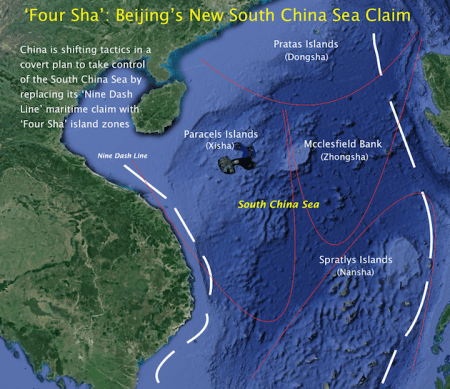
The new narrative that critics are calling “lawfare,” or legal warfare, involves a shift from China’s so-called “9-Dash Line” ownership covering most of the sea.

The new lawfare narrative is called the “Four Sha”—Chinese for sand—and was revealed by Ma Xinmin, deputy director general in the Foreign Ministry’s department of treaty and law, during a closed-door meeting with State Department officials last month.

China has claimed three of the island chains in the past and recently added a fourth zone in the northern part of the sea called the Pratas Islands near Hong Kong.

The other locations are the disputed Paracels in the northwestern part and the Spratlys in the southern sea. The fourth island group is located in the central zone and includes Macclesfield Bank, a series of underwater reefs and shoals.

China calls the island groups Dongsha, Xisha, Nansha, and Zhongsha, respectively.

Ma, the Foreign Ministry official, announced during the meetings in Boston on Aug. 28 and 29 that China is asserting sovereignty over the Four Sha through several legal claims. He stated the area is China’s historical territorial waters and also part of China’s 200-mile Exclusive Economic Zone that defines adjacent zones as sovereign territory. Beijing also claims ownership by asserting the Four Sha are part of China’s extended continental shelf.

U.S. officials attending the session expressed surprise at the new Chinese ploy to seek control over the sea as something not discussed before.

State Department spokesman Justin Higgins said the department does not comment on diplomatic discussions.

The United States, he said, has a longstanding global policy of not adopting positions on competing sovereignty claims over land features in the South China Sea.

“The United States does take principled positions, and has been clear and consistent, that maritime claims by all countries in the South China Sea and around the world must be made and pursued in accordance with the international law of the sea as reflected in the 1982 Law of the Sea Convention,” Higgins said.

All the islands are claimed by other states in the region, including Vietnam and the Philippines, as well as by China.

The United States does not recognize China’s control over the island groups and insists the sea, which sees an annual transit of an estimated $3.37 trillion in trade, is international.

The Pentagon and State Department have said the South China Sea is international waters and that American vessels and aircraft will transit the area unimpeded by Chinese claims of control.

The State Department in December formally protested China’s unlawful maritime claims in a diplomatic note.

The Trump administration’s recent focus on pressuring North Korea to denuclearize has given China a green light to step up its South China Sea control efforts.

Chinese coast guard and navy vessels successfully blocked the Philippines from repairing a runway on one of the Spratly islands, and in July China pressured Vietnam into halting natural gas drilling in the Paracels.

The Chinese Four Sha legal maneuver follows the Permanent Court of Arbitration ruling in July 2016 that legally nullified China’s claim to historically own all waters and territory within the Nine-Dash Line.

The international tribunal ruled in favor of the Philippines government, which disputed the Chinese claim to the Spratlys.

The tribunal noted “there was no evidence that China had historically exercised exclusive control over the waters or their resources,” according to a statement by the court last year.

China has rejected the international ruling, which has the force of international law.

Michael Pillsbury, senior fellow at the Hudson Institute and director of the Center for Chinese Strategy, said the latest maritime maneuver by the Chinese is lawfare—one of China’s three information warfare tools. The two others are media warfare and psychological warfare.

Pillsbury noted that the U.S. government lacks both legal warfare and counter legal warfare capabilities.

“The Chinese government seems to be better organized to design and implement clever legal tactics to defy international norms with impunity,” Pillsbury said.

“It may ultimately require congressional legislation to mandate our executive branch to build a better capacity to counter the Chinese use of lawfare,” he added. “If we had such a unit, it would be easy to counter China, especially when we have the United Nations on our side.”

Retired Navy Capt. Jim Fanell, a former Pacific Fleet intelligence chief, said if confirmed the Four Sha program appears to be “Beijing’s next logical step in their ‘salami slicing,’ asserting the PRC’s claims to the South China Sea.”

“Given that an announcement of claims to the entirety of the Nine-Dash Line raised alarms throughout the region, it makes sense for the PRC Foreign Ministry to float this notion of an incremental step forward with the concept of the Four Sha approach to the eventual restoration of the entirety of the South China Sea.”

Fanell said the Trump administration should first remind Beijing and the rest of the world about the 2016 Permanent Court of Arbitration ruling that found China’s sovereignty claims to the sea both illegal and illegitimate.

“Second, the U.S. would do well to permanently deploy a carrier or expeditionary strike group to the South China Sea in order to make sure Beijing knows that our words are backed up by more than mere words,” he said.

The United States has been pushing back against China’s maritime claims in the sea by conducting Navy warship freedom of navigation operations around the disputed islands.

The naval operations were stalled during the Obama administration in a bid to avoid upsetting China. Under President Trump and Defense Secretary Jim Mattis, warship freedom of navigation operations have resumed with regularity but without formal public acknowledgement of the operations.

In August, the destroyer USS John S. McCain sailed with 12 miles of Mischief Reef in the Spratlys, drawing criticism from China.

China denounced the warship passage as a provocation and violation of Chinese sovereignty.

China over the past several years has reclaimed some 3,200 acres of islands in the sea and in recent months began militarizing the islands with missile emplacements and other military facilities.

China also created a new governing unit over the sea called the Sansha administration in 2012. Sansha, or Three Sha, includes the Paracels, Macclesfield Bank, and the Spratlys and covered a total of 20 square kilometers of land, more than 2 million square kilometers of water, and a population of around 2,500 people.

A State Department notice at the end of what was billed as an annual U.S.-China Dialogue on the Law of the Sea and Polar Issues made no mention of the new Chinese lawfare tactic.

The statement said only that officials from foreign affairs and maritime agencies “exchanged views on a wide range of issues related to oceans, the law of the sea, and the polar regions.”

The U.S. delegation was led by Evan Bloom, State Department director for ocean and polar affairs in the Bureau of Oceans and International Environmental and Scientific Affairs.

Bloom declined to comment on the talks.

Tillerson, Haley Clash Over Iran Nuclear Deal

September 21, 2017

Tillerson, Haley Clash Over Iran Nuclear Deal, Washinton Free Beacon , September 20, 2017

Secretary of State Rex Tillerson and Ambassador to the UN Nikki Haley / Getty Images

In a sign of the ongoing internal dissent over ending the landmark nuclear agreement with Iran, multiple sources told the Washington Free Beacon that Secretary of State Rex Tillerson and United Nations Ambassador Nikki Haley have been at odds over the deal, with Trump’s U.N. ambassador privately expressing dismay with Tillerson over his continued efforts to preserve the nuclear agreement.

Tillerson and Haley held a private powwow Wednesday with international leaders regarding the future of the nuclear deal, a sign of Haley’s vital role in the Trump administration’s key foreign policy issue.

The meeting is likely to underscore mounting tensions between Haley and Tillerson on the issue, according to multiple sources with knowledge of the situation, who told the Free Beacon that Haley views Tillerson’s efforts to preserve the deal as anathema to Trump’s own policy agenda.

The division is one of several that Tillerson has sparked within the administration, particularly in the West Wing, where the secretary of state has been described as in “open war” with Trump on a series of major foreign policy issues, including Iran and the Israel-Palestinian impasse.

“The tension between Rex and Nikki is the worst kept secret in the State Department,” according to one veteran foreign policy hand who has been in close contact with the State Department on the issue.

Haley “thinks that [Tillerson is] trying to undermine the president and preserve Obama’s Iran legacy, which is true,” explained the source, who would only discuss the sensitive matter on background. “He thinks she’s running her own foreign policy and auditioning for his job, which is also true.”

These tensions have “spilled into the open” several times “over the last few weeks,” but were quickly dispelled in order to promote a public face of unity within the Trump administration, according to the source and others who spoke to the Free Beacon.

“It will keep happening as long as the secretary keeps working to force Trump to certify while the ambassador keeps working to promote what Trump says he wants,” the source said.

Asked about the Wednesday joint meeting and report of divisions between Haley and Tillerson, a State Department official denied the divisions and said both senior administration officials are working together.

“We are not going to get ahead of any meetings and we are not going to discuss internal U.S. government discussions,” a State Department official, speaking only on background, told the Free Beacon in response to questions about reported tensions. “The secretary and Ambassador Haley work in close cooperation to address the most pressing national security challenges.”

Another veteran Republican foreign policy adviser who has advised multiple U.S. officials on the Iran portfolio confirmed the internal divisions between Tillerson and other senior administration officials such as Haley, telling the Free Beacon the secretary of state remains a chief voice pushing for the Iran agreement to remain in place.

“Tillerson is buying what the Europeans are selling and he’s really pushing the president to recertify,” said the source, who also requested anonymity to discuss internal conversations. “The Republicans on Capitol Hill don’t want this to fall into their lap so they’re backing Tillerson for now. Haley is doing what she can to fight for what’s right, but it might not matter if [Secretary of Defense] Mattis backs up Tillerson.”

“President Trump’s going to be totally humiliated by the Iranians if he falls for something this stupid,” the source said.

These tensions over the Iran deal have also been making waves on Capitol Hill, where opponents of the deal view Haley as one of their chief allies.

“Haley clearly understands that the status quo is unsustainable,” said one senior congressional official involved in the matter. “She recognizes that the nuclear deal has been a complete disaster for the United States and our allies.”

“Meanwhile, Tillerson continues to pursue his own agenda at State with little regard for the president’s priorities,” the official said. “It’s good to see Haley stand firm as the voice of reason, and urge Tillerson and other Iran sympathizers to end their rogue behavior.”

Haley and Tillerson are expected to raise the issue of renegotiating the Iran deal with international allies, a proposal that is not likely to gain much traction.

The Europeans have already reengaged in business with Iran and view attempts to re-litigate the accord as damaging to their financial interests.

Richard Goldberg, a longtime foreign policy strategist who was one of the chief architects of Iran sanctions during his time as a senior congressional adviser, told the Free Beacon the Europeans cannot be trusted to crack down on Iran’s increasingly belligerent activities, such as ballistic missile tests.

“The president would be foolish to recertify Iran on Europe’s empty promise of “fixing” the deal,” said Goldberg, the author of a recent memo outlining for the Trump administration how it can remove the U.S. from the nuclear deal. “Unless European leaders credibly believe President Trump might reimpose sanctions at any moment, they will say nice things in meetings and do absolutely nothing to ‘fix’ a fundamentally bad deal they already accepted.”

Given this scenario, Trump’s best move it to designate Iran as in violation of the deal in the coming weeks, Goldberg said, explaining that European government’s would have no choice but to comply with any new U.S. sanctions on Tehran.

“The president has no other option than to decertify and hold the re-imposition of sanctions over both Europe and Iran as a financial Sword of Damocles until we see behavioral change by the regime,” he said.

European promises to help crack down on Iran are being viewed as hollow in light of an upcoming international gathering next month between the European Union and Iran that is aimed at boosting commercial trade.